







Abstract
Enhancing in-vehicle experiences can improve driver well-being by balancing vigilance and emotional regulation, and result in better driving performance. This study investigates the effects of multi-sensory stimulation, including light, music, scent, temperature, and vibration, on driver vigilance and mood in a simulated driving environment. Twenty-six participants viewed a monotonous nighttime driving video inside a stationary vehicle, while physiological (heart rate and heart rate variability) and subjective data (alertness and mood) were collected across five time segments: baseline, early and late stimulation, and early and late post-stimulation. During stimulation, participants reported higher alertness and mood, accompanied by decreased heart rate and increased heart rate variability, indicating a state of relaxed alertness. After stimulus removal, both subjective and physiological measures returned to baseline, suggesting a temporary effect. These findings demonstrate that multisensory interventions can enhance driver well-being without causing cognitive overload. Future work should explore long-term, personalized inputs for driver engagement.
Keywords
Introduction
Enhancing in-vehicle experiences can improve driver well-being by balancing vigilance and emotional regulation. In driving, vigilance ensures responsiveness and situational awareness (Williamson et al., 1996), while positive emotions reduce stress and fatigue, supporting good decision-making. Optimizing both is essential for safe and effective driving. Previous studies have tended to test single-modality interventions such as auditory alerts or seat vibrations, but each modality on its own has shown limited effects on vigilance or emotional regulation or failed to sustain them over time (Al-Shargie et al., 2019). These limitations highlighted the need to explore alternatives, such as a combination of multisensory stimuli, that might better support drivers by leveraging the complementary strengths of different sensory modalities.
The current study investigates the temporal effects of coordinated multisensory stimuli, including light, music, scent, temperature, and vibration, on driver experience, specifically vigilance and mood. Additionally, this study examines whether these effects persist after stimuli removal and the extent to which they align with indicators of vigilance and mood regulation. By integrating both subjective and physiological measures, this research provides a more comprehensive understanding of the role of multisensory interventions in promoting driver well-being.
Background
Driving requires constant attention, but prolonged driving can reduce vigilance, increasing accident risk (McCormick et al., 2015). Previous research has demonstrated that passive sensory stimuli (i.e., those that do not require active user involvement) can enhance drivers’ engagement. For example, blue light exposure and specific odors improve alertness over time (Phipps-Nelson et al., 2009). Additionally, other sensory inputs, including certain types of music or nature-inspired audio (Jeon, 2012), olfactory (Lim et al., 2023), temperature modulation (e.g., cooling for alertness, warmth for relaxation; Wang et al., 2023), and tactile vibrations (Howard et al., 2013), help mitigate fatigue and sustain alertness.
Beyond vigilance, a driver’s emotional state is also a critical factor in driving and, thus, the design of vehicle cabins. While adding sensory stimuli has been shown to boost vigilance, some stimuli may lead to cognitive overload or unpleasant feelings (Sammler et al., 2007). Thus, the challenge is to design sensory interventions that balance driver vigilance and mood. A multisensory experience holds the potential to enhance attentional focus and regulate mood. To test this hypothesis, a multisensory experience that coordinated five stimuli was explored in this study: blue lighting, high-energy music, pleasant scent, cool airflow, and seat vibration.
Methods
Twenty-six participants (17 male and 9 female) were included in the analysis. Throughout the study, participants were seated in a stationary 2021 Lincoln Navigator and continuously watched a monotonous nighttime driving video without actual control over the vehicle. The experiment began with a 15-min baseline period, followed by an 8-min multisensory experience. Based on internal pilot studies, the experience included ambient blue light (along the top and side inner edges of the windshield), pre-selected high-energy chorus played through the vehicle speakers, a “Violet Cashmere” scent, cool airflow from the air conditioning directed toward the driver’s face and hand, and seat vibration applied to both seatback and seat pan. After the stimulation ended, participants continued watching the video for 12 minutes.
To assess subjective alertness and mood, participants orally provided their state in four surveys at four time points (Figure 1) using 9-point Likert scales. Alertness was rated from 1 (not at all alert) to 9 (extremely alert), and mood from 1 (extremely negative) to 9 (extremely positive). A Polar H10 sensor was used to record participants’ heart rate (HR) and heart rate variability (HRV). Heart rate data were segmented into five time windows (Figure 1): pre-stimulation (BASE), early stimulation (STIM), late stimulation (ENDSTIM), early post-stimulation (DECAY), and late post-stimulation (END). A 1-min window was extracted from two possible periods: (1) 90 to 30 s prior to the start of the survey, or (2) 30 to 90 s after the survey ended.
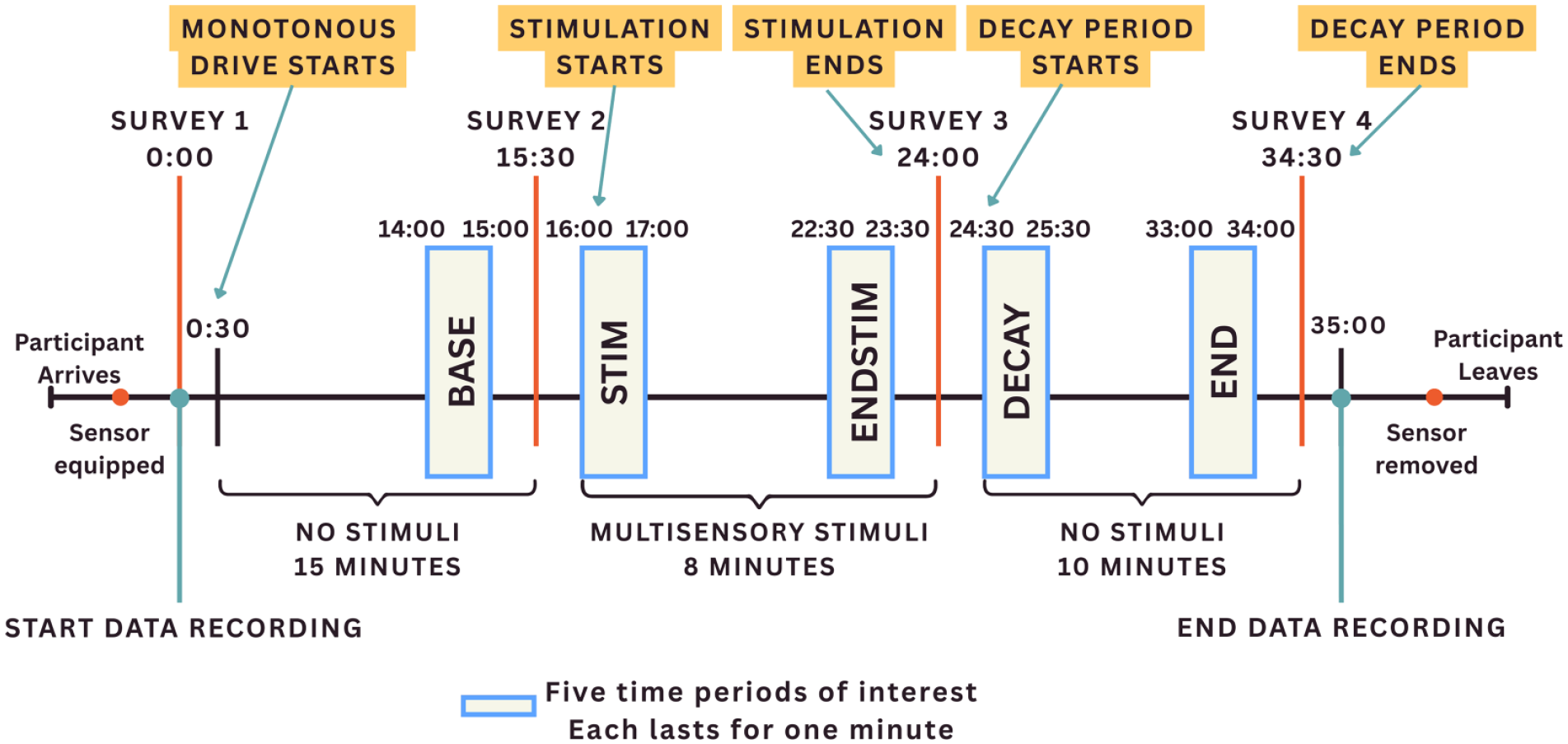
Experiment timeline.
Mixed-effects models were employed in R (Version 4.4.1) with participant ID as a random effect and time periods as fixed effects to analyze both subjective and objective data. The analysis compared physiological measures, including HR (Mean HR (beats/min)) and HRV (i.e., Mean RR (ms) and RMSSD (ms)) across five time of interest. Subjective measures, including alertness and mood, were analyzed across four survey time points. Statistical significance was set at p < .05. Post-hoc pairwise comparisons were performed using Least Squares Means (LSMeans) with Tukey’s Honest Significant Difference (HSD) test.
Results
Mixed effects models showed significant changes in both subjective and objective data over time. The model indicated self-reported alertness and mood were significantly higher in Survey 1 and Survey 3 compared to Survey 2. Post hoc analysis revealed significantly higher alertness and mood in Survey 3 compared to Survey 4. Significant differences in Mean RR, Mean HR, and RMSSD were found over time. The mixed effects model showed that compared to the BASE, STIM and ENDSTIM had a significantly lower mean HR and significantly higher Mean RR and RMSSD. Moreover, compared to BASE, DECAY had significantly lower Mean HR and higher RMSSD. According to post hoc analysis, END had a significantly higher Mean HR and lower Mean RR and RMSSD compared to ENDSTIM.
Discussion and Conclusion
Self-reported alertness and mood have been significantly increased after exposure to the stimuli. However, while traditional research often associates a decrease in HR and an increase in HRV with reduced vigilance (Mehrabi & Kim, 2022), our findings present an interesting contrast.
Our results indicated that HR decreased and HRV increased throughout the stimulation, despite increased self-reported alertness. One possible explanation for this observation is that, rather than indicating a decline in vigilance, the reduction of HR and increase of HRV may reflect a more efficient attentional state. In cognitively demanding tasks, a lower HR and higher HRV can indicate greater autonomic flexibility, which enables cognitive control without inducing excessive physiological strain (Thayer & Brosschot, 2005). Sensory stimuli effectively engaged participants’ sensory resources, thus reducing distractions and enhancing attentional control (Yadon & Daugherty, 2019). Sensory gating theory also suggests that when the brain receives relevant sensory input, it suppresses irrelevant distractions, thereby improving focus (Eimer, 1994). These findings suggest that HR reduction and HRV increases may not signify a loss of vigilance, but rather an optimized attentional state where individuals sustain vigilance with minimal physiological cost. These effects do not, however, seem to persist after stimuli removal, as HR, HRV, self-reported vigilance, and mood all returned to baseline.
One limitation of the study is that it examined the coordinated experience without isolating the individual effects of each sensory stimulus. Second, while heart rate was used for its stability, future research should incorporate additional methods, such as eye-tracking and EEG, to better understand underlying mechanisms. Further studies should also examine other factors, such as stimulus duration and intensity, that affect the driving experience.
In summary, in the long term, our findings could help to inform adaptive in-vehicle systems that dynamically adjust stimuli based on driver state, particularly in autonomous vehicles where engagement is lower.
Footnotes
Declaration of Conflicting Interests
The author(s) declared no potential conflicts of interest with respect to the research, authorship, and/or publication of this article.
Funding
The author(s) disclosed receipt of the following financial support for the research, authorship, and/or publication of this article: This research study was supported, in part, by the Ford Motor Company.
