







Abstract
Technology-facilitated sexual violence (TFSV) includes different forms of digital violence, such as online gender-based violence, online gender- and sexuality-based violence, digital sexual harassment, online sexual coercion, and nonconsensual pornography. The aim of this study was to design and validate a measure to assess the perpetration and victimization of each dimension of TFSV. The relationships between the different dimensions and differences by gender and sexual orientation were also analyzed. The participants were a sample of 2,486 adults (69% women) from Spain, aged between 16 and 79 (M = 25.95; DT = 9.809) years. The Technology-Facilitated Sexual Violence Scales were found to be valid and reliable instruments, supporting our recommendation for the use of these scales. Network analysis and solution-based exploratory factor analyses showed that the dimensions of online sexual coercion and nonconsensual pornography clustered together. All the perpetration variables were related to sexism. Finally, cis women and nonheterosexual people reported higher victimization scores overall compared to cis men and heterosexuals, respectively, while cis men reported higher perpetration scores overall than cis women.
Keywords
The study of different forms of digital violence has progressed considerably in recent decades (e.g., Poland, 2016; Powell & Henry, 2017; Yar & Steinmetz, 2019). Consequently, there has been an advance in the understanding of many digital issues, especially those affecting the young population (Henry & Powell, 2018; Pashang et al., 2018), such as cyberbullying (e.g., Chan et al., 2021; Ng et al., 2022; Sun et al., 2016) and online grooming (e.g., De Santisteban et al., 2018; Gámez-Guadix, Mateos-Pérez, et al., 2023; Ringenberg et al., 2022). However, research on online sexual and gendered violence has progressed more slowly due to the lack of consensus on the conceptualization of the phenomenon (Patel & Roesch, 2022). Differences in the definitions and instruments used across studies have made it difficult to compare results and establish clear relationships between this problem and other psychological constructs (Henry & Powell, 2018; Patel & Roesch, 2022). Nevertheless, in recent years, the term technology-facilitated sexual violence (TFSV) has emerged to aid in the conceptualization of the phenomenon by encompassing a series of behaviors that are committed through technology to enable sexual and gender-based harassment and victimization (Henry & Powell, 2015, 2018; Powell & Henry, 2019). Hence, TFSV extends beyond violence of a physical and sexual nature and includes emotionally harmful acts targeted at intentionally constructed “sexed” and “gendered” subjects (Powell & Henry, 2019).
TFSV Dimensions
TFSV is an umbrella term that typically includes online gender-based violence, online gender- and sexuality-based violence, digital sexual harassment, online sexual coercion, and image-based sexual abuse (or nonconsensual pornography; Powell & Henry, 2019). Although these dimensions are not strictly delineated and occasionally intersect (e.g., in cases of image-based sexual abuse and sexual coercion), they present distinct characteristics that allow for their definition and an assessment of their prevalence within broader society. In the following subsections, a detailed description of each subsection is provided, elucidating the ways in which these constructs overlap.
Online gender-based violence refers to any behavior in which technology is used to harm people based on their gender (Barak, 2005; Powell & Henry, 2019). This is a form of violence for which the majority of perpetrators are men (Gámez-Guadix, Sorrel, & Martínez-Bacaicoa, 2023; Martínez-Bacaicoa et al., 2023) and the majority of victims are women (Donoso-Vázquez et al., 2017, 2018; Varela et al., 2021). Therefore, while we recognize that gender is a very broad construct, in this article we focus on the online gender-based violence suffered by women because they are assigned an inferior position in the binary gender system (Heise et al., 2019).
Online gender-based violence is one of the least explored dimensions of TFSV (Henry & Powell, 2018). Nevertheless, it is a very broad term because experiences of digital violence related to being a woman can be highly diverse. For example, Megarry (2014) analyzed the testimonies of women who recounted their experiences as victims of digital violence perpetrated by men on Twitter, finding that a large portion of these experiences were related to criticism and insults to the women’s physical appearances. More recently, a similar study conducted by Felmlee et al. (2020) found that comments about physical appearance were a very common form of violence against women. In addition, Megarry (2014) found that many women’s victimization experiences occurred when their behavior deviated from expected feminine norms. Women who perform traditionally masculine activities (e.g., sports players and video gamers) are often subject to these forms of violence (Kavanagh et al., 2019; Kuss et al., 2022; McCarthy, 2022). In connection with the transgression of gender roles and normative beauty standards, there is also evidence that people who defend anti-patriarchal positions and identify themselves as feminists are likely to suffer from digital violence (Castaño-Pulgarín et al., 2021; Martínez-Bacaicoa et al., in press).
Online gender- and sexuality-based violence refers to any behavior committed through technology to harm someone for having a nonnormative sexuality or a nonnormative gender identity (Henry & Powell, 2018; Powell, Scott, & Henry, 2020). By “nonnormative,” we mean identities that do not conform to the prescriptions of the binary gender system, either because an individual identifies with a gender other than the one assigned at birth or because they do not conform to the heterosexuality imposed by that gender system. Thus, in this study, online gender-based violence evaluates violence motivated by the inequalities inherent in the binary gender system (i.e., where being a man and what is considered “masculine” is viewed as superior to being woman and what is considered “feminine”), while online gender- and sexuality-based violence evaluates violence motivated by the victim not conforming to the prescriptions of that system.
Lesbian, gay, bisexual, and trans (LGBT) people are, therefore, the main victims of online gender- and sexuality-based violence (Gámez-Guadix & Incera, 2021). In light of this, online gender- and sexuality-based violence encompasses two types of violence: online sexual orientation–based violence and online gender identity–based violence. Online sexual orientation–based violence refers to any kind of violence committed through technology and motivated by the victim’s actual or perceived sexual orientation (Nagoshi et al., 2019; Powell et al., 2019). Nonheterosexual people are the main victims of this form of violence, with bisexual people being the most victimized, according to the limited existing research (Powell, Scott, & Henry, 2020). In terms of gender, some studies have indicated that men are both the primary perpetrators and the primary victims of violence related to online sexual orientation–based violence (Pachankis et al., 2020; Powell, Scott, & Henry, 2020). Online gender identity–based violence, also called online transphobia-based violence, refers to any unwanted or harmful behavior carried out against trans people with the aid of technology (Klemmer et al., 2021; Nagoshi et al., 2019). Existing research suggests that trans people are more likely to experience violence than the rest of the LGBT community (Powell, Scott, & Henry, 2020). To the best of our knowledge, no studies have reported on gender differences in the case of gender identity–based violence, so studies are needed to expand the existing information on this form of cruelty.
Digital sexual harassment (also known as unwanted sexual attention) refers to a range of unwanted sexual behaviors conducted through the use of technology that make people feel uncomfortable (Barak, 2005; Powell & Henry, 2019). Digital sexual harassment can be verbal in nature, including intimate questions about the victim’s life and unwanted comments or propositions of a sexual nature, or graphic in nature, including the sending of explicitly sexual photos or sexual material (Barak, 2005). Although men can also be victims of this form of violence, the existing literature reflects that men are the main perpetrators and that women are victims to a greater extent (Campbell et al., 2021; Döring & Mohseni, 2020). In fact, the data reflect that, along with the forms of online gender-based violence mentioned above, digital sexual harassment is one of the main forms of online violence suffered by women (Donoso-Vázquez et al., 2017, 2018; Varela et al., 2021).
Online sexual coercion involves exerting pressure on someone with the objective of obtaining some type of sexual cooperation (Barak, 2005). This pressure usually involves the use of intimate and personal information to blackmail and pressure the victim to achieve sexual aims (Barak, 2005; Powell & Henry, 2019). When this personal information is graphic and sexual in nature, it is referred to as sextortion (Patchin & Hinduja, 2020; Wolak et al., 2018).
Image-based sexual abuse (also known as nonconsensual pornography or “revenge porn”) refers to the creation, distribution, or publication of content of a sexual nature without the victim’s consent (Citron & Franks, 2014; Powell & Henry, 2019). This content may initially be sent voluntarily by the victim and then subsequently distributed by the offender without consent (Wolak et al., 2018) or obtained by the perpetrator through threats. Thus, sextortion has been studied not only as a form of online sexual coercion (e.g., Champion et al., 2022) but also as a form of image-based sexual abuse (e.g., McGlynn et al., 2017, 2019; O’Malley & Holt, 2022). In fact, Powell and Henry’s latest work (e.g., Henry et al., 2019, 2020; Powell et al., 2019; Powell, Scott, Flynn, & Henry, 2020) incorporates threats of distribution (sextortion) as part of the image-based sexual abuse dimension. Thus, this article employs the term nonconsensual pornography when referring to the creation, distribution, or publication of content without consent and treats the term image-based sexual abuse as encompassing both this conduct and sextortion.
Gender differences in the case of image-based sexual abuse are not as clear as in the other forms of TFSV. Throughout the literature, some studies point to women as the main victims (Gámez-Guadix et al., 2022; Karasavva & Forth, 2022; Ruvalcaba & Eaton, 2020) while others identify men as victims to a greater extent (Patchin & Hinduja, 2020; Powell et al., 2022). This is also true in the case of perpetration, with some studies pointing to men as the main perpetrators (Karasavva & Forth, 2022; Patchin & Hinduja, 2020; Powell, Scott, Flynn, & Henry, 2020; Ruvalcaba & Eaton, 2020) and others finding no significant gender differences (Clancy et al., 2019; Gámez-Guadix et al., 2022; Walker et al., 2021). These inconsistencies in the studies’ results may be due to the different instruments used to measure the phenomenon, which points to the need for adequate valid measures to evaluate different forms of TFSV.
TFSV Assessment
Although the study of TFSV has increased in the last few years (e.g., Champion et al., 2021; Salerno-Ferraro et al., 2021; Snaychuk & O’Neill, 2020; Zhong et al., 2020), there are still no validated and reliable instruments for assessing this phenomenon. To date, the assessment of the different forms of TFSV has been completed through individual items (e.g., Cripps & Stermac, 2018; Oksanen et al., 2014; Pew Research Center, 2021) or through open-ended questions and interviews (e.g., Bilgehan Ozturk, 2011; Champion et al., 2022; Donoso-Vázquez et al., 2017; Nova et al., 2019; Salerno-Ferraro et al., 2021). These approaches have enabled the capture of a wide variety of valuable information that can be used in the development of measurement scales, such as those outlined by Powell and Henry (2019) and Donoso-Vázquez et al. (2017). Nonetheless, to the best of our knowledge, there are no previously validated scales for measuring a wide range of TFSV behaviors, both in terms of perpetration and victimization.
Another issue to consider when researching TFSV is the fact that most studies have evaluated its different dimensions separately (e.g., Dunn, 2020; Powell, Scott, & Henry, 2020; Wolak et al., 2018; Yar & Drew, 2019). This has enabled progress in the study of each dimension, but it has also made it difficult to understand how these dimensions are related to each other and to obtain data on polyvictimization and polyperpetration. In this respect, a recent study carried out with adolescents showed that the different dimensions of TFSV can be related to each other, which may indicate that the prevention of TFSV should be carried out holistically (Gámez-Guadix, Sorrel, & Martínez-Bacaicoa, 2023). However, to our knowledge, no studies have explored these relationships among adults.
In addition, the majority of studies have focused on victimization (e.g., Dunn, 2020; Henry et al., 2019; O’Malley & Holt, 2022; Pavan, 2017; Powell, Scott, & Henry, 2020; Yar & Drew, 2019), so little is known about the relationship between perpetration and other variables. Accordingly, studies are needed to examine the relationship between victimization and perpetration, which has been shown to be bidirectional in some forms of digital violence (Patchin & Hinduja, 2020; Ramos Salazar, 2021). Understanding the relationship between victimization and perpetration, as well as the relationships between the different forms of violence, can help in understanding how TFSV dynamics work. Consequently, reliable instruments are needed to adequately assess the totality of TFSV and, in turn, to study its relationship with other psychological variables that could act as risk or protective factors. All of this may facilitate the development of prevention and intervention programs.
The Current Study
The main aim of this study was to develop a set of measures for assessing TFSV behaviors related to both perpetration and victimization and to analyze the psychometric properties of these scales by measuring factorial validity, concurrent validity, and reliability with a sample of adults. Given that gender-based harassment has been linked to sexist ideology (Fox & Tang, 2014; Martín-Fernández et al., 2022; Pina et al., 2017), we analyzed the relationship between sexism and different forms of TFSV to measure concurrent validity. The second objective was to analyze the relationships between the different dimensions of TFSV, as well as between victimization and perpetration behaviors. The final aim was to describe the differences in TFSV across genders and sexual orientations.
Method
Participants
An a priori power analysis (G* Power) indicated that a total sample of ∼1,200 participants was needed for a small effect size (0.15), with α = .05 and power = 80%. The sample consisted of 2,486 participants aged between 16 and 79 (M = 25.95; DT = 9.809) years. Of the total number of participants, 633 (42.7% women; M = 24.77; SDage = 11.99) were recruited through an email sent to Spanish professional training centers, 1,309 (73.7% women; Mage = 29.16%; SDage = 9.14) were recruited through the dissemination of study information across social networks, and 546 (88.3% woman; Mage = 19.63; SDage = 2.29) belonged to Spanish universities. Among the total sample, 1,771 were cis women (68.8%), five were trans women (0.2%), 698 were cis men (28.1%), eight were trans men (0.3%), 47 were nonbinary (1.9%), and 17 (0.7%) did not indicate their gender. Regarding sexual orientation, 1,708 (68.7%) were heterosexual, 133 (5.3%) were gay/lesbian, 530 (21.3%) were bisexual, 48 (1.9%) indicated other sexual orientation, 59 (2.4%) preferred not to answer, and 8 (0.3%) did not indicate sexual orientation. Being a Spanish speaker was a criterion for inclusion because all the measures employed were administered in Spanish. The majority of the sample was Spanish (89.54%), and the remaining participants were American (7.16%), European (1.93%), African (0.6%), or Asian (0.52%) or did not indicate their country of origin (0.24%).
Measures
Technology-Facilitated Sexual Violence Scales
To develop the TFSV measures, we first conducted a literature review that included gray and white literature, qualitative and quantitative studies on the most frequent forms of digital violence, and the instruments used to assess its perpetration and victimization. As the literature regarding online gender-based violence was particularly limited (Henry & Powell, 2018), we expanded the existing information about this form of violence. To this end, we conducted a series of in-depth interviews with university women (Martínez-Bacaicoa, 2019), the main victims of this form of violence (Donoso-Vázquez et al., 2017, 2018; Varela et al., 2021). We then reviewed the items that have been used previously to measure the other dimensions (e.g., Powell & Henry, 2019) and tried to update them based on the most recent literature and definitions. Examples of the contributions of the items we developed include specifying the undesired nature of sexual digital harassment and emphasizing the necessity of extortion in cases of online sexual coercion. In addition, we reviewed previous scales that had demonstrated good psychometric properties in the adolescent population (Gámez-Guadix et al., 2022; Gámez-Guadix & Incera, 2021) and adapted them to the adult population (e.g., the word “girl” was substituted with “woman”). Following this, three specialists in interpersonal violence reviewed the content of the questionnaire to ensure that it was adequate for measuring the corresponding constructs among adults.
Based on these adaptations, a series of items were obtained to assess both victimization and perpetration of the different dimensions of TFSV (online gender-based violence, online gender- and sexuality-based violence, digital sexual harassment, online sexual coercion, and nonconsensual pornography). Some of the general dimensions of TFSV include different subtypes of violence for which subscales were developed. Specifically, online gender-based violence includes three specific forms of violence (online gender role–based violence, online physical appearance–based violence, and online anti-feminism violence), and online gender- and sexuality-based violence contains two specific forms of violence (online sexual orientation–based violence and online gender identity–based violence). Subtypes of online gender-based violence were developed based on in-depth interviews conducted with university women (Martínez-Bacaicoa, 2019). The final perpetration and victimization scales include parallel items. All the perpetration items were preceded by the following question: “Through the internet (in forums, chats, video games, etc.) or a mobile phone (e.g., social networks), how often have you done the following things during the last 12 months?” Similarly, all the victimization items were preceded by the following question: “Through the internet (in forums, chats, video games, etc.) or a mobile phone (e.g., social networks), how often have the following things happened to you during the last 12 months?” Each question was accompanied by the following response scale: 0 = never, 1 = 1 or 2 times, 2 = 3 or 4 times, and 3 = 5 times or more. Finally, to ensure the clarity of the scales, we conducted a pilot test with young adults studying at one of the authors’ institutions. In this pilot test, we asked a group of 25 participants (88% women; Mage = 19.76, SDage = 0.97) to complete the questionnaire and provide feedback on whether they understood the items or had any doubts about the item wording. All participants affirmed the clarity of the items, and no further modifications were deemed necessary. The content of the final TFSV scales is provided in Table S1 of the Online Appendix, and a more detailed description of the different scales and subscales is provided below.
Online Gender-Based Violence Scale
This scale assessed the online violence experienced by women and compared it with that experienced by men. It was composed of a total of 12 items, divided into three subscales of four items each: online gender role–based violence scale, online physical appearance–based violence scale, and online anti-feminism violence scale. The online gender role–based violence scale assessed the presence of violence motivated by the transgression of gender roles assigned at birth (i.e., You have insulted a woman for looking “too masculine” or doing “manly things”). The online physical appearance–based violence scale assessed violence directed at someone’s appearance (i.e., “You have insulted a woman because of her physical appearance”). The online anti-feminism violence scale assessed violence in relation to advocating feminist-related issues (i.e., “You have insulted a woman for expressing or defending feminist issues”). Parallel scales were developed to measure perpetration and victimization (i.e., “You have made fun of a woman for looking ‘too masculine’ or doing ‘manly things’” / “Someone has made fun of you for looking ‘too masculine’ or doing ‘manly things’”).
To measure online gender role victimization, the items were tailored to suit each participant’s gender (woman, man, nonbinary; that is, “Someone has made fun of you for looking ‘too masculine’ or doing ‘manly things’” / “Someone has made fun of you for looking ‘too feminine’ or doing ‘womanly things’” / “Someone has made fun of you for not conforming to the gender roles assigned to you”). Each scale consisted of four items that assessed (a) specific verbal insults (“Someone has insulted you for . . .” / “You have insulted someone for . . .”); (b) teasing or facetious comments (“Someone has made fun of you for . . .” / “You have made fun of someone . . .”); (c) any form of humiliation, constant disdain, or any other form of emotional mistreatment (“Someone has humiliated, belittled, or made you feel inferior for . . .” / “You have humiliated, belittled, or made someone feel inferior for . . .”); and (d) exclusion from online spaces (“Someone has discriminated against or excluded you from an online group, forum, or chat for . . .” / “You have discriminated against or excluded someone from an online group, forum, or chat for . . .”). Respondents were asked how many times the situations described in the items had occurred while using the internet (e.g., forums and chats) or a mobile phone (e.g., social networks) in the past 12 months.
Online Gender- and Sexuality-Based Violence Scale
This scale evaluates the presence of violence directed at someone because of their nonnormative gender identity or sexual orientation. This scale consisted of eight items divided into two subscales comprising four items each: the online gender identity–based violence scale and the online sexual orientation–based violence scale. The online gender identity scale evaluated violence directed at trans people (i.e., “You have insulted someone for being trans”), and the online sexual orientation–based scale evaluated violence toward nonheterosexual people (i.e., “You have insulted someone for being homosexual, bisexual, asexual, or non-heterosexual”). Parallel scales were developed to measure perpetration and victimization (i.e., “You have made fun of someone for being homosexual, bisexual, asexual, or non-heterosexual” / “Someone has made fun of you for being homosexual, bisexual, asexual, or non-heterosexual”). Each scale consisted of four items that assessed (a) specific verbal insults (“Someone has insulted you for . . .” / “You have insulted someone for . . .”); (b) teasing or facetious comments (“Someone has made fun of you for . . .” / “You have made fun of someone . . .”); (c) any form of humiliation, constant disdain, or other form of emotional mistreatment (“Someone has humiliated, belittled, or made you feel inferior for . . .” / “You have humiliated, belittled, or made someone feel inferior for . . .”); and (d) exclusion from online spaces (“Someone has discriminated against you or excluded you from an online group, forum, or chat for . . .” / “You have discriminated against or excluded someone from an online group, forum, or chat for . . .”). Respondents were asked how many times the situations described in the items had occurred using the internet (e.g., forums and chats) or mobile phone (e.g., social networks) in the past 12 months.
Digital Sexual Harassment Scale
This scale consisted of five items that assessed the presence of sexual attention behaviors committed through technology and directed at someone who did not desire to receive them (i.e., “You have made sexual comments to someone that you believe they did not want to receive”). Parallel scales were developed to measure perpetration and victimization (i.e., “You have insisted that someone send you sexual content [photos or videos] that you believe they did not want to send” / “Someone has insisted that you send sexual content [photos or videos] that you did not want to send”). Respondents were asked how many times the situations described in the items had occurred while using the internet (e.g., forums and chats) or a mobile phone (e.g., social networks) in the past 12 months.
Online Sexual Coercion Scale
This scale consisted of four items that measured the presence of threats related to disseminating sexual graphic content (sextortion) or intimacies to someone in an online environment (i.e., “You have threatened someone with showing their sexual content (photos or videos) to another person”). Parallel scales were developed to measure perpetration and victimization (i.e., “You have threatened someone with telling others on the internet about his or her sexual intimacy” / “You have been threatened with telling someone on the internet about your sexual intimacy”). Respondents were asked how many times the situations described in the items had occurred while using the internet (e.g., forums and chats) or a mobile phone (e.g., social networks) in the past 12 months.
Nonconsensual Pornography Scale
This scale consisted of four items that measured the presence of behaviors aimed at showing, posting, or forwarding someone’s sexual content without their consent (i.e., “You have shown someone sexual content (photos or videos) of another person without their consent”). Parallel scales were developed to measure perpetration and victimization, that is, “You have forwarded sexual content (photos or videos) of another person without their consent” / “Someone has forwarded sexual content of you (photos or videos) without your consent.” Respondents were asked how many times the situations described in the items had occurred while using the internet (e.g., forums and chats) or a mobile phone (e.g., social networks) in the past 12 months.
Ambivalent Sexism Inventory
The Spanish version (Expósito et al., 1998) of the Ambivalent Sexism Inventory (ASI; Glick & Fiske, 1996) was used. This inventory consists of two 11-item subscales that measure two types of sexism against women: hostile sexism and benevolent sexism. The items are statements regarding the relationships between men and women in society (e.g., “Women seek to gain power by obtaining control over men”). Participants were asked to rate their degree of agreement with each statement using a 6-point Likert-type scale ranging from strongly disagree (0) to strongly agree (5). The ASI has been shown to have adequate reliability and validity (Expósito et al., 1998). In this study, we used the total score (i.e., across all 22 items) as a measure of sexism. All items were consistently framed in the same direction, wherein a higher score signified a higher level of sexism. The Cronbach’s alpha in the current study was considerably high, at .927. The scores ranged from a minimum of 0 to a maximum of 110, with a mean score of 14.16. The median, situated at 8, indicates a highly positively skewed distribution.
Procedure
A convenience sampling method was used to recruit participants. To that end, the survey was disseminated using different methods: (a) invitations with information about the research were distributed to different Spanish educational centers by email; (b) invitations were sent to students from several Spanish universities; and (c) the survey was circulated through social networks (e.g., Facebook, Instagram). Potential participants received an information sheet stating that our project was a study about online experiences and were given the researchers’ email addresses in case they had any further questions. This information sheet included a link to the informed consent form, where participants had to indicate that they understood the information and agreed to participate voluntarily by checking the corresponding box. Participants were informed that their participation was anonymous and that they could leave the study at any time. Once participants consented to participate, they were given access to the questionnaire, which was completed using the Qualtrics platform and took approximately 25 to 30 min to complete. The questionnaire contained questions concerning a larger project on TFSV that aimed to delve into the predictors and consequences of this form of violence, so participants had to complete, in addition to the TFSV scales, measures of personality, attitudes, and mental health related to the victimization and perpetration of TFSV. This project was approved by the Ethics Committee of Autonomous University of Madrid.
Data Analysis
Several data quality checks were performed on the database, including the examination of response times and patterns. A total of 145 participants (5.5% of the initial sample) who completed the survey in an unusually short amount of time (less than 15 min) or who provided implausible answers to open-ended questionnaire items (e.g., random letters such as “asdfghj”) were excluded from subsequent analyses. Exclusion of those participants resulted in the final sample (n = 2,486). We used the default option in the R functions to manage missing data, employing pairwise deletion as our approach. The rate of missing values per item on the perpetration and victimization scales remained low, with the average per item being 0.01 in both cases. Four sets of analyses were performed to address the goals of the study. The first set of analyses was aimed at separately assessing the performance of each TFSV measure. For this purpose, item-level descriptive statistics (mean, standard deviation, skewness, kurtosis, and item-rest of the test point-biserial correlation) and reliability indicators, such as omega and Cronbach’s alpha, were calculated according to the confirmatory factor analysis (CFA) solution with a robust maximum likelihood estimator (MLR). The dimensionality of each measure was explored using parallel analysis based on the Pearson correlation matrix, the polychoric correlation matrix, and the exploratory graph analysis (EGA) method (Garrido et al., 2013; Golino et al., 2020). The alignment of outcomes across diverse dimensionality detection methods enhances the decision-making process (Nájera et al., 2021). In other words, when different methods converge, there is a higher likelihood that the retained number of dimensions is the most appropriate. These specifications are tailored for categorical variables; nevertheless, low variability may hinder accurate estimation. In the case of the Gender-Based Violence Scale, composed of three subscales with four items each, the information provided by the dimensionality techniques was complemented with the fit indicators of different CFA models corresponding to the one-, two-, and three-factor models. Specifically, the comparative fit index (CFI > .90), root mean square error of approximation (RMSEA < .08), and unbiased standardized root mean square residual (USRMR < .05) indices were considered (Hu & Bentler, 1999; Ximénez et al., 2022). For all scales, unidimensionality was expected, except for the gender-based violence scale where a three-factor structure (gender roles, physical appearance, and anti-feminism) would also be tenable. The second set of analyses aimed to explore the relationships between perpetration items and victimization items. For this purpose, exploratory factor analysis (EFA) using the minres estimator and EGA solutions were employed. To corroborate the stability of the EGA solution, the item stability indicator was computed using 500 bootstrapped samples (Christensen et al., 2020). Third, the relationship between the TFSV measures and age, socioeconomic status, and sexist ideology scores (i.e., sexist ideology sum score) was studied by assessing the Pearson correlation between these measures. Finally, we studied the mean scores of perpetration and victimization according to sexual identity and sexual orientation. For this purpose, two separate analyses of variance (ANOVAs) were run, and the omega-squared was calculated to assess the effect size. In the case of a significant effect, Tukey honest significant differences were calculated to determine which group pairs differed from each other. Regarding the ANOVA assumptions, an examination of the normality of residuals generated by the model was undertaken. Simultaneously, Levene’s test was executed to assess the equality of variances assumption. In cases where this assumption was not met, group comparisons were conducted without assuming equal variances. The failure to meet the normality assumption for residuals has the potential to influence Type I or II error rates. Although statistical significance plays a role in interpreting conclusions, the emphasis on evaluating effects is placed on effect sizes to mitigate this concern. All analyses were run in R (R Core Team, 2020) using the packages CTT (Willse, 2018), psych (Revelle, 2020), lavaan (Rosseel, 2012), semTools (Jorgensen et al., 2021), EGAnet (Golino & Christensen, 2021), cdmTools (Nájera et al., 2022), and ggplot2 (Wickham, 2016).
Results
Evaluation of Each TFSV Scale
Table 1 summarizes the performance of each TFSV item and scale. At the item level, we can observe generally very low means and low variability (more accentuated in perpetration than in victimization), leading to a markedly asymmetric distribution. Regarding the contribution of the items to internal consistency, the item-rest of the test point-biserial correlation generally indicates very high values, with averages ranging from .535 (digital sexual harassment perpetration) to .817 (online sexual coercion victimization). Thus, the internal consistency of the scores is generally high, with values always above .708 for Cronbach’s alpha and ranging from .682 to .741 for omega.
Psychometric Analysis of the Technology-Facilitated Sexual Violence Measures: Descriptive Statistics, Reliability, and Dimensionality.
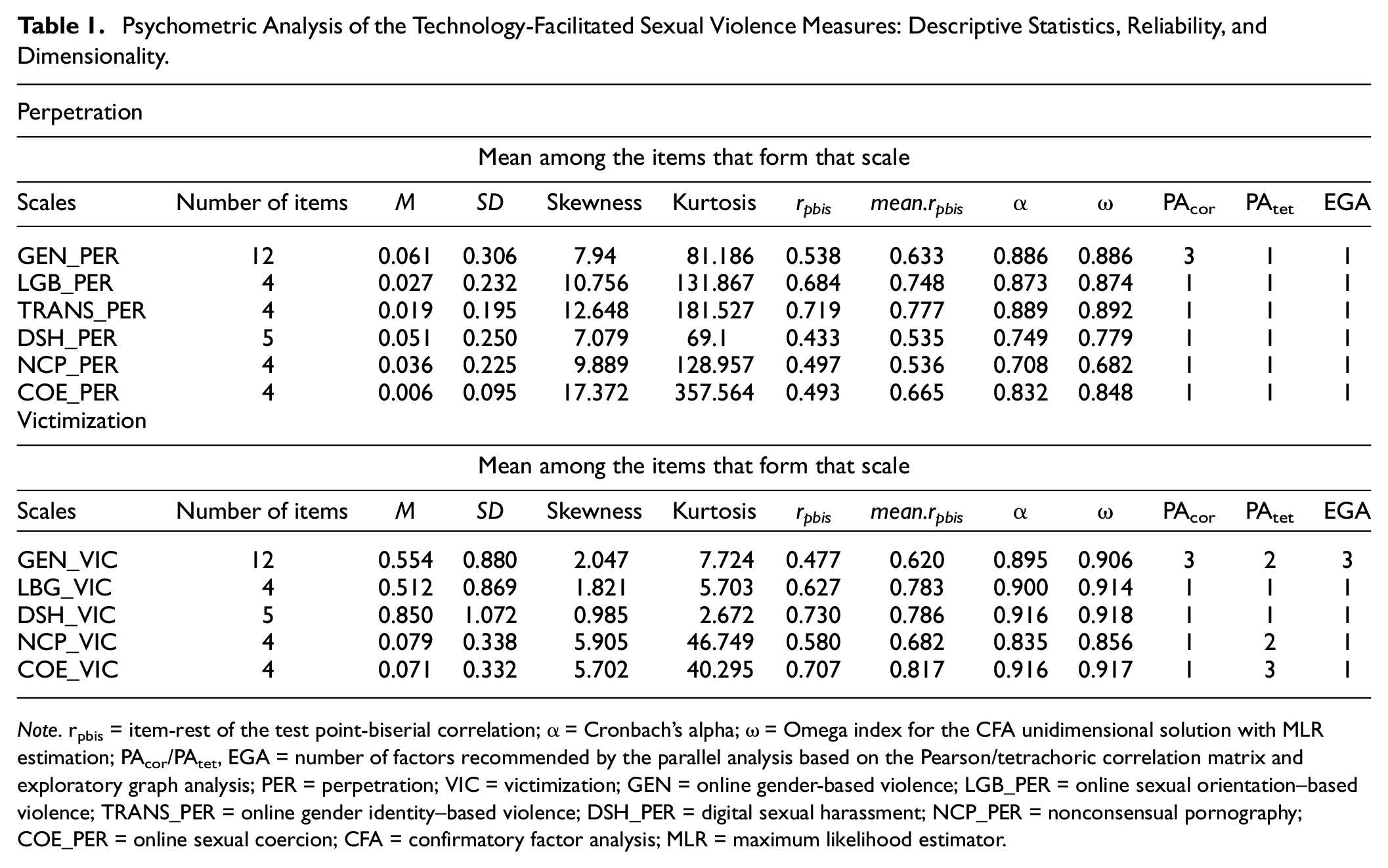
Note. rpbis = item-rest of the test point-biserial correlation; α = Cronbach’s alpha; ω = Omega index for the CFA unidimensional solution with MLR estimation; PAcor/PAtet, EGA = number of factors recommended by the parallel analysis based on the Pearson/tetrachoric correlation matrix and exploratory graph analysis; PER = perpetration; VIC = victimization; GEN = online gender-based violence; LGB_PER = online sexual orientation–based violence; TRANS_PER = online gender identity–based violence; DSH_PER = digital sexual harassment; NCP_PER = nonconsensual pornography; COE_PER = online sexual coercion; CFA = confirmatory factor analysis; MLR = maximum likelihood estimator.
In general, based on polychoric correlations and the EGA procedure, the scales were found to be unidimensional, with high congruence between the solutions of the parallel analysis based on Pearson correlations. The only notable exception seems to be online gender-based violence variables in both perpetration and victimization. This prompted us to explore these scales more thoroughly. Under the theoretical perspective, both the one-dimensional solution and the three-factor solution (gender roles, physical appearance, and anti-feminism) were admissible, so these two-factor solutions were tested together with a two-factor structure where each item was assigned according to its estimated factor loading in an exploratory solution (Items 1–8 and 9–12, loadings were all greater than 0.30 in the main factor and there were no crossloadings) by estimating CFA with an MLR estimator. The model fit information and estimated factor solutions are reported in Tables S2 and S3 of the Online Appendix. Considering the fit values and the estimated factor solutions, the three-factor correlated version for victimization appeared to be more defensible, while for perpetration, the two- and three-factor solutions obtained similar support. The finding of a high correlation between factors F1 (gender roles) and F2 (physical appearance) in perpetration can be justified by parsimony, supporting the two-factor version. Although CFI and USRMR indicated a good fit, RMSEA was still somewhat large for the three-factor models (.097 and .108 for victimization and perpetration, respectively). Goodness-of-fit indices were examined to identify the sources of the misfit. There were modification indices related to items with similar wording (e.g., Items 4 and 8, which both refer to discrimination from an online group, although for different reasons, or Items 5 and 6, which both refer to making a comment to a person about their physique). Including two correlated errors among these items was enough to achieve acceptable RMSEA levels (0.079 and 0.082 for the victimization and perpetration measurement models, respectively; see Tables S2 and S4 of the Online Appendix). However, these values, although close to the predefined cutoff for being considered acceptable, may suggest that some degree of misfit is still present. Taken together, the information provided by the various fit indicators leads to the conclusion that the fit can be considered adequate.
Relationships Between TFSV Scales
Figures 1 and 2 show the relationships between the perpetration measures and the victimization measures, respectively. The solutions are presented for two procedures: one based on network analysis and one based on an exploratory factor solution. The EGA procedure identified five and six dimensions for perpetration and victimization, respectively. The additional dimension in victimization is due to the fact that the online gender-based violence items were divided into three factors (gender roles, physical appearance, and anti-feminism) instead of two (gender roles + physical appearance and anti-feminism). This result was checked by bootstrapping, and the solution was found to be absolutely stable for perpetration and very stable for victimization (in some cases, the image-based sexual abuse variables were divided into two groups: online sexual coercion and nonconsensual pornography).
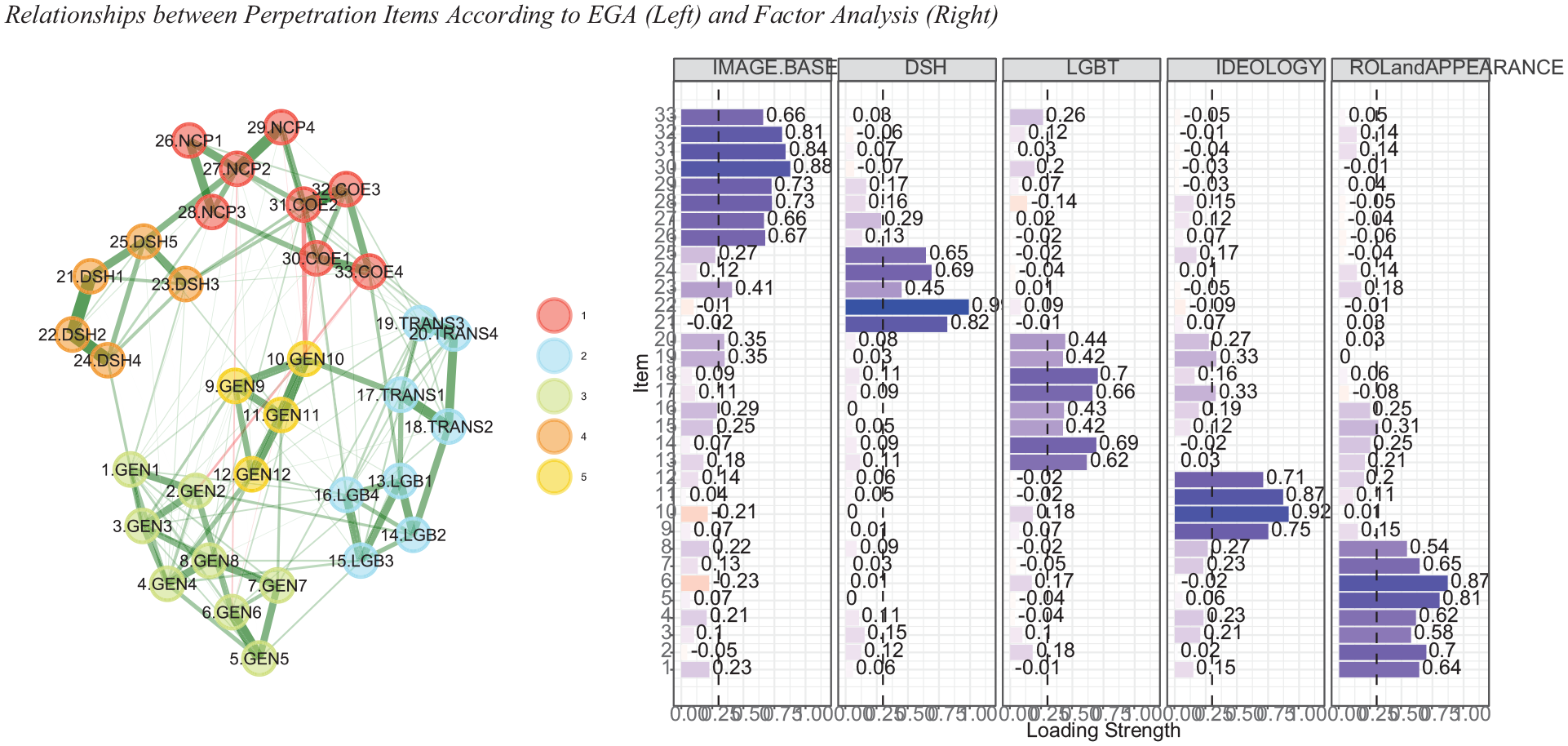
Relationships Between Perpetration Items According to Exploratory Graph Analysis (Left) and Factor Analysis (Right).
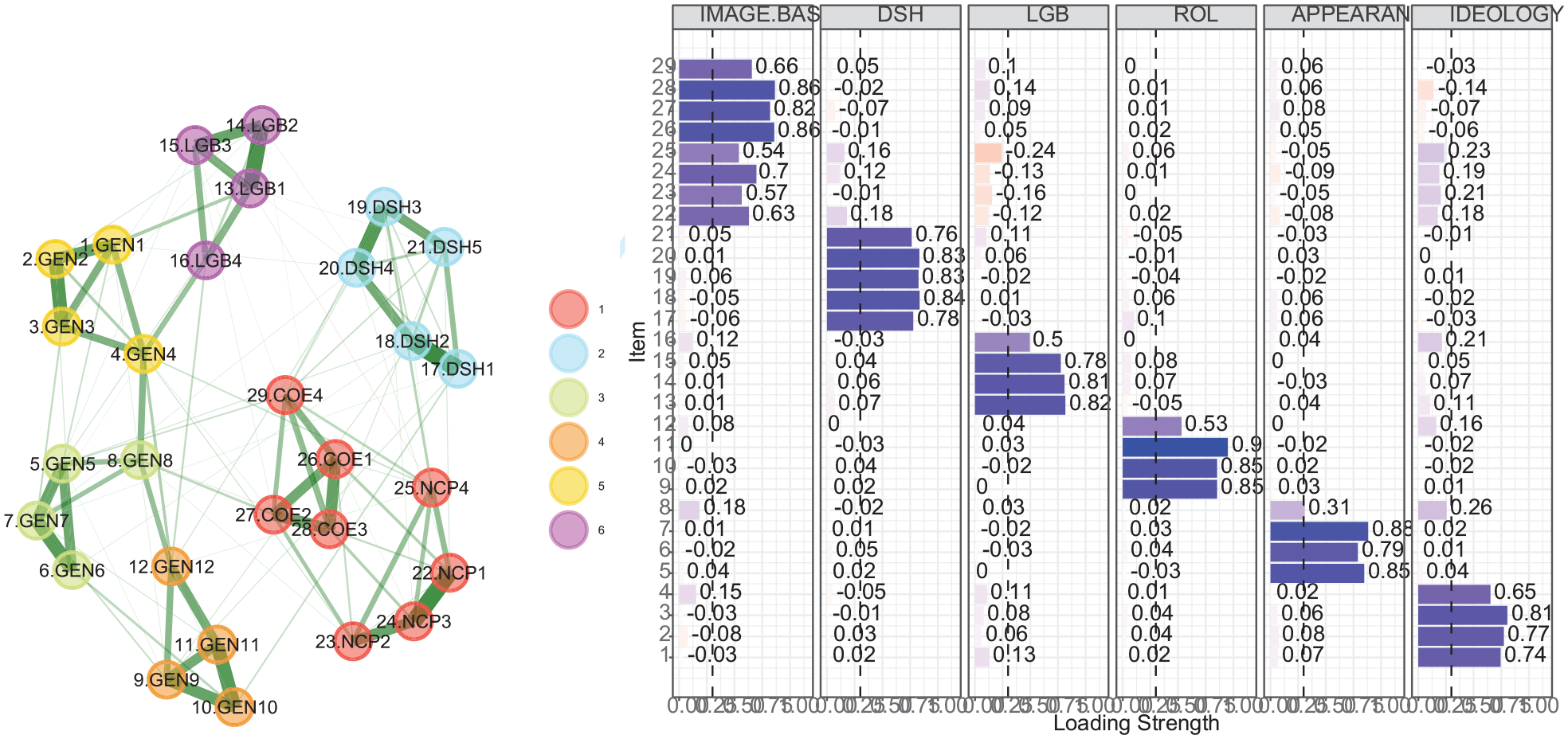
Relationships Between Victimization Items According to Exploratory Graph Analysis (Left) and Factor Analysis (Right).
With regard to the EFA solution, it was found that for perpetration, the six-dimensional factor solution did not lead to the separation of the nonconsensual pornography and online sexual coercion scales. Instead, it generated a sixth factor in which only one item loaded (online sexual orientation–based violence, –2 with a load of .31), which also had its main load in one of the factors already identified (online sexuality-based violence). This is consistent with the EGA solution, and we therefore chose to represent the five-factor solution in Figure 1. It can be seen that the scales are clearly differentiable, without the presence of cross-loadings, except for the variables of nonconsensual pornography and online sexual coercion, which formed a single factor (i.e., image-based sexual abuse). As could be hypothesized on the basis of the results shown in the previous section, the online gender-based violence items formed two groups: one comprising gender roles and appearance and one comprising anti-feminism. The results reported in Figure 2 are quite similar to those found for perpetration, with the exception that online gender-based violence is now divided into the three factors mentioned above: gender roles, appearance, and anti-feminism.
Relationships Between TFSV Measures and Age, Income Level, and Sexism
As can be seen in Figure 3, the correlations for the intragroup relationships (i.e., within the perpetration or victimization domains) were higher than those for the intergroup correlations (i.e., between the perpetration variables and victimization variables). In any case, it was found that the variables referring to digital sexual harassment and image-based sexual abuse correlated somewhat more with each other than with other variables (e.g., the correlation between nonconsensual pornography victimization and digital sexual harassment perpetration was .26), which could indicate a certain “transfer” between victimization and perpetration variables where one leads to the other.
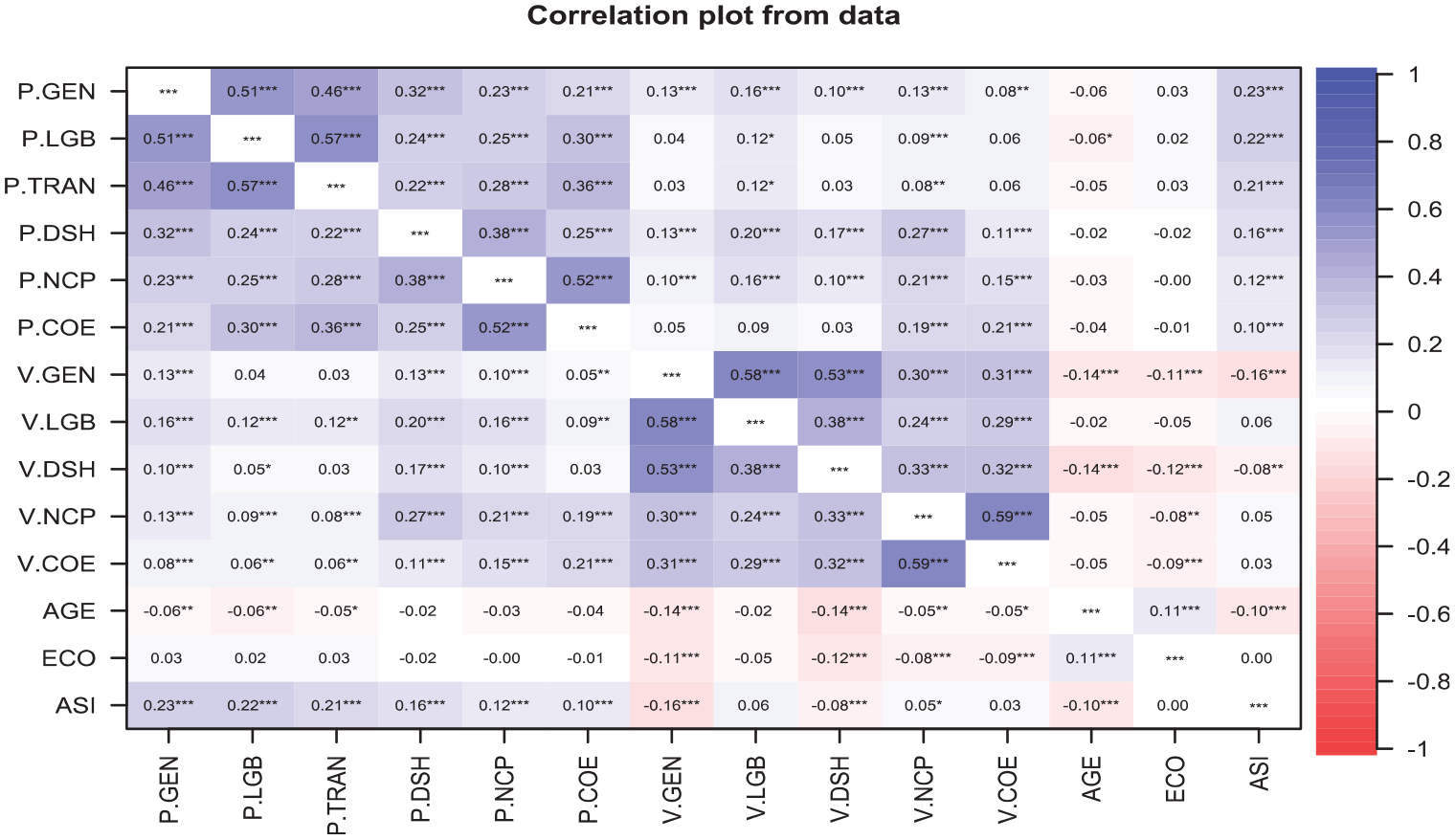
Correlations Between the Scales (Sum of Items) of Perpetration (P.) and Victimization (V.).
With respect to the other variables, we observed that all the perpetration variables were related to sexist ideology, with correlation coefficients ranging from .10 for the perpetration of sexual coercion to .23 for the perpetration of online gender-based violence. On the contrary, online gender-based violence and digital sexual harassment victimization correlated negatively and significantly with sexist ideology. Age and socioeconomic status showed negative relationships with the victimization variables (except sexual orientation–based violence), with values between –.05 and –.14. Age also correlated negatively and significantly with online gender-based violence, online sexual orientation–based violence, and online gender identity–based violence perpetration, although the correlation coefficients were small (–.06, –.06, and –.05, respectively).
Differences According to Gender Identity and Sexual Orientation
The results of the two ANOVAs are summarized in Table 2. For gender, a significant effect was found in all ANOVAs. However, it was generally associated with small effect sizes, with the exception of online gender-based violence victimization and digital sexual harassment victimization, where the effect size was medium. Due to the small number of trans and nonbinary people (e.g., five trans women), we focus only on describing the differences between cis women and cis men. In perpetration, the lowest means were for cis women when compared with cis men. Regarding victimization, the lowest means were generally found for cis men (except for online sexual orientation–based victimization), while cis women exhibited higher means than cis men for online gender-based victimization and digital sexual harassment. For the image-based sexual abuse variables (nonconsensual pornography and online sexual coercion), the differences were significant in the case of perpetration, but with a smaller effect size.
ANOVA Results According to Gender Group and Sexual Orientation.
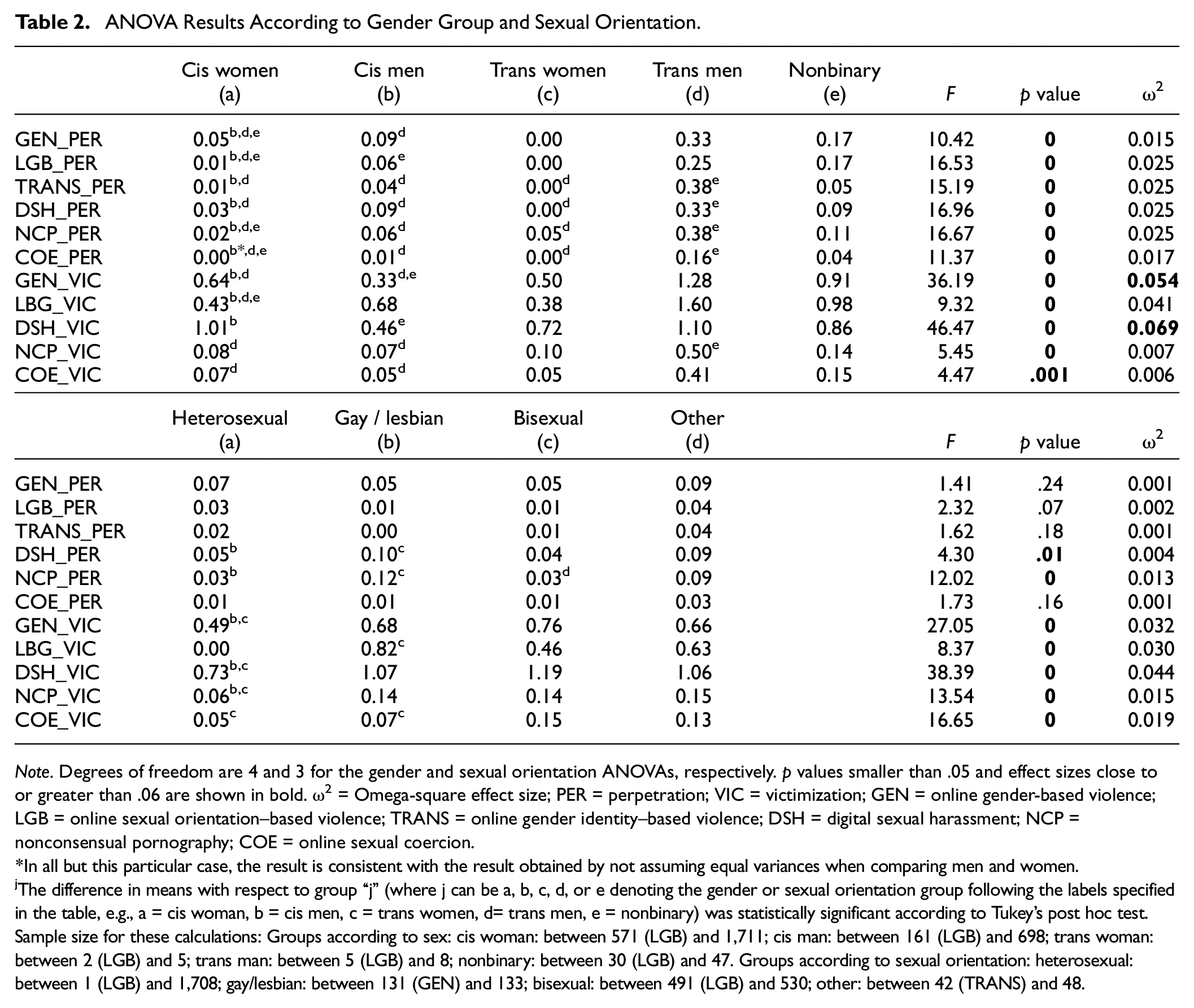
Note. Degrees of freedom are 4 and 3 for the gender and sexual orientation ANOVAs, respectively. p values smaller than .05 and effect sizes close to or greater than .06 are shown in bold. ω2 = Omega-square effect size; PER = perpetration; VIC = victimization; GEN = online gender-based violence; LGB = online sexual orientation–based violence; TRANS = online gender identity–based violence; DSH = digital sexual harassment; NCP = nonconsensual pornography; COE = online sexual coercion.
In all but this particular case, the result is consistent with the result obtained by not assuming equal variances when comparing men and women.
The difference in means with respect to group “j” (where j can be a, b, c, d, or e denoting the gender or sexual orientation group following the labels specified in the table, e.g., a = cis woman, b = cis men, c = trans women, d= trans men, e = nonbinary) was statistically significant according to Tukey’s post hoc test. Sample size for these calculations: Groups according to sex: cis woman: between 571 (LGB) and 1,711; cis man: between 161 (LGB) and 698; trans woman: between 2 (LGB) and 5; trans man: between 5 (LGB) and 8; nonbinary: between 30 (LGB) and 47. Groups according to sexual orientation: heterosexual: between 1 (LGB) and 1,708; gay/lesbian: between 131 (GEN) and 133; bisexual: between 491 (LGB) and 530; other: between 42 (TRANS) and 48.
For sexual orientation, there were occasions in which this variable did not have a significant effect. Thus, perpetration was found to have only a small effect on digital sexual harassment perpetration and nonconsensual pornography perpetration, with higher means in the sexual minority group. In terms of victimization, the sexual orientation variable had a small effect on all variables, with the heterosexual group presenting lower means than the gay/lesbian and/or bisexual group in online gender-based violence victimization, digital sexual harassment victimization, nonconsensual pornography victimization, and online sexual coercion victimization. In the case of online sexual orientation–based victimization and online sexual coercion victimization, the differences in means between the gay/lesbian and bisexual groups were significant, with the gay/lesbian group’s mean being higher in online sexual orientation–based victimization but lower in online sexual coercion victimization.
Discussion
The main objective of this study was to develop, validate, and analyze the psychometric properties of a measure for assessing the perpetration and victimization of different types of TFSV. Overall, we found support for an instrument composed of several dimensions of TFSV that covers both perpetration and victimization, including online gender-based violence, online gender- and sexuality-based violence, digital sexual harassment, nonconsensual pornography, and online sexual coercion. Because the analyses showed good psychometric properties, this study provides a new instrument that can be used by researchers interested in studying the perpetration and victimization of each form of TFSV.
The results of the exploratory and CFA analyses revealed that the scales were unidimensional in both perpetration and victimization, except in the case of online gender-based violence. In the case of the perpetration of this kind of violence, two dimensions were found: one comprising online anti-feminism violence and the other comprising online gender role–based violence and online physical appearance–based violence. The relationship between online gender role–based violence and online physical appearance–based violence is consistent with the findings of previous studies that identified a relationship between having a sexist ideology and having internalized such beauty canons (e.g., the idea that women must dress in a certain way; Ramati-Ziber et al., 2020). One explanation for these results is that the imposition of a particular beauty standard is actually part of gender roles (Eisend, 2019). Therefore, not adhering to imposed beauty canons can be a way of transgressing these roles. Thus, the same behavior (e.g., insulting a woman for being unshaven) can be considered both as online gender role–based violence and as online physical appearance–based violence. However, although these forms of violence may be part of the same phenomenon, we must consider the possibility of people suffering violence based on their online physical appearance without clearly transgressing any gender role. In fact, the online gender-based violence victimization scale presented three differentiated dimensions, one for each subtype (online gender role–based victimization, online anti-feminism victimization, and online physical appearance–based victimization). This may be due to the fact that there are women who suffer violence related to their physical appearance but who do not consider this violence to be related to the transgression of any gender role.
The analysis of the correlations of TFSV with other related variables provided evidence of the concurrent validity of the instrument. As expected, all perpetration scales correlated positively with sexist ideology, especially in the case of online gender-based violence. Nevertheless, the correlation was lower or negative for the victimization scales. As previously pointed out, this could indicate that social norms regarding how men and women should behave might play an important role in explaining TFSV perpetration. It could also reflect the importance of nonsexist education to prevent and address these forms of violence. Future studies should delve deeper into the relationship between TFSV and sexism. This would involve exploring how sexism influences both perpetration and victimization related to TFSV, particularly across different gender identities.
In addition to providing information on the psychometric properties of the instrument, the results of this study offer information on the relationships between the dimensions of TFSV among adults. For example, it was found that being a victim of image-based sexual abuse was related to being a victim of online sexual coercion and that engaging in image-based sexual abuse was also related to engaging in online sexual coercion. This seems to indicate that the creation of sexually charged content and threats, usually studied together (Gámez-Guadix et al., 2022; McGlynn et al., 2017), may be part of the same dynamic in which threats of distributing content actually end up being carried out. Furthermore, these results could suggest that victims of image-based sexual abuse and online sexual coercion share certain characteristics that could make them more vulnerable to being victims of these forms of violence. The relationship between image-based sexual abuse and online sexual coercion was also observed when analyzing the relationship between victimization and perpetration variables. Specifically, it was observed that being a victim of image-based sexual abuse was related to perpetrating nonconsensual pornography, online sexual coercion, and digital sexual harassment and that being a victim of online sexual coercion was positively related to perpetrating online sexual coercion. This could indicate, as some previous research suggests, that this is a bidirectional dynamic (Powell et al., 2019; Walker et al., 2021).
The second objective of this study was to analyze differences in relation to gender and sexual orientation. In terms of gender, cis women generally scored significantly higher on victimization items, while cis men scored higher on perpetration items. Considering that the items were intentionally tailored to mirror women’s experiences, it is unsurprising that these results align with expectations for online gender-based violence. However, the differences in the rest of the TFSV dimensions emphasize that this phenomenon is indeed related to gender dynamics. Notably, these results are consistent with previous studies suggesting that women are the primary victims of many forms of online violence and that cis men are the primary perpetrators (Donoso-Vázquez et al., 2017, 2018; Gámez-Guadix, Sorrel, & Martínez-Bacaicoa, 2023; Varela et al., 2021). However, there are some exceptions that might indicate that, as reported by Powell and Henry (2019), TFSV experiences may differ for men and women. Specifically, our results reflect that in the case of sexual orientation–based violence victimization, the rates were higher for cis men compared to cis women. This could indicate that not being heterosexual is one of the most penalized gender transgressions for men. In addition, cis women reported facing significantly more digital sexual harassment victimization than cis men, with no significant differences in victimization for nonconsensual pornography and online sexual coercion. Cis men reported significantly higher perpetration of digital sexual harassment, nonconsensual pornography, and online sexual coercion than did cis women. The existence of gender differences in the case of IBSA remains a debated issue, with studies both supporting (e.g., Patchin & Hinduja, 2020; Ruvalcaba & Eaton, 2020) and challenging (e.g., Clancy et al., 2019; Walker et al., 2021) this finding. The results of this work could indicate that although gender is not as important a variable when estimating the incidence of these forms of violence as in other TFSV dimensions, online sexual coercion and nonconsensual pornography are still gendered issues. In addition, there are studies that indicate that men and women experience TFSV situations differently (Powell & Henry, 2019), so there is a need for research that analyzes gender differences not only in terms of frequency but also in terms of how it is experienced.
Regarding sexual orientation, heterosexual people present lower scores in victimization, which corroborates the results of previous studies showing that nonheterosexual people are victims of TFSV to a greater extent (Gámez-Guadix & Incera, 2021; Powell & Henry, 2019). Regarding differences within the LGBT community, the results showed that gay and lesbian people suffered more violence based on sexual orientation than bisexual people. These findings contrast with those of Powell, Scott, and Henry (2020), who reported higher levels of violence related to sexuality among bisexual individuals. This difference may be explained by the fact that bisexual women tend to be perceived as “sexy” and “really hetero,” whereas bisexual men tend to be perceived as gender nonconforming and “really gay” (Yost & Thomas, 2012). Given that the majority of participants in our study were women, bisexuality may have been perceived as less gender transgressive than homosexuality. However, we found that in the case of online sexual coercion victimization scores, the means for bisexual people were higher. This is consistent with the results of studies in which bisexual women have been found to be at greater risk of being victims of image-based sexual abuse than lesbian women (Ruvalcaba & Eaton, 2020). Taken together, these results show that sexual orientation may be an important variable in understanding the nature of the different forms of TFSV. Nevertheless, studies on online sexual orientation–based violence are still needed, as the available information is limited.
It should be noted that the predominant Spanish demographic in this study may have influenced the results. Hispanic cultures have historically been dominated by the presence of a strong gender ideology, also known as “machismo” (Pérez-Martínez et al., 2021); however, in recent years, Spanish society has made considerable progress toward equality, aligning with other European countries. In fact, a report by the Organisation for Economic Co-Operation and Development (2020) highlights that Spain is among the countries that are most inclusive of gender and sexuality-diverse people. This could have influenced the TFSV experiences of participants in this study; consequently, these results should not be generalized to other Hispanic or nonoccidental countries that are making slower progress in terms of equality.
Strengths, Limitations, Constraints on Generality and Future Directions
To our knowledge, this is the first study to validate a measure for assessing both the perpetration and victimization of different forms of TFSV (online gender-based violence, online gender- and sexuality-based harassment, digital sexual harassment, online sexual coercion, and nonconsensual pornography). Among its strengths, we can highlight the evaluation of the instrument using exploratory analysis, CFA, and an assessment of construct validity. In a research context, our instrument can be used to advance the study of the different types of TFSV, improving the assessment of their prevalence, their predictors, and their consequences. Likewise, the instrument can be used in the context of prevention to conduct an initial screening of TFSV situations. In addition, this study expands on the scarce existing information regarding the frequency of the different forms of TFSV according to gender and sexual orientation. It also provides information on how the different dimensions of TFSV relate to each other, which may be useful in understanding the nature of this phenomenon.
This study has certain limitations that need to be mentioned. First, although the sample was large, we utilized a nonprobabilistic sampling procedure, so caution is required when generalizing the results. Future research should examine how gender influences men’s experiences of online violence and provide information on the impact of TFSV on men. Second, as this study specifically examined women’s encounters with online gender-based violence, it is necessary for future research to investigate the experiences of nonbinary people facing online violence. These incidents are becoming more noticeable and common and therefore require focused investigation. Third, due to the low number of trans participants, it was not possible to validate the gender identity–based violence victimization scale. Therefore, the results regarding online gender identity–based violence should not be generalized. Future studies should replicate the factor structure of the instrument in other cultural contexts and use samples with more diverse gender identities. Fourth, it is essential to note that this scale was exclusively administered in Spanish and to a predominantly Spanish participant pool, thereby limiting its validation to the Spanish language. Future research endeavors should aim to assess its validity and reliability in diverse linguistic contexts and among individuals from other countries. Fifth, the categorization of TFSV utilized in this study does not encompass certain manifestations of online gendered and sexual violence. Future research should acknowledge that the progression of technology (e.g., the advent of artificial intelligence [AI]) is giving rise to novel forms of TFSV (e.g., sexual deepfakes) that warrant investigation. Finally, although this study provides information on some of the instrument’s psychometric properties, future studies should analyze the test–retest reliability of the scale.
Conclusions
Interest in the study of TFSV among adults has grown in recent years (e.g., Powell & Henry, 2019; Salerno-Ferraro et al., 2021). The present work provides a reliable set of instruments for assessing the perpetration and victimization of the different dimensions of TFSV (online gender-based violence, online gender- and sexuality-based harassment, digital sexual harassment, nonconsensual pornography, and online sexual coercion). The results reveal that the initial validation of the instrument had good psychometric properties, and we encourage its use in future research projects aimed at studying any form of TFSV.
Supplemental Material
sj-docx-1-asm-10.1177_10731911241229575 – Supplemental material for Development and Validation of Technology-Facilitated Sexual Violence Perpetration and Victimization Scales Among Adults
Supplemental material, sj-docx-1-asm-10.1177_10731911241229575 for Development and Validation of Technology-Facilitated Sexual Violence Perpetration and Victimization Scales Among Adults by Jone Martínez-Bacaicoa, Miguel A. Sorrel and Manuel Gámez-Guadix in Assessment
Footnotes
Declaration of Conflicting Interests
The author(s) declared no potential conflicts of interest with respect to the research, authorship, and/or publication of this article.
Funding
The author(s) disclosed receipt of the following financial support for the research, authorship, and/or publication of this article: Funding for this study was provided by Ministerio de Ciencia e Innovación (Spanish Government) grant PID2022-140195NB-I00 and the predoctoral contract PRE2019-089729.
Ethics Approval
This study was performed in line with the principles of the Declaration of Helsinki. Approval was granted by Ethics Committee of Autonomous University of Madrid.
Consent to Participate
Participants provided informed consent to participate in this study.

Data Availability Statement
Data are available on reasonable request and on signature of a confidentiality agreement from authors.
Supplemental Material
Supplemental material for this article is available online.