







Abstract
This study uses survey data to explore ecologists’ willingness to prioritize the behavioral goal of considering local community members’ perspectives in the context of research at Long Term Ecological Research (LTER) sites. It finds that believing in the benefits of such listening is a relatively strong statistical predictor of expressing a willingness to prioritize listening. Neither normative beliefs nor agency beliefs were strong correlates of prioritizing listening. Women and younger scientists were more willing to prioritize listening as a goal. The study builds on the “strategic science communication as planned behavior” approach to try to better understand scientists’ communication choices.
Introduction
This study seeks to advance the discussion of dialogue and participation as primary indicators of communication quality (Bauer et al., 2007; Stylinski et al., 2018; Trench, 2008). Specifically, borrowing from the idea of “strategic science communication as planned behavior,” (Besley & Dudo, 2022a), it uses behavior change theory to improve our understanding of several factors that could lead ecologists to prioritize considering community members’ perspectives around research decisions at long-term research sites.
Dialogue is an important science communication tool, but it is not a substantive goal. Any science communicator who says their goal is to “spark dialogue” (or engagement) invites the question of “what do you want to accomplish through dialogue?” Similarly, the idea of dialogue sounds virtuous but suggests a need to identify desired outcomes for all participants. Put differently, one way to differentiate one-way dialogue from two-way (or multiway) dialogue in strategic communication is to identify who the communication is meant to affect. The current study understands two-way dialogue as communication where organizers are eager to affect their own beliefs (i.e., attitudes), feelings, frames, and resultant behaviors while also still potentially trying to (ethically) affect their interlocutors’ beliefs, feelings, frames, and associated behaviors (Besley & Dudo, 2022b; Kent & Taylor, 2002; Van Dyke & Lee, 2020). Strategic communication researchers describe this distinction as being between asymmetrical communication where the intention is simply to change others and symmetrical communication where there is an equal focus on affecting oneself (Hallahan et al., 2007). This distinction further recognizes that all communication has effects—whether intentional or unintentional—and puts the focus on trying to ensure that the communication choices that lead to those effects are intentional and appropriate, as well as trying to ensure that outcomes themselves are appropriate in any given context.
For example, past research suggests that scientists’ top behavioral goal for communication is to increase the likelihood that decision-makers to consider scientific evidence in their work (Besley et al., 2020; Besley & Schweizer, 2022). This is a reasonable goal, but scientists committed to two-way communication would also try to design communication activities that intentionally give themselves opportunities to obtain information and ideas that would help them make different (and potentially better) choices about things like research topics and methods. The expectation is thus that scientists committed to symmetrical and two-way communication would put substantial effort into ensuring that they are genuinely considering the perspectives of other actors in society to make potentially different research choices as well as potentially different choices in their management of scientific organizations. Unfortunately, as will be discussed, scientists do not rate listening to others’ perspectives to help make community-informed scientific decisions as highly as trying to shape other peoples’ decisions. The current study thus seeks to understand what factors might increase the likelihood that scientists devote more time and energy to considering community members’ perspectives.
Below, we describe an initial attempt to learn about what a specific group of ecological scientists think about the behavioral goal of using community listening to make community-informed decisions. The study uses ideas from the Integrated Behavioral Model (Montano & Kasprzyk, 2015) as articulated by the “strategic science communication as planned behavior” approach to studying scientists’ communication decision-making (Besley & Dudo, 2022a). Below, we provide a brief literature review and then put the primary focus on the underlying data and results. A brief discussion highlights implications and potential future research.
Literature Review
Background
The science communication community has put a spotlight on two-way “dialogue” and “participation” as an alternative to naïve communicators’ over-emphasis on reducing “deficits” in science knowledge. Dialogue and participation, in this regard, are meant to represent indicators of high-quality communication. Trench (2008) reflects on this shift while recognizing the challenge of fostering meaningful dialogue with nonscientists alongside the value of involving more societal actors into scientific decision-making. Well-cited histories of research in this area similarly point to increased attention to the value of dialogue and participation in both research and practice (Bauer et al., 2007; Fischhoff, 1995) and dialogue is a theme that continues to be highlighted in more recent discussions (e.g., National Academies of Sciences, Engineering, and Medicine, 2016).
The current study specifically focuses on the challenge of getting scientists to put resources—including time and money—into listening to the perspectives of nonscientists to help the scientists make community-informed and thus potentially better research choices (hereafter just “better” research choices). It does so in the context of local communities near long-term ecological research sites in the United States. An assumption of this focus is that proponents of evidence-based science communication—including people like communication trainers, coaches, and support staff—may need to communicate with scientists in ways that make them more likely to put effort into listening to their fellow members of society. At a theoretical level, the study builds on Poliakoff and Webb’s (2007) recognition that we can seek to understand scientists’ communication choices using key concepts from the well-established Theory of Planned Behavior (TPB) (Armitage & Conner, 2001; Fishbein & Ajzen, 2010).
Specifically, Poliakoff and Webb found that “attitudes” toward communicating and communication-related “perceived behavioral control”—two key TPB constructs—were both reasonable predictors of a willingness to communicate. Attitudes were operationalized as a set of evaluative beliefs about the relative risks and benefits of communication. Behavioral control was measured as beliefs about communication skills, similar to what is often called self-efficacy (Bandura, 1978) or internal efficacy (Craig et al., 1990). Beliefs about social norms were not substantially associated with engagement willingness. Social norms, in this regard, are a third key TPB construct and were measured using questions focused on whether scientists expected that communication efforts would be accepted by their peers. Such beliefs are often called injunctive norms in norms-focused research because of the focus on beliefs about peers’ expectations for behavior (Lapinski & Rimal, 2005). Other researchers have followed up Poliakoff and Webb’s work with similar studies focused on engagement willingness with similar results (e.g., Dudo, 2013).
Also important within the TPB is the idea that behavioral intention (or willingness) is understood as a primary predictor of later behavior (Lawton et al., 2007) and that the behaviors meant to be studied are “intentional behaviors.” The core idea is thus that strategic communication campaigns can seek to affect these intentional behaviors through a focus on (re)shaping the underlying evaluative beliefs about the behavior. This focus on belief change is also understood to be substantially different from communication where the focus is on the use of heuristic cues or nudges to affect a specific behavior without seeking to change underlying evaluative beliefs (Thaler & Sunstein, 2008).
Whereas Poliakoff and Webb (2007) focused on the amount of overall engagement, later research drew on their insight to look at other intentional communication choices that scientists may need to make to be effective communicators. This includes choices about the tactics scientists are willing to use (i.e., messages, behaviors, styles, channels, and sources) (Besley, Newman, et al., 2021), the cognitive and affective communication objectives they might prioritize (i.e., desired knowledge, beliefs/perceptions, feelings, and frames) (Besley et al., 2018; Dudo & Besley, 2016), and the overall behavioral goals that they might seek to achieve as a result of their chosen tactics and priority objectives (Besley et al., 2020; Besley & Schweizer, 2022). The authors of this work have described this approach as a “strategic science communication as planned behavior” approach (Besley & Dudo, 2022a). Studies using this approach have found that scientists are most likely to prioritize a tactic, objective, or goal when they believe it is more beneficial than risky and, to a lesser extent, when they believe they can perform the behavior (i.e., perceived behavioral control or self-efficacy). Normative beliefs, in contrast, have not demonstrated strong relationships with scientists’ willingness to make specific communication choices. This work has all been done through cross-sectional surveys, however, whereas qualitative work (Dijkstra et al., 2015; Rödder, 2012) continues to point toward norms as a likely driver of communication choices (for a summary, including non-TPB focused studies, see Bennett et al., 2019).
The Importance of Behavioral Goals
Communication researchers have put only limited focus on understanding scientists’ behavioral goals for their public communication despite the centrality of such goals to any meaningful discussion of strategy. While it can be difficult to get nonprofessional communicators to identify their behavioral goals (Dudo et al., 2021), it is impossible to talk deeply about communication strategy unless you are clear on what you want to achieve from the time and money you put into communication. From a strategic perspective, anyone saying that their “goal” is to affect cognitive or affective outcomes, that is, knowledge, beliefs about risks/benefits (attitudes), norms, self-efficacy, trustworthiness, as well as discrete emotions, should be encouraged to explain why they want to achieve these outcomes (e.g., They could be asked: “What do you anticipate will happen if you succeed in changing X cognition or Y feeling?”). Similarly, someone saying they want to use tactics such as storytelling, humor, plain-language explanation, conversation, or social media should be asked to describe what they expect to use these tactics to accomplish. Behavior change theories such as the TPB and the IBM only make sense if there is a focal behavior to try to predict (McEachan et al., 2011). Similarly, most theories of trust differentiate between the behavior of trust in the form of making oneself vulnerable (McCroskey & Teven, 1999; Schoorman et al., 2007), the beliefs that lead to trust (i.e., ability/expertise, benevolence/goodwill, and integrity/honesty), and communicative choices that affect trustworthiness beliefs (e.g., demonstrating integrity). Some prominent past work focused on key outcomes of science communication has failed to fully distinguish between desired behaviors and the cognitive and affective objectives that theory suggests might result in those behaviors (National Academies of Sciences, Engineering, and Medicine, 2016; National Research Council, 2009; Rose et al., 2020), but these distinctions seem central to being an evidence- and theory-based communicator.
Beyond their strategic role, a focus on behavioral goals should also be central to any discussion of the ethics of two-way communication. It now seems common to say that the scientific community should engage in more dialogue with people within scientists’ broader communities (e.g., Leshner, 2003). It also, however, appears common for people to default into using dialogue as a tactic to convince others without any intention of changing themselves (Goven, 2003; Trench, 2008). As noted, public relations scholars have recognized this challenge in their distinction between asymmetric and symmetric two-way communication (Van Dyke & Lee, 2020). Having a goal of potentially changing one’s own behavior because of one’s listening-focused communication efforts can be understood as a key element differentiating asymmetric communication from symmetric communication (Grunig, 1992). Scientists are not pursuing symmetric communication unless at least one substantial goal of their communication efforts involves potential changes to some aspect of their own behavior. This might, for example, involve changes to research topics or methods, as well as changes to communication approaches. Past work on scientists’ goals has, however, almost exclusively focused on scientists’ behavioral goals for audiences (e.g., increasing the likelihood that policymakers consider scientific evidence or fund science), not behavioral goals for scientists (Besley et al., 2020; Besley & Schweizer, 2022). Increasing the likelihood that scientists meaningfully consider the views of community members to make potentially better research choices—the focus of the current study—can be understood as a behavioral goal for scientists.
One challenge to identifying meaningful behavioral goals for scientists is recognizing that scientists’ goals for others during a communication process will not be the same as the goals they make for themselves. For example, it could make sense for a group of ecological scientists to participate in an event where a primary goal is to try to increase the likelihood that landowners consider a particular conservation practice. Designing communication for such an activity based on the TPB might involve sharing what research says about the benefits of the behavior as well as information related to self-efficacy and norms. At the same time, the scientists might recognize that they need to build behavioral trust within a community to have their perspective considered while equally recognizing that they might benefit from trying to establish who they can trust (i.e., rely on) as potential partners for future work. The hypothetical scientists would therefore have at least four, nonmutually exclusive goals, including two community-focused goals and two scientist-focused behavioral goals (the “behaviors” are italicized). The community-focused goals would include (a) encouraging community members to consider evidence in the context of a policy alongside the reinforcing goal of (b) fostering behavioral trust in the form of a community that is making themselves vulnerable by considering scientists’ guidance. Versions of these goals have typically been among scientists’ highly prioritized goals in past work (Besley et al., 2020; Besley & Schweizer, 2022). The scientist-focused goals include (c) deciding who they can trust (i.e., turn to) and (d) trying to identify new research ideas through their opportunities to hear landowners’ perspectives. This final behavioral goal—increasing the likelihood that scientists devote effort to considering community members’ perspectives—is the focus of the current study as it has typically been among the lowest prioritized goals in the aforementioned past research, despite being central to discussions about what constitutes ethical, high-quality communication. The study also includes an initial descriptive element in which scientists are asked about the other types of behavioral goals, building on past work (Besley et al., 2020; Besley & Schweizer, 2022).
A concern underlying the current project is that past research and experience (Besley & Dudo, 2022a) suggest it is unlikely that scientists will intentionally prioritize goals that involve changing their own behavior without substantial guidance from communication experts. This concern partly arises from the persistence of deficit model approaches in which scientists tend to see science communication as an effort to increase scientific knowledge to improve perceptions of science (Simis et al., 2016). It also comes from interview studies with people in the scientific community that have consistently found that scientists and other science communicators rarely indicate that the goal of their communication is to change their own behavior, and that few trainers seem to emphasize this goal as a priority for science communication training (Dudo et al., 2021; Yuan et al., 2017).
A related challenge is to avoid getting side-tracked by discussions about whether a communication activity should be labeled as persuasion or advocacy (e.g., Weingart & Joubert, 2019). Textbooks on persuasion show that “persuasion” is a broad label used to cover a wide area of study and that most communication activities are inherently persuasive, whether intentionally or unintentionally (e.g., Hovland et al., 1953; O’Keefe, 2016; Petty & Cacioppo, 1996). Similarly, advocacy often seems to be used with a pejorative connotation when someone wants to criticize science communicators for violating a vague norm of impartiality. On the contrary, however, deliberative systems of democracy are meant to be built on people making the best possible arguments for their preferred path forward (Elster, 1998). From the perspective of strategy, all communication should be understood to have potential effects and the key questions thus become whether communicators are (a) intentional and (b) ethical in their communication choices (Besley & Dudo, 2022). From this perspective, it may often be unethical to be nonstrategic. Inadequate intentionality, for example, could result in a range of perspectives being overlooked (Canfield et al., 2020). Indeed, the elevation of “engagement” through dialogue seems to have emerged from the deliberative democracy literature (e.g., Rowe & Frewer, 2005) and the literature on public opinion quality (Price & Neijens, 1997). Relatedly, it may also reflect a recognition that the scientific community should make its arguments in ways that encourage and allow all participants to think systematically (i.e., centrally) rather than heuristically (i.e., peripherally) about scientific issues and actors (Chaiken & Maheswaran, 1994; Petty & Cacioppo, 1986). In practice, this means that science communication that involves engagement typically seeks to motivate and enable all participants to think relatively deeply about the relevant issues and thus form or reshape beliefs. This would be contrasted with communication that seeks to cue/prime existing beliefs or evoke transitory emotions with no longer-term change in beliefs. This approach is consistent with the earlier argument that behavior change theories (such as the IBM) are focused on fostering belief change through systematic processing.
The Current Context
As noted, the current study focuses specifically on the scientist-focused engagement goal of trying to make better decisions by listening to community members who live near Long Term Ecological Research (LTER) sites. Our first research question is to understand where “listening to make better choices” fits as a behavioral goal relative to other potential goals that scientists could prioritize. As noted, we use a list of other potential behavioral goals drawn from previous research for comparison.
Research Question 1 (RQ1): How important do LTER scientists rate the goal of considering community members’ perspectives to make decisions relative to other potential behavioral goals?
LTER sites are government-funded research sites that sit primarily within the United States and its territories where groups of scientists study a wide range of ecological issues (LTER Network, 2023). The survey underlying the work was a small part of a grant-funded effort to assess and encourage strategic thinking about engagement priorities within each research program. Such strategic engagement priorities might include drawing on the interests and insights of local communities when making decisions about site management, including research choices. LTER sites are useful subjects for such research because they involve multiple scientists (typically less than 100) from a range of universities and other organizations who come together to conduct collaborative projects and thus have the potential for shared communication goals. They are also place-based, can have a long-term focus, and sometimes employ professional communicators/educators who can facilitate strategy development and implementation (Besley, Garlick, et al., 2021; Peterman et al., 2021).
Building on Poliakoff and Webb (2007), as well as more recent work using strategic science communication as a planned behavior approach (Besley & Dudo, 2022b), our hypotheses are fairly straightforward. An extension of the Poliakoff and Webb work that has been integrated into more recent work is the use of the Integrated Behavioral Model (rather than the TPB; Fishbein, 2009; Montano & Kasprzyk, 2015). The IBM, however, is just an extension of the TPB that integrates other behavior change theories such as the Health Belief Model (Carpenter, 2010) and Bandura’s work on self-efficacy (Bandura, 1997). In practice, this means recognizing that it often makes conceptual sense to differentiate among two or more different types of risk/benefit beliefs (i.e., attitudes), normative beliefs, and self-efficacy beliefs.
In this regard, for risk/benefit beliefs, whereas the original TPB just focused on overall risk/benefit beliefs (i.e., attitudes), the IBM distinguishes between peoples’ expectations about how a goal behavior will make them feel (affective beliefs) and the degree to which they expect the goal behavior will be useful (instrumental beliefs) (Lawton et al., 2007). The questions included in the current study also recognize distinctions between benefits to the group (i.e., site) as well as the individual (van der Linden, 2015). It further included questions reflecting the possibility that affective expectations about behavioral enjoyment (i.e., hedonic expectations) may differ from affective expectations related to potential satisfaction gained from communication choices (i.e., eudaimonic beliefs) (Oliver & Raney, 2011), and specific focus on ethicality beliefs given the importance of this issue in past work (Besley & Schweizer, 2022). That being said, given the small number of questions available for each construct measured (due to survey length limitations), this study does not seek to make specific hypotheses for each of these different types of benefit/risk belief questions. For the current context, consistent with the TPB/IBM operationalization of attitudes, this might mean that we would expect the following.
Hypothesis 1 (H1): Scientists will be more likely to prioritize considering community members’ perspectives as a function of the degree to which they believe that listening will be beneficial rather than risky.
For social norms, the IBM differentiates between beliefs about whether a behavior is expected by key peer groups (i.e., injunctive norm beliefs) and the degree to which a goal behavior is common in such groups (i.e., descriptive norm beliefs) (Rimal & Lapinski, 2015). Again, however, while questions were included for both types of norms in the survey underlying the project, we do not attempt to differentiate them here given past results that suggest relatively high correlations (Besley & Schweizer, 2022). Indeed, given past results (Tiffany et al., 2022), it may be that there is no relationship between scientists’ normative beliefs and their goal choices. Nevertheless, we include this hypothesis given the underlying theory (i.e., IBM/TPB) and qualitative studies that continue to point toward norms as a key driver of scientists’ communication choices (Dijkstra et al., 2015).
Hypothesis 2 (H2): Scientists will be more likely to prioritize considering community members’ perspectives as a function of the degree to which they believe that listening is normative.
Finally, for perceived behavioral control, the IBM differentiates between agency beliefs about whether a behavior is within the respondent’s control (i.e., control beliefs, consistent with the original TPB) and within the respondent’s abilities (i.e., self-efficacy beliefs). Past work again suggests that these will be highly correlated, so we propose a single hypothesis even though there are measures for both concepts in the survey underlying the project.
Hypothesis 3 (H3): Scientists will be more likely to prioritize considering community members’ perspectives as a function of the degree to which they believe that they have the agency to consider community members’ perspectives.
Demographics are only a minor focus here as past research suggests that scientists’ demographics (age, sex, etc.) are limited predictors of communication choices (Bennett et al., 2019). We also put only limited focus on demographics because they are not typically subject to change, unlike benefit/risk beliefs, normative beliefs, and agency beliefs. Indeed, these factors are typically understood in TPB research to underlie or moderate behavioral beliefs and thus not affect behavior directly (Fishbein & Ajzen, 2010). Put differently, it may be that scientists with specific backgrounds are more willing to consider specific communication choices, but we would expect any such differences to be largely mediated by the more proximate beliefs about risk and benefits, norms, and self-efficacy, as well as other factors. Practically, any result that suggests that demographics remain meaningful predictors of prioritizing listening after simultaneously considering the other variables in the model would suggest a potential need for additional research to identify other potential factors that might be shaping communication priorities. We therefore include demographics as a broad research question.
Research Question 2 (RQ2): To what degree will scientists be more likely to prioritize considering community members’ perspectives as a function of their demographic characteristics?
To assess this research question, given the limited racial variation within the available sample means, we only include self-reported sex, whether or not the respondent identifies as white, career stage (i.e., a proxy for age), whether the respondent is a principal investigator (PI) or co-principal investigator (co-PI) at the site (i.e., a site leader), and their amount of past engagement. This approach is consistent with past work (Besley & Schweizer, 2022).
Measurement of each of the constructs is described below alongside the measurement of the outcome variables used to assess the hypotheses and research questions.
Methods
Sample Characteristics
The online survey underlying this project was conducted using the Qualtrics survey platform in March and February of 2023 using a sample of scientists provided by the LTER Network coordinating office (a partner in the project). List members were sent an initial request followed by three reminders. The list included 2,775 emails but a screening question at the start of the survey suggested that about 9.6% of respondents were nonresearch staff (i.e., educators and communicators), and thus the adjusted population of scientists is likely about 2,509 scientists. Of these, 371 completed the bulk of the survey (adjusted response rate = 15%), although not all these respondents answered all of the questions asked. This means the specific n for each question is provided in the results. Also, LTER Network staff indicated that they expect that the list they provided included people who are no longer active at the LTER so the “active” response rate might be somewhat higher. The survey took an average of about 15 minutes to complete.
In terms of demographics, about 48% of respondents identified as women, and 83% identified as white. In terms of career stage, 28% were students, 16% were junior scientists (e.g., post-docs, assistant professor, or equivalent), 21% were mid-career (e.g., associate professor or equivalent), 31% were senior, and 4% were retired/emeritus. In terms of field, although not used in the analyses, 78% identified as ecologists, 42% identified as biologists, 33% identified as biogeochemists, 19% identified as hydrologists, 8% identified as atmospheric scientists, and 8% identified as social scientists/humanities scholars (respondents could choose more than one field).
Measurement
Table 1 provides descriptive statistics and item wording for a broad set of potential behavioral goals that LTER scientists could pursue through their communication. This list was adapted from Besley and his colleagues’ past surveys of scientists’ goals to make the categories relevant to LTER scientists (Besley et al., 2020; Besley & Schweizer, 2022) as well as ongoing discussions with project partners. The list reflects a range of different key audiences (e.g., policymakers, resource professionals, youth, and scientists themselves) as well as both direct behaviors (e.g., choose a career and consider evidence when making a decision) and the more abstract behavior of building trust (Besley & Dudo, 2022a). RQ1 is then assessed by comparing means with reference to absolute scores and confidence intervals. These questions are not used for hypothesis testing but provide context.
Behavioral Goals for Scientists at Long-Term Ecological Research Sites (RQ1).
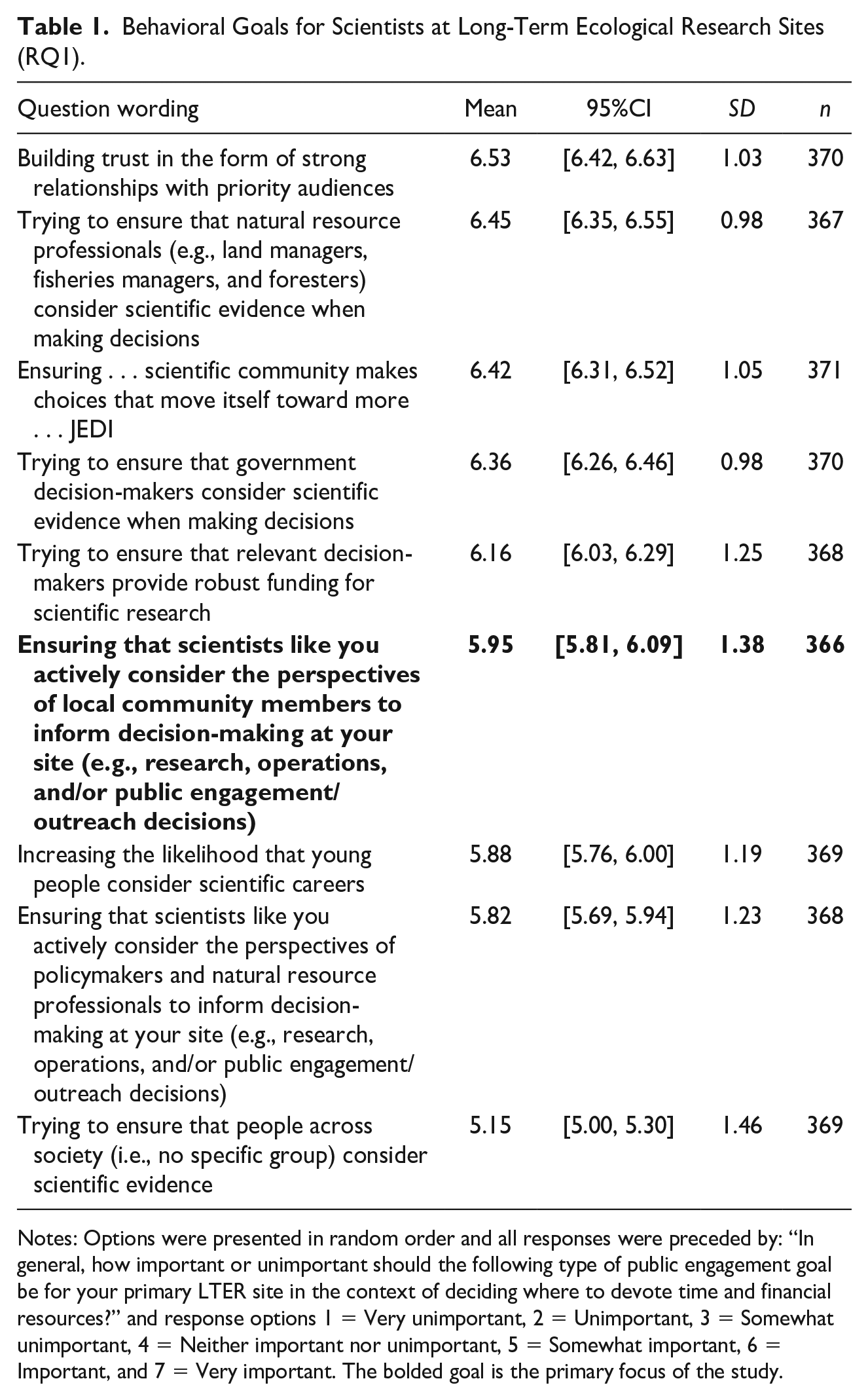
Notes: Options were presented in random order and all responses were preceded by: “In general, how important or unimportant should the following type of public engagement goal be for your primary LTER site in the context of deciding where to devote time and financial resources?” and response options 1 = Very unimportant, 2 = Unimportant, 3 = Somewhat unimportant, 4 = Neither important nor unimportant, 5 = Somewhat important, 6 = Important, and 7 = Very important. The bolded goal is the primary focus of the study.
Table 2 provides additional descriptive statistics and item wording for the predictor variables used to assess H1 to H3. This includes measures of affective and instrumental beliefs, normative beliefs, and agency beliefs all also adapted from past work focused on scientists’ communication choices (Besley & Schweizer, 2022) as derived from the TPB/IBM (Montano & Kasprzyk, 2015).
Descriptive Statistics for Key Variables and Pearson Correlations for Views About the Goal of “Ensuring That Scientists Like You Actively Consider the Perspectives of Local Community Members to Inform Decision-Making at Your Site.”
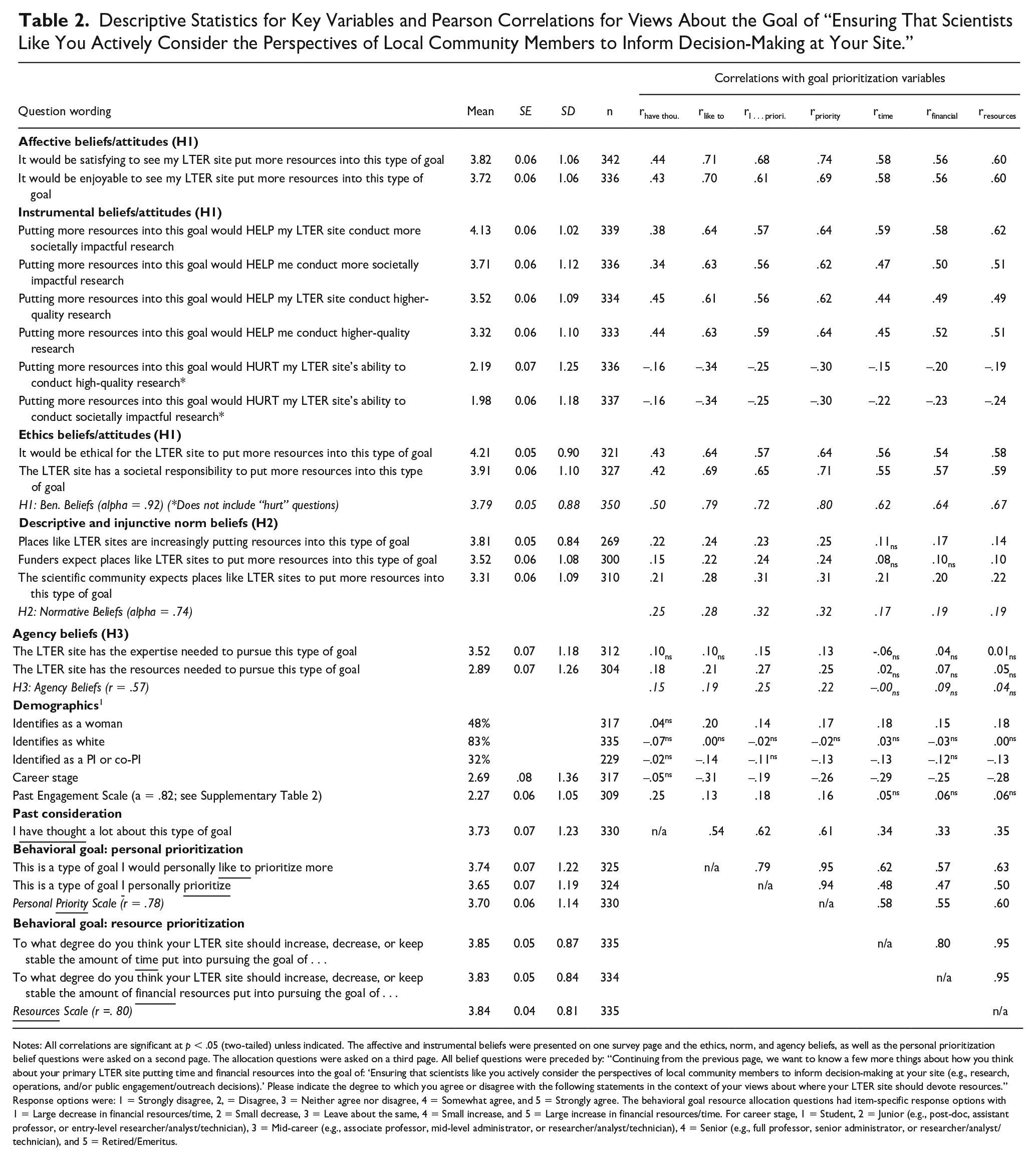
Notes: All correlations are significant at p < .05 (two-tailed) unless indicated. The affective and instrumental beliefs were presented on one survey page and the ethics, norm, and agency beliefs, as well as the personal prioritization belief questions were asked on a second page. The allocation questions were asked on a third page. All belief questions were preceded by: “Continuing from the previous page, we want to know a few more things about how you think about your primary LTER site putting time and financial resources into the goal of: ‘Ensuring that scientists like you actively consider the perspectives of local community members to inform decision-making at your site (e.g., research, operations, and/or public engagement/outreach decisions).’ Please indicate the degree to which you agree or disagree with the following statements in the context of your views about where your LTER site should devote resources.” Response options were: 1 = Strongly disagree, 2, = Disagree, 3 = Neither agree nor disagree, 4 = Somewhat agree, and 5 = Strongly agree. The behavioral goal resource allocation questions had item-specific response options with 1 = Large decrease in financial resources/time, 2 = Small decrease, 3 = Leave about the same, 4 = Small increase, and 5 = Large increase in financial resources/time. For career stage, 1 = Student, 2 = Junior (e.g., post-doc, assistant professor, or entry-level researcher/analyst/technician), 3 = Mid-career (e.g., associate professor, mid-level administrator, or researcher/analyst/technician), 4 = Senior (e.g., full professor, senior administrator, or researcher/analyst/technician), and 5 = Retired/Emeritus.
The belief questions were asked across two pages of the survey instrument in which the relevant statements were presented in a matrix table format with a description of the goal (see note in Table 2) provided at the top of the page as a reminder meant to further ensure that the goal was top-of-mind for respondents. An additional set of questions about the goal was provided on the page prior to these belief questions to provide respondents with a further understanding of what this goal might entail. As reported in Supplementary Table 1, the surveyed LTER scientists generally saw substantial utility in listening to community members to design “outreach/public engagement” activities and to help determine ways in which to report results. They only had moderately positive views about the utility of seeking input on who to involve in studies, questions that studies should ask, and site management. Scientists did not seem to see substantial utility in seeking input on how to conduct studies.
Demographics used to assess RQ2 are also in Table 2.
Table 2 provides further descriptive statistics and item wording for the criterion variables used in the analyses. As noted, these were adapted from previous research described above. These include two questions that were included alongside the questions about attitudes, norms, and self-efficacy that focus on self-reported current and future prioritization of listening as a goal as well as a set of two questions focused on whether the respondents believe their LTER should put additional time and money into the goal of considering community members’ perspectives. An additional variable focused on the degree to which scientists had thought about the goal is also included for context but not analyzed.
Analyses
The primary analyses presented are kept fairly parsimonious—bivariate correlations, or the equivalent—whereas the supplementary material includes more detailed, multivariate, multilevel analyses using SPSS mixed model procedures (Hayes, 2006). The multilevel models are included to ensure that the results remain consistent with the simple correlations when appropriately controlling for the fact that respondents were sometimes at the same site and thus not fully independent. No effort was made to propose site-level variables or test site-level hypotheses as these are not the current focus. As the results show, the one reason to emphasize the parsimonious approach is that the simple correlations seem to capture the story in the data fairly well. While each site is different, we also have no reason to expect systematically different patterns at different sites, and some sites have a small number of respondents (with a range from about 3 to 22). A second reason we decided to focus on correlational results for the main text of the study is that the various benefit questions were so highly correlated that it did not make sense to make multiple scales for each subdimension of the criterion variables (Supplementary Table 3 provides the noted multivariate analyses). Reporting simple correlations thus facilitated the study’s purpose of showing the key patterns as clearly as possible such that the data is understandable to the widest possible range of potential users.
We report null-hypothesis statistical test results for hypothesis testing as though we were using a traditional probability sample but, the fact that the survey represents an attempted census (i.e., all members of the population were contacted), means that all of the relationships discussed are technically “significant.” The relevant error comes from nonresponse and measurement, rather than sampling. Limitations of the current approach are addressed in the discussion.
Results
RQ1: How Important Do LTER Scientists Rate the Goal of Considering Community Members’ Perspectives
The descriptive statistics reported in Table 1 suggest that considering community members’ perspectives is seen as an important goal, but not a top-tier goal. The most highly scored behavioral goals focused on building trust, trying to get resource professionals and policymakers to consider scientific evidence, and moving the scientific community toward justice, equity, diversity, and inclusion. All of these have means well above 6.00 on a 7-point scale. The mean for considering community perspectives falls just below this mark—still high, in an absolute sense—but not as high as most other potential goals. Also noteworthy is that considering policymakers’ and resource professionals’ perspectives is similarly scored in a second tier of goals along with encouraging young people to consider scientific careers.
H1: Scientists Will Be More Likely to Prioritize Considering Community Members’ Perspectives as a Function of the Degree to Which They Believe That Listening Will Be Beneficial Rather Than Risky
Descriptively, the mean scores (all above 3.00 on a 5-point scale) for most of the benefit measures suggest that the LTER scientists surveyed generally agree that listening to communities has potential benefits for their LTER and, to a lesser extent, themselves. The low means for the two questions focused on risks further suggest that scientists see few dangers to listening. The correlational data clearly show high correlations between the various measures of benefits and the measures of goal prioritization. No matter how you measure it, the evidence suggests LTER scientists who believe that considering community perspectives is likely to be affectively and instrumentally beneficial are also relatively more likely to say the goal should be prioritized. Indeed, these correlations are so high that it is difficult to argue that the measures of benefit beliefs are distinct from the criterion measure for behavioral intentions (i.e., prioritization), despite clear conceptual differences between beliefs and behaviors. Exploratory factor analyses confirm this pattern (not shown). This is not true of the two risk measures as they correlate relatively weakly with the prioritization measures. The supplementary multivariate, mixed effects models that treat the LTER site as a random factor and include measures for benefit beliefs, normative beliefs, agency beliefs, and demographics show that these benefit beliefs are still the dominant predictor of both personal prioritization and a desire to put resources into considering community members’ perspectives (Supplementary Table 3). Overall, the results are consistent with H1.
H2: Scientists Will Be More Likely to Prioritize Considering Community Members’ Perspectives as a Function of the Degree to Which They Believe That Listening Is Normative
The descriptive statistics suggest that LTER scientists somewhat agree that funders expect scientists to put resources into listening to local communities, and that such listening is becoming increasingly common at LTER sites. They are more neutral about the degree to which they agree that the broader scientific community expects LTERs to put resources into community listening. The correlations between normative beliefs and goal prioritization measures are also substantially weaker than benefit beliefs, with several of the normative belief measures having nonsignificant relationships. The additional multivariate analyses (Supplementary Table 3) suggest that these weak relationships do not hold up after controlling for benefit beliefs. At best, H2 is very weakly supported as it appears that normative beliefs are only weakly associated with LTER scientists’ relative prioritization of community listening.
H3: Scientists Will Be More Likely to Prioritize Considering Community Members’ Perspectives as a Function of the Degree to Which They Believe That They Have the Agency to Consider Community Members’ Perspectives
The descriptive statistics suggest that LTER scientists weakly agree that their sites have the needed expertise but tend to disagree that they have the resources to put more effort into considering community members’ perspectives (Table 1). The correlations suggest that these views are also only weakly correlated with personal prioritization and largely uncorrelated with views about putting in more time and money. The multivariate analyses in the supplementary analyses again show that including beliefs in the model makes consideration of agency beliefs irrelevant to predicting goal prioritization (Supplementary Table 3).
RQ2: To What Degree Will Scientists Be More Likely to Prioritize Considering Community Members’ Perspectives as a Function of Their Demographic Characteristics
Finally, Table 2 also shows that demographics are somewhat weak predictors of LTER scientists’ prioritization of considering others’ perspectives. Those who identify as women and who have past engagement experiences seem to prioritize listening somewhat more highly than nonwomen and people with relatively less engagement experience. PIs and co-PIs (i.e., site leaders) and respondents who are later in their career tend to prioritize such listening less highly than others. These patterns can also be seen in multilevel analyses of Supplementary Table 3, although simultaneously taking the IBM variables into account substantially diminishes or eliminates these relationships between demographics and listen prioritization. This might suggest that the IBM variables are capturing variance that might be accounted for by demographics.
Discussion
A key premise of the current study is that, in the context of science communication, we can partly understand meaningful, two-way dialogue as communication activities where scientists have a behavioral goal of listening to dialogue partners to make (potentially) better decisions about their research or communication activities. Listening can also be understood as a tactic—a tactic often misused by those who engage in dialogue-for-the-sake-of-dialogue—but is treated here as a behavioral goal for scientists because of the focus on listening to make better decisions. Identifying what makes scientists more likely to engage in this type of “listening-with-purpose” is central to the broader project underlying the survey reported here. This perspective on two-way dialogue recognizes that scientists may have other goals that they want to achieve through communication (e.g., increasing the likelihood that dialogue partners consider scientific evidence when making decisions), but the current study focuses primarily on scientists’ views about meaningful listen.
The results presented above suggest that any effort to get scientists to prioritize considering community members’ perspectives should likely start with emphasizing specific benefits of substantive listening (H1). The descriptive statistics suggest that benefit beliefs could be strengthened (i.e., not all respondents gave a “5” on a 5-point scale), and the strong correlation results suggest there could be potential utility to increasing the strength of these benefit beliefs. In contrast, the current evidence suggests that efforts to increase perceived norms (H2) and (H3) sense of agency may only have a limited impact because these variables have only a limited relationship with the prioritization of substantive listening. There is capacity for scientists to have more positive normative beliefs and efficacy beliefs about listening, but the low correlations suggest that such improvements might have only a limited impact on scientists’ prioritization of listening. There may be specific contexts in which norms and agency matter more, but this study did not identify them, and the size of the difference suggests that benefit communication should be an initial focus. Meta-analyses of the TPB and other behavior change theories also point to the relative dominance benefit and risk beliefs (i.e., attitudes) in predicting most planned behaviors (Armitage & Conner, 2001; Carpenter, 2010). The only available research on scientists’ views about communication goals similarly suggested that benefits were the best statistical predictors of scientists’ prioritization of the goal of getting policymakers to consider scientific evidence when making decisions (Besley & Schweizer, 2022).
With regard to demographics, although not a priority here, both identifying as a woman and past engagement seem to independently increase the perceived importance of listening. In contrast, all things being equal, scholars in later career stages seem to see slightly less value in considering local community members’ perspectives (RQ2). These demographic results suggest that it may be useful to explore whether there are additional contextual factors shaping goal priorities beyond the IBM variables.
Given these results, a potential next step for anyone trying to increase scientists’ willingness to consider community perspectives is to gather examples of cases where listening resulted in more innovative or more impactful science or improved communication. Partners from the LTER Network Office and informal author conversations with LTER scientists suggest the existence of many examples of scientists getting insight from stakeholder interactions, but these have not been tracked in any meaningful way (Besley, Garlick, et al., 2021). Collecting and sharing such material could enhance future efforts by communication managers or trainers to ask scientists to consider putting more time and money into listening. They could also help identify opportunities to enhance scientists’ opportunities for meaningful listening and community partners’ opportunities to share insights.
Another path forward for future research could focus on scientists’ beliefs about the risks of listening (or other communication choices). The two risk questions included in the “attitude” battery did not correlate with the benefit-focused attitudes questions enough to include them in the overall attitude scale that was used in the supplementary analyses. There was, however, a meaningful correlation between risk beliefs and scientists’ reported willingness to prioritize listening such that it is possible scientists’ concerns about listening deserve more attention. On the contrary, it is noteworthy that most scientists did not indicate that they perceived substantial risks to research from listening. This might suggest that these risks are unlikely to be concerns that communicators who argue for more listening need to substantially address for most scientists.
The demographic results could be understood to suggest that a communication manager seeking to identify scientists to help spur community listening efforts might find it easier to start with women and relatively younger scholars, although this seems problematic since such scholars may already face higher burdens and have less autonomy. Framed differently, there likely is a need to find out why men and older scholars are less eager to consider community perspectives and identify paths forward that see broader support for listening.
Of course, the fact that the current results—as well as past studies on related topics—are based on one-off correlational surveys means that additional work could be useful to help extend the findings. If meaningful listening is a key to better science communication, then science communication researchers may benefit from knowing more about what additional scientists think about specific examples of listening in the real world. Such research could specifically focus on trying to understand what factors make it more likely that science communicators will engage in genuine listening rather than performative listening (i.e., where there is no clear intention to consider nonscientists’ insights when making scientific decisions). Such work would ideally involve experiments meant to test, for example, whether communicating benefit information about goals with scientists during training shapes scientists’ listen-related communication choices. Past research on training, unfortunately, has not suggested that trainers are explicitly using theories such as the TPB or IBM in the design or evaluation of science communication training (Dudo et al., 2021; Newman, 2020; Rodgers et al., 2020). The use of such theories to design training, in this regard, might involve identifying specific communication choices that trainers want to see scientists make (e.g., devoting time and resources to genuine listening) when they communicate and assessing the degree to which these scientists believe the choices will be more beneficial than risk, normative, and within their capacity. Such work could further include continued development of the type of measures used here. Those used here were based on past research but limited by the novel context and limited space in the underlying survey.
With regard to theory, the causal logic and concepts within behavior change models are well-established. This is why the Strategic Science Communication as Planned Behavior approach to studying science communication decision-making was built on the Integrated Behavioral Model. However, many gaps continue to exist in what we know about how people in the scientific community identify potential goals, prioritize cognitive and affective objectives related to those goals, and select tactics to achieve those objectives (Besley & Dudo, 2022a). Future research on the current focus might benefit from shifting to additional populations of scientists, measuring constructs in different ways, and ultimately finding ways to test the ideas using panel data. Focus might also turn to other outcome variables of potential interest, including other goals, objectives, or tactics. Additional focus might similarly turn to scientists’ choices about behaviors that might help them listen, including better understanding when they choose to ask for help or budget for communication support.
Supplemental Material
sj-docx-1-scx-10.1177_10755470241239940 – Supplemental material for Ecologists Prioritize Listening to Community Perspectives When They See the Benefit: Norms and Self-Efficacy Beliefs Appear to Have Little Impact
Supplemental material, sj-docx-1-scx-10.1177_10755470241239940 for Ecologists Prioritize Listening to Community Perspectives When They See the Benefit: Norms and Self-Efficacy Beliefs Appear to Have Little Impact by John C. Besley and Martha R. Downs in Science Communication
Footnotes
Acknowledgements
Thank you to Allison Black-Maier, Sarah Garlick, Anthea Lavallee, and Cristina Mancilla, Kari O’Connell for their help at various stages of manuscript preparation.
Declaration of Conflicting Interests
The author(s) declared no potential conflicts of interest with respect to the research, authorship, and/or publication of this article.
Funding
The author(s) disclosed receipt of the following financial support for the research, authorship, and/or publication of this article: This material is based upon work supported by the National Science Foundation (NSF, Grants AISL 1421214 and 2215188). Any opinions, findings, conclusions, or recommendations expressed in this material are those of the authors and do not necessarily reflect the views of the NSF.

Author Biographies
References
Supplementary Material
Please find the following supplemental material available below.
For Open Access articles published under a Creative Commons License, all supplemental material carries the same license as the article it is associated with.
For non-Open Access articles published, all supplemental material carries a non-exclusive license, and permission requests for re-use of supplemental material or any part of supplemental material shall be sent directly to the copyright owner as specified in the copyright notice associated with the article.
