







Abstract
A gifted student-athlete, Charlie Bloomfield is introduced to athlete’s journals by his coaches at Burke Mountain Academy (Vermont), an elite American ski school. Used by Olympians and professionals alike, journals provide athletes with ways to organize and reflect on training and competitions. Athlete’s journals help gifted male athletes address identity development and create images of their emerging adult selves. The themes that emerged in Charlie’s journals offer insight into this student-athlete’s physical and social-emotional needs while suggesting the potential benefits of journals for gifted student-athletes like Charlie.
Tucked onto a mountainside in Vermont’s Northeast Kingdom, Burke Mountain Academy (BMA) nurtures future Olympians, World Cup skiers, and National Collegiate Athletic Association (NCAA) prospects. What may be even more impressive is that the little ski school’s alumni repeatedly land spots in America’s top colleges. There’s no doubt, BMA challenges the bodies and minds of an elite group of student-athletes.
At lunchtime in the academy’s rustic dining hall, student-athletes fuel-up for the afternoon’s training session and take turns making community announcements. When 16-year-old Charlie Bloomfield stood, he addressed what he saw as one of the academy’s limitations. “I feel out of touch up here,” said the Massachusetts’ native. His words quieted the lunchtime ruckus. “It’s like I don’t know what’s going on in the outside world,” he added. Dozens looked up from their plates and several others stepped back from the salad bar. “I’d like to start a current events group. If you’re interested, let me know.”
And they did. Up to a dozen student-athletes and staff members attended weekly gatherings through the fall until the snow hit and the Burkies migrated across our planet’s snow belt seeking speed and podium gold. Thanks to Charlie (Figure 1), they also enjoyed 3 months of discussions beyond their nonstop lives in the classrooms, training areas, and ski slopes of America’s premiere ski academy.

Charlie.
Charlie
A self-proclaimed math and science guy, Charlie Bloomfield not only attacks ski courses at speeds of up to 50 mph, but he’s also a gifted student with a quick wit and a mature outlook.
Charlie’s 11th-grade humanities teacher, Reid Jewett, agrees. “Charlie is an intellectual without trying to be one. He has a brilliantly funny, dry sense of humor and, though he is respectful of authority, is not afraid to challenge others’ ideas.” Jewett elaborates,
Charlie is indeed a gifted student. When I met him, he seemed to have pegged himself as a “math and science” student, but I was fascinated by how well his mind internalized the events of American History. Charlie has an amazing memory—throughout the year he would cite obscure details we’d read months before or pull an exact line from our textbook in a way that indicated his superior reading comprehension skills. In our English seminar, he was “the connector.” He was able to weave our various discussions by understanding that what linked our otherwise disparate readings was the human condition.
Now teaching at Choate Rosemary Hall, Jewett adds, “Charlie also is deeply curious, which I am sure you saw when he started the current events club.”
On the athletic side, BMA men’s alpine coach Jake Fisher found Charlie to be “one of the most intelligent athletes” he has ever worked with. The well-traveled ski coach goes on to explain, “Charlie’s both book smart and athletically smart. He has incredible body awareness and is able to take my feedback, apply it, and come back to me with accurate and insightful responses.”
Introducing Athletes’ Journals
In August of 2010, I met with the BMA coaching staff to discuss athletes’ journals. These journals provide “an athlete with a place to set goals, reflect, grapple with issues, keep track of training ideas, and record results as well as plan, scheme, ponder, rant, question, draw, and rejoice” (Kent, 2011, p. 105). They include writing prompts, graphic organizers, writing activities (e.g., quick writes, quick write/snapshots), and free-choice entries. A dozen BMA coaches participated in my workshop. They discussed my work and tried out a few writing activities for themselves. We read about and discussed how writing enhances learning (Murray, 2005; Zinsser, 1988) and spoke about our own experiences with writing.

Questions surfaced about the implementation of journal writing during the workshop. I explained that at secondary school and collegiate levels, coaches use writing as a regular part of their instruction. Some have their athletes write daily, others use writing every other day, and a few use writing activities like journaling more sparingly throughout the athletic season. For veteran and elite athletes, the coach and the athlete make the decision together on employing journal writing, though every elite athlete I had met used reflective writing in their training logs as a way to learn more thoroughly about their training and competitive tactics.
Two coaches decided to try out athletic journaling with Charlie’s Junior 2 (J2) boys training group (15- to 16-year-olds). They assigned journals to their student-athletes during an on-snow training camp in Chile. After the 3-week autumn training camp, I met with the J2 boys and coaches to discuss their experiences. In my conversation with the training group, I asked if writing in a journal could make someone a faster ski racer or a better athlete? Charlie wrote,
Writing can help me become faster. Putting my thoughts on paper about how a day went . . . I get a better understanding of how I feel about myself and what it is that I should do. In Chile, I found that writing helped me understand what I really wanted to do and what I had done.
Other J2 boys concurred explaining that writing offered another way for athletes to think more fully about training, competition, and life. A ski racer from Vermont, Chris McKenna captured the training group’s thinking in a 3-min quick write:
Writing makes you learn about yourself. Knowing yourself physically and mentally as an athlete is very important. Writing made me think about what I was doing well and what I need to work on. This will make my training and motivation much better.
A ski racer from Maine, Carter composed one of my all-time favorite lines about the benefits of writing as an athlete: “No one likes skiing with a cluttered mind, so put it on paper and free some space.”
As a result of these discussions, I entered into more conversations with Charlie at the end of the ski season. He shared his journals from Chile. We talked about writing, ski racing, and learning, and then tried out several other writing activities.
Charlie’s Journals
During the training camp in the Andes, Charlie and his teammates spent the morning hours training on the ski slopes. Later, they attended video debriefing sessions with their coaches, attended to their homework, and wrote in their journals. The boys either responded to a coach’s prompt or were set free to write what they wished.
While at Nevados de Chillan, Charlie wrote 2,000 words in his journal addressing a variety of athletic themes that included the following: motivation, race tactics, daily training goals, a coach’s feedback, free-skiing, confidence, and performance analysis.
The themes that surfaced from Charlie’s writing seemed to create an outline of his needs and interests as an athlete. Such entries appeared to help Charlie further organize his training and to think more about a coach’s instructions. When journals are shared with coaches, the writing can also inform them about issues their athletes face.
In one journal entry, Charlie focused on a specific ski racing technique that has been a focal point of his training:
Today . . . my main focus was on the transition and trying to find the front of the boot before every turn. I find myself at the bottom [of the mountain] having forgotten to tell myself to keep getting forward. Tomorrow, I want to try to keep my focus from top to bottom. Every run will have a purpose and I think this will prevent me from returning to old ways.
This entry introduced some of the practical uses of athletes’ journals. For example, Charlie identified a weakness in his ski technique, analyzed his own performance, set goals for future training, and visualized the result (“I will be fast.”). In addition, as Charlie received instruction from his coaches about staying forward on his skis, what he called finding “the front of the boot before every turn,” this entry served as a reflection on instruction, or what might be called an extension of that instruction.
Charlie’s writing revealed an attempt at making sense of his coaches’ advice and served as evidence of his ongoing learning. In the next journal entry, he unpacked his own thinking about his training for the day by posing five questions that highlighted his understanding of the larger picture of his skiing:
How prepared for training was I?
What was my goal today?
Did I understand my coach’s feedback?
Was there any change in my level of confidence during training?
How did I feel about my performance?
As with the previous journal, this one illustrated a connection to his coaches’ teaching and showed how journal writing might help Charlie and other student-athletes move toward extending a coach’s ideas. In doing so, Charlie extended the role of student-athlete to one who thought like a coach.
Although the primary focus of an athlete’s journal is sport, other areas of the athlete’s life find their way into the journal. Charlie’s writing moved well outside the athletic realm as he addressed more personal topics. He explained, “Once I found out that writing could be a means for understanding myself, I enjoyed using it to apply to other areas of my life.” Some of the themes that Charlie addressed beyond the ski slopes included the following: homework, friendship, being a helpful teammate, treatment of others, treatment by others, being a better person, respect, his mother, community, and change. These themes paralleled those that surfaced in the journal of U.S. ski racer David Chamberlain (Kent, 2012).
While in Chile, the coaches and staff members held school meetings that focused on the theme of respect. As a result of those talks, Charlie wrote a personal journal entry on friendship and respect. Here’s a small section of that writing:
I want to be more consciously friendly and considerate to all of my peers not because of the consequences I will get for not doing this, but for the self-satisfaction I will gain from being a helpful teammate and a better person. Why is it that I feel compelled to treat people who I have spent the most time with less respect than others? My goal in life is to be appreciated for being a person who shows respect to everybody, even when it is hard to do so. One day I remember vividly from freshman year is when I consciously chose to be nice to kids I either didn’t like or didn’t know well, and I remember leaving school that day feeling like the person I really want to be. Why is it so hard to always act like this? Why is it popular to be mean? I hope to continue to write about this to find the answers for myself.
As with many gifted young adults, Charlie revealed his sensitive nature and an acute awareness of his feelings (Hébert & Kent, 2000; Heylighen, 2012). Such writing not only showcased this young man’s sensitive ways but also displayed how he grappled with identity development—who he was and who he would like to be. Through his journal writing, Charlie worked to construct an image of his emerging adult self. He posed the kinds of questions and addressed the sort of issues that parents and teachers hope gifted male adolescents will tackle.
Whether an athlete writes twice a week or every day, taking ‘a timeout’ to reflect on training and competition sets a tone of thoughtful inquiry that promotes learning.”
The 20 athletic and personal themes that surfaced in Charlie’s journal entries captured the breadth of thinking that can permeate a gifted athlete’s journal. The topics of Charlie’s writing offered insight into this athlete’s physical and emotional needs. The topics also suggested the potential benefits of journaling for a young man like Charlie.
When asked about his journaling, he said, “Writing allowed me to go back and see what I was thinking. Being able to reflect . . . is a good way to understand who I am and how what I am doing with my life has shaped who I’ve become.” Charlie’s words point us toward several theories that underpin the use of athletes’ journals.
Practice to Theory
Over the centuries, scientists, mathematicians, historians, sea captains and, yes, even basketball players have kept journals. Across the academic landscape, scholars have explored and acclaimed the wide-ranging benefits of journal writing, a mode of writing known as expressive and “most closely connected to the discourse model developed by James Britton and his associates” (Newkirk, 2009, p. 74). Britton (1970, 1982), Lightfoot and Martin (1988), and Strong (2005) concurred that journals assist “writers in discovering and clarifying ideas or experiences for themselves or for others” (Strong, 2011, p. 107). Note how the following fields of scholarship support the use of journal writing for gifted male athletes.
Write to Learn
Charlie’s journal entries reveal a young man who is working to clarify his understanding of himself as an athlete and person. Such work is critical as adolescent student-athletes move through the mental, physical, and emotional stages of development and work toward discovering more about themselves. This discovery process fits neatly into the realm of writing to learn theories. Murray (2005) explained, “We write not to say what we know, but to learn, to discover, to know. Writing is thinking, exploring, finding out” (p. 37). Zinsser (1988) echoed Murray:
Writing organizes and clarifies our thoughts. Writing is how we think our way into a subject and make it our own. Writing enables us to find out what we know—and what we don’t know—about whatever we’re trying to learn. (p. 16)
At BMA, Charlie and his classmates, two of whom are seen to Charlie’s left in Figure 2, use writing as a way to learn in the academic and athletic arenas. Not only do BMA student-athletes write multiple reflections of their classroom and ski racing experiences, but also their teachers and coaches write periodic assessments in response to their performances. For all student-athletes, and especially gifted boys like Charlie, such reflections provide powerful opportunities to learn.

Charlie (left) with Burke Mountain Academy classmates Sam Coffin (center) and Charlie Harrison (right).
Expressive Writing
Martin (1983) identified the expressive as “crucial for trying out and coming to terms with new ideas” (p. 6) while Atwater (1981) explained that expressive writing enables people to
make sense for themselves of what they have seen or read or done or talked about by composing it for themselves in their own words. Thus, expressive writing is fundamental to learning—in any subject matter—because it enables [writers] to internalize knowledge, to make it part of themselves, by putting it together in their own terms. (p. 23)
Atwater’s (1981) “composing it for themselves in their own words” is what we see in Charlie’s writing. He goes deeper into his thinking about training and competition in his journals, and that thinking complements the many hours of training, racing, and discussions with coaches that ultimately leads to improvement as an athlete.
The Psychological
According to the American College of Sports Medicine (2006), athletes plagued by stress may struggle in a variety of ways, including difficulty sleeping, altered appetite, inability to concentrate, or self-doubt. Through discussions, visualization, yoga, meditation, and writing athletes address any number of psychological or physiological issues. Sport psychology consultant Sheila Stawinski (2012) of the University of Vermont provides athletes with writing activities that work toward sharpening players’ mental approaches, curbing performance anxiety, and eliminating negative talk and thoughts (e.g., Performance Feedback Form, 2012). Dowrick (2009) maintained that athletes benefit psychologically through writing because journaling has the potential to reduce stress and anxiety, increase self-awareness, sharpen mental skills, promote genuine psychological insight, advance creative inspiration and insight, and strengthen coping abilities.
In a meta-analysis of the research on the benefits of journal writing, Baikie and Wilhelm (2005) identified a wide range of advantages, including how journal writing provides a greater sense of psychological well-being, an improved immune system, and therefore fewer stress-related visits to the doctor. They further elaborated that student-athletes who journal may benefit from improved sporting performances and higher grades in the classroom. The reduction of stress, sharpening of mental skills, and increase in coping abilities can play vital roles in enhancing a gifted student-athlete’s performance on the playing fields, in the classroom, and in life.
Praxis and the Athlete’s Journal
Athletes’ journals are as distinctive as the athletes who keep them. Whether posted online, saved on a computer, or composed in a notebook, journals can include technical or personal topics using many different genres as seen in Figure 3. Such a wide variety of entries will provide gifted student-athletes with many learning opportunities. When shared, these journals also have the potential to inform coaches as well as teachers and other school personnel.
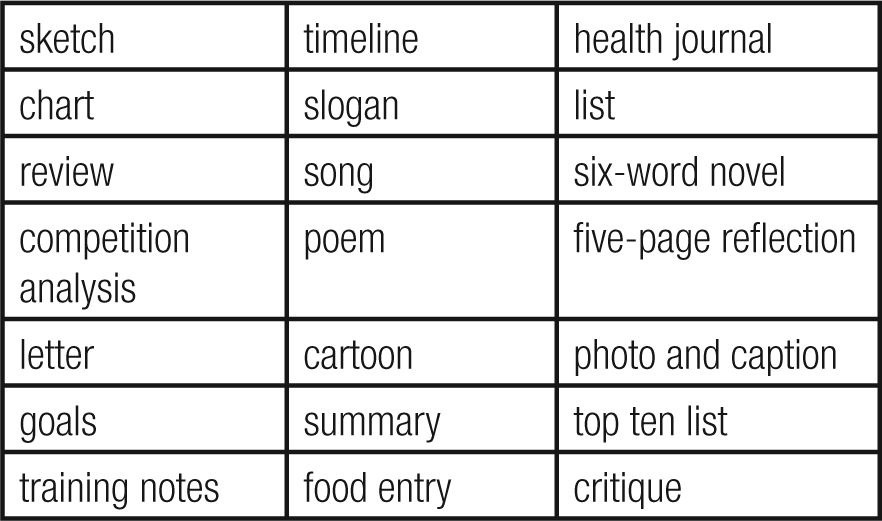
Athletic journal genres.
Most Olympians and world-class athletes write about their thinking, training, and competition in journals, notebooks (e.g., Athletic Team Notebooks [Kent, 2012]), and training logs (2011). At Wimbledon in 2007, Serena Williams showed the press two pages from her journal book. Part of her writing included the following lines:
My good thoughts are powerful
My only negative thoughts are weak!
Decide what you want to be, have, do, and think the thoughts of it.
Hang on to the thought of what you want. Make it absolutely clear.
For Williams, her journal writing focuses mostly on the mental side of the game of tennis.
At Fenway Park, those who followed the fabulous Red Sox teams of the mid-2000s may have seen ace pitcher Curt Schilling writing on the bench between innings. According to NESN broadcaster Jerry Remy, Schilling recorded technical aspects of the game such as pitching choices for individual batters and the results of those choices. It is pure speculation, but Schilling’s journal quite possibly contained written comments about his health, frame of mind, or teammates. And in the batter’s box, baseball slugger Carlos Delgado kept a similar journal that he regularly shared with selected teammates (Jenkins, 2006).
On the ski trails of the world, former Nor/Am SuperTour Cross-Country Ski Champion David Chamberlain trained 850 hr a year. As a member of the U.S. Nordic World Championship Team, David maintained a journal, two blogs, training logs, and written correspondence with coaches and advisors. He explained, “I like free writing . . . it’s a meditation, trying to open up the mind and go for it.”
In the end, the praxis that evolves from the underlying theories supporting athletes’ journals is highly individualized, yet there are comparable features. Said another way, there is no one right way for Serena Williams, Curt Schilling, or Charlie Bloomfield to write the story of their training, competitions, or lives.
“Victory isn’t a fast time”: Three Journal-Writing Prompts
After the ski season, Charlie tried out several journal-writing prompts and activities. A number of his entries are presented below along with his responses:
Three-Sentence Poem*
Using the words, images, actions, and moments of your sport, write a poem using the following template:
First sentence: a setting or action
Second sentence: question
Third sentence: an image
Charlie’s poem:
He pushes out of the gate,
The cold, frigid air forgotten,
The sound of the earth disappears
And it’s a race.
“How was your run?”
“I did it—I stayed
ahead of it and attacked,
but I fell at the end and through the finish”—
but victory isn’t a fast time.
*Adapted from Wormser and Cappella (2004).
Making Meaning
“Making Meaning” (Kent, 2012) helps athletes unpack and make sense of issues like wins and losses, training, and coaches. Making meaning can also frontload team or athlete–coach discussions, help an athlete make a decision, or work out an emotional issue. Here, Charlie focuses on the theme of “Mental Strength”:
Step 1: Using single words name some of what Mental Strength is to you. Place those words on the left-hand side of the chart below.
Step 2: Name the opposite of those words to create a dialectic. This is important because reconciling (i.e., merging) opposites or reasoning contrary arguments helps us arrive at the truth (i.e., there are always two sides to everything):
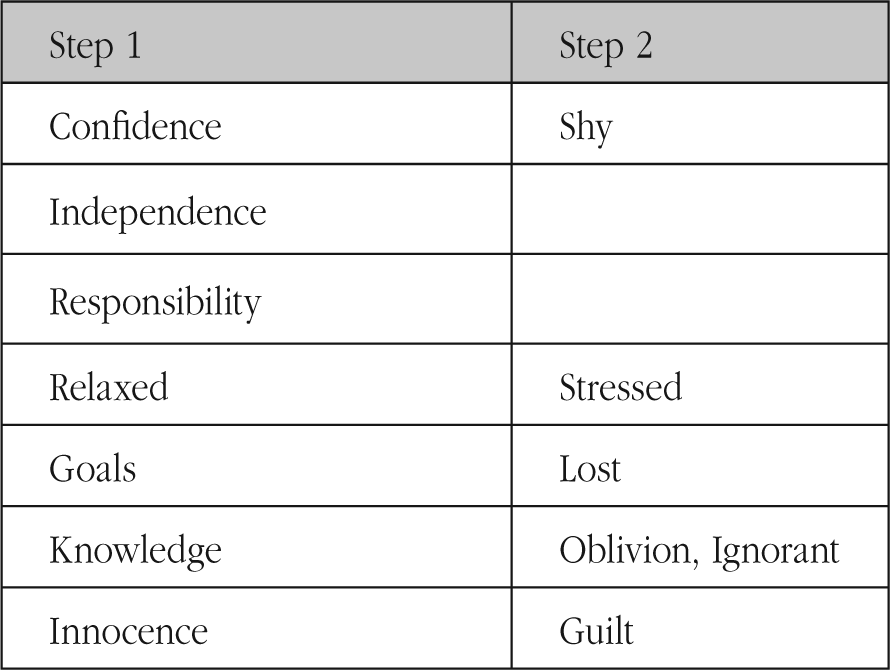
Step 3: Place some of the opposing words in a true sentence about your subject of Mental Strength:
When I am relaxed, I am mentally ready to overcome any task; if I am stressed, I can do nothing.
I must have confidence to be strong, for if I am shy, and I question myself, I am weak.
When I have goals, I know who I want to become and where I want to go; when I do not, I am ignorant of who I am becoming and where I’m going.
Step 4: In the final step, we use strict form to help us make meaning. Write one paragraph of five sentences about Mental Strength using the following guidelines:
Sentence 1: a five-word statement
Sentence 2: a question
Sentence 3: two independent clauses combined by a semicolon
Sentence 4: a sentence with an introductory phrase
Sentence 5: a two-word statement
Charlie’s paragraph was as follows:
Mental Strength leads to success. Without it, can I really do what I want to do? My mindset allows me to accomplish my goals; my goals allow me to go somewhere. To get where I want to in life, I must know where it is I want to go. Becoming myself.
Draw Your Thoughts
Sketch a moment in time during a competition and write your thoughts at the time. For example, draw a section of a race course—perhaps a certain gate combination—and sketch your skiing line and then add “thought bubbles” that would suggest your approach to taking that combination. Charlie’s drawing is Figure 4.
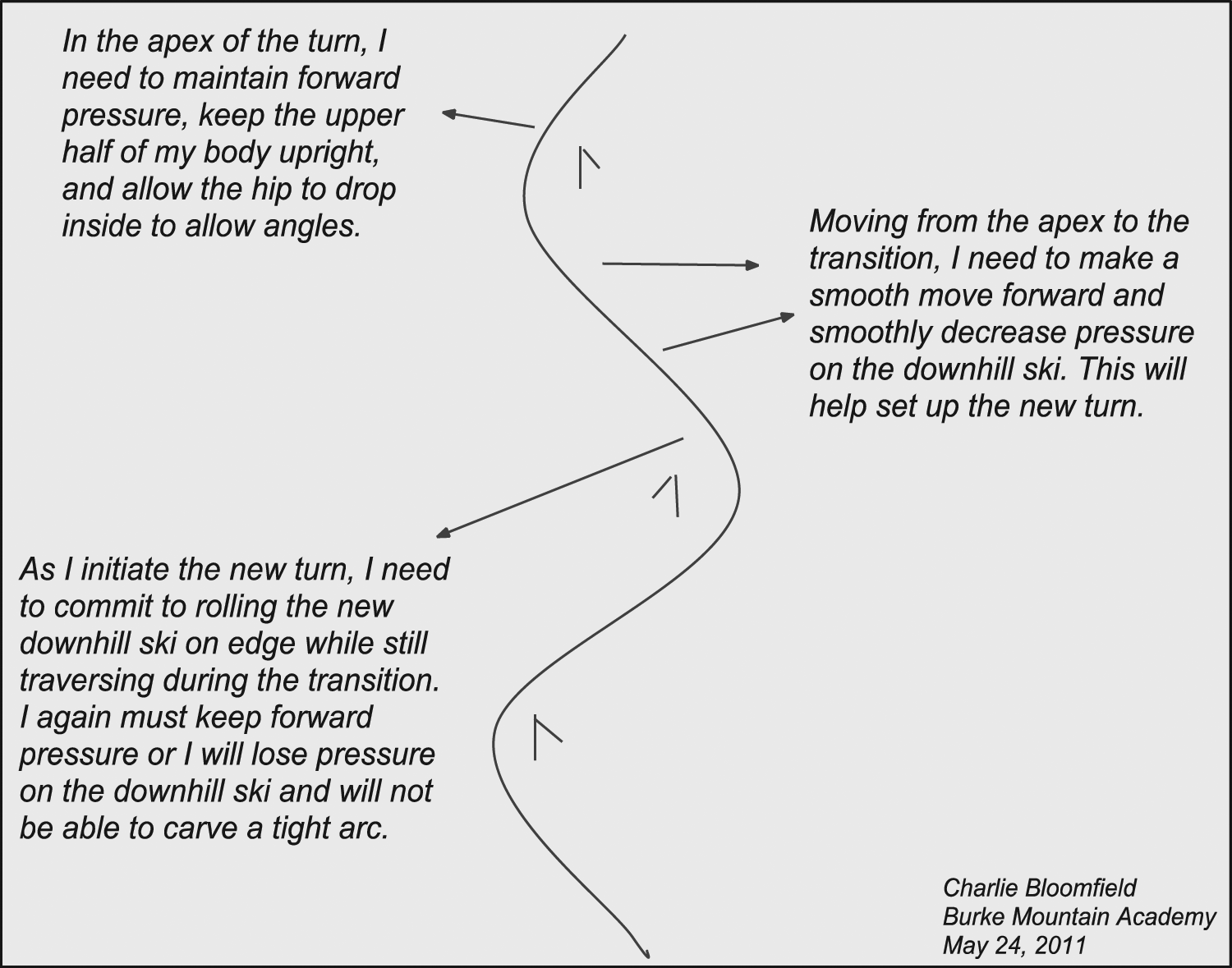
Charlie’s drawing.
Further Connections
Throughout my work with coaches and athletes, I identified some of the myriad ways student-athletes learn (Kent, 2011). They are highlighted in Figure 5. Note the activities student-athletes may undertake (e.g., reading sports articles, keeping a blog) and imagine coaching practices that deliberately address and promote different learning styles. Consider the opportunities for gifted writers, twice exceptional males who may struggle with reading, and that quarterback whose bodily/kinesthetic intelligence brings home the coveted gold ball.
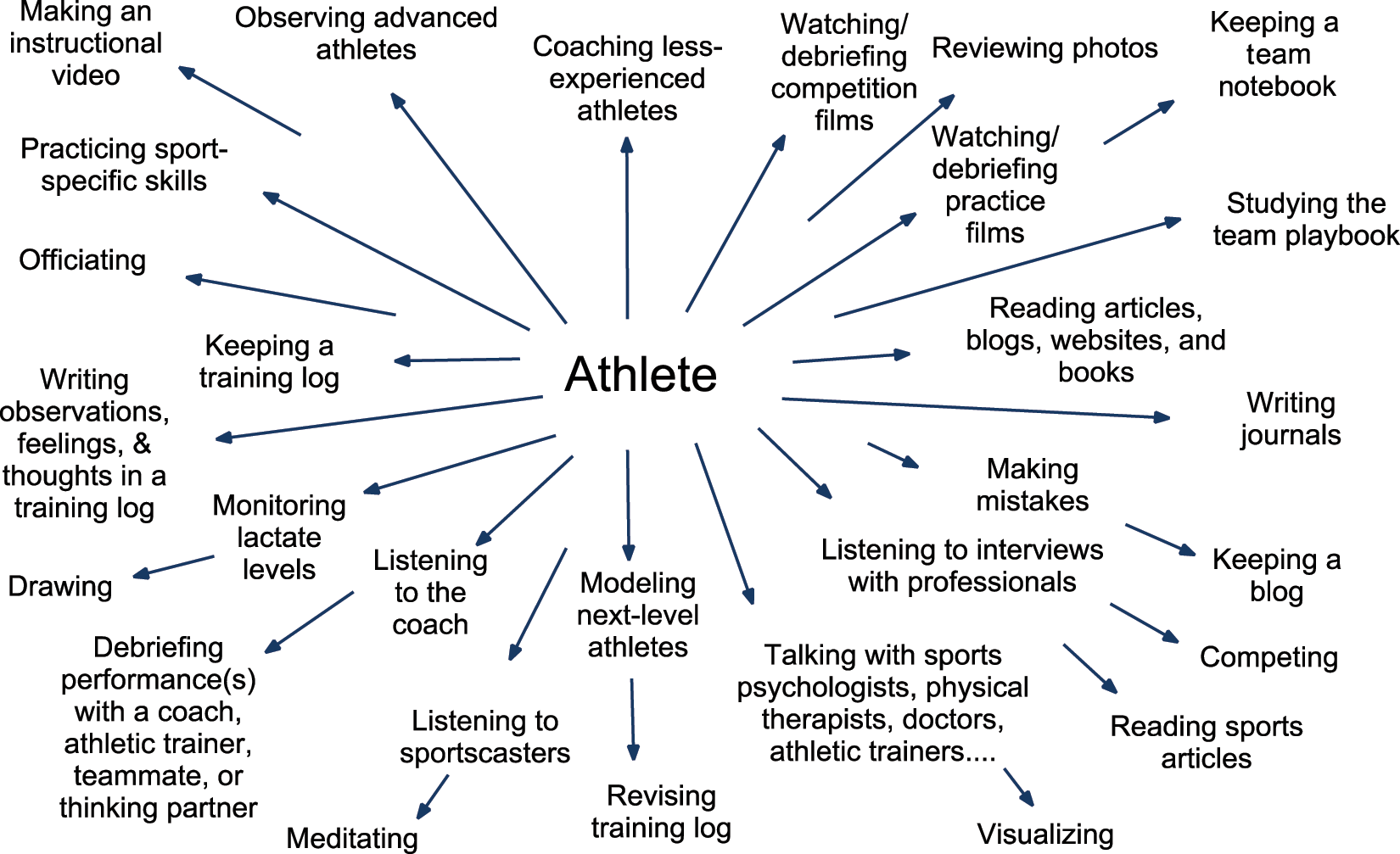
Some of the ways athletes learn.
Encouraging gifted males to explore their understandings of their academic and athletic abilities through writing gives these young people the kind of “freedom and individuality in learning situations” that engage gifted students (Manning, 2006). We heard this engagement in Charlie’s writing when he addressed the technical aspects of his ski racing and the personal issues he faced as a young adult.
In their research on boys and literacy, Smith and Wilhelm (2002) and Newkirk (2002) addressed the positive effects of high-interest writing assignments and choice. In Boy Writers: Reclaiming Their Voices (2006), Fletcher identified “sports commentary” as a genre of high interest to boys when interviewed in Education Week by Michael F. Shaughnessy (2006), Consulting Editor for Gifted Education International. Hébert and Pagnani (2010) highlighted Tony Hawk’s and Sean Mortimer’s (2000) biography titled Hawk: Occupation: Skateboarder, as a popular book for many boys. Evidence suggests that journals provide gifted adolescent male student-athletes with writing (and reading) opportunities in the high-interest area of sports while offering choice of writing assignments.
A student’s own story within the pages of his athlete’s journal might be used in his English language arts classroom as a free writing assignment, in his physical education class as a way to learn more about developing an effective training plan, or in history class to explore one’s own personal history. Such writing happens in Mary Poulin’s English class at Maine’s Carrabassett Valley Academy (CVA), another elite ski academy. Poulin explains,
Juniors and seniors at CVA are enjoying the daily prompt at the onset of class. I offer two choices: (1) the opening line of a notable poem which they can spring board off in prose or poetry; or (2) a prompt from the text, Writing on the Bus. Most choose the athletic prompt . . . [we’ve] talked about authenticity, humility, good sportsmanship.
Summary
Journals provide diverse learning opportunities for gifted males and their coaches. Whether an athlete writes twice a week or every day, taking “a timeout” to reflect on training and competition sets a tone of thoughtful inquiry that promotes learning. As Newkirk (2012) noted,
Competitive sport . . . involves intense and continuous reflection, what John Dewey called “intelligence.” By that Dewey meant the ability to locate and name problems, to devise plans, to test them in practice—then to revise plans and begin the cycle again. (pp. xii-xiii)
Journals will not take the place of organized and dedicated training, smart coaching, or the genetic gift of being a 6’ 10” power forward with serious ups. But as Charlie’s words demonstrated, writing does give athletes an opportunity to explore, analyze, and maybe ski a bit faster.
Addendum
Journal Book
To guide student-athletes in thinking about their training, competitions, and lives, coaches may wish to create an athlete’s journal book that can be photocopied and distributed to athletes. The following includes six examples of writing activities for a sports season:
Day One—Journal prompt: Time Line: Draw and label a time line of your athletic career thus far. Identify your athletic milestones, important coaches, and significant changes.
Day Two—Journal prompt: Write about some of your athletic favorites. Why are they your favorites?
Elite athlete Training partner Place to train
Place to compete Opponent Shoes
Day Three—Journal prompt:
Three-Minute QuickWrite: What makes training hard for you?
Three-Minute QuickWrite: What makes training easy for you?
Day Four—Journal prompt: Write a game: Tell the story of one of your games or competitions. Begin with your pregame routine all the way through your cool down. Remember to write about the nitty-gritty like what you ate, how long you warmed up, pregame visualization, thoughts at different stages of the game, strategies, the effect of the crowd on you, recovery, and so on.
Day Five—Journal prompt: Read and highlight a section from your favorite sport book, magazine, or blog. After reading and highlighting areas of interest, make a list of points of interest and select at least three of them to write more about in relation to your own training.
Day Six—Journal prompt: Letter to former coach: Write a letter to one of your favorite former coaches. You may wish to include the following:
what you’re doing now as an athlete
the coach’s contributions to your career
the issues you currently face as an athlete
a fun memory from your time with this coach
a picture from “back in the day,” if you have one
personal news beyond sport
Footnotes
Conflict of Interest
The author(s) declare no potential conflicts of interest with respect to the authorship and/or publication of this article.
Bio
Richard Kent, PhD, is the author of Writing on the Bus: Using Athletic Team Notebooks and Journals to Advance Learning and Performance in Sports (2012). A site director for the National Writing Project, Kent is an associate professor at the University of Maine who serves as a consultant to athletes, teams, and sports academies. An athletic coach for 33 years, Maine’s 1993 Teacher of the Year maintains an informational website on athletes and their writing ( ).
).