






Abstract
Incomplete sensed data in structures have made exact structural damage detection a serious challenge. In this paper, an effective method is presented for damage detection and estimation in structures based on incomplete modal data of a damaged structure via a pattern search algorithm. An objective function based on the condensed mass and stiffness matrices is formulated. The proposed method determines the damage to structural elements using optimization of the objective function by using pattern search algorithm. The performance of the presented method has been verified through two numerical examples, namely, a two-span continuous beam and a three-story plane frame with and without noise in the modal data containing several damages. Also, the effect of the discrepancy in mass and stiffness between the finite-element model and the actual tested dynamic system has been investigated. Furthermore, the experimental data from the vibration test of a mass–stiffness system are used for verification of the proposed approach. The results show that the presented method is sensitive to the location and severity of structural damage in spite of the incomplete modal data.
1. Introduction
Much attention has been given to structural damage detection in recent decades in order to assess the reliability of structures during their service time. To detect damage in structures, one method, among the different ones, is considered the most important, i.e. vibration-based methods. Because the modal parameters of structures such as the frequency and mode shape are so sensitive to structural properties such as stiffness, it can therefore be used for detecting damage in structures (Doebling et al., 1998).
One of the problems in damage detection is the compatibility between the number of sensors and degrees of freedom (DOFs) in the finite-element model of structures, in which the number of sensors, installed to structure, is usually less than the number of DOFs in the finite-element model. As a result, damage detection using incomplete modal data has been inspected by some researches in recent years. Law et al. (1998) presented a three-stage method for damage detection with incomplete modal data, which consists of: (a) expansion of the measured mode shapes, (b) localization of the damage domain using the elemental energy quotient difference, and (c) damage quantification based on sensitivity of the modal data. Au et al. (2003) describe a two-level search strategy to detect damage based on a micro-genetic algorithm using incomplete modal data. In the first step, the elemental energy quotient difference is employed to approximately locate the damage domain and then a micro-genetic algorithm is used to quantify the damage extent by minimizing the error between the measured data and numerical results. Duan et al. (2007) extended the damage locating vector method to the case of ambient vibration with incomplete measured DOFs. Rahai et al. (2007) presented a global algorithm for detecting and estimating damage in structures based on the parameter estimation method, in which elemental damage equations, which partially relate the measured mode shape of the damaged structure to the change of structural parameter, are developed using incomplete measured mode shapes. The results show that this method is capable of detecting damage with the same high level of accuracy with less measurement and experimental efforts. Recently, Li et al. (2008) developed the cross-model cross-mode (CMCM) method for damage detection that is capable of identifying the damage to individual member of offshore jacket platform, when limited, spatially incomplete modal data were available.
Some researchers used model updating for damage detection of structures with incomplete modal data. Yuen et al. (2006) studied a Bayesian structural model updating methodology which can treat incomplete modal data. Ching et al. (2006) developed a Gibbs sampler approach for linear Bayesian structural model updating, in which the goal is to detect and quantify any damage using incomplete modal data obtained from small-amplitude vibrations measured before and after a severe loading event. Carvalho et al. (2007) presented a direct method for model updating with incomplete modal data. The proposed method uses an algorithmic method without needing any model reduction or modal expansion techniques. Huajun et al. (2008) extended the CMCM method to simultaneously update the mass, damping and stiffness matrices of a finite-element model when only few spatially incomplete, complex-valued modes are available. The results reveal that applying the CMCM method, together with an iterative Guyan reduction scheme (Guyan, 1965) can yield good damage detection in general. Also, Chen (2008) presented an approach for detecting local damage in large-scale frame structures by utilizing regularization methods with incomplete noisy data. A system of linear basic equations for determining the damage indicators has been developed by directly adopting the measured incomplete modal data.
Recently, fuzzy approaches have been applied to solve structural engineering problems. Chiang et al. (2004), Hsiao et al. (2005), Chen (2006, 2009, 2011), Chen et al. (2006, 2007, 2009), and Yeh et al. (2008, 2009) proposed new methods for control and stability analysis of systems using the fuzzy method. In the field of damage detection, Pawar and Ganguli (2007) used fuzzy logic with genetic algorithms to detect cracking and delamination in a composite helicopter rotor blade. In addition, Chandrashekhar and Ganguli (2009) presented a method for uncertainty handling in structural damage detection using fuzzy logic and probabilistic simulation.
A pattern search method is considered as a kind of prominent direct search strategy, which was first introduced by Box (1957) and Hooke and Jeeves (1961). The pattern search approach is a deterministic, fast and efficient derivative-free optimization process searching for objective function minima (Tokan and Gunes, 2011). Unlike other heuristic algorithms, the pattern search method possesses a flexible and well-balanced operator to boost and adopt the global search as well as fining tune local search. Pattern search method has been widely used in different fields of engineering as robust and promising methods to tackle barriers of traditional methods [Swann, 1972; Lewis et al., 2000; Biondi et al., 2006; Al-Sumait et al., 2007].
In this paper, a new method is introduced to detect and estimate damage in structures using the frequencies and incomplete mode shapes of a damaged structure. The Guyan reduction method has been used to condense the mass and stiffness matrices. The damage identification is carried out through applying the pattern search method to minimize the objective function. This method has been applied to two numerical examples, namely a two-span continuous beam and a three-story plane frame containing several damages. Furthermore, the experimental data from the vibration test of a mass–stiffness system are used in the present approach. The final results show that the present method performs quite well in spite of the incomplete modal data.
2. Problem formulation
In this section, the proposed approach for structural damage detection and estimation are described in detail. First, the objective function using incomplete modal data is formulated. Then, the pattern search optimization algorithm for minimizing the objective function is presented.
2.1. Objective function
The differential equation governing free vibration of an undamaged system is

The modal characteristics of Equation (1) for an undamaged structure are described by the equations

One of the simplest techniques to determine damage-induced alteration stiffness is the degradation in Young's modulus of the element as follows:

Degradation in the Young's modulus of the element can be defined as follows:
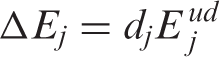
Moreover, it is assumed that no change would occur after damage in the mass matrix, which seems to be reasonable in most real problems.
In the finite-element method, the global stiffness and mass matrices are formed by assemblage of element matrices. So, the global stiffness matrix of a damaged structure can be made using the damaged element stiffness matrices as follows:

Thus, as mentioned above, the eigenvalue equations for a damaged structure become

As the number of sensors used to measure modal data is normally limited and usually are less than the number of DOFs in the finite-element model, either the model reduction method should be used to match with incomplete measured mode shapes or the measured mode shapes must be expanded to the dimension of the analytical mode shapes. Because we have no convergence in the proposed optimization method using the modal expansion, the first option has been adopted using the Guyan static reduction method. This method is employed to condense the mass and stiffness matrices. In this method, the mass and stiffness matrices, and the displacement and acceleration vectors in Equation (1) are partitioned into a set of master and slave DOFs:

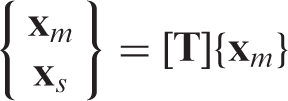
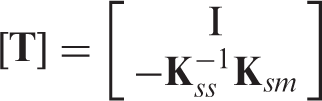
Substitution of Equation (8) into Equation (7), followed by permultiplication by [


In which
Applying the incomplete measured mode shapes and natural frequencies of damaged structure to Equation (10) leads to form the inverse problem of determining the damage severity parameter. The definition of a local damage severity parameter d in the finite-element model allows the damage quantity and location to be estimated together since damage identification is then carried out at the element level. The problem can be formulated as an optimization problem of the objective function while using some transforms as a direct inversion to obtain a solution is impossible most of the time.
Localizing and quantifying damage is often considered as a difficult and complex problem, requiring a sophisticated optimization procedure. In typical optimization problem, there may be lots of locally optimal layout; therefore, a downhill-proceeding algorithm in which steady declining value of objective function is created in iterations, may be stuck into a locally optimal point instead of providing global optimal solution. For that reason, global search algorithms, such as the pattern search method, are adopted by the authors in order to characterize damage.
The pattern search approach attempts to find the best solution to a given problem by minimizing an objective function. In any optimization process, existence of objective function is an indispensable part of the problem. Then, the key point in a minimization problem is the objective function.
The general statement for the objective function is

In the process of substituting the incomplete measured modal parameters of the damaged structure in Equation (10), a dynamic residue vector can be defined over each measured mode as follows:

Then, if structural damages are determined correctly, the residue vector would be near to 0 in Equation (14). Therefore, the problem of damage detection can be formulated as an optimization problem. The objective is to minimize the following objective function:

2.2. Optimization using a pattern search method
The pattern search method is a subclass of direct search methods which were first introduced in the 1950s (Box, 1957); however, in 1991, there was a growth in interest in the direct search method. Since then two things have become increasingly clear (Kolda et al., 2003):
Direct search methods remain an effective option, and sometimes the only choice, for several varieties of difficult optimization problems. For a large number of direct search methods, it is possible to provide a thorough guarantee of convergence.
The pattern search method is a derivative-free method for solving a variety of optimization problems where typical optimization methods are not so effective. The main idea of this procedure is to generate a sequence of iterates which consider the behavior of the objective function at a pattern of points, all of which lies on a logical lattice without utilizing any information about derivatives including gradient and second-order derivatives of the objective function.
The pattern search method can be briefly explained in a way that starts by establishing a set of points called a mesh around the given point which could be computed from a previous step of the iteration or from the initial starting point provided by the user. The mesh is created by adding a scalar multiple set of vectors called a pattern to the current point, then it searches a set of points (mesh) around the current point of parameters to find a point where the objective function has a lower value. After a point with a lower objective function value is detected, the algorithm sets the point as its current point and the iteration can be considered successful. Then, the algorithm steps to the next iteration with extended mesh size which is induced by the expansion factor. If the algorithm does not find a point that improves the objective function, the iteration is called unsuccessful. The current points stay the same in the next iteration and the mesh size decreases due to the contraction factor (Lewis and Torczon, 2002). The pattern search optimization algorithm stops when any of the following situations occurs (Coelho and Mariani, 2006):
The number of iterations or evaluation of the objective function reaches the maximum value. The mesh size becomes less than the mesh tolerance. The distance between two successful points obtained in two consecutive iterations is less than the given tolerance. Alteration in the improvement of the objective function is less than the function tolerance.
The optimization problem is formulated as a minimization of the objective function. The pattern search method applied to Equation (15) to find an optimal solution using incomplete modal data which leads to localizing and quantifying damage.
3. Numerical examples
In this section, the efficiency and effectiveness of the proposed method is evaluated through some numerically damage identification examples using incomplete modal data, which may be noisy or noise-free. Also, different initial values of damage severities and the modeling errors in the analytical model have been tested to check the proposed method. A two-span continuous beam and three-story plane frame are chosen with two different scenarios of damage for each of them for this purpose.
3.1. Two-span continuous beam
A two-span continuous beam as illustrated in Figure 1 with a finite-element model consisting of 20 beam elements and 21 nodes is considered. The numerical studies are carried out within the MATLAB (Mathworks, 2008) environment, which is used for the solution of finite-element problems.
The two-span continuous beam with the finite-element model.
For the considered concrete beam, the material properties include Young’s modulus of E = 25 GPa and mass density of ρ = 2500 kg/m3. The cross-sectional area and the moment of inertia of the beam are A = 0.35 m2 and I = 0.01429 m4.
Damage patterns for the two-span continuous beam
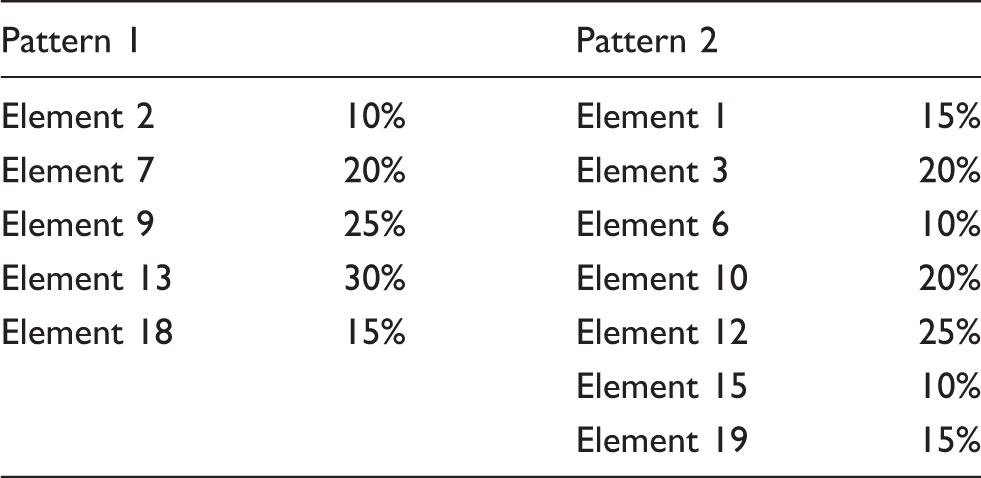
In this case, only 18 translational DOFs are selected as measured DOFs and the spatially incomplete modes are measured for the damaged structure at 18 translational DOFs.
Input parameters for the pattern search method
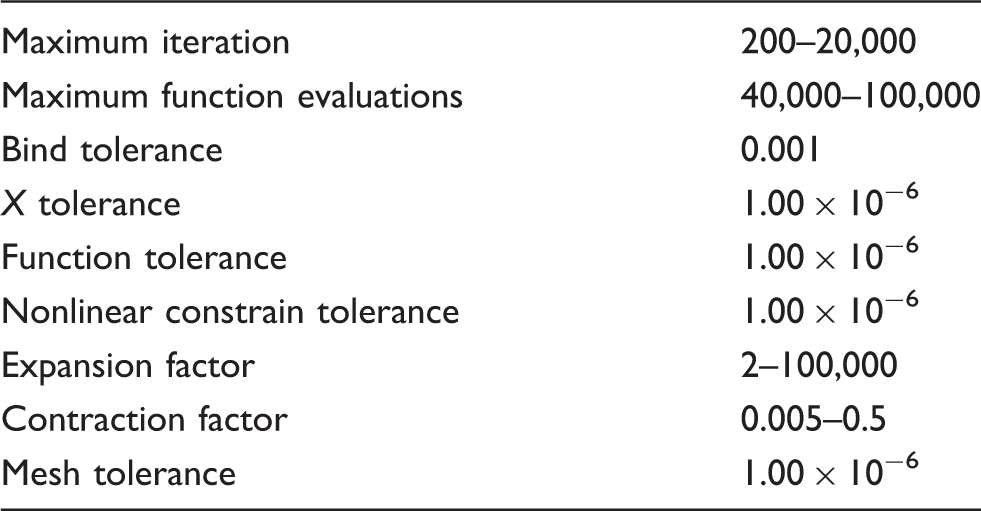
Different initial values of damage severities in the proposed method have been tested to check its convergence. Figures 2 and 3 show the results of damage identification in the two-span continuous beam for two damage patterns with zero and 20% initial values, respectively. The figures show that the proposed method is a robust and effective method in detecting and quantifying various damage patterns with different initial values of the damage severities. Note that better estimations are obtained when the number of applied modes increases.
The obtained results for two damage patterns of the two-span continuous beam with zero initial values. The obtained results for two damage patterns of the two-span continuous beam with 20% initial values.

To be more suited with the real dynamic cases, another examination has been performed in which the natural frequencies with 5% noise are utilized to damage identification considering the same patterns mentioned before. Figure 4 illustrates that the proposed method is robust and promising in detecting and quantifying various damage patterns with 5% noise. Although some undamaged elements are detected as damage by mistake in which the value of damage is very low, the damaged elements are properly detected with a correct value of severity. As was noted before by increasing mode numbers, the accuracy in detecting and quantifying damage increases but when the model is contaminated with noise, there are some extra perturbations in other elements. A reason for this is the presence of noise in different modes, in other words, noise put its influence three times more in comparison with the time when only one mode is used in the method.
The obtained results for two damage patterns of the two-span continuous beam with 5% noise.
Finally, the modeling errors in the analytical model have been studied. It is assumed that the actual tested beam has perturbations of stiffness of 3%, 4% and 5% at elements 3, 12 and 19, respectively, and perturbations of mass of 5%, 4% and 5% at elements 2, 9 and 17, respectively. Figure 5 illustrates the efficiency and effectiveness of the proposed method in detecting and quantifying of various damage patterns considering the modeling errors.
The obtained results for two damage patterns of the two-span continuous beam with modeling errors.
3.2. Three-story plane frame
Consider a three-story plane steel frame in which the finite-element model consists of nine elements (six columns and three beams) and six free nodes, as shown in Figure 6. For the considered steel frame, the material properties of the steel include a Young’s modulus of E = 200 GPa, mass density of ρ = 7850 kg/m3. The mass per unit length, moment of inertia, and cross-sectional area of the columns are m = 117.75 kg/m, I = 3.3 × 10⁻⁴ m4 and A = 1.5 × 10⁻² m2, respectively; for the beams are m = 119.32 kg/m, I = 3.69 × 10⁻⁴ m4 and A = 1.52 × 10⁻² m2. Also, the damage severity in each element is given by the reduction factor listed in Table 3.
The three-story plane frame with the finite-element model. Damage patterns for the three-story plane frame
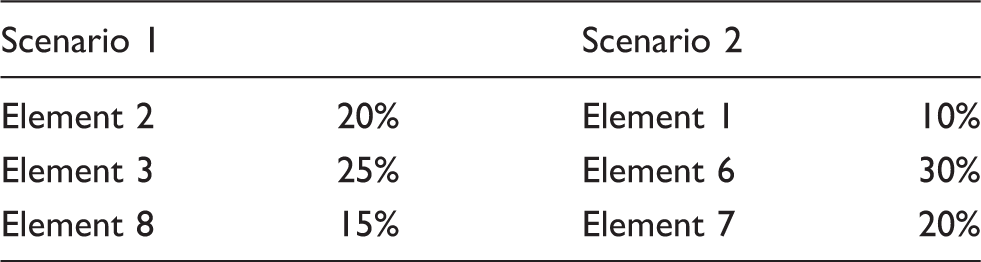
In this case, only six translational DOFs are selected as the measured DOFs in the process of damage detection and quantification.
Using modal parameters including natural frequencies and incomplete mode shapes of the damaged frame, the proposed method was applied to detect and quantify the damage in the considered frame with different initial values of the damage severities. Figures 7 and 8 show the identified damaged elements using the proposed method with zero and 15% initial values, respectively. It can be seen that the damage severity and locations are precisely obtained for two different patterns considered with two different initial values of the damage severities. Results can be considered reasonably good even using one mode rather than three or six modes.
The obtained results for two damage patterns of the three-story plane frame with zero initial values. The obtained results for two damage patterns of the three-story plane frame with 20% initial values.

The modal data experimentally carried out usually are contaminated with noise, therefore to evaluate the stability and robustness of proposed method, it is essential to consider natural frequencies with noise. Figure 9 illustrates the same example investigated above contaminated with 5% noise, considering the patterns mentioned already. The results show that by increasing mode numbers the accuracy in detecting and quantifying damage decrease.
The obtained results for two damage patterns of the three-story plane frame with 5% noise.
Also, the modeling errors in the analytical model have been investigated. It is assumed that the actual tested frame has perturbations of stiffness of 2% and 4% at elements 1 and 8; respectively, and perturbations of mass of 5% and 3% at elements 6 and 7; respectively. Figure 10 shows the efficiency and effectiveness of the proposed method considering the modeling errors.
The obtained results for two damage patterns of the three-story plane frame with modeling errors.
4. Experimental study
In the previous section, the damage identification method was demonstrated through some numerical simulation studies. However, it is useful to examine the experimental performance of the proposed method using measured data from an experimental study. Therefore, in this section, the performance of the proposed damage detection and estimation method is validated thorough vibration response data measured from an 8-DOF spring–mass system tested by Duffey et al. (2001).
The 8-DOF spring-mass system is formed with eight translating masses connected by springs which is shown in Figures 11 and 12. Each mass is a disk of aluminum 25.4 mm thick and 76.2 mm in diameter with a center hole. The masses are fastened together with coil springs epoxied to the collars that are, in turn, bolted to the masses (Duffey et al., 2001).
Schematic of the analytical 8-DOF system. Reproduced with kind permission from the ASME (Duffey et al., 2001). Experimental 8-DOF system with the excitation shaker attached. Reproduced with kind permission from the ASME (Duffey et al., 2001).

The undamaged configuration of the system is the state for which all springs are identical and have a linear spring constant. The nominal values of the system parameters are as follows: m1 = 559.3 g (this mass is located at the end and is greater than the others because the hardware is required to be attached to the shaker), m2–m8 = 419.4 g and spring constants are 56.7 kN/m. Damage is simulated by replacing an original spring with another spring which has a spring constant 14% less than that of the original (Duffey et al., 2001). The mass and stiffness matrix of undamaged system can be calculated as follows:

Based on the measured data, the two first frequencies and mode shapes which are measured in the last 5 DOFs were utilized for damage detection and quantification.
Figure 13 shows the capability of the proposed method for detection and quantification of damage in the experimental 8-DOF system. The obtained results indicated that the proposed method can be characterized as a robust and viable method for damage detection and quantification of actual structures.
The obtained result for the experimental 8-DOF system.
5. Conclusions
This study presented a novel method for detection and estimation of structural damage using the pattern search method. The proposed method can be localized and quantified the damage severity as an optimization problem in the elements of structure using incomplete modal data of the damaged structure. In the presented method, estimating the damage identification was conducted by optimizing an objective function applying the pattern search method.
To verify the efficiency and applicability of the proposed method, a comprehensive study on the damage detection and estimation using incomplete and noisy modal data was conducted through simulated damage patterns. Also, the effects of different initial values of the damage severities and perturbation in mass matrices and stiffness matrices were considered. The obtained results from the numerical and experimental studies indicated that the proposed method is a strong and viable method to the problem of damage detection and estimation in structures. Therefore, the suggested method can be characterized as a powerful method for structural damage detection and estimation in spite of incomplete modal data.
Footnotes
Funding
This research received no specific grant from any funding agency in the public, commercial, or not-for-profit sectors.