In the present study, the free vibration characteristics of single- and double-walled carbon nanotubes (SWCNTs and DWCNTs) are investigated on the basis of a nonlocal elastic shell model. Eringen’s nonlocal elasticity equations are applied to the classical Donnell shell theory to incorporate the size-effects into the vibration analysis of carbon nanotubes (CNTs). An exact solution is developed for the governing equations of the nonlocal elastic shell model with the inclusion of size effects. Molecular dynamics (MD) simulations are performed to obtain fundamental frequencies of SWCNTs and DWCNTs with different values of aspect ratio and types of chirality. To derive the appropriate values of a nonlocal parameter for vibrations of SWCNTs and DWCNTs, the results of the continuum model are matched with those of MD simulations. This study shows that the small scale effects in the nonlocal model make nanotubes more flexible.
Carbon nanotubes (CNTs) have attracted a great deal of attention from the scientific community due to their remarkable physical, electrical, and mechanical properties (Forro and Schönenberger, 2001; Yakobson and Avouris, 2001; Ho et al., 2004; Rafii-Tabar, 2004; Lopez et al., 2005; Sumfleth et al., 2010). As the size of CNTs is at the nanoscale, there are some difficulties in the experimental methods of investigation into their behavior that causes theoretical analyses of nanostructures to become increasingly important.
To consider the internal characteristic length in the constitutive equations, modified continuum models have been widely used in the theoretical researches because of their computational efficiency and their ability to generate truthful results which are comparable to those of atomistic models. For the vibration analysis of nanostructures many researchers have successfully used the nonlocal continuum mechanics which consider small scale effects. An investigation of transverse and torsional waves in single-walled carbon nanotubes (SWCNTs) and double-walled carbon nanotubes (DWCNTs) was conducted by Hu et al. (2008), focusing on the effects of CNT microstructure on wave dispersion in which the nanotubes were modeled as nonlocal single and double elastic cylindrical shells. Heireche et al. (2008) studied wave propagation in CNTs by modeling a single-elastic beam model using nonlocal elasticity based on the Euler-Bernoulli and Timoshenko beam theories. Ke et al. (2009) investigated the nonlinear free vibration of embedded DWCNTs based on nonlocal continuum mechanics and the Timoshenko beam theory. Murrmu and Pradhan (2009) developed a single-elastic beam model to analyze the thermal vibration of SWCNTs on the basis of thermal elasticity mechanics and a nonlocal elasticity theory. Narendar and Gopalakrishnan (2009) represented the effect of nonlocal scale parameter on the wave propagation in multi-walled CNTs.
In this work, the vibrational characteristics of SWCNTs and DWCNTs are investigated using nonlocal elasticity continuum as the nanotubes are modeled on the basis of a onlocal Donnell shell model. An exact solution is presented for the governing equations of the nonlocal shell models. Molecular dynamics (MD) simulations are also employed for a series of SWCNTs and DWCNTs with different aspect ratios and chiralities. The fundamental frequencies obtained directly from the simulations are matched with those of nonlocal elastic shell models through a nonlinear least square fitting procedure to extract the proper values of the nonlocal parameter. Moreover, the nonlocal effects on the vibrational behavior of CNTs are investigated.
2. Nonlocal elastic shell model
In classical continuum mechanics, the stress tensor at a reference point x of a body can be determined by the strain tensor at that point. According to Eringen (1972, 1983), in nonlocal continuum mechanics, the stress tensor at a reference point x in a body depends not only on the strain tensor at that point x, but also on the strain tensor at all other points of the body. In the context of two-dimensional nonlocal elasticity, the nonlocal stress tensor σ can be expressed in a differential form as
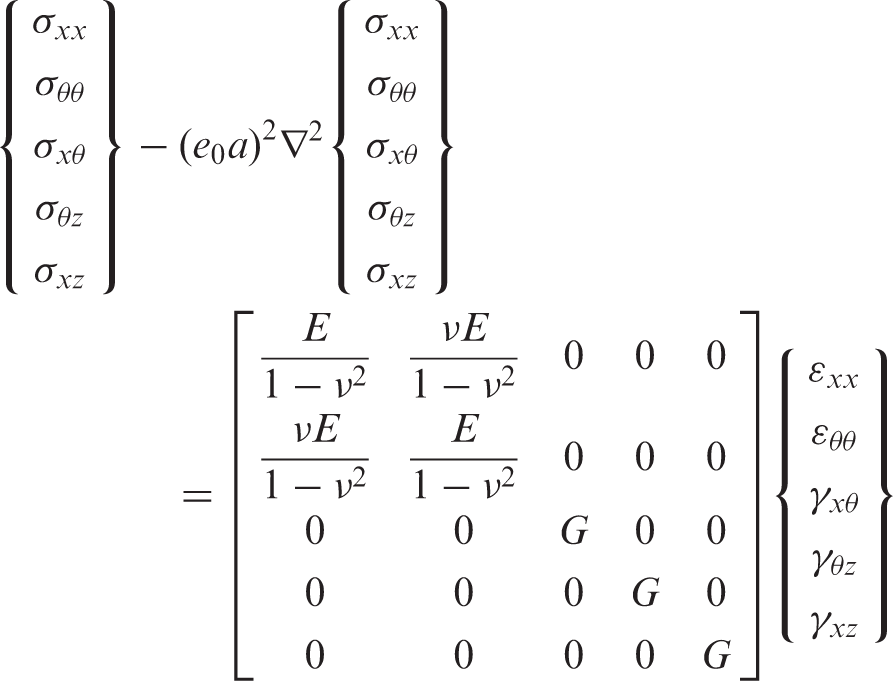
where is the nonlocal parameter and t is the macroscopic stress tensor at a point. In the limit, when the nonlocal parameter goes to zero, the nonlocal elasticity reduces to the local elasticity. By using Hooke’s law, the stress and strain relation can be expressed as
in which and ν are Young’s modulus, shear modulus and Poisson’s ratio, respectively. Consider a cylindrical shell of length L, radius R and thickness h with its coordinate system as x-axis is along the length of the shell. Based on the Donnell shell theory, the displacements and the rotations can be expressed in the following form
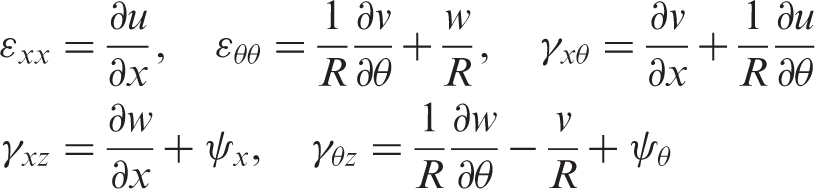
The following kinematics relations for normal strains , and shear strains , can be expressed as
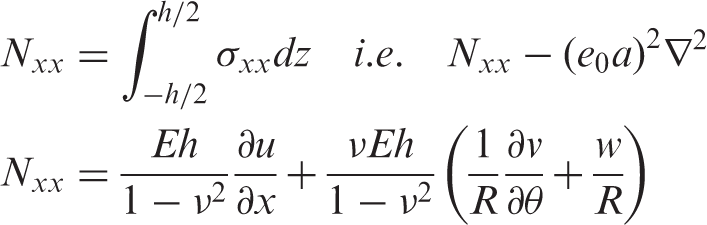
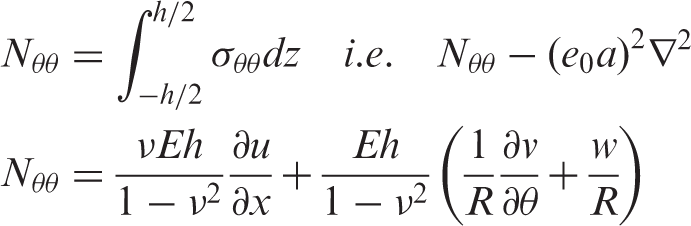
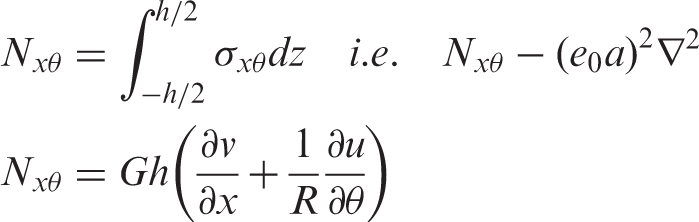
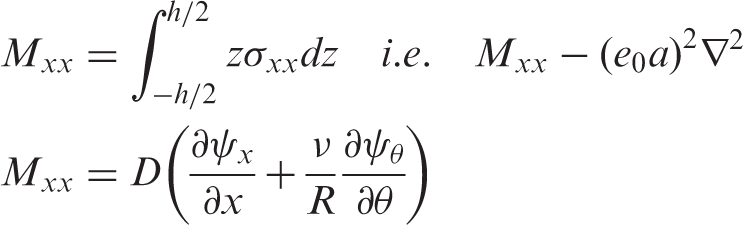
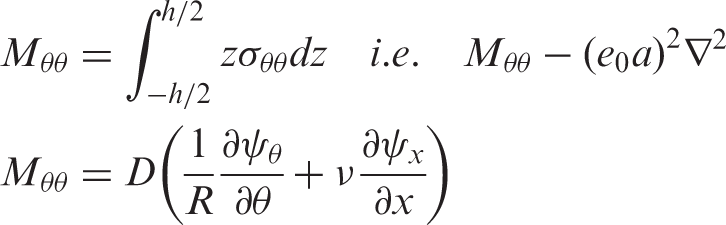
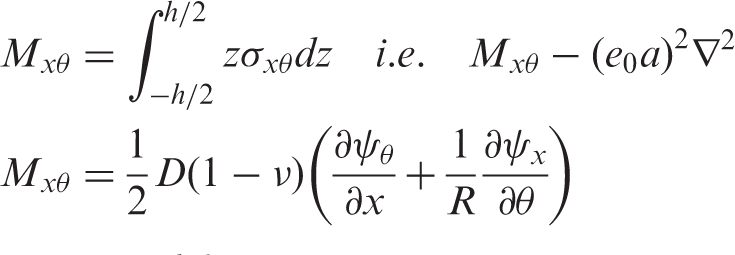
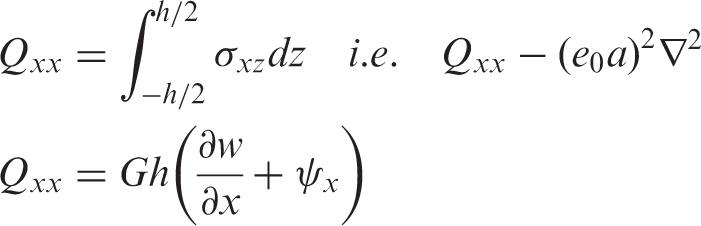
From equations (2) to (4), the nonlocal force and moment resultants, according to the Donnell (1976) shell theory, become
where D is the bending rigidity of shell. The governing equations, on the basis of the Donnell (1976) shell theory, can be given as
where are the inertia terms and p is the pressure exerted on the nanotube through the van der Waals (vdW) interaction forces in the case of vibrations of DWCNTs. The vdW model employed captures the effects of the van der Waals interlayer interaction of both walls of DWCNTs which can be obtained as
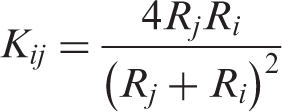
in which the vdW coefficients that represent the pressure increment contributing to wall to wall are given as
where
Å is the CC bond length, the depth of the potential, Å a parameter that is determined by the equilibrium distance.
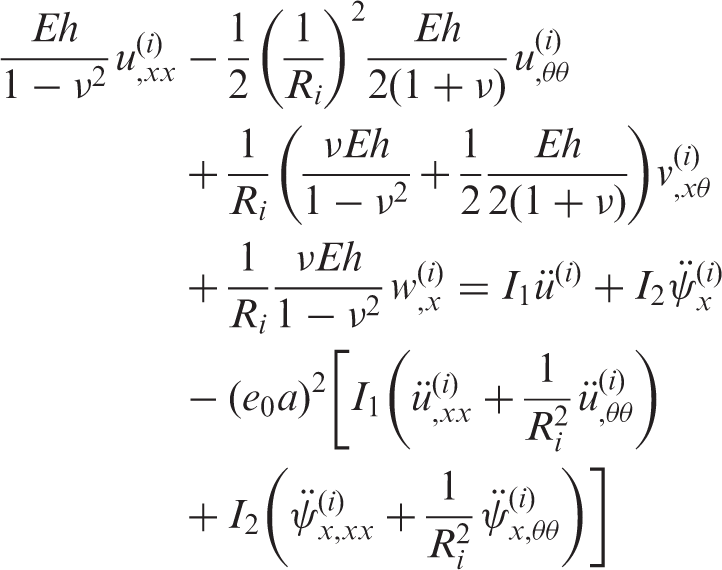
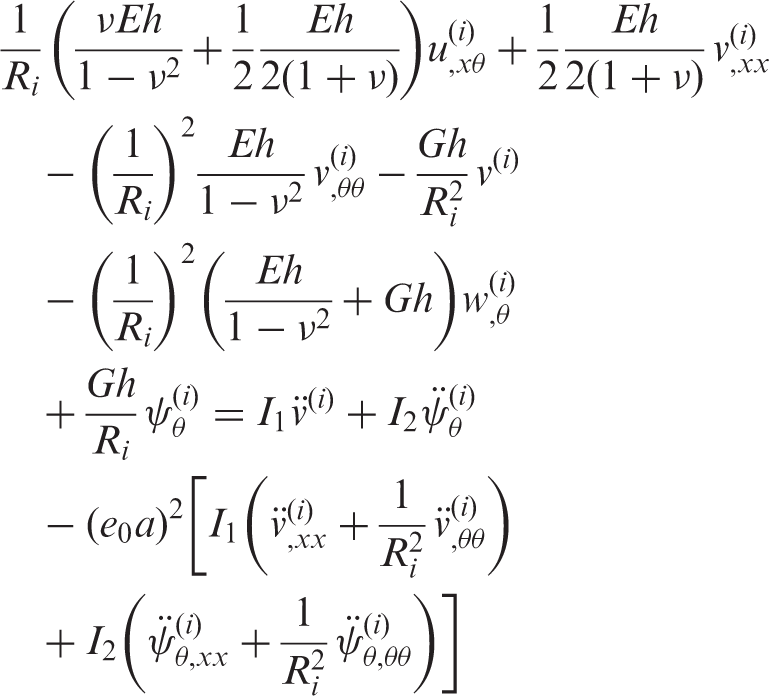
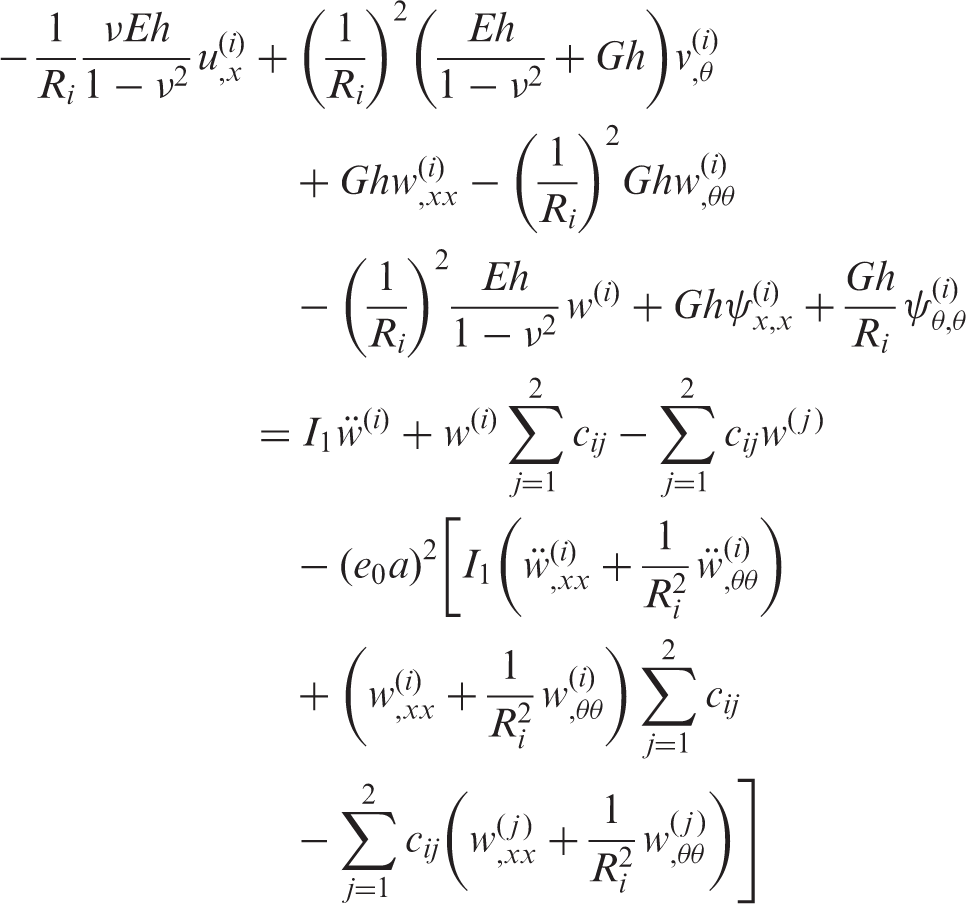
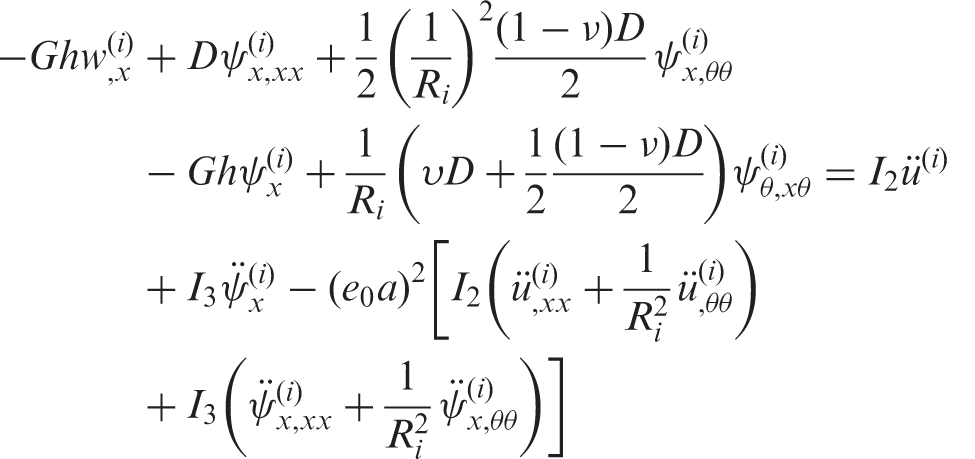
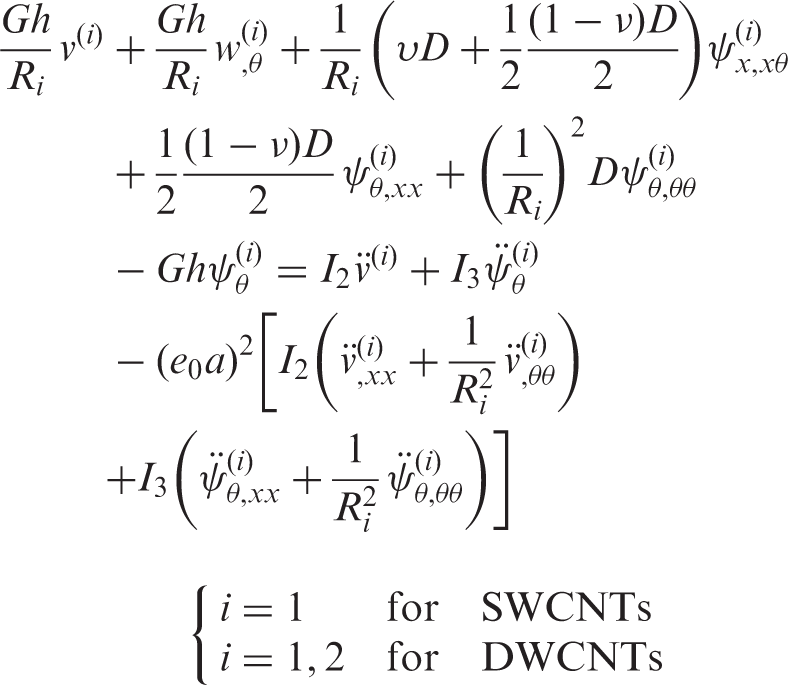
Substituting equations (5) into equations (6) yields the field equations corresponding to nonlocal Donnell shell model as
It must be remarked that the above field equations reduce to the classical Donnell shell theory ones by setting the nonlocal parameter equal to zero.
3. Analytical solution for simply-supported carbon nanotubes
In this section, an exact solution of the free vibration of CNTs is developed. The components of displacement and rotation can be considered in the following generalized form which satisfies the simply-supported boundary conditions
where ω is the angular frequency of vibrating CNT and and are the constant parameters denoting the amplitudes of the vibrations. n is the number of half waves in the axial direction and m is the number of waves in the circumferential direction.
Substituting equations (10) in the field equations of the present nonlocal continuum shell models and solving the resulting eigenvalue problem lead to obtaining the natural frequencies of SWCNTs and DWCNTs.
4. Molecular dynamics simulations
In this work, to assess the validity of the continuum model and also to propose the proper values of a nonlocal parameter, MD simulations are performed using the “NanoHive” simulator (Nanorex Inc., 2005). The simulations are conducted on SWCNTs and DWCNTs with different chiralities and aspect ratios. All simulations are established using the adaptive intermolecular reactive empirical bond order (AIREBO) potential (Stuart et al., 2000). The simulations are all performed at a constant temperature equal to the room temperature (300 Kelvin). The van Gunstern-Berendsen thermostat is implemented in such a way that the scaling factor is used after each step of the MD simulation; the velocities of the atoms of the system are scaled as the average kinetic energy remains approximately constant.
To accomplish the MD simulations of the vibrational response, SWCNTs and DWCNTs are initially deformed to that mode-shape which is to predict its fundamental frequency by mathematically changing the coordinate of carbon atoms. One layer of atoms at the end of the SWCNTs and DWCNTs is fixed in space to simulate simply-supported boundary conditions. After the atoms at both ends of the CNTs are fixed to simulate the simply-supported boundary conditions, they are allowed to vibrate freely for 10 000 timesteps of . By imagining the vibration responses of the SWCNTs and DWCNTs in the NanoHive post processor called Hive-keeper (Nanorex Inc., 2005), the fundamental vibration period of each CNT can be obtained which is then employed to find the fundamental frequency of free vibration associated to that mode-shape.
5. Numerical results and discussion
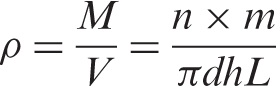
In the current study, the thickness and Young’s modulus of shell models are assumed to be and , respectively (Batra and Gupta, 2008; Wang and Zhang, 2008). The bending rigidity and Poisson’s ratio are also taken to be and (Yakobson et al., 1996; Yan et al., 2010). Moreover, the value of density used in the nonlocal shell models can be obtained easily as
where M is the mass of nanotube which is equal to n atoms with the mass of m. and L are the volume, diameter, thickness and length of the nanotube, respectively.
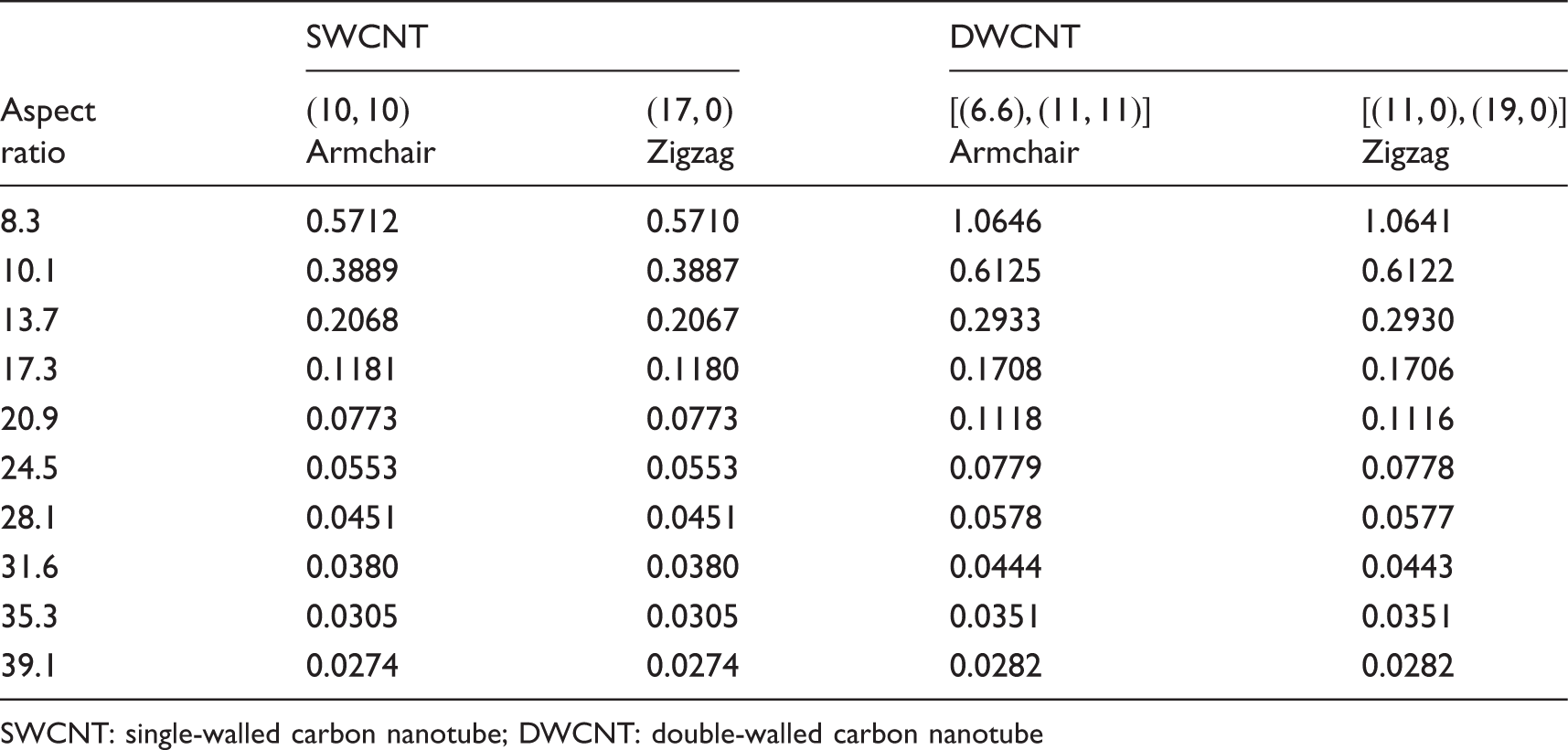
The fundamental frequencies obtained using MD simulations are given in Table 1 for SWCNTs and DWCNTs with different aspect ratios ( for SWCNTs and for DWCNTs) and chiralities. (10,10) armchair and (17,0) zigzag nanotubes in the case of SWCNT and [(6,6),(11,11)] armchair and [(11,0),(19,0)] zigzag nanotubes in the case of DWCNT are considered so that they have approximately the same diameters that makes it possible to investigate the effect of chirality. According to the results of MD simulations, it is discovered that the fundamental frequencies of armchair SWCNTs and DWCNTs are relatively a little higher than the ones corresponding to zigzag SWCNTs and DWCNTs, especially for lower values of the aspect ratio. This difference may be attributed to the chirality-dependent anisotropy of the CNT structure. However, it is seen that the chirality does not have a considerable influence on the value of the fundamental frequency of nanotubes.
Fundamental frequencies of armchair and zigzag SWCNTs and DWCNTs obtained from molecular dynamics simulation (THz)
An important issue in the application of the nonlocal elasticity models used for the CNTs is the determination of the appropriate value of the nonlocal parameter. In other words, employment of the nonlocal models is beneficial when the suitable value of a nonlocal parameter is available. In this work, the results of a nonlocal shell model are matched with the MD simulation ones using a nonlinear least square fitting procedure to minimize the Euclidean norm of the difference between the two series of results. In this procedure, the value of a nonlocal parameter is set as the optimization variable to obtain a consistent value of it. In Table 2, the appropriate values of a nonlocal parameter are given for SWCNTs and DWCNTs with different chiralities. It can be seen that the chirality does not have a considerable influence on the consistent value of a nonlocal parameter used in the nonlocal continuum shell model to predict the vibrational behavior of nanotubes.
Appropriate values of nonlocal parameter (nm) for SWCNTs and DWCNTs with different types of chirality
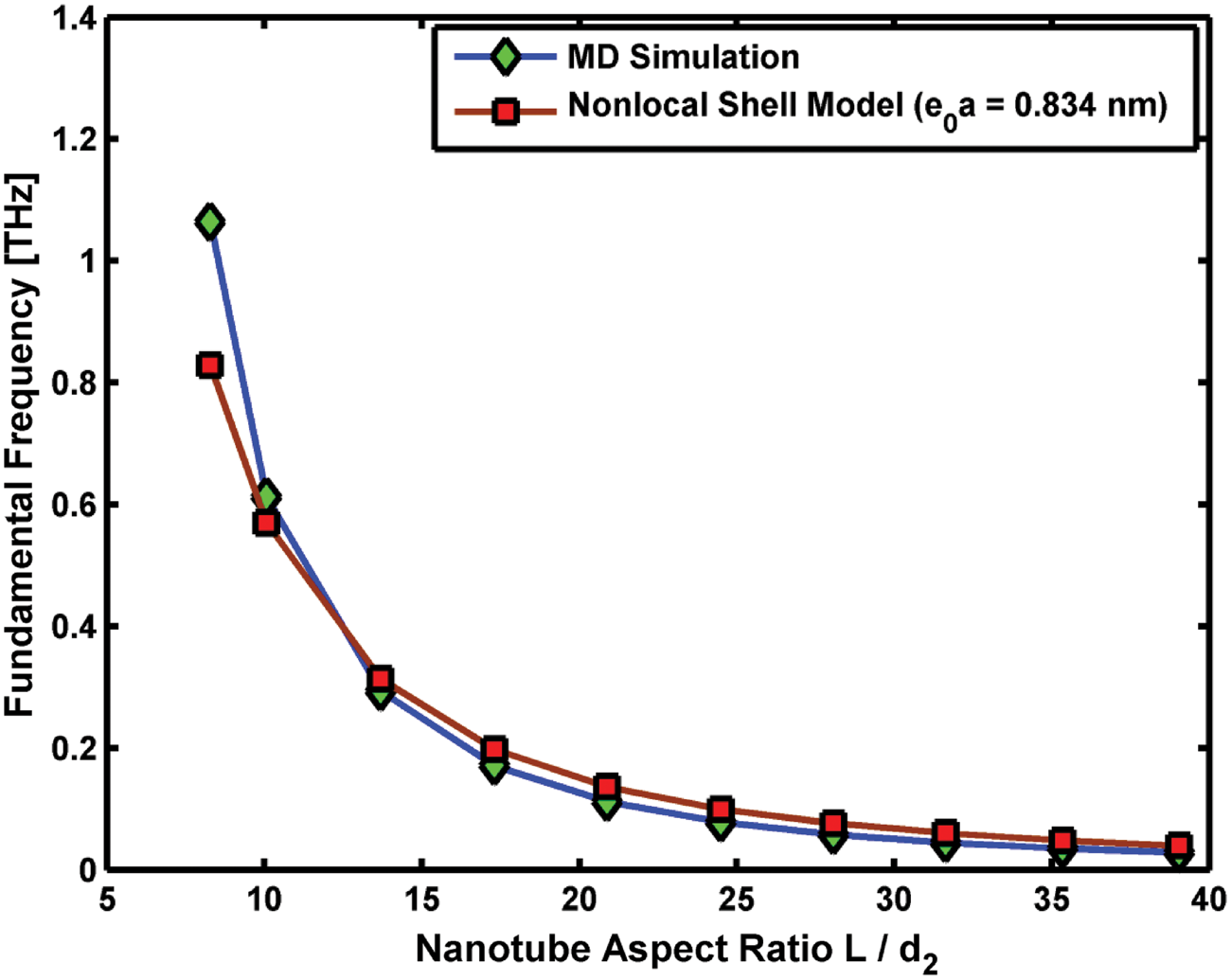
Additionally, Figures 1 and 2 show a comparison between the results obtained directly from MD simulations and those calculated by the nonlocal continuum shell model for armchair SWCNTs and DWCNTs, respectively. It can be observed that in the case of the SWCNTs, there is an excellent agreement between the two series of results. In the case of the DWCNTs, the present nonlocal continuum model with its appropriate nonlocal parameter has a good capability to demonstrate the free vibrational response of nanotubes, especially with aspect ratios higher than .
Comparison of the fundamental frequencies of single-walled carbon nanotubes obtained by the nonlocal shell model with those of molecular dynamics simulations.
Comparison of the fundamental frequencies of double-walled carbon nanotubes obtained by the nonlocal shell model with those of molecular dynamics simulations.
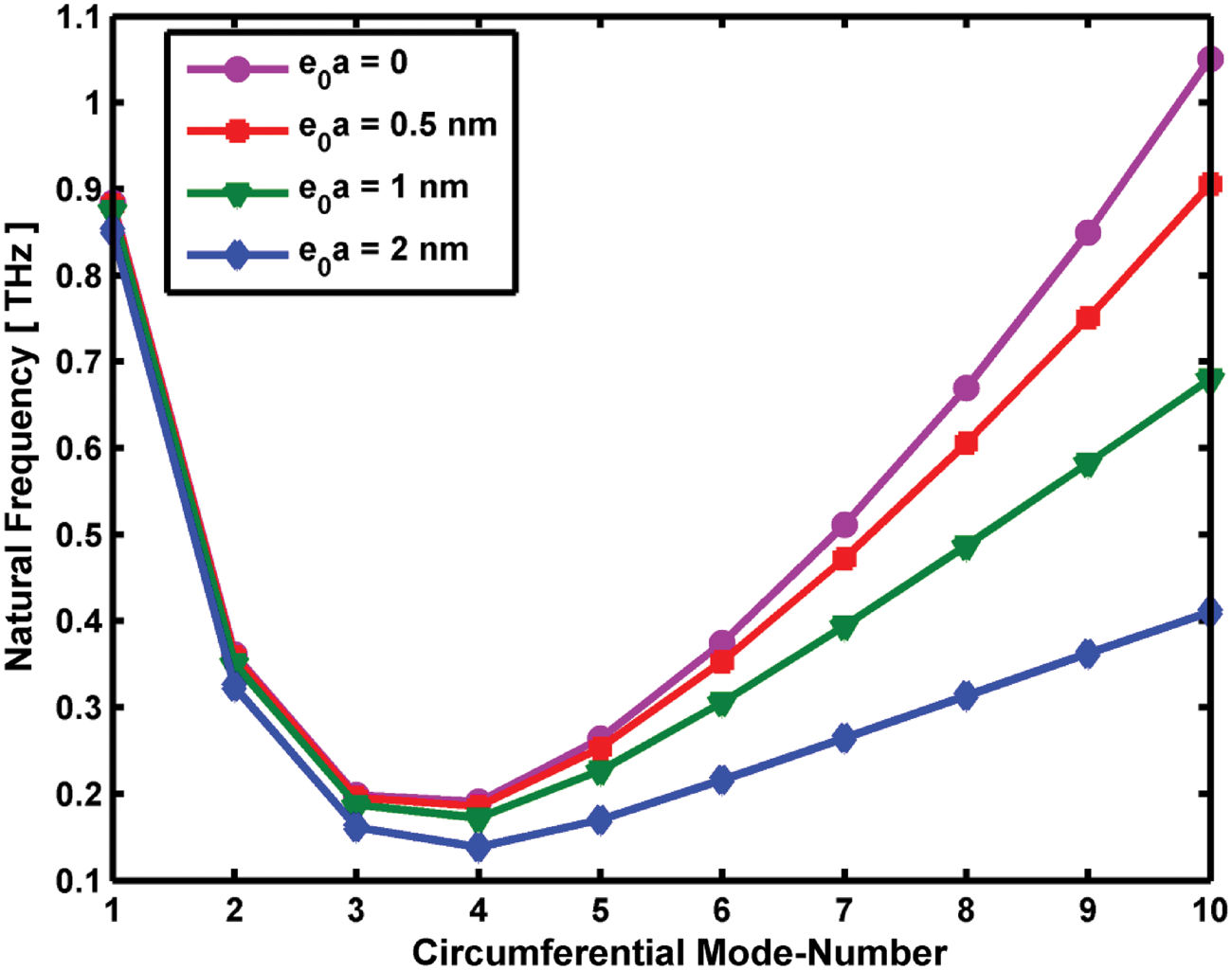
Figure 3 depicts the variation of natural frequencies of a SWCNT with the circumferential mode-number corresponding to different values of a nonlocal parameter. It is assumed that the nanotube radius and aspect ratio . It is found that with the increase of the circumferential mode-number up to the natural frequency of the nanotube decreases. However, the increase of circumferential mode-number higher than leads to an increase of the vibration frequency. Moreover, it can be seen that the effect of a nonlocal parameter on the natural frequency of the nanotube is more significant for higher circumferential mode-numbers. This shows that the influence of the small scale becomes more prominent for a shorter wavelength at higher modes.
Variation of natural frequencies of single-walled carbon nanotube with circumferential mode-number for different values of nonlocal parameter .
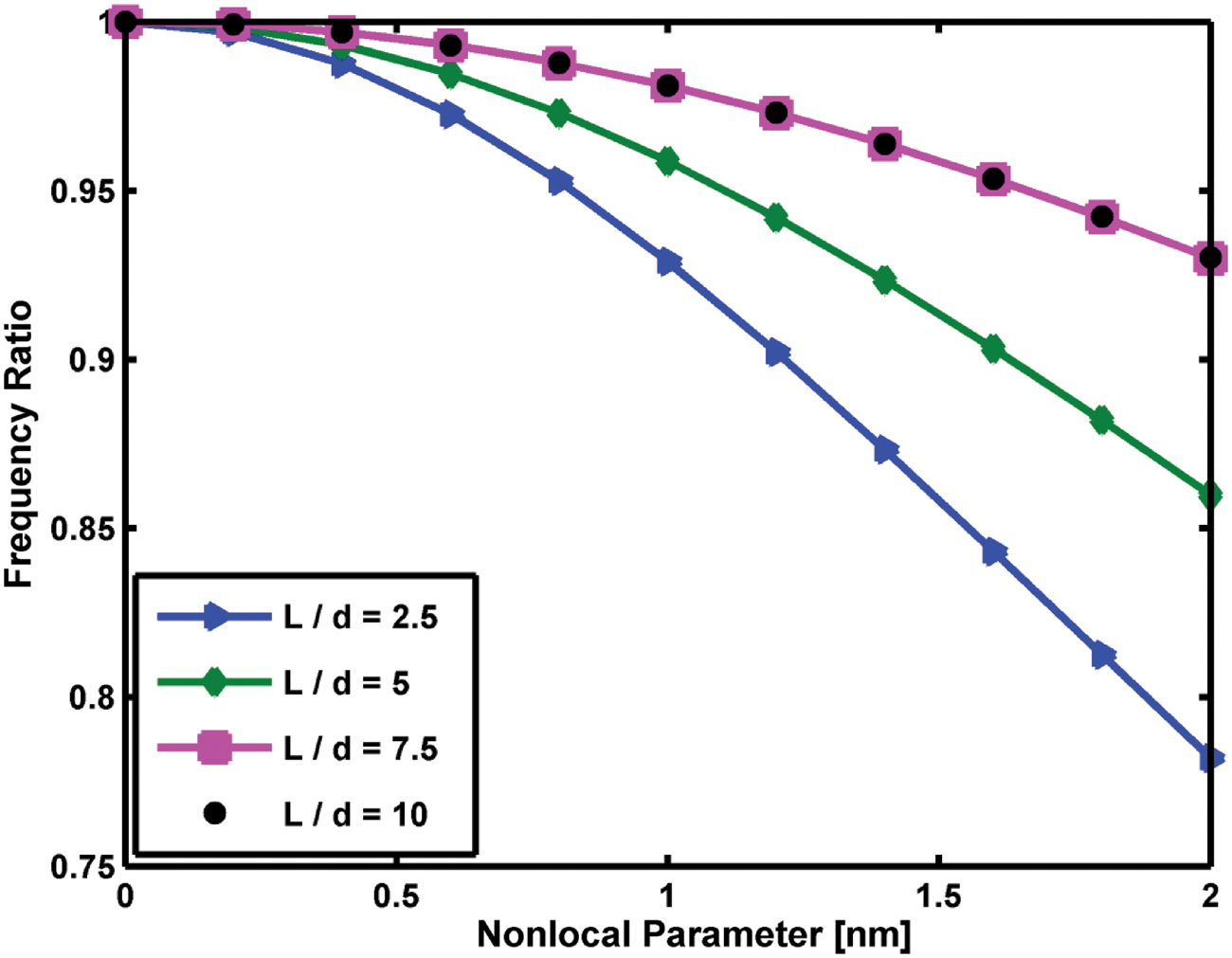
Illustrated in Figure 4 is the variation of the frequency ratio of with the value of a nonlocal parameter for the DWCNTs with various aspect ratios. It is assumed that the inner radius of the nanotubes . It is observed that the results obtained from the local shell model are higher than those of its nonlocal counterpart and also the frequency ratio decreases with the increase of the nonlocal parameter. It means, physically, that the small scale effects in the nonlocal model make nanotubes more flexible. Furthermore, from this figure, the effects of a small scale are found to be more pronounced for the shorter length nanotubes.
Variation of frequency ratio with the value of nonlocal parameter for double-walled carbon nanotubes with different aspect ratios .
6. Conclusion
In this article, the free vibrations of SWCNTs and DWCNTs were investigated. Size effects were applied to the solution procedures using Eringen’s nonlocal elasticity equations along with the classical Donnell shell theory. An exact solution was presented to obtain the fundamental frequencies of nanotubes for various values of a nonlocal parameter and aspect ratio. It was found that the nonlocality has a significant effect on the vibration responses of CNTs.
To obtain the consistent values of nonlocal parameter, MD simulations were performed for a series of armchair and zigzag SWCNTs and DWCNTs. A nonlinear least square fitting procedure was then conducted to match the two series of results in which the value of a nonlocal parameter was set as the optimization variable. It was concluded that chirality does not have a considerable influence on the value of the obtained appropriate values of a nonlocal parameter. It was also shown that the present nonlocal continuum shell models, with their proposed appropriate values of a nonlocal parameter, bring out accurate results which are comparable to those of MD simulations.
Footnotes
Funding
This research received no specific grant from any funding agency in the public, commercial, or not-for-profit sectors.
References
1.
Ansari R, Gholami R and Rouhi H (2012a) Various gradient elasticity theories in predicting vibrational response of single-walled carbon nanotubes with arbitrary boundary conditions. Journal of Vibration and Control DOI: 1177/1077546312439223.
2.
AnsariRRamezannezhadHGholamiR (2012b) Nonlocal beam theory for nonlinear vibrations of embedded multiwalled carbon nanotubes in thermal environment. Nonlinear Dynamics67: 22412254.
3.
BatraRCGuptaSS (2008) Wall thickness and radial breathing modes of single-walled carbon nanotubes. ASME Journal of Applied Mechanics75: 061010061015.
4.
DonnellLH (1976) Beam, Plates and Shells, New York: McGraw-Hill.
5.
EringenAC (1972) Linear theory of nonlocal elasticity and dispersion of plane waves. International Journal of Engineering Science10: 425435.
6.
EringenAC (1983) On differential equations of nonlocal elasticity and solutions of screw dislocation and surface waves. Journal of Applied Physics54: 47034710.
7.
ForroLSchönenbergerC (2001) Physical properties of multi-wall nanotubes. In: DresselhausMSDresselhausGAvourisP (eds) Carbon Nanotubes: Synthesis, Structure, Properties and Applications. Topics in Applied PhysicsVol 80: 329390.
8.
HaoMJGuoXMWangQ (2010) Small-scale effect on torsional buckling of multi-walled carbon nanotubes. European Journal of Mechanics – A/Solids29: 4955.
9.
HeirecheHTounsiABenzairAMaachouMAdda BediaEA (2008) Sound wave propagation is single-walled carbon nanotubes using nonlocal elasticity. Physica E40: 27912799.
10.
HoYHChangCPShyuFLChenRBChenSCLinMF (2004) Electronic and optical properties of double-walled armchair carbon nanotubes. Carbon42: 31593167.
11.
HuYGLiewKMWangQHeXQYakobsonBI (2008) Nonlocal shell model for elastic wave propagation in single- and double-walled carbon nanotubes. Journal of the Mechanics and Physics of Solids56: 34753485.
12.
KeLXiangYYangJKitipornchaiS (2009) Nonlinear free vibration of embedded double-walled carbon nanotubes based on nonlocal Timoshenko beam theory. Computational Materials Science47: 676683.
13.
Lopez ManchadoMAValentiniLBiagiottiJKennyJM (2005) Thermal and mechanical properties of carbon nanotubes-polypropylene composites prepared by melt processing. Carbon43: 14991505.
14.
MurrmuTPradhanSC (2009) Thermo-mechanical vibration of a single-walled carbon nanotube embedded in an elastic medium based on nonlocal elasticity theory. Computational Materials Science46: 854859.
NarendarSGopalakrishnanS (2009) Nonlocal scale effects on wave propagation in multi-walled carbon Nanotubes. Computational Materials Science47: 526538.
17.
NarendarSGopalakrishnanS (2010) Terahertz wave characteristics of a single-walled carbon nanotube containing a fluid flow using the nonlocal Timoshenko beam model. Physica E42: 17061712.
18.
Rafii-TabarH (2004) Computational modelling of thermo-mechanical and transport properties of carbon nanotubes. Physics Reports390: 235252.
19.
ShenHS (2010) Buckling and postbuckling of radially loaded microtubes by nonlocal shear deformable shell model. Journal of Theoretical Biology264: 386394.
20.
StuartSJTuteinABHarrisonJA (2000) A reactive potential for hydrocarbons with intermolecular interactions. Journal of Chemical Physics112: 64726486.
21.
SumflethJPrehnKWichmannMHGWedekindSSchulteK (2010) A comparative study of the electrical and mechanical properties of epoxy nanocomposites reinforced by CVD-and Arc-Grown multi-wall carbon nanotubes. Composites Science and Technology70: 173180.
22.
WangCYZhangLC (2008) An elastic shell model for characterizing single-walled carbon nanotubes. Nanotechnology19: 195 704.
23.
WangL (2012) Vibration analysis of nanotubes conveying fluid based on gradient elasticity theory. Journal of Vibration and Control18: 313320.
24.
YakobsonBIBrabecCJBernholcJ (1996) Nanomechanics of carbon tubes: instability beyond linear response. Physical Review Letters76: 25112514.
25.
YakobsonBIAvourisP (2001) Mechanical properties of carbon nanotubes. In: DresselhausMSDresselhausGAvourisP (eds) Carbon Nanotubes: Synthesis, Structure, Properties and Applications. Topics in Applied PhysicsVol 80: 287327.
26.
YanYWangWQZhangLX (2010) Nonlocal effect on axially compressed buckling of triple-walled carbon nanotubes under temperature field. Applied Mathematical Modelling34: 34223429.
27.
YangYKeLLKitipornchaiS (2010) Nonlinear free vibration of single-walled carbon nanotubes using nonlocal Timoshenko beam theory. Physica E42: 17271735.
28.
ZhangYQLiuGRHanX (2006) Effect of small length scale on elastic buckling of multi-walled carbon nanotubes under radial pressure. Physics Letters A349: 370376.