






Abstract
An adaptive hybrid differential evolution algorithm for the dynamic parameter identification of rotating machinery is developed in this paper. Genetic algorithm (GA) is first used to reduce the range of the identification parameters to save computational time. Adaptive Cauchy and Gaussian mutations are then applied in a differential evolution algorithm (DEA) and dynamically updated during the evolutionary process according to the identification process, to obtain the global optimal solution more easily and more rapidly. Numerical studies of linear and nonlinear rotor-bearing systems are performed. The results indicate that the genetic algorithm-adaptive hybrid differential evolution algorithm (GA-AHDE) is more effective at identifying the dynamic parameters and faults of the rotor-bearing system compared to other evolutionary algorithms.
Keywords
1. Introduction
In high-speed rotating machinery, there are always some unknown dynamic parameters and fault parameters that need to be optimized and identified. Determining these parameters in the rotor system is a crucial issue since they are related to the dynamic characteristic. The identification of the rotor parameters can improve the machinery effectiveness. In recent years, the critical speed position, vibration control and stress reduction are areas that have been investigated through optimization algorithms in linear rotor systems. In addition, the malfunction diagnosis, parameter identification, and the optimization of dynamic characteristic have also been studied in nonlinear rotor systems.
During the past decade, several studies have focused on the dynamic parameter identification of rotor systems. One such study used the identification algorithm based on the least-squares method in the frequency domain to estimate the dynamic parameters of active magnetic bearings and rotor residual unbalances, but the effect of the foundation on the dynamics of the rotor was not considered (Tiwari and Chougale, 2014). The impulse response measurement techniques were used to identify the residual unbalance and bearing dynamic parameters (Tiwari et al., 2002; Tiwari and Chakravarthy, 2006). Chen and Lee also proposed an impulse or synchronous/nonsynchronous excitation technique for estimating the linear coefficients of bearings (Chen and Lee, 1995; 1997).
For the fault identification of rotor systems, two different approaches – equivalent loads minimization and vibration minimization method – are applied for the identification of unbalance fault in a rotor system (Sudhakar and Sekhar, 2011). Bachschmid et al. (2002) presented a model-based identification method for multiple faults. The method requires the definition of the models of the elements that compose the system, i.e. the rotor, the bearings, and the foundation, as well as the models of the faults, which can be represented by harmonic components of equivalent force or moment systems. Recently, nonlinear system identification has also attracted significant attention. Xiang et al. (2007) used the wavelet finite element method to model the rotor system, and identified the crack based on the surface-fitting technique and contour plotting method. The researchers proposed a method to determine the rubbing location according to the dynamic stiffness increase as the rubbing developed. However, this method can only detect the position where the response of vibration can be measured (Chu and Lu, 2001). The studies on determining the rubbing and structure parameters were also carried out (Yang et al., 2005; Szolc et al., 2009; Lee et al., 2010).
With the influence of noise and nonlinear factors in an actual system, evolutionary algorithms seem particularly suitable to solve the optimization and identification problems of rotor-bearing systems. Differential evolution algorithm (DEA) is a recently proposed population-based evolutionary method and uses a rather greedy and less stochastic approach to problem solving compared to other EAs (Vesterstrom and Thomsen, 2004). DEA does not need the derivative information about the objective function and it is performed using floating point numbers directly without further binary transformations. Because of this, DEA is a powerful method in optimization and identification problems (Storn and Price, 1997; Mayer et al., 2005; Price et al., 2005; Wang et al., 2012; Han et al., 2013).
Using DEA, the values of control parameters and strategies are predefined and do not change during the evolutionary process. This tends to result in local minima and takes a long time to converge to an acceptable result. During the past decade, different optimization methods were hybridized to further improve the performance of DEA and reach the global optimum (Coelho and Mariani, 2007; Zhang et al., 2013). Sayah and Hamouda (2013) proposed an approach using combined DEA and particle swarm optimization algorithms to improve DEA’s ability to reach the global optimum for nonconvex economic dispatch problems. Yildiz (2013) presented a novel hybrid optimization approach based on DEA and receptor editing of the immune system to find optimal machining parameters in milling operations. Subudhi and Jena (2011) worked on a DEA-based neural network approach to nonlinear system identification. Some studies on enhanced DEA for solving multi-objective optimization problems can be found in Wang et al. (2014), Ali et al. (2012), and Wang and Cai (2012). Several other adaptive DEAs have been also proposed in recent years to improve the algorithm efficiency (Salman et al., 2007; Elsayed et al., 2013; Jiang et al., 2013; Al-Dabbagh et al., 2014; Das et al., 2014; Venske et al., 2014). In one study by Asafuddoula et al. (2014), both binomial and exponential crossover are used in DEA, and the crossover rate is adaptively controlled based on the success of offspring (trail) solutions generated. Coelho et al. (2014) proposed a DEA based on Gaussian probability distribution, gamma distribution, and chaotic sequencing for solving continuous global optimization problems. To solve the premature convergence problem of the conventional DEA the mixed distribution mutation operation, which combines Gaussian distribution mutation and Cauchy distribution mutation, is proposed to improve DEA. This mixed distribution mutation is carried out using a proportion for maintaining the balance of the exploration and exploitation (Wang et al., 2012).
The purpose of this paper is to introduce an adaptive hybrid differential evolution algorithm for the dynamic parameter identification of rotating machinery. GA is first used to reduce the range of identification parameters to save computational time. Then adaptive Cauchy and Gaussian mutations are applied in the DEA, and dynamically updated during the evolutionary process, according to the identification process, to obtain the global optimal solution more easily and more rapidly. The results obtained using the proposed approach for rotor-bearing systems indicate that the genetic algorithm-adaptive hybrid differential evolution algorithm (GA-AHDE) is more effective at identifying the dynamic parameters and faults in linear and nonlinear rotor-bearing systems than other evolutionary algorithms.
2. Proposed algorithm
In this study, a new GA-AHDE is presented to identify the dynamic parameters of rotating machinery. It combines GA and adaptive hybrid differential evolutional algorithm which adjusts the mutation strategy during identification process.
2.1. Genetic algorithm to reduce the range of parameters
Genetic algorithm (GA) is a global optimization technique and uses simple, stochastic operators to explore the solution domain. The difference between GA and other optimization methods is that GA operates on a group, or population, of trail solutions in parallel. They operate on a coding of function parameters rather than the parameters directly.
In the parameters identification process of rotor systems, one of the major challenges is a wide range of parameter values and a large difference in each parameter value. These challenges increase the computational time required, and affect the accuracy of the identification results. In order to reduce the computational time and enhance the accuracy of results, GA is first used to reduce the searching range of the parameters. This improves the operation efficiency of the overall identification process.
2.2. Adaptive hybrid differential evolutional algorithm
2.2.1. Cauchy and Gaussian mutations
In traditional DEAs, the difference between the individuals in different generations gradually reduces in the evolutionary process and the diversity of the population from the mutation operation is also reduced in complex problems. These results tend to converge towards local optima or even arbitrary points rather than the global optimum of the problem. Using the GA-AHDE approach, the Gaussian and Cauchy mutations adapt during the evolutionary process. These two mutation strategies are based on Cauchy and Gaussian distributions. The probability density functions of Cauchy and Gaussian distributions are in equation (2.1) and equation (2.2), respectively.
Figure 1 shows the difference between Cauchy and Gaussian density function values. From the figure, it is clear that the Cauchy density function is more likely to generate offspring further away from its parent than Gaussian due to its long flat tails. In general, it has a higher probability of escaping from a local optimum or moving away from plateau. On the other hand, the smaller hill around the center indicates that the Cauchy mutation spends less time exploring the local neighborhood, which results in a weak fine-tuning ability compared to that of the Gaussian density function.
Comparison between Gaussian and Cauchy distribution.
2.2.2. The main parts of the GA-AHDE algorithm
(a) Defining the condition parameters FC, MFC, and ɛ. FC is changed depending on the objective function values (OFV) of each generation. MFC (maximum factor condition) is set according to experience and greatly impacts the efficiency of the algorithm. At the beginning FC = 1, if the objective function values of the parents are the same as the offspring, FC = FC + 1, otherwise, FC = 1 again. When FC > MFC the results tend to converge towards a local optimum and the adaptive mutation is considered in different conditions. When OFV > ɛ, the Cauchy mutation is used to help to increase the diversity of population and jump out of the local optimum. When OFV ≤ ɛ, it is near to the global optimum result and Gaussian mutation is used to converge to the global optimum quickly.
(b) Generating random numbers. C (0, b) and N (0, b) are randomly generated based on the Cauchy and Gaussian distributions. b is the adaptive parameter correlated with OFV, expressed as:
(c) Generating new offspring
(d) Discussing the adaptive optimization procedure.
When OFV > ɛ, it indicates that the objective function value is far from the convergence condition and there may be great differences between the current target value and the global optimal solution. If the current target value does not change, the adaptive Cauchy mutation operation in equation (2.5) is considered. Using equation (2.4) to obtain a larger mutation step size, the new offspring is generated away from the current target value, allowing the system to break away from the local optimum according to the adaptive Cauchy mutation operation. If after several adaptive mutation operations, the target value is unchanged, there may be not real difference between the current target value and the global optimal solution. Because of the constant cumulative increase of FC, the mutation step size η will continue to decrease. The new offspring is generated around the current target value with small step size and break away from the local optimum to obtain a more optimal objective function value.
When OFV ≤ ɛ, this indicates that the objective function value is close to the convergence condition and the current target value is near to the global optimal solution. If the current target value does not change in this situation, the adaptive Gaussian mutation operation in equation (2.6) is considered. The global optimal solution is obtained with the small step size mutation searching. This adaptive mutation operation allows the results to converge at the global optimum quickly and avoid convergence at local optimum.
2.3. Identification procedure
Figure 2 shows the general identification procedure of GA-AHDE. Firstly, the origin searching range is optimized based on GA, and the new searching range [Pmin, Pmax] of AHDE is obtained. Secondly, AHDE is used to identify the dynamic parameters of the rotor system, and the objective function is considered as equation (2.8).
The flowchart of GA-AHDE.
3. Numerical application of linear rotor-bearing system
Figure 3 shows the FE model and A rotor-bearing system with three disks.
3.1. Case 1: Ignoring the impact of noise
Comparison of identification results for GA-AHDE, GA-DEA,and AHDE without noise.

In order to test the performance of the proposed GA-AHDE algorithm in a linear rotor-bearing system, the problem was implemented in n = 20 dimensions using GA-AHDE, GA-DEA, and AHDE. Figure 4 shows that GA-AHDE satisfies the convergence condition with fewer updating steps compared to the other two methods.
Comparison of the iterative process for GA-ADE, GA-DEA, and AHDE without noise.
3.2. Case 2: Considering the impact of noise
To consider the uncertainty of the analytical model and to examine the robustness of identification Gaussian noise was applied to the simulated response.
Comparison of identification results for GA-AHDE, GA-DEA, and AHDE with noise.

The results in Table 2 show that GA-AHDE is better than the other two methods and GA-AHDE is less affected by the noise. Figure 5 is the comparison of the fit values in the iterative process, which show that GA-AHDE is efficient and converges with fewer updating steps.
Comparison of the iterative process for GA-AHDE, GA-DEA and AHDE with noise.
Comparison of identification results for GA-AHDE, GA-DEA, and AHDE with noise.

3.3. Discussion
In GA-AHDE, MFC is always less than 10. In this linear rotor system, MFC values of 3, 5, and 10 were chosen as examples to discuss the specific values of MFC. When MFC = 1, the Cauchy or Gaussian mutation is applied during the entire iterative process, and the adaptive mutation does not work on the population diversity. If MFC is large, the problem cannot jump out of the local optimal solution by Cauchy or Gaussian mutation.
Comparison of iterations and time for different MFC without and with noise.

4. Numerical application of nonlinear rotor-bearing system
To demonstrate the accuracy and efficiency of GA-AHDE in nonlinear systems, a two-disk rotor-bearing system with nonlinear rub-impact and nonlinear oil-film force is simulated as shown in Figure 6. The rub-impact parameters [kr, δ, N] are considered as the identification parameters. The ranges of these variables are kr∈[1.0e6,1.0e8], δ∈[1.0e-3,1.0e-5], and N∈[1,4] (where N = 1 indicates rub-impact force from both disks; N = 2 indicates rub-impact force from only the first disk; N = 3 indicates rub-impact force from only the second disk; N = 4 indicates no rub-impact).
A nonlinear rotor-bearing system with two disks.
The rub-impact is short in one period, the rub-impact forces and the nondimensional formula of the oil film force is based on the classic oil film force theory of short bearing as described by Liu et al. (2008) and Han et al. (2017).
To verify the high efficiency and reliability of the GA-AHDE in the nonlinear rotor-bearing system, the rub-impact parameters are identified when the system is in the chaos state (ω = 1500 rad/s) and also implemented in n = 20 dimensions using GA-AHDE, GA-DEA, and AHDE.
4.1. Case 1: Ignoring the impact of noise
Comparison of identification results for GA-AHDE, GA-DEA and AHDE without noise when ω = 1500 rad/s.


Comparison of the iterative process for GA-ADE, GA-DEA, and AHDE without noise.
4.2. Case 2: Considering the impact of noise
Comparison of identification results for GA-AHDE, GA-DEA, and AHDE with noise when ω = 1500 rad/s.

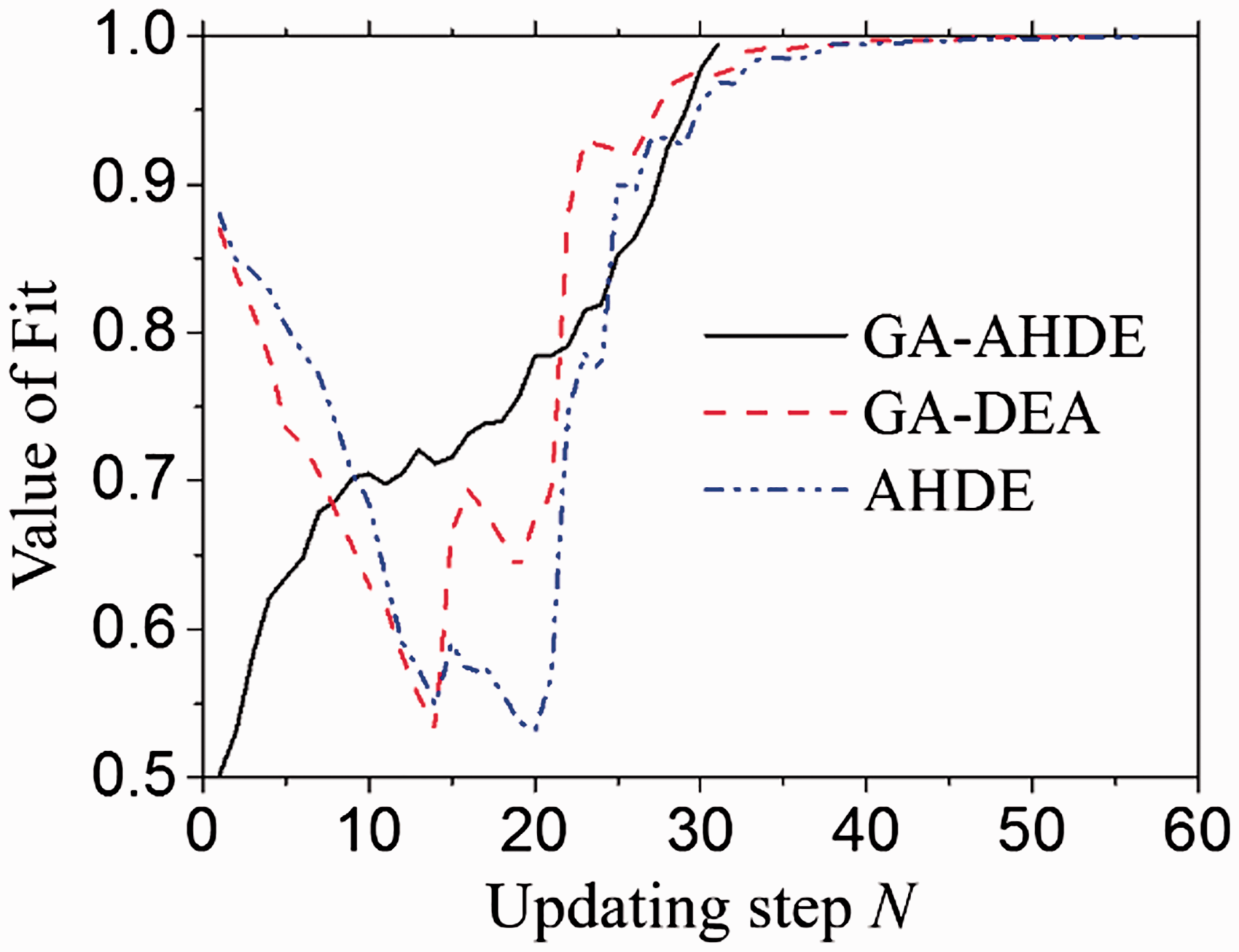
Comparison of the iterative process for GA-AHDE, GA-DEA, and AHDE with noise.
Comparison of mean errors and variance of errors for GA-AHDE, GA-DEA, and AHDE with noise when ω = 1500 rad/s.

4.3. Discussion
Comparison of iterations and time for different MFC without and with noise.

5. Experimental verification
Figure 9 is a RK-4 rotor system and one disk is installed near one side of the bearing. The vertical and horizontal response values are captured by the sensors which are in the middle of the two bearings. A short metal stick is installed in the middle of the two bearings with little clearance to the shaft which simulates the effect of the rub-impact.
Laboratory test rig.
Comparison of identification results for GA-AHDE, GA-DEA, AHDE with noise when ω = 1500 rad/s.

6. Conclusion
In this paper, a new hybrid identification technique based on differential evolution algorithm and the hybrid mutations (GA-AHDE) is developed and successfully implemented to the parameter identification of rotor-bearing systems. Simulations of linear and nonlinear rotor-bearing systems are carried out to investigate the performance of GA-AHDE algorithm. Significant improvement is obtained with the proposed hybrid technique in comparison to the results by GA-DEA and AHDE.
The adaptive Cauchy or Gaussian mutation is operated based on the identification process, which makes the proposed method less susceptible to premature convergence and less susceptible to local optima. Simulation results show that GA-AHDE is less prone to error and more robust for both the linear and nonlinear rotor-bearing systems. From the simulation results GA-AHDE performed best when MFC∈[5,10] with no noise considered and MFC∈[3,5] when noise is added. Experimental results with a rotor bearing system exhibiting nonlinear rub-impact was also conducted to verifying the effectiveness of GA-AHDE with great effectiveness.
As future work, the GA-AHDE algorithm will be extended to more complex rotor systems such as a wind turbine, aero-engine and other rotating machinery. Furthermore, the optimization problems, such as design optimization problems, multi-objective optimization problems and constrained optimization problems also should be considered based on this proposed method.
Footnotes
Declaration of Conflicting Interests
The author(s) declared no potential conflicts of interest with respect to the research, authorship, and/or publication of this article.
Funding
The author(s) received no financial support for the research, authorship, and/or publication of this article.