Free vibration analysis of cylindrical sandwich panel with electro-rheological core and FG-GPLRC facing sheets based on First order shear deformation theory referred by Qatu
Available accessResearch articleFirst published online February, 2024
Free vibration analysis of cylindrical sandwich panel with electro-rheological core and FG-GPLRC facing sheets based on First order shear deformation theory referred by Qatu
In this study, free vibration and damping behavior of cylindrical sandwich panel with electro-rheological core and graphene platelets reinforced composite (GPLRC) facing sheets based on first-order shear deformation theory of thick cylindrical shells referred by Qatu (FSDTQ) is investigated. Effective material properties of graphene platelets reinforced composite are determined according to the Halpin–Tsai micromechanical model. The governing equations of motion with required boundary conditions are derived using Hamilton’s principle. Afterward, these equations are solved analytically using the Fourier series solution for simply-supported boundary conditions, and for the other edges boundary conditions, we used the generalized differential quadrature method. The exactness and correctness of the present formulation are validated by comparing the results with those of existing literature. Finally, the influences of various parameters such as the electric fields, geometrically parameters, boundary conditions, the volume fraction of GPL, and GPL distributions pattern on vibration behavior and modal loss factor is examined. According to the results, the influence of the GPL volume fraction and electric field on the frequencies and modal loss factor is significant. This achievement can help design intelligent controlling structures for various applications.
The advanced sandwich structures are more and more applied because these structures have low weight, cost, and high performance. The use of soft materials such as viscoelastic materials and smart fluids (Electro/Magneto-rheological materials) as sandwich construction core suppresses vibration and noise. Electro-rheological materials change quickly from liquid to quasi-solid when subjected to electric fields. These materials perform as viscoelastic materials in low strain levels, but compared with viscoelastic materials, they have some advantages: controllability by applying electric fields and usability in a more significant temperature range. Numerous studies on vibration and dynamic analysis of these structures have been published.
Additionally, composite materials have a significant role in engineering structures and improving their operational characteristics. Composites are widely applied in aircraft, biomedical, aerospace, infrastructure, marine, energy, armor, recreational, and automotive applications. The high-strength, low-density, and high-stiffness characteristics make composites highly flexible in primary and secondary structures of both civilian aircraft and military.
Yalcintas and Coulter (1995) investigated vibration characteristics and variations of modal loss factors with different parameters of sandwich beam with ER core. Kang et al. (2001) investigated damping characteristics of electro-rheological composite beams using finite element method. Yeh et al. (2004) studied dynamic stability of sandwich beam with electro-rheological fluid core subjected to axial dynamic force by using finite element method and the harmonic balance method. Finite element formulation for vibration of sandwich rectangular plate with electro-rheological core was developed by Yeh and Chen (2004); they found that when an electric field is applied, the damping of the system is more effective. The effect of thickness of ER layer and electric field identity on the natural frequency and modal loss factor of sandwich orthotropic plate with ER core was study also by Yeh and Chen (2007) utilizing discrete finite element method. Yeh (2008)–(Yeh, 2011)used discrete finite element method to study vibration and damping characteristics of sandwich cylindrical shells with electro-rheological layer. Analytical solution for free and forced harmonic vibration of electro-rheological sandwich plate with simply supported edges studied by Hasheminejad and Maleki (2009). Mohammadi and Sedaghati (2012) developed a nonlinear finite element model for nonlinear vibration of sandwich shell with electro-rheological fluid for different boundary conditions. Tabassian and Rezaeepazhand (2013) investigated dynamic stability of smart sandwich beam with electro-rheological core resting on Winkler elastic foundation and subjected to external harmonic loads. Allahverdizadeh et al. (2013) used finite element method to present dynamic behavior of functionally graded electro-rheological sandwich beams with different boundary conditions, optimal parameters characterization, and vibration control of ER sandwich beams are investigation by Allahverdizadeh et al. (Allahverdizadeh et al., 2014). They used ASTM E756 standard for estimation of the storage and loss modules of the viscoelastic layer. Analytical solution for free vibration of three-layer sandwich plate with ER core was presented by Soleymani et al. (2015). Vibration analysis of electro rheological sandwich plate with CNT reinforced facing sheets rested on Winkler Pasternak foundation was carried out by Arani et al. (2017). Based on classical thin plate theory for face sheets and first order shear theory for the core layer, free and forced vibration of a sandwich plate with electro-rheological fluid core and functionally graded facing layers was investigated by Gholamzadeh Babaki and Shakouri (2019). Based on classical plate theory for face layer, Exact solution for SSSS and SSCC sandwich cylindrically curved panel with ER core and CNTRC facing sheets rested on Winkler Pasternak foundation was performed by Ghorbanpour Arani and Jamali (2020). Within the framework of modified couple stress theory, vibration characteristics of a micro cylindrical sandwich panel with foam core and graphene platelets reinforced composite (GPLRC) resting on elastic foundation is studied by Anvari et al. (2020). Vibration of GPLLRC cylindrical shell within the framework of FSDT was discussed by Arefi et al. (2021). Analytical and semi-analytical solution for static and free vibration analysis of porous GPLRC based on theory of elasticity is investigated by Rahimi et al. (2020). Vibration control of GPLRC cylindrical shell surrounded by piezoelectric layers was presented by Al-Furjan et al. (2021) using generalized differential quadrature (GDQ). Song et al. (2017) investigated free and forced vibration of functionally graded GPLRC plates with simply supported boundary condition using Navier’s method. Feng et al. (2017) used layer-wise approach to study nonlinear free vibration of GPLLRC beam within the frame work of Timoshenko beam theory along with von Kármán nonlinear strain displacement relationship. Mohseni and Shakouri (2020) studied free and forced vibration of simply supported sandwich plate with the viscoelastic core and FG-GPLRC face layers based on classical theory. They used rule of mixture to obtain effective material properties of GPLRC. The presence of the trapezoidal shape factor in the derivation of the fundamental equation of shells makes it challenging to integrate and consider the effects of depth ratio in shell theories. In most studies, the term was neglected that mean assumption of thin shell theories The equations with considering this term were presented by Qatu (1999) named the First-order shear deformation shell theory referred by Qatu (FSDTQ) and discussed in some research (Asadi and Qatu, 2012, 2013; Qatu et al., 2012; Qatu, 1995, 1999). Most of the existing works of sandwich structures with ER core restricted to beams and flat plates with isotropic facing sheets using finite element method and classical theories.
To the best knowledge of authors, vibration and damping behavior of a thick cylindrical sandwich panel with ER core and FG-GPLRC facing sheets has not yet been reported in the literature, and in the present work we discuss this matter. A layer-wise approach and Halpin–Tsai micromechanical model are used for facing sheets. The equations of motion within the framework of FSDTQ and applying Hamilton’s principle are derived. Fourier series expansion along the axial and circumferential coordinate is used to solve the equations of motion analytically. In the case of other edge boundary conditions, we used 2D-GDQ to numerically solve the governing equation of motion. As an essential property of the system, the natural frequency changes with the electric field change, and this event makes it possible to change the natural frequency at the right time and prevent the resonance phenomenon.
2. Problem formulation
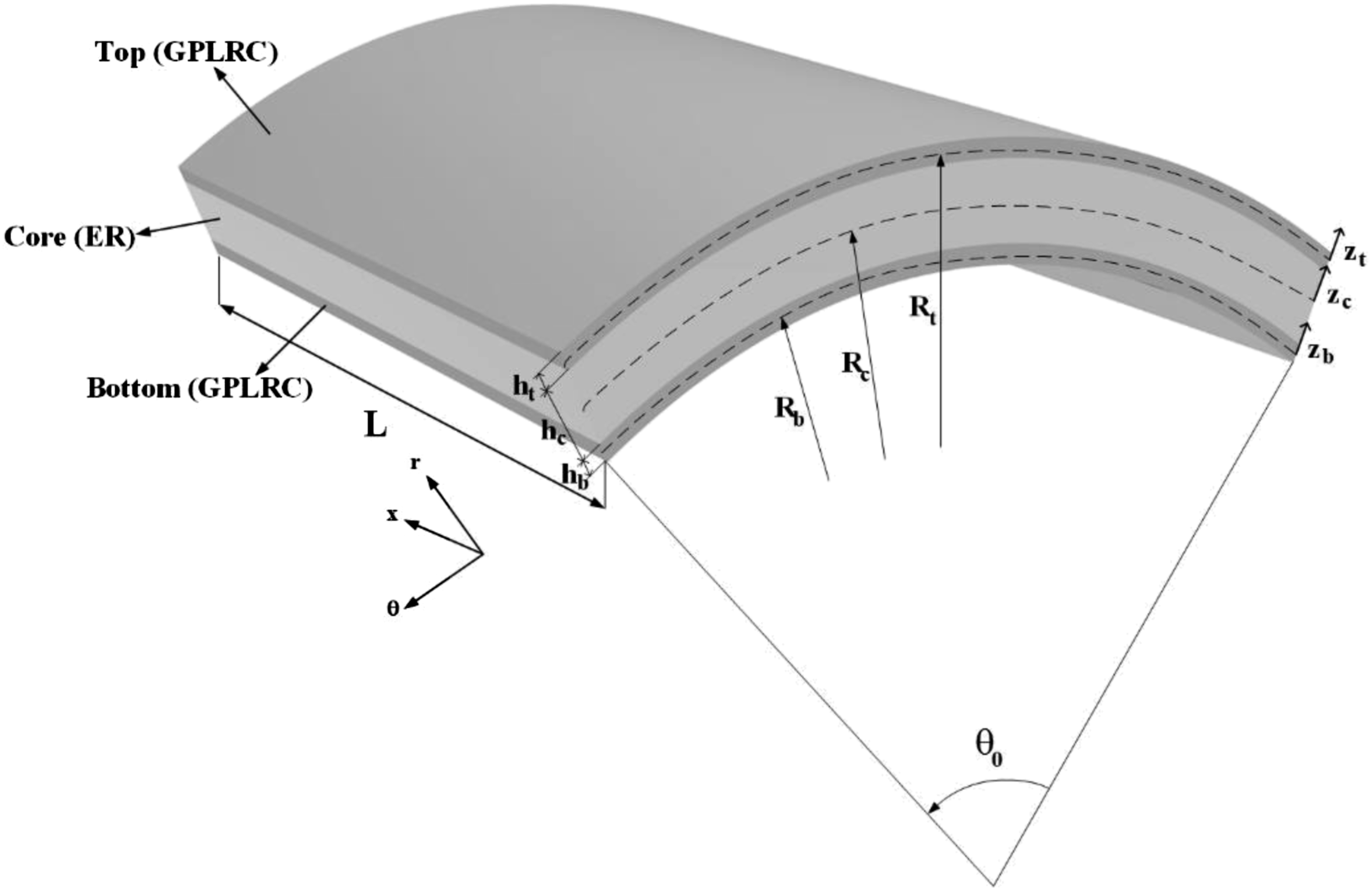
Consider a cylindrical sandwich panel composed of an electro-rheological core and GPLRC facing sheets with lengths (L), span angle (θ0), mid-surface radius (Rc), i-th layer thickness (hi) where (i = t, b, and c), and global coordinate (r, , x) as shown in Figure 1. Generally, t, b, and c represent the top, bottom, and middle layers, respectively. The local axis of the i-th layer radial directions is denoted by zi, and its origin is located on the i-th layer’s mid-surface. Where
Geometry of cylindrical sandwich panel with electro-rheological core and graphene platelets reinforced composite (GPLRC) facing sheets.
The formulation of this study is based on the following assumption:
• A perfect bond without any Slippage between the layers is assumed. According to this assumption, the displacements at the interfaces are the same for the core and facing.
• The deformations are small, and the material properties are assumed to be linearly elastic and viscoelastic of the facing sheets and the ER core, respectively.
• The transverse displacements in the GPLRC layers are the same for every point in the radial direction, but the transverse displacement in the ER layer changes linearly through the radial direction.
• Young’s modulus in the electro-rheological core is small compared to the facing sheets, so normal stresses in the core are neglected. In addition, since the electric field is applied in the radial direction, the shear stress on the x- θ plane relative to the x-r and θ-r plates is ignored.
2.1. GPLRC properties
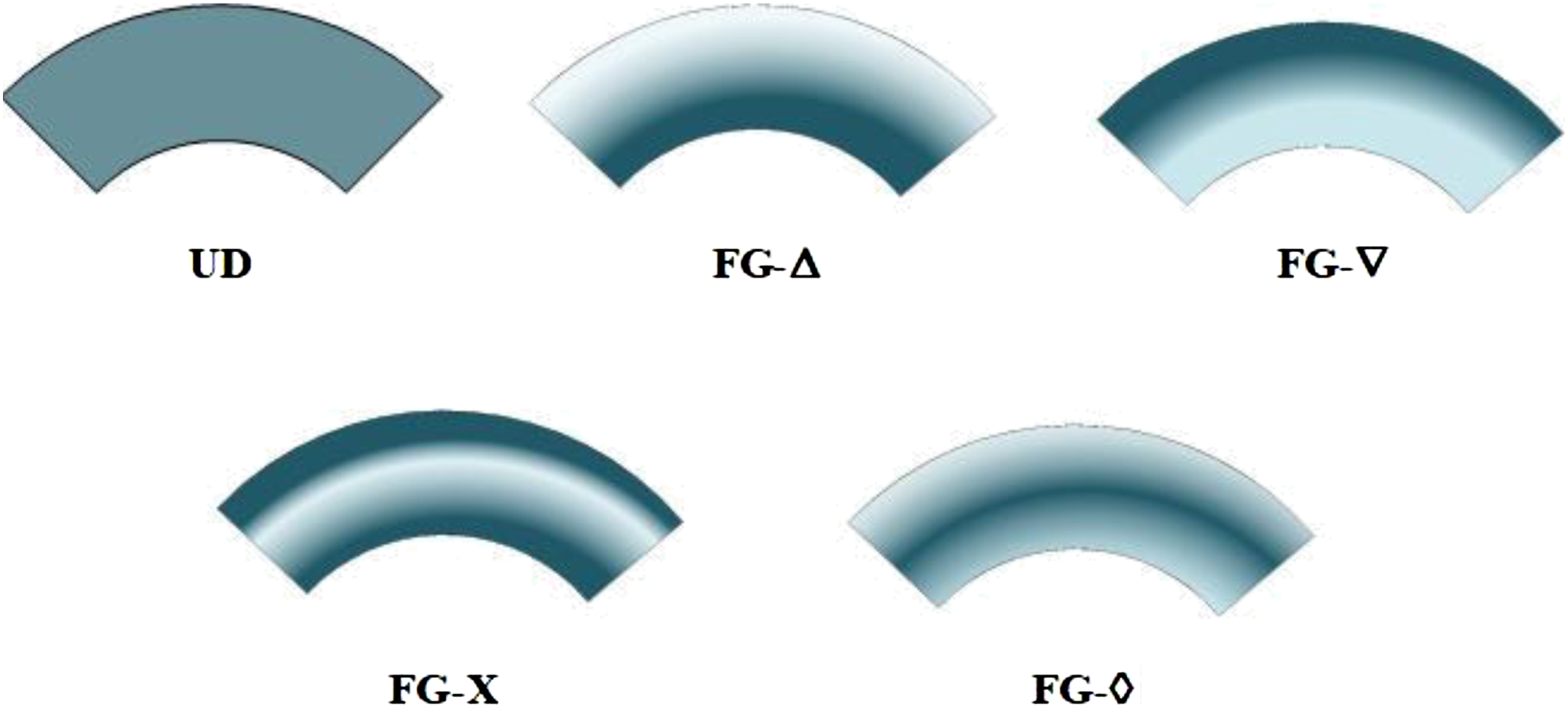
Each GPLRC facing sheet is composed of NL layers of the same thickness. In each sub-layer, GPLs as effective rectangular fillers are perfectly bonded, and dispersed uniformly in polymer matrix while GPL weight fraction changes according to different GPL distribution patterns in the in the radial direction (UD, FG-X, FG-⋄, FG-Δ, and FG-∇) as depicted in Figure 2. The darker colors indicate a higher weight of GPLs. In the UD pattern, GPLs distributed unique, FG-⋄ and FG-X are symmetric patterns by having maximum and minimum weight fraction values in the mid-plane of the layer, in the FG-Δ and FG-∇weight fraction of GPLs decrease and increase linearly from the bottom surface to the top.
Different patterns of GPL distribution across thickness of facing sheets.
Effective young module according to Halpin–Tsai micromechanical model is (Affdl and Kardos, 1976)
Mass density and Poisson’s ratio of the facing sheets sub-layer can be calculated by the rule of mixture
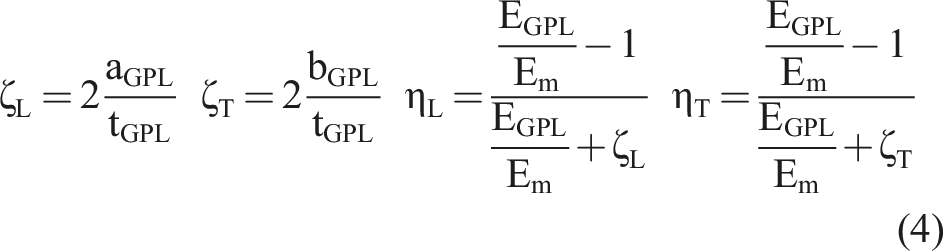
In which , are Young module of polymer matric and GPL volume fraction, respectively, ζ and η are dimensional ratio of graphene plate and Young module ratio of GPL and polymer matrix, respectively, with the following relations
where aGPL, bGPL, and tGPL are length, width, and thickness of graphene platelet, respectively.
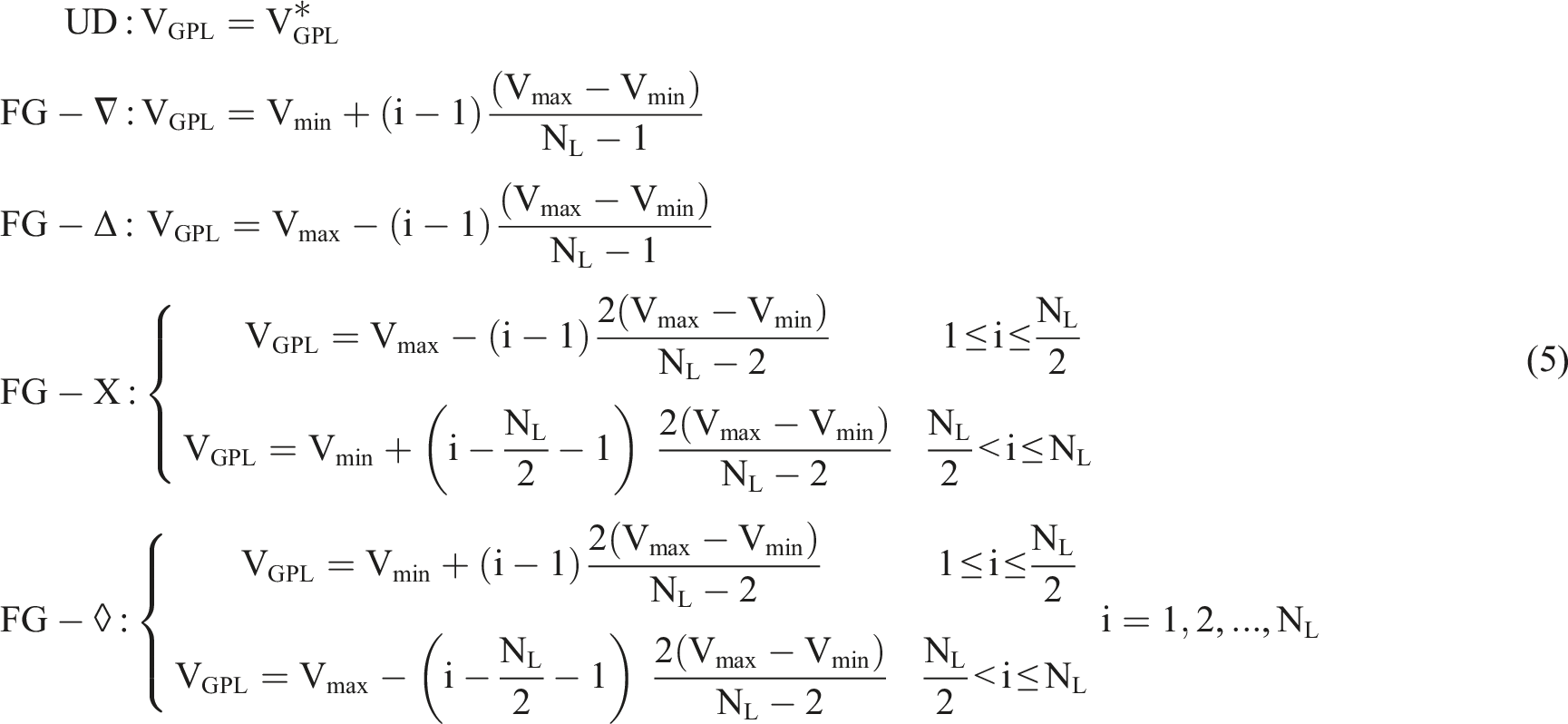
The relation of GPL volume fraction (VGPL) for different patterns of distribution by dividing the layer to NL sub-layer is (Feng et al., 2017)
Here is total, minimum, and maximum GPL volume fraction, respectively, and γGPL is weight fraction of graphene platelet.
2.2. Electro-rheological properties
The electro-rheological material in the pre-yield region is modeled as a linear viscoelastic, which based on the Kelvin viscoelastic model () and the simplifying (Yeh et al. (2004)), the relationship between its shear strain and shear stress with complex module is expressed as follows
where G′ and G″ called storage and loss module, respectively.
The complex module of different ER materials has been obtained by experiment and reported in literatures (Don, 1993; Yalcintas and Coulter, 1995). We used complex module introduced by Yalcintas and Coulter (1995) with relations as: which depends on electric field, E [kv.mm−1].
2.3. Kinematic relations
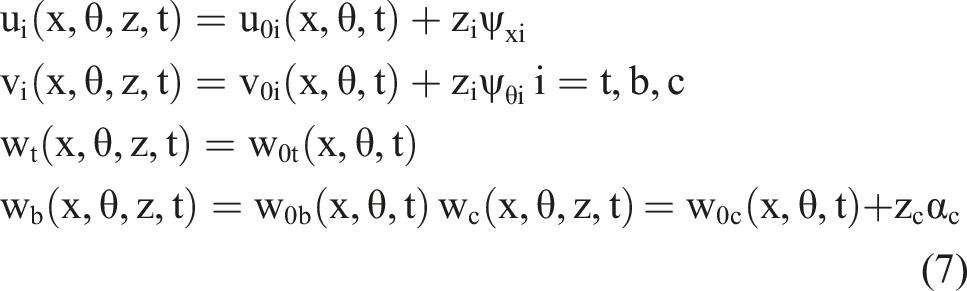
Displacement fields for each layer of sandwich cylindrical panel based on FSDT are expressed as
where u0, v0, w0 are displacement components at mid-surface, and are angular displacements of the i-th layer in the and x directions, respectively. According to equation (7), the transverse displacement of each facing sheet is independent of the radial coordinate, whereas the core transvers displacement varies linearly along the radial coordinate.
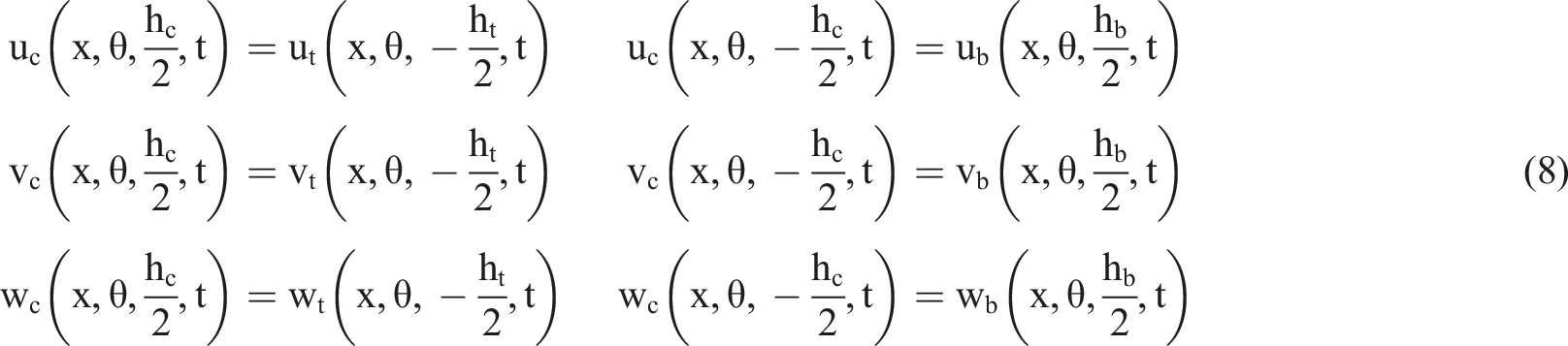
Relation of displacements continuity at the interfaces of facing and core layers are
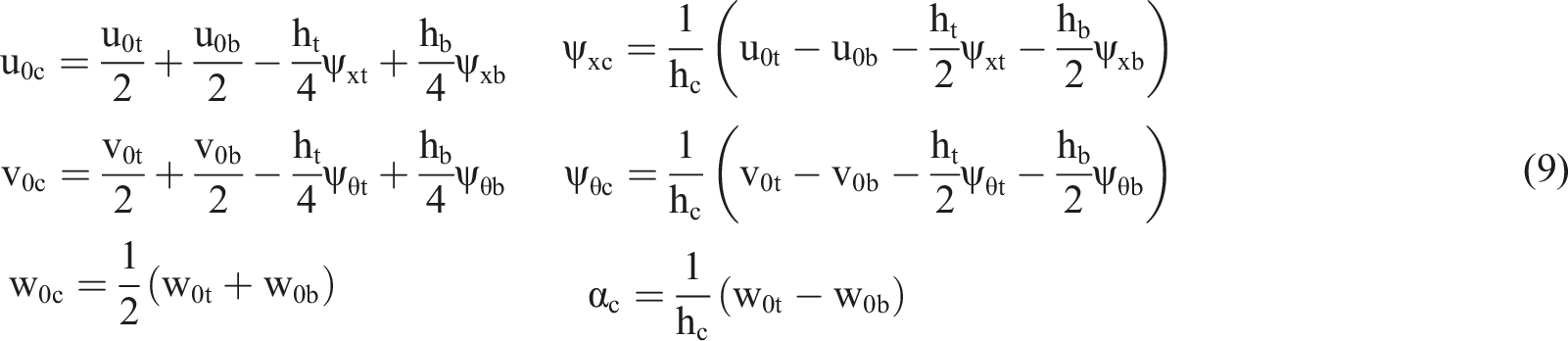
From equation (8), displacements of the core layer can be determined in term of facing layer displacement as follows
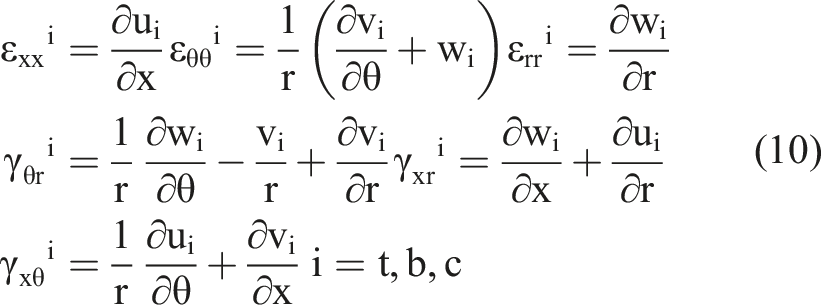
Strain–displacement relations in cylindrical coordinate in linear elastic continuum are (Sadd, 2009)
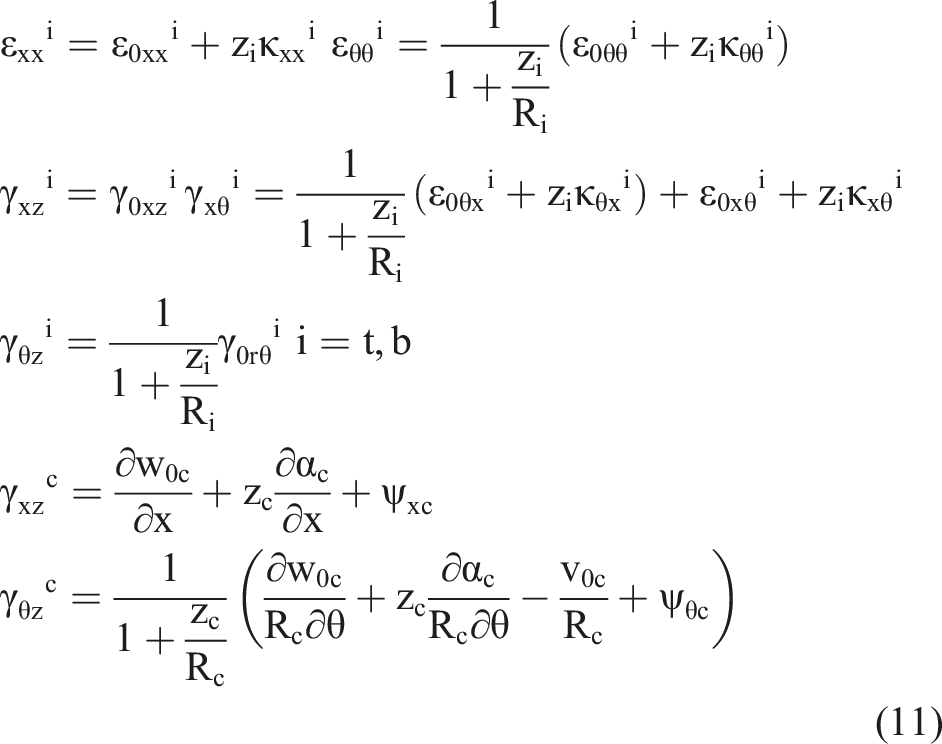
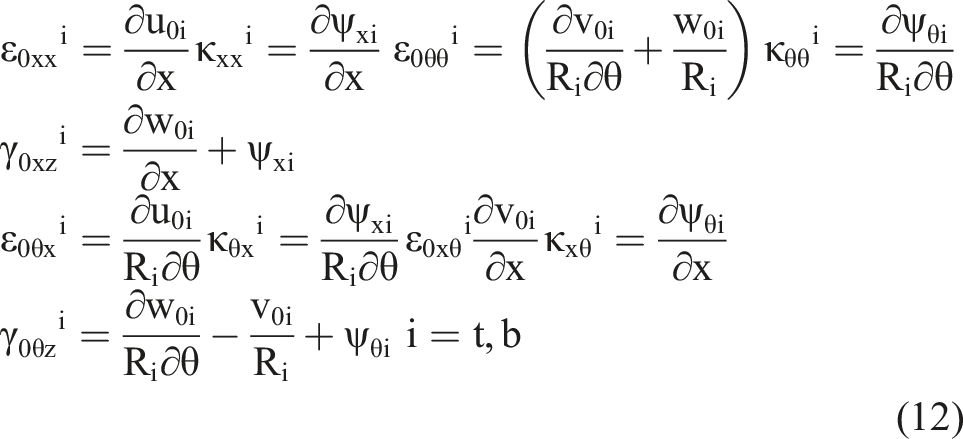
Substitution of equation (7) into equation (10) and using equation (1) results in strain components in term of mid-plain displacements and curvatures
In which
2.4. Constitutive relations
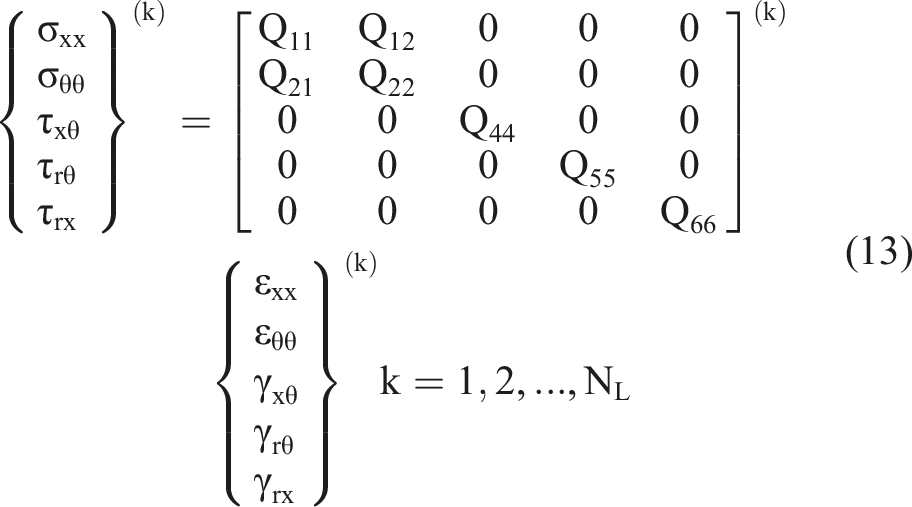
The stress-strain relation for facing sheets is
where is elastic constant for each sub layer (See appendix A).
And for the core layer we have
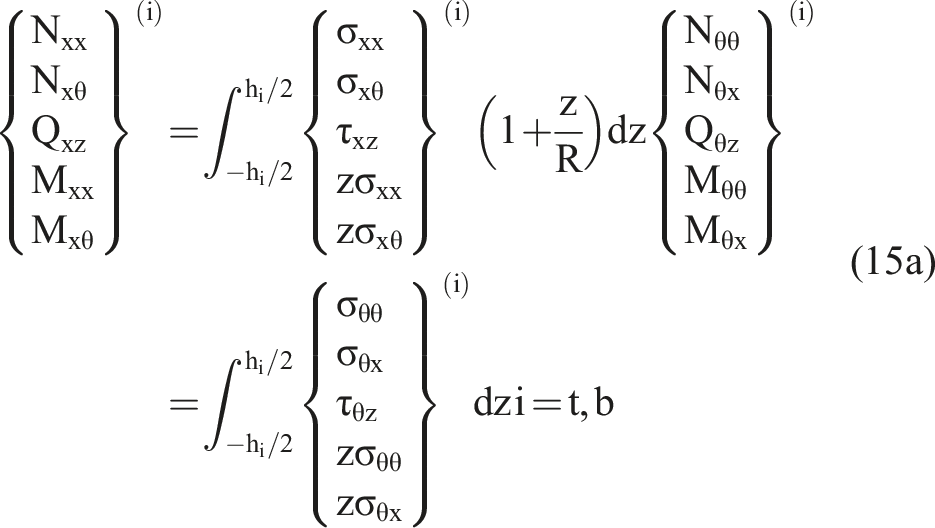
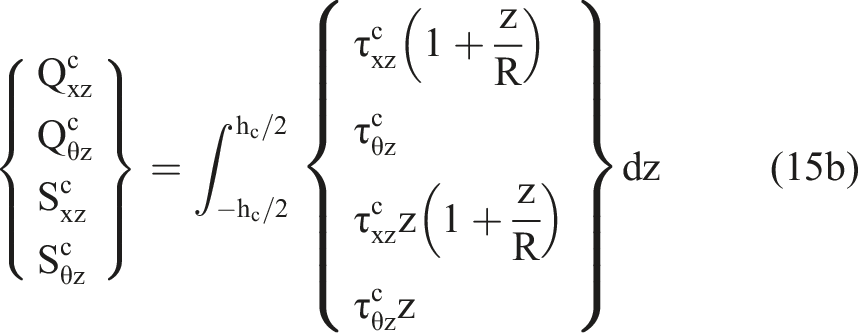
Stress resultants relation is
The integral relations in the equations (15a) and (15b) should be computed in terms of unknown displacements; however, this is a bit difficult due to the lack of . The integration for the core is done directly but the integration for the facing is done with another simplifier assumption which we will discuss below.
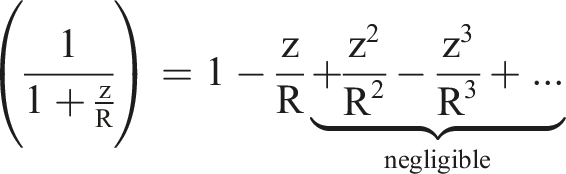
By substituting equations (11), (12), and (13) into equation (15a), the expression appears in the integral which causes to the difficulty of the integration. One of the ways to integrate easier is geometrically expanding this expression
By doing so, we still do not omit , but we can omit higher-order terms
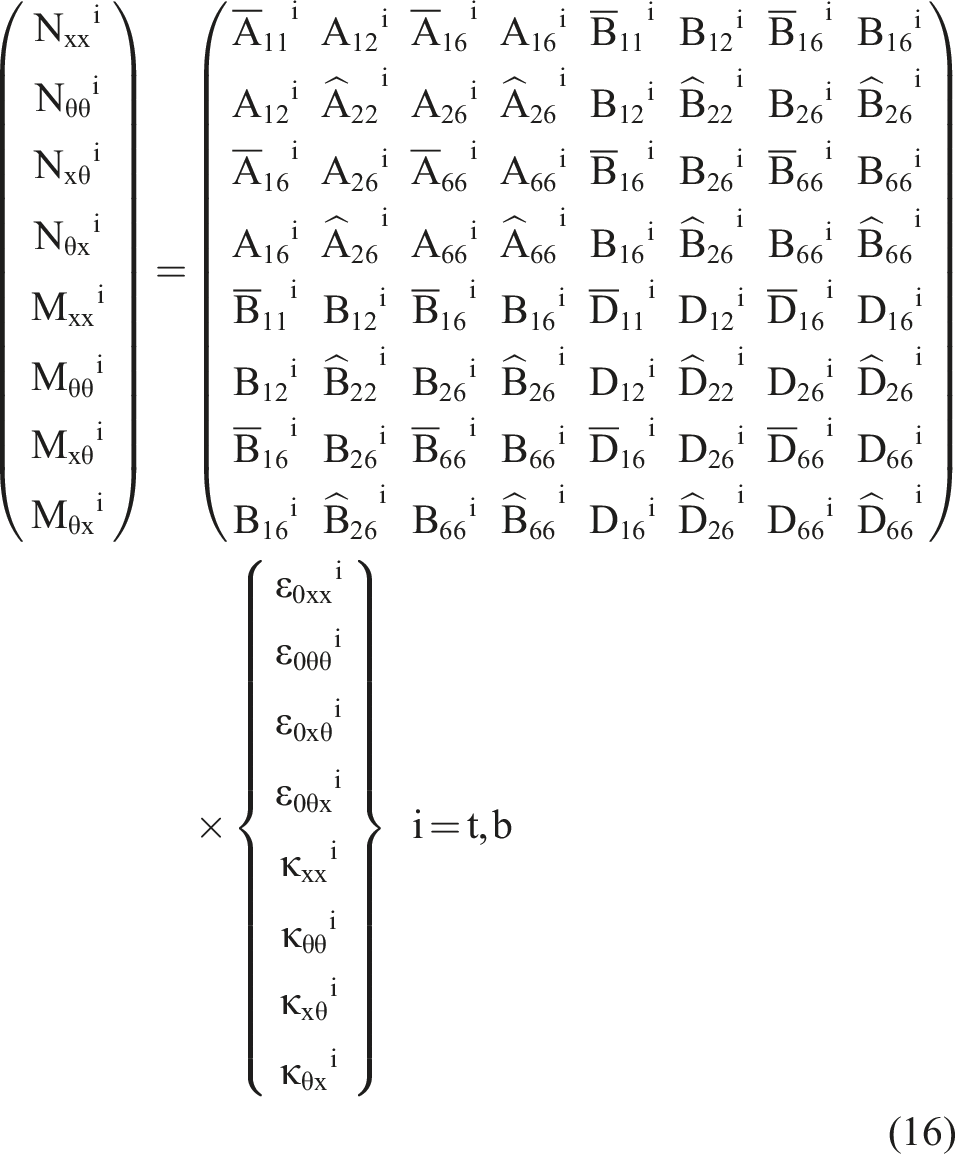
It results in the following force and moment relationship with strain and curvature at the mid surface for each facing layer (Qatu, 2004)
where are the stiffness components (See appendix A).
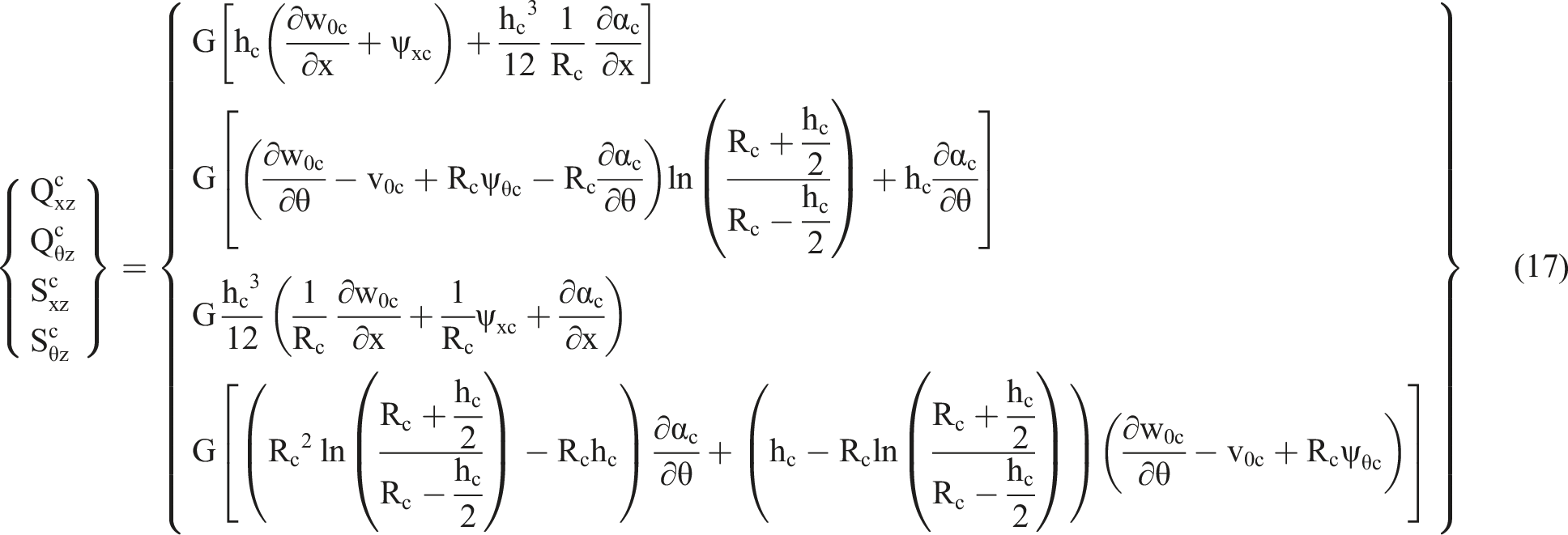
By direct integrating from equation (15b) the following equations is derived
2.5. Equations of motion
Hamilton’s principle with the following relation is used to derive equations of motion
where and δ denotes first variation, U and T are strain and kinetic energy with the following relations
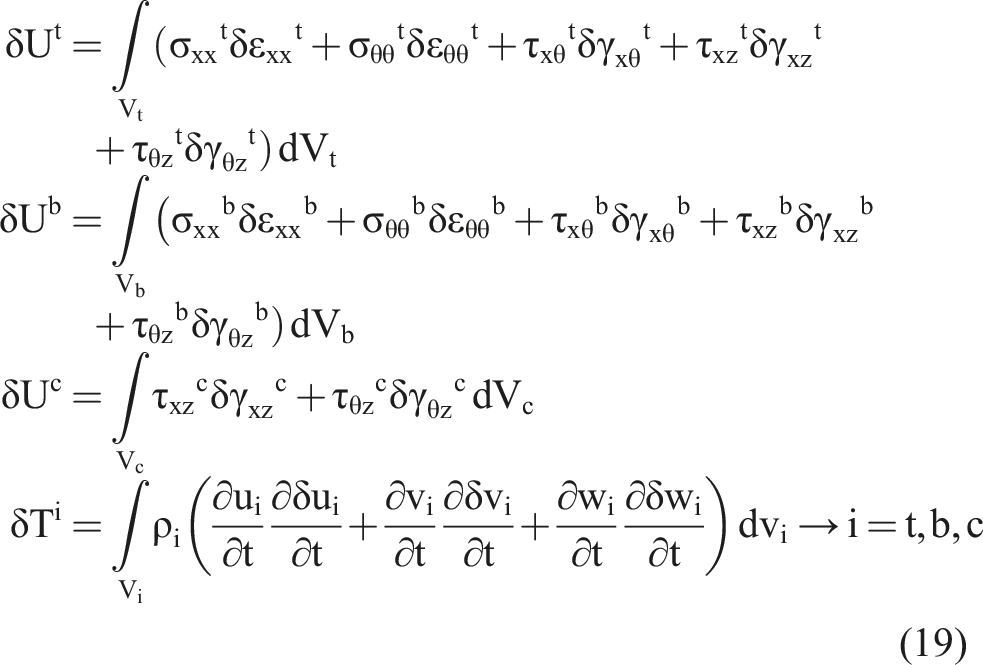
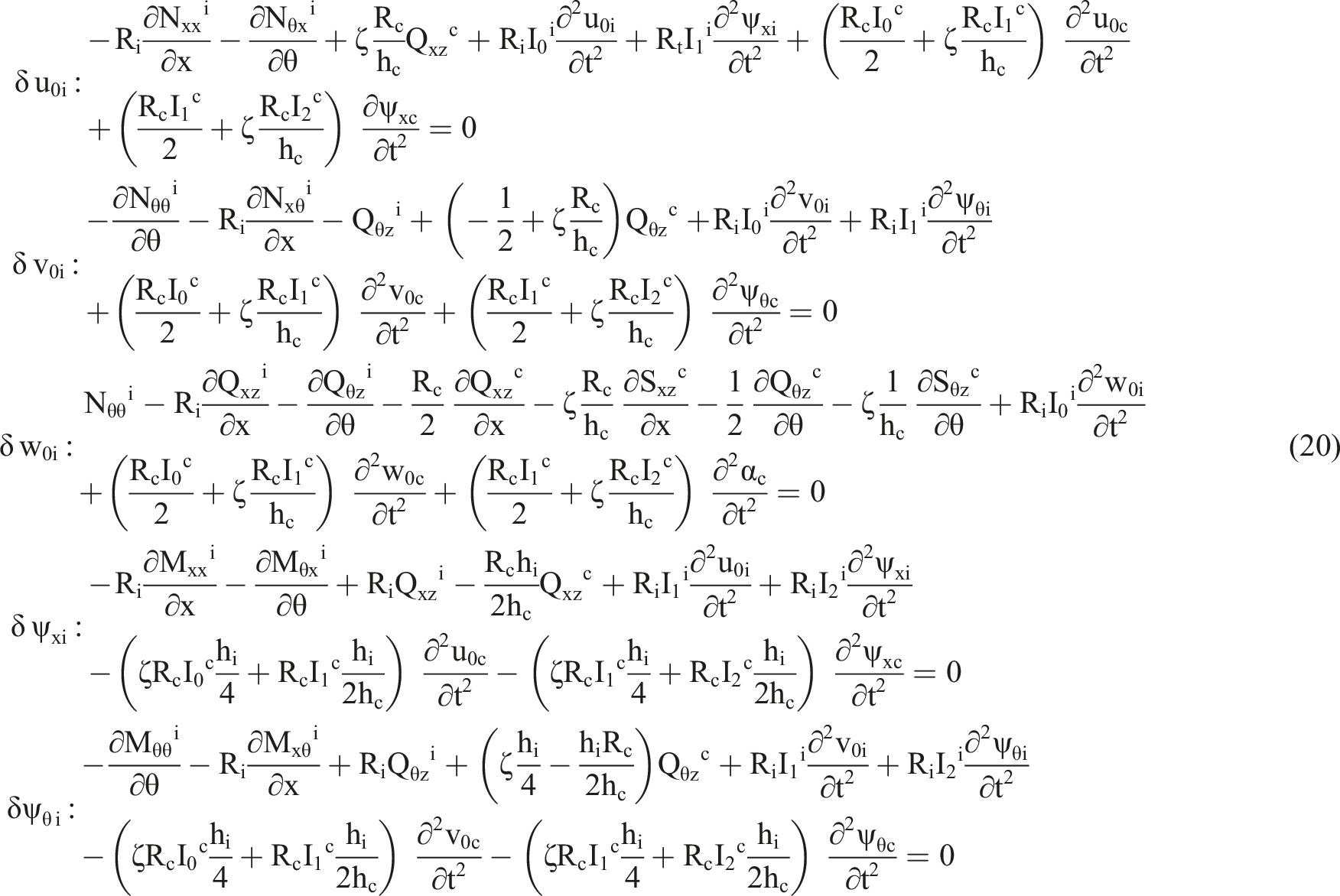
Using equations (9), (11), and (15a) in (19) and next substitution in equation (18) leads to the following governing equation of motions
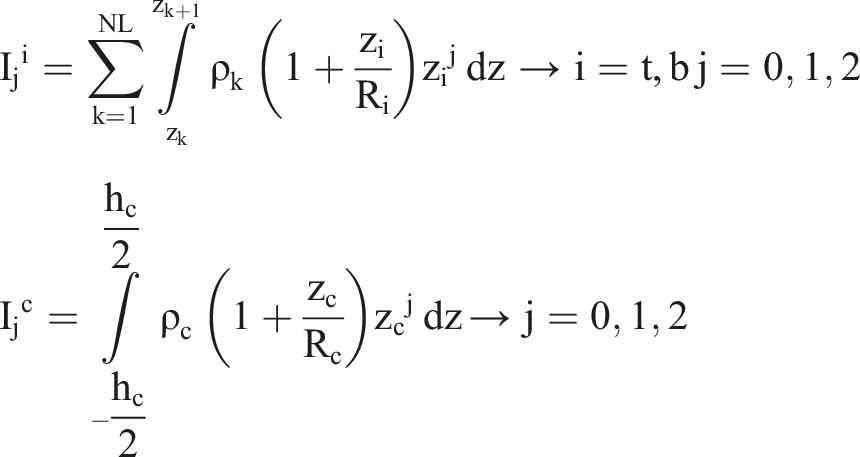
where , and inertia terms are
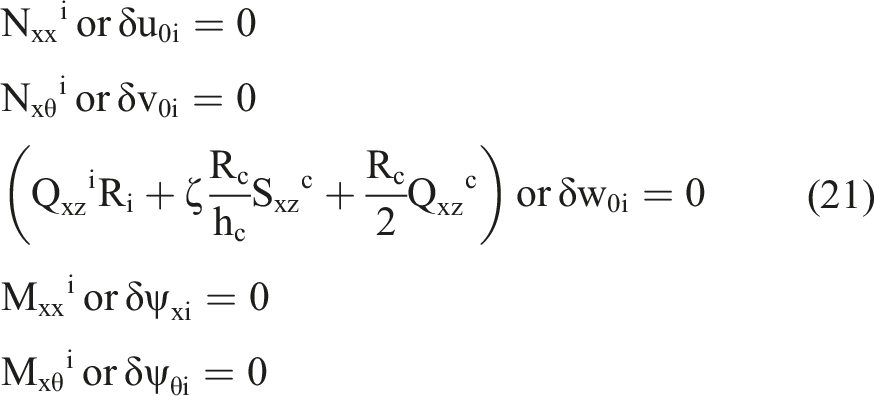
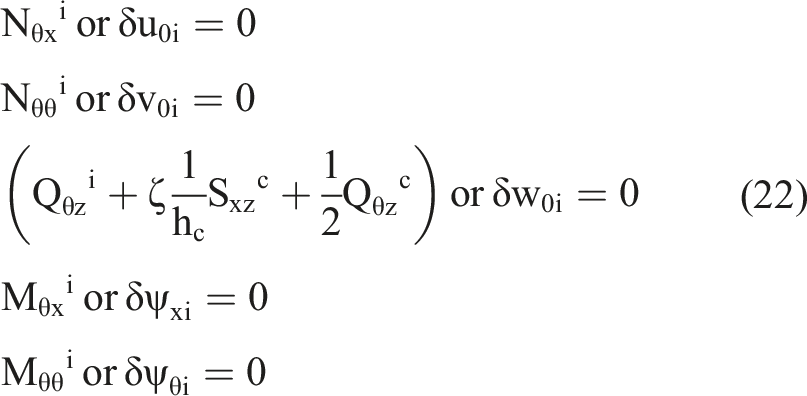
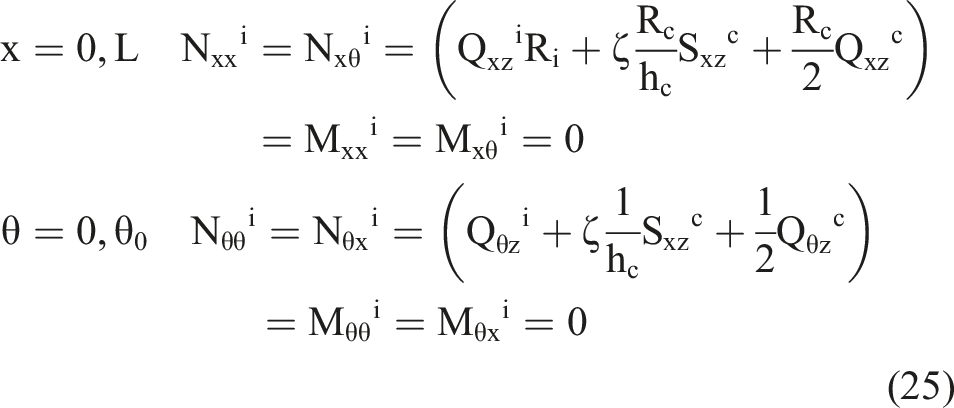
Additionally, following boundary conditions are derived:
At :
And at :
From equations (21) and (22) relation for different edges boundary conditions are expressed as:
Simply-Supported
Clamped
Free
Finally, by using equations (9), (16) and (17) in Equation (20), equations of motion are obtained in terms of unknown displacement of facing sheets as follow:
where D is a coefficient matrix and is displacements vector (see appendix B).
3. Solution procedure
Due to the nature of harmonic vibration of sandwich cylindrical panel, displacement components are expressed as follows via using separation of variable technique
3.1. Analytical solution
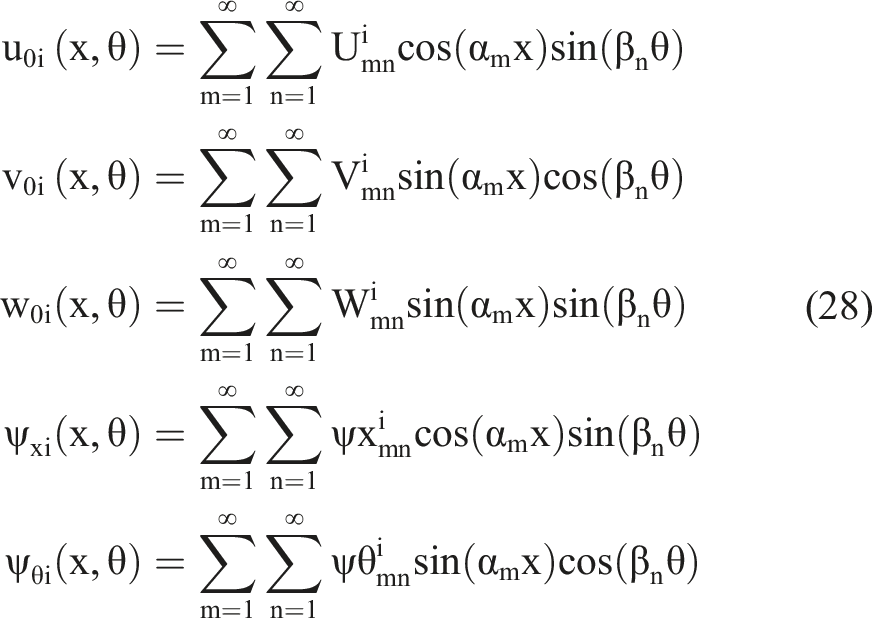
Following Fourier series expansion of displacement components along the axial and circumferential coordinates satisfy relation for simply supported edges, equation (23)
In which . By substituting equation (28) into equation (26) results in the following system of homogeneous equation
where [K] and [M] are stiffness and mass matrices, respectively, (See appendix C). Nontrivial solution to equation (27) leads to the following system of eigenvalue equations
Solving equation (30) results in the natural frequencies and modal loss factor as follows
3.2. Generalized differential quadrature
In the case of other edges boundary conditions, equations of motions are solved numerically by using GDQ.
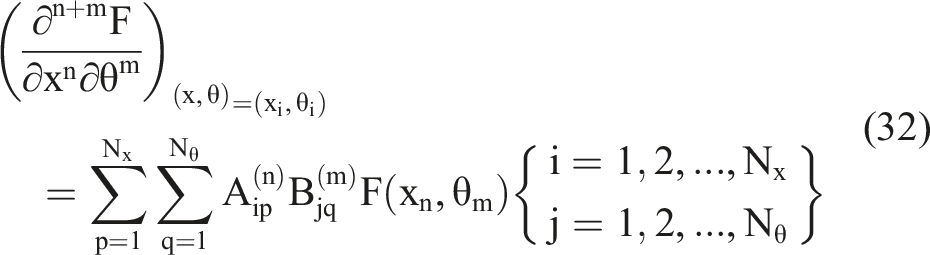
In GDQ, partial derivative of any arbitrary function (x, ) at a sample point (x, ) = (xi, j) is substitute by summation of weighting coefficients multiplied by the function values at sampling points in the domain of function variables
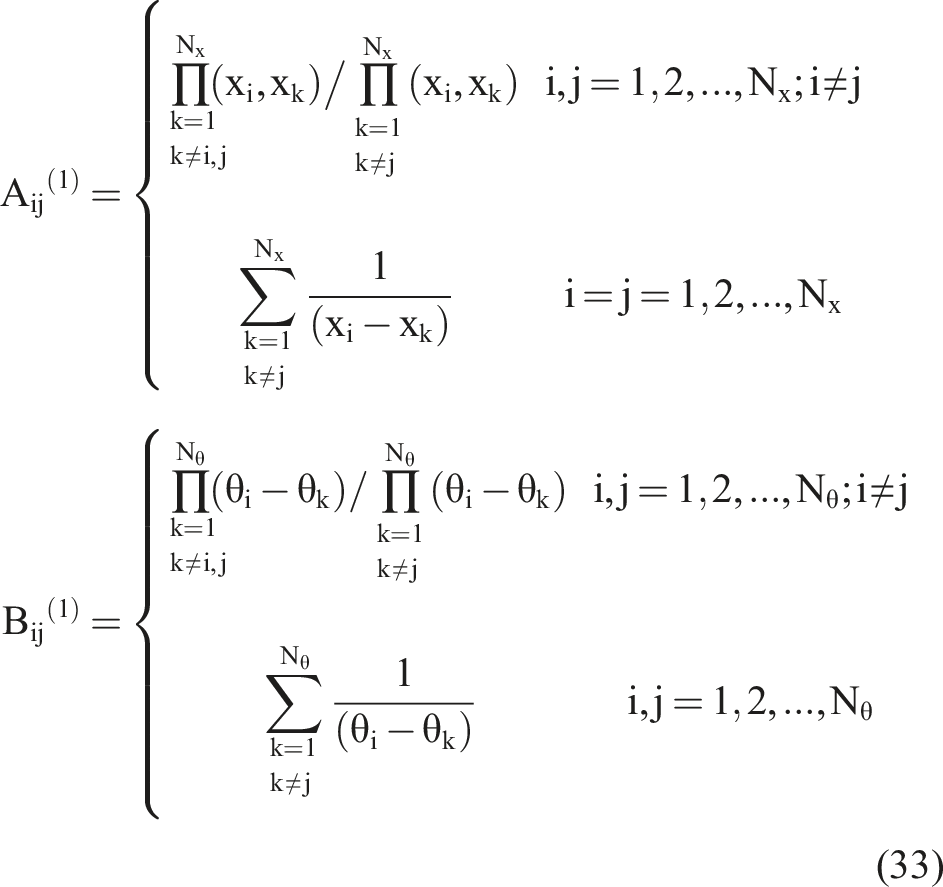
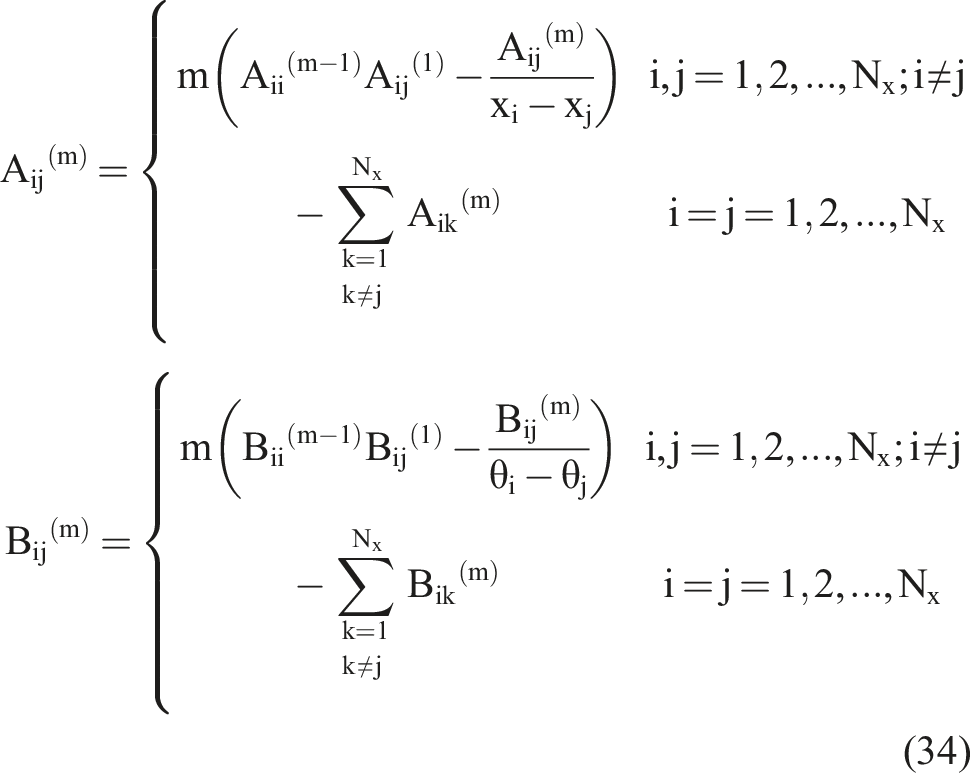
In which, and are the number of sample points along the axial and circumferential direction, also A(1) and B(1) are the first weighting coefficients and written as
And the weighting coefficients for higher derivative computed as
In this study, Chebyshev–Gauss–Lobatto grid distribution is selected to discretize the domain in x and θ directions as follows
By applying GDQ to the equations of motion, following homogeneous matrix equation are derived
where and and are stiffness and mass matrix, respectively, which can be derived by applying Equation (32) to Equation (26). It is noted that the other sub-vector in are similar to .
Next, applying equation (32) to the boundary conditions gives the following matrix equation
Here T is coefficient matrix which depends on the case of boundary conditions.
Assembling equations (34) and (35) leads to following homogeneous matrix equation
In above relation, the subscripts ‘b’ and ‘d’ denote degrees of freedom corresponding to the boundary and domain, respectively. By elimination of the boundary nodes in above equation the standard eigenvalue problem can be obtain as
In which, .
Nontrivial solution to equation (37) leads to the following eigenvalue matrix equations
Solving equation (38) results in the natural frequencies and modal loss factor.
4. Numerical result and discussion
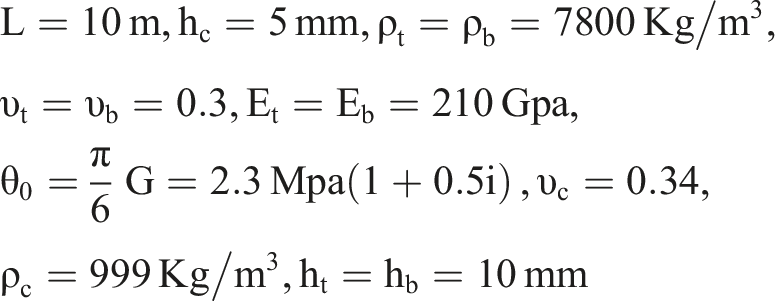
For numerical illustration, consider a sandwich composite cylindrical panel with electro-rheological core and GPLRC facing sheets with geometry and coordinate system as shown in Figure 1. Mechanical properties for materials constituent are according to Table 1, and sandwich panel is considered with the following geometrical properties unless otherwise specified
Mechanical properties of constituent material of sandwich cylindrical panel with ER core and GPLRC facing sheets.
Polymer matrix
Graphene platelet
Electro-rheological core
At first, verification and convergence of the current approach are carried out via computing natural frequency and modal loss factor analytically and numerically and comparing them with each other and with theoretical results that have already been published. Then the parametric study is performed to show the influences of various parameters like the electric field, geometry, boundary conditions, weight fraction, and pattern distribution of GPLs on natural frequency and modal loss factor.
4.1. Convergences and verifications
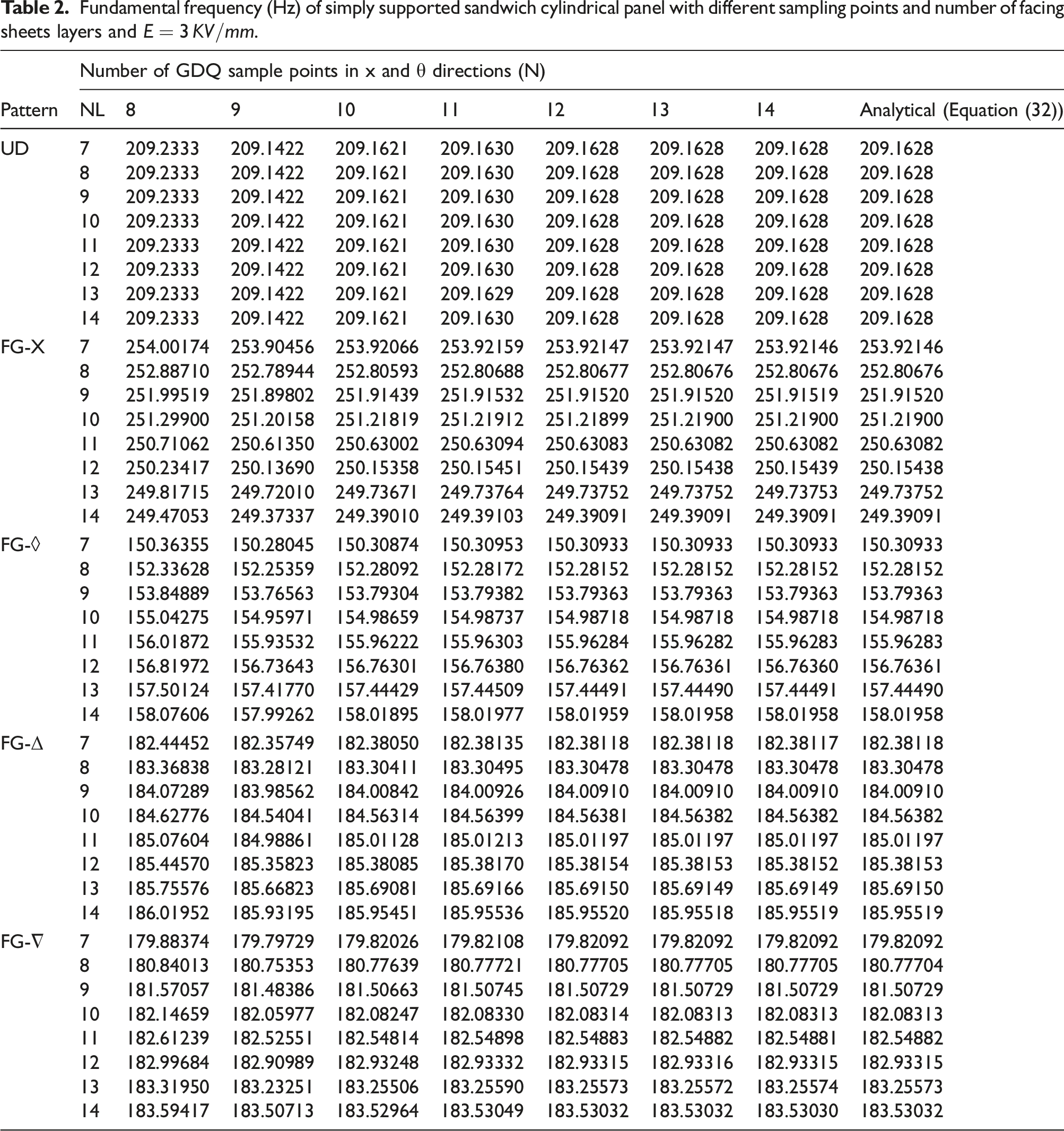
Table 2 shows the convergence for the fundamental frequency of simply-supported cylindrical sandwich panel with different GPL patterns based on the numbers of sample points () and sub-layers of facing sheet (NL). It is observed that the natural frequency obtained from the GDQ and analytical solution are very close to each other, the convergence of the results occurs very quickly, and N = NL = 11 is chosen for the upcoming results. Additionally, it is concluded that natural frequency in the FG-X pattern has a higher value than other graphene distribution patterns, and the FG-⋄ pattern results in the lowest natural frequency, so the upcoming results are based on the FG-X case of GPL distribution.
Fundamental frequency (Hz) of simply supported sandwich cylindrical panel with different sampling points and number of facing sheets layers and .
Number of GDQ sample points in x and θ directions (N)
Because there are many aspects of the model which need to verify, two more comparative examples have been considered. The first is a cylindrical sandwich panel, and the second is flat sandwich plates. To match the present cylindrical model with the rectangular model, the value of the radius of curvature is considered to be very large.
Numerical results for the first ten natural frequencies of cylindrical sandwich panel with viscoelastic core with the following material properties and geometric dimensions are computed and presented in Table 3
Comparing the results of the analytical and numerical solution of the present model and the results obtained in (Zhai et al., 2018), a good agreement can be observed. According to the Table 3, some discrepancy is seen which is due to the considering the trapezoidal shape factor in the present formulation.
Natural frequencies (Hz) of simply supported cylindrical sandwich panel with viscoelastic core.
Since there are no results for cylindrical sandwich panel with ER core, we computed the fundamental frequency of sandwich plate with ER core for the following material properties and geometric dimensions and then compared with the results reported in (Hasheminejad and Maleki, 2009) and presented in Table 4.
Increasing the core to facing sheets thickness ratio causes a decrease in the sandwich plate’s stiffness, and accordingly, the fundamental frequency decreases. Additionally, it is observed that when increased, fundamental frequency decreases due to reducing the stiffness of the sandwich plate. Also, as expected by increasing the electric field, stiffness of the sandwich plate increases, and accordingly, natural frequency increases. The important conclusion is that the present result is slightly different from those reported in (Hasheminejad and Maleki, 2009) due to the simple classical theory used in this reference.
4.2. Numerical results
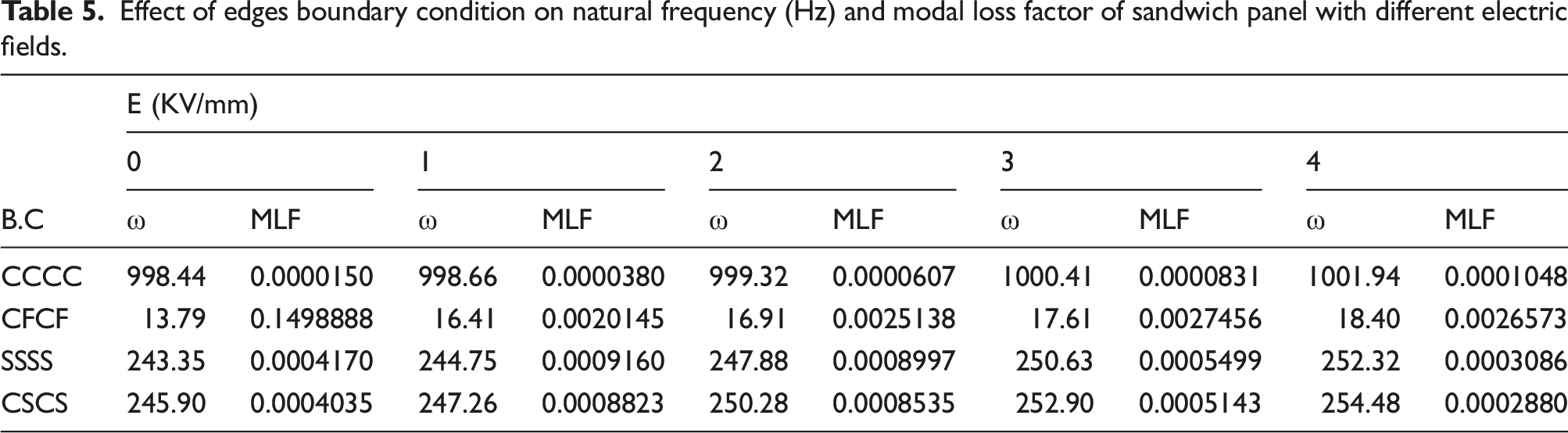
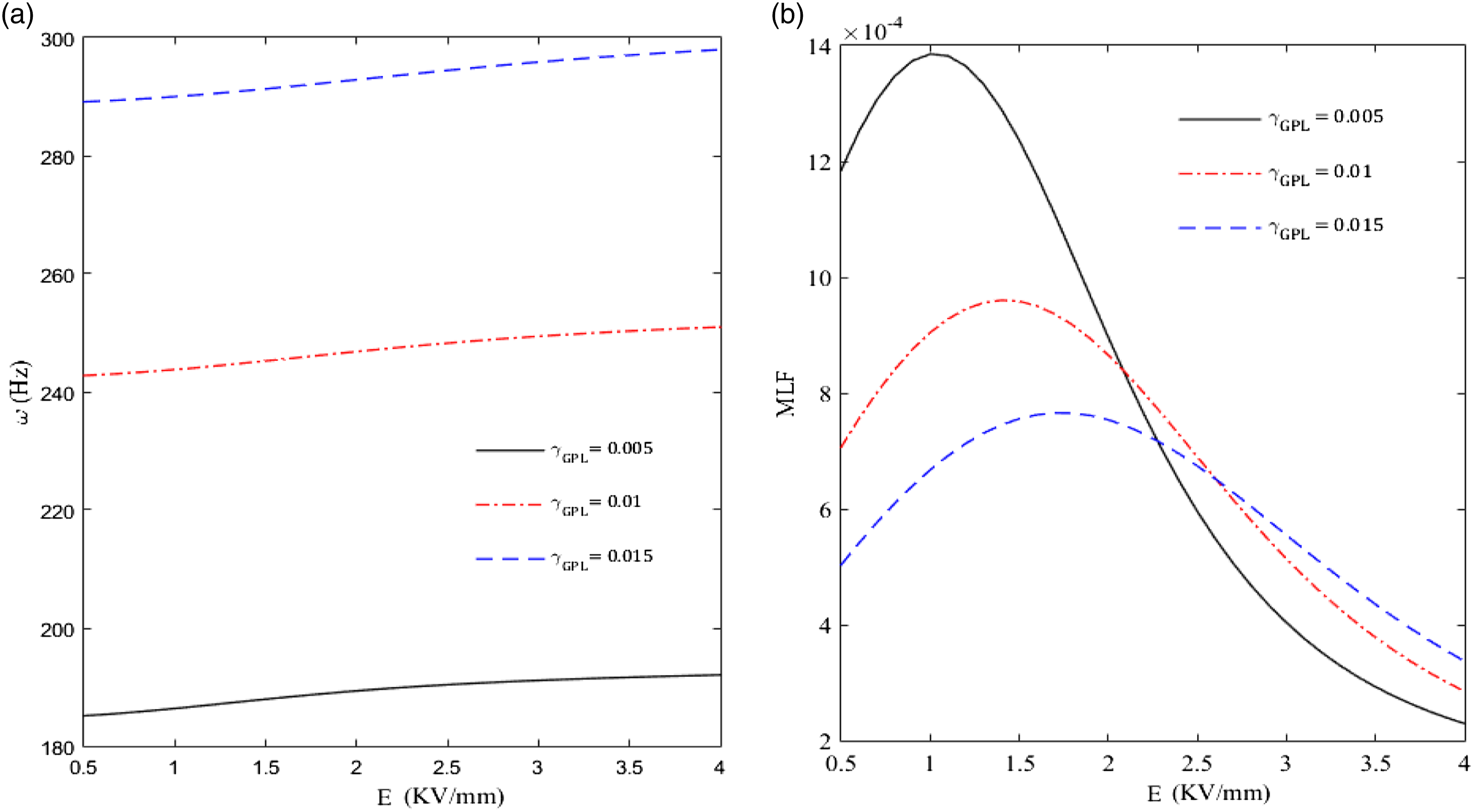
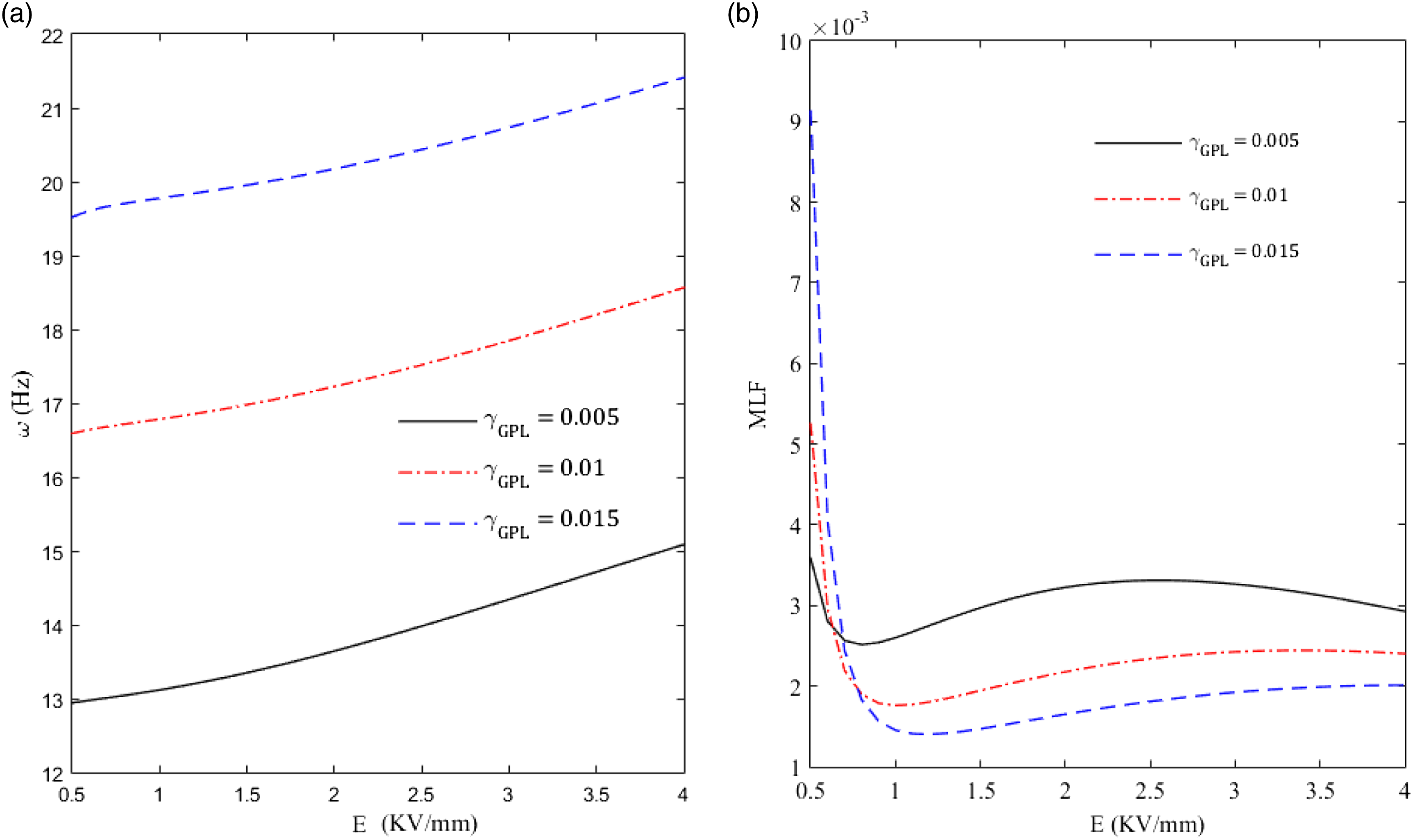
The effect of edges boundary conditions on the natural frequency and modal loss factor with different applied electric fields are represented in Table 5. According to the table, regardless of the applied electric field, and as the expected fundamental frequency in CCCC is greater, it is smaller in CFCF compared to the other edges boundary condition. Moreover, it is observed that increasing the electric field causes an increase in the panel’s stiffness and, consequently, fundamental frequency increase. Since the vibration amplitude in CFCF is greater than that for the CCCC, the edges boundary condition affects the modal loss factor. Figure 3 and Figure 4 show the effect of electric field on fundamental frequency and modal loss factor for different GPL volume fractions with CSCS and CFCF boundary conditions, respectively. As the figures show, natural frequency increases by raising the electric field, which is due to increasing the stiffness of the panel. In addition, the comparison of the natural frequency for the two types of boundary conditions shows that the more constrained the structure, the weaker the effect of the electric field on this increase.
Fundamental frequency (Hz) of simply supported sandwich panel with ER core and different electric fields.
Effect of edges boundary condition on natural frequency (Hz) and modal loss factor of sandwich panel with different electric fields.
B.C
E (KV/mm)
0
1
2
3
4
ω
MLF
ω
MLF
ω
MLF
ω
MLF
ω
MLF
CCCC
998.44
0.0000150
998.66
0.0000380
999.32
0.0000607
1000.41
0.0000831
1001.94
0.0001048
CFCF
13.79
0.1498888
16.41
0.0020145
16.91
0.0025138
17.61
0.0027456
18.40
0.0026573
SSSS
243.35
0.0004170
244.75
0.0009160
247.88
0.0008997
250.63
0.0005499
252.32
0.0003086
CSCS
245.90
0.0004035
247.26
0.0008823
250.28
0.0008535
252.90
0.0005143
254.48
0.0002880
Influence of weight fraction of GPL (a) on natural frequency and (b) loss factor of sandwich cylindrical panel versus electric field with CSCS boundary conditions.
Influence of weight fraction of GPL (a) on natural frequency and (b) loss factor of sandwich cylindrical panel versus electric field with CFCF boundary conditions.
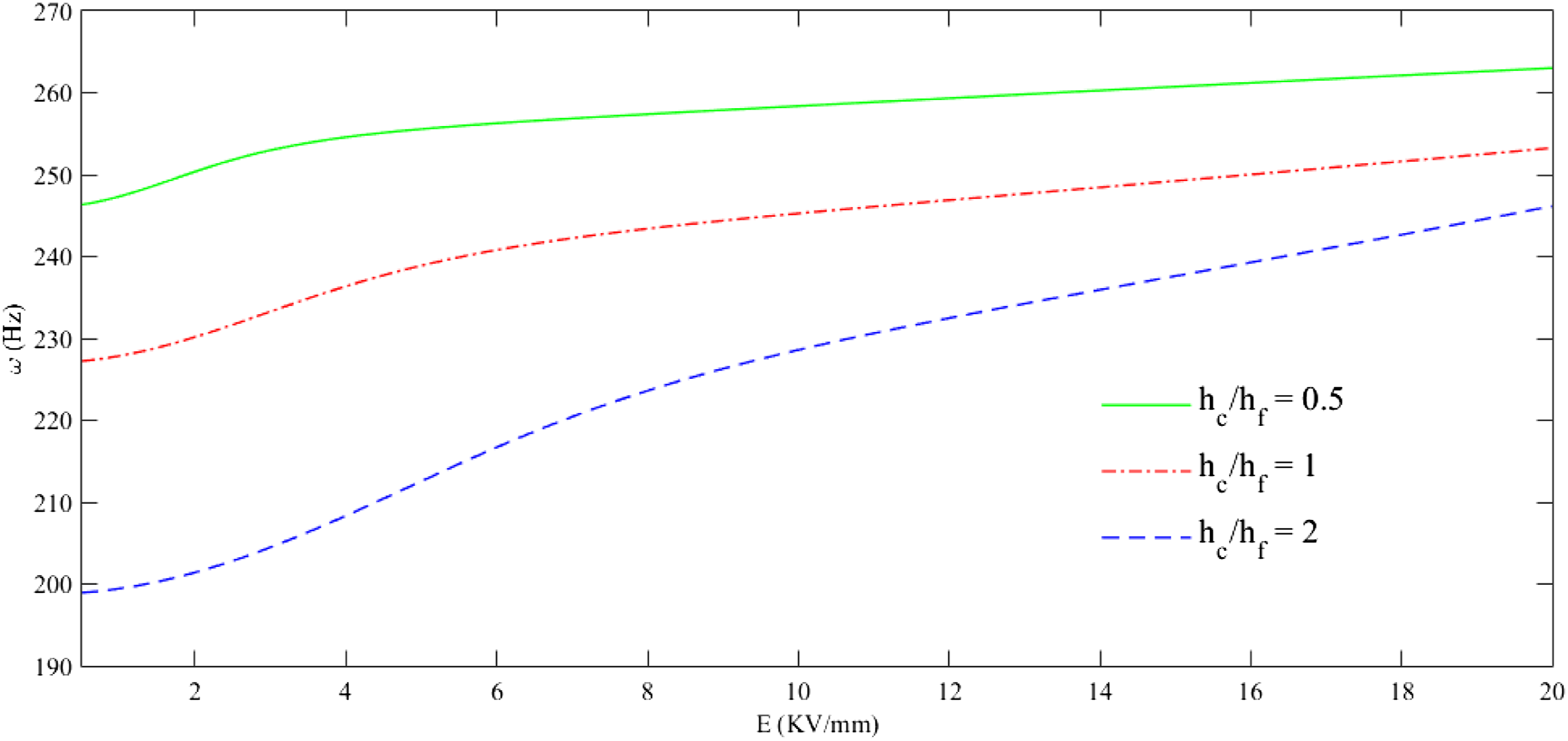
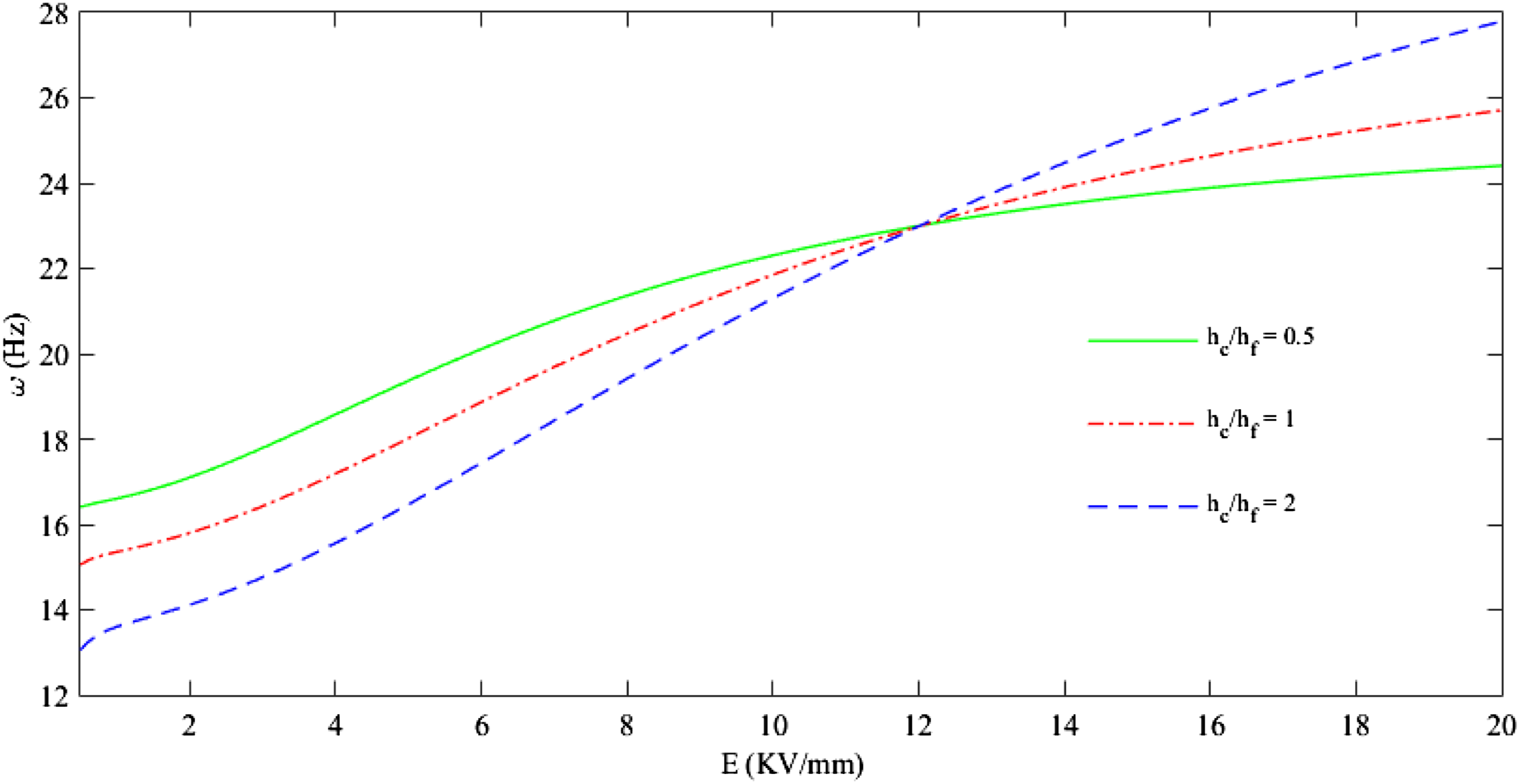
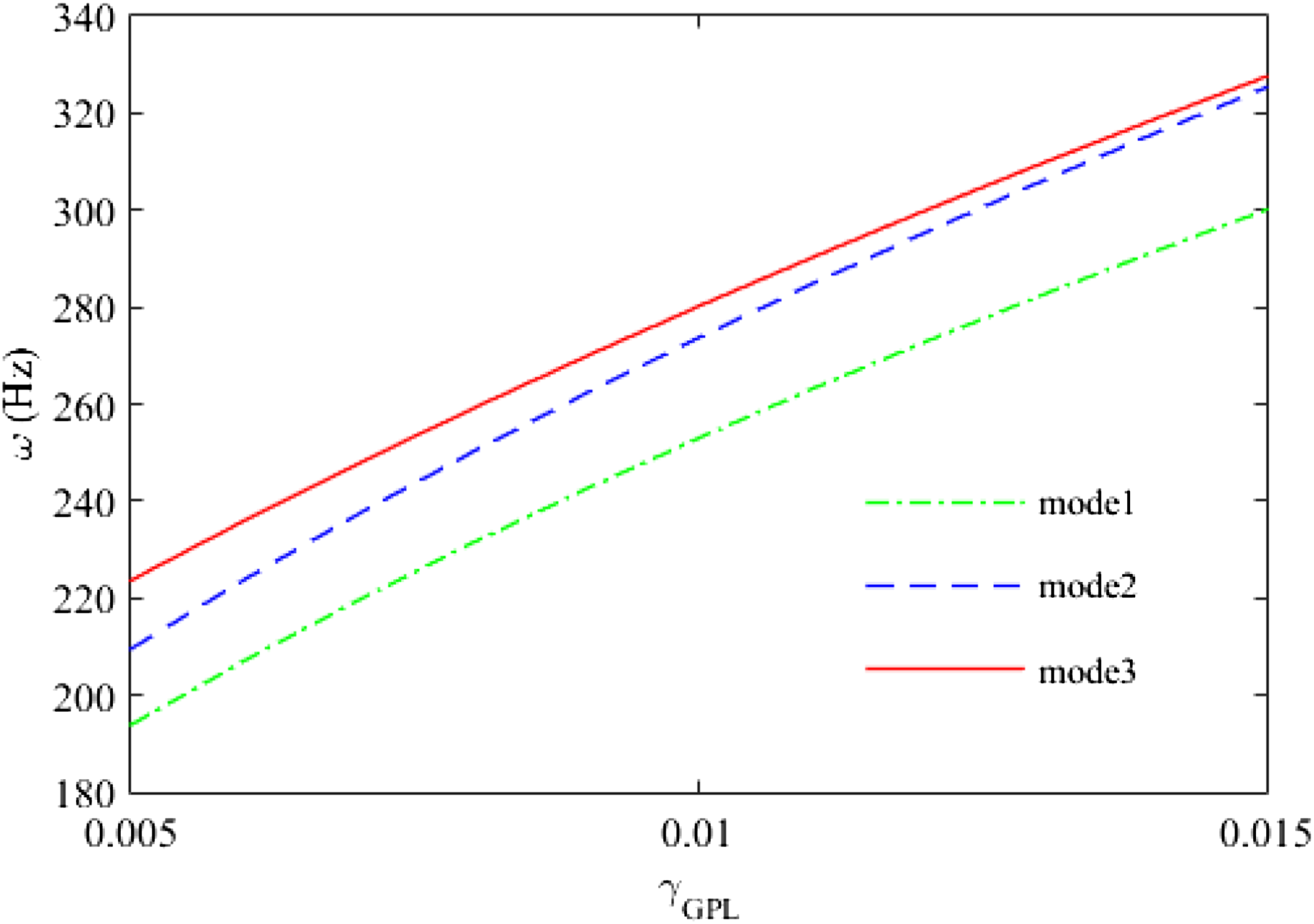
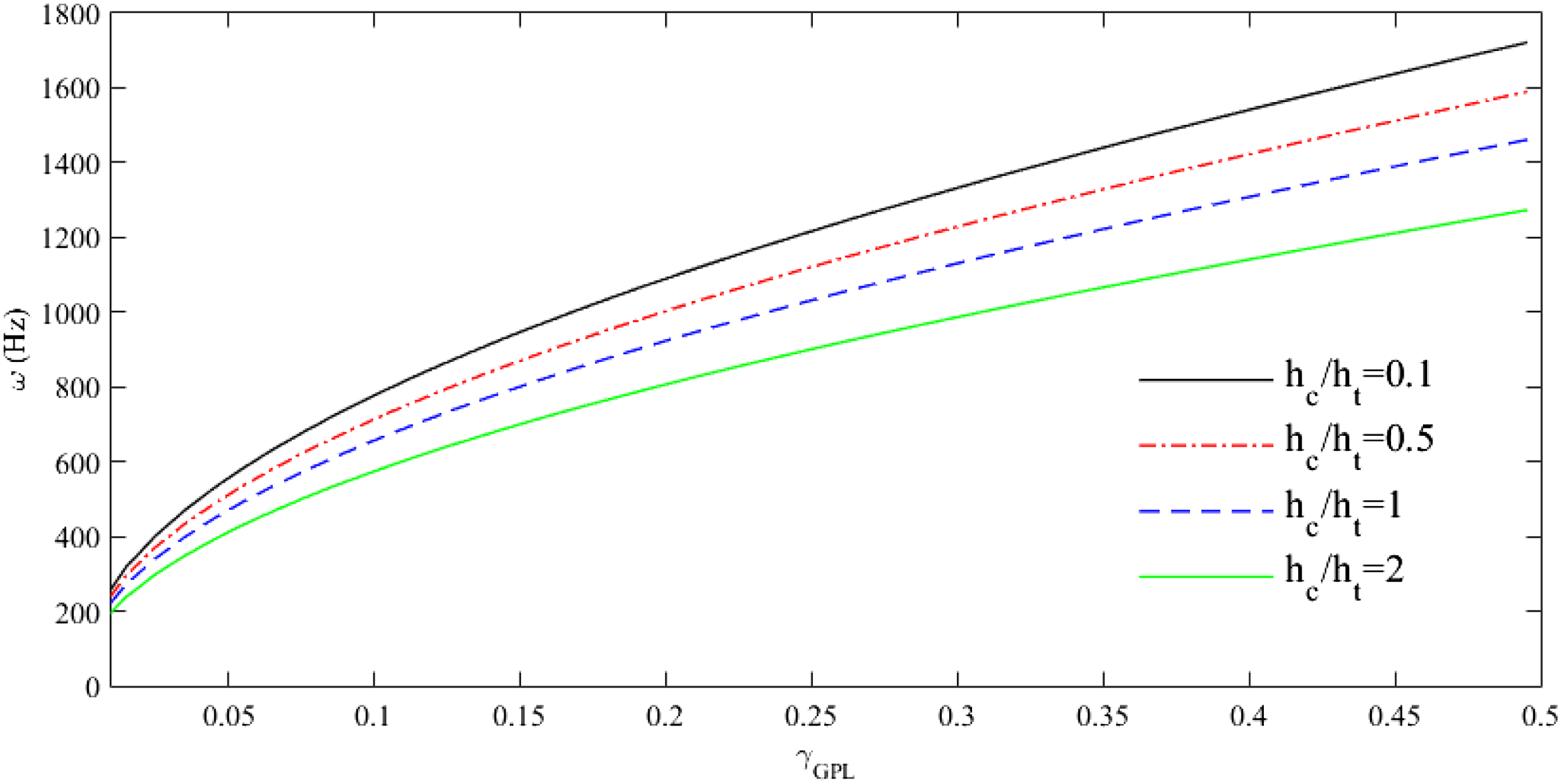
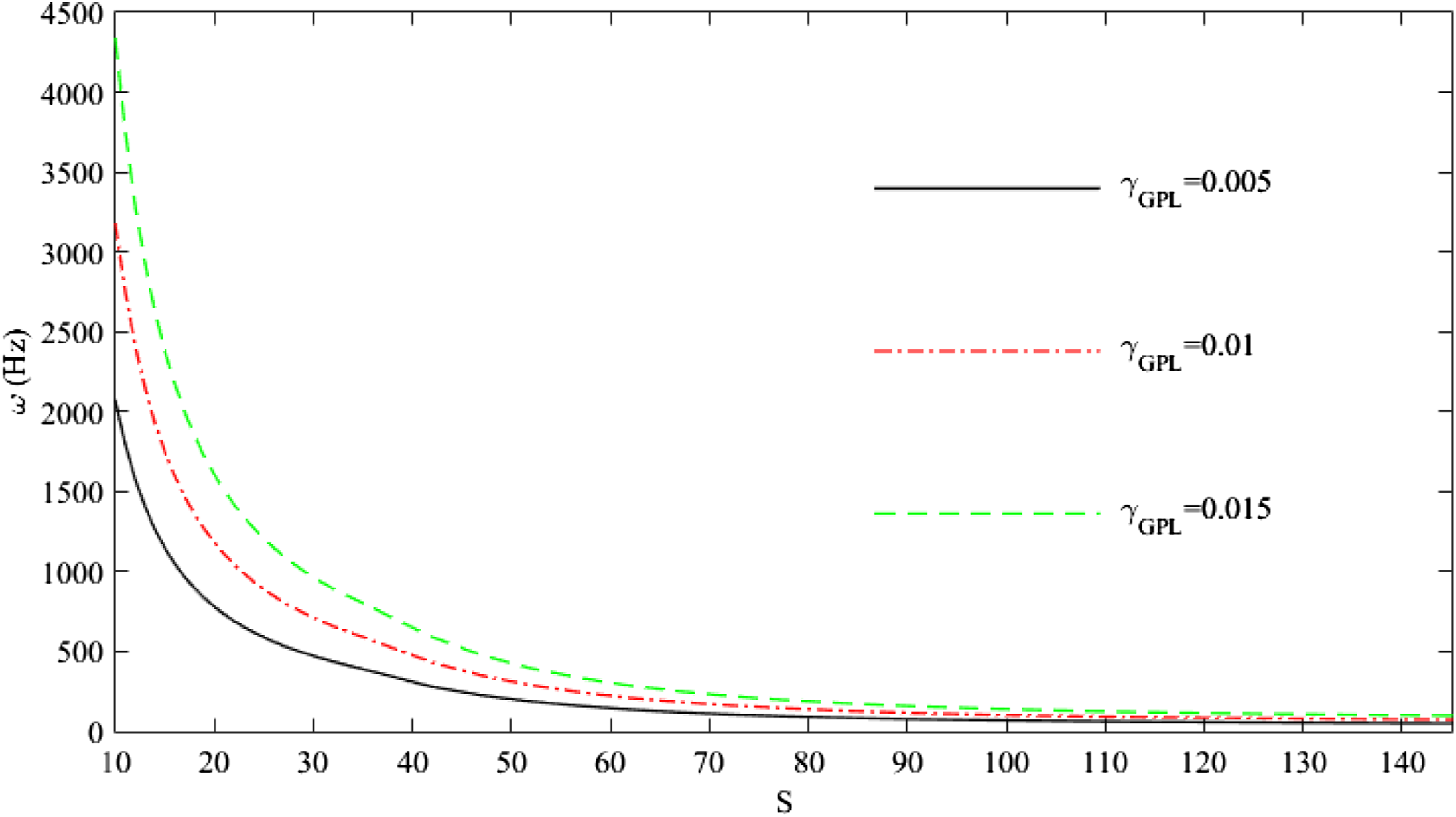
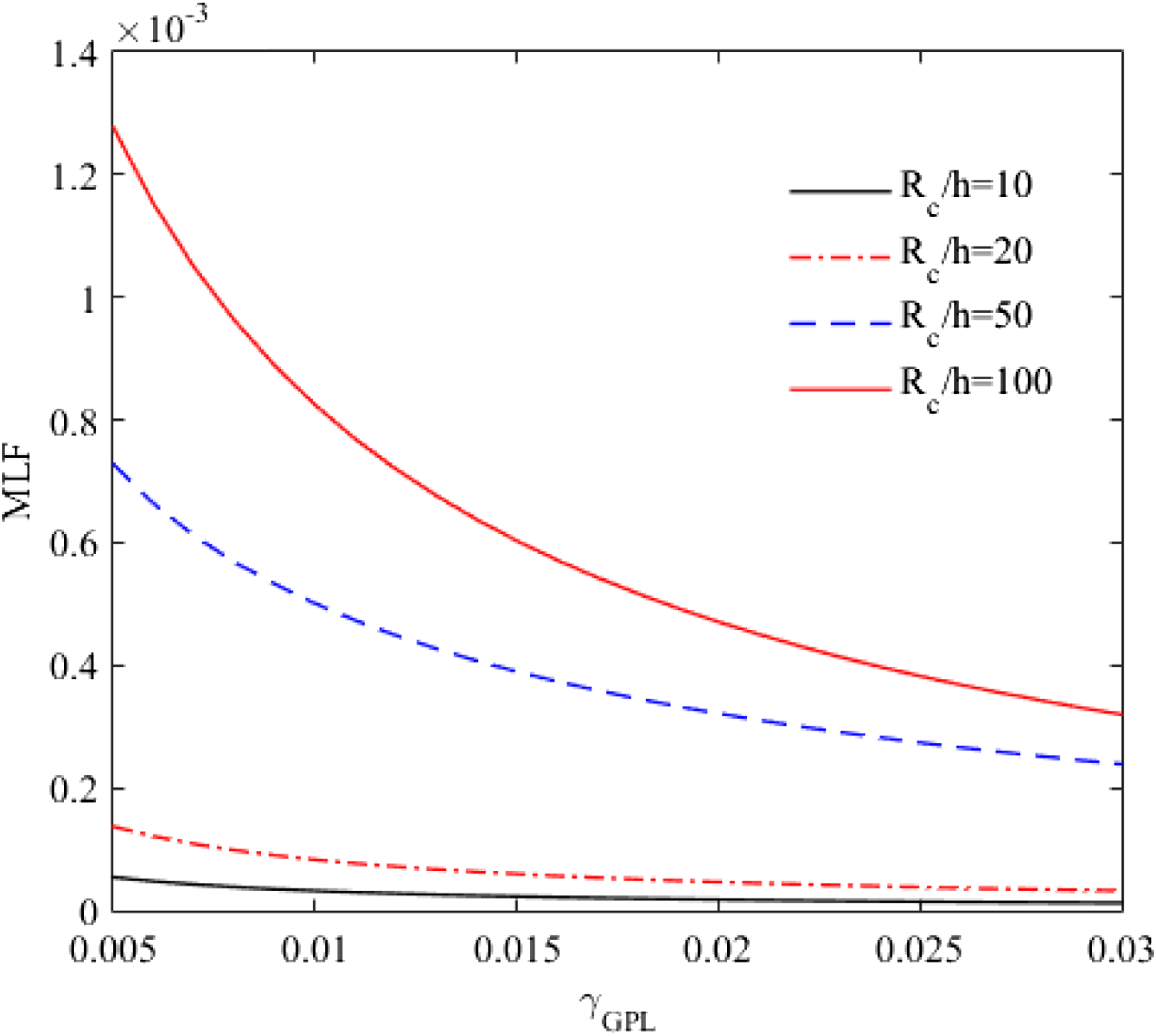
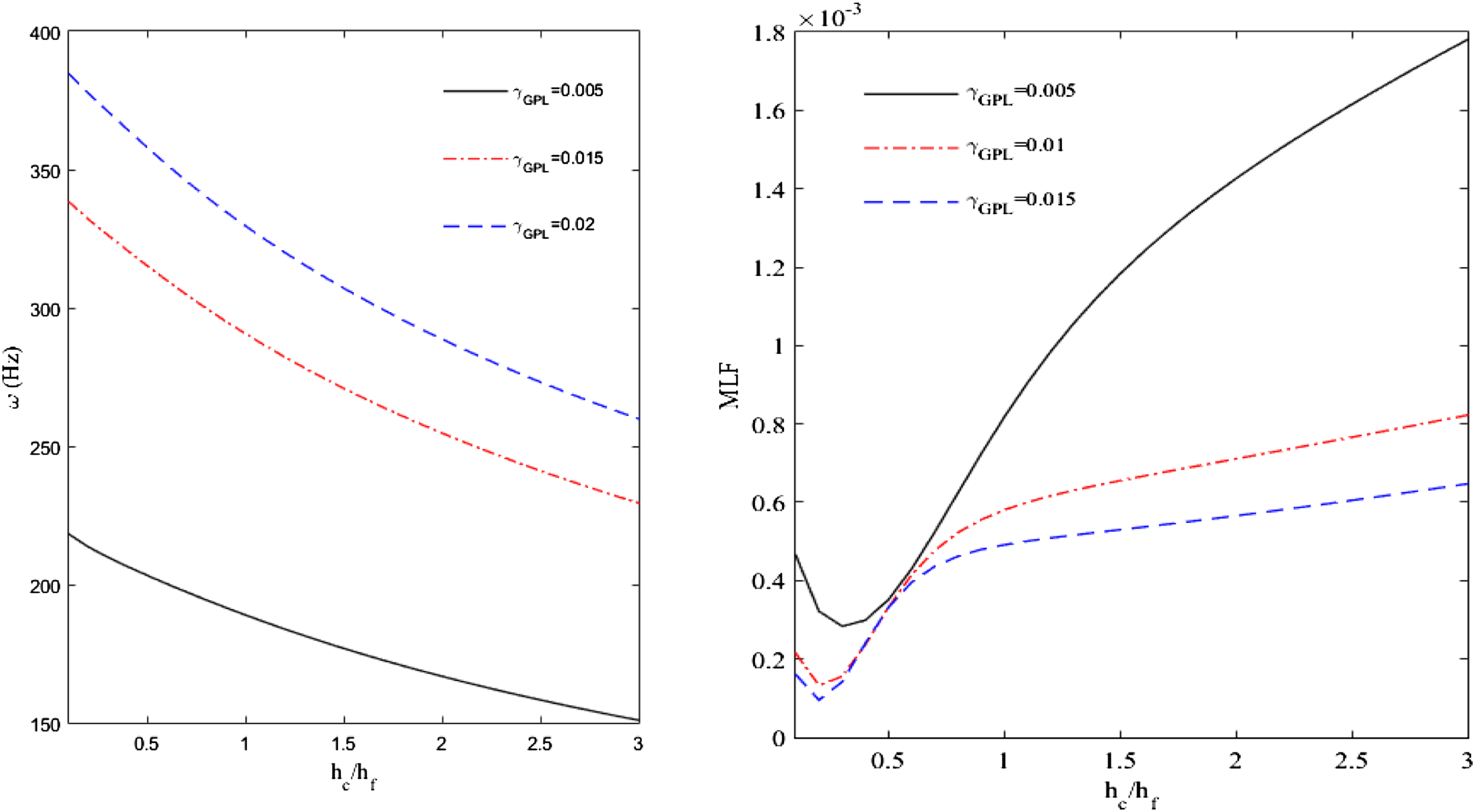
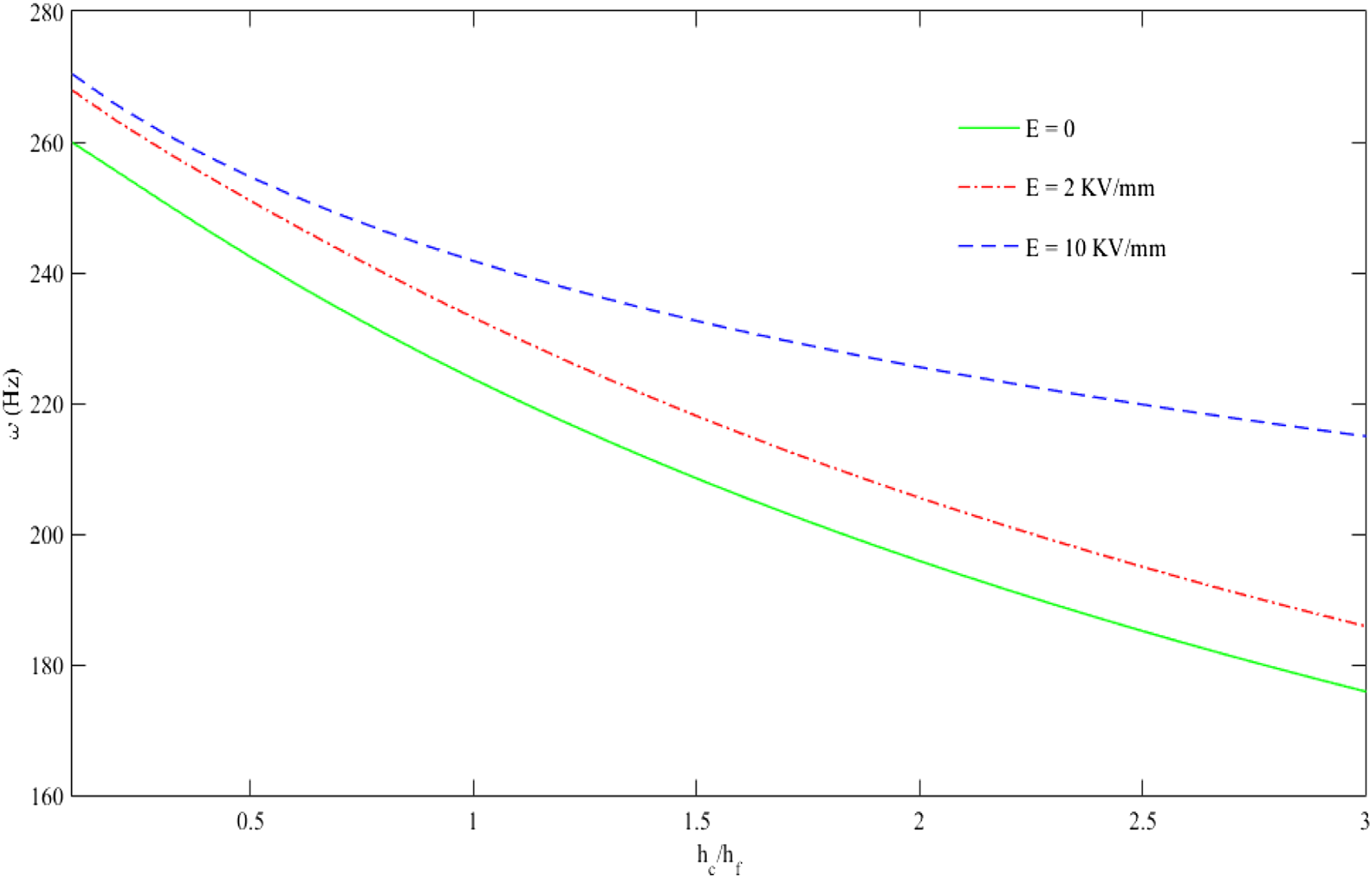
The loss factor increases at the beginning of electric field increase and then decreases. Since the loss factor is the ratio of dissipated energy to stored energy, and due to the relationship between the storage modulus and loss modulus (), with increasing electric field, initially the MLF changes are parabolic, and as the field increases, it converges to zero. It is also clear that the more constrained the structure, the more energy is stored, resulting in less MLF. Important conclusion is that the effect of GPL weight fraction in lower electric filed is more significant. Figure 5 and Figure 6 show the Influence of on natural frequency of sandwich cylindrical panel versus electric field with CSCS and CFCF boundary conditions, respectively. As the electric field strength increases, the shear modulus of the core increases and as a result the sandwich structure becomes stiffer and consequently the natural frequency increases. The increase in natural frequency occurs more rapidly when the ratio of the thickness of the core to the thickness of the facing sheet is greater. In Figure 6, after E12 KV/mm the scale is changed in comparison to Figure 5; the reason is that the increase in the stiffness of the core in CFCF compared to CSCS has a more significant effect on the stiffness of the whole structure. Therefore, since natural frequency has a direct relationship with stiffness, the effect of a larger ratio on the natural frequency increase is more significant in the CFCF boundary conditions. The natural frequencies of three modes versus GPL weight fraction is depicted in Figure 7. It is seen that the natural frequency increases significantly by increasing GPL weight fraction. Moreover, effect of GPL weight fraction in lower modes is more noticeable. The effect of graphene weight fraction on the natural frequency of the sandwich panel for different is shown in Figure 8. It is clear that with increasing weight fraction, the natural frequency increases, but the rate of increase is higher where A is lower. The justification for this can be stated that the facing sheets are much stiffer than the core, and the lower the , the harder the structure. Variation of fundamental frequency versus mid radius to thickness ratio, , is presented in Figure 9. Regardless of GPL weight fraction, by increasing the mid-radius to thickness ration, S natural frequency decreases and finally converges to a constant value, which denotes the thin panel behavior. Important conclusion is that the effect of GPL weight fraction in thick panel is more significant. Variation of loss factor as a function of GPL weight fraction for different is depicted Figure 10. According to the figure and as expected, increasing the GPL weight fraction causes the amplitude of vibration to decrease and accordingly the loss factor decreases. Additionally, it is concluded that the effect of GPL weight fraction on loss factor in thin panel is noticeable. Figures 11(a) and (b) represent the influence of core to facing sheet thickness ratio on fundamental frequency and loss factor, respectively, for different GPL weight fractions. By increasing stiffness of the panel decreases which causes to decrease the natural frequency and this effect is conversely for the loss factor. Moreover, it is observed that effect of GPL weight fraction on fundamental frequency at lower is significant whereas this effect is conversely for the loss factor. In Figure 11(b), MLF has a sudden decrease, then it increases. The physical justification of this behavior can be found in the fact that when the electro-rheological layer is skinny, the energy lost by the friction between the layers decreases, and then with the increase in the thickness of the core, the energy damped by the ER material increases. Variation of natural frequency of sandwich panel versus for different electric field is presented in Figure 12. Regardless of electric field, natural frequency decrease by increasing which is due to the reduction of stiffness of the panel. As expected by increasing effect of electric field increases which is due to increasing the ER region.
Influence of on natural frequency of sandwich cylindrical panel versus electric field with CSCS boundary conditions.
Influence of on natural frequency of sandwich cylindrical panel versus electric field with CFCF boundary conditions.
Effect of GPL weight fraction on first three natural frequencies of panel with CSCS boundary conditions.
Influence of on natural frequency of sandwich cylindrical panel versus electric field with CSCS boundary conditions.
Influence of different weight fraction of GPL on natural frequency versus Rc/h with CCCC boundary conditions and .
Effect of mid-radius to thickness ration on modal loss factor for different GPL weight fractions and CCCC boundary conditions ().
Effect of core to facing sheets thickness ration on (a) Natural frequency and (b) modal loss for different GPL weight fraction and SSSS boundary conditions ().
Natural frequency versus hc/hf with different electric field and CSCS boundary conditions.
5. Conclusion
Vibration behavior of sandwich composite panel with ER core and GPL reinforced composite facing sheets is investigated in current research. A variety of functionally graded patterns are considered for GPL distribution in the cross section of the facing sheets. Governing equations of motion are derived via Hamilton’s principle within the first-order shear deformation theory framework. In the meantime, the thin shell simplifier assumption was not used for any layers These equations are solved analytically using dual Fourier series and numerically using the 2D-GDQ method, and the natural frequency and modal loss factor were calculated. The results obtained from the numerical method and the analytical method were in good agreement with each other and the results of valid references. Finally, the effect of different model parameters on the natural frequency and modal loss factor is shown.
From numerical illustration, some conclusions are made as follows:
• Convergence occurs rapidly in the GDQ method, and its results are in good agreement with the analytical solution results.
• Among the various patterns of graphene distribution in facing sheets, the highest natural frequency occurs when the FG- X pattern is used. In contrast, the lowest natural frequency occurs when the FG-⋄ pattern is used
• The more constrained the structure, the higher its stiffness and consequently the higher the natural frequency, so when the clamp support conditions are used on all four sides, we have the highest natural frequency.
• As the electric field identity increase, the shear modulus of the core increases, and the structure becomes stiffer, increasing the natural frequency. In the meantime, the higher core to facing sheet thickness ratio or the more unconstrained the structure, the greater the natural frequency increase.
• The natural frequency increases with increasing graphene weight fraction, and the lower core to facing sheet thickness ratio, the more significant this increase is.
• As the ratio of the radius of curvature to the thickness increases, the natural frequency decreases and eventually converges to a specific value.
• By increasing the GPL weight modal loss factor decreases.
• Effect of electric field on natural frequency in higher is more significant.
Footnotes
Declaration of conflicting interests
The author(s) declared no potential conflicts of interest with respect to the research, authorship, and/or publication of this article.
Funding
The author(s) received no financial support for the research, authorship, and/or publication of this article.
ORCID iD
Akbar Alibeigloo
Appendix A
where and Ks is correction factor and equal to 5/6.
Appendix B
Appendix C
References
1.
AffdlJHKardosJ (1976) The Halpin–Tsai equations: a review. Polymer Engineering & Science16(5): 344–352.
2.
Al-FurjanMMoghadamSADehiniR, et al. (2021) Vibration control of a smart shell reinforced by graphene nanoplatelets under external load: semi-numerical and finite element modeling. Thin-Walled Structures159: 107242.
3.
AllahverdizadehAMahjoobMEshraghiI, et al. (2013) On the vibration behavior of functionally graded electrorheological sandwich beams. International Journal of Mechanical Sciences70: 130–139.
4.
AllahverdizadehAMahjoobMJNasrollahzadehN, et al. (2014) Optimal parameters estimation and vibration control of a viscoelastic adaptive sandwich beam incorporating an electrorheological fluid layer. Journal of Vibration and Control20(12): 1855–1868.
5.
AnvariMMohammadimehrMAmiriA (2020) Vibration behavior of a micro cylindrical sandwich panel reinforced by graphene platelet. Journal of Vibration and Control26(13–14): 1311–1343.
6.
AraniAGJamaliSZareiHB (2017) Differential quadrature method for vibration analysis of electro-rheological sandwich plate with CNT reinforced nanocomposite facesheets subjected to electric field. Composite Structures180: 211–220.
7.
ArefiMMoghaddamSKBidgoliEM-R, et al. (2021) Analysis of graphene nanoplatelet reinforced cylindrical shell subjected to thermo-mechanical loads. Composite Structures255: 112924.
8.
AsadiEQatuMS (2012) Static analysis of thick laminated shells with different boundary conditions using GDQ. Thin-walled structures51: 76–81.
9.
AsadiEQatuMS (2013) Free vibration of thick laminated cylindrical shells with different boundary conditions using general differential quadrature. Journal of Vibration and Control19(3): 356–366.
10.
DonDL (1993) An investigation of electrorheologial material adaptive structures.
11.
FengCKitipornchaiSYangJ (2017) Nonlinear free vibration of functionally graded polymer composite beams reinforced with graphene nanoplatelets (GPLs). Engineering Structures140: 110–119.
12.
Gholamzadeh BabakiMShakouriM (2019) Free and forced vibration of sandwich plates with electrorheological core and functionally graded face layers. Mechanics Based Design of Structures and Machines49: 1–18.
13.
Ghorbanpour AraniAJamaliS (2020) The vibration of the cylindrically curved sandwich plate with rheological core and nanocomposite face sheets rested on the Winkler–Pasternak foundation. Journal of Sandwich Structures & Materials23: 2196–2216.
14.
HasheminejadSMMalekiM (2009) Free vibration and forced harmonic response of an electrorheological fluid-filled sandwich plate. Smart Materials and Structures 18(5)18: 055013.
15.
KangYKKimJChoiS-B (2001) Passive and active damping characteristics of smart electro-rheological composite beams. Smart Materials and Structures10(4): 724–729.
16.
MohammadiFSedaghatiR (2012) Nonlinear free vibration analysis of sandwich shell structures with a constrained electrorheological fluid layer. Smart Materials and Structures 21(7)21: 075035
17.
MohseniAShakouriM (2020) Natural frequency, damping and forced responses of sandwich plates with viscoelastic core and graphene nanoplatelets reinforced face sheets. Journal of Vibration and Control26(15–16): 1165–1177.
18.
QatuM (1995) Accurate stress resultants equations for laminated composite deep thick shells. Reportno.Report Number|, Date. Place Published|: Institution|.
19.
QatuMS (1999) Accurate equations for laminated composite deep thick shells. International Journal of Solids and Structures36(19): 2917–2941.
20.
QatuM. S. (2004). Vibration of Laminated Shells and Plates. Netherlands: Elsevier Science.
21.
QatuMSAsadiEWangW (2012) Review of recent literature on static analyses of composite shells: 2000-2010. Open Journal of Composite Materials2: 61–86.
22.
RahimiAAlibeiglooASafarpourM (2020) Three-dimensional static and free vibration analysis of graphene platelet–reinforced porous composite cylindrical shell. Journal of Vibration and Control26(19–20): 1627–1645.
23.
SaddM. H. (2009). Elasticity: Theory, Applications, and Numerics. Netherlands: Elsevier Science.
24.
SoleymaniMHajabasiMElahi MahaniS (2015) Free vibrations analysis of a sandwich rectangular plate with electrorheological fluid core. Journal of Computational & Applied Research in Mechanical Engineering (JCARME)5(1): 71–81.
25.
SongMKitipornchaiSYangJ (2017) Free and forced vibrations of functionally graded polymer composite plates reinforced with graphene nanoplatelets. Composite Structures159: 579–588.
26.
TabassianRRezaeepazhandJ (2013) Dynamic stability of smart sandwich beams with electro-rheological core resting on elastic foundation. Journal of Sandwich Structures & Materials15(1): 25–44.
27.
YalcintasMCoulterJP (1995) Electrorheological material based adaptive beams subjected to various boundary conditions. Journal of intelligent material systems and structures6(5): 700–717.
28.
YehJ-Y (2008) Finite element analysis of the cylindrical shells subjected to ER damping treatment. Smart Materials and Structures17(3): 035022.
29.
YehJ-Y (2011) Vibration and damping analysis of orthotropic cylindrical shells with electrorheological core layer. Aerospace Science and Technology15(4): 293–303.
30.
YehJ-YChenL-W (2004) Vibration of a sandwich plate with a constrained layer and electrorheological fluid core. Composite Structures65(2): 251–258.
31.
YehJ-YChenL-W (2007) Finite element dynamic analysis of orthotropic sandwich plates with an electrorheological fluid core layer. Composite Structures78(3): 368–376.
32.
YehJ-YChenL-WWangC-C (2004) Dynamic stability of a sandwich beam with a constrained layer and electrorheological fluid core. Composite Structures64(1): 47–54.
33.
ZhaiYChaiMSuJ, et al. (2018) Dynamics properties of composite sandwich open circular cylindrical shells. Composite Structures189: 148–159.