






Abstract
This paper mainly studies the finite time synchronization problem of stochastic multi weights complex network model with time-varying delay. First, the multi weights complex network model was established, which includes Lévy noise and coupled time-varying delay. Second, by designing continuous control strategy, the new criterion for finite time synchronization of multi weights complex network model driven by Lévy noise was discussed with inequalities and Lyapunov theory. Finally, the effectiveness of the theoretical results was verified through two numerical examples. The results show that as the connection weights between nodes increase, the interaction between nodes is enhanced, which helps the network reach synchronization faster. Time-varying delay and Lévy noise can lead to the decrease in network synchronization quality, which is caused by increasing synchronization errors or extending synchronization time.
Keywords
Introduction
In recent years, complex networks system is ubiquitous in our life, and its synchronization has become the focus. There are many achievements for the synchronization of complex networks, such as asymptotic synchronization (Aadhithiyan et al., 2023), exponential synchronization (Liu et al., 2025a), pinning synchronization (Lin and Wang, 2022) and so on. In these synchronization strategies, the error system converges toward the origin as synchronization time approaches infinity was the most common method. However, finite-time synchronization can ensure that the system reaches a synchronized state within a specific time frame. This property is crucial in engineering applications where timely response is essential, such as power grid stability, secure communication systems, and robotic coordination. For instance, in power grids, finite-time synchronization can prevent cascading failures by ensuring all generators operate in sync within a critical time window. Similarly, in secure communication, it guarantees that encrypted messages are decoded within a predetermined time. Based on this, finite time synchronization is paid more attention (for example, Li et al., 2024a, Wan et al., 2025; Shanmugam et al., 2024). At present, Wang et al. (2023) studied the adaptive finite time synchronization problem of complex network with mixed delay. Xu et al. (2020) discussed the coupling delay finite time synchronization problem of fuzzy cellular neural network, and combined the technology of graph theory and Lyapunov method. Ruan et al. (2024) proposed a robust optimal event-triggered intermittent control scheme, who provided a new theoretical tool for finite-time synchronization of complex networks under resource constraints. In addition, the synchronization problem of complex networks in reality is affected by many internal and external factors, such as multi-weight (Fan et al., 2023), time-varying delay (Yuan et al., 2025), and stochastic disturbance (Wang et al., 2024). The existence of these factors makes the finite time synchronization of the complex network more challenging.
In complex networks, the connections between nodes are often not single, but there are multiple possible connection methods and weights, such as Zhang et al. (2018), Wang et al. (2025), and Xing et al. (2024). These multi weights values may cause complex changes in the speed, direction and intensity of information transmission between nodes, which further affects the synchronization of the network. Li et al. (2021) used linear matrix inequality technology to study the synchronization problem of multi-weight variable order fractional-order complex networks in finite time. At the same time, time-varying delay also has great influence on finite-time synchronization (Chen et al., 2025; Liu et al., 2025b). In control systems, time delay can affect the performance of the controller and may even lead to system instability. Alsaedi et al. (2020) considered sampling data control with stochastic varying sampling periods and provided sufficient conditions of finite time synchronization for the complex dynamical networks with additive time-varying delays. In addition, the introduction of stochastic disturbances may stem from various factors such as small changes in the external environment and measurement errors (Jia et al., 2024; Long et al., 2023). The noises not only increase the complexity of the network but also may cause stochastic changes in the phase difference between network nodes, which affects the synchronization of the network. Shi et al. (2020) utilized Lyapunov stability theory and LMI technique to establish sufficient conditions for the finite time synchronization of stochastic chaotic neural networks. As a type of stochastic disturbance, Lévy noise has more complex statistical characteristics and stronger suddenness compared to Gaussian white noise. Therefore, the synchronization will be more affected when the network is disturbed by Lévy noise (Dong et al., 2019; Li et al., 2024b). Ma and Kang (2019) derived the finite time synchronization problem of the genetic oscillator network with time-varying delay and Markov jumps under Lévy noise disturbance using the stochastic Lyapunov functional method.
In the existing literatures, most studies focus on one or two significant influencing factors for in-depth analysis (Hong et al., 2023; Ren et al., 2021; Zhou et al., 2022;). Zhou and Ma (2025) combined stochastic perturbations and time delays to construct heterogeneously coupled complex dynamical networks, who realized the finite time synchronization problem by adaptive control. Guo et al. (2020) discussed the finite time synchronization of stochastic multi-weight complex networks with Markovian switch topology based on the intermittent control.
Inspired by the above discussions, this paper introduces Lévy noise, multi-weighted structure, and time-varying delay into the finite time synchronization problem of complex network models for the first time. Existing literature usually only considers one or two of these factors. We apply the concept of drive-response and Lyapunov method to design the suitable controller, hoping to achieve network synchronization within the finite time.
Specifically, the main innovations of this paper can be divided into the following points: (1) This study introduces Lévy noise, which has a thick tail and can more accurately reflect the stochastic disturbances and jumps in actual networks. (2) The connections between nodes in a network often have time-varying delay, and these delays may vary over time. This study takes into account time-varying coupling delays in the model, making it more closely consistent with actual networks. (3) The connection weights in the network may vary depending on node type, location or other factors. This study considers multi weights to enable the model to more accurately describe the structure and dynamical behavior of complex networks. (4) Traditional synchronous analysis usually focuses on the long-term behavior of networks, while this study focuses on finite-time synchronization. It derives an explicit upper bound for the synchronization time and verifies the correctness of this upper bound through simulation, which has significant importance in practical applications. (5) Compared with existing synchronization methods, the continuous control strategy proposed in this paper has theoretical guarantees in terms of convergence speed. It avoids the complexity of piecewise analysis, simplifies controller design, and simultaneously provides a rigorous theoretical guarantee for finite-time synchronization through the Lyapunov method.
Preparation work
In this section, some symbols are introduced.
Consider the complex networks system with
In complex networks, Lévy noise has pulsating and heavy tailed characteristics, such as sudden, pulsating changes in the external environment, natural disasters, the emergence of new predators, occasional reposts by influential individuals, and so on. From the perspective of network nodes, Lévy noise may alter the frequency and intensity of information received and transmitted by nodes, therefore we need to further study complex network models under the influence of stochastic factors.
This paper uses the driver-response method to derive the finite time synchronization criterion. System (1) can be regarded as the driving system with state variables
If the synchronization error is defined as
The designed controller (Formula (4)) is a composite controller composed of three core modules, each of which performs a unique and critical function. Some relevant lemmas, definitions, and assumptions for the proposed model are shown as follows.
For the function
Assuming that the noise intensity functions
Time varying delay
For Assumption 1, this assumption ensures the Lipschitz continuity of the nonlinear function
(Li et al., 2024a) Assuming that
(Ma and Kang 2019) The trivial solution of system equation (5) is finite-time stable in probability if the equation admits the unique solution for any initial value (1) Finite-time attractiveness in probability: For any initial value (2) Stability in probability: For each pair of
(Wang et al., 2023) Assuming there exists a positive definite function
This chapter provides a rigorous mathematical foundation for the entire text. Its main contributions include (1) A drive-response system model with multi-weighted, time-varying delays and Lévy noise has been established, which accurately describes the problem under study. (2) A nonlinear continuous controller with a time-delay compensation term has been designed, providing a key tool for achieving finite-time synchronization. (3) It provides key assumptions, definitions, and lemmas, which offer the necessary theoretical prerequisites and mathematical tools for the proof of subsequent theorems, ensuring the rigor of the analysis process.
Main results
In this section, we can provide the main results of finite time synchronization for time-varying delay complex networks disturbed by Lévy noise.
Under assumptions 1, 3, and the proposed controller, if there exists At this time, By applying the By using Assumption 1, it can be concluded that Using assumption 2, we can get By substituting equation (4) into equation (6), we can obtain Furthermore, since Combining equations (6)–(10), it can be concluded that Based on Lemma 1, Therefore, systems equations (1) and (2) are probabilistically synchronized in finite time When there has not time-varying delay in the proposed system, that is, At this time, the controller is
Under assumptions 1-2 and the proposed controller equation (13), if there exists Then there are Based on Lemma 1, Therefore, it can be further concluded that under the controller equation (13), the error system equation (12) tends to be probabilistically stable in finite time, which completes the proof. When there is no Lévy noise disturbance in the proposed system, the error system is as follows: When there has not stochastic disturbance in the proposed system, the error system is as follows: Under the controller equation (4), the error system equation (15) tends to be probabilistically stable in finite time, and the finite time is
This section is the theoretical core of the paper, with its main contribution being the proposal and rigorous proof of sufficient conditions for finite-time synchronization in system implementation: (1) Theorem 1 provides sufficient conditions for synchronization and an explicit upper bound on the synchronization time under the most general model setup, which has important guiding significance in practical applications. (2) Corollaries 1–3 systematically analyze the roles of various influencing factors through step-by-step model simplification. Not only do they verify the robustness of the main results, but they also indirectly confirm the necessity of considering multiple factors together.
Numerical simulation
In this section, the validity of the theoretical results obtained in the previous section is demonstrated through numerical simulations.
The network with 2 nodes and 3 weights.
The corresponding parameters of the system are described as follows:
The time-varying delay function is
The state output function is
The noise intensity function is as follows
The above parameters satisfy the conditions in Theorem 1, indicating that the drive system and the response system can achieve synchronization within the finite time Trajectory diagram of error system equation (3): (a) error 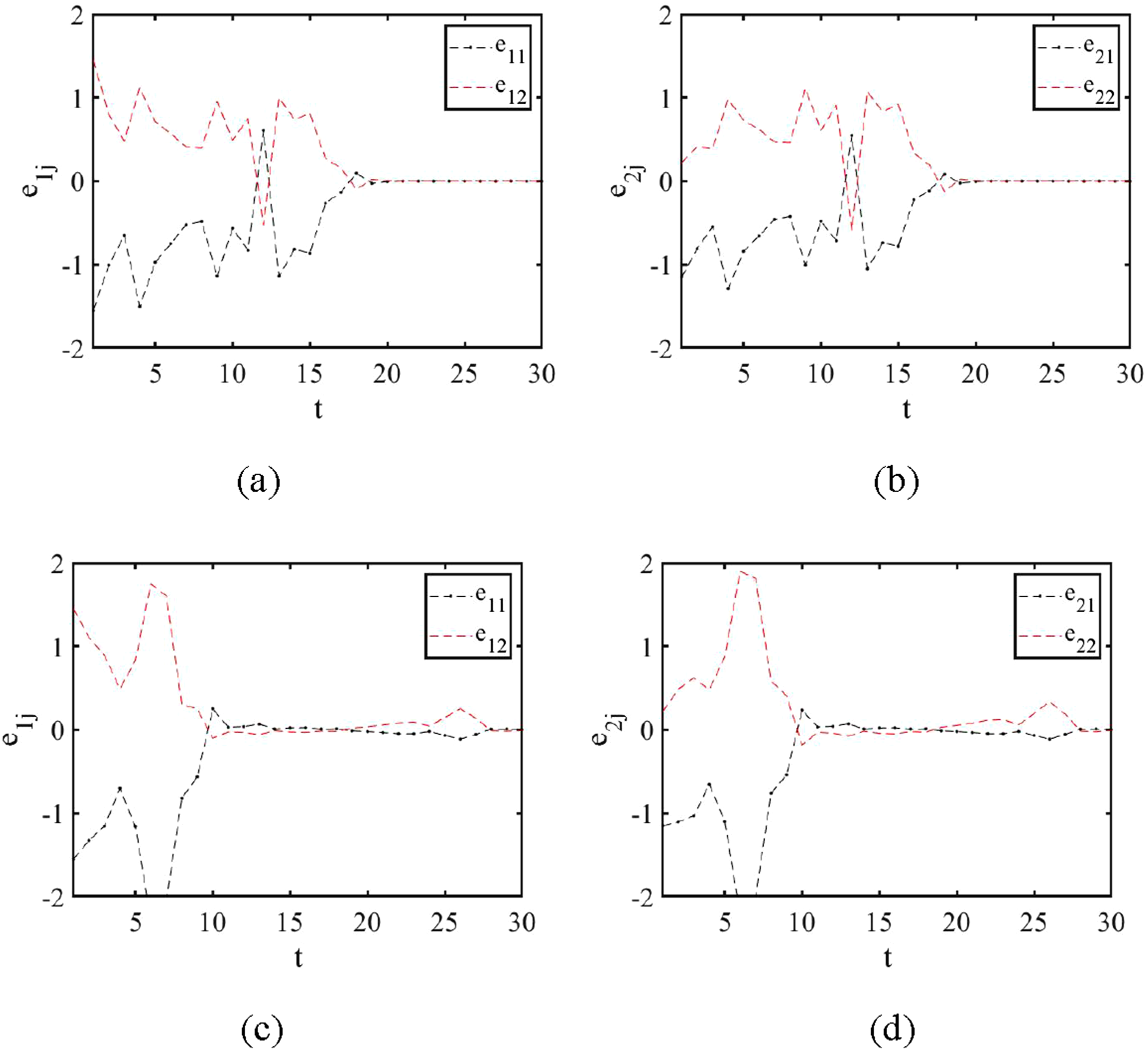
Additionally, Figure 3 presents the specific trajectories of the error system equation (12) without time-varying delay and the time to achieve synchronization is less than the finite time Trajectory diagram of error system equation (12) without the time-varying delay: (a) error 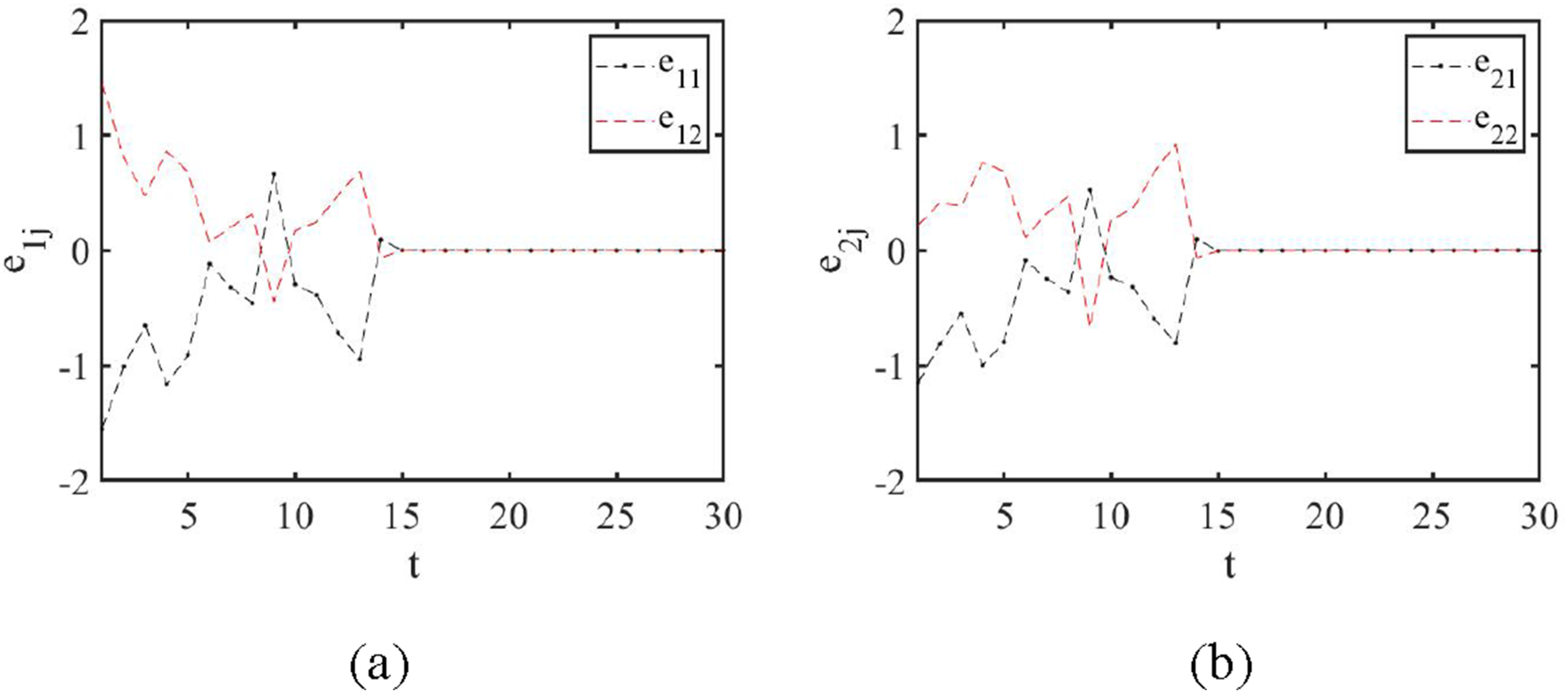
Furthermore, Figure 4 shows the trajectory of the error system (14) with Gauss noise. We find the time to achieve synchronization is less than the finite time Trajectory diagram of error system equation (14) under Gauss white noise: (a) error 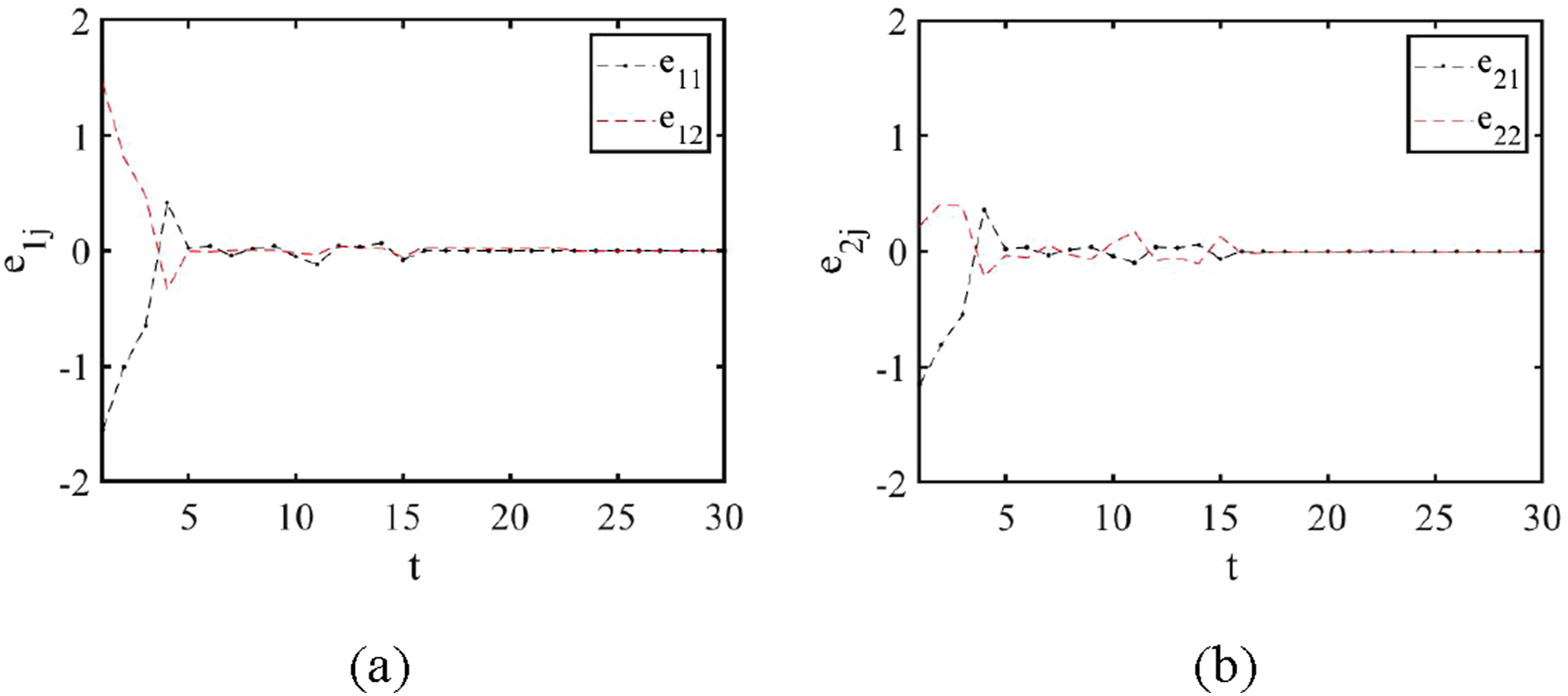
Moreover, Figure 5 presents the specific trajectories of the error system (15) in the absence of stochastic disturbances, and the synchronization behavior of complex networks exhibits greater determinism and controllability. At this point, the time to achieve synchronization is less than the finite time Trajectory diagram of error system equation (15) without stochastic disturbance: (a) error 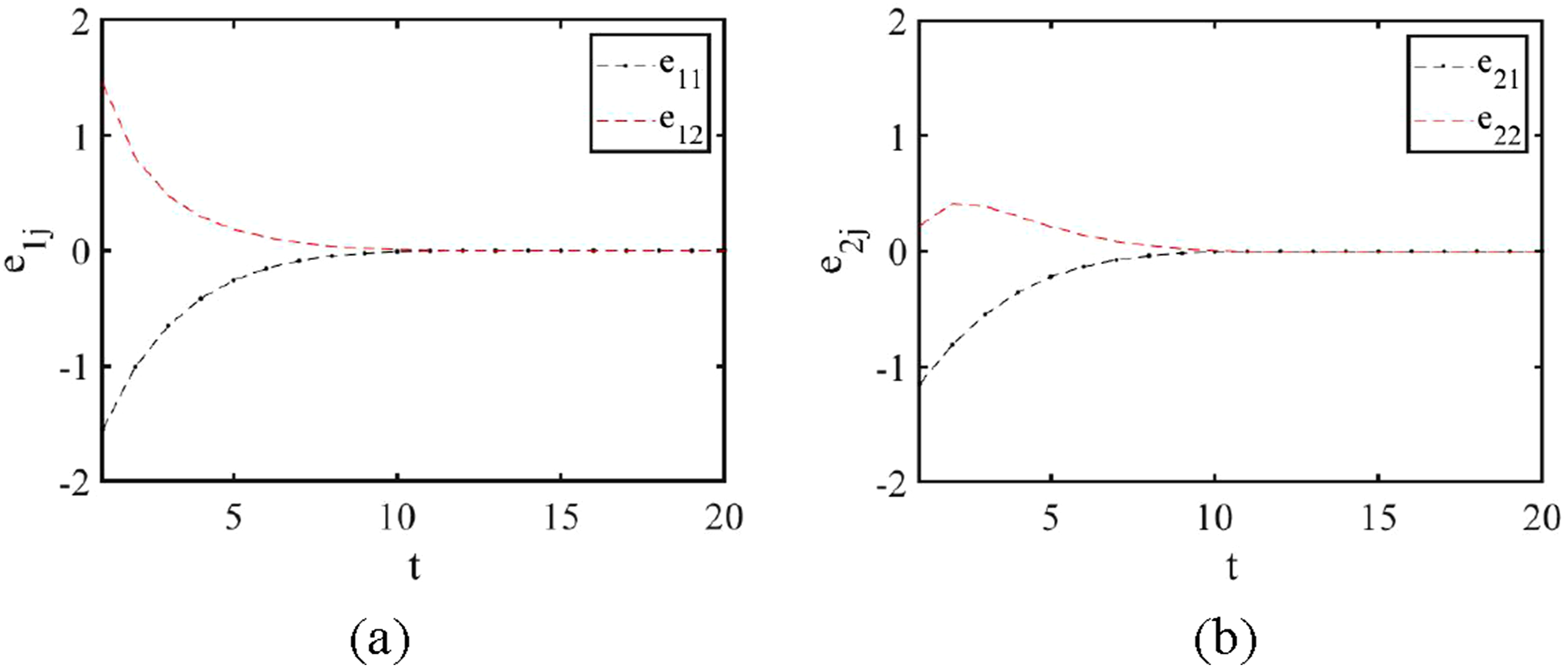
On the basis of the data in Figure 2, the weight
The specific trajectory of error system equation (3) is shown in Figure 6. The synchronization achieved by the error system is less than the finite time Trajectory diagram of error system equation (3) with 4 weights: (a) error 
The network with 3 nodes and 3 weights.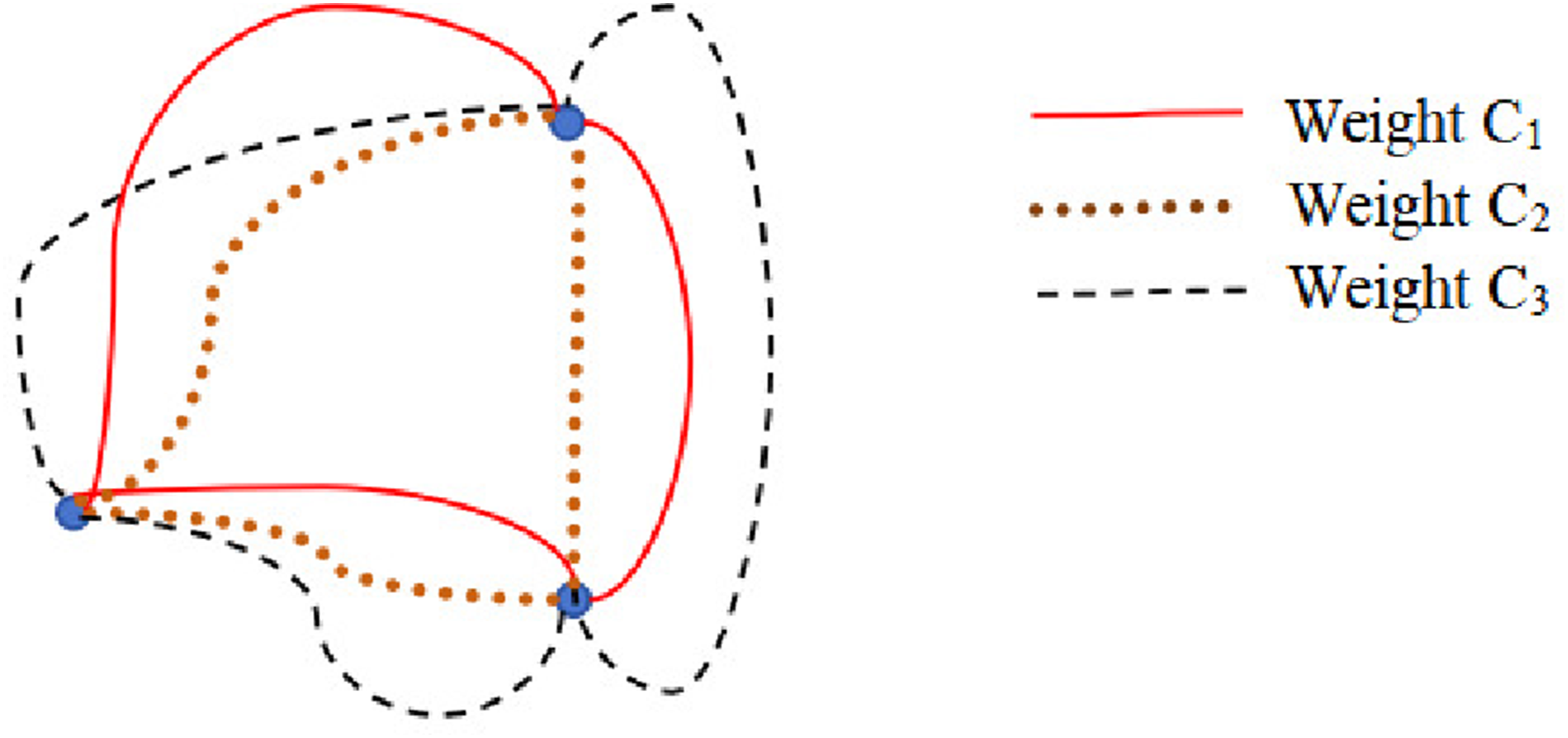
The initial values of the drive and response systems are set to mimic a post-fault scenario where generators are out of synchronization:
The time-varying delay function is
The state output function Trajectory diagram of error system equation (3): (a) error 
The specific trajectory of the error system equation (12) without time-varying delay is shown in Figure 9. We can observe that synchronization was achieved before the finite time Trajectory diagram of error system equation (12) without the time-varying delay: (a) error 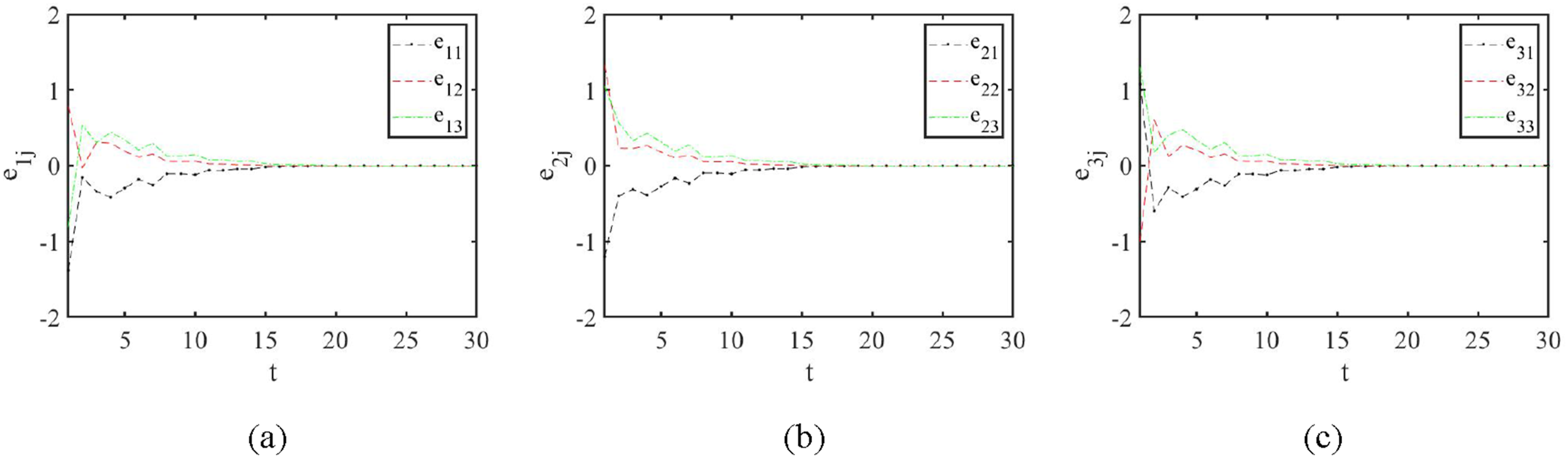
The corresponding trajectory evolution without Lévy noise is shown in Figure 10 and the time to achieve synchronization is less than the finite time Trajectory diagram of error system equation (14) under Gauss white noise: (a) error 
The corresponding trajectory evolution without stochastic noise is shown in Figure 11 and the time to achieve synchronization is less than the finite time Trajectory diagram of error system equation (15) without stochastic disturbance. (a) error 
Under the data in Figure 8, removing the third weight Trajectory diagram of error system equation (3) with 2 weights: (a) error 
By comparing the trajectory evolution of error systems under different conditions, we can conclude that control strategies are crucial for stabilizing the system and reducing errors. Noise (especially Lévy noise) and time-varying delay have the significant impact on the system, which may lead to the decrease in synchronization performance. When the weight between connecting nodes increases, so the interaction between nodes strengthens, which will help the network achieve synchronization faster.
The contribution of this chapter lies in empirically verifying the credibility and practicality of theoretical results. The following content is intuitively demonstrated through two cases (1) the effectiveness and necessity of the designed controller, (2) the negative impact of time-varying delays and Lévy noise on synchronization performance, (3) the promoting effect of connection weights on synchronization speed. These simulation results transform abstract theoretical conditions into visual performance comparisons, significantly enhancing the persuasiveness of the conclusions.
Conclusion
In the current research field of complex networks, the problem of the finite-time synchronization in stochastic multi-weighted complex network models under coupled time-varying delays has received widespread attention. The stochastic disturbances involved here are not limited to common white noise but also include the Lévy noise. Compared to white noise, Lévy noise can bring more complex to the synchronization process of complex networks, which made the study more challenging and practically significant.
By designing a continuous control strategy and utilizing Lyapunov theory, we derived sufficient conditions to achieve synchronization within a finite time. By setting specific network parameters, time-delay values and noise parameters, simulation experiments are conducted according to the proposed control strategies. Numerical simulations demonstrated that increasing connection weights between nodes accelerates synchronization. And it is analyzed that when the weight in the network increase appropriately, it can promote the implementation of finite time synchronization. Time-varying delay and noise further reduce the synchronization speed and affect the stability of the system.
However, this study has several limitations that warrant future research. First, the proposed controller assumes full knowledge of network parameters, which may not be available in practical applications. Future work could integrate adaptive control techniques to estimate unknown parameters online, thereby further reducing reliance on precise network parameters. In practical scenarios where network topology is unknown or time-varying, the current method may require additional adjustments. Second, the computational complexity of verifying the Lyapunov condition increases with the size of the network, indicating that large-scale networks demand distributed or decentralized control schemes. Third, the Lipschitz continuity assumption of nonlinear functions can be relaxed through piecewise analysis or non-smooth Lyapunov functions to cover more general system behaviors. Finally, data-driven approaches such as deep neural networks could be explored to complement model-based control design, especially for networks with partially unknown dynamics. Additionally, the analysis is limited to single-layer networks, while real-world systems typically involve interactions between multiple networks. Future work will focus on extending this framework to multi-layer networks.
Footnotes
Acknowledgements
The authors would like to thank the editors and reviewers for their valuable suggestions on the logic and preciseness of this paper.

Funding
The authors disclosed receipt of the following financial support for the research, authorship, and/or publication of this article: This work was supported by the grants from the National Natural Science Foundation (No.12362005), Key Project of Natural Science Foundation of Ningxia (No. 2024AAC02033), Ningxia higher education first-class discipline construction funding project (NXYLXK2017B09), and Graduate Innovation Project of North Minzu University (YCX24251).
Declaration of conflicting interests
The authors declared no potential conflicts of interest with respect to the research, authorship, and/or publication of this article.