






Abstract
To achieve simultaneous motion monitoring and low-frequency energy harvesting, this study proposes a lightweight, compact, and high-precision wearable self-powered and self-sensing system (WPSS) that integrates energy harvesting with gait monitoring by utilizing the negative mechanical energy generated during knee joint motion. The system incorporates an electromagnetic generator (EMG), a sliding-rail triboelectric nanogenerator (SRT-TENG), and a magnetically excited piezoelectric nanogenerator (M-PENG). Inspired by a ratchet-pawl mechanism, the SRT-TENG enables angle detection with a resolution of 15° during knee extension. In addition, the preset tension of the spring induces periodic contact-separation interactions between the ratchet and pawl, generating structural coupling vibrations that excite the piezoelectric element to produce high-frequency electrical signals closely related to step frequency and motion speed. These coupling-induced signals serve as complementary gait features to the primary triboelectric and piezoelectric outputs, enabling enhanced multi-modal sensing without additional sensing units. The WPSS achieves a gait-recognition accuracy of up to 90% by processing the integrated multi-source signals through a convolutional neural network. Overall, the proposed system offers an efficient, accurate, and self-sustained solution for healthcare monitoring, rehabilitation, elderly care, and human-machine interaction, and provides a promising pathway for the advancement of wearable self-powered sensing technologies.
Keywords
1. Introduction
The rapid evolution of IoT and AI drives demand for intelligent, low-power wearables; however, limited battery life remains a critical bottleneck (Cai et al., 2020; Tang et al., 2023; Yang et al., 2021), as maintenance is inconvenient and costly (Kwak et al., 2019; Lou et al., 2017; Zheng et al., 2021). Consequently, self-powered sensing is essential. Among harvesting technologies, biomechanical energy from human motion (Cheng et al., 2025; Zhang et al., 2018, 2025) is the most promising strategy. Unlike intermittent solar power (Hao et al., 2022; Li et al., 2022; Wang et al., 2024) or low-efficiency thermoelectric conversion (Chen et al., 2023; Liu et al., 2022; Wang et al., 2018), human motion provides a stable and sustainable power source. Common harvesting mechanisms include electromagnetic (EMG) (Han et al., 2024; Wang et al., 2026), piezoelectric (PENG) (Li et al., 2023; Panda et al., 2022), and triboelectric (TENG) (Lu et al., 2025; Wu et al., 2023) generators. While EMGs are reliable but bulky (Liu et al., 2024), PENGs offer high voltage and easy integration (Kumar et al., 2024; Si et al., 2024), and TENGs provide high low-frequency efficiency and self-sensing capabilities (Han et al., 2024; Zhang et al., 2024). However, individual PENGs and TENGs often lack the current and stability required for continuous power, frequently limiting them to sensing applications (Gao et al., 2020; Seong et al., 2024). To overcome these single-mechanism deficiencies, hybrid energy harvesting (Ham et al., 2021; Lu et al., 2024; Lu et al., 2025) has emerged as a flexible, high-efficiency research focus.
Hu et al. (2022) introduced a frequency up-conversion mechanism that utilized a gear mechanism and magnetic excitation to convert micro-rotations into high-frequency resonance of piezoelectric beams, which laid the physical foundation for high-precision motion vector monitoring, though the single piezoelectric mechanism suffers from high internal resistance and micro-ampere-level current outputs. To mitigate this, Gao et al. (2021) adopted a functional decoupling design, achieving a stable power output of 2.4 mW at an ultra-low frequency of 0.75 Hz via a hybrid system, while utilizing a TENG as a digital encoder to resolve deep-level gait metrics. Luo et al. (2024) further developed a dual frequency up-conversion mechanism, significantly enhancing the self-sustainability of a smart backpack through an electromagnetic unit. To address multi-directional motion, Wang et al. (2023) proposed a broadband bidirectional piezoelectric-electromagnetic hybrid energy harvester, which achieved an electromagnetic output of up to 22.7 mW under omnidirectional response. Regarding application and spatial layout, distributed multi-site collaboration and highly integrated designs have emerged as prominent trends. Hao et al. (2025) developed a hip energy harvester utilizing flywheels and gear sets, achieving a power density of 1.67 W/kg for its electromagnetic module. Meanwhile, Zhuo et al. (2025) introduced a triboelectric-piezoelectric-magnetic self-powered sensor with a shared rotating shaft, overcoming the bulky size limitation traditional hybrid generators face. Furthermore, the deep integration of hybrid electrical signals with cutting-edge algorithms has drastically enhanced recognition robustness. By implementing machine learning and deep learning algorithms, Wang et al. (2023) elevated the recognition accuracy from 85.6% in single-signal mode to 100% via multi-mechanism signal fusion. Under complex environmental noise, the systems developed by Luo et al. (2024) and Zhuo et al. (2025) still maintained exceptionally high recognition rates above 93%. Notably, Hao et al. incorporated digital twin technology combined with a GRU deep learning model, which not only achieved a recognition accuracy of 99.95% but also enabled real-time mapping of elderly mobility safety status in virtual space.
This study presents a 3D-printed, compact WPSS integrating EMG, SRT-TENG, and M-PENG for simultaneous energy harvesting and sensing. The EMG captures knee-joint negative mechanical energy for continuous power, while a ratchet-based TENG achieves 15° angular resolution. Notably, the system realizes “structure-as-sensing” by utilizing inherent ratchet-pawl coupling vibrations to enrich gait features without additional sensors. Leveraging a CNN to fuse triboelectric, piezoelectric, and vibration signals, the system achieves 90% gaits recognition accuracy. This WPSS provides a customizable, self-powered solution for rehabilitation, elderly care, and intelligent human–machine interaction.
2. Design of wearable self-powered and self-sensing systems
2.1. Analysis of human motion
Knee joint motion contains abundant mechanical energy and critical information characterizing human movement patterns. This dual nature establishes a theoretical foundation for self-powered and self-sensing systems.
Figure 1 shows that the knee exhibits the largest angular variation and highest energy potential during the gait cycle. This periodic movement involves cyclical positive work for propulsion and negative work for deceleration. Negative work is particularly vital at the end of the swing phase to stabilize motion and optimize energy recovery efficiency. Theoretical analysis of knee.
2.2. Structural design of the wearable self-powered and self-sensing system
Figure 2 and Table 1 detail the WPSS structure integrating an EMG, an M-PENG, and a SRT-TENG. Support arms fixed to the thigh and shank translate knee flexion and extension into shaft rotation for simultaneous energy harvesting and sensing. To efficiently recover negative work from the terminal swing phase, a ratchet mechanism captures unidirectional energy while a planetary gear train with tooth counts of 57, 21, and 15 provides fourfold speed amplification to optimize EMG efficiency (detailed dimensions in Table 2). Schematic diagram of the WPSS. The overall dimensions of the WPSS. Dimensions and parameters of the electromagnetic power generation unit.


Dimensional parameters of the M-PENG.

Dimensional parameters of the SRT-TENG.

Figure 3 analyzes the simulation results of the piezoelectric and triboelectric modules. Figure 3(a) shows that under a 1.5 N magnetic force, the cantilever reaches a 1.3 mm displacement with stress concentrated at the fixed support. For structural reliability and tolerance management, PZT ceramics are positioned away from high stress regions and a 3 mm gap is maintained. Figure 3(b) demonstrates a positive correlation between separation displacement and induced potential, yielding a 16 V peak at 3 mm spacing. These simulations confirm effective mechanical to electrical energy conversion and excellent dynamic response. The simulation analysis results of the piezoelectric and triboelectric modules in the WPSS. (a) Displacement and stress cloud maps of the piezoelectric cantilever beam; (b) potential distribution of triboelectric layer at different separation distances.
Figure 4(a) shows that alternating N-S polarity yields higher magnetic intensity and superior uniformity compared to the N-N arrangement, justifying its selection. During operation, the ratchet driven magnetic disk rotates rapidly, enabling stationary coils to cut alternating flux and generate induced current. Figure 4(b) evaluates coil magnet gaps of 5, 10, and 20 mm, showing that decreasing the gap significantly enhances flux density and field intensity. This confirms that a near field layout is the primary strategy for maximizing induced electromotive force and system efficiency. The simulation analysis under different magnet configurations in the WPSS. (a) Magnetic field intensity under different magnetic pole arrangements; (b) simulation plot of magnetic flux density for the coil at different positions.
2.3. Working principle of WPSS
The motion of the knee joint can be simplified as the periodic swinging of the lower leg around the knee axis. In the WPSS system, the ratchet-pawl mechanism serves as the primary power transmission unit.
Working principles are given in Figure 5. During a complete gait cycle, the working process of the WPSS is illustrated in Figure 5(a). During the phase i–ii (positive work phase), the lower leg rotates clockwise relative to the thigh. Under the pre-tension of the return spring, the pawl remains tightly engaged with the ratchet wheel at the initial stage. As the lower leg rotates clockwise, the one-way bearing is locked, and the pawl moves along the ratchet in the same direction, driving the SRT-TENG to reciprocate linearly within the guide slot under the restoring force of the spring, as shown by the blue arrow in Figure 5(a). According to the formula for contact-separation mode triboelectricity: Working principles of each unit of the WPSS.

The open-circuit voltage of the triboelectric output is mainly limited by the surface charge density of the friction layer and the separation displacement. Therefore, the SRT-TENG signal is generated by reciprocating motion, and the signal frequency is:
By counting the electrical level N, the rotation angle of the knee joint can be accurately calculated:
Based on a 24-tooth ratchet design, the SRT-TENG generates a triboelectric signal for every 15° of rotation, achieving a high angular resolution of 15°. During movement, periodic impacts from the ratchet-pawl engagement under spring tension induce vibrations transmitted to the M-PENG via the rigid structure. Since these vibration signatures vary with motion states, they serve as auxiliary features for motion recognition, significantly enhancing system accuracy and robustness. In the negative work phase (ii–iv), the shank rotates counter-clockwise relative to the thigh; the pawl locks with the ratchet and the one-way bearing engages to transfer torque through the gear acceleration unit to the magnetic rotor disk. As shown in Figure 5(b), the rotating magnetic field efficiently cuts the coil flux lines to convert mechanical energy into electricity, while the M-PENG vibrates periodically via magnetic coupling. The synergy between the M-PENG and SRT-TENG enables simultaneous energy harvesting and motion sensing throughout the gait cycle.
In terms of power generation, the system utilizes the relative motion between the magnetic rotor and coils to produce induced electromotive force. Notably, the magnetic disk serves a dual purpose: it acts as the core component of the EMG and simultaneously functions as a magnetic excitation source for the piezoelectric module. By exerting periodic magnetic forces, it triggers the forced vibration of the cantilever beam, achieving synergistic multi-source energy harvesting.
In terms of sensing, the SRT-TENG generates sensing signals through interfacial charge transfer during the contact-separation process driven by the ratchet-pawl mechanism. This process demonstrates a high degree of structure-sensing integration: the mechanical impulses from the ratchet not only trigger the TENG but also propagate as structural vibrations to the base of the piezoelectric beam. This base excitation modulates the piezoelectric response, ensuring that the multi-source signals sensitively capture complex gait features.
3. The self-power supply performance of the WPSS
To ensure the consistency of the excitation conditions and to eliminate the influence of randomness in human motion on the experimental results, a low-frequency, long-stroke testing platform is used in the laboratory to simulate various characteristics of human movement.
3.1. Experimental verification
The long-stroke vibration platform is used to simulate human motion states for evaluating the signal detection performance and power generation capability of the WPSS. Figure 6 shows the schematic diagram of the experiment and the actual experimental setup, respectively. Experimental platform and testing system (a) Experimental setup and (b) working principle of slider-rocker mechanism.
The experimental apparatus includes a signal generator, a low-frequency long-stroke controller, a low-frequency long-stroke vibration table, an oscilloscope, and a resistance box. The WPSS is connected to the vibration platform via a specially designed guide rail structure. The motion of the platform is controlled by setting parameters such as frequency and amplitude on the signal generator. The output voltage signals from the WPSS are recorded and stored using the oscilloscope. During the experiment, the ambient temperature is 26°C and the relative humidity 34%.
3.2. Output performance of the WPSS
This section systematically analyzes the self-powering performance of the EMG on the experimental platform and comprehensively evaluates the overall energy harvesting potential of the WPSS. COMSOL simulations indicate that the N-S alternating polarity configuration provides significantly higher magnetic field strength than the N-N arrangement. To verify this conclusion, the output characteristics of both layouts were compared across various frequencies. Due to the complexity of the six-coil system connection, two copper coils were selected as representative samples, as shown in Figure 7 The results show that the Peak and Rms voltages of the N-S arrangement far exceed those of the N-N arrangement, confirming the superiority of the N-S configuration. Comparison of output voltage characteristics for N-N and N-S magnet configurations at various frequencies. (a) Peak voltage; (b) RMS voltage.
The internal resistance of the EMG is measured to be 50 Ω. By adjusting the load resistance within a range of 30–100 Ω, it is observed that the peak voltage increases with resistance, while the average output power follows typical impedance matching laws. As shown in Figure 8(a), at an optimal load of 60 Ω, the system achieves a maximum output power of 17.12 mW, corresponding to an average power density of 0.62 mW/cm3. Optimization of EMG output performance; (a) Load characteristics showing peak voltage and average power versus resistance; (b) open-circuit voltage output at varying magnet-to-coil gaps.
Figure 8(b) further elucidates the influence of structural parameters and operating conditions on output performance. Regarding gap optimization, experiments confirm that 3 mm is the equilibrium point for performance and stability, where the open-circuit voltage reaches a peak of 5.8 V, effectively avoiding mechanical collisions caused by insufficient spacing.
In terms of dynamic response, Figure 9 reveals the driving effects of swing angle and excitation frequency: at a constant frequency of 2 Hz, the output voltage increases linearly with the swing angle; as the frequency rises to 3 Hz, both the density and amplitude of voltage pulses increase, reflecting a significant gain in the rate of change of magnetic flux during high-frequency motion. Analysis of EMG output voltage characteristics under different motion parameters. (a) Output voltage at different rotation angles; (b) output voltage at different rotation frequencies.
To evaluate the mechanical durability of the WPSS, we conducted a total of 60,000 motion cycles under excitation conditions with a frequency of 2 Hz and a swing angle of 45°. As shown in Figure 10, even after the complete testing process, the output voltage waveform and peak amplitude exhibited no significant decay, and the core power generation performance remained stable. This preliminarily validates the reliability of the system’s mechanical transmission structures. Given that the piezoelectric and triboelectric units utilize non-contact magnetic excitation and wear-resistant PTFE materials, their fatigue risks are extremely low; thus, separate material-level fatigue tests for these two units were not conducted here. Fatigue characteristics test experiments.
Given that the internal resistance of piezoelectric materials is not a constant value but varies dynamically with excitation parameters, it is crucial to determine the optimal load resistance at specific frequencies. To this end, the rotation angle of the ratchet is fixed at 45°, and its rotation frequency is precisely regulated by adjusting the frequency of the vibration shaker. Figure 11 displays the load characteristic curves of the PENG within the frequency range of 0.5 Hz to 2 Hz, the output power of the M-PENG initially increases and subsequently decreases with the increment of load resistance. The optimal load resistance consistently stabilizes around 250 kΩ, indicating that the device achieves impedance matching at this specific resistance. Comparing the performance across different frequencies, the output power increases significantly as the frequency rises, reaching a maximum average power of approximately 5.8 μW under 2 Hz excitation. This result validates the theory that the output performance in the piezoelectric effect is positively correlated with the strain rate. At a specific magnetic coupling distance and field intensity, the mechanical deformation amplitude remains essentially constant. Consequently, the peak voltage does not vary significantly with frequency. In contrast, average power represents the cumulative energy per unit time. As the excitation frequency increases, the repetition rate of excitation events multiplies, leading to a denser distribution of output voltage waveforms in the time domain. Load characteristic curves of the M-PENG under different frequencies.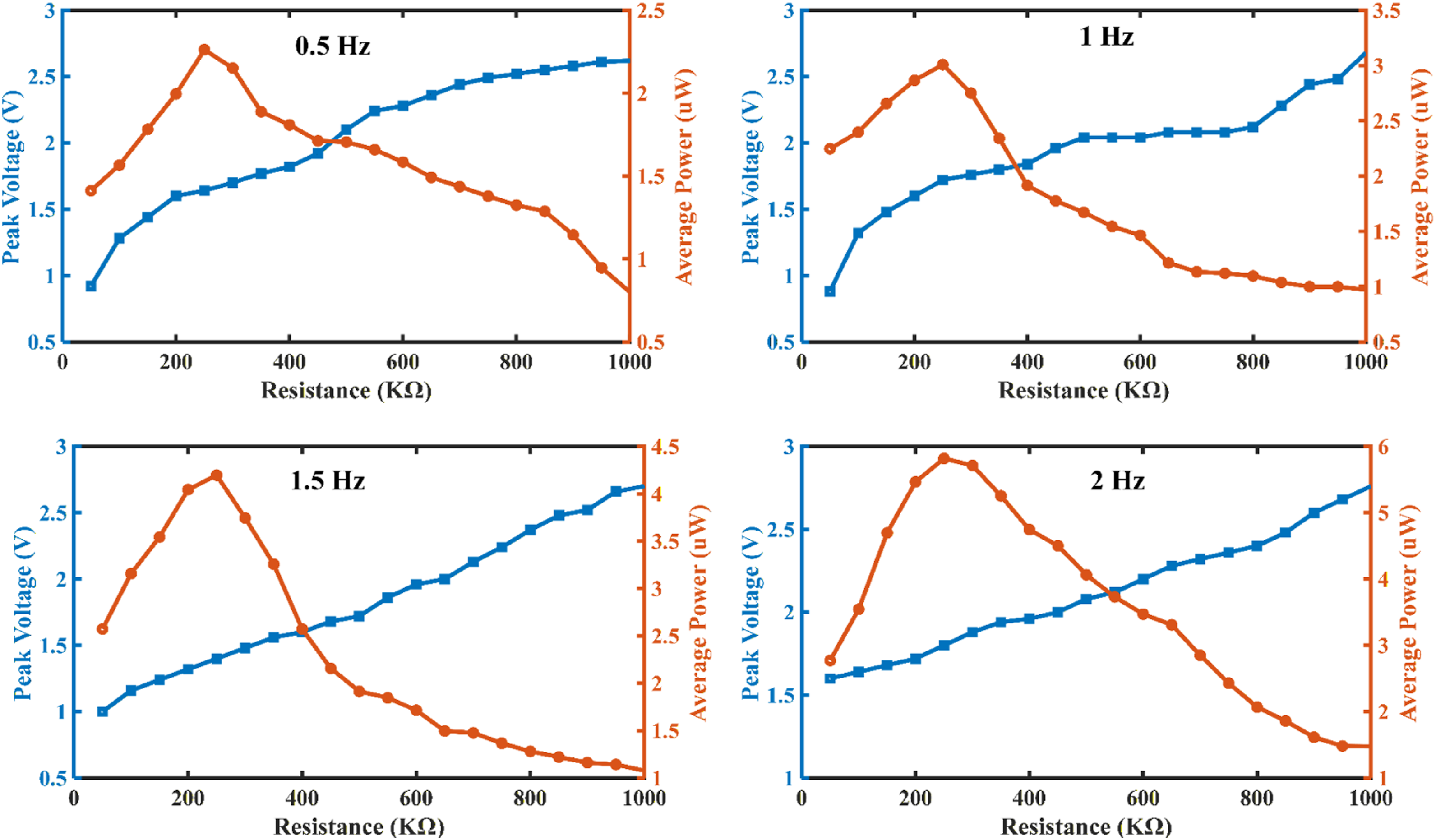
Figure 12 presents the output characteristics of the M-PENG under various conditions. Figure 12(a) illustrates the influence of the excitation angle on the open-circuit voltage of the M-PENG at a constant frequency of 2 Hz. The experimental results indicate a significant positive correlation between the peak output voltage of the M-PENG and the excitation angle. At a small excitation angle of 15°, the peak voltage is only approximately 0.5 V; however, when the rotation angle increases to 75°, the output voltage rises sharply, with the positive and negative peak values reaching approximately 1.5 V and −1.8 V, respectively. The physical mechanism lies in the enhancement of the spatial coupling force between the magnetic poles as the rotation angle increases, which drives the piezoelectric cantilever beam to generate a larger initial mechanical deflection before releasing from the magnetic constraint. Since the piezoelectric potential is linearly proportional to the mechanical strain experienced by the material, this more pronounced bending deformation substantially elevates the energy harvesting ceiling per excitation. Analysis of M-PENG output voltage characteristics under different motion parameters. (a) Output voltage at different rotation angles; (b) output voltage at different rotation frequencies.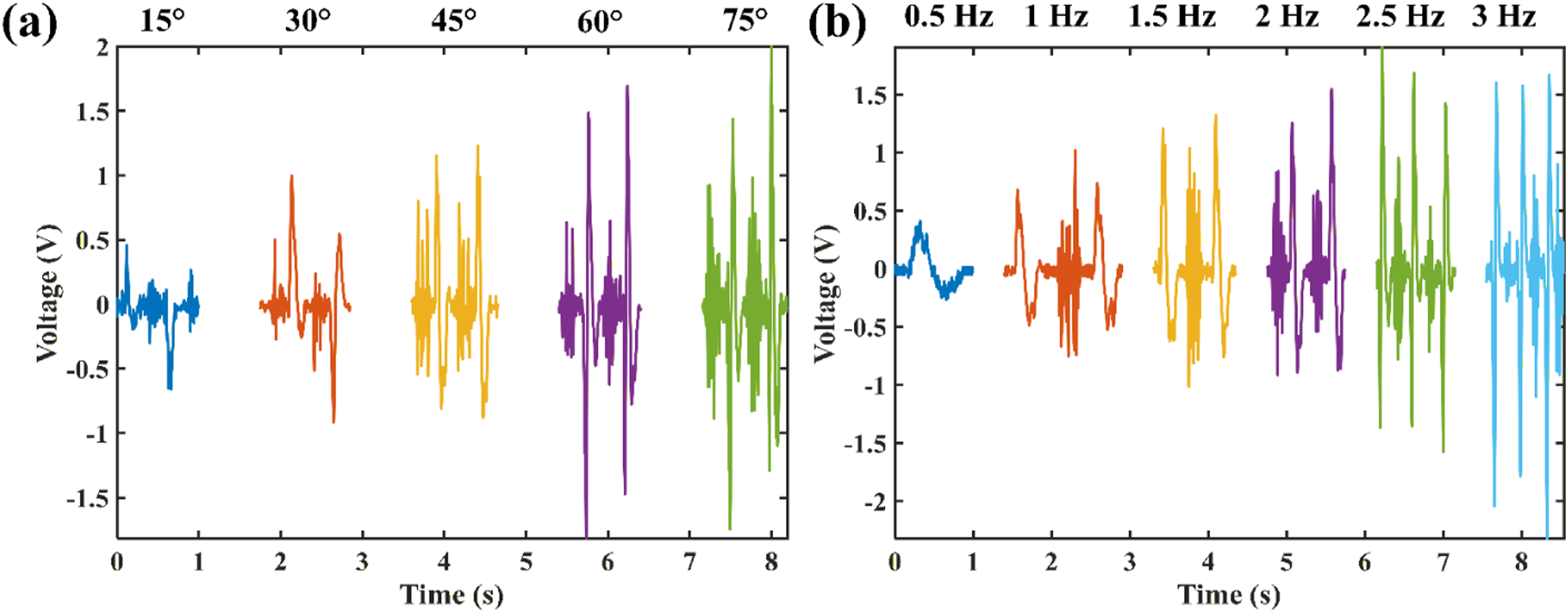
As shown in Figure 12(b), the voltage response of the M-PENG exhibits strong frequency dependence. The output voltage strengthens significantly as the ratchet rotation frequency increases. Under 0.5 Hz low-frequency excitation, the voltage signal is weak with a smooth waveform, whereas under 3 Hz high-frequency driving, the voltage reaches its peak, with the positive pulse amplitude approaching 4 V. The physical essence of this phenomenon is the modulation effect of the strain rate on the piezoelectric output: high-frequency conditions shorten the switching cycle of the magnetic coupling and enhance the dynamic response of the cantilever beam, thereby promoting the rapid accumulation of induced charges. In contrast, the restricted output at 0.5 Hz is primarily attributed to severe charge leakage and neutralization effects caused by low-speed deformation, as well as insufficient excitation energy to induce the cantilever beam into a high-efficiency free resonance state.
Notably, as the excitation frequency increases from 1 Hz to 3 Hz, the growth gradient of the induced voltage significantly slows down and exhibits a saturation trend. The inherent mechanism lies in the “magnetic plucking” process, where the maximum instantaneous displacement of the cantilever beam per pulse is primarily determined by the coupling strength between magnetic dipoles and the preset gap. Given that the operating frequencies remain far below the first-order natural frequency of the cantilever beam, the system enters a growth-restricted non-resonant plateau region upon reaching the physical displacement limit governed by magneto-elastic forces. Consequently, the voltage output no longer increases linearly with the frequency, demonstrating pronounced non-linear saturation characteristics instead.
Figure 13 presents the output characteristics of the SRT-TENG under various conditions. As shown in Figure 13(a), at a constant rotation frequency of 2 Hz, the output voltage amplitude of the TENG exhibits a distinct positive correlation with the increasing rotation angle. Since the indexing angle of the ratchet is 15°, the output signal presents as a pulse sequence with a one-to-one correspondence to the number of teeth, thereby validating its reliability in angular resolution. Additionally, Figure 13(b) illustrates that at a fixed angle of 45°, the voltage pulse density increases significantly as the operating frequency is elevated from 0.5 Hz to 3 Hz. The experimental data reveal that the output pulse frequency demonstrates a high degree of linear consistency with the rotational angular velocity, which endows the device with excellent real-time sensing performance. By leveraging these physical characteristics, the sensor can accurately capture frequency and amplitude information regarding human movement to provide robust data support for intelligent motion recognition. Analysis of SRT-TENG output voltage characteristics under different motion parameters. (a) Output voltage at different rotation angles; (b) output voltage at different rotation frequencies.
4. Application performance evaluation of the energy harvesting device
To validate the feasibility of WPSS power supply, its self-powering performance is evaluated. For the AC output of the transducers, the circuit in Figure 14 is used to rectify signals via DB107 for storage in capacitors. Specifically, the piezoelectric units employ an independent rectification and terminal-merging scheme to eliminate power cancellation caused by phase differences, thereby maximizing energy harvesting efficiency. Circuit topology and schematic of the energy management system for WPSS.
Firstly, the energy harvesting performance of the WPSS unit under human walking conditions is evaluated. To simulate low-frequency human motion, a vibration shaker is employed to emulate a 2 Hz walking frequency, with the vibration amplitude and input signal amplitude set to 2 Vpp and 1.0 V, respectively. Under these excitation conditions, charging tests were conducted on capacitors with values of 100 μF, 470 μF, 680 μF, and 1000 μF, and the resulting real-time voltage response curves are depicted in Figure 15(a). The results indicate that within 15 s, the voltages across the aforementioned capacitors rose to 3.6 V, 2.8 V, 2.4 V, and 2.0 V, respectively, which substantively proves the efficient energy harvesting capability of WPSS in low-frequency environments. Evaluation of the power supply performance of the WPSS. (a) Charging curves for various capacitors under a simulated walking frequency of 2 Hz; (b) influence of various motion frequencies on the charging rate with a fixed capacitance of 470 μF.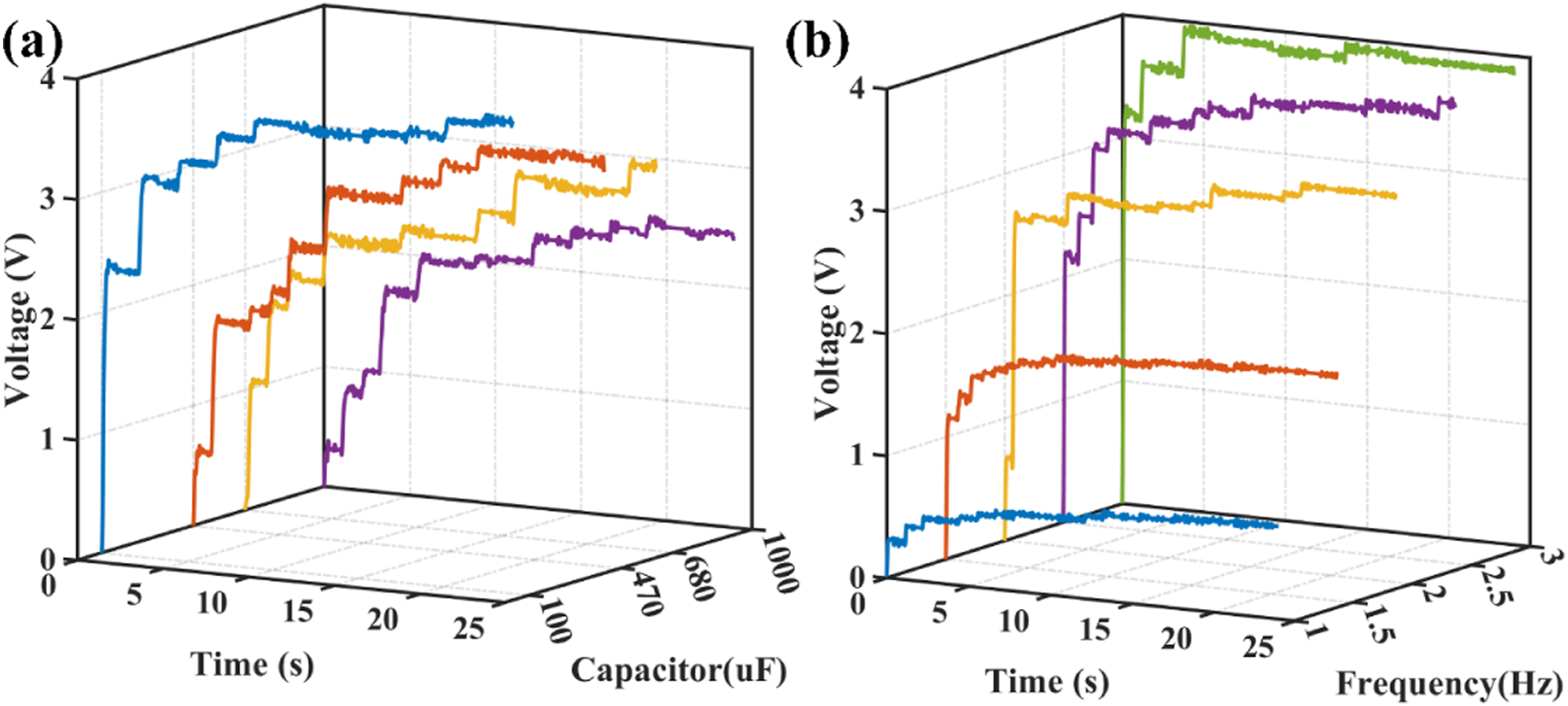
Subsequently, to investigate the effect of frequency on output performance, the capacitance is fixed at 470 μF to test the charging performance across a frequency gradient from 1 Hz to 3 Hz, as illustrated in Figure 15(b). It is observed that the terminal voltage of the capacitor increases significantly with the rising frequency; specifically, within 15 s, the charging voltages reached 0.5 V, 1.8 V, 3.0 V, 3.4 V, and 3.9 V, demonstrating distinct frequency-dependent characteristics.
5. Practical performance of the WPSS under human motion
To comprehensively evaluate the electrical performance of WPSS in practical motion scenarios, this study simulated three typical operating conditions: normal walking, fast walking, and slow running (2–12 km/h). As illustrated in Figure 16(a), a subject (height: 1.85 m; weight: 65 kg) wore the WPSS prototype to perform stepped speed tests on a treadmill. Experimental setup and application demonstration of the WPSS. (a) Schematic of experimental environment; (b) LED driving experiment.
The experimental results, shown in Figure 17(a), reveal a significant disparity in power magnitude between the EMG and the M-PENG. The EMG plays a dominant role with a milliwatt-level output, whereas the M-PENG maintains an output at the microwatt level. Together, they constitute a complementary energy harvesting system spanning both high and low energy levels. Output performance of WPSS under practical human working conditions.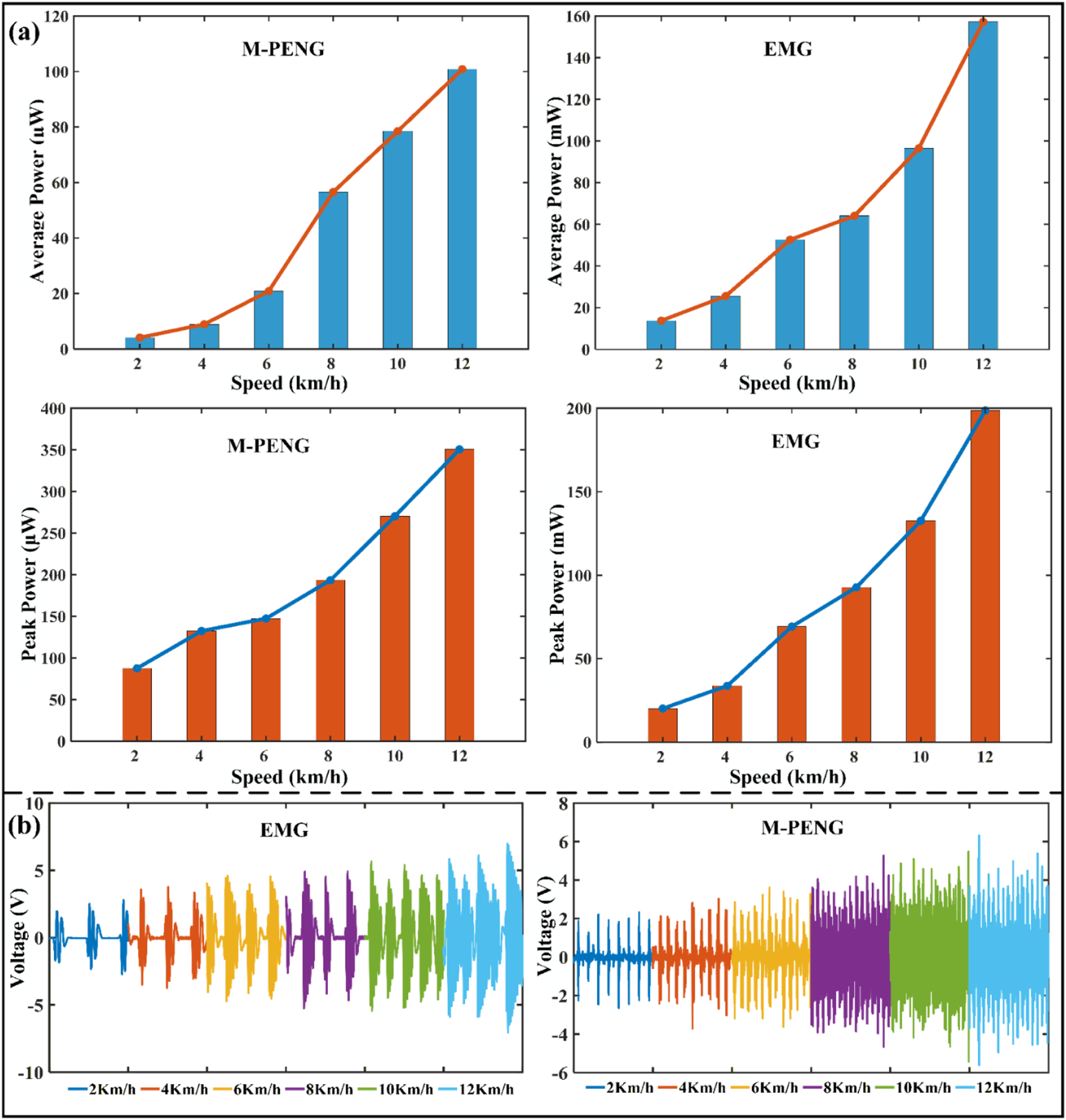
In the low-speed walking range (2–4 km/h), constrained by the relatively low swing frequency of the knee joint, the EMG yields an average power of approximately 18.7 mW and a peak power of about 25 mW, exhibiting stable but modest energy output characteristics. As exercise intensity escalates into the medium-to-high speed range (6–12 km/h), the increased gait frequency significantly intensifies both the knee bending frequency and the release of biomechanical energy, driving a non-linear growth in the EMG output. Particularly during slow running at 12 km/h, the high rate of change in magnetic flux induces a surge in the average EMG power to approximately 160 mW, with peak values reaching 200 mW, demonstrating superior high-speed transduction efficiency. Concurrently, despite its smaller overall energy contribution, the M-PENG achieves a peak power of 350 μW under high-speed impacts, reflecting an explosive response to instantaneous mechanical excitation.
The time-domain waveform analysis (Figure 17(b)) reveals a strong coupling between the movement speed and both the envelope density and amplitude of the output signals. The EMG output exhibits typical cluster-like oscillations; as the speed increases, its voltage swing expands from ±2 V to ±7 V, demonstrating excellent temporal continuity. In contrast, the M-PENG output appears as dense, sharp pulse sequences, with a voltage swing of approximately 6 V at the highest speed. This disparity in waveform morphology originates from their distinct physical mechanisms: the EMG relies on magnetic flux variations to generate induced electromotive force, whereas the M-PENG results from the instantaneous release of polarization charges within the piezoelectric material. These complementary characteristics facilitate a deep integration at the system level.
As illustrated in Figure 16(b), the energy harvested by the WPSS, after high-efficiency conversion via the management circuit, successfully powered a 92-LED array. The stable luminance of the LEDs during sustained human motion validated the system’s robust capability to transform kinetic energy into usable electricity. Biomechanical assessments indicate that the WPSS mass is marginal compared to the natural mass of the human lower limb. By strategically aligning the device with the knee’s axis of rotation, we successfully mitigated the additional inertial load, ensuring minimal deviation from the user’s natural gait and symmetry. This is further supported by gait analysis data, which shows that all motion parameters stay within the baseline of normal physiological variability. Consequently, the proposed system holds significant promise for portable electronics and wearable sensing, paving the way for the realization of sophisticated, self-powered wearable technology.
6. The motion monitoring performance of the WPSS
Different motion states correspond to unique dynamic characteristics of the knee joint. This study developed a lower-limb motion monitoring system based on the WPSS. By real-time monitoring of the joint’s extension and flexion angles and frequencies, the system extracts parameters such as amplitude, rate of change, and phase duration to identify typical locomotive modes, including (1) walking, (2) running, (3) stair climbing, and (4) squatting, thereby providing reliable support for assessing the knee joint’s Range of Motion.
The system employs dual-channel synchronous acquisition, as shown in Figure 18(a) the blue curve represents the SRT-TENG pulse signal for recording joint angles, while the red curve represents the M-PENG signal for capturing bending frequency; meanwhile, coupled vibration signals generated by ratchet-pawl collisions are utilized to characterize motion intensity. To balance computational efficiency with feature integrity, the sampling rate is set at 200 Hz with a window length of 1,200 points (covering 2–3 complete gait cycles). By collecting 100 sample sets for each motion type, a Convolutional Neural Network model is constructed to extract features ranging from local to global scales. Motion recognition system based on WPSS. (a) Dual-channel signals for diverse movement conditions; (b) feature visualization (t-SNE) and confusion matrix validation.
The model input shape is defined as (1200, 2), comprising three combinations of convolutional and pooling layers followed by a fully connected layer. A Bayesian optimization algorithm is introduced to determine the optimal structural parameters through 300 iterations. Based on 4-fold cross-validation, the system achieved an average recognition accuracy of 90%. As shown in Figure 18(b), the confusion matrix analysis indicates that the system performs exceptionally well in distinguishing actions with distinct frequencies; concurrently, the t-SNE clustering results exhibit clear boundaries for the processed data, strongly validating the model’s effectiveness in extracting features from multi-modal electrical signals.
7. Conclusion
This paper presents and validates a WPSS that integrates electromagnetic, triboelectric, and piezoelectric effects for harvesting negative mechanical energy from knee joints and monitoring gait. By deeply coupling a planetary gear speed-increasing mechanism with multi-source energy harvesting units, the WPSS utilizes an EMG to ensure high power output. Simultaneously, it incorporates a ratchet-pawl-triggered SRT-TENG and a magnetically excited M-PENG to convert low-frequency motion into high-frequency pulses, achieving high-precision decoupling of spatial angles and temporal features. This hybrid architecture overcomes the energy efficiency bottleneck of single-mode harvesting in non-steady-state motions. Although the prototype demonstrates superior performance, its encapsulation reliability under complex service environments, long-term material durability, and biomechanical impact on wearers require further comprehensive and detailed evaluation due to its current developmental stage. Future work will focus on the application of lightweight composite materials and the development of environment-compensation algorithms to enhance integration and intelligence, providing a novel solution for battery-free wearable health monitoring.
Footnotes
Acknowledgment
This work was supported by the Key Program of the National Natural Science Foundation of China [grant number 12232014]. Natural Science Foundation of Tianjin [grant numbers 23JCZDJC00230, 25JCQNJC00970].

Author contributions
Funding
The authors disclosed receipt of the following financial support for the research, authorship, and/or publication of this article.
Declaration of conflicting interests
The authors declared no potential conflicts of interest with respect to the research, authorship, and/or publication of this article.
Data Availability Statement
Data will be made available on request.