






Abstract
Previous studies on news avoidance have theorized about the interconnected effects of age, changes in the media environment, and generations to explain the phenomenon. However, no current studies simultaneously assess these effects. Using nearly 40 years of Swedish data, I find that as people age, they increase their news media consumption while both cohort and period effects show opposite trends. I also find substantial educational gaps. Over the life course, educational gaps are formed early. Period effects show growing educational gaps. Cohort effects vary, with those born in the 70s showing the largest educational gaps.
Keywords
Despite the unprecedented accessibility of news available in our current high-choice media environment, a growing number of individuals are tuning out from news media or actively avoiding them (Blekesaune et al., 2012; Newman et al., 2023). These developments are troubling since news media consumption is positively related to behavior generally thought to contribute to democratic self-governance and socially integrated communities (Strömbäck, 2005; Usher, 2021). Taking part of news media contributes to greater knowledge about political issues (Damstra et al., 2023), public engagement such as civic and political participation (Edgerly et al., 2018; Ksiazek et al., 2010) as well as electoral turnout (Prior, 2007). These developments have attracted scholarly attention in recent decades—assembled under the academic umbrella of news avoidance research (Skovsgaard & Andersen, 2020). Perhaps most concerning is the findings that the high-choice media environment might not only contribute to a greater number of news avoiders but also that the inequalities in news consumption will increase (Van Aelst et al., 2017). In previous research, two overarching trends are thought to contribute to this development.
The first factor is the historical restructuring of our media environments from low- to high-choice environments (Prior, 2007; Strömbäck et al., 2013). This research argues that the increase in the media supply forces people to become more selective in their media choices, the results of which are that those interested in news and politics continue to consume news while the uninterested increasingly tune out in favor of content more aligned with their preferences (Prior, 2007; Strömbäck et al., 2013). In essence, this research tradition highlights the period effects in that our news media consumption and avoidance are impacted by the historical information environment we find ourselves in.
The second relates to age-based gaps in news consumption where younger individuals tend to consume less traditional media, relying instead to a greater degree on online media to get their news, with social media playing a prominent role in their news diets (Holt et al., 2013; Newman et al., 2023). These age gaps may on the one hand be explained by life-course effects, where younger people have yet to accumulate the resources and interests—for example, education, social responsibilities, income—that are conductive to news consumption. Resources that they will acquire as they continue through their life trajectories (Quintelier, 2007). Other scholars have theorized that we are also dealing with greater generational changes rather than simply life-course effects. In this line of thought, scholars point to the fact that by growing up in post-industrial societies surrounded by new social and digital media technologies, younger birth cohorts have developed distinct values and habits compared to previous cohorts, leading to generational changes on the view of citizenship, political participation and news consumption (Bennett, 2008; Edgerly et al., 2018; Thorson, 2015). Thus, apart from the historical changes in the surrounding information environment, scholars have also identified both age and cohort effects contributing to low news media consumption.
What all these research strains essentially deal with is the interconnected and parallel over-time processes of socio-technological change in media systems and among audiences in post-industrial societies. Still, there are currently no studies simultaneously assessing these effects and, as a result, the relative importance of the age, period, and cohort factors are unknown. Is the age gap in news avoidance mainly due to life-course effects—implying that we might expect youths to eventually come into the news fold—or are there greater generational shifts in news habits? Or is the main culprit the high-choice media environment, with some scholars arguing that “people have not necessarily changed; they have merely changed the channel” (Prior, 2007, p. 19). Untangling these effects is important for our understanding of news avoidance.
Lastly, while previous research has shown that less-affluent groups tend to be less engaged with news and that we are witnessing growing inequalities in news use (Bergström et al., 2019; Karlsen et al., 2020; Palmer & Toff, 2020; Toff et al., 2023; Van Aelst et al., 2017), there is a lack of a systematic investigation into whether socioeconomic status increase or decrease over the life-cycle, over time, and across generations. This study addresses these limitations by using data spanning nearly 40 years of media use in Sweden from the nationally representative Society, Opinion and Media (SOM) institute while utilizing age-period-cohort (APC) analyses.
Theoretical Review: News (Media) Avoidance
While research on news avoidance has garnered increasing interest in recent decades, the concept has historically encompassed a variety of definitions and operationalizations, which have resulted in ambiguous findings on the scope, causes, and potential remedies of news avoidance (Skovsgaard & Andersen, 2020). Recent efforts in the growing (sub)-field have tried to remedy this ambiguity by proposing a shared understanding of the concept (Skovsgaard & Andersen, 2020), and while conceptual disagreements persist (cf. Palmer et al., 2023), on a general level news avoidance can be described as a multidimensional phenomenon consisting of both low news consumption as well as intentional news avoidance practices and intentions (Andersen et al., 2024).
The first dimension of news avoidance—that of low news use—can be both occasional and periodical as well as more habitual. However, given the concerns surrounding growing gaps in news consumption between groups (Van Aelst et al., 2017), most previous research on this dimension has focused on the characteristics of the societal groups who habitually seldom or never consume news (Edgerly, 2021; Strömbäck et al., 2013; Trilling & Schoenbach, 2013). This perspective is therefore usually referred to as consistent news avoidance (Palmer et al., 2023; Skovsgaard & Andersen, 2022). Consequently, this perspective tends to focus on outcomes of news avoidance—that is, low news use (see Skovsgaard & Andersen, 2020, for review). The second dimension focuses more on the practice of news avoidance, defining it as individuals’ deliberate actions or strategies to refrain from news (de Bruin et al., 2024; Toff & Kalogeropoulos, 2020; Villi et al., 2022; Ytre-Arne & Moe, 2021). This “intentional” (Skovsgaard & Andersen, 2020) view of news avoidance usually does not focus on people’s levels of news consumption but rather relies on self-reported measures of intentional news avoidance practices and motivations.
Even though these dimensions of news avoidance have been extensively studied, there are still conceptual debates surrounding which dimension should be given definitional priority. On the one hand, some scholars argue that intentionality is the defining factor of news avoidance and must be present to be categorized as such (Ohme et al., 2022b; Villi et al., 2022). Scholars with this perspective tend to argue for a clearer distinction between news avoidance and low news usage/news non-use “based on the degree of motivation and proactivity to not encounter content, with greater motivation, aversion and action on the avoidance side, and unintentionality and incidentally on the non-use side” (Villi et al., 2022, p. 160). On the other hand, other scholars argue that distinguishing news avoidance based on stated intentions of avoiding the news is extremely difficult in practice and does not reflect individuals’ lived experiences (Palmer et al., 2023; Toff et al., 2023). This perspective argues that:
news avoidance—like other forms of media use—is not just a response to the content on offer. It is also fundamentally shaped by who we are, what we believe and the tools we rely on to find, access, and navigate content (Toff et al., 2023, p. 3).
For these scholars, it is the consistency of the practice, rather than the intentions of it, that is the key distinguishing factor. In sum, there are different schools of thought within the research field stemming from disagreement about which of the two dimensions should be emphasized. 1
In this article, we follow the perspective of Palmer et al. (2023; see also Skovsgaard & Andersen, 2022) in conceptualizing news avoidance as consistent low news use over a continuous period of time. We do this because we agree that putting too much emphasis on individuals’ intentions and motivations risk misrepresenting how news consumption and news avoidance are practiced in daily lives and how certain social and media structure might facilitate it (Kümpel, 2020; Toff et al., 2023). As such our choice is also based on normative considerations, since a habitual estrangement from the news is arguably the most concerning from a normative standpoint (Palmer et al., 2023). This holds in particular if this estrangement from news is overrepresented among certain groups.
Another source of conceptual ambiguity arises from previous research seldom specifying the specific types of news that individuals are avoiding. Studies tend to show larger gaps in consumption of traditional news media compared to more general measures of online or social media use (Gorski & Thomas, 2021; Karlsen et al., 2020; Strömbäck et al., 2013), leading some researchers to suggest that the latter may minimize gaps in news consumption (Boulianne, 2011; Holt et al., 2013). However, current research indicates that relying on these for news does not adequately replace using traditional media to stay informed about current events and politics (Amsalem & Zoizner, 2023; Shehata & Strömbäck, 2021). Therefore, researchers need to be precise regarding which types of news avoidance they focus on.
As for this study, we will focus on news media avoidance. News media in this study refers to what is commonly understood as mainstream media which, in turn, can be described as the societal system created by specific legacy media organizations that share institutional characteristics resulting in a large overlap of practices, norms, and output (Altheide & Snow, 1979; Cook, 2005; Esser & Strömbäck, 2014). Two main reasons for this choice can be highlighted. First, most scholars agree that consumption of legacy media works as a leveler of political knowledge gaps among citizens and contributes to a more informed electorate with less partisan-selective exposure (Dahlgren, 2019; Fraile & Iyengar, 2014; Shehata & Strömbäck, 2021). On a broader scale, it has also been argued that news media are important for its integrating and stabilizing function in society (Anderson, 1991; Blekesaune et al., 2012; Syvertsen et al., 2014; Usher, 2021). Hence, habitual estrangement from these outlets should be of certain concern on both an individual and societal level, especially if we are witnessing growing gaps between groups (Van Aelst et al., 2017). Second, the choice to focus on news media comes from this study’s longitudinal design. Given that this study investigates developments spanning over three decades, a problem arises since individuals may perceive news in different ways over time (Daniller et al., 2017; Edgerly & Vraga, 2020; Strömbäck et al., 2020), with especially younger generations having a much broader notion of what can be considered news (Edgerly et al., 2018; Newman et al., 2022, pp. 44–45). However, while what is perceived as news is more fluent in today’s hybrid high-choice media environment, there still seems to be consensus on what constitutes the news or news media—namely legacy, traditional news organizations (Newman et al., 2022, pp. 44–45; Tsfati et al., 2023). Thus, measuring the use and avoidance of well-established and well-known news media institutions in Sweden—rather than a general notion of news—improves the comparability and validity of our measures over time (Daniller et al., 2017).
APC Effects on News Media Avoidance
As outlined in the introduction, previous research has identified two broad trends that have contributed to the general decline in news media consumption (Boulianne & Shehata, 2022; Edgerly et al., 2018; Espeland, 2024; Strömbäck et al., 2013; Thorson, 2015; Zukin et al., 2006). The first are the increasing age-based gaps, which in turn have been attributed to both life-course effects as well as generational belonging. The second is the historical change in the form of the technological transitions from a low- to a high-choice media environment in recent decades. In other words, we are dealing with three distinct but interconnected factors: respondents age, their birth cohort and lastly the historical period in which they live. However, to our knowledge, there are currently no studies taking a holistic perspective on these factors, assessing and comparing their independent effects at the same time. We will therefore investigate the topic of news media avoidance using APC analyses, which have been used extensively in other parts of the social sciences (see Fosse & Winship, 2019 for review) due to its power to untangle the independent contributions of these factors, but not yet utilized in the study of news avoidance. The basic proposition of the APC analysis is that any particular sociological outcome can be attributed to three distinct but also interrelated processes, namely age, period, and cohort effects (Fosse & Winship, 2019). Below, we detail each effect and relate it to the study of news media consumption and avoidance.
Age Effects
First—and perhaps most straightforward—there are effects of people moving through their individual life-courses. These processes are more commonly referred to as age effects, and they have continuously been observed in empirical studies on news avoidance (Edgerly et al., 2018; Shehata, 2016). Younger people often have less of those resources that have been found to be related to higher levels of news consumption at their disposal, resources that older people have accumulated during their lifetime (Quintelier, 2007). These are, for example, education, income, as well as social and political ties. Additionally, being in a formative phase of their life, younger people might prefer to socialize with friends, playing games and doing sports rather than watch the news. In short, the life-course perspective assumes that differences in news consumption are mostly tied to individuals’ “specific place on a developmental continuum and thus will change in predictable ways as these members age” (Zukin et al., 2006, p. 11).
Cohort Effects
Related to life-course effects are cohort effects, which builds on the sociology of generations by Karl Mannheim (1952). While generally acknowledging that people to a certain extent change their news behaviors as they grow older, the generational perspective argues that age should not be studied in isolation and rather be seen as a guide to belonging of a specific generational cohort. These socially shaped generations differ from each other based on their shared social locations, which in turn is the result of their common experiences of historical and social processes. In short, people growing up having the formative phase of their lives at similar times and contexts tend to develop similar experiences, values, and practices in that “early impressions tend to coalesce into a natural view of the world” (Mannheim, 1952, p. 298), a worldview that they keep throughout their life. From this perspective, substantial social and cultural change occurs because of the continuous replacement of older cohorts by younger ones (Mannheim, 1952).
Connecting these generational effects to the study of news consumption and avoidance, two main explanations can be identified in previous research. First, we have scholars highlighting that “media generations” tend to form around the medium that were dominant during individual’s adolescence, forming the basis of their news habits (Bolin, 2017; Ghersetti & Westlund, 2018; Westlund & Färdigh, 2013). In short, “the media that were important when people grew up remain central as people grow older” (Westlund & Färdigh, 2013, p. 187). As such, one explanation for the reported age gap in news media consumption is that younger individuals belong to generations which have grown up in a media environment less dominated by traditional news media and more characterized by online and social media and, as a result, have formed both their news habits as well as conceptions of what news is in relation to these media (Boulianne & Shehata, 2022; Edgerly & Vraga, 2020; Edgerly et al., 2018).
Second, apart from generational changes in news habits, scholars have argued that normative changes are taking place among newer generations, which have contributed to declines in news media consumption. In short, the process of social modernization in western post-industrial societies in the latter half of the 20th century, has made traditional social networks and institutional loyalties less rigid which in turn have impacted citizenship norms (Inglehart, 1990). It has been noted that generations growing up in these post-industrial societies puts less emphasis on duty-based citizenship and institutional politics, compared to older ones (Dalton, 2008). Bennett (2008) argued that this also extends to news consumption where conventional news media caters to older generations’ conceptions of citizenship, which might turn younger generations away. The traditional news media is filled both with the views of government officials and delivered in a top-down one-way model of communication. In online and social media, information flows more freely and is more open for discussion and sharing, which is thought to be more conductive to younger generations notions of citizenship and participation (Bennett, 2008). Relatedly, based on extensive interviewing with US adolescents, Thorson (2015) found that the most widely shared norm about a good citizen was that any specific expression of political participation, such as following the news, was optional, a “choice left up to the individual. And it is a choice driven by personal interest” (Thorson, 2015, p. 17). Additionally, since good citizenship was increasingly viewed as optional, based on personal interest, young people did not judge those who chose to disengage because of a lack of interest. It was not seen as a prerequisite for being a good citizen. Engaging with politics has moved “out of the realm of ought-to and into the territory of optional” (Thorson, 2015, pp. 5–6).
A key question is, however, how we define and operationalize these potential generation, which is far from straightforward. Generational boundaries are seldom clear-cut but rather fluent (Bolin, 2017; Mannheim, 1952). Additionally, since formative events, periods, and media systems differ between countries, generational distinctions developed in one country are usually hard to implement in other national contexts (Bolin, 2017; Mannheim, 1952; Volkmer, 2006; Wuttke et al., 2020). Thus, we refrain from specifying generational thresholds a priori to avoid overlooking important insights. Instead, in keeping with the exploratory nature of this article, we measure birth cohorts in 5-year intervals and look for commonalities and differences between cohorts. Doing so we can start to identify potential generational effects without putting restrictions on the data beforehand.
Period Effects
Lastly, there are period effects which occur due to social, economic, and cultural changes that are unique to specific time periods as well as specific events in particular year (Yang, 2008). They differ from cohort effects in that period effects induce changes across all individuals simultaneously. In the case of Sweden for example, the end of the state monopoly on broadcasting in 1987 can be considered a period effect since it affected all Swedish citizens that year regardless of age or cohort. It is important to note though that period and cohort effects might interact in such a way that those cohorts in their formative phases of their life might experience period effects stronger that other cohorts, and thus forming generations around such events (Bolin, 2017; Mannheim, 1952; Zukin et al., 2006).
Relating period effects to news media consumption and avoidance, the biggest focus in previous research has been on the historical transformation of the media environments in western post-industrial societies from low-choice to high-choice media environments and how this has radically changed our media habits (Van Aelst et al., 2017). Prior (2007) argued that the decline of news media audiences was primarily an effect of the expansion of media choice. In the earlier TV-broadcast era, the networks had similar scheduling practices, placing the evening newscast at the same slots during primetime. Additionally, due to the low number of outlets, people might have been tuning in for the latest top series but decided to continue watching the news afterwards. This had a leveling effect of news consumption gaps and political knowledge in the electorate since homogenous audiences were exposed to the same news broadcast, whether due to people intentionally tuning in or being incidentally exposed to it as an inadvertent audience.
As media choices have grown exponentially since the height of the broadcast era, people increasingly must make media choices based on their preferences. Thus—the argument goes—we will see increasing gaps in news consumption where people interested in news and politics can engage with news whenever and wherever they want, while people less interested increasingly tune out (Bennett & Iyengar, 2008). Empirically, even though there are few truly longitudinal studies investigating the relationship between the transition toward a high-choice media environment and the frequency of news media avoidance, the ones that do exist generally support the notion that news media consumption has gone down and news media avoidance has increased over time and that we are witnessing growing gaps in news consumption (Espeland, 2024; Karlsen et al., 2020; Strömbäck et al., 2013; Van Aelst et al., 2017). It is also worth mentioning that some scholars also point out that the affordances in the new media environment might actually decrease news media avoidance through the combined forces of cultural production and consumption powered by algorithms (Karlsen et al., 2020; Webster, 2014), which could potentially indicate null or negative period effects.
Thus, previous research clearly indicates variations in news media consumption across ages, birth cohorts, and periods. However, most extant research on news media avoidance tends to study these effects in isolation, or limit themselves to age and period effects (Espeland, 2024; Strömbäck et al., 2013). To our knowledge, there is so far no study that incorporates all three effects and try to discern their independent contribution. Untangling these effects is important to deepen our understanding of the phenomenon. Both in and of itself by deepening our understanding how socio-technological and temporal change relates to news media consumption, but also to identify—to the extent we consider news media avoidance problematic—where potential efforts toward minimizing the practice would be most effectively targeted. For example, if we are mostly dealing with age effects, this entails a much different course of actions for news organizations since we can safely assume that younger news avoider will “come into the fold” as they grow older. If, on the other hand, we find that we are mainly witnessing growing generational differences, other course of actions needs to be taken since these would reflect broader social changes in relation to news consumption. Or is the main culprit period effects, due to the proliferation of choice in the high-choice media environment as Prior (2007) argued, stating that “people have not necessarily changed; they have merely changed the channel. And they would have done it sooner, had they been given the chance” (p. 19). Thus, we believe this untangling—and confounding—of effects will prove beneficial to our understanding of news media avoidance. Hence, our first research question is.
Even though the main aim of this article is more exploratory in nature, based on the review above, we also pose the following hypotheses:
Regarding generational/birth cohort effects, given the contextual nature of this factor and lack of previous quantitative studies in Sweden, we do not find sufficient empirical grounds to specify a hypothesis and rely on RQ1 to inform the nature of this relationship.
Educational Gaps and News Media Avoidance
This article will also investigate whether educational gaps increase or decrease across ages, birth cohorts, and over time. We do this because we believe that a key question of if, and to what extent, news media avoidance should be considered a problematic phenomenon needs to be evaluated on the basis of to what extent the phenomenon is tied to specific groups and whether we are witnessing growing gaps (Van Aelst et al., 2017). Especially if such gaps run the risk of exacerbating already existing inequalities in political involvement. While we know from previous studies that low socioeconomic status—such as education and income—is related to low levels of news media consumption (Blekesaune et al., 2012; Edgerly, 2021; Toff et al., 2023; Trilling & Schoenbach, 2013), there still exists little research focused specifically on whether and how socioeconomic gaps in news media avoidance increase or decrease over the life cycle, over time and across generations.
We can hypothesize that socioeconomic differences in news media avoidance vary across the life-course. On the one hand one, as people age, they accumulate more resources and become more socially integrated in society through work, child-rearing and so on which would suggest that social inequalities in news media consumption might become less important as people ages. On the other hand, it has also been theorized that early inequalities in socioeconomic status puts individuals on diverging life-trajectories where those initially advantaged are more likely to continually enjoy other advantages—better education, leads to higher wage job, leads to better pension and so on—compared to those disadvantaged. This has been named the cumulative advantage/disadvantage theory and/or the Matthew effect (Bask & Bask, 2015; Kümpel, 2020). To our knowledge, there are currently no studies investigating whether socioeconomic gaps in news media avoidance increase or decrease over the life-course.
Period effects—and more specifically the transition toward high-choice media environments—could be hypothesized to contribute to increasing socioeconomic gaps following the opportunities, motivations, and abilities framework, in which the influx of media choices into an information environment tend to increase gaps based on individuals’ motivations and abilities (Delli Carpini & Keeter, 1996; Prior, 2007). So far, however, the longitudinal studies investigating period effects on socioeconomic gaps in news media consumption seem to provide somewhat inconclusive results. Studying news avoidance in Norway between 1997 and 2016, Karlsen and colleagues (2020) found that the gap between high and low-educated people in the number of people tuning out from news had increased from 5% to 15%. In another longitudinal study, Bergström et al. (2019) showed that out of the four outlets measured—national morning newspapers, tabloids, public service television, and commercial television—the impact of socioeconomic status only increased for national morning papers and decreased for the other three. However, one downside of that study is that it does not account for online or digital news media consumption. Additionally, both studies focused solely on how the effect of socioeconomic status changed over time and thus cannot disentangle whether and to what extent the reported effects might be attributable to age and generational effects.
As for cohort effects, to our knowledge, there exists no study specifically investigating and comparing the socioeconomic gaps in news media avoidance across generations (see Andersen et al., 2021, for partial exception). However, we could expect that different generations exhibit differences in socioeconomic gaps. Cohorts that came of age in the height of the broadcast era could be suspected to have smaller socioeconomic gaps compared to cohorts before and after since media choices were limited and the television news made news consumption more accessible for many people—for example requiring less reading comprehension compared to newspapers (Prior, 2007; Syvertsen et al., 2014). As younger generations come of age in the high-choice media environment, scholars have theorized that these might exhibit greater socioeconomic gaps in news media consumption. By growing up in a high-choice media environment where news consumption is increasingly individualized (Prior, 2007; Syvertsen et al., 2014). This individualization in combination with weakening norms surrounding news consumption as a requirement for being a good citizens (Bennett, 2008; Thorson, 2015), younger generations might find themselves increasingly in a zone of heterogeneous socialization. In such an environment, the transmission of unifying cultural values will get more difficult, and thus already existing gaps in news consumption might increase more among young citizens (Aalberg et al., 2013, p. 299). On the same theme, Thorson (2015) argued that such a heterogenous media and social environment “offers extraordinary possibilities for self-made policy experts and civic innovators but provides little guidance to those for whom politics is at best tangential and at worst irrelevant to daily life” (p. 5). Indeed, recent empirical studies have suggested that news consumption gaps related to individual motivations are greater for younger people when it comes to the choice of consuming news (Andersen et al., 2021; Andersson, 2019; Boulianne & Shehata, 2022) and that this relationship has grown over time (Espeland, 2024), indicating generational effects. Similar studies are, however, lacking when it comes to gaps between socioeconomic groups. Based on the above discussion, we posit the following hypotheses:
However, even though there are reasons to suspect that differences between educational groups have increased, based on the above discussion, it is still unclear what the independent effects of age, period and birth cohorts are on these gaps. We therefore ask:
The Swedish Media Landscape and News Audience
Sweden will constitute the empirical context of this study. On the one hand, Sweden’s media system has been characterized as a media system with traditionally high levels of newspaper readership, high levels of press freedom and organization of journalists, as well as a broad consensus of journalism as a public good (Hallin & Mancini, 2004; Syvertsen et al., 2014). From the audience side, Swedes have comparatively high levels of trust and consumption of news media, and it has remained remarkably stable on an aggregate level (Newman et al., 2023; Strömbäck et al., 2013). On the other hand, while the aggregate picture of the Swedish media system might be one of stability and consensus, an increasing fragmentation and segmentation of the Swedish news audience have been found in previous studies. The most important being, preference-based (Strömbäck et al., 2013), socioeconomic (Bergström et al., 2019; Ohlsson et al., 2016), and generational news consumption gaps (Ghersetti & Westlund, 2018; Wadbring & Bergström, 2017).
Additionally, the Swedish media system has seen dramatic changes over the nearly four decades that this article investigates. While there is not space for an in-depth discussion, some key structural changes should be noted. At the beginning of our time series, in 1986, the Swedish state still had a monopoly on Radio and Television broadcasting. This monopoly was effectively disbanded on New Year’s Eve 1987 when the commercial Swedish channel TV3 started broadcasting via satellite to Swedish audiences. Three years later, in September 1990, the first commercial terrestrial channel TV4 started broadcasting (Weibull & Wadbring, 2014). At the end of 1993 commercial radio starts broadcasting and throughout the 1990s Sweden saw continued proliferation of commercial channels in combination with spread of home computers and internet access, resulting in half of Swedish households having access to the internet at the beginning of the new millennia (Weibull & Wadbring, 2014). After this establishment phase which lasted until around 2005, the latter part of the 00s was characterized by the rapid spread of high-speed internet and transition toward mobile internet and modern social media platforms. In 2007 Facebook and Twitter entered the Swedish media landscape and in 2010 more than 50% reported using social media (Findahl, 2012). In the 2010s, the technological and social changes to the Swedish media system gained increased momentum. The beginning of the decade saw a continued move toward mobile internet access. In 2012, more than 50% owned a smartphone and in 2014, daily social media use exceeded the same threshold (Findahl, 2012; Internetstiftelsen, 2018). In the meantime, daily morning newspapers, continued to suffer from loss of advertising and readers, leading to many newspapers shutting down and increasing ownership concentration (Nord & Grusell, 2020; Weibull & Wadbring, 2020). 2017 marks a historical transition in the Swedish media system since this was the first year that household newspaper subscription dropped below 50% (Andersson, 2020).
In Figure 1, we have mapped out the percentage of News media avoiders in Sweden between 1986 and 2023 overlaid with selected structural changes to the Swedish media system outlined in the previous paragraph. We do this for illustrative and pedagogical purposes to show the developments of news media avoidance and media system changes in Sweden. We do not claim here that the trend in news media avoiders is causally related to the period events listed and that it should rather be seen as a starting point for coming analyses.
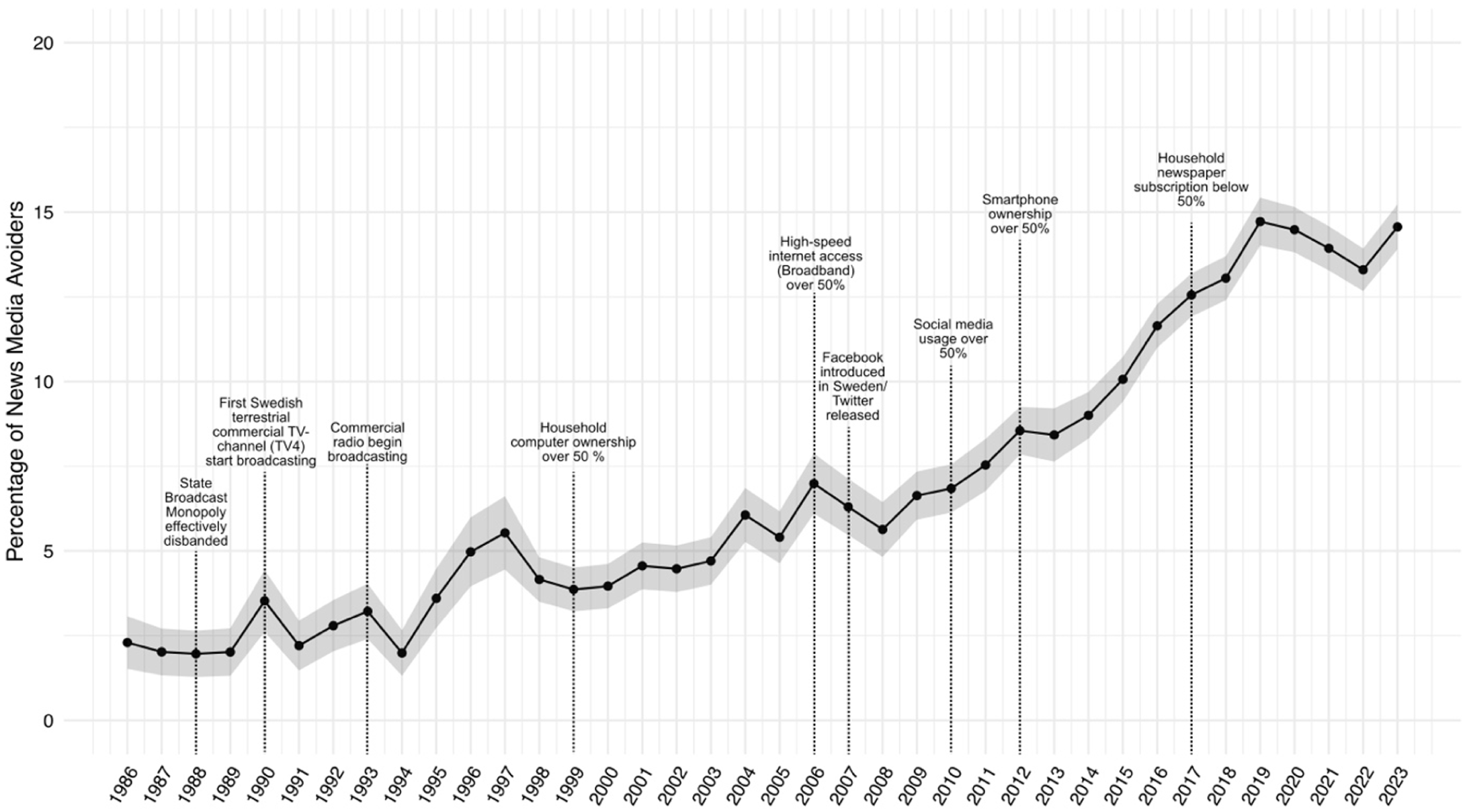
Changes in percentage of News Media Avoiders in Sweden, 1986 to 2023.
Data and Method
This study uses data from the SOM surveys, which are repeated cross-sectional surveys conducted annually between 1986 and 2023 in Sweden. 2 The SOM-survey presents one of the best sources of nationally representative data on the development of Swedish public opinion and media use due to their use of systematic probability sampling and continuous high response rates compared to other surveys (SOM-Institute, 2025). It is a unique dataset, spanning almost four decades, which allows us to effectively model changes over time and follow different birth cohorts throughout their life courses.
Dependent Variable
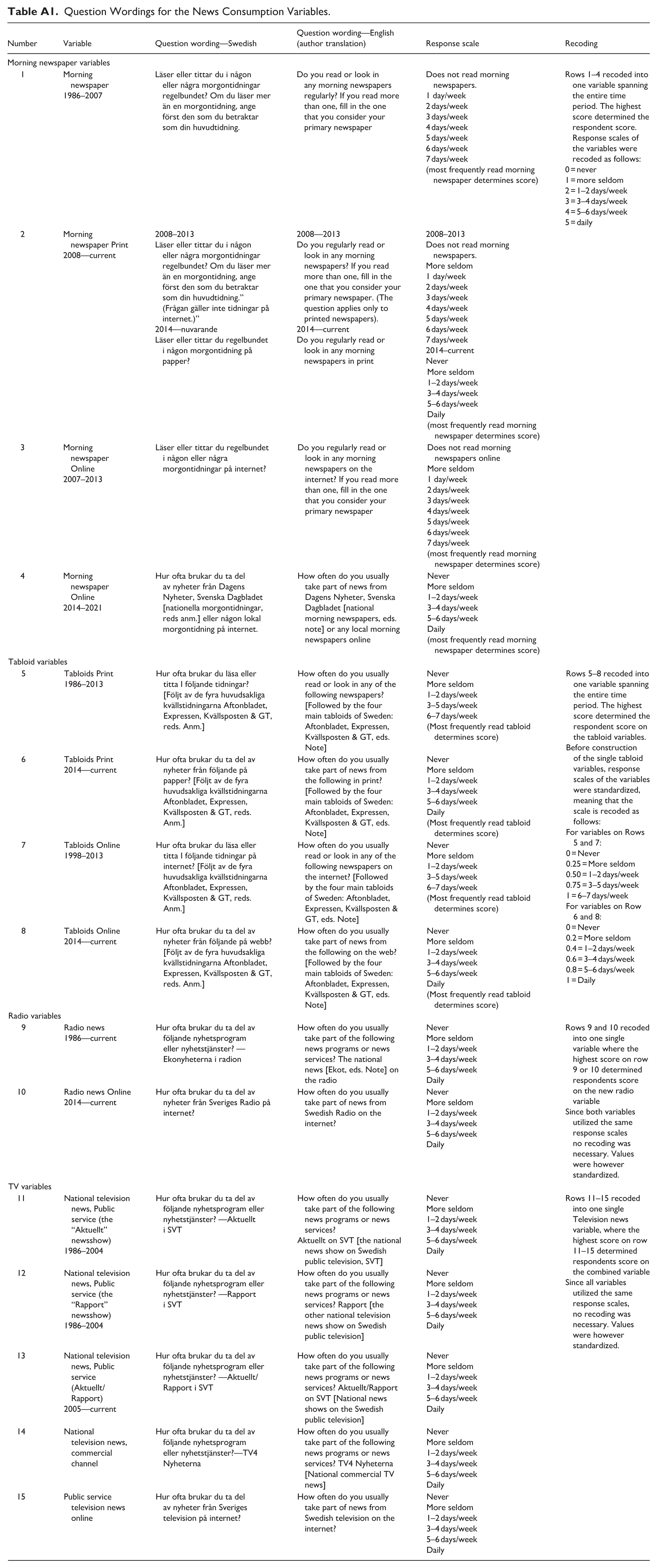
The dependent variable is news media avoidance and was operationalized by first creating an additive index of news media consumption and then classifying avoiders using a threshold based on the index mean. A challenge when constructing the index relates to the fact that the measures must be consistent for the whole time-series—so that it does not discriminate against respondents in those years where the measures were not yet available—while at the same time being able to incorporate the changes that the Swedish media system has experienced since the surveys started in 1986. As a solution, we opted for a platform-neutral but news media type-specific approach. More specifically, we took the news media types that were present in the earliest surveys—newspapers, tabloids, radio news, and television news—and kept these categories throughout the time series. As new options for accessing these outlets became available—for example taking part of a newspaper online—those options were incorporated into the already existing news media type, with the highest frequency within each news media type determining respondents’ score. For example, a respondent reading a newspaper in print 3 to 4 days/week (a score of 3 on that variable) and daily online (a score of 5) would score 5 on the newspaper consumption variable. 3
Next, we standardized the measurements for all four news media type variables to ensure comparability of measurements which means that all news media measure ranges from 0 (never) to 1 (daily or 6–7 days/week) with multiple values in between. Then we combined the respondents’ scores for the four news media type measures into an index of news media consumption (Newspapers + Radio news + Tabloids + TV news). Thus, the news media index ranged from 0 (no news) to 4 (all news media daily). The news consumption index shows a normal distribution (Appendix B). As a final step, we created the News media avoidance variable as a dummy variable where respondents were coded as news media avoiders if they scored equal to or less than 1 on the news media index, which represents roughly one and a half standard deviation below the news index mean. To avoid discriminating against respondents who rely on single outlets, respondents who scored 1 (daily consumption) on any of the individual news media type variables were removed from the news avoider category.
Independent Variables
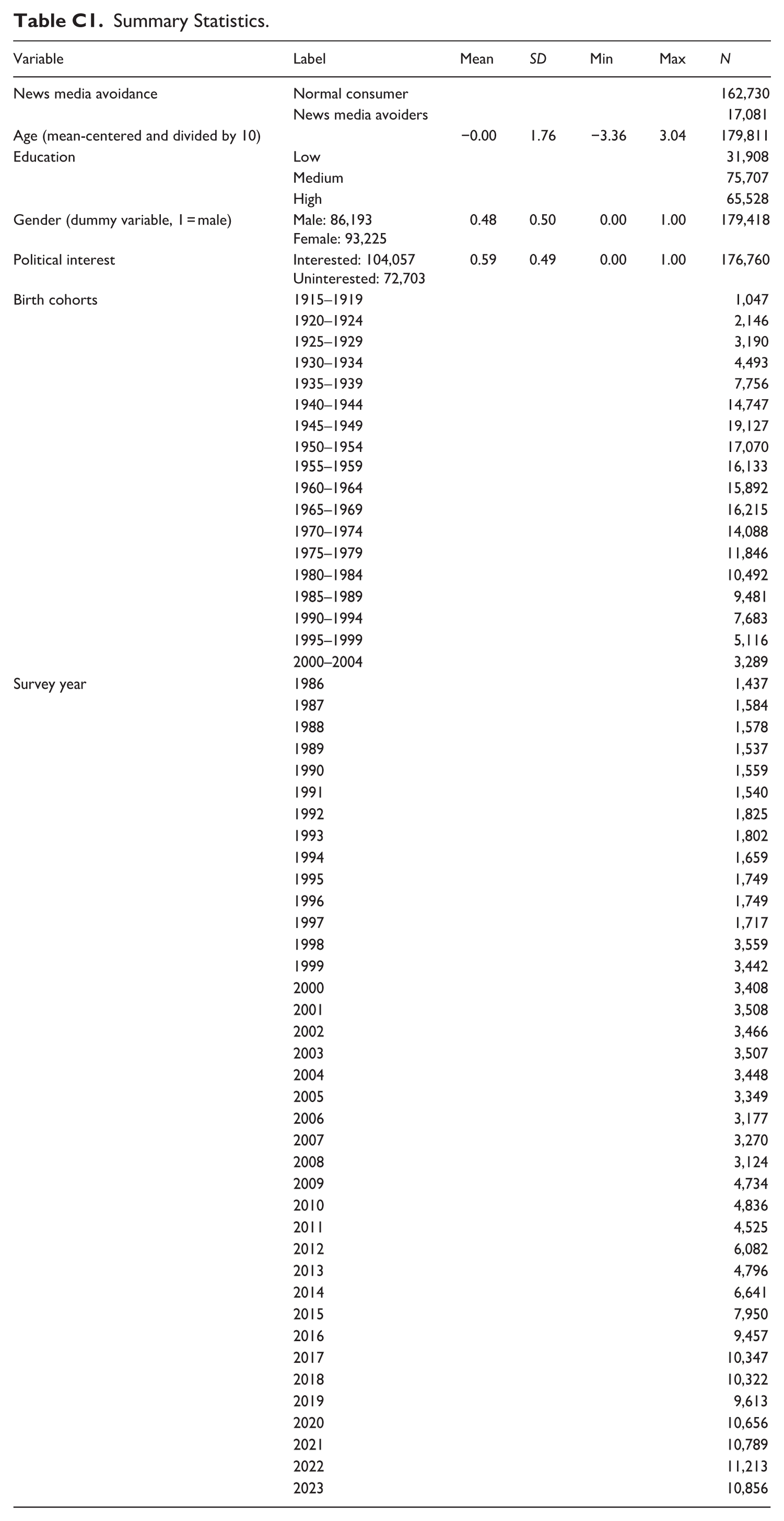
The key independent variables used in the analyses are: age ranging from 16 to 80 (mean-centered and divided by 10 in the models). Period measured by survey year ranging from 1986, to the most recent available survey year in 2023. Birth cohorts were measured in 5-year intervals (ranging from 0 = born 1915–1919 to 17 = born 2000–2004). Socioeconomic status was measured using education since it is usually stable across the life-course and more resistant toward temporal fluctuations, such as employment status. Education was coded as a factor variable consisting of low education (primary education or less), medium education (more than primary but not university/college), and one indicating high education (university/college education). Medium education was used as the reference category. The analyses also control for variables that have been shown to correlate with news media avoidance such as gender (0 = female, 1 = male) and political interest (binary variable, 0 = not at all interested + hardly interested, 1 = quite interested + very interested). For summary statistics of all variables, see Appendix C.
Data Analysis
Despite the theoretical and conceptual affordances offered by APC analyses, the method has historically (and to some extent continuously) struggled with methodological problems. Most salient of which is the fact that—by trying to separate and estimating the effects of age, period and cohort—we are confronted with the “identification problem.” This problem stems from the exact linear dependency between the key factors, meaning that if we know the values of two of the factors, we also know the value of the third one because period – age = birth cohort (or birth cohort + age = period). This means that it is impossible to estimate effects of one variable while holding the other two constants. As a result, scholars have grappled with how to break this exact linear dependency. While multiple solutions of the identification problem have been proposed, there is not yet a universally agreed upon solution (Fosse & Winship, 2019). For this article, we have chosen to go with the hierarchical APC (HAPC) model promoted by Yang (2008). The HAPC seeks to break up the linear dependency between age, period, and cohort variables by specifying a cross-classified random-effects model where we include an age-squared terms in combination with random intercepts for the period and cohorts groups (Yang, 2008). In short, we are treating age as the fixed effects and the birth cohort and periods as random effects, allowing them to vary. While the HAPC approach has been extensively used by sociologists and demographers, it has been criticized for running the risk of putting nonobvious constraints on the estimates, most notably on the cohort effects which might underestimate these (see Fosse & Winship, 2019, for review). However, this problem seems to be most prominent when the cohort variable has more categories compared to the yearly indicators (Fosse & Winship, 2019) which is not the case for us.
Results
We begin by investigating the age, period, and cohort effects on news media avoidance before turning to the question of educational gaps in news media avoidance. As a first step, we can calculate the variance partition coefficient (VPC) for the different levels—that is, how much variance in news media avoidance is explained at the individual, the birth-cohort, and the yearly levels– by dividing the individual variance by the total sum of all variances. Inspecting the VPCs in Model 1, Table 1, we can conclude that about 85% of the variance is located at the individual level. For the higher-level categories, roughly 11% of the variance is explained by period effects and around 3.5% is explained by birth cohort effects. In sum, we see that most of the variance is explained at the individual level, which should be expected, followed by the yearly context. Lastly, the time individuals were born explains the smallest, but not an insubstantial part, of the variance of these three.
The Effects of Age, Period, and Cohort on News media Avoidance.
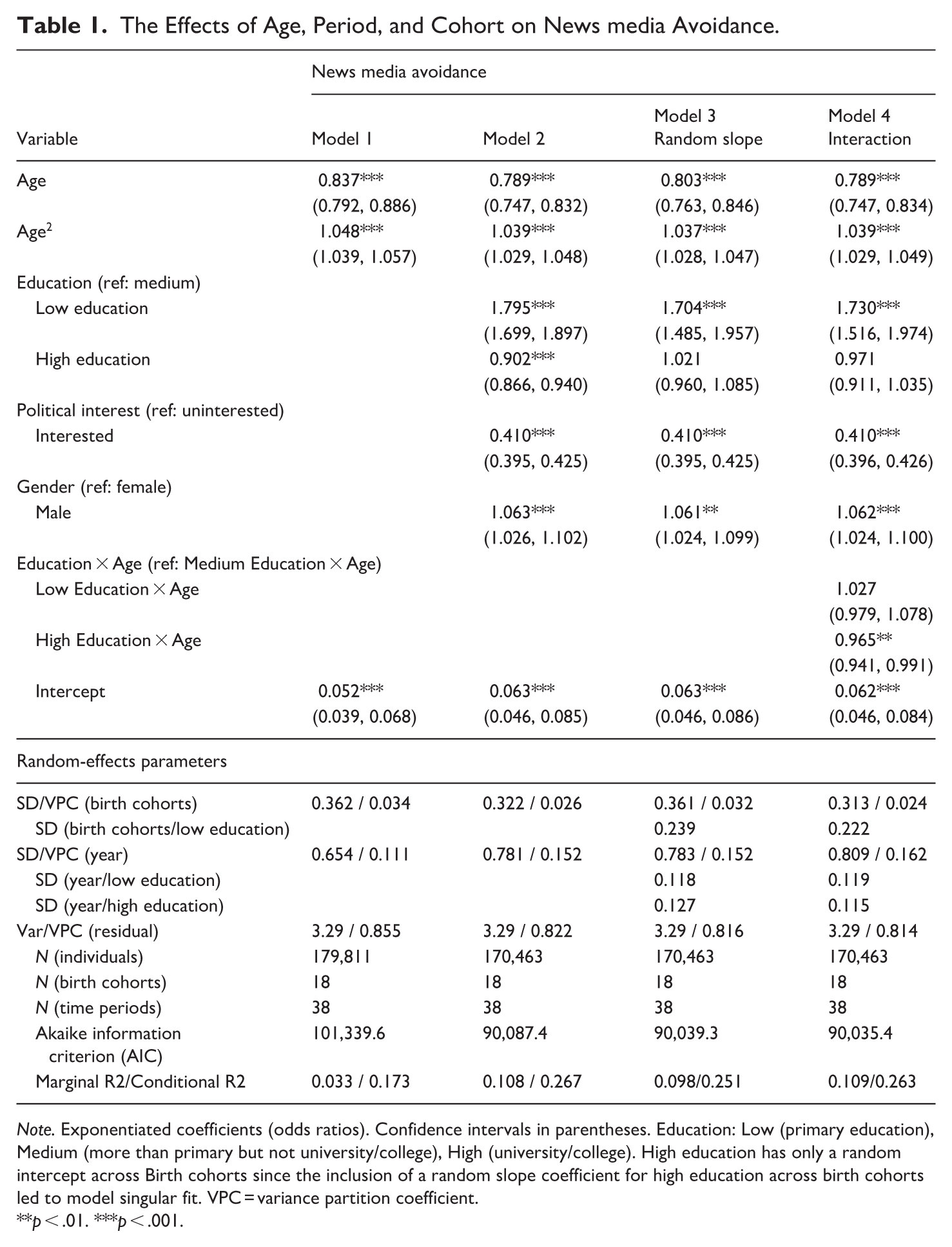
Note. Exponentiated coefficients (odds ratios). Confidence intervals in parentheses. Education: Low (primary education), Medium (more than primary but not university/college), High (university/college). High education has only a random intercept across Birth cohorts since the inclusion of a random slope coefficient for high education across birth cohorts led to model singular fit. VPC = variance partition coefficient.
p < .01. ***p < .001.
In Table 1, Model 2, we see that our coefficients—presented as odds ratios in our models—are statistically significant and in the expected direction. The odds ratio for age is 0.79, which means that for every decade older an individual gets, the probability of news avoidance is reduced by, on average, 21%. However, the squared age term is 1.04, which indicates that this effect is reduced by roughly 4% each decade. Additionally, we see that a low education substantially increases the likelihood of news media avoidance, while having a high education decreases the likelihood. Furthermore, having a political interest has a strong effect on the likelihood of news media use, reducing the probability of news media avoidance by almost 60% compared to those who are uninterested in politics.
In Figure 2, we visualize the independent effects of Age, Period, and Cohort. For the Age effects, we have plotted the predicted probabilities of news media avoidance across ages while holding all other variables at their mean values. This represents the fixed effect portions. For the period and cohort effects, these consist of the random effects structure and maps out the predicted probability of news media avoidance at the mean age (49.5 years).
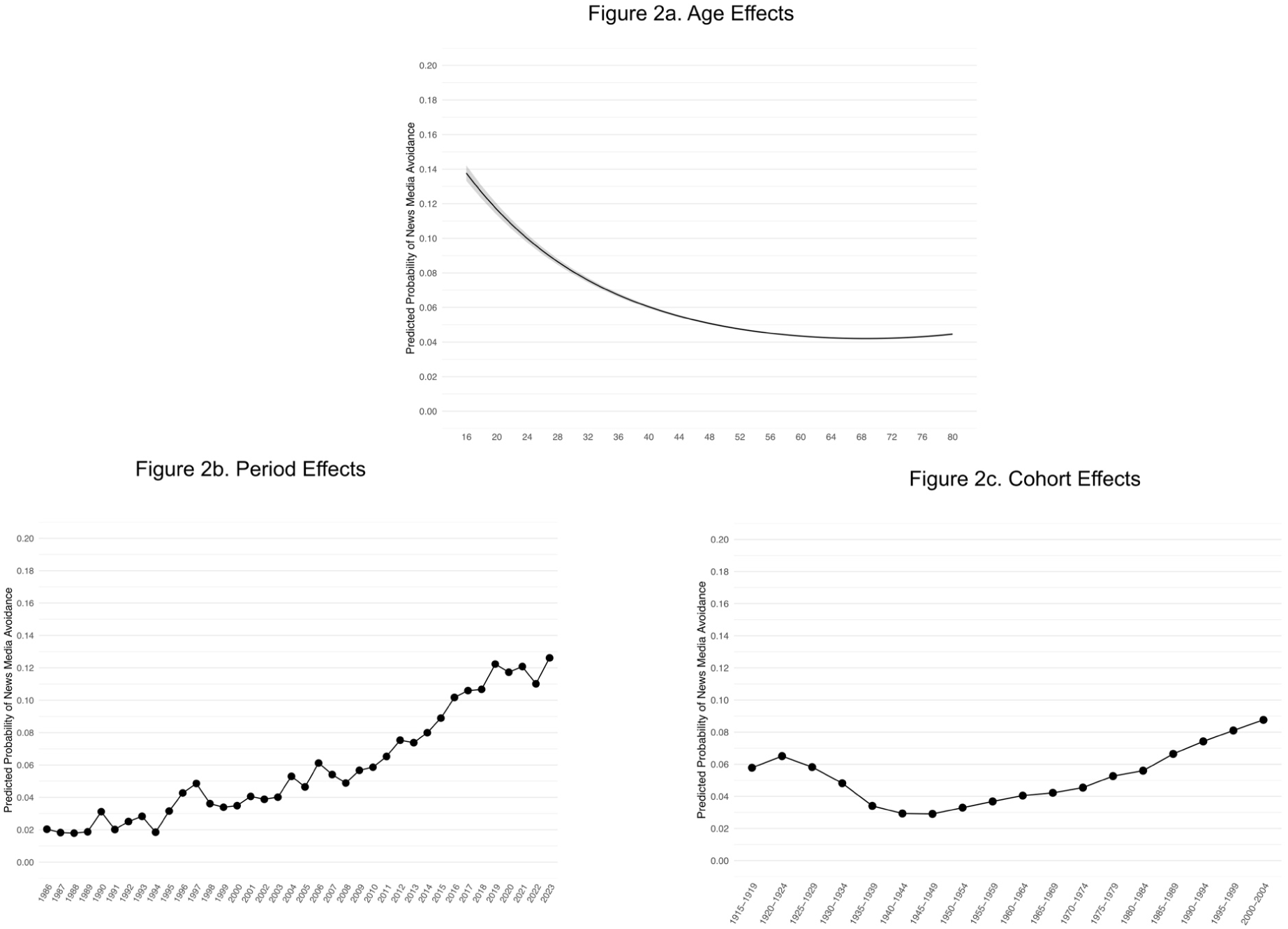
(a) Age, (b) Period, and (c) Cohort effects on probability of news media avoidance.
Beginning with the age effects (Figure 2a), the results are straightforward. The younger an individual, the greater the probability of news media avoidance. Following the x-axis, we see a steady downward slope and at the right side of the axis, the probability of news media avoidance is very low. Since these are fixed effects across the whole 38 years of study, we safely conclude that there are strong and robust age effects when it comes to news media avoidance. As individuals come of age, they seem to increasingly turn to news media. Thus, we find support for H1.
Moving to the period effects in Figure 2b, we have plotted the predicted probability of news media avoidance across time at the mean age (49.5 years old) and averaged across all birth cohorts. Doing this, we see that the effect of the time period has consistently trended upward. At the beginning of the time series, situated in the 1986 context, the probability of news media avoidance was low, roughly 5%. Since then, the probability has only increased, and in particular after 2010. Even though we are unable in this article to tease out the main mechanisms responsible for the accelerated trend, it can be noted that this trend coincides with the broad adaptation of modern social media platforms and smartphones in Sweden (Weibull & Wadbring, 2020) and that scholars have identified these processes of increased choice and mobility as an important factor in explaining why people tune out from news media (Andersen et al., 2021; Van Aelst et al., 2017). The upward trend does, however, seem to flatten toward the end of the time period measured. A qualified guess would be that this could be due to the COVID pandemic which on the one hand seemed to increase levels of intentional news avoidance (de Bruin et al., 2021) but on the other hand also generally promoted higher news consumption (Van Aelst et al., 2021). In the most recent survey year, 2023, the period effect on the probability at the mean age and averaged across birth cohorts is roughly 12%. In short, H2 is supported since the period effect has trended upwards over time.
Lastly in Figure 2c, we have the cohort effects at the mean age and averaged across time periods. The cohort effects display an interesting U-shape when it comes to its effects on probability of news media avoidance. Those being born in first decades in of the 20th century had a somewhat heightened likelihood of news media avoidance but there was a stable downward trend, reaching its lowest point among the birth cohorts born between 1935 and 1949. For the birth-cohorts born 1950 and forwards, the slope turns into a steady upwards trend. These results indicate that in addition to the age and period effect on probability of news media avoidance, we see generational effects. Most notably is that the cohorts born between 1935 and 1949 exhibit a lower probability of news media avoidance.
Moving away from the independent effects of these factors and recognizing their interdependence in Figure 3 we plot changes in predicted probabilities of news media avoidance over the life-course, between cohorts and in different time periods. For the sake of readability, Figure 3 only includes seven birth cohorts and 4 time periods. Inspecting the figure, we see how age, period and birth cohort factors interact when it comes to probability of news media avoidance. In Figure 3, we see the large period effects which has increased the probability of tuning out from news media for all cohorts. We can also see that the birth cohort differences have become more prominent in the high-choice media environment. This is particularly noticeable with respect to the youngest cohort growing up. Here, it becomes clear that even though we can expect that newer generations to some extent will increase their news media consumption as they age, news media organizations should not put too much faith in these life-course effects. News media use seems to come less natural to younger cohorts growing up in a high-choice media environment (Andersen et al., 2021).
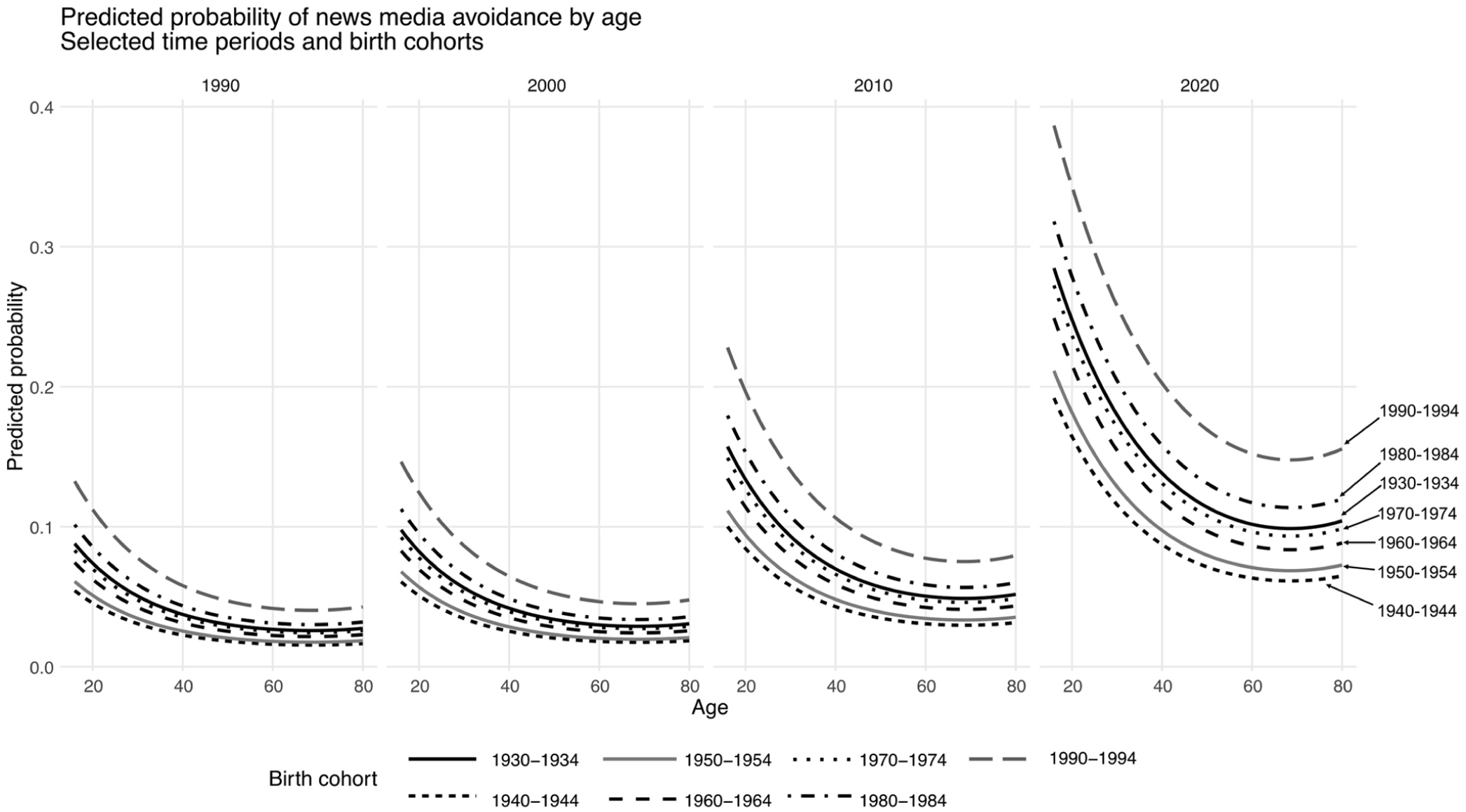
Probability of news media avoidance by age, across selected time periods and birth cohorts.
Educational Gaps Across Age, Period, and Cohort
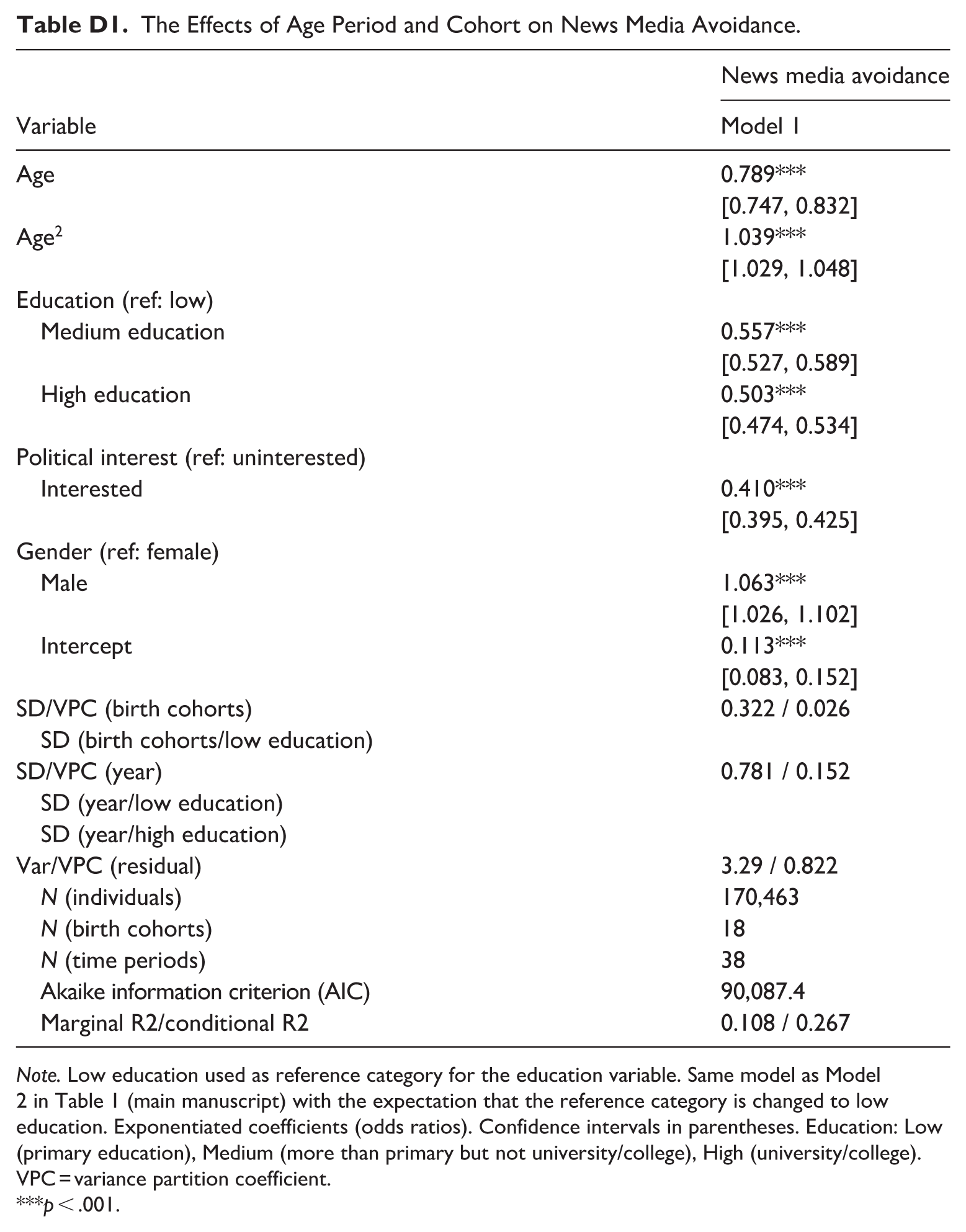
Apart from just studying the independent effects of age, period, and cohort on the probability of news media avoidance, we are also interested in investigating whether, and if so how, socioeconomic gaps in news media avoidance develop over the life-course, across birth cohorts and over time. We begin with answering H3 and H4. In Table 1 Model 2, we find that individuals with low education have almost 80% higher probability of news media avoidance compared to those with medium education while those with higher education has around 10% lower probability. The educational gaps become even clearer when changing the reference category to those with low education (Appendix D, Table D1) where those with medium and high education have both roughly half the probability of news media avoidance compared to those with low education. In Figure 4, we also map these developments over time where we see that the educational gaps between those with high and low education have increased over the roughly four decades measured. Thus, we find support for H3 and H4.
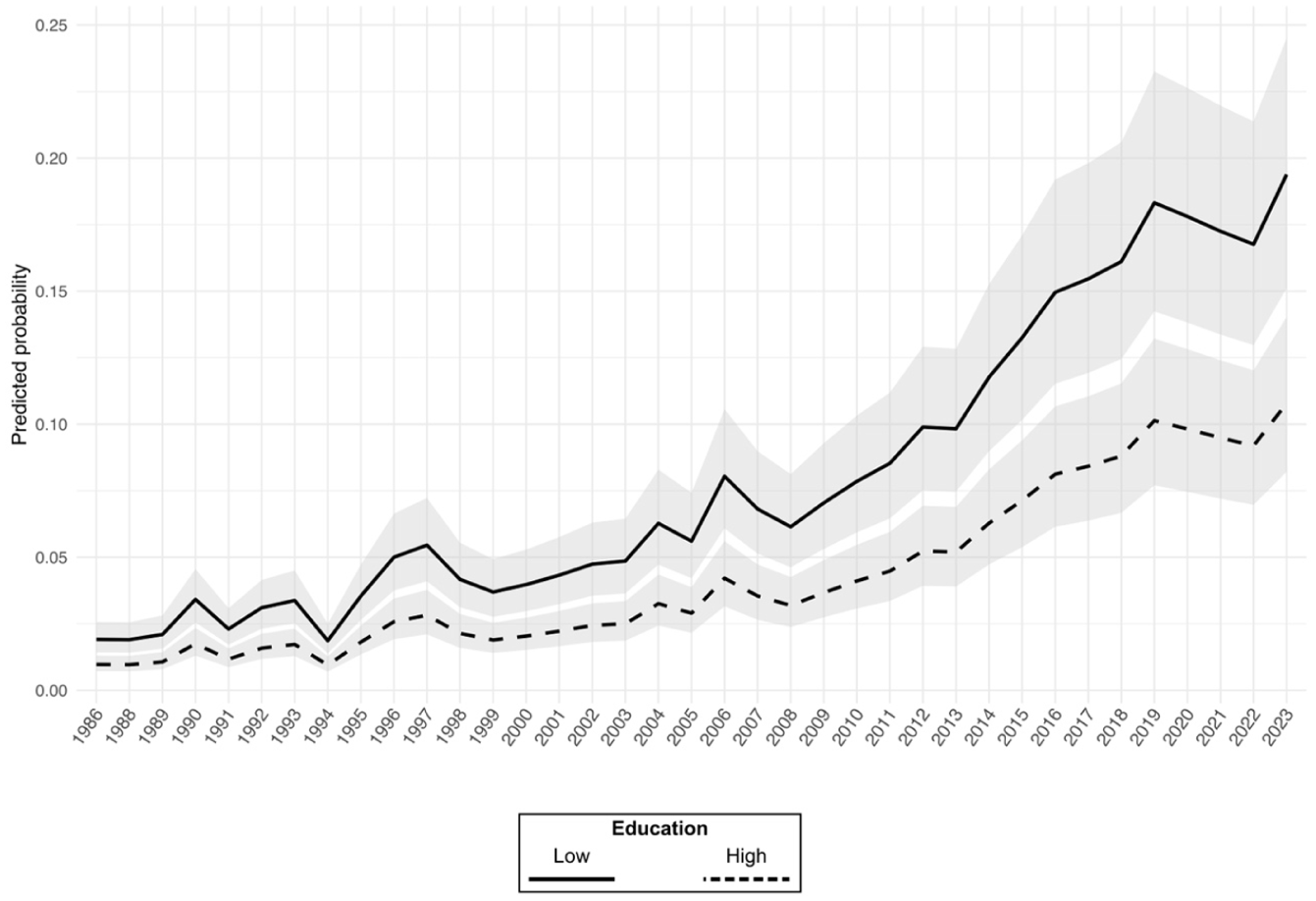
Educational gaps in the probability of news media avoidance.
Moving to our RQ2, and trying to untangle the independent effects of age, period and cohort effects on educational gaps, in Figure 5, we calculate and visualize the predicted probabilities of news media avoidance for those with low and high education across the life course (Figure 5a), time periods (Figure 5b) and birth cohort (Figure 5c).
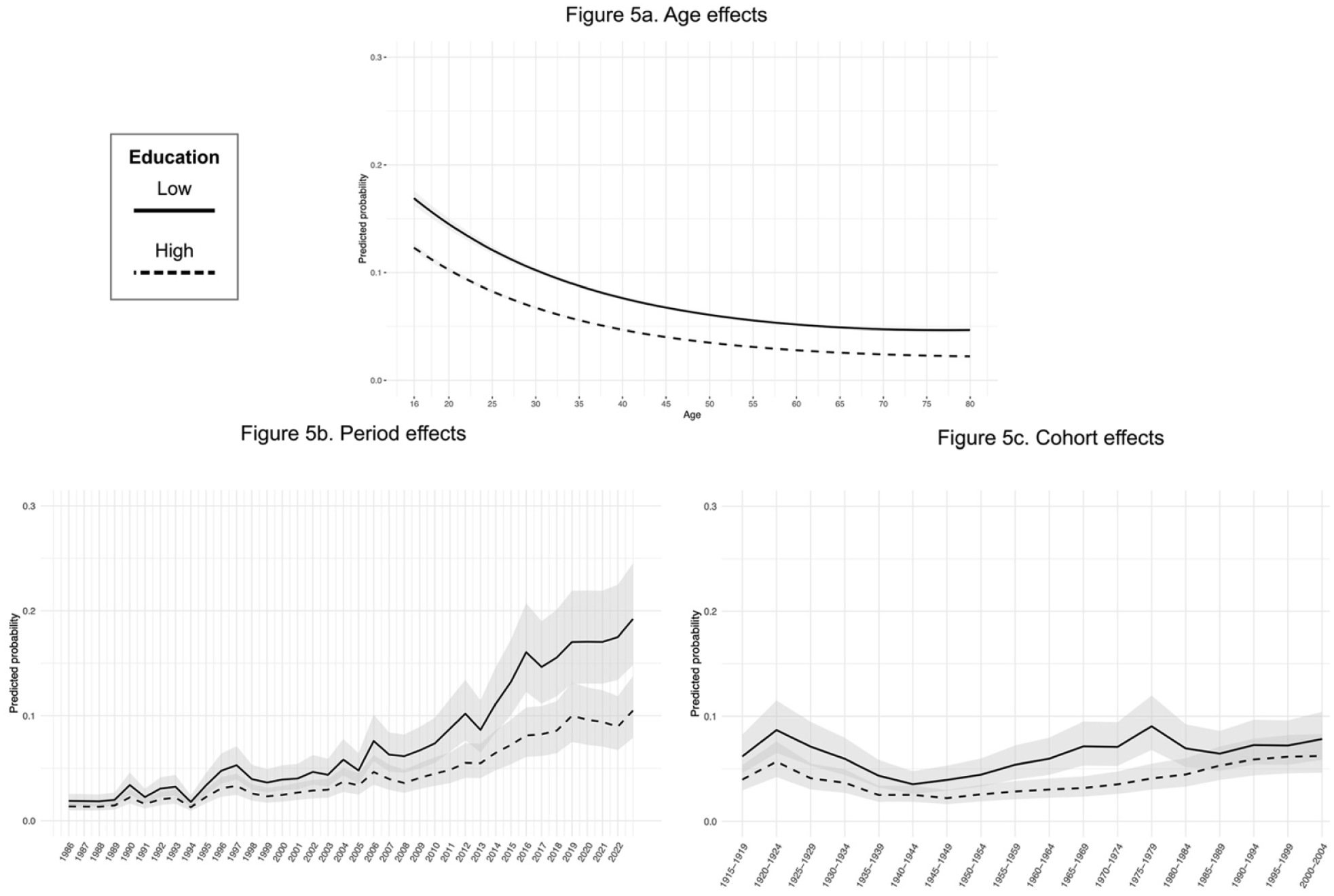
Educational gaps across (a) Age, (b) Period, and (c) Cohorts effects.
Inspecting the life-course effects of education, we see that there are differences between these educational groups (Figure 5a). At early ages, both educational groups have a heightened probability of news media avoidance. As individuals grow older, the probability of news media avoidance decreases for both groups in accordance with the age effects noted previously, and educational gaps remain stable throughout the life course (Figure 5a). This suggests a cumulative (Dis)Advantage and Matthew effect in news media consumption (Bask & Bask, 2015).
Mapping out how the effect of education differs across period and birth-cohorts, we modeled two random slope models (Table 1, Model 3 and Model 4) to allow for variations in the education coefficients between birth-cohorts and measurement years. Doing this, in Figure 5b, we calculate and predict the probability of news media avoidance for different educational groups across time periods at the mean age and averaged across all birth cohorts. Likewise, in Figure 5c, we calculate and predict the probability of news media avoidance across birth cohorts for people at the mean age and averaged across all time periods. This way, we can separate out the independent contributions of period and cohort.
Starting with the period effects in Figure 5b, we see indications of growing educational gaps in the probability of news media avoidance. At the beginning of the time series, there were no significant differences between those with low and those with high education in probability of news media avoidance. Since then, as we move along the x-axis, we see a continuous growth in educational gaps and in 2015, these differences become statistically significant. In the latest year measured, those with low education are almost twice as likely to be a news media avoider compared to those with a high education. These trends give strong support to the argument that the high-choice media environment facilitates growing gaps in news media consumption (Bergström et al., 2019; Prior, 2007; Strömbäck et al., 2013; Van Aelst et al., 2017).
Moving to the effect of birth cohorts on educational gaps in Figure 5c, we can conclude three things. First, there are specific cohort effects when it comes to educational gaps in the probability of news media avoidance distinct from both age and period effects. Second, these are on, average, smaller compared to the period effects. Lastly, the cohort trend does not follow a single trajectory. Generally, we can speak of quite stable educational gaps across birth cohorts with some reductions in educational gaps for birth cohorts born around the mid-1930s up to early 1950s. For cohorts born after this period, we see that educational gaps start to increase somewhat. Significant differences start to appear among cohorts born 1955 to 1959 and peaks for the birth-cohorts born in the 1970s. After the peak in the 1970s, the educational gaps seem to decrease for subsequent birth cohorts. These decreasing gaps among younger cohorts seem to stem mostly from those with high education “catching up” with the low educated group rather than the low educated showing a reduction in probability of news media avoidance.
Taking all these different factors together, in Figure 6, we plot how the predicted probability of news media avoidance for different birth cohorts has developed over time in a hypothetical scenario where respondents age is held at the sample mean (49.5 years). Here we see the interesting development that younger cohorts might exhibit smaller educational gaps than previous ones. These reductions seem to stem from the fact that the highly educated also tune out from news media among these cohorts.
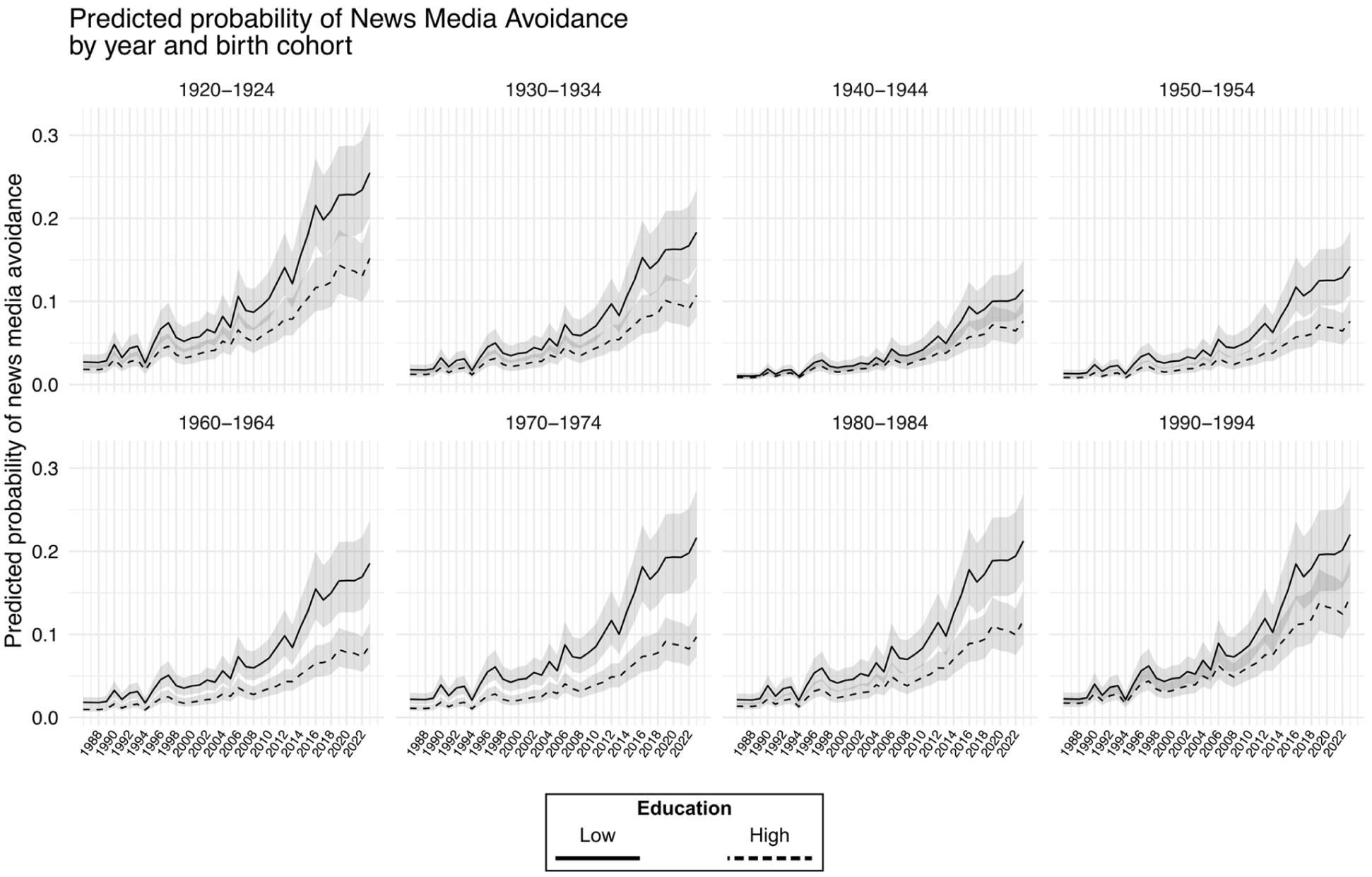
Educational gaps in news media avoidance by cohort and period (age held at mean).
Discussion and Conclusion
The aim of this article has been to deepen our understanding of news avoidance and strengthen the connection between the phenomenon’s theoretical foundations and its empirical investigations. Even though news media avoidance is a concept intimately tied to the longitudinal sociotechnological changes in our societies and media systems (Bennett & Iyengar, 2008; Prior, 2007; Thorson, 2015), the majority of quantitative studies on news avoidance so far have focused on cross-sectional designs and individual-level determinants (but see Andersen et al., 2024). While scholars the last decade have provided excellent insights into the effects of age, generational belonging and temporal location on news consumption and news avoidance (Edgerly et al., 2018; Karlsen et al., 2020; Ohme et al., 2022a; Strömbäck et al., 2013), to date there are currently no studies simultaneously assessing these effects. Using 38 years of survey data measuring news consumption in Sweden and utilizing HAPC modeling, this article provides a comprehensive empirical investigation into the phenomenon of news avoidance and how it relates to both individual life courses as well as sociological and media environmental changes. The findings offer several takeaways:
To start, we find that there are distinct and separate effects of age, period and cohort effects on the probability of news media avoidance. For the age effects, we find that as people come of age, they increasingly tune into news media consumption. This is in line with previous research, and based on the trend in our analyses, we should expect that this pattern will continue. Given that our analyses show that most of the variation in news media avoidance is explained at the individual level, these results should dampen the gloomiest predictions that young people today will not form a relationship with professional news media as they get older.
However, going beyond the individual level, the findings related to the effects of period and birth cohorts could be interpreted as a cause for concern. Both of these broader contextual factors seem to contribute to increasing levels of news media avoidance in the Swedish media environment. The period effects show a steady upward trend and provide robust evidence to previous research highlighting how the expansion of media choice facilitates news avoidance (Strömbäck et al., 2013; Van Aelst et al., 2017). As for the cohort effects, these trends illustrate that when you were born and which media environment you were born into matter when it comes to whether individuals tune out from professional news media (Edgerly et al., 2018; Ghersetti & Westlund, 2018). Additionally, given that the cohort effect trend is u-shaped suggests that there are ways that society can work to reduce news media avoidance. For example, we believe that it is no coincidence that the birth cohorts with the least likelihood of news media avoidance are the ones who came of age as public service broadcast radio and television were established and gained popularity in Sweden (Bolin, 2017; Syvertsen et al., 2014). However, more research is necessary on the specific generational dynamic before anything can be said with certainty. What is clear, though, is that these structural and sociological processes seem to pull audiences from news media consumption.
Previous scholars have pointed out growing inequalities in news media consumption as one of the most important issues facing communication research (Van Aelst et al., 2017), and this article contributes to this literature by investigating the dynamics of these gaps across ages, periods and cohorts utilizing APC analyses. Doing this, we have been able to separate out how each of these might contribute to greater audience fragmentation and stratification. On this point, our findings are quite concerning. As individuals age, educational gaps materialize early and is subsequently maintained throughout the rest of the life-course. We are also able to identify that it is period effects that is the main driver contributing to growing educational gaps among Swedish news audiences, a trend that does not seem to be slowing down. These results echo and reinforce those of earlier studies that have highlighted how high-choice media environments contribute to a process of audience stratification across socioeconomic lines (Bergström et al., 2019; Karlsen et al., 2020; Prior, 2007; Van Aelst et al., 2017) and a Matthew effect in news consumption, where the information rich get richer and relative impoverishment among those already further away from the world of news media (Bask & Bask, 2015; Kümpel, 2020).
While the period effects seem to be driving educational gaps in news media consumption, the cohort effects on audience stratification are generally small and less conclusive. There are, however, some implications from the findings that merit further discussions and future investigation. First of all, those with low education in the late 30s up to the early 50s birth cohorts show a quite substantial drop in probability in news media avoidance compared to those cohorts before and after. While more research is necessary, we offer two explanations for these findings. One is that the socialization of these cohorts came at a time when the public radio and public television in Sweden gained popularity, offering more accessible ways for people to consume news in addition to reading the newspaper (Bolin, 2017; Prior, 2007). Second, this was a period when the Swedish state were proactive in providing such services from the conception of it being public goods (Syvertsen et al., 2014; Weibull & Wadbring, 2014). We also do not believe that it is a coincidence that the biggest educational gaps can be found in the cohorts born in the mid-70s. These cohorts experienced adolescence in a time when the Swedish broadcasting monopoly was disbanded in 1987 whereafter the internet entered the information environment as well as a move toward less state interference in media policy (Syvertsen et al., 2014; Weibull & Wadbring, 2014).
Interestingly, the educational gaps for those born in the 80s and forward do not seem to increase. For these cohorts, the trend seems to be that the highly educated have increased their probability of news media avoidance relative to the low educated. This would suggest that there is a more general detachment from news media among these younger cohorts as suggested by previous scholars (Bennett, 2008). Moreover, these findings also lend support to those scholars who have argued that individual motivations—rather than socioeconomic factors—is the key factor determining engagement with news and the political world for younger generations who were socialized in the high-choice media environment (Thorson, 2015, see also Prior, 2007; Espeland, 2024). However, untangling these effects is tricky since previous research has shown that the development of political interest is more likely to occur in socioeconomically stronger groups (Bergström et al., 2019; Thorson et al., 2018). Thus, more research is necessary to untangle these two, but correlated, sources of audience fragmentation and stratification.
In summary, this study provides longitudinal data in support of previous research highlighting how socioeconomic gaps have grown as we have transitioned from a low- to a high choice media environment (Blekesaune et al., 2012; Karlsen et al., 2020; Toff et al., 2023), suggesting a process of class-based fragmentation in the historically strong egalitarian media welfare state of Sweden (Lindell & Hovden, 2018; Lindell & Mikkelsen Båge, 2023).
Some study limitations should be noted. First, this is a single country study, and we would therefore caution against generalizing beyond the Swedish context. We would, however, suspect that similar trends are present in other post-industrial western societies. The study also relies on self-reported news consumption measures, which is prone to measurement error due to overreporting (Prior, 2009). Another shortcoming concerns the exact linear dependency between age, period, and birth cohorts, also known as the identification problem. In this article, we have used established methods (HAPC modeling) to circumvent these problems, but it is virtually impossible to gain true independence between these factors. This is important to keep in mind when interpreting effects, especially cohort effects, which tend to be underestimated in HAPC models (Fosse & Winship, 2019). Lastly, given our longitudinal approach, we were unable to incorporate online-native news media or social media news consumption, focusing solely on traditional news media in their traditional formats or online. On the one hand, this could be considered problematic since previous research has suggested that social media may have a leveling effect on news consumption gaps (Holt et al., 2013; Karlsen et al., 2020) especially for younger generations (Andersen et al., 2021). On the other hand, the dynamics found in this article have been found in studies on news consumption in social media as well with results increasingly indicating that the online news environment facilitates an information environment where the “rich-get-richer” (Andersen et al., 2021, pp. 130–136; Kalogeropoulos et al., 2026; Kümpel, 2020; Thorson, 2020). As such, while this article is unable to make claims about inequalities in news consumption on social and native digital media, we believe that it has provided a valuable longitudinal and macro perspective on the broad developments of news media consumption gaps in Sweden. We invite future scholars to test different conceptualizations and methods to further our understanding of socioeconomic gaps in news media consumption.
Despite these limitations, we believe that this article furthers our understanding of news media avoidance by providing an in-depth empirical investigation into the interconnected temporal dynamics of aging, time period, and birth cohorts. Focusing on these long-time sociological trends, we can see how these factors have facilitated not only growing news media avoidance in general but also social inequalities in news use in particular.
Footnotes
Appendix A
Question Wordings for the News Consumption Variables.
| Number | Variable | Question wording—Swedish | Question wording—English (author translation) | Response scale | Recoding |
|---|---|---|---|---|---|
| Morning newspaper variables | |||||
| 1 | Morning newspaper 1986–2007 |
Läser eller tittar du i någon eller några morgontidningar regelbundet? Om du läser mer än en morgontidning, ange först den som du betraktar som din huvudtidning. | Do you read or look in any morning newspapers regularly? If you read more than one, fill in the one that you consider your primary newspaper | Does not read morning newspapers. 1 day/week 2 days/week 3 days/week 4 days/week 5 days/week 6 days/week 7 days/week (most frequently read morning newspaper determines score) |
Rows 1–4 recoded into one variable spanning the entire time period. The highest score determined the respondent score. Response scales of the variables were recoded as follows: 0 = never 1 = more seldom 2 = 1–2 days/week 3 = 3–4 days/week 4 = 5–6 days/week 5 = daily |
| 2 | Morning newspaper Print 2008—current |
2008–2013 Läser eller tittar du i någon eller några morgontidningar regelbundet? Om du läser mer än en morgontidning, ange först den som du betraktar som din huvudtidning.” (Frågan gäller inte tidningar på̊ internet.)” 2014—nuvarande Läser eller tittar du regelbundet i någon morgontidning på̊ papper? |
2008—2013 Do you regularly read or look in any morning newspapers? If you read more than one, fill in the one that you consider your primary newspaper. (The question applies only to printed newspapers). 2014—current Do you regularly read or look in any morning newspapers in print |
2008–2013 Does not read morning newspapers. More seldom 1 day/week 2 days/week 3 days/week 4 days/week 5 days/week 6 days/week 7 days/week 2014–current Never |
|
| More seldom |
|||||
| 3 | Morning newspaper Online |
Läser eller tittar du regelbundet i någon eller några morgontidningar på internet? | Do you regularly read or look in any morning newspapers on the internet? If you read more than one, fill in the one that you consider your primary newspaper | Does not read morning newspapers online |
|
| 4 | Morning newspaper Online |
Hur ofta brukar du ta del av nyheter från Dagens Nyheter, Svenska Dagbladet [nationella morgontidningar, reds anm.] eller någon lokal morgontidning på internet. | How often do you usually take part of news from Dagens Nyheter, Svenska Dagbladet [national morning newspapers, eds. note] or any local morning newspapers online | Never |
|
| Tabloid variables | |||||
| 5 | Tabloids Print |
Hur ofta brukar du läsa eller titta I följande tidningar? [Följt av de fyra huvudsakliga kvällstidningarna Aftonbladet, Expressen, Kvällsposten & GT, reds. Anm.] | How often do you usually read or look in any of the following newspapers? [Followed by the four main tabloids of Sweden: Aftonbladet, Expressen, Kvällsposten & GT, eds. Note] | Never |
Rows 5–8 recoded into one variable spanning the entire time period. The highest score determined the respondent score on the tabloid variables. |
| 6 | Tabloids Print |
Hur ofta brukar du ta del av nyheter från följande på papper? [Följt av de fyra huvudsakliga kvällstidningarna Aftonbladet, Expressen, Kvällsposten & GT, reds. Anm.] | How often do you usually take part of news from the following in print? [Followed by the four main tabloids of Sweden: Aftonbladet, Expressen, Kvällsposten & GT, eds. Note] | Never |
|
| 7 | Tabloids Online |
Hur ofta brukar du läsa eller titta I följande tidningar på internet? [Följt av de fyra huvudsakliga kvällstidningarna Aftonbladet, Expressen, Kvällsposten & GT, reds. Anm.] | How often do you usually read or look in any of the following newspapers on the internet? [Followed by the four main tabloids of Sweden: Aftonbladet, Expressen, Kvällsposten & GT, eds. Note] | Never |
|
| 8 | Tabloids Online |
Hur ofta brukar du ta del av nyheter från följande på webb? [Följt av de fyra huvudsakliga kvällstidningarna Aftonbladet, Expressen, Kvällsposten & GT, reds. Anm.] | How often do you usually take part of news from the following on the web? [Followed by the four main tabloids of Sweden: Aftonbladet, Expressen, Kvällsposten & GT, eds. Note] | Never |
|
| Radio variables | |||||
| 9 | Radio news |
Hur ofta brukar du ta del av följande nyhetsprogram eller nyhetstjänster? —Ekonyheterna i radion | How often do you usually take part of the following news programs or news services? The national news [Ekot, eds. Note] on the radio | Never |
Rows 9 and 10 recoded into one single variable where the highest score on row 9 or 10 determined respondents score on the new radio variable |
| 10 | Radio news Online |
Hur ofta brukar du ta del av nyheter från Sveriges Radio på internet? | How often do you usually take part of news from Swedish Radio on the internet? | Never |
|
| TV variables | |||||
| 11 | National television news, Public service (the “Aktuellt” newsshow) |
Hur ofta brukar du ta del av följande nyhetsprogram eller nyhetstjänster? —Aktuellt i SVT | How often do you usually take part of the following news programs or news services? |
Never |
Rows 11–15 recoded into one single Television news variable, where the highest score on row 11–15 determined respondents score on the combined variable |
| 12 | National television news, Public service (the “Rapport” newsshow) |
Hur ofta brukar du ta del av följande nyhetsprogram eller nyhetstjänster? —Rapport i SVT | How often do you usually take part of the following news programs or news services? Rapport [the other national television news show on Swedish public television] | Never |
|
| 13 | National television news, Public service (Aktuellt/Rapport) |
Hur ofta brukar du ta del av följande nyhetsprogram eller nyhetstjänster? —Aktuellt/Rapport i SVT | How often do you usually take part of the following news programs or news services? Aktuellt/Rapport on SVT [National news shows on the Swedish public television] | Never |
|
| 14 | National television news, commercial channel | Hur ofta brukar du ta del av följande nyhetsprogram eller nyhetstjänster?—TV4 Nyheterna | How often do you usually take part of the following news programs or news services? TV4 Nyheterna [National commercial TV news] | Never |
|
| 15 | Public service television news online | Hur ofta brukar du ta del av nyheter från Sveriges television på internet? | How often do you usually take part of news from Swedish television on the internet? | Never |
|
Appendix B
Appendix C
Summary Statistics.
| Variable | Label | Mean | SD | Min | Max | N |
|---|---|---|---|---|---|---|
| News media avoidance | Normal consumer | 162,730 | ||||
| News media avoiders | 17,081 | |||||
| Age (mean-centered and divided by 10) | −0.00 | 1.76 | −3.36 | 3.04 | 179,811 | |
| Education | Low | 31,908 | ||||
| Medium | 75,707 | |||||
| High | 65,528 | |||||
| Gender (dummy variable, 1 = male) | Male: 86,193 |
0.48 | 0.50 | 0.00 | 1.00 | 179,418 |
| Political interest | Interested: 104,057 |
0.59 | 0.49 | 0.00 | 1.00 | 176,760 |
| Birth cohorts | 1915–1919 | 1,047 | ||||
| 1920–1924 | 2,146 | |||||
| 1925–1929 | 3,190 | |||||
| 1930–1934 | 4,493 | |||||
| 1935–1939 | 7,756 | |||||
| 1940–1944 | 14,747 | |||||
| 1945–1949 | 19,127 | |||||
| 1950–1954 | 17,070 | |||||
| 1955–1959 | 16,133 | |||||
| 1960–1964 | 15,892 | |||||
| 1965–1969 | 16,215 | |||||
| 1970–1974 | 14,088 | |||||
| 1975–1979 | 11,846 | |||||
| 1980–1984 | 10,492 | |||||
| 1985–1989 | 9,481 | |||||
| 1990–1994 | 7,683 | |||||
| 1995–1999 | 5,116 | |||||
| 2000–2004 | 3,289 | |||||
| Survey year | 1986 | 1,437 | ||||
| 1987 | 1,584 | |||||
| 1988 | 1,578 | |||||
| 1989 | 1,537 | |||||
| 1990 | 1,559 | |||||
| 1991 | 1,540 | |||||
| 1992 | 1,825 | |||||
| 1993 | 1,802 | |||||
| 1994 | 1,659 | |||||
| 1995 | 1,749 | |||||
| 1996 | 1,749 | |||||
| 1997 | 1,717 | |||||
| 1998 | 3,559 | |||||
| 1999 | 3,442 | |||||
| 2000 | 3,408 | |||||
| 2001 | 3,508 | |||||
| 2002 | 3,466 | |||||
| 2003 | 3,507 | |||||
| 2004 | 3,448 | |||||
| 2005 | 3,349 | |||||
| 2006 | 3,177 | |||||
| 2007 | 3,270 | |||||
| 2008 | 3,124 | |||||
| 2009 | 4,734 | |||||
| 2010 | 4,836 | |||||
| 2011 | 4,525 | |||||
| 2012 | 6,082 | |||||
| 2013 | 4,796 | |||||
| 2014 | 6,641 | |||||
| 2015 | 7,950 | |||||
| 2016 | 9,457 | |||||
| 2017 | 10,347 | |||||
| 2018 | 10,322 | |||||
| 2019 | 9,613 | |||||
| 2020 | 10,656 | |||||
| 2021 | 10,789 | |||||
| 2022 | 11,213 | |||||
| 2023 | 10,856 |
Appendix D
The Effects of Age Period and Cohort on News Media Avoidance.
| Variable | News media avoidance |
|---|---|
| Model 1 | |
| Age | 0.789*** |
| [0.747, 0.832] | |
| Age2 | 1.039*** |
| [1.029, 1.048] | |
| Education (ref: low) | |
| Medium education | 0.557*** |
| [0.527, 0.589] | |
| High education | 0.503*** |
| [0.474, 0.534] | |
| Political interest (ref: uninterested) | |
| Interested | 0.410*** |
| [0.395, 0.425] | |
| Gender (ref: female) | |
| Male | 1.063*** |
| [1.026, 1.102] | |
| Intercept | 0.113*** |
| [0.083, 0.152] | |
| SD/VPC (birth cohorts) | 0.322 / 0.026 |
| SD (birth cohorts/low education) | |
| SD/VPC (year) | 0.781 / 0.152 |
| SD (year/low education) | |
| SD (year/high education) | |
| Var/VPC (residual) | 3.29 / 0.822 |
| N (individuals) | 170,463 |
| N (birth cohorts) | 18 |
| N (time periods) | 38 |
| Akaike information criterion (AIC) | 90,087.4 |
| Marginal R2/conditional R2 | 0.108 / 0.267 |
Note. Low education used as reference category for the education variable. Same model as Model 2 in Table 1 (main manuscript) with the expectation that the reference category is changed to low education. Exponentiated coefficients (odds ratios). Confidence intervals in parentheses. Education: Low (primary education), Medium (more than primary but not university/college), High (university/college). VPC = variance partition coefficient.
p < .001.

Funding
The author received no financial support for the research, authorship, and/or publication of this article.
Declaration of Conflicting Interests
The author declared no potential conflicts of interest with respect to the research, authorship, and/or publication of this article.