







Abstract
This article draws on a recent study of infant participation in research, and work in practice theory and professional education, to explore the implications and challenges of educational research of particular encounters, which we call “moments of wonder”. Working with Merleau-Ponty’s philosophy of expression, we look closely at one such “moment,” as a rich field of sense—an excess of signification and affect. We see this account as demonstrating the value of what we call philosophical–empirical inquiry for opening up the complexity of educational research and practice, and specifically the interplay of early childhood education (ECE) practitioners/researchers and young children in “participatory research.”
Keywords
Vignette: A Period of Data Generation
At the time of Amy’s arrival at the home that morning, Sandy and Richie were playing in the kitchen/dining room, with an educator (Rose) and researcher (Sheena) nearby. As Amy entered the room, Sandy picked up a piece of semiopaque material, which had been provided as a play resource, and placed it over her head whilst simultaneously verbalising and looking towards Amy. Sandy then crawled towards Amy, reached out with her right hand and touched Amy’s face. Amy moved away from Sandy but then returned and sat directly in front of her. Sandy responded by reaching out and touching Amy’s face. Amy immediately started crying, and so Rose sat on the floor and placed Amy on her lap. Rose then asked all of the children: “Do you want to play peek-a-boo?” Rose placed Amy on the floor between her legs and reached for the nearby material. Amy immediately started crying, so Rose placed Amy back on her lap.
Ten minutes after Amy’s arrival, she was still crying and remained seated on Rose’s lap. Sandy and Richie moved towards Rose and Amy, and Richie picked up the semiopaque material. He said: “I am going to play with it,” whilst waving the material around and laughing. Sandy crawled over and sat next to him. Amy stopped crying and looked towards them. Sandy cuddled Richie and stroked his hair. Amy continued looking towards them. Rose placed Amy on the floor between her legs and Amy immediately started crying. Rose placed Amy back on her lap. 1
Twenty-four minutes after Amy’s arrival, her crying increased in intensity and she remained seated on Rose’s lap. Rose picked up a piece of semiopaque material, identical to the one that Richie had been playing with, and rubbed it over Amy’s hands and body, moving it slowly up towards Amy’s face. With stroking movements, Rose gradually placed the material over Amy’s head and body. At the same time, Richie picked up his piece of material and sat underneath it. Sandy picked up one edge of Richie’s material, climbed underneath, and sat next to him. The moment that Amy’s head and body were fully underneath the material, she abruptly stopped crying and looked towards the other children.
Introduction
How to convey what is happening or what is significant, or simply what is “there,” for whom, is one of the most profound challenges in educational research, perhaps particularly so in qualitative inquiry. Although there is now a wide repertoire of languages and techniques available, these are still sometimes inappropriate, or simply inadequate. Sometimes it is more a matter of emergence, and mystery—of wonder. How is meaning produced, and relayed, to whom? These are some of the questions that have vexed us, and which we explore in this article. Our more immediate focus is research with young children, specifically in the context of early childhood education (ECE), and the interplay of ECE practitioners/researchers and young children in educational/care settings. Moreover, our interest is in exploring the complexities of what is called participatory research. We draw mainly from a recently completed study of infant participation in research (Elwick, 2016), as well as work in practice theory and professional education (Green & Hopwood, 2015a). Our particular concern is with exploring some of the implications and challenges of educational research that encounters along the way what we call “moments of wonder,” interruptions in the flow of things, when something catches the attention and makes us think again, and anew. We look closely at one such moment, when Sheena found herself surprised, and intrigued, and which opened up a quite a different practice of inquiry. In this regard, there are similarities, we think, with a point that Vagle and Hofsess (2016) make, in referring to “how a method of data collection took off in unexpected ways” during a research project (p. 338). These are significant occurrences in the process of becoming-researcher, and hence in graduate studies, although they are often little acknowledged or appreciated. But as an important feature of research and scholarship more generally, as practice (Green, 2015), they clearly warrant further investigation.
We begin however by considering what has become an orthodoxy in contemporary ECE—the idea of “participatory research.” This is something needing to be problematized, it seems to us. Although it has become a motif in early childhood studies, and productively so, the way in which language is typically understood within participatory research is something worth reconsidering as a different view might offer worthwhile alternatives. Of particular interest here is the use-value of Merleau-Ponty’s work, and more specifically his philosophy of expression. We see this as directly related to other key concepts of his, namely his notions of flesh, écart, and reversibility, and also of space and the body, which we have worked with elsewhere (e.g., Elwick, 2015; Elwick, Bradley, & Sumsion, 2014). Crucially, such a perspective offers an alternative to the still-dominant representational view, or what has been described as “the ancient picture of thinking, language, and knowing as representation [emphasis in original]” (Hass, 2008, p. 3), which endures today—indeed, in much participatory research, as in ECE. This philosophy of expression would seem to be akin to what has usefully been described as “post-intentional phenomenology” (Vagle, 2015), which seeks to bring together poststructuralism with phenomenology to constitute a distinctive research perspective—if you like, a “post-phenomenology.” 2 At the very least this constitutes an unsettling of various research traditions.
Recent commentary (e.g., Hass, 2008; Landes, 2013) has highlighted the role and significance of “expression” as an organizing principle for Merleau-Ponty, substantively and methodologically, and as both a resource and a catalyst for rethinking and revaluing his work in and for contemporary scholarship. What is especially relevant however, as we shall suggest, is the link, as we see it, between Merleau-Ponty’s philosophy of expression and what has been called practice theory and philosophy (Green & Hopwood, 2015a). That link is indicated, partly, in the interaction here of expressive bodies in coproduced practice. How then is this “moment of wonder” best understood? How best to research such moments, in practice? How best to grasp these as “researchable” moments? How best to make of them matters of meaningful inquiry?
On Philosophical–Empirical Inquiry
Recently, interest has been steadily developing in drawing more explicitly and systematically on philosophy as a resource for (postqualitative) educational research (e.g., Wilson & Santoro, 2015). This work is to be distinguished, on one hand, from theoretically inclined ethnography and, on the other, from more pragmatic postmodernist qualitative inquiry such as that of Jackson and Mazzei (2013), although clearly there are links and even affinities here. We have framed our own work, rather, within what has been called philosophical–empirical inquiry. Originally formulated by Stephen Kemmis, with specific regard to his work in action research and critical social science in education (see Kemmis, 2011, p. 84 3 ), the term has since been taken up by others and developed in somewhat different ways, albeit within a common research program (Green & Hopwood, 2015c). Two strands have been identified in that program, one broadly neo-Aristotelian in its orientation and the other what has been called post-Cartesian. The latter is our own focus, and indeed it is congruent with Merleau-Ponty’s philosophy, as we see it.
In essence, philosophical–empirical inquiry seeks to combine explicitly philosophical exploration with “fieldwork” investigations, “bringing together conceptual sophistication with empirical rigour” (Green & Hopwood, 2015a, p. 5). Working broadly within practice theory and philosophy, Miettinen, Samra-Fredericks, and Yanow (2009) point to “two distinct but complementary motives or research programmes,” which they identify as first “an empirical program, ethnographic in its sensibility,” and aimed at “understanding social and organizational life,” and second, “a theoretical one aimed at transcending perennial problems in philosophy and social sciences” (p. 1312). Ultimately, they suggest, work is required “simultaneously on both theoretical and empirical planes,” as well as “on the interactions between the two planes” (p. 1313). This is what we describe here as philosophical–empirical inquiry: work at once philosophical and empirical in nature and orientation, exploring and engaging what are conceptual and methodological issues and challenges. Of particular interest in this regard is, broadly understood, poststructuralist theory and philosophy, within which we include what has been called “post-phenomenology”—although it might be equally appropriate to point to the intersection of phenomenology and poststructuralism, as a distinctive convergence in Continental philosophy.
The philosophical concept we are working with in this article is that of expression—Merleau-Ponty’s term both for his philosophy in general and for how he came to understand his own practice as a philosopher (his “method”). “Expression” has been described as “a pivotal concept in Merleau-Ponty’s philosophy,” emerging over a considerable period of time and with “a complicated heritage” (Hass, 2008, p. 148). Closely linked to notions of language and thought, “expression” is “Merleau-Ponty’s master term for a creative, productive cognitive power—a power that is rooted in the excess of embodied life” (Hass, 2008, p. 172). It is moreover an originating “power,” producing the new. This can be appropriated here, in our reference to “expressive bodies.” The term is originally Schatzki’s, although he employs it somewhat differently (Schatzki, 1996). Here, we want to highlight the connection between expression and the body, or corporeality as a fundamentally expressive phenomenon. Thus, what we have called philosophical–empirical inquiry is to be understood (in this instance at least) as working with concepts, or conceptually, in our research and pedagogic engagements in and on the world and as inextricable from that world, as both lived and incarnate. Our investigations and our questions are always interactivities, therefore, co-productive, and participatory. It is in that spirit that we turn now to a fuller examination of the conceptual field of Merleau-Ponty’s philosophy of expression, in its implication for illuminating moments of wonder in researching young children and education more generally.
Interrupting Participatory Research With Infants
The period of data generation that provides our focus here occurred within a doctoral study Sheena conducted, as part of an Australian Research Council Linkage Project that sought to employ participatory research approaches with infants 4 in ECE contexts (Sumsion et al., 2008-2011) (Figure 1). Present at the time were two 11-month-old infants, Amy and Sandy; Rose, their educator; and Richie, an older child, aged 3 years 7 months. Sheena was also present, although she spent most of her time positioned behind a tripod-mounted video camera, the primary method of data generation on that day. The purpose of Sheena’s visit was to generate data in interaction with Sandy as she was the officially designated “participant” in that home. Amy and Richie, however, had not been awarded participatory status, due to predetermined research criteria that rendered them ineligible. However, despite that ineligibility, all of the children managed to affirm their presence (i.e., their “participation”) in quite surprising ways.
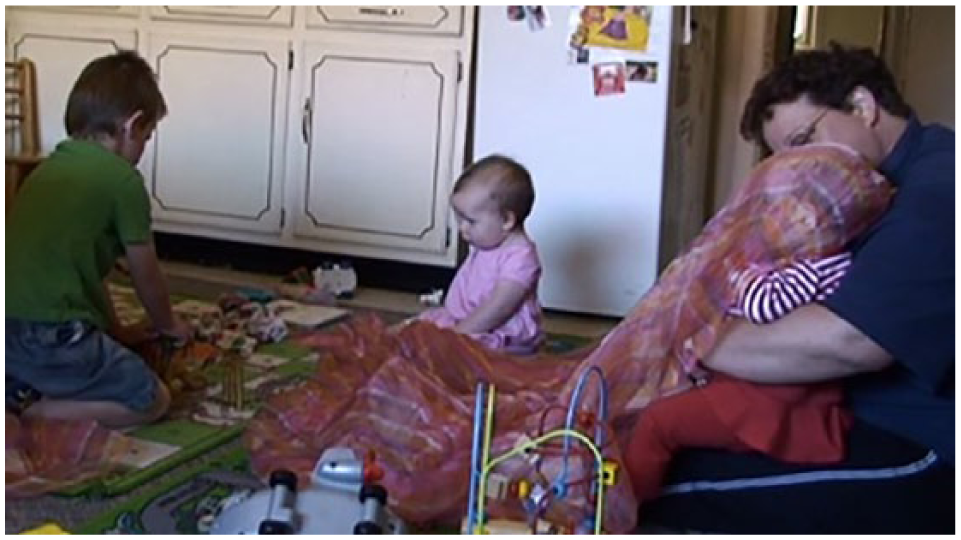
Amy (striped top), Rose, Sandy, Richie, the semiopaque material, and Sheena (Sumsion et al., 2008-2011).
One moment of such affirmation occurred when Amy suddenly stopped crying after a prolonged period (i.e., 24 min). Her silence was so unexpected that, at the time, Rose and Sheena both looked toward one another, mouths agape, instantaneously and simultaneously. They both laughed at the synchronicity of their responses and spoke about their mutual surprise that Amy’s intense and lengthy cries had ceased so abruptly once she was underneath the material. Described in this way, it would be easy to think of this particular moment as one shared between Rose and Sheena, each of whom were looking at and standing outside or alongside what was happening between the children: that there was a disjunction (of sorts) between them and the children. Indeed, if we follow the lead of what might be called “traditional” participatory research methodologies employed with infants that emphasize the importance of knowing the meanings that infants apply to their experiences in ECE contexts, then a relevant line of inquiry might be: “Why did Amy stop crying? What was Amy’s ‘perspective’ of that moment?” Moreover, we could draw on those same participatory research methodologies to reason that Rose and Sheena might well provide relatively reliable answers to such questions, based on their professional observations and interpretations of Amy’s expressions and behaviors (of Amy’s “expressive” body, that is to say). Likewise, once ascertained, we might convey the facticity of those experiences and “perspectives,” by and large, in the form of secondhand narratives, and excerpts of video-recordings, or case-studies, that are subsequently analyzed through various theoretical and conceptual lenses (e.g., Engdahl, 2011, 2012; Pramling Samuelsson & Pramling, 2009; Stratigos, 2015).
However if, instead, we work with Merleau-Ponty’s philosophy, and particularly his philosophy of expression, it is possible to consider this moment as a rich field of sense (sens 5 ) unfolding and taking shape, as Rose, Sheena, Sandy, Amy, and Richie each geared into and “grasped a sense [emphasis in original]” (Landes, 2013, p. 8) of one another’s gestures and actions, thereby realizing it as expression: A concept that, according to Hass (2008), offers an “extremely promising . . . alternative to the dominant western view of . . . language . . . as fundamentally representational ” (p. 147). Indeed, for Merleau-Ponty (1973), “. . . every human use of the body . . . ,” including “oriented gestures” toward other bodies, “. . . retrieves the world and remakes it to know it so much the more” (p. 78). “Look[ing] toward one another, mouths agape,” “crying,” “abruptly stopp[ing] crying and look[ing] toward the other children,” using “stroking movements,” and placing “the material over Amy’s head and body” are all expressions that were impelled by and served a need as Rose, Sheena, Sandy, Amy, and Richie each geared into and “grasped a sense [emphasis in original]” (Landes, 2013, p. 8) of one another’s gestures and actions. The expressive act is not simply about representing “what is expressed in signs given elsewhere” (Merleau-Ponty, 1973, p. 78). Rather, it is about the transformation that occurs in (post)intentional relations. So, although participatory research methodologies might traditionally treat the gestures and actions that unfolded between Rose, Sheena, Amy, Sandy, and Richie as things in themselves—by, for example, attempting to bring the abrupt halt of Amy’s crying into a “scheme of representation” (MacLure, 2011, p. 1002)—Merleau-Ponty’s philosophy of expression requires depicting the complex and fluid interplay of bodies in time and space: expressive bodies in motion, spilling over with implication and possibility, in an excess of signification and affect.
As we see it, then, Merleau-Ponty’s philosophy of expression has the capacity to unsettle the “representational regime” (MacLure, 2011, p. 1002) of participatory research with infants (and, quite possibly, other forms of qualitative educational research) by interrupting the usual practices of analysis, introducing what MacLure might refer to as “a small ruin of representation.” For MacLure, such interruptions are important. They bring into focus “bodily matters [that] resist incorporation into representational schemata” (p. 1002), such as bringing into focus the surprise that Rose and Sheena experienced when Amy abruptly stopped crying. Moreover, such moments of bodily nonconformity “create possible openings onto wonder [emphasis in original]”—openings that MacLure argues could be the “proper business of not only philosophy, but also of qualitative inquiry” (p. 1004).
Reconceiving the Vignette as a Moment of Wonder
Wonder has been described as “an untapped potential in qualitative research,” as a capacity that “resides and radiates in data, or rather in the entangled relation of data-and-researcher” (MacLure, 2013, p. 228). 6 It has long been seen as the beginning of philosophical questioning and inquiry. Held (2002), for example, observes that for both Aristotle and Plato “deep wonder calls forth questions, which in the attempt to answer them, leave us in aporia” (p. 88). This is especially suggestive, here, in working with this particular data moment. It is a moment of fundamental inquiry, and yet, simultaneously, it is not a matter of seeking to represent any ones’ experience of it, whether that be Rose’s, or Sheena’s, or the children’s. Rather, for us, the moment has value because it emerged as an interruption in the everyday flow of things—it reached out and “grasped us.” Sheena went into that FDC home on that day, thinking she was generating data in interaction with Sandy—the designated “participant,” according to predetermined research criteria. Yet, that is not what happened. When Amy suddenly stopped crying it caused a pause in proceedings, a punctuation that goes beyond easy translation. It is a moment rich with possibilities but, equally, fraught with potential pitfalls. It recontextualizes all of what has happened so far, over the past 24 min, and beyond.
What we are working with here is therefore not simply a single moment in time, understood literally but rather an extended, expansive “moment,” an orchestrated, yet always improvisational unfolding across time—an “episode.” There are various complexities here: the practitioner, the child/children, Sheena—each with their own bodily presence, expression, associated objects (the semiopaque material, as just one example), space, time, and more: not clearly distinct, but each flowing into (and out of—or through?) one another. And although it is tempting to pursue those complexities we find easiest to explain, the value of wonder, as Miller (1989) observes, rests somewhat in a willingness to explore the unknown: to “fall under the spell of the unknown in its utter strangeness” (p. 59). It is that willingness to explore the unknown that we are enacting here. 7
Merleau-Ponty’s Body and Beyond
Reconceiving the vignette as a moment of wonder—an interplay of expressive bodies in time and space—brings with it the need, for us, to resist the urge to untangle that interplay in our efforts to articulate its “untapped potential” (MacLure, 2013, p. 228). In this instance, that untapped potential includes this moment’s potential to disrupt what Sheena describes elsewhere as the “deeply entrenched ways of seeing infants—and habits of knowing and behaving towards infants—that saturate research practices” (Elwick, 2016, p. 13). Bearing in mind that this moment occurred prior to Amy and Sandy being able to speak, literally, something is happening that is nonetheless “communicative,” or rather expressive. These are more than bodies simply interacting, or rather, drawing specifically on Merleau-Ponty, we are drawn to consider the body and beyond, as a specific material–corporeal field of possibilities and complicities.
Consider what seems to be happening here, in our expansive moment of wonder. With regard to the children, one (Amy) finds herself suddenly in the company of two others, one of whom (Sandy) is roughly her own age, whereas the other (Richie) is slightly older. She seems unsettled by this, and she starts to cry (something that continues over the next 24 min). While this is going on, Sandy and Richie engage in play with a piece of semiopaque material. This is in response to Rose, the adult, asking if they all want to play a “peek-a-boo” game. Richie has started talking, it is clear, while both Sandy and Amy have not started yet. Yet, there still seems to be some kind of communication going on here—an exchange of looks, for example, and a positioning of bodies relative to and partly in response to each other. An interaction unfolds between Sandy and Richie, with Amy as the third person, looking on, and at this stage, separated from what they are doing, even though it would appear to be something of an invitation. But Rose is also looking on, observing what is happening, and so too is Sheena, as the researcher. There are various shifting relationships in play here, and various forms of involvement.
For instance, what is at issue for Rose, as the ECE practitioner? She is inside the overall action, in its unfolding; she is part of it, a participant. She has to work out not just what is happening but also what to do. Indeed, something very striking here is how Rose manages the situation, as an experienced ECE practitioner. This is clearly part of the phenomenon at hand—the researchable “moment.” From a different perspective (Green & Hopwoodb, 2015b), what is especially notable is Rose’s skill in making all this happen, in orchestrating its unfolding, that is, her professional practice. 8 How does she know to draw Amy in like this, quietening and reassuring her, sitting her on her knee? Where did she learn to do this? Notice how she brings the second piece of material gradually over Amy (“[w]ith stroking movements, Rose gradually placed the material over Amy’s head and body”), until the child’s “head and body were fully underneath the material,” at which point “she abruptly stopped crying and looked towards the other children.” This is then a truly expansive, resonant moment, an extended matter of dynamic intercorporeality, the interplay of bodies and beyond . . .
Sheena, however, has different concerns and interests—she is not so much implicated in the flow of action, the interactivity, as that is what she is researching, what she is looking at, or “spectating.” Yet she is not entirely detached, either, as becomes evident later when she and Rose share a moment of amazed (re)cognition, when Amy stops crying—“their mutual surprise that Amy’s intense and lengthy cries had ceased so abruptly once she was underneath the material,” and now well and truly in the game. This applies to all the children, in fact, all of whom are now playing peek-a-boo, as a matter of both mutuality and community.
But we too, as authors, are implicated in the flow of action, since the moment of wonder is what we are writing about as we enter into (post)intentional relations with the phenomenon through the received expression of the participants. By doing so, we are leaving behind expressive traces that, in themselves, bear sense that is “supersaturated with the weight of the past” (Landes, 2013, p. 12), thus “invit[ing] further readings and repetitions from other expressive bodies” (p. 10)—such as, the expressive bodies of the readers of this article.
Thus, this expansive moment of wonder can be understood as an expressive “phenomenon in motion,” as Landes (2013, p. 12) puts it. Something is happening here, something significant and important, deeply educational, and yet it is impossible to know for sure just what that is, or even what it is that is actually happening, or has happened, to what effect. Perhaps, it is something that can only be recounted, played out, thereby bringing together the narrative of practice and the practice of narrative. 9 But something is certainly emerging out of all this profusion, something that is eloquent, and powerfully, primordially expressive—a rich, expanding field of sense. This particular “moment” then is composed of bodies and things, the material and immaterial, working together, interwoven, entangled, occurring over a certain period of time, in a particular place. It happened, and is happening now, generating wonder and inciting thought, and still providing a space for learning.
Conclusion: Unsettling Research Traditions
So how has engaging with this rich field of sense, in this particular research “moment,” constituted an unsettling of various research traditions? It seems to us that what is significant about combining explicit philosophical exploration with this particular moment of data generation is that it has allowed us to show how our method of meaning-making is different from analytical methods traditionally employed in participatory research with children who are not yet speaking. Most notably, bringing Merleau-Ponty’s philosophical concept of expression together with this expansive moment of wonder—this “phenomenon in motion,” as per Landes (2013, p. 12)—has enabled us to work with the expressive yet ambiguous gestures and actions of infants (and researchers) rather than incorporating them into “representational schemata” (MacLure, 2011, p. 1002). As we see it, then, our philosophical–empirical inquiry has unsettled the “representational regime” (MacLure, 2011, p. 1002) of this form of participatory research by interrupting the usual (i.e., traditional) practices of analysis.
But, more than that, by making the implications and challenges of “moments of wonder” our core business, we have uncovered what one reviewer of an earlier version of this article referred to as a “central flaw” in phenomenology. Generally speaking, to understand the manifestations of phenomena, phenomenology requires those who have lived the experience to both make sense of it and articulate it to others. And yet, as we have shown, making sense of and articulating lived research moments is not straight forward. 10 There are many examples when the body somehow interrupts the “usual workings” of language (MacLure, 2011, p. 1000). One of the most powerful interruptions that we have explored here is the way that the abrupt halt of Amy’s intense and lengthy cries registered not only in the ears of Rose and Sheena but also in the bodily sensations we have labeled here as surprise, intrigue, and wonder.
Perhaps, also, in making those interruptions our primary focus, we have unsettled other forms of qualitative inquiry, including qualitative educational research and practice more generally. It seems to us, that our point regarding the importance of working with the expressive yet ambiguous gestures and actions of participants—rather than incorporating them into “representational schemata” (MacLure, 2011, p. 1002)—might equally apply to all participants whose expressions resist easy analysis. 11 As stated at the outset, bringing together inquiry with an openness to wonder and conceiving it as creative and expressive practice, and hence a practice of possibility, is challenging but profoundly generative. As such, such a perspective clearly warrants further investigation.
Footnotes
Declaration of Conflicting Interests
The author(s) declared no potential conflicts of interest with respect to the research, authorship, and/or publication of this article.
Funding
The author(s) disclosed receipt of the following financial support for the research, authorship and/or publication of this article: This article has been informed by the Australian Research Council Linkage Project LP0883913 and supported by Industry Partners, Family Day Care Australia and KU Children’s Services.
