







Abstract
This study sought to extend the confluence model of sexual assault perpetration by examining attachment insecurity and depression as additional predictors of sexual aggression. Male college students (N = 193) completed an online questionnaire assessing confluence model constructs in addition to attachment and history of depression. Overall, the model fit the data well, χ2(11, 193) = 19.43, p = ns; root mean square error of approximation = .063; comparative fit index = .94. Attachment and depression demonstrated both direct and indirect relationships with perpetration severity. The results contribute to elucidating the process by which certain men become susceptible to perpetrating sexual assault. Implications are discussed.
Sexual aggression is a widespread problem among college populations. Through surveying a representative sample of college students, Koss, Gidycz, and Wisniewski (1987) found that 25% of males admitted to having perpetrated some degree of sexual assault since the age of 14. Since this finding, other studies have reported rates ranging from 14% to as high as 64% (Abbey, Parkhill, BeShears, Clinton-Sherrod, & Zawacki, 2006; Loh, Orchowski, Gidycz, & Elizaga, 2007). Most studies on sexual aggression focus on identifying variables that are viewed as predictors that explain, to some extent, the dispositional characteristics of men who have perpetrated varying degrees of sexual assault. Some of the most established predictors of sexual aggression include dispositions concerning negative attitudes about women, impersonal sexual behavior, childhood sexual abuse (CSA), delinquency, empathy, and alcohol use (Malamuth, Sockloskie, Koss, & Tanaka, 1991; Parkhill & Abbey, 2008; Wheeler, George, & Dahl, 2002). In the present study, we contribute to identifying additional predictors of sexual aggression by examining attachment and depression within the framework of the confluence model of sexual assault perpetration.
The Confluence Model of Sexual Assault Perpetration
The confluence model of sexual assault perpetration is one of the most widely studied models in research concerning sexual aggression (Malamuth et al., 1991). The model hypothesizes that two developmental pathways characterized by hostile masculinity and impersonal sex combine to increase the likelihood that certain men will perpetrate sexual assault. Specifically, higher levels of both hostile masculinity and impersonal sex are associated with a higher risk of perpetration.
The hostile masculinity pathway describes sexual assault perpetrators as having cynical, domineering, and hostile attitudes concerning women in general and more specifically, intimate male–female relationships (Malamuth et al., 1991). It is proposed that these attitudes stem from parent–child interactions during early life experiences within the household environment. In particular, they develop as a result of having experienced sexual abuse and/or having witnessed frequent violence between the mother and father. Furthermore, it has been proposed that such children struggle with feelings of powerlessness throughout childhood (Finkelhor, 1987). They often associate with delinquent peer social groups that encourage valuing masculine traits such as power, toughness, and aggressiveness, while expressing hostility toward feminine qualities. As men, they are likely to exert power over women in sexually aggressive and coercive ways. Indeed, studies that have examined constructs related to the hostile masculinity pathway have found that compared with nonperpetrators, men who have perpetrated sexual assault display higher levels of hostility toward women, sexual dominance, and adversarial sexual beliefs (Malamuth et al., 1991; Parkhill & Abbey, 2008; Wheeler et al., 2002).
The impersonal sex pathway describes sexual assault perpetrators as being emotionally detached within sexual relationships (Malamuth et al., 1991). The tendency to be emotionally detached is hypothesized to develop as a result of engaging in delinquent behaviors and associating with delinquent peers. Being immersed in a social environment composed of delinquent peers encourages the individual to engage in antisocial behaviors while also encouraging the individual to pursue adult roles involving sexuality. The lack of maturity and ability to effectively negotiate sexual interactions leads the individual to utilize manipulative and coercive tactics. As men, they have numerous sexual interactions without emotional commitment, are likely to use manipulative strategies to obtain sex, and view sexual interactions as a game of “sexual conquest” in which they are driven to fulfill the goal of obtaining frequent sexual gratification. Studies have found that compared with nonperpetrators, sexually aggressive men display higher acceptance of casual sex, have a greater number of sexual partners, and report having engaged in sexual encounters at earlier ages (Malamuth et al., 1991; Parkhill & Abbey, 2008; Wheeler et al., 2002).
In sum, the confluence model explains sexual aggression through a developmental pathway perspective, such that men who were abused as children and who associated with delinquent peers are susceptible to developing high levels of hostile masculinity and impersonal sex, and therefore have an increased likelihood for perpetrating sexual assault. Since the model’s original proposal, several studies have made modifications to the model by including additional constructs that are related to sexual aggression. For example, Wheeler et al. (2002) and Abbey et al. (2006) found that the addition of empathy increased the total amount of variance accounted for by the model. Likewise, Parkhill and Abbey (2008) found that general and situational alcohol use also contributed to predicting sexual aggression within the framework of the model. Because the model is relatively robust, it is important to utilize it to explore and identify other constructs that may contribute to sexual aggression. Such extensions may contribute to elucidating the process by which certain men become susceptible to perpetrating sexual assault. The current study sought to do this by investigating attachment and depression as additional components of the model.
Attachment Insecurity and Sexual Aggression
Marshall (1993) hypothesized that attachment insecurity may be linked to men’s propensity to perpetrate sexual assault. It was proposed that, like the hostile masculinity pathway of the confluence model, the development of attachment insecurity is heavily influenced by interactions with parental figures early in life. Specifically, children who experience physical, sexual, or emotional abuse develop less secure bonds with their parental figures, which then impair the development of effective social skills. Such children display deficiencies in their ability to develop secure emotional connections and to sustain relationships throughout the course of their lives (Feeney & Noller, 1990; Main, Kaplan, & Cassidy, 1985). Repeated failures to sustain relationships and to achieve desired levels of emotional intimacy may lead the individual to develop hostile feelings toward women, which may then influence the use of coercive and aggressive tactics during sexual encounters (Marshall, 1993). In support of this hypothesis, it has been found that insecurely attached men report higher levels of loneliness, whereas chronically lonely men display higher acceptance of hostility and violence toward women (Check, Perlman, & Malamuth, 1985; Pielage, Luteijn, & Arrindell, 2005). Further supporting this hypothesis, it has been found that compared with adolescent males who are not offenders, male juvenile sex offenders are more likely to have experienced abuse during childhood, have fewer peer social relationships during adolescence, and display higher levels of attachment insecurity (Awad, Saunders, & Levene, 1984; Marshall, Hudson, & Hodkinson, 1993). It has also been shown that adult sex offenders typically display higher levels of attachment insecurity than nonoffenders (Smallbone & Dadds, 1998). In addition, a recent study reported that attachment insecurity and severity of sexual assault perpetrated are positively related (Abbey, Parkhill, Clinton-Sherrod, & Zawacki, 2007).
Much evidence further suggests that attachment insecurity may contribute to sexual aggression through its relationship with constructs that are closely related to the impersonal sex pathway of the confluence model. As discussed earlier, several studies have found that sexually aggressive men display high acceptance of casual sex and typically report having had their first sexual experience at early ages (Malamuth et al., 1991; Parkhill & Abbey, 2008; Wheeler et al., 2002). In line with these findings, it has been shown that men with high attachment avoidance also report having had their first sexual experience at earlier ages than securely or anxiously attached men (Gentzler & Kerns, 2004). Attachment avoidance has also been shown to be associated with greater acceptance of casual sex, having fewer sexual partners inside the context of a committed relationship, and having more frequent experiences with “hookups” (Brennan & Shaver, 1995; Gentzler & Kerns, 2004; Paul, McManus, & Hayes, 2000). Attachment avoidance has further been shown to be associated with experiencing lower emotional intimacy toward sexual partners, less focus on the partner’s state, and more focus on personal needs during sexual encounters (Birnbaum, Reis, Mikulincer, Gillath, & Orpaz, 2006).
In sum, insecure attachment develops from poor bonding experiences with parental figures, and resulting deficiencies in social skills impair the ability to form intimate emotional connections throughout the life course. The lack of emotional intimacy facilitates the development of promiscuous sexual behavior and hostile views concerning intimate relationships. Because attachment insecurity has been shown to be associated with constructs related to the hostile masculinity and impersonal sex pathways, it is suggested that attachment insecurity may contribute to predicting sexual aggression if assessed within the framework of the confluence model.
Depression, Delinquency, and Sexual Aggression
According to the confluence model, the development of high levels of hostile masculinity and impersonal sex is initiated by the experience of CSA (Malamuth et al., 1991). It has been shown that children who are sexually abused go on to experience higher rates of major depressive episodes than those who are not sexually abused (Fergusson, Horwood, & Lynskey, 1996; Putnam, 2003). Because depression is closely related to CSA, a key component of the confluence model, it is important to investigate whether depression has a role in contributing to sexual aggression.
Although a direct link between depression and sexual aggression is not well supported, depression has been found to share relationships with certain constructs that are connected to sexual aggression. For example, Greene et al. (2002) reported that depressive symptoms during adolescence often covary with delinquent behaviors. Furthermore, a longitudinal study conducted by Capaldi and Stoolmiller (1999) revealed that early depression is a significant predictor of later delinquency. Kofler et al. (2011) found that although delinquency is associated with later development of depressive symptoms, early onset of depression is an even better predictor of later delinquency. These findings indicate that depression is closely related to delinquency and, therefore, may contribute to the development of sexual aggression by mediating the CSA to delinquency pathway of the confluence model.
The Present Study
Attachment insecurity and depression have both previously been linked to more traditional constructs of the confluence model, thus warranting an investigation of the variables within the framework of the model. Although the confluence model has been shown to consistently predict sexual aggression by way of the originally hypothesized pathways (Abbey et al., 2006; Malamuth et al., 1991; Parkhill & Abbey, 2008; Wheeler et al., 2002), very few attempts have been made to explain how CSA initially leads to the development of delinquent behaviors. Malamuth et al. (1991) originally proposed that victims of CSA feel powerless and therefore associate with delinquent groups; however, the relationship between CSA and delinquency remains largely unexplored. The present study sought to further explore the model’s CSA to delinquency pathway by examining depression as an additional component of the model. The present study also examined a direct pathway between depression and sexual aggression to explore a more general relationship between the two variables. The depression variable was assessed as a measurement of the number of depressive episodes experienced overall throughout the lifetime. Although this does not allow for formal conclusions as to whether depression precedes delinquency or vice versa, and whether depression precedes sexual assault perpetration or vice versa, it does allow for the determination of whether depression is related to delinquency and sexual aggression in general within the framework of the confluence model. It is our intent that by establishing a more general relationship between depression, delinquency, and sexual aggression, we can provide a basis for future research concerning the variables.
In addition, the present study sought to investigate attachment insecurity as a predictor of sexual aggression within the framework of the model. The addition of attachment insecurity may provide further explanations as to how certain men develop high levels of hostile masculinity and impersonal sex. As discussed earlier, past research has suggested that attachment avoidance, in particular, is related to impersonal sexual behavior (Brennan & Shaver, 1995; Gentzler & Kerns, 2004; Paul et al., 2000); however, as attachment insecurity in general has been linked to constructs related to hostile masculinity, the present study examined attachment insecurity in its most general form.
We first hypothesized that the basis of the traditional confluence model would be replicated. That is, CSA would be positively related to delinquency, and delinquency would be positively related to both hostile masculinity and impersonal sex, which were both expected to demonstrate positive relationships with sexual aggression. Second, it was hypothesized that the addition of attachment insecurity and depression in the model would produce a good overall model fit. We expected that CSA would also demonstrate a positive relationship with depression, and depression would be positively related to both delinquency and sexual aggression. CSA was further hypothesized to demonstrate a positive relationship with attachment insecurity, which would then demonstrate a positive relationship with both hostile masculinity and impersonal sex.
Method
Participants
Male college students (N = 193) were recruited using flyers posted around campus (n = 67) and the psychology department subject pool (n = 126). Participants’ mean age was 20.79 years (SD = 2.75), ranging from 18 to 30 years. The majority of participants were Caucasian (81%), 4% were African American, 4% were Asian or Pacific Islander, 3% were Arabic/Middle Eastern, 2% were multiracial, and 6% identified as being of some other racial/ethnic background. The mean ages and ethnic makeup of participants from both sources were similar (flyer: Mage = 21.78, SDage = 3.25; subject pool: Mage = 20.28; SDage = 2.29).
Procedure
Participants were recruited from the university’s department of psychology subject pool and through flyers posted throughout the university campus. Participants were required to be male, between the ages of 18 and 30, and currently enrolled as a student at the university. The flyers described that men were needed to complete an online questionnaire concerning personality traits and sexual experiences. To avoid selection bias, no information about sexual assault was provided on the flyers. It was also stated that in return for completing the questionnaire, participants would be entered into a lottery drawing for a US$25 Amazon.com electronic gift certificate; participants would have a 1 in 5 chance of winning. Participants were able to access the online questionnaire using a web link listed on the flyers. Participants recruited from flyers and the subject pool were both offered the same incentives. After completing the survey, all participants were offered either entry into the lottery or research credit to satisfy the research participation requirement of their psychology course if they were currently enrolled in a course with such requirements.
Measures
History of depression
Lifetime history of major depression was measured using a 22-item questionnaire from the Mood section of the Health and Life Experiences Questionnaire (Surtees, Wainwright, & Brayne, 2000). The items assessed affective and somatic characteristics of participants’ most recent experience with a depressive episode. After describing their most recent episode, participants indicated the number of similar episodes they have experienced throughout their lifetime. Surtees et al. (2000) reported that by describing their most recently experienced episode, participants are able to acquire a cognitive template that would aid in the recall of similar affective episodes experienced prior to the one described. They further reported that depressive episode prevalence estimates obtained through this method are closely comparable with those obtained by interview.
General attachment characteristics
General attachment characteristics were assessed using the Attachment Style Questionnaire (Feeney, Noller, & Hanrahan, 1994). Participants rated how much they agreed or disagreed with statements such as, “Overall I am a worthwhile person” and “I find it relatively easy to get close to other people” on a 6-point scale (1 = totally disagree, 6 = totally agree). The 40-item questionnaire measures attachment constructs with several subscales including Confidence (in self and others), Discomfort with Closeness, Need for Approval, Preoccupation with Relationships, and Relationships as Secondary. Measurements with these subscales were then calculated to determine participants’ level of attachment avoidance and anxiety. Cronbach’s alpha for the five subscales ranged from .75 to .85.
Attachment avoidance was determined by calculating the mean from the Discomfort with Closeness and Relationships as Secondary items, and attachment anxiety was determined by calculating the mean from the Need for Approval and Preoccupation with Relationships items. Furthermore, the overall level of attachment insecurity was determined by averaging attachment avoidance and attachment anxiety.
Delinquency
Participants’ delinquent behaviors before the age of 18 were assessed using 11 items developed from previous research (Jessor, Graves, & Hanson, 1968). Participants indicated the frequency of engaging in delinquent behaviors such as fighting, theft, and vandalism on a 6-point scale (1 = never, 6 = 10 or more times; α = .87).
Impersonal sex
Three measures were used to assess impersonal sex. First, participants were asked to indicate the age at which they had their first experience with sexual intercourse. This variable was reverse-scored, so younger ages indicate higher degrees of impersonal sex (Abbey, McAuslan, & Ross, 1998). Second, participants were asked to indicate the number of consensual sexual partners they have had. This variable was winsorized to reduce skew (Wilcox, 2001). Third, permissive attitudes concerning casual sex were assessed using 10 items developed by Hendrick and Hendrick (1987). Participants rated how much they agreed or disagreed with statements such as “I would like to have sex with many partners” and “The best sex is with no strings attached” on a 7-point scale (1 = strongly disagree, 7 = strongly agree; α = .92).
The impersonal sex score was determined by averaging the z scores from the participant’s reported age of first sexual experience (reversed-scored), number of consensual sexual partners, and mean score on the sexual permissiveness scale (Parkhill & Abbey, 2008; Wheeler et al., 2002). All three measurements were positively correlated, ranging from r = .32 to r = .48. The combination of these three measurements provides an indication of participants’ degree of emotional detachment in sexual relationships proposed in Malumuth’s original model (Malamuth et al., 1991).
Hostile masculinity
Three measures were used to assess hostile masculinity, including assessments of sexual dominance, hostility toward women, and adversarial sexual beliefs. Sexual dominance was assessed using 16 items from Nelson (1979). Participants rated their perceived importance of reasons for sex in statements such as “Because I like the feeling that I have someone in my grasp” and “Because it makes me feel intimate with my partner” on a 7-point scale (1 = not important, 7 = very important; α = .87). Hostile attitudes held toward women were assessed using Lonsway and Fitzgerald’s (1995) 10-item Hostility Toward Women scale. Participants rated how strongly they agreed or disagreed with statements such as “I think that most women would lie just to get ahead” and “I am easily angered by women” on a 7-point scale (1 = strongly disagree, 7 = strongly agree; α = .86). Finally, using the 7-point scale, participants’ adversarial sexual beliefs were assessed with items developed by Burt (1980). The scale uses 8 items including such statements as “Most women are sly and manipulating when they are out to attract a man” and “A lot of women seem to get pleasure in putting men down.” Cronbach’s alpha was .87.
Similar to impersonal sex, each participant’s hostile masculinity score was then calculated by averaging his mean scores from the Sexual Dominance, Hostility Toward Women, and Adversarial Sexual Beliefs scales. All three scales were positively correlated, ranging from r = .34 to r = .63. The combination of these three scales provides a measurement of cynical, domineering, and hostile attitudes concerning women and male–female intimate relationships (Malamuth et al., 1991).
CSA
Experiences with CSA before the age of 14 were assessed using seven items from Whitmire, Harlow, Quina, and Morokoff’s (1999) Childhood Sexual Abuse Questionnaire. Using a 4-point scale (1 = no, 4 = many times), participants indicated the frequency at which someone older than them had performed specific sexual acts on them prior to the age of 14. The questionnaire included sexual acts ranging from voyeurism to completed penetration. Participants were categorized according to the severity of CSA experienced. Severity was ranked in the following order: 0, no CSA; 1, exhibition; 2, attempted/completed forced contact; 3, attempted/completed penetration of the mouth or rectum.
Sexual assault perpetration
Sexual assault perpetration was measured using a modified 21-item version of the Sexual Experiences Survey (Koss et al., 1987; Parkhill & Abbey, 2008; Zawacki, Abbey, Buck, McAuslan, & Clinton-Sherrod, 2003). Participants reported the number of times they have engaged in various sexually coercive behaviors against a woman’s wishes since the age of 14. Participants were categorized by the most severe type of sexual assault perpetrated: 0, no perpetration; 1, forced contact; 2, verbal coercion; and 3, attempted/completed rape.
Results
CSA and Sexual Assault Perpetration Prevalence
Overall, 22% of men reported experiencing some form of CSA before the age of 14 (n = 42); 11% of men reported that someone had showed them their genitals, 9% indicated someone had attempted/completed forced contact, and 2% indicated that someone had attempted/completed penetration of the mouth or anus. Furthermore, 16% of men reported having perpetrated at least one sexually aggressive act (n = 31); 2% reported that forced contact was the most severe form of assault perpetrated, 11% reported verbal coercion, and 3% reported attempted/completed rape. Eighteen percent of participants recruited from flyers reported having perpetrated sexual aggression, whereas 14% of subject pool participants reported having perpetrated sexual aggression.
Bivariate Analyses
All significant correlations among the measured variables were in the expected directions (see Table 1). As expected, CSA was positively related to depression but was unexpectedly not related to attachment insecurity or delinquency. Delinquency, in turn, was positively related to impersonal sex, hostile masculinity, and sexual aggression. Although depression was positively related to sexual aggression, and attachment insecurity was positively related to hostile masculinity, neither was related to impersonal sex. Finally, both impersonal sex and hostile masculinity were positively related to sexual aggression.
Means, Standard Deviations, and Correlations Among Predictor Variables.
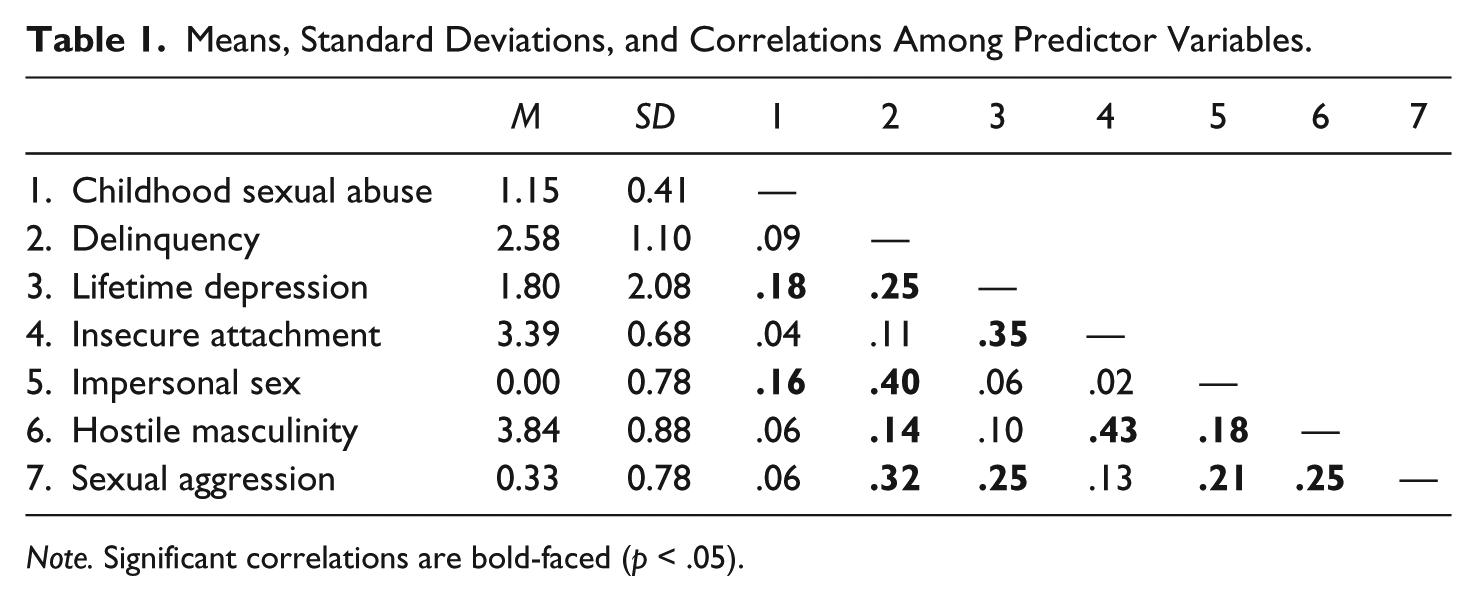
Note. Significant correlations are bold-faced (p < .05).
Path Analyses
The proposed path model was evaluated using Mplus 3.0 (Muthen & Muthen, 2004). Maximum likelihood estimation was selected because it is robust to violations of normality (Chou & Bentler, 1995). Model fit was assessed with several absolute and incremental fit indices, including chi-square statistics, root mean square error of approximation (RMSEA), and the comparative fit index (CFI; Bentler, 1990; Bentler & Bonett, 1980; Bollen, 1989; Browne & Cudeck, 1993). Although a nonsignificant chi-square value demonstrates that the model fits well, it is dependent on sample size, and significant values are often accepted if other indicators of fit are good. RMSEA values less than .08 and CFI values more than .90 indicate a good fit (Browne & Cudeck, 1993; Hoyle, 1995).The hypothesized path model was tested such that paths not represented by lines in Figure 1 were not estimated. This model did not fit the data well, χ2(7, 193) = 15.41, p < .05; RMSEA = .079; CFI = .94. Overall, three hypothesized paths were not significant and were removed from the model including the path from attachment insecurity to impersonal sex and the paths from CSA to both delinquency and attachment insecurity. The correlation between delinquency and attachment insecurity was marginally significant (p = .073) as was the path from delinquency to hostile masculinity (p = .069). These paths were left in the model.
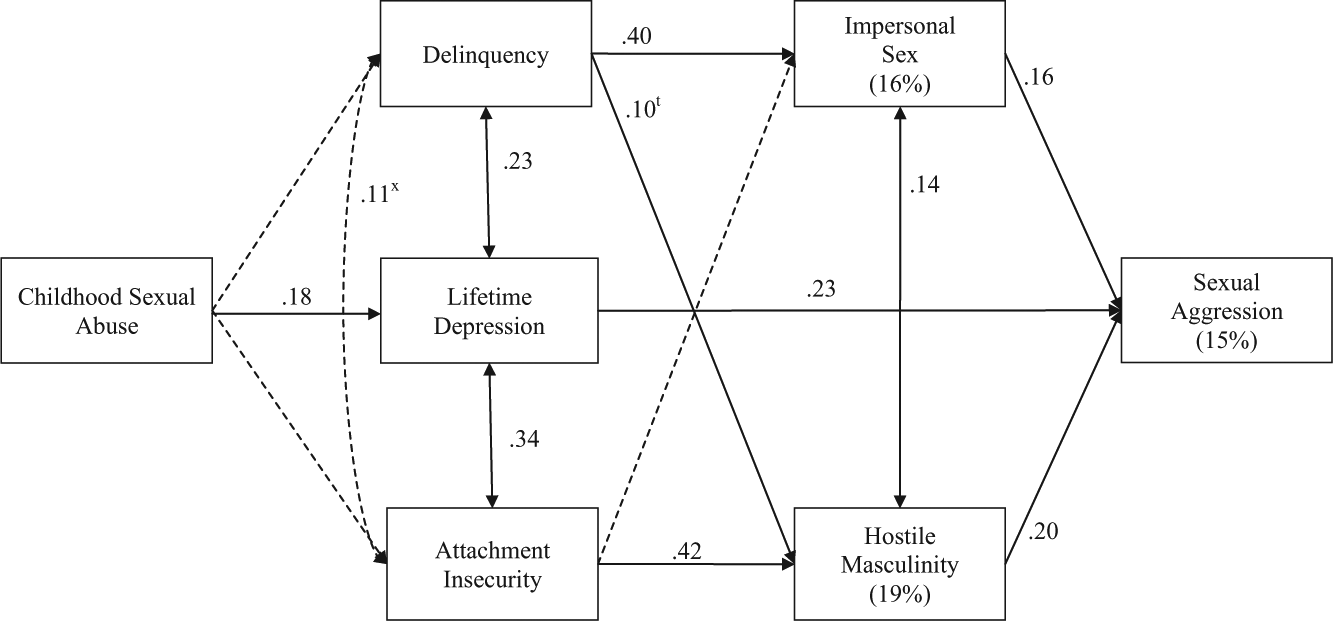
Hypothesized model.
The final path model can be seen in Figure 2. This model fit well, χ2(10, 193) = 17.27, p = ns; RMSEA = .061; CFI = .95. Overall, the basis of the confluence model was replicated such that delinquency was positively related to impersonal sex, marginally positively related to hostile masculinity, whereas both impersonal sex and hostile masculinity were positively related to sexual aggression. Although CSA was not directly related to delinquency or attachment insecurity as hypothesized, it was positively related to depression. Depression, in turn, was directly related to sexual aggression and was correlated with both delinquency and attachment insecurity. Finally, attachment insecurity was positively related to hostile masculinity.
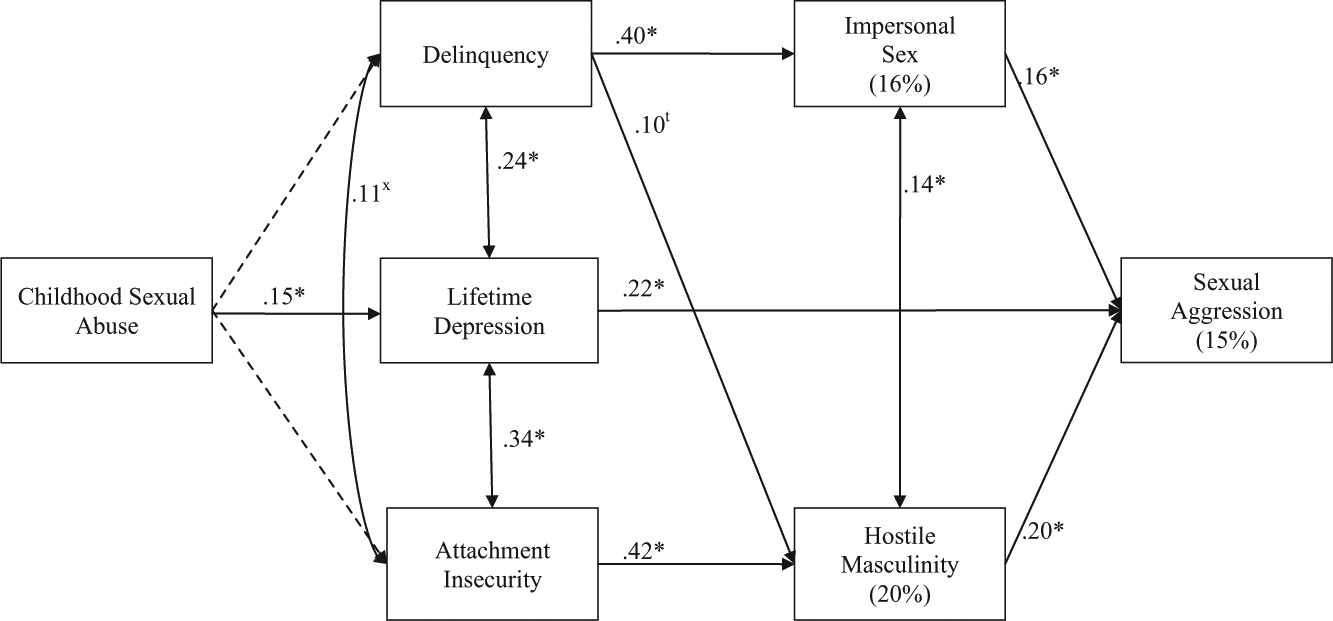
Final model.
Discussion
The purpose of the present study was to examine the role of attachment insecurity and depression in sexual aggression within the framework of the confluence model of sexual assault perpetration. Due to the robustness of the model and findings from past studies that have linked attachment and depression characteristics to variables that are related to the more traditional constructs of the confluence model, we predicted that our variables would contribute to explaining sexual aggression when tested within the framework of the model. Path analysis was used to determine the fit of our hypothesized model.
We first hypothesized that the traditional confluence model constructs would follow the same pathways originally proposed by Malamuth et al. (1991). Contrary to our prediction, CSA did not demonstrate a direct relationship with delinquency; however, the other constructs demonstrated relationships consistent with our hypothesis. Delinquency displayed a positive relationship with both hostile masculinity and impersonal sex, whereas hostile masculinity and impersonal sex displayed positive relationships with each other. Both were also positively related to the severity of sexual assault perpetrated. In other words, men who have higher degrees of cynical, domineering, and hostile attitudes concerning women, and higher degrees of emotional detachment within sexual relationships, perpetrate more severe forms of sexual assault. These predictive characteristics are preceded by engaging in delinquent behaviors and experiencing abuse during childhood.
Also consistent with our hypotheses, the addition of attachment insecurity and depression within the framework of the model produced an overall good model fit. As predicted, CSA displayed a positive relationship with the number of affective episodes experienced, which in turn was positively related to delinquency and attachment insecurity. The number of affective episodes experienced was also positively related to the severity of sexual assault perpetrated. Our depression variable’s positive relationships with both CSA and delinquency provide a possible explanation for the absence of a direct pathway between CSA and delinquency. Our data suggest that depression may mediate the CSA to delinquency pathway proposed in Malamuth’s original model. This suggestion is supported by the Kofler et al. (2011) finding that experiences with early depression is a significant predictor of later delinquency. It is therefore plausible to speculate that experiencing CSA increases the individual’s susceptibility for experiencing depression throughout childhood and adolescence, and such experiences would later lead the individual to engage in delinquent behaviors (Fergusson et al., 1996; Kofler et al., 2011). Although this explanation may contribute to clarifying the process by which CSA leads to delinquency, a degree of caution is warranted when making such conclusions with our data because our measurement of depression does not allow for the determination of whether depression preceded or followed delinquency. Future research investigating childhood depression and later depression separately is needed for formal conclusions to be made concerning the possible mediational effects of early depression.
The positive relationship between depression and sexual aggression indicates that men who experience higher rates of affective episodes perpetrate more severe forms of sexual assault. Rather than concluding that depression independently increases sexual aggression, we propose that the direct pathway between depression and perpetration severity in our model may be mediated by constructs that were not assessed in the present study. For example, it has been shown that depression is associated with a decreased ability to regulate emotional responses to a negative event (Teasdale, 1988). More specifically, depressed individuals exhibit difficulties with inhibiting the processing of negative thoughts, and are more likely to ruminate on negative states (Joorman & Gotlib, 2010). Deficiencies in emotion regulation have also been linked to aggression. Individuals who have difficulties regulating emotional states are more likely to behave aggressively in an attempt to alleviate or avoid discomfort resulting from the experience of a negative event (Roberton, Daffern, & Bucks, 2012). Furthermore, angry rumination is associated with violence, aggression, and vengeful behavior (Barnett, 2011). Finally, it has been reported that the dysregulation of emotional states is a pertinent characteristic of sexual offenders (Gillespie, Mitchell, Fisher, & Beech, 2012). It is possible that the individuals in our sample who have experienced higher rates of depression may also experience higher degrees of emotion dysregulation. Emotional dysregulation may then contribute to the use of aggression to alleviate the negative state the individual may experience on being rejected from sexual activity, and thus perpetrate sexual assault.
It is also plausible to speculate that the depression to sexual aggression pathway may be mediated by deficiencies in emotion recognition. Research has shown that depressed individuals display deficiencies in ability to recognize facial emotional cues (Demenescu, Kortekaas, Boer, & Aleman, 2010; Persad & Polivy, 1993; Surguladze et al., 2004; Tse & Bond, 2004). It has also been shown that sex offenders generally display deficiencies in recognizing facial emotional cues and are more likely to misinterpret a woman’s display of negative moods during intimate interactions (Hudson, Marshall, McDonald, Bakker, & McLean, 1993; Lipton, McDonel, & McFall, 1987). This suggests that depression may contribute to sexual aggression by increasing an individual’s propensity to misperceive women’s intentions, which may then lead them to proceed with unwanted sexual advances.
Although the mediating effects of emotion regulation and emotion recognition provide possible explanations to support the depression to sexual aggression pathway observed in our model, we cannot make formal conclusions about such relationships using our present sample. Future research should further explore the role of depression in sexual aggression by investigating the proposed mediating variables as well as other constructs associated with depression such as anxiety and alcohol use (Kessler et al., 1994).
Our hypotheses concerning attachment insecurity were also partly supported. We hypothesized that CSA would demonstrate a positive relationship with attachment insecurity, which would then demonstrate positive relationships with depression, hostile masculinity, and impersonal sex. Contrary to one of our hypotheses, a direct pathway from CSA to attachment insecurity was not found. Being that attachment insecurity and depression are closely related, it is possible that depression may again serve as a mediating variable (Allen, Porter, McFarland, McElhaney, & Marsh, 2007). The positive relationship between attachment insecurity and depression also suggests that attachment insecurity may contribute to sexual aggression by increasing the likelihood of experiencing depressive episodes. This possible relationship is supported by longitudinal studies that have evidenced that poor attachment during early childhood is associated with the development of depression later in life (Carlson, 1998; Duggal, Carlson, Sroufe, & Egeland, 2001).
Supporting one of our hypothesized pathways, attachment insecurity was positively related to hostile masculinity. As discussed earlier, insecurely attached men’s increase in hostile attitudes toward women may be attributable to repeated failures to sustain intimate relationships, as well as to consequent experiences with chronic loneliness (Feeney & Noller, 1990; Main et al., 1985; Marshall, 1993). Attachment insecurity, however, did not demonstrate a relationship with impersonal sex. Although this does not follow our originally hypothesized model, there are several explanations for the absent relationship. As discussed earlier, past studies that have linked attachment insecurity to behaviors associated with the impersonal sex pathway have done so specifically through the avoidant attachment orientation (Brennan & Shaver, 1995; Gentzler & Kerns, 2004; Paul et al., 2000). In the present study, we combined attachment avoidance and attachment anxiety together to assess attachment insecurity in general. It is possible that the lack of a supported relationship between attachment anxiety and impersonal sexual behavior may have nullified any relationship that would have been demonstrated by attachment avoidance, had it have been assessed separately. Future investigations should take a more specific approach and examine attachment avoidance in particular within the framework of the model.
Due to some limitations, caution is warranted when interpreting the findings of our present study. First, our measure of past experiences with depression was dependent on our participants acquiring a cognitive template after answering questions concerning their most recent experience with an affective episode. The cognitive template was intended to aid in the recall of previous experiences with similar episodes. Although Surtees et al. (2000) found that major depressive disorder prevalence estimated using this method is comparable with that obtained by interview, there are some limitations. For example, it would be of greater difficulty to recall experiences with affective episodes from earlier stages of life than it would be to recall more recently experienced episodes. This limitation may have an effect on the accuracy of reporting episodes experienced as participants delve farther into the past. In addition, the most recent experience with an affective episode that participants initially described followed the criteria of lasting for a period of 2 weeks or more. Reported episodes may therefore last for as short as 2 weeks to periods of time that may be much longer lasting in duration. Thus, the severity of episodes reported may vary greatly across participants. This measure of depression also did not allow for the determination of onset and offset timings of individually reported episodes. Due to this, we cannot conclude whether depression more so preceded or followed the development of attachment insecurity, engagement in delinquent behaviors, and perpetration of a sexual assault. Although these limitations limit our conclusions on the role of depression in sexual aggression concerning timing, we are able to conclude more general relationships between depression and our model constructs. According to our data, depression is indeed positively related to CSA, attachment insecurity, delinquency, and perpetration severity. These findings provide a basis for future studies to further investigate depression as a predictor of sexual aggression. Future investigations may seek to assess the timing of depressive episodes as well as the timing of incidents of sexual assault perpetration. Future research may also seek to explore variables that are associated with depression such as emotion regulation, emotion recognition, anxiety, and alcohol use.
The small size of perpetration severity subgroups in our sample also warrants caution when interpreting our findings. Although the number of participants in our overall sample is adequate, the number of participants who reported having perpetrated some form of sexual aggression is relatively small, thus posing a threat to the credibility of our findings concerning sexual aggression (Schreiber, Stage, King, Nora, & Barlow, 2006). Future research should seek to replicate our findings with the inclusion of more perpetrators and nonperpetrators alike. The inclusion of more perpetrators would especially be beneficial because it may allow for the analyses to be conducted with larger perpetration severity subgroups, as well as allow for the investigation of a wider range in severity of sexual assault perpetrated. More accurate conclusions concerning the strength of our model’s pathways may then be derived. The present study is also limited by the absence of a measure of social desirability responding. A recent study reported that self-report measurements on sexual aggression are affected by social desirability responding; however, the authors also concluded that the impact of social desirability on such measures is much smaller than what was expected (Mathie & Wakeling, 2011). Future directions may benefit from the inclusion of a measurement for social desirability responding.
In conclusion, the results from the present study provide evidence supporting the involvement of attachment and depression in sexual aggression. The addition of the two variables as predictors of sexual aggression within the framework of the confluence model produced an overall good model fit, and therefore contributes to elucidating the process by which certain men become susceptible to perpetrating sexual assault. Although weaknesses in our measurements limit our conclusions, our findings contribute to identifying variables that are characteristic of sexual offenders, and may therefore aid in the development of strategies to identify men who are vulnerable to perpetration, and to prevent sexual aggression. Our findings also contribute to identifying important directions for future research on sexual aggression. The continued study of sexual aggression is of great importance because it will allow for the development of prevention and intervention programs that may effectively contribute to preventing sexual aggression, as well as reducing repeat sexual offending.
Footnotes
Acknowledgements
Thanks to Dr. Scott Pickett for his comments on an earlier draft of this article.
Declaration of Conflicting Interests
The author(s) declared no potential conflicts of interest with respect to the research, authorship, and/or publication of this article.
Funding
The author(s) disclosed receipt of the following financial support for the research, authorship, and/or publication of this article: This research was supported by funds provided by the Undergraduate Research Endowment from the Oakland University Department of Psychology to the first author.