







Abstract
This study presents the Sex Trafficking Attitudes Scale (STAS), assessing cognitive, behavioral, and affective attitudes toward the sex trafficking of women and girls. Across two studies, exploratory and confirmatory factor analyses revealed and confirmed six subscales: (a) Knowledge About Sex Trafficking, (b) Awareness of Sex Trafficking, (c) Attitudes Toward Ability to Leave Sex Trafficking, (d) Attitudes Toward Helping Survivors, (e) Empathic Reactions Toward Sex Trafficking, and (f) Efficacy to Reduce Sex Trafficking. Results showed support for convergent validity as the subscales were associated with related measures. The STAS holds promise to expand research and inform efforts to support trafficking survivors.
Human trafficking is a form of modern-day slavery that continues to be a pervasive social problem. Although it is difficult to determine the exact extent of this complex and multifaceted social problem, some research suggests that at least 800,000 women, men, and children are trafficked annually (American Psychological Association [APA], 2010). Moreover, some scholars rank human trafficking as the third largest organized crime in the world, following drugs and arms trafficking (United Nations on Drugs and Crime, 2006). Although there are various definitions of trafficking, in this study we follow the Trafficking Victims Protection Act (2000), which defines human trafficking as the exploitation of a person for the purpose of labor (i.e., debt bondage or involuntary domestic servitude) or a commercial sex act (i.e., sex trafficking) through the use of force, fraud, or coercion, or when any person under the age of 18 is involved in a commercial sex act (U.S. Department of State, 2010). While there are many forms of human trafficking that affect both genders, sex trafficking is a gendered social problem that disproportionately affects women and children (APA, 2010). To date, the predominance of research on sex trafficking focuses on women and girls who survive sex trafficking (e.g., APA, 2010; Deb, Mukherjee, & Mathews, 2011). Although survivor-focused research is important, research also is needed to understand public perceptions of sex trafficking as it is the public who holds the power to support programs and policies to reduce sex trafficking (APA, 2010; Deb et al., 2011). Much of the recent research on perceptions of sex trafficking has been international in focus and qualitative in nature (Buckley, 2009; Farmer, 2010; Herzog, 2008; Okonofua, Ogbomwan, Alutu, Kufre, & Eghosa, 2004; Pajnik, 2010; Tverdova, 2011). Although this research is important and sheds light on sex trafficking, we are unaware of any validated scales assessing attitudes toward sex trafficking. Such a scale is needed to accelerate research on public perceptions and to inform interventions and community campaigns to increase awareness and action to stop sex trafficking.
In this study, we provide an initial validation of a multidimensional scale to assess sex trafficking attitudes. We followed the tripartite model of attitude assessment that considers attitudes as cognitive (i.e., beliefs, knowledge, and perceptions), behavioral (i.e., overt action or intentions for action), and affective (i.e., emotional responses; Breckler, 1984). Examining these attitudes is important because (a) a lack of knowledge and awareness may serve as barriers to building public support for implementing change, (b) certain victim-blaming attitudes toward survivors may impede support for programs and policies to aid survivors, and (c) specific behavioral attitudes and emotional responses may reveal other pathways that increase support and action. Overall, this scale fills a gap in the literature, provides a new tool to accelerate research on public attitudes toward sex trafficking, and ultimately may inform or be used to test the effectiveness of interventions and community campaigns to increase awareness and action to reduce trafficking. We now discuss the rationale for the subscales for cognitive, behavioral, and affective attitudes.
Cognitive Dimensions of Sex Trafficking Attitudes
Cognitive attitudes focus on knowledge, awareness, and perceptions of the topic of interest (Breckler, 1984). In regard to sex trafficking, assessing knowledge is important as some people may lack a basic understanding of sex trafficking and may not comprehend the complexity and widespread nature of this social problem. Certainly many people know about sex trafficking, but may not be aware of ongoing efforts to bring sex trafficking to an end. Furthermore, research suggests that human trafficking is often confused with smuggling and illegal immigration (Buckley, 2009; Farmer, 2010). Some scholars believe that misperceptions, like conflating human trafficking with illegal immigration, are the direct result of the media’s often simplistic and sensationalistic portrayals of the issue (Pajnik, 2010; Sanghera, 2005). Thus, in this study, we sought to assess individuals’ factual knowledge about sex trafficking and awareness of the issue and campaigns to stop sex trafficking.
Another cognitive attitude regarding sex trafficking is the perception of its geographic location. Specifically, do people believe that sex trafficking happens only in other countries, or in the United States as well? The perception that sex trafficking “doesn’t happen here” or that it only involves racially or ethnically different foreigners is a problematic misperception that can potentially inhibit support and services for survivors (APA, 2010; Pajnik, 2010; Todres, 2009). In reality, trafficking is more complex than this simplistic understanding, affecting many different demographic groups both in the United States and abroad. By not acknowledging this complexity, policies and programs may be ill-equipped to support trafficking survivors.
Moreover, what people believe about a woman’s ability to leave sex trafficking may shape how they choose to respond to survivors and whether they support certain types of public policies. For example, many individuals do not understand why a trafficked woman does not simply leave her circumstances. Indeed, research shows that victims of sex trafficking often are blamed for their engagement in sex work (APA, 2010; Herzog, 2008). Sadly, women are subject to what Herzog (2008) calls “whore stigma,” where trafficked persons are viewed as prostitutes. However, it should be remembered that trafficked women are often subjected to continual violence (e.g., repeated rapes, physical violence, threats of violence), isolated from others, and trained to fear police and other authorities (Cianciarulo, 2008) which effectively discourages help seeking (APA, 2010; Herzog, 2008). Thus, assessing perceptions of a woman’s ability to leave sex trafficking is critical, as erroneous beliefs may contribute to victim-blaming or unempathic responses to trafficking.
Behavioral Dimensions of Sex Trafficking Attitudes
Behavioral attitudes encompass not only overt action but also intentions regarding what types of action would be appropriate and effective. Literature on sex trafficking indicates that different attitudes exist regarding what should be done to support survivors, including whether others should take control of the situation or whether survivors should be empowered to make choices in their “best interest” (Pajnik, 2010). Often, a paternalistic “savior” mentality underlies many well-intentioned efforts to help sex trafficking survivors (Todres, 2009), reflected in outsiders believing they know what is best for survivors instead of trusting survivors to make their own decisions (Todres, 2009). This savior mentality may arise from the media’s portrayal of survivors as powerless victims and “damsels in distress,” and not as whole, able persons. For example, some believe that the best thing to do is to simply return survivors back to their home countries, but this “solution” ignores that many sex trafficking victims in the United States also are U.S. citizens. In either case, the proposed fix fails to consider the structural barrier of poverty, denial of education, or dysfunctional family life that may create a vulnerability to being trafficked in the first place (Pajnik, 2010; Todres, 2009).
A second behavioral component involves a sense of efficacy or how effective people believe their own actions would be in actually helping survivors and reducing their numbers. Measuring efficacy is important because even with knowledge about sex trafficking, awareness of antitrafficking campaigns, and understanding the complexities of a woman’s ability to leave, people still may not know what to do to help reduce trafficking. In other research on racial justice, Stewart, Latu, Branscombe, and Denney (2010) found that students with a greater sense of racial justice efficacy had an increase in antidiscrimination behaviors, concluding that self-efficacy may be a key component for awareness to translate into action. Indeed, qualitative research indicates that many people simply do not know how to help when it comes to sex trafficking, or may feel powerless to help as they believe, whether true or not, that they would be working against a large and organized crime (Buckley, 2009). Thus, examining efficacy to reduce trafficking is important and will open doors in future research to understand how efficacy predicts other intentions to help and what avenues people know about and utilize to support survivors (Herzog, 2008; Tverdova, 2011).
Affective Dimension of Sex Trafficking Attitudes
Affective attitudes are emotional responses to beliefs and behaviors. Emotional and empathic reactions to violence against women show that less empathic reactions toward sexual and interpersonal violence predict a more negative attitude toward those engaged in sex work, greater rape myth acceptance, and greater victim-blaming behaviors toward rape survivors (Burt, 1980; Campbell, 2008; Farley, Macleod, Anderson, & Golding, 2011). Moreover, Campbell (2008) notes that empathy is a key factor in how medical, mental health, and judicial personnel respond to rape survivors with either support or blame and disbelief. Indeed, research on support for domestic violence public policies shows that people who are more empathic are more likely to support survivor-focused solutions (Gault & Sabini, 2000); thus, it is likely that emotional responses to another type of violence against women, sex trafficking, may predict support for policies. Overall, empathic reactions may be a key component to how people respond to sex trafficking.
Conceptual and qualitative research reveal a range of emotional responses to sex trafficking, which may be linked to awareness of sex trafficking and other attitudes toward survivors (Farmer, 2010; Pajnik, 2010; Tverdova, 2011). For example, some people feel that sex trafficking is a form of cruelty, but not particularly prevalent and thus not a great reason for concern or action (Farmer, 2010). Others view trafficking as a major issue and feel overwhelmed and sorry for those who have been trafficked (Buckley, 2009). In short, emotional responses to trafficking (e.g., sympathy, anger, being upset) appear to be related to support (or not) for trafficked persons or for policies designed to reduce sex trafficking.
Present Study
In the present study, we present a multidimensional scale, the Sex Trafficking Attitudes Scale (STAS), to assess cognitive, behavioral, and affective attitudes toward sex trafficking of women and girls. To the best of our knowledge, this is the first scale to assess attitudes toward sex trafficking. Based on the literature, we proposed seven dimensions to capture different cognitive, behavioral, and affective attitudes toward both the issue of sex trafficking of women and girls and toward survivors, with higher scores indicating more desirable and well-informed attitudes. The cognitive dimensions focus on knowledge, awareness, perceptions of where trafficking occurs, and attitudes about a woman’s ability to leave. The behavioral dimensions assess attitudes toward helping survivors and efficacy to reduce sex trafficking, whereas the affective dimension assesses empathic reactions. Overall, this scale is a crucial first step in assessing attitudes toward the sex trafficking of women and girls.
We hypothesize that although distinct, the seven subscales will be correlated as cognitive, behavioral, and affective attitudes assess related constructs (Breckler, 1984). Moreover, we expect that men and women will differ in their attitudes and knowledge as previous research shows that women tend to have more informed attitudes about violence against women (e.g., attitudes toward intimate partner violence) than men (Flood & Pease, 2009). To examine convergent validity, we test associations among the STAS subscales and the related constructs of rape myths, attitudes toward prostitutes, and modern sexism. Based on previous research showing rape myths to predict other gender-related attitudes such as stereotyped sex roles, adversarial sexual beliefs, and a greater acceptance of interpersonal violence (Burt, 1980), we expect adherence to rape myths to predict less informed and less desirable attitudes toward sex trafficking (e.g., lower scores on knowledge, awareness, empathy; Cianciarulo, 2008; Cotton, Farley, & Baron, 2000). Moreover, research suggests a greater acceptance of myths about prostitutes, such as they are not able to be raped, are related to lower levels of empathy (Cotton et al., 2000; Farley et al., 2011). Thus, we hypothesize that negative attitudes toward prostitutes will predict lower scores on the STAS subscales as prostitution and sex trafficking may be related constructs due to their link to sex work (Buckley, 2009; Okonofua et al., 2004). Overall, we believe that greater acceptance of rape myths and more negative attitudes toward prostitutes will correlate with STAS subscales.
Moreover, we expect that modern sexism will correlate with STAS subscales. Modern sexism is the subtle and covert sexism that is built into society. Scales assessing modern sexism examine the acknowledgment or minimization of discrimination toward women and the need for structural change to address gender discrimination (Swim, Aikin, Hall, & Hunter, 1995). Previous research shows a link between modern sexism and traditional gender roles (Swim et al., 1995). This link is important as research shows egalitarian gender roles and an awareness of structural inequalities predict more positive attitudes toward and responses to survivors of rape and interpersonal violence (Burt, 1980; Flood & Pease, 2009; Swim et al., 1995). Thus, we hypothesize that greater acknowledgment of modern sexism will be related to more desirable and informed attitudes toward trafficked persons and less paternalistic methods of how to help survivors (Glick & Fiske, 1996; Herzog, 2008; Pajnik, 2010). Moreover, greater modern sexism may be linked to increased victim-blaming and less acknowledgment of how systemic inequalities can lead to and exacerbate a trafficked person’s circumstances (Okonofua et al., 2004). Thus, we hypothesize that lower modern sexism will be associated with less paternalistic attitudes toward helping and a more informed attitude about one’s ability to leave sex trafficking.
General Method
Initial Scale Construction
To identify relevant dimensions, we reviewed the literature on attitudes toward sex trafficking as well as compiled a list of common misperceptions about the sex trafficking of women and girls (e.g., Pajnik, 2010). This review resulted in the identification of seven dimensions. We then categorized each dimension within the tripartite model of attitudes. The first and second author then collaborated to clarify, distinguish, and crystallize each dimension in a short written definition including what high and low scores represented. For cognitive attitudes, the Knowledge About Sex Trafficking dimension assesses knowledge of the definition of trafficking. For a standard definition of sex trafficking, we used the Trafficking Victim’s Protection Act and defined sex trafficking as when an individual engages in a commercial sex act as a result of force, fraud, or coercion or when someone under the age of 18 engages in a commercial sex act. The Awareness of Sex Trafficking dimension assesses self-reported awareness of sex trafficking and the different mediums through which they learned about trafficking (e.g., the news, organizations, reading material). The International Versus Domestic Recognition of Sex Trafficking dimension assesses whether an individual believes sex trafficking occurs predominately internationally or also in the United States. The Attitudes Toward Ability to Leave Sex Trafficking dimension assesses beliefs about a trafficked woman or girl’s level of choice in regard to being trafficked into sex work and her ability to leave. For behavioral attitudes, the dimension of Attitudes Toward Helping Survivors assesses paternalistic attitudes regarding how to help those who have been trafficked. We modified items from a paternalism scale, originally developed for parental caregiving styles, to capture a paternalistic savior mentality to helping sex trafficking survivors (Cicirelli, 1990). The Efficacy to Reduce Sex Trafficking dimension assesses beliefs about one’s capacity to work and advocate for those who have been trafficked and to reduce sex trafficking more generally. Finally, for affective attitudes, the Empathic Reactions Toward Sex Trafficking dimension assesses emotional responses to trafficking such as sadness, anger, empathy, compassion, and sympathy.
After the first two authors achieved consensus on the dimensions, the first author drafted 55 items to assess the seven dimensions with at least six to eight items written per dimension. The first author wrote the items informed by various misperceptions identified in the literature (e.g., Buckley, 2009; Farmer, 2010; Pajnik, 2010) and from the author’s discussions with a community organization working to end human trafficking. Items were edited for clarity and content by the second author. Next, the third author, an expert in women and gender studies, provided feedback on the items resulting in another round of revisions. Because items were to be administered to an undergraduate sample, we then pilot tested the items with 42 undergraduate students in a psychology research methods course who received extra credit for providing feedback on the survey items. The goal was to ensure that items were clear and relevant for a college sample. To gather feedback, we used an online survey where students were first asked to give a numeric response to a set of items and then prompted to provide general free-response feedback about the set of items for each dimension. Feedback was reviewed and items were edited for clarity to create the initial Sex Trafficking Attitudes Scale–Preliminary (STAS-P).
Participants and Procedures
A total of 601 students participated through an online participant pool system and received course credit. All participants were students from the psychology participant pool at DePaul University. Participants were presented with and gave informed consent before beginning the survey. All participants completed all study surveys. We then randomly split the sample for Study 1 (n = 301) and Study 2 (n = 300). Students in Study 1 were excluded from Study 2. In Study 1, we conducted an exploratory factor analysis (EFA) and in Study 2 conducted a confirmatory factor analysis (CFA) as well as examined convergent validity.
Study 1: EFA
Method
Participants
Participants consisted of 301 students. The mean age was 20.07 years (SD = 2.88) and 71.4% were women. Participants identified as White (62.5%), African American/Black (8.3%), Asian/Pacific Islander (7.6%), Hispanic/Latino/a (12.3%), Biracial or Multiracial (6.6%), and Other (2.7%). Within this sample, 38.5% were in their first year of college, 28.6% second year, 23.6% third year, 7% fourth year, and 2% fifth year or beyond.
Measures
Participants completed the STAS-P and scales for convergent validity. We describe and report convergent validity in Study 2 and only describe measures for Study 1 below.
STAS-P
The 55-item STAS-P uses a Likert-type scale ranging from 1 (strongly disagree) to 6 (strongly agree). These 55 items comprised seven subscales as follows: Knowledge About Sex Trafficking (six items, for example, “A person is trafficked when someone uses fraud to employ her in the sex industry”), Attitudes Toward Ability to Leave Sex Trafficking (11 items, for example, “Trafficked persons are unable to leave their circumstances”), Awareness of Sex Trafficking (10 items, for example, “I have read about sex trafficking”), Attitudes Toward Helping Survivors (seven items, for example, “Even if a trafficked person objects, an outsider should do whatever they think is best for the trafficked individual in the long run” [reverse coded]), International Versus Domestic Recognition of Trafficking (five items, for example, “Trafficking happens all across the globe”), Empathic Reactions to Sex Trafficking (nine items, for example, “I become emotional thinking about trafficking”), and Efficacy to Reduce Sex Trafficking (nine items, for example, “I can make a difference for trafficked persons”). To administer the scale, the Knowledge About Sex Trafficking and Attitudes Toward Ability to Leave Sex Trafficking scales are presented first so participants can report their knowledge and attitudes toward survivors’ ability to leave before being given a formal definition of what constitutes sex trafficking. Directions for the knowledge section ask participants to state their agreement with the following statements about trafficking. Directions for the attitudes toward survivor’s ability to leave section ask participants to think of a trafficked individual’s ability to leave her circumstances and indicate their level of agreement with the following statements. Research notes many misperceptions as to what constitutes sex trafficking and that there may be competing definitions (Buckley, 2009). Thus, after the Knowledge and Attitudes Toward Ability to Leave Sex Trafficking scales, the directions present the following definition of sex trafficking to participants:
The U.S. government defines sex trafficking as a form of human trafficking where “a commercial sex act is induced by force, fraud, or coercion, or in which the person induced to perform such act has not attained 18 years of age. (U.S. Department of State, 2010)
Instructions then ask participants to use this definition when completing the remainder of the subscales. See Table 1 for the instructions. The remaining subscales are then presented in the following order with items randomized: Awareness of Sex Trafficking, Attitudes Toward Helping Survivors, International Versus Domestic, Empathic Reactions to Sex Trafficking, Efficacy to Reduce Sex Trafficking. Higher scores on each subscale indicate more desirable and well-informed attitudes toward sex trafficking.
Table of Exploratory and Confirmatory Factor Analysis: Loadings, Means, and Standard Deviations.

Note. Factors are presented in the order of amount of variance explained in the exploratory factor analysis. F1 = Attitudes Toward Ability to Leave Sex Trafficking; F2 = Efficacy to Reduce Sex Trafficking; F3 = Knowledge About Sex Trafficking; F4 = Empathic Reactions to Sex Trafficking; F5 = Attitudes Toward Helping; F6 = Awareness of Sex Trafficking; 6FM = six-factor model; 6FT = six-factor final trimmed model. (R) indicates the item is reverse coded.
Participants were provided with the following definition to answer items for these subscales: “There are many definitions of trafficking. For the rest of this study, we would like you to think of trafficking as it is defined by the U.S. government. The U.S. government defines sex trafficking as a form of human trafficking where ‘a commercial sex act is induced by force, fraud, or coercion, or in which the person induced to perform such act has not attained 18 years of age.’ Please keep this definition in mind as you respond to the rest of the survey about sex trafficking of women and girls.”
Results
EFA
We conducted an EFA to evaluate the factor structure of the STAS-P and determine which items to include in each subscale. We used a common factor analysis with principal axis factoring as this approach separates common variance from unique variance (Preacher & MacCallum, 2003). We first assessed the unrotated factor solution to determine whether there were highly correlated items (r > .80) and whether the data were acceptable to conduct an EFA. We found no highly correlated items (r > .80); the Kaiser–Meyer–Olkin (KMO) measure of sampling adequacy (.84) was adequate and the Bartlett’s test of sphericity was significant (p < .001), which indicated the data were acceptable for an EFA. However, we dropped four items from analysis because the individual measures of sampling adequacy of each of these items were below .60 (Tabachnick & Fidell, 2001). We then reran the unrotated EFA with the remaining 51 items and found improved model indices (KMO = .86; Bartlett’s test of sphericity, p < .001); thus, we used these 51 items in subsequent analyses. To determine the number of factors to request in the EFA, we used parallel analysis (Fabrigar, Wegener, MacCallum, & Strahan, 1999; Hayton, Allen, & Scarpello, 2004; Horn, 1965; O’Connor, 2000), the scree plot of extracted eigenvalues, the percentage of factor variance explained, and the theoretical model of seven factors (Fabrigar et al., 1999; Preacher & MacCallum, 2003). Scholars note parallel analysis, in combination with these other methods, is a good strategy to determine the number of factors to retain (Fabrigar et al., 1999; Hayton et al., 2004; O’Connor, 2000). However, parallel analysis may over-extract factors (Hayton et al., 2004), and indeed in the present study, parallel analysis suggested a nine-factor solution, whereas the other criteria (i.e., the scree plot and the amount of variance explained) suggested a three- or six-factor solution. Thus, based on theory and these criteria, we decided on a six-factor solution to not under or overfactor (Fabrigar et al., 1999).
Based on these initial analyses, we conducted an EFA requesting a six-factor solution. We used a Direct Oblimin rotation as we expected the factors to be correlated (Preacher & MacCallum, 2003). We retained items if individual factor loadings were greater than .45 and if item cross-loadings with other factors were below .35. Items that did not meet these criteria were dropped from further analyses (Worthington & Whittaker, 2006). Consequently, 33 items remained across the six factors. As shown in Table 1, these six factors corresponded with six of the seven originally proposed dimensions of sex trafficking. The six subscales are as follows: (a) Attitudes Toward Ability to Leave Sex Trafficking (18.15% variance explained), (b) Efficacy to Reduce Sex Trafficking (9.94% variance explained), (c) Knowledge About Sex Trafficking (4.58% variance explained), (d) Empathic Reactions Toward Sex Trafficking (4.05% variance explained), (e) Attitudes Toward Helping Survivors (3.56% variance explained), and (f) Awareness of Sex Trafficking (3.21% variance explained). The seventh subscale of International Versus Domestic Recognition of Sex Trafficking did not receive empirical support and is not considered in further analyses. Factor loadings, means, and standard deviations for these factors are displayed in Table 1. Estimates of internal consistency for these six subscales ranged from .75-.84; thus, these scales evidenced acceptable internal consistency.
Study 2: CFA
Method
Participants
Participants consisted of 300 students. The average age was 20.26 years (SD = 3.55) and 75.3% were women. Participants identified as White (57.3%), African American/Black (5.7%), Asian/Pacific Islander (7.3%), Hispanic/Latino/a (18.0%), Biracial or Multiracial (8.2%), and Other (3.0%). Within this sample, 43% were in their first year of college, 25.7% second year, 18.3% third year, 8.3% fourth year, and 4.3% fifth year or beyond.
Measures
Participants completed the same 55 items that were part of the preliminary STAS; however, in Study 2, we focus on the 33 items from the EFA. We also examine other related scales for convergent validity.
Sex trafficking attitudes
We used the 33 attitudes toward sex trafficking items determined by the EFA in Study 1. These items constitute six subscales as follows: Knowledge About Sex Trafficking (five items), Attitudes Toward Ability to Leave Sex Trafficking (seven items), Awareness of Sex Trafficking (six items), Attitudes Toward Helping Survivors (three items), Empathic Reactions to Sex Trafficking (five items), and Efficacy to Reduce Sex Trafficking (seven items). These subscales are presented in Table 1 under the 6FM column.
Rape myth acceptance
We used Burt’s (1980) 19-item scale to assess rape myth acceptance. This scale uses a Likert-type scale ranging from 1 (strongly disagree) to 6 (strongly agree). Higher scores indicate greater acceptance of rape myths, such as “in the majority of rapes, the victim is promiscuous or has a bad reputation.” Burt notes the acceptance of sex role stereotypes, interpersonal violence, and adversarial sexual beliefs all strongly relate to rape myth acceptance. Burt reports acceptable internal consistency of α = .88. In Study 2, internal consistency was acceptable: α = .90. For convergent validity, we expected a negative association between Rape Myth Acceptance and various subscales of the STAS, such that greater rape myth acceptance will be associated with lower scores on Knowledge About Sex Trafficking, Attitudes Toward Ability to Leave Sex Trafficking, Attitudes Toward Helping Survivors, and Empathic Reactions Toward Sex Trafficking subscales.
Modern sexism
We used the eight-item Modern Sexism scale to assess modern sexism (i.e., subtle and covert sexism that is built into culture and society; Swim et al., 1995). These items are on a Likert-type scale ranging from 1 (strongly disagree) to 6 (strongly agree). Higher scores indicate less acknowledgment of modern discrimination based on gender with items such as “discrimination against women is no longer a problem in the United States.” Swim and colleagues (1995) found that Modern Sexism was correlated with nonegalitarian gender roles, a protestant work ethic, and higher scores predicted an overestimation of the percentage of women in professions dominated by men. They report adequate internal consistency of α = .75. In Study 2, internal consistency was acceptable: α = .80. For convergent validity, we expected that higher scores on Modern Sexism will be related to lower scores on the Knowledge About Sex Trafficking, Attitudes Toward Ability to Leave Sex Trafficking, Attitudes Toward Helping Survivors, and Empathic Reactions Toward Sex Trafficking subscales.
Attitudes toward prostitutes
We used the 15-item Attitudes Toward Prostitutes scale to assess attitudes toward prostitution and people who are prostitutes (Levin & Peled, 2011). These items assess attitudes regarding whether prostitutes choose their occupation and whether prostitutes are viewed as violent, deviant persons with items such as “women choose to be prostitutes” and “most prostitutes are drug addicts.” This scale is on a Likert-type scale ranging from 1 (strongly disagree) to 6 (strongly agree). Higher scores indicate more negative attitudes toward prostitutes as deviant persons who choose prostitution. Levin and Peled (2011) found negative attitudes toward prostitutes were related to identifying prostitutes as socially deviant and the scale demonstrated acceptable internal consistency of α = .84. In Study 2, the internal consistency was acceptable: α = .72. We expected that negative attitudes toward prostitutes demonstrated by higher scores on the Attitudes Toward Prostitutes scale will be related to lower scores on the Knowledge About Sex Trafficking, Attitudes Toward Ability to Leave Sex Trafficking, Attitudes Toward Helping Survivors, and Empathic Reactions to Sex Trafficking subscales.
Social desirability
To assess social desirability, we used the Marlowe-Crowne Social Desirability Scale Form C (Reynolds, 1982). This scale presents 13 true-false items, such as “I sometimes feel resentful when I don’t get my way.” We used the average of the items to form a scale, with higher scores indicating greater social desirability. Reynolds notes the scale is associated with other social desirability scales and shows internal consistency of α = .76. In Study 2, α = .73. We expected no association between social desirability and STAS subscales.
Results
CFA
We performed a CFA to examine the viability of the six-factor structure of the STAS using the 33-items from the EFA. For the CFA, we used the Mplus program and a maximum-likelihood method of estimation. To analyze model fit, we examined the chi-square, comparative fit index (CFI), Tucker–Lewis Index (TLI), the root mean square error of approximation (RMSEA), and the standardized root mean square residual (SRMR). A nonsignificant chi-square, values above .95 for the CFI and TLI, values of .08 or less for the RMSEA, and values less than .10 for the SRMR indicate acceptable fit (Hu & Bentler, 1999). Because the chi-square indicator may be influenced by sample size (Hu & Bentler, 1999), we also used the ratio of chi-square/df and considered values less than 3 to indicate an adequate fitting model (Schermelleh-Engel, Moosbrugger, & Muller, 2003). These criteria indicated a 33-item six-factor model (6FM) was not an adequate fit to the data,
To test the 6FT model against competing models (Marten, 2005), we compared the 6FT model with a unidimensional model and a three-factor model (see Table 2 for all fit indices). We examined the three-factor model as a competing model as the EFA also indicated the plausibility of a three-factor solution. As reported in Table 2, the unidimensional model was not a good fit to the data; moreover, the 6FT model was a significantly better fitting model than the unidimensional model,
Study 2: Confirmatory Factor Analysis Goodness-of-Fit Summary (N = 300).
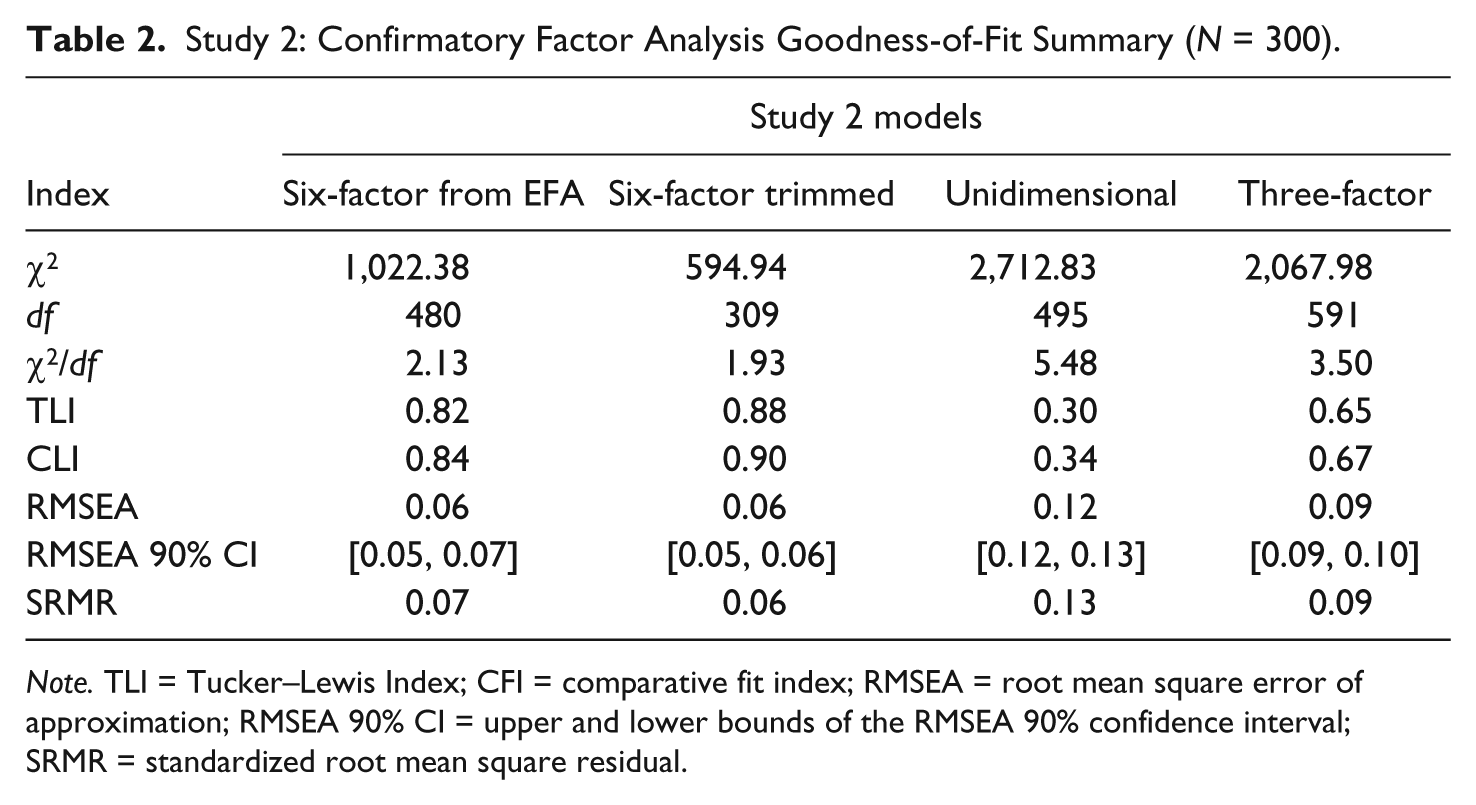
Note. TLI = Tucker–Lewis Index; CFI = comparative fit index; RMSEA = root mean square error of approximation; RMSEA 90% CI = upper and lower bounds of the RMSEA 90% confidence interval; SRMR = standardized root mean square residual.
Internal consistency and intercorrelations for the final STAS subscales
As reported in Table 1, the final, trimmed 27-item STAS contains the following six subscales: Knowledge About Sex Trafficking (four items; α = .79), Attitudes Toward Ability to Leave Sex Trafficking (five items; α = .82), Awareness of Sex Trafficking (five items; α = .75), Attitudes Toward Helping Survivors (three items; α = .80), Empathic Reactions Toward Trafficking (five items; α = .81), and Efficacy to Reduce Sex Trafficking (five items; α = .77). Thus, internal consistency was adequate across the STAS subscales. As expected, we found small to moderate intercorrelations among a few of the STAS subscales. As reported in Table 3, the strongest correlation was .36, indicating that although interrelated, each subscale represented a distinct attitude toward sex trafficking.
Intercorrelations of Study Scales and Convergent Validity.
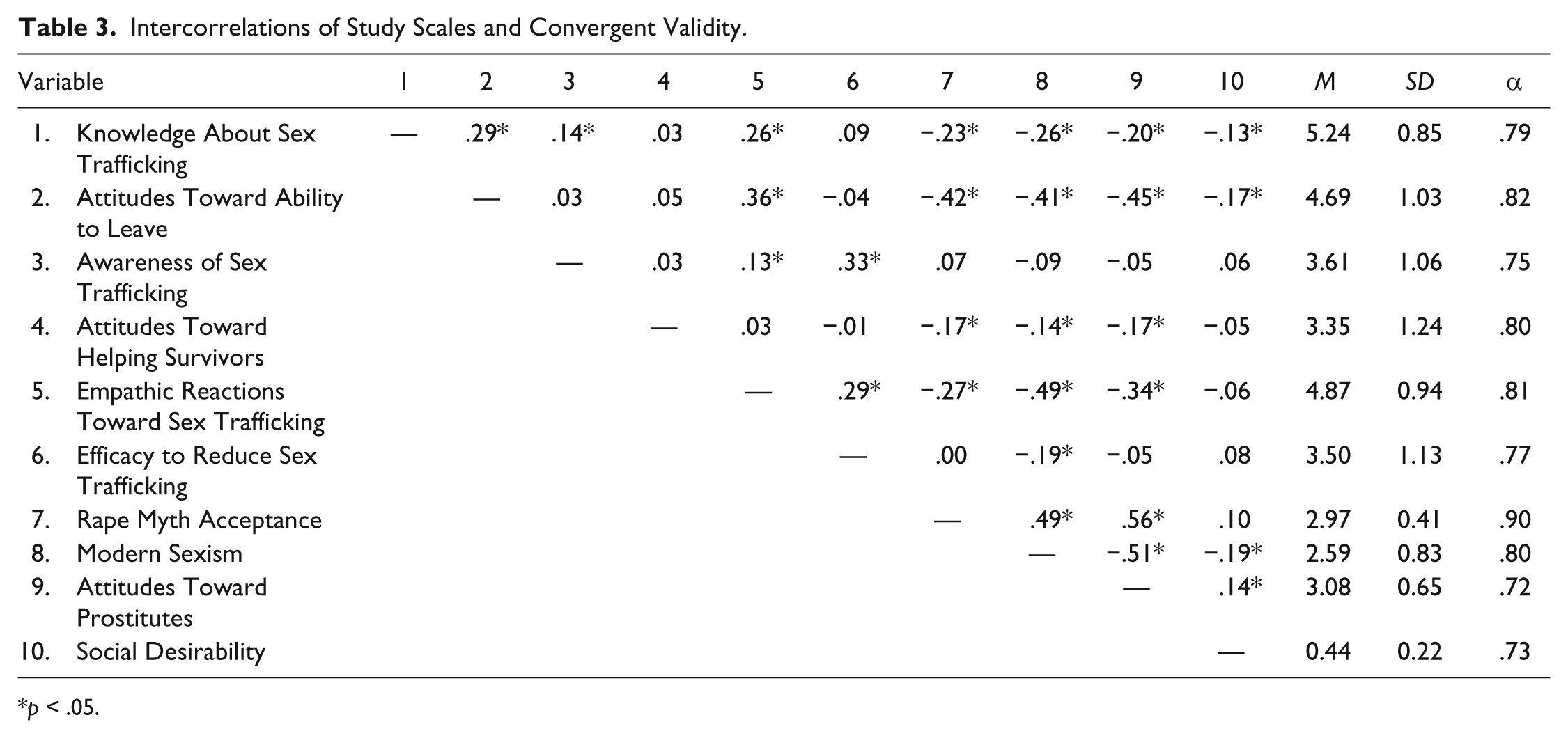
p < .05.
Gender differences
We examined gender differences by conducting a multivariate analysis of variance (MANOVA) where gender was the independent variable and the six sex trafficking subscales the dependent variables. The MANOVA indicated significant gender differences, Λ = .84, F(6, 292) = 9.49, p < .05. Next, using a Bonferonni corrected alpha level of .008 to control for Type I error for six pre-planned comparisons, follow-up tests showed gender differences for two subscales: (a) Attitudes Toward Ability to Leave Sex Trafficking where women had significantly higher scores (M = 4.83, SD = 0.99) than men (M = 4.37, SD = 1.08), and (b) Empathic Reactions to Sex Trafficking where women had significantly higher scores (M = 5.10, SD = 0.79) than men (M = 4.30, SD = 1.02). There were no significant gender differences for Knowledge About Sex trafficking, Awareness of Sex Trafficking, Attitudes Toward Helping Survivors, and Efficacy to Reduce Sex Trafficking. However, even though not significant, women had numerically higher mean scores on (a) Knowledge About Sex Trafficking (M = 5.32, SD = 0.80) than men (M = 5.06, SD = 0.94), (b) Awareness of Sex Trafficking (M = 3.67, SD = 1.05) than men (M = 3.47, SD = 1.07), (c) Attitudes Toward Helping Survivors (M = 3.42, SD = 1.29) than men (M = 3.17, SD = 1.12), and (d) Efficacy to Reduce Sex Trafficking (M = 3.56, SD = 1.13) than men (M = 3.34, SD = 1.10).
Convergent validity
For convergent validity, we report significant correlations, and for strength of effect we follow Cohen (1988) in considering correlations of .10 as small, .30 as moderate, and .50 as large. As hypothesized and reported in Table 3, for the Rape Myth Acceptance scale we found (a) a large negative association with Attitudes Toward Ability to Leave Sex Trafficking, (b) moderate negative correlations with Knowledge About Sex Trafficking and Empathic Reactions to Sex Trafficking, and (c) a small negative correlation with Attitudes Toward Helping Survivors. Also as expected, for modern sexism results showed (a) a large negative correlation with Empathic Reactions to Sex Trafficking, (b) moderate to large correlations with Knowledge About Sex Trafficking and Attitudes Toward Ability to Leave Sex Trafficking, and (c) small, negative correlations with Attitudes Toward Helping Survivors and Efficacy to Reduce Sex Trafficking. For attitudes toward prostitutes, as expected, we found (a) moderate to large negative correlations with the Attitudes Toward Ability to Leave Sex Trafficking and Empathic Reactions to Sex Trafficking and (b) small to moderate correlations with Attitudes Toward Helping Survivors and Knowledge About Sex Trafficking. Finally, for social desirability, there were two significant (but relatively small) negative correlations with Knowledge About Sex Trafficking (r = −.13) and Attitudes Toward Ability to Leave Sex Trafficking (r = −.17). Overall, results showed moderate to large correlations among related constructs and the STAS, and weak or nonsignificant associations with social desirability.
General Discussion
In this study, we presented psychometric evidence from across two studies with 601 students to support a preliminary validation of the STAS. Based on exploratory and confirmatory factor analyses, estimates of internal consistency, and convergent validity, we found support for six subscales of the STAS as follows: Knowledge About Sex Trafficking, Attitudes Toward Ability to Leave Sex Trafficking, Awareness of Sex Trafficking, Attitudes Toward Helping Survivors, Empathic Reactions Toward Sex Trafficking, and Efficacy to Reduce Sex Trafficking; however, we did not find support for the originally proposed International Versus Domestic Recognition subscale. Overall, the STAS extends research on sex trafficking by providing, to our knowledge, the first measure to assess sex trafficking attitudes. This scale holds promise for use in future research, interventions, and advocacy efforts to reduce trafficking and raise awareness. We now discuss intercorrelations of the STAS subscales, convergent validity, and limitations and suggestions for future research, concluding with potential uses of the STAS.
Intercorrelations Among STAS Subscales
The STAS is a multidimensional scale with six distinct, yet related subscales that assess cognitive, behavioral, and affective attitudes toward the sex trafficking of women and girls. We found correlations among the subscales indicating links across cognitive, behavioral, and affective dimensions. For instance, attitudes toward ability to leave sex trafficking, knowledge, awareness, and efficacy to reduce sex trafficking all were correlated with empathic reactions toward sex trafficking. This shows that affective responses to sex trafficking are intricately connected to what people know (i.e., cognitive attitudes) and what they believe they can do (i.e., behavioral attitudes) about the sex trafficking of women and girls. This finding is not surprising given the robust literature showing connections between affect and other types of attitudes (Russell, 2003); however, these correlations underscore the importance of developing empathic responses as this may be a pathway to increase knowledge and behavior to work against sex trafficking. Future research should examine the process of how these attitudes develop over time (e.g., does knowledge precede empathic reactions or vice versa), which may help inform which attitudes to target in interventions or community awareness campaigns.
Knowledge about sex trafficking was positively correlated with other cognitive dimensions such as attitudes about one’s ability to leave sex trafficking. This shows that greater knowledge is linked to an understanding that it may be very difficult for women and girls to leave their circumstances (i.e., higher scores on Attitudes Toward Ability to Leave Sex Trafficking). Given that women and girls often are blamed for being trafficked or not leaving (Herzog, 2008), perhaps greater knowledge contributes to a greater sensitivity to the complexities of trafficking and reduces victim-blaming. Moreover, knowledge was connected to awareness, a particularly interesting finding as knowledge was assessed before giving the definition of trafficking. Thus, people who are more aware of sex trafficking, whether it is in general or through organizations and the news, are more knowledgeable about the formal definition and have fewer misperceptions of trafficking.
Awareness also was associated with a sense of efficacy to reduce sex trafficking. It may be individuals who are more aware also know of organizations to partner with to reduce trafficking. Similar to research on the importance of racial efficacy (Stewart et al., 2010) and social justice efficacy (Miller et al., 2009), future research should assess what components of awareness are linked to efficacy and how both awareness and efficacy translate into actual behavior to reduce trafficking. For the STAS, the various subscales illuminate how the dimensions of the tripartite model of attitudes are interconnected, highlighting the need for strategically designed interventions to increase awareness and action to reduce trafficking.
Convergent Validity and the STAS
We found initial evidence for convergent validity as the STAS subscales were correlated in expected ways with related measures. As hypothesized and in line with Burt (1980), acceptance of rape myths was negatively related to other gender-related attitudes (i.e., knowledge about sex trafficking, attitudes toward survivor’s ability to leave, empathetic feelings about sex trafficking, and attitudes toward helping). This finding extends literature on violence against women, as there was a link between rape myths, negative attitudes toward prostitutes, and attitudes toward sex trafficking (i.e., lower knowledge and empathy, greater misperception of choice, and paternalistic attitudes toward helping). Indeed, research postulates that victim-blaming attitudes are related to the quality and type of services survivors of sexual violence receive from providers within the medical, legal, and mental health systems (Campbell, 2008). In light of this research, it may be that an acceptance of rape myths is related to less empathy and greater misperceptions of choice because people may not fully understand the complexity of trafficking and thus blame victims (Buckley, 2009; Farmer, 2010). Therefore, it is not surprising that views about violence against women were related to these particular STAS subscales.
We also found a negative attitude toward prostitutes to be associated with negative attitudes toward the sex trafficking of women and girls. We found negative views of prostitutes to be associated with (a) more negative attitudes toward trafficked women and girls, (b) lower levels of knowledge about sex trafficking, and (c) a stronger belief that trafficked women and girls choose to engage in sex work. These results are in line with past research showing lower empathy toward sex workers to be associated with a greater acceptance of both myths about and sexual violence toward sex workers (Burt, 1980; Cotton et al., 2000; Farley et al., 2011). Thus, the present study provides further evidence not only for the link between rape myths and prostitution myths but also for the link between attitudes toward sex trafficking and negative attitudes about women involved in sex work. Future research should examine attitudes toward sex trafficking, violence against women, and sex work to begin to formulate and assess the interventions to address negative attitudes toward sex workers and survivors of violence.
Modern sexism also was negatively associated with knowledge about sex trafficking, attitudes toward survivors’ ability to leave, attitudes toward helping, empathic reactions, and efficacy to reduce sex trafficking. Research notes greater modern sexism is linked to greater hostile sexist beliefs, and gender-related political attitudes (Glick & Fiske, 1996). Thus, the finding that lower levels of knowledge and awareness about sex trafficking were linked to greater covert sexism is particularly interesting provided that modern sexism is related to a more hostile view of women. Perhaps modern sexism is related to how one is aware of or seeks out proper information about violence against women, sex work, or sex trafficking. Furthermore, modern sexism was negatively associated with attitudes about how to help survivors, supporting the previous assertion that greater modern sexism was linked to more disempowering attitudes toward assisting survivors (Glick & Fiske, 1996). Thus, it appears that sexist attitudes toward women in general may translate into paternalistic and victim-blaming attitudes toward sex trafficking survivors.
In addition, attitudes toward survivors’ ability to leave were negatively correlated with modern sexism (i.e., failing to acknowledge the oppressive circumstances). A possible explanation for this link is that both modern sexism and a belief that women can easily leave trafficking fail to acknowledge the structural and oppressive barriers faced by women (i.e., gender discrimination) and survivors of sex trafficking (i.e., repeated sexual violence, threats of violence, continual isolation; APA, 2010; Herzog, 2008). Furthermore, modern sexism was negatively correlated with a sense of efficacy to reduce trafficking. Thus, the link between modern sexism and a denial of structural discrimination may indicate that individuals who score higher on modern sexism may not see the need for structural change to support survivors of sexual violence or those who have been trafficked (Campbell, 2008; Swim et al., 1995). Future research should assess helping attitudes and behaviors of individuals toward trafficking survivors, taking into account gender role stereotypes, sexism, and attitudes toward structural change.
Limitations and Directions for Future Research
Although the present study presents initial evidence and validation of a scale to assess attitudes toward sex trafficking of women and girls, it is not without limitations. First, we only focus on one type of trafficking (i.e., sex trafficking), which leaves many other forms of trafficking unexamined and may perpetuate a myopic focus on this one type of trafficking at the expense of examining other forms of trafficking (Pajnik, 2010). Moreover, we did not assess attitudes toward sex trafficking of men and boys or transgender individuals, which may be very different from those of women and girls, especially in light of the link between attitudes toward sex trafficking and views of gender discrimination. We hope future research will build on the present study to examine other forms of trafficking such as domestic servitude or bonded labor as well as focus on other populations such as men and boys or transgender individuals. Also, future studies should build upon the present scale to assess other important domains, as one scale cannot capture all domains related to attitudes toward sex trafficking.
Moreover, the generalizability of our findings is limited due to the demographics of our sample: predominately White and female college students from the Midwest. It is likely that attitudes of undergraduates are different from the general population. Moreover, the wording of at least one of our items, “I can address structural inequalities and barriers facing trafficked persons,” may use overly academic language. Future research should be conducted with greater incorporation of racial, ethnic, gender, age, and geographic diversity and also with community samples. Feedback from survivors on scale domains and items also should be incorporated. Longitudinal research also is needed to examine the development and progression of attitudes toward sex trafficking to understand what may shape attitude change over time. Indeed, a greater understanding of the development and progression of such attitudes toward sex trafficking may be integral to inform awareness campaigns, interventions, and advocacy programs to reduce sex trafficking and the stereotypes of trafficked persons.
Future research with the STAS may examine how attitudes toward the sex trafficking of women and girls may influence support for public policies, community interventions, and support of community-based antitrafficking organizations. Provided that attitudes about intimate partner violence are related to support for particular domestic violence policies (Gault & Sabini, 2000), the present study suggests attitudes toward sex trafficking are correlated to other pervasive beliefs (e.g., rape myth acceptance, modern sexism), which may also shape personal behavior and support for specific public policies. Thus, the STAS holds promise to inform future awareness and educational interventions, such as a pretest and posttest study designed to assess attitude change after participating in an educational intervention. Indeed, local organizations and psychologists may be interested in understanding the attitudes in a particular community (e.g., the community members and helping professionals), as these attitudes may be crucial to the effectiveness and success of community interventions, social services, and policies to respond to survivors and reduce sex trafficking (Gault & Sabini, 2000; Stewart et al., 2010). Through the use of measurement tools like the STAS, data can be collected, analyzed, and presented to community organizations and policy makers to inform advocacy actions and efforts. Overall, we hope the STAS provides researchers, organizations, and policy makers with a useful tool to gauge attitudes toward the sex trafficking of women and girls in an effort to reduce trafficking and better understand and support survivors of trafficking.
Footnotes
Declaration of Conflicting Interests
The author(s) declared no potential conflicts of interest with respect to the research, authorship, and/or publication of this article.
Funding
The author(s) received no financial support for the research, authorship, and/or publication of this article.