






Abstract
To examine the link between fraternity membership and sexual assault perpetration, we used an experimental design to assess the role of perceptions in an ambiguous sexual assault scenario. Undergraduates (N = 408) were randomly assigned to either an experimental group where the perpetrator is a fraternity member or a control group where no fraternity information is given. Males rated perpetrators as less guilty and victims as more culpable when the perpetrator was a fraternity member, suggesting that sexual violence may be reinforced among fraternity members as they are both more likely to perpetrate sexual assault and less likely to be blamed.
Sexual assault is a major problem on U.S. college campuses. Reports estimate that between 20 and 25% of college women in the United States are sexually assaulted during their time in college (Black et al., 2011; Cantor et al., 2015). Several researchers (e.g., Armstrong, Hamilton, & Sweeney, 2006; Burnett et al., 2009; Sanday, 1996) have argued that the social environment on college campuses creates and maintains a rape culture, or a culture in which male sexual violence against women is normalized and women are blamed for experiencing sexual assault (Herman, 1988). Evidence of rape culture can be seen in both the reporting and punishment rates for sexual assault. In a study of sexual assault on college campuses, Cantor and colleagues (2015) found that only 25.5% of women reported physically forced penetration to authorities and 5-7% reported sexual touching involving physical force or incapacitation. Among women who did not report, over half said they did not report because they believed the incident was not serious enough, and over one third believed nothing would be done if they did report (Cantor et al., 2015). Moreover, in 478 sanctions issued for sexual assault across 100 universities between 2012 and 2013, only 12% resulted in expulsions and 28% in suspensions (Anderson, 2014).
What factors allow rape culture to flourish? In their multilevel, integrative approach to campus sexual assault, Armstrong and colleagues (2006) argue that gender inequality is reproduced at both the individual and institutional levels, and this inequality contributes to rape culture. Social fraternities (i.e., organizations of male students, typically associated with parties and communal housing; DeSantis, 2007) are one example of the social structure of college campuses that contributes to rape culture. On the individual level, fraternity members consistently demonstrate greater acceptance and perpetration of sexual violence against women (Boeringer, 1996, 1999; Boeringer, Shehan, & Akers, 1991; Brown, Sumner, & Nocera, 2002; Franklin, Bouffard, & Pratt, 2012; Lackie & de Man, 1997; McMahon, 2010; Murnen & Kohlman, 2007). For example, Foubert, Newberry, and Tatum (2007) found that fraternity members were three times more likely to commit sexual assault than nonmembers. In their meta-analysis of 29 studies, Murnen and Kohlman (2007) found significant effects of fraternity membership on both acceptance and perpetration of sexual violence. On an institutional level, male privilege (and especially White male privilege) is reproduced through fraternity control of social spaces (Armstrong et al., 2006). For example, fraternities own houses near campus and use these houses to host parties with alcohol. Although sororities also have houses, most are not permitted to serve alcohol (National Panhellenic Conference, 2018).
To examine why fraternity membership contributes to sexual violence, researchers have studied elements of fraternity membership that contribute to sexual assault. For example, in her ethnography of fraternity culture, Peggy Sanday (2007) argues that men in fraternities use sexual assault of women as a way to assert their masculinity in the face of homosocial fraternity bonding rituals (e.g., watching porn together, group masturbation). In another study, Seabrook, Ward, and Giaccardi (2016) found that the pressure to uphold masculine gender norms (e.g., having several sexual partners, displaying dominance) explains the relation between fraternity membership and sexual aggression. These studies highlight the internal elements of fraternity culture that contribute to sexual assault. In the current study, we sought to examine how external perceptions of fraternity members might contribute to rape culture. Specifically, we examined whether perceptions of guilt for both the victim and perpetrator of sexual assault would be affected by a perpetrator’s fraternity status. If fraternity members are blamed less for sexual assault than nonmembers, this disparity could contribute to rape culture by allowing fraternity members to “get away with” sexual assault.
Victim Characteristics and Blame Attributions
We know very little about factors that affect perceived perpetrator blame because most research on blame attributions has focused on victims. Overall, researchers have found that victim intoxication, relationship with the perpetrator, and resistance style affect her perceived culpability. For example, compared with victims who did not consume alcohol, victims who did consume alcohol were held more responsible for their sexual assault (Cameron & Stritzke, 2003; Ferguson & Ireland, 2012) and were less liked by participants (Hammock & Richardson, 1997). Generally, a closer relationship between victim and perpetrator predicts more victim blame and less perpetrator blame (Bieneck & Krahe, 2011; Krahé, Temkin, & Bieneck, 2007). For example, vignette studies reveal that victims of sexual assault by a dating partner or ex-partner are blamed more than victims of both “stranger rape” (in which the perpetrator is unknown to the assailant) and victims of “date” or “acquaintance rape” (in which the victim is casually acquainted with the perpetrator; Cowan, 2000; Krahé et al., 2007). Finally, a victim’s behavior during a sexual assault predicts her perceived culpability. Victims who resist the perpetrator are generally blamed less than those who do not resist, especially among male participants (McCaul, Veltum, Boyechko, & Crawford, 1990; van der Bruggen & Grubb, 2014). Timing and type of resistance may also affect victim and perpetrator blame. For example, Kopper (1996) found that observers blamed the victim less when she demonstrated resistance early on in the assault scenario as compared to later in the scenario. In general, female victims are held more responsible when the victim is drinking, knows the perpetrator, and does not physically resist the perpetrator.
Perpetrator Characteristics and Blame Attributions
Less research has focused on characteristics of the perpetrator that predict culpability. Studies that examine perpetrator behavior tend to focus on alcohol and drug use and tactics used to commit sexual assault. Whereas intoxicated victims are blamed for putting themselves in harm’s way, intoxicated perpetrators are excused for not being able to control their actions (Grubb & Turner, 2012). However, perpetrator blame appears to be affected by the voluntariness of the victim’s intoxication. For example, Girard and Senn (2008) found that perpetrators were blamed more when they either made the victim’s drink three times stronger than she requested or when they spiked her drink with a date rape drug, as compared to when the victim voluntarily consumed drugs. In addition, the type of intoxicant affects perpetrator blame, such that observers readily classify the use of “roofies” (a date rape drug) as sexual assault, but do not assign the same label to incidents in which the perpetrator uses alcohol or ecstasy to coerce the victim, despite the fact that in all three scenarios the victim is unable to consent (Finch & Munro, 2004).
Overall, perpetrators who use physical force to coerce a victim are seen as more culpable than those who do not (Bieneck & Krahe, 2011; Romero-Sanchez, Megias, & Krahe, 2012; for null results see Sasson & Paul, 2014). Perpetrators who used physical force to coerce a victim were considered more responsible than those who used alcohol (Bieneck & Krahe, 2011; Romero-Sanchez et al., 2012), and victims were perceived as more likable when perpetrators used physical coercion than verbal coercion (Hockett, Saucier, & Badke, 2016). Overall, perpetrators are blamed most when they use physical force to commit sexual assault, as compared with other forms of coercion. Such findings are consistent with state laws: over half of states require the use of physical force to qualify an incident as rape (Tuerkheimer, 2014).
Theoretical Rationale for Why Perpetrators Are Blamed Less Than Victims
In addition to the individual factors (e.g., alcohol use, physical resistance/force) that affect perceptions of blame, the type of crime also affects perpetrator blame. For example, Bieneck and Krahe (2011) conducted an experimental study in which they found that victims of sexual assault were blamed more than victims of robbery. Among actual rape and robbery cases in Missouri’s juvenile system, perpetrators of rape received less severe sanctions than perpetrators of robbery (McGuire, Donner, & Callahan, 2012). Sexual assault is unique in that victims tend to be blamed more, and perpetrators blamed less, than in other crimes.
Kimmel (2008) describes three cultures that can illuminate why male perpetrators are blamed less than female victims: the cultures of entitlement, silence, and protection. The culture of entitlement refers to the idea that men who adhere to traditional masculinity (e.g., are tough, stoic, and unemotional) deserve the power associated with masculinity (e.g., money, access to and control of women). The culture of silence describes the ways in which people who witness risky or deleterious behaviors associated with masculinity (e.g., hazing, sexual assault, reckless driving) are forced to stay silent or else risk being labeled a “tattle tail” (at best) or physically assaulted (at worst). Finally, the culture of protection refers to the ways in which society at large “protects” men who behave badly. For example, reckless behavior among young men is explained away with the phrase “boys will be boys.” It is important to note that both women and men uphold these three cultures (Kimmel, 2008). For example, women who stay silent when witnessing a young boy being bullied for doing something less than masculine are complicit in the culture of silence. Women, as well as men, who rally around high school football players accused of sexual assault, saying that their lives were “ruined” from the accusations (e.g., Steubenville, OH rape case), are enacting the culture of protection.
Rather than assigning blame to the perpetrator, the culture of protection shields perpetrators by placing blame on their victims. Rape myths serve to perpetuate victim blaming by promoting false notions that sexual assault victims are somehow deserving of what happened to them (e.g., “she asked for it”) and thus excusing male sexual violence (Lonsway & Fitzgerald, 1994). Victim blaming is one example of the culture of protection.
However, the cultures of entitlement, silence, and protection are not applied equally to all men. Rather, men who are members of a privileged group tend to have a greater sense of entitlement and are afforded more protection. For example, journalist Robert Lipsyte (as cited in Kimmel, 2008) discusses the “jockocracy” whereby (male) athletes feel entitled to and receive special treatment because of their prestigious status, both on college campuses and in the professional world. As such, we expect men who have a privileged status on campus will be afforded more protection in the form of less perpetrator blame and more victim blame.
Fraternity Status as Privilege
The culture of protection may serve to shelter fraternity members from being held responsible for incidents of sexual assault, despite evidence that fraternity members perpetrate more incidents of sexual assault (e.g., Boeringer et al., 1991; Brown et al., 2002; Foubert et al., 2007; Lackie & de Man, 1997), because fraternity status on most college campuses is a position of privilege. Fraternities have special privilege on college campuses because of their access to and control of party spaces. Fraternities host parties in their houses where they can control “the appearance, movement, and behavior of female guests” (Armstrong et al., 2006, p. 495). Fraternities also control access to alcohol, especially for underaged students who have no other reliable way of obtaining alcohol. Fraternity control over party spaces, guests, and alcohol gives them a privileged status in the college party context (Armstrong et al., 2006).
In addition to control of campus party spaces, members of Greek organizations tend to come from privileged backgrounds. For example, nonworking class students are more likely to be enrolled in Greek life than working class students (Stuber, Klugman, & Daniel, 2011), and White and higher income (US$500K and above) students are more likely to be in fraternities and sororities than non-White students and those from lower incomes (Working Group on Campus Social and Residential Life, 2011). After graduation, fraternity members continue to occupy positions of privilege and are disproportionately represented in the upper echelons of society. For example, 76% of U.S. Senators, 85% of Fortune 500 executives, and 85% of Supreme Court justices since 1910 are alumni of fraternities (Center for the Study of the College Fraternity, as cited in DeSantis, 2007).
In summary, fraternity members often come from privileged backgrounds, maintain that privilege by controlling campus spaces, and tend to retain that privilege after graduation. Given the culture of protection that operates for men in privileged positions, we expect observers to blame fraternity members less for sexual assault and hold less negative opinions of fraternity members who commit sexual assault as compared to nonmembers.
Summary and Purpose
Research on perceptions of perpetrators and victims in a sexual assault scenario has largely focused on characteristics of the victim that make her more or less culpable. Less research has focused on characteristics of the perpetrator. The culture of protection (Kimmel, 2008) suggests that communities tend to rally around young men who commit sexual assault, especially privileged young men, to excuse their behavior. As such, we aim to explore whether young men on a college campus who have relative privilege through their fraternity membership will be held less accountable for sexual assault perpetration than young men who are not fraternity members. Our hypotheses are as follows:
Method
Participants and Procedures
Participants were 408 undergraduates (61.3% women, n = 250) recruited from an undergraduate Psychology subject pool. The majority of the sample identified as White (70.1%), followed by Asian (23.0%), Black (5.1%), Latino/a (3.9%), Middle Eastern (3.7%), multiracial (1.2%), and Native American (1.2%). Participants were 18.54 years of age on average, and the majority identified as heterosexual (95.3%).
We brought participants into a lab room to complete the study. Up to eight participants were in each testing session. The study lasted approximately 30 minutes in duration and was administered on individual Kindle tablets. Participants were supplied with headphones to complete the study.
Once they arrived in the testing room, participants were told that they were participating in a study to gather opinions about a new podcast designed for college students titled College Life. Participants listened to two excerpts from the podcast. The first excerpt was a decoy to maintain the deception, in which a college male describes an incident of bike theft. The second excerpt served as the manipulation. Participants were randomly assigned to listen to one of two versions of the second excerpt (see the appendix). In each version, a college woman named Ashley describes an ambiguous sexual assault scenario with a man named Chris whom she met at a birthday party. In the experimental condition, Ashley notes that Chris is a member of a fraternity. In the control condition, no information is given about Chris’s fraternity affiliation. Ashley tells the interviewer that she and Chris were hooking up and
he even got a condom out. But even though I felt connected to him it was too fast for me so I told him I really thought we should wait . . . at first he was okay with [waiting] but he kept reaching for the condom. I still didn’t want to have sex and I told him I really thought we should wait. But he kept going and we ended up having sex.
At the end of the podcast excerpt Ashley tells the interviewer, “He borrowed a car from one of his friends [control condition]/fraternity brothers [experimental condition] and drove me home.”
After listening to the podcast, participants answered several questions about their perceptions of Chris and Ashley, as well as some filler questions to maintain the deception. The terms “victim” and “perpetrator” were never used with the participants. At the end of the study, participants were debriefed using a written debriefing form on the Kindle. Participants were told the true intention of the study and were given a list of resources on campus, such as the Counseling Center and the Sexual Assault Prevention and Awareness Center.
Measures
Perpetrator attributions
We measured perceived perpetrator culpability using seven items taken from Angelone, Mitchell, and Grossi (2015), such as “How capable was Chris of changing what happened in the podcast you listened to?” and “How much choice did Chris have about what happened in the podcast you listened to?” One item was removed because it substantially reduced reliability. The remaining six items had adequate internal reliability (α = .72). Participants indicated the extent of Chris’s culpability on each of these items using a 10-point Likert-type scale ranging from 1 = not at all to 10 = very much. We measured perceived perpetrator guilt by asking participants, “To what extent would you describe the behavior of Chris towards Ashley as sexual assault?” Participants responded on a 10-point Likert-type scale ranging from 1 = not at all to 10 = very much.
Victim attributions
As with perpetrator culpability, we measured victim culpability using seven items taken from Angelone and colleagues (2015), such as “How capable was Ashley of changing what happened in the podcast you listened to” and “How much choice did Ashley have about what happened in the podcast you listened to?” (α = .83). Participants indicated the extent of Ashley’s culpability on each of these items using a 10-point Likert-type scale ranging from 1 = not at all to 10 = very much. Victim credibility was measured using three items such as “How much did Ashley really want Chris to stop his behavior?” and “How definite was Ashley in her refusal?” (α = .56). Participants indicated the credibility of Ashley’s refusal on a 10-point Likert-type scale ranging from 1 = not at all to 10 = very much. Because Cronbach’s alpha tends to increase as item number increases, the relatively low alpha for our victim credibility scale can be attributed to having only three items. To insure that the low alpha was a result of low item numbers rather than poor reliability, we calculated the correlations between each item and the total scale score for victim credibility. Correlations ranged from .65 to .82 and were significant at p < .001, indicating that the items do make up a single construct (Tavakol & Dennick, 2011).
Semantic differentials
To assess general attitudes toward the victim and perpetrator, participants responded to 11 semantic differentials for both Chris and Ashley. Participants rated Chris and Ashley on characteristics such as Unattractive–Attractive and Flirtatious–Not flirtatious on a 5-point Likert-type scale ranging from −2 to +2. We conducted a principal components factor analysis using oblimin rotation of the 11 semantic differentials separately for Chris and Ashley.
For Chris, two subscales emerged. Perpetrator–Good was made up of Unattractive–Attractive, Unlikable–Likable, Immoral–Moral, Insincere–Sincere, Not trustworthy–Trustworthy, Irresponsible–Responsible, Undesirable–Desirable, and Awful–Nice (α = .87). Perpetrator–Chaste consisted of Promiscuous–Chaste, Flirtatious–Not flirtatious, and Seductive–Not seductive (α = .79). For each subscale, a higher score indicates a more positive attitude toward the perpetrator.
For Ashley, three subscales emerged. Victim–Good consisted of Immoral–Moral, Insincere–Sincere, Not trustworthy–Trustworthy, Irresponsible–Responsible, Awful–Nice (α = .82). Victim–Attractive was made up of Unattractive–Attractive, Unlikable–Likable, Undesirable–Desirable (α = .77). Victim–Chaste was made up of Promiscuous–Chaste, Flirtatious–Not flirtatious, and Seductive–Not seductive (α = .60). Again, due to the relatively low alpha, we calculated the correlations between each of the items on the Victim–Chaste scale and the total scale score. Correlations ranged from .70 to .81 and were significant at p < .001, suggesting that the items do make up a single construct (Tavakol & Dennick, 2011). For each subscale, a higher score indicates a more positive attitude toward the victim.
Greek affiliation
Participants indicated whether or not they were members of a fraternity or sorority on campus. In our sample, 28.9% of participants indicated they were members of a fraternity or sorority.
Prior perpetration and victimization
Prior sexual assault perpetration and victimization was assessed using a modified version of the Sexual Experiences Survey–Short Form (SES-SF; Koss et al., 2007). To measure prior perpetration, participants indicated how many times in their lifetime they had tried to have sex, or had oral, vaginal, or anal sex with someone by (a) overwhelming them with arguments or pressure, (b) using authority status, (c) getting them drunk or stoned, or (d) threatening/using force. To measure prior victimization, participants indicated how many times in their lifetime someone else tried to have sex, or had oral, vaginal, or anal sex with them using the same four behaviors. Participants indicated whether they had used each of these four tactics and whether each of these four tactics had been used on them 0, 1, 2, or 3+ times during their lifetime. Because average rates of perpetration and victimization tend to be positively skewed (i.e., the majority of participants indicate no experiences with victimization or perpetration), we recoded perpetration and victimization into dichotomous variables: never perpetrated [victimized] using any of the four tactics, or perpetrated [victimized] at least once using at least one of the four tactics. In our sample, 5.4% of men and 1.2% of women had perpetrated such behaviors at least once; 19.4% of men and 32.8% of women had experienced victimization at least once during their lifetimes.
Results
Analysis
First, we examined zero-order correlations among covariates and dependent variables (see Table 1).
Correlations Between Dependent Variables and Covariates.
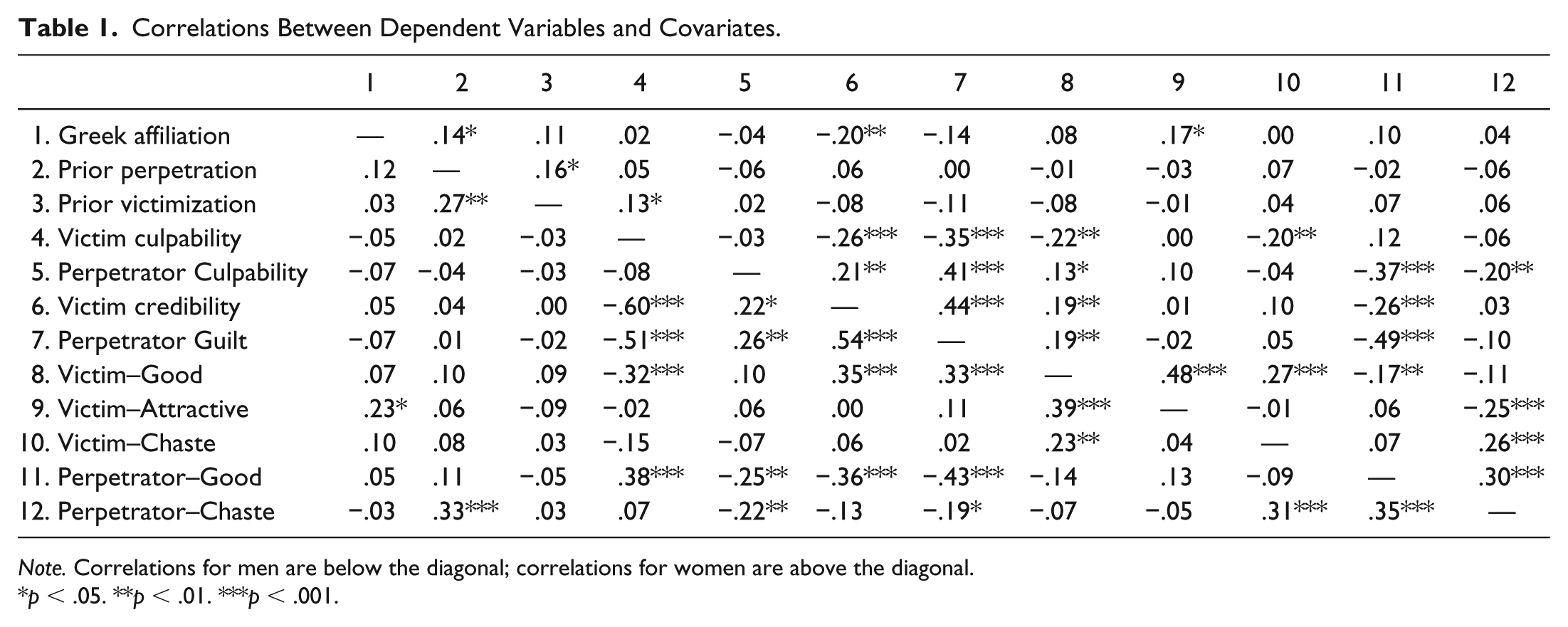
Note. Correlations for men are below the diagonal; correlations for women are above the diagonal.
p < .05. **p < .01. ***p < .001.
Because the dependent variables were significantly correlated, we used MANOVA in subsequent analyses. We conducted two MANOVAs to test for differences between women and men on (a) perceptions of the perpetrator and victim, and (b) semantic differentials (see Table 2).
The t Tests Comparing Women and Men on Dependent Variables.
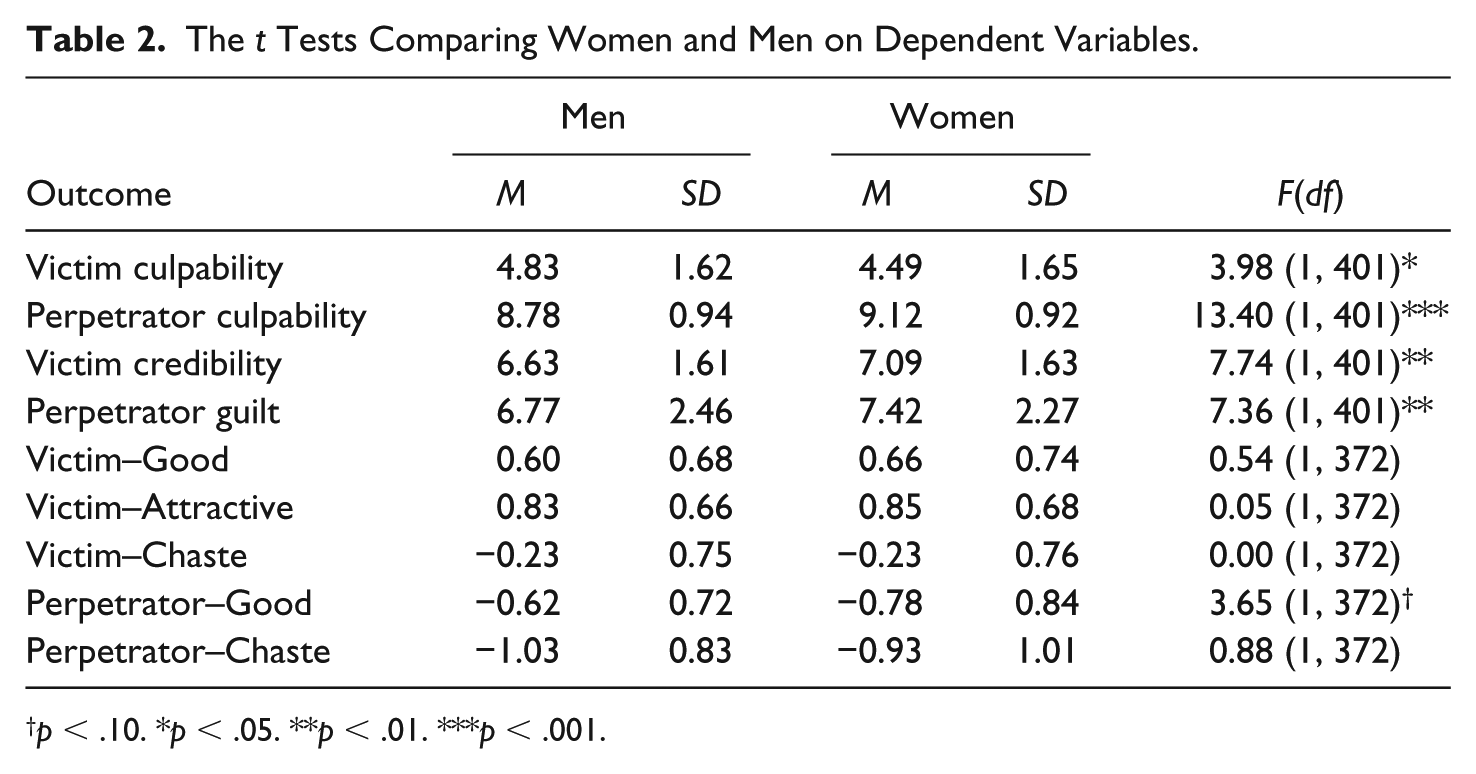
p < .10. *p < .05. **p < .01. ***p < .001.
Men rated the perpetrator as less culpable and less guilty, and rated the victim as more culpable and less credible than did women. Based on these differences, we conducted subsequent analyses separately for women and men. To determine whether perceptions of the perpetrator and victim varied based on the experimental condition, we conducted a Multivariate Analysis of Covariance (MANCOVA) for both women and men. For women, we controlled for Greek affiliation because we expected that those affiliated with Greek organizations may be more forgiving of a perpetrator than nonmembers if the perpetrator is in a fraternity. We also controlled for prior victimization because previous research has shown that female sexual assault victims tend to be more sympathetic toward other female victims (Miller, Amacker, & King, 2011). For men, we again controlled for Greek status. We also controlled for prior perpetration experience because men who have perpetrated sexual assault tend to more strongly endorse attitudes supportive of sexual violence (Abbey, McAuslan, & Ross, 1998; Mouilso & Calhoun, 2013).
Results for Women
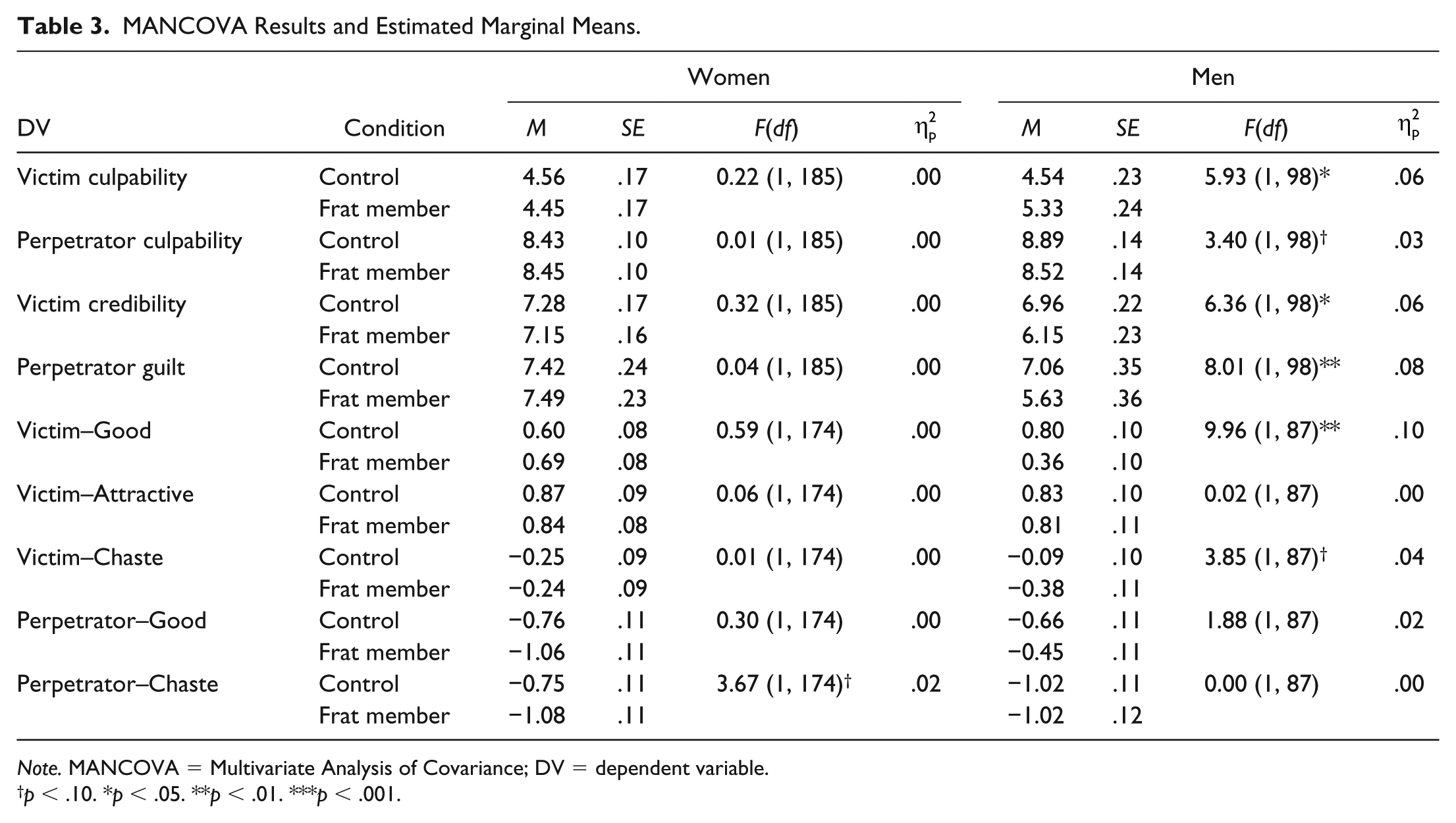
Results and marginal means for women are displayed in Table 3.
MANCOVA Results and Estimated Marginal Means.
Note. MANCOVA = Multivariate Analysis of Covariance; DV = dependent variable.
p < .10. *p < .05. **p < .01. ***p < .001.
There were no significant differences in perceptions of perpetrator culpability, perpetrator guilt, victim culpability, or victim credibility between women in the control condition and women in the experimental condition. Regarding the semantic differentials, women rated the perpetrator marginally lower on Perpetrator–Chaste when he was a fraternity member compared with the control condition. There were no significant differences on any other semantic differential subscales.
Results for Men
Results and marginal means for men are displayed in Table 3. Compared with men in the control condition, men in the experimental condition rated the perpetrator as less guilty, and the victim as more culpable and less credible. There were no significant differences between the control and experimental conditions on perpetrator culpability. Regarding semantic differentials, men rated the victim lower on Victim–Good and marginally lower on Victim–Chaste when the perpetrator was in a fraternity compared with the control condition. There were no significant differences on any other semantic differential subscales.
Discussion
Sexual assault on college campuses is a major problem, and fraternities have been identified as risk factors for sexual assault perpetration (e.g., Foubert et al., 2007; Murnen & Kohlman, 2007). However, we do not know how fraternity status affects perceived blame. In fact, most studies of perceived blame in sexual assault scenarios focus on characteristics of the victim, rather than the perpetrator (for reviews, see Grubb & Turner, 2012; van der Bruggen & Grubb, 2014). Our study addressed this limitation by examining how fraternity status affects perceptions of blame for the perpetrator and victim in a sexual assault scenario. As hypothesized based on the culture of protection (Kimmel, 2008), male observers rated a perpetrator as less guilty and a victim as more culpable and less credible when the perpetrator was a fraternity member compared with when no information was given about his fraternity status. Furthermore, male observers rated a sexual assault victim more negatively (e.g., less moral, less responsible) when her perpetrator was a fraternity member than when no information was given about his fraternity status.
Although our hypotheses were largely supported for male participants, we found almost no differences between the fraternity and control conditions for female participants. We suspect that female participants may not be affected by perpetrator characteristics because they are generally more supportive of victims and less supportive of perpetrators than are men (Hockett, Smith, Klausing, & Saucier, 2016; van der Bruggen & Grubb, 2014). In our study, female participants rated the victim as less responsible and more credible, and the perpetrator as more culpable and more guilty, than did male participants. Women are more likely to experience sexual assault than men (Black et al., 2011) and thus may be more sympathetic toward a sexual assault victim, regardless of the circumstances of the assault.
DeKeseredy and Schwartz’s Male Peer Support Model (DeKeseredy & Schwartz, 1993; Schwartz & DeKeseredy, 1997) may also explain the discrepant findings between women and men. According to this model, men are more supportive of sexual violence because of their association with peers and social groups that are more accepting of sexual violence. Men who are part of all-male organizations may view sexually violent behavior as normal because their male peers encourage such beliefs. Men may excuse the behavior of a man in a fraternity more readily because his peers are perceived to support, or at least not challenge, his behavior.
Focus on Perpetrators
Across several decades, many researchers have examined characteristics and behaviors of sexual assault victims that affect their perceived culpability. Such research is important, but we also need to examine characteristics of the perpetrator. Examining characteristics of the perpetrator allows us to see who is more likely to be blamed for sexual assault, and who is more likely to get away with it. Much of the public discourse on sexual violence focuses on victims, rather than perpetrators (Thapar-Björkert & Morgan, 2010); examining characteristics of the perpetrator is one way to re-center the conversation about sexual assault prevention around perpetrators, rather than victims. Such re-centering is an important step in combating victim-blaming policies and interventions that target victims’ behaviors, rather than focusing on perpetrators. The current study adds to the literature on victim blaming by examining fraternity status as a perpetrator characteristic that affects perceived culpability for sexual assault.
Culture of Protection
Despite the recent media attention focused on sexual assault perpetrated by fraternities (e.g., North, 2015; Valenti, 2014), male observers were less likely to hold fraternity members accountable for sexual assault. Thus, the culture of protection appears to apply to fraternity members because they are “protected” by being perceived as less responsible for sexual assault, and their victims perceived as more responsible, than nonmembers.
One way in which the culture of protection operates is by blaming sexual assault victims for their own assault (Kimmel, 2008). Although we do not know exactly what participants were thinking when they assigned guilt to the perpetrator and the victim, we suspect that observers blamed the sexual assault victim more when assaulted by a fraternity member because fraternity members are stereotyped as engaging in rampant sexual escapades (Fouts, 2010). Indeed, women participants in our study rated the perpetrator as less chaste when he was in a fraternity than when no information was given about his fraternity status. Thus, perceivers may think that the victim should have “known better” than to be with a fraternity member. For example, in their ethnographic study of the college party scene, Armstrong and colleagues (2006) found that both women and men commonly explained incidents of sexual assault by blaming the female victim for associating with men who were “bad news to start off with . . . a shady character” (p. 493). Women recognize parties, and specifically fraternity parties, as potentially dangerous places (Burnett et al., 2009; Sanday, 2007), and thus women who associate with fraternity members may be perceived as more culpable for their assault because they put themselves in a known dangerous environment. Among male participants in our study, the victim was perceived as less good (e.g., less moral, less responsible) in the fraternity condition, lending support to the idea that observers blame the victim’s perceived immorality and irresponsibility for her assault.
Implications for Preventing Sexual Violence Against Women on College Campuses
Previous studies indicate that fraternity members perpetrate more sexual assault than nonmembers (Boeringer et al., 1991; Brown et al., 2002; Franklin et al., 2012; Lackie & de Man, 1997; Murnen & Kohlman, 2007), yet the results of this study suggest that fraternity members are less likely to be blamed for sexual assault, at least among male observers. Thus, we might expect that in cases of sexual assault on college campuses, the people deciding on the verdict and punishment for a sexual assault perpetrator may be less likely to blame fraternity members. Giving fraternity members more leniency in cases of sexual assault may create a cycle in which fraternity members perpetrate more sexual aggression, but are less likely to be punished, thus reinforcing sexually violent behaviors.
It is important for university administrators to understand this potential bias in favor of fraternity members as they move forward adjudicating cases of sexual misconduct. Because our sample consisted of college students, it is important to repeat the experiment in a population of people who are in charge of jurisdiction (e.g., campus administrators, police officers). However, some schools do have undergraduates serving on their disciplinary boards. Moreover, although undergraduate students may not always have a role in formal jurisdiction, most female sexual assault victims disclose their experiences of sexual assault to their peers (McMahon, Stepleton, O’Connor, & Cusano, 2015; Orchowski & Gidycz, 2012; University of Michigan, 2015). For example, in a recent study conducted by the University of Michigan, researchers found that of those students who disclosed a nonconsensual sexual experience, 93.9% told a friend, compared with 3.6% who told an official university resource or law enforcement personnel (University of Michigan, 2015). Given the rate at which sexual assault victims disclose to their peers, it is important to understand how peers might perceive the responsibility of both the victim and the perpetrator in cases of sexual assault.
Limitations
Given that our sample consisted of undergraduate students, we cannot generalize to other populations. As mentioned above, it is important to repeat this experiment in a sample of people who are in charge of overseeing sexual assault cases on college campuses to assess whether the same biases exist.
Our sample was collected at a predominantly White institution. Given the makeup of the student body and the typical fraternities at the university, we expect that when participants listened to the podcast they pictured the perpetrator as a White male in a social fraternity. However, race may be an important predictor of both reputation and behavior among fraternities. For example, predominantly Black fraternities are perceived as more gender egalitarian and tend to maintain a more positive reputation on campus (Ray & Rosow, 2012). In addition, although the “typical” fraternity is a social fraternity made up of male members, there are other types of fraternities that are coeducational and not based on social activities. For example, professional fraternities bring students together based on their professional interests (e.g., Phi Delta Phi for law students; DeSantis, 2007) and honor societies organize students who have achieved excellence in scholarship (e.g., Phi Beta Kappa; DeSantis, 2007). The results of our study cannot be generalized to these other types of fraternities.
We expect that other privileged statuses on campus might elicit the same results. For example, athletes on high-status university teams (e.g., football, basketball) may be perceived as less guilty than nonathletes. In addition, socioeconomic status may affect perceived blame such that men from working class backgrounds are held more responsible for sexual assault. We are currently collecting data to address these characteristics.
Conclusion
The results of our study suggest that among male participants, fraternity members are blamed less and their victims blamed more for sexual assault than are non-fraternity members. This study is one of relatively few to manipulate characteristics of the perpetrator, rather than the victim, to assess culpability for sexual assault. Our results highlight the importance of the culture of protection (Kimmel, 2008) afforded to men in fraternities. College administrators tasked with combating sexual violence against women on college campuses should consider the ways in which fraternity members are less likely to be held responsible for sexual assault.
Footnotes
Appendix
[Control condition: He borrowed a car from one of his friends, and drove me home.]
[Experimental condition: He borrowed a car from one of his fraternity brothers, and drove me home.]
Declaration of Conflicting Interests
The author(s) declared no potential conflicts of interest with respect to the research, authorship, and/or publication of this article.
Funding
The author(s) received no financial support for the research, authorship, and/or publication of this article.