







Abstract
This study examines Agogo Traditional Area (ATA) women's well-being during farmer–herder conflicts. It emphasizes women's voices, and survival mechanisms in conflict resolution. A gendered dimension to the farmer–herder conflict in the ATA is essential to a more lasting resolution in the afflicted area. Qualitative data from semistructured interviews and Focus Group Discussions with ATA women shows how the conflict affected them. Themes were created to clarify and frame the discussions. The themes included safety and security, destruction of crops, death and forced migration, and impact on infrastructure. Civil society organizations addressing violence should offer psychosocial help to women victims in conflict areas in Ghana.
Introduction
The term violent conflict comes into play when physical force addresses competing claims/interests (Szayna et al., 2017). Conflicts are unavoidable in human interactions and can sometimes spearhead positive change. However, when conflicts that arise are not well handled and turn violent, this inflicts pain and other negative consequences on everyone's well-being. Violent conflicts affect many things, including food security and destroying important physical structures. A cue can be taken from the ongoing Russia–Ukraine scenario (Behnassi & El Haiba, 2022). Even more relatable are the emotional effects that victims of violent conflicts go through and the enormous difficulty in treating such effects on victims, especially when such conflict areas do not have the needed psychosocial resources and experts to administer the needed treatment to bring back the health, be it mental or otherwise, of the victims of such violent conflicts (Krafona & Appiah-Boateng, 2017).
Extensive literature has recounted the devastating effect of conflict on victims at the individual and state levels (Krafona & Appiah-Boateng, 2017; Olaniyan, 2015; Tonah, 2006). Some of these conflicts stem from chieftaincy issues, ethnic divisions, and unequal access/use of resources. Therefore, competition over distribution, access, use, and control of land is determined through the lines of identity and enmeshed in local struggles for power by indigenes and settlers alike (Paalo, 2021).
This makes it imperative for land to be protected by the owners at all costs. The notion of “owners,” “settlers,” and “foreigners” conferred on a group causes competition over the use of land and its resources, sometimes leading to violent conflicts and the destruction of properties as well as the loss of lives (Abubakari & Longi, 2014; Olaniyan, 2015). Farmers who are chief land users may resort to violent means to protect their crops from the herders. These herders, in some instances, are considered as migrants or foreigners in land-use conversations although some indigenes also engage in the herding business. Farmers who have their lands closer to water bodies are at a greater risk of crop destruction when herders searching for water and grazing lands for their animals move to use those water bodies (Issifu et al., 2022).
Again, even though water is a nonexcludable resource, the fact of the “owners”—“foreigners” connotation has also led to the exclusive claim of ownership of such a resource. Perceptively, as much as those deemed “foreigners” tend to recognize that farms belong to their owners exclusively, the same recognition is not made for water bodies. This further emboldens the supposed “foreigners” to also claim a right of use without much recourse to the protection of crops belonging to farmers. The lack of understanding of the use of such resources between these users often leads to farmer–herder conflict.
Farmer–herder conflicts are a reoccurring issue in most West African countries, and Ghana is not exempt; it has occurred since the early 1990s (Appiah-Boateng, 2020; Bukari, 2016). These clashes started as a fight for space for different aspects of agriculture, that is, crop production and animal rearing. However, these seemingly “simple” or “straightforward” conflicts have quickly evolved and become “embedded in sociopolitical systems governing access to resources” (Abubakari & Longi, 2014). Over time, the confrontations between farmer communities and herders have metamorphosed from communal clashes and disintegration, become contextualized into citizenship matters (Bukari, 2017), and have escalated to large-scale violence. This has resulted in the loss of lives, and properties and the displacement of several individuals. Generally, when tracing incidents of farmer–herder conflicts in Ghana, the Northern, Savannah, Upper East, Upper West, Brong Ahafo, Volta, and Ashanti regions top the list. For instance, the Gushegu district in the Northern region recorded over 30 lives lost to farmer–herder clashes in 2015 alone (Bukari & Schareika, 2015). The Sawla-Tuna-Kalba districts, Mamprugu, and North Tongu in the Northern part of Ghana, and the Agogo Traditional Areas (ATAs) have all not been spared this menace.
Violent conflicts affect men and women differently, but women are particularly affected by their negative short and long-term consequences (Buvinic et al., 2013). These adverse effects include sexual violence, physical and verbal abuse, and resource access barriers (Kwaja & Ademola-Adelehin, 2018). Put simply, women are often objectified as weapons of war. However, their involvement in peacebuilding efforts seems to be relegated to mere personal accounts and experiences, which are often only used to fill initially omitted narratives. Unlike the period before the 21st century, now, research and conversations on women's participation in peacebuilding have increased (Kaol, 2020). This aligns with the United Nations Security Council Resolution 1325, which requires gendered perspectives on the impacts of conflict, its prevention, resolution, and sustainable peace.
This article aims to recognize the effects of violent farmer–herder conflicts on women in the ATA. This article intends to give voice to women to tell their own stories in the hope that these will intensify the search for solutions to the farmer–herder issue in ATA specifically and Ghana at large. The following available literature has underscored the impact of farmer–herder conflicts in ATA of Ghana (Abubakari & Longi, 2014; Agyemang, 2017; Bukari, 2013; Olaniyan, 2015; Tonah, 2006), but these studies have not uniquely given a voice to women in their narratives. This article's specific objective is to share women's lived experiences as victims of the farmer–herder conflict in the ATA. It does not only look at the effects of the farmer–herder conflict in ATA on women but zooms in on the several survival mechanisms these affected women employed. Women in ATA form about 51% of the agroecological populace, and these issues cannot be left to linger on as they threaten food security (SDG Goal 2) within the community, region, and the country at large.
Review of Related Literature
Land as a resource is essential in economic activities and wealth creation. The quest to access, control, or change land significantly triggers conflict. Due to the patriarchal nature of African communities, it is difficult for females to access and own land. Thus, economically, women are automatically disadvantaged in wealth creation through agroproduction where they are heavily affected by conflict. For Baaré (2006), failure to address the gender dimensions of ownership of land potentially leads to violence, leaving women most vulnerable. The control and ownership of land goes beyond the possession of mere resources to the protection of identity; thus, land ownership is often through generational succession and as a result, has attached to it the identity of the family or the main ancestor who purportedly broke the virgin forest. As a result, the quest to protect the same will always be pursued even in the instance that such will lead to violent conflict. Generally speaking, control or access to land has contributed to violent conflicts in Rwanda, Burundi, the Eastern Democratic Republic of Congo, Mali, Nigeria, and some parts of Ghana, among other countries. Such conflicts significantly impact women as they bear the brunt of these various forms of conflict. According to the report by the United Nations Development Fund for Women, as of 2005, 70% of the casualties in violent conflicts were/are/and continue to be women and children. The conflict about land resource control and access is also reflected in the farmer–herder conflict.
The farmer–herder conflict has been recurrent and widely reported among pastoralists and farmers in the tropics. It is noted that these are products of competition over land resources mainly caused by population growth. Armah et al. (2014) observed that over 70% of the people in Ghana rely on the exploitation of land for their survival. Rubenstein (2017) added that when the primary material needs of people are not satisfied, even a hierarchical socioeconomic structure can degenerate into structural violence. Such violent conflicts threaten, hinder, and most times disrupt development and are catastrophic at both individual and community levels. Atta-Asamoah and Aning (2012) attribute this catastrophe to the overreliance on the scarcity of resources between the herders and farmers.
The violent conflict within the ATA in Ghana is between herders and indigenous farmers, although conflict occurs within the former group. The herders are primarily of Fulani descent, an ethnic group found predominantly in Northern Nigeria, parts of Ghana, Burkina Faso, Mali, Chad, and Niger. The general perception held by indigenous farmers is that Fulani herdsmen are migrants from the Sahel region, and so are foreigners and thus do not have a right to possess or access land within regions with indigenous farmers (Appiah-Boateng & Kendie, 2021). It is this view that has stuck with indigenes over the years, and whether such herdsmen are citizens or not has been an issue worth considering by the indigenes in this area. As far as a person is a Fulani, such person is a foreigner and there is no integration path within the community. This perception fuels the friction, decreases the tolerance level, and, by extension, dictates the pace at which conflict escalates. Be that as it may, the conception of whether a person is a foreigner or an indigene does not grant any right to the destruction of properties, in this case, farmland, even though the matter takes on a different turn when the person is considered a foreigner ab initio (from the beginning).
According to Akinyetun (2016), herders, by their nature, only occupy places for a short time. This is due to their nomadic nature, meaning they are transient people. This means the Fulani are usually in one place for a short time and heavily engaged in barrel-induced land grazing. The presence and practices of the herders in the ATA and indeed in most areas they flutter too often brings them in contact with crop farmers, and the process, the herds destroy crops (Appiah-Boateng & Kendie, 2021). Whether this destruction of crops by the herds is deliberate has since been lost in the heat of the conflict. Thus, the retaliating consequences are dire, but the government and traditional authorities tend to side mainly with indigenous farmers, a fact not appreciated by the herders.
The farmer–herder clash in the ATA, just as similar happenings in other places, borders on environmental degradation, access to land, climate change, and weak capability to adapt to new situations of living as well as responsible shared access to resources (Shettima & Tar, 2008). Additionally, the conflict reflects a weak land tenure system and a clash of undefined rights or ownership, a system aimed at optimal land use by all and sundry. However, the attitude of land grabbing with complete disregard for farming or grazing lands has led to intense competition and haphazard claims of ownership of available lands. The violent nature of such conflicts is a double-edged sword for both sides but with a far more negative outcome for the indigenous farmers. While the loss of lives is recorded on both sides, farmers suffer damage to their farmlands while herders also have their cattle poisoned by the farmers (Mensah et al., 2016). There are also instances where the houses of farmers have been set ablaze (Olaniyan, 2015), threats and intimidations issued, intentional bushfires, water pollution, and highway robberies indulged in by the Fulani herders, among other vices (Agyemang, 2017; Opoku, 2014).
There is extant literature on violence that is visited on women during conflicts. Women go through not just sexual violence but also have to endure verbal, physical, health, and psychological abuses while being used as weapons and spoils of war (violent conflict). According to Amnesty International (Europe, 2016; Martens, 2006), conflict actors use rape and sexual violence on women as punishment and general warning systems to get men in line. It is observed that during the conflict, women are separated either intentionally or unintentionally from their men, traditionally their source of income. This leads to economic hardship amid many other psychological strains on women (usually with children) left alone with no income or livelihood. They go beyond their socially constructed roles to support themselves financially.
Gender-based violence against women during farmer–herder conflicts is not different from the narrative above. Clashes between farmers and herders over farmlands and pastures quickly escalate with massive casualties. Such conflicts and their adverse effects on women severely impede social development. They are human rights concern that begs the attention of policymakers, academics, and other relevant stakeholders (Mutisi et al., 2011). For Kudakwashe and Richard (2015), incidences such as unlawful killings, sexual mutilation, rape, and mental health-related issues have been some of the reported forms of violence experienced by women. The long-term social and economic effects of these experiences on women are premature deaths, destruction of properties, reduced life expectancy, displacement of people, increased widows and orphans in affected communities, stigmatization, unwanted pregnancies, and the spread of sexually transmitted diseases (Buvinic et al., 2013; Mubi, 2018).
For Lindgren (2011), sexual violence persists even after a cease-fire and an agreement for a truce have been reached. The primary issue with such effects of conflict being visited on women is underreportage (UNHCR - The UN Refugee Agency, n.d.). This lack of reportage has been attributed to, among others, the fact that such violence is usually perceived as a “private” matter. As a result, it is not brought out for law enforcement to get involved. Also, fear of stigmatization affects reportage as many of these victims of sexual violence tend to be isolated and or looked upon as tainted, even by their spouses and the community at large.
Additionally, patriarchal thinking and the cultural conservativeness of society inhibit reporting. It is noted that women who have suffered from abuse also suffer psychosocial challenges, making it difficult for them to reintegrate even after the conflict. In other cases, the possibility of finding suitors and settling down after experiencing these abuses is almost nonexistent. According to Oppong (2017), in such instances, most women are traumatized to the extent that they cannot maintain relationships. In all, situations such as their vulnerability to violence, the reproductive burden, unequal access to and control of resources, and loss of legal protection further, enhance women's risks during conflict (Kabeer, 1994).
Terry (2007) indicates that armed violence implies a double burden on women; they must first endure the general atrocities visited on victims of conflict as part of the population. Secondly, they must endure the preexisting traditional and customary discrimination and inequalities that affect women. Even more, physical, sexual, verbal, psychological, and emotional violence is also deliberately visited on women, sometimes as punishment and a system of patriarchal subjugation. Among the devastating effects of violence on women is the destruction of farms and the taking away of agricultural land. According to Azumah et al. (2023), when women lose their agricultural land due to the activities of herders, it not only means a halt in food production, be it subsistence or commercial, but it also means a loss of livelihood and security. This forces them to work in areas and places under extreme conditions, which could lead to a threat of sexual exploitation and or pay/investment in their security (Mensah et al., 2016).
Theoretically, the necessity to pay attention to gender matters in conflict situations is outlined by normativism and instrumentalist theories. According to normativism, gender equality is crucial in achieving human rights (Greenberg & Zuckerman, 2009). In the same vein, instrumentalists posit that gender equality is valuable in conflict prevention, transformation, and achieving developmental outcomes (Harders, 2011). Anderlini (2011) observes that it is important to understand gender dynamics to avoid unintended negative consequences or harm to gender relations in conflict situations. As a social fact, most socially excluded groups experience multiple violence/deprivations during the conflict. According to Stewart (2006), even though men and women experience social exclusion, women suffer disproportionate discrimination and poverty much more than men in conflict situations.
From the above, one can deduce that violence is not viable for settling disputes. Suppose we go by the current peace discourse on conflict resolution by dealing with conflict through the convergences of human rights, gender, and democratic governance. In that case, we need to understand the experiences of actors/victims of conflicts to design a realistic pathway to prevent future conflicts from turning violent. This article, therefore, adds to the pool of literature on conflict by capturing the dimension of women's lived experiences as victims of the farmer–herder conflict in the ATA and how they navigate the effects such violent conflicts have on them.
Methodology
In the methodology section, the researcher described the methods and techniques that were used to address the study objective. It elucidates methodological issues such as study approach and design, study area, the sample selection process used to arrive at the study population, data collection methods and instruments, ethical issues and analysis.
Study Approach and Design
The study uses the qualitative approach which is premised on the philosophical idea that meaning is produced (Hatch & Cunliffe, 2006; Hibbert et al., 2014). The study also adopted the narrative research design placed within the constructivist paradigm, which emphasizes how individual activity can shape notions of reality through forms of understanding and lived experiences. From this viewpoint, the study aimed to understand how the farmer–herder conflict has impacted women and their activities within their local communities.
Study Area
The research area is the ATA in the Asante Akyem North District of the Ashanti Region (Figure 1). The capital town of ATA is Agogo. ATA is characterized as a tropical zone which makes farming and animal rearing easy and successful. Plantains, watermelons, and tomatoes are all grown in abundance in this area. It has a female population of 51.2%, and the significant economic activity in the area is agriculture (Ghana Statistical Report, 2014).
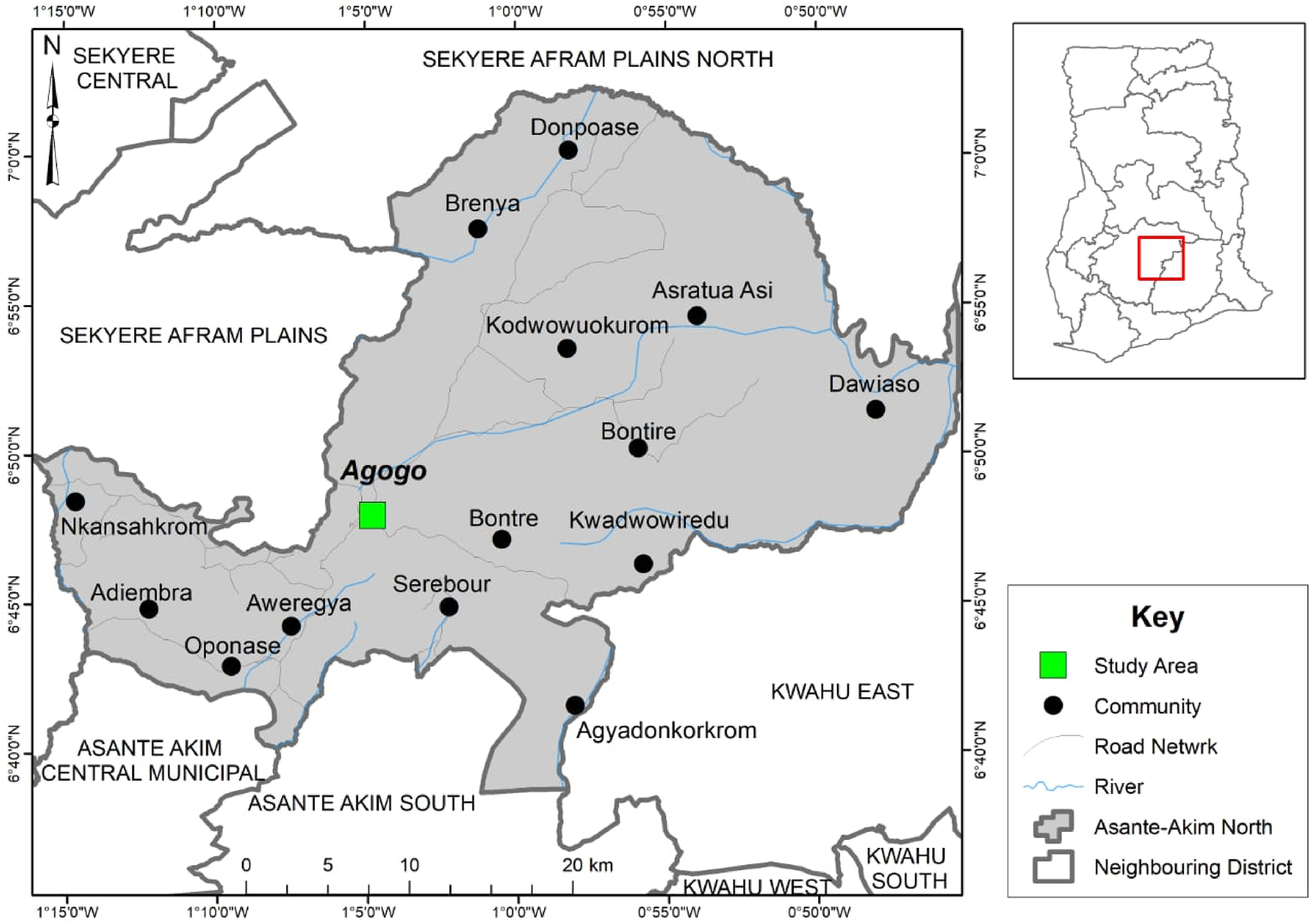
Map of Agogo traditional area.
Nonetheless, the rich land in ATA has served as a source of conflict between crop farmers and herdsmen as they compete for this resource. The culminating consequences have largely been injuries, loss of livelihoods, and lives of the residents especially women and children (Appiah-Boateng & Bukari, 2022).
Study Population and Sampling
Women were the primary participants in the study. It included the queen mother of the traditional council, market queen mothers, women farmers, and women residents of ATA who are not farmers. The study could not include Fulbe women who were wives of the herdsmen because they had fled the community to other areas outside ATA due to the humiliation, insults, and psychological torture they faced from the community members, especially at the river banks and market spaces. The herdsmen recounted supporting this as a security or protection strategy for their children and wives.
Study populations such as the queen mother of the traditional council and market queen mothers were purposively sampled. This was because these women are individuals who head segments of women from the traditional area and the market spaces and could directly provide answers to the issues being studied so it was relevant to include them. For the remaining women, the study employed a convenient sampling technique in the selection process. The researcher took into consideration the respondents’ availability and easy proximity in the selection process.
As a nonprobabilistic technique which generally has less clear generalizability, here in this study the researcher maintains the positionality that the group is homogeneous and that convenience samples here have clearer generalizability relative to conventional convenience samples (Jager et al., 2017). Owing to the repetitive nature of the conflict, almost everyone in ATA is known to be a victim of the conflict in one way or the other. For this reason, it was necessary to sample women who had suffered directly from the conflict. Such women were selected using the snowball sampling technique. The researcher largely dwelled on this sampling technique through social networks to get to these hard-to-reach women who have directly been affected by the conflict to voice their experiences. There was no predetermined sample size for the study. However, the researchers relied on the above sampling techniques until saturation was reached. Saturation was reached when the responses from the participants kept reoccurring. In all, a total of 20 women participated in the study.
Data Collection Methods and Instruments
The researcher employed primary data solicited through semistructured interviews and focus group discussions. Two focus group discussions comprising a membership of eight women per group were engaged to explore women's perspectives on the farmer–herder conflict. The data collection tools (semistructured interviews and focus group discussion guides) were ideal since they were flexible enough to accommodate changes made during the fieldwork and helped address new issues the researcher encountered while collecting data. During the data collection, notes were taken as well audio recordings were made. The researcher ensured that any information that could be traced to participants’ identities such as names, and telephone numbers among others would not be collected. In instances where names were collected, pseudo names were used to replace them to avoid linkages to any participant's identity. The investigator ensured that ethics of respect, privacy, safety, and confidentiality were all exercised. The researcher sought ethical clearance (with the ID number UCCIRB/CHLS/28/19) from the University of Cape Coast Internal Review Board before conducting the study.
Data Analysis
The data collected were transcribed and coded to make it easier to thematize responses which helped with the overall data analysis. Ethical considerations were of principal concern, chiefly on how the researcher's positionality will not affect participant engagement and the overall research process. Specifically, thematic analysis was done, and quotations were used where relevant.
Results and Discussions
As indicated, the farmer–herder clashes had already started in Ghana as pastoralists constantly searched for lands conducive to their livestock. According to a Graphic online report (2017), it was in 1997 when four Fulani herdsmen solicited grazing land from the Agogo Traditional Council. The council then gave them grazing land and outlined some terms to be met. These terms included annual compensation with live cattle per herdsman, preventing animals from destroying crops, and allocating new sites when needed. There were breaches to the terms given (Tonah, 2002), and a second agreement was reached. That also needed to be adhered to. In 2010, a government committee was instituted to investigate the conflict situation and propose practical steps to curb the menace. Based on the committee's recommendation, the Agogo Traditional Council called for ending nomadic cattle rearing within its communities. This was met with complete defiance, hence the protracted farmer–herder conflicts in the ATA. Negative peace prevails as trauma from the clashes has left bitterness and enmity within people. The slightest trigger can cause a relapse and plunge the entire area into conflict again.
Conflict undoubtedly affects everyone as established. In as much as the effects of the farmer–herder conflict in the ATA affected both genders, the effect on women was gruesome. Four themes were generated from the responses of female participants of this study, which are used to enhance understanding and put results discussions into better perspective. The thematic areas identified during the data collection phase are safety and security, destruction of crops, death and forced migration, and impact on infrastructure.
Safety and Security
Generally, Asante Akyem North District within which ATA is located has been a peaceful area with no threat to life or properties. It is also not an area occupied by only indigenes but many people have migrated to this area to engage in farming and other activities. Relative peace, security, and safety have been uninterrupted, the reason why people have found it attractive to move to its environs to undertake business activities. During this period, therefore, the area was out of the public eye as no extraordinary news of the destruction of any sort was recorded worth the attention of everyone. The state of affairs then began to change when there were snippets of the clashes between herdsmen and farmers. The escalation of these rifts and clashes turned the public eye to ATA, even more, was when the traditional leaders were accused of connivance and clandestine collaboration with the herdsmen. As indicative of any conflict, there is a threat to the security and safety of both individuals and the property. During this period, the safety of individuals especially women, and the security or protection ordinarily afforded them was nonexistent.
The threat to safety and security was preemptory acts or retaliatory. They were also seen mostly from the side of the indigenes or farmers in the area. Ordinarily, it would have been the case that it is only when there is a confrontation in the farms between the herdsmen and the farmers that there will be an evident threat. It was not so in this instance, as the confrontations became actual protracted conflicts. As a result, groups used ambushment against their opponents; in this case, there are many lived experiences of women who were ambushed and attacked. It is also important to note that these threats to safety were not only during farming periods or at the farms, rather any instance that presents an opportunity to stage retaliation is used.
It is thus the case that the farmer–herder conflict in ATA brought a general environment of indiscipline, deviant behavior, and militarism to the ATA due to the recurring breakdown of law and order. Robbery incidents and trafficking of humans restricted women from going about their normal activities; even to marketplaces. Comparatively, because women were physically weaker, they were the easy targets of most of the vices stated above. Those who dared to step out are sometimes robbed leading to sustenance of injuries, death, and loss of money and other valuables. For instance, a participant narrated her ordeal; “I have stopped going to the farm because I am scared of either being killed, harmed, or raped. This feeling stems from my past robbery experience. I was on a tricycle going to town when we were attacked by some herdsmen. They hit my head with the butt of their machete” (Fieldwork, 2021). This affirms the brutality that women within the ATA faced during the clash. This assertion was also made by Mubi (2018) when he observed that the Fulani herdsmen are reportedly being engaged in various criminal acts such as robbery, rape, and murder among others.
Another participant recounted her traumatic ordeal: I stayed a little longer on the farm with my child. I was confronted by some Fulani herdsmen who approached me aggressively. From all indications, they were going to harm us; so, I pleaded with them to spare my child and hurt me instead. My plea rather infuriated them and you know what? They rather killed my child right in front of me. I have resolved not to go to the farm because these herdsmen have taken over the place. I engage in backyard gardening to ensure my family has something to live on. It is obvious at this point that such an act can be carried out in a community that has a complete breakdown of law and order. Here, no one is accountable for their actions and in a state of lawlessness, just like ‘jungle living,’ it is the case of a survivor of the fittest that prevails. Women were, therefore, more disadvantageous. (Fieldwork, 2021)
For survival mechanisms, most of the women were noted to be engaging in petty trading as an alternative means of livelihood to make up for the losses. A participant narrated: “This conflict destroyed portions of our farm. My husband managed to give me seed money of GHC 500 (US$134) to start a food vending business” (Fieldwork, 2021). In this instance, since farms have been destroyed and are also dangerous places to go to alone, petty trading has been the alternative. Other women also engaged the services of the youth to act as security to help them cart their harvest from the farm to the market at a fee. According to Mensah et al. (2016), in certain instances, female traders are even compelled to hire private security at the cost of GHC 250 (US$67) per day for protection against being killed or attacked by herders. The dwindling numbers of women leaving farming as a result of fear has consequences for Ghana's food security.
It is worth noting that the inhabitants of ATA predominantly engage in subsistence farming. This also means that they need to periodically go to the farm at short intervals either to harvest or attend to their crops. Many women were thus engaged in subsistence farming, while others went to buy produce to sell in the market. Thus, most activities engaged by women in ATA are agro-based. The escalation of the conflict and its threat to safety and security meant that a substantial part of the livelihood of these women had been taken away. Their fear was not nominal, because of instances of robbery, battery, and rape, the environment became extremely unwelcome. Even more, is the fact that these women who have gone through such experiences have to live with the memories throughout their lives. In instances when there can be compensatory acts, not necessarily material in nature, but even the fact that such perpetrators are found and dealt it by the law, the pain and trauma could be minimized. These compensatory means were not available and so when such lived experiences are narrated one aptly sees the pain and the inadequacy that such women portray and express.
One major issue to be interrogated was who to provide the security. Generally, the state is seen to carry the onus of providing security. In his context, therefore, the district collaborates with the security agencies to provide security to the inhabitants of the area. This was however difficult due to several factors such as availability of logistics, access to the rural areas, and leadership, among others. From the state level, the community watchdog or organized volunteers also provide security at some point. Though this form of security is not as effective as that to be provided by the state it also goes a long way to help in ensuring safety. However, these groups were also prominent for reasons such as logistics, and lack of support, among others. To the extent that many of the herdsmen wielded guns, it became practically impossible to maintain security through their local groups, which had no such weapons. In the end, it is only when women could organize themselves and move in groups or in the alternative not go to the farm at all that they could protect themselves.
Destruction of Crops
Food security is of great essence to human survival. As part of the SDG goals (Goal 2), collective efforts are needed in attaining food security for this generation and the future ones. However, the violent farmer–herder clashes at ATA are impacting negatively food security; not just in the affected area but in the country at large. Indeed, Azumah et al. (2023) and Akinyemi (2018) all spoke about how such violent clashes can impede food production.
The production of food in ATA has been such that farmers harvest these crops mostly on the mornings of market days and then send them to the markets for sale. Since it is mostly the women who go to the market, they normally do the carrying of the foodstuffs to the market. If it is a family where there is a man, the men go to the farm with the women, do the harvesting, and the women do the transporting to the market. Also, some market women go to the farm to purchase the foodstuffs and bring them to the market areas themselves. The produce is cheaper on the farms since there is no transportation cost for the farmers. Where the produce is not for sale, the farmers normally go to the farm on days designated and harvest their crops for feeding. Here, because these crops are perishable and there are no effective preservation practices, much is not harvested, and the same is done as and when the harvested crops get depleted. What this means is that there is absolute dependence on farm produce for survival.
It is also the case that because mechanized agriculture is not practiced, they are not large-scale farms and so a herd can destroy an entire farm in a day. Many of the farmers also do not practice monocropping whereby it is just one crop, such as cassava in one farm. The scarcity of land and the dependence on agriculture have made it a necessity to plant several produce on one farmland. This also means that the destruction of farmland is the destruction of several crops on the same land.
Women engaged in farming by themselves often hire the service of other men to clear their land and remove stumps as well as engage in some other manual work on the farm for a fee. This means that as much as the women invest their energy, they also invest their resources in the farms. In the case of those women who are married, they also help their husbands by engaging the services of other laborers when it becomes necessary.
ATA is known to have food crops available all year round. Thus, even in the lean seasons, there is food available and these foodstuffs are transported to other areas such as the big cities for sale at a better market price. The sustenance of the all-year-round produce has been the result of local irrigation methods using streams closer to farms. Indeed, some crops, especially vegetables require constant irrigation. This means that most farmers deem having a farm closer to a stream as a luxury to ensure all-year-round cultivation and also be able to cultivate vegetables which are considered expensive in the market.
The violent farmer–herder clashes have been noted to have simply been about the destruction of farms by the herders. The explanations shared by the herders have been that they do not destroy farms but only take their cattle to the streams after grazing. This means that it is those whose farms are at the streams who are heavily hit by the destruction of the crops. Here again, it is conceived that, while some farmers have their crops destroyed because the cattle feed on the leaves of those crops, others have their farms destroyed as a result of the stumping by the herd in the quest to use the streams closer to the farms.
A participant at Kowereso gave a vivid account of how her farm was destroyed and she witnessed instances where other people's farms were also destroyed by the herdsmen. She narrated that: I was returning from the farm when some herdsmen bumped into me and asked that I return to show them my farm. I was hesitant at first and covered my reluctance with wailing; hoping that they would show mercy and let me go. On the contrary, they pulled their machetes and guns at me, and out of fear for my life, I took them to my farmland. They said my initial hesitance implied that I could show them another person's farmland. So, they set my farm and all the others around ablaze. They made me watch everything (my farm and that of others) burn to ruin. (Fieldwork, 2021)
According to Ofuoku and Isife (2009), the nature of such conflict leads to a reduction in farming outputs and associated income of farmers. Another respondent recounts instances when women have lost their husbands and are singularly taking care of their children. Owing to the unlawful killings by the herders during such clashes (Kwaja & Ademola-Adelehin, 2018), women have become widows and children are orphans. Women who found themselves in such situations have expressed more stress about combining the male roles with that of their female roles. A widow recounted her experience “My husband was shot dead on our farmland. We had four kids; these men not only took my husband from me; but they also deprived the kids of their father. They (the kids) became school dropouts because I couldn’t afford to put four children in school at a time. A good Samaritan helped me put them back into school but it is not easy for us at all. Most times, we struggle with what to eat” (Fieldwork, 2021).
Another participant also narrated how she stopped farming and the effect it has on her and others who have gone through the same situation as a result of the conflict. This is what a participant had to say during the discussion. I took a loan and went into rice farming and it was harvesting time. I went with my family to harvest part and bagged it with the hope of continuing the other half the next day. We went there to realize the herdsmen had made their cattle feed on the rest. As a result of this, I ran into enormous losses and so I stopped farming. When I defaulted on the loan, the way the bank harassed me. Hmmm. My neighbors too who had their farms destroyed either through fire or cattle grazing are also struggling like I am. It is not easy at all. The hardship on us is just too much. (FGD 1, 2021)
Concerning the study area, it was realized that the conflict has had an enormous toll on economic activities. Since it is a farming community, the most evident economic effect has been food shortages; on both subsistence and commercial basis. The conflict has affected the production of food especially when farmlands are destroyed by herders (Baaré 2006; Azumah et al., 2023). This threatens the attainment of SDG 2.
The destruction of the crops was evident in the total reduction of foodstuffs for sale and transport to the cities for sale. It was not about whether people were afraid to go to the farm or not it was also about the fact that even when you go to the farm, there is no produce to harvest since it has been destroyed. It was also seen from the narratives of the lived experiences of the women that the destruction either was through actual grazing with the cattle or a reprisal attack by the herdsmen by setting farms ablaze, among others. It was noted that when it became evident that farmers were poisoning and sometimes shooting these animals, the reprisal attacks became more of a conscious destruction of crops and farms by the herdsmen. In the end, women not only lost their farms, but they also lost their livelihood and ran into debt since they had invested in their farms through the hiring of laborers. Additionally, the fact that women could not protect or defend themselves, they were confronted and taken to their farms for the same to be destroyed even when ordinarily those farms had not been in the way of these herdsmen. The resultant effect is that their livelihood was gravely threatened as there was no alternative means of sustenance, especially in instances when they were deemed as the breadwinners or had no husbands to provide support.
Death and Forced Migration
The instances and experiences of the death of a loved one due to conflict seem to be a notable resultant effect.
Among the devastating effects of the farmer–herder conflict in ATA is the loss of lives of both herders and farmers. It was mostly realized that in the ensured confrontations, it was mostly the indigene farmers that were recorded as being killed. This, however, does not exonerate the indigenes of having engaged in any murder of the herdsmen. In this case, the traumatic experiences of the women were instances when they were made to observe the killing of their husbands or children. The effect of this on the mental health of these women has been enormous as the deceased have been breadwinners of the family. In the end, apart from the traumatic psychological and emotional experiences, these women will now need to think of how to take care of the family in the absence of the men.
To escape death, some women decided to flee and migrate from the jurisdiction while others resorted to staying in the violent communities to cater for the family amid threats to their survival and that of the family. For another participant, the conflict reminds her of the painful experience and flashbacks. “The herdsmen made their cattle graze on my sister's 200 bags of maize. As if that was not enough, they shot my sister's husband and their son” (Fieldwork, 2021). To Olusola and Amaechi (2018), the Fulani herdsmen engage in brutal murders of farmers in rural communities, an action that leaves serious implications for human security in these areas.
To another participant: Certain instances bring memories of the traumatic experience I went through. For instance, when I see my husband's land that the herdsmen destroyed, it brings unpleasant memories. Having been robbed by them too, whenever I see a suspicious container, I just sigh deeply. The worst part of all this is that, when our son was ill one night, we could not take him to the hospital. Out of fear for our lives coupled with the fact that we had no money, our son died in our arms. (Fieldwork, 2021)
Many husbands and youths were also forced to flee from the situation. A participant narrated “Many people I know have either fled or financed their youthful children to flee.” I couldn’t go because of my leg; see me, I limp. I also didn’t have any money to give to my brother for him to flee from this place” (Fieldwork, 2021). Another recounted that “because of the conflict, many people have relocated to the cities; especially Kumasi and Accra. My brother is in Accra as I speak with you. I decided to stay because our parents are old and I couldn’t just abandon them. Those who are easily located are those without vulnerable dependents and or have alternative accommodation arrangements elsewhere” (Fieldwork, 2021). Tonah (2006) contends that farmer–herder clashes lead to threats, intimidations, and deaths. This forces many to leave the conflict-prone settlements. This has led to a disintegration of the extended family bond that existed among the members of society. This further emphasizes the danger the conflict posed to the vulnerable in society, especially women since they could not stand up to the herders amid their intimidations.
Buvinic et al. (2013) added a different dimension to the discussion when they opined those conflicts of such nature reduce the life expectancy of women. This is because basically, women are more affected by the indirect effects of displacement, sexual violence, health risks, and economic change. A participant recounted that “the herders were mostly striking between 1 a.m. and 2 a.m. What they do is they set houses ablaze and wait for those who will try escaping and maim or kill them with a machete. Because of this, we were not sleeping. Often too, they rape the women and young ladies. There was an instance when a neighbor of mine had his wife raped in front of him. there was nothing he could do; even if he had attempted, they would have killed him. The woman went through serious trauma; she later relocated to another town but died shortly after. The husband also died about three months after” (Fieldwork, 2021).
In all, these incidents of death and forced migration have consequently hurt economic activities within the ATA. The effect is that the families and individuals who were dependents of these individuals are now left to fend for themselves amid less economic activities including farming.
The enormous negative effect of death and migration has been felt even after the conflict. This is because the absence of the men either through killings or migration has also affected food production now. Those who were killed have had their farms left without replanting or reengagement. Their women whose trauma is triggered by the sight of these farms have refused to go to such farms and work for the sake of their sanity. Some have stopped farming completely as they do not even have the means to be able to farm. Furthermore, since the land mostly belonged to the men through usufructuary interest, upon their death, their extended families have taken over making it difficult for such women to get lands to cultivate on save for those lands that belonged to their own family. These have had an enormous effect on the livelihood of these women and their children.
Again, those who migrated have not seen it necessary to return as their farms have been destroyed, and could not get the needed resources to start another cultivation. As a result, they are relying on menial and petty trading in the cities for survival. This has affected the production of food and the unity of their families as they cannot move their families to stay with them but can only send stipends when available.
The violent conflict and its effect of death and forced migration have led to a reduction in food production, disrupted the family system, and gravely affected the psychological state of women who had to watch their husbands being killed by the herdsmen.
Impact on Infrastructural Development
Apart from the devastating effect on human capital, violent conflict also affects the infrastructural development of the conflict area. This is because, there is also the destruction of properties, which takes years to rebuild and maintain. In the case of the farmer–herder conflict in ATA, there has been an evident effect on the socioeconomic health of the area.
The conflict has also impacted the rate of development in the area. Indeed, much as the general effect of the conflict includes the destruction of properties, there is also the effect that developmental projects either are not implemented at all or are stalled. Adisa and Adekunle (2010) assert that the farmer–herder conflicts have invariably threatened socioeconomic development. In the case of the ATA, the farmer–herder conflict has one way or another impacted and led to the slow pace of infrastructural development in the area. Central among these is the provision of social amenities such as roads. According to one participant, “the bad nature of our roads has led to serious transportation problems. This is because cars do not ply the roads often except for motorcycles. When I was in labor, the terrible nature of our road made me get complications that led to a stillbirth. Another woman who lives down here (pointing to a house), was delivered in the bucket of a tricycle while being transported to the hospital facility in another town” (Fieldwork, 2021). For Akinyemi (2018), the conflict between the farmers and herders has had a direct impact on general infrastructure. Instances such as these necessitate not only access to good roads but also health ports or clinics. Thus, in communities where Community Health Planning and Services compounds and health centers are available, these will be easily accessible to women and thereby reduce such dangerous instances as narrated by the participant above.
Issues of portable and safe drinking water are also affected by the farmer–herder conflicts. The streams within the communities have been contaminated and muddied by the herd of cattle. According to a participant “my community had only one borehole that serves us all but as I am talking to you now, it is spoilt. The pressure to leave when there is a hint of a herdsman approaching, coupled with the pressure for most of us to fetch water at a particular time since we move in groups have rendered this borehole spoilt now (Fieldwork, 2021).
The conflict led to the destruction of several water bodies, which were serving communities. Now since the communities could no longer use the water bodies as a result of its destruction by the cattle, there had to be alternative means of water. This meant that the communities would now require mechanized boreholes as a source of water. The inability of the government to provide enough of these for the communities became an issue as the available ones being used will have to be overly dependent on it. Further, road construction maintenance of feeder roads among others was stalled. Under the explanation that the cost of the conflict through the provision of security has been fiscally draining, such infrastructural activities were not considered and the people since faced enormous difficulty in transporting their goods and even commuting from one community to the other. Economically, the basic economic livelihood was agriculture which was also at the heart of the conflict. The effect is that economic activity has been negatively affected and women now must rely on petty trading to survive.
Conclusion and Recommendation
This study has generally been dedicated to examining the specific impact of how the farmer–herder conflict has had on women as victims of the conflict. While there has been extant literature on the general effects of the conflict in the area, the perspective of women as far as they have been impacted by the conflict and their first-hand experience has remained less explored. It has been established that women have been the major victims of sexual attacks by herdsmen. Such attacks have aimed to serve as punishment and also make a point to the male farmers of how brutish their warring opponents can be. Further, economic businesses have been stalled and as a result, women have had to abandon the selling of foodstuff to sometimes sell cooked food which takes them from their farm work. Thus, since most of the women who engage in business go to the farms to purchase the produce before transporting them to the market areas, the general insecurity and robbery meant a cessation of such activity. Others have had a lifetime altered situation where their spouses have fallen victim and been killed and have become widows. The general experiences speak to the literature that the effects of the conflict, though general have been heavily felt by women who are considered as a part of the vulnerable groups in societies.
Based on the study findings, I recommend that the government, traditional authorities, and civil society organizations (CSOs) collectively and objectively support the resolution of the ATA conflict. I further appeal to the state and CSOs to provide health facilities in conflict areas to support the well-being of women in conflict areas. CSOs championing conflict issues must endeavor to provide women victims of conflict with some psychosocial support.
Footnotes
Declaration of Conflicting Interests
The author declared no potential conflicts of interest with respect to the research, authorship, and/or publication of this article.
Funding
The author disclosed receipt of the following financial support for the research, authorship, and/or publication of this article: African Humanities Program of American Council of Learned Societies with the generous support of the Carnegie Corporation of New York.
