







Abstract
Victim-survivors of intimate partner violence (IPV) often disclose their experiences to friends and family, yet little is known about disclosure-recipients’ responses to non-physical IPV. We analyzed transcribed verbal responses from 28 participants to a simulated disclosure of verbal and monitoring abuse from either a male or female victim. Thematic analysis identified three support types centered around identifying abuse, resolving the situation, and acknowledging the victim. Participants prioritized problem solving and showed greater concern for female victims but condemned the abuse regardless of gender. Findings suggest informal supporters may benefit from training to balance action-oriented responses with demonstrating emotional support.
Introduction
Intimate partner violence (IPV) involves physical, non-physical, and/or sexual forms of abuse, all of which can have devastating health consequences for victim-survivors (Coker et al., 2003; Outlaw, 2009). An estimated minimum of 58% of IPV victim-survivors disclose their experiences exclusively to informal supporters, such as friends or family members (Sylaska & Edwards, 2013). Social support is therefore frequently examined as a means of mitigating these harms and as a point of early intervention (Coker et al., 2003; Dworkin et al., 2019). One particularly consequential opportunity for social support occurs at the point of first disclosure. Responses to disclosures can play a critical role in shaping victim-survivors’ outcomes. Negative (unhelpful or detrimental) responses can be highly damaging—exacerbating immediate and long-term mental and physical health concerns and reducing the likelihood of recovery or further help-seeking (Coker et al., 2003; Dworkin et al., 2019). Although positive (helpful or beneficial) responses are typically not sufficient to counteract the harms caused by the abuse itself, they remain critical for victim-survivors’ well-being. For example, they are associated with short-term improvements in well-being and can facilitate further help-seeking or engagement with support that does improve the odds of recovery (Coker et al., 2003; Dworkin et al., 2019).
Despite the central role informal supporters play in victims’ disclosure experiences, there is little research on how people respond to disclosures of IPV and none that has explored responses to disclosures of emotional, psychological, economic, social, or sexual abuse without physical violence (i.e., non-physical IPV; Outlaw, 2009). As such, this study seeks to understand how potential informal disclosure recipients respond to a disclosure of non-physical IPV. Specifically, as an initial exploration of this issue, we consider disclosure recipients’ responses to a simulated disclosure of verbal abuse and monitoring behavior within a heterosexual relationship.
Background
Much of the relevant literature uses a broad definition of IPV that includes both physical and non-physical IPV. In this paper, the term “non-physical IPV” will be used in contexts that are specific to situations involving non-physical forms of abuse. The term “IPV” will be used when describing relevant studies that have not distinguished between types of abuse. When discussing this research, it should be noted that much of the research focuses on women who are victim-survivors. Comparatively, men's experiences as victim-survivors, and specifically when disclosing abuse, are underrepresented. This is especially the case for non-physical IPV. For this reason, this paper explores responses to both men and women as victim-survivors in the context of a heterosexual relationship.
There are two common approaches used in research to investigate responses to disclosures of IPV. The first involves interviewing victim-survivors about their experiences with making a disclosure. These retrospective accounts are then analyzed qualitatively to identify different types of responses disclosers receive (e.g., Hegarty et al., 2022). The second approach is to use a quantitative assessment tool/measure, such as the Social Reactions Questionnaire (SRQ) (Ullman, 2000). These measures are used to quantify general types of responses that victim-survivors recall receiving when disclosing (e.g., Dworkin et al., 2019). Both approaches provide valuable information about how responses to disclosures may impact victim-survivors.
The Help-Seeking Journey
After interviewing 1,111 Australian female victim-survivors of IPV, Hegarty and colleagues (2022) identified a common sequence of help-seeking behaviors. Early in the abusive relationship, victim-survivors primarily seek support from their friends and family members (Hegarty et al., 2022). At this stage, victim-survivors are often concerned by their partners’ abusive behavior but simultaneously rationalize it as resulting from normal relationship difficulties (Hegarty et al., 2022). Early on, it is common for victim-survivors not to identify their situation as unacceptable or as IPV (Hegarty et al., 2022). As such, victim-survivors often describe being strongly impacted by friends or family validating their concerns and explicitly identifying the abuse as IPV (Hegarty et al., 2022). This body of work indicates that informal supporters can play a critical role in assisting with early identification of, and intervention in, IPV.
Once victim-survivors recognize their partners’ behavior as unacceptable, they typically begin looking for ways to resolve the abuse (Hegarty et al., 2022), which may require disclosing to formal agencies (e.g., the police). While assistance with achieving a resolution or recovering from the abuse becomes a greater priority for victim-survivors in later stages, friends and family are still relied on for their emotional support (Hegarty et al., 2022). As such, negative responses to disclosures or other forms of help-seeking can be detrimental to victim-survivors’ well-being and recovery. It is essential that family and friends do not pressure victim-survivors when offering solutions or providing assistance (Hegarty et al., 2022) and continue to provide validation, empathy, and other forms of emotional support valued by victim-survivors.
The Types of Support and Responses Received
The impacts that the types of support described by Hegarty and colleagues (2022) can have on victim-survivors are consistent with the results of studies that use the SRQ. The SRQ classifies responses to a disclosure into positive and negative categories depending on how they are perceived by victim-survivors (Relyea & Ullman, 2015; Ullman, 2000). Positive responses to a disclosure include providing emotional support and tangible aid, and these are associated with a lower risk of victim-survivors developing psychopathology (Dworkin et al., 2019; Ullman, 2000). In contrast, negative responses to a disclosure are associated with an increased risk of health consequences (Dworkin et al., 2019; Ullman, 2000).
The most harmful responses, identified as unsupportive acknowledgment, involve minimizing, distracting, trying to control victim-survivors’ decisions, or shifting the focus from the victim-survivors’ experiences (Dworkin et al., 2019; Relyea & Ullman, 2015). Unsupportive acknowledgment is linked to more harmful outcomes for victim-survivors compared to more hostile responses, such as victim blame or stigmatization (Dworkin et al., 2019; Relyea & Ullman, 2015). Unsupportive acknowledgment recognizes perpetrator behavior, but it does not acknowledge victim-survivor emotions or interpretations of the abuse (Relyea & Ullman, 2015). As such, unsupportive acknowledgment may encourage victim-survivors to engage in maladaptive coping to reduce negative emotions and, more broadly, to view their emotions rather than the abuse as the problem (Dworkin et al., 2019; Relyea & Ullman, 2015). Together, the findings of Hegarty and colleagues (2022) and studies using the SRQ indicate which responses to a disclosure may be beneficial or harmful for victim-survivors. However, although research has examined individuals’ retrospective accounts of how they responded to victim-survivors’ disclosures, as well as victim-survivors’ recollections of the responses they received (Ullman, 2023), research has not directly examined how informal supporters respond in the moment when a non-physical IPV victim-survivor discloses abuse.
Cognitive Scripts and Schemas of IPV
Schemas and scripts are cognitive frameworks that guide how individuals interpret and respond to social situations. Schemas are broad knowledge structures that help people categorize and interpret events, whereas scripts specify expectations about how situations typically unfold and how individuals should respond (Abelson, 1981; Avery et al., 2009). In the context of IPV, the prototypical representation involves a controlling relationship characterized by a power imbalance, typically with physical abuse perpetrated by a man against a woman (Minto et al., 2021). Further, physical abuse appears to be the most salient feature of this representation. Consequently, disclosures describing non-physical abuse may be less likely to activate an IPV schema (Minto et al., 2021). Instead, non-physical IPV is often interpreted as routine conflict or relationship difficulties rather than abuse (Carlisle et al., 2022; Minto et al., 2021). Although such behaviors may still be recognized as harmful or inappropriate, they may not be categorized as IPV unless physical violence occurs or there is a sustained pattern of overtly harmful non-physical abuse (Carlisle et al., 2022; Minto et al., 2021).
Because scripts guide expectations about how others should respond in particular situations, scripts for supporting IPV victims may also be less likely to activate in the absence of physical violence. Instead, disclosure recipients may rely on scripts associated with ordinary relationship conflict, potentially framing the behavior as less severe. This framing may contribute to responses that victim-survivors perceive as minimizing, unhelpful, or irrelevant. However, because most research has focused on prototypical IPV involving physical violence, the structure and content of social support scripts for non-physical IPV remain poorly understood.
Social Support Scripts
When rural community members were asked to describe how they would support someone experiencing IPV, many admitted to not knowing how to help (Banyard et al., 2018). Some acknowledged the need for emotional support, although many indicated that they felt that they should directly intervene by confronting the perpetrator or telling the victim-survivor to end the relationship (Banyard et al., 2018). However, in the context of a “live” or ongoing disclosure, it is unclear how disclosure recipients communicate or provide the types of support Banyard and colleagues (2018) observed. Further, there are no studies to date that have examined how informal supporters such as friends and family may respond to a disclosure of non-physical IPV.
The Current Study
The aim of this study is to examine how informal supporters respond to “live” disclosures of non-physical IPV. In doing so, we aim to further understand of how individuals who can aid in the early recognition of abusive relationships identify and provide support for non-prototypical IPV. To do this, we explore how people respond to a simulated disclosure of being subjected to verbal and monitoring abuse by a friend with either a male-perpetrator-female-victim dynamic or a female-perpetrator-male-victim dynamic. Through qualitative analysis, we hope to identify the types of support and techniques employed by disclosure recipients when they receive an initial disclosure of non-physical IPV. Our findings may help inform interventions that seek to prepare potential disclosure recipients to better support victim-survivors who are experiencing non-physical IPV.
Method
Study Design
Data reported in this paper were collected as part of a larger quantitative project that investigated if disclosure recipients’ perceptions of their own social reactions were consistent with how their reactions were perceived by others. This project was discontinued due to failing to reach the required number of participants to achieve sufficient statistical power for quantitative analyses (additional details are available on Open Science Framework). Recruitment for this project was open to Prolific users who were Australian residents, were fluent in English, and were 18 years of age or older. All participants were asked to provide their age and gender upon commencing the study. In this paper, we use the terms male/man and female/woman interchangeably for brevity when referring to the victim, perpetrator, or participants. Our use of these terms reflects gender identity, not biological sex.
Participants were randomly assigned to hear a disclosure from either a male or female victim (with the victim's gender implied by their name and voice), portrayed as a close friend, with participant gender (male or female) counterbalanced across conditions. The perpetrator's gender was implied through the victim referring to them using either he/him pronouns (for the female victim) or she/her pronouns (for the male victim). The disclosure was delivered across nine sequential audio vignettes, allowing participants to verbally respond after each vignette. The disclosure was designed this way so that the natural flow of a conversation was simulated, and to ensure that both the disclosure and participants’ responses were as realistic as possible.
Procedure
The study was hosted on Qualtrics, and audio vignettes were presented to participants in MP4 format with participants’ responses recorded. Audio recordings were automatically transcribed and later reviewed and corrected by the research team. In all recruitment, participant information, and consent procedures, participants were informed they would engage in a simulated conversation with a close friend who might talk about experiencing conflict within their relationship. Noting that this may be distressing, participants were reminded that they could exit the study at any time without explanation or penalty. Further, referral information for free counseling support and domestic violence services was provided during recruitment and debriefing.
After providing consent, responding to questions asking their age and gender identity, participants completed an unrelated practice audio recording to check that they could hear and respond to recordings. Participants were then given background information about their speaking partner. Specifically, they were told that they had been friends with Olivia (female victim)/Oliver (male victim) for roughly two years. Participants were informed that the victim had started dating the perpetrator (Olivia's partner = Josh, Oliver's partner = Jess) four months ago. Participants were also told that they had never met the perpetrator, though they have heard good things about them from Olivia/Oliver.
The audio vignettes were then presented one at a time. These vignettes were accompanied by a “Response” question that allowed participants to immediately record and submit their verbal response after listening to each vignette. For each vignette, the written instructions stated: “Please listen to the full audio below before recording your response. After you start recording, respond as if you were speaking to a close friend. Try to respond immediately and only submit your first recording.”
Audio Vignette Design
The first three of the nine vignettes involved the victim greeting the participant and engaging in small talk (e.g., “Hi, how have you been?” and “What did you do over the weekend?”) to allow participants to practice and feel comfortable. To develop participants’ connection to the victim, an item from the Fast Friends Procedure (Aron et al., 1997) was embedded in the second vignette. The victim asked participants: “What would your idea of a perfect day be?” before describing their idea of a perfect day in the third vignette. These first three vignettes were not analyzed as they were included to allow participants to practice and build rapport with the victim.
The script for the remaining six vignettes was developed using Kelly and Johnson's (2008) typology of the intimate terrorist, which involves a pattern of emotionally abusive intimidation and coercion. We also informally consulted with IPV victim-survivors who provided valuable feedback. They felt that, in our original drafts, the victim sounded too “clinical” and too “aware of the abuse.” They suggested revising the vignettes so that the perpetrator's behavior appeared as overreactions to minor, harmless transgressions by the victim. This framing would allow the victim to engage in mild self-blame while questioning and seeking assurance about whether the perpetrator's behavior was unreasonable. After incorporating these suggestions, victim-survivors reported that the vignettes more accurately reflected their experiences in the early stages of their abusive relationships.
To ensure consistency between conditions by controlling for potential differences in vocal cues, AI text-to-speech software (Voicemaker) was used to provide an emotionally neutral but realistic male and female voice for the victim. An outline of the vignettes included in the analyses is presented in Table 1. Recruitment for this project ran from December 2023 to July 2024, before AI-generated media was widespread and people became more aware of it. The full script and audio files for both victims are available on Open Science Framework.
Descriptions of Disclosure Vignettes Included in Analyses.
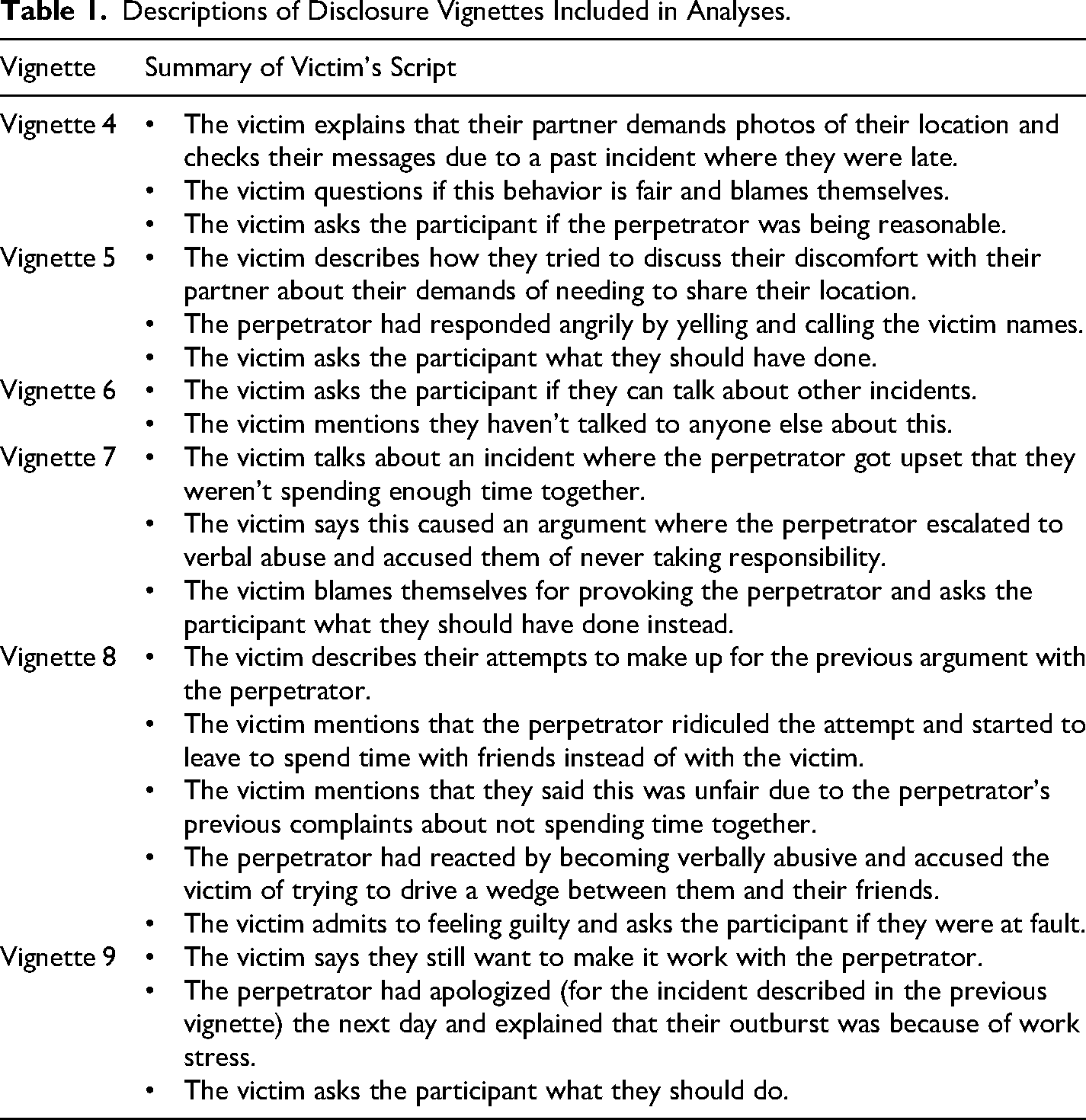
The audio vignettes were pilot tested with 16 first-year university students who also completed six items adapted from the Presence Questionnaire (Witmer & Singer, 1998). This scale is designed to tap into immersion and involvement (in our case in the vignette). Participants indicated their agreement with statements on 1 (strongly disagree) to 7 (strongly agree) Likert-type scales. Example statements included “It sounded like I was talking to a real person.” Results indicated immersion, with mean scores (M = 5.55, SD = 0.92) significantly above the midpoint of the scale, t(15) = 8.50, p < .001, with the degree of immersion not differing between those presented with the female (M = 5.55, SD = 0.96) or male victim (M = 5.55, SD = 0.96), t(14) = 0.02, p = .987.
Participants and Sample Characteristics
Data for this study were provided by 28 Australian residents who were randomly sampled from the larger dataset. Participants ranged in age from 19 to 62 years (M = 34) and provided responses of between 125 and 1117 words (M = 448, SD = 245.86). This subsample was selected pseudo-randomly using a random number generator. We only selected from participants who responded to all vignettes and purposely selected seven of each victim and participant gender pairings (male-male, female-male, male-female, female-female). Although participants’ individual responses were varied and complex, there were consistent patterns in how they responded. These patterns allowed for the necessary nuanced and organic theme construction such that we opted not to expand our subsample (Braun & Clarke, 2016).
Data Analysis
To analyze participants’ responses, we followed Braun and Clarke's (2022) guidelines for reflexive thematic analysis using a contextualist approach. Thematic analysis was chosen because of its flexibility in identifying and interpreting patterns within the language participants used. This allowed us to examine how support was conveyed as the disclosure developed through the vignettes. A contextualist approach allowed us to interpret individual elements of participants’ responses by considering their purpose and function within the context of the disclosure and in relation to other aspects of participants’ responses.
We followed the standard six-phase approach described by Braun and Clarke (2022): data familiarization, generating initial codes, searching for themes, reviewing themes, defining and naming themes, and producing the report. All authors participated in the data familiarization step, though coding and theme construction were predominantly completed by the first author RVM and third author KJ. First, RVM and KJ independently coded eight transcripts, selecting two transcripts from each victim and participant gender combination to generate an initial coding structure. As recommended by Braun and Clarke (2022), meetings prioritized sharing perspectives over obtaining consensus on codes for a singular interpretation. This initial round of coding was to calibrate RVM, who coded the remaining transcripts independently.
After completing coding, RVM then met with KJ to begin searching for and reviewing themes. Once a loose thematic structure was constructed, all other authors reviewed the themes and assisted with refining how the themes were defined and named. During coding, we focused on identifying what participants explicitly said in response to the victim. In the theme construction process, we observed patterns in what participants had said that were consistent with various types of support and techniques for providing that support. These patterns became the structure of our themes (types of support) and subthemes (support techniques).
Throughout the analytical process, all authors reflected on how our interpretation of participants’ responses cannot represent how victim-survivors may perceive responses. The themes and subthemes are constructed to describe the types of support participants provided rather than classifying responses as positive or negative based on how they may be interpreted or potential clinical impacts. However, we do consider the potential clinical impacts of certain responses where empirical evidence exists to demonstrate that impact. For example, the empirical evidence shows that responses promoting avoidant coping are likely to have a negative impact on victim-survivors regardless of whether the victim-survivor interprets it as a positive or negative response (Chao, 2011; Dworkin et al., 2019; Suls & Fletcher, 1985).
Results
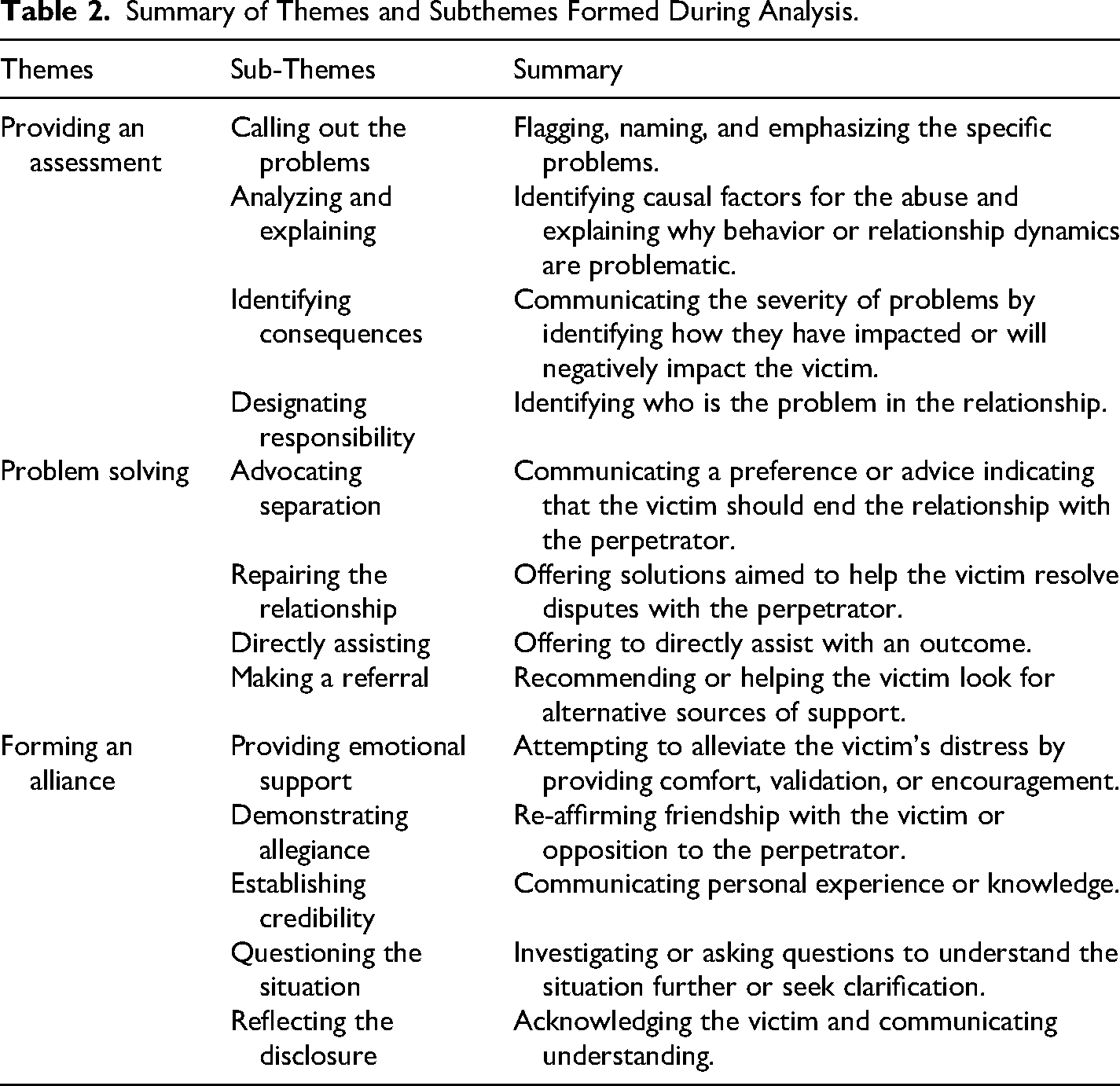
All participants consistently offered support or tried to help the victim throughout the disclosure, regardless of the gender of the victim. We identified three themes for the broad types of support that presented at varying levels of emphasis in all participants’ responses: (1) Providing an Assessment, (2) Problem Solving, and (3) Forming an Alliance. We describe these themes as neutral types of support, in the sense that they are not inherently helpful or harmful to the victim. Rather, these themes reflect behavioral approaches that participants took when responding to the victim. The use of positively or negatively valanced adjectives, such as comforting or minimizing, respectively, describes variations in how any of the themes or subthemes could present.
There were often differences in the techniques participants used when engaging in Providing an Assessment and Problem Solving depending on the victim's gender. We describe these differences within our overview of the subthemes for these types of support. There were no notable differences as a function of victim gender in the methods used for Forming an Alliance. Further, none of the themes and subthemes we describe are participant gender-specific. A summary of our definition of our themes and the subthemes within them is provided in Table 2. We elaborate on these definitions and provide examples of how they are presented in participants’ responses within this section. Several of our subthemes also co-occurred, with participants often drawing on multiple types of support to communicate a specific point. In this section, we identify and discuss these common co-occurring responses to illustrate how the function of communicated support can overlap or take different forms depending on the disclosure recipient's approach. These connections are also shown in the thematic map in Figure 1.
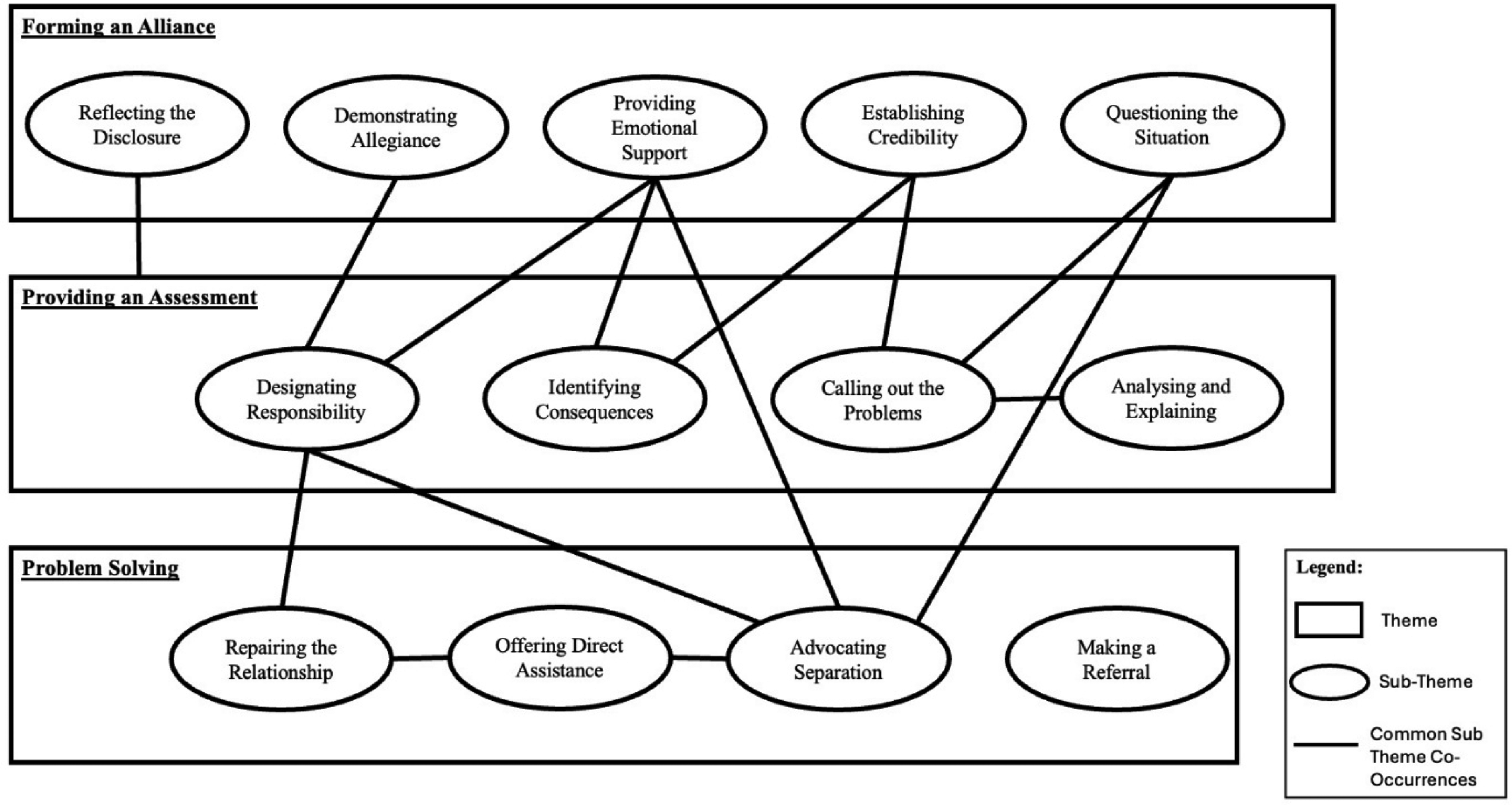
Thematic map of themes and subthemes.
Summary of Themes and Subthemes Formed During Analysis.
Providing an Assessment
The first theme was characterized by responses focusing on helping the victim understand and process the situation. Here participants offered explanations for the perpetrator's behavior and/or challenged the victim's perceptions. The broad types of responses participants used to provide an assessment involved (a) Calling Out the Problems, (b) Analyzing and Explaining the Problems, (c) Identifying Consequences, and (d) Designating Responsibility. This theme is exemplified by the following quote: Girl, you did not mess up at all. None of this is your fault. What it sounds like is an abusive relationship. He is projecting. He is manipulating you and your situations and he's abusing you at every opportunity he can. And you know why they do this? They try to bring you down so that it lowers your self-esteem and so that you won't leave them. And that's exactly what he's doing here. (Participant 2, Female Participant and Female Victim)
This excerpt was in reply to the victim stating that they “messed up” and caused an argument by disappointing their partner. The participant begins by challenging the victim's cognition through clearly designating the perpetrator as responsible. They then begin calling out problems by labeling the perpetrator's behavior as abusive and identifying specific abnormal behaviors. This is followed by analyzing and explaining the perpetrator's behavior as a method of lowering the victim's self-esteem. Finally, the participant identifies the consequences of the perpetrator's behavior by explicitly stating that the victim's self-esteem is being lowered.
Calling Out the Problems
Calling Out the Problems was the most common type of response observed and describes where participants identified or flagged concerning behavior or aspects about the relationship to the victim. The strongest examples involved labeling the situation or perpetrator's behavior: Ah, red flags. Dude, that's totally not cool. If he's going through your text messages there's not a lot of trust going on there. (Participant 28, Female Participant and Female Victim) It is two possibilities here. Either she's an idiot or she's gaslighting you and I am leaning towards gaslighting, to be honest. (Participant 7, Male Participant and Male Victim)
Participants typically used more extreme language when describing or labeling a male perpetrator's behavior towards a female victim, compared to when they described a female perpetrator and male victim. Participants responding to the male victim typically labeled the perpetrator's behavior as unhealthy, toxic, or problematic. These labels contrast with those given to the female victim where participants typically described the behavior as harmful or manipulative and labeled the relationship as abusive. However, it is unclear if labeling the relationship as abusive indicated that participants considered the behavior to be IPV. In most examples of when behavior was labeled as abusive, participants were suggesting it could “almost” be IPV by describing it as “It's nearly turning into domestic abuse from what you're telling me” (Participant 11, Male Participant and Female Victim). There were very few examples of when participants explicitly labeled the behavior or relationship as abusive or IPV, such as stating that “What it sounds like is an abusive relationship” (Participant 2, Female Participant and Female Victim).
Analyzing and Explaining
Analyzing and Explaining frequently co-occurred with Calling out the Problems as many participants were focused on helping the victim understand why the perpetrator's behavior was unacceptable. As shown below, this often involved elaborating on what the perpetrator may have been trying to accomplish: The way he's going about it has no respect in it. It's, uh, incredibly controlling and he's shifting all he's doing. All this blame transference from himself to you to make you feel bad. (Participant 19, Male Participant and Female Victim)
Alternatively, some participants made assumptions about external or underlying causes for the behavior. This included several participants speculating about the perpetrator's behavior stemming from past relationship difficulties or trauma — though this only occurred in response to the male victim: She sounds pretty insecure about things like that. Maybe she's got a bad history with a past relationship or something like that. Because to me, like someone going through your messages is pretty intense. She seems like she's got some trust issues or something going on there. (Participant 26, Female Participant and Male Victim)
Other examples involved relating the abusive behavior to the perpetrator's mental state, such as “I think Josh has anger management issues” (Participant 18, Male Participant and Female Victim), or “she kind of sounds a bit narcissistic. Or like she's got some sort of psychopathic personality disorder” (Participant 20, Male Participant and Male Victim).
Identifying Consequences
Identifying Consequences was the least frequently observed example of Providing an Assessment and is similar to the sub-theme of Calling out the Problems. Identifying Consequences involved communicating the immediate or long-term harmfulness of the perpetrator's behavior, whereas Calling out the Problems served to identify specific instances of problematic behavior. For the female victim, Identifying Consequences mainly presented as participants expressing concern for the victim's physical safety: You can't calm people like that down. He's there. He couldn't have done anything right? He sounds really abusive. (Participant 13, Female Participant and Female Victim)
Other examples vocalized the immediate impacts of the perpetrator's behavior to help the victim understand the harmfulness. For example, one participant explains that the perpetrator is causing the victim to doubt their perception of reality: I feel like that's a tricky place to be. Because if you're with someone who you care about that does that, then it can often make you doubt your own perception of reality. (Participant 26, Male Participant and Male Victim)
There were also some instances of minimization, primarily for the male victim. This is often presented through dismissive advice or assessments, as can be seen below. Although the participant acknowledges a need for the victim to disengage from the perpetrator (“walk away”) because of the stressful behavior, they fail to acknowledge the consequences of this situation and imply it is something easily ignored or forgotten: I would have just ignored her, walked away and just forgotten about her mate. It's seriously not worth the trouble, it's not worth the stress. Just leave it be. (Participant 5, Male Participant and Male Victim)
Designating Responsibility
Designating Responsibility occurred in all responses, typically alongside other types of responses. Typically, responsibility was designated by stating that the victim should not accept the perpetrator's behavior, such as “I think really you shouldn't be accepting these behaviors” (Participant 23, Male Participant and Male Victim). Others simply indicated that the perpetrator was at fault by “It's not ok that he's doing this stuff. He can't be angry at you” (Participant 27, Female Participant and Female Victim).
In our sample, all participants communicated that they believed the perpetrator was responsible for the abuse. However, we observed one instance of responsibility being attributed to the victim, which is shown in the following excerpt from a single participant's response to vignette 7. As the victim revealed more examples of the perpetrator's abuse in subsequent vignettes, however, this participant designated the perpetrator as responsible: Vignette 7: Um, as hard as it is, um, I guess it's important to take a step back and try to be more compassionate. It's understandable that Jess will be upset about not spending enough time together with you. But remember, on the other hand, it also goes both ways, and she should be making an effort to come up with some kind of resolution, too. Vignette 8:If she wanted to go out and spend time with her friend instead, she can't have any issues with you never making time for her. It just doesn't make sense at all. Vignette 9: Honestly, I don't think you should do anything. It sounds like you'd be better off without her. And you deserve someone that actually treats you and respects you quite well. (Participant 12, Male Participant and Male Victim)
Problem Solving
This theme describes responses focused on trying to resolve the cause of the victim's problems or distress through offering suggestions or providing advice. Problem Solving was the dominant theme in participants’ responses, likely due to them being directly asked for advice by the victim. Problem Solving typically involved (a) Advocating Separation, (b) Repairing the Relationship, (c) Offering Direct Assistance, and (d) Making a Referral.
Advocating Separation
The most common form of problem solving involved participants suggesting that the victim should leave the perpetrator: Seriously run for the hills. Break up with him right now. He sounds such a controlling freak. If he's gonna get that angry for something like that, then there's no long-term future in this relationship, so break up with him. (Participant 11, Male Participant and Female Victim)
Further, while Advocating Separation was present for both the male victim and the female victim, it occurred more frequently and was sometimes expressed more urgently in responses to female victims. This pattern may reflect heightened concern for female victims and/or a tendency to view women as less able to make autonomous decisions relative to men. In contrast, responses to male victims were usually worded as recommendations that gave them more agency in their decisions: “To be honest with you, I feel like you really need to consider whether or not this is gonna be something that will work for you at all” (Participant 4, Male Participant and Male Victim).
Finally, the frequency and intensity of these recommendations often increased later in the conversation. A few responses revealed frustration, such as, “I think you're going crazy at this moment and I think you should just leave him. I mean, I told you a million times” (Participant 8, Male Participant and Female Victim).
Repairing the Relationship
Repairing the Relationship was also a common type of Problem Solving where participants offered suggestions for conflict resolution or improving the victim's relationship with the perpetrator. Advice to repair the relationship with the perpetrator was more often observed for male rather than female victims.
Suggestions mostly involved advising the victim to talk to the perpetrator, such as “I think you should talk to her and just find out the root of why she's acting so controlling” (Participant 14, Female Participant and Male Victim). However, a few participants offered advice with specific phrasing to use for conflict resolution: You can maybe be like, actually tell her, um, how, like this is making you feel, you know like; ‘You know, when you react this way, like it it doesn't make me feel, you know, I'm trying, you know, just be like, Look, I'm trying really hard. Uh, I do try to make time for you. Um, you know, But I do. I feel like, um, you're being really kind of overly harsh, like it makes me feel like I'm not good enough.(Participant 25, Female Participant and Male Victim)
Other examples appeared to minimize the victim's situation by framing it as a communication issue or a lack of boundaries with participants making suggestions such as “You kind of need to establish what your boundaries are. If you're not comfortable being yelled at, then you need to tell her that you're not comfortable being yelled at” (Participant 6, Female Participant and Male Victim). More overt examples of minimization promoted avoidant behavior or submission: “You just sit there, be quiet, let her rant and rave and say nothing. That's all you gotta do” (Participant 5, Male Participant and Male Victim). However, when advising the female victim to repair the relationship with the perpetrator, participants usually indicated that they didn't consider it to be the best option and would often still advocate for separation:
If you really wanted to understand and talk to him, I would say you go to a safe space like a public area, just to ask you so he can't actually escalate anymore or yell at you. But really, it's a four-month relationship. It's probably time to cut your losses. (Participant 3, Female Participant and Female Victim)
Offering Direct Assistance
Offering Direct Assistance through personally helping the victim in some tangible way was one of the least common responses, likely in part due to the simulated victim's inability to directly respond. These responses usually overlapped with Advocating Separation by offering the victim a way to escape the perpetrator, such as one participant offering the victim a place to stay: “I think you should come and stay with me for a for a month at least. I really wanna make sure you're safe to start with” (Participant 28, Female Participant and Female Victim). I can support you with that. If you want to have a chat with her together so that you're not alone or if you wanna stay over or something like that. We need to chat more about it mate. (Participant 24, Female Participant and Male Victim)
Making a Referral
Making a Referral was also an infrequent response and involved recommending an alternative source for social support. Most examples recommended getting counseling: “I think maybe you guys could talk to someone like a counselor or something” (Participant 10, Female Participant and Male Victim). Another participant stated: I just feel like you really need some help and professional help at this point because there's only so much I can do. You know I 100 percent support you. If you'd prefer me to be there, I would support you. (Participant 2, Female Participant and Female Victim)
Forming an Alliance
This final theme captures responses that were not focused on resolving the situation. Rather, those who focused on Forming an Alliance enhanced other types of responses by establishing themselves as safe, trusted, and reliable sources of support. There were also no notable differences in how types of responses presented for male or female victims. The sub-themes for Forming an Alliance are (a) Providing Emotional Support, (b) Demonstrating Allegiance, (c) Establishing Credibility, (d) Questioning the Situation, and (e) Reflecting the Disclosure.
Providing Emotional Support
Emotional Support was present in many participants’ responses, though it was often the least salient component of their responses. Most examples of emotional support typically occurred in direct response to the victim engaging in self-blame, with participants offering validation or reassurance. These examples differed from Designating Responsibility in the sense that they often contained de-shaming statements (Steindl et al., 2023), such as “It was not dumb of you to bring it up. And it's actually really great that you felt comfortable doing that. His reaction to you bringing it up is completely unacceptable” (Participant 9, Female Participant and Female Victim).
Other examples of emotional support centered around providing comfort or positive affirmations, for example, one participant stated: “She didn't even acknowledge any of your effort and made you feel bad about trying to make dinner for her and putting in all of that work. Like you are trying. Don't feel bad, bro” (Participant 20, Male Participant and Male Victim).
Other compliments offered affirmation of the assumed positive characteristics of the victim, “I honestly think Olivia, you're doing the best that you can, and I know that you're a wonderful, caring, empathetic person” (Participant 2, Female Participant and Female Victim). Other participants re-affirmed the victim's value while advocating separation, such as, “You shouldn't be with a person like that. You deserve much more. And I'm pretty sure there are thousands of millions of people out there and there's definitely someone way nicer than her” (Participant 15, Female Participant and Male Victim).
Demonstrating Allegiance
The subtheme of Demonstrating Allegiance included responses that aligned participants with the victim. Here participants communicated their willingness to support the victim and/or positioned themselves as being against the perpetrator. For example, one participant stated: I'm glad that you feel comfortable telling me. And I'm really happy that you're bringing this up because this is something that you should be talking about to someone. Thank you for sharing this. (Participant 1, Female Participant and Female Victim)
This type of response mostly occurred in reply to the victim asking if they could continue the disclosure, but it was not typical of responses to this question. Most simply stated that it was ok for the victim to continue, “Yeah, that's OK. Ask whatever you want” (Participant 21, Male Participant and Male Victim).
The most common example of Demonstrating Allegiance was when participants described the perpetrator negatively, such as “Oh my goodness. The more you talk, the more I hate her” (Participant 15, Female Participant and Male Victim). Other examples included more explicit and negative comments about the perpetrator.
Establishing Credibility
Establishing Credibility was the least common type of response observed. It involved responses that participants might use to communicate either their understanding of the victim's situation or that the perspective they offer is informed. An example of this is seen in Participant 21's response where they use their occupation to back up their assessment of the relationship, “I work in domestic violence, and this is an abusive relationship. You need to get out of this” (Participant 21, Male Participant and Male Victim). However, most examples involved participants self-disclosing, as shown in the response below of a participant who used self-disclosure to communicate empathy while providing emotional support: Yeah, bro. I don't really know. Like, it's kind of a bit of a red flag the way she's treating you. Um, I've had a girlfriend in the past that used to, like, lose it at me and be like that, and it feels really bad. It's not very nice. (Participant 20, Male Participant and Male Victim)
Self-disclosure was also used by participants in attempts to relate to the victim. An example of this is found below, where the participant also used their own experiences to support their predictions about the trajectory of the relationship: I'm actually worried about your safety. I've been in this situation before and it's really difficult to see it when you're in there. Cause you think this person is in love with you, but he's not. I do know that he'll hit you soon. He'll hurt you. (Participant 28, Female Participant and Female Victim)
Questioning the Situation
Questioning the Situation refers to when participants asked clarifying or investigating questions. While the victim was simulated and unable to respond, some of these seemed to be participants asking genuine questions: You don't need to report in to anyone as to where you are. Is this something that you're comfortable with? You know, um, how does it make you feel? Are you OK? (Participant 2, Female Participant and Female Victim)
In the response above, the participant indicates concern about the monitoring abuse the victim is experiencing but asks the victim to clarify if it's consensual. Other questions were phrased in a way that suggested participants were trying to lead the victim to recognize the problematic behavior or a solution, such as “I think that you need to get out of this relationship. I really do. Do you? Do you think so?” (Participant 27, Female Participant and Female Victim).
Questioning the Situation also involved asking the victim why they were still with the perpetrator. This questioning mostly occurred in the final vignette when the victim mentioned they wanted to try and make it work with the perpetrator, which seemed to frustrate some participants: Have you not just spent the last, you know, 10 min describing how awful he is to you? But why would, why would you want to continue doing that? (Participant 9, Female Participant and Female Victim)
Reflecting the Disclosure
Reflecting the Disclosure involved either summarizing, paraphrasing, or otherwise repeating elements from the victim's disclosure. The first type of reflection involved recognizing the victim's preferences: “I know you're trying to be supportive, and maybe she's having a stressful time, but that's not fair if, like we all have stressful times” (Participant 24, Female Participant and Male Victim).
Other examples involved engaging in predictive empathy by acknowledging what the victim had said then expanding on it by Identifying Consequences: “If he's calling you names, then it's just not cool. He's probably making you feel like you're a total piece of crap and that's not on” (Participant 28, Female Participant and Female Victim).
Discussion
In this study, we sought to determine how people respond to disclosures of non-physical IPV by a male or female victim in the context of a heterosexual-appearing relationship, focusing on the broad types and methods of providing support. We identified two types of practical or informative support (Providing an Assessment and Problem Solving) in which responses were focused on preventing the abuse. These types of responses were common and the specific presentation and focus of this support often varied depending on the victim's gender. Less commonly, we observed relationship building or affirming support (Forming an Alliance), which involved responses that established recipients as attentive and dependable supporters.
Providing an Assessment—Non-Physical IPV as a Toxic Relationship
Encouragingly, all participants recognized the perpetrator's behavior as problematic and unacceptable. Although very few participants explicitly defined the behavior as IPV—perhaps reflecting awareness that applying this label may damage the relationship if the victim has not yet identified the behavior as abuse—all participants acknowledged the victim's need for support and advice. This is noteworthy, as the absence of physical abuse can often reduce others’ willingness to support those in an abusive relationship (Carlisle et al., 2022; Doolabh et al., 2022; Minto et al., 2021).
However, participants’ assessments of the victim's relationship often communicated greater concern for the female victim's mental and physical health than the male victim. One possible explanation is that participants may implicitly link non-physical IPV with the risk of escalation to physical violence and recognize that women are at greater risk of severe physical injury when violence is perpetrated by a male partner (McLindon et al., 2025). This perceived trajectory, from non-physical IPV to potentially serious harm, may therefore heighten concern for female victims in particular. This possibility is also consistent with the differences in how participants labeled the abuse and communicated potential consequences for male and female victims.
Most participants framed the male victim's relationship as toxic or troubled rather than violent or abusive. In contrast, participants responding to female victims were more likely to label the relationship or perpetrator's behavior as abusive. Further, participants were more likely to identify both the short and long-term consequences of the female victim's relationship than the male victims. Instead, with the male victim, participants focused more on analyzing the perpetrator's behavior to identify or explain the cause of it. As such, participants were more likely to attribute the female (relative to the male) perpetrator's behavior to external causes, such as trauma from prior relationships. In contrast, the male perpetrator's behavior was attributed to internal factors such as personality.
Many male victim-survivors of IPV have described informal disclosure recipients or supporters as failing to recognize or validate the harmfulness of their experiences (Hogan et al., 2021). Additionally, male victim-survivors often feel that supporters don’t know how to respond or how to help, making male victims less likely to seek help (Hogan et al., 2021). However, these issues are not exclusive to male victim-survivors, as female victim-survivors of IPV often report similar experiences (Hegarty et al., 2022). Consistent with these experiences, we observed some overt instances of minimization and victim-blame. However, in our study, these responses were unique to male victims with the most overt examples given by men. This may suggest that the gender of those providing support may also influence how disclosures are interpreted and responded to.
Research suggests that emotional support can be influenced by the gender pairings of those providing and receiving support (Burleson et al., 2005). In comparison to women, men have been observed to be less favorable toward providing comfort, more likely to endorse dismissive support, and more likely to be influenced by attributions of responsibility, especially towards other men (Burleson et al., 2005). Accordingly, participant gender may represent an additional factor that influences whether responses emphasize validation and concern or shift toward minimization or designating the victim as responsible. However, further research is needed to explore the association between normative masculinity and emotional or social support to understand how responses to disclosures of IPV may be influenced by traditional gender roles. Broadly, our observations support victims’ descriptions of the issues that disclosure recipients have in recognizing abuse as IPV (Carlisle et al., 2022; Minto et al., 2021). However, even in the absence of directly labeling behavior as IPV, our results show that people are still motivated to help.
Problem Solving—Advising or Directing?
Participants mainly tried to help the victim by either providing advice about how to repair the relationship or advocating for separation. In fact, many participants discussed both solutions at least once throughout the disclosure. Usually, participants first offered conflict resolution strategies for both male and female victims. However, participants usually began trying to convince the victim to end the relationship as more examples of the perpetrator's abuse were revealed. While this directness may reflect the simulated nature of the interaction, or the comparatively short duration of the relationship being spoken about, this pattern is consistent with work by Minto and colleagues (2021) who showed that a few isolated incidents of non-physical IPV can be perceived as issues within a relationship that may be resolvable. However, people are typically more supportive of separation if there are repeated and recognizably harmful examples of non-physical IPV (Minto et al., 2021). As such, participants’ reasoning for advocating separation may have primarily been out of concern for the victim's safety, especially for the female victim.
Many victims are not initially willing to separate from their partners due to the stigma associated with IPV and social pressures to make relationships work (Anderson et al., 2003). This is why advocating separation can at times be beneficial as it shows the victim that these social expectations don’t apply to their situation (Hegarty et al., 2022). However, victims can be financially or otherwise dependent on the perpetrator and lack the resources to support themselves after separation (Anderson & Saunders, 2003; Hegarty et al., 2022). Further, victims may also not have the emotional or psychological readiness to commit to such a change (Anderson & Saunders, 2003; Hegarty et al., 2022). If a victim receives advice that does not match their readiness to accept or use, they will usually perceive it as negative (Hegarty et al., 2022; Sylaska & Edwards, 2013).
Participants were more insistent when advocating separation for female victims. Instructions to end the relationship were often communicated as directives, without acknowledging the victim's emotions or offering practical aid to assist with separation. Such responses especially occurred when the female victim indicated wanting to make the relationship with the perpetrator work. This pattern contrasts with responses to the male victim where most participants advocating separation acknowledged the male victim's preference and were typically gentler in challenging it. As noted above, this difference may occur because participants perceive less risk to the safety of the male victim compared to the female victim. Alternatively, it may reflect participants’ gender stereotypical views that frame female victims as more vulnerable and in need of protection and explicit direction, while male victims are afforded greater decisional autonomy (Bates et al., 2019). While a concern for victims’ safety is positive, it is possible that fear around victim safety may inhibit other types of responses that are critical for victims of IPV, such as respecting their autonomy (Hegarty et al., 2022). Overall, our results suggest that inhibition of other forms of support in favor of problem solving may be a particular issue for female victim-survivors.
The Importance of Forming an Alliance
Forming an Alliance responses provide the support IPV victim-survivors want most from friends and family (Hegarty et al., 2022). These responses acknowledge and show interest in the victim's emotions and experiences with the abuse, rather than just the abuse itself. Despite the importance of forming an alliance, these types of responses were the least common (relative to other aspects of responding). Rather, participants prioritized responses that might directly stop the abuse through educating or advising. Such responses could perhaps result in the victim's emotions being minimized. Note that in past work the prioritization of education and advice has been shown to result in well intended support being seen as unsolicited and unhelpful (Hegarty et al., 2022; Relyea & Ullman, 2015).
The advice to simply leave a relationship may also be problematic, for reasons other than dependency as mentioned above. Sometimes attempts at intervention can provoke conflict with the perpetrator and escalate the abuse (Anderson & Saunders, 2003; Hegarty et al., 2022). If this happens after victims take supporter advice, victims may become less receptive to future aid. In turn, this could contribute to the perception that IPV victims generally do not want help (Anderson & Saunders, 2003; Hegarty et al., 2022). In our study, the victim was prompting participants for advice. Nonetheless, at every step participants were instructed to respond as though they were speaking to a close friend and had the opportunity to provide emotional support and build an alliance. That they often did not suggests that there may be a persistent discrepancy between the types of support informal supporters and victims believe is helpful. The minimal focus on forming an alliance with victims suggests a key opportunity for public awareness interventions aimed to help develop people's scripts for responding to a disclosure of non-physical IPV, and perhaps IPV generally.
Along these lines, Banyard and colleagues (2018) found that informal supporters reported not having a clear behavioral script for helping IPV victim-survivors. However, our results indicate that individuals’ behavioral scripts may contain all the necessary types of support for a positive response. The problem with the script then might be the distribution of types of responses, rather than the responses themselves. While participants’ focus on trying to resolve the victim's situation or explain the harmfulness of the abuse is not inherently problematic, these types of support need to be balanced with forming an alliance. As such, IPV training programs for informal supporters may benefit from communicating that forming an alliance with victim-survivors can be just as impactful as attempts to resolve the situation or explaining the harmfulness of the abuse.
Limitations and Future Research
This study offers a novel perspective into the types and methods of support disclosure recipients provide to victims of non-physical IPV experiencing verbal and monitoring abuse in heterosexual relationships. However, the following limitations should be considered.
The first concerns the use of audio vignettes. Although these were designed to enhance ecological validity, and participants demonstrated strong engagement, the simulation lacked many features characteristics of naturalistic conversation (e.g., alignment of speech behaviors, reciprocal exchanges). This likely constrains the generalizability of the findings to real-world disclosures of non-physical IPV.
Further, the abusive behaviors depicted in the vignettes do not represent the full range of non-physical IPV (e.g., sexual coercion). Sexual coercion is a particularly complex form of non-physical IPV, as perceptions of and reactions to it depends on the inferred motives for the behavior (i.e., motives specific to sexual control versus broader patterns of control, with only the latter aligning with other forms of non-physical IPV) (Murray et al., 2016). Sexual coercion also frequently co-occurs with physical abuse and can precipitate physical sexual abuse (McLindon et al., 2025). This means that reactions to sexual coercion may be affected by the assumption of the co-occurrence of physical abuse.
Second, given that schemas unrelated to non-physical IPV influence reactions to violence in non-heterosexual relationships (Stuart, 2020), as an initial exploration our analysis is limited by its focus only on disclosures in heterosexual-appearing relationships. The demographics of the simulated victim are also not representative of gender, sexual, or ethnic minorities. Help-seeking behaviors and support needs among victim-survivors in minoritized populations can differ depending on cultural norms and minority stressors (Sylaska & Edwards, 2015), which may affect how support is provided or received.
Finally, the simulation was designed so the victim displayed minimal emotional distress, which may have reduced participants’ perceived need to provide emotional support or comfort. The simulation also involved the victim actively choosing to disclose and examined only responses across the first occurrence of a disclosure. As little research exists on disclosures prompted by a concerned individual or on how support across repeated interactions with victim-survivors, the extent to which the observed support types and methods generalize to other disclosure styles remains unclear.
Given these limitations, we advocate for co-produced research examining the support needs and experiences of victim-survivors in all populations, using methodology that more closely approximates naturalistic conversations. Future research should example how sexual coercion affects the types and methods of support provided, and how reactions to disclosures vary (or not) in non-heterosexual relationships. Research replicating our simulation approach should consider varying the style of the disclosure to examine differing emotionality, levels of victim help-seeking or change readiness, and the provision of long-term support.
Beyond methodological limitations, there are further limitations of the research relating to our sample. Demographic information collected was limited to age and gender, which prevented an examination of whether cultural background, sexuality, or relationship status influenced responses. The decision to include a relatively smaller sample meant that our analysis captured only a narrow snapshot of the potential breadth of responses to this type of disclosure. However, our analyses focused on identifying broad types of support applicable across a range of non-physical IPV disclosures. Future research with larger samples would be better placed to identify important nuances in how specific types of support are framed or worded in order to better understand potential causes for negative responses.
Conclusion
Our study provides an observer's perspective on how informal supporters respond to disclosures of non-physical IPV. Previous studies relied on IPV victims’ and disclosure recipients’ recollections and perceptions of how disclosure interactions unfolded. Building on this work, our use of a simulated interaction allowed us an independent method of describing the types of support offered in response to a disclosure of non-physical IPV. Our results show that these disclosures can trigger positive helping behaviors from others, regardless of whether disclosure recipients formally identify the behaviors as IPV. However, the practical and informational types of support that were primarily offered provided little acknowledgment of the victim's perceptions or feelings. Responses that aligned with reports of what IPV victim-survivors find helpful comprised a balance of informational, practical, and relationship building or affirming responses (Hegarty et al., 2022). Future training interventions could focus on educating potential disclosure recipients about how to balance practical support and advice with emotional and affirmative support that respects victim-survivors’ autonomy.
Footnotes
Acknowledgments
The authors would like to express their appreciation for the victim-survivors who helped refine the materials for this study. Their feedback and the stories they shared were invaluable to research. The authors would also like to thank the participants in the pilot and main study for their contributions.

Ethical considerations
The Research Ethics and Integrity Office at the University of Queensland approved our study (Approval: 2022/HE001954) on October 27, 2023. Respondents indicated consent digitally prior to participating in the study.
Funding
The authors disclosed receipt of the following financial support for the research, authorship, and/or publication of this article: This study was conducted using funds available to PhD Students. These funds were provided by the University of Queensland, School of Psychology.
Declaration of Conflicting Interests
The authors declared no potential conflicts of interest with respect to the research, authorship, and/or publication of this article.