






Abstract
Transportation infrastructure projects organize mobility and land-use development across metropolitan areas. As such, they are typically undertaken by states, regional governments, or public authorities overseen by higher-level governments. But since these projects have localized implications, city governments have an interest in shaping project planning. I examine case studies of six rail transit projects in France and the United States to understand the regional politics of infrastructure investment. I show that even when deprived de jure jurisdiction over planning, local governments harness the broadly shared view of their democratic legitimacy to exert de facto power over matters affecting them. Localities increase their power through inter-municipal alliances composed of cities whose residents hold contrasting ideological viewpoints. These alliances are founded on mutual deference, which means an agreement to support—or at least not oppose—the perspectives of neighboring localities if doing so does not threaten a locality's own needs.
Introduction
Infrastructure investment has caught fire as a means to accelerate economic growth and promote social equity, and as such has become a national spending priority in the United States, Europe, and China (Freemark et al. 2023; Hancock 2023; Moens 2023). But these investments have substantial localized implications. Many constitute improved transportation, such as new rail lines whose construction requires the demolition or reconstruction of certain neighborhoods, whose stations generate substantial private-sector investment in surrounding development, and whose services improve mobility for residents of a particular area.
Despite these local repercussions, in the interest of coherent regional planning many large infrastructure projects are planned and ultimately constructed by public or semi-public entities controlled by officials representing higher-level governments. Paris's suburban metro, for example, is being constructed by a national government-run organization, the Société des Grands Projets. Minneapolis's new light rail line is being built by the state government-controlled Metropolitan Council. In each case, the new line crosses through many local jurisdictions, each of which has its own elected leaders who are interested in competing for residents and jobs.
Given these circumstances, what official and unofficial roles do localities play in metropolitan-scale infrastructure? Can their leaders affect the planning and design of regional projects? And if so, how do they do so in the context of competition between municipalities?
To answer these questions, I examine case studies of six projects in France and the United States. For each, I conduct on-the-ground interviews and archival research. I focus on transit projects because they are a key backbone for many regional plans, they are expensive undertakings, and constructing them raises special challenges because they often cross through many local jurisdictions featuring variation in the political ideologies of their residents and elected leaders. My comparative approach allows the deciphering of common traits among projects in two countries with different political and economic systems. This, in turn, allows me to detect how local leaders promote their goals.
I offer several insights into how regional infrastructure planning works. First, I document the formal relationships between governmental entities. I illustrate that metropolitan-scale transportation projects are often officially planned and managed by regional entities designed to overcome the fragmentation of local governmental authority. This institutional structure limits the de jure power of local governments in making choices related to project planning.
Second, I show that local leaders can, nonetheless, influence the planning and design of projects. This is enabled by officials at all levels of government who confer a high level of democratic legitimacy on local actors, thus giving localities de facto power over regional planning decisions. This shift in power has economic and efficiency consequences; higher-level officials often subvert the regional interest—such as limiting expenditures of higher-level governments—in favor of local goals.
Finally, I evaluate how localities leverage this power even though the officials representing them hold contrasting ideological viewpoints and have sometimes conflicting local goals. I emphasize that local officials maintain a culture of mutual deference, which means an agreement to support—or at least not oppose—the perspectives of neighboring localities if doing so does not threaten a locality's own needs. Using examples from the Twin Cities and Paris, I show that this allows cities to construct mutually beneficial intermunicipal alliances that increase joint bargaining power over theoretically more powerful regional and national interests. These alliances come about through informal and formal structures of dialogue between local leaders. Officials in higher-level governments respond to these alliances by altering project plans to meet local priorities. Thus, even when deprived de jure jurisdiction over planning, local governments work collectively to exert de facto power over planning matters affecting them.
Literature Review
Metropolitan areas in countries like France and the United States are comprised of dozens or hundreds of localities, each with their own elected officials. These communities (such as towns and cities) typically hold power over land-use policies, such as zoning and building permitting, and they collect revenues to fund spending on policy areas such as policing, parks, and streets (Frug 1999). At the regional scale, this produces a state of “horizontal” fragmentation that encourages competition for limited resources and results in socioeconomic and fiscal inequalities (Briffault 1990; Freemark, Steil, and Thelen 2020; Pinson 2010). This situation may jeopardize the production of metropolitan-scale infrastructure crossing through multiple jurisdictions. On the one hand, localities and their leaders have an interest in influencing these investments, since these could encourage economic growth within their boundaries. On the other hand, too much local influence—particularly if localities disagree about plans and priorities—could make achieving regional objectives difficult.
To address this fragmentation and nonetheless get large projects completed, countries have taken a variety of approaches. In France, the elected Île-de-France (Paris region) regional government develops transportation plans. In the United States, metropolitan planning organizations (MPOs) similarly produce regional transportation plans. MPO boards are usually comprised of local elected officials, appointees of elected officials, and/or transportation agency appointees. MPO plans include a “fiscally constrained” list of projects that can realistically be funded given expected resources and that, theoretically, provide regional benefits, but that list is typically formed by cobbling together other agencies’ desires (Sciara 2017).
French regional governments and US MPOs are far from the only set of entities involved in metropolitan infrastructure planning (Fischer, Ray, and King 2021). Higher-level governments (including counties, regions, states, and national governments) have sometimes created or empowered metropolitan-scale authorities or special districts. These entities are designed to direct project planning and implementation, thus achieving the regional objective of, for example, completing a new rail line, without having to rely on a regional general-purpose government, which is rare in the United States (Savitch and Adhikari 2017). In their influential study of rail, highway, and airport projects, for example, Altshuler and Luberoff (2003) emphasize that supra-local entities can take a leadership role and get large projects completed. These entities range from metropolitan authorities (Healey 2006) to semi-autonomous special districts (Berry 2009).
Whether metropolitan entities are created, and whether services are provided at the metropolitan scale, depends on the kind of activity involved. Williams (1971) argues for a distinction between activities that “control social access” (“lifestyle” activities) and those that are neutral in that regard (“system maintenance” activities). He suggests that issues such as housing policy, which have a major influence on who can live where, are likely to remain decentralized. On the other hand, policies like transit investment—my focus here—are more likely to be centralized up to the metropolitan scale because of scalar efficiencies and the lack of concern about controlling social access in that context (Hugg 2020). Savitch and Adhikari (2017) argue that the end result is that wealthy localities can hoard resources because of the tendency to avoid regional planning on issues that affect redistribution—those most relevant to social access.
Some metropolitan entities are not created by higher-level governments but rather produced through cooperative inter-local relationships, often voluntary (Feiock 2009). These agreements are common in Europe and frequently generate joint provision of public services like trash collection (Lidström 2017). Why might cities engage in such relationships? Municipal leaders are aware of their own interdependence (Meza et al. 2019) and they value the cost savings of joint service provision if it can be achieved with minimal risk (Andrew and Hawkins 2013). They may even enter into such agreements with localities whose residents hold different points of view, crossing partisan or ideological lines. While coalitions of individuals are different than coalitions of elected leaders, their approaches to regional governance may have analogies to the way leaders coalesce. Frick (2021, 62) describes tactical coalitions in which “citizens in opposing camps find common ground and yet retain their primary identities and values.” Localities and their leaders may themselves engage in collective action.
Weir, Wolman, and Swanstrom (2005) similarly show that cities collaborate to promote goals in state legislatures. They describe three coalition types in this context: (a) party-imposed coalitions, in which a dominant party promotes a common approach to achieving policy change; (b) interest-based coalitions, in which municipalities with similar problems collaborate; and (c) governor-backed coalitions, in which a state executive promotes certain goals. Savini (2012) notes that cross-border coalitions are feasible when there are possibilities for economic growth and the potential for strengthening intra-party linkages—particularly in places with partisan local elections, such as France. That said, Gerber, Henry, and Lubell (2013) find that communities with complementary types of residents are more likely to work together.
Once empowered, how do regional entities—whether in the form of voluntary agreements, special-purpose agencies, or regional governments—make planning choices about metropolitan-scale infrastructure? Voluntary inter-local cooperative groups depend on shared agreement about goals and break down with divergence in opinions (Lindstrom 2010). Localities thus pursue cooperative approaches in mutually beneficial circumstances, or at least a state of mutual deference, meaning allowing others to benefit as long as it does not hurt you (legislators in the US Congress, e.g., may prefer such universal benefits in distributive policies because they perceive it as a form of mutual backscratching; see Shepsle and Weingast 1981). That said, municipal leaders may also act beyond their self-interest. Matkin and Frederickson (2009) find that mayors are responsive to their neighbors’ needs, even when it costs them money.
The choices made by regional entities empowered by higher-level governments are likely informed by their institutional configurations. An and Bostic (2021) exploit variation in MPO voting structures. They find that MPO board structures that marginally increase the voting power of a local representative increase funding allocations to that locality (they do not study how voting affects project plans, though). Gerber and Gibson (2009) show that MPOs with boards dominated by local elected officials are more likely to promote policies that support local interests than those with unelected public managers in charge. And when local representatives are given official roles that direct the action of metropolitan entities, they harness that power to get the types of investments they want through a sort of collaborative governance (Deyle and Wiedenman 2014). These results suggest that MPOs make choices that go beyond a rank-ordering of projects based on their expected benefits.
Does giving power to metropolitan entities dilute local power? Kwon and Park (2014) find that regional planning organizations substitute for self-organizing local cooperation. If given greater resources, these entities centralize policymaking (Kwon, Feiock, and Bae 2014). But presumably, in the context of voluntary inter-local agreements, if that policymaking goes against the interest of a locality, that locality will leave the agreement.
This is not possible in the context of metropolitan entities empowered by higher-level governments to pursue a particular goal. Yet the existence of such entities does not mute localities and their leaders. Even if a metropolitan entity controls transportation project development, for example, localities continue to make most land-use policy choices (Sciara 2020). And though some MPOs make recommendations about how land uses should change in areas near their transportation investments, they have no requirements to do so, despite the fact that these two policy areas are deeply connected (Wolf and Fenwick 2003).
Moreover, regional entities’ power is contested. Agranoff and McGuire (2004), for example, note that in the United States, policymakers view cities as preferred actors in policy development. West (2007, 68) argues that residents themselves value municipalities as “the cornerstone of French democracy.” The value given to local governments in regional planning is codified to some degree through federal requirements in the United States that MPOs include local officials on their boards and work cooperatively to make plans (Peckett and Lyons 2012).
Metropolitan governance, then, may be characterized by the combination of, and interactions between, a large number of localities holding political credibility; metropolitan entities empowered by higher-level governments, typically to implement system maintenance activities; and inter-local agreements, typically voluntary in nature, sometimes involving non-state actors (Willi, Pütz, and Müller 2018). While higher-level governments set the table in defining what is allowed, they only control so much in multi-level democracies like France and the United States (Savini 2013). This diversity of influencers and players suggests that official institutional configurations may only go so far in explaining how regional policy is made (Weir, Wolman, and Swanstrom 2005).
We are thus left with several questions about how the governance of metropolitan areas, particularly when it comes to specific planning choices related to infrastructure that crosses through multiple localities. First, in the context of transit projects, what are the official roles of localities? Much of the scholarship in this area has focused on funding distribution and service agreements, but less on urban planning, for which more details about process and the institutional configuration of actors in power are needed. Second, in the context of metropolitan entities empowered by higher-level governments but over which localities have little or no institutional role, can local leaders affect project planning? Previous research suggests that local governments are accorded some legitimacy by other actors, but whether this is adequate to put localities in a position of influence when it comes to planning is unclear. Finally, if they are granted some influence, how do localities exert it in the context of competition between municipalities and ideological divergence between their leaders? We need a better understanding of how voluntary inter-local agreements can co-exist with official metropolitan entities.
Methods and Data
I leverage a comparative case-study approach, evaluating six transit projects in two countries. For each, I consider the viewpoints of leaders of the multiple municipalities that could be affected by the lines. What makes examining transportation projects of this sort particularly interesting is that, unlike the siting of single-place investments like museums or convention centers, transportation links connect varying places. In Lynch’s (1960) terms, this is the difference between a node and a path—the latter has significance across an array of landscapes and multiple districts. The result is that single municipalities often cannot host or dictate singlehandedly (though some projects lie within a single city or town). Transit projects thus offer an opportunity to examine inter-local cooperation and conflicts related to the placement of new infrastructure. They allow us to parse out how municipalities identify and promote their interests in the context of a metropolitan objective.
The projects I select allow a comparative evaluation of policy in France and the United States. This comparison is hardly new; other scholars examining differences in urban policy have conducted similar investigations (Hirt 2014; Kantor et al. 2012; Savitch 1988). These two countries—while quite different in culture, history, and politics—both have horizontally fragmented metropolitan areas, in which primary cities often account for less than half of the overall population.
Selecting Case-Study Projects
In identifying transit projects, I chose among investments that were under construction at the time of research. Compared to projects in planning, projects under construction have a finalized route and set station locations; compared to completed projects, those under construction are more likely to be at the top of minds of officials available for interviews. Because of the sometimes decades-long interval between conception and completion, I focus on how the design of the final project was identified to explore the game of regional conflict and compromise.
I sought out investments that were representative of general conditions countrywide, leveraging a database of all under construction transit lines or line extensions in France and the United States (Freemark 2018). Such lines are rail or bus routes on rights-of-way not shared with automobiles. For each project in the database, I identified the number of separate municipalities it passed through and whether it entered the region's primary city. I define municipalities as incorporated units of local government with their own elected officials below the county or department (département) level; these are cities or towns in the United States and communes in France. Of the 82 projects I identified, a majority run through multiple localities; this is especially true in France (Table 1). In addition, many of the projects are located entirely outside of their respective primary cities. The norm for new transit infrastructure is thus to extend across multiple localities, many of which are in the suburbs. I seek to explore the processes by which a single project emerges out of this fragmented condition.
Summary of new Transit Lines Under Construction or Readying for Construction.
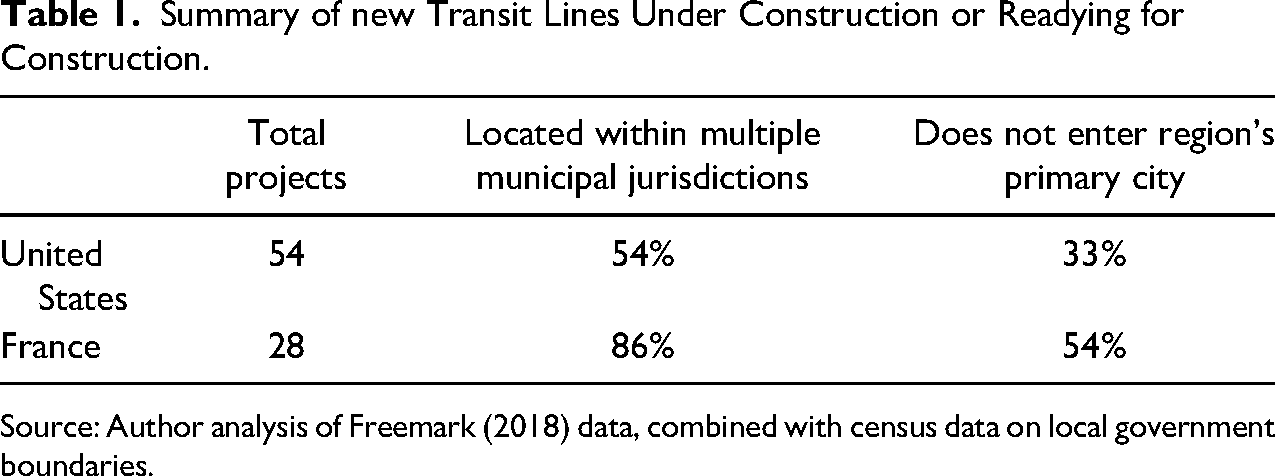
Source: Author analysis of Freemark (2018) data, combined with census data on local government boundaries.
From this group, I identified projects with routes serving cities with ideological variation to establish how their approaches differ or concur. For the United States, I used data on resident ideology scored on a one-dimensional, liberal-to-conservative spectrum (Tausanovitch and Warshaw 2014). For France, I considered the scores of left-wing candidates in the first round of the 2017 presidential election. These measures do not reflect partisan control of municipal governments (though they are often associated with them) but rather resident viewpoints.
For case selection, then, I sought out projects that represented the multi-jurisdictional reality of transit investment, whose routes would serve populations with a diverse range of ideologies, and that would run through different sorts of cities (Table 2). I ultimately selected projects for which the local political environment fulfilled a variety of conditions (I did not include projects which run through municipalities purely on the political right, because these are rare in both countries’ metropolitan areas).
Selected Case Study Projects, Arrayed Based on Political Variation.
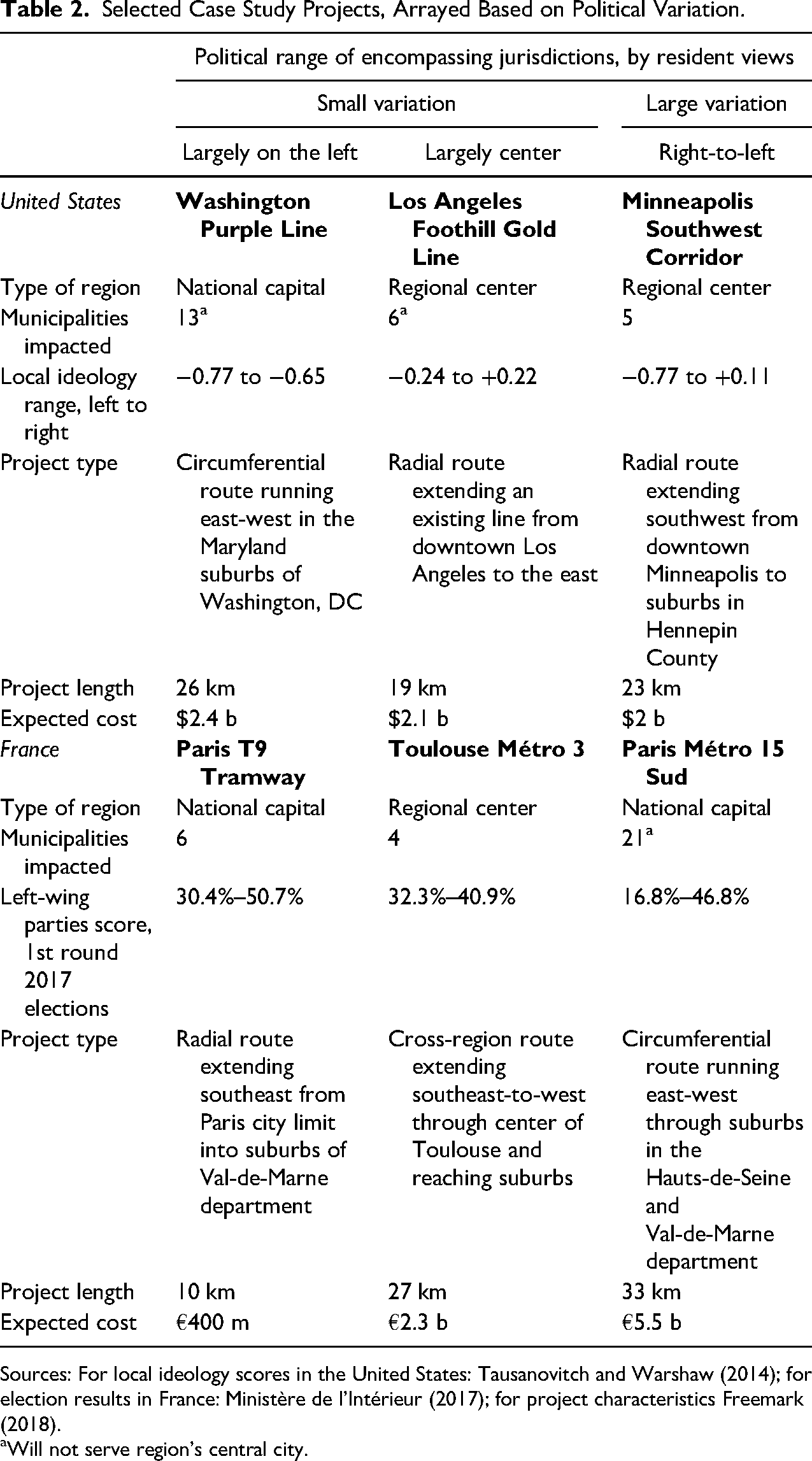
Sources: For local ideology scores in the United States: Tausanovitch and Warshaw (2014); for election results in France: Ministère de l’Intérieur (2017); for project characteristics Freemark (2018).
Will not serve region's central city.
The six case-study projects are in five metropolitan regions. To summarize the projects briefly, the Purple Line will be a suburban circumferential light-rail line linking radial spurs of the Washington Metro in Maryland. The Los Angeles Foothill Gold Line is a light-rail extension that will bring the LA County metro system further east. The Southwest Corridor is a light-rail line in the Twin Cities region that will run southwest from central Minneapolis, lengthening the Green Line that now runs to St. Paul. The Paris T9 is a tramway that connects the edge of Paris with suburbs to the southwest (this project was completed in 2021; the other projects remain under construction as of writing). The Toulouse Métro 3 is an automated metro line that will run from western suburbs, through the city center, and out to southeastern suburbs. And the Paris Métro 15 Sud (the southern portion of a planned full ring) will serve almost two dozen of the city's suburbs. The two Paris examples serve largely different areas of the region (one municipality overlaps between the two) and have different arrays of political composition. In this paper, I put a special focus on the Southwest Corridor and Métro 15 Sud, which feature the largest political variation among residents (Table 2).
All projects are at least 10 kilometers long, are expected to cost at least €400 million to build, and will carry at least 30,000 daily riders, according to design estimates. All projects supplement existing rail transit networks and will run through at least four municipalities.
Interview Data
I undertook a series of 142 interviews, largely with elected officials representing municipalities along the project routes who were involved with project design, but also officials from higher-level governments and special districts, plus staff members from many organizations. Following Feiock (2009, 357), I start from the premise that “only individuals are capable of action yet individuals often act in the name of a group or organization.” Moreover, we can understand collective action as the product of decisions made by a composite of individuals (Ostrom 2005).
I initially identified interviewees by searching governmental websites for the officials who appeared to be most involved in transportation planning in each municipality, and I contacted representatives by email and LinkedIn messaging from every jurisdiction through which lines are proposed to run. I then leveraged snowball sampling by asking interviewees to recommend others who might be able to provide insight; they often provided assistance in connecting me with those others. I conducted most interviews in person in 2019 over the course of site visits, though I completed some over the phone due to difficulties with scheduling. Interviews lasted an average of 1 h but ranged from 45 min to 2 h in length. I conducted all interviews personally, either in English or French. I then transcribed interviews, coded quotes, and translated as necessary.
In addition to the interviews, I collected documents pertaining to each project, using LexisNexis and Google, then reviewed them. This included all newspaper or web articles I could identify; project plans made available on project websites, including out-of-date plans; and meeting minutes for public meetings of relevant committees. My goal was to establish key characteristics of each project and understand how its route, station locations, and associated development had changed since the project was first conceived. I specifically looked to see whether the project was altered in the context of changing political preferences or the intervention of municipalities over time.
Together, these data allow me to develop a theory for regional governance in the context of infrastructure investment. By conducting process tracing—observing the sequencing of major decisions—I build insight into the causal mechanisms at play (Collier 2011; Page 2013). The reader may determine the degree to which they believe the findings presented are relevant to other examples of multi-jurisdictional projects—in other words, just how generalizable they think this study's conclusions are.
Limitations
My research is limited in that it is based on evidence collected from only six case-study projects in two countries. Given the diversity of governments and transportation projects, the conclusions I derive may not reflect broader conditions. The focus on projects in France and United States similarly has its own limitations. These countries may share metropolitan-level fragmentation, but the two nations have wildly different political, social, and urban cultures that may undermine our ability to compare. I also do not describe projects planned in communities purely on the political right, in part because these are rare (investment in transit, particularly in the United States, has frequently been associated with left-wing viewpoints). Additional research is needed to explore their characteristics.
The results I present here primarily reflect my interpretation of interview results. These may be biased by the views of those with whom I discussed these issues. In their roles, moreover, many local officials are representing coalitions within their own localities; I may not be representing the complex interplay between local and regional coalition building. But the large number of interviewees and my effort to collect insights from people holding a broad array of points of view, reflecting people with widely diverging political viewpoints, makes me confident in my conclusions. Finally, because I limit my data collection largely to published reports and interviews with officials, I may neglect to offer insight into the perspectives of “normal” residents.
Nonetheless, even the limited number of case studies I profile provide ample ground for investigating the ways by which municipalities work together or in opposition in the context of infrastructure. I show that political officials in both countries operate under similar approaches. We can learn a lot about how localities influence metropolitan-scale infrastructure even from just these few examples.
De Jure Regional Infrastructure Planning Among the Case-Study Projects
When it comes to the de jure process of metropolitan transportation planning, in none of the case-study regions do cities hold significant official power. Local governments play meaningful roles on issues related to land-use policy. In briefly reviewing institutional structures in this section, however, I show that regional entities, and, in the United States, states and counties, technically dominate the process of planning for metropolitan-scale infrastructure. But, as I demonstrate next, localities exert significant informal sway over regional planning.
In France, regional and metropolitan governments play the most relevant de jure roles; these are defined by national law, which assigns jurisdiction over policy areas (Ministère de la Cohésion des Territoires 2018). The Île-de-France government is run by a directly elected legislature (whose members vote for their leaders) and is charged with developing the regional plan (SDRIF). This lists planned transportation investments and areas of potential urbanization or green space preservation. Other plans, called schémas de cohérence territoriales, are developed by metropolitan governments—run by legislatures comprised of officials elected at the municipal level—in the Paris and Toulouse regions (Métropole du Grand Paris and Toulouse Métropole, respectively). In Paris, the Métropole is divided into intercommunal territories themselves run by municipally elected leaders. In Paris, a subunit of the regional government, Île-de-France Mobilités, operates transit and supervises most transportation planning, including for Tramway T9. The exception is for projects, including Métro 15 Sud, being built by the Société des Grands Projets (SGP; formerly Société du Grand Paris), a national government agency with dedicated revenues and whose board is majority-controlled by national government appointees. In the Toulouse region, transit planning and operation are overseen by Tisséo, whose board is majority-controlled by representatives from Toulouse Métropole.
In France, localities (communes) each have elected councils, mostly with party-affiliated members. These cities have no direct involvement in transportation planning or operation. But they have more involvement in land-use planning, distributing building permits and social housing allocations, while controlling projects of their development corporations. Previously, municipalities managed zoning, but this power was technically transferred to the intercommunal territories and the Métropoles with the 2014 MAPTAM law. Local planning must abide by regional and metropolitan plans. France also has departments with directly elected legislatures whose geographical scale lies between those of cities and regions (Paris is both a city and department), but which have little role in transportation or land-use planning.
In the United States, planning approaches vary, though cities are similarly largely excluded from de jure power over transportation planning. In the Twin Cities, the Metropolitan Council—also the MPO—develops a regional plan; it also operates most transit. Council members are appointed by the governor. But before the Council implements projects, the region's light-rail lines have generally undergone planning, including route selection, by the counties where routes will operate, meaning Hennepin County for the Southwest Corridor. Counties are run by directly elected commissioners. Minnesota statute requires that light-rail planning decisions be approved by city and county governments through “municipal consent,” but the Council can overrule localities that fail to provide it. In Los Angeles, regional planning is technically undertaken by the MPO, the Southern California Association of Governments (SCAG). But most transit projects are undertaken by the LA County Metropolitan Transportation Authority (LA Metro), a subunit of the county that operates most transit service. A major exception is the Foothill case study, which receives funding from Metro but nonetheless is planned by a separate entity, the Foothill Gold Line Construction Authority. This is run by a board whose members represent a local council of governments, LA Metro, and a legally defined set of cities, none of which are the cities the case-study project will serve. Finally, the Washington region MPO is the National Capital Region Transportation Planning Board. Major transit projects were traditionally planned and undertaken by the Washington Metropolitan Area Transit Authority, which built the Metro system and which runs most transit, but the Purple Line was planned and is being overseen by the Maryland Department of Transportation, a subunit of the state government.
Local governments in the United States, each with elected councils, have oversight of land-use planning, with most zoning and building permit power in the hands of cities (in California and Minnesota) or counties (in the Washington region). In the Twin Cities, local comprehensive plans must conform with the regional plan and be approved by the Metropolitan Council. In California, local plans must be approved by the state and allocate land for adequate housing construction based on need and growth estimates (Monkkonen, Manville, and Friedman 2019).
I illustrate the official relationships between various governmental entities and planning in the context of two of the case-study projects—the Métro 15 Sud and the Southwest Corridor—in Figure 1. These diagrams highlight municipal governments and each project. The width of the solid black arrows indicates the influence of governmental units on the planning process in terms of their share of the vote on boards or agencies related to projects. Other arrows indicate planning decision-making, and dashed lines indicate project funding and requirements for guidelines to be prepared. These institutional arrangements reflect a complicated interplay of elected and unelected bodies involved in metropolitan-scale projects.
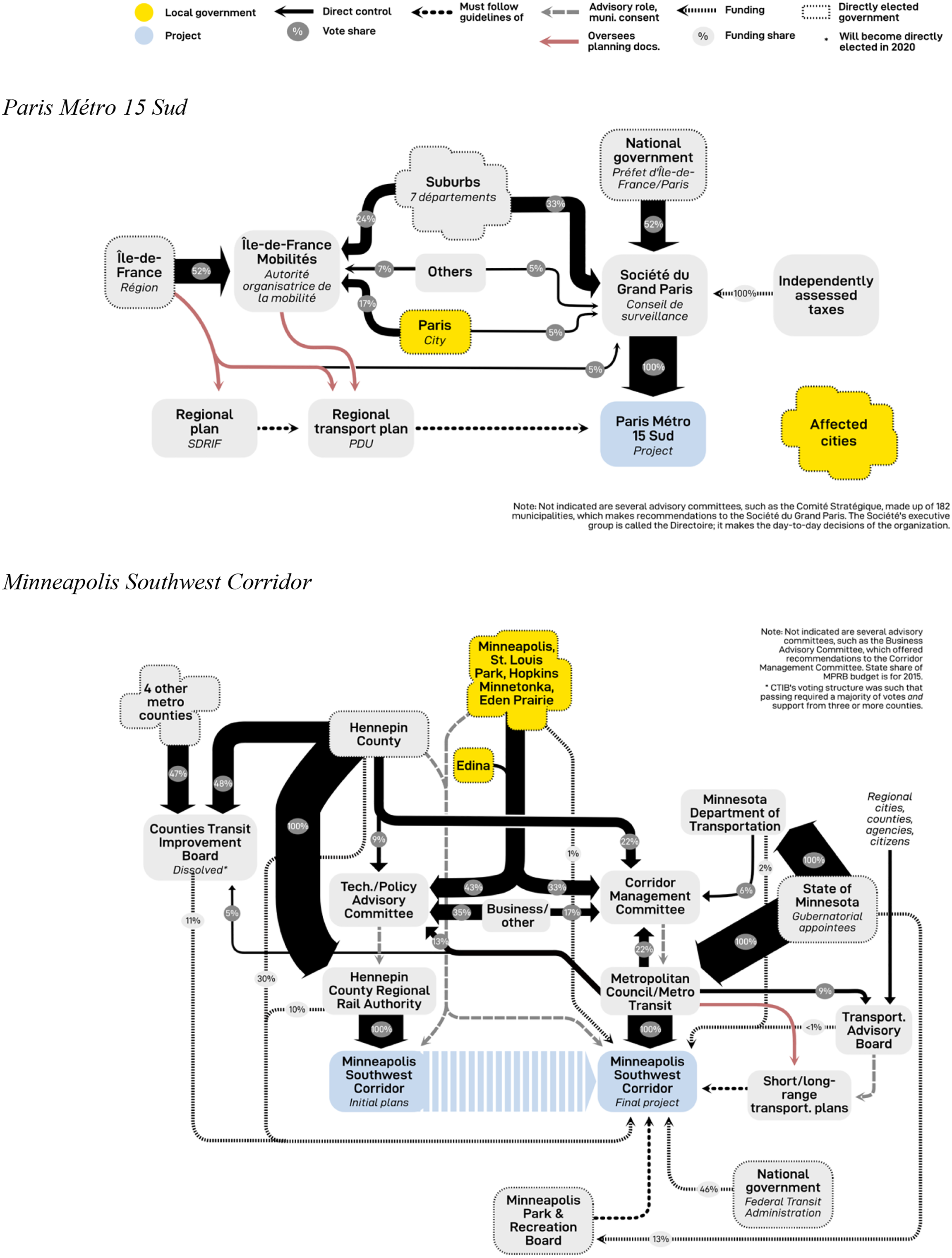
De jure, institutionally inscribed structures of political control in project planning.
Despite its complication, the multi-jurisdictional institutional arrangement present for all the case-study projects suggests relatively clear de jure lines of power. Consider first project decision-making for Métro 15 Sud. National government representatives control a majority of votes on the SGP board. The SGP board does include substantial representation from the seven suburban departments and the city of Paris, but not from any of the cities through which the metro project will run (those cities do have representatives on a non-decision-making, consultative body, the SGP's Comité Stratégique). Nor do cities other than Paris have direct influence on the Île-de-France government, which makes the regional plan, or Île-de-France Mobilités, which operates transit.
For the Southwest Corridor, affected cities had minority voting shares on two groups that were deeply involved in project planning—the Technical and Policy Advisory Committee and the Corridor Management Committee. That said, when it came to selecting the final route alignment, the project was fully under the control of the Hennepin County Regional Rail Authority, whose board is comprised of county commissioners; there was thus no direct local representation. Now under construction, the project is fully managed by the Metropolitan Council. All of the Council's board members, as noted, are appointed by the governor.
I summarize the institutional structure for both projects in Table 3. In each case, public institutions are structured to advance the regional interest of building a metropolitan-scale project, and in each, the power of localities is severely circumscribed and can theoretically be overridden by higher-level entities.
Summary of Governmental Levels and Generalized Official Roles in Metropolitan Transportation Planning for Métro 15 Sud and Southwest Corridor.
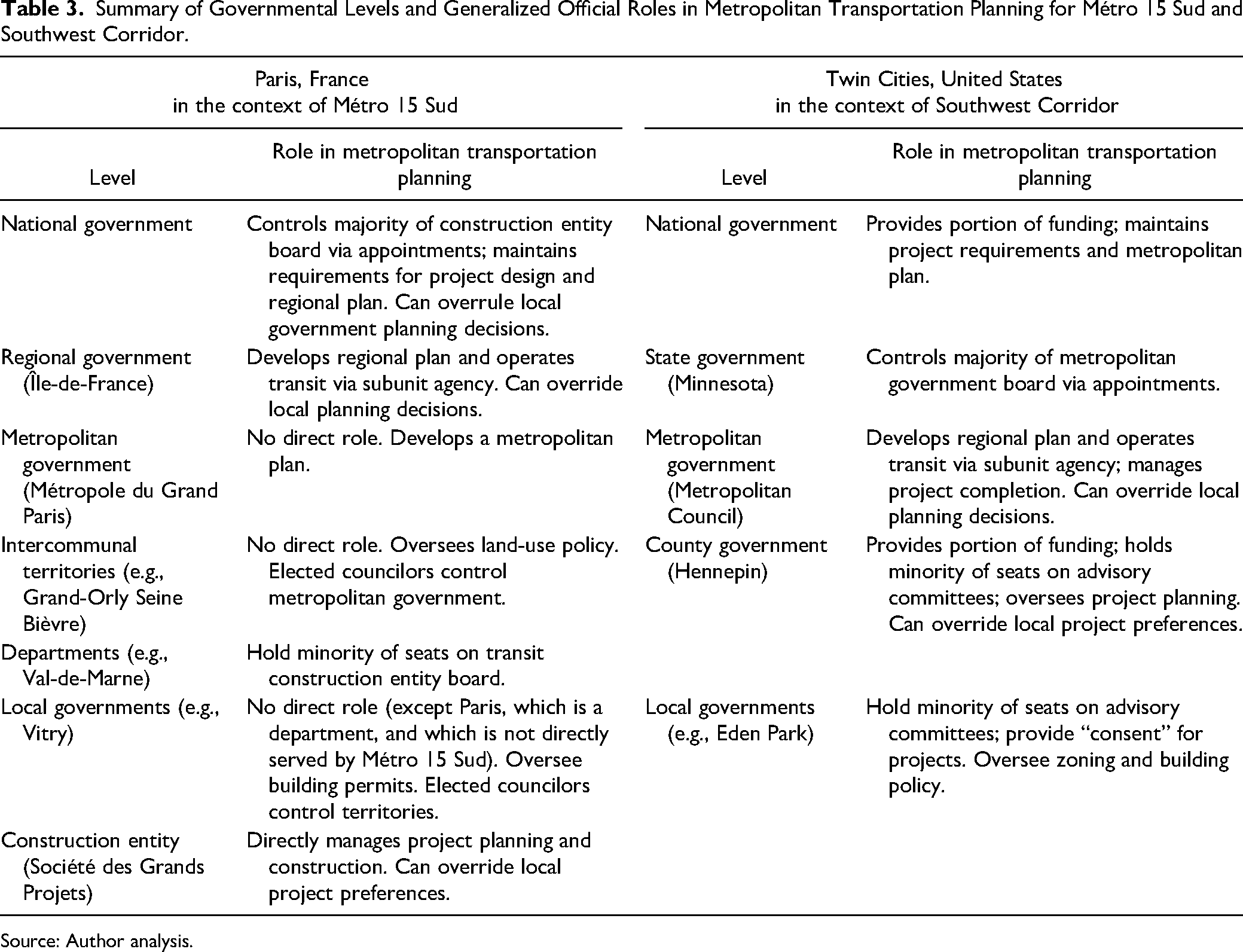
Source: Author analysis.
Similarly limited official power has been assigned to localities and their elected officials for the Tramway T9, Purple Line, and Foothill Gold Line, each of which has its own structure of official decision-making that excludes municipal actors, and that often promotes the power of county or state actors instead (Appendix A). The major exception is Toulouse, where city representatives control a majority of votes on the Métropole, which, in turn, controls the agency planning the project.
We are thus left with several striking facts about the roles of municipal governments in metropolitan-scale infrastructure planning. From an official point of view, no affected municipality but Toulouse has a majority voting stake on the governmental or entity board making planning choices (nor a significant stake in project construction costs). Following An and Bostic (2021), we might expect this institutional structure would severely limit municipalities’ ability to influence outcomes. Is regional planning simply the purview of those holding official power?
The Legitimacy Accorded to Local Governments Through De Facto Power
If the de jure structures of regional planning suggest limited roles for local governments and their elected officials, my examination of the case-study transit projects shows that they in fact command substantial de facto legitimacy, and thus, power. This is the product of a broadly shared viewpoint about what level of democratic decision-making has the most value combined with, in some cases, personal connections that link higher- and lower-level officials. Localities may have little official capacity to influence planning—but they have considerable actual ability to do so.
Leaders with whom I spoke in both countries—including those working in structurally more influential higher-level governments—strongly agreed that local officials best represent proximate democracy and thus should lead local policymaking. The implication is twofold: First, de jure powerful regional institutions may not have the legitimacy to make planning decisions alone. Second, infrastructure projects may be difficult to conduct without municipal agreement.
The role of local governments “is anchored in peoples’ spirits, and for a French person, their municipality is fundamental,” according to city of Bry Mayor Jean-Pierre Spilbauer. His colleague on the other end of Métro 15 Sud, Mayor Jean-Pierre Schosteck of Châtillon, told me, “the city exists in peoples’ spirits … There's a fundamental element that must remain in the local administration: it's proximity… The citizen must be able to identify the [elected] person who could potentially come to their assistance… and if necessary to be their intermediary towards other, higher levels of bureaucracy.” As compared to higher-level governmental officials, local officials believe that they are more responsive. Romain Marchand, a vice mayor in the city of Ivry (along the Tramway T9), argued that local planning was better, “most simply because we can’t do it without being under the supervision of residents.”
Stateside, city councilors like John Fasana of Duarte (along LA's Foothill line) leverage this sentiment as a justification for local planning control. “I always thought that was important, that if [a project is] going to be going through your community… you should be involved, should understand what's being built, and what are the decisions that are being made,” he said. This means that local officials reject the idea that higher-level governments should plan for them.
Officials in higher levels of government, perhaps surprisingly, agreed. Alexandre Bernusset, a transport planner at Île-de-France Mobilités, noted that local officials often generated ideas about infrastructure projects, “because they’re the ones who know their territory.” In some cases, prioritization of local views means ignoring the de jure powers granted higher-level governments. Alene Tchourumoff, former head of Twin Cities Metropolitan Council—which, as described, can technically overrule local planning policy—noted, “it's up to the cities really to decide how they want to reimagine their space.” In France, the approach is similar. Jean-Claude Prager, SGP's economics head, told me, “when you want to dig a hole to perform a test, you have to have the mayor's agreement. The national government could require it, but it's not done.”
Indeed, one top staff member for the Île-de-France government—who preferred anonymity—said the region could ignore the mayor's orders; “it's possible for the national government to allow the prefect [the national government representative] to take the place of the mayor.” But this takes time and political effort. Bernusset agreed. “One does not do a transportation project in Île-de-France against the mayor's wishes,” he argued. “Even if formally, it's not the mayor who decides… the work of the public construction authorities [maîtres d'ouvrage] that we are is to find a compromise with [mayors] so that the projects that we build can be locally accepted.”
Officials in higher-level governments will sometimes act concretely to preserve the de facto power of municipalities if needed—if only because they feel they have no other choice given widespread views about local legitimacy. Stewart Chesler, a planner at LA Metro, emphasized that his agency was unwilling to enforce its own power because city leaders would lobby the state legislature to remove that authority if used. Blanca Rubio, a state assemblyperson, told me, “I see my role as the intermediator… between Sacramento [the state capital] and my local communities… they know that I will advocate for them.”
Local de facto power has consequences on regional institutions. Though MPOs in the United States are officially charged with directing metropolitan transportation planning, and though they are meant to be a forum for collaborative decision-making, in no case-study region did I find them leading initial project planning. “We’ve never been in the business of selecting projects, even if that's what the feds think [or] say we’re doing,” Eric Randall, transportation manager for the Metropolitan Washington Council of Governments, told me. This leaves planning up to other levels of government. Philip Law, transit manager at SCAG, said, “on our board… there's a respect for the local control.” The Metropolitan Council's Cole Hiniker related that, “our policymakers aren’t trying to dictate [projects’] path or the purpose… [we’re] just giving advice on how this will fit into the regional context.”
In France, as noted, intercommunal territories are charged with most land-use planning. But, Nadia Brahimi, a vice mayor in the city of Choisy south of Paris, said, “the territories have jurisdiction over spatial planning, but in reality it's the mayors who continue to decide.” In the Toulouse region, Henri Arévalo of the suburban city of Ramonville emphasized that, “municipalities continue to be autonomous, to do what they want.” City of Vitry councilor Jean-Marc Bourjac said that, even if the SGP officially controlled station placement along Métro 15 Sud, “we [the city] decide.”
Local officials expressed similar views in the United States about local-government intervention in transit planning. Takoma Park city manager Suzanne Ludlow described her experience at a public meeting early in the design of the Washington region's Purple Line. “These [state of Maryland] engineers came up to me, and they said, ‘if Takoma Park doesn’t support it, it won’t work.’” This has produced situations where plans for new transit lines have been scuttled due to local officials’ concerns. Nick Thompson, who directs transportation policy at the Metropolitan Council, described how plans for a long-discussed bus rapid transit line were substantially altered because a municipality along the route asked that it not be served.
Personal connections resulting from past experience and engagement between officials representing different levels of government also help explain why local viewpoints seem to win out. Governors repeatedly appointed local leaders to the Metropolitan Council; for example, former Hopkins Mayor Molly Cummings was chosen for a seat. At the same time, local leaders successfully ran for Hennepin County board; commissioner Jan Callison, for instance, was mayor of the city of Minnetonka. Cummings and Callison then maintained personal links with city officials and continued to conduct listening sessions with them to inform their viewpoints.
In France, the cumul des mandats (dual mandate) system historically allowed local elected leaders to simultaneously serve in the national legislature and promote local interests (Pinson and Le Galès 2005). Though that practice has been eliminated, local officials can still also be elected at the regional and departmental levels; for example, Mayor Spilbauer was simultaneously a councilor in the regional legislature. Intra-party connections, finally, help explain local de facto power in France. Châtillon mayor Schosteck told me he convinced the national government to support city investments in part because of his ties with co-partisans. “When [Nicholas] Sarkozy was president,” he said, “I had little difficulty talking to him, because we’ve known each other since we were young” and involved in joint party activities. Gauthier Mougin, a vice mayor in the city of Boulogne, west of Paris, said he lobbied for a new—and much more expensive—location for a Métro 15 Sud station through “lots of persuasion” of national leaders he knew.
A Culture of Mutual Deference for Multi-Jurisdictional Projects
I have shown that regional and higher-level officials are reluctant to intervene in planning issues perceived to be local affairs, giving cities a much larger role to play than their structural position would imply. But metropolitan-scale transportation projects are typically multi-jurisdictional in design—which means that, to be implemented, they must meet the needs of multiple localities at the same time. This raises questions about how local officials interact with one another. In this section, I argue that local leaders prioritize engaging in mutual deference, meaning that, when making choices about issues that directly apply to only one municipality, officials from other localities defer to the points of view of that locality's leaders, as long as these do not undermine the interests of their own locality. Mutual deference is therefore an enabler of regional cooperation and coordination.
For Jean-Pierre Nourrisson, the head of a Paris-region public developer, “there's a ‘gentlemen's agreement’ that enforces the rule that each community respects that which the neighboring community does.” This creates a “culture of compromise, of consensus, including between people who have very different political tendencies,” according to the city of Ramonville's Arévalo. Nancy Tyra-Lukens, former mayor of the city of Eden Prairie along the Southwest Corridor, emphasized that she “respected each other's communities.” Her neighbor, Edina Mayor Jim Hovland, argued that when “there was nothing in it for me” or his city, “it became advantageous to not have a dog in the fight.” Officials who disagree may sometimes be “a bit reluctant to intervene on decisions that do not affect their communities,” even as they express strong feelings about planning matters in their own communities, said Bernusset.
There is potential political benefit in maintaining mutual deference. Ivry's Marchand, a communist party member, emphasized that he might undermine his co-partisans in other communities if he overrode local planning policy through his leadership role in the intercommunal territory. “If I do that here, that would mean that I’ve accepted that in all the cities that are in right-wing controlled territories,” he said, “we give them the right to do the same thing.” He was willing to undermine the de jure power of the territory to avoid creating a precedent that might hurt communists elsewhere.
This experience demonstrates that—even in contexts where regional power is reinforced through institutional structures—local power remains dominant, and city officials have a mechanism to reinforce that power. Developing new institutional mechanisms to advance de jure regional control may therefore be ineffective in subverting municipal de facto power.
Inter-Municipal Alliances Formed for Projects in Minneapolis and Paris
Nonetheless, it remains true that higher levels of government can legally override localities. They may be more likely to do so in circumstances in which local leaders hold limited connections with higher-level officials. In this section, I show that local leaders thus fortify their power to achieve their preferred outcomes through inter-municipal collaboration. Using examples from the Twin Cities and Paris regions, I show that officials, who trust one another due to a history and practice of mutual deference, develop informal links that are then reinforced in the context of the official institutions through which their leaders interact. Local leaders create alliances that cross ideological lines, then deploy these links as a form of joint bargaining power to successfully contest the planning choices made by higher-level governments.
In the case studies I examine, local leaders established informal connections with one another—a basis for the alliances that they would later build. Sometimes, these links were layered on top of formal relationships, such as those established in the Corridor Management Committee that informed planning for the Southwest Corridor (Figure 1). In other circumstances, they developed in the context of voluntary associations like the Regional Council of Mayors in the Twin Cities, a collaborative group (Feiock 2009) with no direct power over policymaking. In both cases, interviewees noted that meetings gave elected officials the opportunity to assemble and learn about each other's priorities. They then followed up with interactions through other means, such as frequent phone calls.
Informal relationships between cities were particularly strong along the Southwest Corridor due to Hennepin County's “Community Works” program, which established a forum for leaders, both elected and civil servants. Though county supervised, the program led to an informal offshoot for municipal planning staff, which several planning department leaders referred to as J-WOW (“women of the west,” because of the demographics of these leaders, plus the first letter of the first name of the male official from Minneapolis who joined the group). These individuals convened in informal meetings for years, building what they referred to as “peer learning” outside of official planning.
These connections were reinforced by efforts like city of St. Louis Park mayor Jake Spano's “informal, ad hoc” corridor mayor get-togethers. He told me that his goal was to “build personal relationships and connections in an effort to try and help build collegiality and cooperation.” In this way, these leaders constructed an inter-municipal alliance comprised of officials representing jurisdictions with residents holding a wide array of political perspectives (Table 2). It was more than a short-term interest group related to the transit line; the relationships slowly transitioned to a long-term coalition of local governments ready to fight for goals that might otherwise be resisted by the leaders of higher-level governments holding institutional power.
Similarly, the Orbival association in the Paris region enabled local leaders to discuss the Métro 15 Sud informally. Orbival, perhaps best described as a policy network (Feiock 2009), designed to preserve local autonomy and offer opportunities for face-to-face interactions, assembled officials from the municipal and departmental levels at critical moments and allowed leaders to form cross-partisan bonds. The Val-de-Marne department, which organized Orbival meetings, was then run by communist party officials. But several right-wing officials noted that they considered it to effectively represent all local interests, in part because it embedded the mutual deference concept. Orbival became an outlet for municipal officials to crystallize shared objectives and, when necessary, promote them in opposition to those advanced by the de jure powerful SGP.
Importantly, these coalitions developed in spite of the fact that leaders of higher-level governments had varying motivations for supporting the proposed projects and held different ideological perspectives about the value of public investment. Some project proponents envisioned the lines as boosting economic development, whereas others saw the projects as addressing the needs of the working class. Hennepin County commissioner Peter McLaughlin envisioned the Southwest Corridor as a way to reinforce downtown Minneapolis's growth; colleagues like Gail Dorfman, meanwhile, saw it as an “equity train” to boost affordability and expand access to jobs in underinvested communities. With the Métro 15 Sud, President Sarkozy's initial goal was to create a new infrastructure that would allow him to reaffirm Paris’ “world city” status, whereas Val-de-Marne leader Christian Favier's goal was to improve transportation links across the department.
How did the relationships developed between localities play out in specific planning choices? For both the Southwest Corridor and Métro 15 Sud, I identified an example in which cities successfully formed coalitions to achieve priorities, even when those priorities cost higher-level governments significantly more money than they had planned to spend and thus was arguably in the higher-level government's interest to select another option. In each case, cities surmounted their de jure institutional limitations through their de facto power.
Light Rail Alignment Choices in the Twin Cities
One key question for the Southwest project was how to serve the cities at the far end of the line, Minnetonka and Eden Prairie: Along a railroad corridor, or along another route. For context, planning for the line descended from a 1980s decision to purchase a former railroad right-of-way; this acquisition implied this would be the corridor used for trains. Indeed, Hennepin County labeled the bike and pedestrian paths built along the corridor as “LRT [light rail] Trails.” Interviewees noted that it was long understood trains would run along the route.
Yet when the project entered the planning process in the mid-2000s, some argued that the railroad corridor no longer made sense. Minnetonka and Eden Prairie's growth patterns did not follow the railroad corridor. Rather, several business and industrial parks had been completed in Minnetonka's Opus neighborhood and Eden Prairie's Golden Triangle and Town Center, all quite a bit east of the initially proposed rail alignment.
Project planners considered a variety of routes for the new line, indicated in Figure 2. “LRT 1” followed the railroad corridor; “LRT 2” would run along roads but minimize property acquisitions; and “LRT 3” (similar to the final alignment) would require the acquisition of a new right-of-way to run through Opus, Golden Triangle, and the Town Center. LRT 3 was expected to be $200 million more expensive because of land acquisition and a longer route.
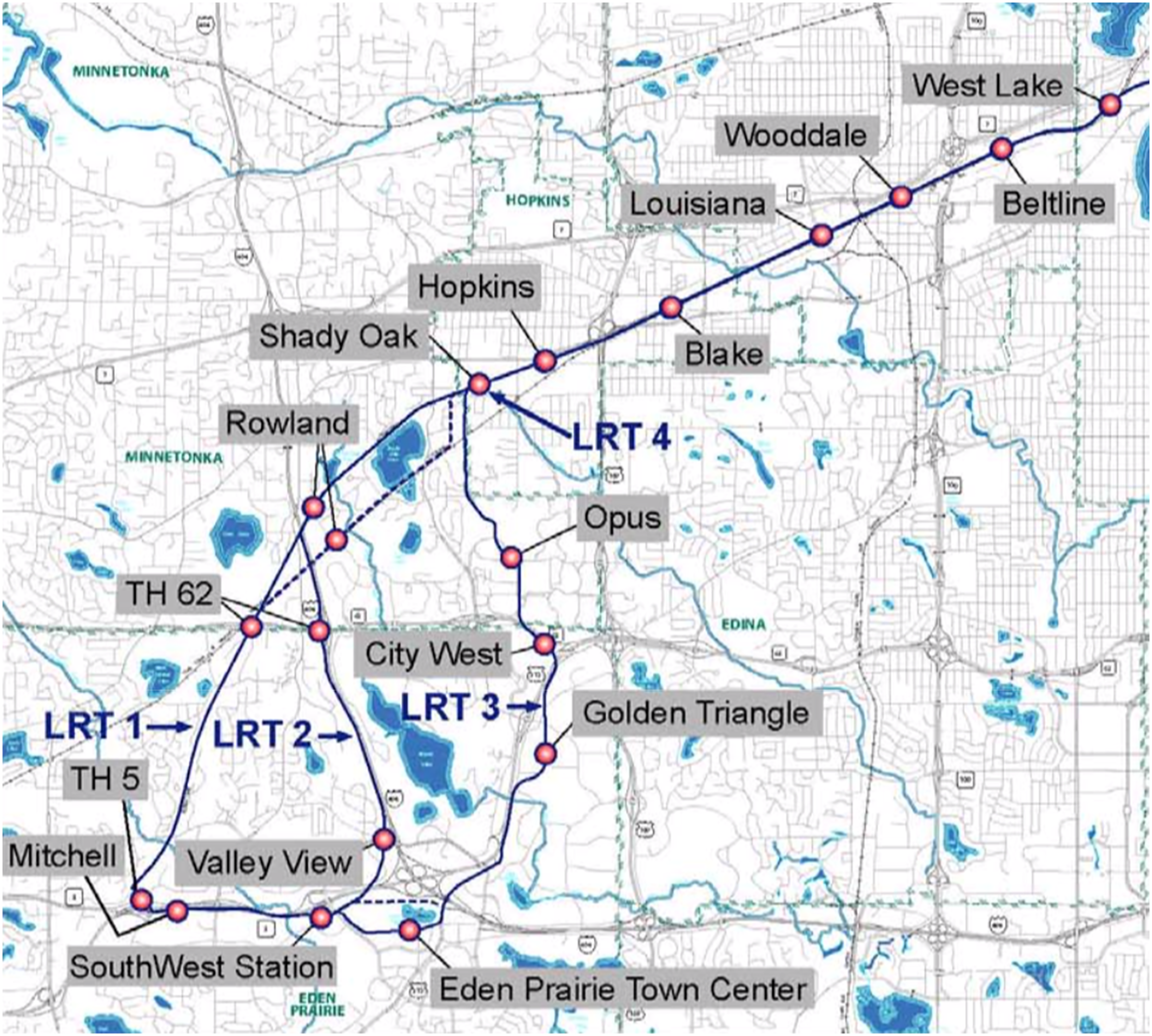
Options for Southwest Corridor route alignments, as presented in 2007. Source: Hennepin County Regional Railroad Authority (2007). Note: Downtown Minneapolis is at the map's top right.
Yet Eden Prairie Mayor Nancy Tyra-Lukens argued that the LRT 3 alignment was essential because it would serve employment centers and increase economic growth through development. She told me: I came out strongly presenting the case for an alternative route… [LRT 1] was a cheap and easy corridor, because the county already owned it, so that's really where [the county] wanted to push it. And I made the case… for us, we were a highway community… And that's where the density is. And we needed to change the route and serve businesses.
Tyra-Lukens made informal phone calls to other local elected officials along the route. At the same time, she made public appeals to Hennepin County board members; commissioner McLaughlin, for example, remembered one of her speeches. He told me, “I can remember her testimony at one point at a public hearing saying, ‘it's all well and good to run these things along old rail lines in the city and the first-ring suburbs, but when you get out to the second-ring suburbs like Eden Prairie, the world was defined not by railroads, but by the freeways.’”
Tyra-Lukens’ colleagues in other cities accepted her view about the importance of changing the route, or at least invoked mutual deference. As such, they collectively endorsed the more expensive alignment in 2009. They received no public complaints from Hennepin County commissioners, who would be responsible for picking up the tab and who would, given limited resources, be unable to pay for other potential projects. Her argument, moreover, retained its usefulness in subsequent planning choices. A few years later, Eden Prairie leaders argued that the route would not adequately serve the Town Center and suggested a realignment that would further increase project costs. Again, these appeals were heard and changes made.
Added Transit Connections in the Paris Region
The Twin Cities example shows how a municipal leader influenced project planning through inter-elected connections and personal appeals; I identified a similar experience in the Paris region. As in Minneapolis, construction costs were an issue. In 2018, the national government mandated that the SGP reduce the expense of the Métro 15 Sud and other projects. To do so, SGP recommended eliminating “interoperability” along the eastern portion of the route. While the original plan was to allow trains heading east to either continue east to Noisy-Champs (at the end of the Métro 15 Sud line) or north to Saint-Denis (via the future Métro 15 Est line), the agency recommended cutting the complex interlockings between the lines, requiring passengers hoping to travel from west to north to transfer at the Champigny-Centre station. This “interconnection” would save €127 million. The difference between interconnection (A) and interoperability (B) is illustrated in Figure 3.
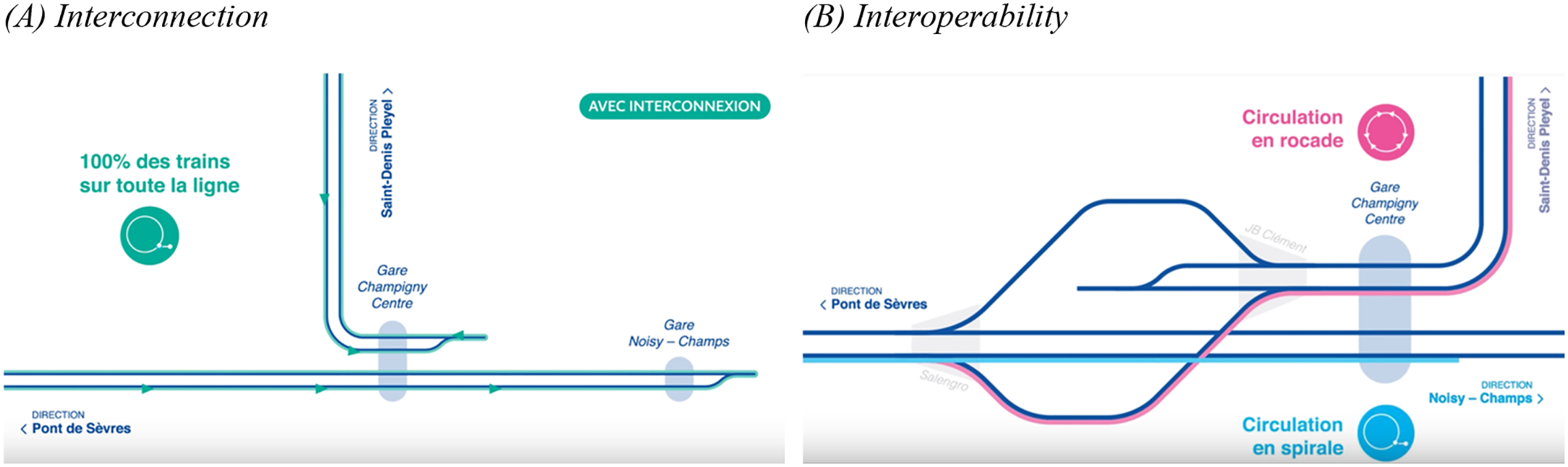
Options for interconnection versus interoperability for Métro 15 Sud. Source: Société du Grand Paris (2019).
But several city leaders along the route reacted vociferously to the proposal, arguing that interoperability was essential because it would allow riders to take the entire future full loop of Métro 15 without transferring (interoperability also fulfilled the initial goal of Orbival to connect the cities of Arcueil with Fontenay-sous-Bois). Even Champigny's elected officials aligned against the SGP's proposal—even though interoperability would entail additional construction and city residents would get the same service under either plan. Local leaders collaborated to stage protests, hold public meetings, and argued that the change was needless national government austerity.
Councilors I interviewed from Noisy-le-Grand, at the end of the line, told me that they privately preferred the cheaper interconnection alternative, which they felt would provide better access to Noisy. But they hid this feeling; other interviewees said they did not know of any disagreement from Noisy. Noisy's officials ultimately decided that interoperability was primarily a Champigny issue; they thus followed mutual deference in not standing in the way of the latter city's goals.
This pressure was eventually picked up by regional officials, who ended up making similar arguments. Stéphane Beaudet, Île-de-France region vice president, told me that “if line 15 isn’t connected… it will not provide the suburb-to-suburb service it's supposed to provide.” Eventually, SGP leadership relented, agreeing to retain interoperability despite the high costs that national government officials—who controlled SGP—had bemoaned. Again, the choice—in the context of limited resources—was to spend more on this project rather than potentially fund other projects.
The protests against cost-cutting were effective in part because of the informal ties between municipal leaders. Orbival provided a space within which leaders could make arguments, reinforce them, and strategize. Moreover, as in the Twin Cities example, the project provided a framework for local-to-local communication. Having frequent meetings about project issues meant officials became familiar with one another and identified how to take advantage of those connections.
The Construction of Inter-Municipal Alliances Through Mutual Deference
I detailed how inter-municipal alliances formed in the context of two of the case-study projects. These alliances were enabled because of the democratic legitimacy granted to local government actors. And because local leaders assembled with a unified view as to how project plans should change, politicians representing higher-level governments responded.
Alliances thus served as a mechanism to enhance the already-existing de facto power held by local governments, boosting the views of individual communities. In the case of Orbival, the voice of Champigny's leaders in favor of interoperability may have been drowned out had they acted alone. In the case of the Southwest Corridor, Mayor Tyra-Lukens’ argument that the route change was necessary for her city was boosted by other leaders who mimicked her point of view.
The construction of inter-municipal alliances can also serve as a tool to create buy-in for a broader project. Consider planning of the Toulouse Métro 3. Originally slated to be located primarily within the city of Toulouse, the city held tense negotiations with the suburban cities of Blagnac and Colomiers, as well as the Sicoval suburban intercommunal organization (whose leaders were themselves elected local leaders), to incorporate them into the project. Eventually, Toulouse Mayor Jean-Luc Moudenc agreed to extend the line to all three and incorporate an extension of the Métro Line B, which Sicoval officials desired.
Rather than push aside his suburban counterparts, Moudenc pulled them into an alliance by shaping the project to support their needs. Despite the mayor of Colomiers being a socialist (Moudenc is on the right), she “found benefit in the project,” according to Julien Hénique, a staffer at Toulouse Métropole. At the same time, Moudenc's choice allowed him to build support from the regional and departmental governments, since he could advertise connections along his new metro line with regional rail services located in Colomiers. What had started out as a city-only project became backed by an alliance of local leaders, all of whom saw the project as in their interest, making the line difficult to oppose.
Several of alliances benefited from continued support from cities that had received benefits from past investments. The LA Foothill line is the extension of two previous projects—an original light-rail link to Pasadena, which opened in 2003, and an extension to Azusa, completed in 2016. Given that those segments were already completed, it might be surprising that people like John Fasana, the councilmember from Duarte (which got service in 2016), continued to advocate for extensions, including through protests he helped stage at LA Metro board meetings. If he and his already-served colleagues had ceased advocacy and the cities on the third phase of the project had been isolated, they might have had a more difficult time making their case. The fact that municipalities were not paying for the investment themselves likely helped them feel comfortable promoting the project, as well.
These alliances activated support that otherwise may not have emerged due to inadequate connections between leaders of various municipalities. These cooperative groups can be understood as something in between regional organizations and collaborative groups (Feiock 2009). They are multilateral, and while they each have involved voluntary participation, they simultaneously have engaged some long-term agreements, such as in developing joint frameworks for station planning for the Southwest Corridor.
The Effectiveness of Inter-Municipal Alliances
The alliances I document demonstrate how groups of municipalities collaborated to achieve positive outcomes. These alliances were not the party-imposed coalitions nor the governor-backed coalitions that Weir, Wolman, and Swanstrom (2005) describe, but they do come close to representing interest-based coalitions in that they all involved allying around similar goals of getting project elements changed. The shared interest in support of the lines allowed the alliances to be transpartisan and transideological, bringing people together into what Frick (2021) might refer to as “tactical coalitions” of people from opposing camps. Frick's focus is on resident or citizen actors, but both the Southwest Corridor and Métro 15 Sud projects demonstrate how municipal leaders can act similarly.
The contrast in objectives that I described—economic development versus access for working class people—between those associated with the alliances is likely part of the explanation for the success of each project. It allowed project proponents to “make the case” in different ways over time. Along the Purple Line, for example, advocates could promote the line as a way to increase equity when Democrat Martin O’Malley was governor. When Republican Larry Hogan took office in 2015, they shifted to promoting it as an economic development tool. They could engage each argument because both equity and economic development groups pushed for the line, leveraging the case that best fit their needs (Whittemore 2013).
Similarly, with Orbival, Favier's national role in the communist party allowed him to connect closely with left-wing leaders at the regional and national levels when they were in power. Alternatively, when President Sarkozy was in charge, and when right-wing officials took control of the region in 2015, Favier assigned another Orbival member, Jacques J.P. Martin—the right-wing mayor of Nogent-sur-Marne—to make the case.
These examples show how inter-municipal alliances empowered local governments to influence project planning. But I did identify counter-evidence of municipalities failing to achieve the outcomes they desired—in the context of conflict with other localities. One instance related to how to handle freight on the Southwest Corridor. Between 2009 and 2015, Minneapolis leaders argued that freight trains—which had been temporarily rerouted onto the Southwest Corridor alignment in the late 1990s—should be returned to their previous routing in St. Louis Park to free up space for the light rail project, as St. Louis Park officials had agreed upon originally. But St. Louis Park residents, and eventually its leaders, argued against the re-routing, claiming that doing so was dangerous (freight trains carrying oil might derail) and would require property takings. St. Louis Park officials had consolidated connections with other suburban localities, like Eden Prairie and Hopkins; as such, they were successful in making their case.
Minneapolis’ elected officials, on the other hand, had been largely absent from project meetings and its representatives had, according to interviewees, irritated suburban leaders with their “negative” working style. As such, there was little sympathy for Minneapolis’ perspective among other local leaders; Minneapolis lost its bid to re-route freight trains. Mutual deference did not apply because both Minneapolis and St. Louis Park were affected by the choice—and they had opposing goals.
The failure of Minneapolis’ leaders shows how cities can be deprived of their de facto power when they do not develop an inter-municipal alliance to promote their goals. Leaders in Minneapolis would likely have had a better chance of achieving their desired outcomes had they leveraged a large group of influential municipal officials to support their goals. Instead, they argued alone and eventually had to accept what they considered a suboptimal project.
Conclusions
I have detailed the workings of municipal power and inter-municipal alliances in the context of several case-study transit projects. From a de jure perspective, local government power over planning for metropolitan-scale infrastructure is quite limited—and institutional structure matters in influencing regional outcomes (An and Bostic 2021). But local governments are granted considerable legitimacy by stakeholders involved in regional planning decisions, and in the right conditions, that legitimacy transforms into de facto power. Municipalities further enhance their sway through alliances constructed with other local governments. The result is that cities and their leaders harness significant control over issues related to transportation planning, beyond what the official structures of institutions imply.
This approach to understanding inter-municipal alliances helps explain how regional planning functions in contemporary metropolitan areas. For one, it reaffirms the importance of valuing the influence of both vertical and horizontal relationships of power in developing infrastructure projects relevant to regional needs. Extending Weir, Rongerude, and Ansell (2009), these relationships can be described both for citizen coalitions, and also for coalitions of local leaders.
This is not to say that local leaders could have acted alone; leadership from regional entities, like the SGP in the Paris region, is necessary to coordinate projects and to fund them. But regional entities likely would have faced political headwinds in undertaking the projects without the participation of municipalities; members of the Minnesota state legislature, for example, could have acted to stop the Southwest line if they felt localities were being ignored by Hennepin County or the Metropolitan Council. The municipalities, meanwhile, leveraged their formal and informal engagement through alliances to alter the path of the project to better fit their goals.
Following Matkin and Frederickson (2009), local governments are embedded in processes of metropolitan governance. Municipal leaders interact with one another and alter how regions are planned together (Cox 2010). These leaders build coalitions across ideological lines in a manner similar to how citizens operate in tactical coalitions (Frick 2021). Jurisdictional boundaries often do not correspond to economic or social realities in urban regions, in which transportation projects routinely cross jurisdictional lines, but localities play essential institutional roles in project planning.
The coalitions built between municipalities do not neatly fit the coalition types described by Weir, Wolman, and Swanstrom (2005). They are, on the surface, responsive to collective interests, but actors’ motivations vary. Moreover, local leaders value the input of their neighbors out of a sense of collective fraternity through mutual deference, not just out of a sense of having a collective interest (though in all cases, they support project completion). Reaffirming Gerber and Gibson (2009), regional governance is a balance between local and regional needs.
In both the Minneapolis and Paris cases, the structure of metropolitan-scale project planning has directed authority to higher-level units of government or semi-independent metropolitan entities. This reflects what other scholars have pointed out about the circumstances in which regional planning is engaged: when projects are multi-jurisdictional (Savitch and Adhikari 2017) and when they maintain the infrastructure system, while allowing localities to manage social control (Hugg 2020; Williams 1971). But what I show here is that localities also have substantial power to influence the regional project planning that those higher-level units undertake. These findings show that altering institutional configurations to meet a metropolitan goal can only go so far in isolating metropolitan governance from local desires. The result may be that projects already in planning, like the Southwest Corridor and Métro 15 Sud, come to absorb more of the region’s resources because local leaders exert sway to alter those projects to meet their own goals, and in so doing increase their costs. It is unclear if other projects that could be funded lose out over the long term due to limited resources.
The management of regional affairs by local interests has its limits. We saw in the Minneapolis case that not every city gets the outcome it desires if that outcome conflicts with the interests of other communities. More research is necessary to understand how such inter-local conflicts can be resolved, and the role of mutual deference in that context. Moreover, we need more insight into whether the experiences I have described related to transit projects can be translated into other types of regional investments, such as energy infrastructure or affordable housing.
Supplemental Material
sj-docx-1-uar-10.1177_10780874241271366 - Supplemental material for How Municipalities Exploit Their De Facto Power to Manage Metropolitan Planning Through Mutual Deference
Supplemental material, sj-docx-1-uar-10.1177_10780874241271366 for How Municipalities Exploit Their De Facto Power to Manage Metropolitan Planning Through Mutual Deference by Yonah Freemark in Urban Affairs Review
Footnotes
Acknowledgements
I thank Daniel Nichanian, Justin Steil, Kathleen Thelen, Lawrence Vale, and Jinhua Zhao for their review of previous versions of this manuscript. I also thank the anonymous reviewers for their detailed feedback.
Declaration of Conflicting Interests
The author declared no potential conflicts of interest with respect to the research, authorship, and/or publication of this article.
Funding
The author received no financial support for the research, authorship, and/or publication of this article.

Supplemental Material
Supplemental material for this article is available online.
Author Biography
References
Supplementary Material
Please find the following supplemental material available below.
For Open Access articles published under a Creative Commons License, all supplemental material carries the same license as the article it is associated with.
For non-Open Access articles published, all supplemental material carries a non-exclusive license, and permission requests for re-use of supplemental material or any part of supplemental material shall be sent directly to the copyright owner as specified in the copyright notice associated with the article.
