







Abstract
This study investigates syllabi for evidence of the principles of writing across the curriculum (WAC) in courses offered by the Faculty of Business (FOB) at a university operating in a non–English-speaking country. The research analyzed all syllabi of FOB courses offered in the spring 2010 semester for evidence of WAC looking for indications of writing activities. The analysis focused on both expressive/informal and product/formal writing and discovered through the syllabi the intention of the instructor to incorporate writing. The findings suggest that these courses require little or no writing and therefore principles of WAC are not evident.
Introduction
This study investigated the courses that comprise the baccalaureate programs in a Faculty of Business (FOB) operating in a rural area in the north of the country of Lebanon. We work at this university, and as members of the English department we teach writing composition courses, among other things. We consistently hear criticism and complaints that students do not demonstrate good writing techniques or skill in English in their major courses. Knowing what skills students are taught in the English and writing composition courses, we initially undertook this research to discover if and how students’ writing skills are being nurtured in their major courses.
Students’ inability or lack of initiative concerning the transfer of their skills across courses and across disciplines is not unique to this school (Hinkel, 2011; Justice, Rice, &Warry, 2009; Tardy, 2006). The issue is complicated by the fact that students working in a foreign language will often default to their mother tongue if not pressed to use the less comfortable language (Cummins & Swain, 1986; Nation, 2003). The research process reported here elucidated several important findings that can be applicable to the theory of skill transfer certainly in like environments but perhaps all environments.
Our school is a private university in Lebanon functioning in a non–English-speaking environment, with students’ mother tongue, which is Arabic, being largely spoken outside the language classroom. This university is located in the north of the country near the city of Tripoli, far from the more cosmopolitan area of Beirut where English is widely spoken. Students at this university, for whom English is a second or even third language, by and large resort to Arabic rather than English in their social interactions on campus and in their dealings with family and community. English is viewed as a language to use for some university work and is not the default language in the overwhelming majority of cases.
Another characteristic of this institution that complicates the English language acquisition of students who attend classes here is that the institution has adopted many aspects of the French educational tradition. Lebanon was under a French mandate for about 23 years, and one of the legacies of that period is the French influence on the Lebanese educational system. Both French terminology and some French methodological conventions are still prevalent throughout the education sector. For example, this university uses the word faculty to describe a school or college that houses a particular discipline or like disciplines. Thus, Faculty of Business means School of Business in an Anglophone tradition. Students of English are confronted with such juxtapositions in several areas as they negotiate their newfound vocabulary.
The English Composition and Rhetoric Sequence (C&R Sequence) at this university robustly focuses on the writing skill. Students test into one of the seven courses that comprise the C&R Sequence, depending on the score of an admission-required external exam, TOEFL, or SAT I: a trend followed by most international business programs that use English as the language of delivery (Knight, 2005). All students are required to take two writing intensive English courses at the sophomore level, the final two courses in the C&R Sequence.
The writing across the curriculum and in the discipline movement, known as WAC/WID, is largely associated with Western, native speakers of English contexts. Little research has been done that investigates WAC in non–English-speaking contexts but where English is used as the medium of instruction. Consequently, it is not known if WAC/WID programs are functioning in these contexts and, if so, what they look like and how they are working. This study aims to begin to elucidate such a context and to perhaps generate learning that can inform WAC/WID in similar contexts.
What Is WAC?
With a WAC and a WID approach to the teaching-learning process what is learned in English language and writing courses is transferred to other contexts. Scholars for some time have asserted that writing is a method that can promote better learning in any course (Astin, 1993; Carter, Ferzli, &Wiebe, 2007; McLeod & Maimon, 2000; Russell, 2001; Todd & Hudson, 2008). Even though the evidence suggests that writing is not the only variable at play when learning is promoted, WAC programs can help integrate learning across courses. The evidence is strong that WID contributes to student engagement in the discipline, motivating students to be critical thinkers and active learners (Ackerman, 1993, Astin, 1993; Langer & Applebee, 1987; McDermott, 2010).
WAC programs mean different things to different institutions (Bazerman et al., 2005; Fulwiler, 1988; Townsend, 2005, 2008), and therefore, it is not possible to describe a standardized WAC program. WAC programs imply an existing support structure. According to Inman (2001), WAC programs do have common features, which include faculty workshops, a campus writing center as well as common philosophical beliefs—in particular, that writing is used as a learning strategy. Such a support structure is what identifies a WAC program as opposed to simply adding writing to an instructor’s pedagogical arsenal. McLeod and Maimon (2000) provide a good summary of this approach: “WAC is a pedagogical reform movement that presents an alternative to the ‘delivery of information’ model of teaching in higher education, [an alternative] to lecture classes and to multiple-choice, true/false testing”(p. 579).
The impact writing can have on learning processes should encourage the use of writing as a learning tool (Bangert-Drowns, Hurley, & Wilkinson, 2004). Astin (1993) reported that college courses that emphasize the development of writing skills are among the most effective type of courses for developing cognitive ability. Finally, Langer and Applebee (1987) claim that “there is clear evidence that activities involving writing . . . lead to better learning than activities involving reading and studying only” (p. 135).
The types of writing activities commonly used when writing is used as a learning strategy include journal writing activities in classes such as history, philosophy or social studies, lab notebooks in any kind of science course, summaries and note taking, and writing prompts incorporated in math or accounting courses. These kinds of cognitively based writing activities can serve to involve students in the learning process (Ackerman, 1993; McLeod &Maimon, 2000). However, for these activities to play a role in improving students’ writing ability, teachers must be instructionally involved in students’ attempts at written communication; otherwise, students will not be able to improve their writing skills (Ochsner & Fowler, 2004).
Writing activities found in WAC programs that focus on WID allow for students to demonstrate their knowledge of a discipline and that discipline’s way of transmitting information in addition to helping completely grasp and solidify that knowledge. Thus, WID is one strategy that can promote a writing across the curriculum culture. WAC/WID has been referred to as “writing to learn to do” by Russell (as cited in Stout, 1997). Carter et al. (2007) explain that executing an “authentic activity in a knowledge domain embody the ways of knowing that domain” (p. 283). The types of writing predominantly featured in WID are essays, research papers and literature reviews, depending on the discipline. These kinds of rhetorical writings are used to aid students’ understanding of the subject matter and help them adjust to the conditions that surround the purposes for writing in their area of study (Inman, 2001), as well as guide them to better facility with the communicative and scholarly norms of their disciplines.
Subject domains have distinctive problem solving strategies, language conventions and writing genres. Research that investigates WID asserts that writing is related to knowing and that subject disciplines are not domains of declarative knowledge (Carter, 2007; Inman, 2001). Therefore, students in a specific discipline must learn these conventions, as well as vocabulary and language standards and conventions in order to be understood in the discipline (see Bazerman et al., 2005; Carter, 2007; Hanson & Williams, 2008; Hyland, 2009; Stout, 1997). Hyland’s (2009) work includes a discourse analysis that identifies specific language features in different domains and illustrates them in terms of frequency of verbs, “engineers show, philosophers argue, biologists find, and linguists suggest” (p. 11). Such a finding points out the necessity of familiarizing students with the word choice and conventions of their discipline so that their writing will be recognizable to anyone familiar with the discipline.
Writing in the disciplines can also guide students into the way of conducting research and writing up research in a specific discipline. Hilgers, Hussey, and Stitt-Bergh (1999) report that students claim confidence in dealing with the writing requirements of their disciplines as well as ability to engage with a variety of resources and subject knowledge as a result of writing intensive courses in their majors. Bazerman et al. (2005) also assert that WID activities expose students to the role of the author in their disciplines, the audience stance, and discipline-specific literature. Some students also concur that through WAC/WID strategies, the subject matter of the discipline can be learned more comprehensively (Todd & Hudson, 2008). WAC/WID programs recognize that university communities as a whole, not just one department, are responsible for students’ writing skills and that writing is an explicit illustration of a student’s thinking process.
WAC in the Outer and Expanding Circle
Because of globalization and internationalization of higher education, English medium universities and programs offered in the English language have significantly increased worldwide (Coleman, 2006; Kirkpatrick, 2011). Nonnative speakers of English are estimated to outnumber native speakers of English by three to one (Crystal, 1995). It is also estimated that 80% of English language teachers are nonnative speakers of English (Canagarajah, 2005). Given such statistics, it seems imperative to learn how best to prepare nonnative speakers of English in effective written communication in EFL (English as a foreign language) contexts where English is not the first language.
The terms EFL and English as a second language (ESL) have historically been used to describe the different functions that the English language plays in different countries and contexts (Seargeant, 2010). The label EFL refers to the teaching and use of English as a foreign language outside the countries where it is spoken and where English has no special status. ESL, on the other hand, can be used to identify two types of contexts: countries where English holds a special status (e.g., former British colonies) and “the English of immigrants and other foreigners who live within a country where English is the first language” (Crystal, 1995, p. 108).
Kachru (1992) presents a persuasive model that divides the users of English in the world into three circles: the inner circle, the outer circle, and the expanding circle. The inner circle refers to the English-speaking countries such as England, United States, and Canada. English is used in the inner circle as a native language (ENL). The outer circle comprises former colonies such as India and Nigeria where English is used a second language (ESL). The expanding circle consists of all the other countries of the world, such as China, Turkey, and Japan, where English has become an important language in business, science, technology, and education. English in the expanding circle is usually used as a foreign language (EFL). Therefore, whereas ESL students usually communicate with native speakers or study English to integrate into an English-speaking country, EFL students usually study English to communicate with nonnative speakers in the outer and expanding circles where English is used for functional purposes such as finding a job, academic studies, and communicating with professional contacts (Xiaoqiong & Xianxing, 2011).
In some contexts, the lines between the outer and expanding circles have become fuzzy (Berns, 2005). Lebanon, for example, can be situated between the outer (ESL) and expanding (EFL) circles. In fact, English in Lebanon functions as a second language in American- and British-sponsored schools and universities and as a foreign language in the community because it is not usually spoken outside the classroom (Bacha & Bahous, 2011). English is taught as a subject in French medium schools and is used as a medium of instruction in international schools and local schools that follow the American or British systems of education.
McLeod (2008) in her plenary address in the ninth international WAC conference discussed the internationalization of higher education and how an increasing number of universities around the world are now teaching in English. She urged American WAC scholars to open a dialogue with their international WAC colleagues who are working with students who are linguistically and culturally different. In fact, only a few studies have examined the particular needs of students enrolled in WAC programs from the outer and expanding circles (Matsuda & Jablonski, 2000; Zamel, 1995). Such a lack of research in outer and expanding circle contexts could contribute to an uncritical use of the WAC strategy in those contexts, eventually leading to the marginalization of second-language writers in WAC programs.
Zamel (1995) presents the narratives of ESL students regarding their experience with academic writing along with the views of faculty members across the disciplines about the L2 (second language) writing of foreign students. Faculty members reported that ESL students are linguistically “underprepared” and “deficient” while students talked about classes that “silenced” them and made them feel “fearful” and “inadequate.” Zamel concludes that “it is unrealistic and ultimately counterproductive to expect writing and ESL programs to be responsible for providing students with the language, discourse and multiple ways of seeing required across courses” (p. 517).
Zhu (2004) conducted qualitative interviews with 10 business and engineering faculty members regarding their views on writing instruction and the academic writing of ESL students studying in the United States. Some participants saw academic writing as a general skill that was the responsibility of language teachers while others saw that writing involves “disciplinary thought and communication processes” (p. 38). This second view entails that content and language teachers should both be involved in the teaching of writing. A similar study was conducted in Lebanon by Bacha (2012), who studied the disciplinary teacher and student perceptions of writing assignments, writing problems, and ways to develop students’ writing skills. The study found that English teachers were viewed as the major source of help, but both teachers and students viewed the collaboration between disciplinary and English teachers as something important in improving students’ disciplinary writing.
Method
The rationale for conducting research into the WAC/WID initiatives at this university is to determine whether or not the curricula of the university-required courses run by the Department of English are being supported by other departments and a specific school in this outer circle environment and are being developed across disciplines. The School or Faculty of Business, as explained above, was chosen as the first school in our university to investigate because we surmised that there would be writing opportunities in business courses, but at the same time instructors would have to be deliberate in designing writing activities in courses such as accounting or finance, for example, showing awareness and existence of WAC/WID principles. We felt that should writing activities be evident in courses where writing is not an obvious teaching/learning strategy, then students’ writing skill would be being developed outside of the required English courses and in a discipline-specific way. In addition, English is the lingua franca of international business and therefore English continues to be the dominant language of instruction for business programs globally (Knight, 2005). Such a situation requires that students in baccalaureate programs in institutions in non–English-speaking contexts, or outer circle contexts, be guided in their language skill development.
In the FOB, depending on which specialty students are working on, they are required to complete a total of 93 to 96 credits, only 6 of which are two university-required English courses that focus on the writing skill. We assumed that other than these two required courses, students are not required to use their writing skill as an integral part of a business course design. We also assumed that students are not required to use writing as a learning strategy in their major business courses and therefore their writing skill was not being developed in the FOB. The emerging research was therefore designed around two research questions.
Research Question: 1: Is written communication being reinforced in business courses?
Research Question: 2: What genres of writing are required of business students and in which courses?
This study aimed to determine whether or not WAC/WID elements exist or are beginning to be visible at this university. Since, as stated above, an obstacle to evaluating a writing across the curriculum program is that WAC means different things at different institutions (Bazerman et al., 2005; Fulwiler, 1988; Townsend, 2005, 2008), it was determined that a review of the course syllabi in the FOB would give us some indication whether or not writing is even present as a learning strategy.
The syllabus is considered a “communication device” in which teachers communicate the course goals and the strategies that enable students to reach these goals (Albers, 2003). The form of the syllabus at the target university is unified and includes the following sections: (a) basic information about the course (title, credits, prerequisites, meeting time), (b) basic information about the instructor (title, office location, office hours, and contact information), (c) information about the course (course description and course learning outcomes), (d) required readings, (e) course content and timetable (including covered themes and topics, tests and assignments), (f) teaching strategies and guidelines, (g) student work evaluation, and (h) classroom policies. Therefore, given the universal fields found in this university’s syllabus, it was assumed that we would be able to discern explicit evidence that confirms the existence of WAC/WID principles.
Content analysis was used as a research method entailing the study of documents, which “typically involves categorizing information and then comparing the frequency of occurrence of different categories” (Robson, 2002, p. 546). The content analysis was conducted through adapting the “Syllabus Review” method developed by Ridley and Smith (2006). The strategy was to collect and review all the syllabi in an undergraduate program in order to determine what, if any, WAC/WID principles exist. A syllabus review approach is a legitimate way of determining if WAC/WID principles exist in a course and to determine whether writing is used in some courses outside of English as a strategy for learning and for strengthening students’ writing skill.
The syllabus review strategy used in this study is also based on the recent research study that Graves, Hyland, and Samuels (2010) conducted. They analyzed 197 syllabi in one Canadian college to determine the types and frequencies of writing assignments that students might encounter. Their study revealed that there are differences between programs in the frequency of assignments, learning goals, type of assignment, and in-process feedback. Based on these findings, an evaluation checklist was developed to identify the writing component in each syllabus at the target university. The checklist elicited whether or not writing exists as a component of the course and the type of writing and the weight given to it in the overall course assessment.
The first step in this study was to contact the dean of FOB and request an electronic copy of all the syllabi that were offered in the spring term. The dean of FOB is the assistant to the President for academic advancement, and in the spirit of academic reform he eagerly cooperated and made all syllabi for all classes offered that semester available to us. FOB professors were asked to send an electronic copy of their syllabi to the faculty secretary, who then forwarded them to us.
The type of writing was coded by using labels that instructors used in describing the assigned written tasks. The syllabi of the 30 courses offered by the FOB were assessed by two raters. Using a rating table, the raters looked at the course description, the intended learning outcomes (ILOs), the course outline, the teaching strategies, and the assessment component.
Results and Discussion
The results of the syllabus review provided information as to whether or not writing is required in the FOB courses. The review also highlighted the type of writing required and the evaluation weight given to it, signaling the value or importance given to the writing skill. Data generated from the review of syllabi showed that 30% of the courses in the FOB explicitly require a written product from the students while no reference to writing was found in 70% of the courses reviewed (see Figure 1).
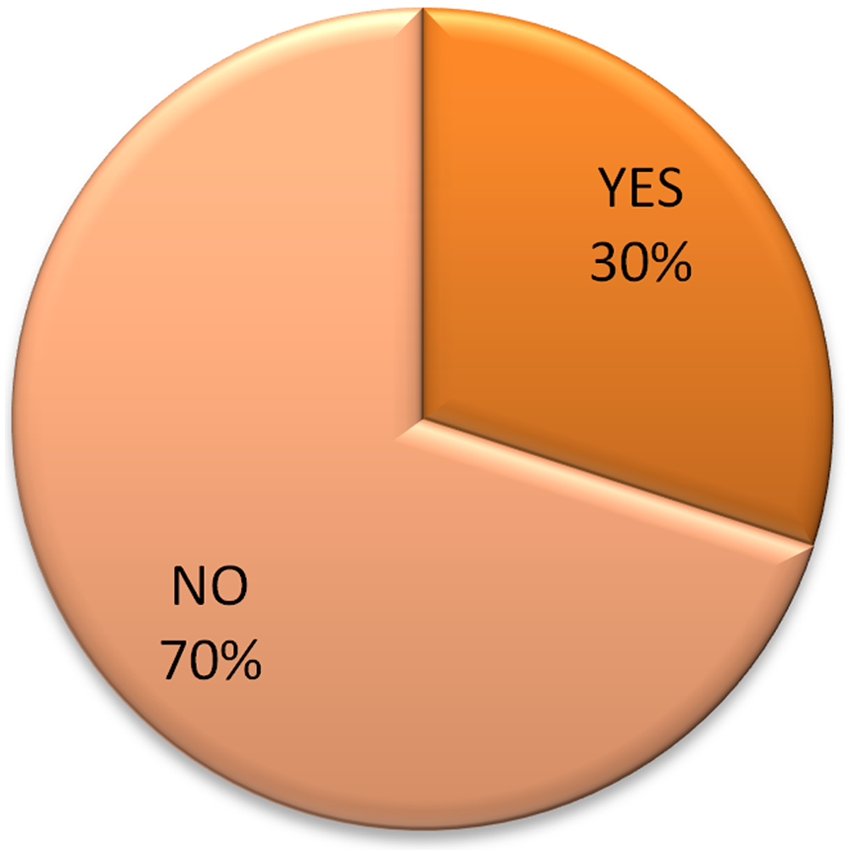
Writing component in business syllabi.
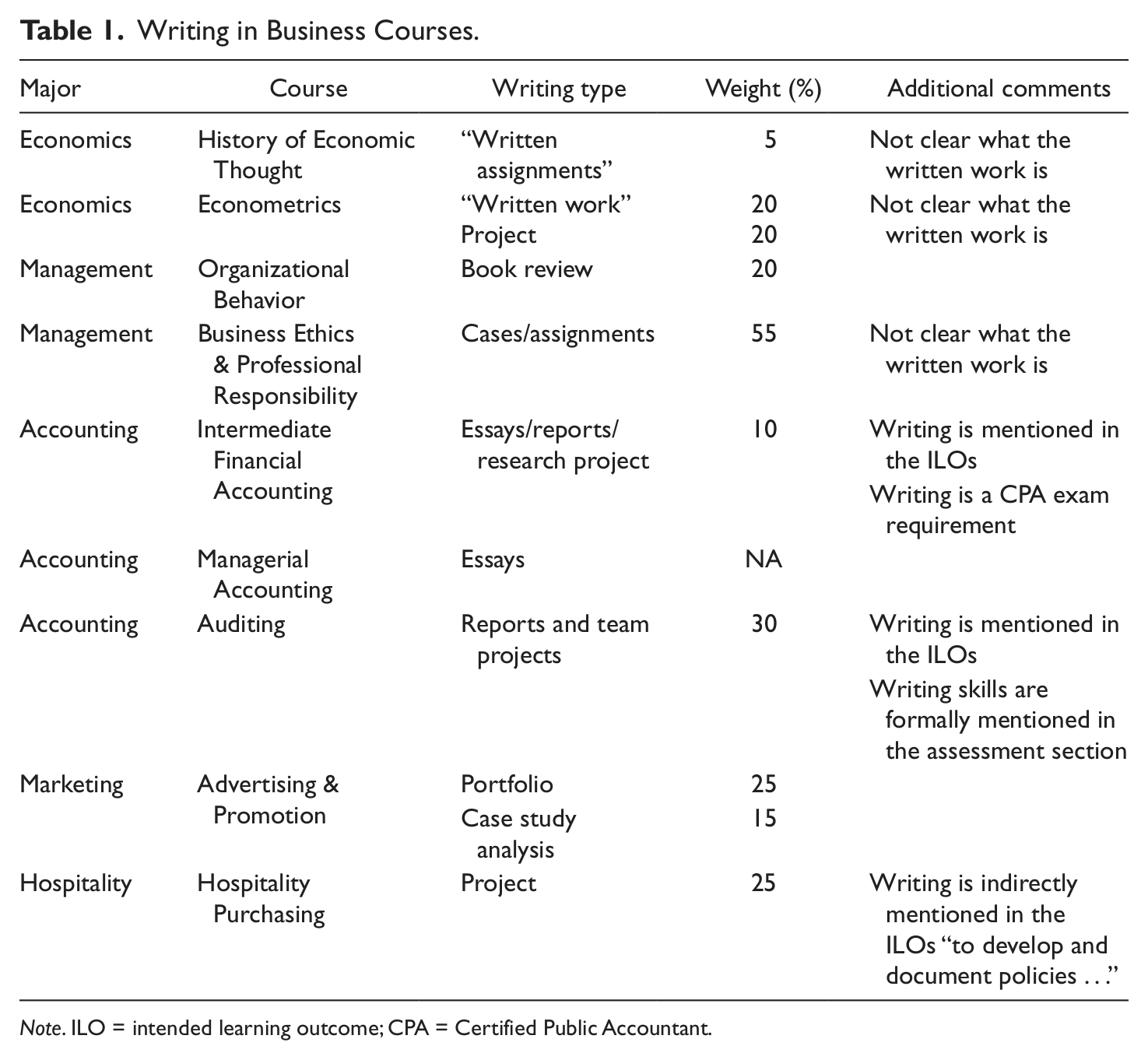
Nine out of the 30 courses incorporate a writing component. Table 1 displays the writing elements in each course and how much weight is given to writing in the assessment of the course.
Writing in Business Courses.
Note. ILO = intended learning outcome; CPA = Certified Public Accountant.
Three of the nine courses that appeared to include writing activities do not clearly state what the writing activities are. The syllabi for those three courses mention “written assignment” or “work” without specifying the nature of the writing assignment. In the other six courses, essay and report writing seem to be the most common writing activities that students are required to do; in all six courses, neither are descriptions of the requirements present nor is the writing genre clear. Furthermore, the due dates, when reported, are at the end of the semester, signaling that students will not receive any feedback or have any knowledge of how their writing had been evaluated.
In general, based on the syllabus review, the following observations were made and will be briefly discussed.
1. Written communicative competence is almost absent in the ILOs of the 30 courses.
All types of communication skills are often cited as the most important skills employers seek in potential employees (National Association of Colleges and Employers, 2012; Parks & Goldblatt, 2000; Quible & Griffin, 2007). Particularly, good writing skills are often hailed as one of the most important qualifications an employee can possess (Quible & Griffin, 2007). Consequently, universities are under more pressure from external demands on student preparation for the job market. In this study, FOB teachers seem to focus only on their subject matter competencies in their syllabi, ignoring language competence in the ILOs. The responsibility for meeting the current market trend concerning communicative skill is therefore left to the English department through the two service courses required of all university students.
2. The formal assessment of writing is minimal in most of the courses.
Almost all the FOB instructors are nonnative speakers of English, with little experience in writing in a foreign language or teaching writing. Current research shows that some instructors in different disciplines in outer circle contexts recognize that students need to be trained in discipline-specific thought and communication processes (Zhu, 2004). In addition, research consistently states that writing assignments in a particular academic domain aid in students’ ability to understand the material in that particular domain (Goma, 2001; Riordan, Riordan, & Sullivan, 2000; Simpson & Carroll, 1999).
3. Writing is only formally incorporated in 30% of the courses.
Although it is widely assumed that writing enhances learning as well as facilitates teachers’ awareness of students’ comprehension of material (Langer & Applebee, 1987; Peritz, 1994; Pobywajlo, 2001; Russell, 2001; Thomas, 2009; Todd & Hudson, 2008), the instructors in these courses seemed to be unaware of the potential of such a teaching/learning strategy as evidenced by this finding. This finding supports the finding in Knight (2005) that revealed that writing did not “play a prominent role in that sample” of international business programs (p. 144).
4. When writing is required, page requirements are unknown, the required writing genre is generally unidentified and process writing is absent.
Well-conceived writing assignments can accomplish at least two goals: better thinking and learning in a discipline (Astin, 1993; Carter et al., 2007; Plutsky & Wilson, 2001) and better writers in the discipline. When instructors are not explicit in communicating the criteria for the assignment, the assignment will fail to deliver its full potential. In the university-required English courses at this university, at least two writing assignments go through the draft-edit-revise process. The process of drafting and redrafting a writing assignment allows for higher order processes to be employed including decision making, and judgments about quality and precision. The findings revealed that no process writing is required of the students in this cohort of baccalaureate courses. Plutsky and Wilson (2001) similarly report that faculty members in the Business school in their study failed to provide students with guidance in the process of writing, assuming that students would already know the stages and implement them.
Limitations
The purpose of this research study was to investigate if WAC/WID principles were at least intuitively present in the business course syllabi in this outer circle environment through analyzing the business course syllabi for all courses offered in the spring 2011 semester. We are aware that the use of content analysis as the only source of data has resulted in some limitations. Some course syllabi might not fully reflect what teachers and students do in class. Therefore, further investigation is needed through interviewing teachers and students in order to explore if students are perhaps undertaking any writing activities that are not mentioned on the syllabi.
Conclusion
The use of the syllabus review methodology employed in this study has proven to be an unobtrusive way of extracting meaningful information that can elucidate a potentially sensitive situation of tremendous importance for the teaching learning process. Syllabi are communication devices and therefore should include all content and procedures associated with the running of a course. If a syllabus is well prepared, it should reveal all the ILOs of a course, including whether or not students will gain proficiency in the writing conventions of that discipline.
The approach to data gathering was also particularly effective for an EFL environment that functions in an outer circle and/or expanding circle context of English language use. An outer circle environment by definition involves professors teaching discipline-specific courses in their second or even third language. Such a situation can create a lack of instructor confidence in nurturing students’ use of language. Investigating the role of language in a course through syllabus review proved to be an effectual way of uncovering the necessary information.
The syllabus review indicated that about two thirds of the courses in the FOB do not formally include a writing component. The other third suggest some writing is required of students, but the function of the writing activities as a learning strategy or as a means of improving writing skills is not explicit. The principles of WAC/WID are absent in the FOB curriculum since writing does not seem to be included as a WID strategy in the courses being offered. While some writing assignments are confirmed on some syllabi, it can be inferred that instructors are unaware of the potential of writing as a learning strategy. The power of writing exercises to engage students in productive learning seems to be undervalued. Furthermore, the inference can extend to include the absence of the idea that students must be trained in the writing conventions of their discipline, including verb choice, author stance, and audience perspective (Bazerman et al., 2005; Hyland, 2009).
It is reported in the literature that a single pedagogical solution is never the answer for the acquisition of any structurally complex skill (Carter et al., 2007; Russell, 2001; Soven, 2000). Therefore, it is paradoxical to think that a single department or any program alone will cure poor student writing. Universities, especially universities in outer circle or expanding circle contexts, would be wise to initiate WAC/WID principles to reinforce skills taught in the courses run by the English department if students are expected to acquire internationally competitive language skills, particularly in writing.
WAC/WID programs place a high emphasis on the writing skill, and the rationale that guides WAC/WID programs states that nurturing students’ ability in this all important skill is a responsibility of the entire educational community. Furthermore, WAC/WID maintains that through writing, learning is enhanced. As mentioned above, WAC/WID programs require certain features to ensure their effective implementation. One of those features is a writing center to aid and assist students in their pursuit of effective writing ability (Inman, 2001; McLeod & Maimon, 2000); this university has such a resource. However, additional features that are required for WAC/WID implementation such as instructor training, workshops, and foundational philosophical beliefs (Inman, 2001) are missing. The four primary observations generated by this research study, reported above, add to the existing literature that cites the necessity of these features for a WAC/WID program to be implemented (Inman, 2001; Townsend, 2005). The four observations also strongly reveal that WAC/WID in contexts outside the inner circle requires research generated information to guide best practices.
The importance of writing in the learning process is well documented (Ackerman, 1993; Astin, 1993; Bangert-Drowns et al., 2004; Langer & Applebee, 1987) and in business courses specifically (Faris, Golen, & Lynch, 1999; Riordan et al., 2000). Therefore, this study not only informs the research study’s context concerning this axiom but also draws attention to the use of syllabus review as an effective and unobtrusive research design that can elucidate a situation. Importantly, this study begins to answer McLeod’s (2008) call for opening a dialogue with international WAC scholars as well as supports Cox’s (2011) assertion that research into WAC in environments other than English as the native language environment is much needed.
Footnotes
Acknowledgements
The authors gratefully acknowledge the comments and suggestions made by Dr. Martha Townsend on an earlier draft of this article.
Declaration of Conflicting Interests
The author(s) declared no potential conflicts of interest with respect to the research, authorship, and/or publication of this article.
Funding
The author(s) received no financial support for the research, authorship, and/or publication of this article.