






Abstract
Introduction
Wilderness medicine (WM) is the study of medicine in austere environments. There are several US multidisciplinary courses that teach WM to people from varying medical backgrounds. However, WM topics are covered to different extents. This study's purpose was to compare WM components among US multidisciplinary training courses.
Methods
The American College of Emergency Physicians WM fellowship curriculum's 19 components and the Fellowship of the Academy of Wilderness Medicine's 12 core and 16 elective competencies and their credits were used as two control lists. Curricula from 10 US multidisciplinary courses were analyzed for WM components. Using descriptive analysis, each course curriculum was compared with the controls.
Results
This study examines WM components in 10 courses. The greatest number of American College of Emergency Physicians WM fellowship topics (14 of 19) was covered by the Paramedic course and the fewest number (4 of 19) by the Tactical Combat Casualty Care–Combat Lifesaver course. The greatest number of Fellowship of the Academy of Wilderness Medicine core credits (56) was offered by the Paramedic course and the fewest number (24) by the Tactical Combat Casualty Care–Medical Personnel course. The greatest number of Fellowship of the Academy of Wilderness Medicine elective credits (83) was offered by the Paramedic course and the fewest number (25) by the Tactical Combat Casualty Care–Combat Lifesaver course.
Conclusion
This research analyzed WM components in US multidisciplinary courses and demonstrated that each covers WM topics to varying extents. This shows an opportunity for these courses to expand their WM education within their scope. It also demonstrates competencies offered by different courses for interested trainees.
Introduction
Wilderness medicine (WM) is the practice of medicine in austere environmental conditions with a scarcity of resources and a need for improvisation. 1 The field of WM dates back centuries but was organized within the last century.1,2 Doctors Greer, Auerbach, and Kizer created the Wilderness Medicine Society (WMS) in 1983 to organize and pioneer education, research, and practice in the field. 1 Currently, there are 19 civilian WM graduate medical education (GME) fellowships and 1 military WM fellowship for post–emergency medicine or family medicine residency training. 3 Of these, one currently offers WM fellowship training to both physician assistants and nurse practitioners as well. 4 Seventeen of these WM GME fellowships are certified by the WMS, which indicates that they met the criteria set forth by the WMS to meet their defined educational standards. 3
The WMS requires that these WM GME fellowships must meet the educational criteria outlined by Lipman et al.5,6 This educational curriculum was developed by the American College of Emergency Physicians (ACEP) WM Section via a Fellowship Subcommittee Taskforce at the 2009 ACEP Scientific Assembly. 5 After meeting from 2010 through 2012, the taskforce of WM fellowship and academic experts came to a universal vote on 19 curriculum topics that encompass WM education, including 4 academic development topics (ie, education of wilderness medicine, quality, research, and leadership) and 15 core content topics (ie, altitude, environmental exposure, wilderness trauma, expedition medicine, drowning, dive medicine, aquatic medicine, poisonings and envenomation, fire, wilderness Emergency Medical Services [EMS], search and rescue, survival, lightning, avalanche, and wilderness toxicology). 5
The ACEP WM GME fellowship curriculum was used as a control curriculum to assess WM components in the multidisciplinary training courses because it is considered to be a comprehensive list of WM curriculum topics for emergency medicine physicians pursuing a WM fellowship and was created in consensus by leading WM experts. In this study, multidisciplinary training courses are described as training courses that are not exclusive to physicians. It is not assumed that these multidisciplinary training courses must contain all components from the ACEP WM GME fellowship curriculum, which was developed for physicians. The ACEP WM GME fellowship curriculum was used primarily as a baseline of WM topics from which our study assesses the inclusion of WM topics in other courses.
Some topics from the ACEP WM GME fellowship curriculum must be clearly defined because even though they may appear to cover overlapping information, they actually cover different teaching points. For example, aquatic medicine includes injuries from marine animals, poisonings, and infections, whereas dive medicine includes physics, physiology, barotrauma, and decompression illness. 5 As another example, avalanche medicine includes terrain and snowpack assessment, victim physiology, patterns of injury, and rescue equipment, whereas expedition medicine includes topics such as pretravel considerations, evacuation criteria, infectious disease, and field water disinfection. 5
A second control curriculum was used that is not focused primarily on physician training. This is the Fellowship in the Academy of Wilderness Medicine (FAWM) core and elective credits.7,8 Although separate from the FAWM, the WMS appoints the FAWM's chair. The purpose of this fellowship is to recognize the formal WM training of an individual who pursues at least 45 to 70 core credits and 5 to 15 elective credits in addition to attending 1 to 2 WMS conferences and earning 20 to 40 experience credits. 9 After completion of the FAWM, one earns the degree of Fellow of the Academy of Wilderness Medicine. This fellowship requires a degree in a medical field and at least 1 y of experience in that field. Of note, an applicant must be a WMS member to pursue this fellowship.
There are US training courses not focused primarily on physicians that include WM training. These training courses include Emergency Medical Technician (EMT), Paramedic, Tactical Combat Casualty Care–Combat Lifesaver Course (TCCC-CLS), and Tactical Combat Casualty Care–Medical Personnel (TCCC-MP). Additionally, various WM-specific training courses are offered via different organizations. These include Wilderness Emergency Medical Technician (WEMT), Wilderness First Responder (WFR), Wilderness Medicine for Professional Practitioners (WMPP), Wilderness Upgrade for Medical Professionals (WUMP), Wilderness Advanced Life Support (WALS), and Wilderness Life Support for Medical Professionals (WLS:MP, formerly known as Advanced Wilderness Life Support [AWLS]). Table 1 summarizes the intended trainees, duration and level of training, parent organization, and curriculum of these multidisciplinary training courses. The following subsections describe each of these training courses in more detail, including, but not limited to, what bodies they are set forth by, whom they are intended for, and length of training.
Description of multidisciplinary training programs.
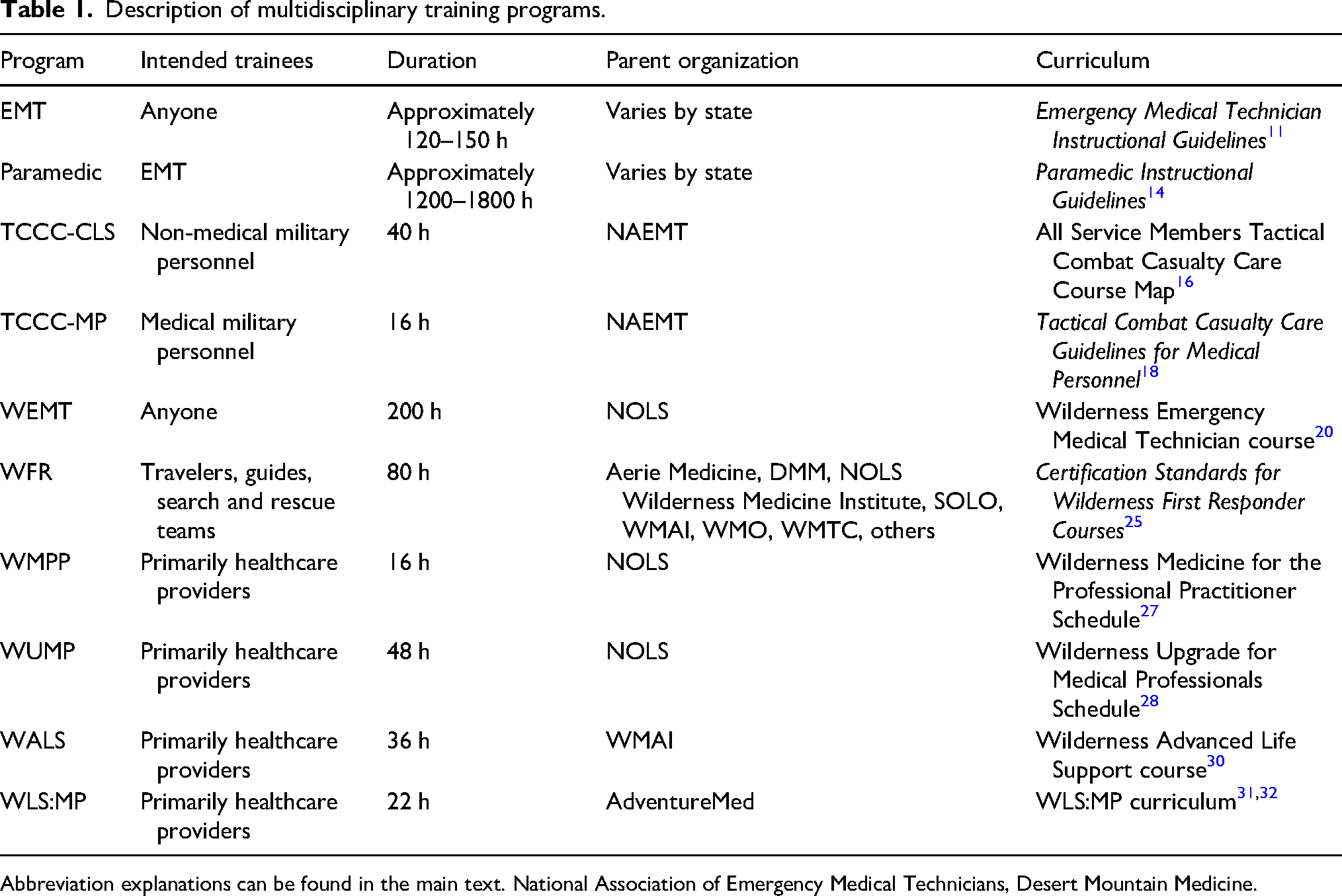
Abbreviation explanations can be found in the main text. National Association of Emergency Medical Technicians, Desert Mountain Medicine.
Emergency Medical Technician
An EMT can perform basic prehospital interventions and use basic equipment from an ambulance. 10 EMT Basic is a foundational training level for EMS personnel. Emergency Medical Responders (EMR) are only accepted in about half the United States and therefore are not included in this study. Because of the nature of their role, EMTs provide care in the field, which often includes austere elements. It is only natural that EMT personnel are trained in at least some aspects of WM. For example, trainees learn to apply splinting before moving a patient. The EMT training curriculum is encompassed by the Emergency Medical Technician Instructional Guidelines and set forth by the US Department of Transportation National Highway Traffic Safety Administration. 11 The EMT's primary goal is to reduce morbidity and mortality in the prehospital setting using noninvasive techniques. 12 It is important to note that the exact scope of care provided by EMS practitioners varies from state to state. 10
Paramedic
Paramedic training requires EMT Basic training in addition to Paramedic certification in most states.10,13 Although their scope of practice varies by state, 10 paramedics focus on prehospital medicine and are usually overseen by physicians. Paramedics practice at an advanced level, including using advanced equipment such as cardiac monitors and transthoracic pacers, performing endotracheal intubation in many states, and administering various medications including those used in Advanced Cardiac Life Support (ACLS). 12 The Paramedic curriculum, set forth by the US Department of Transportation National Highway Traffic Safety Administration, includes many more hours of training than the EMT curriculum.10,14
Tactical Combat Casualty Care–Combat Lifesaver Course
TCCC-CLS is a training course geared toward nonmedical military personnel who are being deployed. 15 These individuals do not have experience in the medical field, and thus, the course is more basic than the TCCC-MP course, which is intended for medical personnel. Set forth by the nonprofit National Association of Emergency Medical Technicians, the TCCC-CLS course is a 40-h course created by the Committee on Tactical Combat Casualty Care that includes training in topics such as the use of basic medical equipment, trauma and respiratory assessment, and evacuation procedures. 16 Because of the often austere and unpredictable nature of combat zones, some of these topics overlap with WM training.
Tactical Combat Casualty Care–Medical Personnel
In contrast to the TCCC-CLS course, TCCC-MP is a 16-h training course catered to deployed medical personnel in the military, including physicians, nurses, medics, corpsmen, and pararescue personnel. 17 The curriculum, also created by the Committee on Tactical Combat Casualty Care and set forth by the nonprofit National Association of Emergency Medical Technicians, is more advanced than that of the TCCC-CLS course in that more advanced techniques are included, such as administration of medications such as tranexamic acid and ketamine as well as airway techniques such as cricothyroidotomy. 18 However, it also overlaps with WM training by the very nature of the medical needs in the austere environment of a combat zone.
Wilderness Emergency Medical Technician
WEMT training is offered by many organizations, including the National Outdoor Leadership School (NOLS), which is a nonprofit global wilderness school, and includes 200 training hours. 19 Although there are other WEMT courses with their own curricula, the NOLS WEMT curriculum was chosen for this paper because it is approved for FAWM credits through the Academy of Wilderness Medicine and Continuing Medical Education (CME) through the WMS. 20 This month-long course includes didactics, skills, and simulation lessons, and at the end of the course, participants have the opportunity to be certified for both EMT and WEMT. 20
Wilderness First Responder
WFR is offered by several organizations, including, but not limited to, Aerie Medicine, Desert Mountain Medicine, NOLS Wilderness Medicine Institute, Stonehearth Open Learning Opportunities (SOLO), Wilderness Medical Associates International (WMAI), Wilderness Medicine Outfitters (WMO), and Wilderness Medicine Training Center (WMTC). The course offered by NOLS is an 80-h training including didactic and skills lessons. 21 It is recommended for travelers, guides, and search and rescue teams. The course meets the standards of Scouting America and the American Camp Association and is approved by the US Coast Guard. The course offered by Wilderness Medicine Associates International runs at a minimum of 70 training hours. 22 WMO offers an 89-h combined WFR/WEMT course. 23 These courses may differ in terms of their length and the depth to which they teach, but they all follow the updated scope of practice, including the minimum core requirements, for WFR set forth by members of Aerie, Desert Mountain Medicine, NOLS Wilderness Medicine Institute, SOLO, WMAI, WMO, and WMTC in 2018.24,25
Wilderness Medicine for Professional Practitioners
WMPP is also offered by NOLS via a 16-h didactic and skills course aimed at the medical professional, including, but not limited to, EMTs, nurses, nurse practitioners, physician assistants, and physicians. 26 It is also approved by the WMS for credits toward the FAWM. Because this course is directed toward medically proficient providers, it builds on preexisting basic medical knowledge. Trainees receive a certification in epinephrine autoinjectors.
Wilderness Upgrade for Medical Professionals
NOLS also offers a 48-h training course for WUMP. This course includes didactics, skills, and simulation training geared toward EMTs, nurses, nurse practitioners, physician assistants, physicians, and other medical providers. Compared with the WMPP course, this course offers an expanded curriculum and offers certifications in epinephrine autoinjectors, WEMT, and WFR.27,28 The WUMP course is approved by the Accreditation Council for Continuing Medical Education and NOLS and is recognized by the WMS. 29 Like WMPP, this course is also approved for FAWM credits.
Wilderness Advanced Life Support
WALS is a 36-h course offered by WMAI for Advanced Life Support (ALS)–trained advanced care medical professionals, including physicians, physician assistants, nurses, and paramedics. 30 The curriculum was created by rescue professionals, medical personnel, and researchers and includes both didactic and skills sessions. The course is approved for FAWM credits.
Wilderness Life Support for Medical Professionals
WLS:MP is an advanced course offered by AdventureMed that is geared toward licensed and training medical professionals.31,32 It is approved by WMS, ACEP, the American Academy of Family Physicians, and the American Academy of Physician Assistants. The didactic and skills course is multiple days long and offers CME as well as FAWM credits. 33 There are third parties that offer the course, such as RedSTAR 33 ; however the official curriculum is provided by its parent organization, AdventureMed. 31
The purpose of this study was to analyze the curricula of the aforementioned US training courses and determine the extent of overlap with the WM GME fellowship curriculum as well as the FAWM curriculum. The hypothesis was that these courses had overlapping content with the WM GME fellowship curriculum but that they overlapped to varying degrees.
Methods
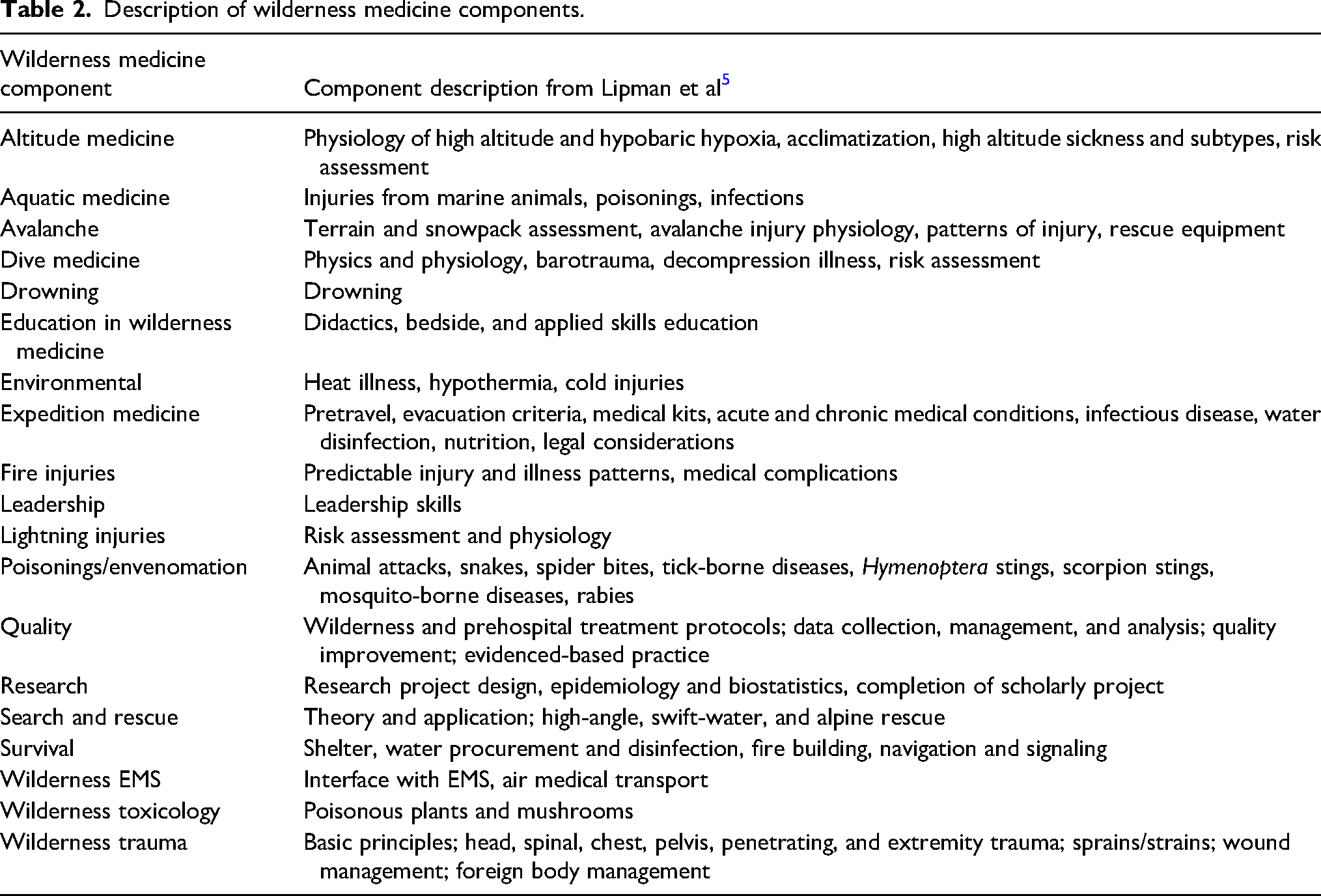
The ACEP WM GME fellowship curriculum described in Lipman et al 5 was used as a control curriculum, and from this curriculum, 19 WM competencies were noted. 5 The ACEP WM GME fellowship curriculum was used as a control because it is a rigorous and intensive WM curriculum that was created by leading experts and educators in WM. These included Education in Wilderness Medicine, Quality, Research, Leadership, Altitude, Environmental, Wilderness Trauma, Expedition Medicine, Drowning, Dive Medicine, Aquatic Medicine, Poisonings and Envenomation, Fire, Wilderness EMS, Search and Rescue, Survival, Lightning, Avalanche, and Wilderness Toxicology. Table 2 provides descriptions of each WM component as described by Lipman et al. 5
Description of wilderness medicine components.
The FAWM curriculum was used as a second control, from which 12 core and 16 elective competencies were noted.7,8 Each of these competencies has a certain number of credits that individuals may earn toward becoming a fellow of the Academy of Wilderness Medicine. This was used as another control because it is open not only to physicians but also to any other individual with a medical degree. The 12 core competencies include Diving and Hyperbarics; Tropical and Travel; Altitude and Mountaineering; Expedition Medicine; Survival; Safety, Rescue, and Evacuation; Sports Medicine; Preventative Medicine, Sanitation, and Hygiene; Environmental; Improvised Medicine; Disaster; and Wilderness Emergencies and Trauma. The 16 elective competencies include all of the 12 topics just listed plus Faculty Development, Research, Tactical Combat Casualty Care, and Desert Medicine.
Table 3 displays the components covered by the ACEP WM GME fellowship curriculum as well as the FAWM core and elective credits. In comparing the two, there is much overlap in topics covered. The ACEP WM GME fellowship curriculum includes other broad topics such as quality, leadership, and varying educational techniques, whereas the FAWM core and elective competencies offer a few more niche topics, such as disaster, desert, and preventative medicine. It should be noted that some main components in the ACEP WM GME fellowship curriculum are noted as credits of FAWM core or elective overarching competencies. These are annotated in Table 3.
Comparison of topics covered by ACEP WM GME fellowship curriculum and FAWM core and elective credits.
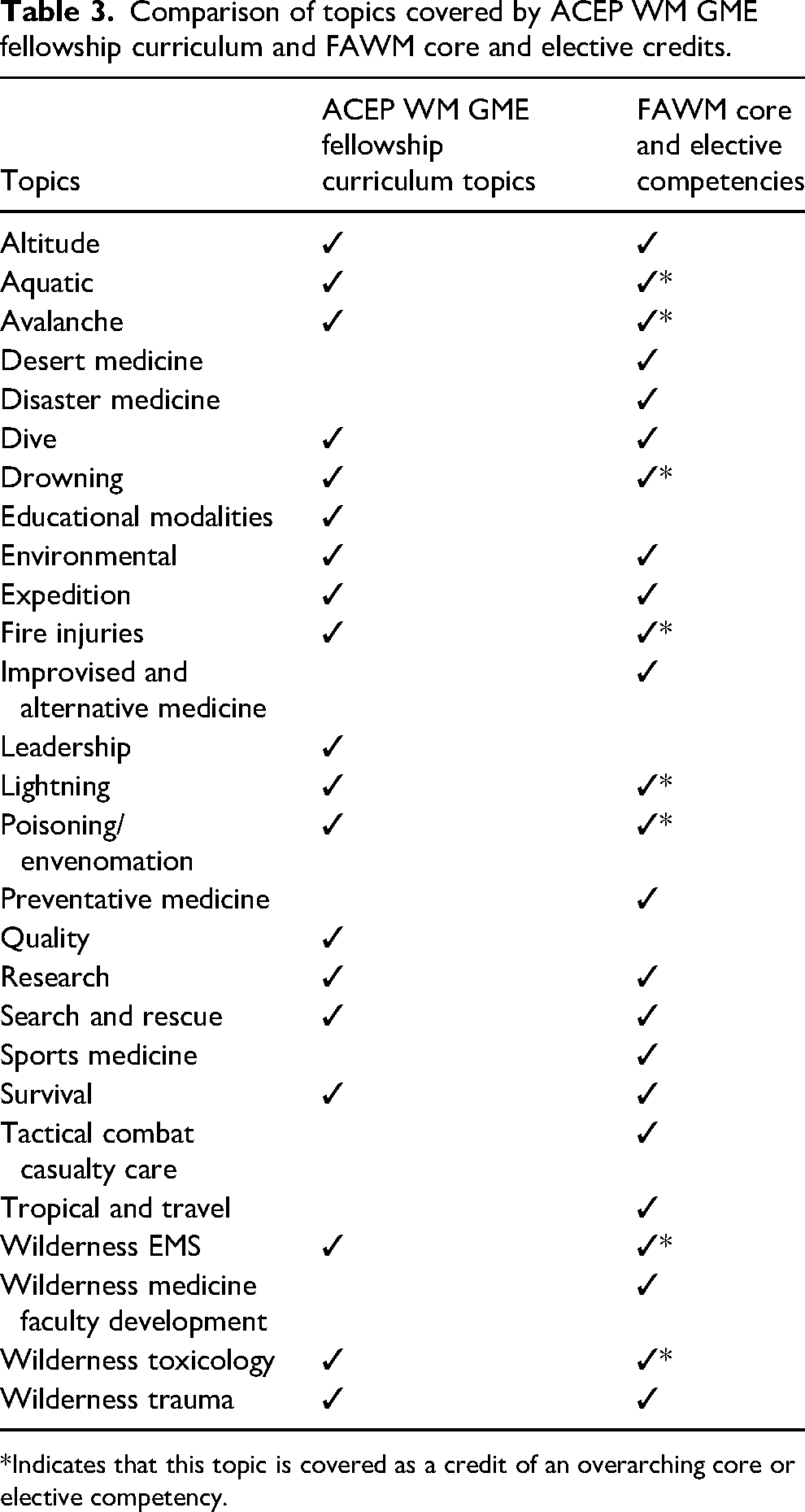
*Indicates that this topic is covered as a credit of an overarching core or elective competency.
The US national curricula for EMT, Paramedic, TCCC-CLS, TCCC-MP, WEMT, WFR, WMPP, WUMP, WALS, and WLS:MP courses were gathered, and their sources are noted on Table 1. They were then analyzed for their respective competencies related to WM. A course was noted to cover a particular component from the ACEP WM GME fellowship curriculum if the main aspects of that WM component's description as defined in Table 2 were covered by the course curricula. Each course was then analyzed to determine which FAWM core or elective credits it offered.7,8 The analysts do not have any involvement with the ACEP WM GME fellowship curriculum, FAWM core and elective credit curricula, or the curricula of the multidisciplinary courses. The WM components were then examined alongside the ACEP WM GME fellowship curriculum and the FAWM credits curricula as controls. Descriptive analysis was used to identify similar and different topics between each course curriculum and the two controls.
Results
Table 4 shows the ACEP WM GME fellowship curriculum components included in each training curriculum. The WM components that were covered by all 10 course curricula included education in WM, environmental, and wilderness trauma. Expedition medicine and aquatic medicine were only covered by WUMP and WFR, respectively. Avalanche was only covered by WALS and WLS:MP. The topic of research was only covered by the Paramedic curriculum. No course covered the topic of survival.
ACEP WM fellowship curriculum components found in each training program.
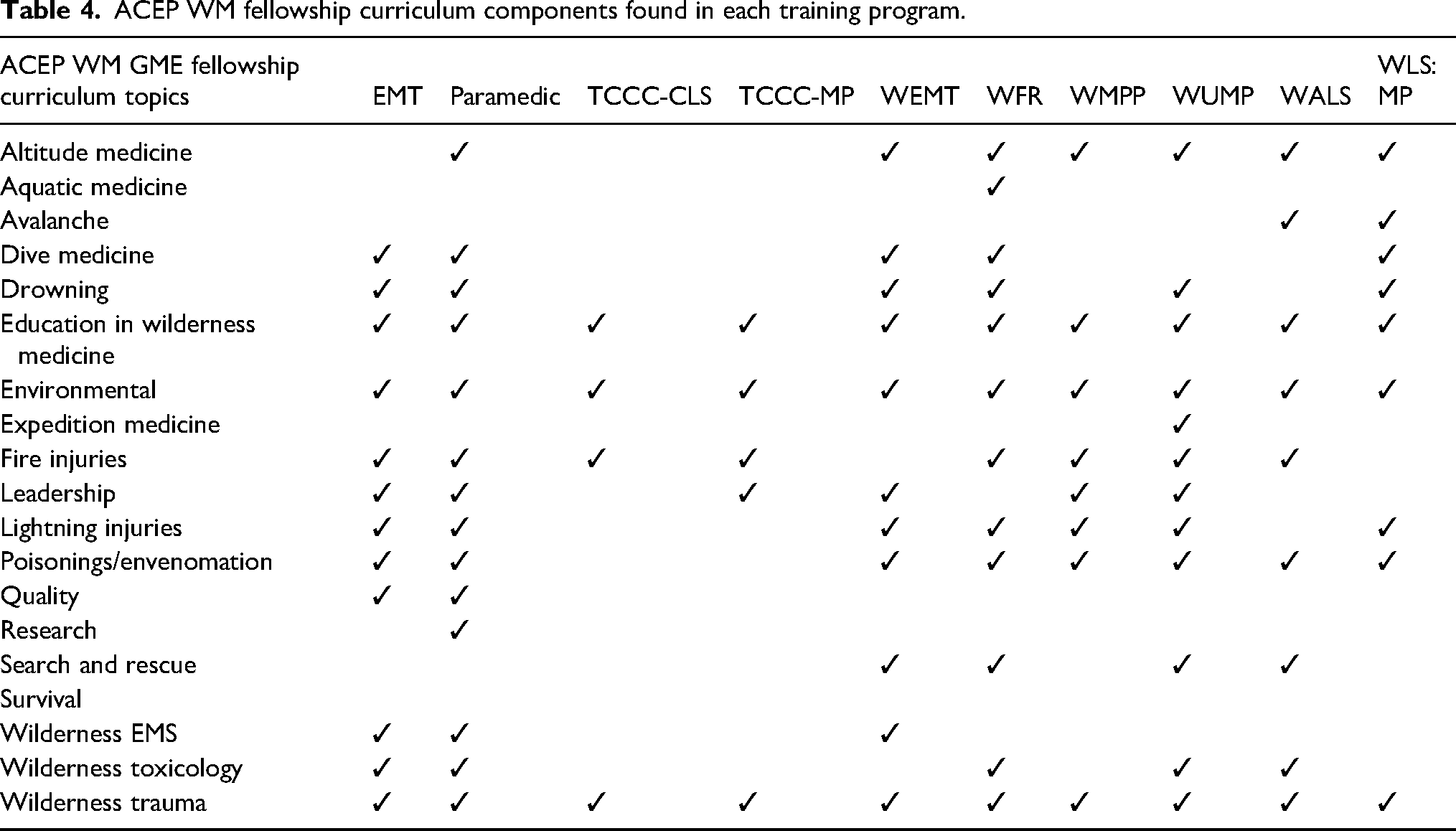
Table 5 shows the number FAWM core credits offered by each course. Most courses offer the majority of core credits for the General Environmental Medicine and the Wilderness Emergencies and Trauma Management competencies. All courses offered very few core credits for the Tropical and Travel Medicine, Expedition Medicine, Survival, Field Craft and Equipment, and Disaster and Humanitarian Assistance competencies.
Number of FAWM core credits offered by each course.
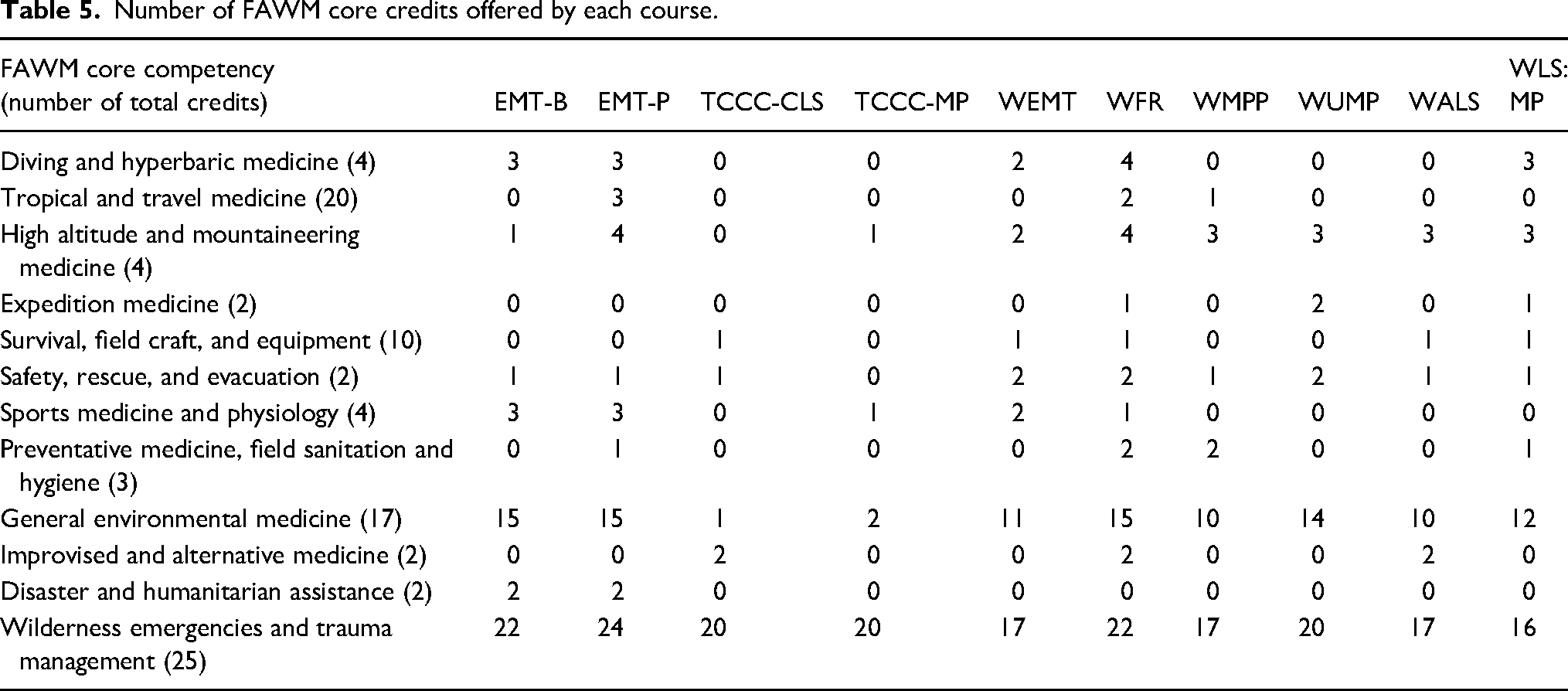
Table 6 demonstrates the number of FAWM elective credits offered by each course. Most courses offer the majority of elective credits for the General Environmental Medicine and the Wilderness Emergencies and Trauma Management competencies. No course offered elective credits for the Wilderness Medicine Faculty Development competency.
Number of FAWM elective credits offered by each course.
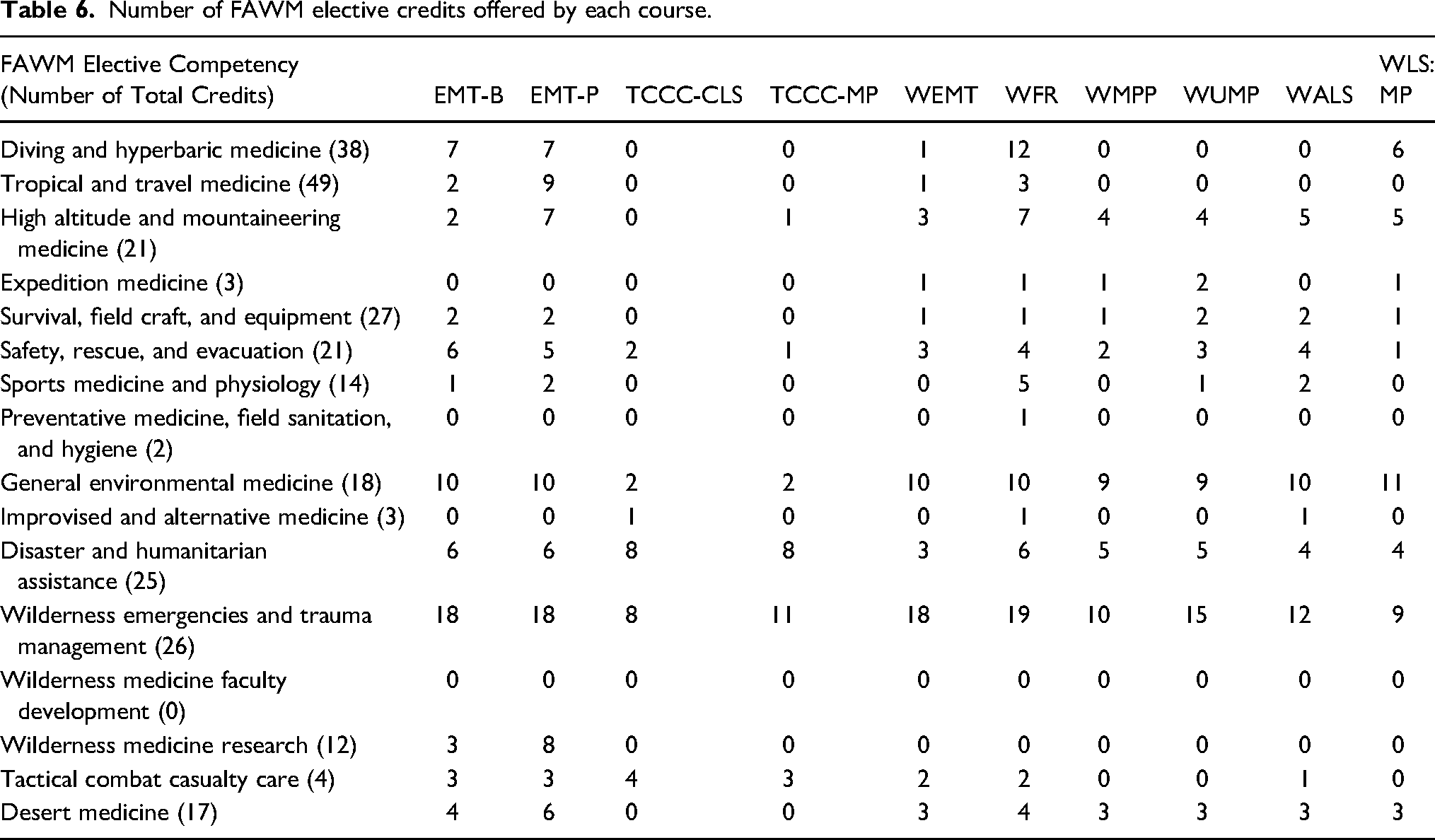
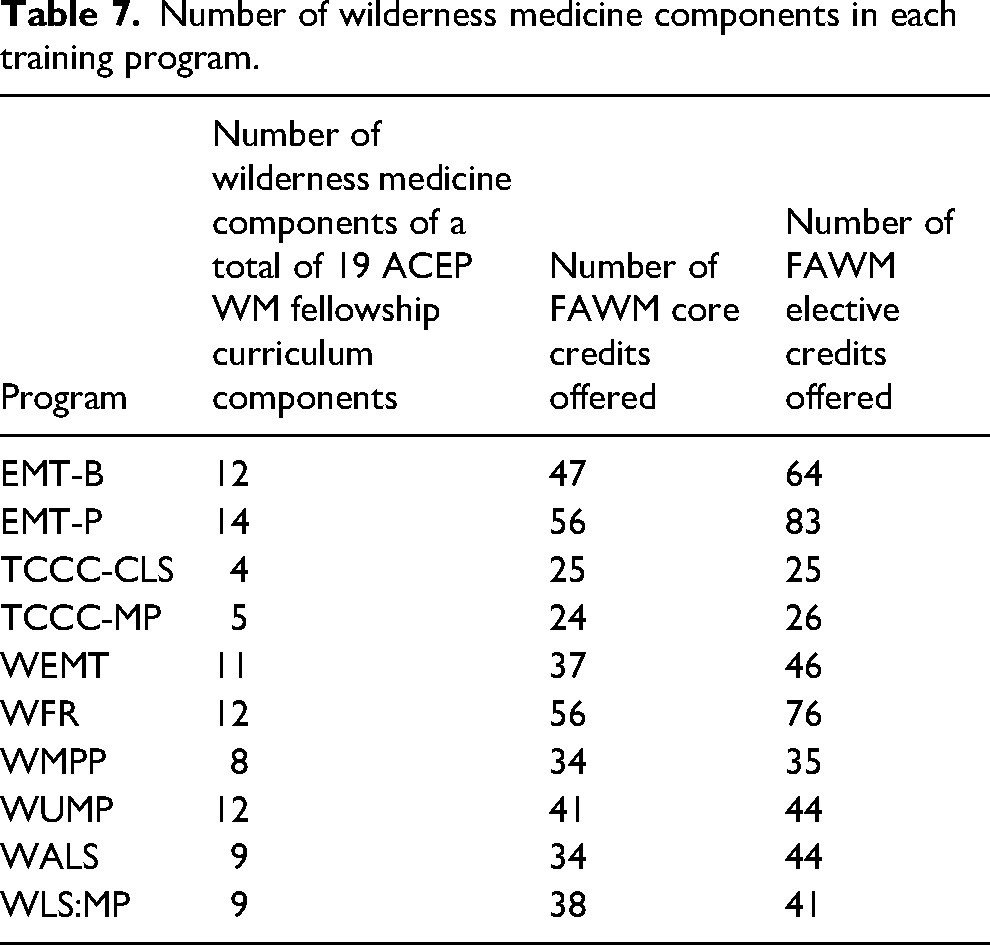
Table 7 demonstrates the number of ACEP WM GME fellowship curriculum components, FAWM core credits, and FAWM elective credits that each training course contains or offers. The Paramedic course curriculum covers the greatest number of ACEP WM GME fellowship curriculum topics (14 of 19), whereas the TCCC-CLS course covers the fewest number of WM topics (4 of 19). The Paramedic course offers the greatest number of FAWM core credits (56), and the TCCC-MP course offers the fewest (24). The Paramedic course offers the greatest number of FAWM elective credits (83), and the TCCC-MP course offers the fewest (25).
Number of wilderness medicine components in each training program.
Discussion
Each of the US courses evaluated covers various components of the ACEP WM GME fellowship curriculum and core/elective credits from the FAWM curriculum. Paramedic training covered the greatest number of WM components from the ACEP WM GME fellowship curriculum (14 of 19), whereas TCCC-CLS training covered the fewest (4 of 19). All courses had education in WM in their curricula, which included didactics and applied skills. The Paramedic course offers the greatest number of core credits from the FAWM curriculum, whereas the TCCC-MP course offers the fewest. The Paramedic course offers the greatest number of elective credits, whereas the TCCC-CLS course offers the fewest. It should be noted that these training courses may teach the WM components at a different depth or from a different perspective. For example, TCCC training focuses on three settings of combat care—while under fire, while in a prehospital combat environment not under fire, and while being evacuated from the combat zone. 34 In contrast, EMTs typically focus on a domestic setting and usually not a combat zone. Additionally, the WM-focused courses cover topics to different depths depending on the goals and prior training of their students. The types of skills required by these personnel will differ based on their settings and goals.
Although these US multidisciplinary training courses do not cover all WM components or FAWM core/elective credits, it may be beneficial for these courses to incorporate more of these components. For example, because military personnel may find themselves in hot, cold, or aquatic combat zones, 34 it could be of benefit to include elements of environmental medicine, aquatic medicine, or drowning into the TCCC-CLS or TCCC-MP curricula. Other valuable skills for military personnel may include treating various envenomations, surviving in austere environments, and performing search and rescue. Additionally, a 2018 review found that there should be adequate military training in mountain medicine to provide the best care in high elevations and rugged terrain. 35
Most air medical helicopters in the United States are staffed by nurses, respiratory therapists, and paramedics. It could be beneficial to include a more robust WM curriculum for these trainees because they are often the first personnel to encounter an emergency in this setting. Additionally, if personnel in helicopters providing medical transport rescue people in a remote area such as a mountain, they could benefit from WM training on survival and injury management in an austere environment. Many of these multidisciplinary training courses already teach many valuable skills, such as leadership, trauma, and fire injuries. However, it could be beneficial to expand the scope of these skills to apply them to the austere environment. This is one way in which the use of the ACEP WM GME fellowship curriculum and the FAWM core and elective credits can be advantageous.
WM-focused training courses such as WEMT, WFR, WMPP, WUMP, WALS, and WLS:MP may already cover a number of the topics included in the ACEP WM GME fellowship curriculum and FAWM core credits. However, these groups may find benefit in adding a few more topics they do not currently cover to offer their trainees a more robust WM education.
As mentioned earlier, these courses offer different aspects of WM training. By demonstrating which topics are covered by each program, this research may be of use to individuals who are exploring different WM training options. With the WM topics of each program clearly displayed, one may choose a program that caters to one’s specific needs.
Limitations
One limitation of this study is that it is not known with certainty the extent to which each WM component is covered by each multidisciplinary course. For example, one course may cover aquatic medicine more thoroughly than another course. This may be due to differences in geographic location, scope of practice, or training objectives. Additionally, different courses have different methods of training, such as hands-on skills workshops vs didactic lectures vs examinations. It also should be noted that the courses were said to have covered a WM component if they covered more than half the description of that WM component.
Another limitation is that although a course may not cover all the WM topics, personnel may go on to fulfill these requirements through another training course. For example, although military personnel fulfill much of their trauma field care in the TCCC courses, they may go on to fulfill their training in altitude medicine in another training course such as a mountain medicine course.
A third limitation is that although each course curriculum was derived from its parent organization, there are third parties that may provide training in all topics in the official curriculum plus extra training in other areas not included in the official curriculum.
A final limitation is regarding the WEMT and WFR course curricula. There are many different organizations that offer the WEMT course but no universal curriculum. 36 For the purposes of this paper, the NOLS WEMT curriculum was used to evaluate for WM topics taught because this course is approved by the WMS and FAWM. Likewise, there is no universal curriculum for WFR courses, but there is a guiding universal scope of practices document with minimum core requirements. 37 This document was used to evaluate which WM topics are taught in WFR courses.
Conclusion
This study compares the ACEP WM GME fellowship curriculum components and FAWM core and elective credits with various US multidisciplinary training courses, including EMT, Paramedic, TCCC-CLS, TCCC-MP, WEMT, WFR, WMPP, WUMP, WALS, and WLS:MP. Each of these courses covered some WM components. Paramedic training covered the greatest number of ACEP WM GME fellowship curriculum components (14 of 19) and TCCC-CLS training covered the fewest (4 of 19). Paramedic training offered the greatest number of FAWM core credits (56), and TCCC-MP training covered the fewest (24). Paramedic training offered the greatest number of FAWM elective credits (83), and TCCC-CLS training covered the fewest (25). With this new information, WM training courses may consider expanding their educational topics using the ACEP WM GME fellowship curriculum and FAWM curriculum as guides. Additionally, individuals may use the information demonstrated in this paper to choose a WM course that fits their specific needs.
Footnotes
Acknowledgment
The authors acknowledge and thank the Emergency Medicine and Emergency Medical Services mentors and professionals for assisting in the development of this project.
Abstract presented at ACEP22 Scientific Assembly on October 2, 2022, in San Francisco, CA.
Author Contribution(s)
Declaration of Conflicting Interests
The authors declared no potential conflicts of interest with respect to the research, authorship, and/or publication of this article.
Funding
The authors received no financial support for the research, authorship, and/or publication of this article.
