The concept of material distribution is introduced as describing the geometric material structure of a general non-uniform body. Any smooth constitutive law is shown to give rise to a unique smooth integrable singular distribution. Ultimately, the material distribution and its associated singular foliation result in a rigorous and unique subdivision of the material body into strictly smoothly uniform components. Thus, the constitutive law induces a unique partition of the body into smoothly uniform sub-bodies, laminates, filaments and isolated points.
Since material bodies are modelled in terms of differentiable manifolds, it should not be surprising that many of the constructs of modern continuum mechanics can be described in a faithful and rigorous way in the language of modern differential geometry. The first formulation of the theory of uniformity and homogeneity in modern differential geometric terms is that of Wang [1]. To a smoothly uniform body Wang assigns a reduction of the principal bundle of frames, with a structure group equal to the typical symmetry group of the material. This material G-structure is flat if, and only if, the material is homogeneous [2]. A further development [3, 4] associates with every constitutive response of a body, whether uniform or not, a material groupoid. Uniformity corresponds to a transitive groupoid. If a material transitive groupoid is also a Lie groupoid [5], then its associated material Lie algebroid becomes available to investigate local conditions of homogeneity [6]. For certain non-uniform solid bodies, corresponding in applications to functionally graded materials with point-wise conjugate symmetry groups, it is possible to develop a formulation [7] that, in many respects, mimics the uniform case. On the other hand, for general non-uniform bodies, no differential geometric results are known, beyond the mere existence of an associated material groupoid.1
In this paper, we propose the introduction of a new material structure, the material distribution, associated with any given smooth constitutive law. This distribution is, in general, a singular distribution, whose definition and properties are briefly reviewed in Section 4. A powerful theorem by Stefan and Sussman,2 which generalizes the classical theorem of Frobenius for regular distributions, allows us to subdivide the body into a disjoint union of uniform bodies of possibly different dimensions. Thus, we may encounter a body that is uniform over an open sub-body and laminated over the rest of the body, even though the constitutive equation of departure is perfectly smooth .3
2. Constitutive equations and material responses of material points
Given a body manifold , a configuration is an embedding , whose derivative at a point is called the deformation gradient at X. If for convenience, as is often stated in textbooks, we identify the body with one of its configurations, called a reference configuration, the material properties of a simple body at a point X are defined by means of a constitutive equation that may depend on the whole past history of and, possibly, other variables, such as the temperature. For definiteness, we can and will think of an elastic material, for which the constitutive equation of each body point is specified in terms of the symmetric Cauchy stress tensor, namely,
Consider the space of all possible smooth elastic constitutive equations, namely,
where is the space of contravariant symmetric second-order tensors in . Each element of this space is a possible descriptor of the material properties of an elastic material point. Moreover, since the constitutive equation itself depends on the particular reference configuration chosen, we try to pin down the concept of material response by considering a right action of the general linear group on . For each the action of on is the function
A material response is identified with an orbit of this right action. In other words, the space of material responses is the quotient space . This definition corresponds exactly to the physical intuition that the material response is a physical invariant, independent of the particular reference configuration adopted to describe it. In this language, two points are said to be materially isomorphic4 if they have the same material response, namely, if, in any reference configuration, their respective constitutive equations belong to same orbit in .
3. Constitutive equations and material responses of material bodies
Having chosen a reference configuration for an elastic material body , is an open set in . The constitutive equation of the body is a map
namely, a function
Henceforth we will assume this function to be smooth in both arguments. An equivalent way to understand the constitutive equation of a material body is as a map
A body is materially uniform [10] if the image of is contained in a single orbit of .
At this point, it is convenient to provide some explicit conditions of smooth uniformity. From the various definitions introduced, we conclude that a necessary and sufficient condition for material uniformity is that for each point there exists a neighbourhood and a smooth field of linear maps with such that
An infinitesimal version of this equation yields the necessary condition
In this equation we have used the notation
Sufficiency can be argued as follows. Assume that equation (8) has a solution , independent of . Interpreting as the Christoffel symbols of a linear connection, if the associated curvature tensor happens to vanish, we automatically have a parallelism on . But even if the curvature does not vanish, let be a smooth parametric curve joining X with . We can solve the system of ordinary differential equations
where s is the curve parameter. The neighbourhood may be reduced, if necessary, to satisfy the conditions of the theorem of existence and uniqueness of solutions of ordinary differential equations. It can be easily verified that all the points of the curve are materially isomorphic, via the solution of equation (10). Indeed,
This implies that
for all . In this way, all points in are shown to be materially isomorphic to X. Notice that, once a material isomorphism is established, the groups at the corresponding points are automatically conjugate, thus affording more freedom to choose material isomorphisms in a smooth way.
Remark 1.If the body is known a priori to be uniform and if a field of material isomorphismsis known, then equation (9) delivers the Christoffel symbols of the corresponding material connection, as defined in Noll [10] and Wang [11]. Here, however, this interpretation is possible only if equation (8) has a solutionindependent of. In other words, the existence of such a solution is a necessary and sufficient condition for local uniformity.
Remark 2. Consider the spacewithin which constitutive laws can be prescribed, as in equation (5). A tangent vector at a point of this product space has a component representing a vectortangent to the body manifold and another componentrepresenting a small matrix increment. Intuitively speaking, if the body happens to be uniform and if we choose, at a point, a vectorsuch thatdescribes a ‘small’ (i.e., near to unity) material isomorphism between X and, we observe a property of left invariance in the following sense. As we move to a point, the vector corresponding to the same material isomorphism will have the same componentas before. This is precisely the meaning of equation (12), which is satisfied identically for all elements of the general linear group.
Our purpose in this paper is to address the question as to what is the most general situation that can arise from the mere assumption of smoothness of the constitutive law of a material body. Our point of departure is inspired by equation (12) in a uniform material. Given the constitutive equation (5), we will consider the (never empty) set of all smooth left-invariant vector fields on that annihilate the differential of the constitutive law. These fields give rise, in general, to a singular distribution in , which we call the material distribution associated with the given constitutive equation. A theorem of Stefan and Sussman will permit us to conclude that every smooth constitutive equation splits the body into a disjoint union of uniform bodies of possibly different dimensions.
4. Distributions
4.1. Definition
A distribution over a manifold M is obtained by assigning to each point a vector subspace of the tangent space . The distribution is defined as the disjoint union
The distribution is said to be regular or of constant rank if the dimension of is the same for all . Otherwise, the distribution is called singular.5 We are interested in studying distributions, whether regular or singular, which are smooth in a precise sense. To this end, recall that a vector field V on a manifold M is a smooth section of the tangent bundle TM, that is, a smooth function such that , where is the tangent bundle projection and is the identity map in M. A vector field defined on some open subset is called a local vector field. We can, accordingly, consider the collection of all local vector fields that belong to the distribution. Put differently, if a local vector field V is defined on an open subset , then if, and only if, for each , we have that . The distribution is smooth if it is spanned by . Equivalently, for every , coincides with the set of all linear combinations of all vectors V (x) of all local vector fields defined at x.
4.2. Integral manifolds
An important question in the theory of smooth distributions is whether there are submanifolds whose tangent spaces coincide everywhere with the local subspace in the distribution. In the case of a regular one-dimensional distribution, the answer is always positive, as assured by the theorem of existence and uniqueness of solutions of systems of ordinary differential equations. A simple counterexample in higher dimensions is obtained by considering the smooth regular two-dimensional distribution in spanned by the two vector fields and , with the standard notation. At each point , the two vectors span a plane, but there is no surface such that its tangent planes in some open subset of coincide with the distribution.
An integral manifold of a distribution in M is an immersed submanifold , such that, at each point , . A maximal integral manifold is an integral manifold that is not contained in any strictly large integral manifold. Given a distribution on M, it can be shown that each point that is contained in some integral manifold is contained in a unique maximal integral manifold.
4.3. Integrable distributions
A smooth distribution on a manifold M is said to be integrable if every point is contained in an integral manifold of and, hence, in a unique maximal integral manifold. It follows that an integrable distribution induces a partition of the manifold M made up of all its maximal integral manifolds. This partition is known as a foliation of M, with each maximal submanifold referred to as a leaf of the foliation. Notice that in a strictly singular integrable distribution there will be leaves with different dimensions. To emphasize this fact, we sometimes refer to the partition induced by a singular integrable distribution as a singular foliation. At any rate, the use of the terminology ‘foliation’ is consistent with other uses of this terminology in differential geometry. In particular, for each there exists a so-called distinguished chart with the following property: each inverse image of the set with constant components , where , falls within a connected component of a leaf of dimension n. This means that, in spite of having required only that the integral manifolds be just immersed submanifolds, the leaves of an integrable distribution fit well with each other locally, like the layers of a cake. This property is guaranteed by the theorem of Stefan and Sussman.
Theorem 1. (Stefan–Sussman)
Letbe a smooth singular distribution on a smooth manifold M. Then the following three conditions are equivalent:
is integrable.
is spanned by a family of local vector fields, with respect to which it is invariant.
is the tangent distribution of a smooth singular foliation.
Remark 3. The second condition in this theorem generalizes to singular distributions the condition of involutivity in the classical Frobenius theorem, which is valid for regular distributions. The following elementary example [9] shows how the fact that the subspaces of a singular distribution have different dimensions plays a role in making involutivity insufficient to guarantee integrability. Recall that the Lie bracket of two vector fields,andis the vector field defined (in components of a local chart) as
where the summation convention for diagonally repeated indices is in force. A distribution is involutive if the Lie bracket of every pair of vector fields in the distribution belongs to the distribution. Consider the distribution on spanned by the constant vector field and by all vector fields in , that is, the plane devoid of its origin. This is clearly a smooth singular distribution, which assigns the whole tangent plane to each point in , and the line to the origin. This distribution is not integrable, since it does not have a (one-dimensional) integral manifold containing the origin. Indeed, this manifold should contain points other than the origin, where the dimension of an integral manifold should be two. This distribution, however, is trivially involutive. What fails, therefore, is not involutivity but stability, which is the meaning of the second condition in the Stefan-Sussman theorem. A distribution is stable if it is invariant under the flow of any of its vector fields. Under the flow of the field , for any some vector different from will come to occupy the origin. The distribution is not stable and, therefore, according to Theorem 1, it is not integrable.
5. The material distribution
5.1. Generation
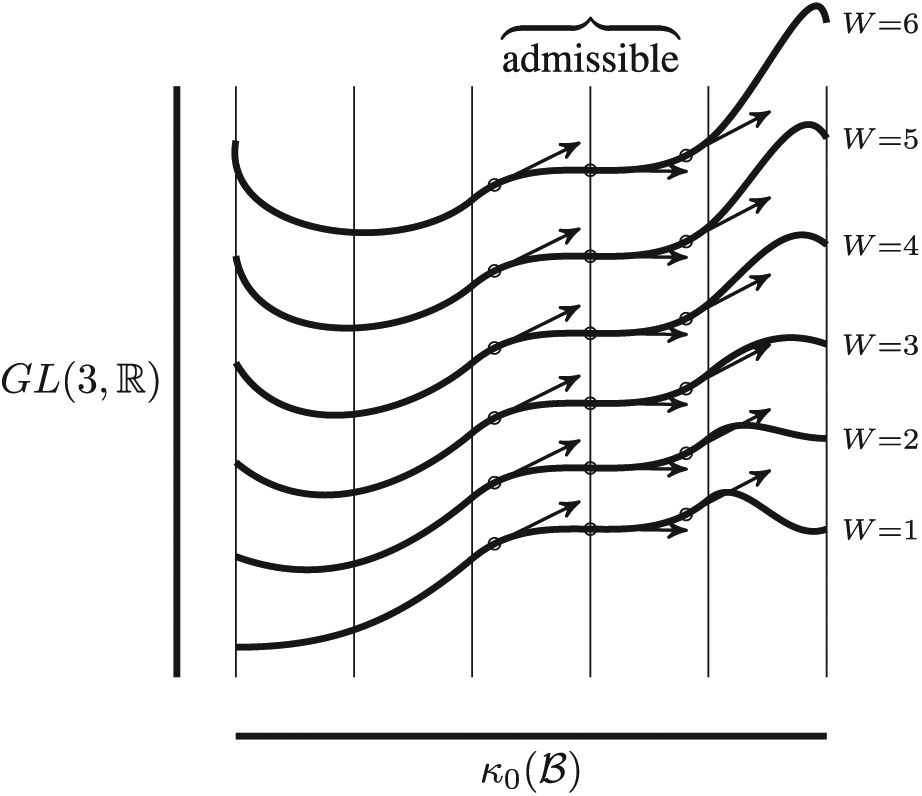
As already remarked at the end of Section 3, we have at our disposal the whole family of local vector fields over the (12-dimensional) manifold that annihilate the differential of the constitutive law. For pictorial purposes, let us represent the product manifold as shown in Figure 1, where the first factor has been placed along the vertical direction for convenience, and let us consider a scalar-valued constitutive function . The annihilation condition is tantamount to tangency of the vector fields to the level sets of the function W. In a strictly uniform body, these level sets are invariant under the left action of the general linear group. To understand why this is the case, recall that in a uniform body there exists at least one material isomorphism between each pair of points. Let be a field of material isomorphisms between a fixed point and all the points Y in a neighbourhood of X. Since for all, a multiplication of to the left by any leaves the equality unchanged and, therefore, translates (multiplicatively) the whole level curve ‘vertically’ by the amount . On the basis of this simple observation, we declare as admissible only those local vector fields that satisfy both conditions: annihilation of and left invariance, and we call the distribution generated by all such vector fields the material distribution associated with the given constitutive law.
Admissible non-vanishing vector field. Since the left action is multiplicative, we may think of the vertical scale as logarithmic. Only the level sets that are vertically parallel qualify as legitimate carriers of the desired non-vanishing vector fields.
Note that, as a direct consequence of the left invariance, the dimension of the subspaces of the material distribution at all points of that project on the same point of is necessarily constant. If a point has no neighbourhood with a non-vanishing admissible vector field, the subspace of the material distribution at each point of the form is of dimension zero. Projecting the subspaces of the distribution in onto , we obtain a new singular distribution on , which we call the body material distribution.
5.2. Integrability
To prove that the material distribution is always integrable, we only need to show that it is stable under the local flows of its generating vector fields and then invoke Theorem 1. We recall that, when a group G acts (on the left) on a manifold M, a vector field on M is left-invariant if, and only if, its (local) flow commutes with the group action, that is,
where denotes the action of the group on the manifold.
Given two left-invariant vector fields, and , for each fixed value of t, consider the composite flow . At each point we have a parametrized curve , which is the image by of the parametrized curve passing through the point . The tangent vector to this curve is nothing but the value of the vector field produced by at the point . Consequently, the tangent to at x is the image of this vector under the flow . Thus, for each value of t we obtain a new vector field that is induced (locally) on M by the image of through the flow of . Applying the action of G to its integral curves, we obtain
Comparing this with equation (15), we conclude that, for each t, the local vector field associated with the flow is indeed left-invariant.
The result just derived is a general result for any left-invariant vector field induced by the flow of another left-invariant vector field. Moreover, for the case of the material distribution, by construction, all the flow lines involved dwell in level sets of the constitutive law. Consequently, the material distribution is stable under the flow of any of its generating vector fields. Applying Theorem 1, we conclude that every material distribution is integrable. Put differently, every material distribution is the tangent distribution to a smooth singular foliation.
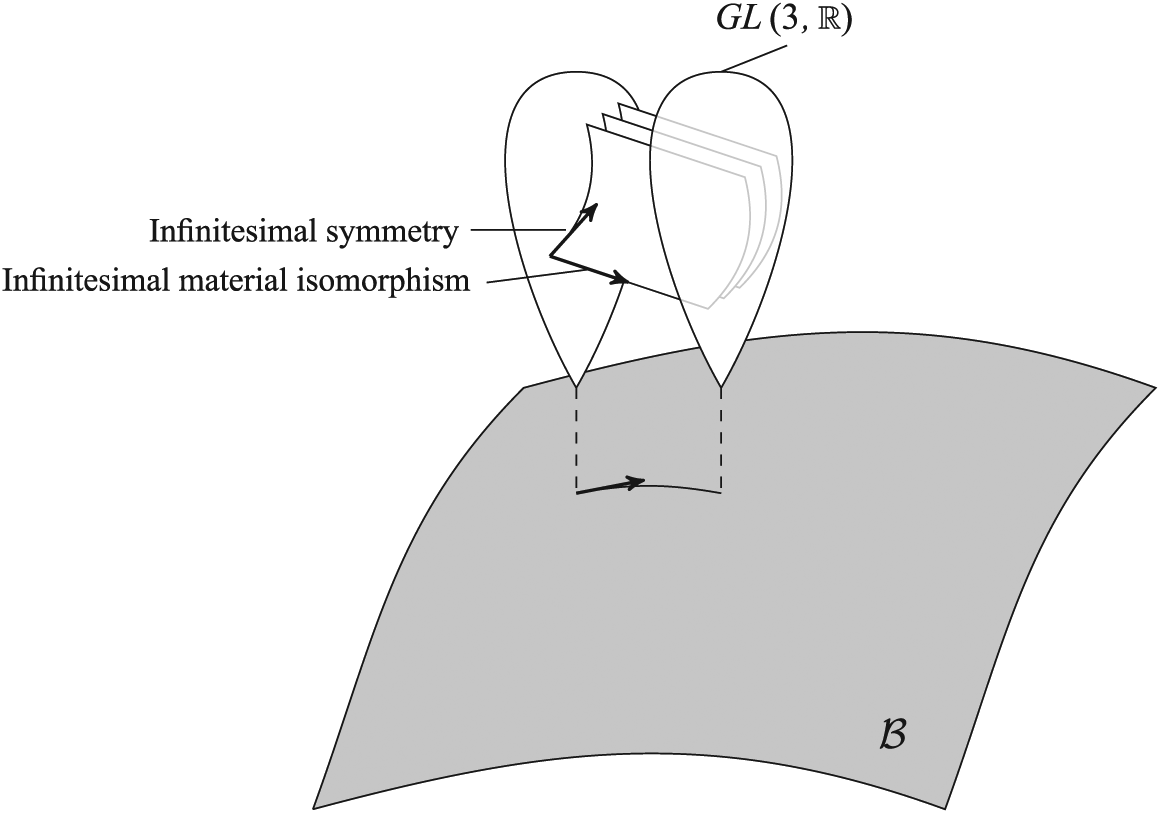
As a projection of the material foliation, the body material distribution can be shown to be integrable. The leaves of its associated singular foliation can be regarded as sub-bodies of various dimensions, each of which is smoothly uniform, as suggested in Figure 2. This is a general conclusion that applies to any smooth constitutive equation defined on a material body.
Body material foliation as the projection of the material foliation.
6. An example
Consider a body placed in a reference configuration occupying the open cube in . Let its constitutive law be characterized by a function given by a product of two functions as
In this equation, are the natural coordinates of and is the identity thereat. The function f alters the value of the material constants as X1 varies. To obtain a meaningful example of a non-trivial singular material distribution, we adopt a function
where is non-negative, monotonic and differentiable, such as the function . A body with this constitutive equation is not uniform, as can be directly verified by checking that equation (8) cannot possibly be identically satisfied by any functions of the body coordinates for L=1 and .
To construct the vector fields that generate the material distribution, consider the differential of the constitutive law, namely,
In this equation, we are purposely using index notation to avoid any confusion. Since the coordinates, both in the body (uppercase indices) and in space (lowercase indices), are assumed to be Cartesian, we can afford to be liberal with the placing of subscripts and superscripts while obeying the summation convention. We are looking for vector fields with components on that annihilate the differential (equation (19)) and that are at the same time invariant with respect to the left action of the general linear group.
Consider first the open half cube with . Since all the partial derivatives of the function f vanish thereat, any vector field of the form is a generating vector field. This is clearly another way of stating that this sub-body is uniform. Each vector can be considered as a small material parallelism. There are, however, other generating vector fields in this sub-body. They are obtained by supplementing the vectors just discussed with vector fields of the form , where is an arbitrary skew-symmetric matrix in the reference configuration. These are clearly the infinitesimal generators of the full orthogonal group. In other words, these vectors represent infinitesimal material symmetries of the constitutive law.
Proceeding to the analysis of the open half cube , we discover that, whereas the infinitesimal symmetries are preserved, this is not so for the infinitesimal material parallelisms. Indeed, when , there are no vector fields that annihilate the differential of the constitutive law while being left-invariant with respect to the action of the general linear group. We conclude that the infinitesimal material parallelisms are arbitrary vectors with a vanishing component.
The plane deserves special treatment. On an open neighbourhood of a point lying on this plane, the admissible smooth vector fields cannot admit a component different from zero. In other words, the admissible vector fields on this plane are of the same kind as in the open half cube , in spite of the fact that the points on the plane are materially isomorphic to the points in the open half cube .
Summarizing these results, the material distribution can be described as follows:
On the set , the distribution subspaces are given by the product , where is the Lie algebra of the symmetry group (in this case the orthogonal group ).
On the complementary set the distribution subspaces are given by the product .
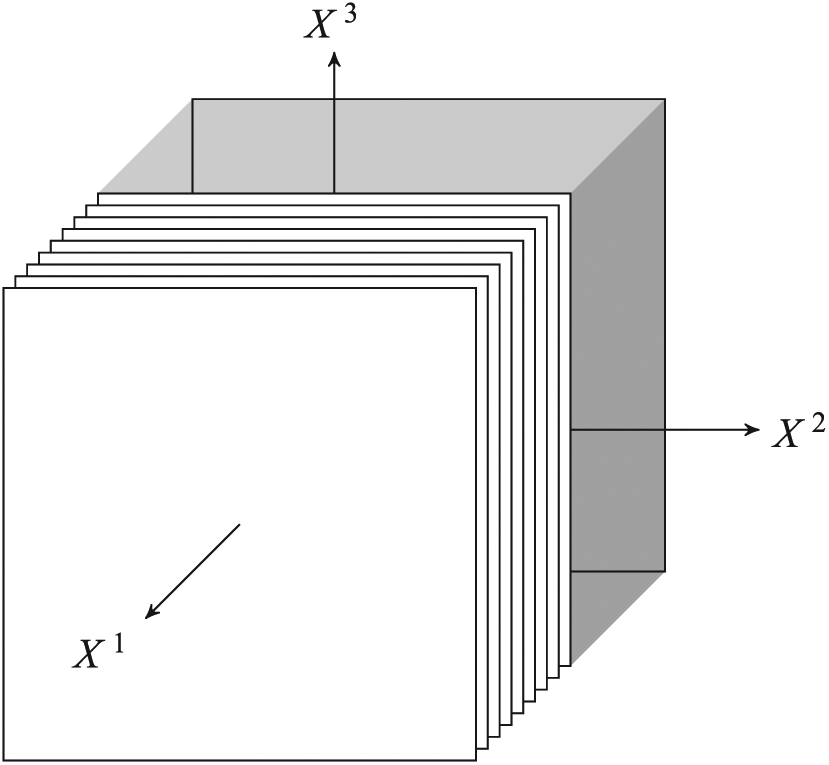
The corresponding material foliation consists of the leaves for and for . Finally, the body itself sustains as a body material foliation the open left half cube and the material planes , as shown in Figure 3.
Body material foliation for the example.
Footnotes
Funding
The author(s) disclosed receipt of the following financial support for the research, authorship, and/or publication of this article: This work was supported by MINECO Grants MTM2013-42-870-P and the ICMAT Severo Ochoa projects SEV-2011-0087 and SEV-2015-0554. V.M.J. wishes to thank MINECO for a FPI-PhD Position.
Notes
References
1.
WangC-C.On the geometric structure of simple bodies, a mathematical foundation for the theory of continuous distributions of dislocations. Arch Ration Mech Anal1967; 27: 33–94.
2.
ElżanowskiMEpsteinMŚniatyckiJ.G-structures and material homogeneity. J Elast1990; 23: 167–180.
3.
EpsteinMElżanowskiM.Material inhomogeneities and their evolution: a geometric approach. Berlin: Springer-Verlag, 2007.
4.
EpsteinMde LeónM. Geometrical theory of uniform Cosserat media. J Geom Phys1998; 26: 127–170.
5.
MackenzieK.Lie groupoids and Lie algebroids in differential geometry (London Mathematical Society Lecture Note Series, vol. 124). Cambridge, UK: Cambridge University Press, 1987.
6.
JiménezVMde LeónMEpsteinM.Lie groupoids and algebroids applied to the study of uniformity and homogeneity of material bodies. arXiv:1607.04043v2, 2016.
7.
EpsteinMde LeónM. Homogeneity without uniformity: towards a mathematical theory of functionally graded materials. Int J Solids Struct2000; 37: 7577–7591.