The paper presents a coordinate-free analysis of deformation measures for shells modeled as 2D surfaces. These measures are represented by second-order tensors. As is well-known, two types are needed in general: the surface strain measure (deformations in tangential directions), and the bending strain measure (warping). Our approach first determines the 3D strain tensor E of a shear deformation of a 3D shell-like body and then linearizes E in two smallness parameters: the displacement and the distance of a point from the middle surface. The linearized expression is an affine function of the signed distance from the middle surface: the absolute term is the surface strain measure and the coefficient of the linear term is the bending strain measure. The main result of the paper determines these two tensors explicitly for general shear deformations and for the subcase of Kirchhoff-Love deformations. The derived surface strain measures are the classical ones: Naghdi’s surface strain measure generally and its well-known particular case for the Kirchhoff-Love deformations. With the bending strain measures comes a surprise: they are different from the traditional ones. For shear deformations our analysis provides a new tensor , which is different from the widely used Naghdi’s bending strain tensor . In the particular case of Kirchhoff–Love deformations, the tensor reduces to a tensor introduced earlier by Anicic and Léger (Formulation bidimensionnelle exacte du modéle de coque 3D de Kirchhoff–Love. C R Acad Sci Paris I 1999; 329: 741–746). Again, is different from Koiter’s bending strain tensor (frequently used in this context).
The paper presents an analysis of deformations of thin shells. The ultimate goal is the determination of appropriate deformation measures for linear shells modeled as 2D surfaces. It is well-known that the literature contains multiple suggestions in this case, with different, often not entirely clear, motivations. Our motivation is based on a 3D-2D approximation of the geometry of deformation. The main novel features in our analysis are
– strict adherence to an index-free notation for curved surfaces (i.e., Christoffel’s symbols and covariant derivatives do not occur in our analysis), and
– simultaneous linearization in small magnitude of deformation and small thickness of the 3D shell.
The paper introduces two new linearized curvature tensors,
given by (3) and (9), respectively. Each of these two tensors is related to a specific situation involving a deformation of an oriented surface, as described in Subsections (a) and (b), below.
(a) The tensorand the change of curvature under deformation.
Consider a general deformation of an oriented 2D surface in with normal n, i.e., a bijective map onto another oriented surface 2D surface in with normal The curvature tensors L of and of are second-order tensors given by
where denotes the surface gradient (see Section 3). Theorem 5.3 determines the difference under the assumption that the displacement
where ≈ denotes the linear part and is a second-order tensor given by
Equation (2) contradicts the common belief that the linear part of the change of curvature is equal to Koiter’s bending strain tensor1
This belief is seemingly supported by the fact that Koiter [10, Eq. (3.4)] defines the components of as the linear part of the difference of the components of and L. However, the components of the linearization of generally differ from the linearization of the difference of components of and L. The point is that the latter neglects the change of coordinate vectors in the deformation. Proposition 5.7 determines the difference of the two ways of linearization explicitly; for a general superficial tensor S this difference is
The difference between and is a particular case
Example 5.10 considers a homogeneous, isotropic extension of a sphere of radius r to a sphere of a bigger radius The tensors and L can be easily computed directly, which also gives the linearized part of difference when is small. The result is subsequently compared with the ‘predictions’ given by and . It turns out that gives the correct result while that gives the opposite value.(!) While the linearization of the curvature tensors may be the subject of a dispute, this is not the case of the (scalar) mean curvature, where the definition is commonly accepted and unambiguous. Also in this case gives a wrong value. The correct value is
which is negative if is positive, naturally. However, gives the opposite value, i.e., it predicts the increase of the mean curvature.
(b) The tensorand the change of the 3D small strain tensor under deformation.
Sections 6 and 7 are devoted to the choice of the strain tensors in the 2D linear shell theory by the 3D elasticity. Our line of argument starts at the 3D elasticity. The central geometric entity is the 3D deformation gradient of the deformation of the 3D body. A linearization about a stress-free state results in the 3D linear elasticity. The ★
of the displacement u of the 3D body ; here ∇ is the gradient with respect to . The passage from the nonlinear to linear elasticities is not described here; see, e.g., [13, Chapter 20].
Thus we start from the 3D linear elasticity. We consider a 3D shell-like body with the reference configuration
where is the middle surface with the normal and where is the thickness of the shell. If h is sufficiently small, one can pass from the variable to the normal coordinates of These are defined implicitly by the equation
which expresses x uniquely in terms A shear deformation is defined by the 3D displacement u of of the format
where and some vector-valued functions defined on Clearly, is the displacement on the middle surface. The quantity is called the change of the director; the deformation moves the normal fiber of direction in the reference configuration into a fiber whose direction is .
Next, we calculate the small strain tensor E of the displacement u in (7). The tensor E is given by (5) with the gradients with respect to the variable . However, we use (6) and (7) to express E in terms of and and their their (surface) derivatives with respect to the normal coordinates One uses Proposition 6.1 (below) to accomplish this.
In the main step we linearize E simultaneously in t, and , assuming that these quantities and their surface derivatives are small. The linearization is defined explicitly (but on a formal level); no ambiguities occur, see Subsection 7.2. The result is
where
The tensor is Naghdi’s surface strain tensor [12, Equation (7.69)]; the tensor is new, as already mentioned.
(c) Naghdi’s linearization.
A linearization procedure similar to ours is undertaken by Naghdi in [12, Section 7], but he arrives at different results [12, Equation (7.69)], viz.,
where is as before, but
which is called Naghdi’s bending strain tensor in the literature. I am not able to reproduce Naghdi’s result. Example 7.5 tests the discrepancy between and on a radial deformation of a spherical shell, where E can be evaluated directly. The calculation confirms (8), while (10) gives the opposite sign of the term linear in
(d) Kirchoff-Love’s deformations.
A Kirchoff-Love deformation is the special case of shear deformation when the normal fiber in the reference configuration is deformed into the normal fiber to the deformed middle surface. A Kirchoff-Love deformation is completely determined by the displacement of the middle surface since , as will be shown below. The tensors and reduce to the tensors and , respectively, where
where P is the projection onto the tangent space to the middle surface in the reference configuration. The tensor is used standardly for the Kirchoff-Love deformations. The tensor , called the Anicic-Léger bending strain tensor in this paper, was introduced by Anicic & Léger in [2], independently of but their motivation is different. The resulting asymptotics is
and not the one in terms of the Koiter bending strain tensor :
as might be tempting. Indeed, Example 7.5 confirms (11) and excludes (12).
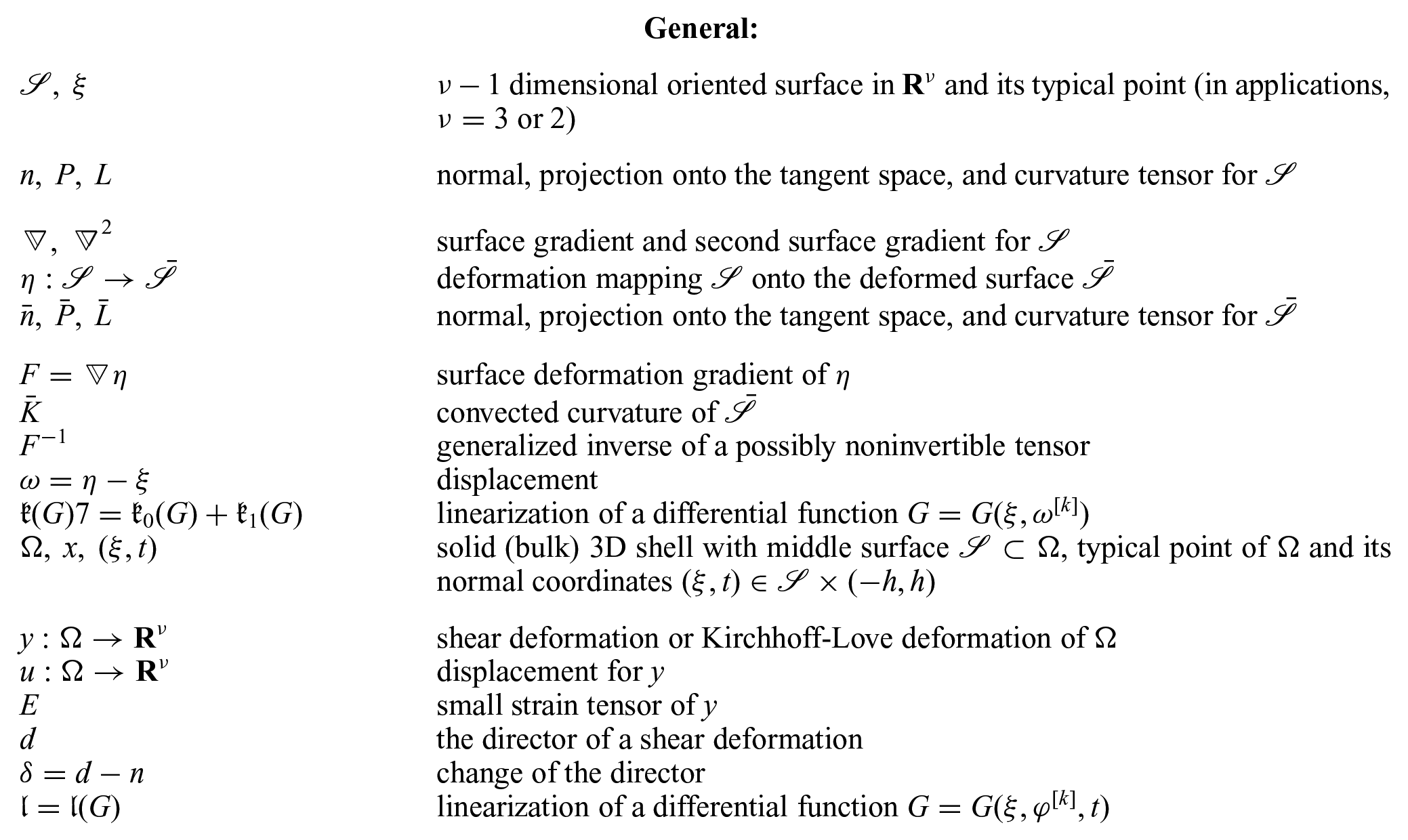
Outline of the paper. Section 2 summarizes the notation and gives a synoptic view on the surface strain and bending strain tensors to be encountered. Section 3 presents a coordinate-free geometry of surfaces suitable for our purposes. Sections 4 and 5 determine the changes of geometric quantities under the deformation of surfaces (most importantly of the curvature); Sections 4 exact and Section 5 linearized. However, Sections 4 and 5 are included only for completeness, because it is not apriori clear, why the change of curvature should be related to the elastic response of the shell. The main theme of the paper is treated in Sections 6 and 7. Section 6 introduces a shell-like body and calculates important formulas for the 3D gradients of the normal coordinates. Finally, Section 7 introduces the shear and Kirchhoff-Love’s deformations of evaluates the exact value of E for them and applies the linearization to obtain formulas outlined above.
2. Glossary of notation
General:
dimensional oriented surface in and its typical point (in applications, or 2)
normal, projection onto the tangent space, and curvature tensor for
surface gradient and second surface gradient for
deformation mapping onto the deformed surface
normal, projection onto the tangent space, and curvature tensor for
surface deformation gradient of
convected curvature of
generalized inverse of a possibly noninvertible tensor
displacement
linearization of a differential function
solid (bulk) 3D shell with middle surface , typical point of and its normal coordinates
shear deformation or Kirchhoff-Love deformation of
displacement for y
E
small strain tensor of y
d
the director of a shear deformation
change of the director
linearization of a differential function
Review of the surface strain and bending strain tensors:
Shear deformations
Present analysis: Naghdi’s surface strain and a new bending strain tensor :
Naghdi: Naghdi’s surface strain and Naghdi’s bending strain tensor :
Kirchhoff-Love deformations
Present analysis: classical surface strain and the Anicic-Léger bending strain tensor :
Budiansky-Sanders: classical surface strain and Budiansky-Sanders bending strain tensor :
Invariant change of curvature
Present analysis: a new bending strain tensor :
3. Geometry of surfaces, surface gradients of orders 1 and 2
This section presents the geometry of dimensional surfaces in . Central to the approach are the first and second surface gradients as defined in [15], [14]. Our approach has many features in common with [11], [8], [6], [3], [4].
3.1. Surface and its tangent space
By a surface we mean an oriented manifold of dimension (without boundary) embedded in . Thus a surface is a pair where is the set of points and is the unit normal giving the orientation, to be specified below. By definition, can be locally parametrized by a parametrization . Specifically, we require that maps homeomorphically an open subset of onto a relatively open subset of and is an injective linear transformation from into for every . The tangent space to at is the linear subspace of of dimension given by
where is any local parametrization of such that for some . The normal in the pair is any continuous function with values in the unit sphere such that is perpendicular to for every The class smoothness of implies that n is of class We denote by the orthogonal projection from onto given by
We often denote by the oriented surface
3.2. Definitions
Let be a finite dimensional vector space and .
(i) We say that f is differentiable at if f has an extension to an n-dimensional neighborhood U of that is differentiable at The surface gradient (= derivative) of f at is defined by
for any . This definition is independent of the choice of the extension. The element of defined by
is called the directional derivative of f at in the direction
(ii) We say that f is twice differentiable at if f is differentiable in some neighborhood of in and has the derivative at . We identify with an equally denoted bilinear form given by
The form is not symmetric in general and should be distinguished from the second surface gradient of f. The second surface gradient of f at is a bilinear form defined by
for any Proposition 3.4 shows that the form is symmetric; also it establishes the relation between and .
We interpret the second-order tensors as linear transformations from into We denote the set of all second-order tensors by . Define the functions and by
where denotes the trace of a second-order tensor. We call L the curvature of and the scalar curvature of . For the boundary of the unit ball oriented by the exterior normal n our choice of signs of L and provides L a positive-semidefinite tensor and a positive number. See Example 3.7.
3.3. Proposition
The curvature is symmetric and superficial, i.e.,
Moreover, we have
for any equivalently,
for any
3.4. Proposition
If is twice continuously differentiable then is symmetric, i.e.,
and we have
3.5. Lemma. (Normal extensions)
If is a class function on then for each there exists a class extension of f defined on some neighborhood U of x in such that
Proof. Let Z be the linear subspace of given by
By [7, Subsection 3.1.19], each point of has a neighborhood U in , a diffeomorphism of class , and a relatively open subset of Z such that
If is a class function on then is a class function on Let be given by
for any Then has the required properties. □
Proof of Propositions 3.3 & 3.4. The properties (16) are well-known and their proof is omitted. To prove (17), we note that it is easy to verify that the directional surface gradient satisfies the product rule
for any and any two vector fields Let be fixed. From (13) we obtain
we then take the directional surface gradient , use the product rule and the definition of L to obtain (17).
To prove (19), we take an arbitrary point x of , a class extension of f to a neighborhood of x in satisfying (20) and a class extension of P to a neighborhood of x in . We can assume that and are defined on the same neighborhood U of x. Throughout the proof let a and b be fixed vectors in The definition gives
for any Let be defined by
A differentiation in the direction yields
throughout U. A comparison of the right-hand sides of (21) and (22) shows that is a class extension of to U and hence the restriction of (23) to provides
The insertion of the formula
which is a consequence of (17), into the second term on the right-hand side of (24) and the use of (20) yields
By (15) then
which proves (18) and reduces (25) to (19).
3.6. Example. (Surface gradients of the identity map)
Let be the identity map on given by
Then
Proof. The identity map , given by for every is a local extension of . Then (14) provides which is . From (17) we obtain
which in combination with (15) yields □
3.7. Example. (The curvature of a sphere)
Let be the sphere of radius This is a surface of dimension of class and we have
where the quantities on the left-hand sides are evaluated at a general point .
Proof. The expressions for n and P are immediate. To obtain the curvature, we use the local normal extension of n to given by for every Then and (14) yields Next we note that for sphere we have and thus the expression for follows from . □
4. Deformation of a surface. Changes of the normal and curvature under deformation
This and the next sections determine the changes of the normal, projection onto the tangent space and curvature under the deformation of a surface. Here we treat exact formulas, the next section linearizations. The central results are the transformation formulas for the curvature in Proposition 4.4. As a preparation, we introduce the surface deformation gradient F and its generalized inverse as a particular case of the generalized of a non-invertible linear transformation to be introduced below.
4.1. Deformation of surfaces
Let be an oriented surface. We say that a map is a deformation of if is twice continuously differentiable, injective, and the surface deformation gradient of
has the rank equal to everywhere on It follows that the pair , given by
is an oriented surface. Indeed, if is a local parametrization of then is a local parametrization of ; moreover, the tangent space to at is given by
To prove , we note that the tensor of cofactors is the unique continuous function satisfying for every . In the case (28), we have from which for every and hence for every
We call the pair the image of under the deformation . The general unit normal to is, of course, locally , but our sign convention for the image is always as in
The formula
gives the projection onto the tangent space of We further denote by the curvature of , given by
where, of course, denotes the surface differentiation with respect to Finally, we denote by the convected curvature, i.e., the pullback of to given by
4.2. Generalized inverse
To state the formulas that follow in a notationally simple form, we now introduce the generalized inverse of any , invertible or not. Namely, we shall prove that for each there exists a unique such that
where P is the orthogonal projection onto the orthogonal complement of the kernel of F and is the orthogonal projection onto the range of It suffices to note that F maps bijectively onto and to put
where is the inverse of the restriction of F to Clearly,
If F is bijective, the generalized inverse coincides with the usual inverse of One has and for any orthogonal projection
If D is a -valued bilinear form on and a vector, we define the product as a second-order tensor satisfying
for every and
4.3. Lemma
If is a function and a fixed vector then
throughout
Proof. Let be defined by for every Then for every Hence (19) yields, for every
where we have used Since b and c are arbitrary, we can restate (33) as (32). □
The following important proposition expresses the quantities and in terms of the second surface gradient of the deformation function .
4.4. Proposition
We have
By (31), at each the right-hand sides of (34) and (35) are symmetric second-order tensors T satisfying
for every where the argument has been omitted.
Proof. Since the normal to the deformed surface is always in the orthogonal complement of F, we have the relation at every point of The surface gradient of this relation provides
We now apply (32) with to evaluate the second term to obtain
We multiply this equation by from the right and combine with the chain rule to obtain
A multiplication from the right by and the use of gives (34). Equation (35) is a consequence. □
5. Linearized changes of the normal and curvature under deformation of a surface
This section gives approximate formulas for the changes of the normal, projection onto the tangent space and curvature under the deformation provided the displacement
and its surface gradients up to some order k are small. We recall that by the results of Section 4 the quantities and can be expressed as functions of and its surface derivatives up to order Hence they can be expressed as functions of and its surface derivatives up to order
5.1. Differential functions of ; linearization in the variable
Let and be finite dimensional vector spaces. If is a k-times continuously differentiable function and we denote by
the collection of surface derivatives of at up to order k. Here Further, we denote by
the set of all pairs where ranges and ranges the space of all k-times continuously differentiable -valued functions on .
By a -valued differential function of of order k we mean a continuously differentiable -valued function G on an open subset of which contains all elements of the form where . We write symbolically
If , then the equation
determines the field g on corresponding to
By the linearization of G in the variable we mean a differential function of given by
for every where
The assumption on guarantees that the arguments of G in the last two relations belong to (in the case of the second relation for all sufficiently small ). We write
Equation (37) shows that the function is affine in the variable . The two terms on the right-hand side of (37) are the absolute and linear terms, respectively.
Let , and finite-dimensional vector spaces and let be a bilinear operation from into . The operation ⊙ can be, e.g., the product of two real numbers, scalar or tensor products, etc. Let G and H be differential functions with values in and . Then we have Leibniz’s rule
5.2. Lemma. (Linearized changes of the normal and tangential projection)
We have
as .
Equation (39) is standard; together with its consequence (40) it will be numerously used below.
Proof. Equation (39): We apply the operator to the equations
The use of Leibniz’s rule (38) and of the relations
then gives
The elimination of P from the first equation via and the simplification of the result by the second equation provides
which is (39).
Equation (40) is obtained by the application of the operator to the equation and the use of Leibniz’s rule in combination with (39). □
5.3. Theorem. (Linearized change of plain curvature)
We have
where is a second-order tensors given by
As mentioned in Introduction, Equation (41) and the tensor are new.
Proof. Recall the identity map from (26). The application of Leibniz’s rule (38) to the right-hand side of (34) gives
where we have used
since We now linearize the individual terms occurring in (42). First, let us prove that
Indeed, the application of the operator to the equations and and Leibniz’s rule give
The elimination of P from the first equation via and the simplification of the result by the second equation provides (43). Further, Equations and (39) provide
The insertion of (43) and (44) into (42) gives (41).
5.4. Theorem. (Linearized change of the convected curvature)
We have
where is a second-order tensor given by
The tensor is called the Koiter bending strain tensor. The compact expression in (46) is equivalent to the original component expression by Koiter [10, Eq. (3.4)]. The equivalence can be established by a straightforward computation; however, a more direct way is employed here. Namely, Koiter defines the covariant components of as the linearization of the difference of components of and L in the convected and original coordinate systems, respectively. That property of is proved in Theorem 5.8 (below).
Proof.Equation (45): We linearize (35) by Leibniz’s rule to obtain
Equations and (39) provide and thus (47) reduces to (45). □
5.5. Coordinates and convected coordinates
Let be a local parametrization of defined on an open subset of (Section 3.1). Each that belong also to the range of can be written as where are called local coordinates of Let be the coordinate vectors, i.e.,
and let be the dual basis (in the tangent space). If is a deformation, then each point can be written as where are called convected local coordinates of We denote by the coordinate vectors corresponding to the convected coordinates. Clearly,
where F is the deformation gradient of Let be the components of L in the basis and let be the components of in the basis of the convected coordinate system i.e.,
where we use the summation convention.
5.6. Components of linearization versus linearization of components
It is important to realize that the components of the linearization of the curvature tensor differ from the linearization of the components of the curvature tensor. The reason is that the former takes into account changes of coordinate vectors while the latter not.
We now determine the difference explicitly for a general quantity. Let be a -valued differential function of of order such that is a symmetric linear transformation from into itself. To introduce the components of as differential functions of we first define as a differential function of of order 1 by
for any where and Then we define differential functions of of order k by
for any , where and are evaluated at
5.7. Proposition
For any we have
where and and n are evaluated at .
Proof. Since the absolute terms of the two linearizations on the left-hand side of (49) coincide, it suffices to compute the difference of the linear terms. If we view the term as the product of with , Leibniz’s rule (38) gives
By (48) we obtain Using (43) to compute , we obtain
By Leibniz’s rule
The insertion of (51) into (52) and the insertion of the result into (50) then gives (49). □
5.8. Theorem. (Linearized changes of components of the curvature tensor)
We have
where are the components of in the basis .
As already mentioned, Property (53) is used as the definition of in [10, Eq. (3.4)]. It is also employed in [5, Section 2.5].
Proof. The particular case in (49) gives
By (41) we have and the elimination of from (54) provides
which completes the proof of (53). □
The eigenvalues of the curvature tensor L are called the principal curvatures of . We recall that L is superficial, i.e., and hence at least one eigenvalue of L is equal to The remaining eigenvalues are denoted by where in this descending sequence we take into account multiplicities. We define the principal curvatures of analogously.
5.9. Theorem. (Linearized changes of principal curvatures, Anicic [1])
Let have distinct principal curvature with the corresponding normalized eigenvectors of L denoted by . Then the linearizations of the principal curvatures of are
as , where is a second-order tensor given by
Proof. Since the principal curvatures are the eigenvalues of which we write as , the well-known continuity and differentiability properties of eigenvalues of a symmetric tensor (see, e.g., [9, Eq. (6.10), p. 125] or [16, Section 2, Eq. (2.1)]) show that are Lipschitz continuous functions of and if is a simple eigenvalue of then is infinitely differentiable in some neighborhood of L and the derivative at L is given by
for every symmetric where is the corresponding unit eigenvector of L. The last formula in combination with the chain rule and (41) gives
Observing that we obtain (55).
5.10. Example. (Comparison of linearized curvature tensors)
We consider an isotropic expansion the sphere of radius and center 0 in into the sphere of radius and of the same center. This changes the curvature tensor L and scalar curvature of into the corresponding quantities and of . We calculate the differences
directly from the definitions and then, assuming that the difference is small, we linearize the quantities (57) in The goal is to compare these linearized changes with the ‘predictions’ given by and .
By Example 3.7,
here P and are the projections onto the tangents spaces of and the tensors L and P are evaluated at a general point and the tensors and at the point Consequently,
The linearizations in are
We now interpret the correspondence as a deformation of the sphere into the sphere Thus the deformation and the displacement are
From the equation (see Example 3.7) we obtain
and from that we deduce
In view of (58), only and give the correct result. In particular, (59)1 gives
which is positive if is positive. Thus predicts an increase of the mean curvature under a genuine increase of the radius
5.11. Lemma
For any oriented surface we have
Proof. Since is symmetric and superficial, we have for any . A differentiation of the relation in the direction provides
By (19) we have
and consequently,
The insertion of this into (61) and the omission of the arguments yields (60). □
5.12. Example. (Normal expansion of a surface)
The preceding example can be generalized. Let be an oriented surface, let be a given number, and consider a subset of and a map given by
If is sufficiently small, the implicit function theorem can be used to prove that the map is injective. Moreover, if is defined by
then is normal to and thus is an oriented surface. We now determine the curvature of One possibility is to use the general formula (34) ; however, in view of (62), it is simpler to use directly the definition of curvature. Namely, we have
where is the surface deformation gradient of and
its generalized inverse. Thus
Thus the change of curvature under the passage from to is
where is evaluated at and the remaining quantities at It is easy to verify that is negative semidefinite if Thus a normal expansion of can only decrease the curvature, an intuitively clear fact. The linearized change of curvature is
The displacement of the deformation is
The elimination of the term by (60) from the formulas for and provides
Thus the conclusion is the same as that in Example 5.10: only and give the correct result.
6. Shell-like bodies
The following notion is central for this and the next sections.
A shell-like body is a subset of of the form
where is an -dimensional oriented surface and h a positive number. For technical reasons we assume that is bounded and that there exists a oriented surface such that the closure of in satisfies . We call the middle surface of and the thickness of . As before, we denote by the projection onto the tangent space of , and the curvature of respectively.
6.1. Proposition. (Normal coordinates)
If the thickness of a shell-like body is sufficiently small then the map defined by
is a diffeomorphism onto . The inverse map associates with any an element of which we denote by . We have
for any where and where the right-hand side of is the generalized inverse of the noninvertible tensor see Subsection 4.2. We call the parameters the normal coordinates of
Throughout this chapter, denotes a shell-like body that admits normal coordinates
Proof. The normal coordinates are solutions of the equation
Let be the extension of as in the definition of a shell-like body. Consider an extension of given by the right-hand side of (63) for every The derivative of at and is given by
for every and where we have used that the surface gradient of the identity map on is see (27). From the definition of a surface one readily deduces that maps bijectively onto for any Thus by the inverse function theorem, for every point , has a continuously differentiable inverse defined in some neighborhood of . Since is compact, a standard compactness argument shows that is invertible in some neighborhood of Hence has a continuously differentiable inverse in if h is sufficiently small. To prove (64), we differentiate (65) in the direction The definition of L provides
where we have omitted the argument Splitting the last equation into the tangential and normal components and solving for and we obtain (64). □
7. Linearized strain tensors: the shear and Kirchhoff-Love’s cases
This section deals with shear deformations and Kirchhoff-Love’s deformations of a shell-like body of . The strain tensor E is determined for these two types of deformations as functions of the normal coordinates of a point The objective is to linearize E under the assumption that t and the displacement are small.
7.1. Shear deformations
A map is said to be a shear deformation if
for any with the normal coordinates , where is a deformation of (see Subsection 4.1) and is a map.
The function d gives the direction after the deformation of the material line that was normal to the middle surface before the deformation.
The bulk displacement u and the bulk strain tensor E of any deformation are given by
and
One obtains
where are the normal coordinates of and
are the displacement of the middle surface and the change of respectively. A differentiation of u given by (66) using equations (64) provides
The derivative in (68), and hence also its symmetrization depends explicitly on and t, and implicitly on through the quantities n, P and Using the notation (36), we can say that and E depend on Similarly, it will be seen in (84) (below) that in the Kirchhoff-Love case depends on . Below, these dependencies are unified in the notion of a differential function of of order where is a function with values in a finite dimensional vector space. A differential function G of of order k is an ordinary function of the variables . The function G is generally nonlinear in the variables If and t are small, we can replace the exact dependence of G on by the linearization of G in the variables (‘small displacements of thin shells’).
7.2. Differential functions of ; linearization in the variables
Let and be finite dimensional vector spaces. We denote by
the set of all triples , where ranges , ranges , and t ranges We refer to (36) for the definition of Here
By a -valued differential function of of order k we mean a continuously differentiable -valued function G on an open subset of which contains all elements of the form , where . We write symbolically
If is a shell-like body, then any determines a field g on by putting
for a general point with normal coordinates .
The linearization of G in the variables is a differential function of of order The procedure consists of two steps. The first step is the linearization of in the variable , defined in Subsection 5.1. The second step is the linearization in the variable t. If H is a function of t defined on an open subset of which contains the origin, we define its linearization in the variable t as the function on by
A formal definition of the linearization of in the variables is as follows. Given we define a differential function of by
and determine the linearization of in the variable which is again a differential function of , as defined in Subsection 5.1. To proceed to the linearization in the variable for each we define the function of t by
The linearization of G in is a differential function of given by
for every We write
The definition implies that for every , the function is affine in t at fixed and affine in at fixed Hence is the sum
where the four terms on the right-hand side of (70) are the absolute term, the term linear in the term linear in and the term bilinear in the pair of variables These functions are given in (93) (below) in terms of G and its partial derivatives.
We now apply this formalism to and to a differential function given by the right-hand side of (68).
7.3. Proposition
We have the following approximate formula for the strain tensor E of a shear deformation at a point with normal coordinates :
where
where all quantities are evaluated at
Proof. Let G be a differential function of order 1 of given by
Since the right-hand side of (74) is linear in , it coincides with its linearization. Next, to linearize the right-hand side of (74) in the variable we note that the absolute and linear terms of the linearization are
and
respectively. To use the product rule to calculate the derivative in (75), let us preliminarily prove that
Indeed, if is sufficiently close to 0 then is the orthogonal complement of n and hence Thus, invoking the definition of the generalized inverse, we see that reads
The differentiation at gives (76). The calculation of the derivative in (75) provides Hence the linearization of the right-hand side of (74) in the variable t is
which also by definition. Thus
A symmetrization gives (71), (72) and (73). □
7.4. Remark
In [12, Equation (7.69)] Naghdi derives a different approximate expression for the components of In our notation, he derives
where is as before, but
which is called Naghdi’s bending strain tensor in the literature. It is often used with the additional realistic restriction in which case we have [5, p. 365], [4]
The difference between the tensors in (78) and (73) is found to be
The following example is devoted to this discrepancy.
7.5. Example
Let be a solid spherical shell with the middle surface and the thickness , , i.e.,
Let be a deformation and the corresponding displacement given by
where c is a constant. Our goal is to compute the strain tensor of u, then to linearize in c under the assumption that c is small, and finally to compare the result with the ‘predictions’ for this linearization given by and
The strain tensor of the displacement is
In terms of the normal coordinates we have
where is the projection onto the tangent space of It is easy to see that y is a shear deformation of with
The linearization of (80) in is
On the other hand, we have
by a combination of with and by Example 3.7, respectively. It is also recalled that The definitions (72), (73), and (79) then give
A comparison with (82) shows that Equation (71) holds, but (77) does not.
7.6. Kirchhoff-Love’s deformations
A map is said to be a Kirchhoff-Love’s deformation if
for any with the normal coordinates where is a deformation of and is the normal to the deformed surface
The Kirchhoff-Love’s deformation is a special case in which the normal line before the deformation is mapped into a normal line to the deformed middle surface, i.e., The Kirchhoff-Love hypothesis is usually formulated for small deformations; in the verbal statements this restriction is missing. The reader is referred to e.g., [17, Assumption 4, Section 3.1], [5, p. 336 and p. 372] for essentially the same assumptions.
The bulk displacement of a Kirchhoff-Love deformation is
where is given by . We now differentiate (83) with the help of (64) ; the subsequent use of the chain rule and the definition of the curvature of provides
Equations and (34) expresses and as a functions of and its derivatives up to order 2 and hence also of and its derivatives up to order 2. Thus the right-hand side of (84) is an implicitly defined differential function .
Thus we can apply the linearization of Subsection 7.2 to and G given by the right-hand side of (84) to obtain the following result.
7.7. Proposition
We have the following approximate formula for the strain tensor E of a Kirchhoff-Love deformation at a point with normal coordinates :
where
where all quantities are evaluated at We note that has already been encountered in (56).
Proof. To linearize the function in the variable at fixed we split G into three parts, viz.,
The first term is linear in and so it coincides with its linearization. To determine the linearization of the second term, we first linearize the term by Leibniz’s rule (38), which gives
Using (41) and we obtain
Thus the linearization of the second term in (85) is
Finally, the linearization of the third term in (85) is by (39). Collecting these three partial linearizations, we see that the linearization of G in the variable at fixed t is equal to
We linearize the last equation in the variable The absolute term (i.e., the first term on the right-hand side of (69) ) is
and the linear term is
The sum of (86) and (87) is the linearization of G in the variables ; a computation provides
A symmetrization of the equation
provides the result. □
7.8. Remark. (Consistency)
The linearization of the right-hand side of (83) in using (39) gives
In this approximation, a Kirchhoff-Love deformation is a shear deformation with
Let us show that with the choice (88), the bulk stain tensor E of a shear deformation from Proposition 7.3 reduces to that of a Kirchhoff-Love deformation from Proposition 7.7. That is, let us prove that
Equation is immediate. To obtain we have to determine By the product rule,
The evaluation of the first term on the right-hand side by (32) with provides
The insertion into (73) provides
Next, let us show that with the choice (88), we have
Indeed, from (90) we obtain
and the insertion into (79) provides (91).
8. Conclusions
The paper presents a rigorous derivation of the strain measures in linear shell theory. The main working tool is a novel formalism for linearization of functions depending on quantities defined on surfaces and on their surface gradients. The linearization procedure is used to obtain approximate formulas for the 3D linear strain tensor for shear deformable and Kirchhoff-Love type models. These approximations are new and contradict classical approximations. Examples are given which confirm our approximations and refute the classical ones.
The paper uses a direct notation. In comparison with the traditional index notation (as presented, e.g., in Ciarlet [5]), our notation leads to compact, notationally simple formulas with more transparent and more immediate meaning.
The analysis provides two new curvature-type tensors. The first of them, is equal to the linearized change of the curvature tensor of a 2D surface under deformation. The second of them, is involved in the approximate formula for the infinitesimal strain tensor in shear deformations.
Footnotes
Appendix
We determine the functions , and from (70) in terms of the function .
The definition in Subsection 5.1 gives that the linearization in is
The subsequent linearization of in t reduces to the sum of linearizations of the two terms on the right-hand side of (92). The linearization of the first and second terms are
and
respectively. Thus
The interchangeability of the second partial derivatives implies that the linearization in is independent of the order of linearizations in and
Acknowledgements
The author is thankful to M. Lucchesi for many helpful discussions.
Funding
The author(s) disclosed receipt of the following financial support for the research, authorship, and/or publication of this article: This research was supported by RVO 67985840 and by the Department of Civil and Environmental Engineering, University of Florence (author’s visit in October 2018).
ORCID iD
Miroslav Šilhavý
1
It will be shown in Section 5 that (4) is equivalent to the component expression by Koiter [10, Eq. (3.4)] and Ciarlet [5, pp. xlii, 93, 173, 301].
References
1.
AnicicS.Mesure des variations infinitésimales des courbures principales d’une surfaceC R Acad Sci Paris I2002; 335: 301–306.
2.
AnicicSLégerA.Formulation bidimensionnelle exacte du modéle de coque 3D de Kirchhoff-Love. C R Acad Sci Paris I1999; 329: 741–746.
3.
BlouzaALe DretH.Existence and uniqueness for the linear Koiter model for shells with little regularity. Quart Appl Math1999; 57: 317–337.
4.
BlouzaALe DretH.Nagdhi’s shell model: existence, uniqueness and continuous dependence on the midsurface. J Elasticity2001; 64: 199–216.
5.
CiarletPG.Mathematical elasticity, Volume III: Theory of Shells. Amsterdam: North-Holland, 2000.