







Abstract
The polarization saturation (PS) model is modified here by considering generalized polynomial-varying saturation condition
Keywords
Nomenclature
1. Introduction
Smart materials, due to their extraordinary physical properties, have been enormously used in day-to-day appliances and scientific/engineering instruments. Piezoelectric ceramics, one of the smart materials due to their electromechanical coupling effect, have been extensively used in sensors, actuators, transducers, smart embedded structures, etc. However, these materials are always susceptible to fracture due to high brittleness and low fracture toughness, leading to failure in the smart structures. Therefore, fracture mechanics studies were established for these materials in the late nineties. All sorts of fracture problems, i.e., Mode-I, Mode-II, and Mode-III types, were studied in piezoelectric media. Most of the problems were studied for Mode-I and Mode-III transversely isotropic piezoelectric media considering impermeable crack face conditions and linear theory of piezoelectricity. But similar to the Dugdale model in elastoplastic materials, Gao et al. [1] proposed a non-linear fracture model, also known as the polarization saturation (PS) model in piezoelectric materials. In this model, an electrical yielding zone or electrical displacement saturation zone was considered in the form of a strip just in front of the crack tips of the center crack problem, and the same was approximated under the linear theory of piezoelectricity by considering it as an extended electrical crack length arrested by a constant saturated electric displacement value. Moreover, they calculated a new fracture parameter, the local energy release rate, which showed the behavior concerning electrical loading in agreement with experimental evidence.
Hence, after that, many researchers applied/extended this approach to study various fracture mechanics problems in piezoelectric and piezomagnetic media. Zhang and Hack [2] studied the stress and electric fields in the neighborhood of a mode-III crack in piezoelectric media considering the crack filled with a dielectric medium such as air or vacuum. It is found that under constant electric displacement, the applied field may increase or decrease the effective applied stress depending on its direction. Applying a complex variable approach, Zhang and Tong [3] studied the mechanical and electrical field around the elliptical cavity in piezoelectric media. The problem of mode-III crack is studied by reducing the elliptical cavity into a slit crack. Effects of electric loading were observed, which showed that it may promote or retard crack propagation depending on whether it increases or decreases the applied stress. Zhou and Nishioka [4] applied the Fourier integral approach to studying a steady semi-infinite mode III crack growth along the mid-plane of a piezoelectric layer sandwiched between two identical half-spaces. Hu and Li [5] mathematically analyzed a constant-velocity Yoffe-type moving mode-III crack in a functionally graded piezoelectric strip using the Fourier transform technique. The problem was studied under both impermeable and permeable electric boundary conditions. Hu et al. [6] employed Fourier transform technique to study a finite mode III crack in a piezoelectric semiconductor of 6 mm crystals. The effect of semiconduction was observed on fracture parameters. Using the boundary integral equation method, Stoynov [7] presented the fracture mechanics study on mode-III cracked functionally graded piezoelectric/piezomagnetic media.
Anti-plane moving crack problem in piezoelectric media based on the PS model was studied by Chen et al. [8]. Using Fourier cosine integral transform, Bhargava and Verma [9] presented the mathematical solution for a non-centric, semipermeable, mode-III crack subjected to strip-electro-elastic yielding model in a long and narrow piezoelectric strip. Bhargava et al. [10] obtained the explicit solution for fracture parameters under two collinear semipermeable mode-III cracks in piezoelectric media considering the strip saturation model. Singh et al. [11] applied a complex variable approach and developed new closed-form solutions for the mode-I center crack problem in an infinite piezoelectric domain based on linear, quadratic, and cubic varying modified PS models.
Given the above studies on mode-III cracks in piezoelectric media and modified PS models in mode-I type crack problems, Singh and Sharma [12, 13] employed the complex variable approach to study the mode-III crack problem in semipermeable and arbitrarily polarized piezoelectric media based on linear and quadratic varying polarization saturation condition. Also, Singh and Sharma [14] extended the study of the PS model to modified PS models in piezoelectric media for two equal collinear cracks using complex variable and non-homogeneous Riemann- Hilbert approach. Verma and Meena [15] proposed Fourier integral transform techniques to solve an influence of changing poling angle on a mode-III non-centric semipermeable straight hairline crack in an infinitely long piezoelectric strip under small-scale electric yielding. Recently, Wu and Wan [16] applied the Fourier integral transformation technique and the Copson method to study the mode-III interface Yoffe-type crack in piezoelectric bimaterial subjected to the PS model with electrical and mechanical yielding zones. Verma et al. [17] demonstrated the closed-form solutions for mode-III quadratically varying strip saturated model with arbitrary poling direction in the piezoelectric strip. Singh and Jangid [18] extended the PS model in piezoelectric material to the DBY-PS model and studied the Yoffe-type crack problem under semipermeable crack-face conditions.
To date, authors and their collaborators [11–14] have extended the study of the PS model to include modified versions of PS models in piezoelectric media, addressing both Mode-I and Mode-III crack problems. However, in literature, these models were extended up to cubic polynomial varying saturated conditions only. Consequently, an analytical solution for the Mode-III generalized polynomial varying modified PS model in semipermeable piezoelectric media is attempted in this paper. The concept of considering a generalized polynomial-varying saturated normal electric displacement is based on the following aspects:
The saturation of electric displacement under high electric fields is attributed to the physical behavior of piezoelectric ceramics. At high electric fields, ionic movement in these materials is reduced, limiting polarization and, consequently, electric displacement. Furthermore, defects such as cracks, voids, or inhomogeneities amplify stress and electrical quantities significantly. These regions are likely areas where electric displacement saturation occurs, playing a critical role in the material’s behavior.
The exact shape and size of the saturated zone in-plane deformation are challenging to determine. To simplify the analysis, this unknown zone is approximated as a line segment extending from the crack tip. The precise saturation condition imposed on the strip is uncertain. According to Ru [19], the condition should be finite and bounded by the saturated value of electric displacement. A constant saturation condition, as proposed by Gao et al. [1] in their polarization saturation model, is one possible approximation. However, alternative approximations for the saturation condition are also possible.
The saturated condition near the crack tip is uncertain and does not need to be uniform throughout the strip, as electric field quantities vary with distance from the crack tip. A constant approximation is the simplest approach to represent this unknown condition.
Since the saturated electric displacement near the crack tip varies with distance, the authors considered the saturated condition as a position-dependent variable. It is represented as
Using the concept of Taylor’s theorem in calculus, the unknown function
These modified polarization saturation (PS) models can also be viewed as studies on crack arrest models in arbitrarily polarized semipermeable piezoelectric media, where the arrest of extended electrical cracks is achieved using polynomial-varying saturated electric displacement conditions.
The approach/obtained solutions can be tested as a linear combination for a PS model with a generalized polynomial-type saturation condition.
An analytical solution for a generalized modified PS model can be addressed as an independent mathematical problem of the non-homogeneous Riemann–Hilbert type. The obtained generalized solution may apply to other problems and provide a foundation for exploring alternative saturation conditions in PS models.
In summary, the proposed models are significant for understanding crack behavior in two-dimensional piezoelectric media and contribute to broader studies of crack arrest mechanisms under varying saturation conditions. Explicit expressions have been obtained for saturated zone lengths (in the form of two non-linear equations), local stress intensity factors, and the electric displacement intensity factor. The last section presents numerical studies concerning the variation in electrical loadings, crack-face conditions, and polarization angle.
2. Basic equations and crack-face boundary conditions
The well known plane problem, displacement components


where

Hao and Shen [20] introduced the crack-face boundary conditions in 2-D piezoelectric media are crucial for analyzing the behavior of piezoelectric materials with cracks under mechanical and electrical loads. The concise expression for the crack-face the boundary conditions is

where the indices “+” and “−” represent the upper and lower crack surfaces,
One can reduce these conditions to impermeable by considering
3. Mathematical modeling of generalized modified PS model in piezoelectric materials
3.1. Stroh formalism-based solution in piezoelectric materials
The Stroh formalism approach applied for elastic materials has been extended to a generalized Stroh formalism for piezoelectric media. In the case of a two-dimensional problem, all field variables are defined as functions of independent position variables x and y. Let the generalized displacement vector

Equations (1)–(3) satisfy equation (5) for an arbitrary analytic function

which has a non-trivial solution only if

Now, in case of an arbitrary poling direction, the material matrices

The transformed material constants
Here, the rotation matrices are

and

where
The general solution of equations (1)–(3) may be expressed in terms of generalized stress function


where

3.2. Formulation of the problem
An infinite transversely isotropic piezoelectric domain under anti-plane strain conditions and having arbitrary polarization direction is considered. It is taken along the
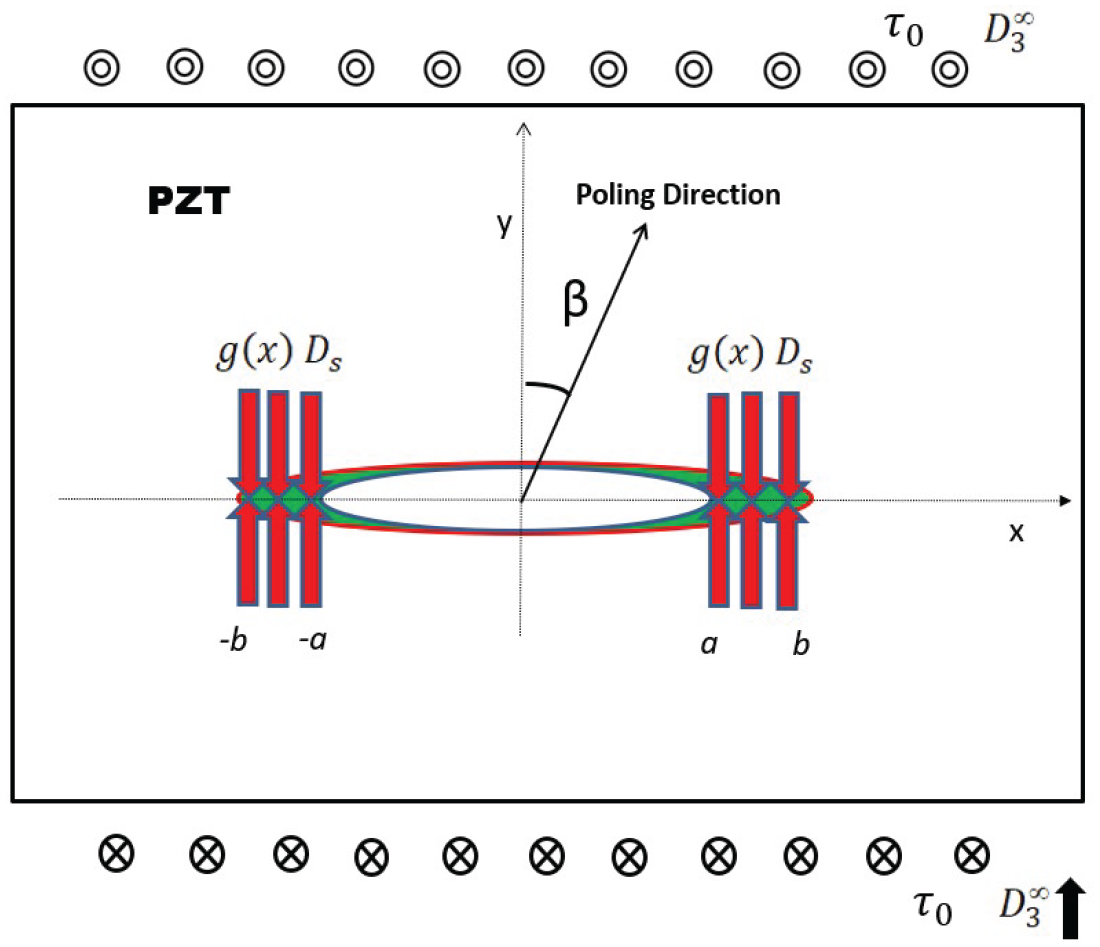
A center crack with polynomial varying saturation zone.
The physical boundary conditions of the problem can be mathematically written as
The continuity of


According to Musklishvili [21], the solution of equation (10) may be written as


where
Applying the boundary condition (1) in equation (10), we obtained

Introducing new complex functions as


where
Equation (13) can be expressed in its component as


Solving equations (16) and (17), with boundary condition

where
4. Mathematical solution of the problem
Using the single-valued-ness condition of the mechanical displacement, the solution of above equation (18) is

Now from equation (17),

Applying the boundary condition (4) in equation (20), we obtained

Solution of equation (21) considering

where
5. Analytical solution of the fracture parameters
We express various applications of the problem such as finding of saturation zone lengths, CSD, and electric displacement intensity factors.
The jump displacement vector

5.1. Saturation zone
The electric displacement is obtained from equation (9) as

Taking the second component of the above equation, we have


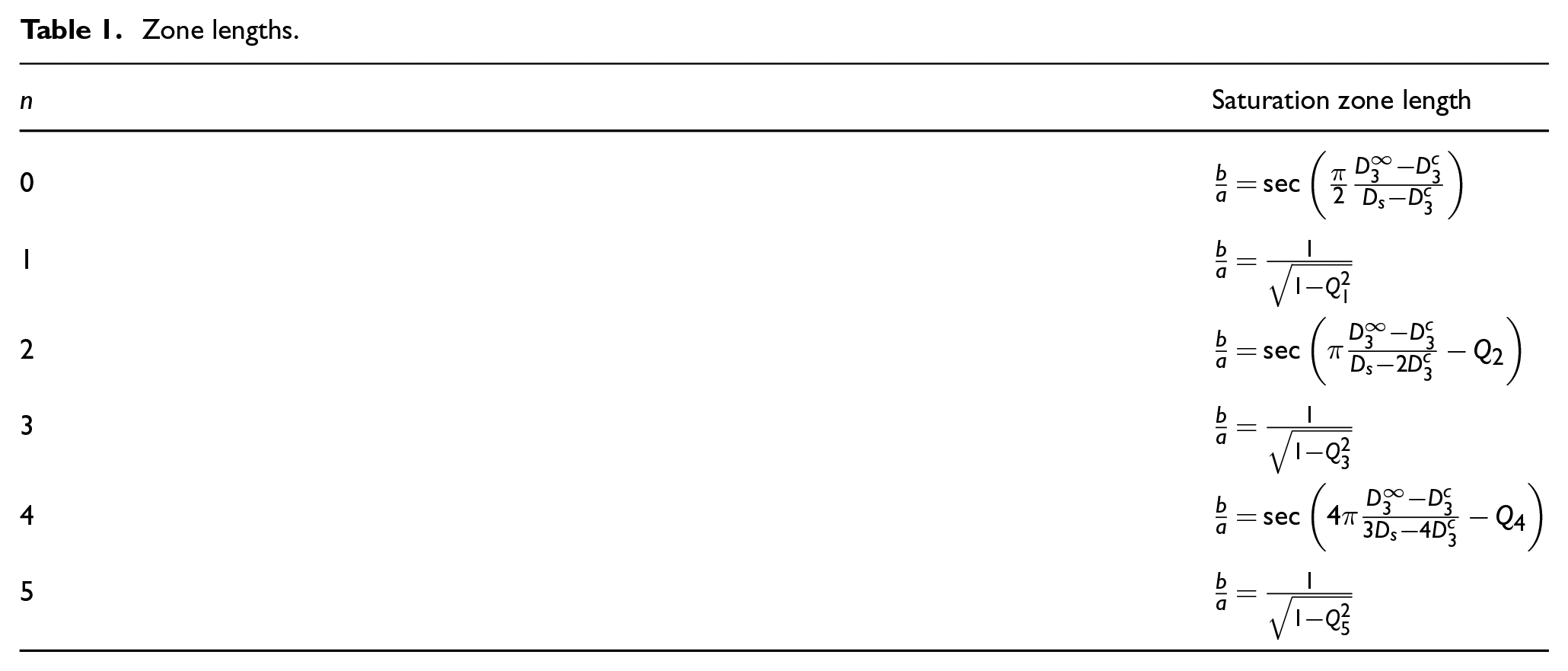
Considering the condition of the finite electric displacement intensity factor at the saturated zone tip implies equating the coefficient of singularity terms in the electric displacement intensity factor to zero; the saturation zone lengths are obtained for each PS model. The relationship between saturation zone length and half crack length is shown in Table 1.
Zone lengths.
where
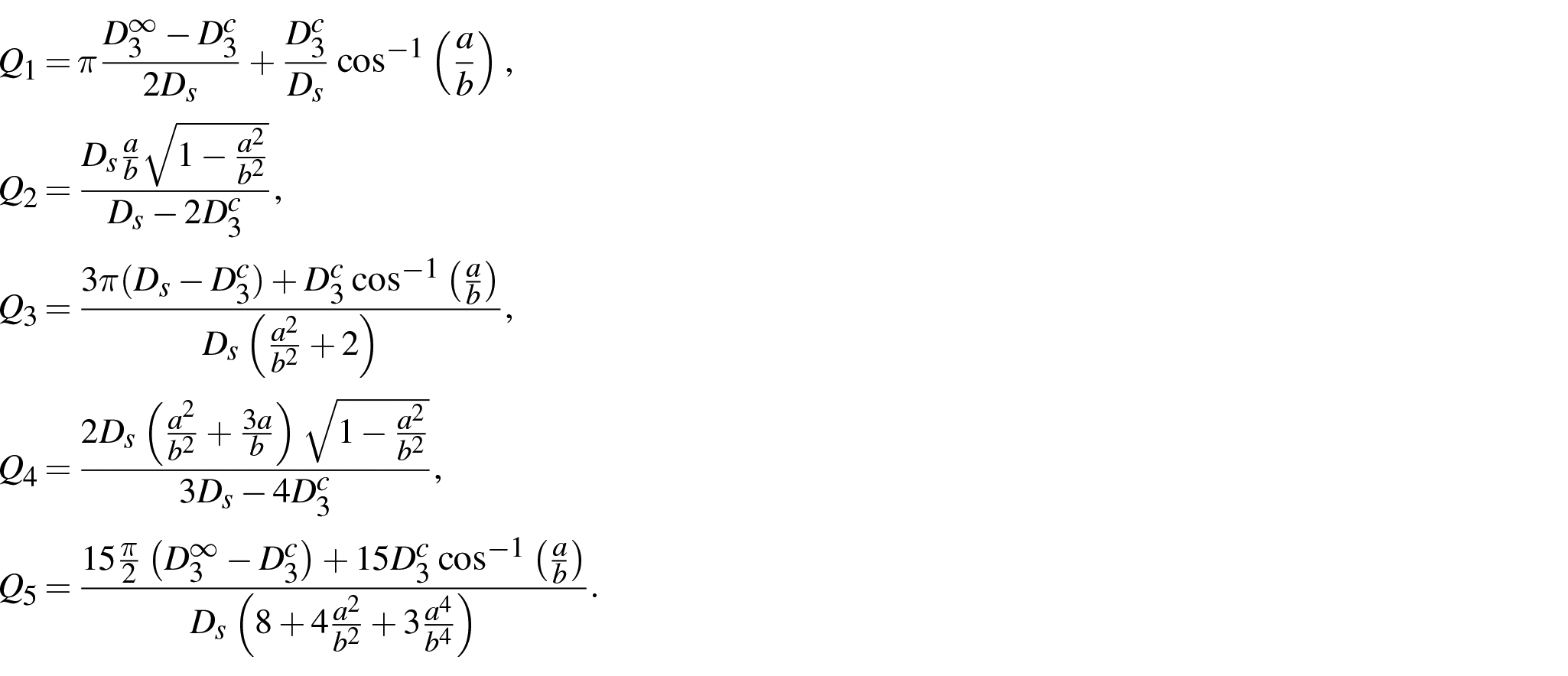
The expressions obtained here upto cubic polynomial varying saturated conditions from the generalized solution agree with the results of Singh et al. [11].
5.2. Critical applied electrical loading
To analyze the effects of the imposed saturation conditions on the cracked 2-D piezoelectric domain, the following mathematical analysis has been done on the saturated zone length and the possible applied electrical loading. One can observe from Table 1 that the saturated zone length increases w.r.t increase in electrical displacement loading for a fixed saturated
Critical electrical loading for the modified PS model.

Here, also, the obtained critical electrical loading values upto cubic polynomial varying saturation conditions are in agreement with the results of Singh et al. [11].
5.3. Crack sliding displacement (CSD)
Crack sliding displacement (CSD) refers to the relative opening movement between the two faces of a crack. It serves as a measure of material toughness under mode-III deformation. In this context, the CSD, denoted as

On integrating,

5.4. Local stress intensity factor (LSIF)
The local stress intensity factor (LSIF),

5.5. Electric displacement intensity factor (EDIF)
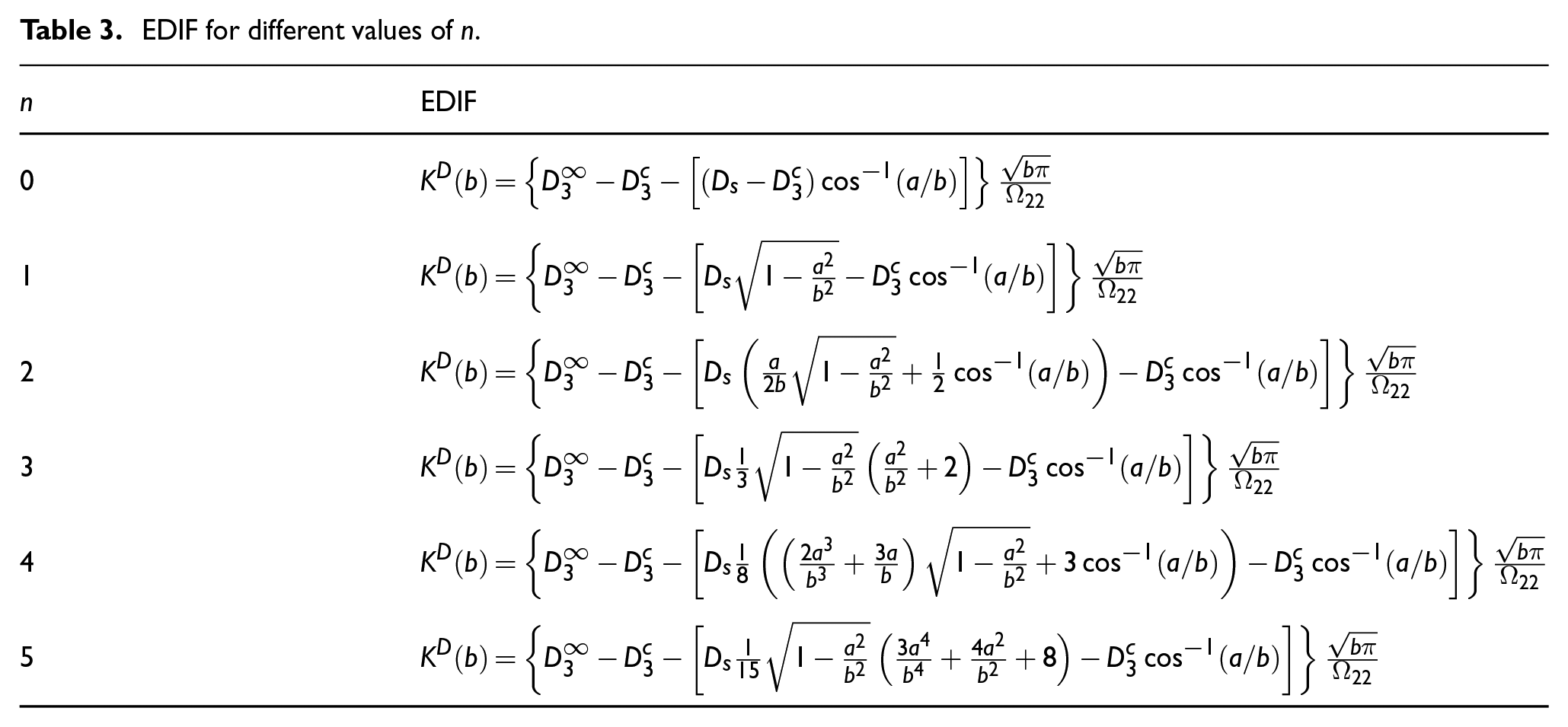
In mode-III, the following expression gives the EDIF obtained at tip

where
The value of the electric displacement intensity factor for different values of n is shown in Table 3.
EDIF for different values of
6. Numerical discussion
This section presents the numerical studies of a center crack based on generalized polynomial varying modified strip saturated models. A problem of a center crack in the infinite 2-D piezoelectric domain is considered under the mode-III mechanical and in-plane electrical loadings. The piezoelectric materials such as PZT-4, PZT-5H, and PZT-PIC151 have been considered for the studies. The material constants for PZT-4 are tabulated in Table 4, whereas other material constants are taken from Li and Chen [22]. Moreover,
The material constants of piezoelectric PZT-4 used for the analysis.

6.1. Effects of electrical loading and crack-face conditions
Figure 2 illustrates the effects of crack-face conditions on saturated zone lengths as normalized electrical loadings increase while other parameters remain constant. It is observed that the saturated zone lengths increase with the increase in electrical loadings for both impermeable and semipermeable conditions. Furthermore, the saturated zone lengths have higher values for impermeable crack-face conditions than semipermeable conditions. A similar trend is evident in the modified strip-saturated models, where the saturated zone lengths increase with the increase in the degree of the polynomial varying saturated conditions for a given loading. Notably, these effects are consistent across all the piezoelectric materials analyzed, demonstrating the robustness of crack-face and polynomial varying saturated conditions in influencing the saturated zone lengths. This behavior is further confirmed in Figures 3–5, which present the evaluation of normalized EDIF for all the piezoelectric materials studied under varying
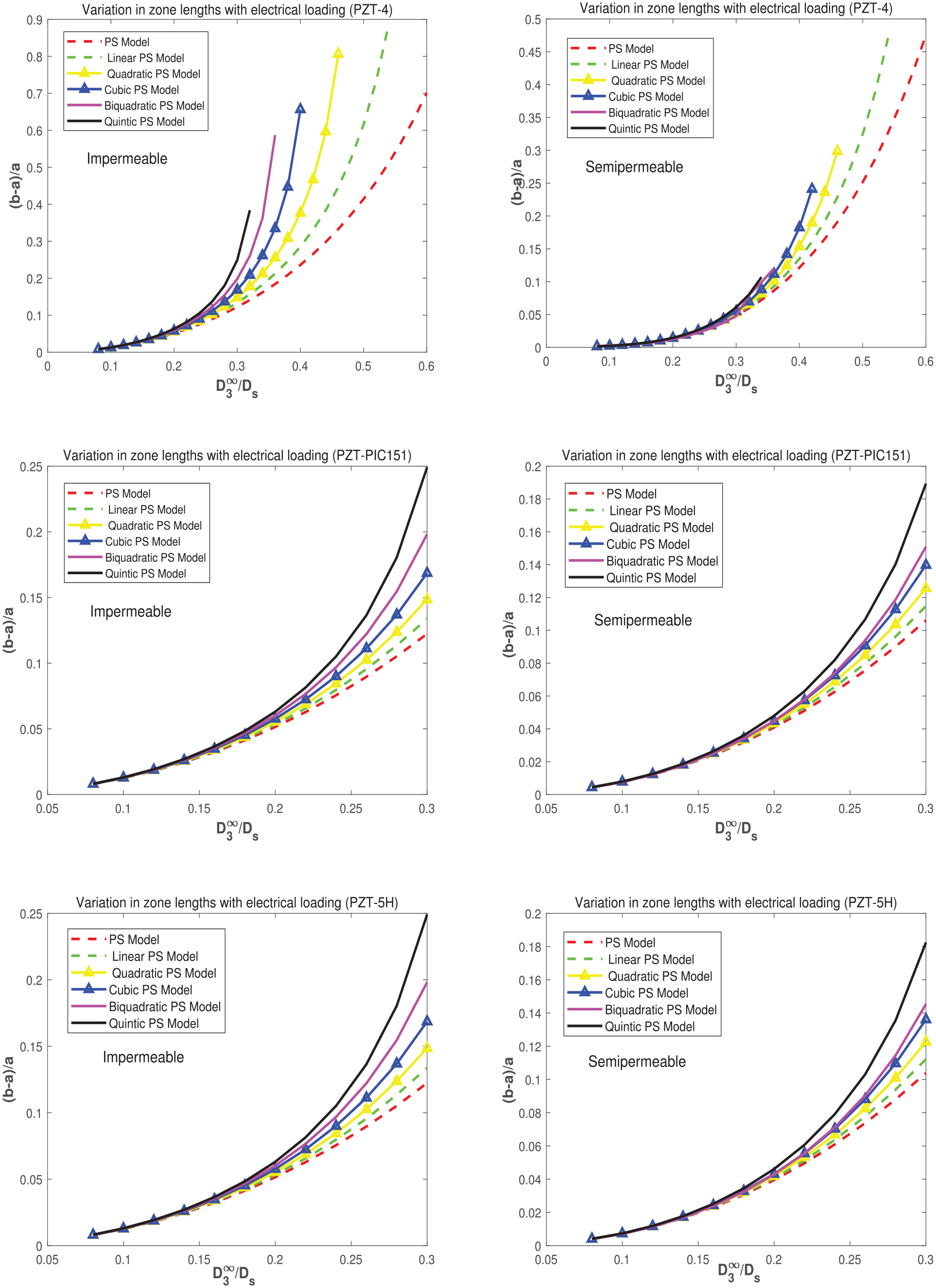
Variations in zone length versus
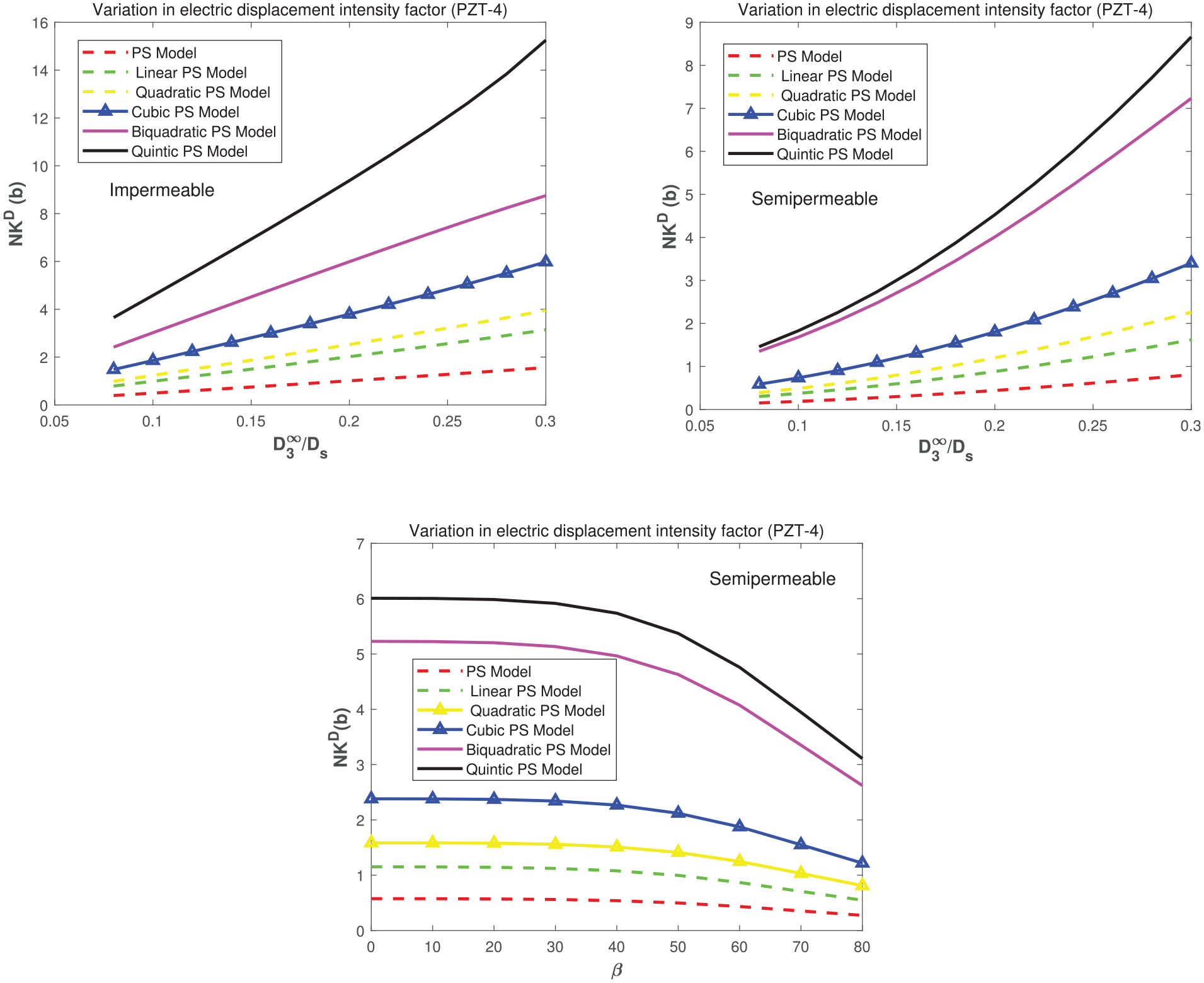
Variations in normalized EDIF w.r.t
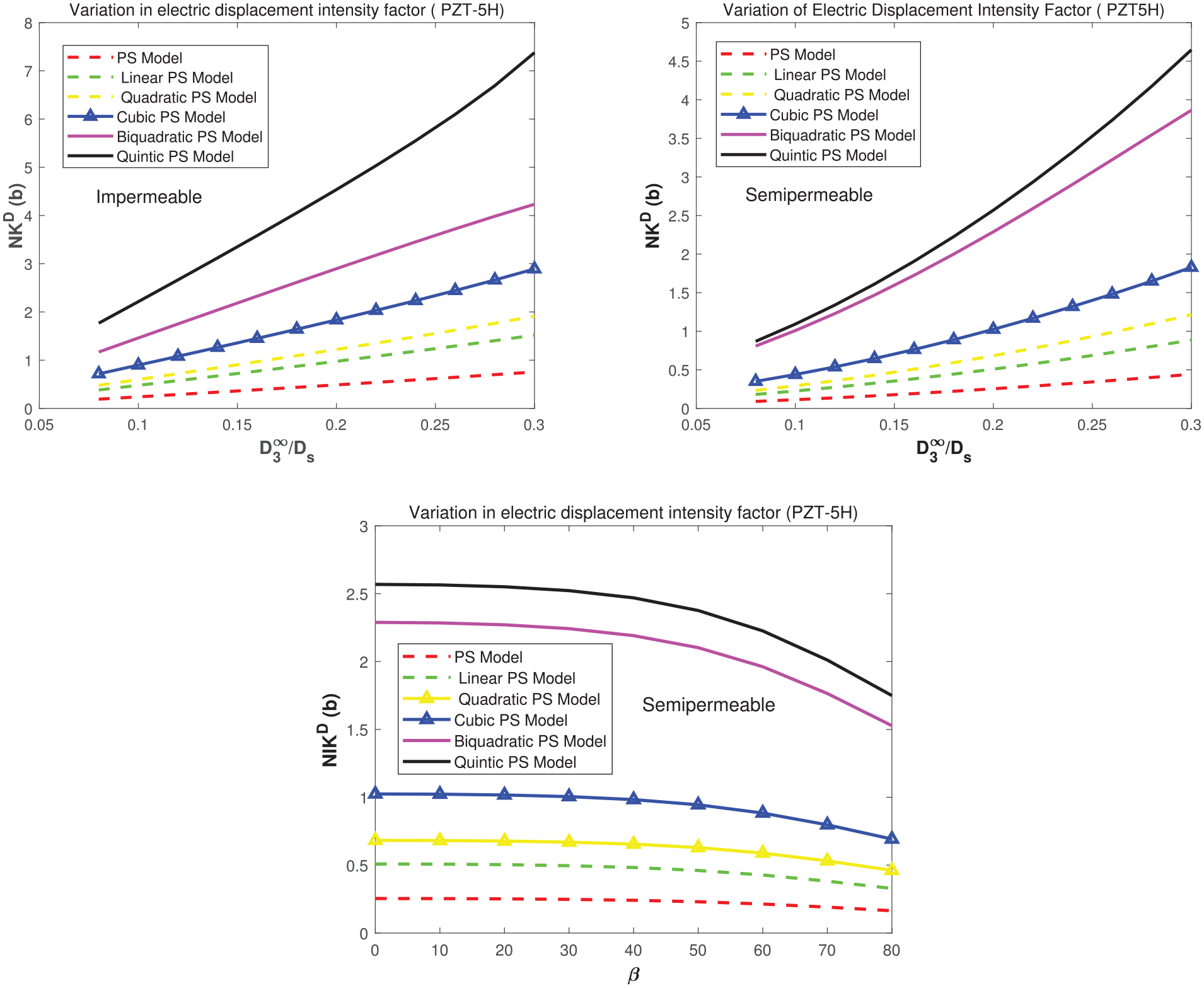
Variations in normalized EDIF w.r.t
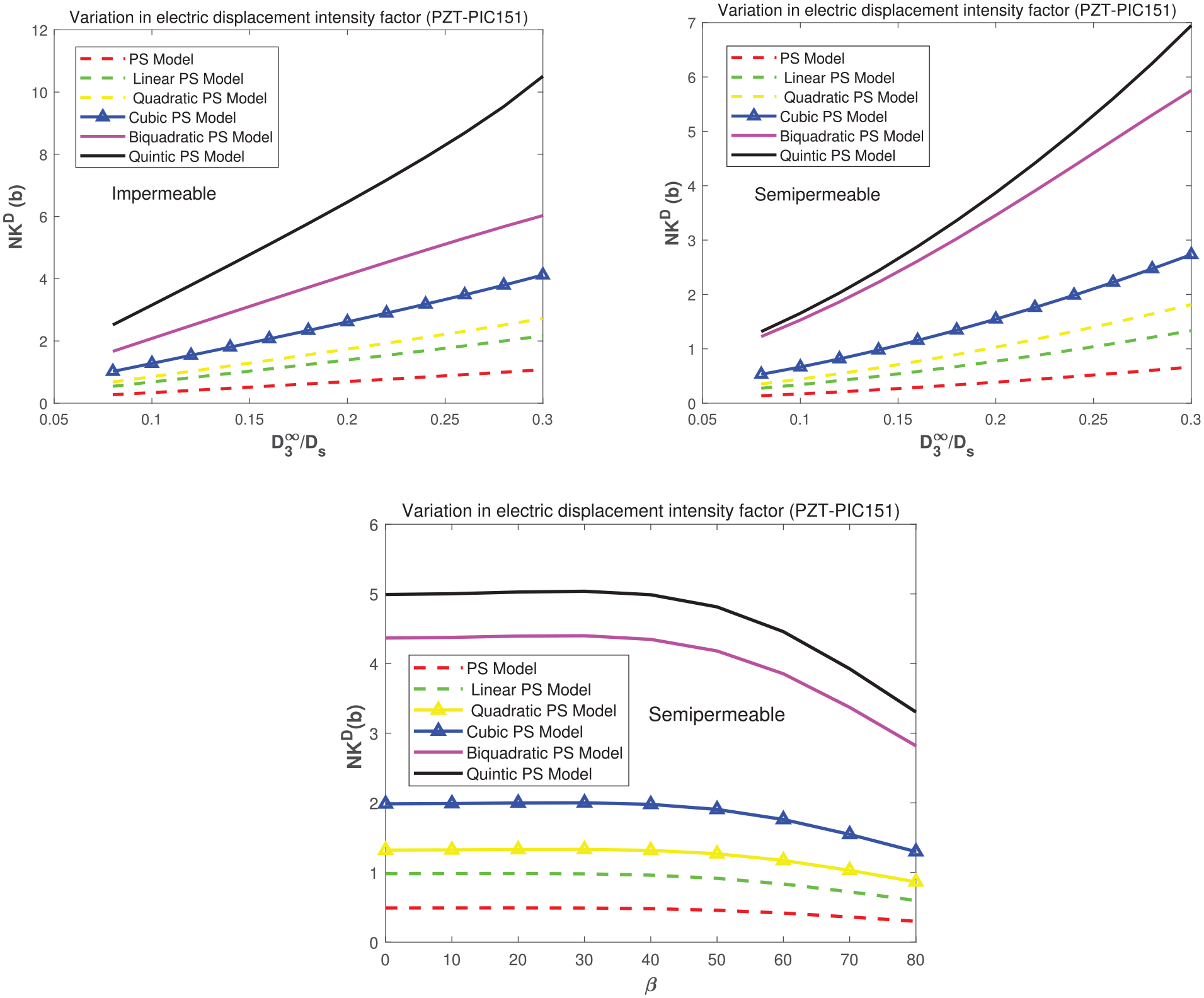
Variations in normalized EDIF w.r.t
6.2. Effects of polarization angle
Figure 6 illustrates the effects of the poling angle on the behavior of saturated zone lengths for all modified strip-saturated models under semipermeable crack-face conditions and for all the piezoelectric materials considered. The results indicate that saturated zone lengths decrease as the poling angle increases, with higher polynomial degrees yielding greater saturated zone lengths. In addition, Figures 3–5 present the evaluation of the EDIF for varying poling angles
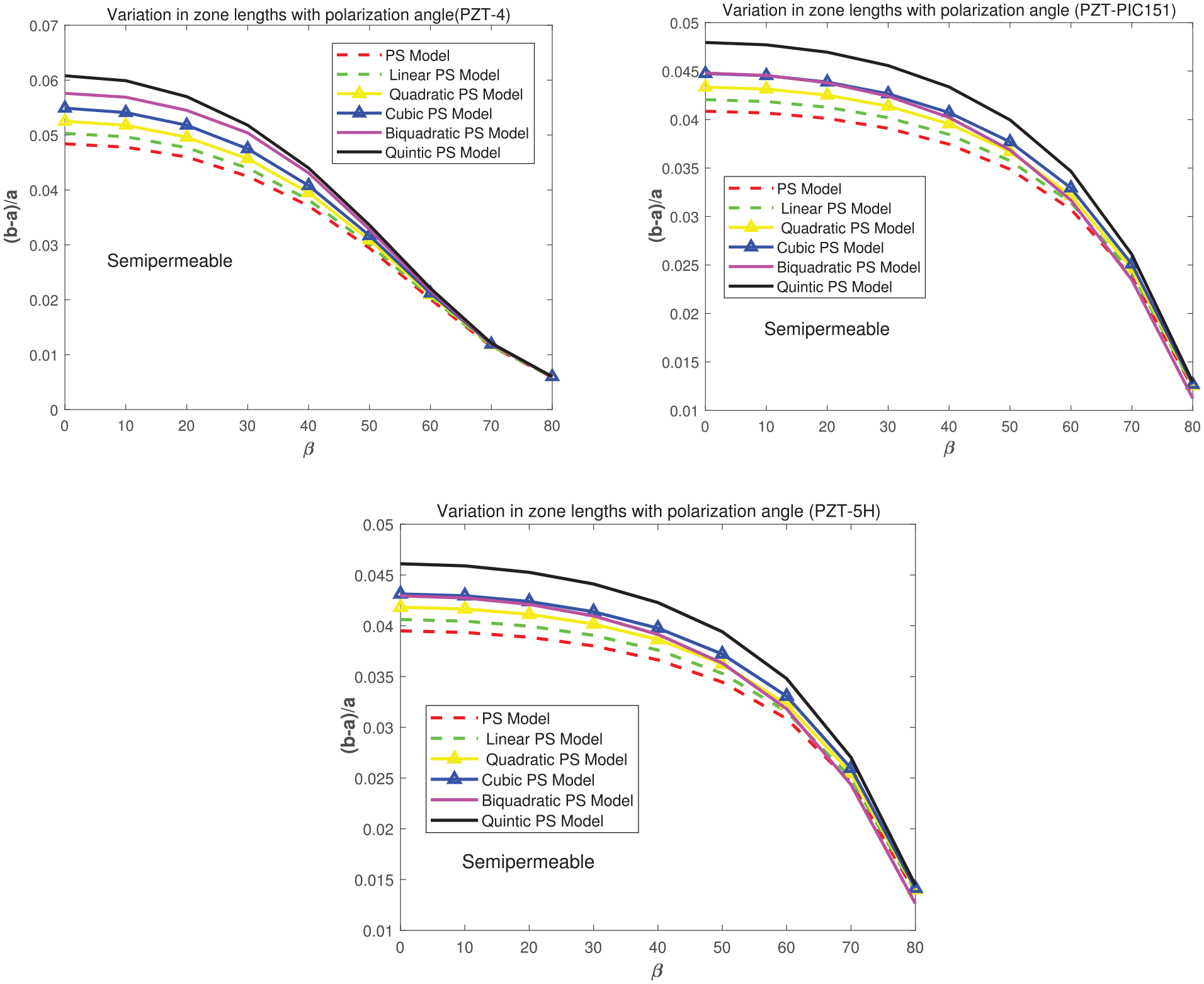
Variations in zone length versus polarization angle (
6.3. Effects of electrical loading, poling angle, and crack-face conditions on the local stress intensity factor (LSIF)
Figure 7 illustrates the variations in the LSIF with respect to the increase in electrical loading under different crack-face conditions and polarization angles. The results indicate that the LSIF increases as
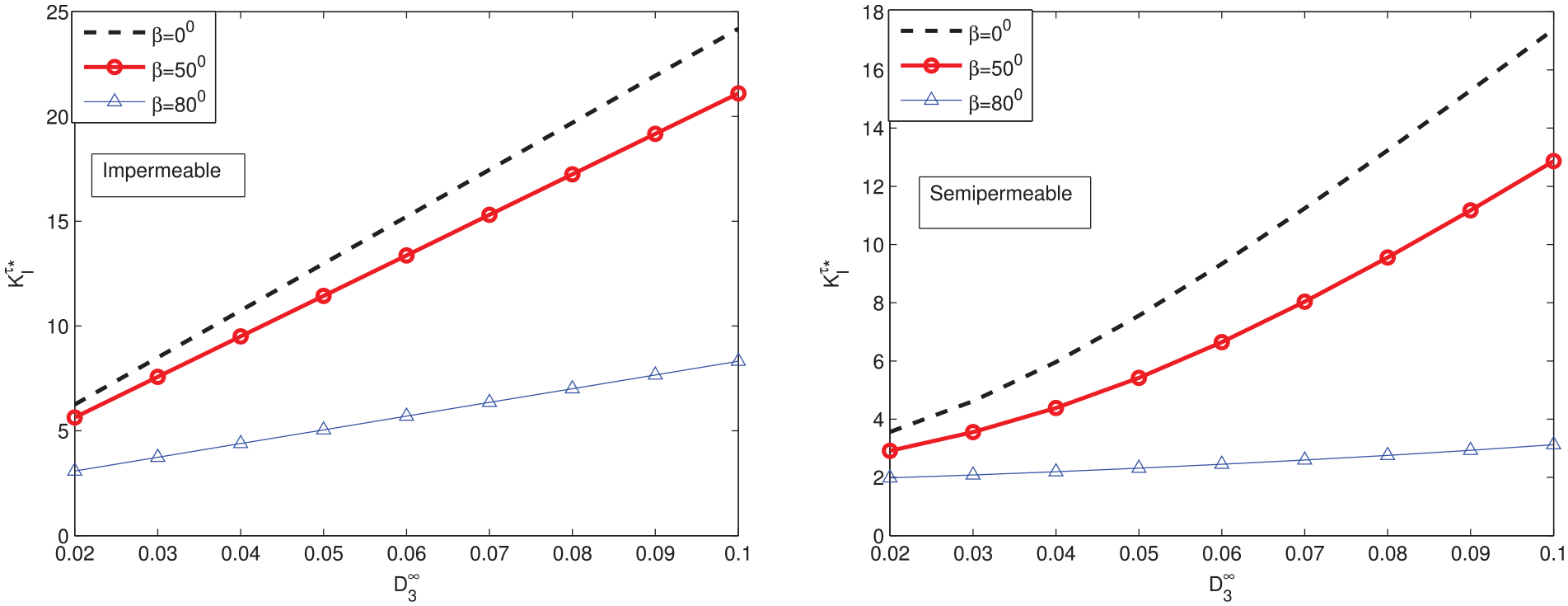
Variations in the LSIF versus
7. Conclusions
The mathematical solutions and numerical studies discussed in Sections 4 to 6 lead to the following conclusions:
Validation of specific cases of the generalized solution against existing solutions confirms the accuracy of the developed method and its formulation approach.
Both the saturated zone length and local stress intensity factors increase with higher applied electric displacement loading.
An increase in the polarization angle decreases the saturated zone length and the EDIF.
For modified PS models with polynomially varying saturation conditions, the saturated zone length and the EDIF increase, while the critical applied electrical loading decreases as the polynomial degree increases, under a particular electrical loading.
The saturated zone length and intensity factors are greater for impermeable crack-face conditions compared to semipermeable crack-face conditions.
