







Abstract
The fresh-cut industry is constantly growing and generating wastes. The major challenge for this industry consists in an environmentally sustainable production through re-utilization of by-products, for instance, in extraction of bioactive compounds. In this paper, the nutritional and functional compounds of apple, potato, cucumber, melon and watermelon by-products were investigated. The amount of by-product produced was of 10.10 to 30.80% of initial fresh weight depending on the product. By-products were characterized by low protein (<20 g/kg fresh weight) and fatty acid content (<5 g/kg fresh weight) and high levels of minerals. Carbohydrates content ranged from 43.7 to 235 g/kg fresh weight, while total dietary fibre was between 20 and 150 g/kg fresh weight The content of antioxidants (53.6 to 3453.2 mg/kg fresh weight) and total polyphenols (124.5 to 4250.2 mg/kg fresh weight) depended strongly on the type of by-product. In most cases, the nutritional and bioactive content was higher in the peel than in whole product. Apple peel was rich in carbohydrates, total dietary fibre, antioxidants and total polyphenols. Potato peel was high in iron. Melon was rich in magnesium. Watermelon peel was characterized by the level of potassium, and cucumber peel was rich in manganese, zinc, phosphorous, calcium and sodium. All these data demonstrate than natural by-product from fresh-cut industry could potentially be utilized as ingredients to design new functional foods with a future market.
Introduction
The fresh-cut industry is constantly growing; sales have increased spectacularly during the last decade in Europe and USA, mainly due to changes in consumer habits. Sales were estimated to be 15.9 billion dollars in 2007 (Cook, 2007). The appeal is the ready-to-eat, convenience and a healthy image (Aguayo et al., 2010). However, fresh-cut products generate high amounts of wastes (peels, seeds and stones) and they constitute a source of nuisance in municipal landfills, causing an important environmental problem. Over 1 million tons of vegetable trimmings from the vegetable processing industry are produced in the Europe Union (EU) every year (Eurostat, 2005). In USA, reported estimates for orange and other citrus fruits annual waste was of 15.6 million tons and 3.0 to 4.2 million tons of apple wastes (Oreopoulou and Tzia, 2006).
Processing wastes for biological compounds such as natural antioxidants or bioactive compounds to add to food products could represent a solution to the environmental problem. Wolfe and Liu (2003) suggested the use of apple peel as a value-added food ingredient. Some researchers have used fruits and vegetable by-products from pears, oranges, peaches (Grigelmo-Miguel and Martin-Belloso, 1999) as sources of dietary fiber supplements or polyphenols in refined food. Larrosa et al. (2002) obtained a ‘functionalised’ tomato juice using phenolic-enriched extracts from vegetables by-products. Tomato industries produce a high amount of by-products, mainly tomato peel and seeds. Since tomato peel is rich in lycopene, the direct addition of peel to food products could be a way to use this by-product to obtain a new product enriched in lycopene (Calvo et al., 2008). In addition, nowadays consumers demand original and natural compounds. Concepts related to the presence of antioxidants in foods and their potential health benefits to humans are becoming recognized. Cancer is the second leading cause of death in the United States and diets rich in bioactive compounds (such as polyphenols, carotenoids and anthocyanin) are reported to reduce the risk of certain types of cancer and cardiovascular diseases (Rao and Rao, 2007). In fact, an interesting approach to utilize by-products is their potential use as sources of natural compounds (mainly phenolic compounds) with high antioxidant activity. For example, it has been reported that mango peel contains a number of valuable compounds such as polyphenols, carotenoids, enzymes and dietary fiber (Ajila et al., 2007) and watermelon peel is a rich source of biological amino acids such as citrulline (Tarazona-Díaz et al., 2011), which has potential antioxidant and vasodilators roles (Ikeda et al., 2000). However, little information is available about the useful compounds that are present in the by-products obtained during fresh-cut operations. In this study, by-products value from fresh-cut products as peels from apple, potato, cucumber, melon and watermelon were studied. Protein, fat, total dietary fiber, available carbohydrates, minerals, polyphenols, antioxidant capacity and chlorophylls were determined. All these evaluations were done to appraise the nutritional value and to determine the viability of obtaining food ingredients from these by-products.
Materials and methods
Plant material and preparation
The fresh material used in this experiment was apple (Malus sylvestris L.) cv. Fuji, potato (Solanum tuberosum L.) cv. Ágata, cucumber (Cucumis sativus L.) cv. Blanco, melon (Cucumis melo var. saccharinus Naud) cv. Piel de sapo and watermelon (Citrullus lanatus Thumb.) cv. Fashion. All these fruits and vegetables were obtained from a supermarket in Cartagena (Spain).
Apple, potato, cucumber, melon and watermelon were size classified and in a clean processing room at 9 ℃ were hand washed with distilled water to remove dirt and gritty particles from the peel and dried with absorbent paper. Each product was separated into four samples (or repetitions) resulting in 20 packages from each commercial product. Characteristics of each sample of fruit or vegetable are shown in Table 1. Apples, potato and cucumber were peeled using a manual peeler (Titan peeler, Barcelona, Spain) meanwhile for watermelon and melon a sharp knife was used. Peels obtained from each repetition and product was grouped in three groups of 200 g each according to their subsequent analysis:
200 g samples were ground in a coffee grinder using stainless steel blades (Moulinex luxe, Polanco, México). From this extract moisture and ash were analyzed. Another 200 g of peel was dried in a hot air oven at 105 ℃ (J.P. Selecta S.A. Barcelona, Spain) to constant weight. Peels were ground to a fine powder and passed through a stainless steel sieve of 100 mm diameter (Filtra Vibración S.L, Barcelona, Spain) before analysis to ensure uniformity. Samples were kept in a glass flask with hermetic lid and silica gel desiccant and stored at room temperature until used. Protein, fat, mineral contents and total dietary fiber were analyzed on this dry matter. Finally, another 200 g of each product were frozen in liquid nitrogen and kept at −80 ℃ for a maximum of 1 month. The frozen samples were ground to a fine powder in a Cryomill in liquid nitrogen to ensure uniformity. Cryomilled powder was used to analyze antioxidant capacity, polyphenols and chlorophylls. External characteristics (weight, equatorial and polar diameter), moisture and by product yield (peel) generated from the fresh-cut processing Values are means (n = 80) ± standard error.
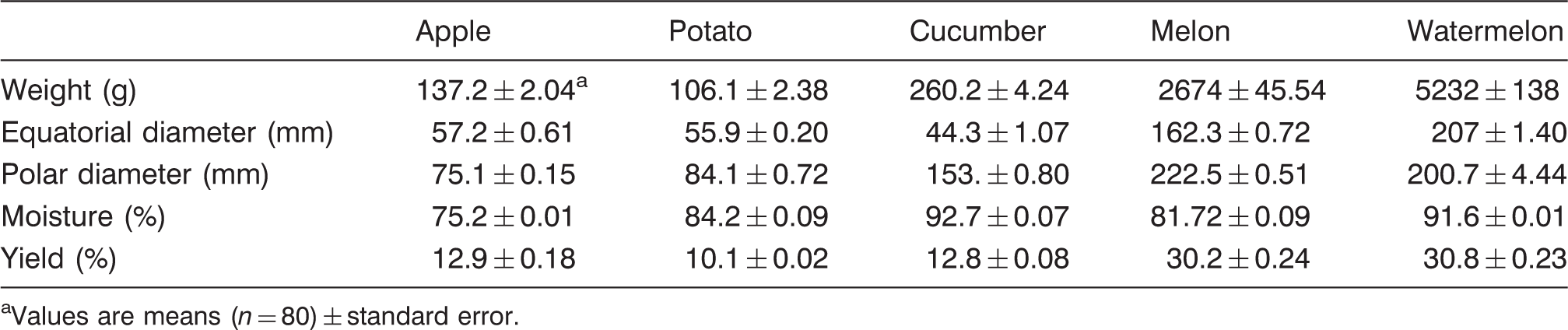
Fresh-cut waste yield
Peels of all commodities were weighed using a balance with an accuracy of 0.01 g (Mettler Instruments, Zurich, Switzerland). The results are expressed as percentage of usable product of initial whole fruit.
Proximate analysis
Samples from groups a and b were analyzed using the following AOAC (2000) methods: moisture (Method 925.09), protein content (Method 950.48), ether extract (Method 983.23) and ash content (Method 940.26). Protein content was evaluated using a nitrogen determinator pronitro II (J.P. Selecta, S.A, Barcelona, Spain). Total carbohydrate content was determined by difference from the total dietary fiber, ether extract, protein and ash (Chau and Huang, 2003).
Total dietary fibre
The total dietary fibre (TDF) was determined by the enzymatic-gravimetric method according to Prosky et al. (1998). One gram of milled and dried sample was weighed into a 500 mL volumetric glass beaker, and then 50 mL of pH 6.0 phosphate buffer added. The samples were successively treated with 0.1 mL heat stable α-amylase (pH = 7.5, 95 ℃, 15 min, Sigma Chemical S.A, Madrid, Spain) by heating in a bath oil (Huber, Polystat CC3, Barcelona, Spain) and adjusting the pH with 10 mL of 0.275 M NaOH. Then, the samples were incubated with protease from Sigma Chemical (0.1 mL of a 50 mg/mL solution in phosphate buffer pH 4.0 to 4.6, 60 ℃, 30 min) in a water bath (J.P. Selecta S.A, Barcelona, Spain) with continuous agitation adjusting pH with 10 mL of 0.325 M HCL; 0.1 mL amyloglucosidase (Sigma Chemical) was added to remove protein and starch, and samples incubated at 60 ℃ for 30 min with continuous agitation (J.P. Selecta S.A, Barcelona, Spain). A total of 400 mL of 95% ethanol was added to each sample to precipitate the soluble dietary fiber. Then, precipitate was filtered and washed three times with 20 mL of 78% ethanol, twice with 10 mL of 95% ethanol and twice with 10 mL of acetone. This was carried out using a vacuum pump (Vacuubrand, Wertheim, Germany) and a Gooch crucible (Corning, Pyrex, Wiesbaden, Germany) containing celite moistened with 78% ethanol. The precipitated soluble dietary fiber was dried and weighed. Ash and protein in each precipitate was analyzed using the AOAC (2000) methods described above.
Mineral contents
A total of 0.3 g samples of by-products were digested in 9 mL of 65% nitric acid in a microwave digester (Milestone, Ethos Plus, Shelton, US) equipped with temperature and pressure regulation through a sensor vessel. The digestion program consisted of a ramp time of 5 min to reach 180 ℃ and digestion for 10 min. The tubes were cooled and the sample made up to a 100 mL in a volumetric flask using 1% nitric acid and water. Manganese (Mn), boron (B), zinc (Zn), calcium (Ca), phosphorous (P), potassium (K), iron (Fe), sodium (Na) and magnesium (Mg) were determined using inductively coupled plasma-mass spectrometry (ICP-MS, Agilent 7500ce, Agilent Technologies, Manchester, UK). The standards were appropriately diluted and used to calibrate the ICP-MS before metal determinations in samples.
Preparation of methanolic extract
A methanol extraction was prepared for the estimation of phenolic compounds and antioxidant capacity. About 200 g of by-products were immediately frozen and ground in a liquid nitrogen mill (IKA, A11 basic, Berlin, Germany) at 28000 × g for 10 s, and stored in polyethylene containers at −72 ℃. Triplicate samples (0.5 g) were weighed into Falcon tubes together with 3 mL of pure methanol and homogenised (Ultra-Turrax T25, IKA-Labortechnik, Staufen, Germany) for 1 min. Samples were then transferred to Eppendorf tubes and centrifuged at 1200 × g for 15 min at 4 ℃ (Thermo Heraeus Fresco 21, Germany) to obtain the extracts.
Total antioxidant activity
The antioxidant activity of by-product samples was based on the evaluation of the free radical scavenging capacity according to Brand-Williams et al. (1995). Briefly, a solution of 0.7 mmol/L of 2, 2-diphenyl-1-picrylhydrazyl radical (DPPH) in methanol was prepared daily. A 0.05 mL aliquot of the methanol extract previously obtained was added to 0.95 mL of DPPH stock solution. The homogenate was shaken vigorously and kept in darkness for 40 min at room temperature. The absorption of samples at 515 nm was measured in a spectrophotometer (Hewlett Packard 8453, UV-Vis Waldbronn, Germany) against a blank of methanol. The measurement was compared with a standard curve of ascorbic acid concentrations and expressed as mg ascorbic acid equivalent antioxidant capacity (AAE)/kg fresh weight (f.w.). All measurements were made in triplicate.
Total phenolics content
The amount of total phenolics was determined by the Folin-Ciocalteu colorimetric method, based on the procedure of Singleton and Rossi (1965). A 0.1 mL of the methanolic extract was mixed with 0.15 mL of Folin-Ciocalteu’s reagent (diluted 1:1 v/v with Milli-Q water) and 1 mL of 4 g/L NaOH; 20 g/L Na2CO3. The solution was incubated at room temperature for 1 h in darkness, after which its absorption at 750 nm was measured (Hewlett Packard 8453, UV-Vis spectrophotometer, Waldbronn, Germany). The measurement was compared with a standard curve of chlorogenic acid concentrations and expressed as chlorogenic acid equivalents (CAE) in mg/kg f.w. All extracts were analyzed in triplicate.
Chlorophyll contents
Total chlorophyll and chlorophyll a and b contents of melon, cucumber and watermelon sample by-products were determined spectrophometrically (Arnon, 1949), with additional modifications to the equations as proposed by Lichtenthaler and Wellburn (1983). In all, 0.5 g of each ground peel sample (group c) was mixed with 9 mL of hexane and 15 mL of a mixture of methanol-acetone (1:2). The samples were agitated with a vortex mixer (Heidolph Reax top, Schwabach, Germany) and stored at 5 ℃ for 5 h in darkness, covered with aluminium foil and shaken for 1 min every 15 min using a vortex. After incubation, 25 mL of 1 M NaCl was added. The samples were shaken again, and then centrifuged for 30 min at 2800 × g at 4 ℃. The final volume of the extract was recorded and the absorbance 662 and 664 nm was measured (Hewlett Packard 8453, UV-Visible spectrophotometer, Waldbronn, Germany) in precision cells made of optical glass (OG-6030, 10 mm, Hellma, Germany). All measurements were made in triplicate.
Statistical analysis
There were four repetitions per by-product analyzed. Mean and standard error (SE) was calculated.
Results and discussion
Fresh-cut waste yield and moisture
The amount of by-product (peels) measured in apple, cucumber and potato peels ranged between 10 and 13% f.w., meanwhile in watermelon and melon it raised to 30% (Table 1). In fresh-cut melon, Aguayo et al. (2004) reported the inedible portion was about 47%, of which 3.4% corresponded to the seeds and 43.7% to the peel. In watermelon, in which the seeds are distributed throughout the flesh, the edible portion is slightly higher and the amount of by-product varies from 31.27 to 40.61% of fresh product weight, depending on the cultivar (Tarazona-Díaz et al., 2011). Sliced apples produced 10.91% of by-products (Ayala-Zavala et al., 2010) very close to the values obtained in this study.
The amount of moisture provides an indication of the perishability of the by-product, and consequently the resulting environmental issues such noxious odours, microbiological hazard and volume management. The minimum moisture content was 75% from apple peel, but it increased to 92% in cucumber and watermelon peels (Table 1). This high value of moisture shows the by-products could be susceptible to degradation by microorganisms such as bacteria and fungi. Therefore, appropriate storage conditions, like short storage time and low temperatures, are required if by-products are to be re-used as bioactive compounds.
Proximate composition
The chemical nutritional composition of the by-products is presented in the Figure 1. The protein content ranged from 5.8 (apple) to 17.8 g/kg f.w. (potato) by-products. Potato peel showed a value close to the whole potato with 20.4 g/kg (Souci et al., 2000) However, in other products, the peel protein content was upper to the flesh. For example, in cucumber and watermelon the peel protein level was of 15 versus 6 g/kg (Souci et al., 2000) and in melon 9.8 versus 8.4 g/kg (USDA, 2010).
Proximal composition of by-product from fresh-cut fruits and vegetables (g/kg). Means (n = 4) ± standard error. Results expressed on fresh weight.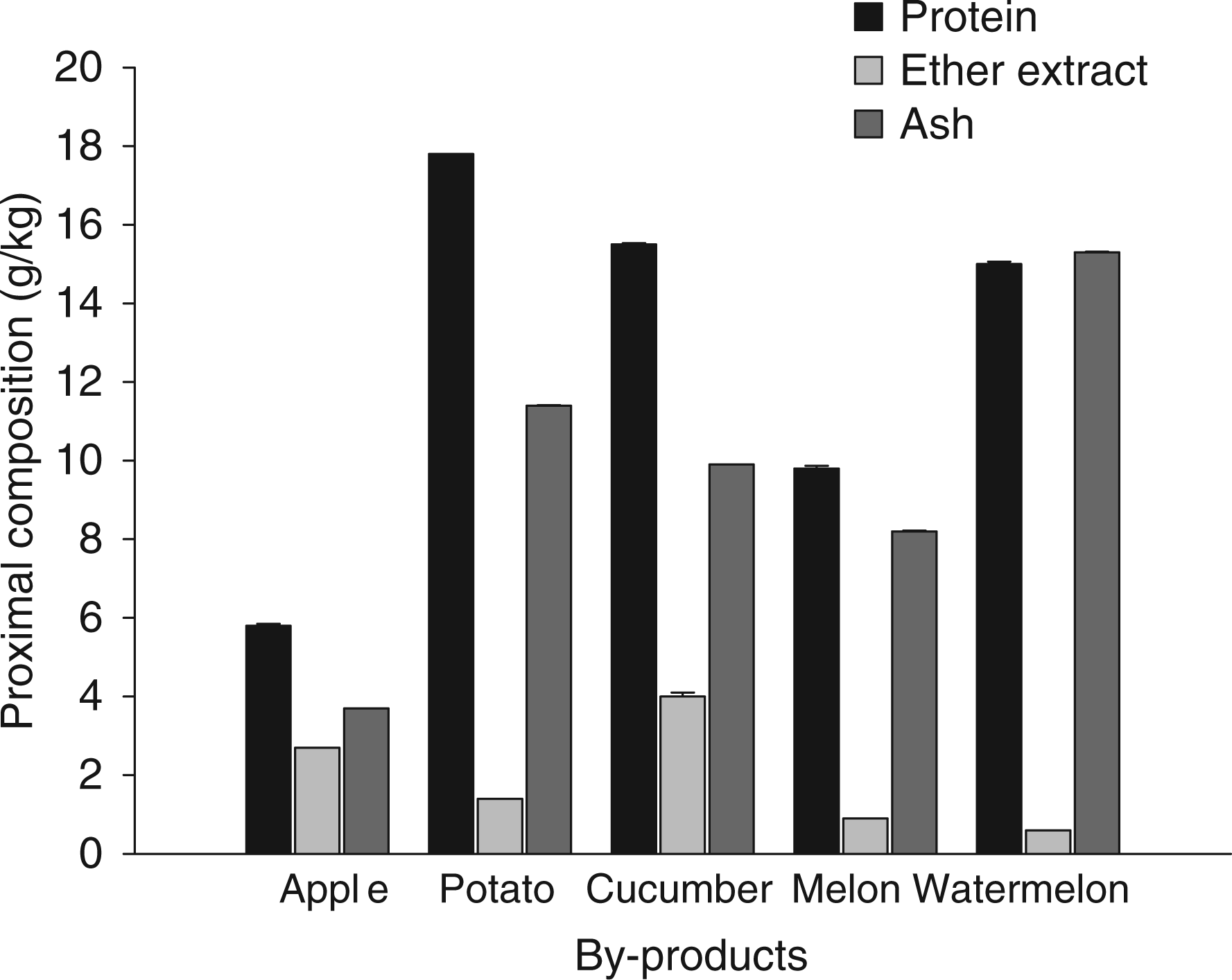
The ether extract (fatty acid) content obtained in the by-products was relatively low, between 0.6 and 4 g/kg f.w., although for cucumber, apple and potato peels, this value was slightly higher than that in the peeled product (USDA, 2010). In melon peel, the fatty acid content was of 1 g/kg f.w. (5.5 g/kg d.w.) and it was not really significant as a nutritional component compared to the values reported in seeds (FAO, 1997). These authors reported (350 g/kg d.w.) in seeds from the melon hybrid ‘ChunLi’, the presence of 25 fatty acids and an important content of proteins and amino acids.
The ash content of by-products ranged from 3.7 to 15.3 g/kg f.w. Ash levels in peels were similar to those found in whole apple fruit (3.7 versus 3.2 g/kg) and potato (11.4 versus 10.2 g/kg; Souci et al., 2000) but higher than those reported for whole cucumber, watermelon and melon (9.9, 15.3 and 8.2 g/kg) compared with the whole product 6, 4 and 6.5 g/kg, respectively (Souci et al., 2000). These results indicate that peels contain a high mineral content.
Carbohydrates are vehicles for important micronutrients and phytochemicals and help maintain glycemic homeostasis in the body (FAO, 1997). The total carbohydrate content in the by-products was in the range of 43.7 (cucumber) to 235 g/kg f.w. (apple) as shown in Figure 2.
Total carbohydrates (g/kg) and fiber (g/kg) of by-products from fresh-cut fruits and vegetables. Means (n = 4) ± standard error. Results expressed on fresh weight.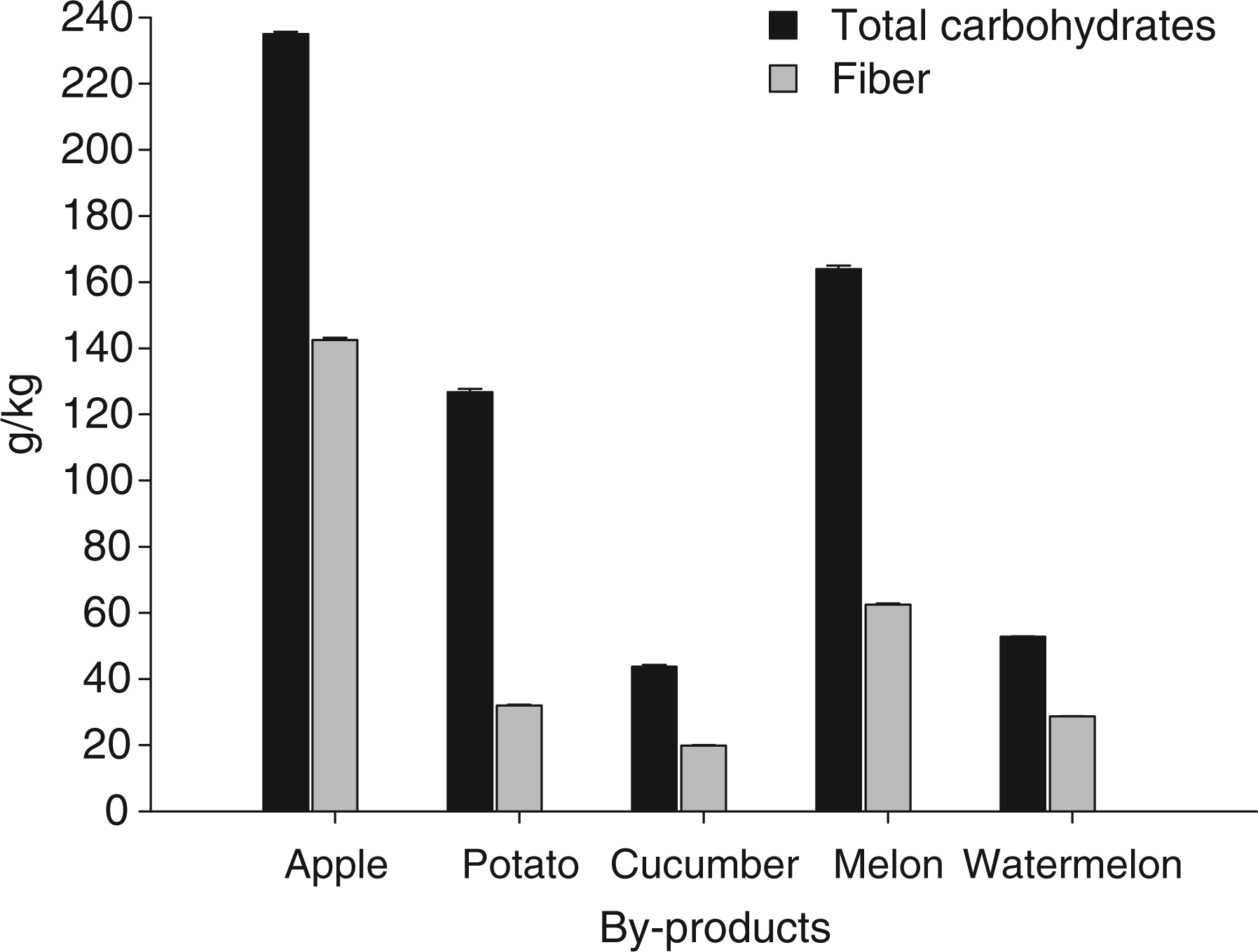
Total dietary fibre
Figure 2 shows the content of TDF. The fibre content ranged between 2 and 142.5 g/kg f.w. or 203.1 and 576.3 g/kg when converted to dry weight (data not shown). Melon and watermelon by-products had similar values (340 g/kg d.w.) and very close to peach peel (358 g/kg d.w.; Grigelmo-Miguel and Martin-Belloso, 1999). Fruit with less water content such as apple peel (Table 1) had higher values of TDF. The removal of peel decreases TDF, meaning the apple pulp contains 33–39% less fibre than an unpeeled apple (Marlett and Vollendorf, 1994). Apple fruits are a good source of fibre with a good balance between soluble and insoluble fraction (Gorinstein et al., 2001). Our results showed that apple peel had 576.3 g/kg d.w., in harmony with those obtained by Grigelmo-Miguel and Martin-Belloso (1999). Therefore, these results demonstrate that by-products are good sources of TDF and it is of great nutritional interest if the industry could combine it to new foods, obtaining products rich in fibre.
The mineral and trace element contents of by-products
Main minerals and trace elements in by-products from fresh-cut fruits and vegetables
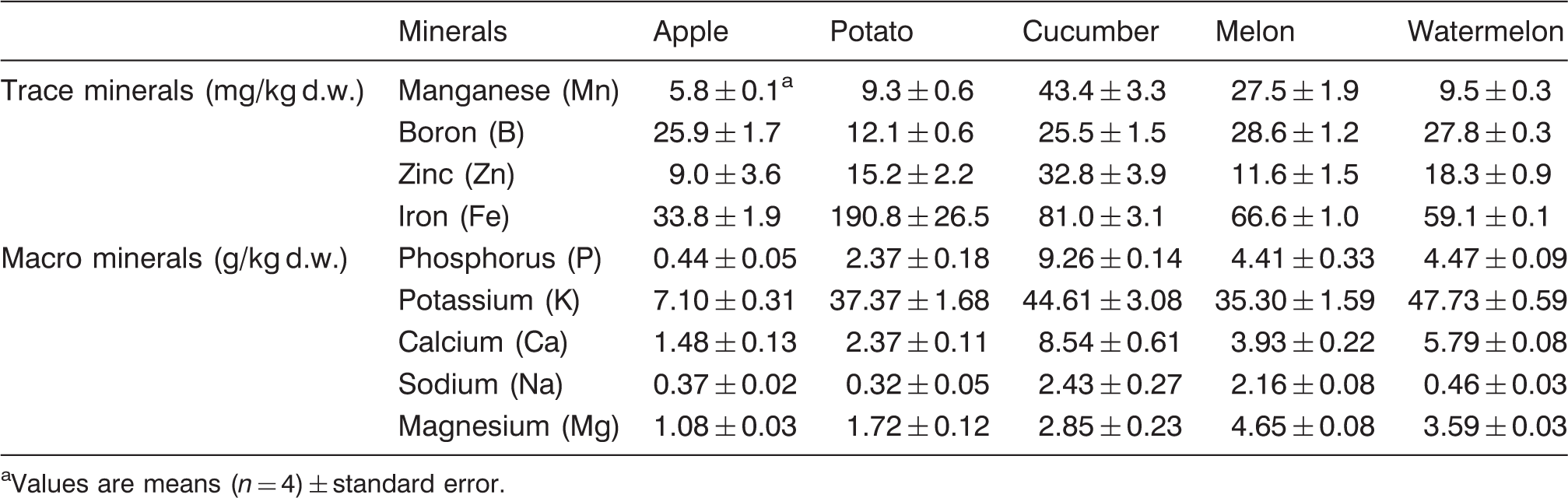
Values are means (n = 4) ± standard error.
Antioxidant activity and total polyphenols
It has been reported that peels and seeds from by-products of fresh-cut fruit and vegetables contain high amounts of phenolic and flavonoid compounds with antioxidant and antimicrobial properties (Muthuswamy and Rupasinghe, 2007). In Figure 3, the antioxidant capacity and phenolic content in the by-products is shown. It is well known that apples are an excellent source of various phenolic compounds and also have high total antioxidant capacity (Aguayo et al., 2010). Here, we demonstrate even the peel is rich in these compounds (3453.2 mg AAE/kg f.w.). The lowest values were obtained for watermelon, cucumber and melon peels with 66.4, 58.8 and 53.6 mg AAE/kg f.w., respectively.
Total antioxidant activity (mg (ascorbic acid equivalent) AAE/kg) and phenolic compounds (mg chlorogenic acid equivalents (CAE)/kg) of by-products from fresh-cut fruits and vegetables. Means (n = 4) ± standard error. Results expressed on fresh weight.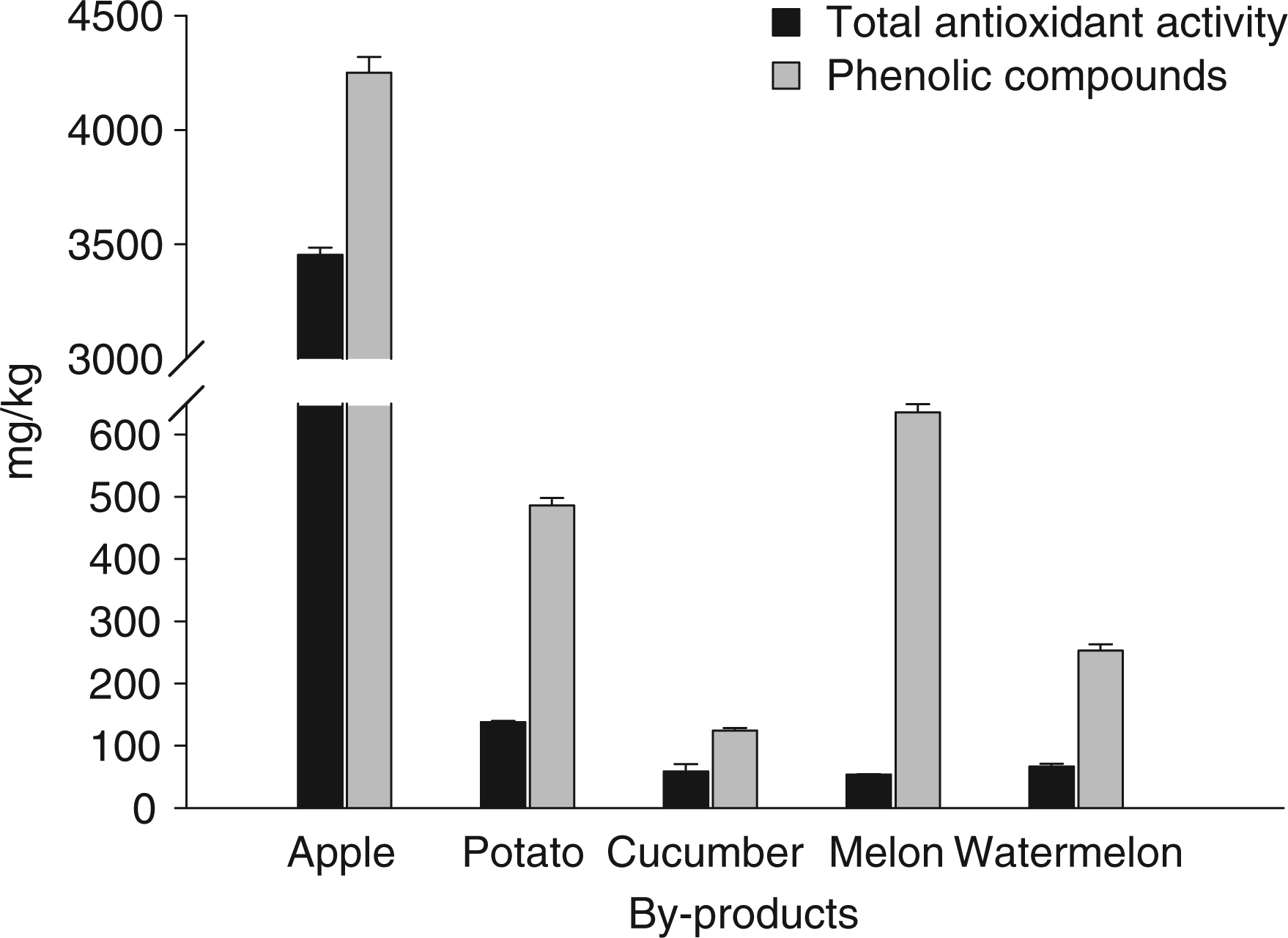
The total polyphenol content ranged from 124.5 to 4250.2 mg CAE/kg f.w., depending on the type of by-products (Figure 3). Apple peel had substantially higher total phenolic contents (4250.2 mg/kg f.w.), than the next highest (melon peel, 635.3 mg/kg f.w.). Previous studies (Wolfe and Liu, 2003) have reported apple flesh containing 1560 mg gallic acid/kg, therefore both peel and flesh apple have a high content of polyphenols. Potato and watermelon peels were in the range of 250 to 486 mg CAE/kg, similar to tomato cherry pulp (270 mg/kg; George et al., 2004) and peach (420 mg/kg; Chang et al., 2000). According to these results, the by-products are a good source of total polyphenols with similar levels to some fresh pulp fruits.
Chlorophyll content
Chlorophyll is responsible for the characteristic green color typical of plants. In this work, chlorophyll was measured in cucumber, watermelon and melon (data not shown). In these by-products, the chlorophyll content ranged from 240.8 to 718.3 mg/kg f.w. with cucumber peel having higher level, followed of melon and watermelon. The chlorophyll values found in these by-products were lower than those found in kale (1624 mg/kg), spinach (1080 mg/kg) and parsley (1006.8 mg/kg) (Lisiewska et al., 2007). However, the amount of chlorophyll in the melon peel was similar to endive (356 mg/kg) and lettuce (353 mg/kg; Bohn and Walczyk, 2004).
Conclusions
Fresh-cut processing generates huge amounts of natural by-products as peels which could potentially be utilized as a source of valuable compounds such as fiber, minerals, antioxidants and pigments. These could be further processed into functional food or even in non-food areas such as pharmaceuticals and cosmetics with a high value added. However, much more work is required to investigate extraction methods and feasibility of converting this discarded resource of the fresh-cut industry into high value product.
Footnotes
Acknowledgements
The authors are grateful to Magdalena Vasquez Méndez from ‘SAIT’ for metals characterization. Thanks are also due to the Institute of Plant Biotechnology of the Universidad Politécnica de Cartagena.