






Abstract
The use of pseudocereals, legumes and ancient grains for breadmaking applications is receiving particular attention since they involve nutrient dense grains with proven health-promoting attributes. Dilution up to 45% of the basic wheat flour matrix by accumulative ternary addition of teff, green pea and buckwheat flours did significantly impact both the extractability and distribution of lipid subfractions in composite flours, doughs and breads, and induced differentiated dynamics in lipid binding along breadmaking. During mixing, a preferential covalent lipid binding to the inside part of the starch granules takes place at the expenses of both accessible free lipids and lipids initially bound non-covalently to the gluten/non-gluten proteins and to the outside part of the starch granules. During fermentation and later baking a preferential lipid binding to the gluten/non-gluten proteins and to the outside and inside starch granules takes place at the expenses of both a free lipid displacement and a bound lipid translocation to new protein and starch active sites. It can be noticed that the larger the accumulation of both protein- and starch-bound lipids over fermentation and baking, the higher physic-chemical and sensory profiles, and the slower starch hydrolysis, firming and retrogradation kinetics of composite breads were obtained.
Introduction
Lipids provide a wide array of beneficial properties during breadmaking stages and bread storage which reflects the overall lipid diversity. Over the past years, the role of lipids in the areas of gas cell stabilisation (Sroan and MacRitchie, 2009) and the emulsifying properties of specific polar lipids (Selmair and Koehler, 2010) has been particularly emphasised. Lipids have a significant effect on the quality and texture of baked goods because of their ability to associate with proteins, due to their amphipathic nature (hydrophilic and hydrophobic groups present), and with starch, forming inclusion complexes (Goesaert et al., 2005). Nonpolar lipids are either associated with the glutenin polymeric network through hydrophobic interactions or entrapped within the gluten matrix. In gluten, glycolipids are likely to be associated with glutenins through both hydrophobic interactions and hydrogen bonds, while phospholipids preferentially interact with gliadins and lipid binding proteins (McCann et al., 2009). Amylose-lipid complexation can prevent the crystallisation of amylose with amylopectin, and lipids can also complex with the outer branches of amylopectin and inhibit retrogradation in a more direct way (Putseys et al., 2010).
In breadmaking applications, protein and starch lipid binding in both wheat flour and additive-bread systems have been reported to correlate with loaf volume, crumb structure, softness and/or texture of bread (Collar et al., 2001; Angioloni and Collar, 2011a). At dough level and in presence of surfactants, free and bound lipids (BL) preferentially bind to gluten (monoglycerides) and to the outside part of the starch granules (cationic surfactants). Hydrocolloids preferentially bind to the gluten and to the outside part of the starch granules depending on their polarity (Collar et al., 1998). In wheat bread, a preferential binding of the added anionic surfactant to the starch with a concomitant displacement of endogenous polar lipids from starch to gluten was observed (Collar et al., 2001).
The binding of free lipids (FL) with gluten proteins may provide lipids with the ability to align at the interface of gas cells during the initial phases of dough mixing and increase gas cell stability throughout the bread making process (Pareyt et al., 2011). Gas cells are retained in dough during fermentation and baking. Both gluten and lipids play a role in this. Initially, during fermentation, the growing gas cells are surrounded (Selmair and Koehler, 2010) and stabilised by a continuous gluten network, the viscosity of the dough liquor and the adsorbed lipid crystals. The gluten matrix remains only as a thin film between gas cells at the end of fermentation and some surface active proteins and lipids exert film stabilising properties and, as such, increase gas cell retention (Gan et al., 1995). The endogenous lipids and gluten proteins act synergistically to stabilise the gas cells during fermentation.
In diluted wheat flour systems by addition of non-gluten forming grain flours, lipid binding during breadmaking stages takes place to both gluten and non-gluten proteins and to mixed starches. In single and blended oat, rye, buckwheat and wheat flour matrices, lipids bound to proteins during dough mixing are translocated and bound to starch during baking. Lipids bound to starch showed the most significant correlations with parameters related to dough and bread performance during breadmaking, especially over the mixing step (Angioloni and Collar, 2011a). In complex grain flour matrices, during baking, lipids bind to the gluten/non-gluten proteins at the expenses of both a free lipid displacement and a lipid migration from the inside part of the starch granules to the protein active sites. It was observed that the higher the decrease of free lipid content during baking, the higher the pasting temperature and the lower the total setback on cooling and the dynamic moduli, but the higher the specific volume in blended breads (Collar and Angioloni, 2014).
Pseudocereals and teff flours exhibit richer qualitative and quantitative lipid profiles than green pea and wheat flours (Hager et al., 2012). This research is aimed at characterising the lipid fractions of flour, dough and bread stages in single and blended teff, green pea and buckwheat added to a wheat flour matrix. An analysis of the impact of FL and starch- and protein–lipid binding along the breadmaking steps on the physico-chemical and sensory properties and starch digestibility of composite matrices was presented.
Experimental
Materials
Commercial flours from refined common wheat Triticum aestivum (W), and whole teff Eragrostis tef (T), green pea Pisum sativum (GP), and buckwheat Fagopyrum esculentum (BW) were purchased from the Spanish market. Protein, dietary fibre and fat contents (% flour, dry basis) were 14.13%, 2.19%, 1.56 (W); 25.12%, 14.56%, 1.27 (GP); 19.71%, 13.52%, 3.44% (BW), and 13.05%, 12.19%, 5.06% (T), respectively (Collar et al., 2014a). Refined W flour (70% extraction rate) of 356 × 10−4 J energy of deformation W, 0.64 curve configuration ratio P/L, 95% Gluten Index, 62% water absorption in Brabender Farinograph, was used. Ireks Vollsauer sour dough was from Ireks (Spain); Novamyl 10000 a maltogenic thermostable α-amylase of 10,000 Maltogenase Units (MANU) of activity, from Novozymes (Denmark); and calcium propionate, from Sigma-Aldrich (USA).
Methods
Bread making of wheat and wheat-based blended flours
Doughs and breads were prepared from W as control, and wheat-based blended flours (T, GP, BW) by W flour replacement from 22.5% up to 45%, and incorporation of ternary blends of T, GP and BW flours according to a Multilevel Factorial Design (Statgraphics Centurion XV, version 15.2.11, Statpoint Technologies, Inc. Warrenton, Virginia, USA) with the following attributes: three experimental factors (T, GP and BW flours) at two levels, coded 0 (7.5% W flour replacement) and 1 (15% W flour replacement), and five error degrees of freedom. The model resulted in eight randomized runs in one block. A three digit bread sample code was set referring to low (0) and high (1) W flour replacement by T (1st digit), GP (2nd digit), and BW (3rd digit) flours in sample formulation, as it follows: 010, 001, 011, 000, 111, 101, 100, 110. Blended flours, water, commercial compressed yeast, salt, sugar, commercial sour dough, milk powder, Novamyl 10000, and calcium propionate were mixed, and used to make control and blended breads according to the quantitative formulations and breadmaking procedure described earlier (Collar et al., 2014a). Bread samples were stored for one, three, six, and eight days to describe firming kinetics. Two trials of baking tests per sample were performed.
Sensory analysis
Sensory analysis of fresh breads was performed with a panel of 10 trained judges (five males and five females aged 24–57) using semi structured scales, scored 1–10 in which extremes (lowest: 1; highest: 10) were described for each sensory attribute according to Setser (1996). Evaluated attributes were grouped into visual (cell uniformity, size, brightness and shape, and cell wall thickness), textural (tactile moistness, elasticity and smoothness, and biting coarseness, adhesiveness, cohesiveness, chewiness, crumbliness and dryness) and organoleptic (taste intensity, quality, saltiness, sourness and aftertaste, and aroma intensity, quality and sourness) characteristics (Collar et al., 2005).
Starch digestibility
In vitro starch hydrolysis kinetics and relevant starch fractions in freeze-dried and ground fresh blended breads were determined following the AACC (2005) method 32–40, adapted by Angioloni and Collar (2011b) as previously described (Collar et al., 2014a). Rapidly digestible starch (RDS) and slowly digestible starch (SDS) were measured after incubation for 20 min and 120 min, respectively. Digestible starch (DS) was calculated by the sum of RDS and SDS. Total starch (TS) was calculated by the sum of DS and RS. A first-order kinetic equation [C = C∞ (1 − e−kt)] was applied to describe the kinetics of starch hydrolysis, where C, C∞ and k were the hydrolysis degree at each time, the maximum hydrolysis extent and the kinetic constant, respectively. Resistant starch (RS) determination was performed according to AOAC Official Method 2002.02 (AOAC, 2000) and AACC Method 32–40 (AACC, 2005), as described by Megazyme International Ireland (2011) in the Resistant Starch Assay Procedure (kit K-RSTAR 08/11). Three replicates were made per analysis.
Textural measurements and firming kinetics
Bread mechanical characteristics (TPA in a double compression cycle) of fresh and stored breads were recorded in a TA-XTplus texture analyser (Stable Micro Systems, Surrey, UK) using a 25 mm diameter cylindrical aluminium probe, a 5 kg load cell, 50% penetration depth at a running speed of 1 mm/s, and a 30 s gap between compressions on crust-free slices of 25 mm width (Armero and Collar, 1998). For textural measurements, three slices of two breads were used for each sample. The obtained firming curves during bread storage were modelled using the Avrami equation, and model factors were estimated by fitting experimental data of hardness to the nonlinear regression equation
Thermal measurements and retrogradation kinetics
Thermal properties regarding starch retrogradation of control and blended samples were assessed in a differential scanning calorimeter Perkin-Elmer DSC-7 (Norwalk, USA) as previously reported by Collar et al. (2015). Stored previously gelatinised dough samples (Collar et al., 2015) were submitted to a second DSC scan to analyse starch retrogradation at the different storage periods after one, three, six, and eight days. Scanning conditions included keeping sample pans at 25℃ for 1 min, and then heating from 25 to 130℃ at a rate of 10℃/min. The enthalpy of amylopectin retrogradation (ΔHr) was calculated, and To, Tp, and Te for the thermal transitions, identified. All samples were analysed in duplicate. Modelling of crystallization data was carried out using the Avrami equation, and model factors were estimated by fitting experimental data for melting enthalpies to the nonlinear regression equation
Lipid determinations
Flour, dough and bread FL
Flour (10 g), ground freeze-dried dough (10 g) and ground freeze-dried bread (20 g) samples were extracted with light petroleum ether under reflux conditions for 90 min in a soxhlet (McCormack et al., 1991) The solvent was removed under vacuum and the extracts were determined gravimetrically.
Flour and dough BL
Residues of the FL extraction were extracted with chloroform under reflux conditions as described by McCormack et al. (1991) to obtain total BL (non-covalent forces) to both starch and proteins (BL).
Bread protein-bound lipids
Residues of FL extraction (10 g) were treated with 100 mL 1% pepsin in 50 mM sulphuric acid, (pH 1.6) and gently stirred for 4 h at 40 ℃ under the conditions described by Collar et al. (2001). This fraction specifically refers to lipids easily or strongly bound to proteins.
Starchy lipids
Flour and dough starchy lipids (SL) were obtained by acid hydrolysis of the non-starchy lipid-free residue (ICC 136). This fraction specifically refers to lipids covalently bound to starch.
Bread starch-bound lipids
Residues of FL extraction (10 g) were reacted with 100 mL 0.5% α-amylase in 10 mM NaH2PO4, (pH 6.5) and gently stirred for 4 h at 70 ℃. When the reaction was completed, 100 mL of Cl3CH were added, and the mixture stirred for 1 h at room temperature and centrifuged. Supernatants were washed with 5% NaCl, the solvent removed, weighed (SBL) and stored under nitrogen until analysis (Collar et al., 2001). This fraction specifically refers to lipids easily or strongly bound to starch granules either by non-covalent (outside) or covalent forces (inside).
Total lipids were indirectly determined by addition of FL+BL+SL amounts retrieved in flours and doughs, and by addition of FL+PBL+SBL levels determined in breads. All lipid fractions and subfractions determinations were made per duplicate, and contents were expressed in g/100 g flour basis, as is.
Statistical analysis
Multivariate analysis of variance and correlation matrix of data were performed by using Statgraphics V.7.1 program (Bitstream, Cambridge, MN). Multiple range test (Fisher’s least significant differences, LSD) for analytical variables was applied to know the difference between each pair of means.
Results and discussion
Plural physic-chemical and biochemical approaches have been performed (a) to know the qualitative and quantitative profiles of endogenous lipid fractions of single and multigrain flour, dough and bread matrices and (b) to link lipid binding along breadmaking to the sensory, physical, starch hydrolysis, firming and starch retrogradation kinetics parameters in fresh and aged composite bread matrices.
Lipid extractability and distribution in single and multigrain flour, dough and bread samples
Data for extractability (g/100 g flour) and distribution (% of total lipids) of lipid fractions and sub-fractions from single and blended flour, dough and bread samples are reported in Table 1 and Figure 1, respectively. Total lipids (g/100 g flour basis) in single flours ranged from 1.85 g (W) to 4.91 g (T), in mixed flours from 1.85 g (W) to 2.57 g (111), in doughs from 1.20 g (W) to 2.47 g (101), and in breads from 1.44 g (W) to 3.12 g (101) (Table 1). The total lipid content determined in this study is in general in line with results previously found by Collar et al. (1998, 2001) for wheat, Schoenlechner et al., (2008) for pseudocereals, de Almeida Costa et al., (2006) for green pea, and Hager et al. (2012) for pseudocereals and teff flours.
Lipid distribution (%) in flour (a), dough (b) and bread (c) samples. Blended samples were based on: Wheat (W), teff (T), green pea (GP), and buckwheat(BW). Three digit bread samples code refers to low (0) and high (1) wheat flour replacement by T: GP: BW flours in sample formulation. Lipid subfractions (g/100 g of flour) from single flours and blended doughs and breads (mean values of three replicates ± standard deviation) Blended samples were based on: wheat (W), teff (T), green pea (GP) and buckwheat (BW). Three-digit sample code refers to low (0) and high (1) wheat flour replacement by T: GP: BW flours in sample formulation. Within each column of single flour samples, values with different letters differ significantly from each other (p < 0.05).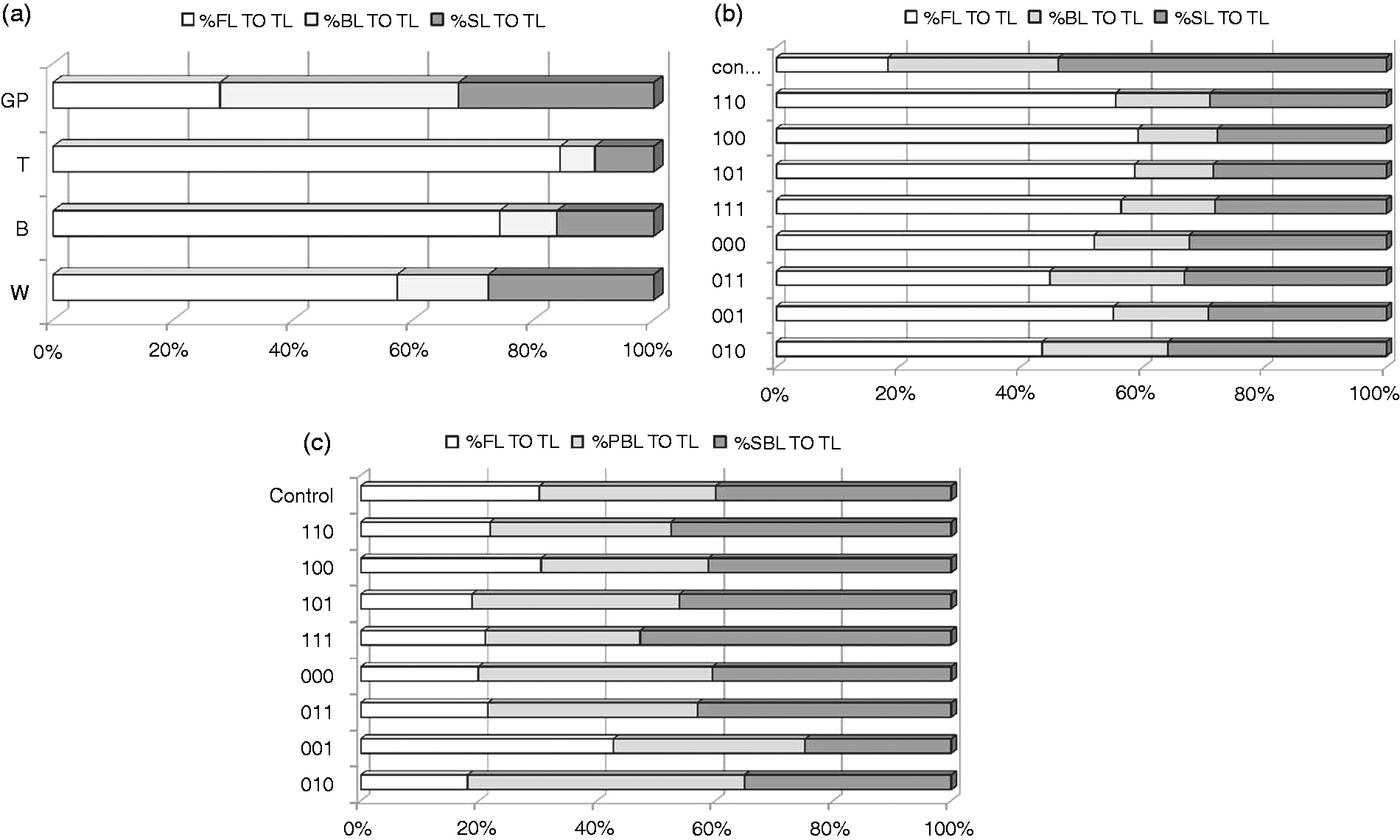
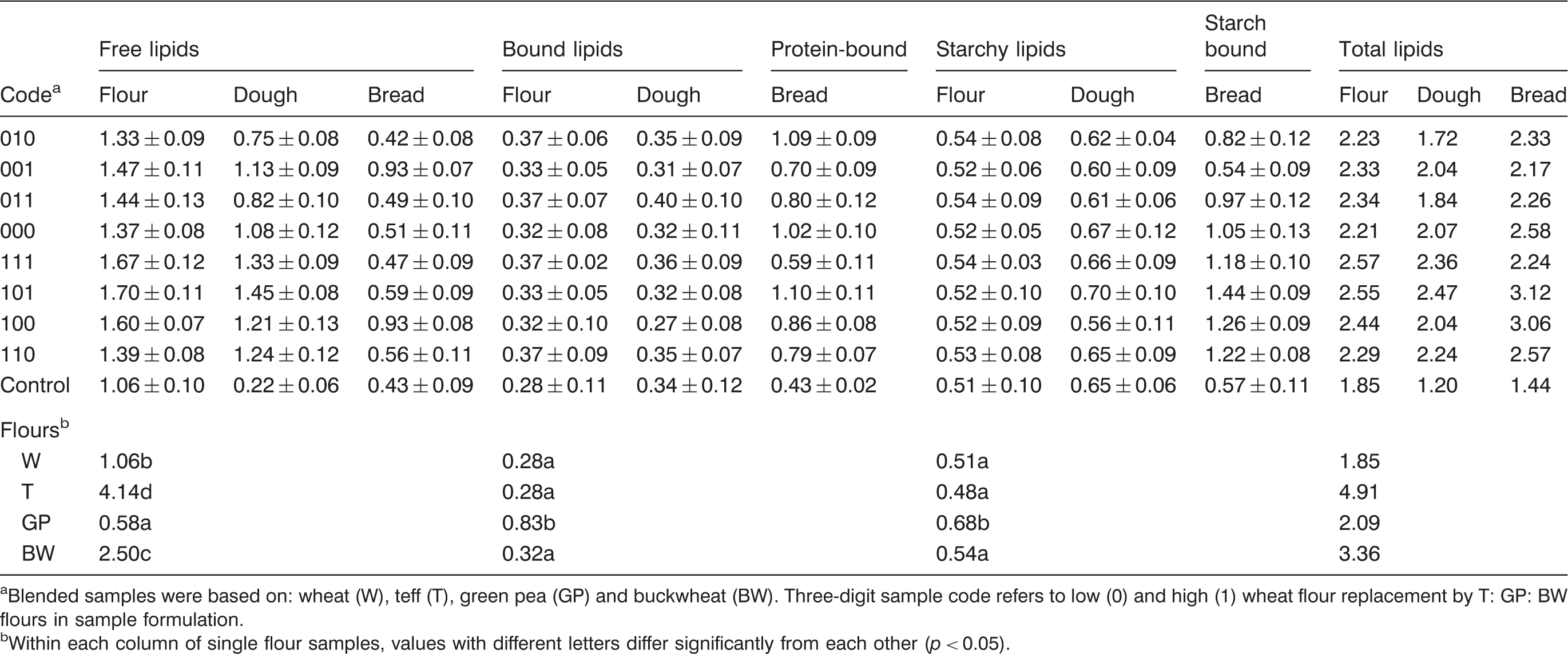
Free lipid (FL) was the most prominent fraction in terms of absolute content (Table 1) and as a percentage of total lipids (Figure 1) in flour (except for GP) and dough samples (except for control W); whereas in general, protein-bound lipids (PBL) and starch-bound lipids (SBL) predominated in breads with some exceptions. BL were minor lipid fraction in all single and blended flour matrices, while SL accounted for intermediate quantitative lipid fractions in blended flours and doughs (Table 1). FL in single grain flours varied greatly (from 0.58—GP—to 4.14—T—, g/100 g flour basis, accounting from 28 to 84% of total lipids, respectively), little in blended flours (from 1.33—010—to 1.70—101—, g/100 g flour basis), doughs (from 0.75—010—to 1.45—101—, g/100 g flour basis, accounting from 44 to 59% of total lipids) and breads (from 0.42—010—to 0.93—001, 100—, g/100 g flour basis, accounting from 18 to 31–43% of total lipids). PBL in breads varied from 26 (111) to 47% (010) of total lipids, while SBL accounted from 25 (001) to 53% (111) of total lipids (Figure 1).
Significant (p < 0.01, **) single and 2nd order interactive effects of non-wheat flours – t eff (T), green pea (GP), buckwheat (BW) – on lipid subfractions contents – free lipids (FL), bound lipids (BL), starchy lipids (SL), protein-bound lipids (PBL) and starch-bound lipids (SBL) in composite matrices

Mean values ± standard deviation. Within each parameter, values with different letters differ significantly from each other.
Coded levels refer to 7.5% (0) and 15% (1) wheat flour replacement by non-wheat flours in sample formulation.
Lipid binding during mixing, fermentation and baking of composite matrices
Along breadmaking steps – mixing, fermentation and baking – lipid subfractions of composite matrices underwent significant quantitative changes as a result of a balance between (a) release of protein- and/or SBL to the pool of FL, (b) binding of FL to protein and/or starch and (c) translocation of PBL to SBL and/or vice versa.
During mixing, a variable depletion of the pool of FL – from −11% (110) to −44% (010, 011) – was denoted in composite matrices, in accordance with a discreet variation in BL – from −17% (100) to +9% (011) – and a moderate promotion of SL – from +8% (100) to +35% (101) – (Figure 2). Increased amounts of either GP or BW from level 0 to level 1 promoted the extent of the changes in FL and minimised those in BL, while increased T replacement led to opposite effects. Control samples on W observed a different lipid pattern during mixing: maximum depletion in FL (−79%) and notable accumulation of both BL (+21%) and SL (+27%). After consecutive fermentation and baking steps of composite matrices, FL decreased from −37% (001) to −72% (111), while a variable sharp increase was denoted for both PBL – from 60% (111) to 236% (101) – and SBL – from 53% (010) to 175% (101) – (Figure 2). Increasing amounts of any non-wheat flour moderated the changes in PBL but enhanced those of SBL. In absence of non-wheat flours, lipid dynamics of W systems followed a notable decrease in FL (−59%), a moderate increase of PBL (+53%), and a discreet accumulation of SBL (+13%) (Figure 2).
Changes (%) in lipid subfractions free lipids (FL), bound lipids (BL) starch lipids (SL) during mixing (a) and in free lipids (FL), protein-bound lipids (PBL), starch-bound lipids (SBL) during fermentation and baking (b). Blended samples were based on: wheat (W), teff (T), green pea(GP) and buckwheat(BW), three digit bread sample code refers to low (0) and high (1) wheat flour replacement by T: GP: BW flours in sample formulation.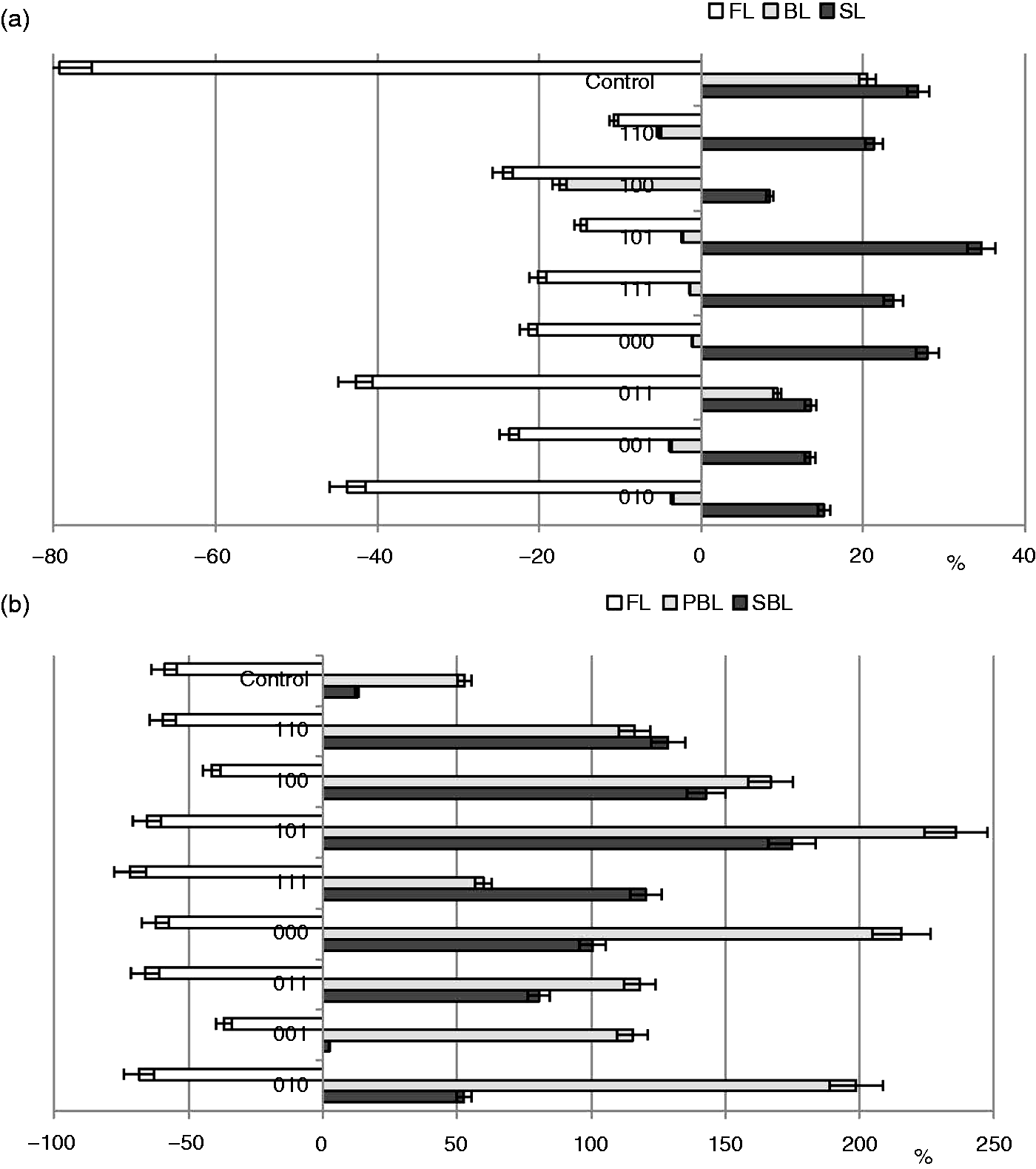
Relationships between lipid dynamics along breadmaking of composite matrices and physico-chemical, sensory and nutritional properties of fresh and aged breads
Mixing of composite matrices induced binding from flour to dough of both FL and BL through a respective sharp decrease up to −44% in the pool of FL and a slight decrease in BL up to −17%. Concomitantly, a prominent accumulation of SL up to 17% took place in blended doughs (Figure 2). So that, a preferential covalent lipid binding to the inside part of the starch granules takes place during mixing at the expenses of both accessible FL and lipids initially bound non-covalently to the gluten/non-gluten proteins and to the outside part of the starch granules. Results are in contrast with those found for W systems, where around 80% of FL migrated to the active sites of both gluten and starch leading to a notable accumulation of BL and SL in doughs, respectively (Figure 2). In wheat systems, it has been reported than more than half of the FL in flour become associated with the gluten protein during dough mixing (Chung, 1986). The association could involve either physical entrapment or binding of lipids to protein (Carr et al., 1992), and as a result, some of the flour lipids can no longer be extracted with the non-polar solvents used for free lipid extraction. The protein and lipid might be associated through (a) chemical interactions involving polar and hydrophobic bonding (Pomeranz and Chung, 1978), suggesting that dough is strengthened by the ability of polar lipids to be associated with protein and starch and/or (b) lipid is retained within the gluten in a relatively non-specific way and that the interaction of protein and lipid in gluten may involve the physical entrapment of lipid and also polar or ionic bonding between the components (Carr et al., 1992). It has been alluded that the binding of FL with gluten proteins may provide them with the ability to align at the interface of gas cells during the initial phases of dough mixing and increase gas cell stability throughout the bread making process (Pareyt et al., 2011). When non-gluten forming flours are added to the breadmaking system, interferences in the binding of lipids to main biopolymers – protein, starch – can occur since original wheat flour system is diluted with other fat, protein, starch and dietary fibre entities that compete for water and active sites of biomolecules. This is the case of the present flours used, whose chemical composition is particularly rich in fat (T, BW), protein (GP, BW) and dietary fibre (T, GP, BW). Transformation of dough into bread after successive fermentation and baking steps induced binding of FL and most probably also of BL from dough to bread through a sharp decrease in the pool of FL and a concomitant increase in PBL and SBL of mixed breads (Figure 2). This means that a preferential lipid binding to the gluten/non-gluten proteins and to the outside and inside starch granules takes place during fermentation and later baking at the expenses of both a FL displacement and a BL translocation to new protein and starch active sites. Nature of pseudocereal proteins – highly soluble and foaming and emulsifying properties – (Schoenlechner et al., 2008), and teff prolamins – lower polymerization, hydrophobicity and denaturation temperature – (Adebowale et al., 2011) can stimulate lipid binding, particularly for the most accessible fraction (FL). In fact, in control W systems, FL migration takes places mainly to the gluten protein active sites and very little to the starch leading to a discreet accumulation of PBL and a poor increase of SBL from dough to bread (Figure 2).
Pearson correlations (p < 0.01) between dynamics in lipid subfractions along breadmaking and sensory, physical, starch hydrolysis, firming and starch retrogradation kinetics parameters of composite matrices
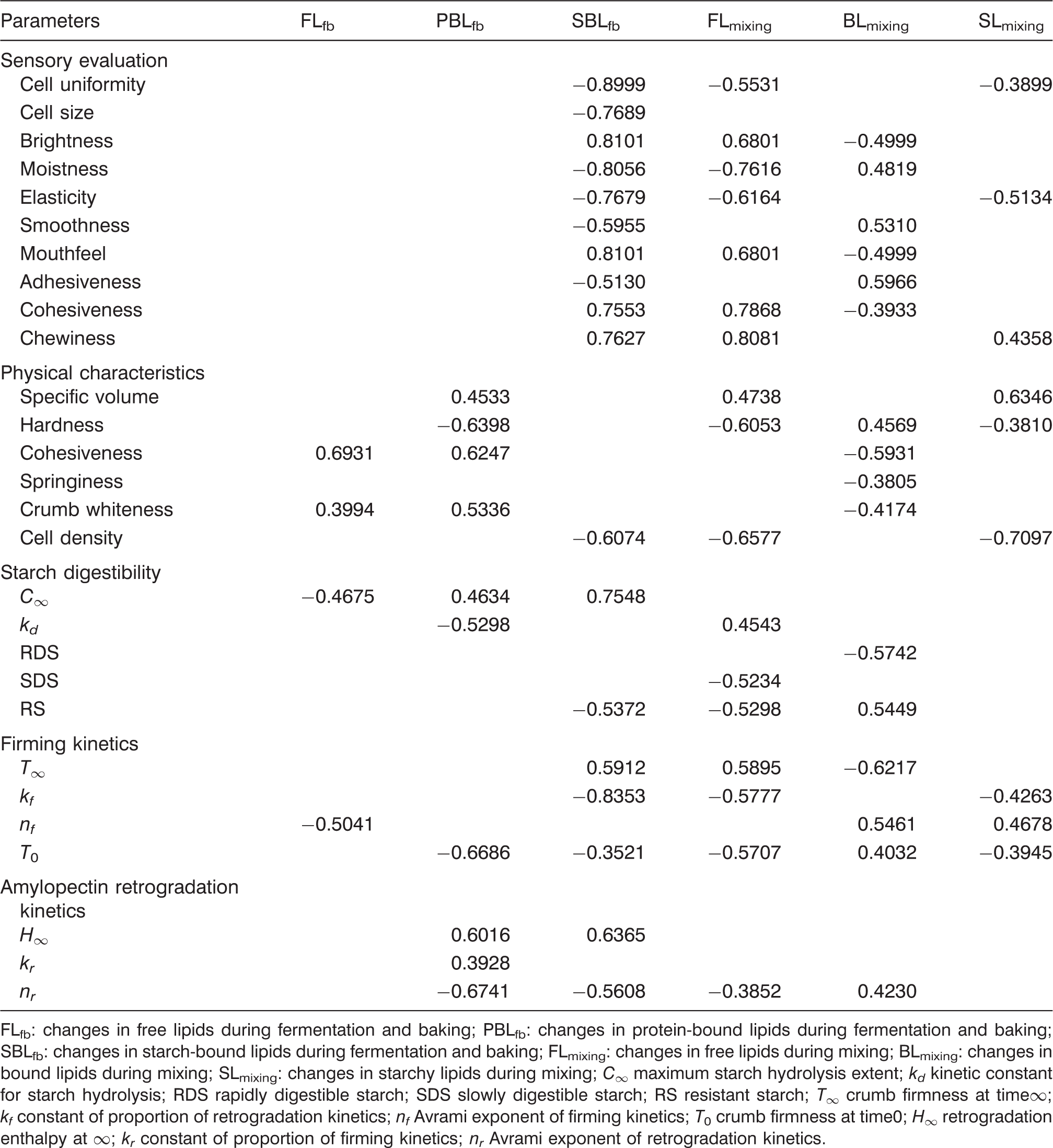
FLfb: changes in free lipids during fermentation and baking; PBLfb: changes in protein-bound lipids during fermentation and baking; SBLfb: changes in starch-bound lipids during fermentation and baking; FLmixing: changes in free lipids during mixing; BLmixing: changes in bound lipids during mixing; SLmixing: changes in starchy lipids during mixing; C∞ maximum starch hydrolysis extent; kd kinetic constant for starch hydrolysis; RDS rapidly digestible starch; SDS slowly digestible starch; RS resistant starch; T∞ crumb firmness at time∞; kf constant of proportion of retrogradation kinetics; nf Avrami exponent of firming kinetics; T0 crumb firmness at time0; ΔH∞ retrogradation enthalpy at ∞; kr constant of proportion of firming kinetics; nr Avrami exponent of retrogradation kinetics.
Dynamics on PBL and SBL during fermentation and baking significantly (p < 0.01) correlated with main sensory features and physical characteristics in fresh breads, and with firming and retrogradation kinetics on ageing. It can be noticed that the higher the accumulation of PBL over fermentation and baking, the larger the bread volume (r = 0.453), and the softer (r = 0.640) and the more cohesive (r = 0.625) bread crumbs are obtained, undergoing slower starch hydrolysis (r = −0.530) and retrogradation kinetics (r = −0.674) in blended breads (Table 3). Increased accumulation of SBL after fermentation and baking significantly impacted the sensory perception of subsequent mixed breads mainly in terms of decreased cell uniformity (r = −0.900), brighter (r = 0.810), less elastic (r = −0.768), but more cohesive (r = 0.755) fresh bread crumb, with slower both firming (r = −0.835) and starch retrogradation (r = −0.561) kinetics (Table 3).
Conclusions
Dilution up to 45% of the basic wheat flour matrix by accumulative ternary addition of teff, green pea and buckwheat flours (7.5%–15% single flour) did significantly (p < 0.01) impact both the extractability and distribution of lipid subfractions in composite flours, doughs and breads, and induced dynamics in lipid binding over mixing, fermentation and baking steps, in variable extent. At dough level, a significant promotion of FL or BL was provided by blending higher levels of T or GP flours, respectively, which encompassed a depletion of respective BL or FL in composite doughs thereof. At bread stage, GP incorporation at higher levels favoured accumulation of SBL at the expenses of a notable depletion of FL, whereas blending larger amounts of either T or BW resulted in a common decrease in PBL and an accumulation (T) or depletion (BW) in SBL.
During mixing, a preferential covalent lipid binding to the inside part of the starch granules takes place at the expenses of both accessible FL and lipids initially bound non-covalently to the gluten/non-gluten proteins and to the outside part of the starch granules in flours. Results are in contrast with those found for W systems, where around 80% of FL migrated to the active sites of both gluten and starch leading to a notable accumulation of BL and SL in doughs, respectively. Higher depletion in FL contents over mixing corresponded to more uniform cell structure, moist and elastic bread crumbs, exhibiting larger formation of both SDS and RS upon starch hydrolysis. Concomitantly, the higher the displacement of BL over mixing, the softer, the more cohesive and springier the bread crumb was in blended breads.
During fermentation and later baking a preferential lipid binding to the gluten/non-gluten proteins and to the outside and inside starch granules takes place at the expenses of both a FL displacement and a BL translocation to new protein and starch active sites. It can be noticed that the higher the accumulation of PBL over fermentation and baking, the larger the bread volume, and the softer and the more cohesive bread crumbs are obtained, undergoing slower starch hydrolysis and retrogradation kinetics in composite breads. Increased accumulation of SBL after fermentation and baking significantly impacted the sensory perception of subsequent mixed breads mainly in terms of decreased cell uniformity, brighter, less elastic, but more cohesive fresh bread crumbs, with slower both firming and starch retrogradation kinetics.
Footnotes
Declaration of conflicting interests
The author(s) declared no potential conflicts of interest with respect to the research, authorship, and/or publication of this article.
Funding
The author(s) disclosed receipt of the following financial support for the research, authorship, and/or publication of this article: The authors acknowledge the financial support of Consejo Superior de Investigaciones Científicas (CSIC), Ministerio de Economía y Competitividad (MINECO) and Fondo Europeo de Desarrollo Nacional (FEDER) (Project AGL2015-63849-C2-1-R).