






Abstract
Normal pressure steaming, high pressure steaming, microwave, and frying are widely used to deactivate enzyme in the oats, but these thermal processing methods may affect the structural and functional properties of soluble dietary fiber, which contribute greatly to the health benefits of oat foods. The objective of this study was to evaluate the effects of four different thermal processing methods on the structural and functional properties of soluble dietary fiber from whole grain oats. The results showed that the thermal processing resulted in changes on nutritional components of whole grain oats. Especially dietary fiber components, the total dietary fiber, insoluble dietary fiber, and soluble dietary fiber content of heat-treated oats were significantly increased (p < 0.05). Moreover, thermal processing can not only result in an increase in molecular weight and particle size, but also cause molecular aggregation and different functional properties of soluble dietary fiber. High pressure steaming-treated oat soluble dietary fiber displayed significantly higher swelling and emulsifying (p < 0.05), but microwave-treated oat soluble dietary fiber exhibited the highest glucose, cholesterol, and sodium cholate adsorption capacities. These results might provide basic information to help to better understand the functionality of oat soluble dietary fiber and improve the process efficiency of oat foods with high nutritional qualities.
Keywords
Introduction
Epidemiological studies have shown that regular consumption of whole grains and whole grain products is associated with reduced risks of various types of chronic diseases (Huang et al., 2015; Okarter and Liu, 2010). Oats are recognized as one of whole grains with high nutritional value, especially are considered to be an excellent source of dietary fiber (DF). Oats and oat products have gained more attention from consumers and researchers due to its health-beneficial properties, such as lowering blood lipid and glucose levels, reducing risks from cardiovascular and colorectal cancer diseases (Dong et al., 2014; Maki et al., 2010; Shen et al., 2011, 2016). These physiological benefits are generally attributed to soluble dietary fiber (SDF). SDF possesses good functional properties, such as water-holding capacity (WHC), oil-holding capacity (OHC), hydration capacity, glucose adsorption capacity (GAC), and cholesterol adsorption capacity (CAC) (Ozyurt and Ötles, 2016), which is important for designing oat products with health benefits (Fabek et al., 2014). Most importantly, these functional properties are related to food processing methods, extraction methods, chemical composition, structure, and particle size (Martínez et al., 2012; Peerajit et al., 2012; Wuttipalakorn et al., 2009).
Oats have more lipid than other cereals and are rich in lipase, lipoxidase, and other hydrolytic enzymes. Over time, enzymes result in hydrolysis of the lipids in the oats and affect the shelf life of the oat foods. So, it is necessary to inactivate these enzymes to extend shelf life during the oat processing and storage (Doehlert et al., 2010; Hu et al., 2010). The most efficient treatments to deactivate enzymes are thermal processes (Doehlert et al., 2010). Previous studies have used different thermal processing methods including steaming, microwave (MI) heating, and passing through infrared and gamma radiation to decrease lipolytic activities (De Almeida et al., 2014; Hu et al., 2010; Jha et al., 2013; Li et al., 2016; Rose et al., 2008). However, thermal processing can not only alter the lipase activity, but also affect the structure, physicochemical properties, and nutritional effects of DF (Zhang et al., 2011). Zhang et al. (2009) found that extrusion treatment could change the distribution of the molecular weight and the ratios of the (1/3) and (1/4) chemical bonds in oat bran (OB) SDF. Accumulating evidence has identified that some thermal processing can increase the extraction rate of nutrients and increase their functionality and improve the quality of food (Dolatabadi et al., 2016; Farzaneh and Carvalho, 2017; Ghodsvali et al., 2016; Jabrayili et al., 2016; Ozyurt and Ötles, 2016; Zhang et al., 2011). Available evidence suggested that the high temperatures and high pressures can break covalent bonds and disrupt physical structures of macromolecules leading to a change in their functional properties (Kim et al., 2006; Singh et al., 2007). Many published studies have attempted to clarify the changes of thermal processing on the nutritional components, mainly focused on the starch, protein (Bornet, 1993; Honců et al., 2016; Hu et al., 2010; Ovando-Martínez et al., 2013; Runyon et al., 2015). Nevertheless, fewer studies focused on the effects of thermal processing on the structural and functional properties of SDF from whole grain oats.
Today, because of the high demand for crops for extensive application in the human diet, increases in the efficiency of the processing are attracting much more attention (Farzaneh et al., 2017, 2016). Therefore, the objective of this study was to evaluate the effects of thermal processing on the structural characteristics and functional properties of SDF extracted from whole grain oats. Normal pressure steaming (NPS), high pressure steaming (HPS), MI, and frying (FR) were selected to process whole grain oat kernels and the different SDF samples were obtained, the SDF from unprocessed raw whole grain oat kernels was added as a control group to determine whether thermal processing led to difference in structural characteristics and functional properties of SDF. This is important because oat SDF contributes greatly to the nutritious value of oat foods. It is our hope that the research will provide valuable guidance for the processing of oat foods. Different kinds of processing methods could be selected depending on the purpose of oat foods.
Materials and methods
Materials
Oat kernels were purchased from Zhangjiakou Jianjun Oat Food Co., Ltd (Zhangjiakou, China). The total starch assay kit, total dietary fiber (TDF), and mixed linkage beta-glucan assay kit were purchased from Megazyme International Ireland Ltd (Bray, Ireland). Glucose, cholesterol, and sodium cholate were purchased from Nanjing Jiancheng Bioengineering Institute (Nanjing, China), and other chemicals were analytical reagent grade.
Sample preparation and thermal processing methods
Hu et al. (2010) and Wang et al. (2015) reported that the optimal processing parameters of NPS, HPS, MI, and FR can completely inactivate the lipase and make the quality of the oats after inactivated enzyme is good. Therefore, sample preparation and thermal processing were performed according to the method from Hu et al. (2010) and Wang et al. (2015) with minor modification. Nonprocessed raw whole grain oat kernels were used as a control and the four different thermal processing methods were described as follows:
NPS. The kernels were steamed in batches of 250 g, which allowed the kernels to form a layer no deeper than 1 cm in the steamer basket. Oat kernels were placed into the metal basket of a steamer and treated over boiling water for 20 min. HPS. Using an autoclave, oat kernels were steamed at 121 ℃ and 15 psi for 10 min. MI. The oat kernels were treated by MI at 1000 W for 2 min. FR. Oat kernels were fried 160 ℃ for 15 min by wok.
After above thermal treatments, the oat kernels were kept at room temperature for 24 h for moisture equilibration and then they were put in an air oven at 33 ℃ for 12 h to reduce the moisture content to about 10%. Whole grain oat kernels were processed into flour using a grinder at 50 Hz for 5 min and passed through a 0.250 mm sieve. The different thermal processed whole grain oat flours (OFs) were used for determination of nutritional components and extract SDF.
SDF extraction
Extraction of SDF from whole grain oats was performed according to enzymatic-gravimetric procedure AOAC 985.29 (2000) with minor modifications. Briefly, samples were thoroughly dispersed in four times volume of deionized water, and the pH was adjusted to 6.0 with 0.1 mol/l NaOH. Afterwards, 0.1% (w/w) heat stable α-amylase was added and hydrolyzed at 95 ℃ with constant stirring at 120 g for 30 min. After the temperature of the hydrolysate was cooled down to 60 ℃, 0.016% (w/w) neutral protease was added and further hydrolyzed for 30 min with constant stirring at 120 g. After the enzymatic hydrolysis reaction was quenched at 95 ℃ for 5 min and then centrifuged at 3800 g for 20 min at room temperature, the supernatant and sediment were collected. The supernatant was condensed to one-tenth with a vacuum rotary evaporator (Model R203B, Shanghai Senco Technology Co. Ltd, Shanghai, China). At the end, the concentrated supernatant was mixed with 95% (v/v) ethanol at 4 ℃ for 12 h and then subjected to centrifugation at 3800 g for 15 min. The precipitated flocculate was dried in a vacuum freeze dryer for 48 h. The dried flocculate was SDF, which was milled and passed through a 0.250 mm sieve and stored at 4 ℃. The extracts were stored under refrigeration for further analysis.
Nutritional components determinations
The moisture content, ash, total starch, protein, lipid, TDF, SDF, insoluble dietary fiber (IDF), and total β-glucan were determined according to AOAC 934.01/4.1.03, 942.05/4.1.10, 996.11/32.2.05A, 988.05/4.2.03, 920.39/4.5.01, 985.29, and 995.16 (2000) methods, respectively. All samples were analyzed in triplicates.
Molecular weight distribution determination
Molecular weight of oat SDF samples was determined using gel permeation chromatography-multi-angle laser light scattering (GPC-MALLS) (Wyatt Technology Co., USA) equipped with two Viscotek A 6000 M columns. The GPC-MALLS system consists of a Waters 2690D separations module, a Waters 2414 refractive index detector, and a Wyatt DAWN EOS MALLS detector. The oat SDF samples were dissolved (1 mg/ml) in mobile phase (NaNO3) and then passed through a 0.22 µm nylon filter. The mobile phase was 50 mM NaNO3 with a flow rate of 0.5 ml/min and 100 µl of sample was injected, and then molecular mass distribution of oat SDF samples was determined through the designated software.
Particle size distribution determination
The particle size distribution of oat SDF samples was analyzed by a particle size analyzer (Winner 3001, Jinan Micro-Nano Particle Technology, Jinan, China). Five percent solution was prepared with distilled water and ultrasonically dispersed for 30 min, and then placed in a hopper and scanned in a range of 0.1–500 µm using a laser particle size analyzer.
Fourier transform infrared spectroscopy (FT-IR) determination
The FT-IR of oat SDF samples was determined according to Diop et al. (2011). Oat SDF samples were thoroughly mixed with KBr (1:100, w/w) and infrared spectra of samples were obtained by a Fourier transform spectrometer (IR Prestige 21, Shimadzu) in the 4000–400 cm−1 region with 32 scans and a resolution of 4 cm−1.
Scanning electron microscopy (SEM) determination
The oat SDF images were observed using a scanning electron microscope (SU1510, Hitachi, Japan). The sample was prepared according to a published method (Chen et al., 2014a). Briefly, oat SDF samples were fixed on a specimen holder with double-sided scotch tape and sputter coated with gold. Subsequently, each sample was transferred to the scanning electron microscope at an acceleration voltage of 20 kV and magnifications of 300 × and 1000×.
WHC, OHC, swelling capacity (SC), emulsifying activity (EA), and emulsion stability (ES) determinations
The WHC of SDF was determined by the procedure of Sowbhagya et al. (2007). The OHC was measured by the method of Wang et al. (2015). The SC was determined according to the method of Sowbhagya et al. (2007).
EA and ES were evaluated following Wang et al. (2015) with minor modification. Briefly, 2 g whole grain oat SDF was dispersed in 100 ml deionized water to obtain 100 ml whole grain oat SDF suspension, which was homogenized using a Caframo HD-1 homogenizer at 2000 g for 2 min and then 100 ml of corn oil was added to each sample and homogenized for 1 min. The emulsions were centrifuged at 2000 g for 5 min and then emulsion volume was measured. EA was expressed as the milliliter of the emulsified layer volume of the 100 ml entire layer in the centrifuge tube. The EA was calculated as follows

The ES was determined by heating the prepared emulsions at 80 ℃ for 30 min, cooling them to room temperature (25 ℃), and centrifuging at 2000 g for 5 min. ES was expressed as milliliter of the remaining emulsified layer volume of 100 ml of the original emulsion volume. The ES was calculated as follows

GAC determination
The GAC was determined by the method described by Peerajit et al. (2012). Briefly, each sample (1 g) was mixed with 100 ml of different glucose concentrations (50, 100, and 200 mmol/l) and incubated at 37 ℃ for 6 h. The sample was centrifuged at 4000 g for 20 min after glucose adsorption reached equilibrium. The amount of glucose retained by whole grain oat SDF was determined by measuring the supernatant glucose content using a glucose assay kit. GAC was expressed as millimoles of retained glucose per gram of whole grain oat SDF

Sodium cholate adsorption capacity (SAC) determination
In vitro SAC of SDF was carried out using the method of Hu and Huang (2001) with slight modifications. Briefly, 1.00g sodium cholate was diluted to 500 ml with 0.15 mol/L NaCl solution and adjusted the pH to 7.0, then 100 mL of the above solution was mixed with 1.0 g SDF samples and incubated at 37 ℃ for 2 h. Next, the solution was centrifuged at 4000 g for 20 min. The supernatant (1 ml) was analyzed using furfural colorimetric method; 1 ml of supernatant was mixed with 6 ml 45% H2SO4 solution, afterward, added 1 ml 0.3% furfural solution. Finally, the absorbance was measured at 620 nm after cooling to room temperature. The concentration of sodium cholate was calculated according to the standard curve of sodium cholate salt (Y=1.742X−0.00043, R2 = 0.9984). The formula to calculate adsorption capacity for sodium cholate is as follows

CAC determination
The CAC of SDF samples was determined according to the procedure of Zhang, Huang and Ou (2011) with some modification. First, fresh egg yolk was diluted with nine times volume of distilled water. Whole grain oat SDF (1.00 g) was mixed with 50 ml of the diluted yolk; then adjusted the pH to 7.0, 2.0, and 7.0 (simulating the pH conditions in the stomach and small intestine, respectively); the mixtures were maintained in a shaker water bath at 37 ℃ for 2 h; afterward, the mixtures were centrifuged at 3500 g for 20 min. The cholesterol in the supernatant was determined at 550 nm.
A 0.1 ml volume of the supernatant was measured according to the cholesterol standard curve (Y = 1.8663X + 0.0148, R2 = 0.9991), where Y is the absorbance at 550 nm of sample and X is cholesterol concentration. The formula to calculate adsorption capacity for cholesterol is as follows

Statistical analysis
Data were presented as the mean ± SD (n = 3). The statistical differences between groups were determined by one-way ANOVA using IBM SPSS Statistic Version 20.0 (SPSS, Chicago, IL, USA). Statistical significance was considered at p < 0.05. Duncan's comparison test was used.
Results and discussion
Nutritional components of thermal processed whole grain oats
Nutritional content (%) of different thermal processed whole grain oats
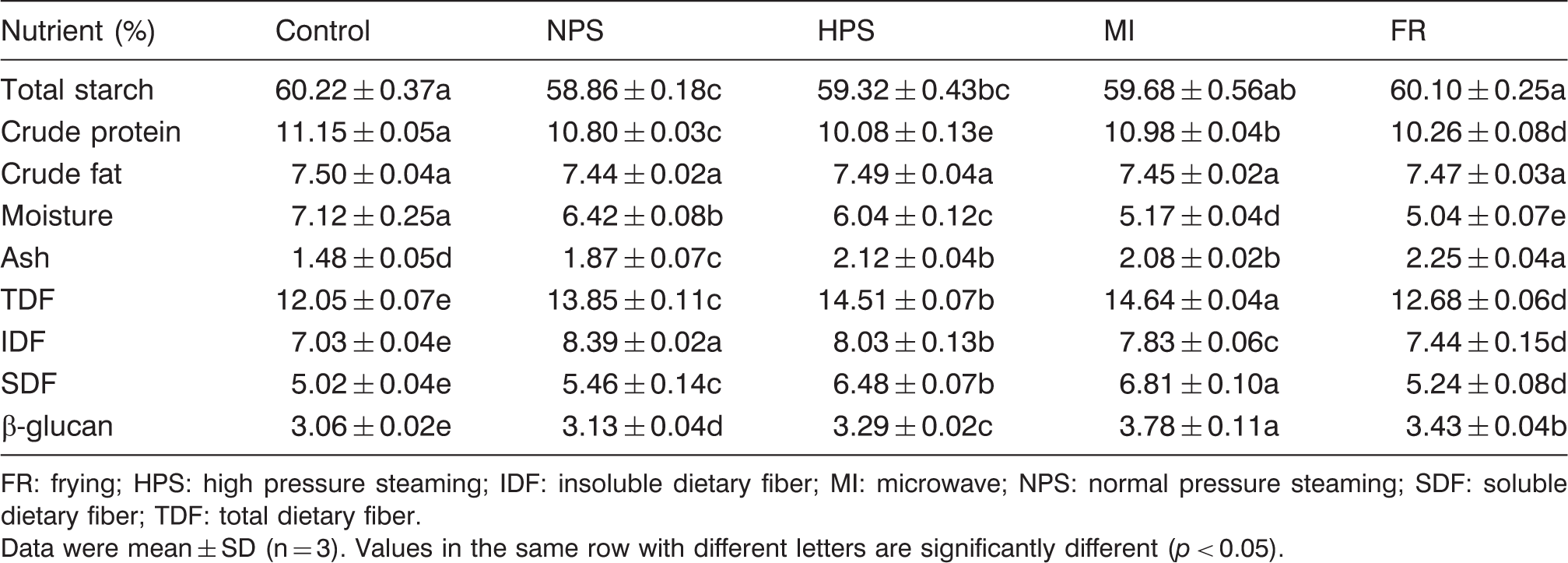
FR: frying; HPS: high pressure steaming; IDF: insoluble dietary fiber; MI: microwave; NPS: normal pressure steaming; SDF: soluble dietary fiber; TDF: total dietary fiber.
Data were mean ± SD (n = 3). Values in the same row with different letters are significantly different (p < 0.05).
Chen et al. (2014b) found that thermal processing improved the content of SDF from soybean residues. Stojceska et al. (2010) suggested that extrusion technology increased the levels of TDF in gluten-free products made from gluten-free cereals. These results could be partly confirmed by the observation that thermal processing has an effect on DF. In addition, the β-glucan as major SDF components also significantly increased (p < 0.05). It might be that high pressure and high temperature aggravated the movement of molecules to promote the dissolution of DF (Lai and Lu, 2014). Lan et al. (2012) reported that steam processing and drying in sunshine affected the physicochemical properties of DF isolated from Polygonatum odoratum. De Paula et al. (2017) suggested that cooking significantly increased the extractability and molecular weight of β-glucan. In sum, high temperatures break down glycosidic bonds in polysaccharide, which can lead to the release of oligosaccharides and thus increase the quantity of SDF (Wolf, 2010). The above result showed that thermal processing contributes to the increase of oat DF content and affecting their structural properties. Therefore, it is necessary to study the effects of thermal processing on DF.
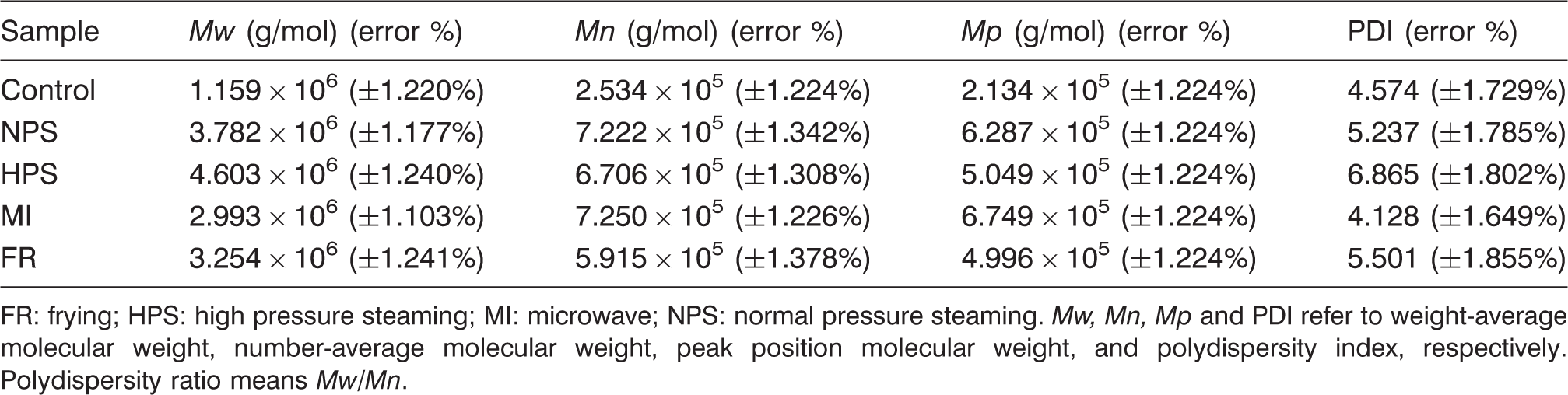
Molecular weight distribution
The molecular weight chromatograms of thermal processed whole grain oat SDF are shown in Figure 1. The GPC-MALLS chromatograms of the thermal processed whole grain oat SDF were similar. The molecular weight distribution exhibited a strongest peak when all samples were at about 12 min. The Mw (weight-average molecular weight), Mn (number-average molecular weight), Mp (peak position molecular weight), and polydispersity index (PDI) values are shown in Table 2. The Mw, Mn, and Mp values of control were 1.159 × 10⁶, 2.534 × 10⁵, and 2.134 × 10⁵ g/mol, respectively, whereas thermal processing improved the Mw, Mn, and Mp of the whole grain SDF, which may be due to the presence of intermolecular aggregation by the different thermal processing conditions, which was consistent with the results obtained by Kong et al. (2015). It can be seen that the Mw of SDF after HPS was the highest (4.603 × 10⁶ g/mol), indicating that the SDF molecular after HPS easily aggregated. The PDI (Mw/Mn) was used to clarify the breadth of SDF molecular weight distribution. The results displayed that the SDF molecular weight distribution after MI treatment was the most uniform, but after that HPS was the most dispersed. These results indicated that thermal process had an impact on the molecular weight values and improved Mw of SDF. In previous studies, it was shown that thermal processing could induce effective extraction of high-molecular-weight SDF from OB (Zhang et al., 2009). Dong et al. (2016) reported that the molecular weights of β-glucan from three processed oat products like oat meal (OM), OF, and high fiber OB were very different. Notably, three oat products modulating the gut microbiota and producing antiobesity effects in obese rats had obvious differences. Wood (2007) found that β-glucan with higher molar mass exhibited better health and nutritional effects to the maintenance of normal blood cholesterol levels and to the reduction of blood glucose rises after consumption of β-glucan. However, β-glucan with a smaller molar mass exhibited better prebiotic effects in the intestine (Arora et al., 2012; Barsanti et al., 2011). We will also study the structural effects of thermal processing on DF components (β-glucan, arabinoxylan) in order to find the relationship between structure and nutritional properties in the future.
The GPC-MALLS chromatograms of different thermal processed whole grain oat SDF. SDF-a: control, SDF-b: NPS, SDF-c: HPS, SDF-d: MI, and SDF-e: FR. SDF: soluble dietary fiber. Molecular weight distribution of different thermal processed whole grain oat SDF FR: frying; HPS: high pressure steaming; MI: microwave; NPS: normal pressure steaming. Mw, Mn, Mp and PDI refer to weight-average molecular weight, number-average molecular weight, peak position molecular weight, and polydispersity index, respectively. Polydispersity ratio means Mw/Mn.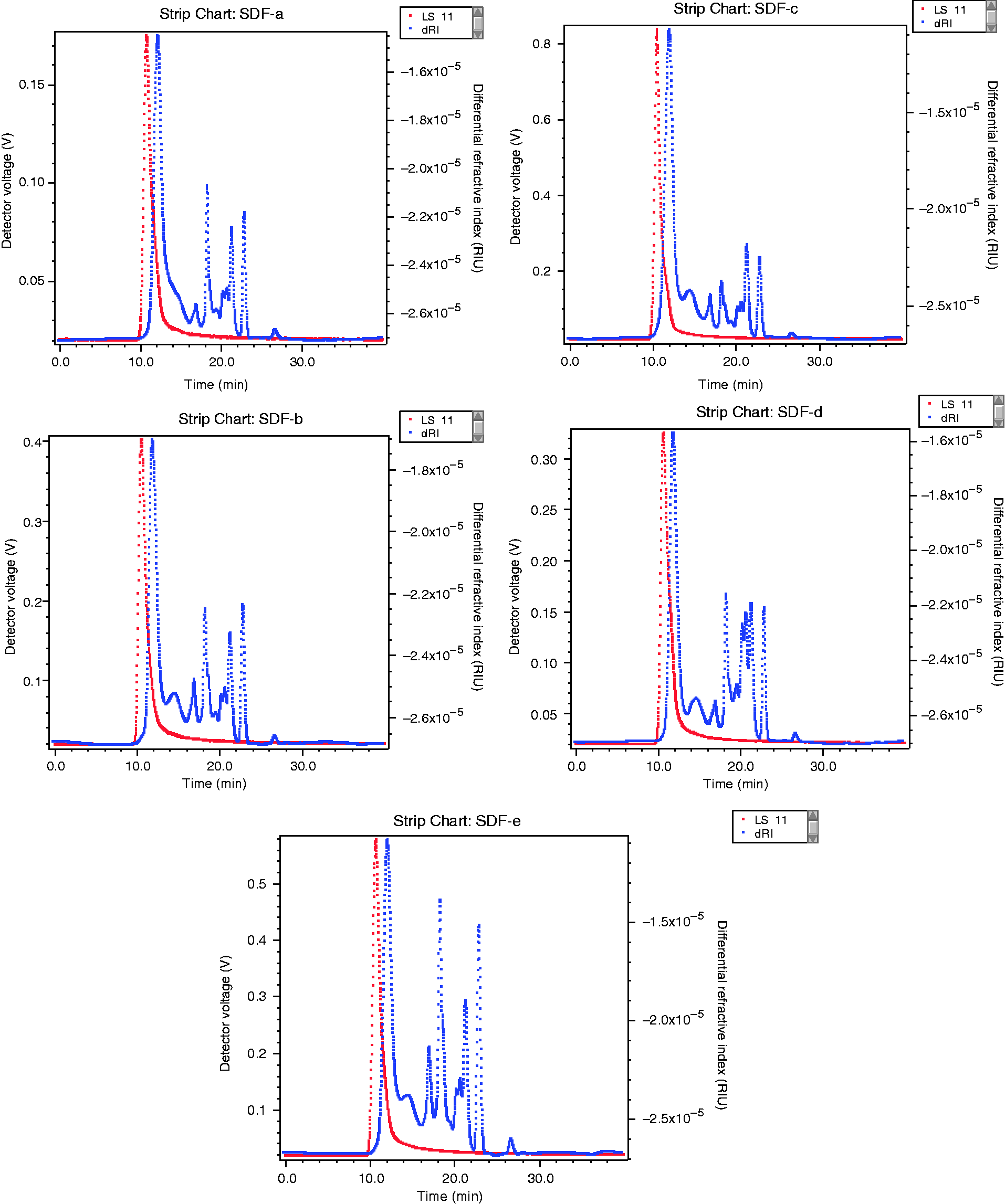
Particle size distribution
Particle size distribution of different thermal processed whole grain oat SDF
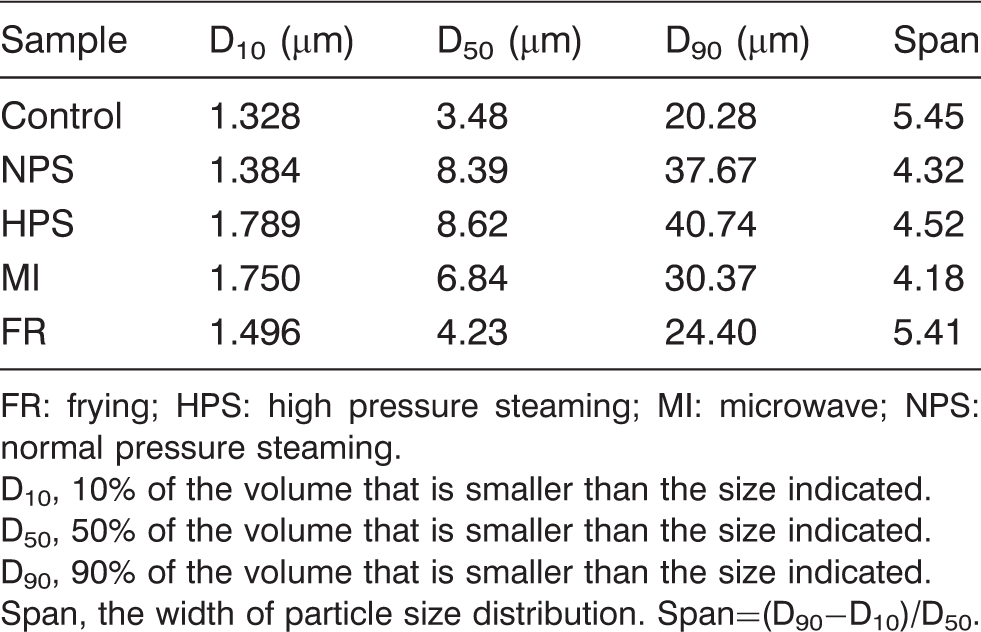
FR: frying; HPS: high pressure steaming; MI: microwave; NPS: normal pressure steaming.
D10, 10% of the volume that is smaller than the size indicated.
D50, 50% of the volume that is smaller than the size indicated.
D90, 90% of the volume that is smaller than the size indicated.
Span, the width of particle size distribution. Span=(D90−D10)/D50.
FT-IR
FT-IR of thermal processed whole grain oat SDF is shown in Figure 2. Thermal processed whole grain oat SDF samples showed similar spectral profiles with the control. As can be seen in Figure 2, there was a broad absorption band at about 3400 cm−1, which corresponds to the stretching absorption bands of –OH groups. Notably, this is closely related to the hydrogen bonds and the moisture contained in the molecules of the SDF component (Raghavendar et al., 2006). The absorption peaks at 3000–2800 cm−1 indicated stretching absorption bands of C–H. The absorption peaks between 1640 and 1620 cm−1 revealed the absence of carbonyl groups (C = O). The absorption peaks between 1400 and 1200 cm−1 were attributed to C–H bending vibration. The absorption peaks in the range of 1200–1000 cm−1 showed the C–O stretching vibrations of fiber (Alemdar and Sain, 2008). Furthermore, peak at 898 cm−1 revealed the stretching vibration of β-glycosidic linkages in polysaccharides (Ma and Mu, 2016). Moreover, the absorption peak at 620 cm−1 revealed the angular vibration of C–H in the sugar molecule. The above absorption peaks were the characteristic absorption peak of sugars (Elleuch et al., 2011). These results showed that thermal processing of whole grain oats did not cause chemical changes of SDF.
FT-IR of different thermal processed whole grain oat SDF. SDF-a: control, SDF-b: NPS, SDF-c: HPS, SDF-d: MI, and SDF-e: FR. SDF: soluble dietary fiber.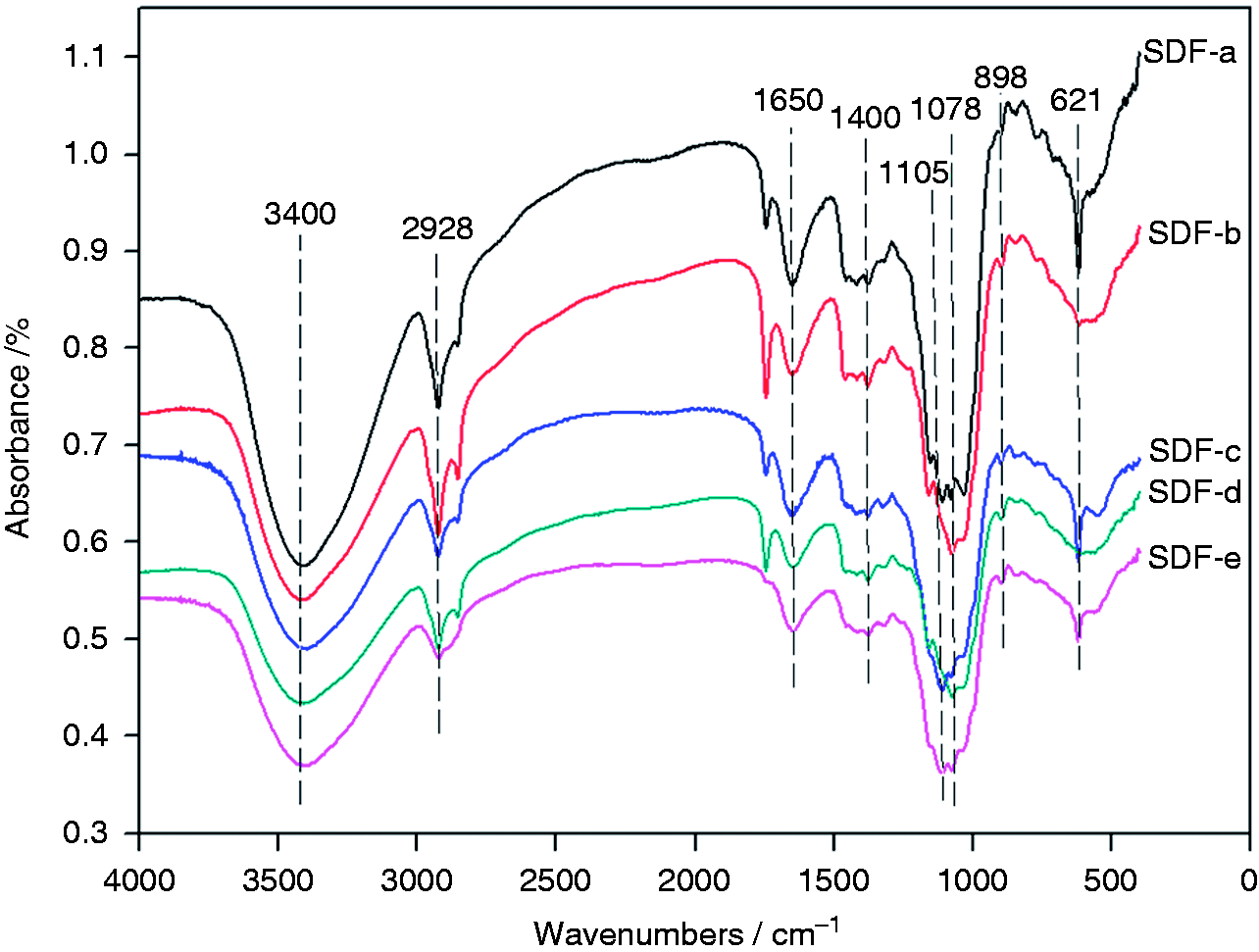
SEM
The morphological characterization of whole grain oat SDF observed by SEM is shown in Figure 3. SEM revealed the changes in the microstructure of whole grain oat SDF after thermal processing. The microstructure of SDF from untreated whole grain was irregular and rough, and flaky shape in the magnification was not obvious. However, some SDF from thermal processed whole grain oats showed the presence of a big flaky structure, which may be attributed to the presence of intermolecular aggregates by the different thermal processing (Kong et al., 2015). Moreover, flaky structure of SDF from thermal processed whole grain oats was more obvious and uniform, especially the microstructure of SDF extracted from MI-treated whole grain oats was relatively even, which was consistent with the results of molecular weight distribution shown in Table 2, but there was not a great deal of difference between the different thermal processing groups.
SEM of different thermal processed whole grain oat SDF. a/A: control, b/B: NPS, c/C: HPS, d/D: MI, and e/E: FR.
WHC, OHC, SC, EA, and ES
Functional properties of different thermal processed whole grain oat SDF
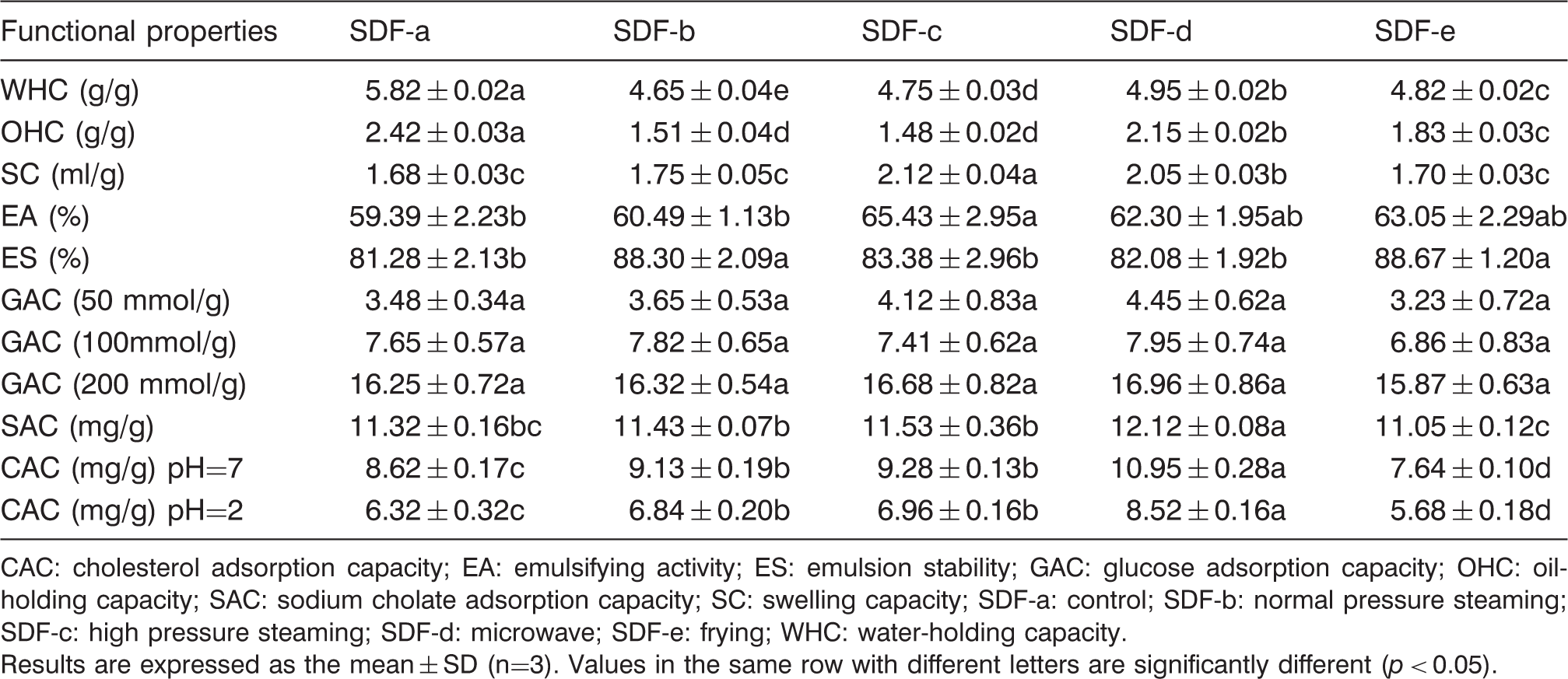
CAC: cholesterol adsorption capacity; EA: emulsifying activity; ES: emulsion stability; GAC: glucose adsorption capacity; OHC: oil-holding capacity; SAC: sodium cholate adsorption capacity; SC: swelling capacity; SDF-a: control; SDF-b: normal pressure steaming; SDF-c: high pressure steaming; SDF-d: microwave; SDF-e: frying; WHC: water-holding capacity.
Results are expressed as the mean ± SD (n=3). Values in the same row with different letters are significantly different (p < 0.05).
Glucose, sodium cholate, and cholesterol adsorption capacities
Three different concentrations of glucose (50, 100, and 200 mmol/l) were used to evaluate GAC of SDF. This value is used to show the behavior of dietary fiber on adsorbing of glucose during the gastrointestinal transit time (Chau et al., 2007; Ou et al., 2001). As shown in Table 4, the results revealed that whole grain oat SDF in different glucose concentrations (50–200 mmol/l) could adsorb the glucose (3.23–16.96 mmol/g) effectively. It was observed that the GAC values were dependent on concentration and there were no significant differences in GAC between control and other thermal treatments, but MI-treated SDF exhibited the highest glucose adsorption capacities. The SEM images in Figure 3 revealed that MI treatment resulted in obvious network structure; this structure could also significantly slow down the diffusion rate of glucose solution and led to the higher GAC (Peerajit et al., 2012).
The DF with high bile acid adsorption can effectively delay or inhibit bile acid adsorption during gastrointestinal digestion by accelerating the excretion of bile acids, thereby preventing epithelial cell and DNA damage (Wuttipalakorn et al., 2009). The sodium cholate and cholesterol (at pH 2.0 and 7.0) adsorption capacities of SDF were listed in Table 4. The results indicated that oat SDF in all samples had good sodium cholate adsorption capacities. The CAC of SDF after different thermal processing was different, and the pH of the system had a great influence on SDF cholesterol adsorption capacities. The CAC at pH 7 was higher than those at pH 2. These results indicated that SDF exhibited better healthy effect to lower the concentration of cholesterol in the small intestine, which was consistent with the study obtained by Nsor-Atidana et al. (2012). In these in vitro experiments, the GAC, SAC, and CAC of SDF were increased after thermal processing than that of control except for FR. The GAC, SAC, and CAC of MI-treated oat SDF were the highest, while the GAC, SAC, and CAC of FR-treated oat SDF were the lowest, which was consistent with the results obtained by Wang et al. (2015). These results showed that NPS, HPS, and MI could improve functionalities like CAC and STAC values.
Conclusions
The effects of different thermal processing on structural and functional properties of SDF from whole grain oats were investigated in this study. The results showed that the molecular weight and particle size of SDF were increased after four different thermal processing methods, which resulted in molecular aggregation and cause changes of functional properties. Specifically, among all samples, HPS-treated oat SDF showed better SW and ES than other samples. However, MI-treated oat SDF exhibited significantly higher GAC, SAC, and CAC. Therefore, HPS process can be considered to develop oat products with high SW and ES, and MI process can be considered to develop oat products with GAC, SAC, and CAC. Additionally, we can also consider adding HPS-processed oat SDF or MI-processed oat SDF to the food in order to obtain desired functional properties. These results might provide valuable reference for the oats processing and its application in food industry. Further studies by using human fecal bacteria to ferment different thermal processed oat SDF would be also useful to determine the differences in gut microbiota regulation, which would provide reference for the development of oat products with high nutritional qualities.
Footnotes
Declaration of conflicting interests
The author(s) declared no potential conflicts of interest with respect to the research, authorship, and/or publication of this article.
Funding
The author(s) disclosed receipt of the following financial support for the research, authorship, and/or publication of this article: This research was supported by the Natural Science Foundation of China (No. 31671856).