







Abstract
Considering environmental pollution caused by the non-biodegradable polymers used in food packaging, developing and enhancing the properties of biodegradable films seem to be necessary. For this aim, in the present study, kefiran-whey protein isolate bionanocomposite films were prepared and the impact of different concentrations (1, 3 and 5% w/w) of Al2O3 (alumina) nanoparticles on their physical, morphological, thermal and mechanical properties was studied. Based on the obtained results, an increase in the nanoparticles content led to a significant decrease (p < 0.05) in the water vapor permeability, moisture absorption, moisture content, and water solubility. Scanning electron microscope images showed a homogeneous structure, confirming the good dispersion of alumina nanoparticles with smooth surface up to concentration of 3%. In addition, both thermal stability and mechanical properties of the films were improved by the increased concentrations of alumina. The results of X-ray diffraction indicated that the intensity of the crystalline peaks of film increased with the addition of Al2O3 to kefiran-whey protein isolate matrix. By considering all results, the concentration of 3% was proposed as the appropriate concentration of Al2O3 for the nano-reinforcement of kefiran-whey protein isolate bionanocomposites.
Introduction
Nowadays, the largest part of the materials used for food packaging are produced from petroleum derivatives and are practically non-biodegradable, representing a serious global environmental problem (Cazón et al., 2017; Debeaufort et al., 1998; Rydz et al., 2018; Shankar and Rhim, 2019; Tharanathan, 2003). Considerable attempts have been made to introduce a material without environmental effects, targeting at tackling the problems made by plastic wastes. Particular attention has been paid to the replacement of petrochemical-based plastic materials by biopolymer-based materials with competitive properties and low cost (Echeverría et al., 2014; Khazaei et al., 2014; Moradi et al., 2019; Siracusa et al., 2008). Several studies on the packaging material produced from biopolymers of naturally renewable resources confirmed their promising function (Ghanbarzadeh and Almasi, 2011; Sorrentino et al., 2007). The utilization of biopolymers can be beneficiary in some particular sections like food packaging. However, it seems impossible to substitute all the current packaging materials with eco-friendly ones.
Protein polymers and carbohydrate such as whey protein and kefiran are considered as promising film-making ingredients (Ghasemlou et al., 2011a, 2011b, 2011c; Piermaria et al., 2009; Sothornvit et al., 2009; Zolfi et al., 2014b). Thanks to its antibacterial and therapeutic activity, kefiran, the polysaccharide of kefir grains, is a water-soluble glucogalactan, and has won a lot of attention as a sufficient biodegradable polymer enjoying better mechanical, physical properties than other biopolymers (Moradi and Kalanpour, 2019; Piermaria et al., 2009; Shahabi-Ghahfarrokhi et al., 2015; Zolfi et al., 2014a). As a widely-known source of biodegradable film, Whey protein, the protein found in whey, is the watery portion of milk separated from the curds during making cheese. Given its high nutritional value and film-forming ability, Whey protein is a widely-used food supplement (Sothornvit et al., 2009).
The biopolymer-based films typically are sensitive to moisture and have poor mechanical properties. In order to address these shortcomings, recent studies focused on the modification and improvement of their vapor-barrier and mechanical features (Ghanbarzadeh and Almasi, 2011; Motedayen et al., 2013).
Owing to the large surface area to volume ratio of nanoparticles, they have been recently considered as a reinforcing agent in polymer science (Avella et al., 2005). Metal oxide nanoparticles are the major nano-reinforcing agents utilized for improving the properties of packaging materials. In the past decade, aluminum oxide (Al2O3) nanoparticle has been widely used in different technological applications, thanks to its interesting properties such as high strength, high melting point, proper corrosion resistance, good chemical stability, low thermal conductivity and acceptable electrical insulation properties, while being cheap, nontoxic, and neutral (Cai et al., 2010; Kadhim et al., 2013; Zheng et al., 2009). Thin films with nano-sized particles in their structures present a vast array of favorable chemical and physical properties and can provide a high antimicrobial activity (Bala et al., 2011; Sadiq et al., 2009, 2011). There are a few reports on the use of Al2O3 nanoparticles in the reinforcement of synthetic polymers such as epoxy and Nylon 6 (Zheng et al., 2009).
According to the bibliographic studies, no noticeable study has been reported on the effect of Al2O3 nanoparticles on the properties of biodegradable films particularly obtained from kefiran or whey protein isolate (WPI) films. Therefore, the objectives of the current study were to modify the functional properties of glycerol plasticized kefiran–WPI blend films with the aid of Al2O3 nanoparticle and study the effects of Al2O3 concentration on the physical and mechanical properties of the films.
Materials and methods
Materials
WPI powder was bought from Arla Food Ingredient (Denmark). Kefir grains, utilized as a starter culture in this study, were purchased from Local dealer in Iran. Anatase Al2O3 nanoparticles were provided by Iranian Nanomaterials Pioneers Company, NANOSANY (Mashhad, Iran). Other reagents used were of analytical grade and obtained from Sigma (Germany).
Starter culture kefir
Kefir grains were inoculated in to milk (1:10). Following 24 h incubation at room temperature, the grains were separated from the fermented product. Then, after continuing the culture for seven subsequent days, the grains were recognized as active.
Isolation and purification of kefiran
Exopolysaccharides were extracted from the kefir grains by modified method of Rimada and Abraham (2006). In brief, a weighed amount of kefir grains was added to boiling water (1:10) and stirred for 1 h. Then, the resultant mixture was centrifuged at 3000 r/min for 30 min at ambient temperature. After that, the addition of 96% cold ethanol at 1:1 ratio led to the precipitation of the polysaccharide in the supernatant, which was then left at −20 ℃ for 18 h. After that time, centrifugation was carried out at 3000 r/min for 15 min (ambient temperature) for the separation of the precipitated carbohydrate. After dissolving the obtained pellets in distilled water, the mixture was centrifuged again under the same conditions. This procedure was performed in triplicate and final pellets were considered as kefiran. Obtained kefiran was stored in a refrigerator until test time.
Preparation of nanocomposite films
An aqueous solution of 2%wt. WPI was prepared and heated in a water bath at 90 ℃ for 30 min in order to denaturation of proteins, after that rapidly cooled by putting on ice. Kefiran solution (2% (w/v)) was prepared under constant magnetic stirring at 50 ℃ for 1 h. Then, kefiran and WPI solutions, having the equal amount of each biopolymer (50:50 (v/v)), were mixed at 35 ℃ for 15 min. Glycerol, as a plasticizer was added to the mixture at a level of 35% w/w of the total solid weight and was stirred at 35 ℃ for 15 min. having done that, Ultrasonic bath (SONER 2003, Taiwan) was utilized to disperse Al2O3 nanoparticles at concentrations of 1, 3 and 5%wt. Afterwards, nanoparticles’ solutions were added gently to the film-forming solutions and mixture was stirred for 30 min. Then, 50 mL of each mixture was cast onto plastic Petri dishes (12 cm in diameter), and dried in an oven at 35 ℃ for 24 h. kefiran-WPI film without any nanoreinforcement was used as a control sample. Dried films were peeled off the casting surface and stored in plastic bags. After that, they were preconditioned at 25 ℃ and 55% RH for at least 48 h in a desiccator having saturated calcium nitrate solution before any evaluation. All the samples were made in triplicate.
Determination of the physical properties of the films
Film thickness
A manual digital micrometer (Mitutoyo, Japan) with an accuracy of 0.01 mm was utilized to measure the films’ thickness. After measuring the thickness in ten random points for each film, an average value was determined.
X-ray diffraction
X-ray patterns of kefiran–WPI film, nanoparticles of alumina and kefiran–WPI/alumina nanocomposite films were recoded using an XRD diffractometer (Labx XRD-6000 Shimadzu, Japan), equipped with Cu Kα radiation at a wavelength of 0.1546 nm. The voltage applied and the current utilized were 40 kV and 30 mA, respectively. Samples were scanned over the range of diffraction angle 2Θ = 1–80°, with a scanning rate of 1°/min and step interval of 0.02° at ambient temperature.
Scanning electron microscopy
Scanning electron microscopy (SEM) (MIRA3 FEG-SEM, check) was used to evaluate the surface morphology of the films. To do so, after cutting the pieces from the films and depositing them onto the aluminum specimen stubs, they were coated with a thin layer of gold before the examination. An accelerating voltage of 5 kV was applied to examine all samples.
Thermogravimetric analysis
Thermal properties of the films were measured with a thermogravimetric analysis (TGA) apparatus (Linseis Sta Pt-1000, Alman). Having placed the samples in the balance system, they were heated from 0 to 700 ℃ at a heating rate of 10 ℃/min in an air atmosphere.
Color measurement
A colorimeter (Minolta model CR-410, Japan), standardized with a white calibration plate, was utilized to determine the color of the films. After placing the samples on white plate, the color values (L* (lightness), a*(red-green), and b* (yellow-blue)) were determined. For different sites of each film, three readings were recorded. The average values were used for the calculation of the total color difference (ΔE) and whiteness index (WI) according to the following equations (Moradi et al., 2019).


Mechanical properties
For determining the mechanical properties of the films, including tensile strength (TS) (MPa), elongation at break (EB) (%), and elastic modulus (EM) (or Young’s modulus) (MPa) a TA. XT Plus Texture Analyzer (Stable Microsystems, UK) was used at 25 ℃ according to ASTM standard method D882-10 (ASTM, 1991). Before the test, the films were cut in dumbbell shaped strips with dimensions of 8 cm × 0.5 cm and preconditioned at 55% RH and 25 ℃ for 48 h in a desiccator containing saturated calcium nitrate solution. The initial grip separation and cross-head speed were set to 40 mm and 0.83 mm/s, respectively. The TS, EB and YM amounts were calculated using the following equations



Water vapor permeability
A gravimetrical method of ASTM E96-05 (Montalban and Rio, 2001) was used to determine the water vapor permeability (WVP) of the films. First, the preconditioned samples were sealed on top of the 13 mm-wide glass cups having anhydrous calcium chloride at 25 ℃ and 0% RH (0 Pa water vapor pressure). Then, they were placed in a desiccator maintained at 25 ℃ and 75% RH (1753.53 Pa vapor pressure) with sodium chloride saturated solution. The weight gain of the cups was recorded in 1 h intervals during the first 9 h and finally after 24 h (with an accuracy of 0.0001 g), as an indication of the water vapor transferred through the desiccator and adsorbed by the film. The slope of weight gain versus time was calculated via linear regression. The water vapor permeability coefficient was determined using the following equations (g/m s Pa)


Moisture content
The moisture content of the films was determined by measuring their weight loss, before and after drying in a laboratory oven at 105 ℃ until the constant weight was obtained (dry sample weight).
Moisture absorption
The modified method of Almasi et al. (2010) was hired to measure the moisture absorption (MA). To start with, the dried sheets of 20 mm × 20 mm were conditioned at 0% RH (silica gel) for 24 h. After weighing, they were conditioned in a desiccator containing calcium nitrite saturated solution at 25 ℃ to ensure an RH of 55%. The weighing of the samples was continued at desired intervals until reaching the equilibrium state. The following equation was used to calculate the MA of the samples.

Water solubility
The solubility of the films in water was measured using the method of Moradi et al. (2019). The initial dry matter of films (W1) was determined by drying samples of each film to constant weight in an oven at 105 ℃. Following the immersion of the samples in 50 mL distilled water, they then stirred for 6 h at 25 ℃, after which, the remaining pieces of the films were filtered and dried at 105 ℃ to constant weight (final dry weight). The following equation was used to calculate solubility

Statistical analysis
The data were analyzed through one-way analysis of variance (ANOVA) using SPSS software (Version 22; SPSS, Chicago IL, USA). The difference between mean values of film specimens’ characteristics at a statistical level of 0.05 was inspected by Duncan’s multiple range tests.
Results and discussion
X-ray diffraction
Figure 1 depicts the XRD patterns for pure alumina powder, control film, and kefiran–WPI films with different concentrations of Al2O3, according to which, the control film exhibited two diffraction broad peaks at 9.04° and 20°, indicating its semi-crystalline nature (George et al., 2014). X-ray diffraction analysis for alumina nanoparticles showed the peaks at 2Θ = 20°, 32°, 36°, 39.5°, 47°, 67°, 72° and 74.5°, among which 67° and 47° were intense peaks. Similar results were reported in other studies (Ahmad and Hassan, 2019; Sonmez et al., 2012). The evaluation of the XRD pattern of the control film and its nanocomposites confirmed that only the intensity of the diffraction peaks increased with an increase in the nano-Al2O3 concentration. This observation proved that the crystalline nature of biocomposite film was strengthened after the addition of Al2O3. However, the effect of changing the nano-Al2O3 concentration on the angle of the diffraction peak for film specimens was not noticeable, meaning that the kefiran–WPI chemical structure and presented interactions were not altered due to the presence of nano-Al2O3 (George et al., 2014). XRD pattern of nanocomposite films showed that the diffraction peaks of Al2O3 disappeared, an indicative of an adequate dispersion of the nano-Al2O3 in the kefiran–WPI matrix without any detectable agglomerates (Slavutsky et al., 2014). This result was confirmed by SEM images in Figure 3. The XRD patterns of the kefiran films reinforced with TiO2 (Zolfi et al., 2014a) and ZnO (Shahabi-Ghahfarrokhi et al., 2015) nanoparticles, presented similar results.
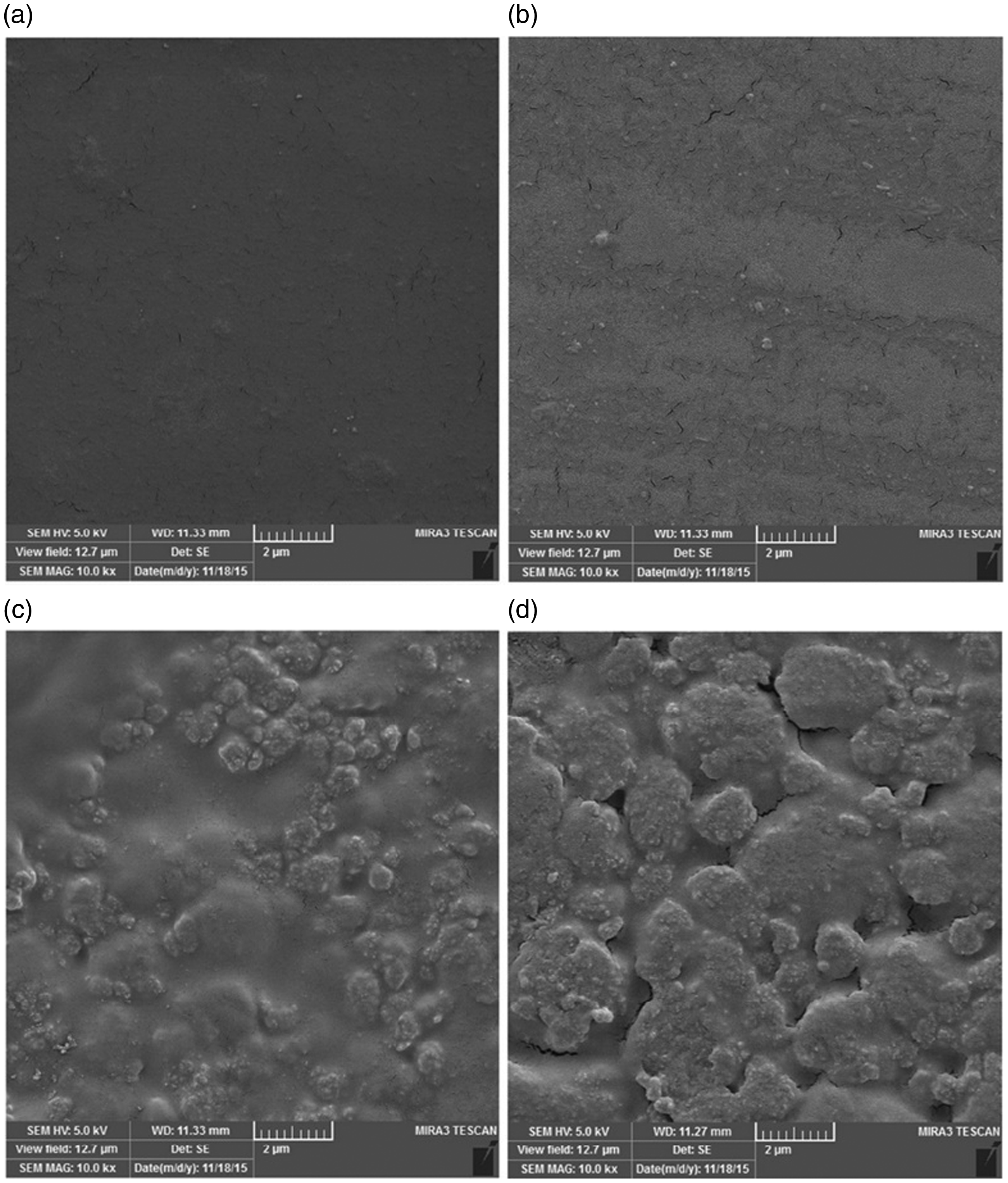
XRD patterns for the kefiran–WPI, Al2O3 nanoparticles and their composites. (a) Al2O3 nanoparticles; (b) neat kefiran–WPI; (c) kefiran–WPI-Al2O3 1%; (d) kefiran–WPI–Al2O3 3%; (e) kefiran–WPI–Al2O3 5%. Scanning electron microscopic images of surface of kefiran–WPI/alumina (Al2O3) nanocomposite films: (a) neat kefiran–WPI; (b) kefiran–WPI/Al2O3 1%; (c) kefiran–WPI/Al2O3 3%; (d) kefiran–WPI/ Al2O3 5%.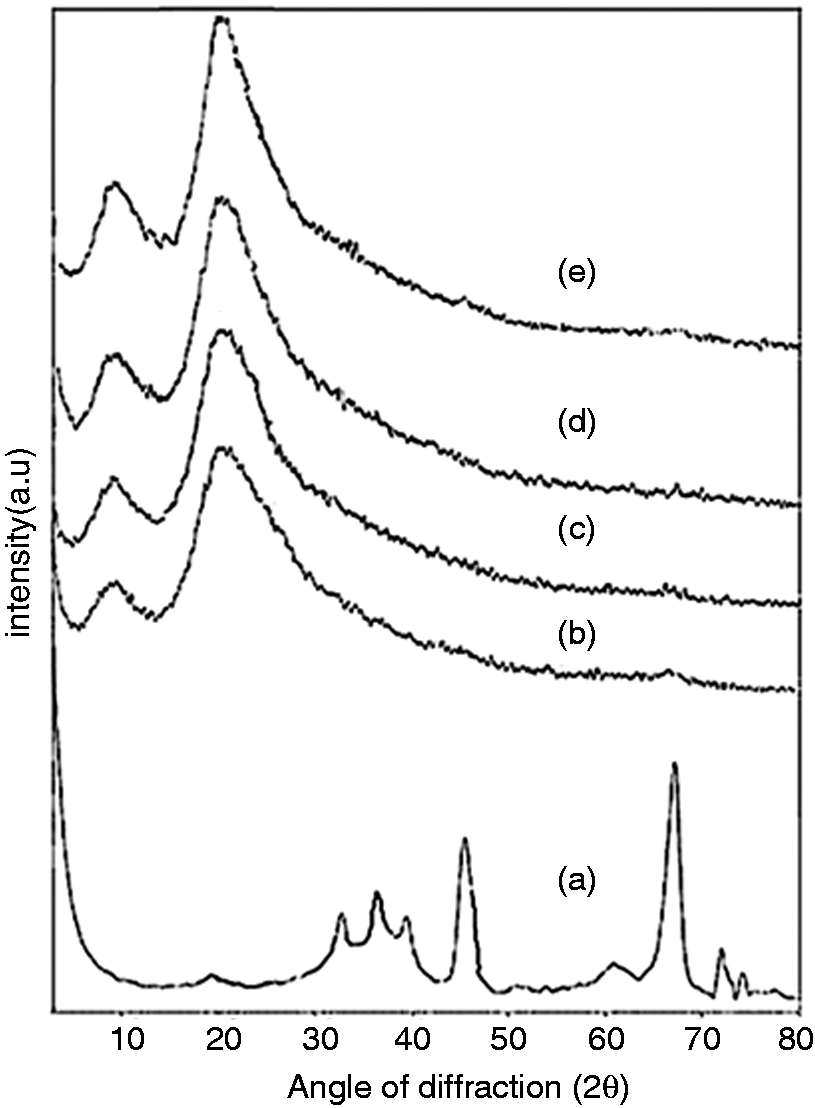
Thermal properties
The thermogravimetric analysis was carried out to investigate the thermal stability of the films (Figure 2), according to the results of which both pure kefiran–WPI film and nanocomposites exhibited a similar degradation pattern but with different residue left overs. All films showed three degradation steps (step 1: 175 ℃ to 310 ℃, step 2: 310 ℃ to 475 ℃ and step 3:475 to 600 ℃): Steps 1 and 2 were ascribed to the glycerol evaporation and kefiran, respectively, while step 3 was related to the degradation of WPI (Raghavendra et al., 2016; Ramos et al., 2013; Rhim and Wang, 2014). The addition of Al2O3 nanoparticles resulted in an increase in the thermal stability of nanocomposite films. The incorporation of Al2O3 in the kefiran–WPI matrix could act as thermal insulator or a mass transport barrier to the volatile products generated during thermal decomposition (Arfat et al., 2014). After the final thermal destruction at around 700 ℃, the residual percentages of the kefiran–WPI, and nanocomposites containing 1, 3 and 5% wt. Al2O3 were 3.44%, 6.32%, 10.91% and 12.35% respectively. The residues were higher in case of Al2O3 incorporated bio-nanocomposite films, confirming the improving thermal resistance effect of Al2O3 on kefiran–WPI matrix.
Thermogravimetry curves of kefiran–WPI and kefiran–WPI-based nanocomposite films.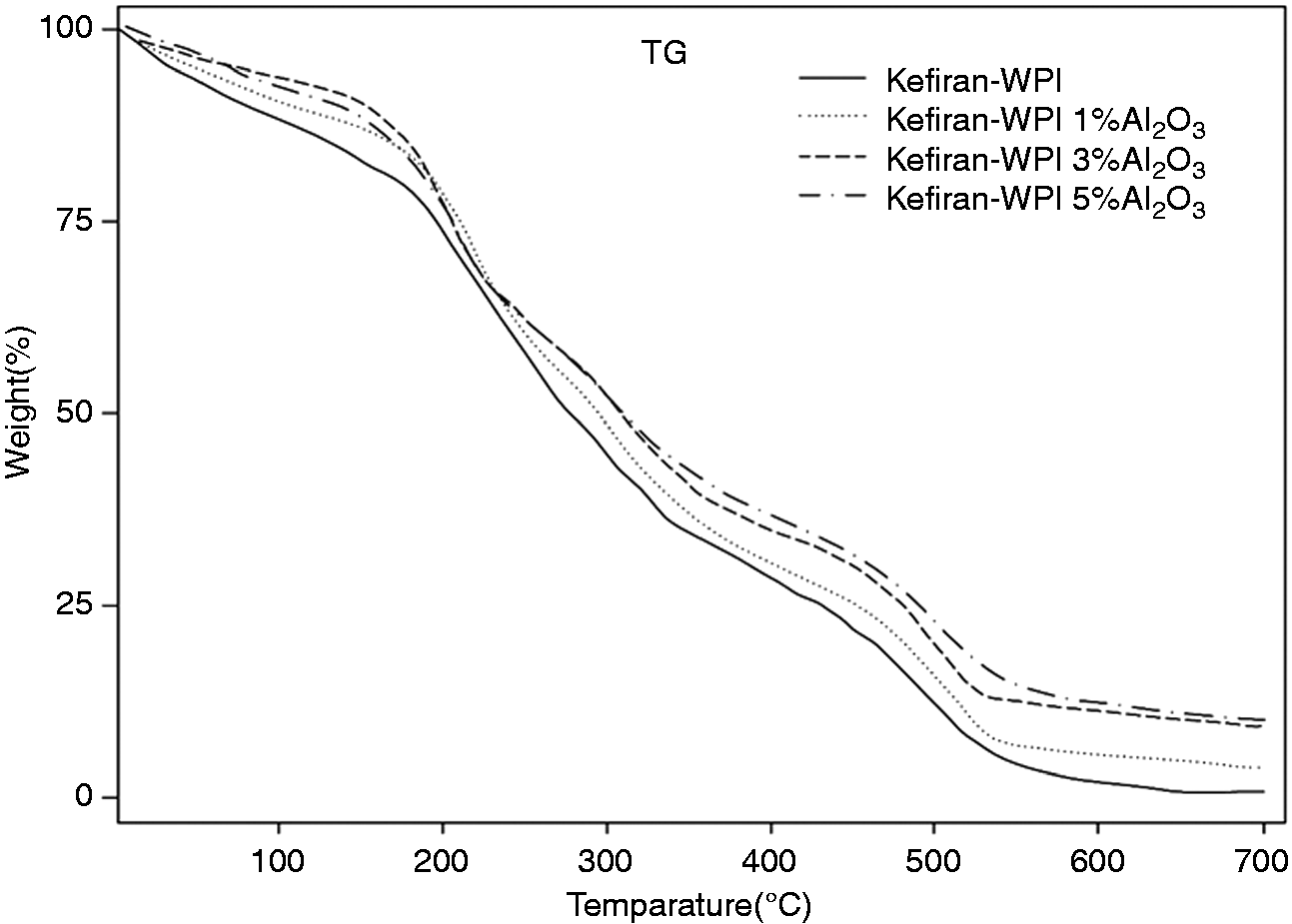
Increasing thermal stability of the kefiran–WPI films by adding Al2O3 nanoparticles enabled the films to endure high temperatures, entitling them to be used during preparation or processing films in large scale. Therefore, these nanocomposites can be produced in the industrial scales.
Color properties
Surface color parameters of kefiran–WPI based nanocomposite films.
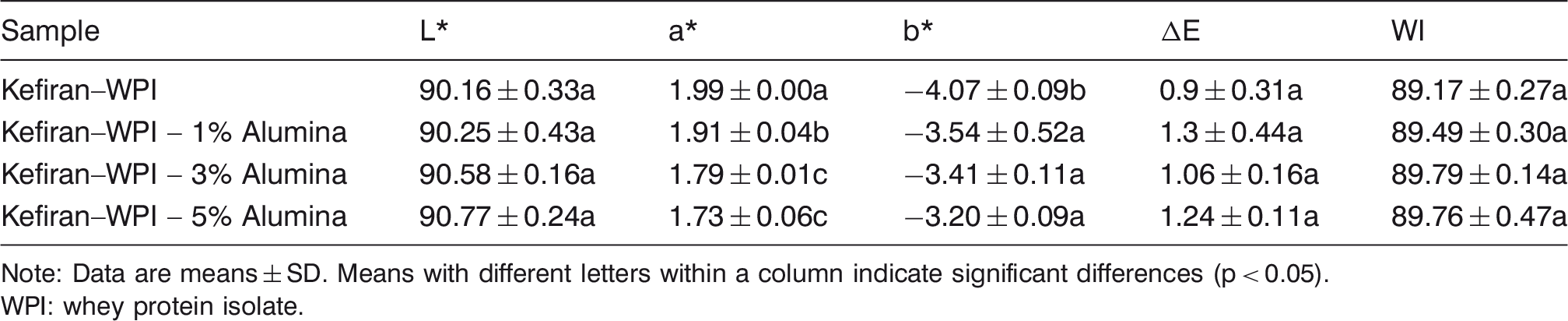
Note: Data are means ± SD. Means with different letters within a column indicate significant differences (p < 0.05).
WPI: whey protein isolate.
Thickness, moisture content, solubility and water-absorption
Effect of alumina (Al2O3) concentrations on thickness and barrier properties of films.
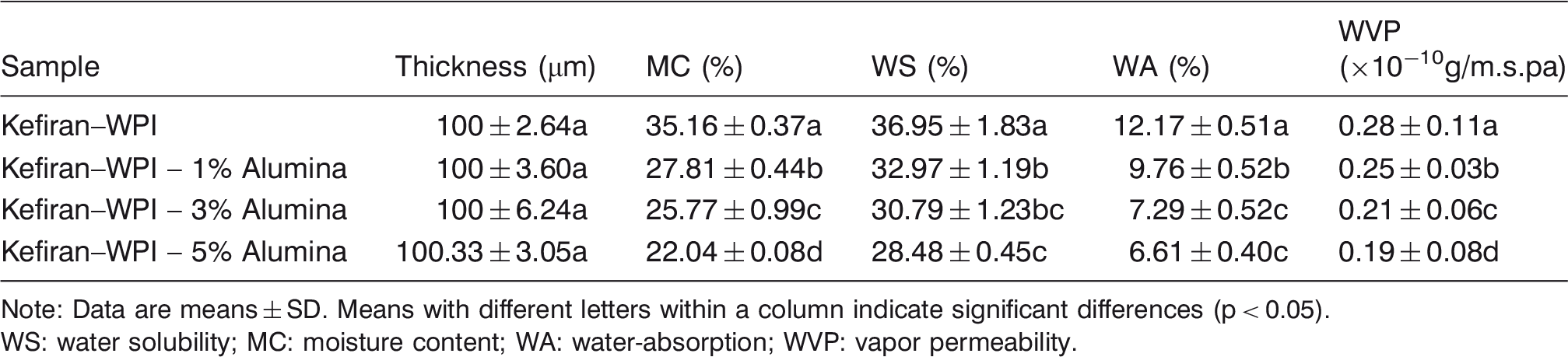
Note: Data are means ± SD. Means with different letters within a column indicate significant differences (p < 0.05).
WS: water solubility; MC: moisture content; WA: water-absorption; WVP: vapor permeability.
MC is a parameter related to the total vacant volume occupied by water molecules in the microstructural network of the film and WS is an important feature of the films, related to the hydrophilicity of the film-forming compounds (Li et al., 2011). As indicated in the Table 2, MC and WS of the films were significantly (p < 0.05) affected by the addition of alumina nanoparticles. MC and WS of pure kefiran–WPI film were 35.16% and 36.95%, respectively, in good agreement with the values reported by Casariego et al., (Cyras et al., 2008). According to the results, a significant (p < 0.05) decrease was witnessed in the MC and WS of kefiran–WPI films with an increase in the alumina concentration. This decrease could be attributed to the conformation of new bonds between oxygen atoms of alumina nanoparticles and biopolymer chains, leading to an increase in the cohesiveness of the biopolymer matrix, in turn resulting in the reduction and even repulsion of water molecules from the microstructural network of the film (Shahabi-Ghahfarrokhi et al., 2015).
Table 2 presents the WA of the bionanocomposites as a function of the alumina content. Obviously, the moisture absorption of kefiran–WPI biocomposites at the relative humidity of 55% was higher compared to that of kefiran–WPI–alumina bionanocomposites. At the level of 5% alumina, the lowest moisture absorption values of the films were experienced (6.61%). The improved water resistance can be ascribed to the form of strong bonds in nanocomposite, reducing the diffusion of water molecules in the films. Other studies on bionanocomposites approved the obtained results (Almasi et al., 2010; Beigzadeh Ghelejlu et al., 2016; Cyras et al., 2008; Moradi et al., 2019).
According to the results stated above, increasing cohesiveness in the biopolymer matrix with adding alumina nanoparticles led to the enhancement of resistance of the films against water. This characteristic can make possible the wide application of kefiran–WPI–alumina bionanocomposites in food packaging, because one of the most important roles of films or coating in food packaging is hindering the absorption or loss water of food, significantly increasing the shelf- life and quality preservation of food.
Water vapor permeability
One of the most important features of the films is water vapor permeability, thanks to its key role in the maintenance of food against water adsorption or desorption. Table 2 presents the WVP values of kefiran–WPI films with different concentrations of alumina. The presence of alumina brought about a significant decrease in the WVP of kefiran–WPI films (p < 0.05). The WVP of the control film and the films with 5% alumina were the highest (0.288 × 10⁻¹⁰g/m s Pa) and the lowest WVP value (0.19 × 10⁻¹⁰g/m s Pa), respectively. The water resistance of nanocomposite was better than that of the matrix, because with an increase in the alumina concentration greater interactions were observed between biopolymer and nanoparticles, probably introducing a tortuous path for water molecules to pass through. The slow movement of water molecules through these long and time-consuming paths led to the declined WVP (Kristo and Biliaderis, 2007).
Comparing WVP values of kefiran–WPI films with other biopolymers such as corn zein (5.35), corn zein plasticized with glycerol (8.9), corn starch plasticized with glycerol (2.57), whey protein plasticized with sorbitol (7.17) wheat gluten plasticized with glycerol (7) Amylose (3.8) and synthetic polymers such as LDPE, low-density polyethylene (0.009), HDPE, high-density polyethylene (0.002) and PVDC (0.002 × 10⁻¹⁰g/m.s.pa) represents WVP of kefiran–WPI films are lower than those of biopolymers, but barrier to water vapor in mentioned synthetic polymers is better than kefiran–WPI films (Cleary, 2009).
Mechanical properties
Mechanical properties of kefiran–WPI and their nanocomposites.

Note: Data are means ± SD. Means with different letters within a column indicate significant differences (p < 0.05).
The elongation at break amount of specimens was significantly affected by Al2O3 contents. In addition, with the addition of 3%wt Al2O3, EB increased and reached 26.20 ± 0.17%, but the corresponding value of nanocomposite containing 5% Al2O3 lessened to 5.06 ± 0.008%. However, EB decreased with an increase in the nanoparticle content in other studies (George et al., 2014; Moradi et al., 2019; Yu et al., 2009).
TS of kefiran–WPI films, even after adding Al2O3 nanoparticles, was lower than synthetic polymers such as polyethylene terephthalate (81–85 MPa), low-density polyethylene (16–18 MPa), polyvinylidene chloride (65–75 MPa) and oriented polypropylene (50–60 MPa). However, nanocomposite containing 3% Al2O3 has demonstrated higher elongation than polyethylene terephthalate (19–25%) and polyvinylidene chloride (18–23%) (Shit and Shah, 2014).
Microstructure and surface morphology
Microstructure analysis by SEM was used to evaluate the films’ homogeneity, surface smoothness and pores. SEM images of pure kefiran–WPI film and nanocomposite containing 1% Al2O3 exhibited smooth surfaces without any pores, but with little cracks (Figure 3(a) and (b)), nanocomposite containing 3% Al2O3 had compact structure (Figure 3(c)) without any cracks, but the surface roughness increased in this concentration of Al2O3. The roughness increased when Al2O3 content increased to 5% and small pores could be detected on the surface of Al2O3-5% sample (Figure 3(d)).
As seen in this attempt, adding a high content of Al2O3 nanoparticles (Al2O3 5%) to nanocomposite films created a heterogeneous structure with the compact and dense regions, due to over-dosing of interactions in the film matrix. Indeed, the nucleation of Al2O3 nanoparticles increased with the increase of the nanoparticles concentration, forming granular structures in the films. Since the aggregation was affected by the nucleation, intense nucleation caused the aggregation in nanocomposite matrix (Li and Kaner, 2007). This phenomenon resulted in a porous structure (Babaei-Ghazvini et al., 2018) without large agglomerates in nanocomposite containing 5% Al2O3. The attained results were in agreement with XRD results, approving the increased crystallinity of nanocomposites without observable aggregates of Al2O3 nanoparticles.
In addition, the decreased homogeneity in the film matrix decreased the stress resistance of kefiran–WPI matrix, thus leading to the weakening of mechanical properties at Al2O3 loading level of 5%.
Conclusion
Kefiran–WPI nanocomposite films were prepared successfully and the effect of Al2O3 on their structural and physical properties was studied. XRD patterns showed an increase in the intensity of the diffraction peaks with the addition of Al2O3 to kefiran–WPI matrix. Good interaction between kefiran–WPI and Al2O3 caused to improved WVP, higher water resistance, and better mechanical properties of the kefiran–WPI films. However, SEM observation in this research indicated that the higher concentration of Al2O3 (5%) caused to a decrease in the homogeneity of biocomposite matrix, leading to a decrease in the mechanical strength of film.
According to the results obtained in this research. Kefiran-WPI films characteristics can further improve for broad application of them in food packaging as an alternative for synthetic polymers. This research is the useful introduction for future research in this area.
Footnotes
Declaration of conflicting interests
The author(s) declared no potential conflicts of interest with respect to the research, authorship, and/or publication of this article.
Funding
The author(s) disclosed receipt of the following financial support for the research, authorship, and/or publication of this article: The author gratefully appreciates the financial support provided by the Urmia University.
