






Abstract
Introduction
ADHD is a common, persistent, and impairing psychiatric disorder affecting many children aged 3 to 17 years in the United States (Regier et al., 2013). Naturalistic longitudinal studies show that even when ADHD symptoms remit in adolescence and adulthood, signs of impaired functioning frequently persist (Barkley, Murphy, & Fischer, 2010; Biederman, Mick, & Faraone, 2000), and although treatment studies have documented the efficacy of ADHD medications (Faraone & Buitelaar, 2010; Faraone & Glatt, 2010), long-term studies suggest that some symptoms and impairments persist with treatment (Fredriksen et al., 2014). All ADHD symptoms are refractory to treatment in some patients, and secondary residual impairments in emotional dysregulation and reward sensitivity are common. Rostain, Jensen, Connor, Miesle, and Faraone (2015) suggested that the standard of care for youth with ADHD should seek optimal outcomes throughout the day that go beyond simple reductions of ADHD symptoms aggregated over days, and that there is a need for novel approaches to reliably and validly assess ADHD-related functioning.
One way to optimize the outcomes of ADHD youth would be to reduce their symptoms and improve their functioning at home before they go to school. A quantitative survey of 201 primary caregivers of youth with ADHD examined parent-reported temporal occurrence and severity of ADHD symptom control throughout the day (Sallee, 2015). Although their children were maintained on stable doses of stimulant medications administered in the morning, three in four caregivers rated their child’s morning routine before school as a period associated with moderate to severe symptoms of the disorder and related functional impairments. Many caregivers also reported negative emotions resulting from their child’s early-morning ADHD symptoms; nearly half reported that these symptoms and impairments led to a more negative relationship with their children. The study concluded that early-morning ADHD symptoms and related functional impairments were inadequately controlled for many youth with ADHD treated with stable morning doses of stimulant medications (Sallee, 2015).
Although time-sensitive rating scales have been developed for adult ADHD (Adler, Lynch, et al., 2011; Adler et al., 2013; Adler, Shaw, et al., 2011), clinical trials of ADHD treatments in youth do not typically target early-morning behaviors impaired by ADHD symptoms. Most clinical trials of youth subsume early-morning behaviors in the broad category of total symptoms and/or functioning throughout the day. The child’s early-morning behavior routine, especially on school days, deserves special attention for several reasons. Between waking and arriving at school, children must adhere to a series of complex behaviors (e.g., dressing, eating, self-hygiene/brushing teeth, gathering school books, etc.). Completing these behaviors requires time management and working memory skills, which are frequently impaired by ADHD symptoms (Whalen et al., 2006).
A study by Barkley & Cunningham (1979) showed that ADHD impaired early-morning organization, self-care, preparation for the school day, and transportation to school. When children fail to complete their morning routine, it puts them at risk for being late to school and forgetting to take homework and other materials to school. These issues may lead to academic and social difficulties. Parents of ADHD children may experience increasing stress while getting their child ready for school and may be late to work on days when their child is late to school (Sallee, 2015). Using electronic diaries, Whalen et al. (2006) showed that children’s ADHD symptoms reduced parenting effectiveness, and that this decrement was greater before school than after school. Given that the before-school time interval often comprises 2 to 3 hours or as much as 20% of the waking day (Whalen et al., 2006; Wilens et al., 2013), and that impairments during this time period may affect the entire day, studies capturing treatment efficacy in the early- morning are essential for developing optimal treatment strategies.
Despite the documented importance of early-morning behaviors, the effects of ADHD medications on such behaviors have not been widely studied (Barkley & Cunningham, 1979; Cunningham & Barkley, 1979). The laboratory school paradigm has successfully documented the time course of treatment effects on ADHD symptom and performance measures but that paradigm was not designed to address the effects of medications on before-school behaviors (Wigal & Wigal, 2006). Two placebo-controlled clinical trials assessed impairments in early-morning behavior associated with ADHD symptoms using the Before-School Functioning Questionnaire (BSFQ), which has documented reliability, internal homogeneity, and concurrent validity (Faraone, Hammerness, & Wilens, 2015). These trials provide information about the potential reliability and validity of Before-School Behavior scales. A scale with low reliability and validity would not separate drug from placebo. However, studies showing that such discrimination occurs suggest that a scale is reliable and valid.
We know of two such trials. Wilens et al. (2013) studied 461 ADHD children, aged 6 to 12, with suboptimal response to stimulants in their prior treatment. Participants were randomized to receive either continued stimulant treatment plus guanfacine extended release (GXR) in the morning (GXR AM) or evening (GXR PM), or continued stimulant treatment plus placebo. Parent-rated BSFQ scores indicated that morning functioning improved with GXR whether administered in the morning or evening. In a crossover study of 30 ADHD youth 6 to 12 years of age, Wilens et al. (2010) compared the methylphenidate transdermal system (MTS) with a placebo transdermal system (PTS). Compared with the PTS, MTS significantly reduced the investigator-rated BSFQ total score but not the child self-rated BSFQ total score for ratings reported for the 6 a.m. to 9 a.m. time period.
The Daily Parent Rating of Evening and Morning Behavior (DPREMB) was used in another group of studies. The original DPREMB included four items to measure early-morning behaviors. Michelson et al. (2002) reported a double-blind study of atomoxetine treatment that included 171 children and adolescents with ADHD. Participants were randomly assigned to receive 6 weeks of treatment with atomoxetine or placebo administered once daily. Although atomoxetine was significantly better than placebo for reducing ADHD symptoms, it was not better on any of the four early-morning behaviors reported by parents.
A modified version of the DPREMB was developed by removing the “irritability” item from both the morning and evening rating sections. The reliability and validity of the revised instrument was assessed, focusing primarily on the total score, which combines morning and evening items. The total score showed good split-half reliability (r = .93) and temporal stability (r = .72). Items were internally consistent as measured by Cronbach’s alpha (.89). The total score showed concurrent validity based on significant correlations with ADHD symptoms (r = .48). It significantly discriminated among ADHD subtypes, levels of baseline severity, and presence or absence of oppositional defiant disorder. Both the morning and evening subscores were significantly improved with atomoxetine treatment in an 8-week randomized, double-blind, placebo-controlled study of ADHD children aged 6 to 12 (Sutton et al., 2003). Several other studies using either the DPREMB (Sangal et al., 2006) or the DPREMB-R (Kelsey et al., 2004; Whalen et al., 2010) also showed that the Morning Behavior scale separated drug from placebo.
Information about the reliability and validity of measurement scales provides the foundation for interpreting the results of clinical research. Ideally, validity measures would include content validity, concurrent validity, predictive validity, and construct validity. Without information about reliability and validity, the results of research reports are difficult to interpret, and scales lacking such information are unlikely to be approved by funding agencies for use in funded research. Given the dearth of information about the reliability and validity of measuring early-morning ADHD symptoms in youth, more work is needed to assure that such measures are standardized and can be incorporated into clinical and treatment studies. Although the utility of assessing such behaviors has been shown in clinical trials, only two studies directly addressed concurrent validity (Husarova, Bittsansky, Ondrejka, & Dobrota, 2014; Sutton et al., 2003) and only one addressed internal homogeneity (Sutton et al., 2003). We know of no prior study that addressed test–retest reliability. To add to this literature, we used data from a clinical trial to assess these three features for the DPREMB-R. Given the prior studies of the DPREMB-R and related measures, we hypothesized that it would show high levels of internal homogeneity, test–retest reliability, and concurrent validity.
Method
We accessed data from a multicenter study of the safety and efficacy of HLD200 (a novel delayed-release, extended-release methylphenidate [MPH] formulation) treatment in participants aged 6 to 12 with a previous diagnosis of ADHD. This was a 6-week, open-label, treatment optimization phase followed by a double-blind, placebo-controlled, 1-week, randomized, parallel-group test period with diagnosis confirmed using the Mini International Neuropsychiatric Interview for Children and Adolescents (MINI-KID).
Participants
Participants had to meet the following key eligibility criteria to enter the study: They should be 6 to 12 years old at study entry; have a diagnosis of ADHD and Screening or Baseline ADHD-RS-IV hyperactive/impulsive, inattentive or total score at or above the 90th percentile normalized for gender and age. In addition, participants had a Clinical Global Impression–Severity (CGI-S) score of 3 or greater and had shown a clinical response to MPH pharmacotherapy. Participants were not eligible for study entry if any of the following exclusion criteria were met: history or presence of significant cardiovascular, pulmonary, hepatic, renal, hematologic, gastrointestinal, endocrine, immunologic, dermatologic, neurologic, or ophthalmologic disease; comorbid psychiatric diagnosis that could affect participant safety or confound results (e.g., psychosis, bipolar disorder).
Study Design
The study consisted of three phases: a screening/washout phase (up to 4 weeks); a 6-week open-label, treatment optimization phase; and a 1-week double-blind, placebo-controlled test phase. Treatment was optimized as follows. At the start of this phase (Visit 2/Day 1), participants began daily evening (at 9:00 p.m.) treatment with HLD200 at either their MPH dose equivalent or approximately 1.4 mg/kg HLD200, at the discretion of the investigator, for a period of 1 week. Participants were then allowed five weekly dose adjustments at Visits 3/Day 8, 4/Day 15, 5/Day 22, 6/Day 29, and 7/Day 36 to achieve both (a) an optimal dose (i.e., 20, 40, 60, 80, or 100 mg HLD200) and (b) an optimal treatment time (9:00 p.m. ± 2.0 hr) prior to beginning the double-blind test phase at Visit 8/Day 43. A visit window of 7 ± 2 days separated each weekly visit during this and the subsequent test phase.
Dose Optimization: At Visits 3 through 7 (Days 8-36), participants were permitted to titrate their dose in 20 mg increments until either achieving their “optimal” daily dose or reaching a maximum daily dose of 100 mg/day.
Treatment Time Optimization: In concert with dosage adjustments, treatment time adjustments were permitted in increments of ±0.5 to 1.0 hr until an “optimal” evening treatment time is achieved (9:00 p.m. ± 2.0 hr).
At each of the treatment optimization visits, ADHD symptom control was assessed during the day using the clinician-rated ADHD Rating Scale–IV (ADHD-RS-IV) and during the at-home morning routine using the clinician-rated BSFQ. The optimal dose was defined as one that was safe and tolerated and allowed for improvement of ≥30% from the study baseline (Visit 2/Day 1) on the ADHD-RS-IV (in the opinion of the investigator following review with the Medical Monitor). Similarly, the optimal treatment time was defined as one corresponding with improvement of ≥30% from baseline (Visit 2/Day 1) on the BSFQ in the absence of safety/tolerability concerns (in the opinion of the investigator following review with the Medical Monitor).
Following the screening/washout and the treatment optimization phases, participants were randomly assigned (in a 1:1 ratio) to either double-blind HLD200 (at their optimal dose and time) or placebo (optimal time) treatment for a period of 7 days. On the morning following their last daily evening treatment, participants returned to the clinic to participate in a laboratory school analog classroom assessment during which both safety and efficacy were measured. Participants’ study participation lasted up to 11 weeks from study start to study completion.
Participants meeting study entry criteria were withdrawn from their current ADHD medication for a minimum period of 3 days prior to the open-label phase. At the start of the open-label treatment optimization phase (Visit 2/Day 1), participants began daily evening (at 9:00 p.m.) treatment with HLD200 at either their MPH dose equivalent or approximately 1.4 mg/kg HLD200, at the discretion of the investigator, for a period of 1 week. Participants were then allowed five weekly dose adjustments at Visits 3/Day 8, 4/Day 15, 5/Day 22, 6/Day 29, and 7/Day 36 to achieve both (a) an optimal dose (i.e., 20, 40, 60, 80, or 100 mg HLD200) and (b) an optimal treatment evening administration time (9:00 p.m. ± 2.0 hr) prior to beginning the double-blind test phase at Visit 8/Day 43. A visit window of 7 ± 2 days separated each weekly visit during this and the subsequent test phase. Dose Optimization: At Visits 3 through 7 (Days 8-36), participants were permitted to titrate their dose in 20 mg increments until either achieving their “optimal” daily dose or reaching a maximum daily dose of 100 mg/day. Treatment Evening Administration Time Optimization: In concert with dosage adjustments, treatment time adjustments were permitted in increments of ±0.5 to 1.0 hr until an “optimal” evening treatment time is achieved (9:00 p.m. ± 2.0 hr).
The 1-week, parallel-group, double-blind placebo-controlled test phase began at Visit 8/Day 43. At the end of Visit 8/Day 43, participants were randomized in a 1:1 ratio to receive either HLD200 or matching placebo daily evening treatment in a blinded fashion at the optimal dose level determined in the open-label phase for the next 7 days (including the day of Visit 8/Day 43). During the laboratory school assessment day (Visit 9/Day 50), there was a total of eight classroom sessions each lasting for approximately 30 minutes.
Assessments Used in This Report
ADHD Rating Scale (ADHD-RS)
The primary outcome was the ADHD-RS (DuPaul, 1990; DuPaul, Power, Anastopoulos, & Reed, 1998). Physicians assessed each of the individual Diagnostic and Statistical Manual of Mental Disorders (4th ed., text rev.; DSM-IV-TR; American Psychiatric Association, 2000) symptoms of ADHD (0-3 on a scale of severity) across the day (total score ranging from 0-54). Psychometric properties have been established in children, and the scale has been shown to be sensitive to stimulant drug effects (DuPaul, 1990; DuPaul et al., 1998). The time frame of the ADHD-RS was the past week.
Daily Parent Rating of Evening and Morning Behavior Scale, Revised (DPREMB-R)
The DPREMB-R comprises three questions about early-morning behaviors that had been derived from a survey of expert clinicians (Sutton et al., 2003). Each item is rated on a 4-point scale (0 = none, 1 = a little, 2 = a moderate amount, 3 = a lot), which gives a potential score ranging from 0 to 12. The questions are as follows: (1) How much difficulty did your child have getting up and out of bed this morning? (2) How much difficulty did your child have getting ready this morning (e.g., getting washed, dressed, eating breakfast, and getting to school) because of being distracted and inattentive (not because of arguing or refusing to do things)? (3) How much was your child arguing or struggling excessively with you this morning? Parents were instructed to complete the scale on the final 2 school days prior to their child’s Visits 2, 8, and 9 of the double-blind study. These ratings were reviewed with the investigator at each visit. The investigator then completed the scale based on that parent interview for that 2-day time period. We analyzed the scale completed by the investigator.
BSFQ
We used the BSFQ clinician-rated component based on a parent interview. The BSFQ comprises 20 items that cover commonly reported areas of dysfunction in early-morning activities associated with ADHD. Each item is rated on a severity scale of 0 to 3 (0 = none, 1 = mild, 2 = moderate, 3 = severe). The items address early-morning, before-school activities (i.e., breakfast, hygiene, time awareness, getting to school, etc.). Before answering questions, parents were told to answer questions regarding the 6:00 a.m. to 9:00 a.m. period only. As with the DPREMB-R, parents were instructed to complete the scale on the final 2 school days prior to their child’s Visits 2, 8, and 9 of the double-blind study. These ratings were reviewed with the investigator at each visit. The investigator then completed the scale based on that parent interview for that 2-day time period. We analyzed the scale completed by the investigator.
CGI-S Ratings
The clinician-rated CGI-S (National Institute of Mental Health, 1985) was used to measure the overall severity and improvement due to ADHD symptoms. Per the direction of the scale, to maintain its reliability and validity, information was collected about the entire day.
Data Analysis
We examined internal consistency reliability using Cronbach’s alpha, which assesses the internal homogeneity of the items comprising a scale. High values of Cronbach’s alpha indicate that the items on the scale are measuring a unitary construct. We assessed test–retest reliability with the Pearson and intra-class correlation coefficients between Visits 8 (end of dose optimization phase) and 9 (end of 1-week, double-blind treatment phase). We assessed concurrent validity by computing correlations between the DPREMB-R morning score and measures of ADHD or ADHD-associated features. We also computed a multivariate regression model to determine which of the concurrent validators was most predictive of DPREMB-R morning score.
Results
Forty-three participants provided the data needed to assess the reliability and validity of the DPREMB-R morning score. The age range of the latter group was 6 to 12 years with a mean age of 9.7 ± 1.7. Fifty-four percent were male, and 25.6% were Hispanic. The racial breakdown was as follows: Asian 9.1%; Caucasian 81.8%; Black 4.5%; and Asian and Black 4.5%.
Reliability
Internal consistency reliability
We examined internal consistency reliability using Cronbach’s alpha, which assesses the internal homogeneity of the items comprising a scale. High values of Cronbach’s alpha indicate that the items on the scale are measuring a unitary construct. We used data from Visit 2 (baseline), which are free from drug or placebo effects. At Visit 2, alpha was .65 with a lower 95% confidence interval of 0.47.
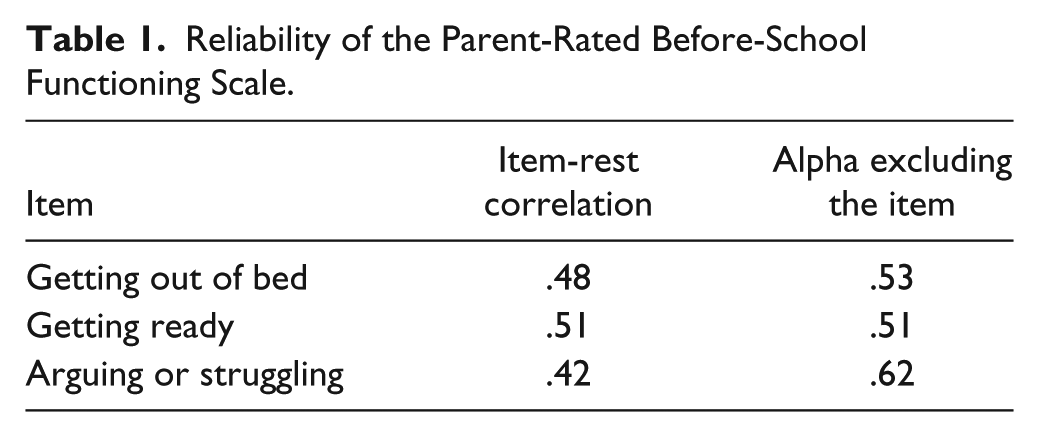
For each item, we computed the correlation of the item with the total score minus the item (the item-rest correlation) and the alpha of the total score that excludes the item. When an item performs poorly, it will have a low item-rest correlation, and the alpha coefficient with the item excluded will be markedly lower than the overall alpha. As is evident from Table 1, no single item is functioning poorly.
Reliability of the Parent-Rated Before-School Functioning Scale.
Test–retest reliability
If a test is measuring a stable trait, two assessments taken proximal in time should be significantly and highly correlated. Ideally, test–retest reliability is assessed by giving the same test to the same participants a few days apart outside of a clinical trial or other experimental manipulation. Lacking assessments that had been collected a few days apart, we used DPREMB-R assessments made 1 week apart. These data came from Visits 8 (end of dose optimization phase) and 9 (end of 1-week, double-blind treatment phase). This gives us a lower estimate of test–retest reliability because we have introduced some unknown degree of variability due to the placebo effect and non-specific effects of being enrolled in a trial. For the DPREMB-R morning score, both the Pearson (r = .52, p = .02) and the intra-class correlations (r = .45, p = .03) were statistically significant.
Concurrent Validity
If the morning score from the DPREMB-R is valid, it should be significantly correlated with the BSFQ, which is a validated measure of early-morning behavior and it should be correlated with ADHD symptoms and overall functioning. Such correlations are referred to as concurrent validation. Figure 1 provides the correlations and corresponding plots for all pairs of the following Visit 2 variables: DPREMB-R total score, ADHD-RS total score, CGI-S, and BSFQ total score. The DPREMB-R was significantly correlated with each of the concurrent validators (see first row of the figure). Notably, its highest correlation was with the BSFQ, the only other measure of morning functioning. In a multivariate Poisson model predicting DPREMB-R morning scores from the other concurrent validators, only the BSFQ remained significant (z = 2.7, p = .008).
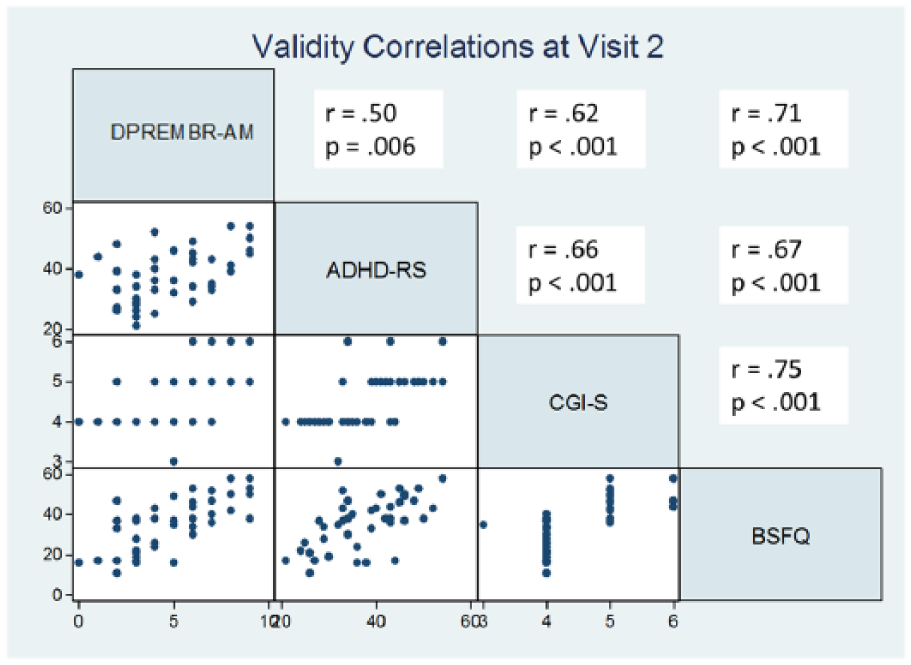
Concurrent validity of parent rating of evening and morning behavior, revised morning scale.
Discussion
Our results suggest that the morning score from the DPREMB-R is a reliable and valid measure of the effect of ADHD symptoms on the morning behavior of children. As measured by Cronbach’s alpha, the internal consistency reliability, albeit modest, was statistically significant, which indicates that the items of the DPREMB-R Morning Scale measure a homogeneous construct. Test–retest reliability was also modest, yet statistically significant. The concurrent validity of the investigator-rated DPREMB-R morning was high as measured by its correlations with total ADHD symptoms as measured by the ADHD-RS, overall severity as measured by the CGI-S, and before-school functioning as measured by the BSFQ.
The evidence for the validity of the DPREMB-R Morning Scale rests on its significant correlations with ratings of ADHD symptoms, impairment, and behavioral measures of executive functioning. Notably, the DPREMB-R Morning Scale shares about 50% of its variance with the BSFQ, which is a validated measure of before-school functioning in ADHD youth (Faraone, Hammerness, & Wilens, 2015). We found significant correlations for both the DPREMB-R and the BSFQ with both the ADHD-RS and CGI-S ratings of ADHD symptoms and impairments throughout the day. This finding indicates the importance of morning behaviors in the parent’s overall assessment of the child. When we used a multivariate regression model to predict DPREMB-R morning scores from all of the concurrent validators, only the BSFQ score remained significant. This finding suggests, quite sensibly, that the effects of other concurrent validators on DPREMB-R ratings are mediated by the behaviors that occur before school.
Our results are consistent with prior studies (cf. Introduction). Two studies supported the validity of the DPREMB-R Morning Behavior scale by showing greater improvements in atomoxetine versus placebo groups in randomized-controlled clinical trials (Kelsey et al., 2004; Sutton et al., 2003), and two trials showed that, compared with stimulant treatment, atomoxetine was more effective for treating early-morning behaviors as measured by the DPREMB-R Morning Behavior scale (Sangal et al., 2006; Whalen et al., 2010). Further supporting concurrent validity is Wehmeier et al.’s (2008) finding that the morning score of a similar scale, Weekly Rating of Evening and Morning Behavior Revised (WREMB-R) was significantly correlated with Global Impression of Perceived Difficulties scores, Sutton et al.’s (2003) finding of concurrent validity based on significant correlations with ADHD symptoms, and Husarova et al.’s. (2014) report that the DPREMB-R morning score predicted neuroimaging measures of neuronal integrity or neuroplasticity and glutamate signaling in dorsolateral prefrontal cortex, a region that has been repeatedly implicated in ADHD (Faraone, Asherson, et al., 2015).
Based on the work of Faraone, Hammerness, and Wilens (2015), we can compare the psychometric features of the DPREMB-R morning score with the BSFQ, which is another measure of the early-morning functioning of children with ADHD. For the BSFQ, Faraone, Hammerness, and Wilens (2015) reported a higher Cronbach’s alpha (.91 for BSFQ vs. .65 for DPREMB-R), a similar test–retest reliability (.60 for the BSFQ vs. .52 for the DPREMB-R), and similar concurrent validity (.42-.86 for the BSFQ vs. .50-.71 for the DPREMB-R). Both measures show significant evidence for validity by significantly separating drug from placebo in clinical trials (Kelsey et al., 2004; Wilens et al., 2013). These comparisons are found for the investigator-rated BSFQ. The child-rated version was much less reliable and less valid (Faraone, Hammerness, & Wilens, 2015). Given that the present study found the DPREMB-R and investigator-rated BSFQ to share 50% of their variance, it seems reasonable to conclude that they are measuring the same construct. Two potential reasons for differences between the two measures are as follows: (a) The BSFQ has more items, and (b) the results we discuss from the Faraone et al. study are based on the BSFQ when rated by the investigator based on an interview with the parent whereas the DPREMB-R is rated directly by the parent.
Although currently available data on the DPREMB-R are promising, future work should consider creating a revised scale that incorporates additional relevant items. The DPREMB-R uses only a few items to assess early-morning behaviors. Although this has the benefit of being quick to administer, a longer scale would likely improve reliability given the well-known Spearman–Brown formula, which predicts increasing reliability with increasing numbers of relevant items. Such items should, of course, be generated by content experts and be shown to correlate well with one another and with current DPREMB-R and BSFQ items. The assessment of validity would benefit from additional studies of concurrent validity and new studies that address divergent and predictive validity. Only after several such studies are performed can we be confident in the construct validity of these measures of early-morning behaviors. In addition, future use of the scale should include other standard stimulant pharmacotherapies for ADHD that have already been Food and Drug Administration (FDA) approved for ease of interpretation of relevant findings.
Our conclusions are tempered by several methodological limitations. First and foremost, we used data from a study that was designed as a clinical trial rather than as an evaluation of the psychometric properties of the DPREMB-R. This may limit generalizability due to the exclusion criteria of the clinical trial. Also, had we designed the study as a psychometric evaluation we would have used a larger sample and would have conducted test–retest reliability over a shorter period of time (e.g., a few days). In this regard, use of clinical trial data may have underestimated our estimates of reliability, validity, and their statistical significance. In particular, although our comparison of baseline and Week 2 scores for placebo participants simulates test–retest reliability, any variance due to the placebo effect would have reduced our estimate of reliability. We also could not compute inter-rater reliability. We view this as a minor limitation because it is impossible to compute inter-rater reliability for parent ratings; fathers and mothers typically do not observe the same sets of behaviors due to differences in work and child-care schedules. Also of note, our study was limited to children 6 to 12 years of age. These results may not generalize to adolescents or adults. Another scale would be needed to assess early-morning behaviors relevant to adults. Finally, our sample was small, which means our negative findings should be viewed with caution.
Despite these limitations, our systematic analysis supports prior research by providing additional evidence for the reliability and validity of the morning score from the DPREMB-R in children with ADHD. Given the clinical and practical impact of ADHD on morning symptoms and functioning, we suggest that this scale be used in future clinical trials of ADHD in youth. There is, however, room for improving the reliability of the DPREMB-R. Thus, future questionnaire development should include new items to improve reliability as well as a parallel questionnaire to target adolescents.
Footnotes
Declaration of Conflicting Interests
The author(s) declared the following potential conflicts of interest with respect to the research, authorship, and/or publication of this article: The analyses and writing of this manuscript was funded by a grant to Stephen V. Faraone by Ironshore Pharmaceuticals & Development, Inc. (“Ironshore”). Norberto J. DeSousa and Randy Sallee are employees of Ironshore. Stephen V. Faraone analyzed the data and wrote the first draft of the manuscript. In the past year, Dr. Faraone received consulting income, travel expenses, and/or research support from Ironshore, Arbor, Shire, Akili Interactive Labs, Alcobra, VAYA, and Neurovance and research support from the National Institutes of Health (NIH). His institution is seeking a patent for the use of sodium-hydrogen exchange inhibitors in the treatment of ADHD. In previous years, he received consulting fees or was on Advisory Boards or participated in continuing medical education programs sponsored by Shire, Alcobra, Otsuka, McNeil, Janssen, Novartis, Pfizer, and Eli Lilly. Dr. Faraone receives royalties from books published by Guilford Press, Straight Talk About Your Child’s Mental Health; Oxford University Press, Schizophrenia: The Facts; and Elsevier, ADHD: Non-Pharmacologic Interventions. Sharon B. Wigal received consulting income, travel expenses and/or research support or was on Advisory Boards or participated in continuing medical education programs sponsored by Arbor, Attentiv, Eli Lilly, Ironshore, Neurovance, Next Wave, NuTec, Pfizer, Purdue, Quintiles, Rho, Rhodes, Shire, Sunovion, Tris, and Vernalis. Scott H. Kollins has received research support and/or consulting fees from the following sources: Akili Interactive, Alcobra Pharmaceuticals, Arbor Pharmaceuticals, Atentiv, EPA, NIH (NIDA, NIEHS, NICHD), Neos Pharmaceuticals, Neurovance, Purdue Pharmaceuticals, Rhodes Pharmaceuticals, Shire Pharmaceuticals, Sunovion Pharmaceuticals, and Tris Pharmaceuticals. Dr. Childress has received consulting income, travel expenses and/or research support from Ironshore, Shire, Pfizer, Noven, Lilly, Forest Research Institute, Otsuka, Sunovion, Rhodes, Theravance, Neurovance, Neos, Arbor, Tris, Purdue, Lundbeck, and Alcobra.
Declaration of Conflicting Interests
The author(s) declared no potential conflicts of interest with respect to the research, authorship, and/or publication of this article.
Funding
The author(s) disclosed receipt of the following financial support for the research, authorship, and/or publication of this article: Foundation for the National Institutes of Health (10.13039/100000009).