







Abstract
There are increased demands to prepare for and coordinate of crisis management in public administrative bodies. Governmental organizations and authorities have responsibility for providing systems and structures of coordination before, during, and after crises. Among these are the technical information systems which create the structuring arena for coordination and integration that is analyzed here. There are several technical information systems to choose from for municipalities, which are responsible for local crisis management in Sweden. One technical information system, known as web-based information system (WIS), was a national initiative, but due to the local autonomy mandated in the Swedish constitution it was complicated to get municipalities to choose the national system and alternative local technical information systems were developed. The study builds on a bottom-up analysis of how municipalities choose technical information systems within crisis management. The main conclusion points out the importance of organizational structure in governance and the demand of flexibility in technology.
Introduction
In recent years, crisis management has developed as a new infrastructural structure, which can be seen as a response to the more mature risk society (Beck, 1992). These systems are developed in close interplay between public and private organizations. Public authorities can maintain legitimacy if their activities are considered relevant and good crisis management. In recent years, several serious situations in Europe and in Sweden have been considered as crises, asking for improved public crises management. In Sweden, two major storms in 2005 and 2006 had devastating consequences on the infrastructure for power and telecommunications. The crisis management in those situations was criticized by the media and the general public raising demands for new abilities to fulfill the promise of ensuring public safety in everyday life and in extra serious emergency situations. A new authority—Swedish Emergency Management Agency (SEMA)—was created and new legislation was formed, based on an increased responsibility for autonomous municipalities to act in extra serious crisis situations (SFS, 2006). The changes included increased resources and formation of regional coordination with the county councils in line with the development in many other states.
In this new governance context, technical information systems were developed for improved preparation for and coordination of crisis management. Two systems were paradoxically introduced at the same time. The national web-based information system (WIS) was developed in interplay with local, regional, and national actors to structure, coordinate, and integrate national crisis management. However, based on the constitutional principle of local autonomy a regional information system called eNavet was also developed in one region, allowing for broader integration of local actors. Both systems coordinate and share information among actors within municipal and other public authorities, as well as with private actors such as companies and nonprofit organizations. eNavet also functions like a public e-service that can provide selected and edited information to the general public. The two partly competing systems indicate the different forms of diffusion of technology—the traditional forms of bottom-up or top-down processes.
The aim of this article is to analyze, in a governance context, how some Swedish municipalities choose between national (WIS) and local (eNavet) technical information systems within crisis management. The analysis is based on a case study of seven municipalities in the region of Östergötland (see figure 1). To analyze this, theories of implementation for technical innovations which focus on success factors are used (Bogason, 2001; Linton, 2002; Pressman & Wildawsky, 1973). From the inductive case study approach the organizational factors and social interaction appeared to be the main differences between the cases and are thus in focus for the analysis. The conclusion also opens for some general policy implications in the growing field of crisis management.

Map of Sweden’s location and the region of Östergötland
The article will proceed in five steps, after the discussion on method and material that follows in this introduction. The section on governance as a setting outlines the theoretical approach setting Linton’s (2002) theories on successful implementation in networked governance. The section on the Swedish crisis management system contextualizes the case study in the governmental structure of Swedish crises management. The process of choosing technical information systems for crisis management is then presented in relation to the theoretical and contextual background. In Choice of Technical Information Systems in Local Crisis Management section, the relevance of municipal size and key actors are highlighted in the analysis, and finally some more general conclusions are drawn and policy implications discussed.
Method and Material
The study took off from the double implementation of technical information systems within crisis management searching for reasons for choices and design. Thus our field work consists of in-depth interviews, participatory observations and document analysis of government legislation, Swedish Government Official Reports (SOU, 2003), local and regional documents, minutes, and notes.
The case study took place in the Östergötland region in eastern Sweden and 7 out of the 13 municipalities was selected (see figure 2) to represent both large and small municipalities with a variety of crisis management arrangements. In some of the municipalities, this function was located in the fire and rescue service, whereas in others the officer is placed in the central municipal administration office, which may indicate the local interpretation of crisis management. In any event, we interviewed the responsible official. The interviews were about 1 hr and focused on the question “What is important when choosing technical information systems for local crisis management?” Together this made up a thick description of the process opening for the analysis of choices in the implementation process.
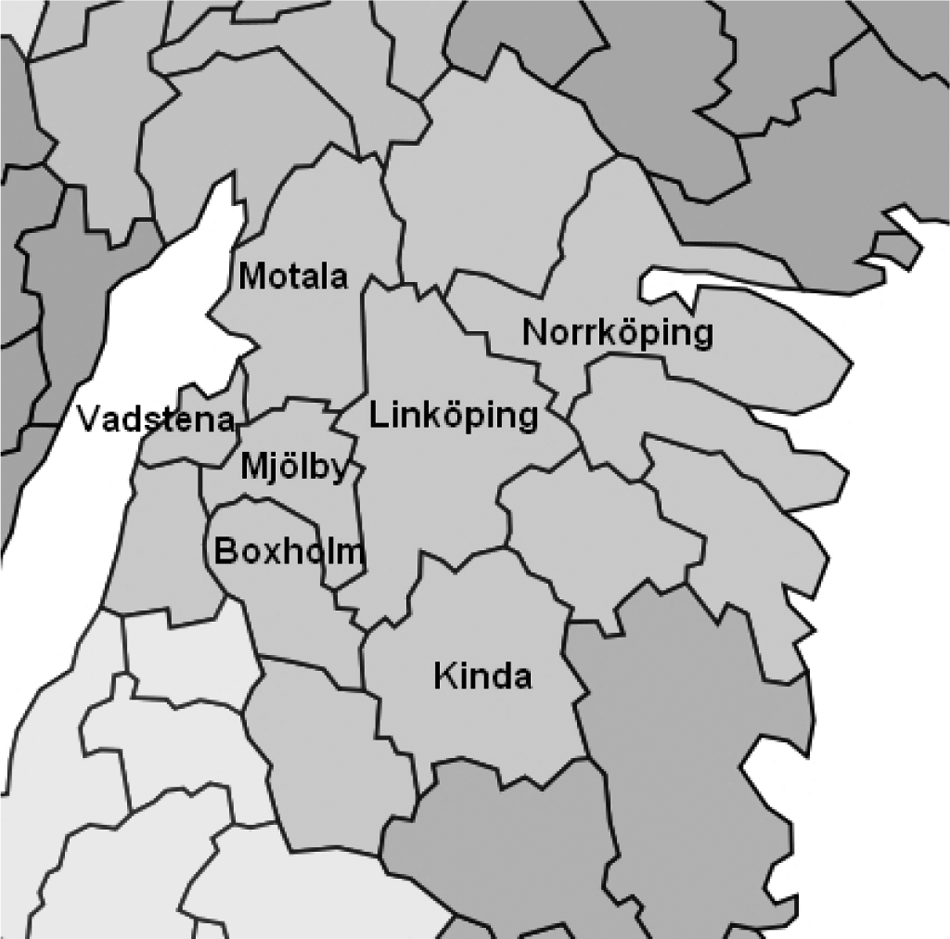
Map of case study municipalities
The field study allows a bottom-up perspective toward the analysis (Bogason, 2001). There are collaborative bottom-up adaptations to meet national and European policies by creating an efficient crisis management program in the local context and its organizational settings. Social theories regarding policy making plays (at least) a double role. They primarily help to make analysis of social phenomena—an analytical tool of policy making. They also define the conclusions we make and provide implications on how society could develop—a tool for policy makers. Theories on innovations and local organizations are no exception—they have both analytical potential as well as political implications. Thus the presentation of this case study carries the theoretical approach because the presentation as such is made through the chosen perspective (Bogason, 2001).
Governance as a Setting and an Explanatory Model
The context of collaborative crisis management is networked governance (Sörensen & Torfing, 2007) based on the shift from government to governance for policy making and implementation analysis. To analyze how municipalities choose technical information systems, we apply Linton’s (2002) model of success factors for implementing technical innovations, even if only a part of his approach could be used for valid analysis in our case.
From Government to Governance
The traditional government approach highlights the formal steering chain of public organizations and decision making by political actors. The government approach implies that governing takes place within governments and their formal institutions and the state’s monopoly on the use of legitimate coercion is in focus (Boyer, 1990; Stoker, 1998). The government approach has long been the norm of analysis, and it has determined the structure for policy making. The government model has long been the sole norm both for policy analysis and policy making. However, the governance context including governmental actors is today the norm for both practice and theoretical grounding (Gjelstrup & Sörensen, 2007).
The governance approach has been developed to explain the more open and network-oriented decision-making processes, including an intricate interplay among public, private, and nonprofit organizations. This approach has been explanatory and, at the same time, inspirational for policy makers aiming to achieve “good governance.” According to Peters and Pierre (2004), the common denominator in definitions of governance is that it “refers to the process through which public and private actions and resources are coordinated and given a common direction and meaning” (p. 78).
Governance is about issues of coordinative character but focuses on how and why actors continue to participate and develop interactions in networks. Networks are considered nonhierarchical with mutually dependent actors among whom power resources are unevenly spread. There are usually open exits for actors from networks. Actors participating in networks exchange resources and negotiate shared purposes. Cooperation and coordination are seen as the best ways to address common interests (Börzel, 1998). Networks are self-organizing and governmental bodies participate on more or less self-defined conditions in these networks (Rhodes, 1997). Governance enforces cooperation and opens networks, but the reach of influence formal decision-making governmental authorities is often limited (Baldersheim & Ståhlberg, 2002).
In a democratic context, the state gives its agencies opportunities to express legal and authoritative power in relation to other actors. Who has the power to choose which technical innovation to implement, and when and where to implement it, is thus a consequence of the process and the relationships made up through it (Wihlborg & Palm, 2008). In these cases, networking also takes place in the technical information systems. Networking becomes a form of implementation.
Technology Choices as an Implementation Process
The implementation process must have an object, usually a “policy” (Pressman & Wildawsky, 1973). However, when implementing technology policies the complexity increases because the object is both the technical artifact and the policies related to it. Thus the infrastructure policies become the object to be implemented, and the choice of technology is a crucial issue in these cases. Here the infrastructure also provides an arena for networking. Implementation is a process that goes on until usage becomes routine (Linton, 2002, p. 68).
Technology, and above all information technology, is considered a formative “subject” in relation to social processes—a constructivist shift (Woolgar, 2002). Based on an essential research overview of implementation of technical innovations into sociotechnical contexts, Linton (2002) concludes that there are five central principles for successful implementation. These are organizational structure, technology, project management, divisibility, and social interactions. He argues that even if a system is new to the public administration, the ideas and policies may be more or less already present in the administration.
Linton’s first factor, organizational structure, is defined by the organization’s characteristics, size, structure, and culture. Certain attention also has to be given to the interplay of actors and structures in the choices of technology and process of implementation. In a networked governance structure, the organizational structure is an open issue and it has to be settled by negotiation and local design. Thus this dimension appears to be a key of understanding technology implementation in governance settings.
Second, the implementation of innovations depends on the complexity of the technology. The more complex an innovation and technology is, the more complicated the implementation process becomes (Linton, 2002). Complexity is related to knowledge and competence in the organization as well as experiences of former processes of change. Organizations used to high levels of complexity more easily take on such challenges. The “absorptive capacity” of the organizations is an outcome of the ensemble of competence among actors and the organization as well as the interplay among them and the technical system.
Thus the uptake by project leading in the organization is considered to be a determining factor for success (Linton, 2002). Project leading is both about its organization and the capacity of the actors taking part thereby expressing power to lead the projects. Planning and organization of the process is crucial as well as the understanding of and interplay among actors and their competences and the institutional setting of the process. Project leading processes of technological choices and implementation are often taken on by local key actors as policy entrepreneurs (Wihlborg, 2000; Wihlborg & Palm, 2008).
Divisibility is for Linton (2002) closely related to technology and builds on an incremental approach, dividing the process into small segments that can then be chosen and implemented as such. The divisibility depends on the form of technology, the organization, and the policy ambitions. Finally, Linton (2002) highlights the importance of social interaction. Linton launches the concept “technology championing,” for the individuals or group of individuals who act as system builders (Hughes, 1986) or entrepreneurs. The technology champion in the process manages social interaction and reduces the resistance toward the changes. Communication and learning are outcomes of a functional social interaction in this type of processes. When using Linton’s model to a specific implementation case, here in a networked governance context, not all aspects will appear as important. The specific characteristics of the case may make some of these aspects more important.
Governance as a Context
When technology is implemented in public administration, the organizational structure is governance and projects are managed by a collaboration of actors. The Swedish multilevel structure is characterized by strong local autonomy for municipalities as set out in the Swedish constitution. Local autonomy was strengthened in the 1990s when the national government allowed for a more governance-oriented networked structure (Sörensen & Torfing, 2007). Thus there are also “regulatory regimes” focusing on coordination between centralized and local-level activities. The central-level “control” in a multilevel context is exercised more through informal structures like self-control, reporting, conferences, and seminars. The central-level attempts to gain common solutions through support, information, and technical assistance. Governance can lead to different local solutions.
The actors participating in the network relate to the organizational structure based on constitutional local autonomy. The municipalities are expected to play important roles both in formulating municipal policies and by implementing national policies and legislation (Gustavsson, 1996). As local autonomous bodies, they have the power to define local polices. In a networked governance context, the strength of the state—even the local state—increases the actors’ desire to participate in networks and form coalitions to build networks of actors (Bogason, 2001, p. 34).
Choice of Technical Information Systems in Governance Contexts— Our Analytical Framework
By applying a bottom-up approach the multilevel structure as well as the networked implementation will be seen through the perspective of the municipalities. The technical information systems analyzed here represent a bottom-up approach in the case of eNavet. Although the other system—the web-based information system WIS—is designed from the national authority, the SEMA is supposed to be in use on the local level for coordination between municipal and other local actors.
The social interaction when innovations are chosen relies on how actors enroll and relate to each other and form networks. Thus the organizational structure, technology, and the divisibility it defines is the first characteristic of these networks. Linton (2002) points to project management as an obvious structure and visible organizational unit constructed through the formation of the sociotechnical infrastructure as such. The choice takes place in networks and is thus conducted both through networks and at the same time by forming networks. However, the more networked collaboration is the less obvious is the project management (Sörensen & Torfing, 2007). Thus we will mainly focus on social interaction and “technology champions.”
These aspects of implementation will guide the presentation of the story of crises management in the networked governance structures. However, first we will give a background of the Swedish crisis management system that contextualizes the cases.
The Swedish Crisis Management System— A Background
The Swedish crisis management policies aim to develop a system that supports actors in preparing to handle serious crises. This section gives the contextual background of the case study.
There is a national authority at the time of the case study—the Swedish Emergency Management Agency (SEMA). 1 The authority has a coordinating role together with the county administrative councils, municipalities, organizations, and other government authorities to improve the society’s emergency capability. The obligations of the authority are given by laws and regulations and through the government’s distribution of funds, setting of targets, and follow-up of results. One of the six main areas of coordination is effective coordination of local actors through good communication, such as information technology systems.
The Geographic Area Responsibility
Swedish crisis management is grounded on the basic principles of the geographic area responsibility, which builds on the same principle of localization as the local autonomy. The purpose of geographic responsibility is to reach good coordination through one coordinating body at each level of society, whether it is national, regional, or local (SEMA, 2007). The municipality has to be prepared for several forms of crisis in what is called crisis preparedness. The responsibility implies a responsibility for coordination of actors at or within their geographical area. These actors can indeed be different, and thus it is a complex task to handle different interests and ambitions in relation to an aim as diffuse as crisis management.
Building on the geographical foundation of crisis management, three additional but still fundamental principles guide Swedish crisis management. These are the principles of responsibility, parity, and proximity. The principle of responsibility means that the actor normally responsible for an activity retains the corresponding responsibility in the event of a crisis. The responsible actor will then cooperate with other actors to solve common issues and problems. According to the principle of parity, authorities’ localization and organization will as far as possible remain the same during a crisis as under normal conditions. The principle of proximity means that a crisis should be dealt with at the lowest possible level, where it occurs and by those most affected by and responsible for its consequences (Governmental bill, 2005/2006).
Municipal Crisis Management
Municipalities are given responsibility to coordinate crisis management locally (SFS, 2006). The county administrative boards are assigned to coordinate among other activities the crisis management on the regional level as well as function as a supervisory authority (SEMA, 2003). This partly conflicting division of responsibilities and roles does influence the policy area of crisis management.
In the most recent Swedish legislation regarding crisis management (SFS, 2006), the role of coordination is thus emphasized even more. According to the legislation, every municipality must also have a committee—called the crisis committee—responsible for the organization and handling of all types of issues that can appear in crisis situations. If such a situation were to develop, the committee can—if they consider it necessary—take over decision making from the ordinary municipal committees. The purpose of this is to establish an efficient chain of command and coordination system in the municipality.
The municipalities can receive specific state funding to execute these duties. In practice, this means that municipalities are compensated for the planning and staff connected with national designed crisis management, such as the implementation of WIS. To conclude, the national legislation both forces the municipalities to take on a specific coordinating responsibility and at the same time allows for regional and local adaptations, in particular regarding the choice of information technology systems.
Crisis Management Through WIS and eNavet in the Region of Östergötland
In this section, the two cases of technical information systems present in the same region are presented. The region of Östergötland is located in southeast Sweden, with 415,000 inhabitants in an area of 11,630 sq. km. The region is a centre for aerospace, communications technology, software development, and life science technologies and has a university with almost 30,000 students (ÖSTSAM, 2007a).
The region includes 13 autonomous municipalities. However, they have also formed the independent organization ÖSTSAM among themselves. The map below shows the region with the municipalities included in the case study marked.
The seven municipalities included in the more in-depth study had all been working on a coordination of their crisis management activities. They followed the national legislation and focused on cooperation and coordination. The County Administrative Board of Östergötland that covers all 13 municipalities formed a consultative council for the region’s crisis management. The two largest municipalities in the region—Linköping and Norrköping—are permanent members of the council, whereas the other, smaller municipalities are invited on special occasions. They are thus also included in our study.
WIS— A National Innovation
The forerunner to WIS was an information system called Elvira. Elvira aimed to improve management support within civil defense. Elvira was a client and server system for authorities designed to create a common impression of a crises situation. The system had several functions, such as a diary, situation reports, management tools, and maps. Elvira was implemented as of 1999, and in 2002 all 25 Swedish county administrative boards used the system and approximately 25% of the municipalities in Sweden. The system was criticized for its technical complexity, weak functions for documentation, and the extra costs for hardware, maps, and the like. Therefore, the government made the decision to end the Elvira system (SOU, 2003).
Based on the Elvira experience, SEMA was given the assignment to develop WIS, with easy accessibility, high usability, and low technical complexity. The aim was to support actors with central functions in the crisis emergency management system by an open web-based diary system. The additional documentation function aims both to simplify management during a crisis as well as for postemergency evaluation. The system is also useful before a crisis because the users can view each other’s emergency plans, risk and vulnerability analysis, and exercises (SEMA, 2006). There is a low level of divisibility in WIS, even if not all functions of the system is in use it cannot be excluded.
WIS is optional for regions and municipalities because there is no coherent legislation to implement the system. The system, introduced in 2005, is used in several parts of Sweden; every county has at least one actor who uses WIS. The WIS system is Windows-based and easily accessible, thereby the threshold for learning and using the technology as such is low and most actors could simply and almost by themselves introduce the system. SEMA has put a strong emphasis on promotion of the system, which does not require major financial investments either. Another lesson learned from Elvira is that SEMA continues to take responsibility for the system’s support and development. Despite that, WIS should not be used for secret information. Both nationally and regionally, WIS was regarded as a useful and sufficient system in emergency management (Interview official County Administrative Board in Östergötland Palmblad, K. [November 29, 2006]; Interview principle administrative officer SEMA; Garefelt, R. [December 21, 2006].
Although the County Administrative Board in Östergötland in 2006 was confident that all 13 municipalities in the region would implement WIS, several municipalities—according to municipal officials—had not yet decided which system they would use (inter alia interview municipal officials in one large and two medium-sized municipalities). Among the small municipalities, there was, however, a positive attitude toward WIS. They thought the functions of the system were compatible with their organization—not too complicated yet effective. Due to lack of resources, the small municipalities felt that they could not create an information system for crisis management on their own. Therefore, they were thankful for SEMA’s and the County Administrative Board’s support in both economic and technical terms (interviews with three municipal officials in small municipalities). One expressed it this way: “It is not sure that we will use WIS, but we are prepared. We know how the system works and it is cheap and easy to use, so there is no reason why we should not have it.”
On the contrary, the two large municipalities—Norrköping and Linköping—in the region were hesitant about WIS because they saw demands for a system with more technical functions. Linköping thus developed its own information system—eNavet—further described in the next section. The municipal policy was to mainly use its own system (interview with municipal official in Linköping, Carlsson, C. [September 18, 2006]). The other large municipality, Norrköping, had evaluated different systems, for example, eNavet and WIS, but decided that WIS was not a sufficient system for their organization (Interview municipal official in Norrköping).
The County Administrative Board identified the different needs among the municipalities. Large municipalities with an extensive organization needed more complex systems, and they also had resources to develop or buy systems suitable to their requirements. They could maintain the local autonomy better or, from the other perspective, defy the national policy.
The County Administrative Board made a local compromise policy by saying that the municipalities could—if they wished—have two systems: WIS and another one as a complementary system. WIS was promoted as the uniting system for communication within the region and among the municipalities (Interview official County Administrative Board in Östergötland, Palmblad, K. [November 29, 2006]).
The Local Solution— eNavet
The municipality of Linköping, the largest municipality in the county, developed eNavet in close cooperation with firms and the university in the region. The system is mainly an information and communication system to improve the management of crises. It is designed for both true crises and everyday emergencies, for example, traffic jams. eNavet combines systems already in use in the municipal organization, by integrating information presented on a main page available to all users. Building on already existing and implemented systems was cost-effective, and the threshold for starting it was expected to be low (Linköping Municipality, 2005). Hereby, the system was developed more in sections that can be added to it. There is more divisibility than in WIS, but it is still a coherent system.
This system builds on a decentralized base, and each actor that uses the system functions as a “hub” (in Swedish “nav”). It has similarities with the national system WIS, but it can also be used to contact the general public and media through telecommunication or through the web. eNavet was funded by municipal resources and subsidies from the municipal-owned power utility; running power systems, broadband, and the like (Wihlborg, 2003); and the private firm that is the largest employer in the municipality because it could argue that the support to the municipal system improved cooperation and increased security, not just emergency management. A critical problem with technological information systems is the function when there are power outages. The local private company Combitech had experienced this and developed a solution built into eNavet (Interview municipal official Linköping, Andersson, K. [September 18, 2006]). Hereby, the local system got another advantage regarding emergency management.
Linköping Municipality had an ambition to disseminate eNavet throughout the region, but the County Administrative Board recommended that all municipalities in the region use WIS. Despite lack of authority and resources for dissemination, eNavet was spread by networking and individual’s promotion of the benefits of the system. A simple conclusion was that through the networked governance good technological arguments persuade authority.
What Influences the Choice of Technical Information Systems in Local Crisis Management?
The technical information system became a tool to overcome and sometimes even integrate the different levels of governance. Here the organizational structure allowed two partly competing systems. Thus the choice of technology was opened up in the implementation process. The policy first pointed out the networked coordination and collaboration, and technology was subordinated to these policy aims. Thus the social interaction and building of networks was more in focus than the choices of technology and its divisibility in this specific case. The social networking became more important than the organizational structure and project management because the social interaction in networks compensated weak organizational structure and lack of project management.
The importance given to crisis management by both policy makers and the public motivated the public administration to take actions that they may not have made in less critical policy areas. The division of governance into decision-making levels became less obvious. The social interaction was the main focus to show a preparation for managing small and larger emergencies. Thus also the technology and divisibility became subordinated to a networked consensus focus. However, Linköping Municipality had a leading role throughout the project through eNavet. They owned much more of the project and could stand outside the regional network. The municipal size and competences among key actors thus appear here as a main factor for successful implementation. A key competence was capacity to form social networks.
Municipal Size a Key Characteristic of the Organizational Structure
In these cases, municipal size turned out to be a key aspect of organizational structure in line with what Linton (2002) identifies as organizational structure. The contrast of municipal size and organizational capacity is important to point out. There were obvious differences between small and large municipalities in their attitude toward WIS. The municipal officials indeed experienced different levels of support from the political management of the municipality and public officials. Larger municipalities have much more individual as well as personal competence in the process and can therefore develop their own technical information systems suitable for their specific organization.
In the small municipality of Kinda, the official responsible for crisis planning had much more influence and personal expertise in the area than did the responsible official in the municipality of Vadstena, in spite of their similar sizes. While Kinda was active in the regional development of crises management, for example, regarding the debate on technical information systems, Vadstena claimed that the municipality had to develop crises management within its own boundaries before it could increase cooperation with other actors in the region. The two municipalities were both small and therefore had similar resource conditions. However, with the municipality’s autonomy, each municipality can decide its organizational structure, and in our study this generated different outlooks on the municipality’s crisis management. Even if the constitution treats municipalities as similar, they really appeared as different organizational settings. Thus it is complicated to keep up an image of similar constitutional responsibility. They can never be fully responsible—neither politically nor professionally—for the same policy ambitions.
To conclude regarding organizational structures, small municipalities were positive toward the nationally developed technical information system, even if the crisis management work in the municipalities differed. On the contrary, large municipalities argued that the functions in the national system were few and too simple and therefore not suitable for the large municipalities’ organization. Instead, both of the larger municipalities studied other systems and one municipality, Linköping, created its own system.
Key Actors in Governance Networks
Linton’s (2002) factor on social interactions points out so-called “technology champions” as essential actors as a driving force to promote the system to other actors, collect resources, and simplify the process. The case study shows the importance of state actors (officials) as promoters for WIS, where they took on the role of project management. Without them the development of the system almost stands still. Good communication between these actors and the region’s absorptive capacity was also vital to get necessary resources. Another factor was how and why the actors could gain new knowledge. However, failures were mainly related to the level of complexity of the system, especially in the smaller municipalities, which lacked resources. The attitude of municipalities toward technical information systems seems to be highly related to the knowledge of the specific innovation as well as the experience of other innovation processes in the public sector body.
Resources for implementation here also appear as a key factor for success, but interpretations of what is considered success vary. The national agency used their experiences from the unsuccessful implementation of the system Elvira when creating WIS, such as the importance of starting with few technical functions. The argument behind the positive attitude to WIS was the low technical complexity in contrast to Elvira. There was also a different distribution of the cost. Primarily, the monetary investment is low. The costs of organizational adjustments were indeed greater but tended to remain hidden. These costs and their relationship to the organization arrangements need to be more visualized in evaluations of implementation processes.
Flexibility in the Meaning of Success— Concluding Remarks
The overall impression of the analysis of these two technical innovations is that the meaning of success is flexible and varies among the actors and organizations. In networked governance, there are several intersects invested in the same process. Here local and national crisis management, local and national policy makers, as well as local firms and the general public became actors. Taken even further, the technology as such could have been considered an actor in the process because it allowed for different, partly competing systems.
These case studies showed that if the social and organizational changes demanded when introducing a technology are seen as unreachable, then the technology can be abandoned. Both these technology systems appeared to provide a good mix of complexity and usability to be integrated in organizational structures with different size, organization, resources, and competences. The social arrangement of the technical information systems regarding access to information and keys to actually change and present information did, however, build on a clear division of responsibility. Here the municipalities had different ambitions and possibilities to divide and clarify the responsibility.
The process of implementing the WIS system is characterized by networked governance. The open process between local administrators and central authorities makes up an arena for discussing and forming the meanings of the system and thereby also for regional crisis management. However, using the “soft control” central level cannot force a municipality to use the WIS system. From a policy perspective, it is important to point out the importance of the organizational structure and the division of power and accountability among different levels and actors in the process of implementation, where the first step is to choose which technical information system(s) to implement. If there had been a more articulated understanding of the municipal responsibility as well as the competence of the municipality, the choice of technical information system would probably have been much smoother and more coherent.
A final reflection is that the accountability as built into the technological system was a rather implicit activity just handled through management and not a clear policy ambition. Here indeed is potential for development in practice and research. The degree of institutionalization appears important for the opportunities to form an organizational setting for the implementation. Local and regional policy makers and other key actors could have the power to create a regional adoption of the national emergency management system. It is indeed important to highlight regional characteristics and make the systems legitimate among participating actors. In the growing policy field of emergency management, these discussions of technology choices and implementation must be further developed.
Footnotes
Authors’ Note
The views expressed in the article are those of the authors alone.
Declaration of Conflicting Interests
The authors declared no potential conflicts of interest with respect to the research, authorship, and/or publication of this article.
Funding
The authors disclosed receipt of the following financial support for the research, authorship, and/or publication of this article: The work undertaken in preparation for this article forms part of the research program “Emergency management for technical infrastructure—regional and municipal strategies for coordination and implementation,” funded by the Swedish Civil Contingencies Agency (MSB).