







Abstract
Based on the rational choice assumption that politicians seek to enhance their reelection chances, the authors posit and test several hypotheses about how the use of franked mail varies across members of the House of Representatives. This study improves upon the existing literature by using a sample of all full-term representatives and by using multiple regression analysis that allows for estimation of the marginal effect of each explanatory variable after controlling for other factors that might affect franking behavior. The results of this study indicate that (1) politicians seeking higher office tend to make greater use of franked mail while those who are retiring engage in less franking, (2) narrower electoral margins, especially for first termers, are associated with more franking, (3) representatives who have larger campaign expenditures also have higher levels of franked mail, and (4) franked mail increases with a congressional district’s distance from Washington, D.C.
I have three pieces of advice for you if you want to stay in Congress. One, use the frank. Two, use the frank. Three, use the frank.
Advice reportedly given to a newly elected representative by a former congressman. (Clapp 1963, 332; quoted in Cover 1985)
Since colonial times, members of Congress have been allowed to send mail with their signatures affixed instead of postage. This privilege, known as franking, has been justified as being necessary for representatives to inform their constituents of government actions. It has also been criticized as financially wasteful, subject to abuse, and antidemocratic in that it affords incumbent politicians an advantage over their challengers (Glassman 2007).
Not surprisingly, the potential advantage that franking affords incumbents has been a topic of interest for scholars. Cover and Brumberg (1982) find that franked mail increases incumbent saliency (name recognition) and creates a more positive view of incumbents. Likewise, Cover (1985, 649) concludes that “franked mail can produce a rich harvest of votes.” 1 Levitt and Wolfram (1997) also find that franking and other officeholder resources provide a substantial benefit to incumbents, but their decomposition of incumbents' advantages attributes less than one-half of officeholders' edge to franking and other benefits. Although there is much evidence supporting the incumbent advantage hypothesis, the literature is not unanimous. McAdams and Johannes (1988) find that mailings did not affect the percentage of the vote won by House members in the 1982 congressional elections. Similarly, Born (1982, 347) documents the increased usage of perquisites by freshman representatives elected in the 1960s but concludes that “there is no evidence to demonstrate that this aggressiveness has been a source of more recent freshmen's greater electoral success.”
That the evidence on the relationship between franking and electoral outcomes (or, in the case of Cover and Brumberg [1982], surveys about constituent views of public officials) is mixed is not surprising because electoral outcomes are affected by many other factors such as national political trends. Hence, rather than examining the relationship between franking and electoral outcomes, this article takes a different approach. It assumes that politicians use the franking privilege to enhance their standing with constituents and thereby retain office. Based on this rational choice assumption that politicians are attempting to enhance their reelection chances, several hypotheses about how the use of franked mail should vary across members of the House of Representatives as they seek to influence their constituents are posited and tested.
To date, the only study examining franking usage across representatives is Cover (1980). In the mid-1970s, he conducted a telephone survey of 137 congressional offices to find out how many mass mailings each representative sent out over an 18-month period. Among the 137 members in the sample, Southerners were significantly underrepresented, while Democrats and freshmen were somewhat overrepresented. Cover then examined the pattern of mass mailings across representatives and found that both incumbents' victory margins and their seniority were negatively correlated with the number of mass mailings. In the late 1970s, he also performed a follow-up survey of the 75 of his 137 representatives who remained in Congress; that survey revealed the same negative correlation between victory margin and mass mailings and between seniority and mass mailings.
The approach in this article improves on Cover (1980) by updating it, by expanding it to include all house members from three Congresses (those serving partial terms for reasons such as death or resignation are excluded), by examining a more extensive set of covariates, by using a better measure of franked mail, and by basing the statistical inference on robust standard errors.
The next section describes the hypotheses about expected patterns of franking usage. The following section describes the data and reports the estimation results, and the final section concludes.
Variation in Franking Usage across Representatives
The following model is posited for analyzing the use of franking by representatives:

The matrix REPRESENTATIVE contains representative-specific variables, including seniority and electoral margin analyzed by Cover (1980), which might be related to the use of franking. If the purpose of franking is to influence public opinion and enhance reelection chances, then representatives who were elected more narrowly should subsequently make greater use of franked mailings and other resources that might improve their standing with voters. (Fiorina [1981] makes this point.) Hence, the model includes SPREADMARGIN, the number of percentage points between a representative’s vote share and that of his or her closest opponent in the previous election relative to the sum of the vote shares obtained by the top two candidates (Matsusaka 1993). As with Cover’s results, a negative relationship is expected between SPREADMARGIN and PIECES.
The matrix of representative-specific variables also includes two other measures relating to the competitiveness of the member’s most recent election. OPPOSED is a dummy taking a value of 1 if the person was opposed in his or her party primary. Members who were opposed may be inclined to send more franked mail in order to shore up their electoral prospects. (For those facing primary opposition, a better measure would be the margin of victory over the primary challenger, but a margin of victory variable would be undefined for members who did not face primary challenges.) The other competitiveness measure is (the log of) campaign spending (CAMPAIGN). The expected sign of the relationship between campaign spending and franking is unclear a priori. If campaign spending is a substitute for franking then the relationship would be negative; if franking complements campaign spending then the expected relationship is positive.
If, as assumed, franking is related to the pursuit or retention of electoral office, then it may be affected by a politician’s attempt to obtain higher office, a member’s fear of losing an upcoming election, or a representative’s decision to retire from electoral politics. Hence, the model includes the dummy variable RETIREMENT, which takes a value of 1 for representatives retiring at the end of the current Congress. The model also includes the dummy variable DEFEATED, taking a value of 1 for representatives defeated in their next election. It is hypothesized that the anticipation of a difficult upcoming election might prompt house members to increase their use of franking.
To capture the possibility of more franking in pursuit of higher office, a relationship that would be consistent with Parker and Parker’s (1985) finding that members seeking higher office travel home more often, the variable HIGHEROFFICE is included. The effectiveness of franking to aid a run for statewide office depends on the size of the state. A representative from a state with only a single representative can reach all of the voters who will be casting ballots in, say, a senatorial or gubernatorial election via franking. However, the more districts there are in a state, the smaller the share of the state’s voters that a representative can reach by sending franked mail to residents of his or her district. Hence, HIGHEROFFICE is defined as 1 divided by the number of congressional districts in a state for candidates seeking higher office and 0 otherwise. (Among nonzero observations, the value of HIGHEROFFICE ranges from 0.019 in California with its 53 congressional districts to unity in states such as Vermont, which have only a single congressional district.) HIGHEROFFICE is hypothesized to be positively correlated with PIECES; that is, candidates who can reach a larger share of the statewide electorate will engage in more franking while running for statewide office than will candidates whose districts comprise only a small share of the statewide electorate.
As with Cover (1980), controls for seniority are also included. One might expect that as representatives build up name recognition over time and become more entrenched that their use of franking would decrease; Cover’s finding of a negative correlation between franking and seniority is consistent with this expectation. There are two approaches to investigate this possible relationship. First, TERMS, a variable indicating the number of terms a member has served is included. Alternately, a series of dummy variables TERM1, TERM2, and so on, taking a value of 1 for the indicated term is used. Unlike the continuous variable TERMS, the TERM1 and so on dummies do not constrain the effect of seniority to be linear.
To control for systematic partisan differences in the use of franking that may exist, the dummy variable GOP is included. It takes a value of 1 for Republicans and 0 for Democrats. There is no a priori expectation about the existence or sign of a partisan franking effect. Likewise, the dummy variable INMAJORITY, which takes a value of 1 for years in which a representative’s party is the majority party in the House is included. Again, there is no a priori expectation about the relationship between majority party status and franking.
Turn now to DISTRICT, a matrix of district-specific attributes that might make the use of franking more or less attractive as a part of a reelection strategy. These variables include DISTANCE, the distance between Washington, D.C., and each representative’s district. Members from more distant districts are hypothesized to make more use of franked mail. While members from more distant districts receive larger travel allowances, the time cost of personally traveling home to the district is greater for members from more distant districts. Hence, these members might substitute franked mailings for personal appearances in their districts. (Fenno [1978] finds that distance is negatively related to trips home.) For similar reasons, AREA, the number of square miles in the district, is also included as district-specific variable. Larger districts should, ceteris paribus, be more difficult for representatives to maintain personal visibility and might therefore increase the use of franked mail.
It is hypothesized that constituent characteristics might be important district-specific attributes related to franking. Such characteristics might include the district’s economic well-being, so median income (INCOME) is included as an explanatory variable. Since franking might be more effective with a more literate population, the correlation between income and education might lead to a positive relationship between income and representatives' use of franked mail. Alternatively, the positive relationship between income and voter turnout (Highton [1997] and Bonaparte [2007]) might prompt politicians from high-income districts to view franking as a more effective strategy than would representatives from poorer districts.
Another important district characteristic might be its ethnic makeup. In particular, Yiannakis's (1982) finding that officials can use franked mail to target different segments of their constituencies suggests that more ethnically diverse districts might lead politicians to make more extensive use of franked mail to highlight positions or accomplishments important to different ethnic parts of their constituencies. Hence, included is a measure of ethnic fragmentation, ETHNIC, defined as in Alesina, Baqir, and Easterly (1999):

Lastly, included are dummy variables for all years except 2003. The inclusion of year dummies controls for systematic changes in the use of franking over time; it also estimates whether election years (even numbered years) have more franking than nonelection years. 2
Data and Estimation Results
The model is estimated using data from the following sources. PIECES is the number of pieces (plus one) of mass mail sent each year from 2003 to 2008 by each representative; these data are reported in the Statement of Disbursements of the House. 3 The estimation includes 2,556 observations, 6 apiece (2003–2008) for each of the 435 congressional districts less 54 for representatives who did not serve full terms. DISTANCE is constructed as the number of miles, as reported by Google Maps, between Washington, D.C., and the member’s hometown. All of the remaining right-hand-side variables are obtained from The Almanac of American Politics (Barone and Cohen 2003, 2005 and 2007). Descriptive statistics for all variables are contained in Table 1 ; also reported is the simple correlation between each of the regressors and ln(PIECES).
Summary statistics
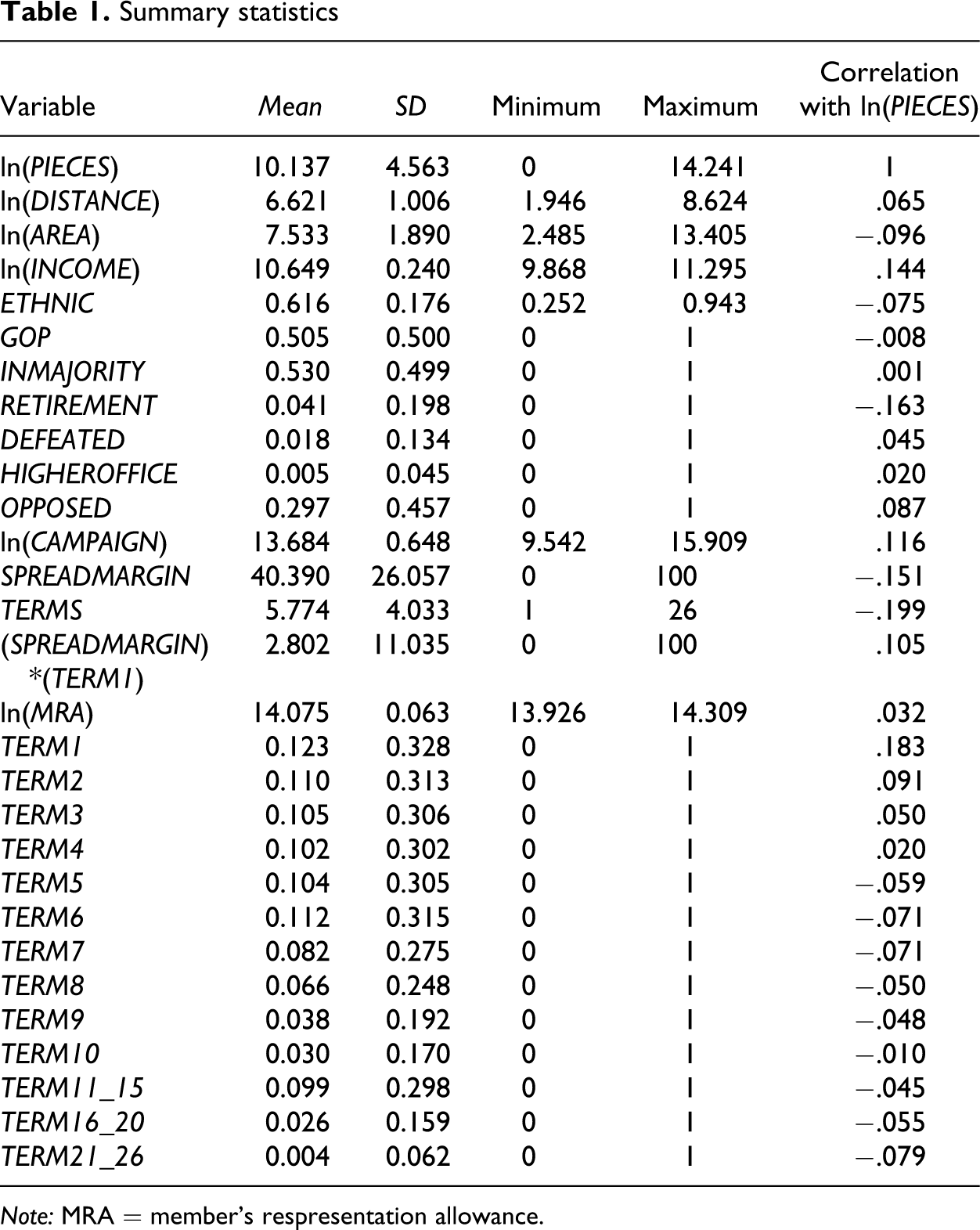
Note: MRA = member's respresentation allowance.
Table 2 reports the OLS estimation results; adjacent to each estimated coefficient is its standard error obtained from clustering by representative. Column (1) contains the base model except for a measure of seniority. Looking first at the district-specific variables, the positive coefficient on the distance variable suggests that members of Congress substitute mailings for trips home. A district’s median income is also positively related to the member’s use of franking. No significant effect is found for ethnic fractionalization; franking may allow for targeted mailings to different segments of constituents, but apparently it does not increase the total volume of franked mail. Contrary to expectations, the results indicate a negative relationship between a district’s area in square miles and franking. This finding suggests representatives find franking less useful in rural areas, though the reason for this negative relationship is unclear. 4
Regression results
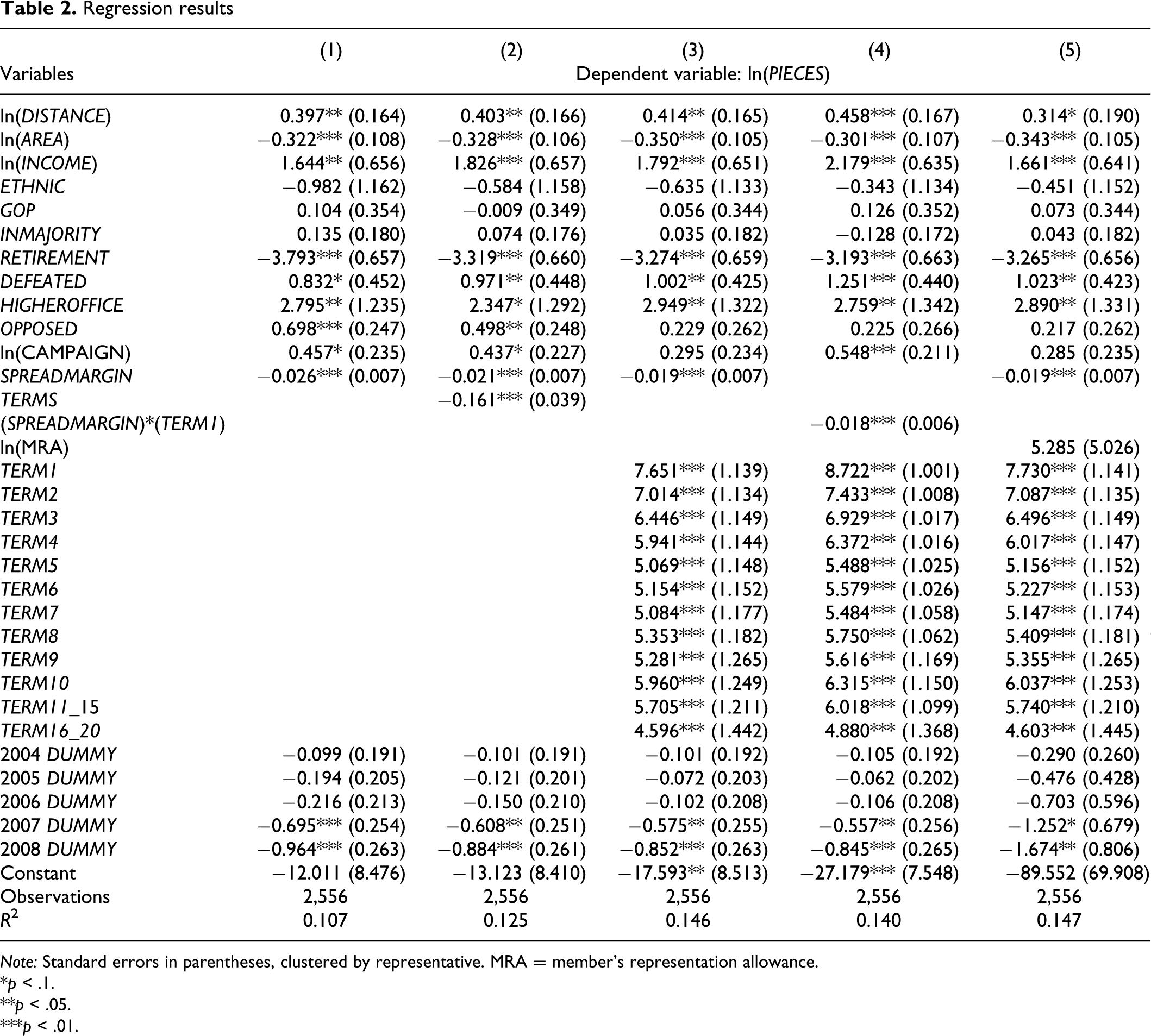
Note: Standard errors in parentheses, clustered by representative. MRA = member's representation allowance.
*p < .1.
**p < .05.
***p < .01.
As for representative-specific variables, being opposed in the previous primary, a more narrow victory in the previous election, being defeated in the subsequent election, and the larger the amount of campaign spending in the previous election are all associated with larger volumes of franked mail. The relationship between franking and campaign spending is therefore complementary; politicians feeling the need to spend larger sums on their reelection efforts also apparently feel it necessary to send more franked mail. Retirement has a negative and statistically significant point estimate, as anticipated, and suggests that representatives who plan to retire send fewer pieces of franked mail. On the other hand, representatives running for higher office tend to increase their use of the franking privilege. Neither GOP nor INMAJORITY has a large or statistically significant relationship with the number of pieces of franked mail sent.
In column (2), the variable TERMS is included in the model to control for representatives' tenure in office. Seniority has a significantly negative relationship with franking, meaning that representatives with more years in office make less use of franking, ceteris paribus. Other results are largely unchanged in magnitude and statistical significance.
Since the continuous variable TERMS implicitly assumes a linear relationship between tenure and franking, column (3) repeats the estimation using term dummies (TERM1, TERM2, and so on; the omitted category is representatives with 21 or more terms) instead of TERMS. Because there are relatively few representatives in some of the longer-serving tenure categories, representatives with 11 to 15 terms are combined into the dummy TERMS11_15, and representatives with 16 to 20 terms are combined to form TERMS16_20. The estimated coefficients on the term dummies generally have smaller coefficients as length of service increases but the decline is not monotonic. Franking tends to fall by about one-third over a representative’s first five terms, then remain more or less unchanged in later terms. The results, therefore, are somewhat at odds with Cover’s (1980) finding of large franking effects related to seniority. (It is important to keep in mind that Cover’s results were based on simple correlations rather than a multiple regression framework capable of controlling for other relevant determinants of franking usage.)
Column (4) uses the term dummies; it also includes an interaction variable between SPREADMARGIN and TERM1. The interaction variable does have a significantly negative relationship with franking. Thus, electoral closeness also matters for newly elected representatives; first termers with narrow margins apparently make aggressive use of franking in order to enhance their reelection prospects. 5
Column (5) addresses an issue arising from House rules governing the use of franking. US House members are given a member’s representational allowance (MRA) consisting of three components: a personnel allowance that is common to all members, an office expenses allowance that varies across members according to the distance between Washington and the member’s home district, and an official (franked) mail allowance determined by the number of nonbusiness addresses in the member’s district. Although the allowance for franked mail is part of the MRA, members are allowed to use funds from the other two components for franking expenses. 6 Hence, the relevant budget constraint is the MRA which varied from about $1.1 million to about $1.6 million per member in 2003–2008. Because members from more distant districts receive larger travel allowances and because members are allowed to use travel funds for mailings, it is possible that the finding of a positive relationship between distance and franking is spurious. To address this possibility, the estimation is repeated with the MRA included as a regressor. The results, reported in column (5), indicate a large but imprecisely estimated coefficient on the spending allowance variable. While the estimated coefficient on DISTANCE remains statistically significant, its magnitude is now about one-fourth smaller than the estimates in columns (1) through (4). 7
Lastly, the year dummies in all specifications indicate a large decrease in the use of franking in 2007–2008. This decline may be attributable to the use of new forms of electronic communication as a substitute for franked mail.
Conclusion
This analysis of the variation in franking improves upon the scant existing literature by using a sample of all full-term representatives and by using multiple regression analysis that allows for estimation of the marginal effect of each explanatory variable after controlling for other factors that might affect franking behavior. The results are largely consistent with the notion that politicians use franked mail in an effort to enhance their electoral prospects. Politicians seeking higher office tend to make greater use of franked mail, while those who are retiring engage in less franking. Narrower electoral margins, especially for first termers, are associated with more franking. Politicians who have larger campaign expenditures also have higher levels of franked mail. There is no evidence of a difference in franking usage across parties or of a difference associated with being in the majority or the minority.
At least one significant question remains unanswered: Why do many members (more than 10 percent in this sample) of Congress choose not to frank? Or, more generally, why do many members leave substantial amounts of their MRA unspent? This is an issue for future research.
Footnotes
Acknowledgment
The authors acknowledge the superb research assistance provided by Martha Reynolds of Berry College’s Memorial Library and by Kayla Badding, Damien Brooks, and Cullen Hammontree. We thank the National Taxpayers Union’s Pete Sepp and an anonymous referee for providing data. Art Carden, David Mitchell, and other participants in a session at the 2009 Southern Economic Association conference and two anonymous referees offered helpful comments.
The author(s) declared no potential conflicts of interest with respect to the research, authorship, and/or publication of this article.
The author(s) received no financial support for the research, authorship, and/or publication of this article.