






Abstract
Consumers experiencing financial vulnerability often face multiple intersecting barriers to well-being. Accordingly, social service systems have begun integrating programs to more holistically address the many factors affecting financial vulnerability. Results from a qualitative case study show how an integrated approach to financial vulnerability influences consumer experiences as they navigate through social service systems. Findings explain how initiation into social service systems requires adequate client readiness to comply with entry conditions placed by service providers. Furthermore, while many organizations believe readiness must be attained prior to entering the system, we find that a network of internal and external providers can support the cocreation of client readiness. Integration into the system deepens as clients take on structured responsibilities, as providers take on risks in supporting clients through vulnerabilities, and as both clients and providers develop mutual trust. The authors introduce the concept of contingent value propositions to explain how providers can structure services to make support available based on client readiness and cocreative action. Client transitions through the service system can be hindered or supported by integration with external partners. Implications for social service theory and practice are discussed, including recommendations for delivering holistic social service support to consumers experiencing financial vulnerability.
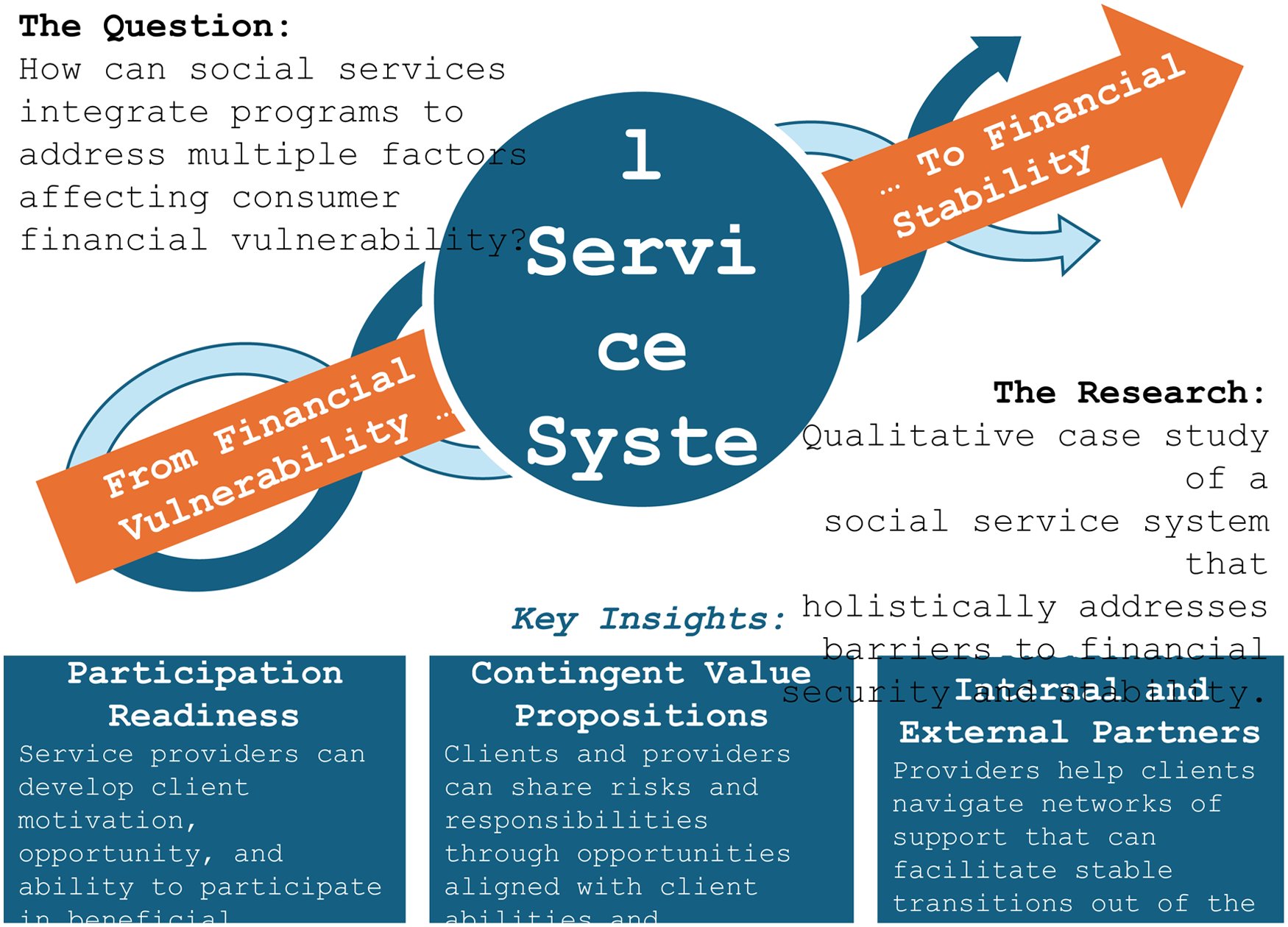
Disadvantaged, financially vulnerable consumers often face multiple, intersecting challenges that impair well-being and prevent self-sufficiency (Baker, Gentry, and Rittenburg 2005; Salisbury et al. 2023). Social service organizations that address financial vulnerability have conventionally structured their offerings around specific programs, such as education or housing assistance, due in large part to a reliance on grants that often focus on specific need areas (Gibson, O’Donnell, and Rideout 2007). While such program-centric models allow organizations to specialize in particular services, these organizations often struggle to address the multiple challenges that people experiencing financial vulnerability face (Placzek et al. 2021). As a result, social service organizations have begun to adopt client-centric service models that integrate multiple services and programs and allow these organizations to better meet their clients’ needs (Searle, Neuhoff, and Belton 2011). Despite this shift in service models, little is known about how disadvantaged consumers experiencing financial vulnerability navigate these social service systems.
In the current research, we conduct a qualitative case study of a nonprofit organization that integrates multiple services and programs to more holistically address financial vulnerability. We analyze this case to explain how consumers enter and integrate into these social service systems, as well as how they exit or transition from these systems into the mainstream marketplace. Our study offers three contributions to theory and practice. First, we develop a processual model that explains the relationship between social service systems and trajectories of consumer financial vulnerability (Mende et al. 2024). Second, we demonstrate how mutual trust and structured client responsibility allow consumers and service providers to cocreate client readiness to participate in social service system offerings. While prior research shows that consumers have varying degrees of participation readiness (Dong et al. 2015; Rothschild 1999), we find that consumers are most likely to enter social service systems when service providers support the cocreation of participation readiness prior to the development of formal service relationships. Our novel concept of contingent value propositions explains how service system participation evolves through relationships of mutual trust and structured responsibility. Third, we extend prior theories on service system research (Chandler and Lusch 2015; Polonsky et al. 2024; Vink et al. 2021), explaining how external partners influence the success and failure of service systems to address financial vulnerability. Specifically, we provide new insights into research that identifies the role of service system orchestration but does not differentiate internal from external partners or theorize different stages of participation (Breidbach, Antons, and Salge 2016). These theoretical contributions also have important practical implications for social service organizations interested in adopting holistic service models.
In the following sections, we integrate past research on consumer financial vulnerability and service systems to provide a foundation for our study and its contributions. Next, we describe our qualitative research methods and detail the analysis leading to our conceptual model. We conclude with a discussion of theoretical contributions and practical implications for addressing consumer financial vulnerability through more holistic social service systems.
Consumer Financial Vulnerability
Financial challenges present one of the most pervasive and impactful vulnerabilities faced by contemporary consumers (Martin and Hill 2015). Prior research that focuses on financially disadvantaged people defines vulnerability as “a state in which consumers are subject to harm because their access to and control over resources are restricted in ways that significantly inhibit their abilities to function in the marketplace” (Hill and Sharma 2020, p. 554). We adopt this definition in our research, focusing specifically on consumers’ limited access to and control over financial resources, and thus financial vulnerability.
Financial vulnerability manifests as an experience rather than a personal attribute (Koppenhafer et al. 2023). It arises from a multitude of factors, including: consumer choices, such as purchase decisions; consumer backgrounds, such as debt or social class; temporal circumstances, such as health or life stage; and external forces, such as market institutions that control resource access (Salisbury et al. 2023). These factors often interact and create situations where consumers lose power over aspects of their lives in ways that hinder their goals and affect perceptions that they or others have of themselves (Baker, Gentry, and Rittenburg 2005; Riedel et al. 2022). Over the course of a person’s life, financial vulnerability can increase or decrease in breadth (i.e., the number of intersecting factors affecting a person) and depth (i.e., the degree to which a person experiences vulnerability; Mende et al. 2024). Furthermore, experiences of financial vulnerability at one point in a person’s life can create spillover effects that lead into cycles or path dependencies that accumulate and reinforce negative impacts (Mende et al. 2024). For example, inadequate access to healthcare means that a relatively minor illness or injury can spiral into greater costs, lost employment, and perpetual financial vulnerability (Saatcioglu and Corus 2014).
Conventional approaches to address financial vulnerability focus on remedying individual weaknesses or deficits, such as spending habits or education levels, that prevent consumers from becoming more financially stable (Raciti, Russell-Bennett, and Letheren 2022). Marketplace interventions, such as behavioral nudges, are often implemented to help consumers overcome these shortcomings (Benartzi and Thaler 2013). While such deficit-based approaches can achieve success in shifting specific behaviors, the complex contexts and intersecting challenges facing financially vulnerable consumers limit the long-term effects of such interventions (Morduch and Schneider 2017). On contrast, many contemporary strategies, follow strengths-based approaches that empower consumers by addressing the underlying barriers they face when trying to escape vulnerable situations (Russell-Bennett et al. 2023). Social service system models, which we discuss next, incorporate aspects of both deficit- and strength-based approaches to address individual as well as systemic barriers that consumers face in pursuing financial self-sufficiency.
Social Service Systems
Services can empower consumers by providing opportunities, choices, happiness, and relief from suffering (Fisk et al. 2018), yet access to social services remains inaccessible to many. Extant funding structures and institutional norms mean that many social services address financial vulnerability through individual programs targeted at specific challenges (Gibson, O’Donnell, and Rideout 2007; Placzek et al. 2021). For example, nutrition assistance in the United States is provided through state and federal welfare programs, local charitable organizations that distribute meals and ingredients, and food retail businesses that offer discounts or donations (US Department of Agriculture 2024). These programs are often administered by service providers at different geographic locations with distinct processes and program requirements, which can make them difficult to access and understand. Such piecemeal structures hinder social service sector attempts to address consumer financial vulnerability because programs and services become costlier and more difficult to implement as challenges multiply and consumers become mired in “financial vulnerability quicksand” (Salisbury et al. 2023, p. 667).
Some innovative social service providers have begun to explore more holistic, integrated service models that combine deficit- and strength-based approaches to better address the underlying barriers financially vulnerable consumers face when trying to attain financial stability. For example, after recognizing the multiple, intersecting needs of its clients, Nourish Eco Village created a hub where clients can access childcare and nutrition assistance (strength-based programs), as well as computer and financial literacy, job training, and small business development assistance (deficit-based programs; Nourish Eco Village 2024). Such integrated systems of social service offerings not only allow consumers to access multiple services and programs more easily, by reducing cost and accessibility barriers (Rutman et al. 2020), but also help social service providers better understand client needs and address the multiple systemic and individual barriers they face (Searle, Neuhoff, and Belton 2011).
Service system theory shines light on processes that can help explain the potential success of these social service models. For instance, extant literature suggests that services always involve systems of providers, organizations, and consumers (Vargo and Lusch 2004 2016). Chandler and Lusch (2015) explain that such systems enable value cocreation through participation in ongoing relationships with multiple actors over time. When service systems are not explicitly integrated, consumers typically seek solutions to their problems through a network of disparate services—such as a person seeking pain relief by consulting with a chiropractor, visiting a massage therapist, and beginning a personal exercise regimen (Tax, McCutcheon, and Wilkinson 2013). Importantly, social services administered by government, nonprofit, and other organizations serving financially vulnerable consumers are typically not formally integrated as a system. As a result, consumers often must take on additional work and costs to integrate available social services into their lives. In the next section, we discuss two ways that service systems can improve outcomes: increasing client readiness to participate in the system and orchestrating client transitions through the system.
Participation Readiness and Service Orchestration
Participation plays an important role in empowering consumers to cocreate value within service systems (Koppenhafer et al. 2023; McColl-Kennedy et al. 2012). As consumers expend more effort and become more personally involved in service systems, they can experience improved well-being and greater satisfaction (Sweeney, Danaher, and McColl-Kennedy 2015). However, consumers must have adequate motivation, opportunities, and abilities to participate (Rothschild 1999). Collectively, these factors have been conceptualized in service research as participation readiness, which includes positive perceptions of participation benefits, acceptance and internalization of participant roles, and sufficient ability to participate (Dong et al. 2015). Many disadvantaged, financially vulnerable consumers face barriers that hinder their abilities or opportunities to participate in certain programs. For example, substance use can limit consumers’ abilities to take on job responsibilities or disqualify them from employment opportunities. Service benefits may also be difficult to communicate, and personal experience with broken promises or negative outcomes in the past may impact consumer motivation to participate in the present. Furthermore, accepting roles or terms of participation may be difficult for financially vulnerable consumers transitioning from differently structured lifestyles. Thus, many consumers may not be ready to enter or fully participate in social service systems.
Better orchestration of service systems may help bridge this participation readiness gap. For instance, service orchestrators are service providers who help consumers navigate complex service systems by facilitating access to multiple resources and services within an organization (Breidbach, Antons, and Salge 2016). Service orchestrators play a particularly central role in what Breidbach, Antons, and Salge (2016, p. 459) call “human-centered service systems,” such as healthcare or social services, which focus on the needs and experiences of consumers through “complex configurations of people, information, organizations, and technologies.” While the role of service orchestrators within service systems has been examined, less is known about how their roles may change at different stages, including client initiation, integration, and transition out of service systems. Furthermore, Breidbach, Antons, and Salge (2016) find inconclusive results regarding the role of service orchestrators in encouraging consumer participation, and they call for additional research to examine how consumer vulnerabilities might explain these findings. Our research responds to this call. Specifically, we analyze how people experiencing financial vulnerabilities enter, integrate into, and transition out of social service systems, and where potential limitations or shortcomings of social service orchestration may arise.
Research Context and Methods
To provide such insights, we partnered with a regional nonprofit organization, Goodwill Industries of Kentucky, which provides pathways out of poverty through a suite of interconnected financial well-being programs in the southeastern United States. While the organization is often referred to simply as “Goodwill,” Goodwill Industries of Kentucky operates independently from other regional Goodwill organizations. The organization asked to be identified in this paper to better enable other social service providers to learn from their ongoing efforts; all references to specific people and locations are disguised and pseudonymized to ensure privacy. Goodwill Industries of Kentucky provides many social services, including education, job training, justice system expungement and transitioning, employment, housing, transportation, healthcare, and other programs to disadvantaged and financially vulnerable people. While some of these programs are offered by in-house service providers, many programs involve partnerships with external organizations such as banks, community colleges, government assistance programs, healthcare providers, and legal aid organizations (see Figure 1). Importantly, many of these partnership programs are offered at one of Goodwill’s centralized service locations.

Illustration of Goodwill Industries of Kentucky social service system.
Goodwill Industries of Kentucky operates several one-stop social service centers, along with retail stores that sell donated items and provide employment to more than 2,000 social service clients across several urban areas and many rural locales. About 10% of Goodwill’s clients receive financial well-being services through its internal employment track, where clients earn an hourly wage as a retail worker and receive mentorship from a career coach who acts as a service orchestrator. Career coaches not only recommend relevant programs but also guide clients through program participation. Goodwill funds this system of social service programs largely through retail store revenue, supplemented by monetary or in-kind donations, as well as government grants and contracts for specific programs.
Our methods follow the procedures of a single embedded case study (Jaakkola and Alexander 2014; Yin 2018), where researchers create a holistic picture of a single entity by collecting data from different sources and at different levels of analysis (e.g., individual, relational, organizational). Case studies are helpful for identifying and analyzing new or misunderstood phenomena within an exemplary social context, leading to the development of new theoretical understandings that can transfer across domains (Burawoy 1998; Eisenhardt 1989). We draw on interviews to document individual experiences, fieldwork to uncover relational dynamics, and archival data to understand organizational contexts (see Table 1).
Summary of Full Dataset.
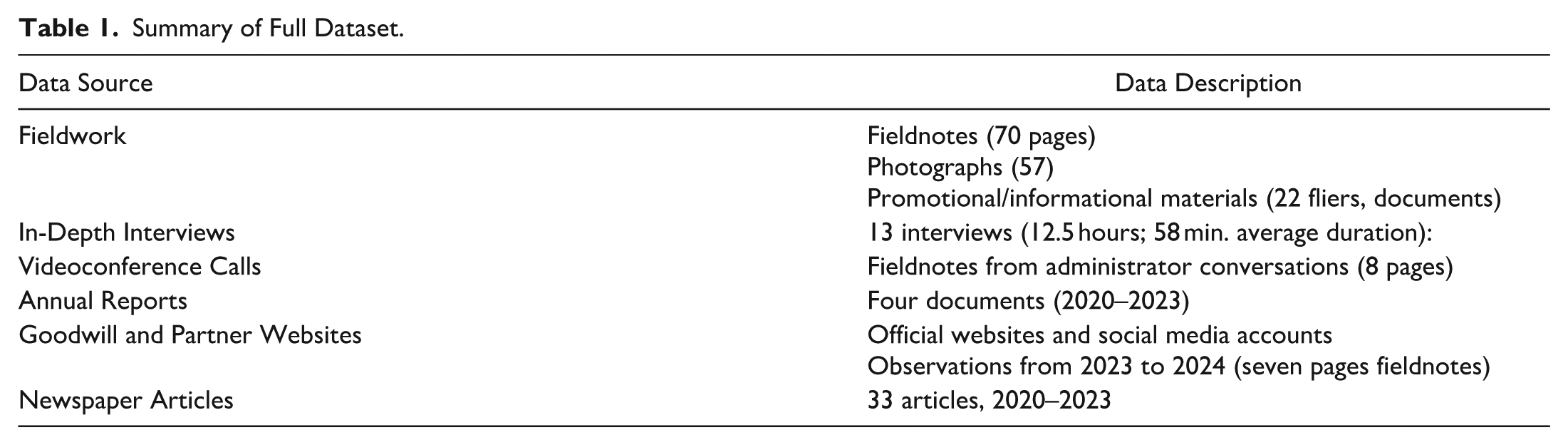
We began by holding videoconference calls with organization administrators who introduced us to Goodwill Industries of Kentucky’s unique financial vulnerability support model. These discussions provided a background understanding of the social service system, and our fieldnotes from these calls served as a valuable source of data, which we compared with later observations and interviews with clients and service providers.
In the summer of 2023, the first and second authors spent three days immersed in the organization’s social service programs. The researchers and Goodwill administrators agreed upon a range of locations where clients received multiple services, which allowed for observations of the service system being orchestrated. This fieldwork included visits to retail stores, social service centers, and housing facilities. In the field, the authors took detailed written jottings and audio notes while observing, interacting, and conducting informal ethnographic interviews (Emerson, Fretz, and Shaw 2011). The researchers visited all sites as a team, but they split up at times to observe multiple facets of the same site simultaneously. After leaving the field each day, the authors used jottings, photographs, and program documents to write 70 single-spaced pages of fieldnotes documenting program offerings, physical locations, interactions between clients and service providers, and meetings with Goodwill Industries administrators.
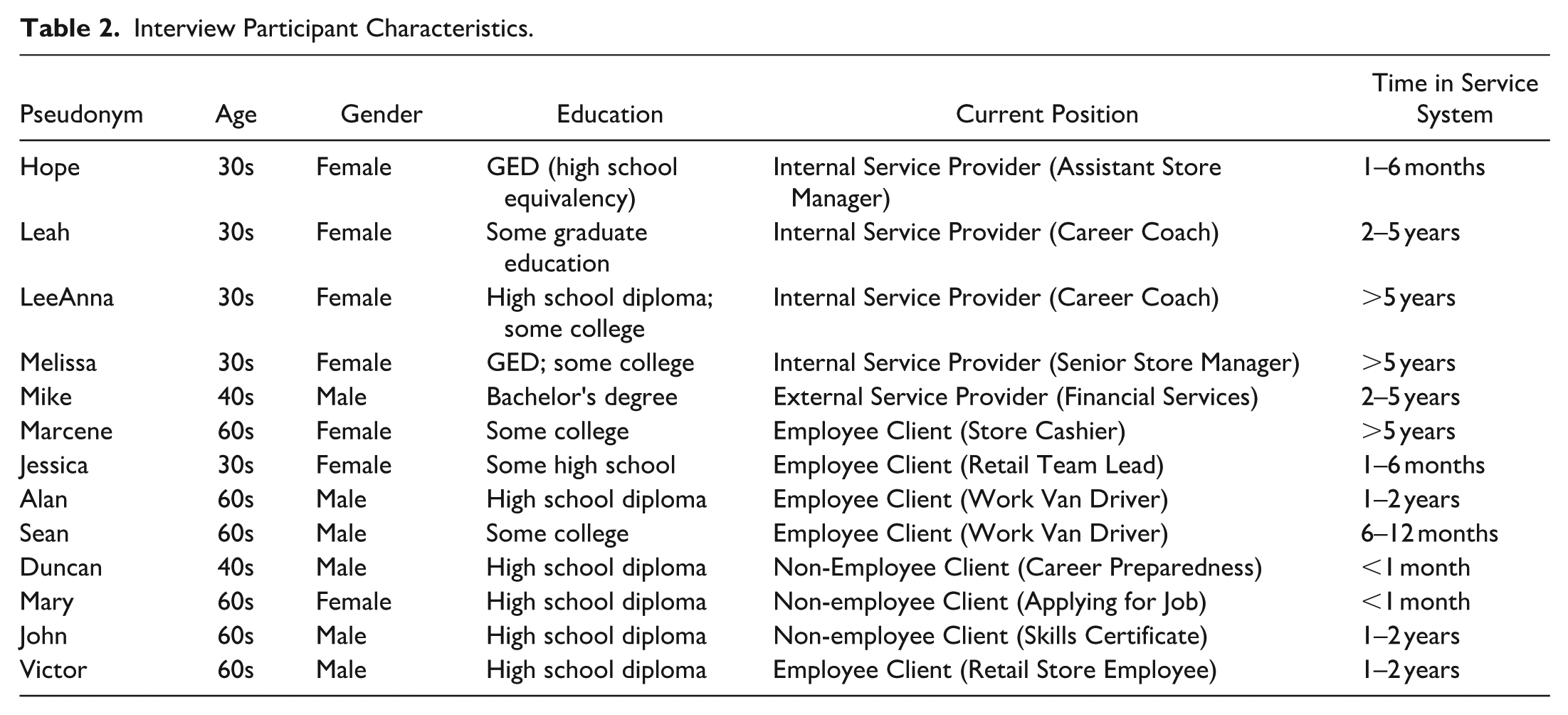
The first and second authors conducted in-depth interviews with 13 individuals, including five employee clients, three non-employee clients, four internal service providers (e.g., store manager, career coach), and one external service provider working for a financial services partner. Participants reflect socioeconomic backgrounds prevalent in Goodwill’s organization, with most having experienced homelessness, addiction, incarceration, or a combination of intersecting challenges. To protect participant anonymity, we do not report their race, ethnicity, or precise ages. Six of our interview participants are racial or ethnic minorities, primarily African American clients and service providers, which approximates the diversity of Goodwill’s organization and of the surrounding urban areas. Table 2 summarizes key characteristics of our interview participants. The distinction between Goodwill’s clients and service providers is blurry, with many store managers and career coaches starting their journey as clients experiencing their own financial challenges and continuing to receive social services. We asked Goodwill Industries of Kentucky to invite clients and service providers who have experienced different services and have taken different paths through their service system to participate in interviews. Goodwill employees assisted with scheduling interview times and locations, and we worked with a university research ethics board to ensure that recruitment did not involve social coercion, such as power dynamics between clients and managers, or financial coercion, such as pressure to participate for pay. Participants could volunteer to meet with researchers before or after scheduled service appointments or during paid working hours. In gratitude for participants’ time, each interviewee received a $20 gift card from the research team and a $20 gift from Goodwill, valid at a discount department store and a popular sandwich chain, respectively.
Interview Participant Characteristics.
Interviews averaged 58 minutes in duration, ranging between 26 and 94 minutes. We began with grand tour questions about participants’ backgrounds and followed a semi-structured interview guide to discuss topics related to initiation and ongoing participation in Goodwill Industries’ services (McCracken 1988). All in-depth interviews were conducted in person, audio was recorded, and recordings were transcribed. We quickly reached theoretical saturation in interviews and observations involving clients and internal service providers, who repeated similar phrases and experiences that became familiar themes after only a few interviews. We did not reach saturation in the field regarding the experiences of external partners due to limited access to these actors. To fill this gap, we collected archival data to examine external partnerships and more fully understand Goodwill’s organization context. Archival data included websites for internal programs and external partners, as well as Goodwill’s annual reports and local newspaper articles mentioning Goodwill Industries of Kentucky between 2020 and 2023.
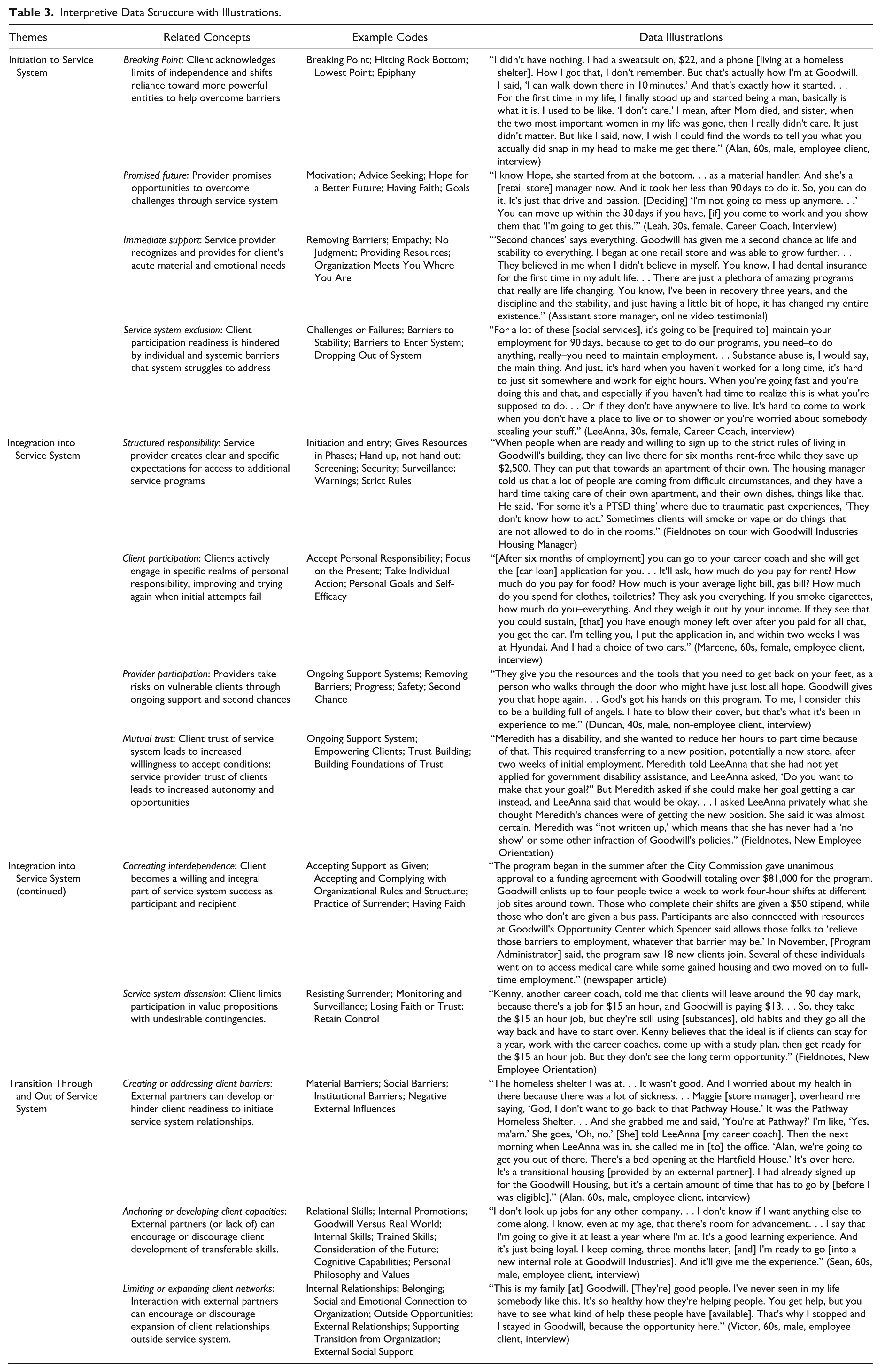
Following data collection, interview transcripts and fieldnotes were coded by the authors and two graduate student research assistants using nVivo qualitative data analysis software. We followed a grounded theory approach to interpretive analysis, where we developed themes and theoretical explanations based on patterns and relationships observed in our qualitative data (Glaser and Strauss 1967). Coders discussed themes and refined code names and categories iteratively to develop a data structure (Gioia, Corley, and Hamilton 2013), which we organized around processes and themes that emerged in relation to coding and in comparison with prior research and theory (Suddaby 2006). The final data structure is presented as Table 3 at the end of our findings. We also presented our findings to Goodwill Industries of Kentucky service providers, who provided additional information and compared our interpretations favorably to their experiences.
Interpretive Data Structure with Illustrations.
From our analysis, we identify a process that enables social service systems to support consumers experiencing financial vulnerability, whom Goodwill Industries and other social service organizations refer to as “clients.” Figure 2 illustrates this process, which unfolds through interactions between clients and service providers who may be internal or external to the service system. We present a detailed analysis of this model in the following sections, beginning with clients’ entrance and initiation into the service system.

A holistic social service system delivery model.
Initiation into Social Service Systems
Goodwill Industries of Kentucky positions its service system on the frontlines of financial vulnerability by locating branches in high-poverty areas and partnering with external organizations, such as food banks and shelters for unhoused people. Consumers often become aware of Goodwill either through referrals from friends, family, or external organizations or through Goodwill’s promotion and outreach initiatives. Referrals can be particularly impactful when consumers themselves deem they are ready to seek help from outside entities. As illustrated in Figure 2, readiness to seek help typically occurs when consumers experience breaking points, such as incarceration or homelessness, and the associated significant financial vulnerability that prompt them to seek external support. Clients commonly describe the breaking points leading them to Goodwill Industries as being “at the bottom” (Sean, 60s, male, employee client) or “I was broken. . . at my lowest point” (John, 60s, male, non-employee client). The severe vulnerability experienced at these breaking points means that consumers often feel compelled to shift reliance toward more powerful entities to overcome seemingly unsurpassable barriers, similar to the way Alcoholics Anonymous participants rely on a higher power to overcome addictions after “hitting bottom” (Greil and Rudy 1983, p. 5). While inflection points like these can initiate trajectory changes (Salisbury et al. 2023), subsequent movements can progress toward increased or decreased vulnerability (Mende et al. 2024). We find that the direction of change depends on service system initiation and integration processes that involve both internal and external partners, and that vary based on consumers’ participation readiness (see Figure 2).
Facilitating Readiness Through Immediate Support and Promised Futures
In addition to potential clients reaching out to Goodwill for help, Goodwill also promotes its services proactively. Frontline service providers engage in community outreach to connect with financially vulnerable people. They offer promises of better, less financially vulnerable futures through a suite of services designed to address both acute needs—such as housing, food, clothing, or identification—and broader barriers to stability—such as access to transportation, medical care, financial systems, and jobs—with the intent of helping potential clients see the value of the social service system. Sean (60s, male, employee client) works in a program that serves unhoused people. He describes such outreach efforts: Literally, we ride around the city and see people flying a sign [soliciting for money]. ‘Hey, you want to work today? You want to make 50 bucks? We’ll feed you a hot lunch.’ But our goal is to get them connected to services. If they don’t have ID and they don’t have birth certificates, they don’t have social security cards, we’ll pay for birth certificates, we’ll pay for their IDs. We get them connected with insurance. If they don’t have a phone, we have a lot of partners. Goodwill has a lot of partnering companies. . . We usually get on the jobsite about 10 o’clock, then 11 o’clock take a break, 12 o’clock we eat lunch. . . and we tell them about the services and things that Goodwill offers. Then we turn them over to Goodwill’s career coaches, and they do the follow-up, trying to get them job ready, get them work ready. . . They’ll buy clothes for them, work boots.
When working with these potential clients, Sean offers immediate support—including a meal and a paycheck—while continually promising a better future through Goodwill’s programs. Such promises are reinforced by Goodwill’s employment model as many of Goodwill’s service providers have participated in the system themselves, including Sean who began working at Goodwill after recovering from a decades-long substance addiction. One senior administrator said about Goodwill’s staff, “Most of our staff have a story” (fieldnotes). Service providers’ first-hand experience lends empathy and authenticity that help clients believe in the future benefits promised and accept their roles in the service system—key aspects of service system participation readiness (Dong et al. 2015).
Potential future benefits also feature prominently across Goodwill fliers and recruitment materials that advertise available services and include bullet-point lists of “educational and training opportunities,” and describe “customizable transportation packages,” among numerous other promises of future support. To further help prepare potential new clients for initiation, Goodwill incentivizes consumers to interact with and learn about available services. As a Goodwill Industries administrator describes in an annual report, “Providing piecemeal services is not enough, so we band together with our many partners for a holistic approach.” Fieldnotes from a weekly “partner day” show these external service partnerships in action: Once a week Goodwill hosts partners at about 20 tables set up throughout a large room. . . About half an hour after things started, Kimberly, a woman in her 50s who is a senior administrator at Goodwill Industries, made an announcement with a microphone that you could get a slip of paper with six blank spaces on it. If you got six different service providers at the tables to sign the slip, indicating that you had talked to them and received some information, you could bring it back to the front desk and be entered into a drawing for a $25 gift card. Goodwill employees and interns were going around handing out these slips to everybody. Kimberly added, ‘You gotta play to win. . . That means get some education while you’re at the tables.’ Later on, she told us that someone might come in thinking they just need legal aid, or they just need a job from Goodwill. But if Goodwill can get them to talk to partners at a bunch of other tables, then they can realize that there are other services: mental health, nutrition assistance, and other things that are available.
Upon indicating interest in entering the service system, Goodwill career coaches (acting as service orchestrators; Breidbach, Antons, and Salge 2016) and community partners work with potential new clients to identify and address any existing acute needs such as housing, food, clothing, and/or identification that may hinder or prevent potential clients from entering the social service system. In other words, they work together to facilitate client participation readiness. For instance, Goodwill may refer unhoused clients to temporary housing providers and/or fund other clients’ applications for identification required for employment. The promise of future stability coupled with immediate support facilitates clients’ positive perception of benefits and acceptance of their roles. Importantly, clients also point to the individualized attention, optimism, and dignity they received during these early and ongoing interactions with Goodwill Industries as critical to their initiation and success. As Duncan (40s, male, non-employee client) says, “They see something in you when you don’t even see nothing in yourself.”
Despite such efforts, however, the value created by these initial connections remains contingent upon client action and initiative, which can often result in potential clients failing to participate sufficiently to receive the service system’s available support. For instance, many clients opt for sporadic day-to-day employment with Sean’s work crew, rather than steady employment and financial stability through Goodwill’s service system. In Sean’s words, “I tell them, I say, ‘What? 50 bucks or a long-term job? You got to weigh the difference.’ But sometimes when you’re homeless, 50 bucks is me surviving another day.” Ultimately, we find that a lack of full integration between internal and external service providers to address barriers that hinder or prevent client readiness during initiation, combined with clients’ varying degrees of abilities or willingness to comply with providers’ requirements, excludes many people from the service system, as we discuss next.
Contingent Value Propositions and the Impact of Readiness on Service Exclusion
Goodwill Industries of Kentucky defines success within its service system as increased self-sufficiency, which career coaches measure along ten dimensions (e.g., housing, food, healthcare, income) during monthly client meetings. Successful participation, from Goodwill’s perspective, means that clients progress from situations on these dimensions that coaches assess as “crisis” or “vulnerable” toward “empowered” positions of stable independence. Goodwill tracks aggregate completion numbers for its many programs, but the organization does not prescribe specific rates of program participation for individual clients, whose personal circumstances and readiness for programs vary widely. After providing immediate support, providers invite clients to participate more fully in the service system by accepting contingent value propositions (Figure 2), which we define as promises of service support and outcomes that are conditional on clients and providers fulfilling specific obligations or responsibilities. As an example, clients may be invited to participate in an educational program, such as a secondary school diploma or career readiness course, or to work at one of Goodwill’s retail locations. These forms of participation, however, are contingent on clients’ abilities to reliably transport themselves to specific locations at certain times and refrain from illicit drug use. Others may be eligible for additional housing support, contingent upon following rules and regulations such as curfews and visitor limitations.
Contingent value propositions support Goodwill’s organizational culture, which is built on ideals of personal responsibility and self-sufficiency. The organization views transitions through and out of the service system as successful to the extent that client participation builds capacities for increased stability and independence. Clients and service providers frequently reference these goals using aphorisms such as “teaching them how to fish” (fieldnotes), “an honest day’s work for an honest day’s pay” (John, 60s, non-employee client), and “giving a hand up, not a handout” (multiple participants). These cultural tropes bridge tensions between individualism and collective responsibility that social service organizations navigate in the United States (Hong et al. 2022), and which Goodwill Industries accomplishes through contingent value propositions that invoke both client participation and service provider support.
To fully participate in the service system, applicants must demonstrate readiness through screening that includes processing identification and passing a drug test. If identification proves a barrier, Goodwill can fund applications for new or replacement documents. But when a person fails a drug test, “Goodwill would tell them to come back and take another drug test in two weeks” (fieldnotes). Goodwill does not have the resources or expertise to provide in-house addiction recovery services, so some clients are excluded and must seek out external partners, such as treatment or rehabilitation centers, for support with barriers to service system initiation. Such centers typically operate as independent programs that Goodwill cannot directly orchestrate, leaving individuals to develop readiness on their own and amid vulnerable circumstances. Due to a myriad of reasons, many consumers fail to seek out such support, as explained by an external partner offering outpatient addiction recovery services who states that “people come to him every week here [at partner day]” but added that “he wished more people would actually come to their unit and take advantage of what they offered” (fieldnotes).
Even after passing the initial screening, clients often face additional barriers that lead to exclusion. In an urban area where we conducted fieldwork, Goodwill hires about 20 new clients for internal retail positions each week. However, only about half of these hires typically continue for more than 2 weeks (fieldnotes, service provider interviews). New employee orientations take place after 2 weeks to focus training and human resources on clients who are most likely to continue in the service system. When asked about this relatively high rate of service exclusion, providers explain that some clients “just weren’t ready” (fieldnotes). Melissa (30s, female, internal service provider) is a store manager who explains client readiness in these terms: I’ve had people that worked for me, and they went back to prison, and [then] they went back to prison again. So, at some point in time, you get tired of going back to prison, or you get tired of living on the streets, you get tired of being homeless, you get tired of not succeeding in life. But it has to be you. I can’t get tired for you. Goodwill can’t get tired for you. We can only offer you, ‘Here, this is what we have for you.’ Either you accept it, or you don’t. Either you’re tired or you’re not, and that’s it.
Readiness for Melissa entails reaching a breaking point that is powerful enough to prompt full initiation and engagement in the service system. Reaching such a breaking point may help client readiness by motivating clients to recognize the benefits of participation and accept roles or opportunities in the service system (Dong et al. 2015; Rothschild 1999). But breaking points do not endow clients with new abilities or remove barriers to participation, which may explain why a person’s life trajectory can change in positive or negative directions following such inflection points (Mende et al. 2024). The common explanation that clients are not “ready” glosses over the importance of cocreating readiness through support for service system initiation.
Many clients who eventually succeed in increasing financial self-sufficiency through the service system describe previously failing multiple times outside of Goodwill’s coordinated support. LeeAnna (30s, female, internal service provider) is a career coach who spent years attempting to overcome a substance addiction through recovery centers that permitted her children to stay with her. She later lost custody of her children after multiple relapses while trying to balance participation in recovery center services with parenting responsibilities. However, temporarily losing her children provided an unexpected silver lining: LeeAnna not only reached a critical breaking point but also became eligible for an intensive rehabilitation program that did not permit older children to stay in residence. She ultimately overcame her addiction, regained custody of her children, and began working at Goodwill Industries. She says, “It’s so hard for mothers, people with kids, and you really do have to prove yourself, as you should, but there aren’t as many options for women with children.” LeeAnna accepts personal responsibility for participation, but a lack of options that support her through multiple barriers—addiction and parenting—hindered her ability to fully participate. After LeeAnna received support from an external partner who could prepare her to participate in Goodwill Industries’ full suite of services, she began to succeed by gaining capacities that reduced her financial vulnerability. In summary, exclusion from service initiation results when internal and external providers fail to work together and integrate their services to support client readiness. Given this, we find that clients who are deemed “ready” typically progress and more deeply integrate into the service system only after addressing acute barriers to maintain a steady job or attend regular classes and meetings, which the social service system requires for full engagement.
Integration Between Clients and Service Providers
Following initiation, the service system enables deeper integration and opportunities to participate in further contingent value propositions by providing structured responsibility that includes specific expectations for client action and service provider support (see Figure 2). To summarize the integration process, clients develop trust in the service system as they experience support and benefits from providers, which in turn increases their willingness to accept the system’s structures of responsibility. At the same time, service providers develop trust in clients who exhibit patterns of responsibility within these structures, which leads to opportunities for clients to participate in additional programs. Clients are susceptible to vulnerabilities when they dissent from service system structures before developing abilities that improve their chances to succeed by attaining stable, self-sufficient independence. Close integration between internal and external service providers helps clients develop these abilities and expand their networks to enable future participation inside and outside of the system. Conversely, a lack of integration between these partners means that clients may anchor on skills or abilities that transfer less readily to outside organizations, resulting in clients becoming dependent on internal structures and resources, which can impede their ability to transition beyond the service system. In the next sections, we demonstrate how clients and providers cocreate independence, as well as how clients negotiate independence from, and dependence on, the service system.
Structured Responsibility and Mutual Trust
Programs available through Goodwill’s social service system require clients to take specific actions within a defined area of responsibility. For example, employee clients can opt into Goodwill’s retirement plan after 2 weeks of stable employment, and they qualify to receive up to a 5% contribution match after 6 months of employment. Six months of employment is also a prerequisite responsibility for participating in Goodwill’s car loan program, which offers reliable used cars purchased through partner dealerships. Marcene (60s, female, employee client) explains, “If you never miss a payment, you’re never late, you get all your interest back after you pay the car off.” Goodwill structures contingent value propositions like these so that clients take on responsibilities as they gain or demonstrate readiness through previous participation. As clients take on new roles, Goodwill also takes on the additional responsibility of greater financial support and more personalized coaching for vulnerable clients.
Duncan (40s, male, non-employee client), who began participating in Goodwill’s career preparedness training after completing a substance abuse rehabilitation program, describes Goodwill’s ongoing support: What [the career coach] would do is she would help you go over a budget and help you meet—remind you of these goals you got, and you come up with a plan. They help you come up with a plan and you follow that plan, and then whatever they need to do on their end they’re going to do.
Regular and ongoing participation gives Duncan access to a career coach who mentors him individually, providing knowledge and recommendations that supplement in-class training. Duncan’s self-correction in this quote, explaining that career coaches merely “remind” him of goals that he sets, showcases his acceptance of the active role he plays in the service (Dong et al., 2015). But Duncan also understands that Goodwill takes responsibility to do “whatever they need to do on their end” to augment his personal efforts. Goodwill’s employee handbook further illustrates the dual nature of mutual trust and structured responsibility between clients and providers, describing both “Goodwill’s Commitments” and “Goodwill’s Expectations.” Through continued participation in contingent value propositions, Goodwill and its clients share vulnerability and develop mutual trust by each taking on risks and responsibilities.
As clients integrate more deeply into the system, career coaches also regularly assess their financial stability and vulnerability across a range of indicators, including debt, housing, transportation, physical health, mental health, and addiction. This addresses both deficits and strengths (Raciti, Russell-Bennett, and Letheren 2022), as career coaches recommend programs that provide remedial assistance (e.g., mental health services, financial literacy), remove barriers, and provide responsibilities that match client readiness. For example, a senior administrator describes how some clients feel shackled by “impossible” child support obligations after leaving incarceration. The administrator explains that Goodwill’s career coaches sometimes contact social services workers and creditors to negotiate on behalf of their clients, because their knowledge and experience makes them sound “more professional. . . we get respect” (fieldnotes). During such interactions, career coaches not only connect clients to services but they also model strategies for clients to successfully navigate these services independently in the future.
Goodwill also builds links with external service providers to help clients develop new abilities to address both the breadth and depth of their current vulnerabilities (Mende et al. 2024). For example, a recently constructed “opportunity center” not only hosts services offered by Goodwill Industries but also houses an external financial institution, food service startup, space for services offered by community organizations, and even a medical center operated by a private healthcare company. As a Goodwill administrator summarizes, this “provide[s] a powerful combination of resources to help strengthen the lives of many local residents” (newspaper article). Integrating multiple social services empowers clients to take on opportunities with support to fulfil new responsibilities inside and outside the service system.
Interdependent relationships between clients and the service system enable mutual trust, which is needed to navigate the risks and potential vulnerabilities that come with independence. Mike (40s, male, external service provider) is a representative for a bank that partners with Goodwill to provide clients with free checking accounts. He says that overdrafting during emergencies like overdue rent or unexpected medical expenses represent one of the most common reasons clients become excluded from mainstream financial institutions. He describes how Goodwill’s career coaches help clients navigate this financial vulnerability: You [the client] can decide how you want us to handle overdrafts. So, if you swipe your card and you don’t have the funds, you make a decision up front, [so that] if the funds aren’t there, [we] decline it. Now, I can’t sway your decision. That’s the bank—that’s a federal policy. But when I open accounts in front of [career] coaches, they can have that conversation. So, I may say, ‘Hey, at this point we’re going to talk about how you want us to handle an overdraft, should it occur on a swipe.’ They [the career coaches] are like, ‘You should opt out. We don’t want you to incur fees or whatever.’ So, we don’t get as many calls, even at the bank, these days, as we used to about overdraft. . . I would say 95% of the people at Goodwill opt out [of allowing overdrafts].
Mike understands that overdrafing can create unnecessary vulnerabilities for clients with limited financial resources. However, federal law prohibits him from advising clients about how to manage this risk. The partnership with Mike’s bank means that he sets up accounts with clients at Goodwill locations where career coaches are available to provide guidance. Goodwill’s service providers understand individual and structural barriers that its clients face in financial services, and they identify ways that standard financial services like overdraft protection can hurt rather than help. Equally importantly, Goodwill’s service providers establish sufficient trust with their clients to provide advice without coercion. At the same time, Goodwill also guides clients through the risks and opportunities that its partners provide. By integrating external opportunities for independence with internal support, clients access resources at the same rate that they develop the ability to sustain long-term financial independence.
Dissension from Contingent Value Propositions
Sometimes clients resist or refuse conditions placed on their participation in Goodwill’s social service system. Mary (60s, female, non-employee client) accepted employment in one of Goodwill’s retail stores. She values thrift and feels a moral responsibility to avoid waste, so she dissented from Goodwill’s procedures for discarding unsold merchandise. She says, “My heart’s breaking. They’re telling me to throw it away. . . and my mind is racing, trying to think of ways to buy it, because that’s all I could think to do, because I didn’t want to throw it away.” Mary’s dissension from Goodwill’s structured responsibilities places her in a vulnerable position, where she feels compelled to spend rather than save to rescue products from the landfill. Mary eventually quit the job and exited the system to dedicate more time and effort to recycling and repurposing waste. Unfortunately, Mary continued to face barriers, including family trauma and abusive relationships, which eventually prompted her to initiate a new relationship with Goodwill Industries. Contingent value propositions can provide opportunities for structured growth, but they can also pit these opportunities against client independence. By dissenting from the service system’s structures, clients like Mary lose available support and may exit the system prematurely, before becoming ready to succeed in sustaining financial stability (see Figure 2).
Similarly, Sean (60s, male, employee client) utilizes multiple integrated services within Goodwill’s system, including career training, employment opportunities, and an automobile loan assistance program. However, Sean says, “I turned down the housing here. . . I have no problem with living with somebody else, but when you put a camera in my apartment, I can’t do that. That was too much for me. I said no.” For housing program participants, Goodwill deposits the first 6 months of on-time rent payments into a savings account available to pay for a deposit on a future apartment outside the service system. They also install security cameras in shared kitchen and living areas. Despite giving up resources that could fast-track his future financial independence, Sean views the conditions attached to this housing service as an invasion of his privacy and independence. He explained to us that he “struggled” with his career coach to find stable housing, and he is “still fighting with him [the property manager] a little bit. . . to get my paint done and stuff like that. But at the end of the day, I get to walk into my own place.” Sean’s dissension prioritizes a vulnerable state of independence, gaining the freedom of walking into his “own place” at the expense of integrated support and resources for developing his capacities.
As clients consider their options, some avoid dissension by reframing potential losses of independence as temporary investments in greater future financial power. Hope (30s, female, internal service provider) told us that the engine in a truck she recently purchased used from a stranger “blew up and I can’t find anyone to put another engine in.” This left Hope relying on public transportation and expensive Uber rides for her commute. Hope considered turning to payday lenders to finance truck repairs, but she says, “I know it’s a trap, basically. It’s money, but it’s expensive.” For Hope, independence would come at the risk of long-term vulnerabilities, and at the expense of lost support and mentoring from Goodwill career coaches. Instead, Hope plans to utilize Goodwill’s car loan program, including financing a used vehicle that she explains comes “from a decent car lot. I think you can get four door sedans. I’m more of a truck girl, but crawl before you walk.” Hope reframes her surrender to Goodwill’s contingent value proposition as a temporary compromise on her identity as a “truck girl.” She accepts the promise of greater future independence, described by Goodwill as “a life with real choices” (annual report), by choosing to invest her present independence in developing financial power within the security of the service system and increase her readiness to achieve greater future independence.
Dependence and Interdependence Within the Social Service System
In contrast to clients dissenting from Goodwill’s rules and requirements, we also find that others can become so dependent that they remain in Goodwill’s supportive system despite readiness to transition beyond it (see Figure 2). One of Goodwill’s senior administrators admits perhaps too many of its long-term clients fail to gain the confidence or motivation to “leave the nest.” Melissa (30s, female, internal service provider), a store manager, describes her perception of opportunities inside and outside of Goodwill: There are some people that are on disability that have to work that part-time, and we absolutely have those [roles] for them. But we also need people who are going to be managers, who are going to be senior managers, who are going to be regional managers. We need those people too. So that’s what I decided to do. I thought, ‘I really like it here.’ So, it’s team lead, and then it’s assistant manager, and then a general manager. So, I just moved my way up through Goodwill, and that’s why I’m here today. I probably—I haven’t thought about leaving. I really haven’t.
More than a decade of management experience may qualify Melissa for better-paying external positions. However, clients like Melissa view Goodwill’s supportive culture and holistic programming as so different from that of external organizations that they often cannot envision life outside. A lack of confidence or experience in transferring internal capacities to external opportunities explains part of this challenge. But perhaps equally important is that Melissa feels that Goodwill “needs” her and others with internal knowledge and capabilities to support its programming. Detachment from Goodwill’s service system can free people like Melissa from internal constraints, but many choose instead to remain interdependent participants in a system where they feel both needed and supported. Many clients express a belief that “everything that you could ever want is in Goodwill Industries” (Jessica, 30s, female, employee client, interview). Clients who remain with Goodwill for years have limited opportunities for growth beyond promotion into retail store management or career coaching, which are both competitive career tracks. Within the service system, clients develop new abilities and take on new opportunities in well-supported roles (Dong et al. 2015; Rothschild 1999), but these experiences may not translate into belief in, or motivation for, seeking external opportunities.
Close collaboration with external partners during the service system integration process helps to mitigate the potential for overreliance or dependence. Clients who do not enter Goodwill’s service system through employment sometimes have more support for integrating with external partners. For example, Duncan (40s, male, non-employee client) worked on his resume and participated in a career training class that helped him obtain a position at a large manufacturing plant. He says, “When I was down there on their computer, I was working on my website, or I was working on typing up my book, or I was working on typing up [and] editing my business plan, or I was filling out an application [for a job]. And they all go hand in hand because I need that job for my personal stability while I work on these business loans and these business grants.” Duncan accesses service system resources for a wide range of goals; his career coach even proofread a draft of his memoir. Since Duncan’s responsibilities as a non-employee client do not confine him to specific internal tasks, Goodwill can support his overall “personal stability” through both internal and external opportunities.
We do find that Goodwill is restructuring some of its services to better integrate with external partners that can support transferable skill development. Shortly after a regional healthcare center opened on one of Goodwill’s campuses, a hospital administrator describes, “You can see the partnerships and relationships that are developing, and the trust and relationships that are developing between our patients and providers. So, as we hoped that we would close that gap and disparity [in healthcare access], we’re starting to see that happen” (partner website). Goodwill’s existing relationships with community members enable the formation of new relationships between financially vulnerable consumers and external service partners who provide greater inclusion and reduced vulnerability. Mike, the bank representative who offers services tailored to the needs of Goodwill’s clients, similarly explains: Folks that work at Goodwill, because they have a partnership with us, they can get the best type of account we have for free. It’s normally $20 a month, but they don’t pay for that. They never pay for it.
By partnering with external service providers, Goodwill extends the mutual trust it develops with clients to support the formation of supportive relationships with external financial institutions. Each organization shares responsibility for the client’s overall financial well-being, including their financial stability or vulnerability outside the social service system. The bank not only provides opportunities to develop transferable skills, such as monitoring bank accounts and interfacing with financial institutions, but it also extends its support even after the client’s employment at Goodwill ends. This prevents banking services from creating new or unexpected challenges for clients as they transition out of the social service system, because clients remain partially integrated into the system’s support and benefits. Goodwill holds up self-sufficiency as an ideal for success, but its integrated programs recognize the need for holistic support that empowers clients to sustain stable independence. Close integration between external and internal partners during transitions out of the service system ensures that clients continue on positive trajectories after the critical inflection point that a system exit represents. Table 3 provides a summary and additional data illustrations, and the following section discusses our contributions.
Discussion
Our research analyzes a process through which social service organizations can integrate programs and opportunities to address the multiple, intersecting challenges that affect consumers experiencing financial vulnerability. Using a single embedded case study, we find that providers within holistic social service systems initiate relationships with clients by offering immediate support and promising a better future. At the same time, potential clients initiate relationships with service providers after reaching breaking points that motivate a search for help. During these early encounters, some potential clients may be excluded from initiation into the service system when service provider expectations for client readiness exceed the system’s capabilities for cocreating readiness. After initial support is given, service providers invite clients to participate in contingent value propositions, which offer further opportunities and resources based on specific conditions of participation. Following initiation, clients integrate into the service system by taking on responsibilities supported by programs that engender mutual trust. Clients may forgo internal development opportunities by dissenting from contingencies attached to value propositions within the social service system. Conversely, clients may forgo opportunities for external growth by becoming overly dependent on support inside the system. Each of these challenges can be addressed through closer integration of internal and external service partners throughout the system. In the following sections, we discuss our research’s contributions to theory on vulnerability and service systems, directions for future research, practical implications for addressing financial vulnerability, study limitations, and conclusions.
Contributions to Vulnerability and Service System Theory
Multiple, intersecting barriers often hinder attempts to address consumer financial vulnerability one factor at a time (Baker, Gentry, and Rittenburg 2005; Morduch and Schneider 2017; Saatcioglu and Corus 2014; Salisbury et al. 2023). Our holistic social service system model contributes important theoretical insights into (1) the cocreation of client readiness to participate in service systems and (2) the system-level orchestration of social services.
Our first contribution is an explanation of how client readiness for social services can be cocreated. Social service systems can integrate individual programs in ways that address both the breadth and depth of financial vulnerability to facilitate client readiness (Mende et al. 2024). Breadth of vulnerability involves the multiplicity of interconnected factors affecting consumer experiences. For example, a new client may initiate a relationship with Goodwill while they are unhoused, suffering from chronic health conditions, and lacking reliable transportation. These challenges influence one another, shaping experiences of financial vulnerability in intersecting ways. Rather than offering discrete programs that address each challenge separately, Goodwill’s service orchestrators connect clients with temporary housing, healthcare services, bus vouchers, and a long-term relationship anchored on employment or participation in training programs. This holistic approach is most effective when multiple programs are closely integrated because many barriers (e.g., housing, employment, and transportation) are best overcome in tandem. Depth of vulnerability increases with greater exposure to hardships (Mende et al. 2024). By enabling different levels of participation, social service providers can tailor strength-based support around clients’ changing degrees of readiness. While some clients have characteristics that enable rapid integration into the service system, in line with prior research on participation readiness (Dong et al. 2015), we find that many clients receive deepening levels of support that match their increasing ability to take on new responsibilities. Clients who are more deeply embedded in vulnerable situations can develop readiness to participate as service providers support them in specific roles or responsibilities, such as attending classes or meeting with career coaches.
To theorize the relationship between provider support and client participation, we introduce the concept of contingent value propositions, which make specific forms of support available contingent on varying levels of client participation. Contingent value propositions draw on aspects of both strength- and deficit-based approaches to vulnerability (Raciti, Russell-Bennett, and Letheren 2022; Russell-Bennett et al. 2023). Goodwill’s career coaches identify specific challenges that threaten clients’ well-being, leading to recommendations for training or education. However, rather than blaming individuals for shortcomings (Russell-Bennett et al. 2023), Goodwill identifies actions that clients can take with service system support to build on strengths and increase abilities. By offering opportunities for individual action within a safe, structured, supportive service system, contingent value propositions offer security without diminishing autonomy (c.f., Sandberg et al. 2022). Furthermore, while prior research suggests that motivation and readiness are crucial for participation in any service (Dong et al. 2015; Rothschild 1999), we show that service systems can cocreate readiness by providing holistically supported opportunities for growth.
Our second contribution is a system-level analysis of service orchestration. Goodwill’s career coaches act as service orchestrators, fulfilling a similar role to healthcare case managers, by connecting clients to needed services and coordinating their journey through the system (Breidbach, Antons, and Salge 2016). We extend prior research by examining service orchestration across stages of client participation (e.g., initiation, integration, transition/exit) and across internal and external partners. We find that service orchestrators can effectively connect clients to internal as well as external programs and providers, which have different impacts at different stages of participation. During initiation, for example, external providers and organizations nurture client abilities and motivation. Service orchestrators identify barriers to participation and integrate resources that help clients develop sufficient abilities to accept contingent value propositions. Service orchestrators also demonstrate the benefits of participation, often by embodying success as former clients who have overcome their own vulnerabilities through the social service system. Service orchestrators then make more opportunities available as clients integrate into a social service system, personalizing contingent value propositions through a tailored assemblage of programs. To support a successful transition or exit out of the system, service orchestrators act as network facilitators, navigating clients through a gradual transition into stable financial independence. Clients remain integrated with necessary services to mitigate the potential for negative inflection points that may become cliffs when people lose support.
A system approach to service orchestration avoids the expense of adding new programs (Mende and Van Doorn 2015) and instead personalizes access to already existing programming. As clients develop further abilities, their motivation also increases as they gain hope for a better future and confidence to achieve it. Furthermore, mutual trust and structured responsibility illustrate the importance of shared vulnerability in social service systems. Organizations like Goodwill Industries of Kentucky take on some of their clients’ vulnerability by offering resources to ease financial challenges. At the same time, clients take on risks associated with individual action to unlock the potential of these resources. During the integration stage, service orchestrators expose clients to programs and opportunities offered by both internal and external partners to give clients confidence to transfer abilities gained inside the service system to outside opportunities when they are ready. Participating within the structured responsibility of contingent value propositions involves a temporary surrender of client independence, but service orchestrators can help clients maintain motivation and avoid dissent by framing participation as an investment in future financial independence and by providing support that nurtures mutual trust.
Directions for Future Research
Future research can build on our theoretical contributions, examining both the cocreation of participation readiness and the orchestration of social service systems. First, further research on the cocreation of participation readiness could add important nuance to current theorizations of consumer motivation, opportunity, and ability to participate in social services (Rothschild 1999). Motivation is important, but our research challenges the common belief that motivation to participate in social service starts primarily internally (i.e., hitting rock bottom). Organizations may also provide external motivation to facilitate system entry and integration. For instance, it is not uncommon for P.E.A.R.L., a nonprofit organization working to provide pathways to addiction recovery, to integrate initially reluctant clients into its service system through partnerships with local law enforcement agencies (P.E.A.R.L. 2025). Future research might evaluate the impact and efficacy of service organizations providing external motivation to facilitate client readiness. Additionally, research can examine the role of service provider empathy or personal experience with financial vulnerability and social services, which Goodwill’s career coaches demonstrate, for authentically influencing client motivation.
Opportunity and ability are also central to participation readiness (Dong et al. 2015; Rothschild 1999). The novel concept of contingent value propositions provides a framework for examining how to align social service opportunities with client abilities. Research can further examine how far beyond a client’s current skills and experience a provider should push, balancing possibilities for growth with potential for failure. We show how contingent value propositions connect clients to a network of providers in relationships of trust and mutual responsibility. Future research can build on this insight by measuring and assessing the balance of support and expectations shared between clients and providers in social services. Additionally, examining contingent value propositions outside the social service system domain, including for-profit service contexts, also provides a potentially fruitful research direction. Many businesses expect customers to take on some level of responsibility for the cocreation of services, and the concept of contingent value propositions provides a lens for analyzing this dynamic relationship. Building on Goodwill’s approach to encouraging client action around specific responsibilities, what additional monetary or non-monetary incentive structures could providers employ to increase participation in service opportunities that can improve well-being?
Second, conceptualizing service provision at a system level can direct future research toward more comprehensive analyses of service processes and customer experiences. Insights from our study are particularly relevant for directing research on social services, which depend on a network of providers whose operations and impacts on consumer vulnerability are not always examined together (Rutman et al. 2020; Searle, Neuhoff, and Belton 2011). We identify the importance of orchestrating partnerships between clients and multiple providers. Prior work has examined the importance of orchestrating service opportunities (Breidbach, Antons, and Salge 2016), and we explain further that partnerships with external organizations can increase social services access and personalization of opportunities for clients’ unique experiences of financial vulnerability. However, additional research is needed to study how orchestrating organizations and individuals, such as Goodwill Industries of Kentucky and their career coaches, establish external partnerships that add value not only to clients but also to a broad range of organizations with diverse goals and resources. Similarly, future research can study how service systems respond to changing or inconsistent provider readiness to support clients through vulnerable experiences. Finally, building on Goodwill’s second-chance approach, how can organizations better orchestrate client re-entry after failing or dropping out of participation in a service partner’s programming?
Implications for Service Practice
Addressing financial vulnerability also means addressing barriers related to housing, education, mental health, substance abuse, justice system constraints, and other interrelated challenges. Integrating multiple programs through a service system provides stability during program or funding changes that inevitably arise due to political or economic dynamics. Many aspects of our case serve as a model for financial vulnerability service systems, while others point to opportunities for improvement. These implications provide lessons for service practice across consumers’ financial vulnerability journeys. We detail four specific recommendations below.
To support and motivate clients during initiation, providers can offer immediate support in conjunction with promises for the future. Although access to Goodwill’s full suite of services is contingent upon certain participation responsibilities, support for many acute needs is provided immediately (e.g., housing, food, clothing). Immediate support makes service promises feel real and authentic, especially when made by providers who have experienced service system benefits themselves. Following a similar approach, Finland and other locations have successfully reduced homelessness through “housing first” models, which provide immediate shelter to unhoused people and offer additional social services after meeting this basic need (Shinn and Khadduri 2020). Immediate support recognizes human dignity and invites people to begin the challenge of overcoming financially vulnerable circumstances from a position of strength.
Goodwill and other social service organizations often direct more attention to clients who are ready to integrate and thus require less effort and expense to serve. This focuses the service system on those who are most likely to succeed, excluding people who may need the most support but whose current motivation or abilities hinder their participation. Instead of waiting for clients to get ready, service providers can orchestrate alternative paths to help them develop readiness. Cocreating readiness is most effective when support is distributed and coordinated across organizations whose programs offer different forms of assistance. For example, Goodwill Industries could track and follow up on the needs and progress of clients who are preparing to enter the service system under the care of emergency housing or substance rehabilitation centers. Furthermore, organizations can intervene earlier in situations where people often experience financial vulnerabilities, such as within justice or education systems. For example, Goodwill Industries of Kentucky recently partnered with government and other non-profit organizations to open a youth-specific resource center to help young people develop abilities that may prevent future vulnerabilities and dangerous breaking points. Banks, credit unions, and financial regulators can apply this process by implementing readiness programs targeted at disadvantaged consumers who are less served by traditional financial institutions.
Contingent value propositions can address multiple barriers (breadth) through opportunities tailored to the extent of clients’ current vulnerability and participation readiness (depth). Providers and clients share vulnerability through contingent value propositions, with each taking on risks through specific roles and responsibilities. Goodwill’s auto loan program, for example, removes transportation barriers that prevent stable employment while also reducing client barriers to credit and purchasing power. At the same time, Goodwill bears the risk of financially vulnerable clients not paying according to loan terms. Tailoring such propositions to individual client needs is most effective when service orchestrators have access to a sufficient breadth of programs to address identified barriers facing people in financially vulnerable circumstances. As clients become more financially stable, they gain access to opportunities for deeper participation across a broader range of services.
As clients move through the service system, service orchestrators transition to networking roles by establishing and strengthening relationships between clients and external opportunities. Across many cities in the United States, for example, the Urban League provides business training to minority entrepreneurs and connects them to mentors as they develop knowledge and begin to execute business plans (National Urban League 2025). Peer support groups can also function as collective service orchestrators, recommending service opportunities and providing ongoing support. Transitional support is enabled by the close integration of internal service providers and external partners whose relationships and programming build transferable skills and connect clients to greater opportunities for financial stability and well-being.
Limitations
Our investigation is not without limitations. First, our data collection focused on participants who were currently participating in Goodwill’s service system, with a focus on understanding system entry and integration. This provided a limited window into the experiences of those who successfully or unsuccessfully transitioned out of the system. A focus on exits could have lent insights into any barriers these clients faced, including overdependence on Goodwill Industries, as well as strategies for successfully overcoming them.
Second, our interview participants entered the service system with varying levels of social capital. Some clients had very limited networks of support, while others maintained strong relationships with friends, family, and/or colleagues as they navigated the system. However, we were limited in our ability to examine the social networks of individual clients, leaving open questions regarding social network influences and interventions that may hinder or facilitate the development of relationships with people and communities external to the social service system.
Third, we did not examine differences between consumers entering the service system from different positions of financial vulnerability. Examining how to orchestrate services differently for clients experiencing chronic, long-term poverty versus temporary, short-term poverty is beyond our current scope but represents an important area for additional study.
Conclusion
Our case study, which examines the service model of Goodwill Industries of Kentucky, provides a comprehensive view of social service systems and a path forward that more fully accounts for and responds to changing client readiness to participate. We introduce the concept of contingent value propositions to theorize a service relationship established through mutual trust and responsibility, shared between clients and a network of internal and external opportunities orchestrated by an internal service provider. We encourage service organizations and researchers to build on our work to further address consumer well-being and vulnerability.
Footnotes
Acknowledgements
The authors thank Goodwill Industries of Kentucky for opening their doors to our research, and we express gratitude to the individuals who shared with us their extreme difficulties and uplifting experiences of facing financial vulnerability. This project also benefited from qualitative data analysis assistance from Sahar Rashidyravary and Selma Karim, as well as financial support from the Isenberg Summer Research Project Funding program.
Declaration of Conflicting Interests
The authors declared no potential conflicts of interest with respect to the research, authorship, and/or publication of this article.
Funding
The authors disclosed receipt of the following financial support for the research, authorship, and/or publication of this article: The authors received funding for travel and research expenses related to this project from the Isenberg School of Management’s Summer Research Funding program.
