






Abstract
This study develops an updated ranking of hospitality and tourism journals by assessing the influence assigned to those journals by researchers in each field. Journals are evaluated utilizing data collected from two groups, 62 of the top 100 researchers and 463 other researchers in the fields of hospitality and tourism. Results suggest that journals that are considered “top tier” in tourism and hospitality have remained relatively constant over the years. However, there is little consistency among the rankings of journals beyond the top journals in both fields. Annals of Tourism Research, Tourism Management, and Journal of Travel Research are found to be top journals in the field of tourism while International Journal of Hospitality Management and Journal of Hospitality & Tourism Research are identified as the top journals in the field of hospitality.
Journal assessment provides a tool for determining the quality of research published and enables scholars and administrators to identify changes in journal quality, which is important in rapidly evolving fields like hospitality and tourism. In addition to offering a heuristic to locate research outlets with the largest impact (McKercher, 2012), journal rankings also provide feedback to authors as to how the academic community regards their publications (DuBois & Reeb, 2000). Journal rankings allow others, possibly outside a given field, to make tenure and promotion decisions. Even though journal rankings may be a limited tool, individuals outside a field may need some metric by which to assess output. “Rankings often serve as that surrogate measure of quality” (McKercher, 2011, p. 969). “University administrators require greater knowledge of journal rankings to accurately evaluate faculty performance and productivity, hire faculty whose research agenda are congruent with the missions of their business schools and encourage inter-disciplinary scholarship” (Alexander, Scherer, & Lecoutre, 2007, p. 321). Furthermore, journal rankings are frequently used by accrediting bodies in their assessment of programs.
While it is relatively easy to identify the top journals in the hospitality and tourism fields, the rapid increase in the availability of additional publication outlets has made it harder for scholars and administrators to determine the quality or impact of outlets beyond those at the top. Over the past 40 years, the fields of hospitality and tourism have witnessed tremendous growth in the number of scholars, the number of academic journals and the amount of information generated in different aspects of these fields (Cheng, Li, Petrick, & O’Leary, 2011; Nunkoo, Gursoy, & Ramkissoon, 2013). According to McKercher, Law, and Lam (2006), only a small number of hospitality and tourism journals were available in mid-1970s; however, a recent TRINET posting by McKercher in 2013 identified more than 250 journals in the hospitality and tourism fields.
Researchers have indicated that it may be necessary to differentiate between the fields of hospitality and tourism. McKercher et al. (2006) argue “it is necessary to disaggregate the population of tourism and hospitality academics based on their respective fields of study to gain a more accurate understanding of the relatively importance of each group’s set of journals” (p. 1238). “Tourism, hospitality, leisure, and recreation are quite separate fields and should be approached as such in ranking and rating schemes” (Jamal, Smith, & Watson, 2008, p. 75). While journals may appeal to separate audiences in the fields of hospitality and tourism, most previous studies have combined the set of journals and not discriminated between respondents. Therefore, this study aims to develop updated rankings of tourism and hospitality journals separately.
The purpose of this article is not to debate the necessity or validity of journal rankings. Rather, this paper simply attempts to provide a current, relevant, and separate ranking of hospitality and tourism journals. This study utilizes two sets of data that were collected from 62 of the top 100 researchers and 463 other researchers in the fields of hospitality and tourism. This study aims to contribute to the literature by providing an additional tool that administrators and new researchers can use to assess journal influence as perceived by their peers.
Literature Review
Methods Used in Prior Studies
There are lively debates in many research disciplines regarding how and why journal rankings should, or should not, be done. According to McKercher et al. (2006) the five most common techniques used to rank journals are: citation indices and impact factors; acceptance rates; downloads from electronic websites or libraries; the use of expert panels; and peer review. Of these five, two approaches dominate the literature. The first approach uses peer evaluations to rank journals on perceived quality. The second approach uses journal citations in the academic literature associated with the discipline (Law & van der Veen, 2008).
Survey-based ranking methods utilize peer opinions to evaluate journal quality for specific research areas or disciplines. This method assumes that journal quality can be accurately assessed by researchers, authors and/or administrators of a specific discipline. Typically, this approach uses a survey to determine the aggregate view and subsequently produces a ranking.
Citation-based methods rate journals using an impact factor. The most common impact factor is provided each year by the Institute for Scientific Information, with the Social Science Citation Index (SSCI). The difficulty here is that only a small number of hospitality and tourism journals are listed in the SSCI (Ryan, 2005); most hospitality and tourism journals are not formally ranked. The Thomson ISI scale, which houses the SSCI, assesses 8,750 journals. In 2013, SSCI included 38 journals in the category “Hospitality, Leisure, Sport & Tourism,” 20 of which were specifically hospitality and tourism related (Thomson Reuters, 2013).
Although a specific count of hospitality and tourism related journals is difficult to determine, according to a list generated by McKercher (2013), there are more than 250 refereed/peer-reviewed academic hospitality and tourism journals. While the top journals are covered by SSCI, the percentage of journals represented is low, which indicates the need for additional assessment measures. This is even more important in the field of hospitality since fewer hospitality journals than tourism journals are included in SSCI impact factors.
Because of this incomplete representation, hospitality and tourism researchers are compelled to develop their own ranking systems (McKercher, 2005). To overcome this limitation, researchers have utilized modified, citation-based methods to rank journals. Included in these studies are McKercher’s (2012) study that calculated impact factors, Ryan’s (2005) study that considered the number of internet “hits” that an article received and Law and van der Veen’s (2008) study that calculated online citation counts within the search engine Google Scholar. Since these approaches are not universally accepted, and only 20 of more than 250 journals are included in the SSCI, researchers in the field have no other choice but to provide self-generated rankings of journals in their respective fields. While peer rankings are not a guarantee of quality, they provide scholars with another way to assess journals beyond the top journals when determining alternate venues to submit articles for publication.
Ranking Studies in Hospitality and Tourism
Since 2003, there were five studies that formally ranked hospitality and/or tourism journals, and several others that considered developing knowledge in the discipline, knowledge transfer, and individual author and university impact, research contributions and productivity. A summary of the five hospitality and tourism journal ranking studies since 2003 that were most relevant to our study can be found in Table 1.
Tourism and Hospitality Journal Ranking Studies From 2003 to 2013

Note: ATR = Annals of Tourism Research; APJTR = Asia Pacific Journal of Tourism Research; CHQ = Cornell Hospitality Quarterly; EM = Event Management; IJCHM = International Journal of Contemporary Hospitality Management; IJHM = International Journal of Hospitality Management; IJTR = International Journal of Tourism Research; JHMM = Journal of Hospitality Marketing and Management, JHTE = Journal of Hospitality and Tourism Education; JHTM = Journal of Hospitality and Tourism Management; JHTR = Journal of Hospitality & Tourism Research; JHLSTE = Journal of Hospitality, Leisure, Sport and Tourism Education; JLR = Journal of Leisure Research; JST = Journal of Sustainable Tourism; JTR = Journal of Travel Research; JTTM = Journal of Travel & Tourism Marketing; JVM = Journal of Vacation Marketing; LS = Leisure Studies; SJHT = Scandinavian Journal of Hospitality and Tourism; TE = Tourism Economics; TG = Tourism Geographies; THR = Tourism and Hospitality Research; TM = Tourism Management.
Hsu and Yeung (2003) conducted a survey during two Hospitality and Tourism conferences. The authors distributed questionnaires to 251 conference attendees, asking respondents to rate 21 hospitality and tourism journals as top tier, middle tier, or bottom tier (Hsu & Yeung, 2003). The authors combined hospitality and tourism journals for this study and derived a numerical ranking. Although they included 21 journals to rate, they also allowed room for respondents to write in any journals that were not listed. Limitations of this study were that it was not a randomly selected sample, sample size was small, response rate was low, and the authors thought that Asia may have been overrepresented (60% of respondents were from Asia; Hsu & Yeung, 2003).
Pechlaner, Zehrer, Matzler, and Abfalter (2004) rated hospitality and tourism journals according to the perception of the scientific community by assessing the journals’ readership frequency, scientific, and practical relevance, overall reputation and importance of being published in the journals to the academic career of the respondents. The authors also considered international differences in the responses concerning the different variables; the impact of a journal’s practical and scientific relevance on the overall journal reputation; and the impact of journal reputation on readership frequency. The small sample size and the lack of separate ranking of hospitality and tourism journals were limitations of this study. Also, participants were provided with the titles of 22 hospitality- and tourism-related journals to evaluate and were not allowed to enter journals that were not included on the list.
Ryan (2005) rated the performance of individuals, institutions and journals by examining readership, productivity and citations. In this study, the author considered tourism journals only. This study produced a list of “leading” journals based on “hits” derived from data released by CAB International’s www.leisuretourism.com site and a list of prolific academics derived from the same site from January 1990 to May 2004. Additionally, Ryan produced a list of most cited articles derived from Elsevier’s Science Direct website. Limitations of this study are that only a citation-based method was used, and only tourism journals were considered.
McKercher et al. (2006) created a comprehensive list of journals, based on human assessment. McKercher criticized prior studies for either evaluating awareness levels or assessing journal quality through peer assessment, but not accomplishing both tasks. In their 2006 study, McKercher et al. considered both approaches. The authors created a list of 30 hospitality journals, 40 tourism journals, and 16 leisure and recreation journals and asked respondents to assess the awareness and perceived quality of each journal (McKercher et al., 2006). They used peer ranking to determine importance, awareness and quality (McKercher et al., 2006). This study seemed to be the most comprehensive with a sample size of nearly 500 academics from 103 universities in 15 jurisdictions. Offering a prepopulated list of journals, rather than allowing respondents to utilize top-of-mind awareness could be considered a weakness of this study.
McKercher (2012) used an alternate approach to the citation-based ranking methods utilized in prior studies. He calculated influence ratios based on the share of citations generated by each journal, compared with the share of articles published by that journal (McKercher, 2012). Data for the study came from Google Scholar and was analyzed using Publish or Perish software. This study only used a citation-based method and did not use any form of peer assessment.
Each of these studies has specific strengths and contributes to the tourism and hospitality ranking literature. In designing the present study, the weaknesses of prior studies were considered. First, several studies did not consider hospitality and tourism journals separately. As suggested by Jamal et al. (2008), tourism, hospitality, leisure and recreation are quite different fields. Differing objectives in these highly related but separate research fields, and the resulting focus of journals tailored to each discipline requires these to be considered separately. A second weakness of prior studies is small sample sizes. Sample sizes for studies that were most similar to the present study ranged from a low of 52 to a high of 505. The study by McKercher et al. (2006) was the exception to the small sample size trend with the largest sample size of 505. A third weakness of prior studies is the inclusion of specific journal names from which to choose. In the case of all survey-based studies, a list of journals was developed using a panel, or from their own familiarity, or by consulting other hospitality/tourism educators, and so on. These prepopulated lists of journals may have introduced representation bias or force researchers to assess unfamiliar journals. The present study avoids this issue by allowing top-of-mind recall and requesting participants to list those journals they consider most influential.
Method
Data were collected from two groups: (1) top 100 researchers in hospitality and tourism fields and (2) other researchers in these fields. Top 100 researchers were identified from five previously published studies that ranked top researchers in the fields of hospitality and tourism (Jogaratnam, McCleary, Mena, & Yoo, 2005; Law, Ye, Chen, & Leung, 2009; McKercher, 2008; Park, Phillips, Canter, & Abbott, 2011; Way, Harrington, & Ottenbacher, 2012). Authors who were mentioned in the studies but were retired or had passed away were not considered. A 62% response rate resulted in 62 usable surveys for the first stage of the study. The second sample consisted of a list of 1,529 other researchers. This list was developed from refereed journal and conference publications. The sample was reduced to 1,280 due to invalid email addresses. A 35% response rate resulted in 463 usable surveys. A combination of the two samples resulted in a sample size of 525 researchers.
Participants were asked to list hospitality and/or tourism journals in rank order using top-of-mind awareness, starting with what they considered the most influential journal in the field. The survey stated “Please list hospitality journals in rank order starting with the most influential journal in the field.” Question 1 was the “most influential journal in the field,” Question 2 was the “2nd most influential journal in the field” through Question 10, which was the “10th most influential journal in the field.” Question 11 allowed the participant to include any additional journals that they felt were influential, but were not included in their top 10. The survey then went through the same questions for tourism journals allowing participants to rank the top 10. After participants listed their top 10, there was additional space to list any other journals that they considered influential, but were not listed in their top 10.
In order to calculate the journal rankings, each response was assigned a specific number of points. A journal that was ranked by the respondent as the most influential in a research area (hospitality or tourism) received 15 points; the second highest ranked journal by the same responded received 14 points; the third highest ranked journal received 13 points, and so on. Journals that were ranked 11th or lower received 0 points. The same procedure was repeated for each respondent. The point score for each journal was summed to determine a total score. This was done for each group of participants.
In order to combine the total scores for both groups of participants, the total score was converted to an overall “index.” The top journal for each group of participants in each field was given an index of 100. Each subsequent journal score was divided by the score of the top scoring journal. For example, the top scoring journal in tourism for the Top 100 Researchers was Annals of Tourism Research with a total score of 2,584. This journal was assigned an index of 100 (2,584 is 100% of 2,584). The second highest journal, Tourism Management, had a total score of 2,363. When divided by the total score of the top scoring journal, it received an index of 91.45 (2,363 divided by 2,584 times 100). Once the index was calculated for all journals, these were combined for an overall ranking index. Equal weight was given to both groups of study participants. If a journal represented both tourism and hospitality, and was ranked by researchers from both fields, it was included and ranked in the field where it had the most responses.
Results
In the first group of respondents, 62 of the Top 100 Researchers in Hospitality and Tourism, 24 or 40.7% of respondents considered themselves hospitality researchers, 16 or 27.1% tourism researchers and 16 or 27.1% both. A small percentage of respondents (3 or 5.1%) chose “other.” In the second group of respondents, 463 Other Hospitality and Tourism Researchers, 66 or 14.3% considered themselves hospitality researchers, 242 or 52.3% tourism researchers, 130 or 28.1% both and 25 or 5.4% other. Response rate was 62% for the Top 100 Researchers and 36.17% for the Other Hospitality and Tourism Researchers.
Tourism Journal Results
The results from the top 100 researchers and all other researchers for tourism journals were similar to the results found in previous studies. Table 2 presents scores from both groups of respondents for tourism journals. According to this group of prolific researchers, the top 5 most influential tourism journals are Annals of Tourism Research, Journal of Travel Research, Tourism Management, Journal of Sustainable Tourism, and Journal of Travel & Tourism Marketing. The second group, other researchers in hospitality and tourism, produced slightly different results, determining the top 5 most influential tourism journals to be Annals of Tourism Research, Tourism Management, Journal of Travel Research, Journal of Sustainable Tourism, and Current Issues in Tourism. When these tourism journals were ranked by their overall score, the first 4 or 5 (depending on the study) were consistent with results from other ranking studies (see Table 1).
Index and Ranking Scores for Tourism Journals

Note: Journals that received a score lower than 10 from the top 100 researchers group and journals that received a score lower than 20 from the all other researchers group are not included in the list.
Hospitality Journal Results
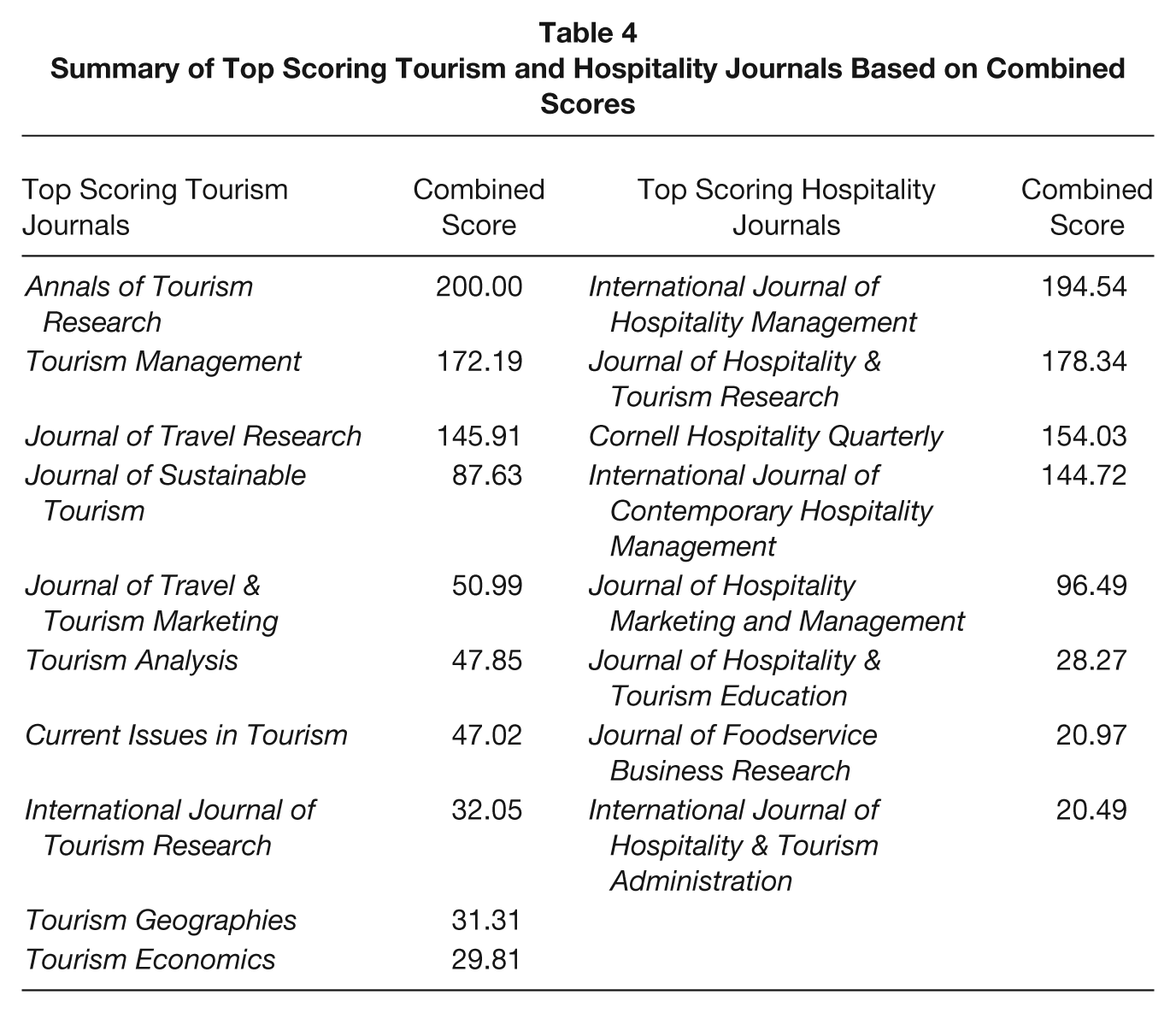
As presented in Table 3, the results from the top 100 researchers and all other researchers for hospitality journals were similar to the results found in previous studies. According to the top 100 researchers the top 5 most influential journals in the field of hospitality are International Journal of Hospitality Management, Journal of Hospitality & Tourism Research, International Journal of Contemporary Hospitality Management, Cornell Hospitality Quarterly, and Journal of Hospitality Marketing and Management. The second group, other researchers in hospitality, produced slightly different results, determining the top 5 most influential hospitality journals to be: Journal of Hospitality and Tourism Research, International Journal of Hospitality Management, Cornell Hospitality Quarterly, International Journal of Contemporary Hospitality Management, and Journal of Hospitality Marketing and Management. The combined results for these two groups of respondents for both hospitality and tourism journals are also presented in Table 4.
Index and Ranking Scores for Hospitality Journals
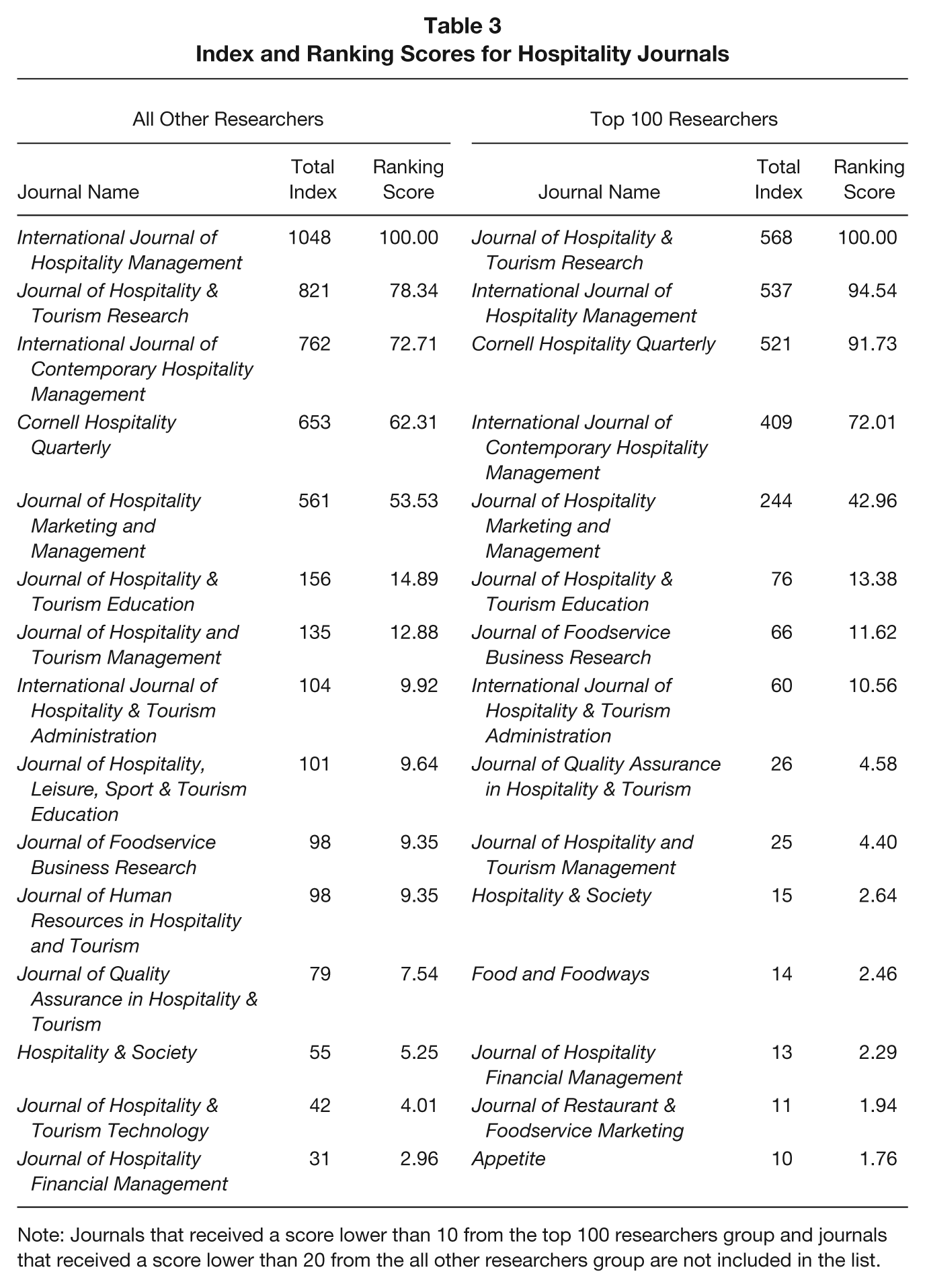
Note: Journals that received a score lower than 10 from the top 100 researchers group and journals that received a score lower than 20 from the all other researchers group are not included in the list.
Summary of Top Scoring Tourism and Hospitality Journals Based on Combined Scores
Discussion and Implications
This article provides a peer assessment of hospitality and tourism journals. There are three primary strengths of this study. First, in this study we disaggregated consideration of two independent, yet interrelated research fields, hospitality and tourism. Participants were able to review tourism journals, hospitality journals or both, depending on their research and publishing interests. Second, the present study utilized a large sample size of 525, including 62 top researchers, and 463 other researchers in these fields. Because participant selection was based on research productivity and participation in research in these fields, there were no geographic restrictions placed on the sample. Finally, this study allowed participants to focus on top-of-mind awareness, rather than a predetermined list of possible journals to consider. This allowed researchers to produce their own ranking of journals they considered influential in their respective field.
This study demonstrated that while the top journals in tourism and hospitality have remained relatively constant over the years, there has been fluctuation among their positions. Beyond the top journals, there is relatively little consistency, which makes it harder for new researchers and administrators to identify lower tier journals with relatively high impact. There are several possible ways to explain why the top journals stay on top. McKercher (2005) states, “A positive feedback loop exists whereby the strong get stronger and the weak stay relatively weak” (p. 649). As researchers seek out places to publish their research, they tend to target those journals that will provide the most recognition, most frequent citations, and most support for tenure or promotion goals. Hence, they attempt to publish in the leading journals in their field.
Prior ranking studies do not dispute that the top three tourism journals lead the field of tourism. Annals of Tourism Research, Tourism Management, and Journal of Tourism Research are the top tourism journals in Hsu and Yeung’s (2003) study, Perlancher’s (2004) non–U.S.-based researcher survey, Ryan’s (2005) “hit” analysis, McKercher et al.’s (2006) peer ranking assessment of journal awareness and quality study, and the present study. Hospitality journal rankings identified in the study are also consistent with the findings of previous studies that ranked hospitality journals. While there is some disagreement about the order, all hospitality ranking studies included the International Journal of Hospitality Management, the Journal of Hospitality & Tourism Research, the International Journal of Contemporary Hospitality Management, and the Cornell Hospitality Quarterly as the top 4 rated journals in the field of hospitality (McKercher, 2012; McKercher et al., 2006).
In an environment where a multitude of publications exist, natural selection will occur and journals will be sorted over time into leaders, niche-players, second-tier players, followers and hangers-on, based on their reach, difficulty in having papers accepted and impact on the field. (McKercher, 2005, p. 649)
Hospitality and tourism journals have demonstrated this natural selection. The Journal of Sustainable Tourism in the field of tourism and the Journal of Hospitality Marketing & Management (formerly known as Journal of Hospitality & Leisure Marketing) in the field of hospitality have gained prominence over the years.
While the top journals in the fields of hospitality and tourism are known to scholars in both fields, there is still no consensus about the ranking of other journals with relatively high impact. The availability of a large number of additional publication outlets makes it even harder for scholars and administrators to determine the quality or impact of these outlets. While publishing in top journals provide the most exposure, publishing in other journals with relatively high impact may also enable researchers to disseminate their findings to a larger audience and have a significant impact on the knowledge generation in the field. Considering the fact that there is fierce competition and a long wait to publish in the top journals, new scholars need additional direction in choosing among the remaining publications. By providing a ranking of journals beyond the top journals in the fields of hospitality and tourism, this study provides additional tools for new researchers and administrators to identify lower tier outlets with relatively large impact.
Limitations
The process of evaluating and ranking journals is imperfect at best. We may have introduced bias with choice of method, the structure of survey questions and use of researchers as respondents. Specifically, we may have introduced bias through the use of an internet survey rather than a traditional mail-in response. The survey in this study allowed the respondent to rank up to 10 replies. If a respondent felt that more than ten journals were influential, the restriction of ten spots would have limited the response. In general, peer opinion is biased. We allowed respondents to define their own measures of an “influential” journal and allowed each researcher to assess according to their own measures. This study assumes that hospitality and tourism scholars are a reliable source for journal ranking data because they are the users of the journals we have asked them to rank. Another limitation of this study is that we only considered peer rankings and we did not consider citation counts, or other potential ranking schemes.
Conclusion
As the fields of tourism and hospitality continue to grow and expand as research disciplines, and the numbers of their associated journals grow journal ranking will continue to serve as an important contribution to the development of the field. Knowing which journals are most respected in the field, along with other studies assessing impact, is important for new researchers as they seek to produce career-impacting publications.
This study contributes journal rankings in tourism and hospitality through peer assessment utilizing a top-of-mind awareness approach. Specifically, by seeking the opinion of the top-producing researchers in these fields combined with the opinions of a broader field of tourism and hospitality researchers, journals that are considered to be the most influential in tourism and hospitality were determined. The results of this study update previous studies using peer assessment to evaluate and rank tourism and hospitality journals, to provide the most up-to-date information. Furthermore, this study provides updated rankings of both the top journals and the other journals that are considered to have significant impact on the knowledge generation in both fields. Findings of this study are likely to provide an additional tool for new researchers and administrators to identify lower tier journals with relatively high impact.