







Abstract
The relationship between account management and creative is a complicated and ever-changing one. A common theme in the advertising literature is that account and creative teams sometimes struggle with intra-agency communication. This article looks at why communication is still an issue today and what knowledge modern account and creative teams need to know about the others’ role in the agency to close the long-standing communication gap. We asked both account managers and art and creative directors (creatives) what they wished the other understood about their roles within the agency. From their answers, we identify pedagogical suggestions for advertising professors as they work to better prepare students for careers in the industry.
The battle between account and creative teams has waged for decades fueling a cultural mentality of “us” against “them” in many agencies (de Waal Malefyt & Morais, 2010; Grant, 2002; Haley et al., 2014). No matter the changes in the agency business, the ongoing debate between the two disciplines seems to stand the test of time. There have been numerous studies (Blakeman et al., 2006; de Gregorio et al., 2012; de Waal Malefty & Morais, 2010; Grant, 2002; Hackley, 2003; Hackley & Kover, 2007; Haley et al., 2014; Kover & Goldberg, 1995; Vanden Bergh et al., 2013) that have analyzed both the codependent and philosophical differences between the two teams as well as the differing roles and personality traits (de Waal Malefyt & Morais, 2010; Hirschman, 1989; Koslow et al., 2003; Morais, 2007; Rothenberg, 1994; Thompson, 2015). But there are few that have concentrated on what actual account and creative team members see as obstacles to improving both the working relationship and overall communication.
Given the importance of this intra-agency relationship, what should advertising curriculum be teaching students to prepare them for productive collaborative relationships? To better understand the current state of the relationship, this article reports interview insights from 33 agency account management professionals and 42 creative and art directors detailing their perspectives on what they wish the other team better understood about their role in the agency. We believe that a clearer understanding of the motivations and desires of each team will help educators understand and ultimately integrate communication and collaboration skills more effectively into both classroom discussions and assignments.
Literature Review
Job Description: Must Know It All
The modern account manager is no longer pigeonholed as just a business disciple in a suit. Creative teams are no longer rebels with a cutting-edge cause.
It is important for all the players in the agency to have well-rounded knowledge of the roles and responsibilities each team is responsible for. Strategically savvy and innovatively creative ideas have evolved from account-driven and creative-owned, into output that is every team’s responsibility (Cook, 1998). Today’s results-driven environment demands that all agency personnel be fairly astute businessmen and women in order to create the kind of creative work that can build both brand image and market share. “It is a knowledge-based industry that develops intellectual capital, that is, ideas and understanding. This is part of the creative dynamic of agencies” (Hackley, 2003). There are both internal and external factors influencing the relationships between account management and creative teams.
Relationship Between Account and Creative
Ideally, the account team understands the client’s problem and represents the client when communicating with the creative team. The strategy and research produced by the account team sets the groundwork for a creative idea (Altstiel & Grow, 2017). Both teams are working to produce great work that solves the client’s problem, and in order to do so there is “immense value” in collaboration between the teams (Burgoyne, 2015, p. 14).
Priorities of creative and account managers often conflict with each other. Account teams are focused on understanding the client’s problem, and keeping the client happy. A creative’s priority is to create original ideas that solve the client’s problem. Not only are priorities different, but the account management and creative perspectives also differ—account managers are generalists, while creatives are specialists (Vanden Bergh et al., 2013).
Productive intra-agency relationships are desired from both the account and creative teams. Current research shows that many things play into a successful relationship between the two teams such as communication, collaboration, creativity, openness, honesty, and trust (Boies et al., 2015; Hall, 2014; Robbs & Lloyd, 2008; Strutton & Taylor, 2011; Vanden Bergh et al., 2013). Communication and collaboration go hand-in-hand. Asking questions, sharing answers, and tackling problems together lead to stronger solutions for the client. The increased complexity of the “digital landscape” in advertising requires great communication and collaboration (Hall, 2014). A shared passion for the creative product helps bond the creative and account teams. Shared collaboration on idea development with the creative team can help inspire both teams to produce strategically outstanding work while giving each a greater understanding of the creative direction required (Robbs & Lloyd, 2008). “The more ideas one creates,” Strutton and Taylor tell us, “the more often one fails–—but the more frequently one also succeeds” (2011, p. 473).
Creatives have to take existing knowledge, objects, and ideas and combine them to create something new—a process that involves just as much, if not more, failure than success. However, the road goes both ways; creatives need to be open to ideas from other teams as well. Honesty and trust play an important role in the account and creative relationships. Account teams often have a more in-depth sense of a client’s priorities, and honest communication is required when reviewing creative work (Hall, 2014). When presenting work to the client, creatives must trust that account teams have their back. “For great work to be created, the creator must have the confidence that the creative process is being supported. Account Management must trust that creative is approaching the job with the vim and vigor of an American Ninja Warrior” (Hall, 2014, par. 32). Account service and creative teams are not only wanting a relationship of collaboration, communication, honesty, openness, and trust within the workforce, but named camaraderie as key for their happiness within an agency (Frauenheim & Peters, 2016). If the advertising industry acknowledges the importance of teamwork, and recognizes that issues remain, then why are we still talking about age-old problems such as teamwork, communication, and trust? Investigating the nature of communication, collaboration, and teamwork can offer holistic insights into how working in tandem produces more enlightened work with less conflict.
It is the account team’s job to ensure the ongoing stability between the agency and the client, and as a result the brand. The creative team, on the other hand, sees the brand as a way to creatively express themselves through the resulting visual and verbal executions (de Waal Malefyt & Morais, 2010). Ultimately, it is the client’s brand that ties agency teams together. It is the account team’s job to ensure stability for both the client, and thus the brand, and manage interagency relationships.
Agencies that encourage congeniality between teams also instill a sense of trust between all agency teams not just account and creative. Positive interactions encourage all who interact with a project to take a collective ownership and thus responsibility for its success or failure (Barclay, 1991; Harris et al., 2008), resulting in an increased number of constructive encounters (de Gregorio, et al., 2012; Menon et al., 1996).
The inherent ownership of client directives and creative response forces the need for both internal and external dialogue (Bohm, 1996). “Collaboration can fluctuate from positions of shared aims and working practices to tension, diverging positions and in some cases conflict” (Grant & McLeod, 2007, p. 428). Exploring external agency dialogue and relationships is discussed next.
External Factors Exert Influence Over Team Relationships—The Client
The client exerts significant influence over the account and creative teams’ relationship and rituals. “Account managers, as collaborators with their creative cohorts and as business partners with their clients are beholden to both of these parties” (de Waal Malefyt & Morais, 2010, p. 339). External forces, namely the client and their brand, and how well their business objectives are strategically woven through the creative product drive much of this success.
Literature Summary and Justification for the Present Study
The literature reviewed above suggests the need and potential benefits of better account/creative team work within advertising agencies. However, what is missing from this discussion is how to better the understanding of the roles among the “other side.” That is, what does a creative need to understand about an account manager and his/her job that might better communication, cooperation, and teamwork, and vice versa. Thus, the present study aims to explore what each side wishes the other understood about their jobs in order to improve the working relationship and, ultimately, the client deliverable. The results of this inquiry should also aid in helping ad educators better prepare students for more effective intra-agency teamwork.
Research Questions
To explore how to improve intra-agency dynamics between account and creative teams in the context of today’s advertising business, the present study explores two main research questions: RQ1: What do creatives want account management to understand about their job? RQ2: What do account management members want creatives to understand about their job?
Method
To answer the research questions, qualitative, open-ended questions were used to gather responses that represented the participants’ perceptions and experiences (Blakeman & Hoy, 2005; Haley & Blakeman 2006; Kendrick et al., 1996; Otnes et al., 1995). The questions probed specifically into what participants (account or creative) wished the other knew about their jobs and roles in the agency. The open-ended questions allowed respondents from both teams to tailor his or her own answer and write as much or as little as s/he wanted. Follow-up probes were embedded in the questions to encourage more in-depth responses.
Strauss and Corbin’s (1990) inductive, qualitative data analysis procedures guided the analysis of the 33 account and 42 creative responses. First, data was broken down into conceptual units by looking for observations and ideas in the text that addressed each research question. Then, the units were organized and subdivided until cohesive, distinct categories of information emerged. Finally, the researchers named the categories placing similar conceptual events and incidents together to form thematically representative categories and items of interest. Emergent themes then were used to answer the two research questions.
Questions were sent via e-mail to 189 account team and 239 creative and art directors at 24 different agencies in ten different cities (Richmond, Dallas, Atlanta, Boston, Rochester New York, Nashville, New York City, Knoxville, Los Angeles, and Memphis). To identify potential participants, a snowball recruitment procedure was used. Initially, program alumni from the researchers’ universities working in either account or creative agency positions in large or medium-sized advertising markets were contacted and asked to respond in the survey. These initial participants were then asked to recommend potential participants from their own network of contacts who worked either in creative or account management at agencies in medium to larger markets. Within the final participant pool, the size of the agencies ranged from 12 employees to 800 employees (M = 418, SD = 238). Nonresponsive participants were contacted by phone and by two follow-up e-mails to request their participation.
A total of 75 advertising professionals completed the open-ended questions. The study’s results are based on the insights of 42 art and creative directors and 33 account management team members. Creative respondents’ ages ranged from 22 to 63 years of age (M = 37, SD = 10.52), and their length of employment at their current agency ranged from 4 months to 35 years (M = 5.6, SD = 7.9). Titles included Creative Director, Art Director, Vice President Creative Director, Senior Creative Director, Chief Creative Officer, Group Creative Director, Creative Group Head, Executive Creative Director, Senior Art Director, and Vice President Group Creative Director.
For the account management sample, responses came from 33 professionals. Age of respondents ranged from 22 to 58 (M = 30.5, SD = 9.7). Length of current agency employment ranged from 5 months to 30 years (M = 3.6, SD = 1.6). Titles included Account Supervisor, Account Executive, Senior Account Executive, Account Director, Brand Manager, Account Manager, Vice President, Account Director, Group Account Director, Associate Brand Manager, Associate Account Manager, Global Account Director, Global Business Director, and Senior Social Media Director.
In looking at the profile of the final participant pool, creative participants had an average of 5.6 years of work and account managers an average of 3.6 years. This suggests that the findings represent insights from experienced ad professionals. A qualitative examination of responses relating to years of service did not suggest differences in major themes emerging within the data from junior versus more senior participants. Also, the average agency size was 418 employees, suggesting the findings represent medium to larger sized agency experiences. However, we also examined the themes by agency size (number of employees) and found no difference in the themes emerging in the participants insights.
FINDINGS
What Do Creatives Want Account Managers to Understand About Their (The Creatives’) Jobs?
The first research question inquired into what creatives wished account service understood about the job of advertising creatives (creative and art directors). Results point to a general consensus that account management needs a better understanding about: how the overall design process works, the amount of time it takes to complete a job, selling the idea, the need for clearly articulated directions, and the importance of being a good listener (Table 1).
Summary of Key Findings.
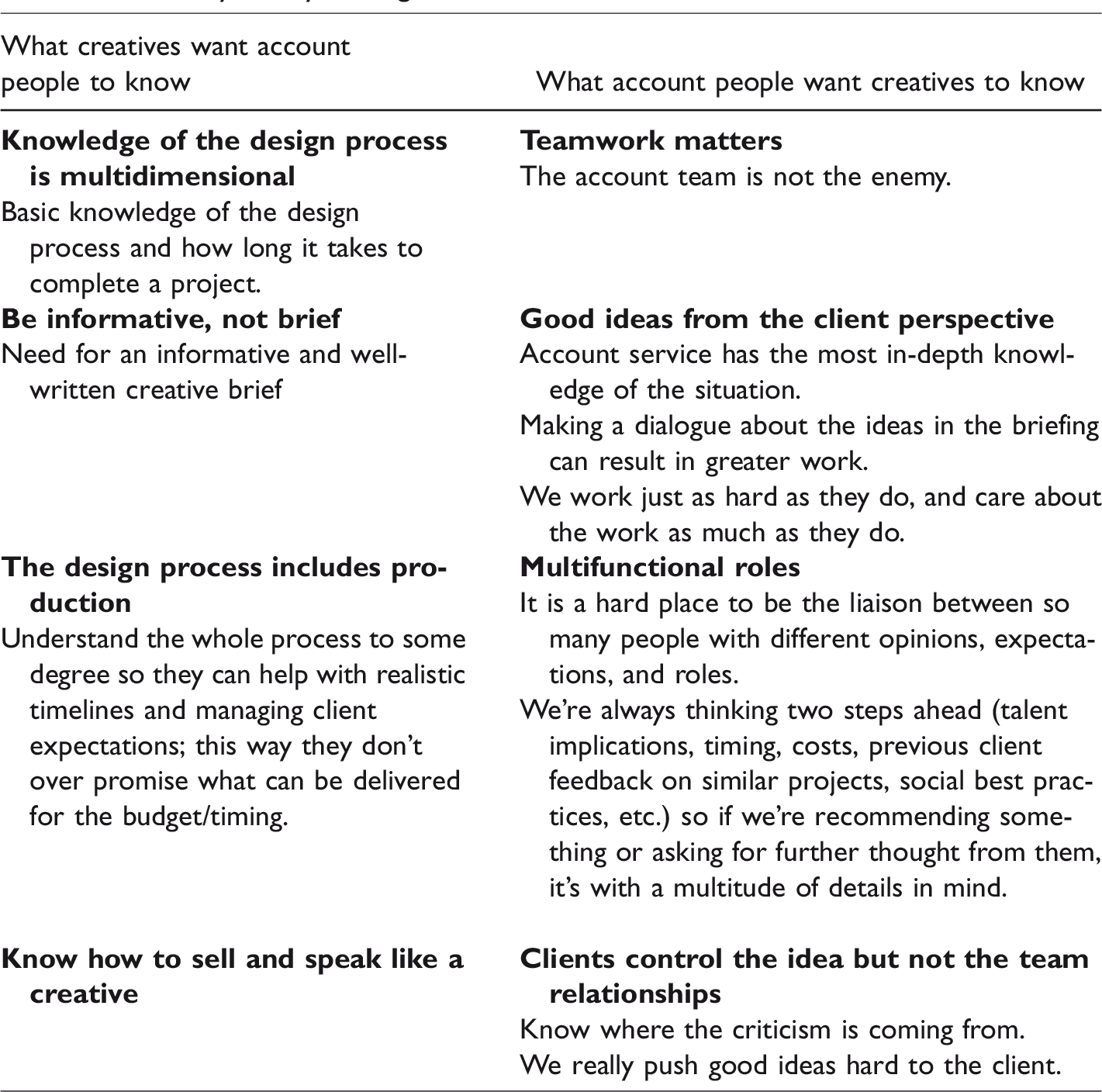
Creatives: Knowledge of the Design Process Is Multidimensional
Creatives believed a basic knowledge of the design process and how long it takes to complete a project was not only needed but also would help the account team to better sell an idea. “I think that they need a better understanding of what the creative process is and what it takes to get to that end piece of work,” an associate creative director from Chicago stated. “There will always be a bunch of ugly uncertainty in-between starting and finishing. I don’t know the minute you hand me the brief what this thing is going to look like. I don’t have any answers until I’ve tried a bunch of stuff, and so it would be great if they just gave us some space. Once we do have something to show them, then the process of the give and take of collaboration and feedback and negotiation can begin.” A time-crunched New York City art director agreed, “I wish they understood design better. Sometimes they cannot visualize the concept, so you have to waste time drawing it out for them. They lack basic common sense.” Another art director from San Francisco wanted account teams to understand the process included passion: “They need to understand that creative is a process it takes a while to come up with a solid idea. There is heart and passion in everything that we do.”
Timing was a repetitive theme in creative responses. “They [account service] need enough knowledge to understand and appreciate how long it takes to flesh out an idea and to what scale each [request] requires,” an associate creative director from Chicago wrote. A creative director from Dallas pointed out that incorrectly researched timelines caused problems both inside and outside the agency: “They need to be aware of what is possible so they don’t promise the client things that creative can’t deliver.” To avoid over promising, a creative director from Dallas believed that keeping communication channels open is a critical asset for account teams. To him, communication included understanding both design and timelines: “Most haven’t got a clue how long it takes to do things. And don’t think about adding time for the internal approval process. I always tell them to give us two weeks to concept. Which translates into one week for the teams to think. Then present to the CD [creative director]. Then a couple of days to make those changes. Then present to ECD [executive creative director]. Then present to account service so they can understand and defend the work. Many AEs [account executives] take this step to mean they can kill creative work. This isn’t the case. They can only kill it if the creative is off the strategy/brief.”
Numerous responses wanted account teams to know the design process often requires inspiration that is not always easily found. One art director from Nashville said, “Stop being uncomfortable with the idea that I have no initial idea where the concept is going.” Another, art director from New York City, summed up why knowledge of the design process and timing is important: “I find account folks that understand design, to be the strongest … they [tend to] end up championing the work more so because they know what goes into it. They push back or take time to understand feedback before running to creative to make changes.”
Others focused on how a basic knowledge of design would help account teams more effectively sell the idea. An executive creative director from New York City stated, “They need to know enough about design to sell it to the client, be able to articulate how this idea solves their advertising problem and not fold under client pressure and concerns. An account person with developed taste [in design] is more helpful in selling the work to the client.” Another creative director from Dallas believed, “They need more training in the language it takes to sell an idea, we are a team, they should have a POV [point of view] and make an effort to understand our POV.” A creative director from Atlanta lamented, “I think it would be just plain helpful if more of them had some kind of knowledge for the entire design process. They are then better able to articulate to the client why certain decisions were made or to understand when a client request is simply impossible.”
An art director from San Francisco summed up why knowledge of design, timing, and selling an idea was important: “I wish they understood how long it takes to build things or get something done and have an understanding of basic design concepts so they can constructively contribute to feedback on why something is or is not working.”
Be Informative, Not Brief
The need for an informative and well-written creative brief was a common theme in responses. “The way they write the brief matters too,” a creative director from New York City informed; “for example, the way they phrase something. A simple line in the brief, to the account person is not that big of a deal, but as a creative you might recognize that hey, that’s going to pigeon-hole us, sometimes the details are so much more than the details. Where it may be only a word or a phrase to you, it affects us in ways you may not be able to see.” Moreover, a creative director from Atlanta complained, “Don’t tell us to just figure out the problem. We do want, and need, levels of information and feedback from account service. We really don’t do what we want to unless you don’t give us enough to work with, then we have no other choice but to do what we want.”
The Design Process Includes Production
Beyond design, many felt more knowledge about production would also be helpful in understanding not only design but timelines. “Knowledge about the varied file types would be helpful, so they know what is needed from the client and when one is needed over another,” said a creative director from New York City. Another art director from Chicago added, “They really should have more education on getting the correct specs (dimensions for print and digital projects). This would save us a lot of time and frustration.” A creative director from Atlanta saw the importance of both design and production knowledge as an organizational tool: “It’s good for them to understand the whole process to some degree so they can help with realistic timelines and managing client expectations, this way they don’t over promise what can be delivered for the budget/timing.” Finally, a creative director from Dallas summed up the need for design inclusive knowledge this way saying, “Great account people are jacks-of-all-trades. They should know about every line item on a production budget and also know how to sell and speak like a creative.”
Creative responses to RQ1 stressed the need for account teams to be able to communicate effectively and understand the timing and language of design and production. When the account team understands what goes into the design process: creative brief, idea generation, execution, and development, many issues surrounding the sell-through to clients and interagency communication issues can effectively be alleviated.
The next section looks at what account teams wished creatives understood about their role in the agency.
What Do Account Managers Want Creatives to Understand About Their (The Account Managers’) Job?
Account teams tended to have a longer list of wishes. To them, responses centered less on understanding the creative process and more on the importance of teamwork, the need to have a voice in creative decisions, the need for understanding the complexity of their multifunctional roles inside and outside the agency, and the delicate balancing act required to deliver client feedback and sell creative (Table 1).
Teamwork Matters
Many respondents commented on the meaning and importance of teamwork and collaboration and the balance required to ensure stability between teams. A New York City account executive reported, “Our job is to find the best solution in difficult times. We’re the only department in the agency that cannot say ‘no.’ Having creative teams (especially junior ones) understand that, would contribute to a sense of teamwork and I believe deliver better creative pieces overall.” Resoundingly, account teams believed the more both teams collaborate, the better the chance there is for creative solutions to be strategically strong. “They need to understand,” an account supervisor from New York City lamented that, “the account team is not the enemy. While we do often deliver unfortunate news and/or push back, it is done to benefit the team as a whole.”
Good Ideas From the Client Perspective
The intense creative, business relationship centers around the client’s brand and how the two teams work together to solve the brand’s specific advertising problem. A popular response from survey respondents was the need to play a larger role in idea generation. “I think many creatives quickly disqualify any ideas that account teams may have for creative concepts,” a senior social media community manger from Boston reported. “In reality,” she went on to say, “account service has the most in-depth knowledge of the situation. If given the appropriate recognition, making a dialogue about the ideas in the briefing can result in greater work.” Respondents felt the need for collaboration was critical at this time: “We wish creatives didn’t go into a silo for ideas. Collaborate with us early on, so we can shape ideas into something that is amazing but also achievable,” a global account director from New York City replied. A brand manager from Nashville felt a bit more strongly saying; “Account service has every right to be helpful in times when creative input is sought.” Finally, many wanted their creative teams to understand the importance of diverse types of creative perspectives: “We work just as hard as they do, and care about the work as much as they do. We use our creative skillset and assets daily, but it’s using our brain in a different form. I want them to understand that I’m inspired by them and I hope I can inspire them too (albeit in a different way),” reports an account executive from Rochester, New York.
Multifunctional Roles
The account team’s placement between the client and creative can often be stressful and contentious requiring different skill sets to accomplish differing tasks. A Memphis account supervisor told us about the internal and external conflicts: “It isn’t easy making everyone happy. Clients get angry at you, creatives get angry at you, traffic gets angry at you. It is a hard place to be the liaison between so many people with different opinions, expectations, and roles. Being able to communicate clearly and effectively with all of the different players on a project is a challenge. It is not social hour. This is heavy-duty work and requires actual skills, not just being able to talk on the phone or send emails. Strategy, planning, organization, everything is a cog in the wheel.”
Many respondents talked about how hard it is to balance the agency/client relationship and the need to back off when “the idea just isn’t that great.” A senior New York City account executive stressed, “There’s a lot that goes into everything we bring forth to them—we’re always thinking two steps ahead (talent implications, timing, costs, previous client feedback on similar projects, social best practices, etc.,) so if we’re recommending something or asking for further thought from them, it’s with a multitude of details in mind.”
External Pressures: Clients Control the Idea but Not the Team Relationships
In the end, it is the client who determines both the strategic and creative outcome of a campaign. Client feedback can often create friction between teams. An account manager from New York City summed up the downside in being the messenger: “We are often between a rock and a hard place and that creatives shouldn’t shoot the messenger. Some creative teams take client feedback as a personal affront and then get mad at account service for not defending the work, when in reality the account team usually has talked to the client several times and attempted to either kill or diffuse any painful requests or feedback, before even alerting or approaching creative teams.”
An associate brand manager from Boston saw it this way: “I think it’s important for creatives to understand that we are only the messengers 99% of the time. If there’s a revision needed, it’s not a personal critique of their work. The client is who we are working for, so if there’s a needed tweak, we have to honor that. We can advise differently, but we have to make the client happy.”
Know Where the Criticism Is Coming From
“I wish they understood that my criticism is not personal, and that I appreciate their work more than anything but I see all creative through the lens of my client. I’m always making sure everything is on strategy according to the brief that either our client provided or our strategist came up with,” an account executive from New York City reported. Another New York City account director wrote, “I think that creatives typically understand what the job of an account person is, they just don’t usually care what it takes to get something approved. They would prefer for us to always fight for their vision, even when it might not be what the client was asking for. There is a fine line between pushing for something the agency wants and pushing for something the client wants.”
We Really Push Good Ideas Hard to the Client
Delivering creative solutions that can be successfully sold to the client is one of those roles that creative teams often feel needs a little work. Many comments centered around how hard the account team works to push a creative idea forward. “We’re trying to win for you. We really are” an account executive from Nashville stressed, “sometimes the client just isn’t that sold on an idea or it’s just too out there for their comfort.” Creative teams often hold account teams responsible for rejected ideas. An account supervisor from Los Angeles echoed the sentiment, saying he wished creatives knew just how much negotiation and fight goes into selling their ideas saying, “We fight hard and push back on the client—even when they don’t see it. Oftentimes we fight for the work and question feedback before it even gets to creatives and that we filter feedback and shield them from subjective comments on the work.”
Account responses to RQ2 show the importance of teamwork and collaboration in decision-making and the delicate balance needed to communicate with both creatives and clients.
The responses by both teams suggest ways forward in how instructors can integrate the skills required by both teams into undergraduate advertising curriculum.
DISCUSSION: TAKING IT TO THE CLASSROOM
Listening to the voice of account and creative provides needed insight into understanding the current working relationship between the two teams. Findings revealed that each wants the same things, but does not believe they are consistently seeing the levels of teamwork, collaboration, and overall knowledge needed to seamlessly accomplish their roles. It is our job as advertising educators to prepare students to understand that communication is everyone’s responsibility and that the quality of the collaboration between teams lies in understanding the others role within in the agency. Working from a foundation of knowledge rather than frustration and accusation, can help both teams: (a) foresee many problems before they happen, (b) ensure all necessary information is delivered in a timely fashion, and (c) work together to collectively solve the client’s advertising problem.
In order to place more focus on developing better communication, collaboration, and teamwork skills, we are not calling for any more courses but believe there is flexibility in existing curricula where additional focus can be placed on these important business skills.
The knowledge needed to build better skills, as reported by this study’s participants, is multilayered and are assigned different levels of importance by each team (Table 2). Because of this, consistent interactions between the two teams not only helps to build knowledge about the complex mix of business and design but assists with building interagency relationships, developing reasonable timelines, and delivering a strong strategic message. Personality traits and working relationships aside, both teams want the same thing: to produce great work that achieves results (Thompson 2015). This was echoed by an art director from Chicago who said, “Coming out of school [students] need to be organized, and feel comfortable communicating with others and keeping them organized, updated on information, and on schedule. They need to understand they need to be good ‘detectives’ – always digging out information and asking directions from the client, creatives and account, whoever, so they can deliver the proper information in a timely manner.”
Summary of Recommendations for Advertising Education
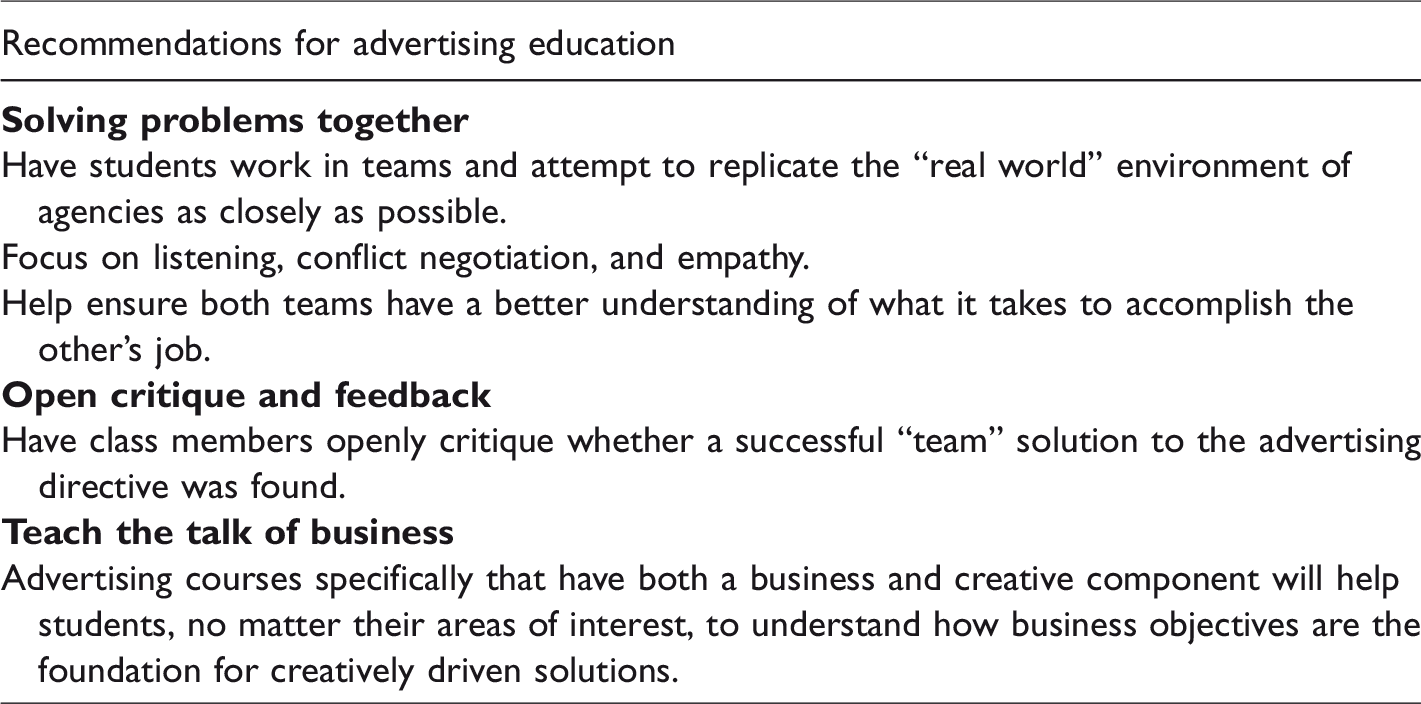
Solving Problems Together
Typically, advertising programs attempt to mimic the agency environment as closely as curriculum limitations will allow. Studies have urged educators to have students work in teams and attempt to replicate the “real world” environment of agencies as closely as possible (Otnes et al., 1995, 1993; Robbs, 1996; Robbs & Wells, 1999). Kendrick et al. (1996) echo these findings and underscore the importance of “real world” exposure either through course experiences or internships. Additional course experiences should focus on listening, conflict negotiation, and empathy; perfecting these soft skills will go a long way to helping graduates emerge as valuable present and future team members.
The creation of mentored collaborative opportunities in the classroom not only replicates the real world but helps to ensure both teams have a better understanding of what it takes to accomplish the other’s job. Through teamwork, students can experience first-hand how crucial communication efforts are to completing a job that is both creative and on-strategy (Blakeman et al., 2006).
Open Critique and Feedback
Teams that have successfully collaborated should welcome feedback. Instructors might consider adding in a step where class members openly critique whether a successful “team” solution to the advertising directive was found.
Pushing students out of their comfort zones (because they only want to do creative, account management, research, or media) gives them a more universal view of the advertising business. Increasing their knowledge of how the varied roles interact and affect other team members will help students better understand how problems that are inarticulately stated can only cause more problems and limit the ability to find a strategically sound creative solution.
Teach the Talk of Business
Beyond exercises, both university advertising and general elective courses are ideally suited to teaching business relationship skills such as communication, teamwork, and collaboration, to both account and creative teams. Advertising courses specifically that have both a business and creative component will help students, no matter their areas of interest, to understand how business objectives are the foundation for creatively driven solutions. This is important especially for those students interested in pursuing a job in creative. Often, their next stop will be portfolio schools where the focus will almost solely be on teamwork between creative teams where a less antagonistic form of collaboration lives.
To ensure a thorough understanding of roles, classes need to do a better job of comprehensively preparing students interested in both account management and creative on how their roles work together. Managing these “suggestions” means expanding their business knowledge to better understand how strategy affects the visual and verbal message. Students considering a career in creative should consider broadening their interests beyond the study of creative by taking advertising research, media, management, business, and marketing courses so that they can see where their work fits into the broad context of strategically solving a business problem.
Students interested in account management need to embrace both marketing and creative. They need to understand what drives the visual and verbal solution and how to successfully sell it to the client. To enhance their creative knowledge, business-driven students should consider courses in art and/or graphic design, creative writing, or even speech and literature courses. A creative group head from Dallas saw the need for a well-rounded perspective: “It’s a bonus for them [account managers] to have had a couple of concepting classes, photography, design, illustration, etc. It’s a bonus for us [creatives] to understand budgets. It just makes each of us more well rounded and gives us a base knowledge to talk to and interact with each other.”
Conclusion
Research suggests that there is a need for students to be cross-trained in both business and creative skills (Haley & Blakeman, 2006), with one Atlanta art director stating, “Classes must encourage media-agnostic thinking, because traditional advertising is on its way out. The successful brands of today are forward thinking and agile with their marketing efforts, and the newest crop of graduates needs to be leading the way, not following the old guard. Students should be taught how to take a step back and solve a brand’s problems in any way necessary. Don’t be afraid to arrive at non-advertising solutions. … teach design fundamentals to everyone, regardless of their title. Force art directors to write creative briefs. Force account planners to think visually” (Blakeman et al., 2006, p. 22). Understanding these varied roles is as much about knowledge as old-fashioned etiquette. According to this survey’s results, teamwork begins with communication and respect for the contribution each discipline brings to the table. A strong working relationship requires trust between teams as well as the skills necessary to: sell creative direction, set realistic timelines, and develop a strong creative brief. The account management and creative relationship is a dynamic and ever-changing one that has evolved to produce better work in an environment where clients are demanding work that is more accountable to business objectives.
Footnotes
Declaration of Conflicting Interests
The author(s) declared no potential conflicts of interest with respect to the research, authorship, and/or publication of this article.
Funding
The author(s) received no financial support for the research, authorship, and/or publication of this article.