







Abstract
We examined the self-reported practices of Head Start personnel toward children’s problem behavior in order to design an intervention for preschool personnel that was compatible with their needs. This study involved 78 Head Start staff from five programs in the Mid-Atlantic region. Participants were asked to respond to four questions concerning their practices for addressing their students’ problem behaviors. We found that survey respondents (a) listed externalizing behaviors as the predominant challenging behavior, (b) identified prevention and replacement methods for addressing problem behavior, (c) indicated that families of children with challenging behavior were involved in intervention planning and implementation, and (d) reported a need for additional training on classroom management and positive behavior support. Participants also were asked to respond to four conflict scenarios that were designed to measure how teachers would handle problem behavior situations. The majority of participants’ responses received a medium rating on a scale of low, medium, or high. Implications of these findings for preschool programs were discussed in terms of professional development and improved needs assessment measures.
Between 10% and 21% of preschool children exhibit challenging behavior (Powell, Fixsen, Dunlap, Smith, & Fox, 2007). Aggression, noncompliance, defiance, tantrums, and property destruction have been identified as the most common types of problem behavior in young children (Strain & Timm, 2001). For children living in poverty, the risk for developing problem behavior and social incompetence may increase to 30% (Qi & Kaiser, 2003; Webster-Stratton & Hammond, 1998). Head Start (HS) programs have reported an increasing number of children who exhibit challenging behavior (Eberhardt-Wright, 2002). Problem behavior also has been documented as being more prevalent among preschoolers with disabilities than among their typical peers (Fox & Smith, 2007; McIntyre, Blacher, & Baker, 2006).
It has been reported that when children’s problem behavior is not resolved in preschool it continues into kindergarten and the early elementary grades (Pianta & Caldwell, 1990; Stormont, Beckner, Mitchell, & Richter, 2005). Furthermore, there is long-standing documentation that children’s problem behavior not resolved by third grade may be considered chronic (K. A. Dodge, 1993) and may lead to school failure with violent behavior and mental health challenges during the adult years (McCord, 1978; Olweus, 1991). Given the predictable and enormous costs of untreated challenging behavior, preschool programs, particularly those serving children from low-income families like HS, are ideal settings in which to implement proven preventative practices and to teach social skills (Dunlap et al., 2006; Powell et al., 2007).
Over the past 25 years, there have been successful demonstrations of positive behavior support (PBS) being applied to young children with challenging behavior in school and home settings (Conroy, Dunlap, Clarke, & Alter, 2005). PBS is viewed as consisting of three tiers of intervention, ranging from universal strategies that are effective in preventing problem behavior with most children to more individualized interventions for specific children who require more intensive supports. Individualized interventions are based on a functional assessment of the predictive antecedent conditions and the maintaining consequences for problem behavior in individual children (Fox, Dunlap, Hemmeter, Joseph, & Strain, 2003; Freeman et al., 2006). Functional behavioral assessment information facilitates the design of interventions that prevent problem behavior, teach children alternate behaviors, and shift staff reinforcement of problem behavior to alternate behaviors. In their review of research on challenging behavior in preschoolers, Conroy et al. (2005) found that fewer than half the studies (40%) designed individualized interventions based on a functional behavioral assessment.
Universal PBS has been shown to prevent problem behavior in preschool classrooms and to improve children’s social skills (e.g., Benedict, Horner, & Squires, 2007; Feil, Walker, Severson, Golly, Seeley, & Small, 2009; Serna, Nielsen, Lambros, & Forness, 2000; Stormont, Smith, & Lewis, 2007). For example, Feil et al. (2009) reported considerable improvements in preschool students’ overall social competence and in teachers’ acceptance of the training following intervention with classrooms in 13 HS centers. Researchers also have demonstrated that PBS can reduce serious problem behavior through individualized approaches (e.g., Dunlap, Iovannone, Wilson, Kincaid, & Strain, 2010; McLaren & Nelson, 2009).
Despite successful research applications, widespread use of PBS seems to be absent from preschool settings (Fox, Jack, & Broyles, 2005). Teachers often lack the skills needed to use PBS interventions, may disagree philosophically, or may consider PBS strategies unworkable (Fox & Smith, 2007). For example, primary prevention strategies for preschoolers include classroom rules and behavior expectations, consistent staff responses to problem behavior, and developmentally appropriate environments (Fox et al., 2003). While these practices are evident in preschool curricula (e.g., The Creative Curriculum, Dodge, Colker, & Heroman, 2002), their actual use in classrooms is variable (Fox et al., 2005). When teachers do not have the skills to address or to teach preschoolers social competence, there are significant child consequences: difficulties in social skills and behavior and preschool failure (Fox & Smith, 2007). The results of a “National Pre-kindergarten Study” that randomly sampled pre-kindergarten programs from 40 states found that children were being expelled for problem behavior at three times the rate of older students (Gilliam, 2005). Despite the design of state-funded programs to teach the skills needed to achieve in kindergarten, it is apparent that not all children’s social-emotional needs are being met.
In published needs assessment results, HS teachers have consistently listed issues related to addressing children’s problem behavior as a top training need. Buscemi, Bennett, Thomas, and Deluci (1995) conducted a comprehensive needs assessment of HS programs in six states and found that the most frequently identified training needs of HS personnel at that time concerned issues related to including children with emotional or behavior problems (68%) or attention deficit disorder/attention deficit hyperactivity disorder (ADD/ADHD, 61%), and behavior management (58%). More recent needs assessment results and our personal communication with HS directors from five programs in the mid-Atlantic region indicate that these training needs continue to be a high priority for HS staff. Quesenberry, Hemmeter, and Ostrosky (2011) found that HS program staff reported challenging behavior as an ongoing concern and identified their need for better supports to address children’s challenging behavior. Bruns and Mogharreban (2007) found that HS and Pre-K teachers listed behavioral issues as one of their top three training priorities. In their study, a majority of teachers reported having skills to implement universal intervention strategies (e.g., arranging the classroom environment, using positive guidance techniques), but fewer teachers were confident about their ability to apply more specialized strategies, including behavioral interventions. Data from a nationally representative sample of HS programs supports this conclusion (Administration on Children, Youth and Families, 2003). In this study, teachers reported that children did not show significant declines in overall problem behavior, aggressive behavior, or withdrawn behavior at the end of a year in HS, although they did show declines in hyperactivity.
In the current study, we began by administering a survey to examine the practices of HS staff toward discipline and children’s problem behavior in order to develop an intervention that teachers could use to prevent problem behavior, teach social skills, and address ongoing challenging behavior. Surveys are one of the most frequently used needs assessment methods as they are an efficient way to gather information from a large number of respondents and, if well designed, they provide constructive program planning information (Snyder & Wolfe, 2008). Our survey used both direct queries (e.g., “What are the top three challenging behaviors you face in your classroom?”) and conflict scenarios to identify staff perceptions and practices on problem behavior and its prevention in their HS programs. The study was designed to achieve four research aims. First, we queried HS staff on their perceptions about the most challenging behaviors faced in their classrooms. Because previous research indicates that teachers report higher rates of externalizing behavior in the preschool classroom (Qi & Kaiser, 2003), we expected respondents would list more externalizing or openly expressive challenging behaviors than internalizing behaviors that are associated with poor social skills. Second, we asked HS staff how they prevented and responded to challenging behavior. We hypothesized that responses to open-ended questions would identify using prevention or positive discipline strategies present in early childhood curricula adopted by their program, but responses to classroom scenarios might reveal more reactive practices. The third aim was to examine survey responses on involvement of family members of children who consistently displayed challenging behaviors. With the family involvement focus of HS (Schumacher, 2003), we expected all respondents to describe how families were actively involved in this process. The fourth aim was to determine respondents’ reported training experiences and needs in regard to topics related to PBS. Because previous studies (Bruns & Mogharreban, 2007; Buscemi et al., 1995) found that HS and preschool staff considered children’s problem behavior to be a top training need, we expected respondents to identify this as a top training focus.
Method
All participants worked in one of five HS programs serving children ages 3 to 5 years in a mid-Atlantic state. These programs reported that 8% to 15% of the children had disabilities, typically identified as speech-language impairment and developmental delay and less often as autism and physical disabilities. Programs had from 9 to 26 classrooms and an average of 17.6 children per classroom. Classrooms typically had two staff members (teacher and assistant teacher); were operated by public schools (n = 2) or community agencies (n = 3); and were located in child care centers, elementary schools, and buildings housing preschool classrooms.
Participants
Survey participants included early childhood educators, assistant teachers, and other HS program staff (e.g., program directors, mental health specialists) who volunteered to complete an anonymous survey of their classroom practices for managing child behavior. To be included in the survey, individuals had to be employed by one of the five participating programs in a teaching or supervisory role and to sign the consent form. A total of 108 teachers, assistant teachers, and other HS staff agreed to participate; 78 completed the whole survey. The 30 respondents who did not complete the survey did not differ statistically from the participating sample; their data are not included in the results. The 78 survey participants varied in terms of position: 38 (49%) described themselves as classroom teachers, 25 (32%) as assistant teachers, and the remaining 15 (19%) were in supervisory or consulting positions (e.g., program directors, coaching trainers, mental health specialists). The group was primarily female (97%) and Caucasian (58%), with 33% being African-American and 3% being Hispanic. Most participants (47, 61%) were middle aged (between 36 and 55 years old) and experienced, with a majority being in their current position more than 3 years and having more than 6 years’ experience with young children. Participants reported having endorsement in early childhood (33%), elementary (10%), ECSE (9%), or special education (3%).
Survey Measure
The Social Competence in Preschool Survey (Berlin, Hadden, & Voorhees, 2008) was designed to gather information on staff members’ perceptions of discipline and social skills in the classrooms and their responses to these behaviors. This article reports only on participants’ data regarding children’s challenging behaviors in classrooms and how they responded to those behaviors. The survey was anonymous and contained open-ended questions to promote honest answers and avoid “what should I say” responses. To strengthen external validity, an initial version of the survey was reviewed by program directors and ECSE professionals who did not participate in the study, and by university professors with expertise in ECSE, teacher attitudes and beliefs, positive behavior support, and developmentally appropriate practices; the survey was revised based on their input. The revised survey was piloted with 17 staff in two HS programs that were not participating in the current study. Final revisions were made to the survey based on the input provided from pilot teachers, directors, and other staff.
The final survey consisted of 10 demographic questions and 4 open-ended classroom practice questions: (a) What are the top three challenging behaviors you face in your classroom? (b) What do you do to respond to challenging behavior? (c) What do you do to prevent challenging behavior? (d) How do you involve family members when a child in your classroom consistently displays challenging behavior? In addition, the survey included four conflict scenarios designed to provide an indication of how teachers would respond to challenging behavior situations in their classrooms. The respondents were expected to provide a narrative addressing how they would handle this situation if they were the teacher.
The first conflict scenario was “In August, the Head Start teacher was really looking forward to the start of the school year. However, one month into the year she was already looking forward to winter break. When asked why, she explained that the children were having a hard time following the school routine, transitioning between activities, and following directions. What should the teacher do?” The second scenario was “Miss Lena has just completed her opening circle activities. The children are taking turns sharing what they did in center time. Some children who have already shared are getting restless. One child leaves circle and goes to the block area to play. Two children are talking to each other. Several children are waving their hands saying, ‘I want a turn.’ What should the teacher do?” The third scenario was, “Every day when it is time for snack, Mary refuses to stop playing in centers and go to sit at the table for snack. When the teacher tries to redirect Mary today, she kicks the teacher and yells and screams. What should the teacher do?” The final and fourth scenario was, “Madison is working a twelve-piece puzzle. She is having trouble completing the puzzle. She stands up and throws the puzzle across the room. What should the teacher do?”
The survey was placed on an Internet-based platform (Survey Monkey™) but was made available in paper form. Both versions averaged 30 minutes to complete (20–45 minutes range).
Procedures
Participants were recruited through their program directors. First, letters were sent to program directors requesting their permission for employees to participate in the study. Once obtained, project staff attended a meeting to explain the anonymous survey and consent forms and to offer directions for completing the survey. Of the 78 participants, 69 (88%) completed an Internet-based form, and 9 (12%) completed a paper-based version of the same survey. The 9 participants who completed paper-based surveys mailed them in prestamped envelopes to researchers. Survey participants received a modest gift card for their participation.
Data Analysis
Open-ended questions
Paper-based and online survey results were entered into an Excel database. There were no demographic differences between participants who completed the online versus the paper-based surveys. Open-ended classroom practice questions and conflict scenario questions were coded by two project staff members with doctorate degrees in education and more than 20 years of experience in early childhood or ECSE education. An expert in qualitative methodology provided feedback on methodological issues during the analysis. Responses were coded at the word or phrase level to capture the behavior that respondents were describing. Analysis at this “unit of meaning” level meant that one response could have contained multiple key ideas. For example, a response to the question about prevention of challenging behavior (e.g., pull a child aside and explain situations and how to handle them more appropriately or give rewards when they follow rules/schedule) was coded in two different categories (discussion and positive reinforcement). To develop the a priori categories that guided the full content analysis, one project staff member reviewed 20 responses (25% of respondents) for each open-ended question (e.g., What are the top three challenging behaviors that you face in your classroom?) and noted key ideas that were represented in each of the 20 responses. Responses were sampled from each participating programs to prevent over-representing a particular locale.
The same two project staff then reviewed the key ideas looking for similarities across respondents in order to develop initial categories or themes. Once themes were identified, project staff defined the themes using exemplars from the responses that had already been reviewed. Responses that represented discrete units of thought and answered the question were categorized by the theme they exemplified; those that did not answer the question posed were sorted into a miscellaneous category. After developing these initial themes, both project staff reviewed an additional sample of responses (30%) to determine the extent to which the themes were also evident in this additional sample. They independently coded the responses using the prior list of a priori categories. These project staff met to discuss and refine the categories. Some categories were collapsed and additional categories were developed based on a review of the miscellaneous categories. These revised categories were then used to code all of the responses using the NVivo 7 qualitative software program (QSR International, 2007). Twenty percent (16 surveys) were double-coded for reliability purposes, yielding an interrater reliability of 80%.
Conflict scenario questions
We included an additional level of analysis for the conflict scenario questions. With the guidance of a qualitative methodologist, project staff developed a scoring rubric to rate the responses within the conflict scenario section of the survey. We used a PBS Prevent-Teach-Respond framework to create the anchors within the rubric. Descriptive examples for each question were selected based on a review of the Teaching Pyramid Observation Tool (TPOT; Hemmeter, Fox, & Snyder, 2008) and actual survey responses. The rubric underwent seven revisions; each version was tested by two to three raters who scored a sample of survey responses. Refinements to the rubric were made after reviewing the raters’ agreement level at each stage of development. The final version was tested by three raters, who reached an agreement level of 90% on a selection of 60 responses. Participants’ responses were rated as low (e.g., response addresses the behavior in a reactive manner; response doesn’t answer the question), medium (e.g., response addresses the immediate problem in a constructive manner using universal interventions), or high (e.g., response shows thought and reflection about the individual child’s behavior or situation; such as identification of the function of the child’s behavior and the use the use of matching individualized strategies).
The rubric was sent to two experts in the field of ECSE to review and validate. Two main questions were answered through this process: (a) Are rubric categories and descriptions appropriate? (e.g. Does the content make sense?) and (b) Have we sorted the sample responses appropriately into the high, medium, and low categories? Once feedback was received from the field experts, the 78 conflict scenarios were coded by two senior project staff. Sixteen conflict scenario responses (20%) were double-coded to assess inter-rater agreement.
Results
Of the 140 potential survey participants (teachers, assistant teachers, specialists), 108 staff agreed to complete the survey and 78 actually completed the survey. The response rate for those who agreed to complete the survey (78 of 108) was 72%, whereas the response rate for potential survey completers (78 of 140) was 56%. Thirty-eight (49%) of the respondents were classroom teachers, 25 (32%) were teaching assistants, and 15 (19%) were other support staff.
For most topics related to PBS, the majority of 78 respondents reported having professional development within the last year: behavior management (60, 77%), classroom environment (53, 72%), promoting positive teacher–child relationships (42, 62%), positive behavior support (41, 60%), functional behavior assessment (30, 49%), and parent communication (33, 47%). In regard to their confidence in implementing these practices in the classroom, more than half of the respondents reported feeling confident in all but one topic: classroom environment (58, 78%), behavior management and promoting positive teacher–child relationships (48, 71%), parent communication (46, 66%), positive behavior support (43, 62%), and functional behavior assessment (25, 41%). When participants were asked if they would like to know more about a topic, the most frequently requested topic was functional behavior assessment (36, 59%). The second most frequently requested topic was behavior management (34, 44%), whereas three other topics were noted less often: promoting positive teacher–child relationships, PBS, and parent communication (26, 37%).
Figure 1 shows participants’ identification of the top three challenging behaviors in their classrooms. The most frequent types of challenging behaviors listed were (a) noncompliance and defiance (refuses to do what asked to do, lack of cooperation, being disrespectful; 53%), (b) aggression or bullying (hurting others, destroying property, hitting, kicking, pinching, spitting, biting; 50%), and (c) disruptive and impulsive behavior (throwing items, crying, whining, name calling, touching others, hyperactive attention seeking; 50%). Other categories of problem behavior noted less often were poor social skills (inappropriate comments to peers, name calling, arguments between children; 24%), problems related to disabilities (poor language skills, self-injurious behavior; 13%), distractibility and inattentiveness (13%), and internalizing behaviors (withdrawn, not speaking to others; 5%). Survey respondents listed externalizing behaviors most often and cited internalizing behaviors and social skill limitations far less often. Many behaviors listed by respondents were milder than the definition of challenging behavior suggests: a repeated pattern of behavior that causes injury to self or others, damage to the physical environment, interferes with teaching or learning, or socially isolates the child and is sustained over time (Doss & Reichle, 1991).
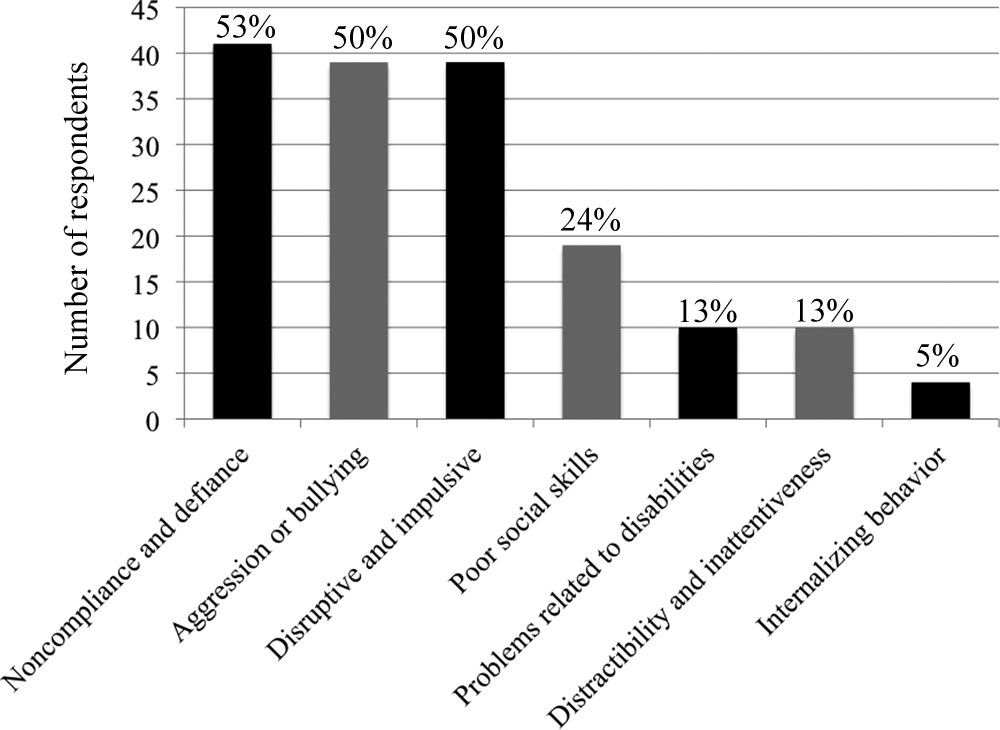
Survey respondents’ identification of the top three challenging behaviors in their classroom.
Table 1 reports the findings for participants’ response to the question “What do you do to prevent challenging behavior?” Qualitative analyses of responses to this question indicated 15 categories of responses. Responses listed by one third or more of the participants (i.e., establish rules and expectations, positive reinforcement) aligned with developmentally appropriate and positive preventative strategies supported by the field (Dunlap et al., 2006); other preventative strategies given less often by participants (i.e., engage in activities, monitor and redirect, arrange environment) also were developmentally appropriate.
Survey Responses to the Question: What Do You Do to Prevent Challenging Behavior?
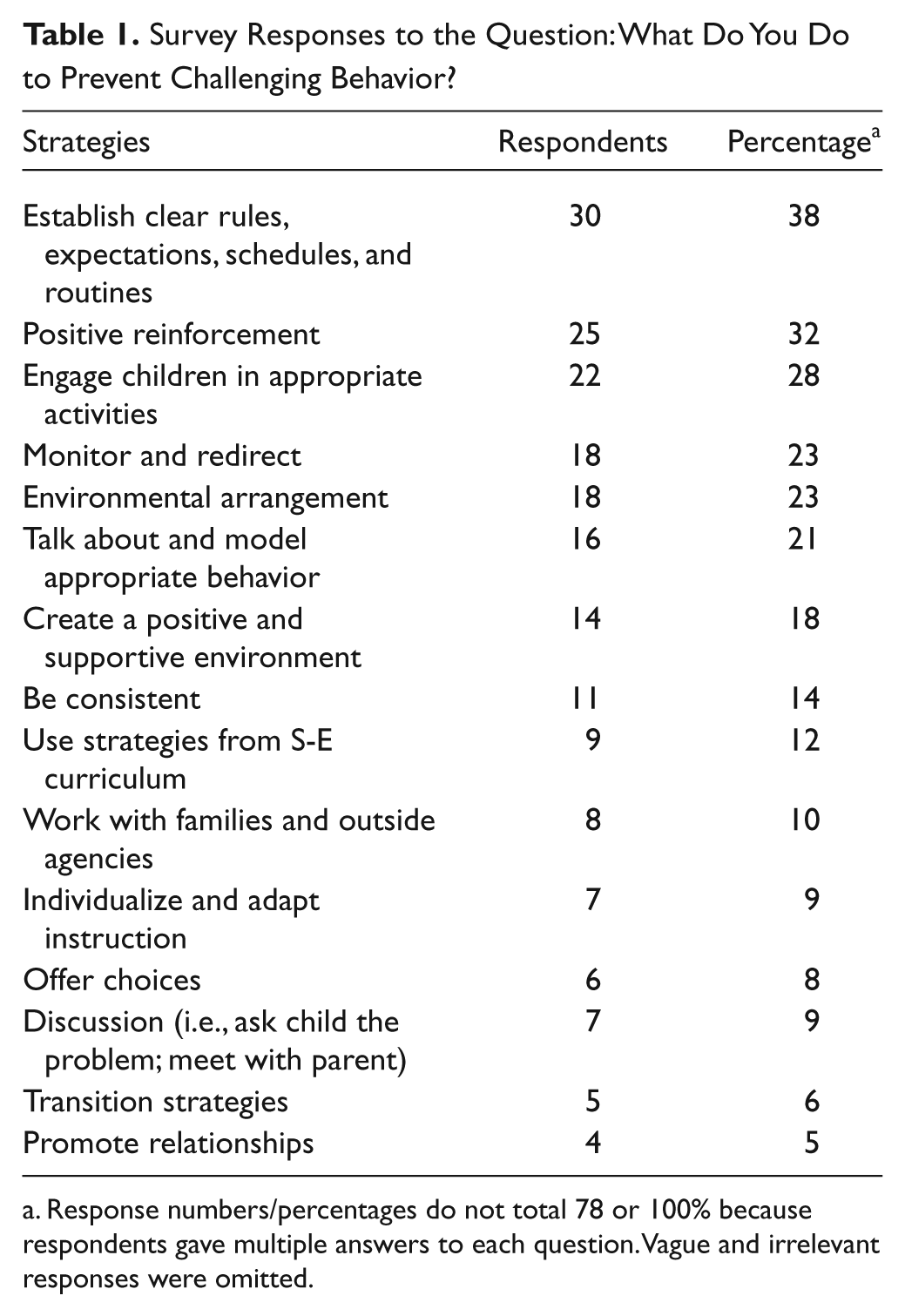
Response numbers/percentages do not total 78 or 100% because respondents gave multiple answers to each question. Vague and irrelevant responses were omitted.
Table 2 reports the top 18 of 24 categories of participants’ response to the survey question “What do you do to respond to challenging behavior?” The most frequently mentioned categories were reported by one third to one half of the participants and included prevention (positive reinforcement, proactive strategies like role-playing prior to an incident occurring; 46%) and redirection (prompting appropriate behavior, 33%). Four strategies were listed by about one fifth of the participants: follow behavior plan and incentive chart (22%), use strategies from a social-emotional curriculum (21%), review rules and expectations (19%), and talk about and model appropriate behavior (19%). The qualitative coding category “Remove the child from the situation” (15%) did not refer to time out but instead referred to strategies like creating a separate, quiet space for children and teaching them to go to this space to self-calm. Most strategies participants listed, with the exception of “deliver consequences” (e.g., loss of privileges, 13%) and “send the child to time out” (10%), appeared to be developmentally appropriate practices. The focus of survey responses to manage behavior in the classroom was on preventative and replacement strategies. One pertinent finding was that “determine cause of the problem behavior,” considered the hallmark of PBS, was cited by only 4 (5%) of the 78 respondents.
Survey Responses to the Question: What Do You Do to Respond to Challenging Behavior?
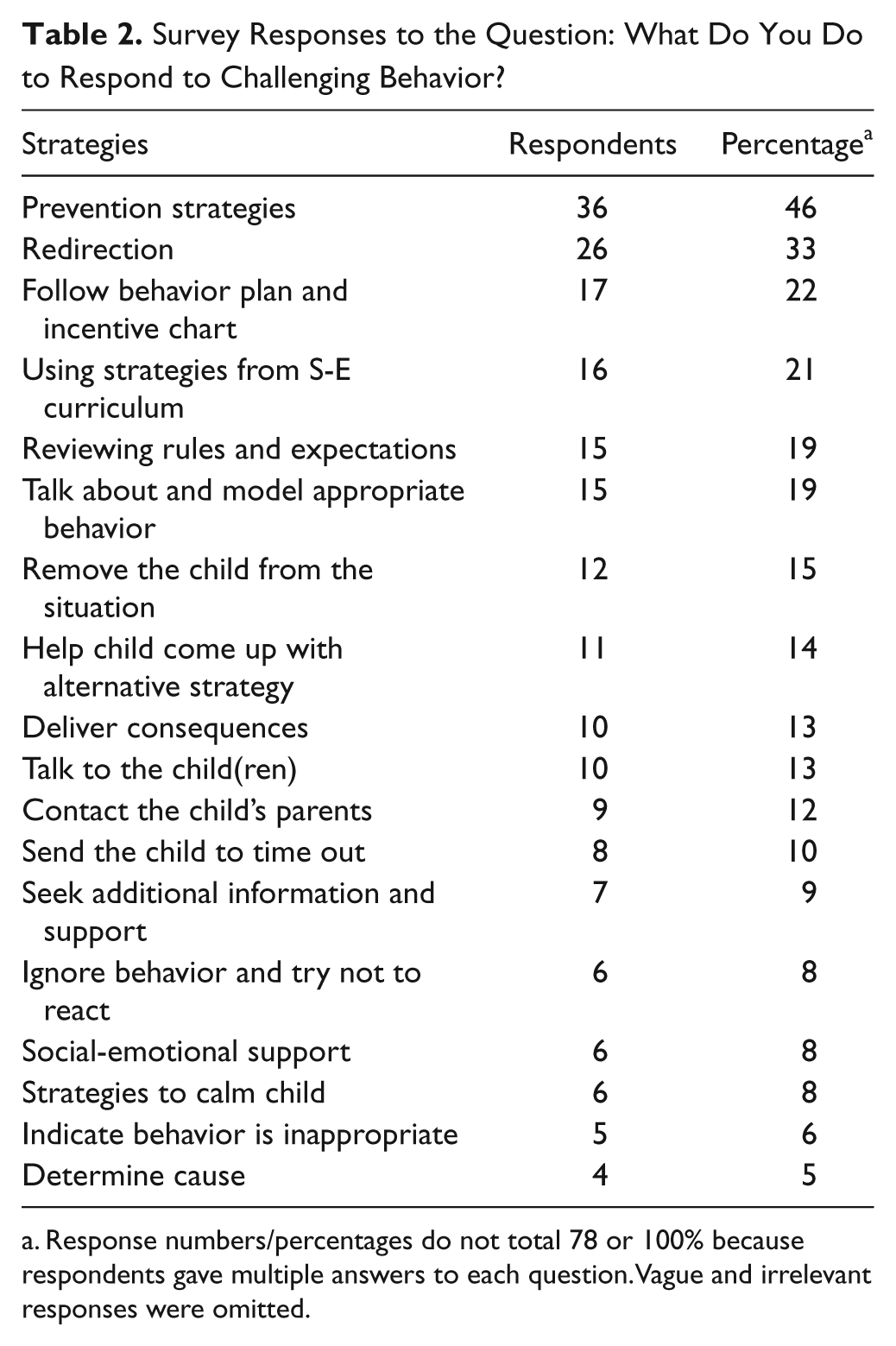
Response numbers/percentages do not total 78 or 100% because respondents gave multiple answers to each question. Vague and irrelevant responses were omitted.
Table 3 displays participants’ responses to the survey question on involving family members of children with challenging behavior. Qualitative analyses of responses indicated nine categories, with most participants listing some form of communicating with parents (92%; verbal, written, or not specified). Slightly more than half mentioned meetings with parents, whereas one quarter indicated that they would work with family members or ask them to come to school for a variety of purposes (e.g., volunteering, observing). As expected with the significant focus in HS on family involvement, survey respondents described accepted methods to include families of children with problem behavior in the process of addressing that behavior.
Survey Responses to the Question: How Do You Involve Family Members When a Child in Your Classroom Consistently Displays Challenging Behavior?

Response numbers/percentages do not total 78 or 100% because respondents gave multiple answers to each question. Vague and irrelevant responses were omitted.
The conflict scenarios provided an indication of how the participants would respond to challenging behavior conflict in the classrooms. These data were analyzed by the qualitative methodology and the scoring rubric of high, medium, and low described earlier. For the first conflict scenario in which a teacher had a difficult start to the school year, 26 participants (33%) received high scores for their response. Examples of highly rated responses included the following: reexamine the rules to make sure they are age appropriate, evaluate the classroom setup and routines, and look at how many times and when children are transitioning. Forty-two participants (54%) received medium scores for their response. Examples of medium responses included the following: go back and teach routines and transitions slowly, set up a schedule so children know what to expect next, and use transition activities to signal a transition. Ten participants (13%) received low scores for their response. Examples of low responses included the following: ask the parents to help out and work with children at home, be consistent and wait a few weeks, and talk to supervisor.
The second conflict scenario concerned restless children in opening circle activities and a child who left circle. Twenty participants (26%) received high scores for their response. Examples of highly rated responses included the following: consider which child left the circle and the reason why, set up a system where each child should have an individual time to talk, and use a social story to help the children understand the importance of being respectful and turn taking. Thirty-nine participants (50%) received medium scores for their response. Medium-rated responses included the following: allow one more child to share, have a quiet or regroup signal, and redirect the negative behaviors. Nineteen participants (24%) received low scores for their response to the second conflict scenario. Low-rated responses addressed the behavior in a reactive manner. Examples included stop the activity, and tell children to listen.
The third conflict scenario described a child who refused to come to snack and kicked the teacher. Eight participants (10%) received a high score for their response. High-rated responses included the following: analyze the situation to see if Mary has difficulty at all transitions or just this transition, use Al’s Pals with Mary, and have a behavior specialist observe the situation. Fifty-one participants (66%) received medium scores for their response. Examples included the following: give two warnings for the transition, allow the child to take one thing to the snack table with her, and give positive redirection. Nineteen participants received low scores for this scenario. Low-rated responses included the following: tell the child you will call her parents, and have the child apologize.
The fourth conflict scenario depicted a child who had trouble completing a puzzle and threw it. Forty participants (51%) received high scores for their response. Examples included the following: talk to the child as you help her pick up the puzzle while explaining the word frustrated, have her clean up the puzzle while asking her what she could do in the future instead of throwing the puzzle. Thirty-eight participants (49%) received medium scores for their response. Examples included the following: ask her to pick up the puzzle, redirect the child, and explain the rules. No participants received low scores for this scenario.
Discussion
The findings of this study contribute to the literature in several ways. First, these survey data confirm previous research that HS teachers view children’s externalizing behavior as most problematic. However, some of the behavior they considered challenging is not consistent with the definition of challenging behavior (Doss & Reichle, 1991). As the use of individualized PBS requires more intensive assessment and intervention planning, it would be important to assist classroom staff to differentiate between children who need intensive, individualized intervention at Tier 3 and children whose behavior could be addressed through the use of Tier 1 or 2 interventions. Second, these data from HS classrooms expand our understanding of staff practices and perceptions of problem behavior and its prevention. As we expected, these findings indicate that respondents primarily described the use of universal strategies to address challenging behavior, but far less often reported the use of individualized strategies. We also found that a small, but noteworthy, percentage of participants described the use of reactive practices or practices that did not address the problem (e.g., time-out, call the child’s parent, or stop the activity) when they reported: (a) how they responded to challenging behavior (10, 13%) and (b) how to address the conflict scenarios (13, 24% for three scenarios). These results emphasize the value of providing staff training on a comprehensive model for dealing with problem behavior in the classroom (Quesenberry et al., 2011); such a model should extend their knowledge base beyond universal practices emphasized in early childhood curricula to individualized strategies that are necessary to prevent, replace, and reduce children’s challenging behavior. Additionally, although participants described multiple options for family involvement, we did not ask about challenges to family participation, nor did we talk directly to family members. Such data might reveal a clearer picture concerning family involvement practices that occur when children have challenging behavior. Finally, even though respondents reported receiving training in topics related to PBS, they expressed a need for more information with behavior management and specific PBS strategies, such as functional assessment, noted most often.
Limitations and Future Research
This study had several limitations. First, this study involved heterogeneous groups of participants including classroom teachers, assistant teachers, program directors, mental health specialists, behavior specialists, and others. It is likely that these participants had varying amounts of experience and exposure to children with disruptive behaviors, as well as differing skills for handling these behaviors. In particular, staff who spent limited time in the classroom (e.g., program directors) and staff whose role it was to work only with children with behavioral needs (e.g., the mental health specialist, behavioral health specialist) may have had very different points of view than classroom teachers who spent a greater amount of time working directly with all children. Second, the sample size was small and only represents perspectives of staff from five programs in a specific geographic region. In addition, one of the challenges with survey responses is the accuracy of respondent reporting and whether their given responses reflect actual practices and beliefs or socially desirable answers. The use of multisource and multimethod strategies for needs assessment including interviews and observation is recommended in order to provide a more reliable data set to guide professional development activities (Hemmeter & Fox, 2008; Snyder & Wolfe, 2008).
Implications for Training and Practice
Current in-service training methods for teachers often rely on passive methods of instruction (lectures, reading assignments, etc.), rather than active methods (teacher modeling, small group discussion, practice with feedback) (Feil et al., 2009; Sexton et al., 1996; Snyder & Wolfe, 2008). There is strong support in the field for in-service training that builds on prior needs assessment, employs evaluation of learning, and incorporates follow-up of teachers’ application of practices (Snyder & Wolfe, 2008).
If our goal is to support HS teachers to use PBS methods, research suggests that researchers and administrators consider several critical factors that influence staff adoption of PBS as well as training methods that may be effective in supporting this adoption. One essential factor is the learner’s “buy-in” to the request to adopt a new practice. Guided discussion is one promising method that involves self-reflection about one’s own beliefs and current practices (Girolametto, Weitzman, Lefebvre, & Greenberg, 2007). Self-reflection, accompanied by a discussion of the rationale for a new approach (e.g., PBS), allows participants to examine the benefits of adopting that approach. Another way to encourage “buy-in” and adoption of new practices is the use of indigenous exemplars as models for the new practice. By showing trainees that a new intervention is used by others who are similar to them (e.g., same role, similar age and gender), trainees are more likely to view the practice as “doable” and to implement it in their own setting. Fantuzzo and colleagues (1996) made use of videotapes of developmentally appropriate practices taken in exemplary classrooms of participating teachers’ peers; they found this approach to be more effective in promoting teachers’ positive initiations and praise with children. Other researchers have found that adult learners were more apt to adopt a new practice if professional development focused on content, was interactive rather than only didactic, provided opportunities to apply content and receive feedback, and was consistent with classroom goals (Garet, Porter, Virman, & Yoon, 2001; Hsieh, Hemmeter, McCollum, & Ostrosky, 2009; O’Brien et al., 2001).
When in-service is focused on addressing problem behavior, experts recommend that teachers be given support to implement their training in the classroom (Hemmeter & Fox, 2008, 2009). Evidence indicates that ongoing follow-up and support in a trainee’s classroom motivates learners to apply new strategies (Duda, Dunlap, Fox, Lentini, & Clark, 2004; Fantuzzo et al., 1996; Raver, et al., 2009). For example, Duda et al. (2004) found that consultation methods and a team approach for supporting a teacher in a community preschool program resulted in successful implementation of an individualized PBS plan and positive child outcomes for two children with challenging behaviors. Similarly, Fantuzzo and colleagues (1996) demonstrated that several active training strategies resulted in teachers’ increased use of targeted skills: (a) classroom teams, including parents, attended training together; (b) staff identified the new practices they wanted to implement; and (c) guided practice (i.e., mentors videotaped them implementing these practices and then provided immediate feedback, including praise for correct use).
Because research provides fairly clear guidance for improving preschool staff adoption of PBS and its sustained and consistent use across program staff, it is important that preschool program administrators build their professional development activities on that body of findings.
Footnotes
Acknowledgements
The authors would like to thank Beverly Sweeney, graduate research assistant, for her assistance in analyzing the survey data.
The authors declared no potential conflicts of interest with respect to the research, authorship, and/or publication of this article.
The authors disclosed receipt of the following financial support for the research, authorship, and/or publication of this article:The research reported here was supported by the Institute of Education Sciences, U.S. Department of Education, through Grant R324A080016 to the University of Virginia. The opinions expressed are those of the authors and do not represent views of the U.S. Department of Education.