







Abstract
This study used interviews and classroom observation to follow up a survey of 78 Head Start staff from five programs in the mid-Atlantic region. The purpose of the study was to collect additional details about administrator and staff needs in regard to addressing children’s challenging behavior in order to design a PBS in-service intervention. Interviews were conducted with 45 adults from the same preschool sample, and direct observation occurred in 10 classrooms. Similar to prior survey results, it was found that interview respondents (a) listed externalizing behaviors as the predominant challenging behavior, (b) identified prevention and replacement methods for addressing problem behavior, and (c) indicated that families of children with challenging behavior were given opportunities to be involved in intervention planning and implementation. However, interview and observation results further exposed the use of reactive practices and revealed five primary barriers to addressing children’s challenging behavior. Finally, interview respondents reported that all programs had defined procedures they followed when children exhibited challenging behavior that in most programs was based on a traditional, child-focused, mental health approach rather than on a comprehensive systems approach like positive behavior support.
Researchers recommend that multisource and multimethod needs assessment strategies produce richer and more reliable information for guiding professional development activities (Hemmeter & Fox, 2008; Mann, 1998; Snyder & Wolfe, 2008). Face-to-face, individual interviews can provide the opportunity to clarify participant responses and to learn more about contextual variables (e.g., policies, climate, resources) that influence teacher practices. Teacher observations, by contrast, can supplement interviews because observations allow for the identification of attributed needs rather than respondent-perceived or “felt” needs (Snyder & Wolfe, 2008). Previous research has found that teachers’ reported practices are not always congruent with their actual practices. For example, in a study by Tiano and McNeil (2006), teachers reported that they frequently praised children but classroom observations revealed that praise was given much less often than reported. Thus, having both types of needs assessment is of value when planning professional development activities.
One priority area of professional development in preschool settings is positive behavior support (PBS), a three-tiered approach that relies heavily on preventive strategies and teaching appropriate behavior. There is some support that teachers from lower quality Head Start (HS) classrooms more often report inappropriate behavior management practices and beliefs than do teachers from middle- and high-quality classrooms, thus suggesting value in understanding teachers’ perspectives when conducting needs assessment (McCarty, Abbott-Shim, & Lambert, 2001). Tillery, Varjas, Meyers, and Collins (2010) recently reported qualitative findings from interviews of early elementary teachers on their practices and perceptions of behavior management and intervention strategies. Their results indicated poor transfer of skills from in-service training to classroom use, infrequent use of preventive methods, and frequent use of a graduated discipline system that started with warnings and progressed to increasing punishment. Thus, despite inservice training, teachers may fail to apply the skills on which they are trained.
Clearly there are many factors that influence whether inservice training on PBS is applied in classrooms by participants. Factors that decrease the likelihood that PBS strategies will be applied in the classroom following professional development activities include (a) inadequate needs assessment, (b) ineffective training methods, (c) no measurement of participant learning, and (d) no assessment of child change. Two other factors that influence teachers’ application of PBS are their acceptance of PBS practices and their success in applying PBS practices. Stormont, Lewis, and Smith (2005) found that early childhood special education (ECSE) teachers rated a majority of PBS strategies as “Mostly important,” but rated significantly fewer items as feasible in the classroom. Teachers’ reports of their approaches to addressing problem behavior, and their likelihood of implementing new strategies, can help shape interventions aimed at improving their practices.
In addition to classroom staff perspectives, it is of value to learn about program policies in order to design appropriate professional development activities. Recent research on HS program policies for addressing children with challenging behavior (Quesenberry, Hemmeter, & Ostrosky, 2011) indicates that there are discrepancies in the way that programs provide support for children with challenging behavior. These authors found a wide diversity of policies and procedures concerning children’s challenging behavior across HS programs. Some programs used more positive practices that fit within the PBS framework, while others used more reactive practices that were not consistent with PBS (e.g., removing children from the program).
This study builds on information collected in a survey of 75 staff from five HS programs in the Mid-Atlantic region about their needs related to working with children with challenging behavior (Snell et al., 2011). The purpose of collecting these data was to design an intervention and training package based on a PBS framework that would be feasible for use in HS programs. “Feas,” in part, depended on obtaining an accurate needs assessment on practices and attitudes toward behavior management across the five programs. Although the survey findings (Snell et al., 2011) provided valuable information about staff perspectives on discipline, the use of a single self-reported, survey measure may not have yielded accurate data. Other researchers have found that (a) survey respondents may interpret questions in different ways and cannot obtain clarification; (b) a single source of self-report needs assessment data may be incomplete; and (c) structured survey questions do not allow for the identification of individual needs (Snyder & Wolfe, 2008).
This study was designed to achieve two research aims. The first aim was to follow up on prior staff survey results and to gather in-depth information by interviewing HS staff on the challenging behaviors faced in their classrooms, the strategies used to address those behaviors, and the ways they involved family members. We were interested in knowing whether these follow-up findings would meaningfully extend and also agree with the prior survey findings (Snell, Berlin, Voorhees, Stanton-Chapman, & Hadden, 2011). Our survey results confirmed previous research that preschool teachers’ main concerns relate to externalizing behavior (Qi & Kaiser, 2003). We expected that interview respondents also would list more externalizing, or openly expressive, challenging behaviors than internalizing behaviors that are associated with poor social skills. However, we also hypothesized that classroom observations and interviews would reveal more reactive practices to address these challenging behaviors than shown in their survey reports. As expected with the family involvement focus of HS (Schumacher, 2003), our prior survey results indicated that families were given the opportunity to be actively involved in the process for addressing their children’s challenging behavior. In this study, we expected that face-to-face interviews would be more likely to reveal the challenges staff experienced with families of children with problem behavior. Because our purpose was to design effective professional development activities, the second aim was to learn more about the program policies for addressing children’s challenging behavior as well as the supports programs provided and the barriers they faced when addressing the needs of children, families, and staff. We expected programs to have policies that might include removal of children, and that different types of staff interviewed would have different perspectives and roles in implementing these policies. Finally, given the historical emphasis in HS on mental health services, we anticipated that supports provided to children with challenging behavior would reflect a mental health approach (Duran et al., 2009; Yoshikawa & Zigler, 2000).
Method
All participants worked in one of 10 classrooms in five HS programs that served children ages 3 to 5 years in a mid-Atlantic state. Program administrators reported that 8% to 15% of children had disabilities, typically identified as speech-language impairment and developmental delay, and less often as autism and physical disabilities. Programs had from 9 to 26 classrooms, with 17.6 children per classroom on average. Classrooms typically had two staff (teacher and assistant teacher); were operated by public schools (N = 2) or community agencies (N = 3); and were located in child care centers, elementary schools, and buildings housing preschool classrooms.
The follow-up interviews involved 45 participants from across the five programs: administrators (n = 9), teachers (n = 11), teaching assistants (n = 10), behavior specialists (n = 4), mental health specialists (n = 3), family support staff (n = 5), and collaborating partner staff (n = 3). Of the 45 participants, 15 also had completed the survey (1 administrator, 14 other staff members). Observations were conducted in all the participating teachers’ classrooms (n = 10, one classroom had co-teachers).
Dependent Measures
Interview
To learn more about participants’ practices regarding challenging behavior, we developed an interview protocol with some variations for administrators and teachers (Voorhees, Berlin, & Hadden, 2008). Two existing interview protocols served as the primary sources for the interview questions: (a) The Preschool-wide Evaluation Tool Administrator Interview Guide (Steed & Pomerleau-Lapointe, 2008) and (b) the Teaching Pyramid Observation Tool for Preschool Classrooms (TPOT; Hemmeter, Fox, & Snyder, 2008). Both latter tools are used to measure the implementation of positive behavior support and classroom quality in early childhood settings. Initial analyses of the descriptive statistics; the item, subscale, and total correlations; and tests of internal consistency revealed that the Preschool-wide Evaluation Tool meets or exceeds basic psychometric criteria for measurement tools used in research (Steed & Webb, 2010). This same measure had high interobserver agreement (IOA), a weak but positive correlation to the TPOT, modest subscale intercorrelations, and sensitivity to implementation change. Snyder, Crowe, Miller, Hemmeter, and Fox (2011) found convergent validity evidence that showed notable correlations between TPOT scores and composite domain scores for the CLASS (Pianta, Hamre, & Stuhlman, 2004), an instrument widely used to measure preschool classroom quality.
We added open-ended questions about the referral process for children with challenging behavior, strategies used to address these behaviors, and the specific roles of specialists who provided support to these children, their teachers, and families. Interview questions were open ended, with standard probes for interviewers to clarify the intent of each question or to obtain additional information responses. Interview questions were revised after being reviewed by project staff not involved in their development. The final version of the interview lasted from 45 to 90 minutes.
Observation
We conducted a direct observation of classroom practices using the (TPOT; Hemmeter et al., 2008). The TPOT is designed to measure the use of positive behavior support practices (ranging from universal to individualized practices). The tool requires that observers be in the classroom for a minimum of 2 hours and observe at least one child-directed routine (e.g., centers or free play) and one teacher-directed routine (e.g., circle or story). In a recent study of 50 preschool classrooms, the TPOT yielded dependable observed scores across multiple raters and multiple occasions (Snyder et al., 2011).
Procedures
Several weeks following completion of a survey on classroom practices with challenging behavior (Snell et al., 2011), 45 HS or collaborating program staff from the same five programs were recruited to participate in follow-up interviews. After interviewing administrators from all programs, we asked them to nominate teachers, assistant teachers, behavior or mental health specialists, and family service specialists for these voluntary interviews. Administrators were asked to select one classroom team who excelled in behavior management and one classroom team who struggled.
On a day prearranged with the nominated classroom teachers, we conducted TPOT observations (Hemmeter et al., 2008). Observations occurred during morning classroom routines and lasted about 2 hours. Observers were two doctoral students in the educational psychology program with previous experience with children. Observers underwent prior training and had achieved the required criterion of 80% IOA.
After the completion of the observation, teachers, assistant teachers, and other HS staff were interviewed separately with the exception of one classroom team that requested a joint interview. All interviews were audiotaped with participants’ consent and transcribed by research assistants blind to the hypotheses of the study. Interviews were conducted either by project staff with doctoral degrees in education and extensive ECSE experience or by doctoral students in educational psychology. Interview participants were sent a modest gift for participating.
Data Analysis
Interviews
An expert in qualitative methodology provided feedback to strengthen the trustworthiness of our interview findings. To ensure credibility, we used transcriptions of tape-recorded interviews rather than postinterview notes. A rigorous process was used to ensure the accuracy of the transcriptions: We compared each transcription to the corresponding audiotape to correct errors, and the researcher who conducted the interview reviewed these corrections.
Next, a systematic and verifiable process was used to develop analytic categories and to code the data using NVivo (QSR International, 2007). Two project staff (second author and final author) took a lead role in interview analysis. First, they developed seven a priori categories to guide them in coding based on (a) a review of transcripts from one HS program, (b) the purpose of the interviews, and (c) the interview questions. The researchers independently coded interviews from one randomly selected program and met to compare and further define the categories. They developed additional subcategories that best depicted emerging patterns and themes and recorded these in a coding manual. Eight final primary coding categories resulted: (a) process: procedure followed to identify children who need support for mental health or behavior problems; (b) universal strategies: methods used to support social-emotional development for all children in the classroom; (c) individual strategies: methods used with children who have severe and persistent problem behavior or mental health needs; (d) challenges: barriers to supporting children’s social-emotional skills; (e) support: scaffolds provided to classroom staff; (f) social: most important social skills to teach; (g) universal family: family involvement for all children in the classroom; and (h) individual family: family involvement for children identified as having challenging behavior.
Interviews from two programs were independently coded by both project staff until they reached 100% agreement on all of the primary and secondary coded categories. The staff member (fifth author) who conducted the interviews for one program served as peer debriefer (rather than as coder) by reviewing these categories and providing feedback. She indicated whether categories accurately reflected the data, and suggested additional descriptors be added to the code definitions to improve them. Next, the staff (last author) coded the interviews from the remaining three programs. The second author reviewed all coded data for these three programs and discussed the codes to resolve any disagreements. Both project staff reached 100% IOA on the coded categories. Matrices were developed to summarize findings and conclusions for each program. Cross-program matrices were created to compare responses across programs.
Observation
Data from TPOT observations in each classroom were recorded on a scoring protocol by the observer while in the field and scored using guidelines developed by Hemmeter and Fox (2009), adding any relevant notes. Observation data were entered into SPSS and analyzed in two different ways. First, the percentage of critical practices in place was calculated for each classroom. Second, the number of “red flags” was counted for each classroom; red flags represent practices not considered to be positive behavior support practices.
Results
Challenging Behaviors
A total of 45 individuals were asked to participate in the follow-up interviews; no individuals who were asked declined to participate, yielding a 100% response rate. The responses to questions about the challenging child behaviors that staff faced confirmed our hypothesis that respondents identified externalizing behaviors more often than internalizing behaviors. The most frequently mentioned challenging behavior noted by interview participants involved aggression (e.g., kicking, hitting, throwing furniture) resulting in harm to children, the teacher, or the child himself or herself. Other behaviors given were those presenting safety concerns (e.g., running out of the classroom) or interfering with children’s learning and participation in class activities (e.g., throwing self on floor, screaming, cursing, sexual acting out). Internalizing behavior (e.g., quiet, withdrawn, not playing with others) was mentioned only by one respondent in one of the five programs. Child behaviors described by interviewees as leading to referral for intervention tended to fit the definition of challenging behavior (i.e., a repeated pattern of behavior that causes injury, damage to the environment, interferes with learning, or is socially isolating and is sustained over time; Doss & Reichle, 1991).
Prevention Strategies
Respondents from all five programs stated that they used specific social skills curricula (e.g., Al’s Pals; Wingspan, 2004) to prevent problem behavior and to teach social problem-solving, identifying emotions, and self-calming; they reported using the Creative Curriculum (Dodge, Colker, & Heroman, 2002) for overall guidance on establishing rules and setting up the environment. Classroom observations confirmed that many of these environmental features were in place (e.g., classroom arranged into centers with boundaries, adequate materials). However, based on their interview responses and our observations, fidelity of implementation of some elements in these curricula appeared to vary considerably. (Mental Health Specialist: “One of the strategies . . . is going to Al’s Place which is a quiet place where [a child] can go to . . . to calm themselves down. . . . With this particular child . . . they were trying to use Al’s Place as a time out place . . . We had to talk about that would defeat the purpose.”)
Response Strategies
Interview results confirmed our hypothesis that when asked how they responded when children exhibited challenging behavior, their responses would focus more on reducing problem behavior than on preventing it. Overall, more reactive practices than positive practices were described; however, this varied by program. Examples of positive strategies noted most often by respondents included redirection, behavior charts or token systems, ignoring the behavior, and use of calming techniques (e.g., quiet place, deep breathing). Examples of reactive strategies noted most often were removal of the child from the activity (e.g., to time-out or the “unhappy chair”), from the classroom (e.g., to the principal’s office or to a “stern” teacher’s classroom), or from the school (e.g., parent required to pick up child, suspension). None of these latter responses were judged to be developmentally appropriate by the research team.
Classroom observations revealed that although all 10 classrooms were using positive strategies, there were clear signs that some foundational practices in early childhood were not in place (called “red flags” in the TPOT; Table 1). Also, positive reinforcement for appropriate behavior was not often used, such as frequent comments on “good” behavior and the provision of positive attention when a misbehaving child begins to behave appropriately.
TPOT Observation Results
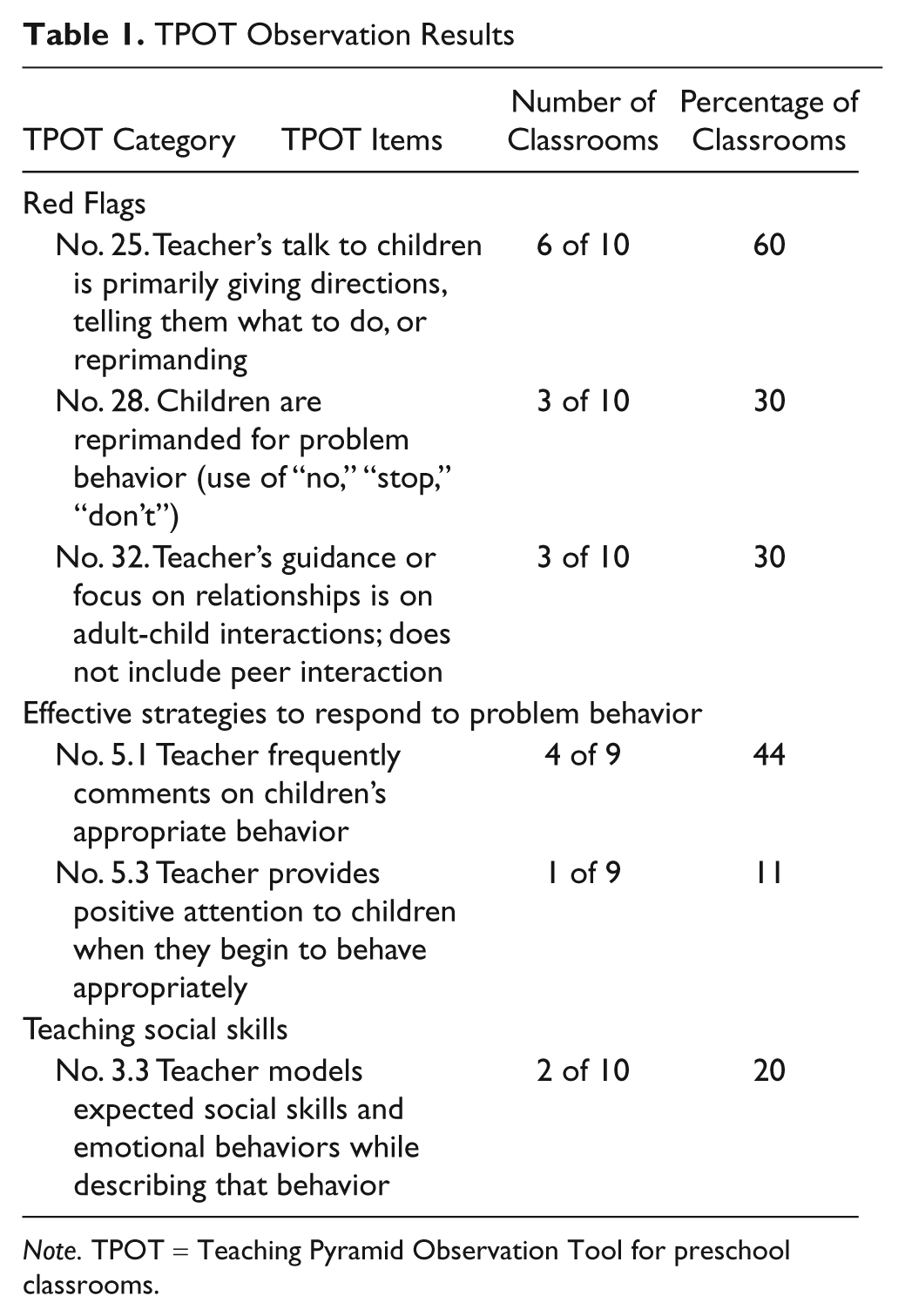
Note. TPOT = Teaching Pyramid Observation Tool for preschool classrooms.
Interviews revealed that most participants did not identify the function of a child’s challenging behavior, nor did programs report using such assessment to design intervention. There was little mention of identifying predicting antecedents; instead, respondents focused on the use of standard response methods, such as behavior or incentive charts, teaching children to go to a quiet spot, and removal from an activity, classroom, or school. (Teaching Assistant: “We [classroom staff and specialists] have tried the smiley face chart with the children. That’s pretty much the only behavior plan that we’ve tried.”)
Some interviewees from every program reported using time-out and/or removal of children from the group or classroom to respond to challenging behavior. However, they also expressed that although not allowed to use these methods, these punitive “consequences” were necessary. Several teachers stated that they believed that other children “missed out” when one child’s behavior disrupted the class. Participants indicated that removal from a classroom activity, from the classroom, or from the school were needed strategies to respond to challenging behavior, because other strategies they were using were not working. Two of the five programs had policies requiring parents to sign a statement before admission into the program that they would pick up their children and take them home if their children’s behavior presented a safety concern.
Program Policies
Interviewees from all five programs described a referral process that was used when children had persistent, serious problem behavior. This process included pre-referral steps such as teacher documentation of the child’s behavior and strategies used to address the behavior, discussion with the child’s family, and meeting with HS administrators or specialists who provided suggestions to try before referring the child. All programs had a group of individuals or team that met to discuss referrals for these children. Some programs noted differences in referral procedures if a child’s behavior seemed related to a developmental delay or a disability. In these cases the child may have been referred to a school division team for consideration of eligibility for special education services.
Interviews revealed that the primary support for children with challenging behavior was provided by mental health specialists in four of the five programs; the fifth program had experienced educators who served as lead teachers or behavior coaches. In three programs, the mental health specialists consulted with teachers but primarily worked directly with children. The level and type of support varied by program, ranging from daily support for half of the day within the classroom to working with individual children using a pull-in or pull-out method. Various methods of support were described such as “talk” or “play” therapy, assisting children to “process,” rational-emotive therapy, and using a specific curriculum. Classroom staff stated that they appreciated any support, but reported classroom consultation or coaching as most valuable.
A consultative model was used by two programs in which primary support persons worked with classroom teams using coaching and mentoring (e.g., building relationships, establishing trust to promote buy-in, being available, maintaining regular communication). One specialist commented: “I’ve built . . . relationships with doing a lot of modeling and co-teaching . . . they’ll watch me and take notes and we talk about what I am doing.”
We found little evidence that program policies took into account the function of children’s challenging behaviors, used functional behavioral assessment, or had a process to select individualized strategies that matched identified antecedents or functions of problem behavior. Only a few interviewees noted that teams discussed the predictors for a child’s behavior or that they developed strategies to prevent the behavior. Although some program staff indicated that they developed a “behavior plan” for a child, their definition of a plan typically referred to classroom rules or an incentive or reward system. There was no substantiation that multicomponent support plans were developed to prevent triggering antecedents, to teach replacement behavior, and to respond so appropriate behavior was reinforced instead of the problem behavior
In all five programs, there was consistency across staff interviews in the identification of five primary barriers to addressing children’s challenging behaviors. The first barrier identified by programs was inadequate training in practices to resolve significant behavior problems in the classroom, including the importance and process of using individualized strategies with some children. (Teacher: “ . . . in my student teaching and practicum, I didn’t see such behavior.”)
A second barrier was identified regarding the differences between teacher beliefs and practices and those of specialists or outside agency personnel. In some programs, this conflict was based on classroom staff beliefs that children need to be “punished” through the use of negative consequences (loss of privileges, time out) rather than using the positive strategies suggested by the specialists (e.g., redirection versus saying “no”; the use of a place to cool down versus time out). Frequently teachers complained that it was not fair to have different expectations for different children because “all children should be treated the same.” Another predominant example of these differences between teachers and specialists were teachers who expressed their need for reactive consequences like removing a child from the classroom because they believed that the positive discipline techniques they were expected to use would not curtail the problem behavior. In one program, the mental health approach (e.g., talking with children and providing time for them to process and make decisions) conflicted with the educational approach of providing immediate consequences. A behavior specialist explained: “There are teachers that do not buy-in [to positive behavior support methods], and my role limits what I can do. I can make suggestions but sometimes they just don’t [use them] and that’s something I have to swallow . . . I just can’t make them do it.”
The third barrier identified in all programs was the lack of direct classroom assistance. Although all programs described supports provided to assist classroom staff with children having challenging behavior (e.g., using volunteers, part-time staff, or school division staff like guidance counselors; referral to outside agencies), most classroom interview respondents expressed a need for more direct assistance in the classroom. One teaching assistant stated: “In this classroom there needs to be somebody with the child all day long, every day . . . It’s scary to the other children and it’s scary to us . . . when . . . shelves are flying . . ..” A Behavior Specialist commented on this barrier of inadequate classroom staff and support to deal with problem behavior in the classroom: “I’ve been in classrooms where I feel like they absolutely need another set of hands”).
The fourth barrier identified in all five programs concerned family involvement. Interviewees from all programs emphasized eliciting input from families and involving them in discussions about their child’s behavior and how to address it. However, as expected, program staff identified several issues that made it difficult to partner with families who had children with challenging behavior. Participants commented on the differences between HS discipline practices and home discipline practices. One administrator noted that a parent’s “response was, ‘That namby-pamby way they discipline in the classroom . . . nothing works as well as whipping him.’” Another administrator commented: “a parent not agreeing that they have some ownership and responsibility in the change.’ [Parents seem to say] ‘It’s your problem. I am sending them to you, and it’s your problem.’”
Interviewees also mentioned that some parents did not recognize their child’s challenging behavior. They also noted that there was not enough support from parents, but empathized with the difficulties experienced in some home environments. One administrator reflected:
Probably our biggest challenge is parents who are in denial that there is a problem. . . . Some families have so many problems that they cannot attend to the child’s problems. . . . Crises are all over the place and usually there is a connection between the significant dysfunction and the challenging behavior.
A behavior specialist noted that, “Parents following through at home [is a difficulty] . . . because parents have a lot of stress on them and behavior charts . . . might not be their first priority.”
The final and fifth barrier to addressing children with challenging behavior that all programs agreed on was the lack of coordination and communication during the referral process and when providing services. For example, interviewees specifically mentioned the difficulty in scheduling meetings to address the referred child, the time required to get assistance after a referral was made, the lack of effective communication between and within agencies during the referral and intervention process, and the lack of a written behavior plan.
Discussion
The findings of this study contribute to the literature in several ways. First, these qualitative data extend our understanding of teachers’ practices and perceptions of discipline in early elementary classrooms (Tillery et al., 2010) to preschool classrooms and identify challenges that must be addressed to support the implementation of PBS practices in preschool settings. Second, our findings suggest that survey and interview results taken from the same HS population may yield somewhat different findings. In agreement with Qi and Kaiser’s (2003) review, respondents indicated that externalizing behavior was more challenging than internalizing behavior, but many of the behaviors listed by survey respondents were not as serious as is implied by the accepted definition of challenging behavior, while the behaviors described by interviewees were more serious and fit the definition. All respondents described classroom practices for preventing and responding to problem behavior; whereas survey respondents cited ways to prevent the behavior as the top strategy used, interview participants described strategies to respond to the behavior following its occurrence more often than to prevent it. The top strategies that survey respondents gave for handling challenging behavior were positive strategies (e.g., redirection, use of behavior charts, modeling appropriate behavior) judged to be appropriate preschool practices (Dunlap et al., 2006). Similar to Tillery et al. (2010), interviewees more often described reactive strategies like the removal of children. Classroom observations agreed with interviews and showed that the interactions of some classroom staff with children emphasized teacher direction and reprimand in place of positive attention to appropriate behavior.
Several factors may explain why survey responses about discipline practices were less negative than interview responses. Although from the same five HS programs, the two groups of participants were sampled differently: survey participants volunteered, whereas interview participants included classroom teams recommended by their program director who were either skilled in handling problem behavior or who struggled with it. There is evidence that teachers in lower quality preschool classrooms tend to report inappropriate practices more often than teachers in higher quality classrooms (McCarty et al., 2001). Differences also might be due to the respondent’s level of objectivity. Survey respondents were asked to provide generic answers rather than to focus on specific children. Interviewees were asked to talk about their programs, and our follow-up questions prompted in-depth comments and reflection.
A final reason that may explain the differences between survey and interview results concerns the use of teaching observations of classroom staff made just prior to their interview and in the presence of the interviewer. These interviewees discussed the strategies they used during the observation; most observations involved some conflict with a child and their strategies tended to be more reactive and less preventive. Based on a review of research on the impact that survey administrative mode has on response effects in survey measurement, it appears that surveys are less likely to produce socially desirable responding than are face-to-face interviews (Schwarz, Strack, Hippler, & Bishop, 1991). However, in this study face-to-face interviews of all classroom staff (21 of 43 individuals interviewed) were preceded by classroom observations on the same day; this arrangement may have neutralized the tendency for teaching staff to say what was expected in interviews and instead to comment on the difficulties they experienced in addressing children’s challenging behavior.
Finally, all interviewees reported that when children had challenging behavior they followed a process that resulted in children’s removal from the classroom or program if current strategies had not been effective. Consistent with the emphasis on mental health services and supports in HS, we found that the supports provided to children were based on a more traditional child-focused mental health approach rather than a comprehensive systems approach like PBS (Duran et al., 2009; Yoshikawa & Zigler, 2000). The field would benefit from research that melds these two approaches and from HS program models that exemplify how this can be accomplished.
Limitations and Future Research
This study had several limitations. First, we purposefully selected classroom teachers and teaching assistants from different types of classrooms. Staff from classrooms identified as “struggling with behavior management” may have differed in their perspectives on and understanding of PBS strategies from classroom staff who excelled in behavior management. These differences in perspective mean that the findings may not represent the norm nor generalize to all classrooms. A second limitation concerns the fact that not all participants in the survey took part in the interviews. Given the number of participants who responded to the survey (N = 78), we lacked the resources to interview all of these individuals. However, we believe that the interviews provided a representative sample of the HS population that we targeted. Third, we did not include participants beyond these five programs in one state, thereby limiting the generality of the findings. Finally, the samples for the two dependent measures (observation and interview) differed from the survey sample (Snell et al., 2011), although there was some overlap in participants. Had the samples across this study and Snell et al. been identical and randomly selected, generalization of findings to all of five programs would have been more feasible and the integration of the three sets of findings may have been easier.
Implications for Training and Practice
During their interviews, staff in all five programs identified five primary barriers to addressing children’s challenging behavior: (a) a lack of training in strategies to use with these children, (b) differences between teacher beliefs and practices and those of specialists or outside agencies, (c) a lack of direct classroom assistance, (d) inadequate family involvement and support, and (e) a lack of coordination and communication during the referral process and when providing services. These barriers have strong implications for the professional development of preschool staff and for improving the practices preschools use to address children’s problem behavior.
Inservice training and staff consistency in beliefs and practices
As in Tillery et al. (2010), our survey study results (Snell et al., 2011) indicated that participants described having prior training on topics relevant to addressing problem behavior. However, despite this training, they reported not only having children with serious problem behavior in their classrooms but also stated their need for more training on methods to use with children with significant problem behavior. The interview findings and our observations further showed that staff used punishment by removing children with problem behavior from activities and classrooms, practices not recommended for use in preschools (Dunlap et al., 2006), and that teachers did not always “buy-into” the use of positive and individualized practices to address challenging behavior. If we expect classroom staff to use these practices in their classrooms, these findings emphasize that professional development must incorporate methods that are effective in promoting both understanding of PBS and its generalization into the classroom (e.g., demonstration, guided practice, feedback, and coaching) (Hemmeter & Fox, 2008; Snyder & Wolfe, 2008). Additionally, we believe it is critical to teach classroom staff to use a problem-solving process that will give them a mechanism for applying PBS principles to all problem behavior situations in their classroom and a framework for selecting appropriate individualized strategies. The Prevent-Teach-Reinforce Model (Dunlap et al., 2010) is a promising model for promoting this type of approach for school-based teams supporting children, kindergarten through eighth grade. The online resources from the Center on the Social Emotional Foundations for Early Learning (CSFEL, n.d.) and the Technical Assistance Center on Social Emotional Intervention for Young Children (TACSEI, n.d.) both promote this approach to be used by teams working with young children.
Inadequate coordination and communication during referral and intervention
When there is poor coordination and communication among staff within and between programs involved in addressing children’s challenging behavior, interventions suffer in quality and timeliness. This barrier may be in part reduced with strong program policies that focus on providing ongoing supports to those working with children with challenging behavior and their families, instead of removing these children from the program (Quesenberry et al., 2011). The adoption of a tiered PBS approach that focuses on addressing children’s social and behavioral needs through prevention and teaching new skills provides a guiding philosophy that can promote consistent practices. But also this barrier is influenced by how widely good policies are known and how consistently they are followed by staff (Quesenberry et al., 2011). “Because team members are the instruments of change, their learning, their support, and their ability to communicate and work effectively with others are prerequisites for creating positive student outcomes” (Bambara & Kern, 2005, p. 100). Team members enhance each other’s capacity “to carry out its work” (p. 100), which in turn depends on administrative support for collaborative teaming (e.g., designating meeting times, problem-solving, reaching consensus on team decisions).
Contextual fit
There is strong evidence that when children’s support plans are designed to mesh with the skills, resources, and values of those who will use them, they are more likely to be implemented in school and at home (e.g., Carr et al., 1999; Fox, Dunlap, & Philbrick, 1997; Vaughn, Wilson, & Dunlap, 2002). Such plans have good contextual fit with their users and the setting(s) where they are applied, a characteristic that relies on effective teamwork with families as members (Albin, Lucyshyn, Horner, & Flannery, 1996). It is surprising that educators and family members have not been universally involved in the design of support plans. In a review of research on assessment-based interventions for problem behaviors, Snell, Voorhees, and Chen (2005) found that family members were involved in behavior assessment and intervention planning in only about half of the 111 studies reviewed, while educators were involved in only 35% of the assessments and 31% of the interventions. While no participants in this study directly named contextual fit as a missing element, interviews and observations indicated that a common practice was to use the same behavior plan for all children (e.g., a smiley face chart or removal from the class or activity). Other evidence that pointed to the absence of contextual fit in behavior plans, which in turn acted as a barrier to the resolution of challenging behavior, was the fact that all of the five named barriers (lack of training, differences in beliefs and practices, inadequate family support, lack of direct classroom assistance, and poor coordination and communication during referral and service provision) can influence whether teams design support plans that have contextual fit with the settings where they will be used and with the values and skills of those who will use them. When teams work to obtain contextual fit they must also address any differences team members have in their beliefs about and their knowledge of ways to intervene with children’s problem behaviors. Inadequate team communication leads to weak contextual fit between support plans and those who are expected to use them. Complaints about inadequate direct support in the classroom to deal with problem behavior can mean that the technical quality of plans were poor, that staff lacked needed support to use the plans, and that classroom team voices were not being heard.
Inadequate family involvement and support
Participants from all programs made comments about parents being in denial of their child’s problem and parents’ lack of cooperation and follow-through with behavior strategies at home. Some participants noted that parents were overwhelmed with so many other issues that they did not have time to be involved (e.g., financial problems, putting food on the table, domestic violence). In addition, the differences between HS practices and discipline practices at home were identified by some staff as strong contributors to children’s problem behavior. There is widespread agreement that parents are needed on the team in order to understand and be successful with children’s problem behavior; how to make that happen is less understood (Lucyshyn, Horner, Dunlap, Albin, & Ben, 2002). Research is far less informative on the ways teachers can form working relationships with families who are living in poverty and whose values about child care may differ from their own (Conroy, Dunlap, Clarke, & Alter, 2005; Qi & Kaiser, 2003), or whose circumstances make it challenging for them to engage in conventional methods offered for family involvement.
Our traditional ways of involving parents in both training and planning (e.g., coming to the school to meet with a group of professionals) may need to be changed by providing options that will support parents’ sustained participation (e.g., meeting at location convenient to family such as work place or home, adding parent advocates to support them in team interactions, providing support to families to use strategies in home or community routines they identify as most challenging). Programs serving preschoolers who are at risk often have family support specialists who could be involved in assisting families to use a PBS approach in the home. Careful attention to contextual fit means that teams seek and respect parent expertise, values, and needs so that support plans are consistent with parent input (Lucyshyn et al., 2002).
Footnotes
The authors declared no potential conflicts of interest with respect to the research, authorship, and/or publication of this article.
The authors disclosed receipt of the following financial support for the research, authorship, and/or publication of this article: The research reported here was supported by the Institute of Education Sciences, U.S. Department of Education, through Grant R324A080016 to the University of Virginia. The opinions expressed are those of the authors and do not represent views of the U.S. Department of Education.