






Abstract
Empirical work examining the effects of police legitimacy has primarily focused on traffic stop procedures with less attention given to traffic enforcement policies. The current study takes advantage of a natural experiment in which a rural town with a strict speed enforcement policy was labeled a “speed trap” through the introduction of a billboard advertisement funded by the American Automobile Association. Drawing on theories of police legitimacy, we hypothesize the label will result in an abrupt-permanent increase in speeding citation contestation rates, despite the fact that the billboard actually increases predictability of citation issuance. Results of an interrupted time-series analysis indicate statistically significant abrupt-permanent increases in the speeding citation contestation rates for the intervention city. Further analyses reveal that significant intervention effects are confined to drivers with higher opportunity to contest tickets (in-state drivers) and to majority subgroups (Whites and men). The implications of these findings for policy and police–citizen relationships are discussed.
Keywords
The enforcement of traffic laws on speeding presents important challenges for society. Municipalities, counties, and states spend a great deal of resources on traffic patrol and enforcement (not to mention the court processing of those ticketed). The increased rates of injuries and deaths and the high amount of property damage that are linked to speeding (National Highway Traffic Safety Administration, 2008) underscore the need for traffic control. Moreover, some speeders may be involved in other crimes that heighten public safety concerns thereby providing additional reasons for high resource allocation to traffic enforcement (e.g., see Evans, 1991; Willett, 1964).
Despite some clear public safety justifications, speed enforcement is a double-edged sword. Although some residents in rural areas note that speeding is a serious concern (Ball, 2001), speed enforcement is often at odds with the needs and desires of motorists and creates opportunities for unsolicited encounters between police and otherwise law-abiding citizens. Over half of police–citizen interactions occur in the context of traffic stops and over half of these encounters result in the issuance of a citation (Langan, Greenfield, Smith, Durose, & Levin, 2001). Typically, citizens report feeling frustrated when being ticketed (Radelet & Carter, 1994) and some contend that traffic enforcement is the police function that has the most damaging effects on police–citizen relationships (Vedder & Keller, 1965; Wilson, 1962). In an era of community-oriented policing strategies, the high frequency of traffic stops coupled with the unpopularity of citation issuance catapults otherwise mundane traffic enforcement to a research topic of substantial import for policy that extends beyond speeding itself.
The context in which ambivalence about traffic enforcement policies comes into sharpest relief may be “speed traps,” especially those that represent long-standing police policies. A town that has earned the reputation as a speed trap offers a strategic site for exploring some complex issues of how speed enforcement policy, police legitimacy, and decision acceptance operate. Drawing on theories of police legitimacy, the current study employs a quasi-experimental design to assess the influence of a literal speed trap label on aggregate rates of citizens’ actual decision acceptance in the form of traffic citation contestations.
The aims of the current study are fourfold. First, we review theoretical frameworks of police legitimacy and their connections to speed enforcement policy and decision acceptance. Second, we examine the effects of a speed trap label on cited individuals’ willingness to accept a traffic citation. We do this by using an interrupted time-series design examining the change in citation contestation rates following the application of the speed trap label to a local police agency. Third, we delve deeper into the connection between speed enforcement policy, police legitimacy, and decision acceptance by determining whether any observed effects operate similarity for different driving groups based on residency, gender, and race. Finally, the findings are used as a foundation to discuss the implications of speed enforcement for police legitimacy and decision acceptance, an important topic that has largely eluded scholarly attention.
Speed Enforcement Policy, Police Legitimacy, and Decision Acceptance
The term legitimacy originates from the idea that internalized norms and values are important in securing compliance with the law and directives above and beyond the coercive power of authorities (Weber, 1968). At the heart of the concept of legitimacy is voluntary acceptance or an entitlement to deference. As Tyler (2006) notes, legitimacy is “the belief that authorities, institutions, and social arrangements are appropriate, proper, and just,” which “leads people to defer voluntarily to decisions, rules, and social arrangements”(p. 376). Voluntariness is important as police require large-scale cooperation to be effective in maintaining social order (Tyler, 1990). Although deference to legal authorities may be the norm, noncompliance does occur at a nontrivial rate (Mastrofski, Snipes, & Supina, 1996). Citizen acceptance of an authority’s decision is threatened when an authority delivers an outcome perceived to be unfavorable (Tyler & Huo, 2002). Importantly, however, citizens do not decide to accept a decision solely based on the favorability of an outcome. Rather, two legitimacy considerations actually trump the importance of whether a citizen obtains a favorable outcome: the general legitimacy of the authority and the extent to which procedural justice was extended to the citizen (Tyler, 1990; Tyler & Huo, 2002).
Legitimacy has long been shown to be an important factor for gaining citizens’ acceptance of unpopular policies, judgments, or actions (e.g., see Gibson, Caldiera, & Baird, 1998; Machura, 2003; Tyler & Huo, 2002). Research examining how the police influence citizen decision acceptance has focused primarily on perceptions of procedural justice with less attention given to institutionalized trust in police policy more generally. Whereas it is certainly important to understand how procedures influence legitimacy and ultimately decision acceptance, it is also important to understand the direct contributions of institutional trust in policies. For instance, it is possible for citizens to experience just and fair procedures during traffic stops but nevertheless perceive an illegitimate policy to be influencing the police–citizen encounter in the first place. Overarching mistrust in police policy is particularly important in influencing decision acceptance as mistrusting individuals will be less likely to place emphasis on procedures during police–citizen encounters (Tyler & Huo, 2002). In other words, when individuals perceive a police agency to be illegitimate (i.e., they mistrust the motives and intentions of the police agency), the decision to contest a citation may largely have already been influenced, rendering procedural justice during the interaction a moot point. 1
Tyler (2004) argues that we need to understand how legitimacy can be enhanced or maintained, especially as police may be unlikely to gain compliance with the law through coercive means alone (Tyler, 1990, 1997a, 1997b). Focusing attention on policies at the agency level, there are two primary ways in which the police can attempt to enhance or maintain their legitimacy. This dichotomy broadly distinguishes instrumental legitimacy from normative legitimacy. The instrumental approach maintains that police can increase legitimacy by strictly enforcing laws, creating a high risk of sanction (Tyler, 2004). In other words, police are viewed as legitimate because they effectively accomplish their formal organizational goals. Under this view, strictly enforcing the speed limit through coercive methods such as citation issuance to gain compliance with the law would actually serve to reinforce voluntary deference to authorities and, in turn, increase decision acceptance. However, past research suggests that attributions of legitimacy are generally unrelated to public evaluations about objective police performance (Tyler, 2006). In fact, decades of objective improvement in police practices have not generated increased legitimacy for the police generally, partly because police were not focused on promoting the idea that their procedures and practices were fair and in the best interests of the community (Tyler, 2006).
The normative approach suggests that police legitimacy is achieved when policies are perceived to be developed honestly and are motivated by real concerns for citizens. Measuring the normative legitimacy of police involves assessing perceptions of trust regarding, for example, whether police policy needs to be changed, whether the things the police do embarrass the city, whether the police are honest, or whether the police make decisions that are good for everyone in the city (e.g., see Tyler & Fagan, 2008). In essence, the normative approach to legitimacy de-emphasizes how well a police agency successfully executes its various job functions such as traffic enforcement and, instead, emphasizes the degree to which its policies are designed to operate in the best interests of citizens. Whether normative legitimacy was garnered through strict speed enforcement would be linked to how citizens perceive the fairness and justifiability of the policy based on the underlying motives of the agency. Citizen assessments that the agency is pursuing the policy for financial gain rather than public safety would negatively affect the development of normative legitimacy, whereas a belief that the policy is motivated by honest and just intentions would positively impact normative legitimacy.
If citizens trust the motives and intentions of a police agency’s strict speed enforcement policy, both normative and instrumental legitimacies would operate in conjunction to simultaneously decrease citation contestation. However, the effectiveness of a police policy and the justification for its existence can be assessed independently and, thus, instrumental and normative legitimacies do not have to operate in the same direction. That is, a police agency can be deemed to be effective (i.e., they have instrumental legitimacy) but their actions can be seen as resulting from an illegitimate policy (i.e., they lack normative legitimacy). Although it is possible that the effects of normative and instrumental legitimacy could conceivably cancel one another out, Tyler (2003) contends “that it is the degree to which a person thinks that they understand why someone is acting (i.e., they understand their motivations) and not the ability to predict their actions that matters” (p. 562; see also Tyler & Huo, 2002). With respect to influencing decision acceptance, normative legitimacy should trump instrumental legitimacy should they be operating in different directions.
Current Study
The current study explores these issues of speed enforcement policy, police legitimacy, and decision acceptance by assessing the effects of an intervention on citation contestation rates among ticketed speeders caught in a speed trap. The intervention under investigation was the implementation of a speed trap advertisement billboard, which was erected outside Waldo, Florida in August 2003. Ordinarily, researchers might refrain from identifying the intervention town specifically; however, this intervention has been covered in local newspapers and national media (e.g., American Automobile Association [AAA] website) and thus simply mentioning the billboard in essence identifies the town. Moreover, identifying the town specifically allows for a clear depiction of the type of intervention being assessed (see Figure 1).
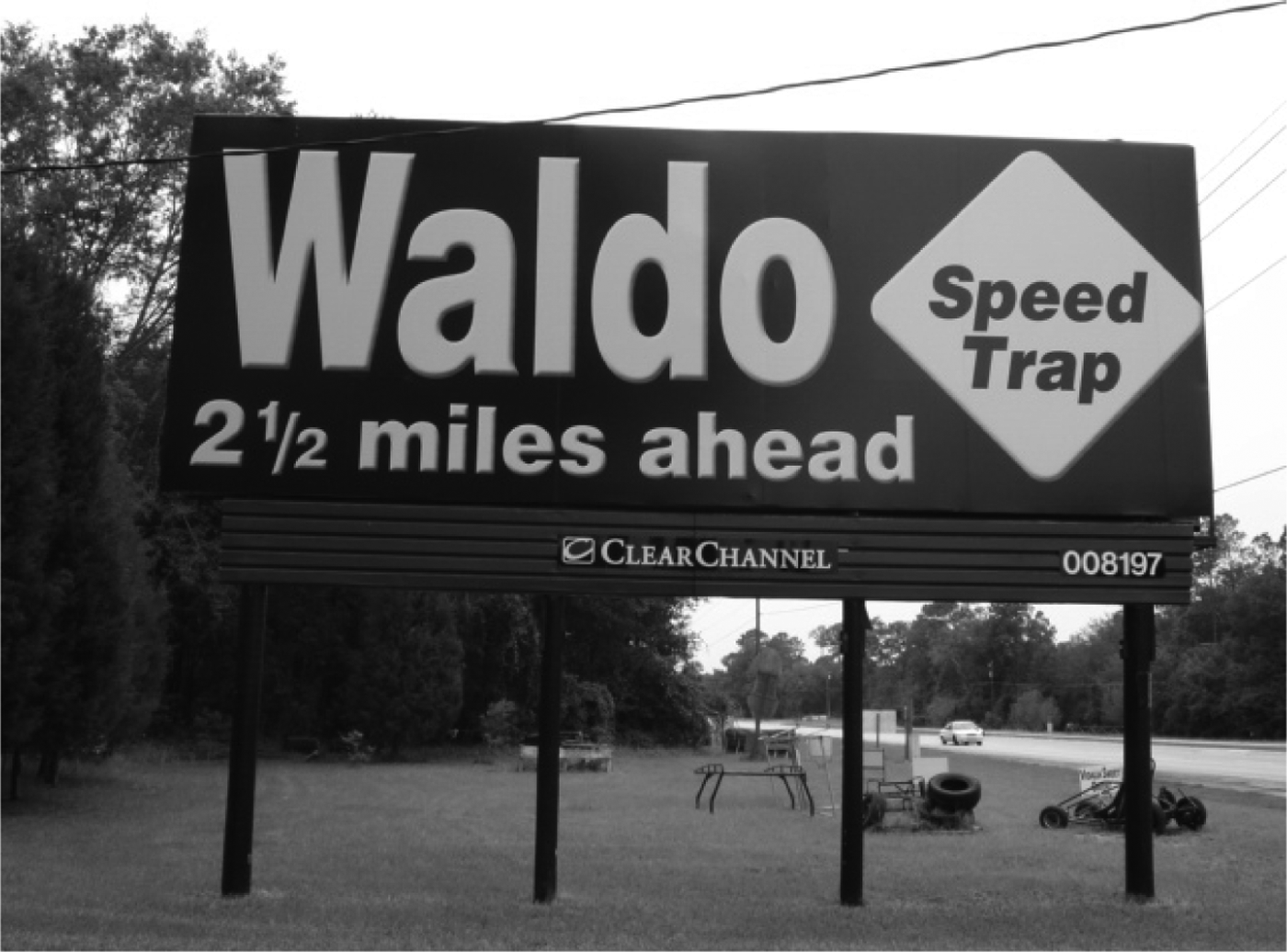
Photo of the speed trap billboard advertisement illustrating the study intervention
We contend that the billboard increases the predictability of receiving a traffic citation and announces that the agency is effective in enforcing the speed limit (i.e., they have instrumental legitimacy). Although both of these claims are logical, the latter warrants some discussion. Unlike common state-issued signs indicating strict enforcement along specific stretches of a road or highway such as “speed enforced by aircraft” or “strict enforcement zone,” the “speed trap” billboard is a message that identifies an entire rural town as a speed trap. Moreover, literally labeling an entire town as a speed trap is quite the atypical occurrence. Waldo was only one of two agencies in the country to be labeled by AAA. For these reasons, we suggest that the billboard has an instrumental legitimacy message that the agency is effective in enforcing the law—even if this is neither the primary nor intended message of the billboard. Under this assumption, the normative legitimacy message of the speed trap label is left to explore. The AAA, who funded and erected the speed trap billboard advertisement, has identified two distinct types of rigorous application of traffic laws. First, “strict enforcement” is defined as “aggressive, legitimate traffic enforcement for the purpose of reducing crashes along high-risk highways and dangerous intersections. Enforcement is justified by crash data history and/or existing conditions” (AAA, n.d.). Second, a “traffic trap” refers to “traffic enforcement measures and practices which are designed to raise revenue rather than prevent crashes or where there is evidence that enforcement is not justified by sound engineering principles. AAA particularly condemns the use of traffic traps which involve unfair, unethical, or illegal law enforcement tactics or traffic control devices, as well as the use of speed measurement devices on roads with speed limits appreciably less than warranted by sound engineering principles” (AAA, n.d.). The “speed trap” billboard was erected in Waldo to declare this agency’s speed enforcement policy illegitimate.
Although it is an empirical question as to whether the billboard affirms or attacks the normative legitimacy of the agency in the eyes of the public, given what we know of the intended message of the intervention, the atypical nature of such a label as well as the general negative connotation of the term “speed trap” in the American lexicon, we believe it is reasonable to claim that the intervention serves, at least to most individuals, as a fairly clear challenge to the normative legitimacy of a local agency’s speed enforcement policy. Therefore, we hypothesize that a speed trap advertisement billboard results in an abrupt-permanent increase in speeding citation contestation rates compared with a similar, unlabeled town, despite the fact that the label serves as a proclamation of instrumental legitimacy.
Supplementing our main hypothesis and providing added depth to our investigation into the effects of the speed trap billboard on citation contestation rates, we anticipate that these effects will be strongest among those with higher opportunity to contest the ticket in person and higher exposure to the speed trap label (in-state drivers). 2 Although some minor differences have been noted (see Tyler, 2005), evidence generally suggests that procedural justice and legitimacy considerations operate similarly across members of different demographic groups (Tyler, 1994, 2000, 2004; Tyler & Huo, 2002). This invariance claim is quite broad and includes race and gender as well as other factors such as income and political party affiliation (Tyler, 1994, 2000). Determining whether there are indeed similarities in the ways in which certain groups respond to police legitimacy messages is important. For instance, should an attack on the normative legitimacy of an agency only affect certain subgroups, counteracting the negative publicity and minimizing challenges to authority may require targeted efforts. However, if everyone is influenced similarly, broader approaches might be warranted. Given the invariance claim, we anticipate the effects of police legitimacy on decision acceptance will be similar across race and gender.
Method
To assess the effects of the speed trap label on citation contestation rates, the current study uses an interrupted time-series design with a nonequivalent no-treatment control group time series (Cook & Campbell, 1979). 3 While ARIMA modeling is often used to assess intervention effects (see Campbell, 1963; McCleary & Hay, 1980; McDowall, McCleary, Meidinger, & Hay, 1980), we employ segmented regression analysis, given the nature of our time-series data (i.e., time series are trend stationary and lack serial autocorrelation). For a single intervention, segmented regression breaks the time series into two segments with the first corresponding to the preintervention time period and the second corresponding to the postintervention time period. Each segment is allowed variation in both trends and levels. Trend refers to the average change in the variable of interest per a unit of time, whereas level indicates the value of the time series at the first unit of time for a given segment. Segmented regression models specify both level and trend of the preintervention segment and model changes in level and trend due to a given intervention indicated by the values of the postintervention segment (Wagner, Soumerai, Zhang, & Ross-Degnan, 2002).
The levels and trends of the pre- and postintervention segments can be modeled with the following formula:
Although data structure has been explained in detail elsewhere (see Wagner et al., 2002), it is necessary here to explain the basic parameters of the univariate segmented regression model. In this equation, Yt indicates the mean number or rate of the variable of interest in month t; t indicates the time variable that ranges the entire time series (1 through 60); step is a dummy variable that differentiates the two segments taking on a value of 0 preintervention and 1 postintervention (including the intervention month); tafter is the time after intervention variable that ranges the entire postintervention time series (including the intervention month; 1 through 29) but takes on a value of 0 preintervention; finally, et represents random variation in variable of interest not explained by the model.
The four parameters estimated by the univariate regression model permit the researcher to assess the gradual, abrupt, permanent, and/or temporary nature of the effects due to a single intervention. In this case, the intercept or the level of the preintervention segment is indicated by β0 and its slope or trend is indicated by β1. In other words, β0 is the citation contestation rate at Time 0 and β1 is the average change in the citation contestation rate per month prior to the intervention occurring in August 2003. The level of the postintervention segment is indicated by β2 and its trend is indicated by β1 + β2. More specifically, β2 is the level change in the citation contestation rate and β3 is the change in the citation contestation rate trend, compared with the preintervention trend. Both of these changes are attributed to the specified intervention, which in this case is the speed trap billboard advertisement. Of importance to the current analysis, a statistically significant β2 regression coefficient indicates the presence of an abrupt effect and the absence of a statistically significant β3 regression coefficient in a regressive direction back toward the trend of β1 (i.e., the preintervention trend) indicates the abrupt effect does not fade over time. If β2 is statistically significant and β3 is not statistically significant, then there is an abrupt-permanent intervention effect with no additional gradual intervention effect. This latter specification is the hypothesized effect of the speed trap billboard on citation contestation rates.
Data
The current study uses data from several sources which enable us to assess the appropriateness of the comparison time series and then to estimate the effect of the intervention on decision acceptance rates across the intervention and comparison sites. First, U.S. Census Data (2000) and Criminal Justice Agency Profile Reports published by the Florida Department of Law Enforcement (2005) were used to compare static characteristics of the towns and police agencies, respectively. Second, official individual-level traffic citation records for Alachua County, Florida were made available which include information on driver characteristics (e.g., race, gender, age), vehicle information (e.g., make, year, license), citing officer and agency, details about the offense (e.g., date/time, statute violated, fine amount), court information (e.g., court date/time, room, judge, verdict), fees collected (e.g., date fine collected, court costs), among other things. These data were used to estimate the effect of the intervention and to assess the similarity of traffic citation contestation trends prior to the intervention. 4 The individual-level traffic citation records from 2001 to 2005 were aggregated by month to create a continuous 60-point agency-level time series.
Dependent Time Series: Decision Acceptance Rate
The dependent time series of interest was the 60-month contestation rate for speeding citations issued by a given police agency. The total number of speeding citations issued by a particular agency and the total number of citizens that opted for a court date to challenge their speeding citations were aggregated by month. The citation contestation rate is defined as the number of individuals challenging their citations for a speeding violation divided by the total number of individuals issued a speeding citation in a given month. Employing a rate here is critical as it forms a measure of citation contestation that is not simply a function of the amount of tickets that are issued in a particular month. Thus, absent the intervention (e.g., preintervention period), we anticipate the citation contestation rate to remain relatively stable over time, despite the fact that the number of citations can vary from month to month. Higher scores on this measure indicate greater contestation (lower decision acceptance) of speeding citations in the aggregate.
Intervention: Police Legitimacy Manipulation
The intervention under investigation is the erection of the speed trap billboard advertisement in August 2003 (see Figure 1), which is hypothesized to simultaneously increase instrumental legitimacy and decrease normative legitimacy of the local police agency. Given the divergent predictions of these two simultaneous legitimacy announcements for decision acceptance, this approach provides a unique way to assess whether normative legitimacy trumps the importance of instrumental legitimacy for decision acceptance in the aggregate.
Independent Time Series: Control Variables
A number of important aggregate-level factors could affect the citation contestation rate in a given month, threatening the validity of the quasi-experiment. To control for the possibility of a spurious intervention effect, three time-varying demographic variables are added to the models to determine whether they corroborate the main findings from the univariate analysis. All of the time-varying covariates were aggregated by month similar to the dependent time series. Race denotes the proportion of individuals that are non-White receiving a speeding citation in a given month. The number of citations issued to minority drivers in each of the three towns was insufficient to estimate time-series models that were further disaggregated by race. Gender is the proportion of women issued a speeding citation in a given month. Finally, age is the mean age of individuals receiving a speeding citation in a given month. Collectively, these characteristics, recorded by the officer, control for monthly differences in the characteristics of drivers who belong to groups that may have different propensities to contest a speeding citation.
Moderating Effects: Opportunity and Social Groups
It is important to account for opportunity to contest a traffic citation because the effects of legitimacy may be considerably more pronounced among groups with greater opportunity to contest in person. To address the issue of opportunity, we split the cited drivers into two opportunity groups. First, in-state drivers receiving speeding citations are considered to have higher opportunity to contest in person. Second, out-of-state drivers receiving speeding citations are considered to have lower opportunity to contest in person. Comparing these two groups allows us to assess the extent to which the effects of legitimacy are conditional on opportunity to contest a traffic citation and challenge legitimacy in person.
It is important to understand if attributions of illegitimacy in speed enforcement policy have similar effects across divergent social groups. Existing evidence suggests that legitimacy considerations are invariant across demographic groups (see Tyler, 1994, 2000, 2004; Tyler & Huo, 2002) and, thus, it is expected that the speed trap billboard will have similar effects across racial and gender groups. We split the in-state cited drivers into two race groups (White and non-White) as well as two gender groups (males and females). Running the analyses separately by social groups allows us to determine whether the effects of the speed trap billboard on citation contestation rates are indeed similar across different groups, a finding that has important relevance for policy.
Analytic Strategy
To address the research hypotheses, the analysis proceeds in several steps. First, we compare static town characteristics as well as information on the preintervention citation contestation rates and trends in Waldo as well as two nearby, similar communities (Alachua and High Springs) that are not labeled speed traps. This provides an assessment of the comparability of the comparison series to the intervention series. We then test for mean differences in the pre- and postintervention periods across all three cities using independent samples t tests. Following this preliminary analysis, we account for the time-series nature of the data and employ univariate and multivariate segmented regression models. Next, we separate in-state ticketed drivers from out-of-state ticketed drivers to see whether opportunity to contest tickets in person influences the impact of the speed trap label on decision acceptance. Finally, the in-state ticketed drivers (i.e., those with more opportunity to contest their citations in person) are isolated for further analysis to see whether intervention effects vary by sex or race. Throughout the analysis, we highlight results from the univariate segmented regression models as these models neatly retain straightforward descriptive information on the levels and trends of the citation contestation rates (e.g., baseline citation contestation rate at Time 0), facilitating comparisons across different time-series models. Accompanying the univariate results, we also report the results of the multivariate models in each table for comparison.
Results
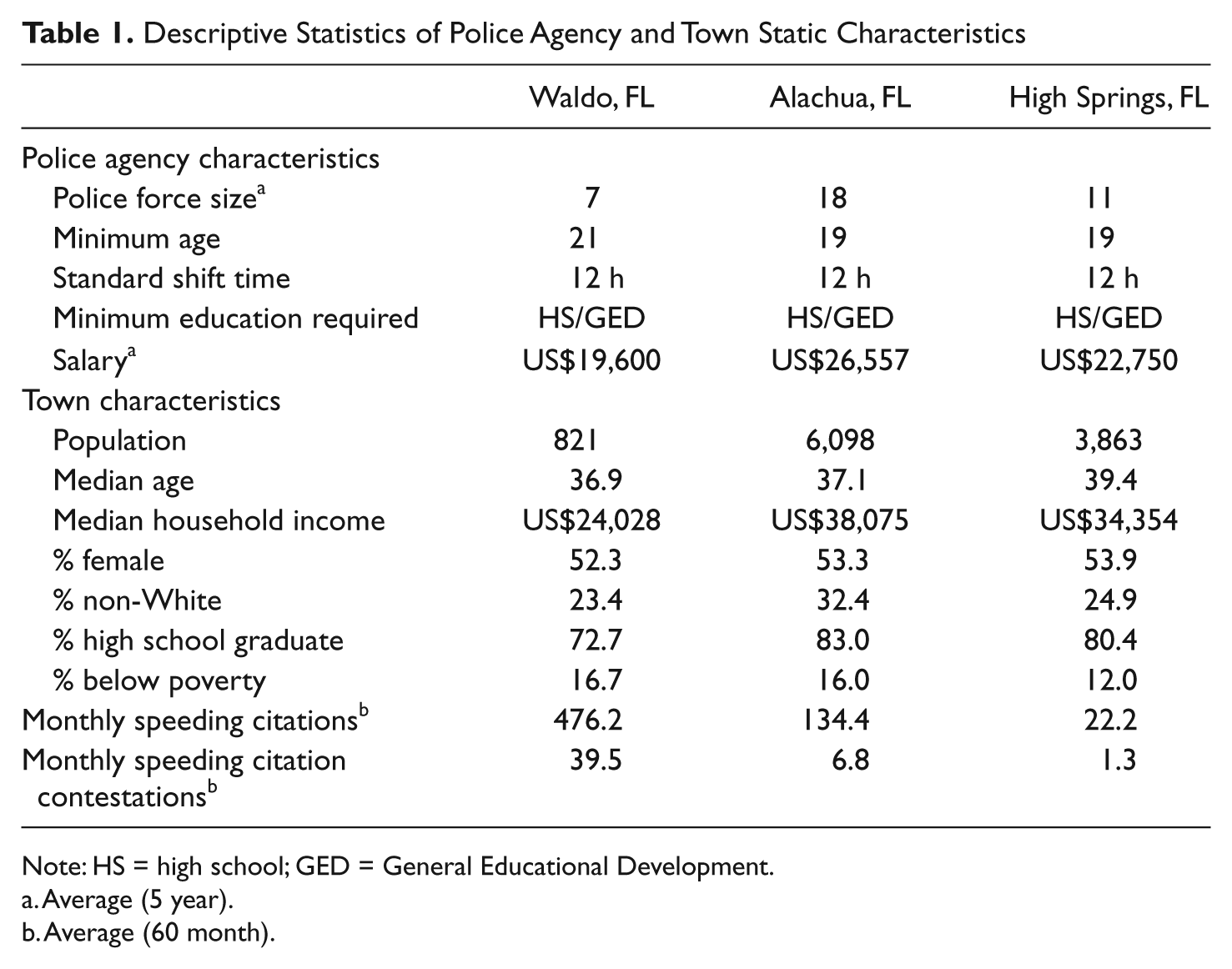
Table 1 contains information about the static characteristics of the police agencies and towns featured in our analysis. 5 The three police departments are relatively similar in terms of agency standards, such as hiring requirements, minimum age, education, and salary level. All three agencies are also characteristically small. The three towns are relatively similar in terms of demographic profiles, with reasonable similarities in median age, gender, racial composition, educational attainment, and poverty levels. Two noticeable differences in town characteristics as well as substantial differences in citation issuance are worth mentioning. First, Waldo’s median household income is substantially lower than Alachua and High Springs. Second, Waldo is easily the smallest of the three towns. Despite being the smallest town, however, the Waldo police department issued approximately 476 citations for speeding infractions in a typical month between 2001 and 2005; this is more than 3.5 times greater than the number issued by Alachua and more than 21 times greater than the number issued by High Springs (see Table 1). In fact, Waldo’s speeding citation issuance in an average month approaches that of Gainesville (539.7), a city within the county that has more than 95,000 residents. These numbers give some insight into why the agency’s normative legitimacy was attacked with the erection of the speed trap billboard, which also happens to announce the agency is quite effective in enforcing the speed limit.
Descriptive Statistics of Police Agency and Town Static Characteristics
Note: HS = high school; GED = General Educational Development.
Average (5 year).
Average (60 month).
The trends in the preintervention periods reveal important insights regarding the suitability of the comparison sites. Figure 2 depicts time-series graphs of the mean monthly citation contestation rates in Waldo, Alachua, and High Springs, respectively. In the 31 months before the speed trap billboard was erected, Waldo averaged a 6.83% citation contestation rate, Alachua averaged a 5.06% citation contestation rate, and High Springs averaged an 8.37% citation contestation rate (6.43% with the outlier removed). 6 The preintervention average citation contestation rate for Waldo is slightly higher than Alachua, t(60) = −2.58, p < .05, but not significantly different than High Springs, t(60) = 0.68, p > .05. Most importantly, both Waldo and Alachua show a citation contestation rate that is flat prior to the intervention. High Springs displays a slight downward trend prior to the intervention.
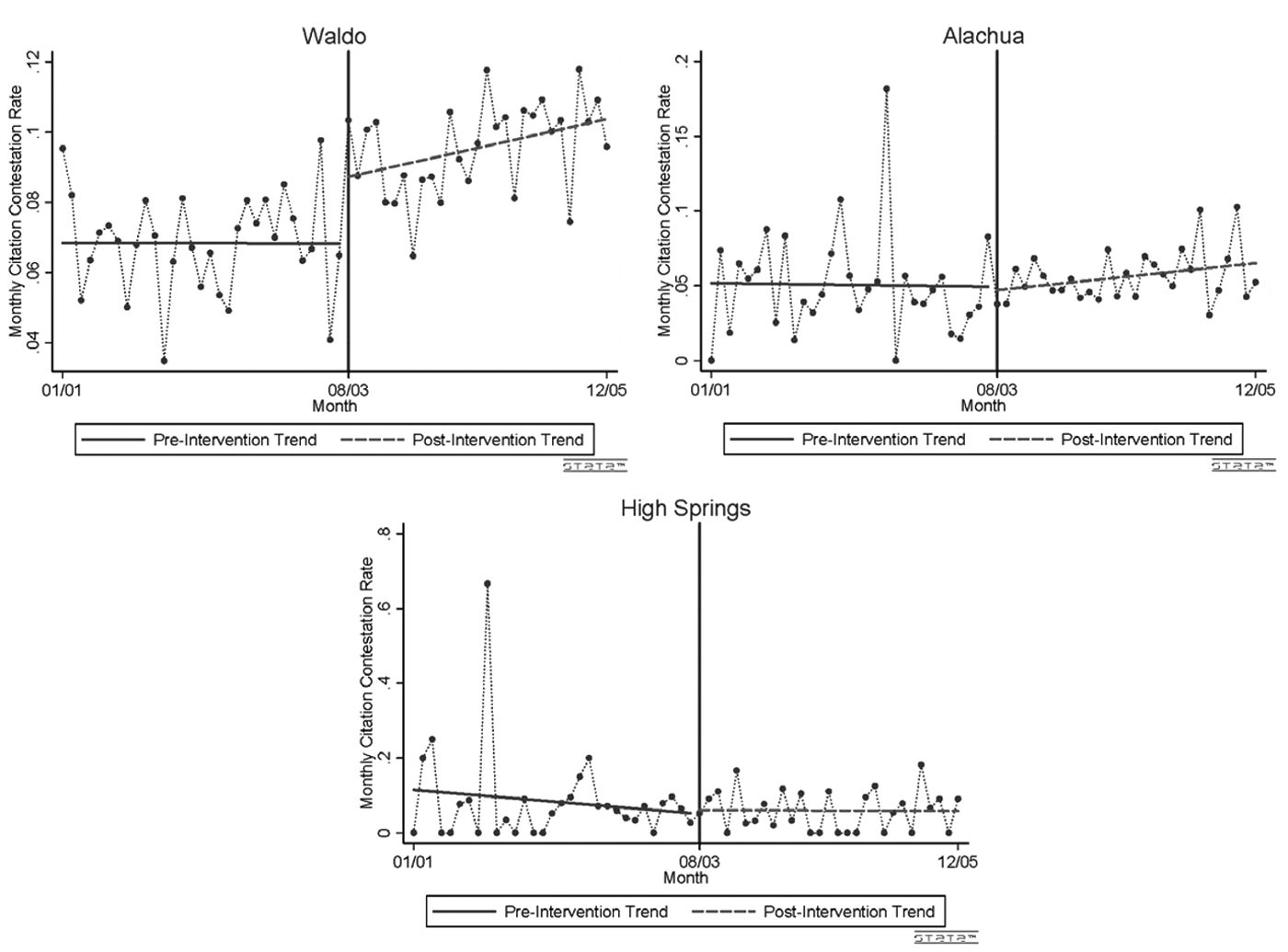
Monthly speeding citation contestation rates in Waldo, Alachua, and High Springs (2001 through 2005).
The postintervention average citation contestation rate is 9.56% in Waldo and 5.61% in Alachua, indicating increases in both cities. The postintervention average citation contestation rate in High Springs is 5.95%, showing a decline. However, a simple pre- and postintervention comparison reveals a statistically significant mean citation contestation rate increase in Waldo, t(58) = −7.67, p < .05, but not in Alachua, t(58) = −0.76, p > .05, or High Springs, t(58) = 0.95, p > .05. Figure 2 shows the citation contestation time series for all three towns. As indicated by the jump in level between the segments, an abrupt intervention effect appears visible in Waldo. However, there does not appear to be a similar abrupt increase in Alachua or High Springs. The postintervention segments that follow the intervention illustrate slight upward trends in both Waldo and Alachua, whereas the High Springs trend is nearly flat. Although these initial analyses are informative, they do not account for the time-series nature of the data nor do they control for any time-varying variables.
Several important diagnostic statistics are used to determine whether a series is stationary and/or contains serial autocorrelation. The results of several tests reveal that both the intervention and comparison time series are trend stationary and the residuals are statistically independent. 7 These facts indicate that a segmented regression analysis is the appropriate interrupted time-series design (Shardell et al., 2007; Wagner et al., 2002) to assess whether citation contestation increased following the erection of the speed trap billboard advertisement.
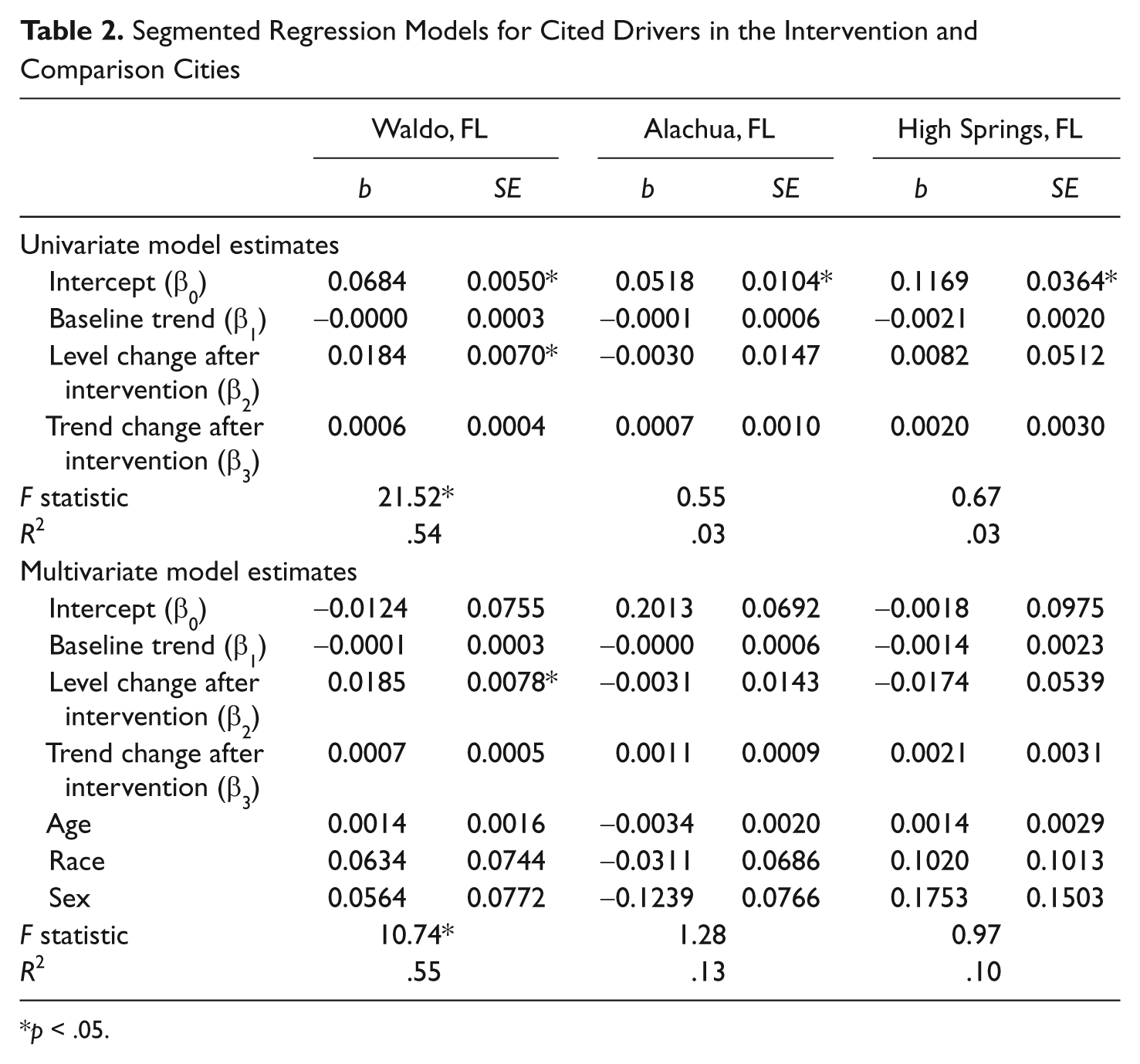
The results of the univariate segmented regression models are reported in Table 2. An important initial observation is the fact that the univariate segmented regression model for Waldo explains 54% of the variance in citation contestation rates (p < .05), whereas the models for Alachua and High Springs explain only 3%. The preintervention trends for all three towns are not statistically significant, indicating the preintervention citation contestation rate is regressing to a constant mean. Confirming the visual interpretation of the time-series graphs, there is a statistically significant abrupt increase in the citation contestation rates in Waldo. Immediately following the intervention in Waldo, the estimated percentage of citations being contested in a given month increased by 1.84. Compared with the rate at Time 0, this level change corresponds to a 26.9% increase in the rate of contestations. Importantly, there is no statistically significant level change in either Alachua or High Springs.
Segmented Regression Models for Cited Drivers in the Intervention and Comparison Cities
p < .05.
Recall that the time-series graphs show there are slight upward trends during the postintervention periods for Waldo and Alachua; however, the coefficients for the trend change due to the intervention fail to reach statistical significance. Thus, there is not a gradual intervention effect of the speed trap billboard in either town. The trend change coefficient for High Springs is positive but similarly nonsignificant. Adding race, sex, and age to the model as time-varying controls also results in the finding of a statistically significant abrupt-permanent effect in Waldo but not in the other towns. In short, the time-series results provide support for the main research hypothesis.
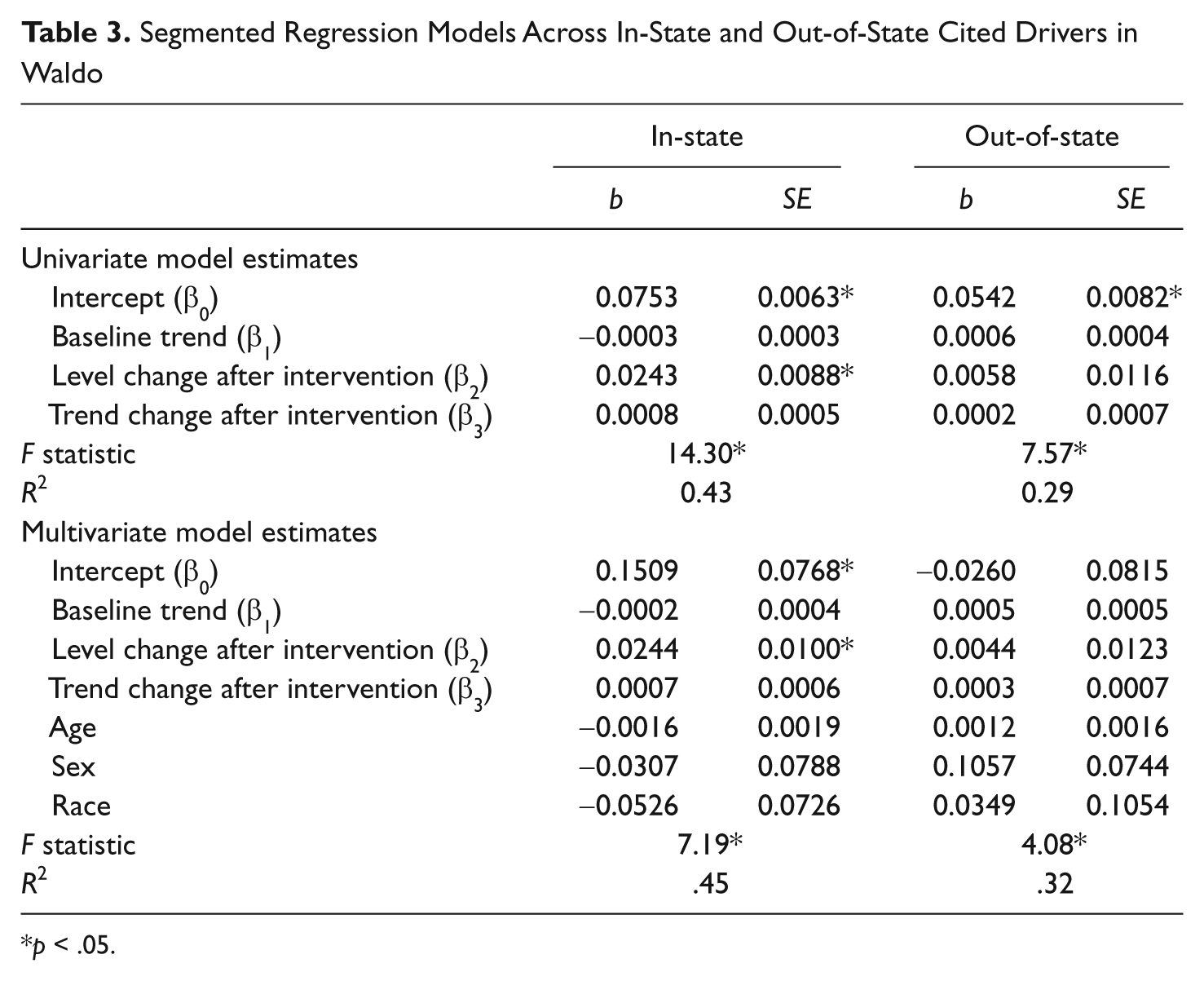
Table 3 focuses on the cited drivers in Waldo comparing the effects of the billboard among those with higher opportunity to contest in person (in-state drivers) and those with lower opportunity to contest in person (out-of-state drivers). Describing first the preintervention levels at Time 1 as indicated by β0, in-state drivers generally contest at a higher rate than out-of-state drivers as evidenced by the higher intercept (7.53% compared with 5.42%). More importantly, results of the univariate segmented regression model show that while the coefficient for the level change after the intervention is in the expected direction, there is no statistically significant effect of the speed trap billboard on citation contestation rates for out-of-state drivers (p > .05). However, there is a strong abrupt-permanent effect for in-state drivers representing approximately a 32% jump in citation contestations compared with the preintervention level at Time 0 (p < .05). This is a relatively large effect and is especially noteworthy, given the fact that this test is quite conservative; a nontrivial proportion of the cited motorists were probably unaware of the existence of the billboard (i.e., they did not see it). This intervention effect holds firmly while controlling for the three time-varying covariates.
Segmented Regression Models Across In-State and Out-of-State Cited Drivers in Waldo
p < .05.
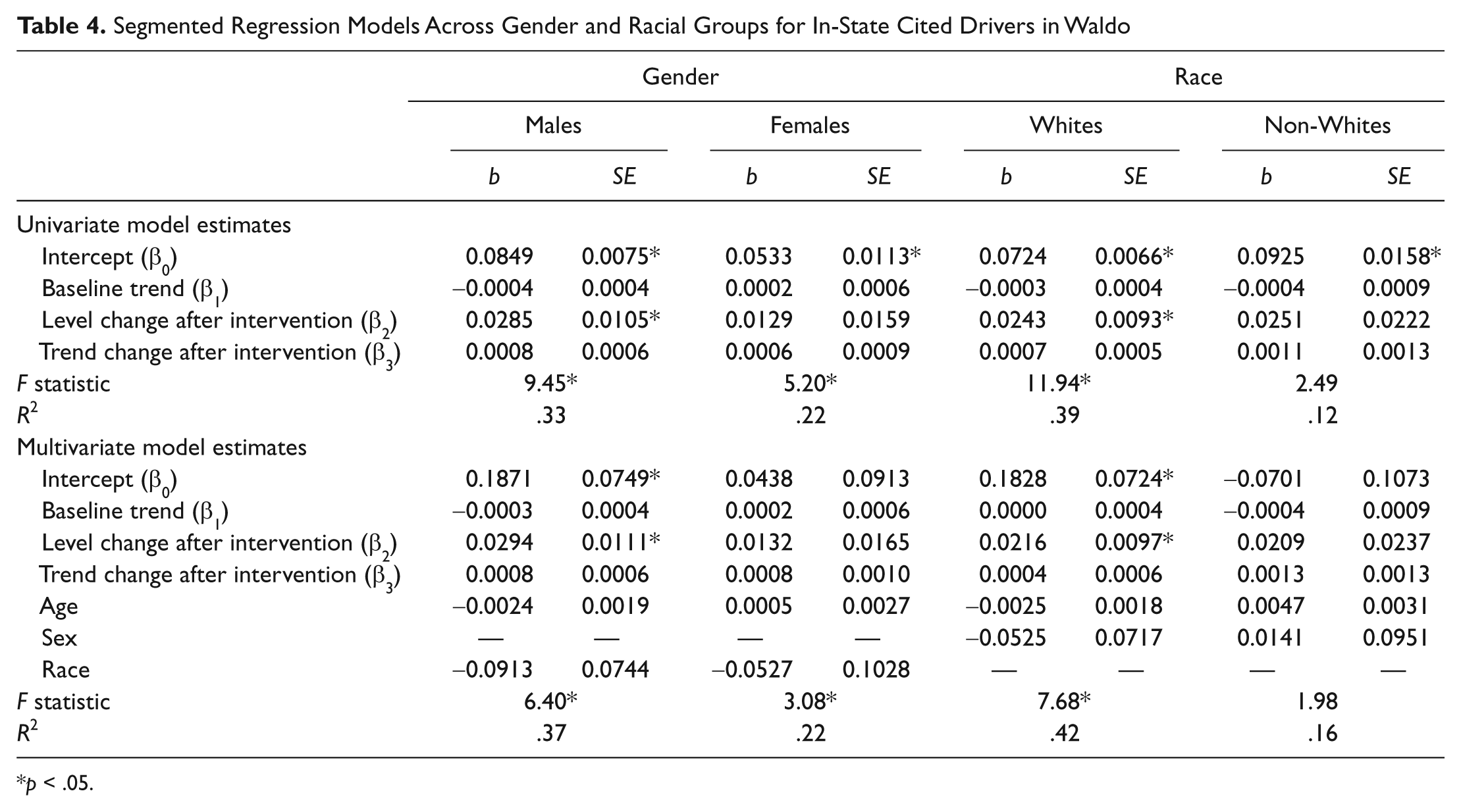
We use the in-state drivers in Waldo, the group in which a statistically significant and sizeable intervention effect was found, to investigate whether there are similarities or differences in the effects of the speed trap billboard on citation contestation rates between divergent social groups. Table 4 reports the univariate segmented regression models conditional on social group membership. Describing the preintervention levels at Time 1, men tend to contest citations at a higher rate than women (8.49% compared with 5.33%) and non-Whites tend to contest at a slightly higher rate than Whites (9.25% compared with 7.24%). In accordance with theoretical expectations, all of the level changes after the intervention are positive in the expected direction. However, we find statistically significant effects for men (p < .05) but not for women (p > .05). In addition, we find significant intervention effects for Whites (p < .05) but not for non-Whites (p > .05). Relative to baseline, the citation contestation rates among men and Whites increased by 34% and 36% following the intervention, respectively. In short, among those with higher opportunity to contest their citations in person (in-state drivers), the results indicate that the citation contestation rates for men and Whites were influenced by the speed trap billboard in the hypothesized way but the same cannot be concluded for women and non-Whites—though they did experience nonsignificant abrupt-permanent increases which are in the expected direction according to theory. These results are confirmed by multivariate segmented regression models.
Segmented Regression Models Across Gender and Racial Groups for In-State Cited Drivers in Waldo
p < .05.
Discussion
Analyses of citation contestation rates before and after the identification of Waldo as a “speed trap” jurisdiction offer important information regarding decision acceptance. Initially, findings from univariate and multivariate time-series analyses revealed that a speed trap billboard led to an abrupt and permanent increase in the rate of traffic citation contestations in the intervention city but not the comparison jurisdictions. These findings held when controlling for three time-varying covariates and are consistent with the hypothesis that the speed trap label led to changes in the way in which motorist viewed the legitimacy of the Waldo police which, in turn, influenced decision acceptance rates.
Importantly, subanalyses revealed that the effect of the speed trap billboard on citation contestation rates in Waldo was not invariant across different driving groups. With regard to in-state drivers, it is not entirely surprising that the intervention effects of the speed trap label were confined to in-state drivers. In-state drivers possess several practical reasons to have greater contestation rates, such as greater ease of in-person contestation and the possible greater exposure to the advertisement, relative to out-of-state drivers. In contrast to our expectation that there would be no differences in gender or race with regard to citizen contestation rates, the analyses did uncover unanticipated findings with regard to these citizen characteristics. Although the effects were in the expected direction for women and non-Whites, only statistically significant effects were observed for men and Whites. There are several potential explanations for these discrepancies. The first possible explanation is somewhat theoretically uninteresting. The observed findings could simply demonstrate differential driving awareness in that some groups are more observant than others. That is, men and Whites were more likely to physically observe the label. Of course, our aggregate-level data cannot evaluate this possibility.
As a more interesting possibility, the effects may represent real differences in the billboard’s effect of decision acceptance rates across social groups. If citizen citation contestation is viewed as influenced by police legitimacy, differential contestation rates reflect differing levels of perceived police legitimacy among gender and race groups. That is, the billboard’s negative normative legitimacy message may have had stronger effects on the decision acceptance rates among majority subgroups (men and Whites) compared with their minority counterparts (women and non-Whites). With respect to race, minorities are more likely to distrust law enforcement than Whites (see, for example, Maguire & Pastore, 1995). Therefore, members of the majority could be more affected by the speed trap advertisement as a group because police unfairness and illegitimacy is outside of the norm for Whites more so than it is for non-Whites. The fact that non-Whites indeed had larger baseline levels of citation contestation compared with Whites provides some degree of support for this assertion. With respect to gender, men may more likely exclude the instrumental legitimacy message compared with women. In other words, men may be apt to see the speed trap advertisement as denouncing the normative legitimacy of the agency, whereas women tend to more equally weigh the instrumental and normative legitimacy messages. Alternatively, both groups may equally consider the instrumental legitimacy message but men may find the speed trap billboard to state the agency is engaging in strict traffic enforcement for profit, whereas women may be more trusting of the motives and intentions of the police policy.
The results of this study speak to the possibility that police legitimacy messages may differentially influence decision acceptance rates across subgroups. This challenges the idea that procedural justice and legitimacy considerations operate similarly across a broad range of social groups (see Tyler, 1994, 2000) and, consequently, potentially important policy implications are raised. Should certain subgroups be more affected by portrayals of police and their law enforcement practices, efforts aimed at restoring police legitimacy and/or securing compliance with police decisions may need to be targeted toward specific subpopulations. Future research on traffic enforcement policy is needed that employs individual-level data to help determine whether differential effects of police legitimacy on decision acceptance rates hold in other contexts. Keeping in mind these differential effects across race and gender, the findings also have relevance for broader discussions of police legitimacy.
Police Legitimacy
Although the findings offer support for our basic hypothesis that rates of citation contestation would be higher in the treatment area, we also were interested in the competing hypotheses regarding instrumental and normative legitimacy. Based on Tyler’s predictions, normative legitimacy should trump instrumental legitimacy and we hypothesized that such a claim would be supported by higher rates of citation contestation. Consistent with Tyler’s predictions, the ability of citizens to foresee a traffic stop and to know the police are effective in enforcing the law (i.e., instrumental legitimacy) appears to be of secondary import to the degree of trust citizens have in the motives for strict speed enforcement (i.e., normative legitimacy). Challenging a speeding citation weeks or even months after the traffic stop demonstrates that citizens may harbor feelings of illegitimacy for periods that extend well beyond the initial incident. Moreover, these feelings supersede personal responsibility for speeding as it is likely that the overwhelming majority of speeding citations issued reflect a true violation of the law. Although our findings offer support for Tyler’s contention regarding the relationship between instrumental and normative legitimacy, questions remain regarding the process by which the police choose such a policy and the related process by which citizens assess the legitimacy of such motivations.
There are at least two possibilities that exist with respect to the agency’s motivations for adopting a strict speed enforcement policy. On one hand, Waldo police may be motivated primarily by the financial gains associated with writing speeding tickets, rendering instrumental legitimacy to a secondary consideration. The Waldo police department appears to be relatively successful at strictly enforcing speeding laws and creating a high-sanction risk. This police agency is able to strictly enforce the law because traffic citation revenue supports a larger than typical rural police department. For example, the officer per 1,000 resident ratio in Waldo was 8.61, whereas the average ratio for all local police agencies in Florida was 3.08 in 2005 (Florida Department of Law Enforcement, 2005). It is the funds received through traffic citation revenue that sustain the entire police operating budget as well as a substantial portion of the local town’s budget (Grace, 2003). While the agency’s policy may nevertheless yield instrumental legitimacy, attacks against the normative legitimacy are entirely justified. In this case, the speed trap label is warranted as the agency is motivated by revenue and shielded behind the letter of the law. Ironically, if the agency is indeed pursuing profit through citation issuance, increased citation contestation rates, to some extent, hinder this endeavor (see Makowsky & Stratmann, 2009).
On the other hand, Waldo police may be engaging in strict speed enforcement to perform their job functions most effectively and/or for altruistic reasons unrelated to revenue generation (e.g., vehicular and pedestrian safety). In this case, because of the specter of economics, the strict enforcement that was intended to produce instrumental legitimacy has unwittingly undermined the agency’s normative legitimacy. Irrespective of the true underlying motives, it is citizens’ perceptions of an illegitimate speed enforcement policy that resulted in the agency being labeled a speed trap town.
One of the key differences in studying speed enforcement as compared with other types of anticrime policing is that speeding may be widely considered normative (Yagil, 2005). In fact, not only is speeding largely recognized and tolerated but a cottage industry of electronic speeding countermeasures supports the endeavor and their use remains legal in most states, suggesting widespread assent from state legislatures as well. In addition, the notion of the citation quota results in citizens generally equating speed enforcement with revenue generation (Sharp, 2005; Taylor, 1973). Empirical evidence and case studies lend support to the revenue generation motive, which may both substantiate and foster citizens’ institutional mistrust in traffic and speed enforcement policies (see, for example, Garrett & Wagner, 2006a, 2006b).
Citizens also typically lack the training and expertise to discern the reasonableness of specific police activities, including speed enforcement policies and procedures. Consequently, individuals rely on their inferences about the intentions and motives of police when evaluating them (Tyler, 2004). When speed enforcement is especially strict and coupled with the absence of an easily identifiable public safety need as is the case in Waldo, mistrust of the motives and intentions of traffic enforcement policy can be particularly strong. It is in these cases where inferences of altruism are exceedingly less likely, paving the way for an intriguing legitimacy dilemma. Due to the contentious nature of traffic enforcement, there is the potential for instrumental and normative police legitimacy to be inversely related. Strictly enforcing the speed limit may increase instrumental legitimacy but have the unintended consequence of actually decreasing normative legitimacy. That is, pursuing legitimacy, revenue, or some combination of the two through aggressive speed enforcement may result in a police agency getting caught in their own speed trap, a situation which has important ramifications for decision acceptance abound—especially for those individuals who are members of majority subgroups.
Limitations and Rival Explanations
It is important to consider rival explanations in the form of simultaneous interventions. One potential rival hypothesis for these findings is that a change in traffic fines or laws related to traffic enforcement coincidentally changed during the period in which the Waldo intervention occurred, causing a rise in contestation unrelated to the speed trap billboard advertisement. However, such a change at the county level, where such fines are assessed, would presumably be evidenced by a change in the level or trend of contestation in the comparison cities. Similarly, a change in state law related to traffic fines, such as a provision to assess additional penalties for speeding in construction zones or for failure to use a seat belt, should also be manifested countywide. Alternatively, citizens may have simply decided to increase their rate of contestation due to a concern related to the punishment for the offense (i.e., the fine and/or points on a license). Although it is not possible to entirely eliminate this as a rival hypothesis, it seems to be unsupported in the data. For this explanation to be relevant, there would have to be some evidence of why Waldo drivers would feel a greater motivation to contest a ticket relative to drivers in the comparison jurisdictions. A simpler explanation, supported by the data, is that drivers in Waldo are reacting to the label of “speed trap.” Given the attention paid to the various methodological concerns associated with interrupted time-series designs and our assessment of the aforementioned rival explanations, we are confident that the billboard indeed had an effect on citation contestation rates in Waldo among certain groups.
We have drawn heavily on theories of police legitimacy (Tyler, 1990, 2003, 2004; Tyler & Huo, 2002) and believe them to be most relevant to explaining the abrupt-permanent decreases in decision acceptance. However, the greatest threat to this interpretation, somewhat ironically, comes from Tyler himself (see Tyler, 1990; Tyler & Huo, 2002). It is possible that the billboard caused a fundamental shift in the speed enforcement procedures of the Waldo police such that individuals began contesting at an increased rate due to greater experiences of procedural injustice. In other words, the speed trap label caused some hostility toward the public which carried over into police–citizen interactions during traffic stops. Then, it is conceivable that both police legitimacy and procedural justice considerations are at play.
Without police–citizen interaction data, we cannot completely rule out procedural justice as being responsible for some of the observed effect of the speed trap billboard on citation contestation rates, but there are two reasons why it is unlikely that procedural justice is responsible for all of the observed effect (if it is even responsible for some portion of it). First, the finding that the billboard increased citation rates for men and Whites specifically is better explained by reference to police legitimacy than procedural justice. Although several ideas were advanced that logically explain why citation contestation rates were affected by the billboard for men and Whites, it would appear to be less likely that changes in the agency’s delivery of procedural justice would apply only to majority subgroups—those that are actually better situated socially to challenge authority in the first place. If procedural justice was responsible for the effect, there would likely be no observed differences across the groups; moreover, if procedural injustice experiences were confined to certain groups, it would make more sense that the affected drivers would be from minority subgroups. This was not the case. Second, procedural justice considerations are relatively less important when an individual enters into a police–citizen encounter and believes the police to be illegitimate (see Tyler & Huo, 2002). That is, if an attribution of illegitimacy is made, the threshold for citation contestation may have already been reached. In short, to the extent that the advertisement fulfills its intention, abrupt shifts in the attributions of police legitimacy would logically be responsible for some, if not closer to all, of the changes in citation contestation rates.
Conclusion
Although the official labeling of a police agency as a speed trap town with a billboard advertisement is certainly not commonplace, the problems strict speed enforcement policy can create for police legitimacy and decision acceptance may very well extend beyond the present case study. First, advances in technology and social networking have made public communication of “speed trap” jurisdictions fairly widespread. For example, in Johannesburg, South Africa, an individual has used a popular social networking site to announce speed traps in real time to combat “police corruption” (Abdelaziz, 2010). In modern society, the activities of the police can more easily be monitored and communication of instances of police illegitimacy can be made rapidly and can be far-reaching. Second, technology has also enabled strict enforcement for speeding violations at unprecedented levels. In some jurisdictions, unmanned speed cameras or cameras designed to catch those who run red lights are replacing traditional officer-driven enforcement as a means of managing costs. Several larger cities are capitalizing on this trend at present. For example, Washington, D.C. implemented a speeding camera system in 2001, and the district received more than US$100 million in citation fines over its first 5 years of operation (Lively, 2006). Modern technology creates a fine line between police effectiveness and loss of legitimacy (Neyroud & Disley, 2008). The revenue generation motive may be even harder to escape, given that citation issuance via camera enforcement generally results in only a monetary penalty, with no points or driver education required. Interestingly, speeding cameras eliminate the chance that procedural justice may directly contribute to decision acceptance, or mitigate perceptions of illegitimacy, as there is no direct police–citizen encounter. If aggressive speed enforcement policies present problems for police legitimacy in their officer-driven traditional form, it seems that those problems may worsen when technology is introduced; public perception of a revenue generation motive may become more prominent.
Third, as energy costs spiral upward, the larger issues of traffic enforcement, speeding, and municipal budgets will make these phenomena more salient in the United States. Traffic enforcement, for better or worse, is indelibly associated with revenue generation, and that revenue may become more critical as state and federal government budgets suffer or the costs of day-to-day policing grow. The likelihood of a citation being issued and the fine amount are both inversely proportional to the amount of local property tax revenue (Makowsky & Stratmann, 2009), suggesting some municipalities may already be instituting stricter traffic enforcement policies as a stop-gap measure to sustain or enhance police operational budgets. Implementing these policies may offer some short-term relief, but the relative sacrifices in terms of institutional trust and legitimacy could outweigh the gains. Whereas we know many positive police–citizen encounters may be undone with a single negative encounter (see Skogan, 2006), it may also be the case that many legitimate policies could be overshadowed by a single illegitimate one. Although the traffic stop is responsible for hosting a majority of police–citizen interactions (Langan et al., 2001), it is among the least understood of any specific area of police practice. This study suggests that future research will benefit by considering the effects of traffic enforcement policies generally in addition to traffic stop procedures specifically.
Footnotes
The author(s) declared no potential conflicts of interest with respect to the research, authorship, and/or publication of this article.
The author(s) received no financial support for the research, authorship, and/or publication of this article.
1.
However, Hegtvedt, Clay-Warner, and Johnson (2003) contend that procedural justice and legitimacy are both independently important concepts and can individually, or interactively, influence outcomes. Nevertheless, this interpretation still points to the importance of examining the direct effects of police legitimacy on decision acceptance.
2.
Most relevant for out-of-state drivers, Florida does provide the option of contesting citations via notarized affidavit. People contesting via notarized affidavit do not have the possibility to rebut or challenge the statements made by the citing officer. In addition, one has to post bond in the amount of the ticket to avoid a late fee in the event that you are found guilty. Given these potential disadvantages and added obstacles, it is reasonable to expect that out-of-state drivers would contest tickets less than in-state drivers.
3.
We have heeded the various advices about conducting univariate interrupted time-series analysis (see Britt, Kleck, & Bordua, 1996; Cook & Campbell, 1979; Kleck, Britt, & Bordua, 2000). First, a key concern with the methodology is that it is often difficult for researchers to determine when a particular intervention occurred (Kleck et al., 2000). Scholars caution against fishing for intervention effects because one increases the likelihood of finding effects due to random chance (McDowall, Wiersema, & Loftin, 1996). We select a “well-defined intervention,” namely the speed trap billboard, which is unambiguous in its timing. Second, it is important to specify the expected relationship of the intervention in advance (Campbell & Stanley, 1966). However, many studies have failed to rely on theory to aid in the specification of a particular impact model (Kleck et al., 2000). The current study avoids this problem by drawing on the theoretical work of Tyler (1990, 2003, 2004, 2006) and Tyler and Huo (2002) to develop a specific testable hypothesis. Third, variations in the pre- and postintervention time periods can yield substantially different conclusions (Cantor & Cohen, 1980; Kleck, 1979). Unfortunately, the length of a time series is constrained by data availability. To check for robustness, however, we also estimated the analysis with 1-year pre- and postintervention periods; these results confirm our empirical findings. Finally, we also address the issue of appropriate comparison site selection by attending to both static and trend characteristics (see Kleck et al., 2000) and estimate additional models with multiple sites as recommended (see McDowall et al., 1996).
4.
Waldo has a sister city (Lawtey, Florida) in a neighboring county which is regarded as a speed trap town and has also been the subject of an American Automobile Association speed trap billboard advertisement. Due to data availability, we focus on the intervention during August 2003 in Waldo and carefully select two towns from Alachua County for comparison sites.
5.
The comparison series shown in the current analysis are used due to the highest degree of similarity in both static and preintervention trend characteristics. That is, we identify the best control series based on a comparison of citation contestation trends as well as static characteristics. Our procedure leads us to employ a comparison series (Alachua) that was most similar in trend characteristics in addition to a comparison series that more closely resembles the intervention site with respect to static town characteristics (High Springs). This multicomparison analysis strengthens our findings; conclusions made from models employing multiple comparison series that are thoughtfully selected are often stronger than those made from the use of a single “appropriate” comparison series (see McDowall et al., 1996).
6.
There was a single outlier in the High Springs series where the citation contestation rate was 66.7%; the month featured three speeding citations issued and two were contested. This outlier was removed from the series to observe the effect, and the preintervention contestation mean dropped to 6.43%. As the substantive conclusions with respect to the interventional analyses are similar, we present the results with the outlier included in the analysis.
7.
The Dickey-Fuller has a null hypothesis of a unit root. The values for Waldo, Alachua, and High Springs are −5.527, −9.460, and −6.096, which all exceed the 1% critical value of −3.567. Also, the Dickey-Fuller test indicates that all models reported herein were trend stationary. Most time-series data exhibit serial autocorrelation, but it is important to remember that the violation of statistical independence occurs because of autocorrelation in the residuals and not the dependent variable per se (Gillings, Makuc, & Siegel, 1981). Durbin’s significance tests for autocorrelation, which has a null hypothesis of no serial autocorrelation, fails to reach statistical significance in any of the sites (Waldo, p = .92; Alachua, p = .09; High Springs, p = 0.14) as well as for all models reported herein.