






Abstract
Background
Countless women experience lumbopelvic pain (LBPP) after pregnancy. Physical activity is revealed as a beneficial procedure to alleviate LBPP, yet it appears that individual investigations report mixed conclusions about its effectiveness.
Lumbopelvic pain (LBPP), as a worldwide health-related issue, is common in postpartum women, leading to a range of unfavorable health results such as walking, work, sleep, and mood. Consequently, there is an unusual indication of socioeconomic disadvantage, mainly because the absence from work diminishes the quality of life (QoL; Mens & Pool-Goudzwaard, 2017; Paredes et al., 2021; Vas et al., 2019).
Postpartum LBPP is a common musculoskeletal disorder because of ligament laxity and postural changes (Ehsani et al., 2020) that start during pregnancy or within 3 weeks of childbirth and continue for 3 months after delivery (Breen et al., 1994; Ehsani et al., 2020; Gutke et al., 2010; McBean & Montgomery-Downs, 2015). When all forms of non-specific LBPP were considered, approximately 33% of postpartum women had some LBPP within 3 months after childbirth, and approximately 40% described moderate to severe disability. Although most women improve within the first 3 months postpartum, a notable percentage (5%–8.5%) suffered from LBPP even up to 2 years after delivery (Olsson et al., 2012; Unsgaard-Tøndel et al., 2016).
Because of the growing fetus during pregnancy, women experience drastic changes, especially abdominal length and strength (Mogren, 2008). To diminish pain and improve disability and QoL, knowing which structures can produce pain and disability is crucial. During pregnancy, joint and ligament laxity increases due to rising relaxin (Schauberger et al., 1996). In one study, women experiencing the most incapacitating LBPP had the highest amount of relaxin (Maclennan et al., 1986). Ligament laxity because of hormonal alteration, lumbar spine structural misalignment, and increased lordosis due to enhanced weight (Casagrande et al., 2015) predisposes the lumbopelvic region to instability (Vleeming et al., 2008) causes diminished efficiency of the passive stability system, which should be compensated by dynamic stability; otherwise, it might cause pain (Vleeming et al., 2008). These changes significantly reduce the core muscle function and result in LBPP (Joshi & Joshi, 2016; Rasheed et al., 2017).
Early discovery and therapy will yield the best probable outcomes regarding these problems within and after pregnancy. Hence, to achieve muscle strength, flexibility, and endurance, rehabilitate injured tissues, and contribute to maintaining healthy daily activities, exercise is one of the common frequently utilized interventions in rehabilitation patients with LBPP.
Core means lumbopelvic-hip complex, including the muscular box with the diaphragm, abdominal muscles, gluteal and paraspinal the hip girdle, and the pelvic floor muscles (PFM; Escamilla et al., 2010). These muscles act as the dynamic spine and pelvis stabilizers. Outwardly these muscles, the spine would become mechanically unstable (Cosio-Lima et al., 2003). Investigations have confirmed a relationship linking poor core stability and LBPP, with notable reductions in core muscle activity and spinal stabilization (D’hooge et al., 2013; O’Sullivan & Beales, 2007).
Briefly, previous investigations found that some guidelines; European guidelines recommend that LBPP are controlled by implementing knowledge, and subjects are suggested to have a positive attitude, be encouraged to maintain their normal daily activities, be active as much as possible, and be given special exercises as appropriate (Adnan et al., 2021). American College of Obstetrics and Gynaecology (ACOG) and National Institute for Health and Care Excellence (NICE) recommended postpartum exercises for LBPP (Bennett, 2014). The Canadian guidelines advised that if pregnancy and delivery are uncomplicated, a mild exercise program consisting of walking, pelvic floor exercises, and stretching of all muscle groups can begin immediately (Davies et al., 2018; Wolfe & Davies, 2003).
Although in current years, stabilizing exercises have become a notable health trend established to be implemented in reconstruction programs (Akuthota et al., 2008) and there have been a number of studies (non-randomized or randomized controlled trials (RCTs) on the influence of stabilizing exercises interventions on pain, disability, and QoL in patients with LBPP, their findings have varied. Nevertheless, despite the potential benefits of stabilizing exercise interventions, a systematic review on the effectiveness of exercise on only lumbopelvic pain among postnatal women have been performed (Tseng et al., 2015). The current systematic reviews and meta-analyses study, therefore, aimed to synthesize the pooled data from randomized controlled trials (RCTs) and controlled trials to examine the effect of stabilizing exercise on postpartum pain, disability, and QoL. As the individual studies in this area tend to have low sample sizes and might absent sufficient power to distinguish small but clinically significant alterations, such an analysis is ideal for objectively assessing stabilizing exercise. We assumed that programs including stabilizing exercise intervention would meaningfully improve postpartum pain, disability, and QoL. Acknowledging the above causes, the purpose of this study was to therefore review the effectiveness of stabilizing exercise interventions on postpartum LBPP using meta-analytic techniques.
Methods
Search Strategy
The following electronic databases were applied to search for eligible researches from their inception to September 2021: PubMed, Medline, Google Scholar, and Scopus. Searches included a mix of MeSH and free-text terms associating with the keywords pelvic girdle pain, postpartum, pregnant, perinatal, exercise, pelvic pain, lumbopelvic pain, pregnancy-related, peripartum, postnatal, symphysis pubis dysfunction, posterior pelvic pain, stabilizing exercise, and core exercises. The Boolean search terms (AND, OR, or NOT) were used, we merged the search terms; stabilizing exercises participation with the term postpartum. Following the initial screening, systematic reviews, meta-analyses, and all study references were also screened to ensure that all relevant investigations were found a basis on the inclusion and exclusion criteria. The present systematic review adhered to the Preferred Reporting Items for Systematic Reviews and Meta-Analyses (PRISMA) guidelines (Page et al., 2021).
Selection Criteria
To define the study inclusion criteria, we considered the PICOTS criteria (participants, intervention, comparison, outcome, time, and study design). The titles, abstracts, and full text were independently reviewed by two investigators in appropriate papers to establish study eligibility. Core stabilization exercise is defined as facilitation of deep muscles of the spine (primarily transversus abdominis or multifidus) at a low level, integrated into exercise, progressing into functional activity, pelvic floor exercises, and diaphragmatic strengthening exercises (Akhtar et al., 2017; Kisner et al., 2017; Norris, 2000; O’Sullivan et al., 1997; Richardson et al., 1999). Studies included in this review compared adults in the intervention and control groups.
Inclusion/Exclusion Criteria
The criteria were utilized to study identification and selection as follows: 1) RCTs or control trials published in the English language; 2) participants aged ≥18 years; 3) investigations that employed stabilizing exercises in a pre-post design with a control group. Review articles, literature reviews, conferences, abstracts, and study protocols have been excluded.
Intervention
Outcome Measures
The outcome measurements of the present systematic review and meta-analysis were LBPP intensity, disability, and quality of life.
Data Extraction
Two investigators independently extracted the data, and the third investigator resolved any disagreements. The information extracted included author, year of publication and country, the number of cases and controls, mean age of participants, details of the intervention regimens, mean and standard deviation (SD) of the outcome measures at pre- and post-intervention, and/or changes between pre- and post-intervention.
Data Synthesis
For all included studies, the effect size for any outcome was summarized by calculating the mean difference (MD) between the exercise intervention and control condition from pre-intervention and post-intervention. If the measurement method or reporting was similar, we analyzed the results by weighted mean difference (MD) with 95% confidence interval (CI). However, for outcomes by different measurement or reporting techniques, a standardized mean difference (SMD) was applied. Review Manager 5.3 (The Nordic Cochrane Centre, Copenhagen, Denmark) was used for conducting all analyses. Extracted outcome data were accomplished by the change in the mean and SD values. The mean at pre-intervention was subtracted from the post-intervention mean, and the change SD was calculated by for study group subject numbers in conjunction with group p-values or 95% CI where the change in mean and SD was not reported. In studies that reported standard error of the mean (SEM) data instead of the SD, this value was converted to SD (Higgins et al., 2003). When unavailable, mean and standard deviation of pain intensity and disabilities were extrapolated from sample size, median, and interquartile range (IQR; Hozo et al., 2005). Where data were not provided in text or tables, and authors could not be contacted, data revealed in figures were extracted or obtained where feasible by GetData Graph Digitizer software. Pooled estimates of the effect of stabilizing exercises on outcome measures were obtained using a random-effects model. The heterogeneity among the studies was evaluated by the I2 statistic, with values >50% illustrating substantial heterogeneity (Higgins et al., 2003). We conducted the meta-analysis employing Forest plots and utilized a 5% level of significance to reveal the significance of results. The risk of publication bias was evaluated using Funnel plots (Egger et al., 1997).
Study Quality
A 15-point scale, Tool for the Assessment of Study Quality and Reporting in Exercise (TESTEX) was applied to the tested methodological quality of the included studies, which is a validated tool for calculating the quality (5 points maximum) and reporting (10 points maximum) of stabilizing exercises interventions (Smart et al., 2015). Two reviewers independently conducted this evaluation. The third reviewer was consulted if disagreements occurred.
Results
Study and Participant Characteristics
In the initial search, 1028 records were identified. After removing duplicates (n = 183), the remaining studies were reviewed according to the title and the abstract and then 827 studies were removed, leaving 18 full-text articles. Seven other studies were omitted because of the following reasons: (a) without control group (Adnan et al., 2021; Unsgaard-Tøndel et al., 2016), (b) duplicate study (Bastiaenen et al., 2004; Stuge et al., 2004), (c) review article (Sakamoto & Gamada, 2019), (d) lack of access to data (Chaudry et al., 2013), and (e) study with different population (Raza et al., 2020). 11 studies (Bastiaenen et al., 2006; Ehsani et al., 2020; ElDeeb et al., 2019; Ghavipanje et al., 2021; Gutke et al., 2010; Khorasani et al., 2020; Mens et al., 2000; Sakamoto et al., 2018; Saleh et al., 2019; Stuge et al., 2004; Teymuri et al., 2018) met our inclusion criteria and were entered in the meta-analysis (PRISMA flow diagram; Figure 1). Studies were performed in Iran (n = 4), Netherland (n = 2), Egypt (n = 2), Sweden (n = 1), Japan (n = 1), and Norway (n = 1). The total number of participants across the 11 included studies was 623 (313 in the experimental group and 310 in the control group), ranging from 30 (Mens et al., 2000) to 114 (Bastiaenen et al., 2006). The mean age distribution of each investigation is shown in Table 1. Preferred Reporting Items for Systematic Reviews and Meta-Analyses flow diagram. Characteristics of the Included Studies. Note. VAS = visual analog scale, ODI = Oswestry disability index.

Intervention Details
All 11 studies were RCTs, and investigated the efficacy of stabilizing exercises in women with LBPP postpartum. Moreover, all included studies assessed pain intensity (was assessed using visual analog scale) in their population. In addition, disability (was assessed using Roland Disability Questionnaire (Bastiaenen et al., 2006) and Oswestry Disability Index) and QoL (was assessed using SF-36 questionnaire) were investigated in 9 and two studies, respectively.
Meta-Analysis Results
Pain Intensity
11 studies providing a total of 623 subjects (313 in the intervention group and 310 in the control group, respectively) reported pain intensity as an outcome measure. Pooled results illustrated that stabilizing exercises significantly reduced pain [-0.76 (95% CI, −1.26 to −0.27), p = 0.002] when compared with a control group (Figure 2). There was a significant high heterogeneity (I2 = 88%, p < 0.00,001) among investigations included for this comparison. Forest plot of the effects of stabilizing exercises versus control on pain.
Disability
Eight studies providing a total of 473 subjects reported disability as an outcome measure. Pooled results from the random-effects model illustrated that stabilizing exercises significantly reduced disability (SMD: −1.19; 95% CI [−1.70, −0.68]; p < 0.00,001). There was a significant high heterogeneity (I2 = 84%, p < 0.00,001) among investigations included for this comparison (Figure 3). Forest plot of the effects of stabilizing exercises versus control on disability.
Quality of Life
The effects of stabilizing exercises on total score of QoL were reported in two studies. Figure 4 displays the MD changes in QoL with stabilizing exercises. QoL did not improve significantly after stabilizing exercises (MD, 4.42; 95% CI, −5.73 to 14.57; p = 0.39). Forest plot of the effects of stabilizing exercises versus control on QoL.
Study Quality
Study Quality Assessment of Included Studies Using the Tool for the Assessment of Study Quality in Exercise (TESTEX).
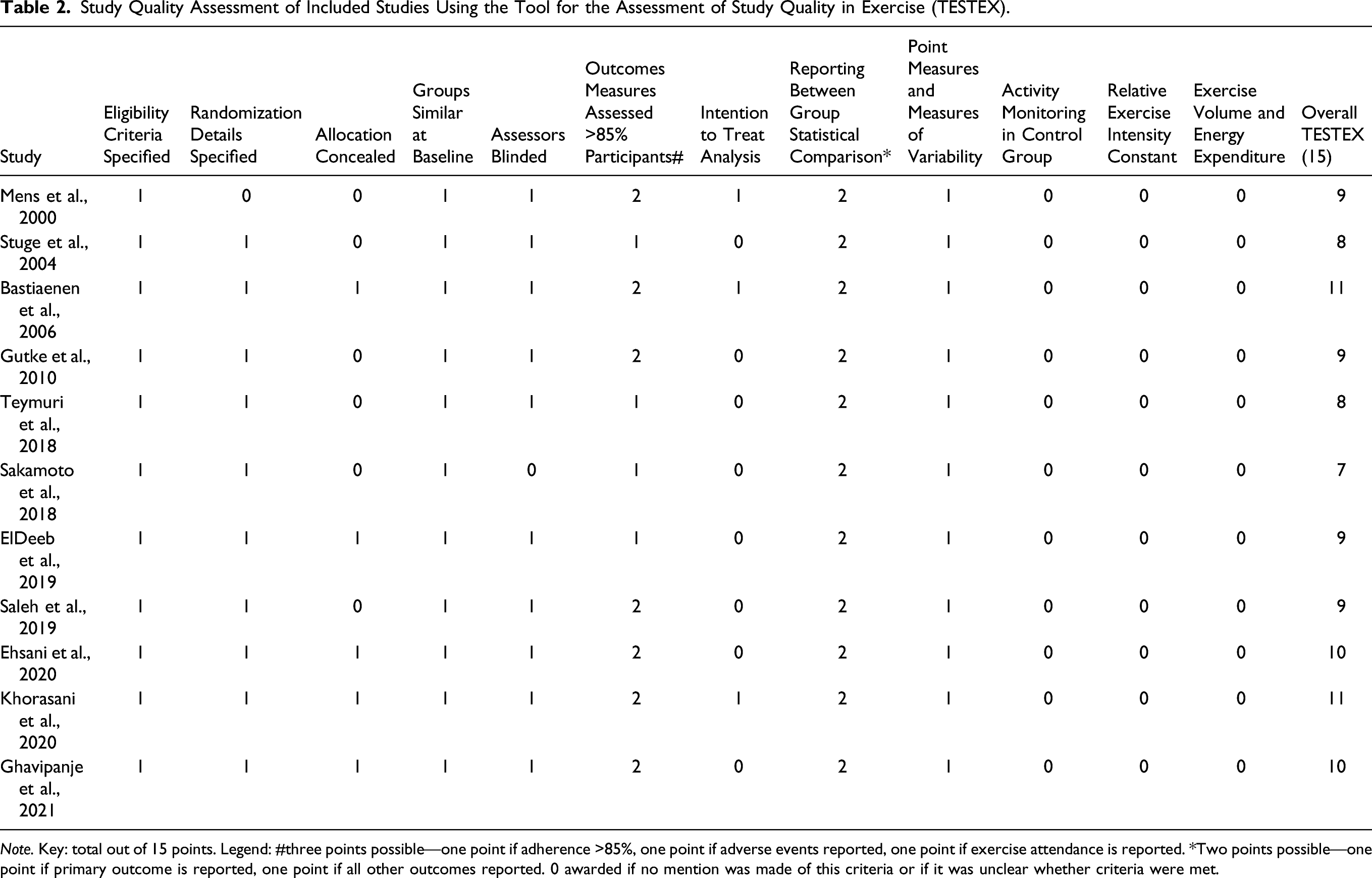
Note. Key: total out of 15 points. Legend: #three points possible—one point if adherence >85%, one point if adverse events reported, one point if exercise attendance is reported. *Two points possible—one point if primary outcome is reported, one point if all other outcomes reported. 0 awarded if no mention was made of this criteria or if it was unclear whether criteria were met.
Discussion
To the best of our knowledge, the current meta-analysis is the first study to investigate the effects of stabilizing exercises for lumbopelvic region impact on pain intensity, disability, and QoL in postpartum women with LBPP. The overall results show that stabilizing exercises intervention compared with the control group significantly improved pain intensity and disability. Nevertheless, there was no evidence of improvement in QoL following stabilizing exercises.
Although the precise reason for postpartum LBPP is unexplored, it could be assumed that facilitating the activity of the internal oblique (IO), transversus abdominis (TrA), multifidus, diaphragm, and PFMs might lead to diminished postpartum LBPP (Vleeming et al., 2008). This highlights the necessity of approval of exercise interventions that stimulate the function of these muscles. Though, some high-quality studies could report strong evidence about their effectiveness and protection. Deficiency of stability of the spine seems to have a crucial role in increasing postpartum LBPP (Casagrande et al., 2015; Vleeming et al., 2008). The therapeutic exercise aimed to retrain motor skills and activate local spinal stabilization muscles should be proposed in a multidisciplinary approach. Currently, stabilizing exercises in clinical practice are growing, accompanied by a growing number of studies conducted in the last years.
Based on spine muscle stabilization, stabilizing exercise programs that describe the role of local musculature (IO, TrA, multifidus, diaphragm, and PFMs) are considered logical to treat LBPP (Bergmark, 1989). The multifidus in co-contraction with the TrA could develop the stabilization of the pelvis (Richardson et al., 2002) and the lumbar segments (Hides et al., 1996). (Moseley et al., 2002) stated that deep local muscles produce a precise adjustment for intervertebral movement to increase pelvic stabilization, and superficial general muscles manage the orientation of the spine (Moseley et al., 2002). This subsequent viewpoint was reported in the study published by Stuge and colleagues (2004).
The dysfunction of the muscle-tendon-fascia system could control force closure of the pelvis, such as latissimus dorsi, the gluteus maximus, and the intervening thoracolumbar fascia transversely oriented abdominal muscles. Stuge et al. (2004) have suggested that a treatment program with specific stabilizing exercises, integrated functionally, effectively reduces pain, improves functional status, and improves health-related quality of life in women with LBPP after pregnancy.
It has been reported that ligament laxity during pregnancy influences the lumbopelvic region to instability, which can play a notable role in postpartum LBPP (Casagrande et al., 2015; Schauberger et al., 1996). Studies have suggested that the instability of the lumbopelvic region could be compensated by increasing the activity of the local stabilizers (Vleeming et al., 2008). The TrA and PFM muscles cause lumbopelvic stability through stiffening the sacroiliac joint and improving spinal stiffness by enhanced IAP (Richardson et al., 2002). Moreover, the study of Ehsani et al. (2020) offer some indication about the probability that enhanced activity of TrA and PFM is less crucial for obtaining pain reducing (Ehsani et al., 2020). Nevertheless, a systematic review conducted on the effect of physical therapy interventions on postpartum LBP suggested that motor control exercises compared with other physical therapy interventions showed no strong evidence for relieving pain and reducing disability (Ferreira & Alburquerque-Sendı´ n, 2013). Indeed, activating both local (the activation of IO, TrA, multifidus, diaphragm, and PFMs) and global muscles via training reduces pain intensity due to decreased ligament laxity and altered postural alignments of the spine (Gutke et al., 2011) and might always be accompanied by improved disability.
Stuge et al. (2004) noticed that muscle rehabilitation was more active and complete in suffering from acute first-episode unilateral LBP who received particular, stabilizing exercises than those who received medical treatment only. Although these are LBPP studies with small sample sizes, it is consistent with Stuge et al. that contraction of the TrA significantly reduces the laxity of the sacroiliac joints (Richardson et al., 2002). Asymmetric laxity of the sacroiliac joints is a risk factor for chronic pain after childbirth (Damen et al., 2001). Therefore, the increase in sacroiliac joint stability by contraction of transversely oriented abdominal muscles may be of importance for LBP subjects.
Pain-related fear and avoidance behavior increase disability and diminished movement in sufferers with chronic pain (ElDeeb et al., 2019). Therefore, it can be recommended that decreased pain by stabilizing exercises may reduce fear-avoidance patterns resulting in reducing disability (George et al., 2008; Ghavipanje et al., 2021). The activation of TrA and multifidus forms a deep muscle corset, improving stiffness to the spinal and pelvic segments while movements, hence decreasing pain and improving movement patterns (ElDeeb et al., 2019). Besides, stabilizing exercises can boost mitochondria, enhance the rate of oxygen consumption, and reduce fatigue of type I muscle fibers (MacDonald et al., 2006), causing developed activity and trunk mobility (Kovacs et al., 2001). The developed strength of PFM improves pelvic support and reduces the stress imposed on the pelvic ligaments (ElDeeb et al., 2019), which may decrease pelvic pain in postpartum women. The more amelioration of pain and functional disability in postpartum women performing PFM training can be demonstrated by the role of PFM in improving trunk stability through promoting feedforward activation in response to trunk disorder (ElDeeb et al., 2019).
The stabilizing exercise programs with a focus on the integrated spinal stabilizing system (ISSS) (Frank et al., 2013; Ghavipanje et al., 2021; Hodges & Gandevia, 2000; Shirley et al., 2003), precise muscular timing, and coordination for movement efficiency and breathing techniques (Frank et al., 2013; Ghavipanje et al., 2021) were considered appropriate for reducing pain and improving disability. Moreover, decreased activity level can cause a disability undoubtedly associated with fear of movement in patients with LBP (Gutke et al., 2011). Thus, immediate comprehensive and available operation, including interventions to reduce fear of activity such as stabilizing exercises, could be withdraw delayed recovery and chronicity, and any intervention that serves and inspires patients to take care of their bodies and control hyper-surveillance can help improve their well-being (Gutke et al., 2011; Milić, 2020). Nevertheless, the stabilizing exercise program probably had financial advantages because it significantly diminished the women’s pain and disability and, consequently, the number of health care associations and the demand for help in daily life.
When stabilizing exercises were compared to general exercise protocols, most studies observed the superiority of stabilizing exercises (Frizziero et al., 2021). However, combining stabilizing exercises with other exercise modalities seems to improve pain and disability compared to both treatments alone (Frizziero et al., 2021; Hu et al., 2020). Furthermore, the combination of stabilizing exercises with respiratory training (particularly inspiratory training), specific exercises for the gluteus muscles, neuromuscular electrical stimulation, thoracic spine mobilization, or myofascial release technique allows more significant improvement. Respiratory resistance determines muscular contractions of the abdominal muscles and diaphragm with increased intra-abdominal pressure, contributing to a decrease in lordotic curve and promoting postural adjustment (Frizziero et al., 2021; Ghavipanje et al., 2021).
Strengths and Limitations
This systematic review and meta-analysis have several strengths. First, this is the first systematic review and meta-analysis to quantitatively and qualitatively explore the evidence for stabilizing exercises on pain intensity, disability, and quality of life in postpartum women with low back pain. Second, a comprehensive search for English databases, accurate quality evaluation, and practical analysis design will make our results more convictive. Some limitations should also be noted. Only articles published in English can be one of the limitations, probably missing some articles published using other languages, and the results may not be sufficiently representative. Another limitation is that considerable heterogeneity may emerge, leading to an adverse effect on the conclusion, and baseline characteristics of participants, particularly in terms of depression and fatigue. Due to the limited number of included studies, especially QoL, the test for publication bias was not carried out. Concerning the lack of available outcome data for some studies and the small number of studies included, the results of this study should be interpreted with caution.
Conclusion
In conclusion, our systematic review and meta-analysis displayed that stabilizing exercise interventions improve pain and disability, but no changes in the score of QoL in postpartum women with LBPP. Further longer-term and high-quality trials are required to additional assess and confirm the findings presented here.
Supplemental Material
Supplemental Material, sj-pdf-1-brn-10.1177_10998004221081083 - A Systematic Review and Meta-analysis of Randomized Controlled Trials of Stabilizing Exercises for Lumbopelvic Region Impact in Postpartum Women With Low Back and Pelvic Pain
Supplemental Material, sj-pdf-1-brn-10.1177_10998004221081083 for A Systematic Review and Meta-analysis of Randomized Controlled Trials of Stabilizing Exercises for Lumbopelvic Region Impact in Postpartum Women With Low Back and Pelvic Pain by Zohreh Moheboleslam, Nasser Mohammad Rahimi, and Reza Aminzadeh in Biological Research For Nursing
Footnotes
Declaration of Conflicting Interests
The author(s) declared no potential conflicts of interest with respect to the research, authorship, and/or publication of this article.
Funding
The author(s) received no financial support for the research, authorship, and/or publication of this article.

Supplemental Material
Supplemental material for this article is available online.
References
Supplementary Material
Please find the following supplemental material available below.
For Open Access articles published under a Creative Commons License, all supplemental material carries the same license as the article it is associated with.
For non-Open Access articles published, all supplemental material carries a non-exclusive license, and permission requests for re-use of supplemental material or any part of supplemental material shall be sent directly to the copyright owner as specified in the copyright notice associated with the article.
