






Abstract
Despite the remarkable progression of surgical procedure (Chen et al., 2011), self-management (Thomas et al., 2019), and complications management (Vijayan, 2021), all-cause mortality in patients undergoing cardiac surgery remains at 11.2–42.7% (Gaudino et al., 2021; Head et al., 2018). Heart rate, the easiest parameter to obtain in the cardiovascular system, determines myocardial oxygen consumption and metabolic demand. An increasing number of studies have indicated that an elevated heart rate is strongly associated with the morbidity and prognosis of cardiovascular disease (Chen et al., 2018; Mathew et al., 1996; Ozieranski et al., 2016).
Numerous studies have focused on the predictive value of perioperative heart rate on mortality in cardiac surgery patients, but whether perioperative heart rate could predict all-cause mortality remains controversial. Reich et al. (1999) demonstrated that a postoperative heart rate >120 bpm in patients with extracorporeal circulation was associated with in-hospital mortality. Mahaffey et al. (2008) pointed out that, after adjusting for demographic data, medical conditions, and medical history, every 10-bpm increase in preoperative heart rate in patients caused a 1.19-fold increase in 1-year all-cause mortality. Conversely, Frank et al. (2010) stated that the preoperative heart rate is not associated with all-cause mortality in cardiac surgery patients. The predictive value of an elevated heart rate remains controversial. Nonetheless, several studies (Antoni et al., 2011; Jensen et al., 2013; Seronde et al., 2014) have shown an independent association between postoperative heart rate and all-cause mortality in cardiac surgery patients in which a higher postoperative heart rate leads to higher all-cause mortality. However, the generalizability of these studies’ findings was limited due to the high variation between overall follow-up time and data type.
Therefore, we conducted a meta-analysis of prospective and retrospective cohort studies involving patients undergoing cardiac surgery to elucidate the predictive value of elevated perioperative heart rate on all-cause mortality in patients with cardiac surgery in both continuous and categorical variables.
Materials and Methods
According to the Preferred Reporting Items for Systematic Reviews and Meta-Analyses (PRISMA) statement, this meta-analysis was conducted and has already been registered in PROSPERO (CRD42021211372).
Search Strategy
The retrieval strategy was the combination of Medical Subject Heading words and free words, which included “heart operation,” “heart surgery,” “cardiac operation,” “cardiac surgery,” “dead,” “death,” “mortality,” “prognosis,” “heart rate,” and “heartbeat.” The search period was from inception to October 11, 2021. The following search strategy was used in PubMed: (cardiac surgery [MESH] OR “cardiac operation” OR cardiosurgery OR “heart surgery” OR “heart operation” OR “open heart” OR “cardiopulmonary bypass” OR “coronary artery bypass grafting” OR CABG OR “valves surgery” OR “valve surgery” OR “valve replacement” OR “congenital heart” OR “aortic dissection” OR aneurysm OR “aortocoronary bypass” OR “coronary surgery” OR “heart surgical procedure” OR “cardiac surgical procedure” OR “cardiovascular surgical procedure”) AND (mortality OR death OR dead OR outcome* OR outcomes OR “follow-up” OR prognosis OR prognos*) AND (heartbeat* OR “cardiac rate*” OR “heart rate*“). In addition, a snowball search for references to relevant studies was also performed.
Selection Criteria
The following criteria were applied in the selection of studies: (1) patients undergoing cardiac surgery aged >18 years, (2) increased perioperative heart rate was the variable of interest, (3) all-cause mortality was the outcome, (4) hazard ratios (HRs) and 95% confidence intervals (CIs) were available, (5) prospective or retrospective studies, and (6) studies published in English. The exclusion criteria were: (1) pregnant patients and (2) conference abstracts. Two researchers separately screened the titles and abstracts according to the inclusion criteria. In addition, two investigators screened the full-text for final inclusion and inconsistencies were resolved by consulting a third investigator.
Data Collection and Quality Assessment
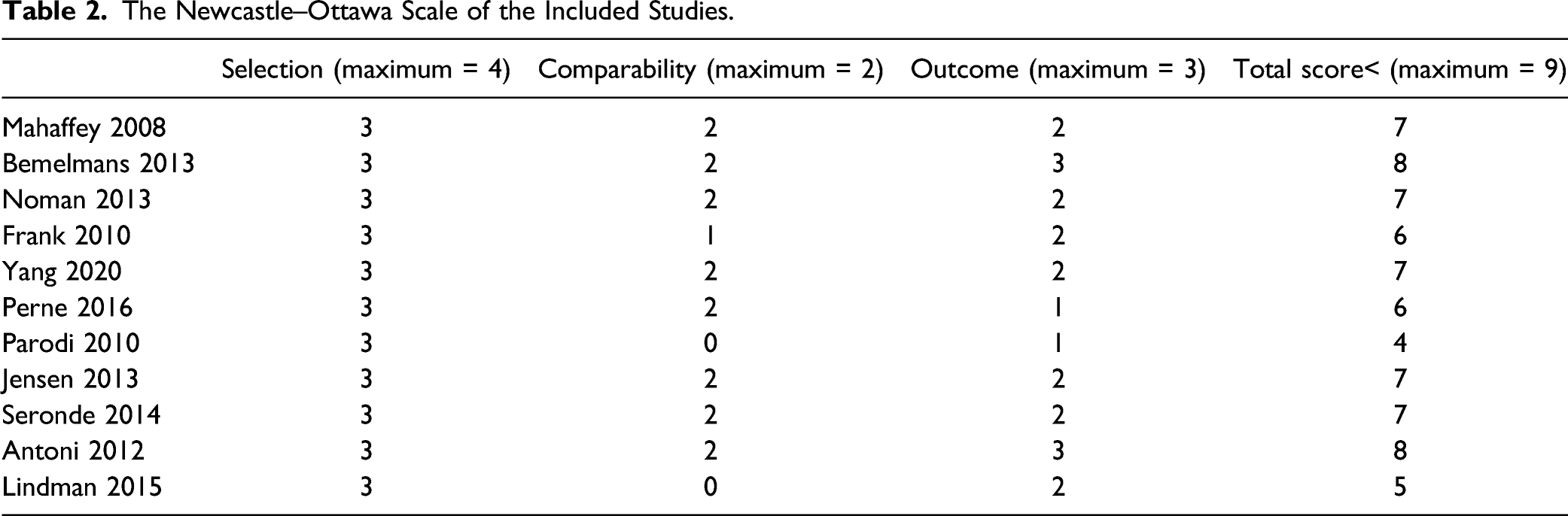
The data included the first author’s name, year of publication, study design, sample size, mean age at baseline, sex ratio, follow-up duration, heart rate and data type (continuous or categorical variable), method of heart rate measurement, all-cause mortality (the longest follow-up time was collected if multiple timepoints of all-cause mortality were reported), covariate in the fully adjusted model, HR, and 95% CI (adjusted HR and 95% CIs were extracted first). The quality assessment used the 9-star Newcastle−Ottawa Scale (NOS; Wells et al., 2015) which comprises three parts: (1) selection (4 items, 4 stars); (2) comparability (1 item, two stars); and (3) outcome (3 items, three stars). A score of 7–9 stars was considered as high quality, 5–6 as moderate quality, and 0–4 as low quality. Two investigators conducted data collection and quality assessment independently, and a third investigator was consulted to settle any inconsistencies.
Statistical Analysis
Review Manager (version 5.3) was applied for all statistical analyses. Heterogeneity was assessed using the Q test and the I2 statistic. Low, moderate, and high heterogeneity were noted as I2 < 25%, I2 between 25% and 75%, and I2 > 75%, respectively. A random-effects model was used for a conservative result in case the measured value was not within the normal distribution range of the real value. Subgroup analyses were conducted to explore the source of heterogeneity. The pooled HR was synthesized separately based on the type of heart rate (continuous or categorical variable). The quantitative synthesis was conducted in two steps as previously reported (Qiu et al., 2017), and multiple HRs were reported according to the stratified heart rate. First, all HRs except for the reference were pooled using a fixed-effects model. The pooled HR was used in the final meta-analysis. Sensitivity analysis was carried out in which the pooled HR was recalculated by removing the studies one by one and comparing the results to assess whether the pooled HR was affected by any single study. A funnel plot was drawn to assess publication bias. All analyses were considered statistically significant at p < .05.
Results
Literature Search and Study Characteristics
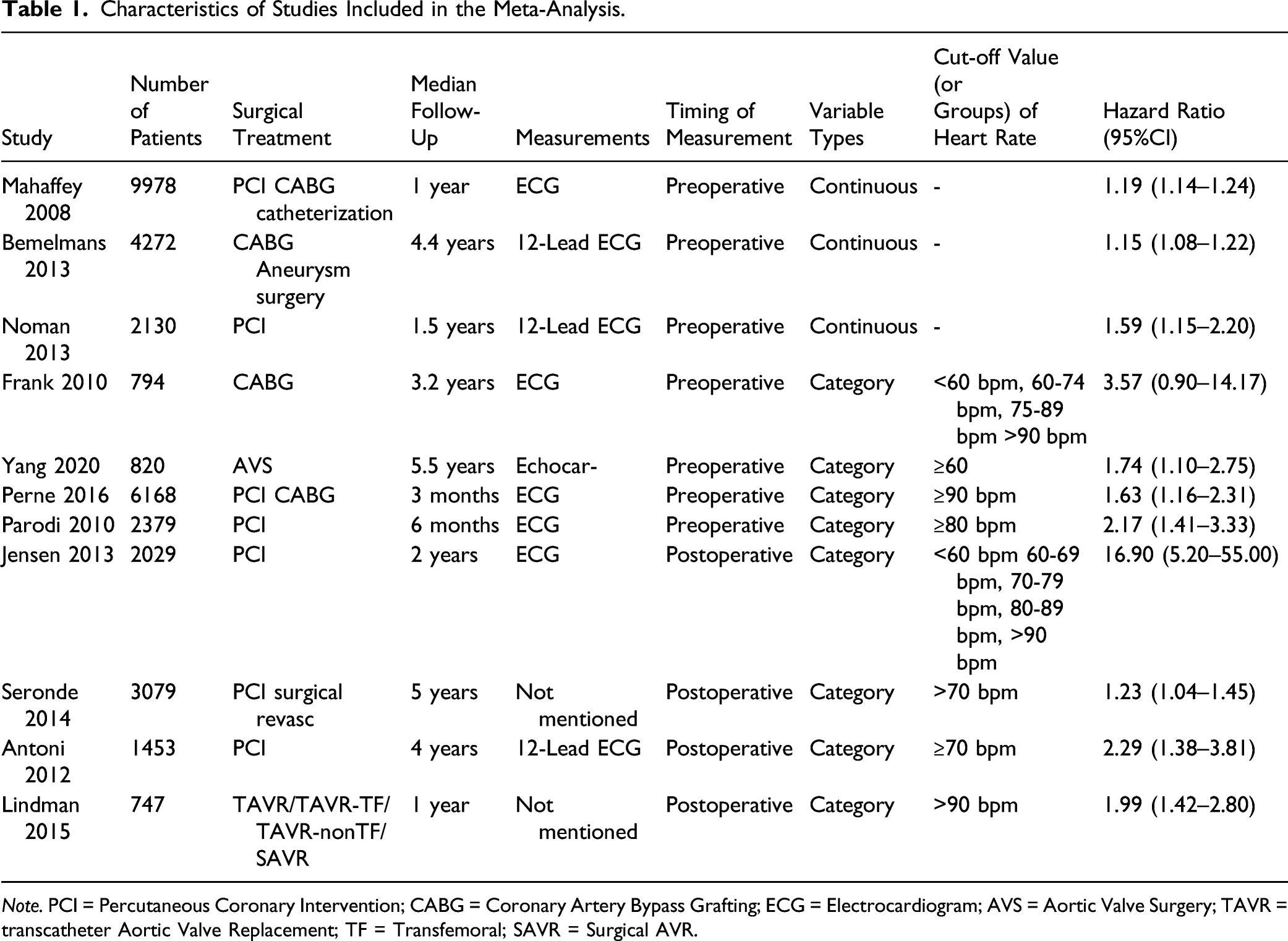
In total, 8586 studies were identified, with six studies identified in the references of a previous study (Xu et al., 2016). After removing duplicates, the titles and abstracts of 6438 studies were screened. Subsequently, 80 studies were included in the full-text screening. Finally, 11 eligible studies with 33,849 patients and 3166 (9.4%) deaths were included in the meta-analysis (Figure 1). The duration of follow-up ranged from 3 months to 8 years. The heart rate data were continuous variables in three studies (Bemelmans et al., 2013; Mahaffey et al., 2008; Noman et al., 2013) that explored the association between all-cause mortality and preoperative heart rate with a 10-bpm increase. The remaining 8 studies investigated the association between all-cause mortality and perioperative heart rate using categorical variables, of which 4 (Frank et al., 2010; Parodi et al., 2010; Perne et al., 2016; Yang et al., 2020) used preoperative heart rate and another 4 (Antoni et al., 2011; Jensen et al., 2013; Lindman et al., 2015; Seronde et al., 2014) used postoperative heart rates (Table 1). The mean age at baseline, sex ratios, and covariates in the fully adjusted models are shown in the Supplementary Materials. According to the NOS criteria, 7 studies were identified as high quality, 3 as moderate quality, and 1 as low quality (Table 2). Flow chart of study selection. Characteristics of Studies Included in the Meta-Analysis. Note. PCI = Percutaneous Coronary Intervention; CABG = Coronary Artery Bypass Grafting; ECG = Electrocardiogram; AVS = Aortic Valve Surgery; TAVR = transcatheter Aortic Valve Replacement; TF = Transfemoral; SAVR = Surgical AVR. The Newcastle–Ottawa Scale of the Included Studies.
Perioperative Heart Rate (Continuous Variables) and All-Cause Mortality
An association between preoperative heart rate and all-cause mortality was reported in three studies (Bemelmans et al., 2013; Mahaffey et al., 2008; Noman et al., 2013). The results showed a 19% increase in all-cause mortality (HR 1.19, 95% CI 1.11–1.26, p < .0001) with every 10-bpm increase in preoperative heart rate with moderate heterogeneity (I2 = 51%) when a random-effects model was used (Figure 2). Meta-analysis of all-cause mortality for preoperative heart rate increased by 10 bpm.
Perioperative Heart Rate (Categorical Variables) and All-Cause Mortality
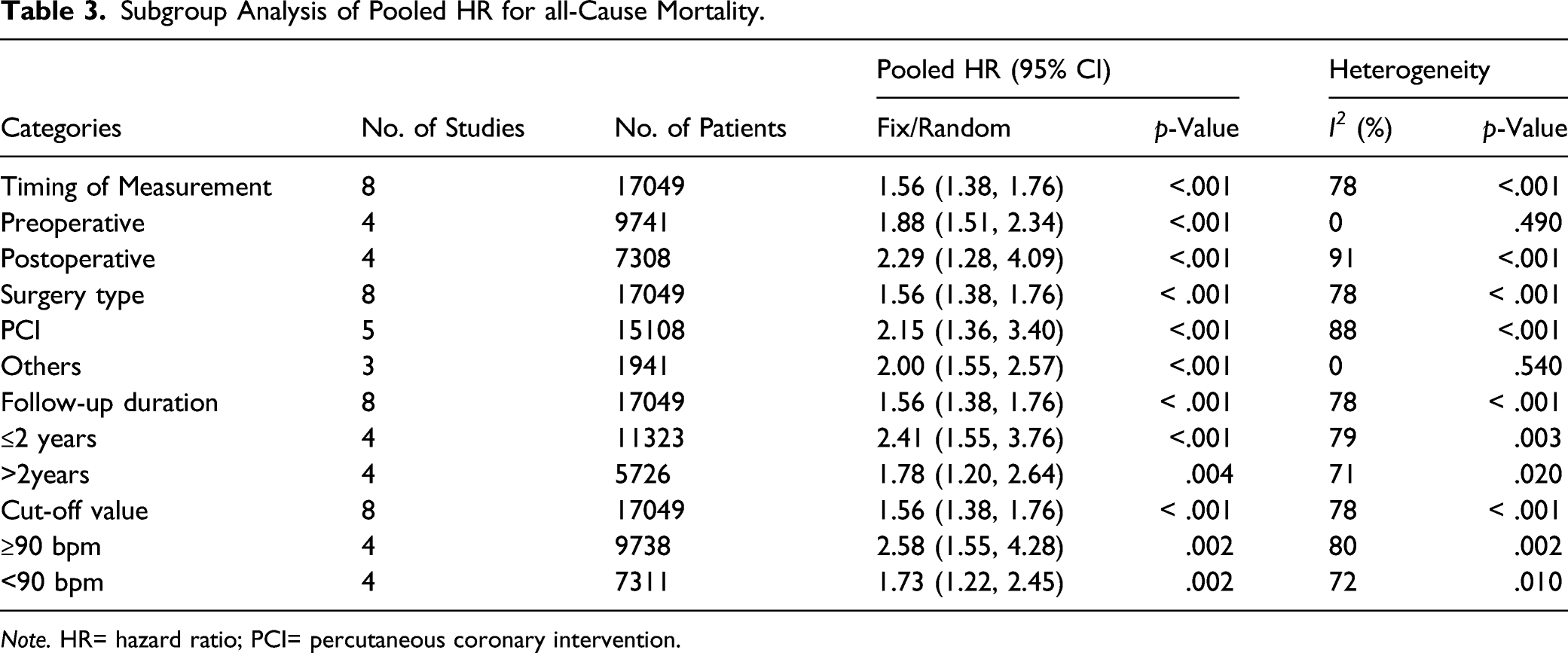
Eight studies (Antoni et al., 2011; Frank et al., 2010; Jensen et al., 2013; Lindman et al., 2015; Parodi et al., 2010; Perne et al., 2016; Seronde et al., 2014; Yang et al., 2020) demonstrated an association between perioperative heart rate and all-cause mortality. The pooled results showed that patients with higher perioperative heart rates had a 2.09-fold higher all-cause mortality rate compared to patients with lower perioperative heart rates (HR 2.09, 95% CI 1.53–2.86, p < .0001) with a high level of heterogeneity (I2 = 81%) (Figure 3). Therefore, subgroup analyses were performed. Meta-analysis and subgroup analysis of all-cause mortality for higher postoperative heart rate and lower preoperative heart rate. *The studies were reported separate data on mortality, which were combined together using a fixed-effects model.
Heterogeneity Analysis
Subgroup Analysis of Pooled HR for all-Cause Mortality.
Note. HR= hazard ratio; PCI= percutaneous coronary intervention.
Sensitivity Analysis
The robustness of the two results was tested by removing a single study each time. Sensitivity analysis indicated that all quantitative syntheses had good robustness and were not influenced by any single original study.
Publication Bias
The funnel plot of the quantitative synthesis of HRs for perioperative heart rates (categorical variables) demonstrated the presence of publication bias (Figure 4). Funnel plot analysis for all-cause mortality.
Discussion
This study, which included 33,849 individuals with 3166 deaths in 11 studies, explored the predictive value of perioperative heart rate on all-cause mortality in patients undergoing cardiac surgery based on prospective and retrospective cohort studies. The results demonstrated that a 10-bpm increase in the preoperative heart rate resulted in a 19% increase in all-cause mortality. Furthermore, patients with higher perioperative heart rates had a 2.05-fold increase in all-cause mortality compared to those with lower perioperative heart rates. These results are similar to those of previous studies (Xu et al., 2016). Therefore, ascertaining whether heart rate, one of the most easily obtainable objective parameters, is an independent predictive factor of all-cause mortality was worth pursuing. In this study, the pooled HR displayed a good predictive value for all-cause mortality. One of the strengths of this study was that the pooled HR of the included studies was calculated by adjusting the covariables in the regression model, which indicated that the predictive value of preoperative heart rate in all-cause mortality was independent of other factors. Due to the high level of heterogeneity of the quantified synthesis of categorical variables, we conducted subgroup analysis based on the timing of measurement, surgery type, follow-up duration, and a cut-off value for heart rate, which indicated that the timing of measurement and surgery type could affect heterogeneity.
The mechanism underlying the association between preoperative heart rate and all-cause mortality remains unclear. We hypothesize that there are three reasons for the predictive value. First, a higher heart rate indicates higher sympathetic activity and myocardial oxygen consumption, both of which are associated with a worse outcome. Abnormal sympathetic activity could lead to increased platelet aggregation, coronary vasoconstriction, and arrhythmia (Rovere et al., 1998). Higher myocardial oxygen consumption can lead to abnormal myocardial metabolism, ventricular dysfunction, and myocardial infarction (Ahmadi et al., 2020). Second, studies have indicated that a shorter lifespan is associated with elevated heart rate (Zhang & Zhang, 2009). An increased heart rate could cause a subsequent elevation of reactive oxygen species (Luo et al., 2020), inflammatory cytokines, glucose-lipid metabolism disturbance (Saladini & Palatini, 2018), and abnormal activation of the immune system (Moreira et al., 2017). These physiological dysfunctions could easily contribute to the impairment of organ function and lead to an adverse outcome, including death. Third, patients with higher heart rates are more vulnerable to diabetes mellitus (Docherty et al., 2020) and obesity (Shigetoh et al., 2009). In addition, a higher heart rate is also an independent predictor of hypertension (Caetano & Delgado Alves, 2015). Summarily, this association indicates that patients could be more susceptible to these pathological conditions, which could continuously play a role after cardiac surgery and lead to a worse outcome. In addition, the mean follow-up time was insufficient for the occurrence of death, which could have underestimated the negative effect of preoperative heart rate on all-cause mortality. Therefore, larger sample sizes and longer follow-up durations are needed in future cohort studies to elucidate the predictive value of preoperative heart rate on all-cause mortality in patients undergoing cardiac surgery.
Antoni et al. (2011) demonstrated that postoperative heart rate is not only an indicator of clinical impairment in patients undergoing cardiac surgery but may also relate to prognosis. We hypothesized that a higher postoperative heart rate predicted all-cause mortality for three reasons. First, the influence of a high postoperative heart rate may overlap with the preoperative heart rate in terms of increased myocardial oxygen consumption and abnormal activation of the immune system. Second, patients after cardiac surgery usually exhibit a high heart rate (Lindman et al., 2015) due to the operation, pain level, and psychological status. Adverse outcomes frequently occur when heart rate control is not optimal. Postoperative acute kidney injury (Wang & Bellomo, 2017) and low cardiac output syndrome (Massé & Antonacci, 2005) can be induced by an elevated postoperative heart rate, which increases the potential for liver and central nervous system dysfunction (Kumon et al., 1986) and the risk of death. Third, an increased postoperative heart rate is associated with post-traumatic stress disorder (Morris et al., 2016), which could negatively affect the prognosis of patients after cardiac surgery. This could explain why patients with higher postoperative heart rates had higher all-cause mortality rates than those with postoperative heart rates. Similarly, as the follow-up durations were not long enough in the included studies (mean follow-up, 3 years), we considered that the predictive effect of postoperative heart rate was underestimated. Therefore, additional studies are needed to investigate this further.
Our results indicated that heart rate control during the perioperative period could improve the prognosis of patients undergoing cardiac surgery. Current studies of heart rate control have mainly focused on atrial fibrillation and demonstrated that rate control is sufficient for treatment (Dobrev et al., 2019). Few studies have focused on the management of increased heart rate with sinus rhythm. Based on our hypothesis, we consider that medical staff should attach great importance to an abnormally increased heart rate in patients about to undergo or who have undergone cardiac surgery, regardless of the existence of an abnormal rhythm. The cut-off value for heart rate remains controversial. Zhang et al. (2016) considered 80 bpm as the cut-off value in a meta-analysis that focused on the general population and explored the relationship between resting heart rate and all-cause and cardiovascular mortality. However, Woodward et al. (2014) found that a heart rate >65 bpm had a strong independent effect of premature mortality and stroke in 12 cohort studies. Furthermore, essential aspects of heart rate control have been put forward by the American Heart Association, the American College of Cardiology, the European Society of Cardiology, the Canadian Cardiovascular Society, and the Heart Rhythm Society. However, the cut-off value remains controversial between these associations which reduced the clinical guidance (Andrade et al., 2017). Therefore, future research should determine the cut-off value for heart rate considering different factors such as race, gender, and disease status.
There were some limitations to this study. To ensure the reliability of the results, we only incorporated original studies with the same data type in the quantitative synthesis, resulting in a small number of included studies, which may have caused publication bias. In addition, the results of the quantified synthesis showed a high level of heterogeneity. However, the potential factors affecting heterogeneity were explored by subgroup analysis, which indicated that the timing of measurement and surgery type could be potential sources of heterogeneity. Furthermore, although uniform methodological criteria were used in the screening and the studies were all cohort studies, heterogeneity was still inevitable due to the inconsistency of confounding factors when the pooled HR of the original studies was calculated. However, the sensitivity analysis showed that no single study influenced the results, indicating good robustness.
In conclusion, this meta-analysis demonstrated that perioperative heart rate (measured by both continuous and categorical variables) is an independent predictor of all-cause mortality in cardiac surgery patients. However, it is important to note that the small sample size and the heterogeneity warrant cautious interpretation of these results. Multicenter, large-scale cohort studies with longer follow-up durations are needed to further investigate the predictive value of increased perioperative heart rate on all-cause mortality in patients undergoing cardiac surgery.
Supplemental Material
Supplemental Material - Predictive Value of Increased Perioperative Heart Rate for All-Cause Mortality After Cardiac Surgery: A Systematic Review and Meta-Analysis
Supplemental Material for Predictive Value of Increased Perioperative Heart Rate for All-Cause Mortality After Cardiac Surgery: A Systematic Review and Meta-Analysis by Shurong Xu, Yanjuan Lin, Lingyu Lin, Yanchun Peng, and Liangwan Chen in Biological Research For Nursing
Footnotes

Declaration of Conflicting Interests
The author(s) declared no potential conflicts of interest with respect to the research, authorship, and/or publication of this article.
Funding
The author(s) disclosed receipt of the following financial support for the research, authorship, and/or publication of this article: This study was funded by the Fujian Provincial Department of Science and Technology Pilot Project (2021Y0023), the Fujian Provincial Finance Special Project (Grant number: 2020CZ011), and the Fujian Key Laboratory of Cardio-Thoracic Surgery (Fujian Medical University).
Supplemental Material
Supplemental material for this article is available online.
References
Supplementary Material
Please find the following supplemental material available below.
For Open Access articles published under a Creative Commons License, all supplemental material carries the same license as the article it is associated with.
For non-Open Access articles published, all supplemental material carries a non-exclusive license, and permission requests for re-use of supplemental material or any part of supplemental material shall be sent directly to the copyright owner as specified in the copyright notice associated with the article.
