






Abstract
An analysis is made of the impact on beliefs regarding the environment of an educational intervention, linked to the objectives of the Global Campaign for Education-2019. The aim is to analyse to what extent the service-learning project influences the environmental sustainability beliefs of university students (N = 210) studying degrees in primary and social education (University of Valladolid), via the ‘New Human Interdependence Paradigm (NHIP)’ Scale, composed of 16 items with a Likert-type response design. Intervention is carried out in the classroom. The results obtained through a quasi-experimental research design of a single group with pre-testing and post-testing show a statistically significant 95% improvement among the participating students. Participation in cooperative groups and the tools used to facilitate critical reflection and an analysis of the connections between learning skills and academic content, together with the creation of educational resources based on those developed by the CME-2019, show their effectiveness in education for the sustainable development of these future trainers of new generations.
The main axes of this research comprise the three given below. First of all, highlighting the importance of the environment in our lives and in those of future generations. Secondly, several psychological theories are presented that can help change beliefs and, therefore, behaviour in terms of a commitment to environmental necessities. Finally, the learning-service methodology is shown as a fundamental element in this necessary transformation, mainly because of its being employed by graduates committed, as a result of their training, to education.
Environmental problems and universal coping strategies
The beginning of the twenty-first century is presenting us with alarming characteristics in many aspects relevant to the life of human beings, at a social, economic and environmental level.
The galloping climate change that the planet is undergoing, and which, fortunately, has received the attention of the international community at the highest level, namely, the Paris Climate Conference in 2015. This is the first universal and legally binding agreement on climate change, formally ratified by the EU in November 2016, involving 189 countries.
Implementation of the agreement is critical if we are to achieve the Sustainable Development Goals, since it provides a roadmap for climate action that will reduce emissions and increase climate resilience. And since acceptable sustainable development cannot be achieved without human rights awareness, in this regard, the United Nations Human Rights Council (2019) pinpoints human rights education as a priority objective in higher education and in training programmes on human rights for teachers, educators and public officials.
The Universal Declaration of Human Rights (UDHR) represents the basis for these guidelines (United Nations General Assembly, 1948, 2006, 2015).
According to García-Vilardell (2021) and Lucas-Mangas (2021), UNESCO has been working on education for global citizenship, with the aim of making it a transformation factor: building the idea of peace in the minds of human beings, as regulated by the 2030 Education Agenda, fundamentally objective 4.7 of the Sustainable Development Goals and in the global programme for human rights education (2005–ongoing). The 17 objectives are implemented from the perspective of human rights, with the aim of making them a reality (García-Vilardell, 2021; Lucas-Mangas, 2021; United Nations Human Rights Council, 2019).
Concern for environmental problems and the emergence of environmental movements commences with the appearance, in the early 1970s, of the ‘Limits of Growth’ report published by the Club of Rome, which showed what would happen by the year 2100 if the trends established since the beginning of the twentieth century continued. It was concluded that industrial growth rates are not compatible with the finite structure of the earth’s resources (Giddens, 2001).
The concept of sustainable development currently prevails. This concept appears for the first time in the United Nations Report ‘Our Common Future’, known as the 1987 Bruntland Report. Ultimately, it is a question of meeting the needs of the present without jeopardizing the capacities of future generations (Giddens, 2001).
As Lagnesjö (2015) stated, during the ICCROM Forum on Conservation Sciences in 2013: (1) human actions have an impact at both local and global levels; (2) in order to establish a framework for international interaction and cooperation, most nations have joined the United Nations and signed the Universal Declaration of Human Rights, which deals mainly with sustainable development; (3) an aspect central to the discussion is that culture and cultural heritage are integrated into all human activities, yet their diversity is the result of culture having various values, meanings and functions for different groups; (4) by means of research, historical perspectives can be provided and awareness raised, thereby transforming ‘easily accessible’ knowledge and providing facts and information; (5) an example of how this can be achieved is working in line with social, economic and environmental sustainability, and in accordance with the following areas: the need for process administrators and facilitators; for active participation in global sustainability challenges; and for inspirational models and case studies.
This enhances the commitments of UNESCO (2021) to integrate Education for Sustainable Development (ESD) at all educational levels and to empower young people as agents of change, creating opportunities for learning and citizen participation, and providing them with the skills and tools to participate in ESD as co-creators of individual and social transformation.
Ultimately, this is the adoption of a human rights–based approach, as a specific methodology to deal with public policies from a cooperational point of view. It focuses on both processes and results, in which human beings are the protagonists of their own development, and an analysis is made which identifies the causes of the violation of rights and addresses the structural causes of the problems and their appearance (United Nations Human Rights Council, 2019; United Nations General Assembly, 2021).
Human rights, promoting a culture of peace, non-violence, appreciating cultural diversity or consolidating global citizenship, are terms largely related to the process of intermediation and the objectives of the 2030 Agenda: the means by which the full development of the person and the promotion of human values are made effective by dialogue between communities, groups and individuals (García-Vilardell, 2021).
As reviewed by Lucas-Mangas (2021), the 1948 Declaration of Human Rights establishes in its article 26 that:
Education shall be directed to the full development of the human personality and to the strengthening of respect for human rights and fundamental freedoms. It shall promote understanding, tolerance and friendship among all nations, racial or religious groups, and shall further the activities of the United Nations for the maintenance of peace.
Likewise, it urges that we should consider article 29.1: ‘everyone has duties to the community in which alone the free and full development of his personality is possible’.
Spain, in compliance with its commitment to the 2030 Agenda, has adopted a plan of educational measures for incorporating global citizenship and education for sustainable development into the educational system. Working procedures are instrumental in preparing children and young people to live in this complex and interconnected world, with the inclusion in the educational curriculum of mechanisms that provide students with socio-affective tools and skills as well as a critical capacity. Thus, values of human dignity, equality, justice, solidarity and participation, ones which constitute the basis of a peaceful democratic coexistence, are promoted (Government of Spain, 2018).
Consistent with these theoretical and methodological underpinnings are innovative educational and research models, such as learning-service and case studies, the impact of which can be seen in various applied studies (García-Vilardell, 2021; ISSUE, 2019; Lucas-Mangas, 2021; Newman & Newman, 2015; Rajala & Akkerman, 2019; Van Eijck & Roth, 2010, among others), which are also of reference in this research.
It is crucial to establish a commitment with global educational action-oriented and universally applicable sustainable development goals (Kautish et al., 2020; Margaça et al., 2022).
Changes in beliefs and attitudes
Various investigations are endeavouring, from different perspectives and theories but with the same goal, to change forms of behaviour so that people are respectful of the environment.
In particular, this research presumes the role of environmental education and changing attitudes among students to contribute to sustainable community development (Corral-Verdugo et al., 2008, 2019; Hernández et al., 2012).
The theoretical framework is to be found in the contributions regarding the Theories of Reasoned Action (TRA) (Ajzen & Fishbein, 1980) and Planned Behaviour (TPB) (Ajzen & Fishbein, 2005), whereby people act in accordance with the information and knowledge they have on a specific issue, in this case, the environment. Therefore, this theoretical framework seeks to determine the beliefs associated with any attitudinal object.
A theoretical model that predicts and explains behaviour according to two premises: (a) that people behave rationally, taking into account the information available and evaluating the results of carrying out an action or not; (b) that actions are determined by the intention to carry them out or not.
Ajzen and Fishbein (2005) postulated that the attitude of people towards a certain situation or object will be associated with the beliefs that the person has at that certain moment, thereby determining the intention between attitude and behaviour.
Two factors influence intention: a personal one (the attitude towards behaviour) and a normative factor (a subjective criterion), defined as ‘the perception of what the population believes, which is important for the person, about whether or not they should perform the behaviour’ (Ajzen & Fishbein, 1980, p. 57). TRA is one of the most widely used models in psychosocial research, despite receiving some criticism, such as the absence of other variables that could influence intention and behaviour (Durán et al., 2016).
It is possible to identify psychological determinants that account for the negative changes affecting the planet, given that human decisions and behaviours that lead to ecological degradation are psychological variables (Corral-Verdugo et al., 2019). These variables can also guide people towards a caring attitude with regard to the environment (Clayton & Myers, 2015).
Nevertheless, when trying to put forward an explanatory model, research into ecological behaviour comes up against certain obstacles, given the multiple variables involved.
Within this broad spectrum, the values will play an important role since they are manifested through beliefs, and these are more specific and closer to concrete behaviours; this suggests the impact of environmental beliefs on ecological values and behaviours (Clayton & Myers, 2015; Corral-Verdugo et al., 2019; Durán et al., 2016; Hernández et al., 2012; Pato & Tamayo, 2006, 2014).
Learning-service projects applied to a change in environmental beliefs
In this contex, the present research is undertaken, and also, in accordance with the regulatory framework promoting the university’s social responsibility and sustainable development, actively engaging with the communities around it (Conference of Chancellors of Spanish Universities, 2015, 2018; European Commission, 2017; Ministry of Education, Culture and Sport, 2010), is embodied in projects such as service-learning.
In line with this, the challenge is to establish a cooperative dialogue between the university and society, so as to contribute to sustainable human-community development. Service-learning is a pedagogical approach characterized by combining classroom learning with community service. Studies have shown that service-learning has important benefits, such as promoting academic learning, personal and social development and civic engagement (Pereira & Arraiga, 2020). More than a learning methodology, it is a philosophy that reconciles educational quality and social inclusion (Batlle, 2020; Lucas-Mangas, 2021). Thus, service-learning is also an innovative teaching and research strategy for psychosocial intervention with a community approach, which understands educational quality as part of social responsibility and responds to the purpose of education (Lucas-Mangas, 2021). The creation of diverse networks in many countries, such as those compiled by Aramburuzabala (2019), reinforces this roadmap.
Many authors have pointed out the need to not ignore the initial efforts to legitimize and expand the opportunities of service-learning, its main theoretical foundations and principles of intervention (Chiva et al., 2018; Gándara & Mugarra, 2019; Lucas-Mangas et al., 2019; Martínez-Odría, 2019).
In this regard, Chiva et al. (2018) have reported a rapid growth of service-learning in the university and other educational contexts, as a result of the work of teachers and researchers committed to a community movement; such work draws on active and experiential education practices and participatory action research.
Intertwining the reference frameworks for service-learning and its essential components, the course seems to be oriented towards a sustainable community development approach and the construction of a culture of peace and human rights, an essential life-quality component (Lucas-Mangas, 2021).
Therefore, this research is based on a learning-service methodology, in that:
A psycho-social intervention strategy based in education (in training and/or research projects) that creates learning and service processes together with the community (geographically nearer or further afield, with a local or more global, even planetary, perspective), in a pioneering project of cooperative dialogue. Those who participate learn by being involved in the needs and challenges of the environment in order to contribute to sustainable human-community development, promoting life quality. (Lucas-Mangas, 2021)
Consequently, according to the literature on the subject reviewed by Lucas-Mangas (2021), the following essential components should be incorporated: students’ prominence throughout the process; focus on a real need; a connection with the proposed learning objectives; developing the service action or project of each of its phases (preparation, planning, executing the plan of action and evaluation); reflection throughout the proposal.
This agenda, approved by Spain and a further 193 countries in September 2015, includes 17 Sustainable Development Goals (SDG), and it constitutes a guide for the development of service-learning projects and the incorporation of university dynamics contributing to sustainable development.
With this shared challenge, the University of Valladolid has, since 2014, been working continuously in the Global Campaign for Education (GCE), via the Teaching Innovation Project ‘Legal Clinic: a learning-service method for the protection of human rights (Area of human rights education)’, consistent with the Sustainable Development Goals, within the framework of the 2030 Agenda.
Consequently, various research studies suggest the need to make an effort to incorporate education for sustainability (Aramburuzabala & Cerrillo, 2023; Lucas-Mangas, 2021; Vance-Chalcraft & Goodwillie, 2022), in the context of environmental beliefs, as a central priority in everyone’s basic literacy (Inkpen & Baily, 2020, Minget & Solís, 2009; Novo, 2006). Regarding the university training of future teachers, a large majority of students recognize the importance of being aware of sustainability, and of the tools required to successfully teach this to future students (Cebrián & Junyent, 2015).
If we consider the various active methodologies that have been applied in the educational field, service-learning has been among those that have had the greatest educational and social impact in recent times, gradually forming part of the curricula in Spanish universities (Álvarez et al., 2017). Recently, Lorenzo et al. evaluated 41 service-learning projects in five Spanish universities (four public and one private), with the aim of determining whether they are SL experiences or other types of educational practices. The results obtained in the research showed a certain change in the teaching culture, with social commitment taking on a more prominent role. However, it was noted that this change was at an early stage (Lorenzo et al., 2020). The aim is to foster students’ academic and skills development, provide a quality service to society and educate in terms of values (Martínez, 2018). Consequently, it is intended to make citizens socially responsible, working together with the community and developing skills, whilst carrying out meaningful activities in cooperation, coordination and collaboration with community partners, carrying out projects in their field of study (Lucas-Mangas, 2021).
In line with this theoretical framework, the following research objective is proposed.
Objectives
The principal aim is to analyse to what extent activities relating to the service-learning methodology influence the beliefs of university students in terms of environmental sustainability. In particular, those relating to quality education (SDG4), sustainable cities and communities (SDG11), responsible production and consumption (SDG12), climate action (SDG13), underwater life (SDG14), life of terrestrial ecosystems (SDG15) and, finally, alliances to achieve the objectives (SDG17).
The project as a whole takes as a reference the needs of education for environmental and social sustainability, ones which guide the following general priority objectives and the competencies of GCE-2019 (Global Campaign for Education (GCE), 2019):
(1) To raise awareness of the different environmental and social challenges that humanity is currently facing, the interconnection between these and how they affect the well-being and exercising of rights of people.
(2) To improve one’s knowledge of the determining role that education plays in empowering citizens to jointly build a socially and environmentally sustainable future.
(3) To promote a change in people’s attitudes and behaviour in order to progress in terms of building a sustainable future from the social and environmental standpoint.
Aims associated with the competencies, objectives and specific contents of the different subjects in which the project is developed (developmental psychology; numerical bases and their teaching strategies; didactics of experimental sciences and environmental education; curricular development of experimental sciences — in the primary education degree; social and cultural anthropology, social psychology and social mediation techniques — in the social education degree).
Method
Research hypothesis
Taking into account what has been exposed in the previous sections, it is necessary to make explicit the research question to which this study tries to give an answer and which is none other than that which raises to what extent an educational intervention based on the methodological principles of service-learning modifies the environmental beliefs on environmental sustainability of university students towards a more conscious and committed system with this problem. In particular, the form that the aforementioned intervention takes in this study will be described in detail in the section concerning the procedure carried out within the framework of this research.
The possible answers to this question lead us to state the following two alternative hypotheses:
H0,1: There are no significant differences between the environmental belief systems before the intervention and after the intervention.
H0,2: There are significant differences between the environmental belief systems after the intervention.
In order to be able to answer the research question posed by contrasting the hypotheses established on the basis of the conditions and environment in which this research was to be carried out, as well as the resources and time available, a quantitative approach was chosen through a quasi-experimental design with a single group, i.e., without a control group.
Participants
The intervention was carried out in a total of eight classroom groups, with a total of 210 participants (55% women; 45% men), with ages between 18 and 21 years old, students of the primary education (156; 74%) and social education (54; 26%) degrees of the University of Valladolid, belonging to the Faculty of Education of the Duques of Soria Campus and the Faculty of Education and Social Work of the Valladolid Campus. The distribution by courses was as follows: 65 in the first year, 38 in the second year and 61 in the third year.
No control group was included, so all the groups involved were experimental. The selection of these was intentional, so that those responsible for instruction were the teachers involved in the research.
In all cases, the ethical principles relevant to research of this type were respected, with special attention to the applicable regulations on data processing and data protection, with the informed consent of all participants. In particular, data collection was carried out in the classroom together with the teacher responsible for the corresponding subject, who explained the procedure, described the purpose and collected the informed consents.
Instrument
The instrument used to put the objectives into practice and compare the hypotheses was the New Human Interdependence Paradigm (NHIP) Scale by Hernández et al. (2012), based on the scale designed by Corral-Verdugo et al. (2008).
The NHIP is composed of 16 items (see Table 1), each of which corresponds to a statement relating to environmental, economic and social sustainability. The scale has adequate psychometric properties, with a Cronbach alpha value for internal consistency of .88, with a seven-level multidimensional Likert-type design, where 1 indicates total agreement with the statement and 7 the exact opposite.
Items of the seven-level NHIP scale.
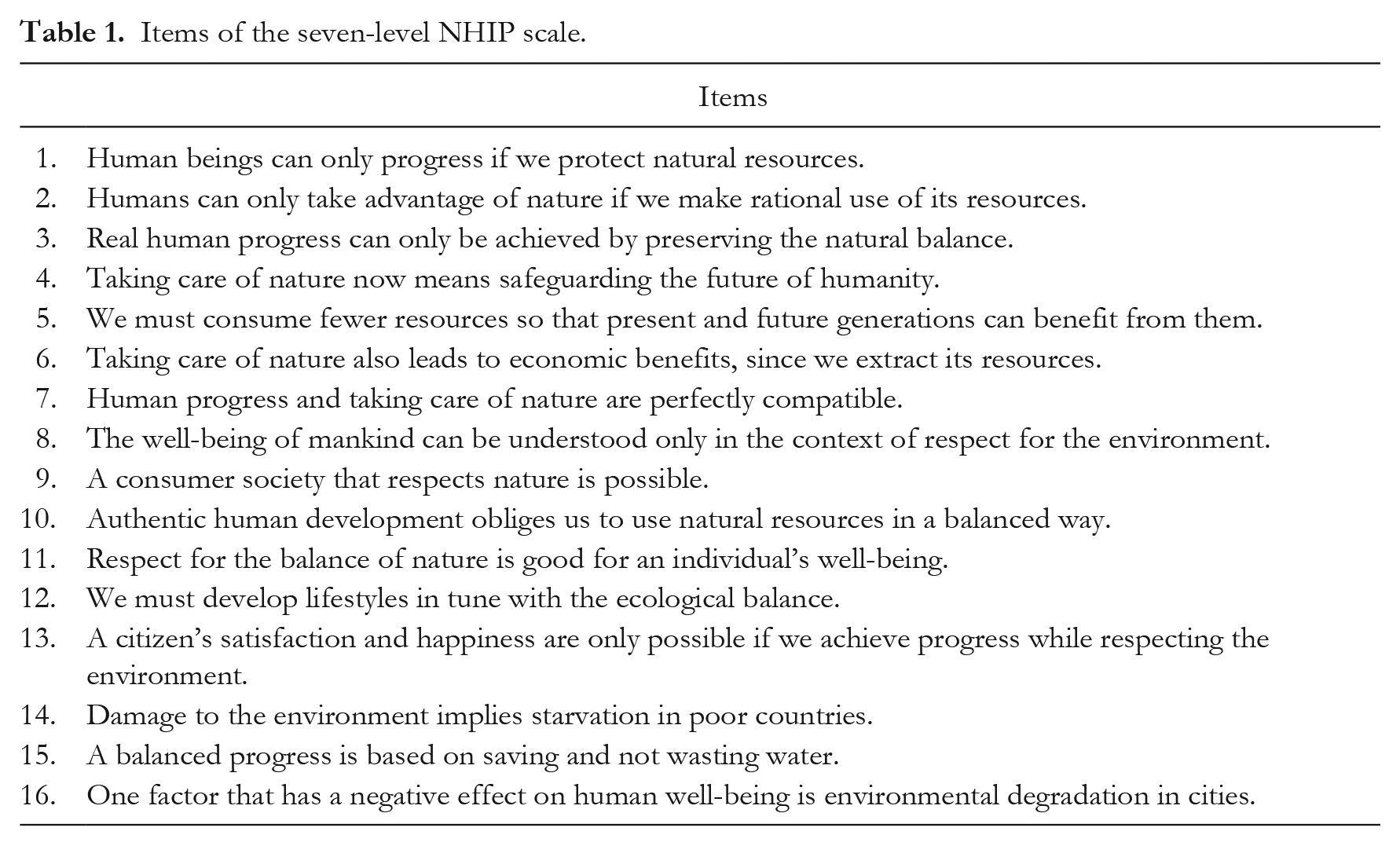
This scale was chosen because it provides for the integration and inclusion of human needs with the balance of environmental dynamics.
Procedure
In this research, the initial preparation and planning stages were essential, taking place beforehand in the first semester of the 2018–19 academic year. During these phases, a serious coordination and training effort ensured a high level of cooperation among teachers in carrying out the research, whilst minimizing the danger of internal validity associated with individual differences between teachers.
The entire process began and was developed by means of networking with the Fundación Entreculturas (Inter-cultures Foundation), a social institution under the GCE in Castilla y León, in coordination and collaboration between teachers and the technical staff (via documentary analysis and a questionnaire).
A model data sheet was used to help structure each line of action developed. This sheet included the following criteria (Lucas-Mangas, 2021): basic data of the project (title, course, subject and participatants), a brief introduction foundation and frames of reference (why), objectives, contents to be covered and learning promoted, skills, methodological development (how), main results obtained, reflections, implications and final assessments, sources of information and other relevant data.
Research into and implementation of the project were carried out throughout the entire second semester, and each group class held eight sessions of two hours each, consisting of supervised environmental sustainability projects in small cooperative research groups (4–5 students).
An instructional proposal was drawn up, whereby various transversal skills would be undertaken with the students, in line with the benchmarks of the Global Campaign for Education (2019). All these competencies were linked to learning the theoretical contents of the subjects involved:
- This acquired learning revolved around the development of integrated problem-solving skills: linguistic, social and citizenship, cognitive, anticipation, strategic, cooperative, critical, autonomy and personal initiative, learning to think and communicate, relating to other people and having a personal balance. Various topics were covered, framed in the sustainable development goals (SDG) and, more specifically, in the area of ‘Environmental and social sustainability in university education’.
- Service to the community was organized in teaching units and experience panels that were registered in journals, reports and portfolios, by combining case studies, presentations, debates, images, stories, songs, producing scripts and videos of plays and other artistic events, student reports, workshops, reading guides, conceptual maps, posters, graphs, diagrams, organizing workshops, self-administered questions and cooperative work. Similarly, second-year social education students represented the university at the World Week for Education (SAME-2019), held at the Faculty of Education and Social Work at Valladolid, and in which cooperative workshops were held together with the community, students of educational centres and personnel of social organizations. Participation in the reading of a manifesto regarding this area of the GCE-2019 was also a feature (https://somos.entreculturas.org/general/semana-de-accion-mundial-por-la-educacion-2019-en-valladolid/).
Finally, the evaluation process of each measure implemented involved the participation of both teachers and students, as well as the technical staff of the Inter-cultures Foundation. This process considered all spheres of the project and allowed for reflection on the learning results achieved, the social impact of the service provided and future lines of action. Consequently, various evaluation criteria were established:
- well-defined and framed objectives
- expected and/or actual indicators regarding the aims of the intervention
- a global evaluation of the activities and expected results
- the level of impact of the educational resources in the community
- the verbal and written clarity of the work performed by the students
- the clarity and quality of the material resources used
All the fact sheets that were prepared were reviewed by the teaching staff and the technical staff of the Inter-cultures Foundation, to make sure that they met the criteria of both learning and service to the community, whose impact was the object of the intervention.
Location and implementing of the teaching and curricular proposal
On the Soria Campus, this research was carried out in the subjects of developmental psychology and curricular development of experimental sciences, part of the primary education degree. We worked in small cooperative groups, studying the interdependence between psychology and environmental sustainability. Investigation was carried out into the excessive use of plastics in the food industry, together with its repercussions (environmental, health. . .), and teaching resources were designed to work on this problem with future primary education students.
On the Valladolid Campus, work was carried out in both social education and primary education degrees. in the former, this involved a transdisciplinary project, in the subjects of ‘social and cultural anthropology’, ‘social psychology’ and ‘social mediation techniques’, with work involving 10 projects in cooperative research groups. In the primary education degree, meanwhile, this entailed the subjects of ‘numerical bases and their teaching strategies’, ‘didactics of experimental sciences’ and ‘environmental education’. Teaching resources were drawn up for mathematics, with inclusive education, visible thinking and education for development as driving axes.
All the educational interventions designed had the following framework:
- The project which was carried out was presented to the group class, and an audiovisual support with a maximum of PowerPoint slides, a panel of experiences, etc., was provided.
- The development process was explained.
- The main contents were presented, with a relationship established between theory and applied practice.
- Participation and intervention by all the students of each group class in each of the activities was mandatory.
An overall rating of the work undertaken by the students took place, in accordance with the evaluation criteria of each subject. This formed part of the practical classes for the subject, these criteria being adjusted to the written presentation of the work and the explanation in the group class.
Results
The results in terms of the change in the students’ environmental beliefs as a result of the service-learning project were obtained by data analysis before and after the implementation of the project. The previously described seven-level NHIP scale was used for this purpose.
First of all, and before showing the results provided by the scale, it should be noted that the number of participants who completed the post-test (126 from primary education and 37 from social education) was lower than that of those who provided data in the pre-test (156 from primary education and 54 from social education), with a slightly higher experimental mortality in one of the degrees (see Figure 1), something common in studies such as the one investigated here.

Participants by pre-test and post-test stages and university degree. A comparison is observed in the number of participants at the times of data collection (pre-test and post-test) for the two degrees participating in the research (primary education and social education).
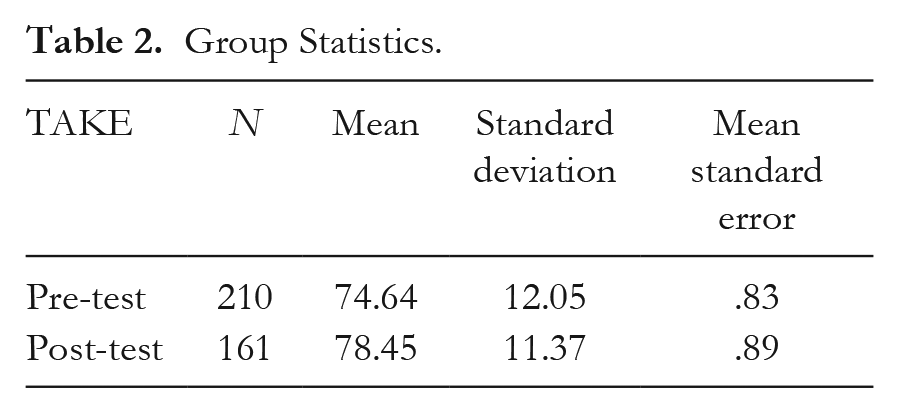
For analysis of the results, a means comparison was carried out based on a t-test for related samples. The participants were paired by the use of an identification code. A 95% level of significance was established. Table 2 shows the group statistics at a time, while Table 3 shows the t values, the significance of the mean difference and a 95% confidence interval.
Group Statistics.
Results of means comparison.
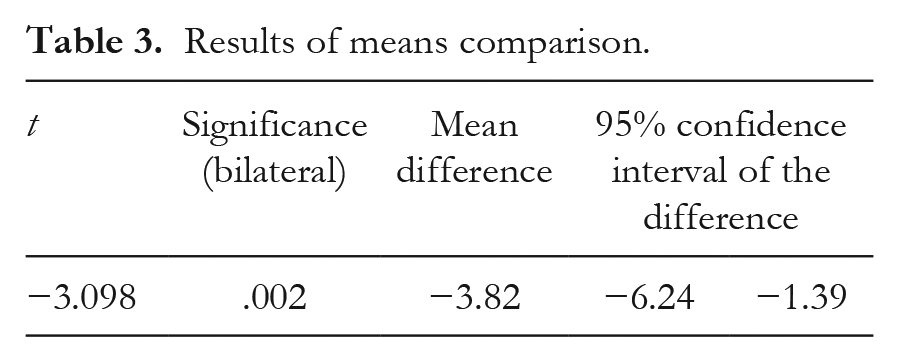
It can be seen that not only is the mean score obtained in the post-test phase higher than that of the pre-test phase, but also that the difference is statistically significant (p < .05). However, no significant differences were obtained in terms of the degree of the participating students nor in terms of gender or course, as was revealed by a complementary ANOVA analysis.
A more detailed analysis of the responses allows us to observe (Figure 2), on the one hand, a positive evolution of the students’ beliefs on the NHIP scale in each and every one of the items comprising this scale, with differences in the mean score ranging between .02 (Q4) and .56 (Q8). In addition, the items representing a greater change in student responses correspond to Q5, Q8, Q10 and Q13. These relate to statements referring to concern for the environment and a sensible use of natural resources as key elements of human well-being, with both a current and future projection. These items are also very much focused towards social responsibility and action.
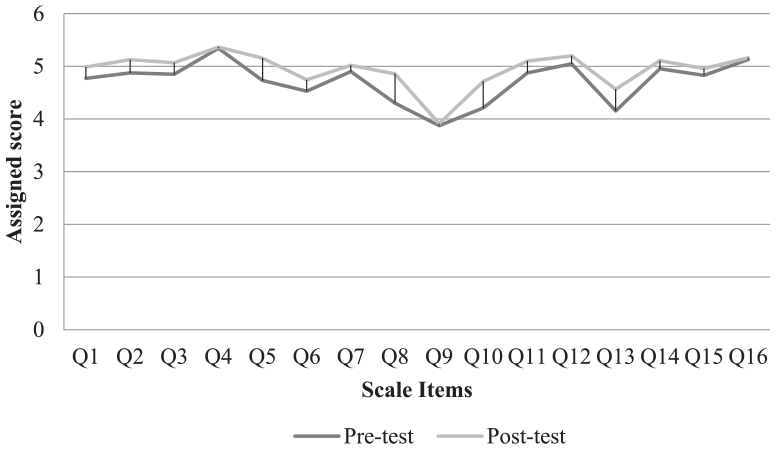
Mean scores per item on the scale. The mean scores are shown for each item on the scale; the pre-test collection stage is compared with that of the post-test.
It should be noted at this point that an item-by-item analysis through the non-parametric Wilcoxon test for related samples showed that none of the differences observed were statistically significant, so the changes show only trends that should be confirmed through new experiments.
The results confirm the main working hypothesis of this study. They reveal a statistically significant impact and change regarding the environmental beliefs of the university students participating in the educational intervention, based on the methodological principles of service-learning and the objectives of GCE-2019.
Discussion and conclusions
With this research we advocate the Human Rights-Based Approach (HRBA) defined by the Office of the United Nations High Commissioner for Human Rights (United Nations General Assembly, 2006) as a conceptual framework for the process of human development. This is based, from a normative standpoint, on international human rights regulations, and from the operational point of view it is oriented towards promoting and protecting human rights.
The point of reference for this research is the New Human Interdependence Paradigm (NHIP), which considers human–nature interaction as an interdependent relationship. This paradigm lays the theoretical bases that guide the psychology of environmental conservation: explaining the reasons that justify certain attitudes of human beings, it assumes the role of environmental education and attitude change for the achievement of sustainable community development objectives (Corral-Verdugo et al., 2019). An attempt has been made to assess the influence of environmental beliefs on a change of attitude, by means of a learning-service, in terms of preserving our natural resources and alleviating the environmental and social deterioration that is taking place on the planet. This establishes a link between environmental beliefs and values and behaviour, in accordance with the studies by Clayton & Myers (2015), Corral-Verdugo et al. (2019), Durán (2001), Durán et al. (2016), Hernández et al. (2012) and Pato & Tamayo (2006, 2014).
Indeed, it may be stated that values shape proenvironmental behaviour and vice versa (Lange & Dewitte, 2019), and according to Xie et al. (2020), personal values determine individual cognition and behaviours and also have an important impact on proenvironmental behaviours. Bouman et al. (2021) also point to a greater emphasis on the influence of personal values on proenvironmental behaviour.
The results show that the principles of service-learning intervention make possible a change in former beliefs (Lucas-Mangas, 2021; Martínez, 2018; Martínez-Odría, 2019; Ruiz-Corbella & Manjarrés, 2018). This, therefore, could also be assumed with respect to behaviours, according to Theories on changes in attitude: Reasoned Action (TRA) (Ajzen & Fishbein, 1980) and Planned Behaviour (TPB) (Ajzen & Fishbein, 2005).
These results thus confirm that the aims formulated and hypotheses raised in this research have had a positive impact, although not significant, explained in the form of a tendency to change socio-environmental beliefs. Therefore, it is deduced that the development of service-learning projects is a promising way to change environmental beliefs, especially considering the role that future educators can play in their areas.
Analysis carried out at a quantitative level shows us that action taken in environmental education through the service-learning project produced a significant change in beliefs concerning environmental sustainability among the sample of students participating, as stated in the general hypothesis of the study.
This is especially relevant if one takes into account that attitudinal beliefs are generally very resistant to change (see, for example, Lao & Young, 2019) and, moreover, that the intervention carried out in this research took place during a single semester of the 2018–19 academic year. Nevertheless, we are aware that intervention was intensive, affecting many issues such as food, the circular economy or environmental mediation and various educational strategies to change attitudes.
Subsequent studies will allow us to evaluate the effectiveness of each of these strategies in attitudinal change, this being a matter of great importance, especially when the timeframes for change are short.
As for the absence of a control group, although this is obviously a limitation as regards establishing solid conclusions of a cause–effect nature, in the context of this research it was considered an appropriate option, due to the nature of the pilot study that was actually proposed. In fact, it is not strictly possible to speak of experimental manipulation in the development of this research, but rather of observation of participants in their natural environment, all of them being subject to the same experimental protocol, as well as to pre-test and post-test measures analysing the effects on the participants themselves.
In any case, it is obvious that this absence of a control group, together with the moderate size of the sample and its incidental selection, and the experimental mortality detected, constitute threats to both the internal and external validity of the study. This would suggest that, despite the recommendation to take the results with some caution, they serve as a reference to develop solid hypotheses that can be tested in further research.
Participation in small, cooperative research groups in environmental education, as well as the instruments used to facilitate critical reflection on and analysis of the connections between academic content and community service, have shown their effectiveness in environmental sustainability education for degree students in primary education and social education, the future educators of new generations. The results are consistent with the reviews carried out by Ruiz-Corbella and Manjarrés (2018) and Bassachs et al. (2020) in response to Jacoby’s (2014) findings, highlighting how an evaluation of tasks that promote student reflection represents a link between learning and service. This points to education as the driving force behind personal transformation.
Assessing results also allows for observing changes in accordance with the objectives and the previously defined hypothesis. This represents an example of how to include Sustainable Development Goals in the university curriculum through service-learning, facilitating the project’s new lines of future cooperation and with new community partners.
Service-learning represents a line of action that addresses a new culture in the face of great challenges, such as the environment and a new education.
The scope of the relevance of this innovation at the cultural and educational level is consistent with the very nature of learning-service, conceived by Lucas-Mangas (2021) as an educational strategy undertaken with the community in a cooperative project, whereby those who participate learn whilst contributing to sustainable development and to their life quality.
The research has also allowed us to develop educational resources within the framework of the service-learning project, which will serve as a reference for application in environmental education in future undertakings. It represents an exercise in social responsibility to continue contributing to sustainable development from the university (Conference of Rectors of Spanish Universities [CRSU], 2015, 2018; European Commission, 2017; SDSN Australia/Pacific, 2017; United Nations Human Rights Council, 2019).