







Abstract
Quality of reading has emerged as one of the topical problems of the learning process among digital-age youth. Reading practices among youth were researched in the survey in Latvia (n = 2,169), which inquired about the frequency of reading of different types of literature, their preferred medium for reading, and cognitive reading strategies. Factor analysis identified three groups of reading strategies: those who practice deep reading, those who are pragmatically oriented, and those who prefer multimodal reading. These factors were found to correlate with the patterns of youth’s online activities and approaches to internet use in learning. Students who use the internet mostly for learning and information seeking tend to practice “deep reading.” Students who extensively use the internet for cooperation prefer “pragmatic” reading. Students who tend to rely on the internet uncritically and habitually practice multitasking prefer multimodal reading. Regression analysis showed that the main factors predicting deep reading are metacognitive attitudes favoring thoughtful approach to learning and the use of the internet for cognitive purposes and creative activities.
The inquiry of the students’ reading practices was a part of the study on the effects of internet usage among students on their cognitive styles. 1 Some questions were included in the national survey targeting students of secondary school and higher education in institutions in Latvia. In the beginning, we conducted five focus group discussions with secondary school teachers and university teachers with a total number of participants n = 39 on the subject of the influence of the internet on students’ learning styles. Even though the theme of reading was not specifically planned, it emerged as a subject of discussion in all groups. The participants pointed out that students nowadays under the influence of the digital environment tend to read less, they read unwillingly, they do not read long texts, and the quality of comprehension is often unsatisfactory. Some teachers mentioned that students’ reliance on the internet in learning has led to the fragmentation of knowledge of students, sometimes failing to form necessary basic concepts in different branches of knowledge. The participants of the focus group discussions characterized some strategies that the students, in their opinion, use when they read online, such as skimming, scanning, hyperreading, and reading selected keyword-searched fragments (Šņitņikovs & Svitaja, 2023). What they said was generally supportive of the shallow processing hypothesis, that is, that reading from electronic devices facilitates superficial reading and shallow processing (Baron, 2015; Carr, 2020). In the research on the effects of digital media on reading, it was found that paper-based text is better for understanding than reading from screen devices (Deacon et al., 2024; Delgado et al., 2018). At the same time, the participants in the focus groups pointed out that not all students are the same, and that there are students who are diligent and creative in learning and who are good readers.
By employing the perspective of cultural-historical psychology, it is possible to explain why media have effects on learning practices (Galperin et al., 2022). However, humans’ relations with the world are mediated not merely by tools but also by the systems of activity where these tools are used (Leont’ev, 1978). Moreover, in the cultural-historical psychology and activity theory, the agency of the learner plays an important role. According to the theory of developmental education, the student is an active participant in the learning process, a subject of the learning activity (Davydov, 1996). Young people, during their studying period, are involved in many different activities, some of which become more subjectively significant for them than others depending on their age and the stage of psycho-social development. We hypothesized that the attitudes of the students toward the learning activity, their purposes, and assumptions would play an important mediating role on the effects of the media on learning style. Furthermore, by applying Vygotsky’s (1984) ideas about reflexivity and the individuals’ capacity to create psychological systems and steer their cognitive activity, we can argue that students’ deliberations, their ideas about the use of the digital tools, will influence the mode with which they use them. Through metacognitive reflection and by assuming certain metacognitive positions, the learners can determine their approaches to learning and reading, their interactions with technologies, and the way they use the internet. Specifically, we supposed that the students’ approaches to learning and reading would be different depending on what metacognitive assumptions the students hold concerning the role of digital technologies in learning, on how much they can rely on it, and to what extent they have a tendency to offload their cognitive work in learning to use technology. We also supposed that the patterns of students’ online activities would indicate their leading interests and motivations, and the place of learning activities in their lives. Therefore, we set out to investigate students’ different reading practices in the context of their online activities and their attitudes toward the internet for learning. As a research method, we used a national survey of students from secondary schools and institutions of higher education in Latvia. The purpose of the survey was to identify different patterns of the use of the internet and digital devices and different types of attitudes toward the use of digital technologies in learning. This could be done only on a relatively large sample of students. In the following sections, we first outline reading as a psychological activity and as a cultural practice and then present the analysis of the survey data, focusing on the students’ approaches to reading and the factors that affect their reading behaviour.
Theoretical Framework: Reading as a Psychological Activity and Cultural Practice
From the perspective of cultural-historical psychology, reading is a complex mental activity that involves the operation of higher psychological functions. Lev Vygotsky viewed reading in the context of his theory of the development of higher psychological functions as an operation with external means of cultural development, along with, for example, writing, counting, and drawing. Operations with external cultural means are closely connected with the development of specific higher psychic functions such as willful attention, conceptual thinking, and memory. Together, these two branches of development constitute, according to Vygotsky (1983), the development of higher forms of behavior. Furthermore, a literary work in the form of a book may be considered, from a Vygotskian perspective, as a cultural object in which ideal forms are encoded. A book encapsulates forms of consciousness and activity developed by humanity in the process of historical development, which the reader extracts in the process of reading. Reading may be seen as a process of a subject’s interaction with these ideal forms, which ensures his or her psychological development.
Reading as a Psychological Process
Vygotsky (1999) pointed out that reading is a willful activity that is “a more conscious and intellectual activity than understanding an oral speech” (p. 387). In contrast to oral speech, written text is more abstract; it is detached from a particular situation, and it lacks the motivating aspect of a dialogue and thus requires the reader’s inner motivation and effort. Reading requires activation of inner speech, which performs the function of logical intoning of the written text. The reader has to select the correct meanings of the words and discard the wrong ones, relating particular parts of the text to other parts and the whole. In this sense, Vygotsky (1999) argues that comprehending a story may be compared to solving a mathematical problem. Luria (1979) viewed the reading process as an orientational activity that is directed at finding conceptual cores in the text and connecting them to each other. More difficult texts require from the reader the analytic activity of identifying the semantic cores and synthesizing them to form the idea about the general sense of the text. Luria emphasized that text comprehension is not limited by decoding of the apparent, surface meaning; to more fully and deeper understand the text, one has to comprehend its inner sense, its implied meaning. The transition from external meaning to the inner sense of the text is crucial for comprehending complex narratives. For example, to understand literary texts, one has to get insight into the motives of the characters and perhaps even the motives of the author. That would indicate a deep understanding of the read text.
More recent theories describe comprehending a text as an effortful and goal-oriented activity in which the reader constructs the mental representation of the text (McNamara & Magliano, 2009). The reader strives to achieve coherence of the mental representation, since semantic coherence is usually a feature of written texts. When a comprehender comes across information gaps, he makes inferences from the previous information or activates his knowledge to build coherence. The reader also consciously monitors the reading process so that he can make necessary adjustments to facilitate comprehension. The goals of the reader set the standards for the understanding of the text—whether it has to be understood more or less superficially, for a particular purpose, or deeply. Reading comprehension is also intimately connected with the learning activity; learning requires deeper comprehension, and the reader relates the content of the text to what he or she already knows (Kintsch, 1998; van den Broek & Kendeou, 2024).
Because reading is such a complex activity, reading skills are mastered and improved over time with practice and experience. Vygotsky makes a distinction between learning and development in the context of the psychology of reading. The ability to read with comprehension has to be developed further after the basic reading skills are acquired at school (Vygotsky, 1999). Learning to read opens up a possibility of further development for a student, but how it proceeds for different students depends on their individual social situations of development.
Reading as a Cultural Practice
As a socio-cultural practice, reading has a history. From a sociological point of view, expanding the practice of reading is related to the process of individualization. Reading engages the psyche in “strenuous, interiorized, individualized thought” (Ong, 2002, p. 150). Historically, access to reading after the introduction of printing technology and the wider availability of printed books opened the way for individual interpretation of texts and fostered individualization through the possibility of choosing the texts one wants to read. The possibility of privacy is among the important social and cultural conditions favorable to reading (Manguel, 1997). Privacy allows the reader to engage deeply with the text and to make reading a personal, unique experience.
This subjective aspect of engaging with the text can be analyzed through the concept of perezhivanie used by Vygotsky. By perezhivanie, Vygotsky meant a process by which stimuli from the external world are refracted into an individual’s inner world through a subjective experience. The influence of various situations depends not only on the content of these situations but also on how the individual understands and interprets them (Vygotsky, 2001). Through the process of perezhivanie, an individual becomes aware of, interprets, and affectively relates to a certain event. It is a meaning-making process of experiencing events in the outer world that involves perception, imagination, thinking, will, memory, and emotions. Reading as a process of interaction with the ideal forms extracted by the reader may be viewed as a process of perezhivanie. The concept of perezhivanie (Erlebnis in German) concerning reading experience is well grounded from the point of view of hermeneutics. Aesthetic experience, according to Gadamer (1990), is a special kind of Erlebnis. An artwork, as a symbolic representation of life, is experienced as an event that has to be subjectively worked out and related by the subject to his or her life as a whole.
Prompted by the digital changes, some authors reflected on book reading as a meaningful subjective experience compared to reading from digital devices (N. Baron, 2008; Birkerts, 2006; Carr, 2020; Levy, 2001). These authors argue that reading books is better suited for intensive reading, or reading in depth, while reading from electronic devices better corresponds to extensive reading, the search and extraction of information. Levy (2001), for example, distinguishes between reading for information and reading as experience. For Levy, reading is a complex activity that involves physical, cognitive, and social aspects. Reading poetry is an experience of participation in a gifted, elevated state of the poet; reading a hard copy is preferable to reading in electronic form because printed books are material objects which give a feeling of sharing the reader’s history. For him, reading books is associated with a particular way of being, a slower pace of life, reflective and contemplative states of mind, and deep focus. For Levy, reading is a sacred, calm, and quiet act of uniting with the book. In Birkerts’ account, reading a novel presupposes deep identification of oneself with the novel’s characters. It involves experiencing the author’s consciousness through the novel’s characters and, thereby, “transcendence of the self.” Reading novels for Birkerts (2006) brought a sense of purpose and meaning, which allowed the events of the narration to be knit together in a larger wholeness. The novels provided to him “exposure to the coherent and meaningful realities” (p. 94) and a sense of life as a unified whole. Birkerts relates that reading novels of classical American and European authors has brought about a transformational change in him, an experience which he calls “existential self-formation” (p. 91).
The Problem of Reading in the Digital Age
Some scholars and observers have expressed concerns about the influence of digital media and the internet on the practices of reading and learning. While reading is important for intellectual development and the learning process, young people spend a lot of time on the internet for recreational and entertaining activities. Consequently, they spend less time on reading and doing homework, and as a result, their academic performance deteriorates (Desmurget, 2023). Many young people read on electronic devices rather than printed texts. Reading from the screens of electronic devices has some peculiarities that make reading different from the traditional reading of paper-based texts. Digital devices are multifunctional, attractive to young people, and are often a source of distractions, which causes interruptions in the study process. Frequent distractions and interruptions hamper cognitive processes (Gazzaley & Rosen, 2016), including those involved in reading. Texts in digital environments often contain links to other texts or digital materials, and the readers may follow the paths to the external links to look for the external information. Reading hypertexts with frequent switching to external materials produces a different reading style. Some studies have shown that hyperlink reading negatively affects reading comprehension (Krenca et al., 2024). The reader may lose the wholeness of the text and fail to construct a coherent mental representation of the text. There are also some more general changes connected with the widespread use of the internet. Digital technologies may subtly change the attitude toward reading and learning in general, since the internet may create an illusion of easy availability of knowledge. The practice of reading online makes subtle changes in the conception of authorship, because searches for information and hyperreading move the author of the text into the background, while the technology is brought into the foreground (Manovich, 2001; Schraube, 2024). As a result, the texts are anonymized and, in students’ perception, may become merely pieces of information. Some scholars point out that acceleration of the pace of life is a consequence of technical progress and a feature of modern society (Eriksen, 2001; Rosa, 2013). Multitasking, which is often part of an accelerated life pace, is associated with reduced performance of intellectual tasks and reading (Clinton-Lisell, 2021; Gazzaley & Rosen, 2016; Turkle, 2017).
Research Methodology
This article draws on empirical data from a project that surveyed Latvian youth aged 16 to 25 in the spring of 2023. The study focused on two groups: (1) secondary school students aged 16–18; and (2) university students across Latvia. The online survey distribution to secondary school students (grades 10–12) was conducted through the E-klase learning platform, while university students were contacted via institutional email databases. The total sample included 2,912 participants: 1,679 university students and 1,233 secondary school students. Since some university students were older than 25, the final analysis focuses on 2,169 respondents aged 16–25. An original survey questionnaire was designed specifically for this project to gather detailed data on youth reading habits and internet usage. It covered various aspects, including access to digital devices, self-assessment of digital skills, internet usage frequency, time spent online, usage intentions and regularity of different internet activities, metacognitive statements about the role of the internet in the learning process, and different reading strategies.
Data Analysis
Youth’s Reading Practices: Frequency and Strategies
In recent years, there has been a notable decline in reading habits among youth, raising concerns about its impact on learning strategies and academic performance. Reading proficiency is key to academic success (Whitten et al., 2019). Poor reading skills, including limited comprehension, can lead to difficulties in learning and lower achievement.
A survey of school and university students on their reading strategies, including reading frequency and types of literature, revealed that fiction—such as novels, short stories, and poetry—is dominant in young people’s reading practices. In contrast, philosophical, spiritual, or religious texts, as well as newspapers and journals other than scientific ones, are read far less frequently (Appendix 1). Secondary school students more frequently (10%) read educational materials and scientific books daily or near daily than university students (7%). They also read fiction (novels, short stories, and poetry) more frequently (12%) than university students (9%). This could be linked to specific school curriculum requirements, where students are often encouraged to read educational materials and fiction as part of their learning process. Conversely, university students read scientific articles and journals more often (7%) than secondary school students (4%). However, both groups report reading them infrequently overall—30% of secondary school students and 26% of university students read scientific articles only a few times a year. Interestingly, university students read popular science and reference literature almost as frequently as scientific articles and journals, typically a few times or once a week. However, secondary school students engage with popular science and reference literature considerably less frequently (12%) than university students (25%). This suggests that university students engage more actively with a wider range of sources to expand their knowledge and achieve their academic goals.
Reading is a highly strategic process during which readers constantly construct meaning using various strategies (Banditvilai, 2020). Afflerbach et al. define reading strategies as “specific, deliberate, goal-directed mental processes or behaviours, which control and modify the reader’s efforts to decode a text, understand words and construct the meaning of a text” (as cited in Anastasiou & Griva, 2009, p. 237). A factor analysis was conducted to identify distinct reading strategies based on students’ responses, condensing the empirical data into three core dimensions (Appendix 2). The first factor includes statements that characterize deep engagement in reading (hereinafter called deep reading): “When rereading an already familiar text, each time I can find new ideas,” “I reflect on the text I read to understand deeper ideas and subtexts,” “I try to perceive the text as a whole and the ideas of the author.” In this dimension, statements with significant loadings indicate that the respondents reflect on the text to understand its deeper meaning and underlying messages, aim to comprehend the text holistically, and find enjoyment in reading texts that demand deep cognitive involvement. Though with a lower loading, this factor also includes the statement that an individual consistently discovers new ideas upon rereading a familiar text.
The second factor comprises three characteristics that reflect goal-oriented reading strategies: “When I read texts for study purposes, I often take notes, write outlines or abstracts,” “When I read long texts, I sometimes go back to what’s been already read to clarify or better understand something,” “When rereading an already familiar text, each time I can find new ideas,” and is designated as “pragmatic reading.” The third factor includes only one key characteristic related to text comprehension, emphasizing difficulties in understanding information without textual visualization—such as images, charts, or other visual aids—and is defined as “multimodal reading.”
The analysis of youth reading strategies showed minimal influence of socio-demographic factors such as age, gender, and educational level. There were no significant differences in age or gender among students who preferred deep reading. This subgroup mainly consisted of university students, with a smaller but notable group of secondary school students. The field of the study did not significantly affect reading strategies. Pragmatic reading was slightly more common among female students, though age and learner status showed no significant effect. Pragmatic readers often reported lower internet use than peers but rated their digital skills similarly. This group primarily comprised humanities and arts students, with fewer participants from technical fields like engineering or computing. Multimodal reading, marked by reliance on visual aids, was predominantly observed among male students. While age and education level had little impact, this approach was more frequent among vocational school students, especially in engineering, manufacturing, and computer science, and less common among humanities students.
Youth’s Online Activities and Reading Patterns
The internet has become a universal medium, an all-encompassing infrastructure of life (Castells, 2003). Young people carry out all kinds of activities on the internet. By analysing activities performed by young people on the internet, it is possible to identify the patterns of their online activities and analyse how they are associated with their reading practices. The survey obtained data on 18 online activities and the time the young people spend on their performance. Using factor analysis, four factors, or activity groups, were identified based on the occurrence and frequency of performance of these activities. The first factor, the creative orientation, includes online activities mostly related to content creation, such as writing various texts and blogs, taking and uploading photos and videos, commenting, discussing on social media platforms, and sharing others’ posts, images, and updates about personal life events. This factor also includes online shopping and seeking like-minded individuals. Creative activities combined in this factor are popular among internet users, especially youth, and these often involve modifying existing digital objects using digital tools provided by platforms and operations pre-defined by specialized software (Manovich, 2001; Miller, 2020).
The second factor is the active use of the internet with a focus on communication and networking. It includes chatting, browsing friends’ profiles, sharing news or posts about current events in one’s life, sharing images and other posts created by others, viewing and evaluating pictures, listening to music, and watching videos. This activity pattern characterizes the largest group of young people in the survey sample. Most of these activities take place on social network sites. There, the young people are building and maintaining relationships and constructing their self-images (Cover, 2023; Turkle, 2017). As Arnett et al. (2022) pointed out, many adolescents spend considerable time in what he called “unstructured socializing,” that is, being together without any clear purpose, which nowadays takes place partly online. The young people with this activity pattern are rather heavy internet users. According to the survey data, over 57% of young people referred to with this activity pattern spend more than three hours a day online communicating with friends and family; 36% of them spend 3–4 hours a day online, 12% 5–6 hours a day, and 9% more than seven hours a day on social activities.
The third factor, gaming, includes activities such as playing single or multiplayer online games and participating in discussions and commenting on social networking platforms. Single-player games are designed for one player, and the player controls the entire gameplay. These games may not require an internet connection. They may include various quests, racing games, simulations, and role-playing games (RPGs). Multiplayer games are designed for multiple real players simultaneously and require an internet connection. These can include massively multiplayer online games (MMO) such as World of Warcraft. Since there are no other players to interact with in an RPG game, the focus is on immersive gameplay. In contrast, in multiplayer games, particularly MMORPGs, it is advantageous to have striking characters that attract attention and facilitate non-verbal communication between the players (Waggoner, 2009, as cited in Stenros & Sihvonen, 2020).
The fourth, information-analytical factor aggregates activities related to obtaining information and learning, including reading and browsing news sites, reading e-books and magazines on screen devices, searching information on web pages, and reading and watching educational content.
These four identified factors may be considered indicators of the activities in which different groups of young people are most interested, or, in other words, their dominant or leading activities. From the point of view of activity theory, the subjectively most significant activities are indicative of the personality structure of the individuals. Leont’ev views human personality as a dynamic, reflexively organized configuration of motives that are realized through activities, and the individual’s relationships with the external world. Leont’ev (1978) pointed out that these configurations tend to form hierarchies, at the top of which are the subjectively most significant activities. This idea has been expressed in the concept of the leading activity 2 (Davydov, 1996). The above-mentioned groups of activities identified through factor analysis may be interpreted as comprising young people with similar leading interests and activities based on how much time they spend daily performing these activities. Even though the young people are engaged in many different activities online, we can assume that the activities on which they spend most of their time would indicate their subjective importance for the young people forming this group. It could also be presumed that the place of reading in the life of the young people would be different depending on their dominant, or leading, activity patterns. Data analysis revealed significant correlations between youth’s online activity factors and reading patterns.
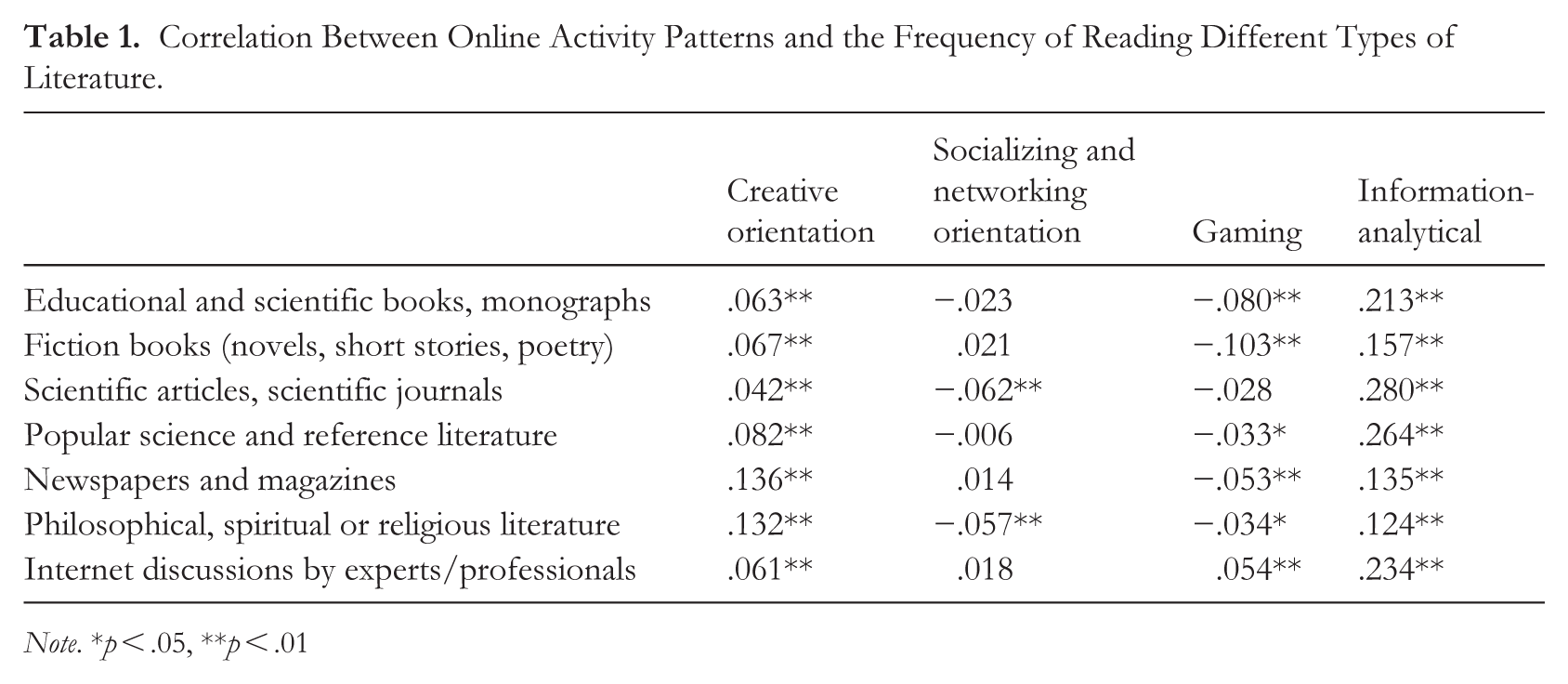
Young people with information-analytical activity orientation are cognitively active and focused on learning activities. There is a statistically significant correlation between this online activity pattern and the frequency of reading in all text categories. For these individuals, reading is a deeply engaging, immersive experience.
Young people with a creative orientation tend to read various literature. Reading different types of information allows them to be open to new ideas. The strongest correlations (Kendall’s tau-b) are observed between reading newspapers and magazines and philosophical, spiritual, or religious literature (see Table 1). The young people exhibiting this online activity pattern also tend to have immersive reading experiences such as deep engagement with the ideas contained in the texts and enjoying reading texts which are demanding.
Correlation Between Online Activity Patterns and the Frequency of Reading Different Types of Literature.
Note. *p < .05, **p < .01
The young people with socializing and networking orientation are less frequent and regular readers than the two above-mentioned groups. They tend to read fiction, newspapers, and magazines, as well as online discussions of professionals and experts. A negative correlation between reading scientific literature (r = −.062, p < .05) and philosophical, spiritual, or religious literature (r = −.057, p < .01). They do not enjoy reading demanding texts with a deep immersion in the content.
Since gamers spend countless hours immersed in the virtual world of gaming, they often have little time to read. Data suggest that gamers have more pronounced interests in entertainment activities. Within the subgroup of gamers, 74% spend more than three hours playing games, and 15% spend more than eight hours. They may be considered active participants in the entertainment gaming subculture (Jenkins, 2006). Gamers are less interested in knowing and learning activities and literary culture. Тhe strongest negative correlation has been identified between reading educational and scientific books, monographs (r = −.080, p < .01), and fiction books (novels, stories, poetry). Even though gamers hardly read any literature, they do engage in expert discussions on the internet (r = .054, p < .01). With a high presence of IT professionals among gamers, these discussions frequently extend to broader tech-related subjects, reflecting the interests of digital professionals in specialized, narrow fields.
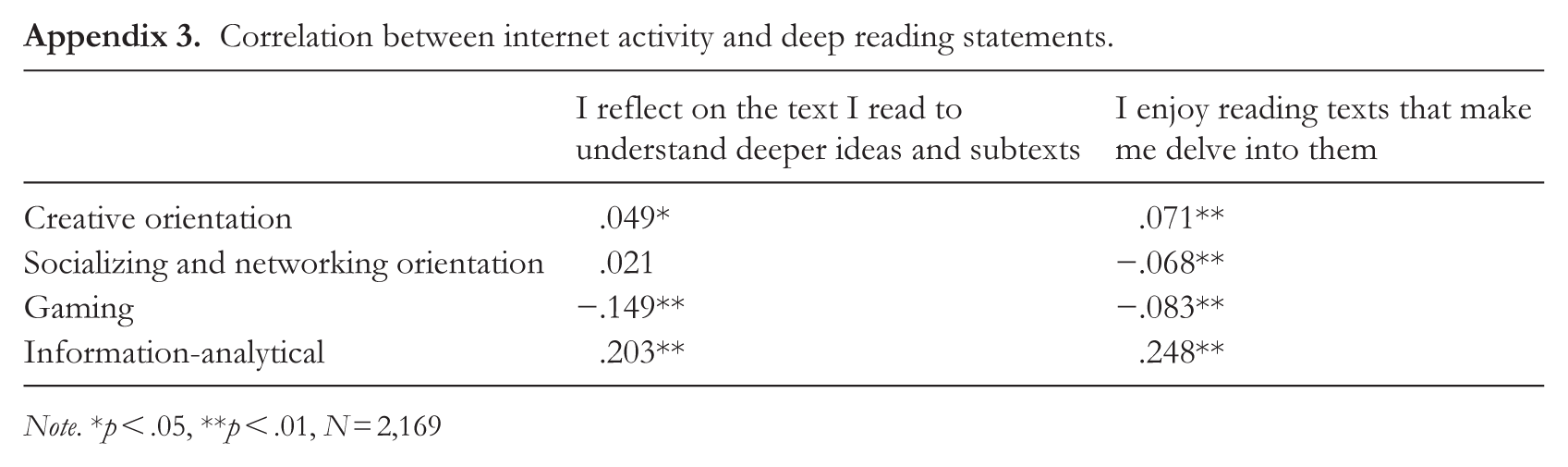
Among the groups of young people exhibiting different online activity patterns, the youth of the information-analytical activity profile have the strongest positive correlation with the statements characterizing deep engagement with the text: “I reflect on the text I read to understand deeper ideas and subtexts” and “I enjoy reading texts that make me delve into them” (Appendix 3). These two statements can be taken as expressions of perezhivanie, or Erlebnis, of deep reading engagement (see p. 4). It can be assumed that reading for young people with the information-analytical profile is a subjectively significant activity that occupies an important place in their lives. The young people with creative orientation have the next strongest correlation with the statements, attributable to perezhivanie in reading, especially with the statement “I enjoy reading texts that make me delve into them.” The perezhivanie of enjoyment while reading complex, demanding texts is an essential indicator which distinguishes reading for experience from reading for information (Levy, 2001). It denotes that reading for these individuals is a practice valuable for itself. However, young people with gaming as well as socializing and networking orientations do not seem to have deep personal experiences while reading. Gamers correlate negatively with both statements describing deep engagement with the text.
Youth’s Approaches to Reading and Their Metacognitive Assumptions
Analysis of the survey data discovered associations between youth’s approaches to reading (reading strategies) and their metacognitive assumptions about the use of the internet for learning. The factor analysis revealed four distinct groups of metacognitive orientations related to the learning process and the use of technology in cognitive activities. To explore these orientations, we designed questions that would help us understand students’ metacognitive assumptions, attitudes, and orientations, which would ground the students’ mode of their cognitive activity and interaction with digital technology. These metacognitive orientations, in our assumption, would then guide the actual cognitive activity of the students and their use of the internet. Additionally, we aimed to measure the extent of students’ reliance on the internet in their learning activities, particularly focusing on how much they are inclined to use the internet for cognitive offloading, taking into account the possibilities of the internet and digital technology for the searching, storing (using the internet as a kind of external memory), and classifying of information. The first factor, intellectual orientation, is associated with using the internet purposefully for learning, not forgetting the deeper meaning and purpose of learning, it is important to understand the essence of the subject, and the interconnections of things; they critically evaluate the information found on the internet. The second factor is collaboration/multitasking. These young people are oriented toward multitasking; they tend to divert themselves to other activities when learning, such as communication with classmates and visiting entertainment sites, but they appreciate cooperation with peers and consider that they can use the internet purposefully.
The third factor that was identified in the analysis is internet-reliant cognitive offloaders. They rely on the internet and think that nowadays it is most important to be able to quickly find information, that learning by heart is outdated and superfluous, and when necessary, one can find everything on the internet; the main purpose of learning is to be able to orient oneself in the large flow of information. The fourth factor is internet-distraction, which is characterized by one stark feature; namely, it is difficult for these young people to focus on the main activity when using the internet.
The concept of metacognition has evolved over time, with John Flavell and Ann Brown widely credited for establishing the modern terminology and conceptualization in the late 1970s (Moshman, 2018). Flavell (1976) defined metacognition as “the active monitoring and consequent regulation and orchestration” of cognitive activities “in the service of some concrete goal” (p. 232), such as learning. A critical precondition for effective metacognitive engagement is self-awareness—recognizing one’s habitual and stable preferences for specific learning and thinking strategies (Sadler-Smith, 2011).
As posited by numerous scholars, metacognition refers to the capacity to reflect on, evaluate, and control first-order cognitive processes such as decision-making, memory, and perception (Katyal & Fleming, 2024). It plays a pivotal role in cognitive processing and regulatory mechanisms, influencing how individuals approach complex tasks, including reading. One of the most important aspects of metacognitive regulation is reflection, which bridges cognitive and metacognitive processes. This is consistent with Vygotsky’s theory of psychological system development through reflection, which proposes that individuals establish novel psychological systems by altering and specifying the connections between functions such as thinking and memory. Through reflection, individuals can critically assess digital cultural influences, evaluating how digital tools affect their cognitive processes and learning strategies.
As Flavell (1979) emphasized, metacognition is pivotal in various cognitive activities, including reading. Research has demonstrated that metacognitive skills enable learners to monitor their progress as they read and adapt their strategies accordingly (Razı & Çubukçu, 2014). Proficient readers coordinate various cognitive and metacognitive processes to help them better understand the text. These processes include strategies such as summarizing, paraphrasing, generating questions and answering them, activating relevant background knowledge, and monitoring (Cromley & Azevedo, 2006; Razı & Çubukçu, 2014). The effectiveness of these strategies can be influenced by cognitive capacity. Linderholm and van den Broek found that readers with high working memory capacity are more likely to engage in reflective metacognitive practices, such as commenting on the text or drawing connections to prior knowledge. In contrast, readers with lower working memory capacity often rely on more straightforward strategies, such as repeating text. These findings underscore the critical role of metacognitive reflection in reading comprehension.
An additional layer to understanding metacognition in reading is the concept of cognitive offloading. This refers to using external aids—such as highlighting, note-taking, or digital tools (e.g., search functions or hyperlinks)—to reduce cognitive demand during reading tasks (Risko & Gilbert, 2016). Cognitive offloading can be double-edged: while it makes knowing an activity less effortful by employing external tools, excessive reliance on them may obstruct the process of deep learning, for example, by reducing deep engagement with the text. Previous research (Grinschgl et al., 2021) has shown that over-reliance on cognitive offloading has a negative impact on long-term memory. The findings suggest one has to be cautious with over-reliance on external tools, such as digital technologies, when learning.
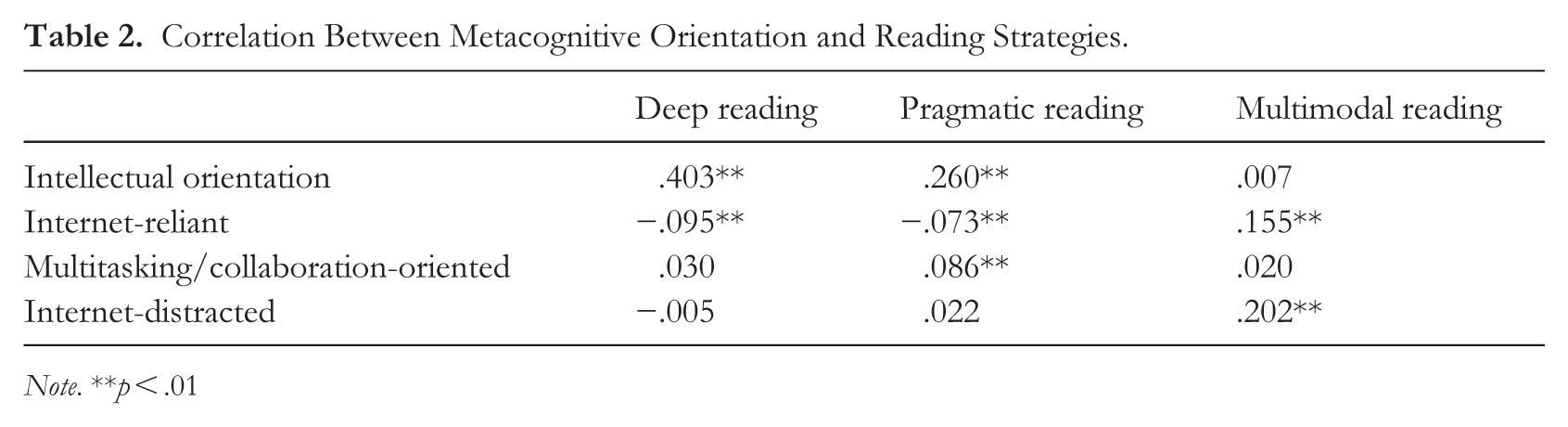
Using Spearman’s rank correlation coefficient, the study identified several significant correlations between internet use for learning purposes (as reflected in metacognitive statements) and dominant reading strategies (see Table 2). The study’s results demonstrate a positive correlation between young people with an intellectual orientation and deep reading (r = .403, p < .01). This suggests that individuals with an intellectual orientation tend to engage deeply with reading materials, demonstrating reflecting on content, revisiting previous sections, and summarizing information to enhance understanding. Additionally, the study found a positive correlation between the internet-reliants and multimodal reading (r = .155, p < .01). This shows that internet-reliant individuals may find it harder to understand text alone and often need visual aids like images or charts to assist them. Nevertheless, a statistically significant negative correlation is also observed with the first two reading dimensions: deep (r = −.095, p < .01) and pragmatic reading (r = −.073, p < .01). Multi-taskers and collaborative learners have been shown to correlate with pragmatic reading (summarizing, revisiting, etc.) (r = .260, p < .01). In contrast, multimodals (who cannot focus on their studies when using internet resources) correlate with difficulties in comprehending textual information. These individuals prefer visual information to textual information.
Correlation Between Metacognitive Orientation and Reading Strategies.
Note. **p < .01
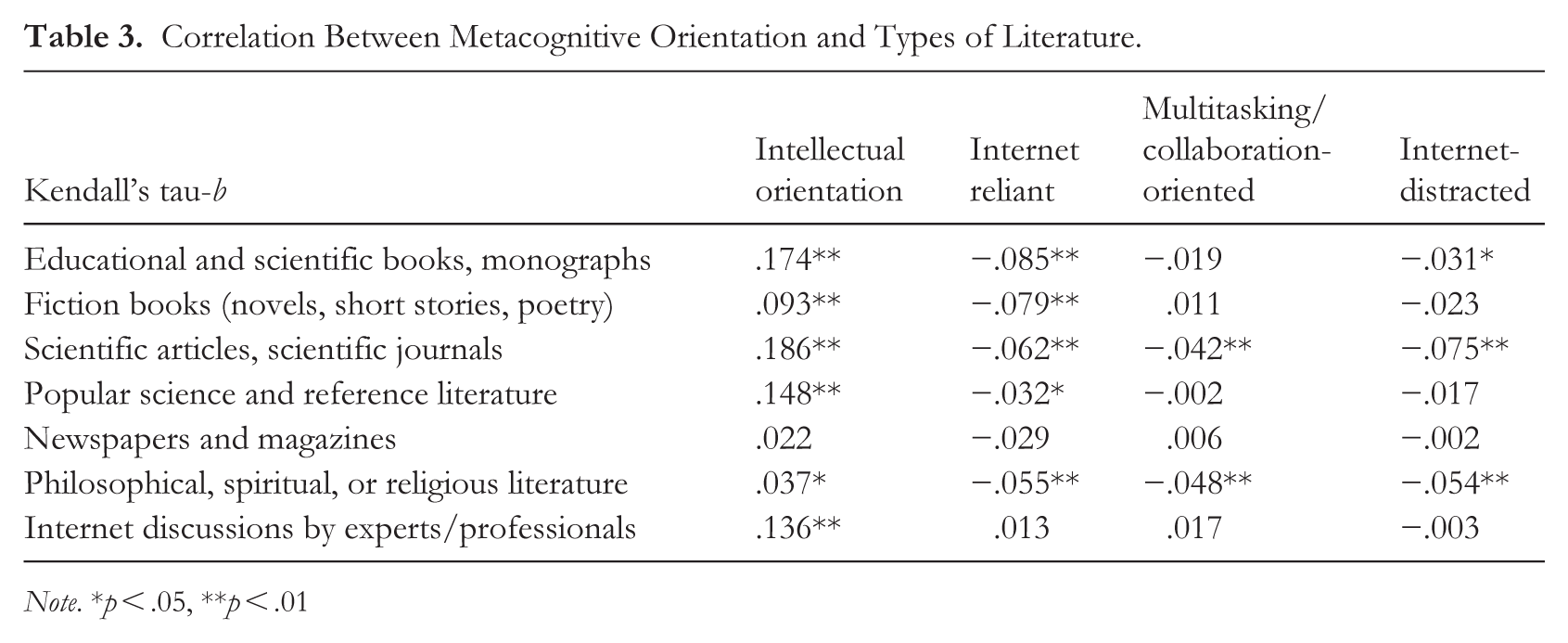
A significant relationship has been identified between cognitive orientations—specifically, attitudes toward using the internet for learning—and the frequency of reading different types of literature (see Table 3). Using Kendall’s rank correlation coefficient, the analysis reveals a positive correlation between an intellectual orientation and the frequency of reading various types of literature, including educational (r = .174, p < .01) and scientific articles (r = .186, p < .01), fiction (r = .093, p < .01), popular science (r = .148, p < .01), philosophical, spiritual, or religious literature (r = .037, p < .05), and professional discussions on the internet (r = .136, p < .01). In contrast, statistical analysis highlights a negative correlation between an internet-reliant orientation and the frequency of reading across various types of text. Statistical analysis indicates a negative correlation between internet-reliant orientation and the reading of various types of text. The analysis also shows a negative correlation between multitasking/collaborative learners and the reading of scientific and philosophical-religious literature. A similar correlation has also been observed between internet-distracted and frequency of reading. Similarly, those identified as internet-reliant cognitive offloaders—individuals who experience frequent distractions while using the internet—also exhibit a negative correlation with the various types of literature.
Correlation Between Metacognitive Orientation and Types of Literature.
Note. *p < .05, **p < .01
The analysis of metacognitive orientations and reading strategies reveals that intellectually oriented young individuals typically engage with a broad range of literature, except newspapers and non-scientific journals, which they tend to avoid. These readers frequently employ both deep and pragmatic reading strategies. A significant positive correlation exists between their reading preferences and reading scientific articles and journals (r = .186, p < .01), as well as educational and scientific books, including monographs (r = .174, p < .01). These findings suggest that metacognition not only shapes these individuals’ attitudes toward internet use but also significantly influences their reading behaviours and literary preferences. Intellectually oriented readers are more likely to seek out complex and thought-provoking texts that stimulate critical reflection and deep engagement.
Reading Strategies and Text Media
The research data enable us to establish interrelations between youth’s practiced approaches to reading and their preferred text media. In our survey, the youth were asked to indicate their preferred media for reading, such as printed books, e-books, or digital screens. We supposed that the media play a significant role in shaping the depth of reading engagement.
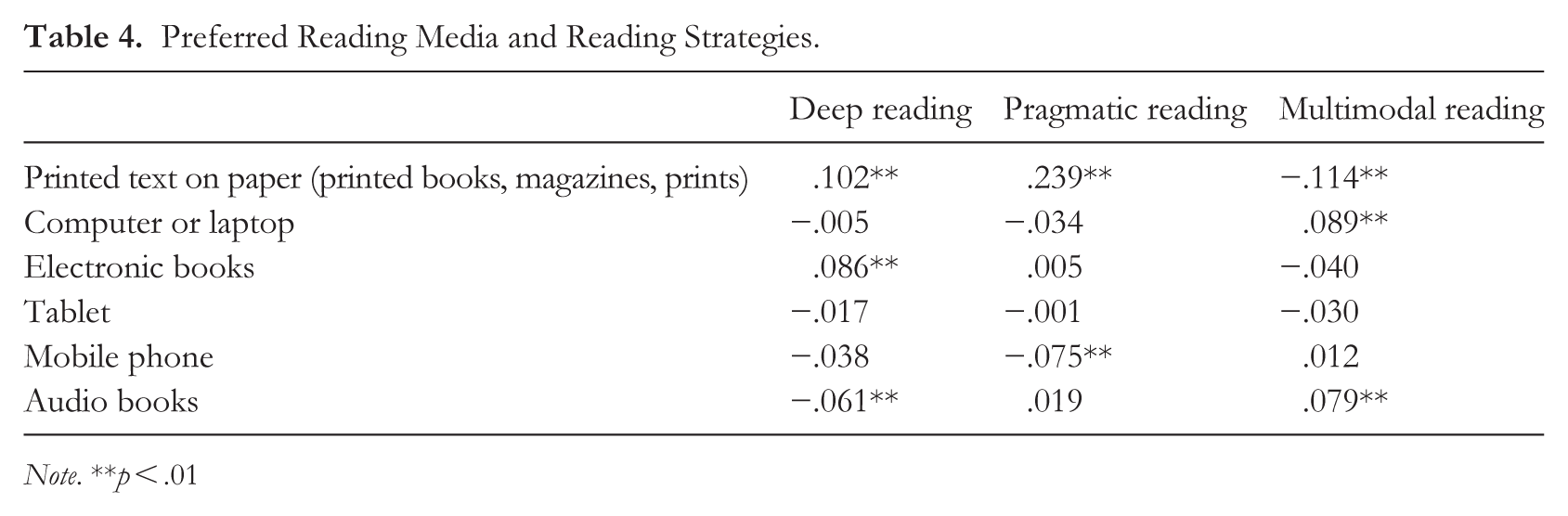
The study demonstrated a statistically significant correlation between deep reading and printed text, including books, magazines, and prints (r = .102, p < .01) (See Table 4). Furthermore, the findings of the study indicate a correlation between e-book reading and deep reading (r = .086, p < .01). The preference among young people for in-depth reading strategies, which emphasize the use of print and e-books, suggests that these formats may offer certain advantages in promoting concentration, fostering deeper engagement with the content, and facilitating reflection on the text. In contrast to other electronic devices, books do not include distracting elements such as hyperlinks, notifications, or multimedia content, allowing for a more focused and deep reading experience.
Preferred Reading Media and Reading Strategies.
Note. **p < .01
A positive correlation is observed between pragmatic reading and printed texts on paper, including printed books, magazines, and prints (r = .239, p < .01). In contrast, a negative correlation was observed with the use of computers and mobile phones. The research data suggest that pragmatic reading strategy is more closely related to printed texts. Printed texts create more favorable conditions for concentrated work with the text. The printed version is the most effective choice if a young reader’s goal is to examine the content.
A positive correlation was found between the multimodal strategy and reading on the computer (r = .089, p < ,01), and audiobook listening. However, a negative correlation has been observed between multimodal strategies and printed texts on paper, including printed books, magazines, and prints (r = −.114, p < .01). Multimodal reading strategies encompass reading from a computer screen or listening to audio, typically including images, videos, or audio elements. Generally, reading on paper is most associated with deep, focused reading, and less with multimodality. The experience of reading from screens is frequently described as less pleasant and less engaging than reading from paper (Clinton, 2019). Mobile phones are associated with shallower, less focused reading (r = −.075, p < .01), while audiobooks are more related to visual imagination (r = .079, p < .01).
A factor analysis was conducted to identify specific reading patterns based on the previously provided description of reading strategies. Cross-tabulations and calculations of adjusted standardized residuals were employed to characterize groups of young people with different reading habits according to socio-demographic characteristics.
The research data indicate that young people who demonstrate an informative-analytical orientation predominate in deep reading and prefer printed text on paper, and also using electronic media. The findings show a lack of engagement among young people who exhibit an interest in games and public communication and those inclined toward creative content production. Young people oriented toward socializing and networking tend to be pragmatic readers and prefer printed texts on paper. This group does not include those oriented toward games and public communication. It has been demonstrated that young people who are game-oriented, as well as internet-reliant and internet-distracted, mostly have difficulty with textual information without visualization and prefer electronic data and textual media.
These findings are in line with other studies that show that people who read on paper have significantly better deep-level comprehension than those who read on a computer. Additionally, people who read on tablets also demonstrate significantly stronger deep-level comprehension (Chen at al., 2014; Clinton, 2019).
Predicting Deep Reading: Regression Analysis
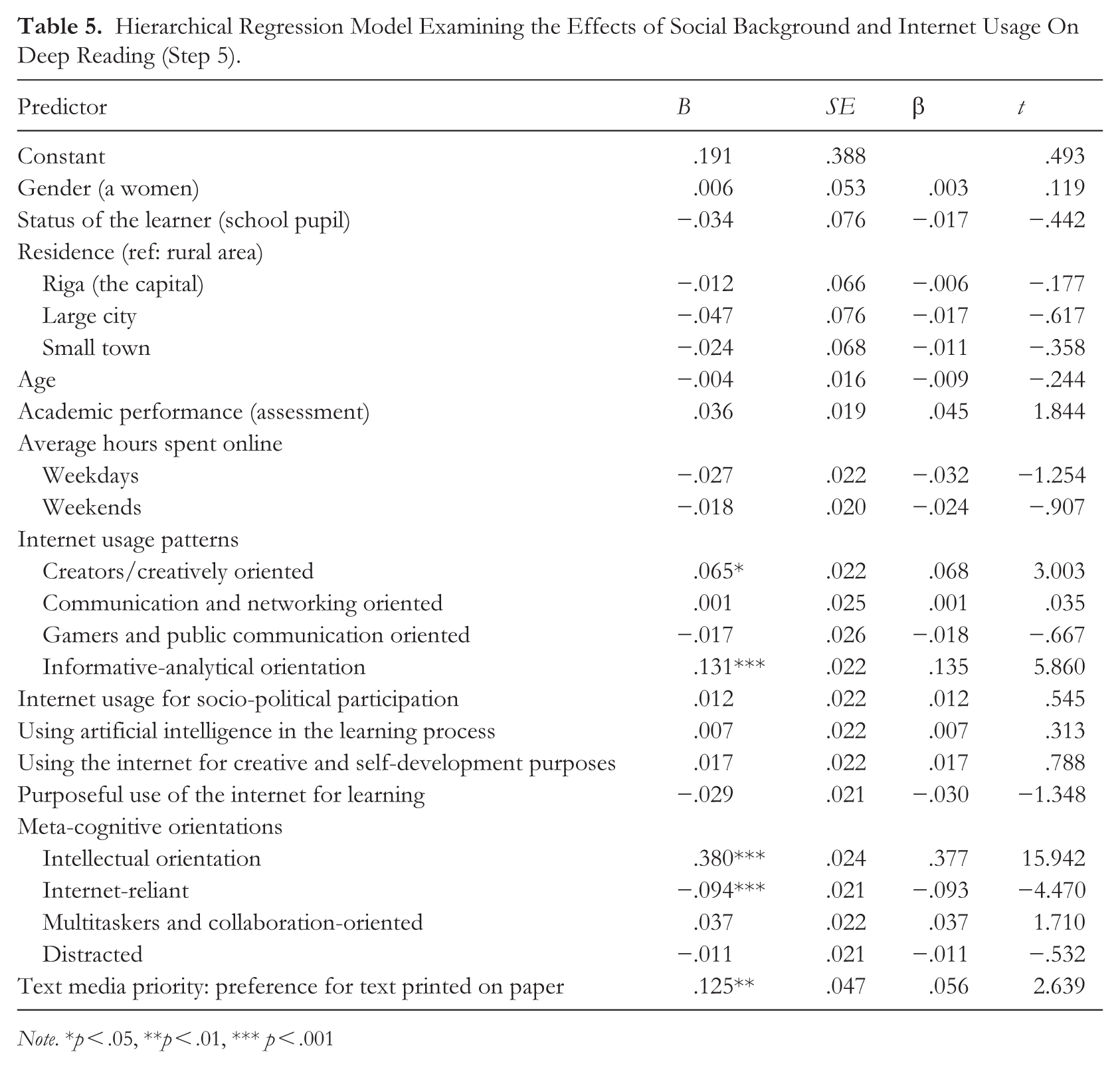
Because deep reading is an important precondition for successful learning and an integral part of a deep approach to learning, the authors set out to examine which factors and characteristics predict that the students would practice it. The relationship between deep reading (dependent variable) and social background characteristics, internet usage patterns, and meta-cognitive orientations (independent variables) was analyzed using hierarchical linear regression. In Model 5, the influence of gaming, socio-political participation, 3 online hours, and academic performance weakens, highlighting the stronger impact of metacognitive attitudes, printed-text preference, and internet usage patterns.
Metacognitive assumptions and internet activities are key predictors of deep reading, reflecting how the mindful use of digital tools shapes reading strategies. The intellectual orientation factor is the strongest positive predictor (B = .380, p < .001) in Model 5 (see Table 5), highlighting that a purposeful and intellectually oriented approach to internet use enhances deep reading. The strong effect size (β = .377) underscores the critical role of purposeful and focused cognitive attitudes. Conversely, the internet-reliant attitude is a significant negative predictor (B = −.094, p < .001), suggesting that over-reliance on the internet may hinder deep reading capabilities. The factors multitaskers-collaborators and internet-reliants do not predict deep reading.
Hierarchical Regression Model Examining the Effects of Social Background and Internet Usage On Deep Reading (Step 5).
Note. *p < .05, **p < .01, *** p < .001
Internet activities as a factor of leading activity show that the informational-analytical orientation emerges as a significant positive predictor of deep reading (B = .131, p < .001 in Model 5), emphasizing that individuals who use the internet for information-seeking and analytical purposes are more likely to engage in deep reading. Similarly, creatively oriented internet use is positively associated with deep reading (B = .065, p = .003), suggesting that engaging in creative online activities may slightly enhance deep reading. Gaming and public communication negatively predicted deep reading (in Model 3, losing significance in the final model), but communication and networking did not show a significant effect. The research data highlight intellectual orientation’s crucial role, reflecting these young people’s cognitive activity and interest in the learning process. In turn, those who are entertainment-orientated are less interested in cognitive activities; they are less interested in literature.
Demographics, including gender, age, residence type, and status as a school pupil, did not significantly influence deep reading. While high academic achievement was associated with deeper reading, and time spent online on weekdays had a negative effect, neither academic achievement nor internet usage showed a significant impact in the final model.
Turning to media preferences, data analysis shows a positive link between printed text preference and deep reading, suggesting that printed materials support deeper reading engagement and that physical books promote more focused and reflective reading. The study found that higher academic achievement relates to deeper reading, which means that more in-depth reading allows for greater understanding and comprehension of information. More hours spent online, especially on weekdays, seems to limit in-depth reading, since it creates distractions and leaves less time for focused engagement with the text.
Conclusion
The survey data collected in our research show that young people differ in their approaches to reading and the reading strategies they employ. Just as there are shallow and infrequent readers, there are young people with a deep approach to reading and reading much. It would be incorrect to argue that the digital-age technologies affect all young people in the same way. The major predictors for approaches to reading are students’ metacognitive orientations concerning the use of the internet in learning, dominant activities on the internet, as well as academic performance. Long hours on the internet negatively predict deep reading. A more intellectual and thoughtful approach to learning and meaningful use of the internet is the strongest predictor of a deeper approach to reading and a more frequent reading pattern. Greater reliance on the internet, practice of cognitive offloading, and lack of capacity to control one’s attention in the internet environment are associated with a more surface approach to reading. This finding highlights the cognitive self-control, reflexivity, and metacognitive steering of one’s mental processes for explaining approaches to learning and reading. It points out the role of agency in creating psychological systems that then guide the learning activity in a digital environment.
The internet activity patterns are also a significant factor in predicting approaches to reading. Online activity patterns are associated with the choice of types of literature and time spent on reading. The dominant activities on the internet can be interpreted as the indicator for the individual’s leading activity; therefore, the choice of the student’s reading strategies can be explained by the activity theory and the theory of psychosocial development in the tradition of cultural-historical psychology. The information-analytical activity pattern and online creativity are associated with deep reading, longer reading time, and more varied reading interests. Youth who exhibit these activity patterns tend to seek deeper meaning in the texts they read, reflect on the content, and enjoy the reading process. In contrast, socializing and networking, as well as gaming activity patterns, are linked to a less engaged approach to reading, shorter reading time, and narrower reading interests. There is a correlation between internet activity patterns and metacognitive orientations: the information-analytical activity pattern is associated with a more intellectual approach to learning and internet use; the gaming activity pattern is linked to cognitive reliance on the internet for learning; and the socializing and networking pattern is associated with multitasking, collaboration, and distraction.
The obtained data also show an association between deep reading strategies and a general preference for printed texts. This finding supports the reported experiences of some commentators and other research that reading of printed books favors deeper engagement with the text. Preference for reading on the printed media is associated with higher grades of the students. This may be interpreted as evidence that reading printed texts is conducive to a better understanding of the text. For this reason, more students with stronger motivation for learning prefer reading from paper. Alternatively, it may be interpreted as an indication that those students, who choose to read on electronic devices, fail to achieve deeper understanding and therefore are less successful academically.
Footnotes
Appendix
Correlation between internet activity and deep reading statements.
| I reflect on the text I read to understand deeper ideas and subtexts | I enjoy reading texts that make me delve into them | |
|---|---|---|
| Creative orientation | .049 * | .071 ** |
| Socializing and networking orientation | .021 | −.068 ** |
| Gaming | −.149 ** | −.083 ** |
| Information-analytical | .203 ** | .248 ** |
Note. *p < .05, **p < .01, N = 2,169