






Abstract
An essential dimension of Vygotsky’s work on imagination is summed up in the title “everything that can be imagined is real.” 1 In the three parts of this paper, it will be shown how this idea is increasingly deepened in Vygotsky’s texts. In his earliest writings, he demonstrates that imagination is made up of elements of the real and creates the real. Later on, he adds a new dimension: “crystallized imagination,” which enables one to grasp imagination as a cycle. To deepen the relationship between imagination and reality, it is necessary to articulate it with thought. As is shown in part two, a philosophical detour through Lenin reading Hegel in the Philosophical Notebooks enables Vygotsky to design a concept of concept based on imagination. Thought and imagination can thus be conceived as a contradictory unit—as shown in part three—reflecting reality in a zigzag relationship with the real, allowing the construction of the “mentally concrete” [geistig Konkretes].
“Man’s consciousness not only reflects the objective world, but creates it.” (Lenin, Philosophical Notebooks, p. 212)
Introduction
The question of the relationship between imagination and reality constitutes a central problem of Vygotsky’s conceptualization of imagination from the very beginning to the end of his meteoric career. To demonstrate this, let us cut, briefly, to Table 1 and Appendix 1.
Frequency of the Words “Reality” and “Real*” in Vygotsky’s Texts on Imagination (References in Appendix 1).
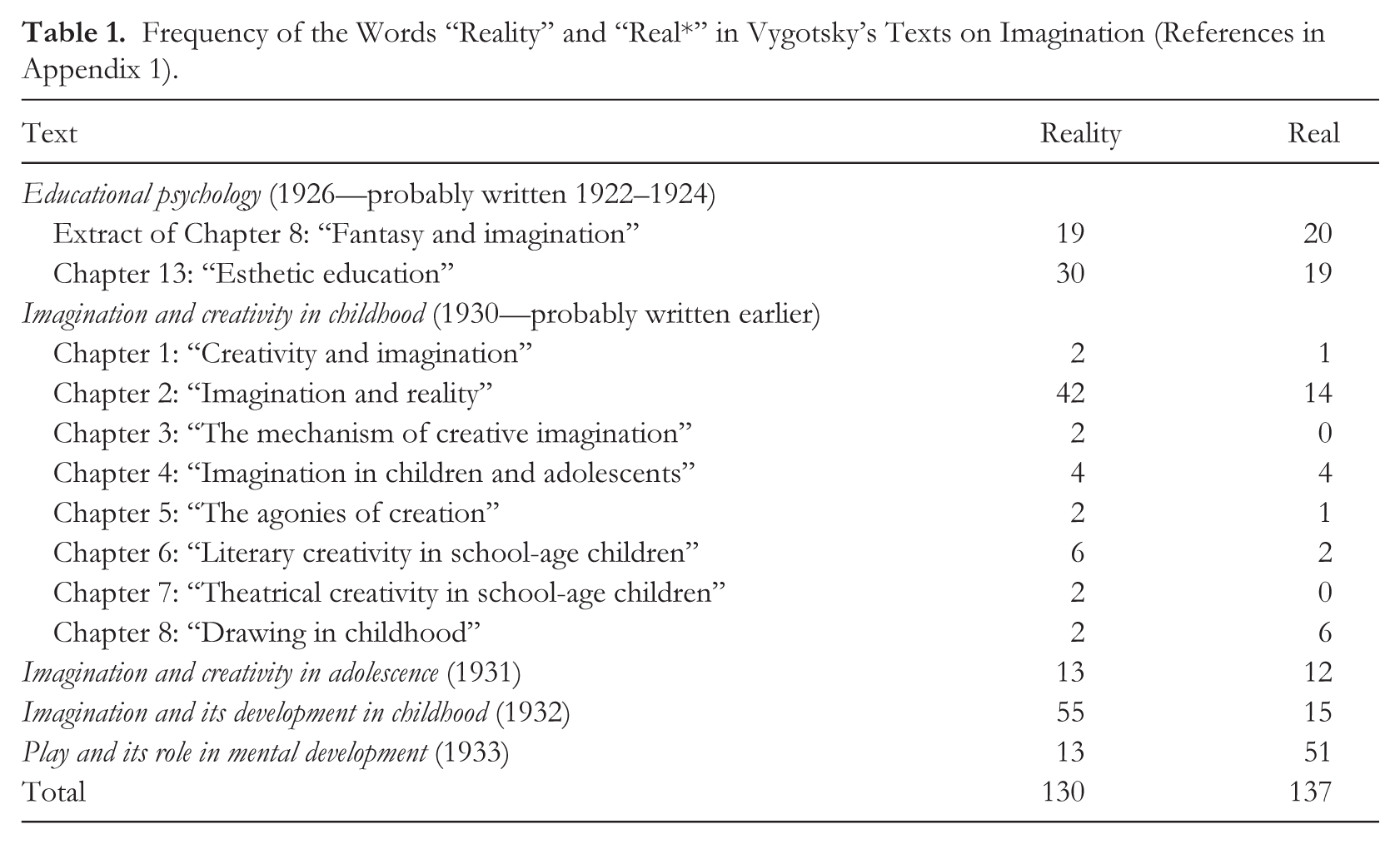
Table 1 shows the number of times the word “reality” and the morpheme “real” are used by Vygotsky in his texts on imagination. The first two (texts 1.1 and 1.22) appear in his Educational Psychology, published in 1926 but most probably written before the beginning of his academic career proper in 1924, when he was a teacher-educator in Gomel (Keiler, 2012). There is already a very clear conception of some aspects of the relationship between imagination/fantasy 3 and reality. Chapter 2, “Imagination and reality” in Imagination and Creativity in Childhood (text 2), belonging to the period of his instrumental model, 4 rests essentially on the same foundations, adding, however, the fundamental idea of a cycle.
Subsequently, as we will show, one can observe a radical change of conception, whose first formulation may be found in the chapter “Imagination and creative activity in the adolescent” (3), published in 1931. 5 We hypothesize that one of the factors that made this new approach possible was Vygotsky’s reading of Lenin’s Philosophical Notebooks. For this, we base ourselves on a most interesting note by Vygotsky on the relationship between concept and imagination (text 6.2), written in 1930. This reading allowed him to reinterpret his initial conception of imagination in a different way: the metaphor of the cycle no longer appeared and was replaced by the “zigzag” metaphor borrowed from Lenin. 6 This change took place in the context of a fundamental reconceptualization of child development in general and of adolescence in particular (see text 3). It was systematized in his discussion of other competing theories of imagination and in his conception of imagination as a psychological system (text 4) and of play as the source and origin of imagination (text 5).
On the basis of this first analysis of the ensemble of Vygotsky’s texts on imagination (see Appendix 1), this paper is divided into three parts: the first describes the initial conception of the relationship between imagination and reality; the second is devoted to the analysis of the transitional phase in Vygotsky’s work that, thanks to a new concept of concept, leads him to redefine the place of the imagination in relation to thinking; the third highlights how the new conception of imagination that had become possible in the transition phase fundamentally transforms, while preserving some essential aspects of the relationship between imagination and reality.
Part I: Imagination Is Reality—the Cycle Theory
Three Forms of Reality of the Imagination
The two texts on imagination taken from Educational Psychology represent the Vygotskian approach to imagination and fantasy before the development of his instrumental theory. In the excerpt “Fantasy and Imagination” (text 1.1), the theme of reality is at the heart. Indeed, Vygotsky defends three theses:
- The sources of imagination are real, namely real experiences (опыт, opyt) of people and the system of internal lived experiences (переживаний, pereživanij 7 ) (emotions and desires); in this sense, “reality” is the source of imagination.
- Imagination allows the construction of the absent real (cognitive function of imagination) and really acts on the emotion through the mechanism of sublimation which mobilizes the imagination. 8
- Education must aim at developing the imagination that builds reality and avoid the fantasy that flees it; imagination must be able to build the “great reality,” that of the social and cultural world to be transformed.
In the chapter on aesthetic education (text 1.2), the question of reality is discussed in relation to art, with imagination as a background. Vygotsky bases himself almost verbatim on passages from Psychology of Art, whose main theses are presented in summarized form. This chapter allows the reader to grasp aspects that will be discussed in more detail in chapters 6 to 8 of the booklet on Imagination and Creativity in Childhood (on literary writing, theater and drawing; text 2). From the point of view of the relationship between imagination and reality, the following points can be noted:
- Art is not reproduction of reality but the means by which a human being transcends life.
- In art, one can observe a certain erasure of the limits: even an imagined, “unreal” event creates real emotions; Vygotsky insists on the emotional reality of a fantasy.
- The function of the imagination is to combine elements of the real coming from unrealized emotions; we find here the theory of sublimation.
- Fantasy or imagination, like play, consists in the transformation of reality.
We see at once that Vygotsky is not at all interested in the “reality of the real,” so to speak. The “real,” and its “reality,” always appears, from its very inception, through the “real” or “lived experience” (opyt or pereživanij). It is thus not an ontological question.
Vygotsky’s Imagination and Creativity in Childhood (text 2) was edited and published in 1930 but most probably written earlier, perhaps even before the pivotal work History of the Development of Higher Mental Functions 9 (Vygotsky, 1928–1930/1987 10 ). Two chapters (3 and 4) are taken word for word from the book Pedology in School Age, published in 1928. 11 These chapters rely heavily on Ribot’s essay Creative Imagination (1900; already translated into Russian in 1901). It is, therefore, likely that it was the reading of this text that allowed Vygotsky to take a further step in his conception of imagination, and more precisely to formulate his idea of the cycle of imagination which is central throughout the whole booklet.
In Chapter 1, Vygotsky refers to Ribot from the beginning, asserting that the totality of culture is a product of imagination: “In this sense, absolutely everything around us that was created by the hand of the man, the entire world of human culture (. . .), all this is the product of human imagination and of creation based on this imagination.” (text 2, p. 9–10). And he refers to Ribot in a long quotation that ends with this sentence, essential for the whole book: “All the objects that we currently use in everyday life, even the simplest, the most common, are, so to speak, crystallized imagination.” 12
In Chapter 2, in which the question of imagination and reality is at the heart, Vygotsky deepens his first analyses and distinguishes four forms of relationship between imagination and reality. The first three reformulate, more systematically, the relations already presented in his chapter in Educational Psychology (text 1.1):
Any creation of the imagination is based on elements of reality or on compositions of elements of real or lived experience. Imagination is not opposed to reality and memory but based on them, both for artistic works and for great inventions.
Imagination allows the creation of new experiences through the experience of others, through their speech, their works, their descriptions.
In other words, in the first form of relationship, imagination is based on experience; in the second, experience is based on imagination.
Any creation of imagination is linked to real emotional elements of which it constitutes the trace, and conversely, any creation, however fictional, creates real feelings, widens them, deepens them.
The fourth relation is added and stems directly from Ribot:
2. Imagination is “crystallized,” embodied in artistic, scientific, and technical works.
The central contribution of this chapter from the point of view of the relationship between imagination and reality is the idea of a cycle through the concept of crystallized imagination. The first definitions, as we have seen, already contained the idea of imagination as coming from lived reality, the cognitive function of it and the close relationship with emotion, thus in fact from the first three forms described in text 1.2. The formulations change—for example, the theory of sublimation disappears completely—but there is nothing substantially new since his first formulations. What is new, however, is the insistence on the idea of “crystallization” of the imagination, clearly borrowed from Ribot (1900), and, beyond Ribot’s theory, that of a cycle, namely the feedback effect of the crystallized products of the imagination—be they technical products or artistic works, the latter rather linked to emotions—on the other relations between imagination and reality.
We can reformulate this through the dialectical figure of reversal. The beginning of the cycle is externalization: elements of the experience of reality, be they real or lived experiences, the latter being deeply rooted in the emotions, are externalized in various forms; they are “crystallized.” This can range from the theatrical scene imagined by children or the writings of teenagers to works of art, technical tools, and scientific concepts. These products of imagination, which are realized by creative activity, act back to the interior, are internalized, and in turn deeply transform the experience, broadening it, giving it a new meaning, and opening up new possibilities of imagination. The cycle of imagination is a perfect illustration of the functioning of the dialectic that Sève (2025) identified in Vygotsky’s thinking: “the reversal of the internal into the external, and its reciprocal, the internalization of the external.” (p. 63). And it is not, therefore, a simple cycle that it produces but a spiral. With this dialectical conception of the imagination, Vygotsky by and large transcends Ribot’s conception.
Vygotsky develops the idea of cycle in more detail in relation to the artistic imagination. Starting from his observation, in agreement with Ribot, that “feeling as well as thought drives human creativity” (text 2, p. 21), he asks the rhetorical question: “Indeed, why do we need works of art? Do they not influence our internal world, our thoughts, and feelings just as much as technical equipment influences the external world, the world of nature?” (pp. 21–22). He develops again the idea of the cycle which acts on the “people’s social consciousness” (p. 23), real effect as it were, where we see the resurgence, without reference, of the idea of art as “social technique of the feeling” (1925/1971, p. 244) discussed in his Psychology of Art.
This conception of the relationship between imagination and reality as a cycle constitutes one of the main threads of the second part of the book, from Chapter 5 onward (in text 2), oriented towards creative activity.
- In Chapter 5 of text 2, on “The Agonies of Creation,” the cycle is the key element of the analysis: “Every product of the imagination, stemming from reality, attempts to complete a full cycle and to be embodied in reality” (p. 41), with the effect that it “possesses a general significance that is reflected in all human behavior” (p. 42).
- In Chapter 6, on literary activity, it is the transformation of the relation to reality and thus the lived experiences which transform the modalities of the creative activity.
- In Chapter 7, on theatrical activity, the cycle of the imagination constitutes the starting point of the analysis: “Thus, the dramatic form expresses with greatest clarity the full cycle of imagination as described in the first chapter. Here the image that the imagination has created from real elements of reality is embodied and realized again in reality, albeit only the contingent reality of the stage; the drive for action, for embodiment, for realization that is present in the very process of imagination here finds complete fulfillment.” (p. 70)
- Finally, in Chapter 8, on the activity of drawing: “All art, by cultivating special methods for embodying its images, has its own special technology (. . .) Technology is a product of the same activity, crystallized imagination, to use Ribot’s phrase.” (p. 85, 87)
The starting point of the book Imagination and Creativity in childhood, crystallized imagination on one hand, the basis of the relationship between imagination and reality in the form of a cycle on the other hand, are, taken together, the basis of the thesis that imagination is reality. Ribot’s idea (1900) seems to have allowed Vygotsky to return to the problem of imagination, all the more so as another central theme, that of development of imagination, is also deeply inspired by the Essay on the Creative Imagination (see Moro & Zampieron, 2022). However, it should also be noted that there is hardly any junction between the conception of imagination and Vygotsky’s instrumental theory. Yet, in Vygotsky’s (1928/2020) Pedology of the School Age, the first chapter on child development and the analyses of memory and of the relationship between thought and language already clearly refer to the use of instruments—signs—as conditions of development. Why is this so?
Part II: Developing New Theoretical Tools
It is necessary here to leave the texts on imagination and to make some more general reflections on the development of Vygotsky’s thought. Chronologically, Imagination and Creativity in Childhood is contemporaneous to History of the Development of Higher Mental Functions. From our point of view, we wonder why, in this book discussing different psychological functions, there is no chapter on imagination, which has nevertheless been thematized on several occasions, as we have just seen.
A Moment of Transition in the Work of Vygotsky
When one tries to understand why this almost finished, well-evolved manuscript composed of 15 chapters was not published by the author, several reasons can be put forward which seem to indicate that Vygotsky needed to seriously develop new theoretical tools to progress in his work:
According to Vygotsky’s own admission, the book does not address the question of emotions which for him is absolutely central. He says that he does not have the necessary knowledge to do so (1928–1930/1987, p. 245).
As noted by Elkonin (2003) and Sève (2014), one is struck by the absence of a chapter on concept formation; both authors believe that this may be the main reason for the work’s non-publication.
As Elkonin further remarks, a theory of systemic relationships between psychological functions and of the transformation of these relationships in development is lacking.
As we have shown elsewhere (Schneuwly, 1999; see also Keiler, 2012), Vygotsky’s theory of development is still tendentially teleological, and takes little account of the individual’s own activity in constructing his or her personality.
Vygotsky thus finds himself at a crucial moment in his own development. He needs a more profound, non-teleological theory of development, a systemic conception of the development of functions, an elaborated theory of concept and its formation, to which one can add the difficulty of including the emotions or affects in an overall theory, but also imagination.
In order to find theoretical means, toward the end of 1930, he read Lenin’s Philosophical Notebooks, published in 1929. What could this bring him? He asks himself at this moment what a concept is. To answer this question, he notes: A philosophical discussion is inevitable when we investigate such a psychological problem as the problem of concepts. (. . .) And therefore it is necessary to trace the beginnings and the ends, the sources, and the continuations of the processes we investigated sub specie philosophiae.
13
And these beginnings and ends rest upon philosophy. Hence, the inevitable philosophical excursions.
As he wrote in his notes in 1930 (text 6.2 1, p. 134), and he adds “psychopathology.” But what are these Philosophical Notebooks? A brief digression is necessary to give elements of an answer to this question.
Digression: Lenin’s Bern Notebooks: A Change in the Conception of Dialectics
It is August 1914. The socialist leaders of the Second International have voted for war credits to allow Germany and France to pursue their respective imperial ambitions. At first, Lenin simply disbelieves it: such an act is impossible; he then denounces “the horrors of the treachery shown by the leaders of present-day socialism, the horrors of the collapse of the present-day International.” (Lenin, 1914/1974, p. 20). And what does he do from August to December 1914, following this political catastrophe, at first incredible and then horrible to him? Either out of a “simple will to return to the sources of the Marxist thought or lucid intuition that the methodological Achilles’ heel of the Marxism of the IInd International was the incomprehension of the dialectic” (Löwy, 1970, p. 259), Lenin undertakes a study of Hegel’s Science of Logic in the peaceful library of the University of Bern in Switzerland. From September 1914 to the beginning of 1915, Lenin copies out hundreds of pages of excerpts from Hegel’s book and other philosophical texts like Metaphysics by Aristotle, accompanying them with comments and reflections. These notes are then published in 1929 in the volume entitled Philosophical Notebooks. These Bern Notebooks 14 (Yibing, 2012) allow us to see Lenin at work, day by day, and to follow step by step how he systematically deepened his conception of dialectics and in particular the relationship between knowledge, practice, and reality. 15
The concept of concept itself at last allows Lenin to revise fundamentally his ancient conception of reflection, which he discusses at length in his notes on the chapter “Subjective logic and the theory of the concept” of Hegel’s Science of Logic. Here, we present only some points that are particularly important, in our view, to understand Vygotsky’s interest in Lenin’s notebook (we base our presentation on Yibing, 2012, and Kouvélakis, 2020).
For Lenin, it is central to overcome the classical vision of the dialectic as a method external to its object: The formation of (abstract) concepts and the operations made with them already includes idea, conviction, consciousness of the law-governed character of the objective connection of the world. (. . .) Consequently, Hegel is much more profound than Kant, and others, in tracing the reflection of the movement of the objective world in the movement of notions. (. . .) the first and simplest formation of concepts (judgments, syllogisms, etc.) already denotes man’s ever deeper cognition of the objective connection of the world. Here is where one should look for the true meaning, significance, and role of Hegel’s Logic. (1895–1915/1976, p. 178)
These concepts are not isolated, on the contrary. Answering the question “What constitutes dialectics?” Lenin writes: “mutual dependence of concepts, mutual dependence of all concepts without exception; transitions of concepts from one into another, transitions of all concepts without exception. The relativity of opposition between concepts (. . .) the identity of oppositions between concepts.” (p. 197) Concepts are the result of work, of human activity which constitutes the mediation towards the truth, knowledge of reality, and this includes the work of subjectivity. Lenin writes, still commenting on Hegel: Remarkable: Hegel comes to the “Idea” as the coincidence of the concept and the object, as truth, through the practical, purposive activity of man. A very close approach to the view that man by his practice proves the objective correctness of his ideas, concepts, knowledge, science. (p. 191) In other words: “The dialectics of things produce the dialectics of ideas” through human activity and labor. This leads to the epigraph at the beginning of the present paper: “Man’s consciousness not only reflects the objective world, but creates it.” (p. 212)
Vygotsky’s Notes on the Concept as Imagination
The note that Vygotsky devotes to the concept of concept in 1930, based on the reading of the Bern Notebooks, reveals a decisive breakthrough in the difficult question of the relationship between concept, imagination, and reality, and allows him to rethink development in a fundamentally new way through the role of the formation of concepts (text 6.2).
His starting point is an observation: in philosophy, concepts are either reduced to reflexes or to pure mind (Plato). We find here the fundamental criticism of psychology and its epistemological foundation that Vygotsky developed in his work on The Historical Meaning of the Crisis in Psychology (1927/1997), a crisis to which he gave a first draft of a solution through his cultural-historical theory and the instrumental approach. This solution, as we have just seen, proved insufficient.
In the first quotation he gives of Lenin—from his notes on Aristotle at the end of the Bern Notebooks—one can note, first of all, the idea that it is the very fact of generalizing and creating concepts that founds the possibility of idealism and religion. 16 This creation, however, is far from being simple. It is above all an “act,” the idea so deeply developed by idealism of the concept as a product of human activity. This “act” functions in zigzags and includes the possibility of “take-off,” 17 of the transformation of “the idea into imagination” which, in the last instance, says Lenin, is God, i.e., deeply idealist thinking. But Lenin immediately reverses the possible meaning of imagination by showing its necessity: even in the simplest idea there is necessarily imagination. And even more, and it is not by chance that Vygotsky highlights, by a circle, the following sentence which, in Lenin’s text, appears only in parentheses, thus stressing the other side of imagination: the possibility of take-off is the condition of construction of knowledge, even in the most rigorous science. Vygotsky finds here, in the production of concepts, the double nature of imagination: on the one hand, “sly teacher,” as Pascal claims, because it leads to illusions, and on the other, “precursor of reason,” as Goethe affirms (text 2, p. 37): not only “precursor,” Vygotsky answers, but the precondition of reason.
Vygotsky develops this line of thought, the concept as an activity of zigzag construction and product of the imagination, by demonstrating that it is a condition of freedom. For the concept, he uses the metaphor of the cell. 18 The concept frees humans of the visual field of which animals are slaves, he writes, referring to Köhler. 19 Vygotsky then poses an equation: “concepts = intellection of necessity = freedom.” In other words, between the concept which is the cell of freedom, he introduces a mediating element: “the intellection of necessity.” It is because the concept is intellection of the necessity that it “contains the whole freedom,” in “cellular” terms certainly. Let us recall that this formula of intellection, often quoted, is from Engels, who proposes it as a summary of Hegel’s reflections in his Encyclopedia, and that Lenin comments at length in this other work that Vygotsky knew well (he quotes it in particular on several occasions in The Historical Meaning of the Crisis in Psychology, 1927/1997), namely Materialism and Empiriocriticism (1908–1909/1972). In the rest of the note, he interprets idealism as a positive possibility of distance from life, of “taking off”—here he paraphrases Lenin—and, he adds, of “liberation.” The intellection is a lively activity, which approaches the thing and moves ceaselessly away from it, is incessant movement in a zigzag, possible approach and distance from reality, including moving into an elsewhere without return—Vygotsky will return to this in his very last note—and thus founds the “dialectic between necessity and freedom.”
The reference in this same note to Cassirer and psychopathology relates to the latter’s observations with aphasics, and Vygotsky quotes him several times to show concretely the role of the concept as a condition of freedom 20 : the absence of language, the absence of concept, deprives them of all the freedom to “take off,” to detach themselves from the immediately given situation: they are “slaves of their visual field,” to use Köhler’s expression quoted by Vygotsky. Along the same line of thought, Vygotsky then paraphrases the rational core of idealism. The latter, he writes, by insisting on the very fact of the possibility of detaching oneself from reality—an act of imagination—founds the possibility of liberation as intellection of necessity, a possibility theorized by Hegel, and before him, in a different manner, by Plato. Interpreting Lenin, Vygotsky can thus formulate his central idea: “In the simplest generalization, in the most elementary general idea, there is always a certain part of fantasy = freedom: in the concept, there is freedom.”
The idea is thus that idealism describes perfectly certain aspects of the construction of knowledge, this dimension that is the fantasy, the take-off from reality, necessary in the movement of the zigzag toward the object and away from it. As Pisarev says—whom Vygotsky quotes—fantasy contains in itself the possibility of taking off towards a whole elsewhere. And Vygotsky concludes: So: the idealists in the theory of concepts see in it a part of fantasy, just like Lenin. But their dream can take-off, away in a direction, etc. and Lenin understood the danger and the benefit of this piece of fantasy. What is it? Freedom included in the concept.
Part III: Imagination—a New Psychic System Necessary in Order to Detach from Reality
We could say that Vygotsky’s own “take-off,” i.e., the detour to approach the concept sub specie philosophiae through Lenin, allows him to conceive a new relationship between imagination and reality. We describe in the form of three theses the core of this new relationship between imagination and reality.
Thesis 1: Imagination as Condition for Reflecting About Reality Dynamically
The possibility of freedom has its origin at a very early age, as Vygotsky shows in his very long and penetrating analysis of Piaget’s (1926) book The Language and Thought of the Child.
21
Quoting Piaget’s conception of autistic thought which, according to this author “tends, not to establish truths, but to satisfy desires,” he retorts that “only empty abstractions devoid of any real content, only logical functions, metaphysical hypostases can be differentiated in this manner. The actual, vital process of the child’s thinking cannot” (1934/1987, p. 78). Then he quotes at length the extract where Lenin comments on Hegel concerning the primitive idealism that we already found in his notebooks (text 6.2). Referring to the end of this quotation from Lenin, “For even in the simplest generalization, in the most elementary general idea (‘table’ in general) there is a certain bit of fantasy,” (p. 133) Vygotsky interprets and widens the point in his critique of Piaget: One cannot more clearly or profoundly express the idea that—in the process of their development—imagination and thinking are opposites, whose unity is inherent in the very first generalization, in the very first concept that people form. This remark on the unity of opposites and their bifurcation, on the zigzagging development of thinking and fantasy, implies that any generalization is, on the one hand, a take-off from life but, on the other, a more profound and accurate reflection of life, [and that in every general concept there is a certain amount of imagination]. (1934/1997, p. 78; modified translation; the last part of the quotation in brackets is not translated in the English text)
Like Lenin, Vygotsky takes up the idea of reflection, but in a new sense in which the dialectic between thought and imagination intervenes, an incessant movement of going back and forth between the real and its reflection to which thought and imagination contribute in a contrary way: “unity of opposites.”
22
Imagination is mediated by thought, which connects it “to life itself,” to reality, just as conversely thought is mediated by imagination, present in the most elementary and simple concept. This same idea is formulated in another way, more “audaciously,” in text 4: Moreover, by observing the forms of imagination that are linked with creativity, that is, the forms of imagination that are directed toward reality, we find that the boundary between realistic thinking and imagination is erased. Imagination is a necessary, integral aspect of realistic thinking. (p. 349)
Thesis 2: Imagination Creates the New Concrete—Another Way of Thinking About the Cycle
Vygotsky borrows this idea of imagination creating a new concrete from Marx. It is another way of describing the functioning of the imagination in adolescence, in connection with conceptual thinking. It has to do with the new way of grasping the real: It is characteristic for imagination that it does not stop at this point, that for it, the abstract is only an intermediate link, only a stage on the path of development, only a pass in the process of its movement to the concrete. From our point of view, imagination is a transforming, creative activity directed from the concrete toward a new concrete. The movement itself from a given concrete toward a conceived concrete, the feasibility of creative construction is possible only with the help of abstraction. Thus, the abstract enters as a requisite constituent into the activity of imagination, but is not the center of this activity. The movement from the concrete through the abstract to the construction of a new concrete image is the path that imagination describes during the transitional age. (text 3, p. 163)
This abstraction—we have seen it at work in the new perception of reality—is only the starting point of the imagination articulated to conceptual thinking. It allows going beyond, towards a new product of the imagination. This is a reference to Marx’s Introduction to A Contribution to the Critique of Political Economy (1857–1858/1976), which Vygotsky read intensively
23
: The concrete is concrete because it is the summing up of many determinations, thus the unity of the manifold. (. . .) The method of ascending from the abstract to the concrete is simply the way in which thought appropriates the concrete, reproduces it as a concrete in the mind [als geistig Konkretes; this could be translated to “as a mentally concrete”]” (pp. 31–32).
Is not the “mentally concrete” here the real, reflected in thought, in the new sense that Lenin gave it?
Thesis 3: The Contradictory Unity of Imagination and Thought Is the Condition of Freedom
All in all, Vygotsky asserts that imagination cannot be considered as a mental function among others but as a system whose heart lies in the complex articulation between thought and imagination that we have just described through the importance of the concept.
The analysis of the varied forms of imagination and thinking demonstrates that it is only by approaching these forms of activity as systems that we can begin to describe the very important changes that occur in them that we can begin to describe the dependencies and connections that are manifested in them. (text 4, like all the quotations that follow; p. 348)
This would not lead to confusing the two: they are different, contradictory even, and it is precisely this contradiction that is the motor, as we have said, of the possibility of reflection of reality and of creative activity. Imagination and thinking function as a whole, as a unity. Vygotsky expresses it in words borrowed from Lenin: “No accurate knowledge of reality is possible without a part of imagination, without a certain take-off [sic!] from the diverse, immediate, concrete impressions by which we initially represent reality through elementary acts of our consciousness.” (p. 349; modified translation). Both are linked to language; both are directed by oriented processes: “Concerning the imagination, its characteristic does not lie in a closer link with the emotional aspects, nor in a lesser degree of consciousness, nor in a greater relationship to the concrete.”
24
But they are different, opposites even. In what does the specificity of the imagination consist? What is its contribution to the reflection and construction of reality? The essential feature of imagination is that consciousness departs from reality. Imagination is a comparatively autonomous activity of consciousness in which there is a departure from any immediate cognition of reality. (. . .) A more profound penetration of reality demands that consciousness attains a freer relationship to the elements of that reality, that consciousness departs from the external and apparent aspect of reality that is given directly in perception. (p. 349)
Here we find a clear echo of Lenin’s “zigzag.” And Vygotsky arrives logically at the question we have already encountered above: that of the human freedom contained in every concept that always presupposes imagination; that which he approached through the loss of freedom in the patients observed by Cassirer. He thus arrives at the following conclusion concerning the relationship imagination allows to be established with reality: “The potential for free action that we find associated with the emergence of human consciousness is closely connected with imagination, with the unique attitude of consciousness vis a vis reality that becomes possible thanks to imagination.” (p. 349; translation modified)
The central role of the concept that appears in the contradictory unity of imagination and thought is further expanded later in the notes concerning emotion and his reflection on Spinoza. It opens up still other perspectives: “The concept of affect 25 is an active condition and it is freedom. Freedom: the affect in the concept. (. . .) The grandiose picture of personality development: the path to freedom. To revive Spinozism in Marxist psychology.” (Vygotsky, 1931–1933/2018, p. 209).
Conclusion
“Everything that can be imagined is real.” We can read Vygotsky’s texts concerning imagination as a continual clarification and precision of this thesis: imagination as a condition for the reflection and construction of reality. At first, Vygotsky conceives it as a cycle, in continuity with Ribot, in a relatively mechanical way, the fusion between thought and imagination being postulated but the cycle being conceived of only from the point of view of the imagination, in a non-dialectical way. The limits of this approach appear in the context of a fundamental revision of the instrumental approach that requires the integration of the semiotic tool as an integral part of the psychic functions, which at the same time implies thinking of them as systems. To accomplish this fundamental change in his approach, Vygotsky makes a detour through philosophy and the theory of concepts, through Lenin’s reading of Hegel. Armed with a richer conception of dialectics and a theory of the concept, Vygotsky can theorize imagination in a new way as an essential element in the reflection and construction of reality, thus echoing another remark of Lenin’s reading of Hegel: “Man’s consciousness not only reflects the objective world, but creates it.” (1895–1915/1976, p. 212)
Coda
In the very last note of his life, Vygotsky returns once again to the zigzag and to the relation to reality, again with reference to Lenin (see text 6.326). After a very detailed anamnesis of two of his patients, K and Z, he describes the behavior of the first one as activity without meaningful action, since concepts are absent, and the behavior of the second as fantasy without activity, unreal thinking, and thus revealing take-off into spheres beyond reality. And he interprets these two opposite clinical images by referring one last time to “Lenin’s philosophical analysis” and his image of the zigzag: “In K., the piece of fantasy is damaged (the first sharp bend of the zigzag); in Z., it is hypertrophied (there is no second bend—[the analogy in Lenin] idealism, religion).” (p. 497) The philosophical detour through Lenin reading Hegel is found in the last note of his life: another indication of the importance of this reading.
Footnotes
Appendix 1: Vygotsky’s Texts on Imagination
List of texts to which the present paper refers, published in French: Vygotsky, 1926–1934/2022; and in Portuguese: Vygotsky, 1926–1934/2025.