






Abstract
The article attempts to reconstruct the roots and the development of the mediacy model as the core of cultural-historical psychology. The author believes that this model can be used as a basic explanatory model, helping to more accurately and concretely understand and describe the changes experienced by humans (especially children and adolescents during ontogenesis) in the context of the emerging hybrid socio-digital reality. The author demonstrates how Vygotsky understood the mediacy model and the key role of the so-called psychological tools in it. A distinction is introduced between the concepts of mediation and mediacy based on the principle of the directionality of action. The article shows that for some reason, many researchers tend to lose sight of this distinction and focus only on interaction between an individual and the external environment. The point is that according to Vygotsky, the act of development is accomplished precisely through the subject mastering one’s behavior by means of a psychological tool. Thus, the concepts of mediacy and mastery are interdetermined and interconnected in a single act.
The central fact of our psychology is
the fact of mediation.
The Birth of the Method
The zeal for thought and action of Vygotsky, the founder of the cultural-historical approach, was not simply to construct a new concept of human development and achieve the desired “ingrowth of man (child) into culture” but to “elevate, initially natural and biological, weak and unequipped man above himself, above his reactive nature, above his biological heritage, without denying the latter, but utilizing its resources and potential.”
It then becomes clear why from the outset of his search for a basic model, in his works devoted to the instrumental method, Vygotsky was so preoccupied with the idea of humans mastering their behavior. 1 His task was to develop an explanatory model that would reveal, substantively explain and demonstrate the mystery of the development of higher human abilities, its entire eventfulness.
Vygotsky did not have such a model yet but relied on the stimulus–response (S–R) pattern, which has dominated psychology in the world to date. All human behavior (specifically behavior, not activity) was understandably explained as a bundle of behavioral reactions. Therefore, as Vygotsky notes, all psychological functions and forms of human behavior were studied in terms of natural processes, not as forms of cultural development (Vygotsky, 1983), 2 and the higher forms remained out of sight. More precisely, they were also thought of as natural processes. The natural and the cultural were generally confused and indistinguishable. The human in a human was not visible, being represented by the same bundle of reactions as any other living being.
That said, there was no shortage of experimental material. The deficit was intellectual and methodological. Thus, drawing on the already rich research base of world psychology, Vygotsky searched for a line of thought that would lead him to an adequate understanding of the essence and meaning of the development of the higher forms of human psyche.
Reviewing various materials throughout that search, Vygotsky mentions the Kaffir’s dream, Pierre Bezukhov’s lot, a knot in a handkerchief, and notches on a stick. Discussing in the customary manner the basic model of explaining human behavior under the stimulus–response scheme, he gives these rudimentary examples on the basis of which a person makes decisions.
He cites Lévy-Bruhl: experiencing difficulties in decision-making, a native would simply say “I’ll dream about it” or roll the dice (Vygotsky, 1983, p. 68).
Vygotsky also refers to the historical anecdote about Buridan’s ass, who is influenced by two stimuli with equal force. The ass is unable to make a decision and therefore cannot respond to either one. An individual in such a situation rolls the dice. Where is the decision here? At first glance, Vygotsky acknowledges, humans also act reactively, following the same stimulus–response pattern. Nevertheless, it isn’t entirely true. Humans introduce an artificial, auxiliary stimulus into the pattern. Indeed, animals do not cast lots. It seems humans do not make decisions themselves, trusting in the blind force of the lot. Yet, they introduce an auxiliary means that doesn’t exist in nature. They introduce a stimulus–means that helps them make a decision. Thus, they perform a mediated action. The human-created stimulus determines their reaction (Vygotsky, 1983).
The S–R pattern can also explain, indeed, how humans make decisions by casting lots. Humans, however, introduce an auxiliary means by constructing a new situation. This is a simple example of consciously constructing a situation. Casting lots, compared to the “Buridan’s ass” situation, creates a new situation: “. . . what’s new here is that a man himself creates the stimuli that determine his reactions and uses these stimuli as means for mastering his own behavioral processes. It’s a man who determines his own behavior with the help of artificially created stimuli-means” (Vygotsky, 1983, p. 72).
Notching for memory is another example taken from Lévy-Bruhl. A missionary asks a native to recount what the latter remembered from a sermon. The Kaffir initially hesitates, then repeats the sermon, all its main points, almost word for word. It turned out that the Kaffir made notches on a stick in the course of the sermon. Guided by his notches, he is able to reproduce the speech he heard. He associated the notches with the content of the speech and organized his memory with the use of them. He controlled the process of memorization (Vygotsky, 1983).
In analyzing these and many other examples, a key connection emerges: mediation–mastery.
Thus, Vygotsky introduces the idea of self-stimulation. Passive, reactive behavior is stimulated under the stimulus–response pattern. This pattern introduces a complete representation and complete determinability of behavior by external stimulation.
For another, cultural form, the “self-stimulation” pattern is introduced, under which individuals introduce artificial stimuli-means and use them to organize their behavior (Vygotsky, 1983, p. 78). The idea of mediation emerges for the first time, becoming the core of the explanatory model.
Before going further, let us differentiate between the concepts of mediation and mediacy.
Mediation and Mediacy
Both words are found in the works of various authors. For L. S. Vygotsky, mediation was dominant. It was more of a search word and a reference point rather than a concept or a term. The context of its usage shows, however, that it concerns mediacy since the theme of behavioral mastery is present. What is the difference between the two?
Mediation (опосредование [oposredovanie] in Russian) emphasizes the relationship between an individual and the environment, humans mastering external artifacts to build relationships with the external environment. The external, object- and tool-based aspect is emphasized here. In fact, it refers to labor activity.
Mediacy (опосредствование [oposredstvovaniye] in Russian) highlights the relationship of individuals to themselves through the means they master, and by applying which they master their behavior. It highlights the means as a psychological tool, the motivational-and-attitudinal aspect, the relationship towards oneself, and a reflexive plan of action. 3
Vygotsky sees the essential difference in the directionality. A tool serves as a conductor for influencing an object of its activity; it is directed outwards. It causes changes in the object, being a means of external human activity aimed at conquering an external object (the nature). A “sign, on the other hand, is a means of psychologically influencing human behavior—one’s own or others—a means of internal activity aimed at mastering an individual himself; a sign is directed inwards” (Vygotsky, 1983, p. 90).
These two words were initially semantically related. Then they were separated. Authors do not always take it into account. They write about a particular context, while applying the other (Figure 1).
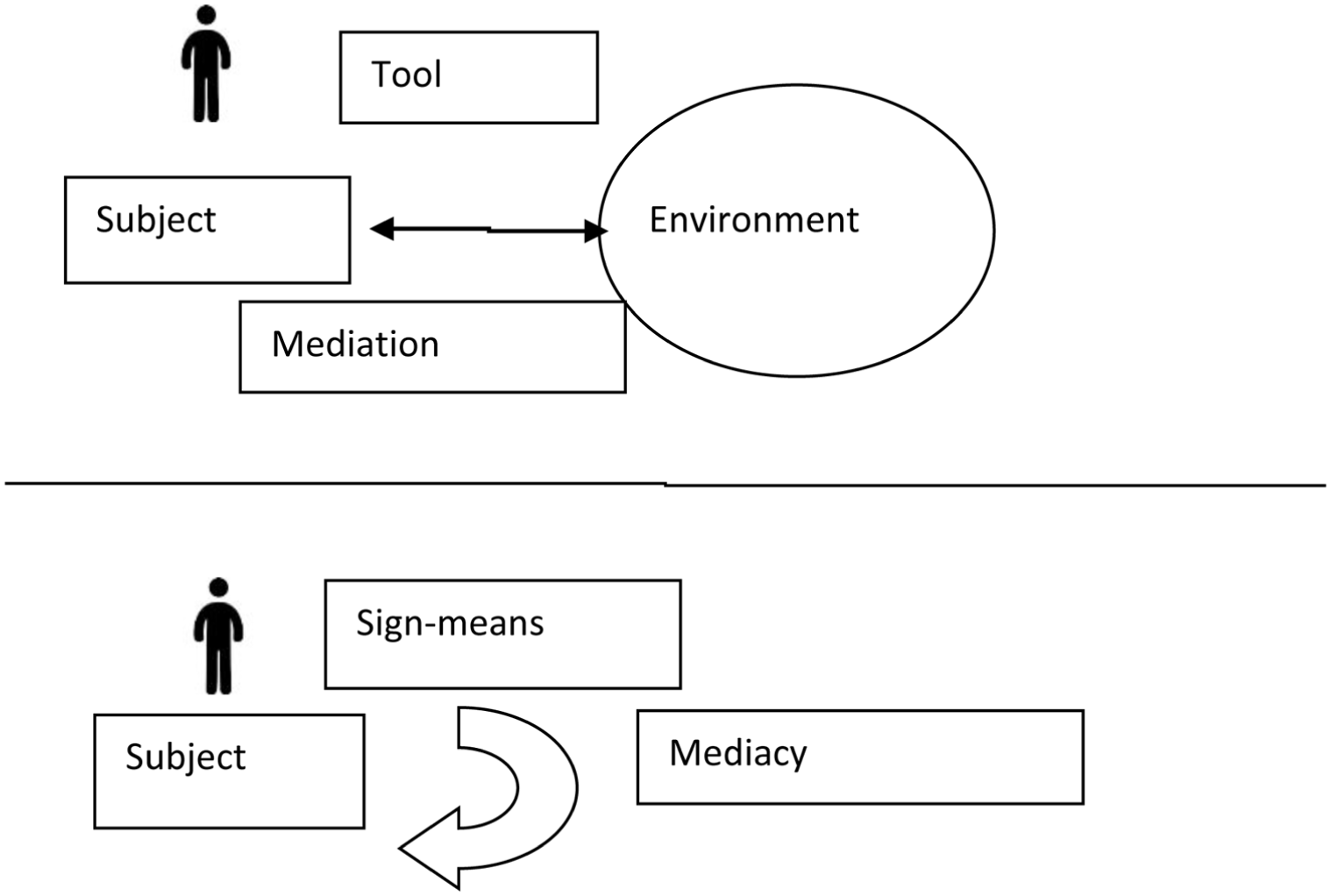
Mediation and mediacy.
Actually, this essential distinction is lost in the English-language literature, dominated by a single word: mediation. The reason why this distinction has practically disappeared from the English-language texts is that many Western authors are interested in the first type of mediation: man–world, man–environment (and further, by analogy: man–text, man–man)—that is, the internal-external framing. The key problem for Vygotsky, who developed the basic model, was the problem of human behavior control through the introduction of an auxiliary artificial sign-tool-intermediary.
Vygotsky introduces the principle of mediacy not only to illustrate the phenomenon of human development in ontogenesis but also to demonstrate the interweaving of the natural and the cultural in human development, to build a connection between them. Mediacy becomes the main link between them. Then the child’s “ingrowth into culture” is clearly described through mediacy practices. That is why the phenomenon of cultural development, in its genesis, has not been studied, notes Vygotsky. The history of the development of higher psychological functions has not yet been written.
Initially, Vygotsky termed the introduced artificial stimulus a sign, defining it as follows: “We term artificial stimuli-means, that are introduced by a man into a psychological situation and perform the function of self-stimulation, ‘signs’, giving this term a broader and at the same time more precise meaning than in ordinary usage. According to our definition, any conditioned stimulus, artificially created by a man, which is a means of mastering behavior—either someone else’s or one’s own—is a sign” (Vygotsky, 1983, p. 78).
If the idea of control, organization and mastery is introduced, then sooner or later Vygotsky is bound to arrive at the connection: sign as tool. And he writes exactly: “The invention and use of signs as auxiliary means in solving any psychological problem facing a person (remembering, comparing, communicating, choosing, etc.), from a psychological perspective, presents, at one point, an analogy with the invention and use of tools” (Vygotsky, 1983, p. 87).
Still, this is too metaphoric, with too many direct analogies and comparisons. The main point, however, is that such artificial means 4 act as a foothold, providing support and assistance in carrying out an action. What does this support consist of? What does it even mean to be an aid of thinking or memory? (Vygotsky, 1983). After all, if we take this literally, notes Vygotsky, the meaning dissolves. For example, technology belongs partly to psychology, but not entirely: “Tools as instruments of labor, means of mastering natural processes, and language as a means of communication and connection are dissolved in the general concept of artifacts or artificial devices” (Vygotsky, 1983, p. 88). 5
Here, the idea of mediacy/mediatization per se appears in various forms, graphically expressed in the triangle diagram: the basis of the analogy between a sign and a tool is the mediating function that belongs to both (Vygotsky, 1983). Vygotsky did not invent ideas and models, he searched for them, selecting analogies and scientific metaphors. Through tools, man influences nature, while through signs man influences his own and others’ behavior. Humans master behavior, their natural processes, reactions and passions with the help of a sign-tool, an auxiliary means, influencing themselves, thereby mediating their own behavior, without directly reacting to an external stimulus. Hence, one of the fundamental differences between natural, native (animal) behavior and human, cultural action is introduced: direct reaction vs mediated action.
Taking the analogy of labor activity, where a person influences an object through a tool, Vygotsky changes the focus and moves to the idea of a psychological tool-sign, through which humans influence themselves, their behavior, in order to manage and organize it, thereby mastering themselves and their reactions. Vygotsky still argues in the tool-based logic, superimposing the concept of labor activity on the psychology of behavior.
Such mediacy alters the structure of sign operation profoundly. Rather than a direct, immediate (reactive) stimulus–response connection, an indirect connection through auxiliary means-stimuli is established (Vygotsky, 1983).
For Vygotsky, this is the main feature of the phenomenon of cultural development (Vygotsky, 1983). An intermediate sign-mediator is introduced, and the entire operation assumes the character of an act of mediacy (Vygotsky, 1983).
Further on we see the main point: the introduction of the sign-mediator, its use and application are carried out to organize behavior and the entire process of mastering one’s own behavior: “We could not better describe the new meaning of the entire operation than by saying that it represents the mastery over one’s own behavioral process” (Vygotsky, 1983, p. 118). A man “subordinates the processes of his own behavior to his own control with the help of signs” (Vygotsky, 1983, p. 118).
A basic pattern emerges: mastering reactions with the help of signs and constructing higher forms of the psyche. Vygotsky concludes: “Psychological processes are the processes of mastering our own reactions by various means” (Vygotsky, 1983, p. 273).
Vygotsky believes that human behavior is interwoven with the inherent laws of nature, the most fundamental of which is the stimulus–response pattern. Therefore, the fundamental law of mastering natural processes is mastering them through stimuli. The act of mastery is understood in the same categories of the behavioral pattern. So far, Vygotsky reasons in terms of stimuli and responses. Accordingly, he describes the act of mastery in these same categories. His goal was to go beyond spiritualism and idealism, to ground psychology on a material foundation, on the one hand, and, on the other, to step forth from naturalism into culture, to describe the act of mastery.
That is why he depicts mastery as the mastery of reactions, introducing an artificial stimulus, a new stimulus, but still a stimulus.
Vygotsky does not yet derive free human action from within but rather from the fact that a man creates a new situation in one’s own behavior, a new, artificial stimulus, and thereby breaks out of a deadlock, when a man is equally influenced by stimuli that hinder his actions. A man changes the environment through external activity and thereby influences his own behavior, subordinating it to his control (Vygotsky, 1983).
At that point, Vygotsky does not go beyond the stimulus–reaction model, introducing an intermediate link into it and following the same logical pattern. After all, higher forms of the psyche, such as will, free action and thinking, do not magically appear. They are of the same nature, Vygotsky believes. Only a human constructs free action from artificial, own stimuli, essentially creating a kind of artificial “functional apparatus” of behavior (Vygotsky, 1983, p. 282).
Ultimately, Vygotsky makes his first generalization in “The Instrumental Method”: “Human behavior encounters a whole series of artificial devices aimed at mastering one’s own psychological processes. These devices, by analogy with technology, can rightly be termed psychological tools or instruments (internal technique, modus operandi) (. . .). Examples of psychological tools and their complex systems include language, various forms of numbering and calculation, mnemonic devices, algebraic symbols, works of art, writing, diagrams, charts, maps, drawings, all kinds of conventional signs, etc.” (Vygotsky, 1982a, p. 103).
Developing the instrumental method and the mediacy principle, Vygotsky followed the logic of the instrumental (tool) paradigm, where sign is precisely a tool, a “device,” a means by which humans control their psychological processes. Here, sign is not an end in itself but merely a means, a tool. 6 By this logic, both a work of art and language are means. At that point, Vygotsky did not yet go further and did not consider the artificial sphere as an end for its own sake, with its own nature, in which humans live and that humans create not merely as some crutches, supports, devices, but as autotelic cultural practices and cultural forms.
This instrumental vector was quite explainable. It was generally associated with the paradigm of mastering—nature, another territory, another world, another person—that dominates Western rationalism.
Vygotsky extends this same logic of mastery to his method. There was no other logic, it totally dominated science. 7
Naturally, in a country where the “Soviet man” was a project to be constructed, designed, Vygotsky introduced a model through the idea of mastering one’s behavior, behind which lies the idea of ideologically “customized” construction. The model had to be adapted to the ideological concept of the Soviet man. Vygotsky also contributed to this ideology of constructing the Soviet man (see, e.g., Vygodsky, 2016). The idea of a person’s mastery of himself and his behavior was important to the scholar. It contains primarily the educational function of such an act: “Upbringing is artificial mastery of natural developmental processes. Education not only influences certain developmental processes but fundamentally restructures all behavioral functions” (Vygotsky, 1982a, p. 107). Here it is, the Marxist impulse and social imperative. Vygotsky the Marxist tasked Vygotsky the researcher with constructing an ideological justification for the concept.
The result is a graphically expressed construct, the famous triangle (Figure 2).
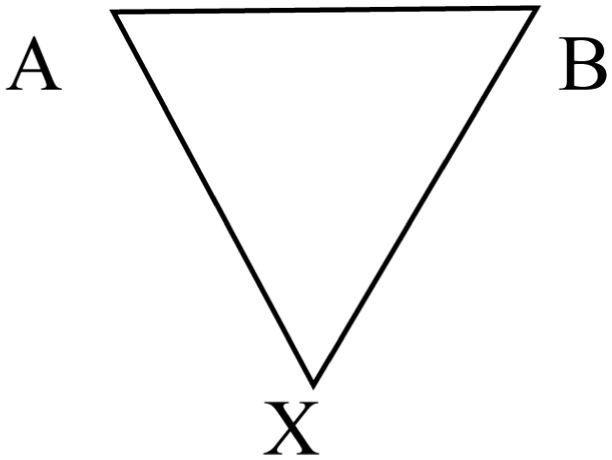
Sign operation of mediation (Vygotsky, 1982a, p. 104).
Behavior is understood and described as a natural act: A–B, that is, stimulus–response. In natural memorization, a direct associative connection (conditioned reflex) is established between two stimuli. In artificial memorization (using mnemonics), with the help of an artificial tool (a knot on a handkerchief, a mnemonic scheme), two patterns of mediating action are established: A–X and X–B. Each of these, according to Vygotsky, constitutes a natural conditioned-reflex process. The new elements are substitution and directionality—i.e., the active use of the brain’s natural properties.
It should be noted that Vygotsky had different mediation triangles. In the 1929 draft of “Concrete Psychology of Man” (Vygotsky, 1986), variations of the basic pattern are found (Figure 3).
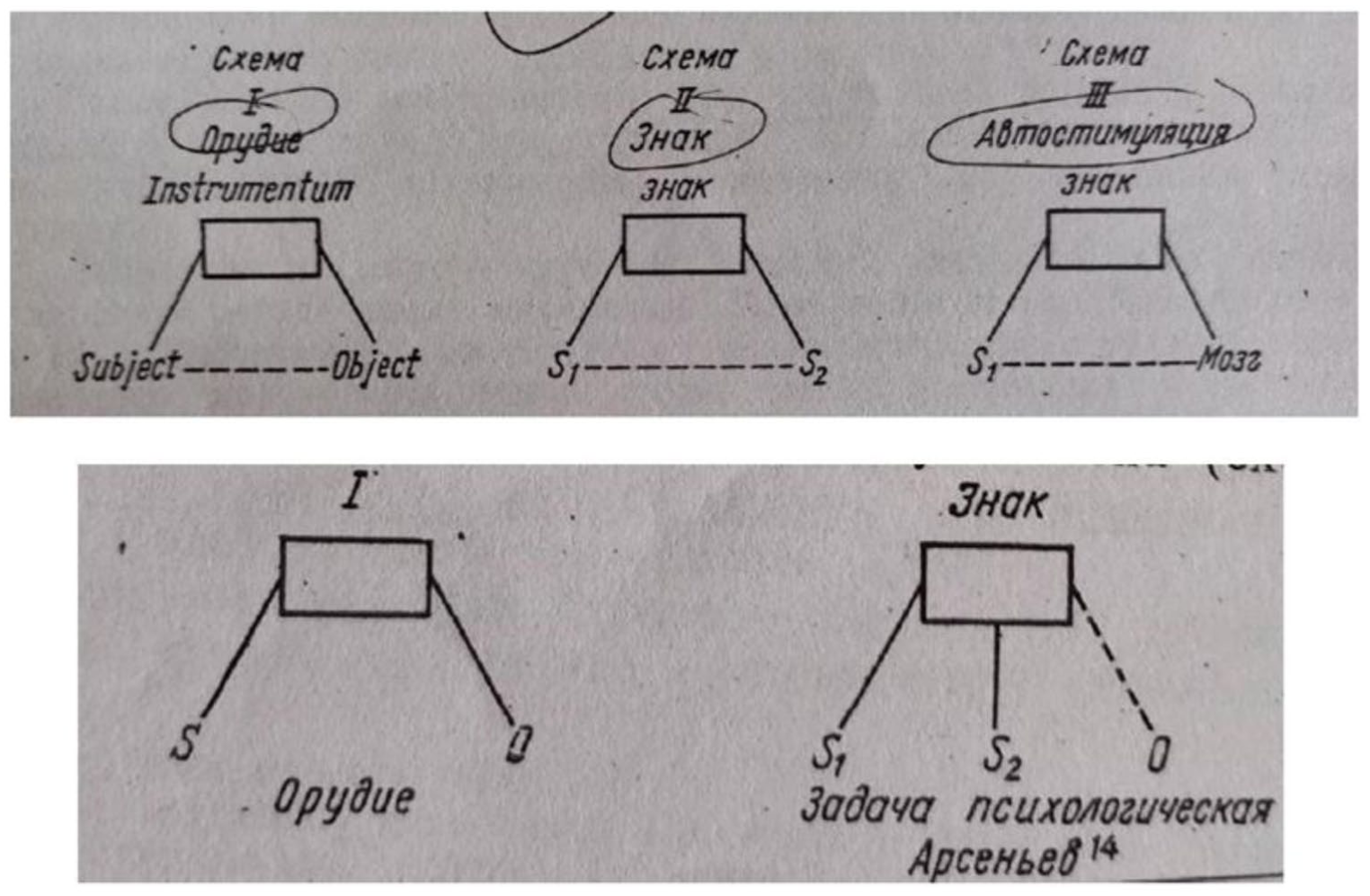
Configurations of mediacy (Vygotsky, 1986, p. 56).
All these triangles lack something fundamental, something essential. The tool-instrumental pattern alone does not lead us to an understanding of the mechanism for the development of higher forms (thinking, willpower, memory). Vygotsky understood this, later introducing other “mediators” in addition to sign in his other works—speech, meaning, another person (“cultured adult”). At that stage, however, he believes that this instrumental, artificial act can be broken down into its constituent natural acts. And humans are still limited by their natural substrate, the capacity of their brain. What is actually human about this pattern? Only the redirection, configuration of a new combination? This is his current explanatory model. He sees no other way at that point.
This pattern explains the essence of the instrumental method; i.e., the actual act of mastery is described in tool-instrumental terms. Moreover, it refers to the basic stimulus–response pattern as a law: this method does not negate any natural-scientific method for studying behavior and does not intersect with it anywhere (Vygotsky, 1982a).
The only difference is that the instrumental method constructs a new interrelation between an act of behavior and an external stimulus. In one case, a stimulus plays the role of an object towards which an act of behavior is directed (remember, compare, evaluate, choose, weigh), while in the other case, it plays the role of a means by which we solve necessary tasks. The psychological nature of these cases is different. They condition and determine our behavior in different ways (Vygotsky, 1982a).
Thus, the idea of a psychological tool is introduced—a sign with which humans influence their behavior. A new member is inserted into the pattern—a “psychological tool” that becomes a new center, a focus, functionally determining all the processes that form an instrumental act. 8 “Every act of behavior then becomes an intellectual operation” (Vygotsky, 1982a, p. 105). A “psychological tool changes nothing in an object; it is a means of influencing oneself (or another parson)—influencing the psyche and behavior” (Vygotsky, 1982a, p. 106).
The move beyond the behaviorist framework and the instrumental method was accomplished later, in “Thinking and Speech,” in Vygotsky’s works devoted to the psychology of children’s play, the problem of consciousness, the problem of the semantic field, in the works exploring the problem of mentally retarded children, and so on.
In the “apocrypha” (as termed by Zavershneva, 2006, p. 285), in the drafts of “The Problem of Consciousness,” report Vygotsky again reaches the fundamental conclusion: “The central fact of our psychology is the fact of mediation. Communication and generalization. The inner side of mediation is revealed in the dual function of sign: (1) communication, (2) generalization. For any communication requires generalization. Direct communication is possible, but mediated communication is communication in signs; generalization is necessary here” (Vygotsky, 1982a, p. 166).
Here the idea emerges on the connection of sign—meaning—sense as the basic units of analysis in peak psychology. Vygotsky almost completely transcends behavior psychology and reaction psychology. He was constantly and painfully searching for and constructing an explanatory model through which one could discern and comprehend the secrets of psychological development, reaching the level of peak psychology (as opposed to depth psychology). He took experimental results from other authors and demonstrated the dead ends of the models proposed by Koffka, Kohler, Bühler, Lewin and others. They had already collected abundant experimental materials; yet, their explanatory models were extremely simplified, either in the stimulus–response line or the introspection line (with the exception, however, of the field idea put forward by K. Lewin).
It was necessary to transit, to exit from natural, elementary processes—to the world of cultural meanings, by constructing a substantive connection between these worlds. For example: “(. . .) not person–thing (Stern), not person–person (Piaget). But: person–thing–person (. . .). Generalization is an exclusion from visual structures and an inclusion in thinking structures, in semantic structures” (Vygotsky, 1982a, p. 167).
Thus, L. S. Vygotsky arrives at the key mediating link—meaning: “Children’s first questions are never questions about naming; essentially these are questions about the meaning of an object (. . .). Consciousness as a whole has a semantic structure. We judge consciousness depending on the semantic structure of consciousness, for meaning, the structure of consciousness, is a relationship to the external world” (Vygotsky, 1982a, p. 165). “Meaning-formation is the main function of sign” (Vygotsky, 1982a, p. 162).
Vygotsky and his colleagues experimentally discovered the idea of a semantic field, beyond the natural, optical, visual field, by observing that subjects—adults and children suffering from mental retardation, speech disorders and paraphasia—demonstrated a clear attachment to a natural situation, to a visible, optical field, in their behavior. He compared aphasics with normal individuals. The former depends on the optical, natural field, the latter can break away from it, controlling it from a semantic field. Echoing K. Lewin, Vygotsky introduces the concept of semantic field (for more details see (Smirnоv, 2016; Zavershneva, 2015).
Vygotsky raises a problem: can a person change the meaning of a situation or do people depend on their needs and affects? What does it mean to “rise above the situation” and control it? Vygotsky notes the importance of the moments when a person changes the field structure and meaning for oneself. Field differentiation and structure depend on semantic moments, on the semantic factor, which determines this differentiation. The switching of field systems and structures depends on how the “semantic meaning of the situation (. . .) changes, the more conceptual is the rational attitude to the situation, the more differentiated and flexible the intrapsychic systems are, the greater freedom will be revealed in relation to the environment” (Samukhin et al., 1981, p. 127).
Freedom, acquired through understanding the meaning, makes it possible to “stand above the situation”; it is expressed in the flexibility and differentiation of mental structures. Such freedom over the situation and the visible natural field is observed in a healthy, normal person. The opposite situation of dependence on the natural field, on the equipment and concreteness of the situation associated with tools of behavior, specific tasks, words, objects, is observed precisely in patients with mental disorders, dementia and paraphasia. Such a patient cannot switch one’s needs and restructure the situation. He is not in the semantic field but in the natural field; he is a “slave of the visible field.” 9 In contrast to the visible field, the semantic field is, as Vygotsky and his colleagues tried to define, “a psychological situation that is determined by the degree of both conceptuality and differentiation of affective systems. Conceptuality (a type of generalization) is the factor that determines vectors of the semantic field (. . .). For a normal person who thinks with concepts, the semantic field is structured differently, vectors arise according to different laws: a person controls one’s field as if standing above it” (cited by: (Zavershneva, 2015, p. 126). Unlike a normal person, a patient exhibits complete subordination to the natural field depicting a specific situation.
Further, Vygotsky considers the semantic field using numerous examples, particularly children’s play, where a child plays with meanings rather than with things (re-objectification of an object, a slipper becomes a steamboat, etc.) (Vygotsky, 1966). Analyzing children’s play, Vygotsky essentially discovered the phenomenon of a child’s transition from a thing to the meaning of a thing. Using the phenomenon of a children’s toy, one can show precisely what a child is playing with. He plays not with the thing itself but with the meaning he endows it with (with a slipper-steamboat). This is both the main contradiction and the energy that drives a play. The child plays with meaning but does not lose touch with reality. He understands that by playing with a steamboat, with meaning, he is manipulating the slipper as a thing. But what matters to him in the slipper is its semantic “steamboatness,” not its material “slipperness.”
In fact, by introducing meaning, a semantic field, Vygotsky outlined a different vector, a transition from the instrumental-tool paradigm to the field paradigm. The introduction of the field concept was important in terms of demonstrating the fundamental difference between rational, or more precisely, meaningful behavior and irrational, meaningless behavior, i.e., as the norm of human behavior. Homo Sapiens does not live in a natural optical situation but in a supranatural, semantic reality, which is not fixed. It is constantly fluid, and therefore we are forced to resort to such a concept as the field, through which the flickering and dotted nature of the boundary of human reality, its constant instability and dynamics of internal processes, is shown. It is important to keep in mind that the semantic field serves, on the one hand, a construct, using which researchers analyze the degree of development of rationality and the formation of meaningful behavior in humans. On the other hand, the semantic field is a reality, not a fiction; it has an ontological status, its own stages of development, beginning with the psychological plane, external to an individual, and ending with the internal plane that screens the processes of human interaction with the world (Zavershneva, 2015).
Being in the semantic field signifies human action per se that is mediated by meanings and symbols and gives the desired freedom. 10
In light of the above, the graphic image of mediacy–mastery should no longer be the image of a triangle but the image of a sphere. L. S. Vygotsky came up with the triangle ad hoc, hastily, rethinking the behaviorist stimulus–response pattern. An intermediary sign is inserted into it and we obtain a triangle, that is, a “structure of a sign operation.”
But then the model expanded with ideas and practices, research and experiments, and ultimately, we should refer to a sphere of mastery through mediacy (Figure 4).
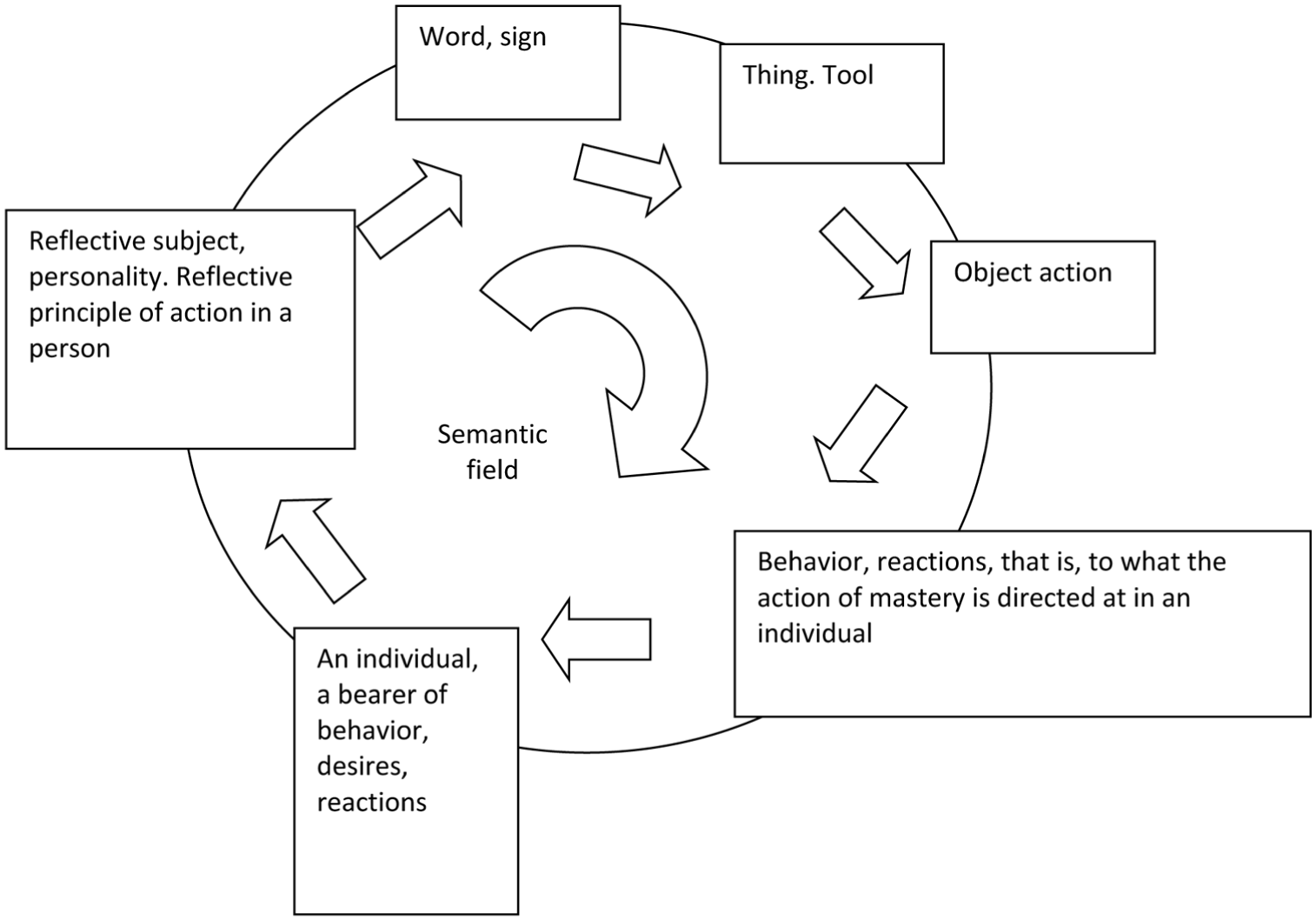
Mediacy-mastery sphere.
Hence, the strategy of thinking and its visual representation changes: a shift from the instrumental strategy and triangular metaphors to the semantic strategy and spherical images, to the representation of a spherically organized field of action rather than a triangular, broken course, which serves as a scientific metaphor at best but breaks and loses the completeness of vision over the entire “cumulative action” (on the fascination with triangles, see Sanninо & Engeström, 2018; Zittoun et al., 2007).
Each step in this sphere is a special moment, part of the entire sign-activity operation of mediacy-mastery: subject-sign, subject-sign-tool, subject-sign-tool-objective action, subject-sign-tool-objective action-reaction of an individual . . . and all this is controlled by a special reflexive principle in a person, formed in the process of implementing these steps—the personality as such: “the highest psychological instance of organization and control of one’s behavior, which consists of overcoming oneself” (Elkonin, 1995, p. 402).
Extracting track-steps from the spherical reality and describing them separately can be a conditional, artificial operation. Just as it would be an artificial representation that a child operates a thing or a tool (child-thing, tool) or a sign (child-sign). In reality, these are hybrids of varying degrees of maturity and development.
There is also no individual–tool step. Because tools in an individual are manipulated by what is developed as a personal principle, governing one’s own reactions within oneself as an individual. An individual, as a reactive being, simply lacks such a subjective and personal principle as well as an organ capable of reflection and self-control.
That is why Backhurst is partly right in stating that there are numerous triangles, for if we cut out each step and act separately from the sphere, we get (Backhurst, 2007): man–man (between them a sign); man–world (between them a sign, a tool); man–attitude towards oneself through a sign-speech; man–thing: between them a sign. Backhurst is concerned with the connection between man and the world, the direct man–world relationship. As he believes, epistemology is cluttered up with various kinds of intermediaries in the form of concepts, projections, interpretations and sense data, while man needs direct connection with the world (Backhurst, 2007, p. 63). Backhurst presumes that the idea of mediation makes this direct connection with the world possible. But in the desire to “straighten” the connection between man and the world, the idea of man’s mastery of his behavior, is lost. Incidentally, the Russian translation of Backhurst’s article uses the word “oposredstvovaniye” (mediacy), while the original, in line with the Anglo-Saxondom tradition, has “mediation.”
Certainly, we also construct and “see” the sphere of mediacy through the power of thought, through the power of abstraction, just like the triangle, as Vygotsky wrote—we can isolate these steps and acts only through the power of abstraction; they don’t exist in their pure form; they are intertwined and exist in thousands of operations, tests, and actions.
Each subject of action maintains its own sphere, not in an isolated space but in contact with the sphere of another person, who also maintains and constructs his own sphere of mediacy. Instead of empirical individuals, they interact as spherically organized subjects of action. Moreover, they see each other not through natural but through cultural eyes, through the subject-sign-action optics. If this is so, then their interactions are configured precisely in accordance with their spherically organized activity structures. A contact between them is either established or not, there is an understanding or not. Because we understand not through empirical bodies and individual reactions but through sign-activity and meaning, through object activity and the semantic pragmatic context, in which those who meet find themselves. Empirical reactions are merely reactions, but in no way a connection, understanding or encounter. Here, the reactions of individual bodies have no meaning, no semantic context, there is only a reaction to external stimuli.
Hence, the examples that Vygotsky cited in his research always require reservation. He knew what he was talking and writing about, keeping the context in mind. He had no time to comment and develop meaningful contexts. And we have to do the opposite—to uncover the meanings hidden in his rough notes and drafts. 11
For example, discussing mediacy, he seeks analogies in the examples of the Kaffir’s dream, memory knots and other rudimentary forms taken from traditional cultures.
The Kaffir, a representative of a traditional culture, a man of myth, is characterized by mythological thinking, which is why he acts this way, making notches. This is precisely because the center of decision-making in the myth culture is not within an individual. He delegates decision-making to another power, the sacred. A decision is made within the framework and in connection with the ritual of theophany, and only God can allow you to act one way or another (see Eliade, 1994). Through the ritual of theophany, a man connects to the sacred and thereby becomes a real being and acts as the sacred principle dictates. Strictly speaking, the subjective principle is neither developed nor required in the Kaffir. Therefore, his sphere of mediacy is incomplete, or to be more precise, different. It is immersed in the ritual of a sacred act.
In the case of mythological consciousness in a man of myth, the priority lies not with an individual but with the culture, the sacred tradition, to which he is introduced through the ritual of a sacred act. Clearly, in such a case, the mediacy loop is constructed in various ways, depending on the type of a “mediator”—be it an object, a sign, a name, a myth, a symbol, God, etc. 12
When Vygotsky discusses similar examples of mediacy (lots, cards, dice, the Kaffir’s dream, notches and memory knots) and the inclusion of a third element, a mediator, in the stimulus–response pattern, he does not specify the sacred and religious context, since it was important for him to demonstrate the difference between the direct reactive action and the mediated action. The rest was put aside at that stage.
In “Thinking and Speech,” Vygotsky maintains this context and not only draws general conclusions but also completes the actual spherical organization of the entire model of mediacy, confirming the connection between mastery and mediacy, introducing them as the basic rather than simply exploratory principles of peak psychology: “(. . .) the central problem in explaining the higher forms of behavior is the problem of the means by which a man masters the process of his own behavior (. . .) all higher psychological functions are united by the common feature that they are mediated processes, i.e., they include in their structure, as a central and fundamental part of the process as a whole, the use of sign as the main means of directing and mastering psychological processes” (Vygotsky, 1982b, p. 126).
In fact, the key problem—the problem of constructing a connection between thought, word and action—was also addressed and described by Vygotsky in terms of a model of mediacy and the construction of an effectively spherical structure, where thought is not a pure act, separated from word and action: “(. . .) the relationship of thought to word is primarily not a thing, but a process; this relationship is a movement from thought to word and back—from word to thought (. . .). Thought is not expressed in words, but is accomplished in words” (Vygotsky, 1982b, p. 305).
Thought as a pure act, separate from word and action, does not exist in reality. It cannot be seen, just as inner speech cannot be seen. It cannot be observed the way we observe behavior. Therefore, higher human abilities cannot be packaged and embedded into the stimulus–response pattern. Nor can they be described in the categories of reactions. It became clear to Vygotsky that an act of thinking is not a brain function and is not a response to a stimulus. It is always an act of connecting action and word, a connection based on the principle of mediacy. The eventfulness of thought lies in the realization of this connection between word and action through mediacy and the control of one’s behavioral reactions: “Thought is an internal, mediated process” (Vygotsky, 1982a, p. 162).
And then the actual act of thought-action represents the same spherically organized space as the space of mediacy action (Figure 5).
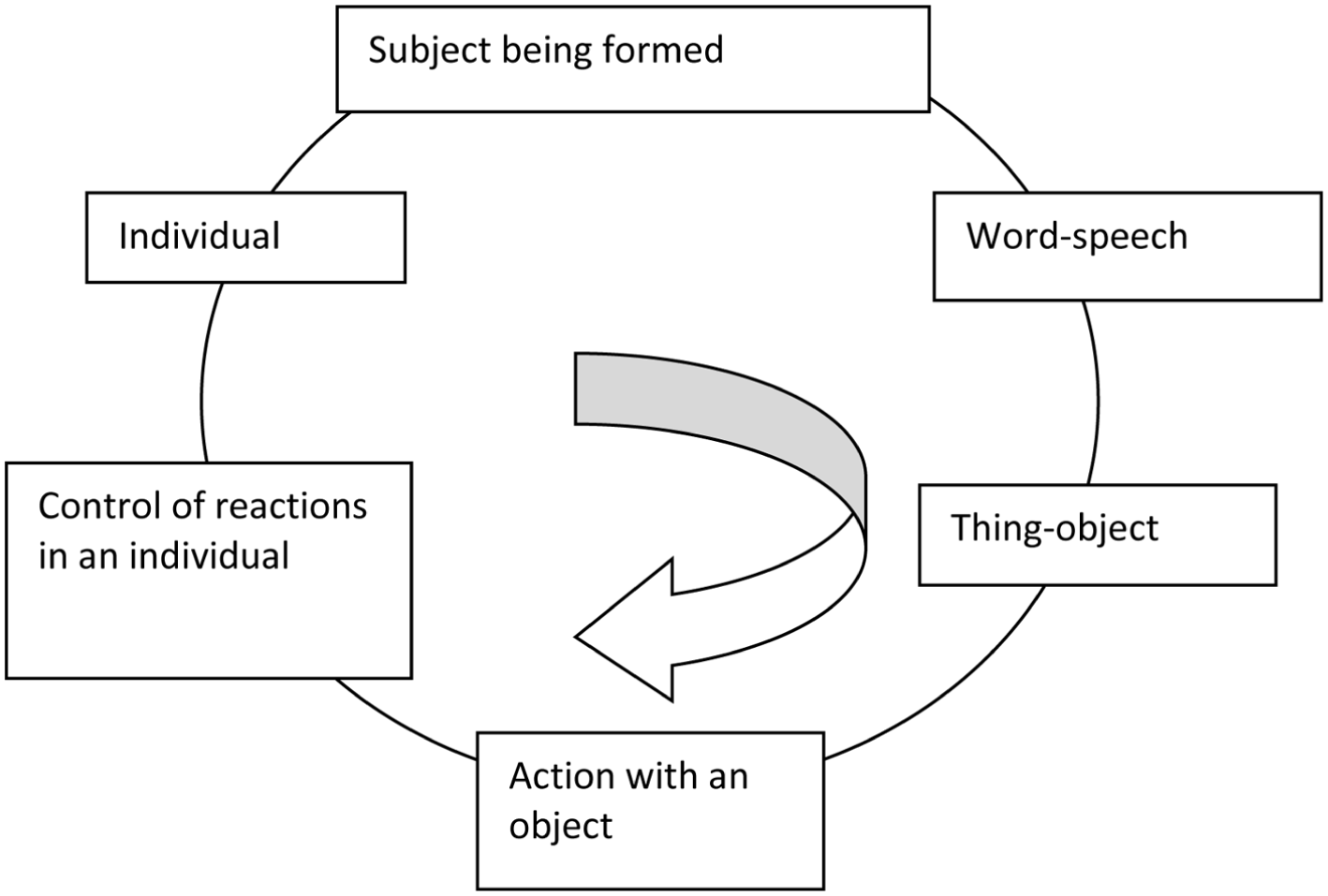
Thought-action sphere.
Vygotsky initially started with the stimulus–response, then inserted a mediating sign, which was any other stimulus, including an action-thing (notches, knots, dice, cards). Then he replaced this mediator with speech-word (starting with childish babble and mumbling and ending with an extended statement).
But the entire dynamic of mediacy, with changing the means of mediacy, revolves around the problem of humans mastering the processes and reactions of one’s behavior. An act of thinking signifies an act of mastery.
An act of thinking coincides with an act of mediacy. Therefore, thinking occurs in the mediator-word. That is why an act of thinking and an act of mediacy have a spherical organization.
There is no thought in a person’s head. A person doesn’t extract it from there. The human brain has only psychophysiological reactions. Exercising an act of mediacy, a person has a chance to perform an act of thought, where word-utterance is the form of accomplishment. Only later, in retrospect, this multiple-times-repeated psychological action reflects on the functional structure of the brain, which is characterized by neuroplasticity and is formed accordingly, depending on the practices of mediacy.
Sooner or later, Vygotsky was bound to arrive at the adult-mediator idea. A child is never alone; he is always in a social environment. Children do not master their behavior alone but with the help of an adult: “The source of development lies in the child’s social environment, in their specific relationships with adults (the experimenter)” (Vygotsky, 1984, p. 29). “The path from thing to child and from child to thing lies through another person” (Vygotsky, 1984, p. 30).
Here, D. B. Elkonin’s model of mediation is born, and the figure of the adult-mediator appears. But that is the theme for another article.