






Abstract
The purpose of this study was to examine the particular reasons why the Maasai ecosystem is home to the spectacular assemblages of the remaining African terrestrial wildlife populations. We highlight how the adherence to locally devised rules, values, and practices play an important role in the management and conservation of land resources particularly wildlife resources. This article indicates that despite the external pressures to dismantle Maasai ecological strategies and practices through imported religions, Western-oriented education, constraining policies, and the cumulative loss of land, the community has continued to maintain significant practices for the conservation of Tanzania’s wildlife ecosystems and livestock. The article extends the overall argument that indigenous practices are central to a continued nurturing of biodiversity conservation.
Conservation areas in Maasailand
The Maasai are a well-known East African indigenous people. Due to their distinctive dress code, traditional customs, and engaging attitude toward the natural environment, some authors (Salazar, 2015; Schneider, 2006; Spear & Waller, 1993) note that the Maasai are recognized worldwide. Together with Sandawe, Akiye, Hadzabe, and Datoga, Maasai have identified and described themselves as members of the indigenous communities (Hodgson, 2011). In tourism, the Maasai are seen as the flag-bearers of Kenyan and Tanzanian tourism (Salazar, 2015). The printing and marketing media featuring Maasai people and culture have popularized and ensured that the pattern of Maasai representation/misrepresentation is reinforced. To some foreign visitors to Africa, the Maasai represent the people of the whole of Africa, even though the Maasai number hardly a million and there are many more indigenous peoples.
In terms of geographical location, Maasai inhabit some 150,000 km2 of the savannahs and grasslands plains and uplands of southern Kenya and northern Tanzania. In Tanzania, Maasailand occupies an area of 63,393 km2 in five administrative districts: Ngorongoro, Longido, Monduli, Kiteto, and Simanjiro (Homewood et al., 2009; Nelson, 2000). The Maasai are subdivided in oloshon, territorial sections which vary in dialect, dress, and detail of behavior. Despite these variations, olporor/alaji (age set) systems cross-cut and permeate all sections, clans, and aspects of Maasai life. The system comprises a mode of social labor, defining political organization, and provides a series of ritually marked stages (age-grades). When cattle were plentiful, milk, meat, and blood constituted the basic components of the Maasai diet. Because of the diminishing livestock-livelihood options, nowadays, Maasai are increasingly diversifying toward non-livestock sources of food such as small-scale cultivation and toward mining activities as a source of income (for Tanzanite in Mererani, Simanjiro district) as well as the making and selling jewelry. Some, including the Maasai themselves, describe Maasai as Iltung’anak loo ngishu, people of cattle. Possession of cattle has remained a backbone of the community, with cattle used as a currency for dowries and settling debts, as food and milk, and a shared sense of identity. The Maasai consider that a man is only a Maasai if he speaks Maa (a Maasai language) and has cattle. More explicitly, Tepilit Saitoti (1978) notes,
One cannot separate the Maasai from their cattle and it would be true for anyone to say without cattle there will be no Maasai . . . . The cattle are very special in Maasailand, themselves a part of the culture. (p. 14)
Small ruminant stock such as sheep and goats do constitute part of the Maasai way of life.
An aspect that also sets the Maasai apart from some other East African communities is their close interaction with wildlife populations that has existed for hundreds of years. Maasai hold a special place in the wildlife and biodiversity conservation fraternity. Their livelihood can be seen as a finely honed symbiotic relationship between local ecology, domesticated livestock, and people in resource-scarce landscapes (Homewood et al., 2009; Rugadya, 2006). For example, the wealth of Tanzanian natural resources, particularly large mammal populations and ecological diversity, exists in the vast expanse of Maasai territories. Such East African Maasai landscapes are a storehouse of the most diverse, abundant, and endemic and endangered biological resources and relatively unspoiled wilderness (refer to Table 1). Examples abound, but this excerpt from a Maasai traditional leader as cited from Lane (2001) amply illustrates how Maasailand has a bearing on herds of wild ungulates and their habitats:
Just look around. The parts of the world left with wildlife are peopled by pastoralists. Why is it so? How is it that supposed “experts” and “guardians of nature” come here after having failed to conserve trees and wildlife in their places of origin? I told them about the name of this place – Ramat – and Ramat means healthy habitat for people and all animals. They said it should be called ‘Crater (Shinana Ole Moinga, Endulen, in Lane, 2001)
Some of the protected areas formerly occupied by the Maasai people.

Most of the biological rich areas in wildlife are now state-protected areas and have become key assets underlying the development of tourism in Tanzania. For example, with 601,215 tourists in 2016/2017, Korongoro (Ngorongoro Conservation Area) generated 127 billion Tanzanian Shillings (US$ 61.4m) (Busiweek, 2018), becoming the highest revenue per unit area than any conservation area in East Africa. Prior to gazettement of a significant number of the present state and national parks and game reserves, these lands were used and occupied by the Maasai people, but their rights of occupancy were gradually extinguished (Nelson, 2012). Even after the gazettement, studies (Nelson, 2012; Thirgood et al., 2004) indicate that some wildlife such as the wildebeest, zebra, and elephants spend most of their total time in the Maasai pastoralist-village lands of the Simanjiro plains, Mount Ketumbeine and Loliondo, and the Salei plains.
The sheer concentration of diverse wildlife species of plains in Maasai territories dispels the narratives by wildlife lobbies that pastoralists are a cause to environmental degradation and damage to wildlife habitat (e.g. Ostrom, 1990). Numerous empirical and theoretical studies carried out in Maasailand on wildlife and pastoralism (e.g. Homewood & Rodgers, 1991; Runyoro et al., 1995 in Ngorongoro, Gichohi’s 2000 in Nairobi National Park in Kenya) suggest the biased claims inspired by Western hegemonic conservation that pastoralists are threat to wildlife may be more imaginary than real. Nelson (2012) points out that the Maasai pastoral production is not only compatible with but helps to create and support microhabitats that are of benefit to ecosystems.
In this article, we highlight some of the Maasai cultural practices and choices which, in turn, have sustained the spatial overlap or co-existence of environmental resources including wild animals and the pastoral Maasai in relatively compatible manner. We argue that the ways the Maasai community manage and interact with their bio-physical environment have a major impact on the conservation of wildlife in the East African Maasai landscapes. Besides highlighting such practices and choices, the article discusses factors responsible for weakening Maasai traditional practices.
Research methods
Growing up as a Maasai herder in the Ngorongoro Maasai ecosystem was the inspiration for embarking on the present study. As a male child herder and as required by the Maasai customary rules, beliefs, practices, and taboos, I “looked after and treated with fairness” both, family animals and wildlife. Around my village, people, wildlife, and livestock utilized pasture and water resources in peace. Upon exploring the world, I have come to learn that such co-existence is deeply rooted in Maasai values and practices. However, critics in favor of exclusive conservation have often blamed the pastoralist livestock production for causing environmental degradation. For them, the increased livestock and human population among the Maasai are inimical to conservation of wildlife and outdoor tourism. Critics have premised on separation of wildlife from people, and concomitant ecosystem adjustment. The separation means loss of land, livelihood, and cultural identify for the Maasai. To the Maasai, the allegations are a cause for deplorable history of marginalization, discrimination, and exclusion that continues to this day over their ancestral lands. Consequently, as a member of this Maasai community, I decided to highlight some of the cultural rules, beliefs, and practices that have enabled the Maasai pastoral livestock production to co-exist alongside a high abundance and diversity of wildlife. As an insider, I have local knowledge of the physical and wildlife resources as well Maasai cultural and social protocols. It is my hope that this study could contribute to the ongoing efforts to build an appreciation that the Maasai traditional ecological knowledge and practices is key in promoting effective biodiversity conservation. I collected information about how the adherence to Maasai devised rules and practices play an important role in the management and conservation of land resources as well as what threats erode such rules. I undertook a series of 12 key informant interviews with Irmoruak/Iltasati (elders) of Iseuri (80–95 years), Irkishumu (60–80 years), and Irkidotu (45–60 years) age group. Study participants were drawn from villages across the Ngorongoro Conservation Area. The elders, some of whom are political leaders and Ilangwanak (traditional leaders of different age-sets, and spoke-persons of three age groups) were highly conversant regarding Maasai devised and enforced rules that govern the use of shared resources. They are holders of a wealth of ecological knowledge and the keepers of the Maasai ethics and are involved in management and conservation land resources at village and district levels. Some of the elders are long time champions for non-separation of wildlife people and have persistently advocated for justice and against the mistreatment of the Maasai on the grounds of conservation and tourism. I supplemented the information collected via interviews by using my observations growing in Maasai Ngorongoro Ecosystem. I augmented the findings and conclusion by consulting the indigenous traditional knowledge and conservation-cultural literature. The next section highlight some of the Maasai devised rules and practices that are most relevant to the policy of use of shared natural resources as well as threats to such practices.
Maasai institutions for managing natural resources
Indigenous people have institutions (i.e. structures, customs, traditions, and belief systems) for enforcing of traditional values and managing their natural resources. For the Maasai, the Olporor (age set) system has played a central role in the nurturing and instilling of positive values and attitudes toward the co-existence of humans and wildlife. For the Maasai, elders are the warehouse for beliefs and fountains of wisdom and learning and regulate access to water and grazing sources. For varying periods, elders offer practical skills and knowledge to Ilayok (young uncircumcised) and Irmurran (warriors) ranging from the identification, movements, and birthing patterns of various wild animals, the do’s and don’ts, importance and uses of various flora and fauna, and myths, legends, and tales about land and the environment. The skills include rangeland management techniques: when and where to set fire, when and where to graze, reasons for not killing harmless creatures, how to avoid aggressive and predating wild animals such as lions and buffalos, and all taboo animals that govern the co-existence of wildlife and human. Traditionally, the young Maasai warriors would kill only those predators such as the emblematic lions in response to Olkiyioi (an attack on livestock and humans) and buffalos to show their braveness. In the words of Orkishumi (60–80) from Irmisigiyo village,
We have learnt to give way to the hyenas, lions, the elephants and buffalos. We know how to escape a charging buffalo or a calving elephant. These animals are part of our culture, they use to be source of traditional trophies, for example kudu horns are hoot to draw attention or to signal wars and lion tails are a sign of brave warrior.
As caretaker of the Maasai tradition and values, Irmurran are the Maasai security force who are responsible for protection of the community and livestock from predators, raids, and harsh weather conditions, particularly drought in Maasailand. Irmurran move livestock between different macro-landscapes classified as osupuko pl isupuki (dry grazing season), orpurkel (hot plains), entim (montane forest), en-damata (valley slopes), orkung’u pl irkung’(upland), ayarata (bottomlands) in search of pasture and water. Such landscapes differ in terms of erosion potential, rainfall pattern, seasonality, plant composition, and livestock-dependent species (Oba & Kotile, 2001). Together with Maasai dogs, Irmurran guard wildlife such as wildebeest, and zebra and Irmurran when they run toward Inkang’itie (bomas) for safety against lions, hyena, and leopard (Goldman, 2005). They collect herbs for soups and medication. As such, they are expected to have an intimate knowledge in the areas of ethnobotany, ethnopharmacy, and ethnotoxicity and as the demographics, behaviors, predation, and movements of wild animals. For example, Irmurran appreciate wildebeest and lions as conflict species but they also recognize their importance in that they bring prestige. When it comes to killing predators such as lions and hyenas, Irmurran know that grazers such as antelopes must not be killed and that killing predating animals without limit is undesirable and potentially catastrophic (death). Individuals particularly Ilayok who infringed against protocols, for example, grazing in drought reserve areas, were punished with lashings by warriors. To develop and maintain breeds of cattle which are adaptive to semi-arid environment, warriors castrate low-quality males, preventing young bulls from mating (Waithaka, 2004)
Maasai women train Maasai girls on what can and cannot be done in all aspects of culture, and obedience and respect to the environment and human. The numerous chores such as gathering material for, and building, houses, fetching water and firewood, milking, distributing food, cleaning milk utensils, as well as mothering for which women are responsible provide a ground for learning the Maasai norms and values. For example, during firewood collection they show young women “trees considered to be morally wrong to cut, materials such as sticks, poles, mixture of water, cow dung used for building huts; where to visit for prayers when they need children e.g. specific mountains, trees, water sources.” Maasai women also compose songs and make poetic prayers related to wild animals. An example of a song sung by women:
Enkai ai, we the children of the earth, we pray thee at sunrise and sunset; that you may not abandon your sacred duty of sustaining our lives. Good one please do not separate loved one. For a complete life, Good one, please do bless us with water that quenches thirst for Olosho lino and cattle. Bless us with the air that we breathe and the trees that provide us shade and everything in the wild that challenges the bravery of Irmurran and give us company.
Through the transfer of such indigenous skills from generation to generation, the Maasai community have hold the view that all living species including the living and nonliving have an equal rights and obligation to use and benefit from the Mother Earth (Matampash, 1993).
Burning practices and grazing pattern
Fire is an important conservation tool in modifying the structure and function of the East African savannah landscapes. Together with elephants and pastoralist land management practices, judicious use of fire has been largely responsible for the substantial growth in the savannah ecology of the Greater Serengeti region (Nelson, 2012). With that understanding, at the end of the dry season before the advent of rains, mostly in September and October, Maasai often burn erashe (oldest grass left unburned by fire) to control bush encroachment and unpalatable dry and dead grass in potentially woody and bushy vegetation covered areas to promote new, diverse, high-quality forage (e.g. irikarro, operesi orasha, and emurwa) for cattle. Describing the usefulness of fire in controlling rangeland resources and diseases, the Maasai elders stated,
When I was Ormurani, we used to set fire in the evening when the day heat and winds are gentle and not in the morning because the grasses have enkolielio, dew following the chilly night therefore the fire many not catch. We also do in the month of Kushin (September) and Iyarat (October) when rains are about to start. (Orkidotui, 45–60, Irmisigiyo village) The herders set fire to the bush and old long grass that have ticks, normally the rainy season is about to start. The fire clears ticks and removes hiding places for the predators. The grasses that sprout are so fresh and healthy for cattle and buffalos and gazelles. (Irkidotui, 45–60, Mokilal village)
The decision to burn considers the age of the vegetation, the type of vegetation present, the amount of rainfall in the previous year or years, the amount of standing biomass, plant health, and the presence of insect pests such as ticks (Butz, 2009). Speaking of the punishment for individuals who lit fire inappropriately, one elder stated,
If someone burns the bush in a not approved area or start in wrong time of the season, he will be punished by traditional elders and the punishment range from a beating or fine of a orker (ram) or enkahe (heifer) depending on the severity of the fire.
Fire kills ticks and tsetse flies which cause diseases to both wildlife and livestock and stimulate the growth of fresh and palatable nutritious grass suitable for both wildlife such as low grass selective grazers; this included hartebeest, warthog, and thomson gazelle and livestock. The highest risk to the ecosystem is unpalatable and invasive plant species such as Datura stramonium L., Argemone mexicana, Gutenbergia cordifolia, Bidens schimperi (jimson weed), Prosopis juliflora, Parthenium hysterophorus (famine weed) which dominated more than half of the huge proportion of the Ngorongoro Crater floor as a result of fire suppression, a cycle of severe drought making burning too risky, and shrinkage of pastureland due to anthropogenic activities (Clark et al., 2011; Foxcroft et al., 2006). Consequently, wild animals do not have enough grazing spaces and they are therefore changing their food habits and shifting to other places such the Serengeti National Park. Other cascading consequences for savannah, besides the loss of habitat and the main problems of invasive species include replacement of the indigenous fauna, poor habitat, water loss, and alteration of the soil chemistry. In addition,
. . . when burning of the bush is not done and no elephants are in place to clear the forest, some short grass animals like cheetah and gazelles will disappear. You know cheetah (Acinonyx jubatus) and wild dog (Lycaon pictus) need open grass plains to see, chase and hunt and antelopes prefer patches burnt.
Estes et al. (2006) and Hassan (2007) note that there is mounting evidence to show that after the removal of Maasai herders from their lands and their controlled use of fire, as a result of the new regime of fire suppression, the Ngorongoro caldera, Serengeti and Manyara grassland ecosystems have been taken over by scrub and woodland making them unsuitable for herds of wild ungulates such as antelopes (i.e. gazelle species sp, wildebeest, kongoni, waterbuck, eland) and their predators including cheetahs.
Eramatare Oontim Orkeek (Practices regarding trees and forests)
Rich in forest wealth, the Tanzanian Maasailand contains several economically and spiritually important trees (Table 2). Almost all aspects of Maasai community life from birth, marriage and traditional rituals and festivals, and tribal songs have in one way or another involved plants/forest products. Much of the Maasai livelihood is derived from the use of tree products for medicines for humans and livestock, ceremonial and spiritual practices, construction, and firewood The Maa word for tree, Olchani; pl Irkeek, is the same as that for medicine which means every ailment has a traditional treatment, if not a cure, obtained in leaves, bark, or the fruits of plants (Kipuri, 1983) The community is rich in details about almost every plant in their range lands and pastures including the size, shape, sturdiness, variety of importance, and use of trees and forests (Maundu et al., 2001). When the area experiences harsh weather conditions such as drought or epidemic diseases, forests and trees are utilized to talk to God, who is seen as the rain maker and caretaker. Hodgson (2005) reports that plants are “a sign of welcome, peace, and blessing for the Maasai” (p. 125). These sentiments are also shared by Maasai elders:
Maasai culture is incomplete without the Entim (Forest). Entim is the spiritual centre of our lives and continuity. People go to Entim to make offerings to Enkai (God). No ceremony can be performed without including a tree in one way or the other. Important ceremonies like Ilamalak, Emayian oo Ntomonak, Irpuli and other important activities such as dry season grazing and source of water are performed within the forests . . . . Maasai know the need to preserve the forest. (Orkidotui, 45–60, Endulen village) The forest like water points are respected and no Inkang’itie (homesteads) are allowed to be created around them. Spotless rams are annually sacrificed to mother Earth for these areas and under a shade of a tree because they are sacred. (Orkidotui, 45–60, Irmisigiyo village) Entim (forest) are special places where our Ilamali (delegations) go to talk to our Enkai. Conserving these treasures, protecting from overcut mean so much to our people. (Orkidotu, 45–60, Irmisigiyo village)
Some of the trees species of cultural and spiritual significant to Maasai.
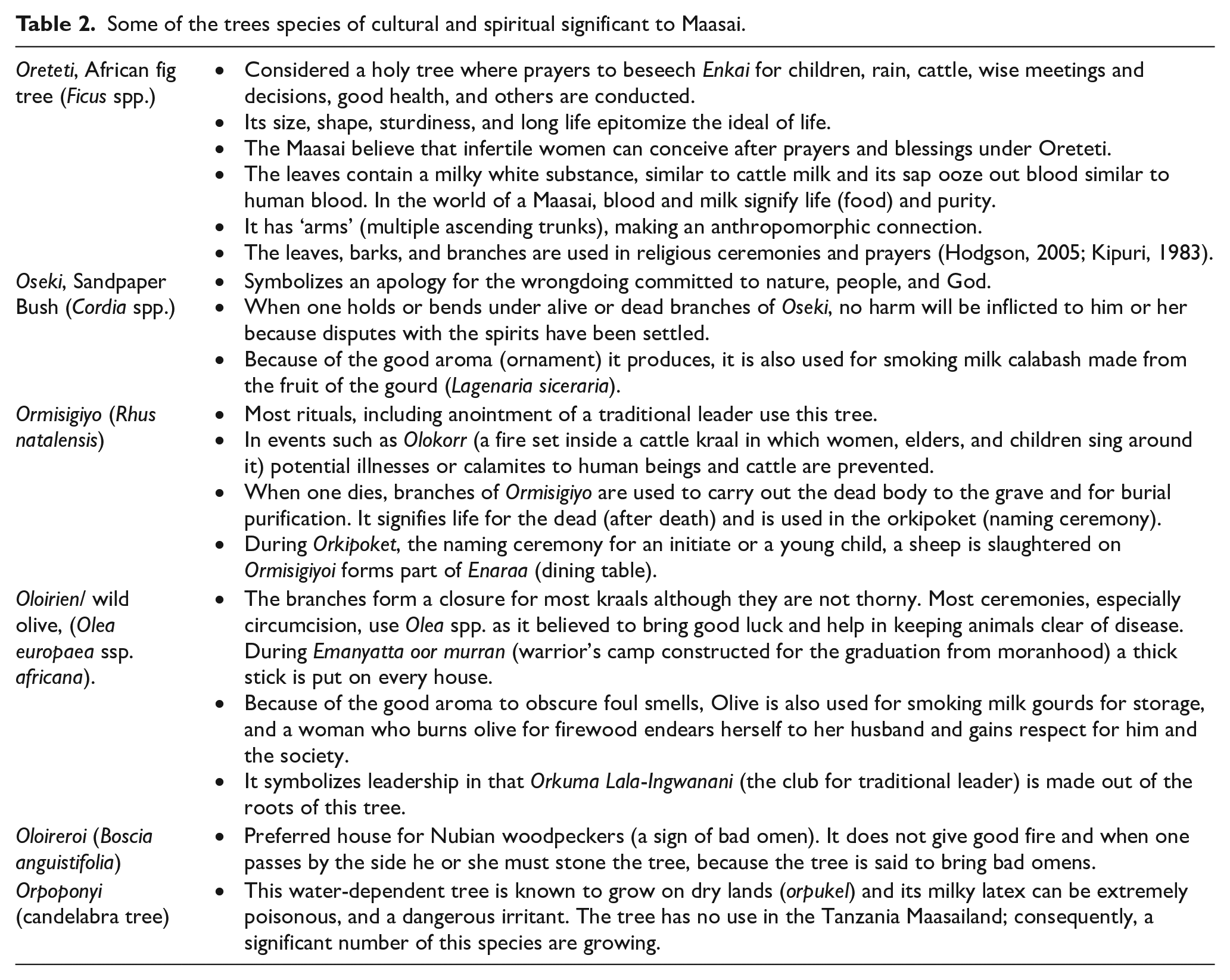
The Maasai widely hold the view that the misuse of forest products will affect the delicate balance, between flora and fauna and humans for food, habitats, water, and fresh air and would induce droughts and epidemics and alienate human beings from the gifts of nature.
To ensure they do not deplete the population of the useful trees, the Maasai community employs a wide range of customary procedures for access of trees and forests including strictly prohibiting cutting and collection of the same trees for firewood and others, and anointing with milk and honey while chanting for prayers. To prune a branch of Oseki (Cordia spp.), one could chant this prayer (Somjee S. 2001, p. 4):
Oseki tree, we pray Give us permission to cut you Surely, it is not to wound you Or to harm you Give us permission It is to take peace from you That we ask of you Peace for our homes
The Maasai would therefore cut down certain trees or branches for a good and justifiable reason including fencing of the cattle kraals, browsing and building, and making tools. In most cases, dead trees are used for firewood, and Maasai generally recommend pruning branches of trees instead of cutting the whole tree down. Although the prime motivator of the traditional practices regarding trees may not have been directly related to conservation, surely maintaining the integrity of forest for medicinal and spiritual significance (worshipping, circumcision, sacrifice, marriage, and meeting places) makes them automatically conserved.
Eramatare ooNg’wesi (Practices toward big game)
There is a special sense of affinity between Maasai and wildlife (fauna). In the Maasai context, clans and moieties identify themselves with some wildlife and plants as totems. Similar to human creatures (Homo sapiens), Maasai believe that wildlife have inalienable rights to grazing lands as cattle and therefore, harming creatures, unless they cause lethal harm such as killing human and cattle, is “breaking the laws” and hence punished as well as being considered abhorrent. For example, the baboons and raven belong to Ilukumai, elephants and gorillas are of Ilaiser, snakes belong to Iltaarosero/Ilaisi and hyena is Ilaitayok, striped hyena belongs to Irmamasitai. Monkey and Marabou stork is Iramkesen and eagles including the black kite are Irmolelian. In a sense, a clan has a duty to ensure that the animal is protected by the entire community. And by extension, the in-laws of the clans to which an animal belongs are also the protectors and watchdogs of the same animal because killing it would be tantamount to killing their in-laws. The harming or disappearance of such animals has side effects for the clan. The killing of in-laws, sisters, or brothers may result in bad luck, but the clan is also dispossessed. Snakes were not stroked and there was a belief that certain very prominent elders returned as African house snakes, black snake, and pythons (Hodgson, 2005) to look after children. When a snake is seen around the hut of Iltaasero/Ilaisi, it will be invited, given some milk on Olorika (stool) for it to lick and after it will go in peace. The Iltaasero would tell a person to desist from striking the snake for it belongs to them.
In essence, this is part of the reason why Maasai do not eat wild game even in times of severe hunger and food shortages because the game is part of Maasai (they define it as no-resources). Anyone who hunts or kills unnecessarily would be Ol-toroboni (poorer with no livestock and live in the wild gathering fruits and hunting) and a killer is likely to get injured/killed by the same wild species. As an elder of Meshili village eloquently stated,
Listen, we are a food selective community and when a warrior eats lets says buffaloes, or eland, or impala he will be disrespected by woman and people will consider him smelly and not normal. It is not a revered practice. People looked down on individuals who eat wild game meat.
The compatible of Maasai and wildlife in a space is largely due to these culturally grounded taboos and practices. No wonder, while bands of poachers were wiping out Tanzania’s elephants and wildlife habitats in recent years, poaching was held at bay in most of the Tanzanian Maasailand, particularly at Ngorongoro Conservation Area (Ngorongoro, Kiteto and Longido) (Mabele, 2017; Shivji, 2013). In fact, working with the Maasai community as the eyes and ears of wildlife has made Ngorongoro one of the most secure for most of wildlife species including the rhinoceros and lions in Tanzania. A position shared by traditional leaders provides further explanation:
We reject positions by the so called Wahifadhi (conservators) that accuse us, the residents, of being predators or destroyers of the land where we bury our own umbilical cords after birth . . . .We have historically and presently been the main and best conservators and contributors of this area and all wildlife. (Orkishimui, 60–80, Meshili village) I grew up seeing wild animals like lions. Yes, there is a fear of lions and other predators as they cause danger to peace and security of livestock and people, but they are part of us. We love and admire them. They are a valuable species. For me, I feel bad when they are not around the village. An elephant is known for being giant and a maker of open areas. (Orkidotui, 45–60, Endulen village)
Moving of grazing livestock between different local pastures depending on season (dry and wet) enable Maasai pastoralists to utilize the heterogeneity in their environments at a larger scale and have proven to be more practical and ecologically sound measures of conserving both biodiversity resources and livestock with the variable semi-arid and arid environments. Maasai have innate understanding and knowledge of wildlife, in that they can tell what, where, when, and why a game animal is present. The knowledge that different animals have different forage and habitat preferences, and water requirements is the reason for keeping a diverse herd: donkeys, cattle, sheep, and goats. The different diet preferences of species of size and body weight minimize competition and allow greater number of animal to utilize same landscape (Rugadya, 2006). According to a Maasai traditional leader,
We know what species of wildlife eat what, for example, giraffe and impala and our goats eat browsers, they eat leaves and animals like wildebeest, zebra and buffalos and cows are grazers. You don’t take cattle where wildebeest have already passed through because they would have finished the grass they are competing for grazing. (Oseuri, 80–95, Mokila village)
The Maasai in Ngorongoro graze their cattle away from the plains of southern Serengeti (Angata Kiti, Lemura, Masek, and Oldupai areas) in the month of January and February when the wet season begins and retreat to upland pastures in the dry season. There are two reasons for this. First, to avoid the spread of wildlife transmitted diseases. A calving wildebeest leaves its fetal membranal substances on the grass which is contaminated with the virus which causes Engeea oinkati (malignant catarrh fever). Around 80% of cattle infected by this virus disease turn blind and die (Potkanski, 1994). Other diseases spread by wildlife to livestock and human are anthrax, black quarter, rinderpest, and brucellois. Second, the practice of moving animals allows the plains to recover/renew fairly rapidly following rainfall, so the concept of carrying capacity is embedded in the traditional conservation practices. In sum, the reasons for mobility as means for managing risks and beyond, as an elder of Iseuri age group (80–95) commented:
I would say we move our animals from one place to another to avoid droughts, rains, and other vagaries of climate and diseases, and in search of water, vegetation and salt minerals and other nutrients.
This shows an understanding that the Ngorongoro grassland ecosystem is both sufficiently resilient and productive so that neither Maasai herds nor the increasing wildlife ungulate population can easily destabilize it:
What you people (modern experts of nature) don’t know is the Maasai traditional rules of partitioning land use for dry season and wet season is good for both livestock and wildlife. It allows livestock to concentrate in one area while wildlife enjoy the other part and olokeri (the dry season refuges) are shared by both calves and weak or infirm livestock and wild animals such as zebra and buffalos. I believe if such arrangement is not in place, conflicts between people and wildlife would be much and the wildlife would decline. (Orkidotui, 45–60, Mokilal village)
Eramatare Ooldoinyok (Practices toward mountains)
The Maasai community has some hills and mountains encompassing an array of important spiritual and cultural values that are tangible and intangible (Table 3). Many rituals, ceremonies, sacrifices, offerings, and prayers essential to Maasai ways of life are performed within or at the edges of mountains. Some of the mountains such as Oldonyo Osira Lenkai are symbolically the meeting points between the Enkop (Earth) and Enkai (God). They are considered as spirit sanctuaries—a space for prayer for most people, but also serve as a place for renewal and cleansing for newborns and warding off sickness. Alamal Loontomonok, ritual delegations of (unfruitful) women lead by old, respected elders, regularly visit such places to pray to Enkai to bless them with children. Other places such as Empakaai crater are believed to be home to giant snakes which prevent people and cattle get down into the crater. Because of such beliefs and choices, these sites have not only remained relatively intact as a mountainous and forested landscapes with considerably diverse plants, including Juniperus procera, acacia species and ficus species but also refuge for mammals, particularly buffalos and duikers. Some landscapes such as Makarot are the source of a number of streams and springs including Oltogom which flows throughout Endulen down to Lake Eyasi. The spring is a lifeline of villages and social amenities such as Endulen Health Center, which serves over 10,000 residents.
Some of the mountains of cultural significant to the Maasai people.
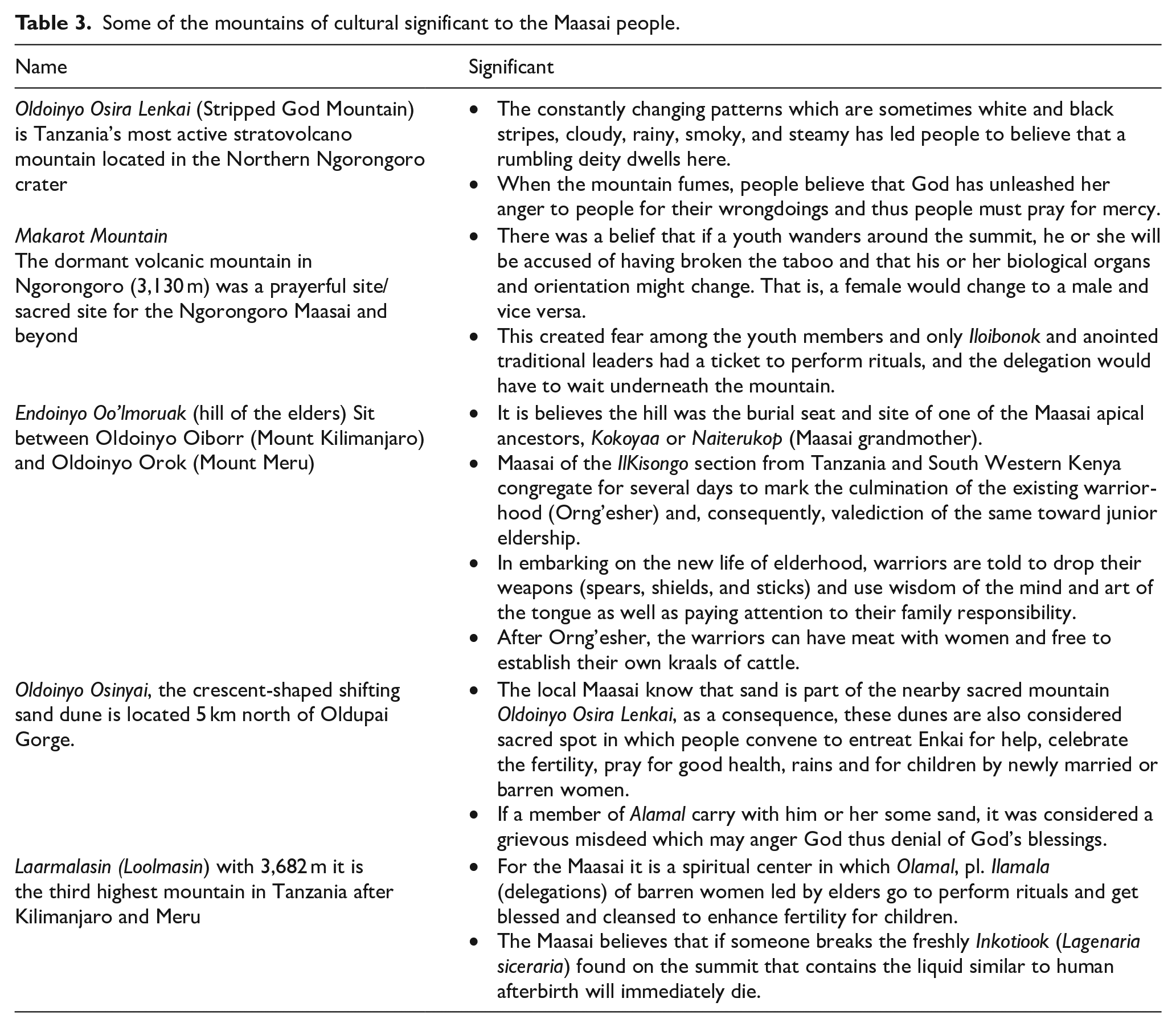
Due to this cultural significance, Edoinyo Oo’lmorwak is one of most well-preserved and protected hills in the Tanzanian Maasailand, thus presenting huge potential for biodiversity conservation. The fear of death scares people away from summiting to the mountain and as a result a closed forest canopy has been formed which support diverse species of birds, mammals, and primates including baboons.
For the Maasai, the protection of mountains with spiritual significance for worship and offerings is an effective way of protecting not only their culture, people but also nature. As explained by one Orkishumi from Oloirobi village,
We are spiritual sons of mountain. We belong to the earth and mountains. Mountains like Oldoinyo Osira Lenkai lift people’s eyes towards God and the heavenly world. I would say Mountain are not mere stones but are of great importance to wild animals and a symbol of Maasai identity.
Threats to Maasai traditional practice
There exist, however, a number of threats to Maasai traditional practice in Tanzania. Indeed, the Maasai are fully aware that as pressure on their lands from outside intensifies and as their pastoral livelihoods dwindle, non-Maasai beliefs become the norms, going to school becomes mandatory, interaction with tourism activities increases, their way of life transforms, and so does sustainability of the traditional practices which have promoted symbiotic interactions with natural resources. Overall, these problems threaten the sustainability of the traditional practices which have promoted natural resources symbiotic interactions.
The Maasai and the expansion of protected areas
It is estimated that around 70% of what claimed to be the Tanzanian Maasai ancestral ecosystem is now in the hands and control of government under the umbrella of protected areas, private concessions, state-held ranching corporations, and large agricultural plantations (Brockington, 1999; Melubo & Lovelock, 2019; Nelson, 2012). Instead of celebrating the inherent links between human and nonhuman (Büscher & Fletcher, 2019), the operating approach for the establishment and management of protected areas calls for exclusion and inaccessibility of local people (Brockington & Duffy, 2010; Carruthers, 1995). In the eyes of the Maasai community, “land exists through them and they exist through it”; therefore, separating people from nature disrupted their patterns of traditional seasonal movements already mastered through long experience of ecological hardship, led to ecological changes which may inevitably be detrimental to wildlife and conservation as well as limited pastoral livelihood options. For example, access to critical grazing lands and watering points within what become state-protected has been altered. In an interview, one elder of Iseuri (80–95) age group remarked,
When huge tracts of land are gone forcefully what good do you have? Land is life, it is shelter, it is water, it is grass, food, salt licks, it is culture it is everything I would say. We have sentimental, spiritual and economic reasons for wanting to stay in our land of birth. Our people became losers in the process and poor because conservation and tourism have denied us access to it (land). We are not happy because we have become strangers in our home.
Worse of all, state-protected areas have represented islands in a sea of poverty in that the surrounding local Maasai are suffering in the midst of multimillion-dollar protected areas. For example, the Ngorongoro Conservation Area received 127 billion TZS (over in 61.4m) in 2017/2018, allocated only 2% to Maasai residents as benefit sharing. Given the high rate of illiteracy (74.1% for women and 51.3% for male), and food shortage (70%) of the total population that amount is highly insufficient in the eyes of the Maasai residents (Melubo & Lovelock, 2019). As one traditional leader from Meshili village put it,
If we get the essential things like veterinaries like vaccinating cattle, schools, medication, much money to send children to school, and water for livestock derived from tourists’ dollars it would have been good for us and wildlife. I would say the returns from tourism right now are indeed very small in comparison with the much money generated. This time nothing big is coming from utalii (tourism) to support us. We are poor.
In addition to loss of land, the communities suffer from lost crops, livestock, and human lives (Nelson, 2012). Taking ownership and management control away from the Maasai does not motivate community members, but rather fosters anti-conservation attitudes among them. Some of these protected areas contain sites important for Maasai cultural and spiritual rituals and ceremonies. These include Ngorongoro Korongoro, Empakaai, and Ormoti and Entim Oolturot in Ngorongoro Conservation Area and Moruo (Maasai rock paintings) in Serengeti National Park. In the words of one Oseuri (80–95) from Oloirobi village,
We used to go up free to the forest and craters for prayer. The craters and forests are spiritual centres of our lives. Enkai resides there. Our movements to access those holy places have been denied. They [conservation management] need us to request for permission to accessing such important spiritual sites. A no go to those places is a denial to our identity.
Overall, the establishment and expansion of stated-protected areas has continued to abrogate existing common property rights, impose restrictions on seasonal transhumance, and place constraints on Maasai traditional knowledge and practices, particularly in terms of their maintenance of communal land uses.
Being biodiversity-rich areas, the Maasai ecosystem has become the most “exotic” and must-visit for most foreigners to Tanzania. For example, the number of visitors to Ngorongoro has increased over time from 20,000 in 1979 to 601,215 in 2016/2017 and 700,000 in 2018/2019, making it one of the most prominent tourist destinations in Africa. While tourism is praised for making wildlife profitable and drawing foreign currency into the economy, the Maasai blame it for transforming the once sacred sites to assets to be bought and sold for recreational purposes, and limiting the access to such culturally important sites. To the Maasai, some of the cultural values (ceremonies such as Emurata-circumcision) and artifacts including Emonyorit (long metal chain wore by women) and Isurutia (coiled brass ornaments worn by women) are supposed to be internal affairs for the community, but with increased tourism, much of this has become commodified. In sum, tourism has not only commoditized but also robbed Maasai of the very meaning by which they organize their lives.
Limited transmission of the traditional knowledge
There is a widely held view that Irkishumu, Iseuri, and Inyangusi Maasai age groups are the last to strongly hold and practice true Maasai culture and intense practical experience and rich knowledge of their environment and the ecological relations. They have displayed the love, patience, perseverance, and respect to the Maasai culture. The groups are in their 70s and 90s and 100s. The younger generations of Irkidotu, Irkorianka, and Inyangulo age groups may be losing respect to values and practices of the Maasai culture:
The future of our good culture and even of the species of Earth is threatened. If younger generations (Irkorianka and Inyakulo) don’t learn from the older generations and retiring Ilajijik (age groups), am afraid we will lose the memory of how to live respectfully as a people and with wildlife. (Oseuri, 80–95, Oloirobi village) The younger people now live in western style houses; they have changed our very Maasai traditional lifestyle completely. Instead of herding cattle, Irmurran are choosing to live close to roads and dance for tourists. I wish I could take Maasai back to the old days were respect for Maasai values was much. (Orkidotui, 45–60, Endulen village)
The Maasai society expresses anxiety and fears that the traditional settings have tremendously changed and that younger age groups are not prepared to uphold the traditional taboos and beliefs. Such changes have led to a weakening of the protection and conservation of sacred areas. For example, the seclusion of initiates in the bush, where values, knowledge, and life skills could be imparted to the youth away from the rest of the community, rarely takes place. The view that younger generations may not uphold the Maasai traditional knowledge and practices was brushed aside by some Irkidotu and Irkorianka, as explained by one Orkidotui:
Yes, the threats to our way of life are greater than ever but I am optimistic about our most sensible land use practices born out of generations. We are a resilient people. The knowledge and values we acquired from wazee (elders) and through our daily interactions with local environment while herding livestock are in us, alive and strong. We do have a unique and inherited ecological knowledge on our connection with our surrounding environment. We too pay attention to our values and we care for the wildlife and happy to see them around our villages.
Impact of the expansion of non-African religion
From the 1920s, Christianity penetrated into the Maasai land (Hodgson, 2005). Rather reluctantly, a considerable number of Maasai were converted to Christianity particularly to Catholic and Lutheran denominations and others which were extreme and intolerant to African traditional faiths. Female Maasai are the strongest adherents to Christianity. More recently (2000s), Islamic religion has found a niche particularly among the IlKisongo section. The conversion is made through schools, in their homesteads, and finally in instruction classes. The Maasai repentance and engagement with their Enkai (God) is changing. At times, adherents of the non-African religions are reported to have destroyed part of the forest (tree species) to demonstrate that African traditional taboos and values have no power and are useless and demonic fetishes. Some staunch Maasai Christians (born again Walokele of Irkilakuno sects) are accused of maliciously cutting the very sacred trees such as Oreteti, arguing that the myths and fantasies are baseless and ungodly. One Orkishumui (60–80), Oloirobi village, was very critical of the problems brought up by some Kanisa (churches):
These churches are a problem. They say the Maasai God is not a good one, is satanic and that their God is a true one and when one dies you go to hell. They force people to get rid of certain practices such as having more wives, wearing Maasai cloth, women shaving hairs, change names to the so-called Christians, not suffocating an animal. Walokole have no respect for trees, no sacred trees for them . . . . I go by what the Maasai culture teaches, God cares for life and receive forgiveness and reside in my house, in mountains, on the air and not only in the Church as they want us to believe.
This group expresses hostility for Maasai culture. Related to this, some Maasai men have married non-Maasai women of their religion affiliation including Western people. The overall results of non-Maasai religion have not only unleashed an unprecedented assault on the environment also have questioned, modified, disparaged, prohibited, and challenged the cultural and spiritual traditional values and beliefs of the Maasai people.
Impact of Western education
Efforts to send Maasai youth to schools for formal education (beyond basic literacy [reading and counting]) are apparently successful. For example, in Ngorongoro Conservation Area, since 1994–2018, roughly 5,000 children have been sent to various training institutions. Being at school reduces social connectedness in that it denies children the time to spend with parents and the community to learn the knowledge of community taboos and values. The school calendar is too constricted; therefore, it denies the youth opportunities to perform traditional practices including initiation ceremonies (Woodhouse & McCabe, 2018). As one Orkidotui (45–60) from Meshili village remarked,
Going to school is good because it enables one to face the challenges of the world but in terms of culture it (going to school) is not always good. It does not give young people the time to learn of our good values. Children are punished when they speak Maa and they are encouraged to speak Swahili and Kingereza (English). They are loosing the time and ability to speak Maa.
In general, western education, where traditional regalia do not form part of the uniform, and English, not Maa (language spoken by Maasai), is a medium of communication and nothing of Maasai culture is taught. These practices have diminished Maasai beliefs in terms of the importance of traditional taboos. This causes an intergenerational loss in traditional values.
Impact of changing economy
“The prioritization of money over livestock” as an elder of Irkidotu age group commented, in recent years has lately become a parameter in defining well-being among some Maasai and has a negative influence on nature and traditional practices. The importance of money is the primary objective in conventional development. Due to the severity of recurring droughts, as a result of climate change, reduced livestock holdings, and food shortage, some Maasai have only recently begun to break a taboo of eating “uncultured” rather reluctantly. As commented by Oseuri (80–95) from Mokilal village,
Things have changed. It is becoming more common to see our people (Maasai) consuming almost everything we use to see as uncultured. They eat potatoes, rice, beans, ugali, ground maize meal and even meat before women something is very much untraditional.
Specifically, the community has been forced to look for alternative sources of livelihoods, such as the environmentally destructive harvesting of forest products for fencing such as Oltiyani (Arundinaria alpine) and building such as Altarakwai (pencil cedar Juniperus procera). In addition, a significant number of Maasai youth have fled to urban areas where they have a chance of getting jobs as watchmen or hawking jewelry and handicrafts on the street. Furthermore, the mingling and close interactions with non-Maasai communities with different cultural backgrounds such as Meru, Sukuma, and Chagga have resulted in the change of attitudes and most of the spiritually significant animals being killed and places destroyed, because as strangers, they have no knowledge or respect for wild animals as the Maasai. Collectively, these situations have affected the population of wildlife species, have brought social dislocation, have frayed cohesiveness, and may limit the use of traditional cultural values in enhancing conservation.
Lack of appreciation of traditional practices
Instead of rewarding traditional practices for their immense contribution to conservation and livelihoods, most conservation authorities have been forcing the complete development interventions including abandonment of pastoralism (Nelson, 2012; Runyoro et al., 1995). Virtually all policies in the areas of wildlife, poverty reduction, land use, environment, range management, and livestock development portray pastoralism in the most negative terms possible. For example, whereas the National Land Policy, 1995 calls for abolishment of free movement of livestock and replaced by sedentarization, livestock ranching, land sub division, privatization of land tenure, diversification of livelihood options, the Wildlife Policy regards livestock grazing activities as antagonistic to conservation. Practices such as Alamayo (killing the offending beast particularly the lion) and Esoto (warriors-girls meeting points for dancing activity) are being phased out as well. The conservation-centric community, in particular, argues that the traditional practice is inadequate and has little to offer in mitigating some of the complex and critical challenges and issues facing conservation and the environment. In comparison with the modern practices which are considered to be objective, intelligent, and rational, some claim that traditional practices are parochial, primitive, and emotional (Ellen & Harris, 2000) and therefore are skeptical of efficacy. Some argue that such actions as herbal collection, seasonal mobility of livestock, and food taboos among the moranis are results of optimal use of natural resources and not indicative of deliberate conservation programs (Ruttan et al. 1999). Sadly, clothed in human rights, “offenders” of traditional taboos/ practices have found a safe haven (courts) in which they quickly sue the community any time they feel harassed. In addition, institutions that establish, support, and empower Ilangwanak (traditional leaders) are seen to be inefficient, weakened, and less organized, and thus ignored. This has created perverse incentives which weaken the enforcement of traditional penalties, restrictions, taboos, and codes of conduct.
Conclusion
Through millennia, generations of Maasai in northern Tanzania and beyond have developed and implemented ecological strategies, devised rules, and choices, and have co-existed in symbiotic interactions of both wildlife and people. As a result, the Maasai territories of northern Tanzania and southern Kenya have become a priceless and irreplaceable repository of diverse wild animals, thus substantially contributing to contemporary conservation endeavors in the East African region and beyond. At present, over 60% of the wildlife in Tanzania and Kenya roams in the rangeland and national parks formerly occupied by the Maasai (Matampash, 1993; Nelson, 2002). With diverse and abundant remaining terrestrial wildlife populations, the Maasai ecosystem has been the key asset underlying the development of the Tanzania’s tourism industry. Because of these particular features and the harmonious co-existence between wildlife and people that has existed for many years, some of these areas such as Ngorongoro and Serengeti were recognized on the World Heritage Sites. For example, the NCA a World Heritage Site since 1979, is by far the largest single contributor to the national economy relative to all other conservation areas in the country (accounting for 38% of park revenue in Tanzania (Busiweek, 2018). Sadly, the Maasai ecological strategies that created the opportunity are faced with a variety of threats such as loss of key land resources through expansion of state-protected areas, large-scale development initiatives, population influx from outside Maasailand, poverty, being viewed as inefficient and archaic, being accused of overgrazing and destruction of wildlife habitats, and non-Maasai religion which have reduced the efficacy of these practices (Matampash, 1993; Nelson, 2012; Woodhouse & McCabe, 2018).
The cumulative loss of peoples’ key resources such as pastures and water sources, and consequently livelihoods, represents a serious threat to the survival of Maasai traditional practices and according to Kipuri (1999) “the denial of their humanity” (p. 19). Ownership, having a voice in decision making, and security of land is central to the cultural survival and the essence of identity of indigenous traditional communities because land represents the life-force from which they have been created (Anderson et al., 2006; UNDRIP, 2007). UNDRIP (2007) emphasizes that the right to own, use, develop, and control the land resources are of fundamental importance if indigenous communities are to exercise and foster their spiritual, cultural, and economic relationship with their environment. Indeed, UN Permanent Forum on Indigenous Issues observes that land is a well-being, spiritual attribute and primary economic base to most indigenous communities throughout the world (UNDRIP, 2007). The Maasai believe with land ownership and authority, they will have the power to decide their own destiny including engaging freely in all their traditional practices and other socioeconomic activities to rebuild their economies. For the survival of the Maasai as a people and their pastoralist livelihoods, particularly livestock production, and if wildlife are to flourish and provide significant benefits, customary Maasai pastoralist land use practices and choices should be encouraged and managed to continue contributing to the development of Tanzania and beyond. The success of conservation based tourism in Tanzania is inexorably linked with enabling Maasai to maintain their pastoralist livelihoods.
Footnotes
Declaration of conflicting interests
The author(s) declared no potential conflicts of interest with respect to the research, authorship, and/or publication of this article.
Funding
The author(s) received no financial support for the research, authorship, and/or publication of this article.
