







Abstract
Approaches to health and social research and development in the Pacific are dominated by Eurocentric frameworks that fail to reflect the region’s ethnic diversity and inherent cultural knowledge and belief systems. We aimed to advance innovative, indigenous methodology with a focus on youth voice and transformative approaches that contribute to a decolonising and sustainable model of development. Talanoa—a Pacific framework for communicating and connecting—and participatory action research were adapted to create a unique Pacific “action cycle” focused on providing opportunities to (a) hear from fruit and vegetable young entrepreneurs and (b) foster healthy and sustainable food systems among young entrepreneurs in Suva, Fiji. A Fijian worldview helped to centralise Fijian concepts of knowledge enquiry and research. This article describes the way in which Pacific Talanoa can be incorporated within a Fijian epistemological paradigm for research and development undertaken in the Fijian context.
The genesis of cultural approaches to research and development arises from an understanding that the epistemological and ontological considerations of a particular group of people stem from cultural norms that are used to inform structures and procedures (Baba et al., 2004). Within the Pacific, at an individual level, cultural traditions can provide an in-depth understanding of individuals’ behaviours and responses to health outcomes (Health Research Council, 2004; Pulotu-Endemann, 2001). For example, spiritual beliefs in many Pacific cultures can cause individuals to seek traditional healers or spiritual leaders for understanding and rehabilitation (Sobralske, 2006). In the context of public health research and development, such cultural norms have the potential to influence the paradigms within which research methodologies and processes are developed.
At a societal level, within the Pacific, broader transitions are also influencing the call for a decolonisation of Eurocentric research methodologies and greater privileging of indigenous knowledge systems (Coxon & Samu, 2010; Gegeo, 2001; Hereniko, 2000; Smith, 2005; Thaman, 2003). Many countries in the South Pacific, including Fiji, are considered middle- to low-income countries. Economic development is leading to major socio-cultural shifts which have influenced well-being and impacted health outcomes; for example, globalisation and availability of processed and high salt and sugar foods had led to a rise in non-communicable diseases (NCDs) in the region (Percival, 2008). In better understanding the causes and solutions to unfavourable health and social outcomes, context-specific and Pacific-centric indigenous paradigms and knowledge are increasingly being employed by researchers and health practitioners (Farrelly & Nabobo-Baba, 2014; Pulotu-Endemann, 2001; Tu’itahi, 2009). These shifts aim to move in the direction of grass roots, community led (compared to outsider driven) partnership models and support indigenous empowerment models of development (Conn et al., 2016; Smith, 2005); to tackle issues and bring change to community. However, currently, innovative approaches that offer empowering spaces and provide opportunities for the voices of indigenous people (Jones & Jenkins, 2008) are still in their infancy (Botha, 2011; Guba & Lincoln, 2005).
Reporting on one such approach, this article considers how a Pacific Fijian cultural worldview informed the methodology and methods of the “bele project”, a study partnering with Fijian youth entrepreneurs in the fruit and vegetable business sector. The study sought to understand how social enterprise and youth models of leadership may be fostered through undertaking research that sought to combine indigenous voice-based methodology with a practice-based action methodology. The findings of the actual research have been published elsewhere (Conn et al., 2020). The purpose of this article is to describe how Talanoa, a Pacific methodological approach can be incorporated within Fijian epistemological foundations for a research study that seeks to provide opportunities for the voices of young Fijian entrepreneurs involved in healthy eating businesses. The article begins with a discussion on the relevance of Pacific worldviews; in particular, the Fijian cultural paradigm and values central to the Fijian ethos. A critical view of the use of Talanoa informed by participatory action research (PAR) methodologies, which are collaborative and change oriented, is explored, incorporating Fijian youth empowerment and health research and development agendas. Next, a model for epistemologically congruent methodological development in the region is presented, along with implications for future research and development among Pacific ethnic groups.
Pacific worldview
There are over 13 Pacific Island countries in the South Pacific, each with distinct ethnicities, languages and cultures (Percival, 2008). Although cultural traditions differ between Pacific Island countries, they share similar values that shape Pacific peoples’ identity and society. Pacific identity is based on an individual’s sense of belonging and relationship with others, the environment, space and time. Tamasese and colleagues (2010), in investigating Samoan, Cook Islands, Tongan, Niuean, Fijian and Tokelauan perspectives of cultural obligation, illustrated values of belonging and relationship according to dichotomised classifications of self. They distinguished between the first self and the relational self which determines well-being, safety and meaning for Pacific people (Tamasese et al., 2010). The first self relates the individual to their genealogy and ancestors, and the times and spaces involved. Such connections also tie to the environment, the land and the water. The relationships drawn from these different realms are sacred and taboo to Pacific people, and remain constant and cyclical.
The relational self involves the emotional, spiritual, physical, mental and cultural elements which are interrelated and cannot be separated. Tamasese et al. (2010) described this state of self as selfless as it exists in relation to others. Therefore, without other aspects of self-identity, one cannot appropriately describe one’s identity. In terms of relationships, the focus is placed on ensuring that people in relationship provide service that nurtures. Such concepts of selflessness are reflected in Christian spirituality that is central to Pacific people’s identity (Tamasese et al., 2010).
Tamasese and colleagues (2010) discussed the importance of belonging in relation to physical structures such as land, homes and possessions. Land represents lineage, connection with the gods and divinity, which is permanent and cannot be removed; thus, land anchors Pacific people. Among Kanaka Moli, the indigenous natives of Hawaii, is the belief that being one with the land makes them whole. This connection is at the centre of customs, language, history and religion (Sobralske, 2006). For many Pacific people, their village or place in which they were born or grew up provides a basis for self-worth and belonging. The home is seen as a nurturing, physical space that creates a sense of belonging and a spiritual place where people can unite and develop boundaries within which relationships are fostered (Tamasese et al., 2010). Therefore, Pacific identity is connected to both to land and sea.
For Pacific people, their beliefs and values are often expressed through cultural practices and traditions, and their spoken language. Enacting cultural practices and obligations helps Pacific people connect with their identity and foster feelings of belonging through connecting past and future generations in respectful and safe ways. Pacific people acknowledge their responsibility to past generations in fulfilling dreams and aspirations. This responsibility extends to the present and future generations, and involves teaching and exemplifying confident and responsible Pacific leaders and people (Tamasese et al., 2010).
Pulotu-Endemann (2001) contended that “Culture is dynamic and therefore constantly evolving and adapting” (p. 4). This is particularly relevant among Pacific people who are exposed to changing social norms caused by migration or changes in economic or socio-political circumstances. Therefore, the acceptance of an indigenous cultural paradigm is an acknowledgement that culture, as a starting point, provides a basis from which phenomena can be understood and critically examined. Within Pacific research and development, shifting towards an indigenous cultural paradigm assists in the decolonisation of research methodologies, whereby Pacific-centric research can be facilitated (Gegeo, 2001; Naepi, 2019; Smith, 2005; Southwick & Solomona, 2007; Thaman, 2003).
Historically, health research has been colonised by the biomedical model which has neglected to address the social dimension that influences people’s health and well-being (Gilroy & Donelly, 2016). More recently, various models of Pacific health and well-being reflecting values and traditions that Pacific people incorporate into decision making have been developed. The models are distinguished by the symbolisms in structures and frameworks that represent values and customs of particular groups in the Pacific. For example, the Tongan Fonua (nation) model incorporates the environment and its relationships with humanity within the context of Tongan hierarchy. This represents the relationships between the individual in relation to external factors and its effect on well-being (Tu’itahi, 2009). Other examples include the Tongan Kakala (process of making a fragrant garland) model (Thaman, 2003), the Cook Island Tivaevae (traditional quilt patchwork) model (Futter-Puati & Maua-Hodges, 2019; Maua-Hodges, 2016) and Tokelauan Te Vaka Atafaga (canoe) model (Kupa, 2009). These models present specific components with critical roles and functions which are mutually dependent on each other. The next section considers, more fully, the values and customs of Fiji, which is where the bele project was located.
Fijian worldview
Fiji is a young nation, with 95% of its population below 64 years (30.6% 0–15; 64% 16–61) and a median age of 25 years. It is a multicultural society with 57.3% indigenous Fijian or iTaukei, 37.6% Indian, 1.2% Rotuman, and 3.9% European, other Pacific Islanders and Chinese. Of the 322 islands, Viti Levu is the largest in land mass (58%) and population (70% of the total population). As of 2019, Fiji’s approximate population was 889,953; making it the second largest populated island in the Pacific, following Papua New Guinea (Fiji High Commission to the United Kingdom, 2019). Although considered more developed than its Pacific neighbours, Fiji remains a developing nation with poor outcomes in health and low life expectancy compared to most countries in the Pacific (Fiji High Commission to the United Kingdom, 2019).
A Fijian worldview is holistic; meaning connections and relationships are integral when operating within Fijian society. Within this context, the concept of the vanua is critical (Nabobo-Baba, 2008). Vanua has both literal and metaphorical meanings. Literally, vanua means land; metaphorically, vanua is the belief and value systems that ground Fijians in their sense of identity as iTaukei or indigenous Fijian (Halapua, 2008; Ryle, 2010; Tuwere, 2002). Further guiding principles for research and development in a traditional Fijian context include values of respect (vakarokoroko), reciprocity (veitokoni) and relationship (veiwekani) within research (Ryle, 2010; Tuwere, 2002). Vakarokoroko refers to the respect that exists between the researcher and participants, and dictates how power is balanced within these relationships. Within this traditional perspective, both the researcher and participant share in the knowledge-generating process (veitokoni) facilitating the development of a mutual partnership (veiwekani).
Fijian scholar Nabobo-Baba’s seminal work on the vanua research framework provides a valuable reference point from which to conceptualise appropriate framing for research among Fijians. The vanua research framework is an “indigenous theoretical approach embedded in the indigenous Fijian worldview, knowledge systems, lived experience, representations, cultures and values” (Nabobo-Baba, 2008, p. 143). Drawing on critical theory (Smith, 2005), where power structures and Western hegemony have led to the marginalisation of indigenous epistemology and cultural knowledge systems, indigenous frameworks, or as Russell (2000) posited, “Native Theory”, “is the right of indigenous people to make sense of their time and place in this world” (p. 10). For example, Kaupapa Māori theory based on the indigenous people of Aotearoa New Zealand, positions Māori ways of doing and being as central to understanding and researching Māori health outcomes and development (Mahuika, 2008). Kaupapa Māori theory interrogates the colonial constructions and the imposition of such structures on Māori well-being and development, and privileges Māori Tikanga (Māori beliefs and practices) as central. Similarly, within the Tongan tradition, the Kakala research framework draws on the cultural practices of kakala making—a valued activity in Tongan culture—providing contextual and procedural research principles for working with Tongan people (Thaman, 2003). In using a vanua research framework, Nabobo-Baba argued that research among Fijians will be undertaken within Fijian cultural identities and realities.
Although processes within the vanua research framework are reflective of indigenous traditions, the values that underscore these processes can be applied within contemporary settings (i.e. outside of the village). These applications often reflect principles of respect and reciprocity, appropriate cultural practices, indigenous language, and competency of the research team and accountability. It is intended that these principles are key to understanding the Fijian worldview and working within the Fijian context.
Values such as veiwekani (relationship) are important to promote trust and familiarity between the researcher and participant; thus, the need for cultural competence on the part of the researcher. To begin the research, relationship needs to be formed, often requiring several interactions and communications between the researcher and participant. Veitokoni, or the notion of “knowledge sharing”, ensures that participants involved in the research process will be supported in their endeavours to carry out their roles in their communities and extends to ensuring that those involved directly benefit from the aims of the research. Thus, there is onus on the researcher to ensure that Fijian values and belief systems benefit from, and are included in, the research processes and methodologies.
The bele project: Talanoa and PAR methodologies
Bele project
NCDs, such as diabetes, are a significant threat to the health and social fabric of Fijians (Conn et al., 2020). Given Fiji’s youthful population demographic, the researchers considered engaging Fijian youth as valuable players in developing solutions, alongside considering their role in developing sustainable food systems within Fiji and the broader Pacific to combat the NCD crisis. The project was undertaken from 2017–2019 in Suva, Fiji, and aimed to understand the challenges and opportunities for youth entrepreneurship in the fruit and vegetable business sector while raising the profile of youth as important players in improving the health of their local communities (Conn et al., 2020). The need to engage youth was key to the design and implementation of the project; hence, the research was multisectoral in nature, consisting of entrepreneurship, health, social and youth empowerment agendas.
Talanoa methodology
Talanoa is defined as a Pacific way of communicating, connecting and learning about Pacific people and their realities (Halapua, 2008). Talanoa is common in Tonga, Fiji, Samoa and Niue. Talanoa discussions are non-linear, inclusive and fluid, encompassing holistic approaches to perceiving phenomena. Using Talanoa to conduct research among indigenous Pacific people provides a natural familiarity that aids in the research process: Pacific island societies have throughout their histories relied upon the Talanoa process. It helps build better understanding and cooperation within and across our human relationships. It advances knowledge about our social identities, extended families, our villages, our ethnic and tribal communities, our religious beliefs and our moral, economic, and political interests. (Halapua, 2008, p. 1)
Although sharing a common emphasis on open dialogue across Pacific ethnicities, Talanoa is inclusive of different interpretations. Tongan academic Vaioleti (2006) defined “Tala” as telling, informing or commanding, while “noa” refers to the ordinary, nothing in particular, imaginary or no value. Thus, according to Vaioleti, Talanoa literally means, talking about nothing in particular and without boundaries. Such meanings have profound consequences in Pacific research as they allow conversations to be as meaningless or as deep as participants want with no assumed obligations or responsibilities. Vaioleti further positioned “noa” as creating the “space and conditions” while “tala” “holistically intermingles researchers’ and participants’ emotions, knowing and experience” (p. 24).
Halapua (2008) discussed Talanoa as a tool whereby communication is open and without concealment, while Nabobo-Baba (2008) described it as a process whereby participants can “offload”. In essence, Talanoa provides an avenue whereby researchers and participants are able to establish rapport with each other, gain an understanding of the environment each exists in and allow for a discussion that is authentic. Vaioleti (2006), explained Talanoa as “a personal encounter where people story their issues, their realities and aspiration . . . (it) allows more mo’oni (pure, real, authentic) information to be available for Pacific research than data derived from other research methods” (p. 21). Talanoa also links to Pacific values of “mana” which depicts the value, prestige or social standing that individuals bring to the Talanoa (Huffer & Qalo, 2004; Latu, 2009; Vaioleti, 2006).
The use of Talanoa also considers the Tā and Vā (time and space) in which the research takes place, and is essential for connection and shared understanding between the researcher and the participant (Anae, 1997; Halapua, 2008; Kalavite, 2012; Prescott, 2008; Tamasese et al., 2010). Timeframes can become restrictive and it is common for Talanoa to continue over several hours or days (Halapua, 2008).
Talanoa as a research methodology has been widely used among Pacific Island countries and communities in the education, social sciences (Baba et al., 2004; Fa’avae et al., 2021; Halapua, 2008; Otsuka, 2006; Otunuku, 2011; Smith, 2005) and business sectors (Prescott, 2008, 2009); and is gaining traction in health research (Conn et al., 2020; Health Research Council, 2004) as a methodology as well as a research method tool to gain authentic data. According to Conn et al. (2020), “the epistemological basis of Talanoa forefronts the knowledge construction processes of Pacific peoples drawing on Pacific world views” (p. 51). That is, “Talanoa’s philosophical base is collective, oriented towards defining and acknowledging Pacific aspirations while developing and implementing Pacific theoretical and methodological preferences in research” (Vaioleti, 2006, p. 25). Within the “bele project”, Talanoa was informed by the Fijian cultural concepts of vakarokoroko, veiwekani and veitokoni which provided the study with a contextual lens within which the methods and processes were based.
Talanoa’s fluidity renders it flexible to the complexities of the holistic, interconnections of Pacific cultural systems and the nuances between various Pacific ethnic cultures. Therefore, although often criticised for its lack of structure, it is argued that Talanoa provides a space (va) for changing cultural practices and participant involvement through veiwekani (relationship building), vakarokoroko (respect) and veitokoni (reciprocity). This was critical in the multisector, socio-cultural context of the “bele project” which provided layers of traditional, Western and multi-ethnic influences presenting a complex set of socio-cultural systems that the research had to navigate. This was a key consideration given the complex history and cultural influence of indo-Fijians which adds to the country’s cultural makeup. Utilising a Fijian iTaukei cultural paradigm, the use of Talanoa as a flexible methodological framework was supported by key values and customs that gave it a basis from which socio-cultural considerations could be explored.
PAR
PAR originated from the work carried out by Colombian sociologist Orlando Fals Borda (2005) who advocated for social justice, community action and the empowerment of underserved, marginalised populations and groups in society. In the 1970s, Fals Borda—alongside Paulo Freire and other Latin American scholars—presented an “alternative research paradigm” that moved beyond narration and ethnography to partnership and community action. PAR as a method is strongly associated with traditions of action research which seek to bring about transformative change (Baum et al., 2006) through adapting traditional focus group discussions as strategy development groups. It aims to create a space for prototype development or co-design, collaboration and partnership between researcher and participant. “PAR advocates that those being researched should be involved in the process actively” (Baum et al., 2006, p. 8.54). As such, the group dynamics employ free expression and critical reflection through action research cycle phases. This approach also considers how the research process impacts the capability of participants to maintain and develop solutions to local or community problems, leading to greater sustainability and avenues for self-determination (Dudgeon et al., 2017). Within the health research and development sector, PAR has been used in many settings around the world including, youth empowerment (Conn et al., 2020; Minkler & Willerstein, 2008). Although participatory research has been critiqued as itself a form of power (Cooke & Kothari, 2001; Waite & Conn, 2011) within Pacific health research, the use of PAR signals the intention of researchers and development agencies to partner, improve and transform health outcomes and behaviour.
In the “bele project”, the goal of co-design with young entrepreneurs was critical to the understanding and exploration of youth entrepreneurial enterprises in Fiji. Therefore, the study adapted PAR, a change-oriented methodology to facilitate co-design processes. PAR involves recruiting participants as co-researchers to work in partnership with academic researchers (Bergold & Thomas, 2012). In this project, the primary partnership was between the Fijian youth entrepreneurs and the research team based in New Zealand. Once the youth entrepreneurs agreed to be part of the study, they assumed the role of co-researchers which required them to actively contribute to the planning and implementation of the project, as well as the dissemination of findings. Thus, more than just passive participants, they were considered an integral part of the research team.
Significantly, PAR involves “action cycles” which mirror the attention to design, implementation, evaluation and redesign seen in development projects and programmes. This is the essential way that PAR differs from Talanoa and it is mainly this aspect that is of interest in the study as it allowed conceptually for the blurring of lines between research (understanding and analysis) and development (intervention and evaluation). In this study, positioning young entrepreneurs as the experts in their own lives, with unique insights based on experiences in the fruit and vegetable entrepreneurial space in Fiji, and as partners in an ongoing process of change, was considered a strength of the PAR process.
The primary researchers
The primary researchers consisted of an indigenous iTaukei Academic with experience of carrying out research in Fiji and in using Pacific methodologies, particularly Talanoa. Dr Cammock was born in Fiji and comes from the village of Vutia in Rewa. Currently a resident of Aotearoa, her familial ties reinforce the values of her iTaukei upbringing (vakarokoroko, veitokoni, veiwekani). The cross-cultural experience of migration and living in Aotearoa informed the processes and perspectives of the current study wherein the use of Talanoa grounded in indigenous (iTaukei) worldviews provided understanding for cultural shifts and changes. Having lived in Fiji and New Zealand, Cammock had identified groups of Fijians who were iTaueki but lived and experienced health, education, politics and social justice in different ways. Therefore, Talanoa became a universal tool to bring people together regardless of its contemporary or traditional framing. Coming from an indigenous background, from the beginning, the first author was an insider offering guidance and perspective during the research process.
The team also consisted of a New Zealander of European ethnicity who had worked with youth in developing countries and Pacific youth in New Zealand using action research and empowerment models in community health. This experience provided the expertise to be able to identify and align the PAR process within the Talanoa approach. In addition, a Pacific research officer who was familiar with Talanoa and Pacific methodologies strengthened the team. Although the team consisted of members from differing backgrounds, the framing of the research within iTaukei research paradigms ensured that partnerships between researchers and entrepreneurs were culturally responsive and supportive of the entrepreneurs’ lived experiences.
Combining Talanoa and PAR
Increasingly, PAR has been recognised as useful in indigenous health research (Botha, 2011; Datta et al., 2015; Pyett, 2002). Drawing on, and combining the strengths of Talanoa and PAR were important for creating pathways through which action research and co-design, cultural competencies, youth development, and action or change agendas could be accommodated. Table 1 illustrates the relationship between Talanoa and PAR in the research.
The relationship between Talanoa and PAR.
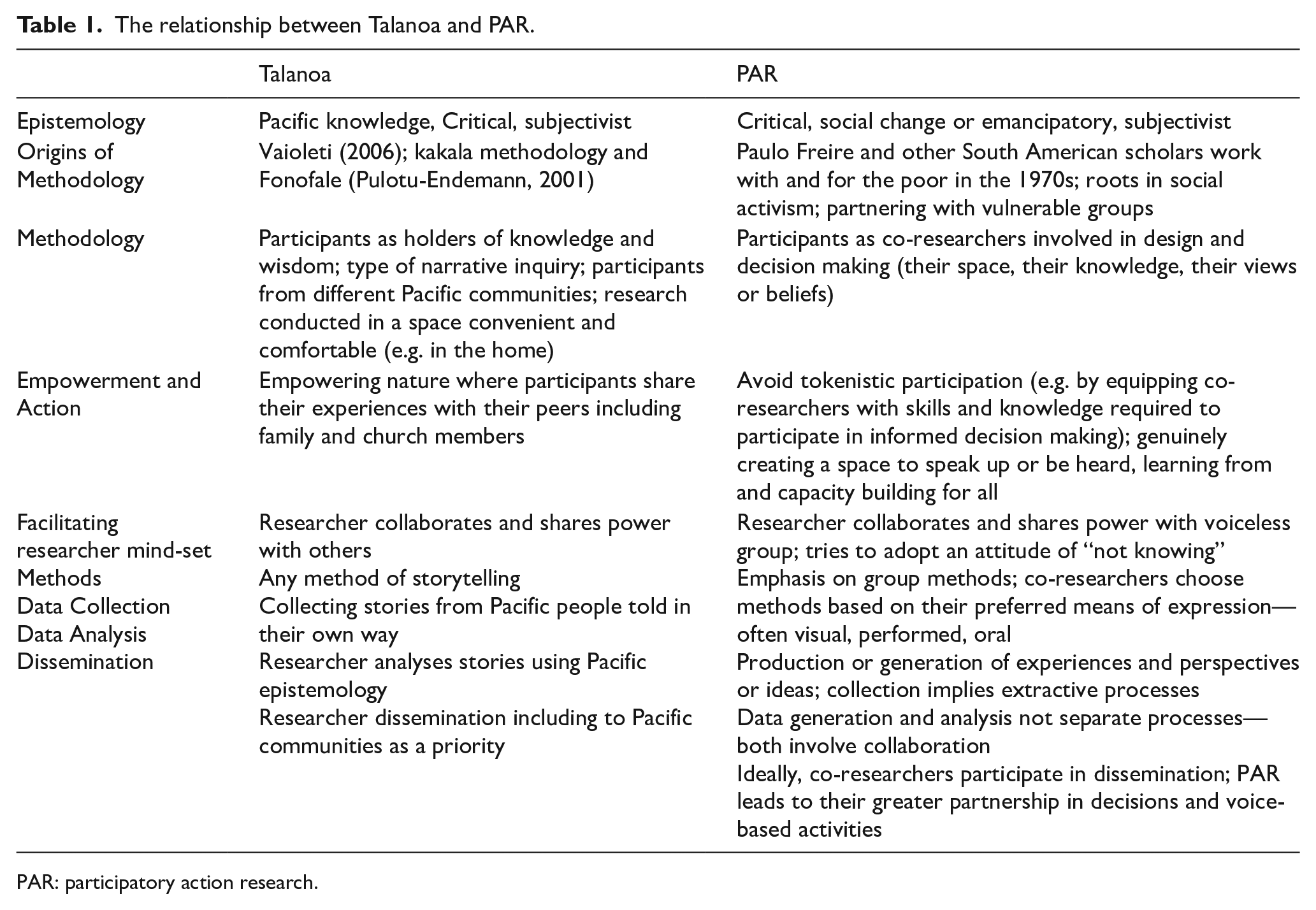
PAR: participatory action research.
For the “bele project”, and in line with seeking an innovative approach to research that respected the context in which it was being conducted, we decided to combine Talanoa, an indigenous worldview, with PAR, a practice methodology. As discussed above, there are many parallels with the two approaches, particularly in terms of collaboration and voice-based methods. However, to date, these approaches have not been readily combined. Talanoa has been used more exploratively rather than as a mechanism for co-design or prototyping during the research process. Due to the synergies around empowerment and change, adapting PAR to align with a Talanoa methodology offered scope for developing a research approach that would align with Pacific Fijian ideologies in this study.
One of the strengths of PAR is the cross-over point between research and development as seen within the action cycle phase. This is the place where gathering and analysing information moves into the world of taking action. Thus, from a community development stance, combining Talanoa and PAR presented opportunities for ensuring the community were active research and community participants in a way that was sustainable after the research had come to an end.
The project utilised PAR methodologies underpinned by Talanoa values and considerations. The methodology broadly followed the four phases of action research—Plan, Act, Observe and Reflect—as described by Kemmis et al. (2004) which were adapted for operationalisation within a Pacific Fijian cultural context. The development of the Talanoa PAR cycle was carried out over a series of meetings with researchers on the project. Discussions centred on the contextual relevance of the PAR process within the Fijian socio-cultural context and the implication of the action research cycle on the research process. The iTaukei values were identified through the Vanua paradigm (Nabobo-Baba, 2008) and were informed by previous Talanoa research addressing iTaukei women’s family planning behaviour (Delaibatiki, 2016). These subsequent adaptations provided broader, culturally relevant definitions of the Talanoa PAR phases while maintaining the action agenda of the original framework (Figure 1). The phases, developed by the project were Veiwekani (relationship building), Talanoa (storytelling), Raica Lesu (reflecting and evaluation) and Veitokoni (dissemination).
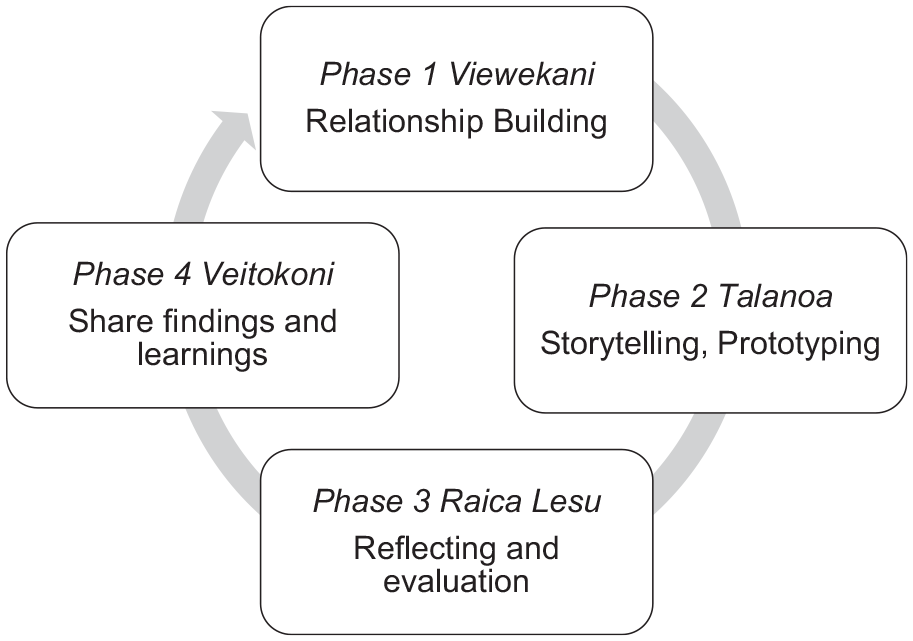
Talanoa and adapted action research cycle framework (adapted from Kemmis et al., 2004). Reproduced with permission from Health Promotion International.
Phase 1: Veiwekani—relationship building and planning
The concept of veiwekani or relationship building activates connection between co-researchers and the research or researchers; a connection integral to conducting robust, culturally appropriate research. Efforts are undertaken with vakarokoroko (respect), acknowledging the value that both parties (i.e. co-researchers and researches) bring to the study (Nabobo-Baba, 2008). It also sets the scene for the type of relationship and power balances that the partnership will entail. Within this phase, we carried out initial scoping of the fruit and vegetable, entrepreneurial and youth space. This involved visiting key stakeholders in Fiji (e.g. University of the South Pacific, Secretariat of the Pacific Communities, Young Entrepreneurs Council, Ministry of Youth and Sport and Ministry of Health and, most importantly, young entrepreneurs) and discussing the project and issues around health, youth involvement and food entrepreneurship.
For the purpose of this research, we were interested in gaining the participation of Pacific youth entrepreneurs living in the Greater Suva area, aged 18 to 45 years. This age range was chosen in alignment with tradition across Pacific Islands (Tuagalu, 2011). An entrepreneur was defined as someone who was working at a healthy food business and was economically active; that is, they were operating their own business and turning over a profit. Youth entrepreneurs were identified through business networks and networks in the community. An advert was disseminated by the Fijian Young Entrepreneurs Council to those who were registered with them, and an information event on the study was provided. We informally spoke to young entrepreneurs at their places of work and at other spaces that were convenient to them (e.g. homes). We introduced ourselves, discussed the project and their potential roles as co-researchers, and asked whether they would like to be involved in the project. This phase involved discussion of family, culture and history, and required researchers to learn about entrepreneurs’ stories. A genuine respect and search for understanding of youth entrepreneurs’ backgrounds led to an exploration of the study researchers’ positioning in the research. From these meetings, 19 young entrepreneurs expressed an interest in the study and were invited to participate in Phase 2.
During this phase, study ethics and regulatory processes were completed in Fiji and New Zealand. In compliance with ethical approval, informed consent processes included participants stating that their names and stories would be available in research reporting and that any use of images and videos would require their sign off. This was considered appropriate because the purpose of the research included promoting their enterprises and raising their profiles using social media and other means.
Phase 2: Talanoa—storytelling, design and prototyping
Following ethical approval and the formation of key relationships, the face-to-face Talanoa sessions began, ensuring that all forms of communication (verbal and non-verbal) were observed. These interactions were important for ensuring familiarity and comfortability within the Fijian worldview (Nabobo-Baba, 2008; Tuwere, 2002). In the Talanoa sessions, young entrepreneurs further discussed their backgrounds and motivations for starting a fruit and vegetable business. Their perspectives on healthy eating in Fiji—both barriers and facilitators—were sought, along with suggestions for improvement. Some Talanoa sessions involved working through key examples, strategies and avenues that the entrepreneurs developed to facilitate their business. These efforts reflected the “action” phase of the research, whereby co-researchers developed actionable outputs for their businesses.
To assist co-researchers in developing strategies, a social media workshop was organised that provided them with tools and skills to take their businesses online. The social media focus was considered an integral aspect of business marketing and advertising that young entrepreneurs felt was needed in Fiji. A total of 19 participants attended the workshop (following recruitment as per Phase 1), which provided the co-researchers with training in marketing their products on social media.
At the workshop, a further invitation was offered for participants interested in sharing details of their personal story and, of the 19 participants, 6 volunteered to continue with the project Phases 3 and 4. Subsequently, two participants withdrew from the study due to personal reasons. Overall, 10 Talanoa sessions were conducted with four youth entrepreneurs and lasted 1 hr on average. The sessions were digitally audio-recorded and occurred at venues that were convenient for youth entrepreneurs (e.g. homes, business offices or sites). Although the Talanoa sessions ranged in topics covered, there was a focus on “action” through strategy development. This is a critical feature of the approach that moved beyond storytelling to solution building with actionable outputs.
Phase 3: Raica Lesu—reflecting and evaluation
This phase involved reflecting on Phases 1 to 3. Within the Fijian worldview, it was important to review the actions that co-researchers developed during Talanoa sessions (e.g. social media marketing strategies), and their experience with working with the study and researchers. In contrast to solely focussing on actionable outputs, this phase included reflection and evaluation on the research process which aligned with Fijian research framing principles. These considerations were important for maintaining the veiwekani principle that initiated the work. For the actionable outputs, the evaluative process involved face-to-face Talanoa sessions with co-researchers showcasing their action outputs. We visited their homes and places of work to get a sense of how their action strategies were being implemented and received. For action outputs that did not work well, we discussed reasons for why it did not work and strategies for future development (e.g. social media marketing and the need for more training and technological support).
Phase 4: Veitokoni—share findings and learnings
Veitokoni means “looking after” each other; in this case, the co-researchers and work or space the research occupied. At the forefront of the dissemination processes was the need to ensure that co-researchers and communities were “looked after”, and that their knowledge was used to transform health outcomes and improve collaboration and solution building. Throughout, co-researchers were given the best opportunities for sharing their stories and experiences, and were involved in various project dissemination activities (e.g. conference presentations, written reports). Co-researchers were also provided with useful links to other sectors (e.g. Ministry of Health) with whom they could initiate communications. These efforts ensured that dissemination plans moved beyond traditional publications to avenues or audiences in Fiji and the region that would benefit from learning of youth entrepreneurs’ experiences and perspectives.
Discussion
This article has highlighted Pacific theoretical approaches that align to key elements of indigenous research methodologies, as outlined in Smith’s (1999) project categories, which explain how indigenous researchers have investigated, theorised and developed indigenous ways of knowing and doing. Within these examples, the current use of Talanoa and PAR demonstrates the following:
Storytelling—the use of Talanoa affirms the Fijian way of offering stories, information, insights and perspectives. Within the “bele project”, Talaona provided a means to collect and affirm Fijian participants’ stories. This placed the power and research drive largely in the hands of the youth entrepreneurs, requiring the research team to be fully reliant on the Fijian entrepreneurs’ experiences. These dynamics ensured vakaorkoro was perpetuated throughout the exchanges with the researchers discussing or raising questions in response to, and in respect of, the Fijian entrepreneurs’ reality. Within the realm of vanua, these exchanges required a level of understanding of iTaukei social cues, cultural norms and mannerisms.
Writing and Theory Making—This article provides insight into the way Pacific Talanoa can be contextualised and grounded within research and ethnic Pacific paradigms (e.g. iTaukei) for a specific Pacific ethnic group (Fijian). It also offers understanding into the way an indigenous Pacific framework, in this case iTaukei, can be conceptualised as the theoretical basis from which Talanoa can be framed and from which a non-Pacific research approach (i.e. PAR) can be aligned methodologically. Although this study is not the first time Talanoa and PAR have been used together methodologically (Conn et al., 2016), it is the first time a Pacific ethnic paradigm has been used to ground both methodologies within the wider research question.
Representing—throughout the research process, youth entrepreneurs had representation as co-researchers and co-developers of strategies that might help improve their business. Their perspectives, stories and experiences are represented through the process of veitokoni which, as stipulated by Smith (1999), goes beyond the confines of the Talanoa sessions to conference and larger scientific audiences that have key decision makers from the health and government sectors. Such representations at these forums are essential for youth empowerment. The significance of being a Fijian youth entrepreneur, among other Pacific groups, provides further representation within regional health and NCD discussions.
Sharing—the iTaukei values of veitokoni centre on the notion of shared outcomes and understanding from the research and investigation. The inclusion of youth entrepreneurs as partners in the PAR process reaffirmed the desire within the approach for collective and mutual benefit of the research findings and process. To further these efforts, Phase 4 of the Talanoa PAR process involved the further expansion of research findings beyond the research team to wider health and business sector officials and regional audiences.
Reflections on the research process
The veiwekani (Phase 1) of the project provided an opportunity for the research team to engage with local youth entrepreneurs and stakeholders, thereby ensuring that the research processes were aligned with the Fijian cultural worldview. Datta et al. (2015) and Kovach (2009) have critiqued PAR as undermining indigenous knowledge, and we were cognisant of the relationships that needed to be established with youth entrepreneurs and the various sectors to be included in the project. Similar to Nabobo-Baba’s (2008) vanua research framework, which embeds the principles of Na navunavuci (conception), Na vakavakrau (preparation and planning) and Na I curu curu (entry), Phase 1 of the project took 2 years of preparation (working with stakeholders and youth entrepreneurs) to establish relevant processes and connections, and finalise our approach. This ensured that Talanoa sessions (Phase 1) and raica lesu (Phase 3) were carried out in culturally appropriate ways, and aligned with young entrepreneurs’ schedules and intentions.
Nabobo-Baba’s (2008) discussion on accountability and vakarogotaki lesu tale and taleva lesu (reporting and informing, and visiting communities) was an important stage throughout the research process and included visiting with local stakeholders to present study findings and youth entrepreneurs’ stories. Youth entrepreneurs were included in the presentations, and were encouraged to take a lead in dissemination activities as experts in their own lives and reiterating their roles as co-researchers in the Talanoa PAR research approach. This approach has led to the inclusion of youth entrepreneurs in discussions regarding childhood obesity and NCDs in Fiji and the wider Pacific region, at such events as a Pacific region health forum held in Nadi, Fiji, in February 2019, and instigated key stakeholders to think more broadly around the inclusion of the private sector, business, social enterprise and youth in the response to promoting good health in Fiji.
The Talanoa sessions revealed that traditional knowledge systems and family were integral to how youth entrepreneurs envisioned and developed their businesses. Blending Talanoa with PAR or, as Ryder et al. (2020) described, “weaving a research interface” was critical for ensuring tradition was not lost or decolonised in the project. Creating a successful business was not just for individual gain, but was understood as having wider community benefits; hence, the value in hosting a social media workshop as part of the Talanoa sessions. Social media, as a business tool, can greatly impact a country in terms of both economic growth and developing communication. Fijian people continue to show interest and active use of social media. As another means of sharing one’s passion, skills and knowledge, training in social media and marketing skills is important for youth entrepreneurs who have potential to influence changing patterns of health within their communities.
One of the major challenges faced in this research was finding active young food entrepreneurs as the environment offers few opportunities to grow small local business with a healthy food focus. It was hoped that advancing knowledge via the social media training would offer another avenue through which this group of fruit and vegetable youth entrepreneurs might share their successes and encourage others to take part in the industry. Although some might argue that four participants is a small number for a PAR project, those who agreed to participate were already established and, therefore, perhaps more confident, motivated and socially aware. Thus, they had a depth of experience to offer in terms of learning for others.
The project revealed the fit between combining Talanoa and PAR approaches which, although time-consuming and resource-heavy in application, proved valuable in building sustainable relationships through which change can be nurtured over time. Given the contemporary context in which youth are currently working, especially within the private business and social entrepreneurial sector, layers of social cultural norms which deviated from indigenous traditional practices needed to be considered. The value of acknowledging indigenous values and worldviews was that it provided a reference point from which to base contemporary practices, providing a rich cultural lens through which we undertook the study.
Challenges to this approach are twofold. The first stems from decision makers not taking the findings of PAR seriously because “it is based on the voices of, and the knowledge of, the subjects of the research” (Waite & Conn, 2011, p. 129). The second lies in the epistemological differences that can make aligning indigenous paradigms with non-indigenous paradigms difficult (Datta et al., 2015; Kovach, 2009). Remedies to these issues lie in further exploration of indigenous paradigms that bring indigenous approaches to the fore of methodological theorising.
Conclusion
The “bele project” was an opportunity to seek and examine alternative, innovative approaches to understanding critical issues within the health and social well-being of Fiji. Focussing on youth entrepreneurs who possessed a high level of social awareness around food and activism in the community, the Talanoa and PAR methodologies provided a framework for research and development in this space. Talanoa is continuously evolving as a methodological foundation that informs research and is flexible to changing socio-cultural contexts and realities in the Pacific. PAR provides transformational opportunities for growth and change in research and development. Used together, Talanoa and PAR provide forward thinking, community action-orientated outcomes that reflect community needs. We acknowledge, however, the scope of such methodological redesign and call for further conceptualisation of the use of indigenous paradigms and methodologies.
Historically, indigenous methodologies and practice-based methodologies have tended to be siloed, with researchers choosing either one or the other. While some critics might argue that either singly or combined, such an approach would not be taken seriously by sectors of the scientific community who might deem it too small, non-positivist and not “mainstream”, we argue that a combination of indigenous and practice-based approaches is essential for moving forward and guaranteeing research that works for the benefit of community development and overall health and well-being.
Footnotes
Declaration of conflicting interests
The author(s) declared no potential conflicts of interest with respect to the research, authorship and/or publication of this article.
Funding
The author(s) received no financial support for the research, authorship and/or publication of this article.
