







Abstract
The purpose of the study was to examine whether Ethiopian oral stories and narratives, known as teret-teret (a story, a story), could be used as a psychotherapy technique in Ethiopia. Thirteen participants were purposively chosen for the study based on their experience with teret-teret application. They included nine elders, two folklore experts, and two counselors. In-depth semi-structured interviews were used to collect data, which were analyzed using thematic content analysis. The findings demonstrated that teret-teret was a beneficial psychotherapy technique used in Ethiopia to help young adolescents mitigate their socio-emotional and behavioral challenges. The implications of the findings highlight the necessity of reconstructing and using teret-teret in structured and formal ways in schools, childcare facilities, and communities. It also suggests that future studies should concentrate on extended longitudinal studies that use a mixed-methods design.
Introduction
As a cosmopolitan continent, Africa has a wealth of Indigenous knowledge. Cultural arts (Tuttle, 2018), riddles (Chala, 2016), storytelling (Jirata, 2019; Lenox, 2000), proverbs, folktales, demonstration, sport, epic, poetry, logic, praise, songs, word games, puzzles, tongue twisters, dance, and music are just a few examples of the expression of Indigenous knowledge (Finnegan, 2014; Owusu-Ansah & Mji, 2013). The application of teret-teret (a story, a story) is one of the most common types of Indigenous knowledge in Ethiopia. Teret-teret is a term that symbolizes socio-cultural stories such as folktales that embed surface and metaphorical meanings that young adolescents can investigate and link to their living situations for self-improvement. In this context, teret-teret is a traditional Indigenous play based on oral traditions, in which stories are passed down from generation to generation (Jirata, 2019; Kovach, 2020).
Although teret-teret is used in Ethiopia, its history, settings, and socio-emotional and behavioral values are still being researched. According to Ashenafi (2015), Ethiopian stories are abundant and powerful when socializing youngsters. However, empirical validation of research to incorporate these stories into children’s literature is still pending. As a result, the current study investigated the application of teret-teret as a psychotherapy technique in Ethiopia. The following research question guided this study: How do elders, folklore experts, and counselors experience the application of teret-teret as a psychotherapeutic technique to support young adolescents experiencing socio-emotional and behavioral difficulties (SEBDs)?
Background
Indigenous stories in folk psychology represent the meaning of long-held beliefs and therapeutic methods. This includes a wide range of ideas, including personal agency, human understanding, inner healing capability, self-image, personal security, and moral lessons (Mohatt, 2010; Ojelade et al., 2014). As a result, the authors of the current study explored how participants felt about the long-standing traditions, settings, and psychological values associated with using teret-teret in Ethiopia. The authors discovered empirical evidence on socio-cultural storytelling traditions and the importance of storytelling circumstances where elders connect and share their experiences with family members (Engel et al., 2018; Huisman, 2014). In other research, story recitation is used to provide emotional support to children in residential care (McLean & Tuite, 2015). Furthermore, teachers use narratives to encourage students’ curiosity in the classroom (Niemi et al., 2014; Smeda et al., 2014) and for health behavior promotion in settings, such as health care and community welfare (LeBorn et al., 2014; Rieger et al., 2018).
Teret-teret necessitates a dynamic interplay between the contents, the story’s characters, the storyteller, the audience’s inner psychological factors, and the overall narrative settings. The mechanism is that stories keep young teenagers’ imaginative attention, which motivates them, promotes conversations, and broadens their learning possibilities (VanSledright & Brophy, 1992; McCann et al., 2019). As a result, research shows that positive narrative therapy using traditional fairy tales is an effective strategy for youth psychological well-being (Ruini et al., 2014). Numerous studies have proven the caring part of storytelling, which encourages youngsters to develop good behaviors, ideas, and emotions (Mohatt, 2010; Ojelade et al., 2014). In that case, the youth sharpen their cognitive and literacy skills (McKeough et al., 2008; Rahmani, 2011), improve their language and communication competencies (Oduolowu & Oluwakemi, 2014; Samantaray, 2014), develop positive moral and social behaviors (Finnegan, 2014; Jirata, 2019), and promote their career aspirations (Balas-Timar, 2015).
On the other hand, resolving socio-emotional and behavioral difficulties (SEBDs) is one of the helpful components of narrative. For example, it is beneficial to support adolescents experiencing aggression (Asl et al., 2015; Beaudoin et al., 2016) and juvenile delinquency (Coleman & Ganong, 1990). Again, storytelling therapy aids in the treatment of emotional problems like anxiety (Akay & Bratton, 2017; Ruini et al., 2014), depression (Gaudiano et al., 2017), and withdrawal (Asl et al., 2015; Cramer, 2016). Other evidence suggests that storytelling therapy can help children reduce bedtime resistance and frequent night waking (Burke et al., 2004; Moore, 2004) as well as encourage self-help and self-feeding habits (Ali & Saad, 2016; Chinnak et al., 2020). As a result, this study confirmed that teret-teret is used in accordance with its tradition, contexts, and socio-emotional and behavioral values.
Positonality
The term positionality describes the worldview of a researcher, which includes their socio-cultural and demographic background, their ontological assumptions, their epistemological assumptions, and their assumptions about human–agency interaction (Holmes, 2020; Rowe, 2014). Positionality is another word for how a researcher places oneself in regard to his or her own social, political, cultural, and personal origins, as well as the context of the study, which is likely to have an effect on each stage of the research process and its outcomes (Hampton et al., 2021). In that sense, in qualitative research, researchers are not distinct from the social processes they examine. Considering the fact that we, the study’s authors, are a part of the social reality of storytelling practices for child and adolescent development, and that other social actors, like elders, have already contributed to its interpretation.
Author 1 is a male Ethiopian with a background in counseling psychology. He has taught counseling and psychotherapies in universities for a number of years. He had, however, been thinking of psychotherapies for children and adolescents that were developmentally and culturally appropriate. In keeping with that, he is aware that storytelling, or teret-teret, is a long-standing Ethiopian tradition for children and teenagers throughout the majority of the country’s 86 ethnic groups. With this circumstance, Author 1 was taken back to his happy childhood when dealing with teret-teret as a study topic. During the dry seasons, they used to sit on oxide or palm mats in the moonlight and play games with neighborhood children and other families using teret-teret as a mode of communication. They enjoyed spending time with their nuclear family around the fire at home during the rainy seasons and reciting teret-teret. In this regard, Author 1 was not an objective observer of the issue raised by the study; he is aware that teret-teret is a tradition that has existed in Ethiopia with the intention of entertaining and educating teenagers, but teret-teret also serves other purposes and has some other realities that Author 1 is unaware of. For example, he is unaware of the psychotherapeutic functions of teret-teret in his context. Furthermore, while coming from the same background as the research participants, the author had no prior knowledge of them; rather, they were all chosen through a snowball selection based on their prior involvement in children’s and teenage storytelling experiences. Although research assistants were responsible for data collection, the authors were responsible for data processing and interpretation. Debriefing and audit trials, however, were carried out throughout the paper’s final stage.
Author 2 is a female Indian South African professor, but she had no relationships with the study’s participants nor engaged directly with the study participants. She has been an Educational Psychologist and professor for many years and has conducted in-depth research on the psychological development of children and adolescents and methods for addressing their social and emotional wellness. She is also aware that storytelling could serve as a useful means of providing psychological assistance for children and adolescents. She did not participate in data collection and analysis; however, she made contributions to conceptualizing the research problem as well as providing expert assistance with the study’s organization, presentation, interpretation, and discussion of the findings.
Author 3 is a female White South African professor, but she had no relationships with the study’s participants nor engaged directly with the study participants. She has worked as a psychology professor and researcher for a number of years using mixed methods to address complex and novel socio-culturally constructed research problems. Drawing on her psychological knowledge, she is aware of the power of storytelling as an appropriate technique for children and adolescents’ psychological support. Despite not participating in data collection and analysis, she conceptualized the study’s problem and made a professional contribution to the study’s organization, presentation, and interpretation of the results.
Research methods
The design of the study
A qualitative approach, with a narrative phenomenological design, was used. Its purpose was to explore participants’ own experiences with using teret-teret as a psychotherapy strategy to work with young adolescents in Ethiopia.
Participants
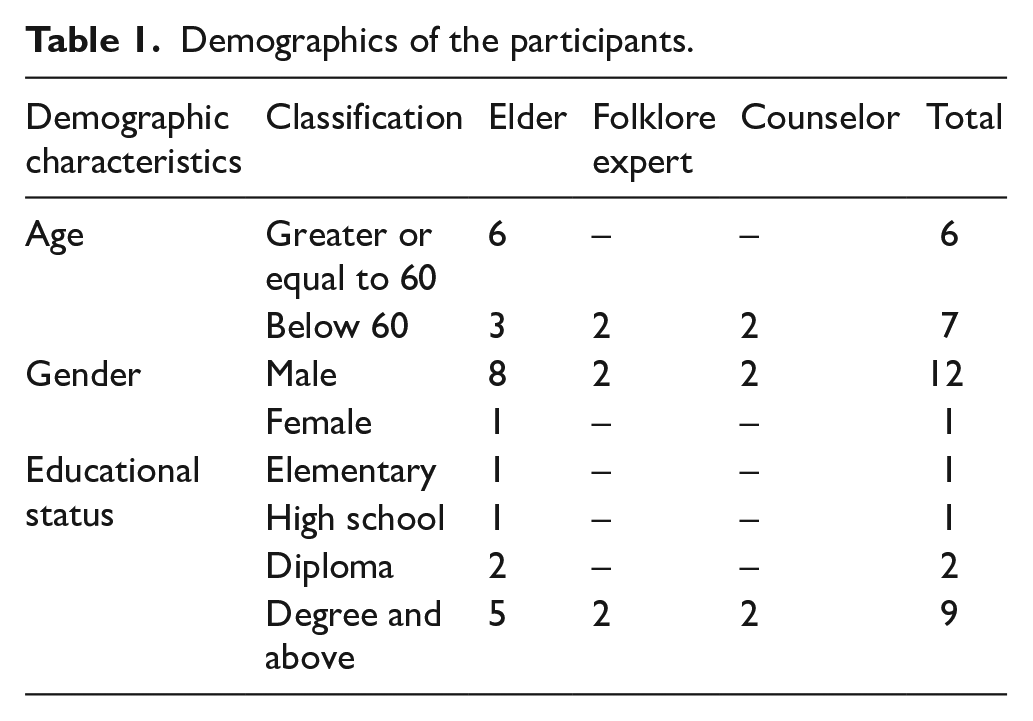
In total, 13 people took part in the study, including 9 elders, 2 folklore experts, and 2 counselors. The elders were chosen based on their experience working with young adolescents on teret-teret, while the folklore experts were selected based on their teret-teret study and research experience. In addition, the counselors used their knowledge to look into the relationship between the symptoms of various SEBDs and the teret-teret in question. Table 1 summarizes the demographic profile of the participants.
Demographics of the participants.
Instrument
To gather information, semi-structured in-depth interviews were conducted. For elders and folklore experts, 10 open-ended questions were posed. Following the collection of demographic information, the participants shared their perspectives on Ethiopia’s socio-cultural storytelling tradition and circumstances. The research assistants then defined eight different categories of youth SEBDs as the classifications made by Achenbach (1991). Then, the participants presented exemplary terets that may be used as a psychotherapeutic strategy in accordance with the types of SEBDs. Following that, the participants expanded on their individual experiences with regard to the surface-allegorical meanings and psychotherapy ideals. Finally, counselors emphasized the psychotherapeutic value of each of the terets offered by elders and folklorists. Interviews were digitally recorded and later transcribed.
Methods of data analysis
Thematic content analysis was used to analyze the data. Based on two coding methodologies, the interviews were transcribed and coded. Importantly, participants’ experiences with the implementation of teret-teret in Ethiopia were described using data-driven coding. Researcher-driven coding was adapted from Achenbach’s (1991) classifications of youth Socio-emotional and Behavioral Difficulties (SEBDs) as a theoretical foundation. As a result of the transcription and analysis, three codes were generated: Code 1: teret-teret tradition and cultural space, code 2: teret-teret contexts, and code 3: teret-teret dynamics as psychotherapy approaches. Finally, the codes were coalesced into other formats such as themes based on their common key properties. The theme, sub-themes, and categories are presented in Table 2.
Thematic outline of the data analysis.
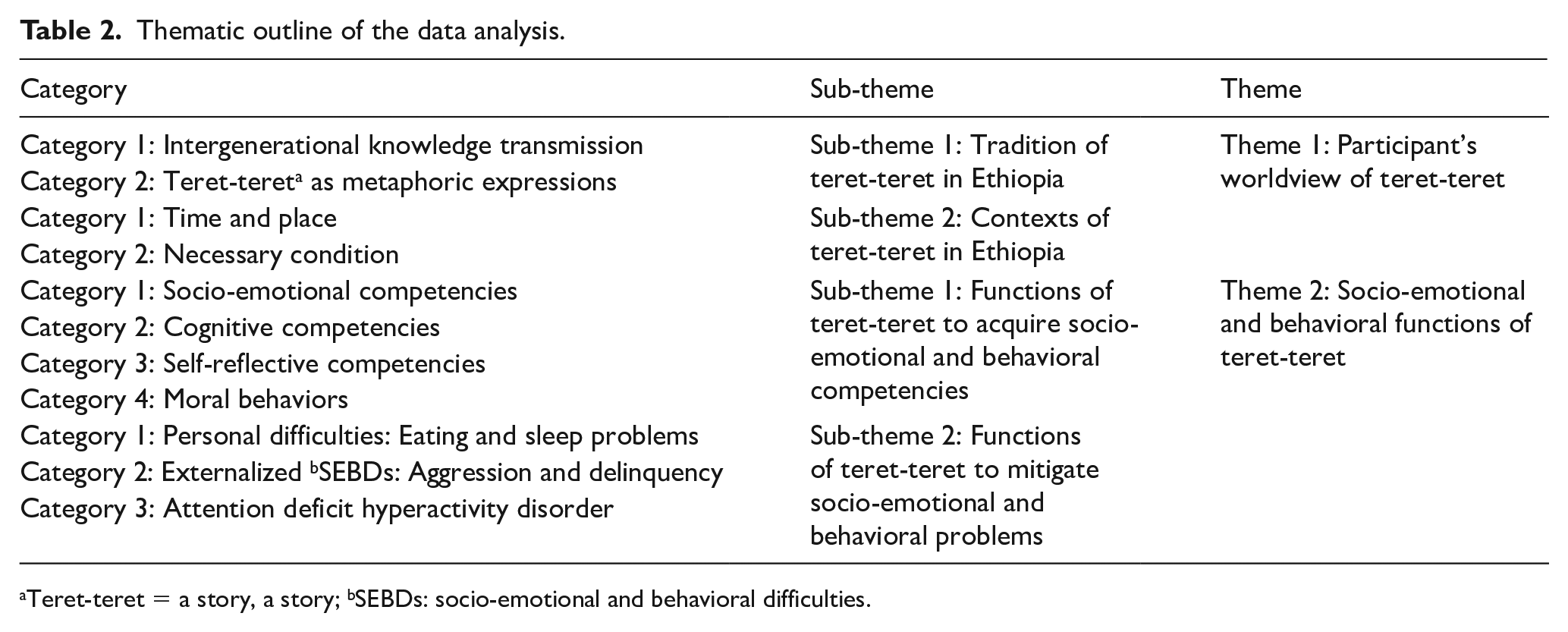
Teret-teret = a story, a story; bSEBDs: socio-emotional and behavioral difficulties.
Trustworthiness
A longer interaction was required to gain a thorough grasp of the data, guarantee the accuracy of the data, and better comprehend the settings of the tale recital. On the other hand, data source triangulation was carried out by assembling informants from elders and folklore experts to elicit extensive experience and opinions on the use of teret in Ethiopia. Furthermore, the participants discussed and analyzed the impact of inadvertent underlying personal attitudes and biases on the study’s method and outcome during and after data collection. Similarly, an audit trail was used to create a relationship between the data and data analysis processes.
Ethics approval
The affiliated university granted ethics approval. Furthermore, the research participants’ informed consent was obtained.
Findings
The purpose of the study was to gain understanding regarding the practice and use of teret-teret as a psychotherapy technique from Ethiopian elders, folklore specialists, and counselors. Information was gathered from the participants to support teret-teret as psychotherapeutic techniques in the Ethiopian context. Based on the data, two themes have emerged, each of which has a variety of sub-themes and separate categories. The findings are presented below.
Theme 1: participants’ worldview on the practice of teret-teret in Ethiopia
The term worldview refers to the different perspectives that the participants have on using stories based on their real experiences. Ethiopians practice stories to teach their children the virtues of coexistence, cooperation, and sharing. Ethiopian stories also include animal characters including lions, hyenas, foxes, and monkeys as well as inanimate objects like trees, earth, the sun, water, and fire. The house is the typical place where parents entertain and socialize their children, but grazing fields, schools, and locations used for rites and ceremonies are other options. Fekade Azeze (1991) further notes that Ethiopian story recitation has a distinct stage of development. Stages 1 through 7 are referred to as the introduction, the beginning, the narration, the conclusion, the termination, the discussion and reflection, and the finalization. In keeping with this understanding, theme one is divided into two sub-themes, each of which includes two categories, which are shown below.
Sub-theme 1: the tradition of teret-teret
Oral storytelling by elders, parents, teachers, and peers has been a long-standing socio-cultural tradition in Ethiopian culture. As a result, assertions made by research participants revealed that Ethiopia’s storytelling heritage is preserved through an intergenerational link in child development processes.
Category 1: intergenerational knowledge transmission
Teret-teret, as an intergenerational type of knowledge transfer, exemplifies the continuity of wisdom transmission through generations. The practice is still carried out in Ethiopia’s modern society. Elder 3 and Folklorist 1 produced evidence to back up their claims: The current generation narrates stories based on what their grandparents and moms taught them. For example, they listen to teret-teret and react to it in schools. Following that, the children begin a new conversation about the tales with their relatives at home. So, teret-teret play a vital role in raising children and allow them to develop appropriate behaviors. (Elder 3) Folktales are relics from the past that serve as a main channel for passing on ancestors’ experiences and knowledge to future generations. (Folklorist 1)
In Ethiopia, the teret-teret illuminates the junction between previous and current generations. As the present generation gains experiences from their ancestors through the voice of teret-teret, this preposition is asserted by Elder 3 and Folklorist 1. Elder 3 also emphasized the reciprocal and multidimensional relationship between schools, young people, and families in the extension of knowledge and experiences through teret-teret. As a result, the accumulation of experiences has a magnified effect, encouraging moral behavior and passing on valuable knowledge.
Category 2: teret-teret as a metaphoric expression
In Ethiopia, teret-teret is communicated through symbolically represented utterances and circumstances. The ironic interpretations provided by the meanings linked to the terms assist the listener in examining the deep implied meaning rather than the literal comprehension. Based on the people and ingrained behavior shown in the tale, it is useful for ethical practices and promotes self-observation. Elders 1 and 2 shared the following opinions in support of this understanding.
A lion’s fist is quite strong. It has the ability to kill and consume a wide range of animals. It is abrasive, but it’s not necessarily effective. Animals, especially monkeys, are aware when the Lion is agitated and avoid approaching it. Despite its strength and aggression, the lion has been repeatedly kicked back by a monkey and even slain by a swarm of ants. As a result, we have been using metaphoric metaphors to teach kids about undesired behaviors like aggression. That is to say, while the Lion’s bravery is wonderful, its hatred and plotting to murder others is not. (Elder 1) To engage the audience’s imagination and intellectual desire, as well as to ensure that the audiences are ready to absorb the message of behavior change, we begin storytelling with the words “in the ancient days there was” . . . . In metaphorical expressions, animals, land escapes, plants, rivers, stone, and other living and non-living things are used. We employ all metaphoric expressions to care for the psyches of the audiences to allow the audiences gaining perspective by analyzing their behaviors, thoughts, and feelings after hearing the story. (Eder 2)
Through metaphoric words, the participants directly highlighted the use of teret-teret in the above assertions. Both Elder 1 and Elder 2 emphasized the importance of symbolism in this debate. To arrange for perspective sensing, symbolization requires representing a phenomenon or a character with an alternate imagined character in a story. Elder 1 offered the lion and ants as illustrative metaphoric items. The lion is a symbol of courage and aggression, but the ants were chosen as emblems of solidarity to represent their strengths. Character casting in Elder 2 presented potentially valuable objects for drawing picture associations with imaginary characters, which could later be translated into real-life circumstances. In addition, the symbolization serves as a moral and psychological shield.
Sub-theme 2: contexts of teret-teret: time, place, and conditions
The background of teret recitation mentions contexts. It is the setting in which the teret-teret elements are united. To obtain meaning and inspiration, the audience makes connections between the physical location, the moment, the theme, and the characters. Pre-conditions for reciting teret-teret are also mentioned as context elements. Attention, listening, dialogue, and privacy are just a few examples. These circumstances help to clarify and establish the reliability of teret application in Ethiopia. The next two categories from Sub-theme 2 provided supported evidence based on the tendency stated in the contexts of teret-teret.
Category 1: time and place
When the proper time and place are established, teret-teret becomes effective. Rooms furnished with Indigenous products and kits, such as cattle models with living pens, yolk and pillow, mat, and others, appear to give more emphasis to the Ethiopian backdrop of storytelling’s indignity. The setting is meant to encourage proximity, group interaction, and competitive involvement. These include evenings spent with family, classrooms in schools, and weekends spent at leisure centers. The following verbatim quotations from Elders 1, 4, and 9 support the preceding discussion: In Ethiopia teret is recited in the evening for young people to instruct and build competitiveness via question and answer. However, parents bring their children to this recreational center on Weekends and Holidays from 2:00 a.m. to 12:00 p.m., and I read stories to the youngsters. (Elder 1) When I was a youngster, my parents would recite us stories in the evenings, but today I read stories for my children on weekends and other occasions when they are free from scholastic obligations (studying, doing homework, going to a tutorial, etc.). I also utilize stories in the classroom to convey lessons and draw students’ attention to what I’m teaching. (Elder 4) I pick before bedtime since it is a good time for my family to gather together and share stories. It also aids in the preparation of my children for undisturbed sleep, which is beneficial to their brain development. (Elder 9)
Various contextual elements during teret-teret are highlighted in the above perspectives. That is to say, a suitable time and location are essential. Elders 4 and 9, for example, frequently asserted that teret is recited in the evening within a family environment since the household has gathered from school, farm area, grazing land, playfield, or market. This is when children benefit from informal learning chances and receive emotional and behavioral support from their family members. Elder 1 and Elder 4 also highlighted weekends as good times to recite teret. This is because modern families are preoccupied with their jobs, and children attend school from Monday to Friday. As a result, family members visit amusement parks on Saturday and Sunday to listen to teret, share ideas, and participate in question-and-answer games. In addition, Elder 4 recite teret-teret in a classroom as an ice breaker to pique students’ interest in the lessons being taught.
Category 2: necessary conditions
Listening with great attention and privacy is the skill of powerful teret-teret. Indeed, this is dependent on the storyteller’s abilities, the structure of the teret-teret setting, and the audience’s comprehension level. A skilled storyteller, in particular, prepares the audience to pay attention to all of the story’s methods, contents, and outcomes. In addition, the storyteller encourages the audience to participate in activities such as questions and answers and sets the stage for conversation. Without a doubt, the audience is better equipped to comprehend the surface and implied meanings depicted by the teret-teret. In the following sections, Elders 4 and 5 share insightful perspectives.
Capturing attention/creating curiosity is the most powerful factor in accomplishing the anticipated change in behavior. (Elder 4)
These statements are used to assess readiness by posing questions and ensuring a response.
The question is, “Teret-teret?” “Ye’lam beret (literally, a cow’s pen; metaphorically, telling as many stories as could fill a cow’s pen)!” is the answer.
Privacy and calmness are required for telling a good story. To keep the mind fresh, stories are told in the evening, before dinner, and early in the morning. Currently, I visit this youth correctional institution on a regular basis to teach the young teenagers using stories, riddles, proverbs, and metaphoric expressions. I have been doing it every Saturday morning, but on other days when the young teenagers are out of school, I have done it by appointment. (Elder 5)
Paying attentive attention during teret-teret is, therefore, an important contextual component. At the end of the session, the storyteller asks questions and facilitates conversation to generate learning opportunities. Elder 4 stressed the need for capturing listeners’ attention as a required but not sufficient aspect in teret-teret. In support of this claim, Elder 4 asserts that when a tale reciter says “teret-teret” at the start of a story, an attentive audience responds with “ye’lam beret!” demonstrating that the audience is paying attention to the storytelling process. Elder 5 further focused on the importance of teret-teret attention in relation to the appropriateness of narrative time, place, and privacy. Morning and evening are critical times to ensure privacy while still encouraging engaging connection.
Theme 2: socio-emotional and behavioral functions of teret-teret
The main objective of this theme is to clarify the roles played by teret-teret in relation to the behavioral and socio-emotional contributions of teenagers. With this knowledge in mind, the research participants lensed their experiences with teret-teret, a technique that has two major functions for working with teens. The first function has a focus on the development of affective and behavioral abilities, with the role of teret-teret as a proactive tool for preventing the emergence of socio-emotional and behavioral problems by assisting children in gaining essential socio-emotional and behavioral skills. Teret-teret, on the other hand, is a retroactive technique that aids in conducting behavioral and socio-emotional intervention. In this sense, this theme is divided into two sub-themes, with Sub-theme 1 having four categories and Sub-theme 2 having three. The discussion of these follows.
Sub-theme 1: functions of teret-teret to acquire socio-emotional and behavioral competencies (SEBCs)
Teret-teret as a communication tool aids in the development of socio-emotional and behavioral competencies. Socio-emotional and behavioral competencies are the combination of psychosocial and motor skills that include young adolescents’ participation in household duties such as babysitting and cleaning. Furthermore, participants indicated that teret-teret aided young adolescents in developing social, emotional, and behavioral competencies like relationship skills, partnership skills, communication skills, trustworthiness, and respect. The SEBCs are illustrated in the following sections as teret-teret is useful in developing socio-emotional skills, cognitive competencies, self-reflective competencies, and moral behavior.
Category 1: develop socio-emotional competencies
The term socio-emotional refers to positive interpersonal, emotional, and personal skills. Interaction skills, helping behavior, and assertiveness are all part of the social side. Respect, tolerance, patience, love, trustfulness, politeness self-regulation, and self-understanding are examples of emotional competences. Elders 2, 3, 4, and 8 each made a statement about this point of view: Children can learn good interpersonal connection skills and self-regulatory behaviors, such as respect, tolerance, and helping behavior—cooperation. (Elder 2) Stories assist to create and enhance familial relationships; a sense of brotherhood and sisterhood. Children can be stimulated to develop intellectual curiosity through participatory methods. (Elder 3) I use stories to educate children about their rights and responsibilities. (Elder 4) Terets are beneficial for youngsters to avoid egoistic behavior and to build a sense of selfless behavior. (Elder 8)
Within the understanding of teret-teret as a tool to assist young people in acquiring socio-emotional skills, four participants shared their opinion to support their position. Elder 3 specifically mentioned teret-teret as a significant tool for teaching young adolescents about various social abilities in order to strengthen family bonds, share experiences, and entertain one another. Similarly, Elders 2 and 8 have focused their attention on teret-teret, which plays an important role in the development of cooperative disposition and altruism, respectively. Elder 4 emphasized teret-teret in this situation to assist the young generation in developing the skills necessary to protect rights and fulfill responsibilities. Elder 2 demonstrated the contributions of teret-teret elaborated in connection to appropriate emotional functioning in comparison. He underlined that self-regulatory skills such as respect and tolerance might be desirable results of teret-teret socialization. Following Elder 2’s lead, Elder 8 confirmed teret-teret as a means of overcoming egoism and replacing it with an adaptable personality.
Category 2: develop cognitive competencies
Cognitive competencies are mental processes that indicate people’s reasoning, decision-making, problem-solving, and curiosity skills. Teret-teret has undoubtedly been used in Ethiopia to help young adolescents develop cognitive skills. Elder 5, Elder 6, Elder 8, and Folklorist 1 offer suggestions for each of these claims: Stories are primarily vehicles to help children be steady and employ thoughtful decision-making and problem-solving. (Elder 5) When youngsters listen to stories, they try to evaluate their thoughts, emotions, and actions, and then adjust in order to acquire the desired healthy behaviors. In addition, youngsters learn to pay attention to what they are listening to, to be curious, and to comprehend metaphoric content. Furthermore, build problem-solving, decision-making, and relevant-answers competencies for any environmental demands. (Elder 6) The bulk of stories are not recorded, but rather oral traditions, and they are quite useful in helping youngsters and young adolescents acquire a sense of cognitive inquisitiveness, among other things. (Elder 8) Children learn their traditions, norms, and values embedded in different stories. It delivers calming stories as they internalize the meanings in the story of being peaceful and morally stable for effective decision-making and problem-solving. (Folklorist 1)
All of the above participants agreed that using teret-teret appeared to improve the cognitive abilities of young adolescents. For the most part, the teret-teret practice aims to strengthen decision-making and problem-solving abilities. Elder 6 aimed to reveal teret-teret as a way to further enhance the skills of rational emotion control among young adolescents. In addition, according to Elder 8, teret-teret is thought to improve cognitive inquisitiveness.
Category 3: develop self-reflective competencies
Participants said that the practice of teret-teret assists young adolescents in developing self-observation and reflective competencies. Complementary abilities such as communication skills, self-assessment for self-understanding and self-reflection and having built-in professional aspiration and development are examples of self-reflective competences. As a result, Elders 2, 4, and 7 presented evidence on the points raised about teret-teret as a communication tool for self-reflection: Children can enhance their listening and focus skills, as well as their articulation and self-expression skills. (Elder 2) I also use stories to orient and educate children to create a sense of hard work and perseverance while avoiding laziness. (Elder 4) I have worked with youngsters who were socially aloof, selfish, and disobedient to their parents around my neighbors. However, I assisted them in developing social competences through self-observation for self-correction by comparing their acts to the actions of characters depicted in various stories. (Elder 7)
Expression of feelings, thoughts, and acts are all part of self-reflection. This type of contact helps adolescents develop the confidence to identify and express their issues in group settings. As young teenagers listen teret-teret, they can critically observe their behaviors and self-correct from moral misconducts such as selfishness and non-obedience. Unlike Elder 7, Elder 2 claims that teret-teret helps young adolescents improve their listening and focus skills. These abilities help young adolescents improve their articulation and self-expression. Another value, as Elder 4 contends, teret-teret motivates young teens to bring their job dreams from fantasy to reality through perseverance, determination, and hard work.
Category 4: develop moral behaviors
The moral functioning teret-teret is the central claim in this issue. Trustworthiness, respect, honesty, and civility are examples of positive moral functioning. The following evidence from Elders 5 and 9 support the belief that teret-teret improves the moral functioning of young adolescents: I utilize terets to help young adolescents acquire honesty and trustworthiness. Apart from that, eagerness to receive and provide love to their parents and other people, as well as hope for a better life and achievement. (Elder 5) In my experience, I believe stories were effective. Listening to teret-teret helps my children develop moral literacy, which allows them to grasp moral concepts and behaviors. (Elder 9)
Elder 5 believes that teret-teret shapes young adolescents’ trustworthiness and honesty as a result of greater preparedness and open-mindedness in the give and receive lifeline of good feelings such as love, hope, and success. Also, Elder 9 expressed as a young adolescent who listens teret-teret because they appreciate the moral ideals and behaviors depicted in the story.
Sub-theme 2: functions of teret-teret to mitigate socio-emotional and behavioral problems
Sleep disorders, eating disorders, violent behavior, criminality, and attention-deficit hyperactivity disorder (ADHD) are examples of SEBDs that may be treated with teret-teret. The participants’ claims demonstrate that the use of teret-teret as an intervention approach has valuable health implications for therapeutic situations in the field of counseling and psychotherapy. Evidence and discussions about teret-teret as a psychotherapeutic intervention are described below.
Category 1: personal difficulties: Eating and sleep problems
Eating and sleeping difficulties can affect children and early teens. Sleep difficulties might include sleep deficiency or excessive sleeping, while eating disorders can include a dislike for food or overeating. In light of these issues, parents continue to practice teret-teret to prevent the difficulties from worsening. As a result, Elder 1 illustrates a technique for supporting a child who dislikes food: Mother: “Yahaaa . . .!” she says as she feeds a bite of food before mentioning the title of the teret. “Mam?” the child chews and swallows. Sweetie!” “Teret–teret!” says the mother. “Ye’lam beret,” says the child. “One more!” says the mother as she feeds another spoonful of food. “Huumm . . .!” says the child as he chews and swallows. Mother: She begins to recite the teret. “Teret-teret?” she asks. The youngster is motivated to pay attention and makes “direct eye contact with the mother!” “Chew quickly, I’m ready to tell you the story,” Mother says as she feeds the third bite of food. “Chews and swallows,” says the child.
Finally, with the last bite of one plate of food, the mother brings the story to a close. This technique continues to be centered on stories with various characters metaphorically represented by animals such as foxes, monkeys, hyenas, humans, lions, or a group of animals or by non-living objects such as trees, dirt, and mountains, or other items. Furthermore, Elder 1 explained that teret-teret was a useful gadget to assist children with sleep issues: In the evening children feel uncomfortable sleeping with the customary sleep time, but it is not advisable to force and coerce them. Adults, on the other hand, must sit and recite stories. Their minds become fatigued as they try to pay attention and listen to the story, and they eventually fall asleep. (Elder 1)
As previously stated, teret-teret was created as a tool to help young teenagers overcome their eating and sleeping issues. Elder 1 revealed that the psychotherapeutic use of teret-teret is subject to certain parameters. Initially, it was preferable for the storyteller to adhere to the natural narrative sequences. The audience can then make sense of their experiences and receive knowledge on how to self-correct. Elder 1’s assertion, in particular, has scientific backing because it claims that inspiring bedtime stories help youngsters and young teenagers relax and lessen any sort of discomfort, including tension and pressure. As a result of the reduced stress–strain and body–mind relaxation, it appears that healthy bio-psychological functioning is achieved. As a result, this result has a significant positive impact on a child’s sleep cycle and diet desire.
Category 2: externalized SEBDs: aggression and delinquency
Externalized problems such as delinquency and aggressiveness are examples. Steals at home, causes fires, steals, runs away, truancy, favors older mates, lies and swears are examples of delinquency. On the other hand, teases, threatens, is loud, stubborn, destroying own property, attacks, fights, and jealousy are some of the behaviors displayed by young adolescents experiencing aggression. Elders 3 and 4 expressed their views on this subject: Stories, to your surprise, are producing exceptional contributions in terms of supporting young teenagers to hold back from becoming agents of social problems such as evil, deceiving, and other sorts of delinquent actions. (Elder 3) I am frustrated because I believe my children learn misbehaviors from their friends, like theft, drug abuse, truancy, and refusing parental advice. As a result, I advise my children and students through storytelling. Furthermore, tales are effective tools to cope with other psychological problems such as conspiracy, liar/trickery, and mobbing. (Elder 4)
Elder 3 has stated that the teret-teret application aids in the management of children who engage in wicked or perplexing behavior. Elder 4 has provided an additional perspective, as she has been using teret-teret at home to prevent her children from developing aggressive behaviors, such as truancy and refusing to follow their parents’ advice, as well as delinquent/challenging behaviors, such as theft, drug abuse, and sexual violence. Furthermore, Elder 4 stated that using stories to deal with youngsters’ symptoms, such as anger, is a valuable tool.
Category 3: ADHD
A lack of focus, a shortened attention span, and overly restless and impulsive behaviors are all symptoms of ADHD in young adolescents. The study’s participants believe that teret-teret helps them control their emotions. Enhanced self-observation and self-consciousness result in improved emotional regulation. Positive self-observation guided by a storyteller leads to changes in feelings, thoughts, and behaviors. Elders 2 and 4 shared their opinions on the matter: Stories are good for children who have attention deficit. It can help them improve their attention span and listening skills. It also improves their memory, which is accomplished by having them retell the story to their friends. Furthermore, kids are permitted to recite the story’s underlying lessons. Third, they assist in the development of confidence in expressing feelings and opinions about the tale or personal concerns, as well as speaking abilities, which are beneficial to young teenagers who are socially isolated. Fourth, youngsters are instructed to concentrate on the problem rather than the story’s main character. (Elder 2) Stories have been used with children and young adolescents to help them become reflective rather than impulsive; that is, to regulate their attention and make sensible decisions. (Elder 4)
The utility of teret-teret in assisting young adolescents with ADHD is revealed in the above views. Elder 2 demonstrates the dynamics of how young adolescents recover from ADHD. He claims that teret-teret helps children’s attention spans and listening skills. Furthermore, children are given the opportunity to practice recalling stories previously told by the storyteller. Furthermore, teret-teret allows youngsters to express their feelings, thoughts, and behaviors, allowing for constructive feedback from various audiences. Finally, Elder 2 observed that teret-teret allows children to focus on their problem and grasp it rather than being motivated by the story’s characters. Similarly, Elder 4 pointed out that teret-teret increases the likelihood of reflective thinking rather than spontaneous impulse manifestation.
Discussion
The participants’ worldviews on the traditions, circumstances, and ideals of teret-teret use in Ethiopia were highlighted in this study. Traditional knowledge and experiences are passed down through the generations using teret-teret as a means of communication. Indeed, the current study emphasized the use of folktales and storytelling as a form of communication and assistance with young adolescents, which was backed up by empirical evidence from previous studies. In this aspect, comparable patterns of data were found to be consistent with Fekade Azeze’s (1991) early article.
The context and scope of teret-teret vary depending on the narration’s goal. Taking this into account, the current study confirmed that teret-teret is performed in household environments with family members, implying that this intervention is accessible to all. This conclusion is in line with previous research (Engel et al., 2018; Huisman, 2014). The study also found that schools are important places to tell stories and would, therefore, be an ideal environment for the practice of teret-teret interventions. This finding is consistent with earlier research (Niemi et al., 2014; Smeda et al., 2014). Furthermore, the research confirmed that in teret-teret, capturing the young adolescents’ attention is critical. Because of this, audiences are inspired, discussions are sparked, and learning opportunities are expanded. In this regards, the findings of this study was found to be consistent with other studies conducted previously including(McCann et al., 2019) and (VanSledright & Brophy, 1992).
The authors went on to look into the benefits of teret-teret for teenagers’ social, emotional, and behavioral health. Other experts arrived at similar conclusions based on these data (Mohatt, 2010; Ojelade et al., 2014). The findings demonstrated that stories could help promote strong cognitive functioning and reading skills, which is in line with previous research (McKeough et al., 2008; Rahmani, 2011). Furthermore, the study validated the role of teret-teret in assisting children in acquiring language and communication skills, which is supported by previous research (Oduolowu & Oluwakemi, 2014; Samantaray, 2014). Similarly, this research confirmed that telling stories promotes moral functions, which adds to the body of knowledge which touches upon moral function and the role storytelling can play (Jirata, 2019). Finally, the importance of storytelling in assisting youth in developing career goals was discussed, and this finding was congruent with that of Balas-Timar (2015).
The second benefit of teret-teret is that it supports adolescents with SEBDs. The findings of this study provided a glimpse of how teret-teret is used to help youngsters who are affected by SEBDs. This result was consistent with the findings of previous investigations (Mohatt, 2010; Ojelade et al., 2014). The participants in this study claimed that parents, teachers, or other adults use stories to help youngsters with psychological problems. In this regard, previous studies have discovered similar patterns of findings. For example, storytelling has been shown to improve children’s eating habits (Ruini et al., 2014) and lessen bedtime resistance (Burke et al.,2004; Moor, 2004). Furthermore, it has been shown to reduce violent behavior (Asl et al., 2015) and prevent delinquent actions (Coleman & Ganong, 1990). Storytelling was also shown to reduce anxiety (Akay & Bratton, 2017;Ruini et al., 2014) as well as depressive (Gaudiano et al., 2017) symptoms in adolescents.
Conclusion
The findings of this study revealed that in Ethiopia, contextually relevant stories have been used to address a wide variety of psychological problems in children and adolescents for many years. As a result, the findings highlight the importance of using more empirical evidence to re-construct existing methods to build and organize context-specific psychological services in schools and communities. The current study’s key contribution is to provide a new incentive for differentiating and linking culturally suitable youth-friendly terets that might be used as a psychotherapy technique to mediate adolescent socio-emotional functioning. However, although teret-teret is still performed informally and in accordance with Ethiopian tradition, institutions are required to formally establish, promote, and broaden this practice. To better understand the uses of the teret-teret beyond amusement and education, this study used to explore teret-teret as a therapeutic tool to help youngsters become more self-aware and reflective. Despite the lack of formal, structured programs for teret-teret practices, there are radio and television shows that concentrate on children and include storytelling in their broadcasts. For instance, many Ethiopians will always remember Ababa Tesfaye, a well-known television program producer who recited teret-teret. Another television program called Ye-Ethiopia lijoch (Ethiopian children) is currently gaining popularity and teret-teret is recited every day. In addition, children’s teret-teret books are being written, which thoughtful parents buy and read to their children. Without these encounters, Ethiopia would not have a formalized system of organized storytelling. Hence, more research, analysis, and application are needed to increase its applicability and effectiveness.
Footnotes
Acknowledgements
We are grateful to all of the participants who took part in the study. We also extend our thanks to the research assistants.
Authors’ note
Declaration of conflicting interests
The authors declared no potential conflicts of interest with respect to the research, authorship, and publication of this article.
Funding
The authors received no financial support for the research, authorship, and publication of this article.

Glossary
teret Ethiopian oral stories, narratives, and folktales
teret-teret literally, a story, a story; a statement made by a storyteller to draw the audience’s attention and signal that the teret (story) is about to be told
ye’lam beret literally, a cow’s pen; metaphorically, telling as many stories as a cow’s pen could hold
Ye-Ethiopia lijoch Ethiopian children