






Abstract

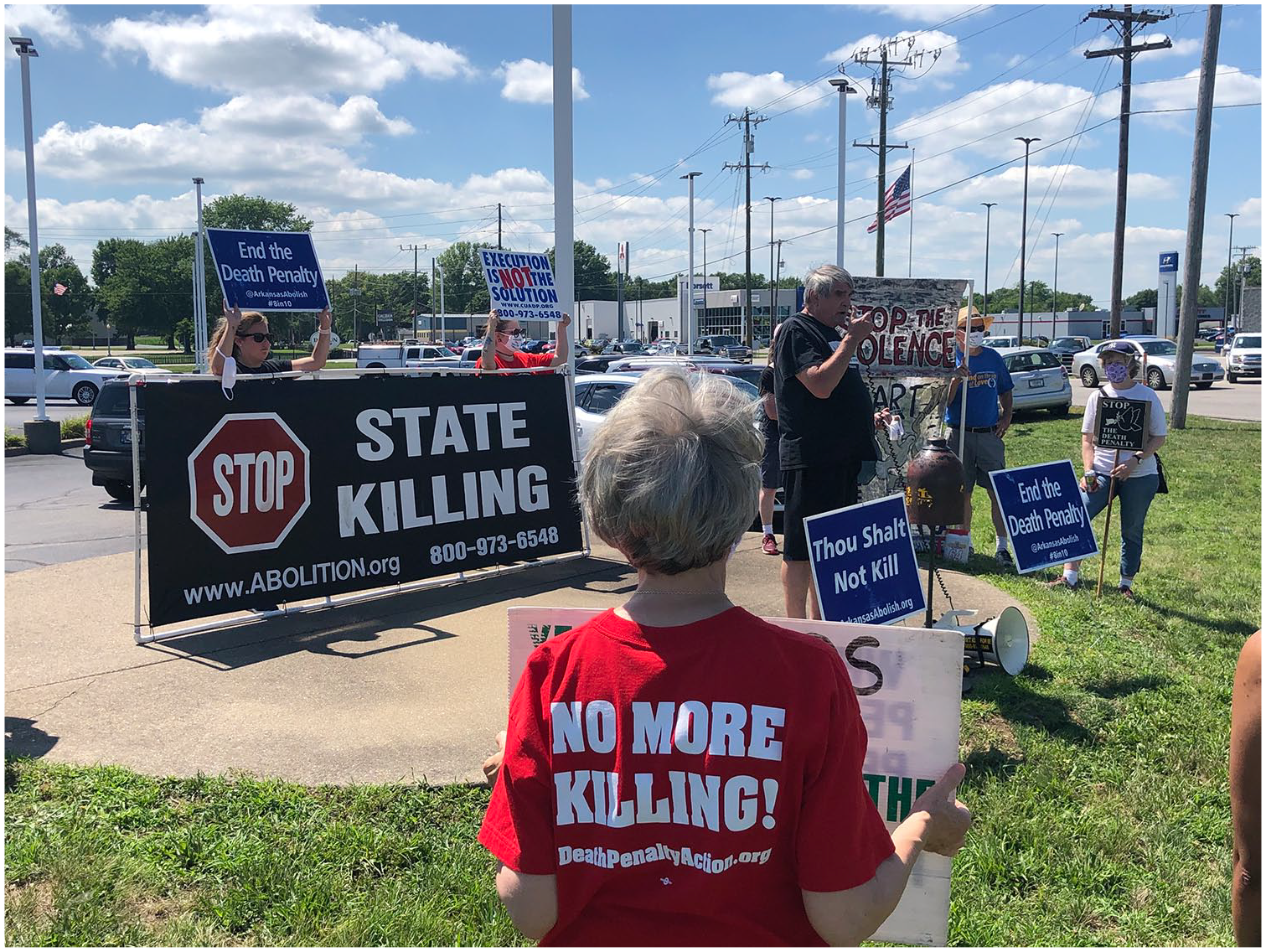
Orlando Hall was declared dead at 11:47 P.M. EDT on Thursday, November 19, 2020, at the United States Penitentiary in Terre Haute, Indiana. The cause was a single-dose lethal injection of pentobarbital, a short-acting barbiturate that causes death by respiratory arrest. He was 49 and left behind six children and 13 grandchildren.
His killing was preceded by those of Danny Lee, Wes Purkey, Dustin Honken, Lezmond Mitchell, Keith Nelson, Will LeCroy, and Chris Vialva. Known within the Federal Bureau of Prisons as Inmate #26176-077, it is likely that Hall preferred “Lan” and his given Persian/Muslim name Shakib Wali.
Two weeks earlier, in the presidential election of November 3, 2020, incumbent Donald Trump was defeated by challenger Joseph Biden, transitioning the president to lame-duck status. With the taking of Hall’s life, Trump became the first president in more than one hundred years—the first since Grover Cleveland in 1889—to oversee a federal execution during a transfer of power in the executive branch.
Orlando Hall was a black man found guilty and sentenced to death by an all-white jury in Texas. His killing in Terre Haute—the eighth federal execution of 2020—was the first for crimes committed against a black victim.
Persons with deep experience in “the system” provide insight into the implicit, and oftentimes explicit, racial biases that shape our mass incarceration industry.
Sylvester Edwards, president of the Greater Terre Haute branch of the NAACP: “The laws that we’re dealing with today were written by the racists of yesterday.”
Sister Helen Prejean, author of Dead Man Walking: “After thirty years’ experience with courts and prisons and execution chambers, I’ve seen just how riddled with racism our entire criminal justice system is . . .”
Richard Pryor: “I was in jail too, man. It’s cold-blooded in the jail. . . They give niggers time like it’s lunch down there. You go down there lookin’ for justice, that’s what you find: Just Us.”
Race matters in criminal justice and Just Us matters.
Race matters in federal prison. As of October 23, 2021, of those incarcerated in federal prison, 90,166 were white (or 57.9% of those incarcerated in federal prison), and 59,277 were black (or 38.1%), in a country where whites comprise 60% of the population and blacks 13%. (Statistics reported by the Federal Bureau of Prisons and based on the prior month’s data. See: https://www.bop.gov/about/statistics/statistics_inmate_race.jsp
Race matters in courtrooms. According to the American Constitution Society, as of October 2020, the racial composition of Article III courts (the U.S. Supreme Court, 13 U.S. courts of appeals, and 91 U.S. district courts) is 601 white judges (74%) and 100 black judges (12%). Seven of nine judges on the Supreme Court are white. Many, if not most, federal prosecutors and defense counsels are white. Majority-white juries are commonplace (Lezmond Mitchell and Chris Vialva, a Navajo and black man respectively, each were found guilty and sentenced to death by 11 white people and 1 person of color.)
Race matters in sentencing. The 2020 report “Enduring Injustice: The Persistence of Racial Discrimination in the U.S. Death Penalty” by Death Penalty Information Center states that 75% of murder victims in cases resulting in an execution were white.
Race matters on federal death row. Fifty-four people were confined on the USP Terre Haute death row as of September 2020: 24 were black (44%) and 22 were white (41%) again, in a country where blacks comprise 13% and whites 60% of the population.
Race matters to execution scheduling. The first three men killed at USP Terre Haute in 2020 were white. In the Summer of George Floyd, Breanna Taylor, #BlackLivesMatter, and “Defund the Police,” it was widely believed that the selection (and murders) of Lee, Purkey, and Honken was intended to avert racial controversies in the early days of the federal killing spree.
Orlando Hall’s trial, sentencing, 25 years on death row, and execution is but one subset of coordinates along a straight line that extends through countless and unaccounted for murders of unarmed blacks by white police officers and citizens, decades of Jim Crow violence, and the lynchings of thousands of black men, black women, and black children where crowds of white men, white women, and white children bore witness to public murders.
In Hall’s own words (authored as Shakib Wali, the Persian-inspired name he took after his conversion to the Muslim faith that translates to “patient guardian”) and published by the Al Jazeera Center for Public Liberties & Human Rights 1 week before he was murdered: Simply put [the] U.S. applies systemic racism to subjugate people of color and the poor. Death Row U.S.A. has always been used as a tool to terrorize the black community, whether by the lynch mob or the Department of Justice. When dispatched to death row, I was essentially illiterate, but I also wasn’t a fool. I was judged by an all-white jury. I felt like thousands before me: doomed. Everyone in the courtroom with any power was white.
There is a blood lust tradition in America yesterday, today, and tomorrow, where whites killing blacks is assumed as birthright, as entertainment, and as justice bestowed upon “Just Us.”
[The following summary incorporates details from “Trump Presses Forward with Execution of Man Convicted by All-White Jury” as written by Liliana Segura for The Intercept and is condensed from “United States Court of Appeals, Fifth Circuit. UNITED STATES of America, Plaintiff-Appellee, v. Orlando Cordia HALL, also known as Lan, Defendant-Appellant. No.96-10178. Decided: August 21, 1998.” and “Hall v. U.S., Opinion, Civil Action No. 4:00-CV-422-Y, (Criminal No. 4:94-CR-121-Y). August 24, 2004”].
Orlando Hall dealt drugs in Arkansas and made bulk purchases of marijuana in the Dallas-Fort Worth area. On September 21, 1994, Hall paid $4,700 for a marijuana delivery. The next day, he was informed by his dealers that they had been robbed and their car stolen; Hall’s money was gone and no drugs would trade hands. Questioning their truthfulness, Hall, his younger brother, and an accomplice began surveillance of the dealers’ apartment in Arlington.
On September 24, they observed the men driving the car they’d claimed was stolen. Several days later, Bruce Webster (a partner in the Arkansas drug trafficking activity) joined Hall and his associates. The four men approached the Polo Run Apartments dressed in camouflage fatigues, Hall and Webster armed with handguns, the others with a small souvenir baseball bat, duct tape, and a jug of gasoline.
Lisa René, the 16-year-old sister of the two drug dealers, was living in the apartment that was leased by her older sister. A few months earlier, she had moved to the United States from St. Croix in the Virgin Islands. An honor student, René hoped to attend medical school. Linked by birth to the local men under surveillance by Hall, the teenager had no obvious connection to the failed drug deal.
Alone in the apartment and hearing men at the front door claiming to be with the Federal Bureau of Investigation (FBI), René called her older sister who said to call 911. René screamed to the 911 dispatcher: “They’re trying to break down my door! Hurry up!” Another scream is heard seconds later, followed by a man’s voice: “Who you on the phone with?” Then, the line went dead.
Webster dragged René from the apartment, across the parking lot, and into their Cadillac Eldorado where two of the men raped the teen. It was decided to return to Pine Bluff, Arkansas with the girl. There, in a motel room, René was tied to a chair and raped. When Hall arrived, he told the group that “She know too much.” The next day, a grave was dug in Byrd Lake Park. That evening René was led into the park but the grave could not be found. In the early morning hours, she was moved to another motel.
As reported in the Dallas Morning News, “Throughout the ordeal, [René] tearfully begged her captors to release her, at one point apologizing for her brothers’ actions and promising to pay back any money that was owed to the men.” Her pleas were to no avail.
That morning, the group returned to the park with René, placed a mask over her eyes, and led her to the gravesite. She was gagged, beaten about the head with a shovel, dragged unconscious into the grave, doused with gasoline, buried naked, and left for dead.
A coroner said Lisa René died of asphyxiation. It would be 8 days before her body was recovered.
On September 29, an arrest warrant for Hall, his younger brother, and a third accomplice was issued by the City of Arlington; Webster was subsequently arrested. The next day, Hall surrendered to Arkansas authorities with his attorney present and indicated he would talk with law enforcement after transport to Texas. On October 5, following his transfer to the county jail, Hall gave a written statement to local and FBI officials in which he implicated himself in the kidnapping and murder of Lisa René.
Two weeks earlier, on September 13, and thirteen hundred miles away in Washington D.C., President Bill Clinton—intent on cementing his “No one is tougher on crime and criminals than me” bona fides—signed into law the largest crime bill in the country’s history. The Violent Crime Control and Law Enforcement Act of 1994, commonly known as the 1994 Crime Bill, provided for 100,000 new police officers, $9.7 billion in funding for prisons, and $6.1 billion for prevention programs.
This new law would have profound consequences for Orlando Hall. Its Title VI component, the Federal Death Penalty Act, created 60 new federal death penalty offenses including one of the charges levied against Hall in his six-count indictment: “kidnapping resulting in death.”
A federal complaint was filed against Hall on October 26. He was appointed counsel 2 days later. Four months later, on February 23, 1995, the government notified Hall of its intent to seek the death penalty. As announced by the federal prosecutor, the charges against Hall and Webster would be the “first death penalty case filed under the new crime bill in the nation.”
Two weeks later, Hall’s appointed counsel withdrew from the case. (The 2004 circuit court opinion provides a motive: “The government . . . advised his initial defense attorneys [that] Hall intended to kidnap the attorneys in an escape attempt . . .”)
One month later, on March 12, 1995, Jeffrey Kearney and Michael Ware were assigned to defend Hall. Fast forward 26 years—from the vantage point of his execution date—and it is possible to see that Hall’s young defense counsels were early in what became exemplary careers.
Kearney, today, is a member of the Texas Criminal Defense Lawyers Association Hall of Fame; and is listed among The Best Lawyers in America (1991-present, includes the year of Hall’s trial), Texas Super Lawyers, and the Bar Register of Preeminent Lawyers. He is authorized to practice law before multiple U.S. district courts, circuit courts, and the U.S. Supreme Court. He has lectured and presented seminars on “pre-trial motions,” “how to conduct a meaningful and effective 30-minute voir dire,” “winning your case in jury selection,” “opening statements,” and “cross-examination.” The Kearney Law Firm is located in Fort Worth.
Ware, today, is also based in Fort Worth. His early career included time as research editor for the Houston Law Review and the Texas Rules of Evidence Handbook, and service as law clerk for a U.S. district court judge. Ware’s criminal defense practice represents clients in state and federal courts throughout the United States. As with Kearney, peers honored him as a Texas Super Lawyer. In 2009, Ware received the Truth and Justice Award from the Innocence Project of Texas.
On August 2, 1995, Kearney and Ware requested an additional 30 days for trial preparation. (Among the reasons: Fort Worth, Texas to Pine Bluff, Arkansas is 360 miles—a 6-hour drive or 40-minute flight—complicating the attorneys’ visits to crime scenes and interviews of witnesses. In addition, Kearney was busy with other trials.) The judge denied the motion. Their repeated requests for continuances were denied and jury selection proceeded with one attorney present, while the other continued trial preparation in Arkansas.
In general, jury selection proceeds as follows. A jury pool is assembled randomly from the community. A summons-to-appear is mailed to the potential juror who, on arrival at the courthouse, is assigned to a trial. Prospective jurors fill out a questionnaire related to key trial issues. Would-be jurors enter the courtroom’s jury box where they are sworn in (and thus under oath) and questioned by the prosecutor and defense counsel, and, if of direct import, the presiding judge. The defendant is also present for this trial phase, known as voir dire. Attorneys have the right to reject specific potential jurors at this point, via an unlimited number of “challenges for cause” (in which attorneys, with the judge’s approval, reject a potential juror for a particular reason) or a limited number of “peremptory challenges” (dismissed by one attorney without giving a reason or needing the judge’s approval). In addition, in capital punishment cases such as Hall’s (where prosecutors seek the death penalty), jurors must be “death-qualified” to remove those opposed to the death penalty.
Voir dire for Hall’s case began on October 2, 1995. It was shaped by implicit biases made explicit at the time and a decade later.
On the day of Hall’s 2020 execution, Sister Prejean wrote of his 1995 trial: “It is undeniable that Orlando Hall’s trial was tainted [by] racism.” Prejean adds facts to bolster her opinion. One hundred citizens were called for jury duty in Fort Worth (which had a 10% black population at the time); only seven were black. One black potential juror was removed before the trial began and another was determined to be unqualified to serve. The federal prosecutors then used peremptory strikes to remove four black potential jurors. The one remaining black potential juror stated her support of the death penalty; she was removed by Hall’s defense counsel.
Research and writing by Liliana Segura for The Intercept adds dimension to the veil of racial bias that cloaked (one could say “choked”) the proceedings.
In 1995, among the prosecution team members was an assistant U.S. attorney who helped choose the all-white jury that ultimately sentenced Orlando Hall to die. That same prosecutor had earlier participated in another trial in which the defendant’s claim of racial bias was later supported by the U.S. Supreme Court. As stated by Justice Anthony M. Kennedy in the 2003 ruling, the evidence “reveals that the culture of the district attorney’s office in the past was suffused with bias against African-Americans in jury selection.”
Nearly 20 years later, and just a week before his execution, Hall’s lawyers drew on statistical evidence that was never offered to the court. Per Segura: “A statistical analysis of all criminal defendants eligible for the federal death penalty in Texas between 1988 (when the federal death penalty was reinstated) and 2010” found that “federal prosecutors in Texas were nearly six times more likely to request authorization to seek the death penalty against a Black defendant than a non-Black defendant . . .”
Unfortunately for Hall, tragically for Hall, life-endingly for Hall, the President of the United States had just completed installation of a federal law that came to target blacks disproportionately; staff members in the local federal prosecutor’s office were enculturated to unduly punish blacks; and at least one member of the federal prosecution team in his trial was a serial offender—in his efforts to “get” and “try” blacks, he made sure to exclude black peers from a black man’s jury.
Hall’s trial began on October 22, 1995. Kearney and Hall did not call any witnesses and made no closing argument in the trial’s guilt phase. They had made a considered decision to not make a closing statement at the guilt phase of the trial so that the government could not give a final closing statement in rebuttal, which would have been the last argument heard by the jury in the guilt phase. Instead, Hall’s counsel decided to make an opening statement at the punishment phase of the trial, in which they would emphasize that Hall accepted responsibility for the crimes and that the appropriate sentence was not death, but life in prison without the possibility of release.
On October 31, 1995, the jury was unanimous in their guilt findings that included three aggravating factors: Hall intentionally killed Lisa René during the course of a kidnapping; he killed Lisa René in an especially heinous, cruel, and depraved manner; and that he constituted a future danger to the lives and safety of other persons.
After a 10-hour deliberation, the same all-white jury recommended the death penalty.
(Bruce Webster, Hall’s co-defendant, also received a death sentence. Unlike Hall, the intention to kill him was vacated in 2019 by a federal judge who was convinced that Webster’s intellectual disability made him ineligible for execution. He is confined on the federal death row in Terre Haute, where it is likely he will live what remains of his life.)
Orlando Cordia Hall was born in Arkansas on April 24, 1971, to parents A.J. and Betty Hall. His siblings included Pamela, Scotty, Cassandra, Tracy, and Demetrius Hall.
Ten years after his first trial, another hearing was held in which testimony was given and declarations offered regarding the household in which he was born and raised that were not part of his defense in his 1995 trial (that is, these arguments were not heard or considered by the jury), as Hall attempted to have his death sentence overturned upon appeal.
Hall’s mother Betty testified that her husband A.J.: was abusive towards her during most of their marriage including when she was pregnant; that she had been beaten with the butt of a gun, by a two-by-four, and with fists; that her teeth were knocked out; that she was dragged out of bed and beaten and beaten after getting home from work or from a store; that this was all done in front of the children; that the children tried to intervene, but would get knocked around themselves; that the police were called several times, but arrested A.J. on only one occasion . . .
Hall’s sister Cassandra testified that there was: a lot of physical and verbal abuse during her childhood; that A.J. would beat her mother with boards and anything else he could get his hands on; that all of the children tried to stop the abuse and would call the police, but their father would snatch the telephone away . . .
The social worker Jill Miller wrote in her declaration that the child Orlando, was a victim of severe physical abuse at home and his mother suffered from health problems and depression; that Hall has learning disabilities; and that Hall was abandoned by his mother when she left his father and thus had responsibilities towards his younger siblings [and that] because of his history of trauma, the lack of good role models during his upbringing, and the pervasiveness of the drug trade in his hometown of El Dorado, the lure of the drug trade was something that Hall could not resist.
This new and previously unheard testimony, given under oath, did not sway the judges who dismissed Hall’s appeal.
Ten years later (approximately), Hall converted to the Muslim faith, taking Shakib Wali as his name.
Ten years later, as his execution neared, family and friends visited Wali in numbers that surprised prison officials. As written by a friend (and reported by Segura of The Intercept): “He’s broken all kinds of records for numbers of visitors.”
Then, within minutes of a 6-3 Supreme Court decision, Shakib Wali was killed. He was dead.
Wali’s remains were transported first to Texas (the state where he was convicted) and then to the Paradise Funeral Home Chapel in Bernice, Louisiana. Public viewing was held on Friday, November 27, 2020 from 2:00 to 5:00 P.M. His body was interred the next day at 3:30 PM at the Mount Pleasant Cemetery in Lisbon, Louisiana.
Less than 1 week before his death, on November 13, 2020, the Death Penalty Information Center posted Hall’s essay, “My Redemptive Journey”: My name is Orlando Cordia Hall Sr. and my Muslim name is Shakib Wali. I’m a 49 year old Black man. I currently reside on federal death row awaiting a November 19th execution date. I am a practicing Muslim, a father of 6, a grandfather of 13, a brother, a friend, a loving companion to my soul mate and above all a fellow human being. I have been on federal death row since 1994 for the murder of Lisa Rene, an innocent 16 year old girl. I would be remiss if I didn’t take a moment to acknowledge my careless, selfish act which caused a lifetime of pain and ruined many lives—none more than the victim Lisa. It is in the spirit of humility, humanity, love, compassion, that I share my redemption journey with you. I believe that it’s through removing the cover of darkness over the death penalty that more people will be exposed to the many redemption stories and those like me who have never given up on their humanity. How did I feel as a black man when I saw my all-white jury? I felt like the thousands before me—doomed! I was never under the false illusion that I would receive a fair trial or a jury of my peers. The system is set up to punish people of color, especially poor people of color. I was an uneducated man, functioning illiterate at best, but I also wasn’t a fool. Everyone in the courtroom with any power was white. There is a systemic institutional racism that is designed to subjugate people of color and the poor. The death penalty has always been used as a tool to terrorize the black community. There has never been a period in the United States when a black person wasn’t under the threat of death, be it by legal lynching, burning, shooting, or beating to death. The method may vary as a means to an end, but the result is still the same. Throughout the history of this nation up until the present day, the vast number of people in prison and on death row are people of color. The American justice system has never been fair when it comes to the poor and people of color. On this fact alone, there shouldn’t be a death penalty. We can have justice without revenge. I humbly implore everyone reading this to lift your voice and use whatever platform you have to educate people on this subject. I may not be the poster child for redemption, but I am a human being who deserves humanity if nothing more. Thank you for your time and the opportunity to shine light on darkness. I can only hope and pray that we can make progress and stop these state sanctioned murders being done in the name of the people. May Allah favor our efforts. I leave you as I meet you in peace. As-salaam Alaikum . . .