







Abstract
The main objective of this article is to explore the challenges for globalizing knowledge management theories. Adopting a practice-based view of knowledge and engaging critically with Nonaka’s SECI (socialization, externalization, combination and internalization) model, the hidden behavioral assumptions and cultural values and meanings embedded within the model are revealed so as to provide a thought experiment to explain the organizational and inter-cultural dynamics that may disrupt its translation in overseas contexts. It is argued that a successful implementation of Nonaka’s SECI model requires a ‘glocalized’ approach, which involves trade-offs between core underlying values and objectives during the process of local translation. This article contributes to current theories of knowledge management by revealing the underlying sources of cultural embeddedness and the implications for their global diffusion.
Judging by the widespread application and popularity of the model, Nonaka’s (1994) and Nonaka and Takeuchi’s (1995) repeated claims of universal validity seem to have been implicitly acknowledged by the knowledge management community (Glisby and Holden, 2003: 29).
Introduction
Ever since Nonaka’s seminal work on the dynamic theory of knowledge creation appeared in the early 90s (Nonaka, 1994; Nonaka and Takeuchi, 1995), we have witnessed an upsurge of interest in how organizations can manage their knowledge assets and learning processes. Diverse theories of knowledge management have proliferated in a short period of time (Easterby-Smith and Lyles, 2003), which has owed much to Nonaka’s and his colleagues’ continued efforts in popularizing his SECI-ba model (socialization, externalization, combination and internalization) of knowledge creation by delving into the black box of firm operations and explicating the underlying knowledge processes (Nonaka and Konno, 1998; Nonaka et al., 2008; Von Krogh et al., 2000). I shall then refer to it as SECI model in the article. His great contribution to the field has been rightfully acknowledged and succinctly summarized by Teece (2008: ix), proclaiming that ‘there is no one who in recent years has done more to shape the field of knowledge management than Ikujiro Nonaka’ (emphasis added).
However, two unresolved issues may have undermined the claim of a near paradigmatic status of Nonaka’s knowledge creation theory. First, various scholars in the field have long been challenging his core idea of knowledge conversion in the SECI model (Gourlay, 2006; Gueldenberg and Helting, 2007; Tsoukas and Vladimirou, 2001), largely due to his quest for converting tacit knowledge into explicit knowledge (Tsoukas, 2003), thus ‘ignoring views that tacit knowledge may be at least partially if not wholly inherently tacit’ (Gourlay, 2006: 1430). This is in a stark contrast to Polanyi’s (1962) original idea of tacit knowledge. Despite a recent attempt was launched to defend and modify his original stance on tacit knowledge (Nonaka and von Krogh, 2009), the epistemological ambiguities surrounding the SECI model still cannot be resolved.
Second, even if the epistemological problems with the SECI model are fixable, a second problem remains. As seen in the opening remarks, many scholars are very much concerned about the universal applicability of the SECI model despite its widespread popularity and acceptance. Teece (2008: xv), alongside his accolades of Nonaka’s achievement, also raised the same question of ‘whether the SECI process is fully transferable to US and European contexts’. Moreover, previous empirical studies have been conducted to explore the international transfer and replication of those knowledge creation practices overseas, but no conclusive evidence can be found (Glisby and Holden, 2003). Examples of difficulties include the embedded nature of Japanese management practices (Lam, 2003), cultural conflicts with local employees (Hong and Snell, 2008; Hong et al., 2006b) and broad institutional differences between Japan and host countries (Collinson and Wilson, 2006). All these indicate the need to critically evaluate Nonaka’s SECI model in terms of the complexities involved and problems encountered during the process of its globalization (Gueldenberg and Helting, 2007; Hong et al., 2006a; Weir and Hutchings, 2005).
It is against this conceptual background that the article has been developed. Its main objective is to explore the challenges for globalizing knowledge management theories by using Nonaka’s SECI model as a specific example. The expected contributions of this article are two-fold. First, echoing the view of Easterby-Smith (1998), we hope to highlight the context-specific and particularistic nature of organizational learning and knowledge theories. Second, by focusing on Nonaka’s SECI model in particular, this article hopes to bring out the situated dynamics of knowledge translation and the contributions from local actors during the process of glocalization.
The article is divided into five sections. Following the Introduction, a brief review of the practice-based perspective of knowledge (Gherardi, 2010) is conducted in order to highlight the socially embedded characteristics of knowledge and subsequent challenges of local translation (Czarniawska and Sevón, 1996, 2005). The next section contains the critical evaluation of the cultural specificity of Nonaka’s SECI model and assessments of ‘the implicit assumption informing the foundation of Nonaka’s theory’ (Glisby and Holden, 2003: 30). This is followed by a section which elaborates on a glocalized approach in order to recognize the myriad contributions of local actors and their ‘local accomplishment of practice’ (Nicolini, 2009: 1392) for turning this general idea into practical use. The main contributions of this article are highlighted in the final section ‘Concluding remarks’.
A practice-based view of knowledge
The concept of knowledge in extant literature has long varied, owing to its complex nature and presence of multiple images (Blackler, 1995). For example, knowledge in organizations can be classified along different properties and dichotomous dimensions, such as explicit vs. tacit (Polanyi, 1962), universal vs. situated (Sole and Edmondson, 2002), reified vs. constructed (Lervik and Lunnan, 2004), individual vs. collective (Spender, 1996), or canonical vs. non-canonical (Brown and Duguid, 1991).
The recent emergence of a practice-based view (Gherardi, 2000, 2010) provides an alternative perspective to the dominant knowledge diffusion (Latour, 1986) or knowledge capture (Ribeiro and Collins, 2007) approach. Instead of conceiving items of knowledge as reified objects that can easily be acquired, processed, transferred, spread and stored across different geographic domains and organizational contexts, the knowledge-as-practice approach emphasizes the members’ participation in ‘situated material and semiotic activity mediated by a plurality of artefacts and institutions’ (Gherardi, 2010: 504). Its main focus is on the knowing process in which a system of socially constructed activities embedded in different contexts of knowledge work (Nicolini, 2007, 2010) is accomplished.
That knowledge as a social and cultural phenomenon situated in practices gives rise to the issue of embeddedness since it represents the customary rules, or habitus (Bourdieu, 1977), rooted in local environment. Those formal and informal rules are internalized into people’s underlying logic of thoughts and manifested in their activities, representing the historical product of previous individual and social practices (Wenger, 1998: 47, 48). While engaging in social practices, the interactions with other people in practice, their immediate responses and the field of practice are all intertwined to produce the coordinated moves or actions. In this sense, practice is a localized act, structured and conditioned by both human and non-human elements in a process of heterogeneous engineering (Law, 1992).
Besides, the practices are continuously evolving. The notion of habitus as the grand behavioral guiding principles does not prevent the individuals and groups from generating novel solutions and new practices when local situations demand. The differences between modus operandi and opus operatum signify the limitations of the latter as a finished view to address the constantly changing work environment and social conditions. The former, which only sums up some general rules and practical schemes, offers a dynamic platform for engaging in subsequent improvisation processes (Bourdieu, 1990) and undergoes the inevitably continuous reproduction and transformation, subject to the demand of local contingencies. Therefore, as opposed to viewing practices as mechanical, prescribed and static descriptions of action responses, Bourdieu (1977) emphasizes the dynamic nature of practices by taking into account the past experience to respond to present situations.
The situated and transformative characteristics of knowledge as social practice indicate the need to understand localized dynamics of translation when the general ideas and principles travel across time and space and are shared with local constituents. As argued by the knowledge translation perspective (Czarniawska and Sevón, 1996, 2005; Latour, 1987), differences in power, values, norms or other contextual conditions between the source and recipient seem to mediate the local institutionalization process in which the localized rules are subsequently developed by bridging the gaps between problems encountered and perceived usefulness of the solutions. But this entails a process of social construction on the receiver’s end in which a logic of appropriateness (Czarniawska and Sevón, 1996) is adopted as a basis of interpretation for guiding and legitimizing meaningful actions and resolving conflicts. Nevertheless, the focal question is about how the objectified practices and global ideas (Czarniawska and Sevón, 2005) can be adapted and turned into practical use in local space.
Following Nicolini (2010), for turning universal principles and practices into localized solutions, one must cope with the demand of global vs. local aspects of knowledge by first stripping knowledge of its contextual richness (Kasper et al., 2010) prior to the objectification and standardization of practices, and then understanding the contextual conditions that drive the localized processes of struggle and negotiation (Nicolini, 2010: 1013). According to this view, the spread of knowledge needs to pass through successive stages of dis-embedding, translation and local institutionalization (Czarniawska and Sevón, 1996), but it is the local actors who would undertake a more salient and performative role by acting as knowledge agents and re-embedding the ideas and materializing them into specific actions (Latour, 1986), which involves creativity, improvisation, enactment, blending and transformation of the taken-for-granted cultural rules since ‘to set something in a new place is to construct it anew’ (Czarniawska and Sevón, 2005: 8). In order to demonstrate the application of this practice-based approach, I will use Nonaka’s SECI model as an illustrative example by revealing its cultural embeddedness and the implications for its global spread. Then some challenges for re-embedding it into foreign settings are highlighted.
Cultural specificity of Nonaka’s SECI model
Nonaka’s knowledge creation theory borrows heavily from the pioneering work of Polanyi (1962) on the distinctive aspects of tacit knowledge and the relationship to the explicit knowledge. According to Nonaka and Takeuchi (1995), the knowledge creation process involves a dynamic interaction between tacit and explicit knowledge, which is commonly known as knowledge creation spiral in the SECI model. The overall process consists of four different modes of conversion, the first one being the sharing of tacit knowledge to tacit knowledge, or the socialization process. The second process deals with the integration of different forms of explicit knowledge, which is labeled as combination. The third and fourth modes of knowledge conversion take into account the interactions between tacit and explicit knowledge. The process of making tacit knowledge into explicit knowledge is externalization, whereas the conversion of explicit knowledge into tacit knowledge is called internalization (Figure 1). Each of these four modes possesses distinctive practices and the interplay between them constitutes a dynamic process of knowledge creation (Nonaka, 1994).
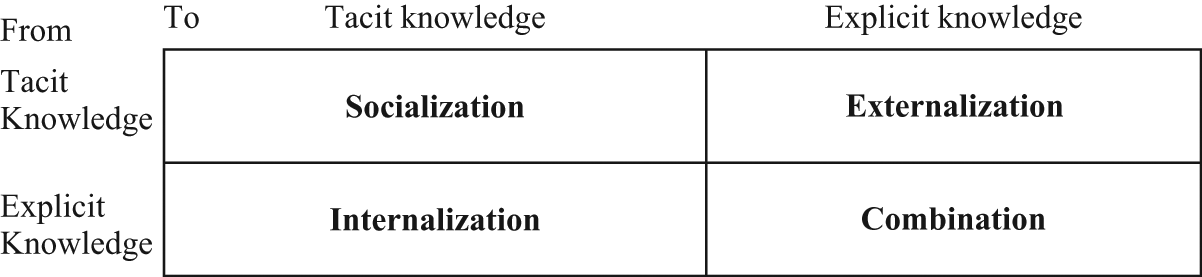
Contents of knowledge created by the four modes. [Nonaka and Takeuchi (1995: 62)].
Nevertheless, Nonaka and colleagues make no attempt to confine those knowledge processes specifically to Japanese organizations. On the contrary, their intention is to propose a global theory of knowledge creation, featuring ‘interesting and focused narrative detail that allows us to abstract and articulate universals that explain the “how”’ (Nonaka et al., 2008: 4, emphasis added). However, the main research findings may undermine their purported claims of universality, since the unique Japanese cultural and institutional elements underlying those knowledge creation practices (Hong et al., 2006b; Lam, 2003) may encounter friction during their global spread and the ensuing local adaptation processes (Lervik and Lunnan, 2004).
There are three reasons for focusing on national culture as the primary explanatory factor for uncovering the particularistic nature of Nonaka’s SECI model and the related challenges of local institutionalization. First, previous research on cross-national transfer of knowledge and learning in the contexts of acquisitions (Sarala and Vaara, 2010), strategic alliances (Child and Markoczy, 1993) and foreign direct investments (Carmona and Gronlund, 1998), has indicated that there is a strong association between cultural differences and their transacting patterns for the acquisition, transfer and implementation of knowledge. Some cultures, due to their idiosyncratic values and norms, have developed some specific cognitive styles and behavioral practices (Bhagat et al., 2002) and have encountered problems and difficulties when interacting with other cultures (Michailova and Husted, 2003).
Second, most comparative studies of knowledge management between Japanese firms and other multinationals (Easterby-Smith, 1998; Glisby and Holden, 2003; Hong et al., 2006b) often attribute the cause of variations in their knowledge processes to their idiosyncratic cultural values, which is also a salient assumption among the cultural relativists (Hofstede, 1980; Shenkar et al., 2008). For instance, when explaining the tendency to share knowledge in most Japanese organizations as a consequence of the employees’ identification with the firm, Glisby and Holden (2003: 31) explain that ‘this kind of commitment and loyalty is deeply rooted in Japanese cultural values’. Besides, the emphasis on social reciprocity as part of the Japanese cultural tradition serves as the behavioral foundation to support and shape the firm-specific, team-based learning activities (Cole, 1989) that are oriented more towards frequent interpersonal exchange of both tacit and explicit knowledge.
Third, it is often the traditional Japanese philosophies and cultural assumptions that have implicitly enshrouded Nonaka’s SECI model, particularly when it is related to their specific approach of tacit knowledge management (Gueldenberg and Helting, 2007). For example, the concept of ba (Nonaka and Kono, 1998) was adopted from the thinking of a Japanese philosopher, Kitaro Nishida, on the importance of having a shared mental, social and physical space for engaging in knowledge creation and interaction, which reflects some particular traits of Japanese culture, namely their strong inclination for building and engaging in close interpersonal relationships with those whom they share a common fate or identity, and their cognitive style of preferring tacit over explicit knowledge (Nonaka and Johansson, 1985).
However, this line of reasoning may also bear the risks of cultural stereotyping and over-generalization, especially about the presupposed superiority of the knowledge creation capabilities of Japanese firm vis-à-vis other types of multinationals. I agree that not all organizations are alike within the same country, and that Nonaka’s case study examples appear to be exemplary. Indeed, I also note that the key behavioral patterns of shared identity and collective participation underlying the SECI processes are not exclusive to Japanese firms and culture, but can also be found in the studies of communities of practice (Brown and Duguid, 1991) originated from the West. Besides, empirical studies conducted recently have identified that organizational culture is another potential factor that can facilitate and promote organizational knowledge creation (Sarala and Vaara, 2010; Ueki et al., 2011). Therefore, it is not my intention to glorify the Japanese firms’ knowledge-creating capabilities, but to discuss the behavioral assumptions underlying each mode of the SECI model, their embedded cultural values and related implications for the behavioral patterns. I adopt Hofstede’s (1980) four broad cultural values of uncertainty avoidance, collectivism, power distance and masculinity-femininity, which are posited to shape the ways that the members manage their knowledge processes in organizations in different studies (Bhagat et al., 2002; Wilkesmann et al., 2009). By referring to the case of Japan in particular, I hope to bring out the cultural specificity of Nonaka’s knowledge creating practices.
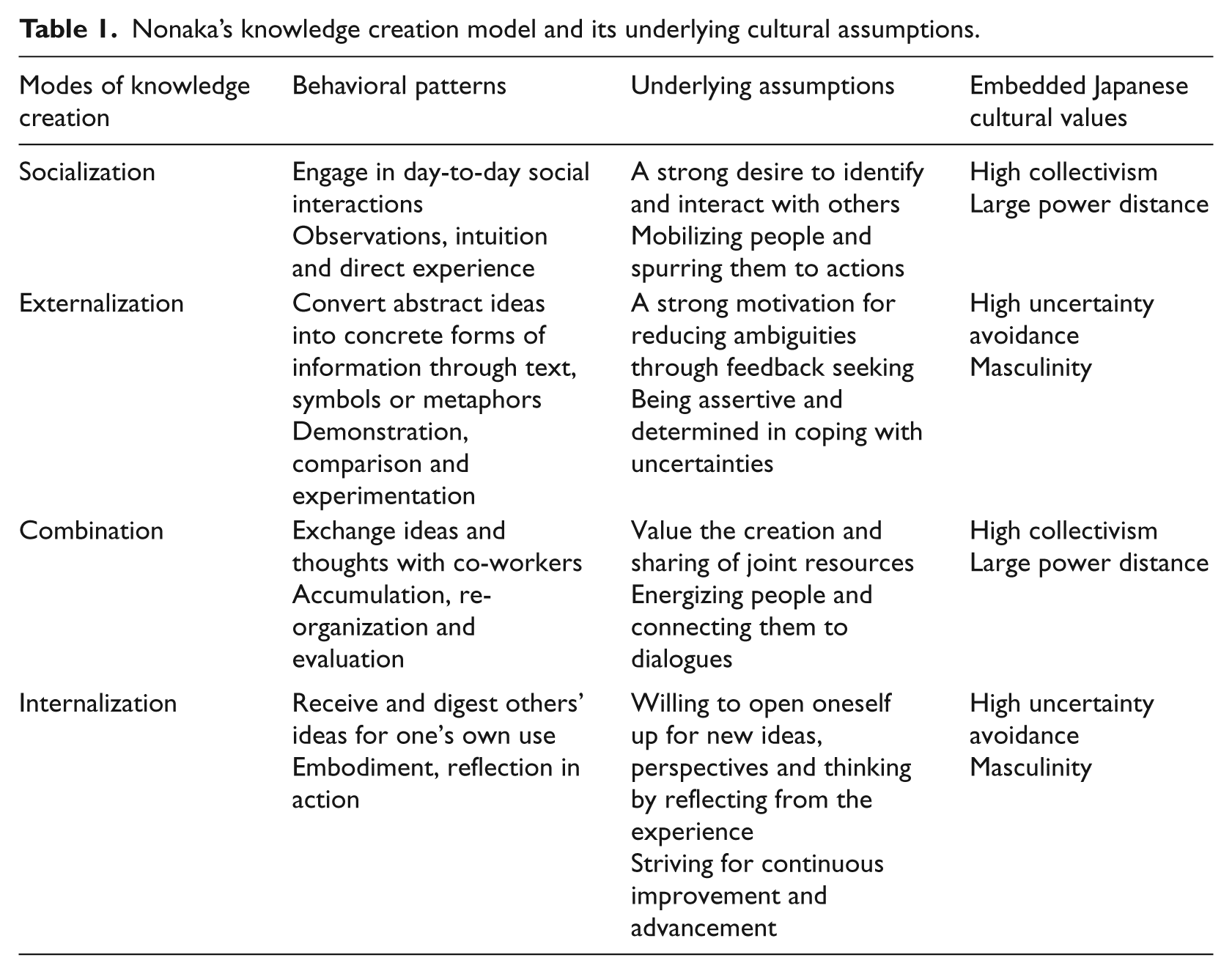
Nonaka’s knowledge creation model and its underlying cultural assumptions.
Underpinning socialization
First, for the socialization process to take place, people need to possess a strong desire for (1) identifying and interacting with others as well as (2) energizing and sustaining the collaborative efforts in knowledge creation. Inside the exemplary Japanese organizations, employees tend to spend prolonged hours every day attending the socializing events and working under a team structure (Yoshimura and Anderson, 1997). Consequently, the employees themselves develop strong and intimate feelings towards each other through their mutual work experiences and socialization processes. To them, the company is not just a place to work, but is also a coherent social community with profound emotional attachment and common identity. There is a shared identity and common fate established between the staff and the enterprise.
Prior research on team learning indicates that a good and supportive social environment gives confidence to the team members for engaging in interpersonal risk-taking behavior (Edmondson, 1999). The perceived emotional backing obtained from the fellow members provides a feeling of psychological safety (Edmondson, 1999) which increases their confidence to undertake bold changes and try out new options as mandated in the process of constructive engagement. In the exemplary Japanese organizations, a tightly-coupled and interdependent work relationship provides a shared context for the creation, sharing and dissemination of the tacit knowledge among different members in the factory-wide level (Cole, 1989). A sustained involvement and participation in teamwork allows the team members to empathize with each other’s thinking and feeling, thus increasing the level of social confidence (Andrews and Delahaye, 2000) that is requisite for promoting the sharing of tacit knowledge.
Furthermore, as knowledge can only be created in and through actual practices (Gherardi, 2000), it is a question of how the Japanese employees take on the tasks and deal with each particular situation (Nonaka et al., 2008). That was the reason why the need for creating knowledge activists was championed by Von Krogh et al. (1997), who were specifically in charge of catalyzing and connecting various knowledge-related initiatives throughout the organization. It is through the active mobilization and engagement of other team members into group dialogues that all individuals can bring the tacit nexus of meanings into play for explication.
The embedded cultural values driving the predisposition to identify with each other and act in teams are collectivism and large power distance (Hofstede, 1980). Under the influence of traditional Confucian values from the ancient past, the Japanese have been normally regarded as a group-oriented culture (Fukuyama, 1995; Hofstede, 1980) with a strong collective mentality. Interpersonal relationships in Japan are governed by the feudalistic obligation called giri. Giri governs the behavioral disposition of individuals for various kinds of social relationships, and the acceptance of obligation is unconditional (Minami, 1971). Kumon (1992) argues that Japanese are ‘contextualist’ in nature so that they have a strong desire to identify with others and develop a kind of mutual dependence relationship. The inheritance of a strong cultural predisposition to identify with others facilitates the development of strong personal ties among the Japanese. The Japanese word, amae, understood as ‘to depend and presume upon another’s benevolence’ (Takeo, 1962: 132), best describes the cultural preference of the Japanese for developing a mutually dependent relationship with other group members.
When it comes to the construction of self-identity vis-à-vis other members, the Japanese see themselves as being an integral part of the collective. From the Japanese employees’ viewpoint, they will emphasize oneness with members of the group and stress common goals and collective interests from which a normative relationship can be formed. The basis of their solidarity is created by common bonds and mutual obligations as seen from most clan type cultures (Ouchi, 1980). Team-based learning activities are frequently launched in order to tap the individuals for ideas and provide a shared platform for knowledge creation. For example, the quality control circles in Japanese organizations (Cole, 1989) provide each frontline employee with an equal chance to voice their opinions during the learning activities and generate a collective effort to make sense of the problematic situations and interpret the events. As knowledge in Japanese organizations is widely distributed in a group context, it is important to have a common ground for supporting the sense-taking activities among the participants. This unified identification among co-workers facilitates the development of mutual understanding critical for the sharing of tacit knowledge.
A strong group-oriented culture in Japan, as well as the leaders’ normative power for mobilizing all members to conform and participate in the team-based discursive activities, serves to create a shared context for sense making (Chikudate, 1999). Through the creation of interacting ba (Nonaka and Kono, 1998) that encourages face-to-face interactions, team leaders connect people from different departments together and spur them to action by making sense of how others behave through direct experience and observations. But this is only feasible under a cultural environment where good interpersonal relationships and a strong allegiance towards the leaders for participating in the knowledge sharing activities are promoted.
Underpinning externalization
Second, the effectiveness of externalization in which the abstract ideas and intuition are converted into explicit forms of information depends on (1) the felt need for converting the tacit element of knowledge and (2) the incentive for making it available to other co-workers. When communicating with other fellow employees, the Japanese are preoccupied with externalizing their deeply embedded tacit knowledge into explicit knowledge through various metaphors in a way that ‘subjective, tacit knowledge held by an individual is externalized into objective, explicit knowledge to be shared and synthesized within the organization, and even beyond’ (Nonaka and Toyama, 2007: 17), a proposition that is often subject to much criticism (Tsoukas, 2003; Tsoukas and Vladimirou, 2001). The widespread adoption of metaphors and analogies among Japanese managers helps ‘crystallize’ their vague ideas that are otherwise hard to discuss and transform them into some concrete forms for shared interpretation (Nonaka, 1994: 25).
Besides, a mindset of creating information redundancy (Nonaka and Takeuchi, 1995) is shared among the employees, who will appreciate the practical benefits and creative power of excess information in their daily work. For example, in a study of the product innovation process in Japanese firms, Takeuchi and Nonaka (1986) discovered that there was a significant overlapping between different stages, with increasing amounts of information being shared among the members throughout the development cycle. They tried to utilize the abundant information available for (1) the cross-fertilization of ideas, (2) engaging in a continual process of feedback provision involving multiple individuals, and (3) responding to the changing market demands (p. 141).
I argue that the two key cultural forces driving the tacit knowledge conversion and sharing process can be attributed to the general levels of uncertainty avoidance and masculinity existing in the society, which are understood as the extent of which the risks and ambiguities are tolerated, and the degree of assertiveness, advancement and challenges that are generally accepted by people in society, respectively (Hofstede, 1980). Driven by their high level of uncertainty avoidance and a strong determination to achieve excellence, the Japanese have developed a cultural predisposition for collecting and sharing more information than is needed in order to minimize the impact of uncertainties in striving for continuous improvement, since ‘the effect of these types of effort is a culture where a broad definition of relevant information is encouraged’ (Nonaka and Johansson, 1985: 286). The underlying Japanese cultural drive for being ‘knowledgeable human agents’ (Chikudate, 1999: 74) generates a strong quest for information redundancy inside Japanese organizations (Abramson et al., 1993).
Underpinning combination
Third, in order for the members to combine and process different items of explicit knowledge during the knowledge combination process, they need to develop a strong motivation to speak up and share what they know with others. Otherwise, the problem of knowledge hoarding (Michailova and Husted, 2003) will arise when people conceive of knowledge as a source of power and conceal it from others for obtaining personal gains. But within Japanese firms, there is a widespread availability of critical background information, enabling the Japanese workers to become competent in improvising solutions (Nonaka, 1994). Koike (1984) labels this phenomenon as the white-collarization of skills. The mastering of these situated skills and practices to conduct site-specific learning would not have been possible without extensive information sharing and team-based discussions (Nonaka and Takeuchi, 1995).
Having unrestricted access to important information enables the Japanese workers to create joint knowledge resources by adopting a sense of common fate to engage in practical discourse. Under the influence of a highly collectivistic culture in Japan with asymmetrical power relations existing at the workplace (Chikudate, 1999), this creates an atmosphere for the subordinates to share what they know, thus promoting the possession and sharing of a common body of knowledge among the members.
A group-oriented culture in Japanese organization with the leaders’ ongoing attempts to connect people to dialogues mandates a close cooperation among members, promotes transparency and enhances mutual interdependence. As harmony, or wa, is the overall guiding principle governing social relationships among Japanese, it is assumed to be important to provide an equal footing for everyone to participate in the work process by having a shared repertoire of resources. As the members need to be fully informed of the problematic situation before they exchange ideas with co-workers, it is also assumed that a widespread sharing of information in the enterprise is essential.
Underpinning internalization
Lastly, the process of internalization by embodying explicit knowledge into tacit knowledge entails a process of self-reflexivity in which members allow a new understanding to emerge through a continuous evaluation and examination of their own fundamental assumptions and current ways of doing things (Cunliffe, 2008: 135). But in order to successfully challenge the entrenched thoughts and prevalent practices, they need to adopt a more open and critical stance towards themselves and their actions, and assess the ongoing impact on the surrounding environment. At the individual level, this highlights the need for a greater sensitivity and willingness to subject oneself to continuous scrutiny and critical self-questioning of one’s actions and consequences (Cunliffe, 2002), thus indicating the masculine attributes of valuing progress and continuous improvement in Japan.
The Japanese have long been criticized for their reluctance to make bold moves and implement drastic change during turbulent times (Collinson and Wilson, 2006; Porter et al., 2000), partly due to their high level of uncertainty avoidance (Hofstede, 1980). Instead their approach for learning and strategic development is more evolutionary in nature (Kagono et al., 1985). This has encouraged the Japanese to undertake frequent assessments of its outcome effectiveness, thus promoting a mindset of mindfulness and reflexive interaction with the situations that are being unfolded upon them. As argued by Nonaka et al. (2000), Japanese managers often engage in experience sharing with their team members and conduct experiments. The purpose is to create an embodied understanding from everyday practice and within the experience.
Glocalizing Nonaka’s SECI model
The previous section provides a brief review of Nonaka’s SECI processes and identifies their underlying behavioral assumptions and embedded Japanese cultural values. I concur with the cultural relativists (Easterby-Smith, 1998; Glisby and Holden, 2003) that those knowledge processes in the SECI model are inherently context specific. In the following section, by adopting a practice-based perspective (Gherardi, 2010), I will further conjecture the related challenges and difficulties for globalizing Nonaka’s SECI model from the objective, subjective and social viewpoints.
The extant literature and criticisms (Gourlay, 2006; Tsoukas, 2003) appear to adopt an objective view by interpreting the knowledge creation practices in the SECI model from outside, featuring the visible and stable patterns of activities socially recognized and adopted by all members in the organizations. For example, the ongoing debates about the epistemological assumptions and treatment of tacit knowledge (Tsoukas, 2003) focus on the dynamic interactions between tacit and explicit knowledge as four modes of knowledge conversion in the SECI model. Critiques and alternative solutions are proposed to guide our reflective processes for better understanding and sharing of tacit knowledge (Gourlay, 2006; Tsoukas, 2003), but they only concentrate on removing the syntactic knowledge boundaries (Carlile, 2002) by developing a common lexicon and tool among the researchers and practitioners (Carlile, 2004). This conforms to the popular transfer model (Lervik and Lunnan, 2004), featuring objectification and standardization of management ideas for achieving ‘more or less shared understanding that allows their repetition’ (Gherardi, 2010: 505).
Conceiving practices as ongoing social accomplishments, the subjective viewpoint looks at the ways that knowing in practice is socially constituted and reconstituted (Orlikowski, 2002). This goes beyond the technical descriptions and emphasizes the symbolic aspects of practice by identifying the differences in individuals’ semantic understandings (Carlile, 2002) and the related implications for their pattern of actions. According to this view, adopting and implementing the SECI processes encapsulates a socially constructed process in which members who are sharing different social and cultural norms ‘reconcile discrepancies in meaning’ (Nonaka and Takeuchi, 1995: 67) and develop common practices ‘justified by the individual organizational member at certain moments and using various mental models’ (Nonaka and von Krogh, 2009: 639).
As seen in earlier arguments and other cross-cultural studies of knowledge transfer (Glisby and Holden, 2003; Hong et al., 2006b), the core behavioral assumptions underpinning the SECI processes are their collectivistic orientation, active engagement in reflective learning through dialogues and a strong quest for continuous improvement, which are culturally embedded in Japan. Any attempt to adopt the SECI model needs to recognize and overcome the discrepancies in meanings that are embedded and collectively shared and navigated behind those processes.
The social and political perspective highlights the continuous struggles and negotiation among a network of institutional actors and forces during the process of local accomplishment (Gherardi, 2010). The central concern is to resolve pragmatic boundaries (Carlile, 2002) that appear among a coalition of interested participations. Since knowledge is invested in practice (Orlikowski, 2002) and matters to the participants whose interests are at stake, they will engage in various ‘acts of political persuasion’ (Lervik and Lunnan, 2004: 295) and ‘collective translation of meanings’ (Saka, 2004: 222) in order to turn the abstract ideas into concrete actions and gain legitimacy throughout the process of local knowledge transformation (Carlile, 2004).
Therefore, local actors embedded with specific interests and agenda take up the role of active agency for spreading, adapting, localizing and legitimizing the knowledge processes across time and space (Latour, 1987). They first interpret the meanings of the SECI model and infuse them with their own understandings prior to the local re-contextualization process in which a new set of practices may evolve under different contextual conditions. As argued by Nicolini (2010: 1013), ‘to circulate and transfer is to transform’, which signifies the importance of actors’ local responses and their contributions in shaping and enforcing their own choice of useful practices into use.
Based on this view, the SECI model together with the content to which it refers, then only serve as quasi-objects (Czarniawska and Joerges, 1996) for the local participants, who are endowed with more liberty and power to develop shared interpretations in the local context and materialize them into actions. In this case, the critical issue is neither about developing and passing on the right approach to managing knowledge, nor looking for a semantic fit (Brannen, 2004) between two different cultural communities. Instead what matters is how the SECI model is locally enacted and accomplished by applying a variety of localized approaches to create new meanings and absorb the global ideas into everyday use. This resembles a continuous struggle as evident in the phenomenon of glocalization (Robertson, 1994) that involves a dual process of both universalizing and particularizing the global practices.
In order to demonstrate how the glocalization of the SECI model plays out, I draw on the story of Matsushita’s Home Bakery Machine from Nonaka and Takeuchi’s (1995) The Knowledge Creating Company book and use it as a practical example. This was one of the pioneer cases adopted by Nonaka (1994) for demonstrating the SECI model in practice. Using the same empirical material can give us a common reference point to disentangle the knowledge processes and dynamics manifest at both global and local levels. Besides, this case study is frequently cited as a subject of critical assessment in previous commentaries (Gourlay, 2006; Ribeiro and Collins, 2007; Tsoukas, 2003) in which the primary focus has been on the controversial nature of the idea of knowledge conversion. While benefiting from their particular insights on the non-convertibility of tacit knowledge owing to its personal and ineffable attributes (D’Eredita and Barreto, 2006; Tsoukas, 2003), I can go one step further and steer our discussions towards the dynamics of local knowledge translation.
A thought experiment
Instead of dwelling on the debate about the convertibility between tacit and explicit knowledge (Gourlay, 2006; Tsoukas, 2003), I conceive of Matsushita’s SECI processes as a set of its organizational routines (Nelson and Winter, 1982) and explore the difficulties that were possibly encountered during the process of global spread. Our specific focus is on the ‘Second cycle of home bakery spiral’ (pp. 103–106), involving the acquiring of tacit knowledge learned from a master baker and sharing it with other pilot team members before developing a prototype. The use of routines as a conceptual device to represent the SECI processes in Matsushita is justified on the following grounds. First, routines contain both the explicit and tacit dimensions of knowledge. While the explicit side is represented by the ostensive aspect of routines manifest in the forms of formal scripts and codified procedures which ‘participants use … to guide, account for and refer to specific circumstances’ (Pentland and Feldman, 2005: 796), the tacit knowledge is manifested by a pattern of performative routines enacted by members under different circumstances that embodies their ‘grammar of actions’ (Pentland and Rueter, 1994).
Second, routines entail the elements of both stability and change (Feldman and Pentland, 2003). That an existing repertoire of routines can be constantly modified and expanded implies a potential for knowledge transformation. As argued by Feldman (2000: 613), ‘ideas produce actions, actions produce outcomes and outcomes produce new ideas. It is the relationship between these elements that generates change’. The notion that routines change as a consequence of members’ reflective response to the previous outcome implies the constitutive and transformative roles of human agency locally embedded in the institutional, social and organizational contexts.
Third, the performative aspect of routines that encapsulates people’s actions at a specific time and space (Pentland and Feldman, 2005) is in line with the practice-based view (Bourdieu, 1977, 1990), which emphasizes the dynamic, provisional and socially constructed nature of knowledge with a predisposition for actions. By studying how local actors participate in their specific routines and develop subsequent responses, we can explore the complexities and challenges for translating and transforming knowledge that is localized, embedded and invested in practice (Carlile, 2002).
Let us first recap the story of Matsushita’s home bakery machine. In 1985, the Osaka-based Matsushita Electric Company intended to develop a bread-making machine equipped with the capability for kneading dough to a standard that was as good as that achieved by humans. After repeated attempts by the engineers at the outset, the machine still failed to produce dough that could meet the management’s expectations. Then a novel idea was proposed by the software developer, Ikuko Tanaka, who subsequently trained with the head baker of the Osaka International Hotel for one year and observed his way of kneading dough before developing the machine prototype. By using the phase of ‘twisting stretch’ (Nonaka and Takeuchi, 1995: 104), Tanaka was arguably able to translate the tacit knowledge into specific mechanical specifications (explicit knowledge), involving special ribs and a propeller, in which the master baker’s highly personal twisting and stretching skills were said to be embodied, and communicate with the mechanical engineers for developing the prototype with those specific features.
I shall now recast the Matsushita example as it might happen in an international setting. Suppose that after the Home Bakery Team’s great success in developing ‘products with genuine quality that met real customer needs’ (Nonaka and Takeuchi, 1995: 110, emphasis added), the headquarters (HQ) decided to transfer the knowledge of customer-centric product development routines to an overseas subsidiary, for example, in China (e.g. Second cycle of home bakery spiral), starting from an apprenticeship with the head baker, to creating and justifying the concept, and ending with a prototype (Nonaka and Takeuchi, 1995: 106). In order to build up the routines at local context, Tanaka would need to address both ostensive and performative aspects by (1) dis-embedding the HQ-based practices into some general plans and systematized procedures (Czarniawska and Sevón, 1996), such as taking apprenticeships with the masters, organizing the cross-functional pilot team for the task of developing new models, and (2) co-participating with the foreign team members in the trial-and-error sessions.
However, it is possible to encounter variability of routines (Pentland and Feldman, 2005) in local settings as a result of local members’ own interpretations and judgments about their logic of appropriateness (Czarniawska and Sevón, 1996). For example, the Chinese engineers may not be active enough to propose new ideas for improving the product features owing to their narrow focus on individual, hierarchically differentiated job duties (Hong et al., 2006b). Moreover, even if they do, this may reflect the belief that the company will attribute the future success of product to their specific knowledge domain, thus enhancing their status and influence in the company. So the corporate ideals of HQ of transferring the routines of new product development ‘through cooperation rather than through internal competition’ (Nonaka and Takeuchi, 1995: 110) may not be realized at the end, and those routines may take up new meanings and new forms of life in the foreign environment, thus spurring up a new wave of knowledge glocalization (Figure 2).
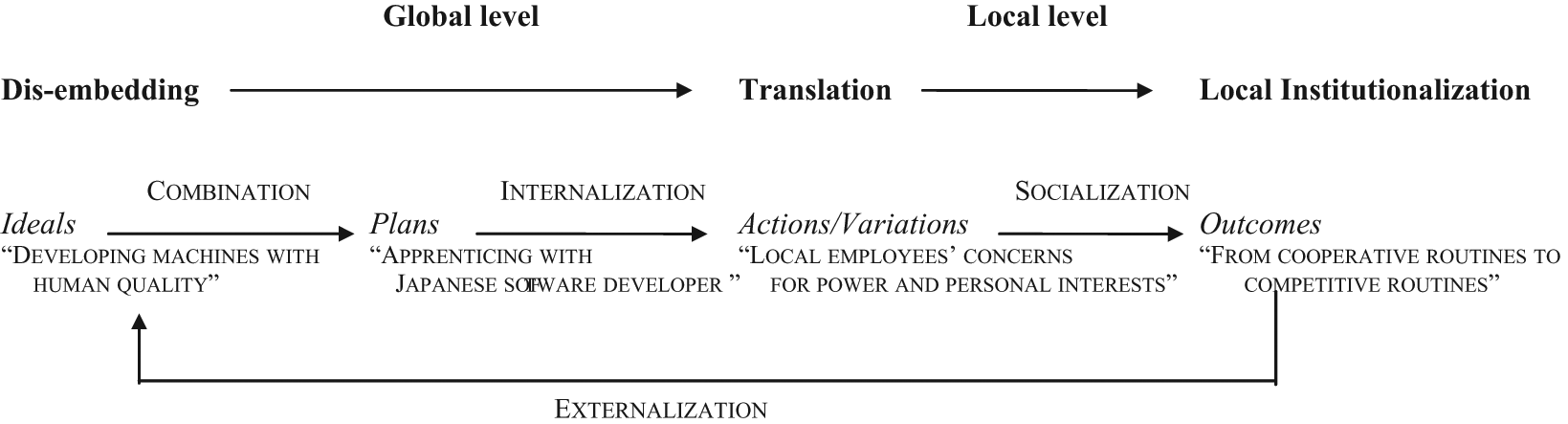
Glocalizing Nonaka’s SECI model: a performative model of knowledge creation in routines.
As a summary remark, the challenges entailed by attempting the global spread of Matsushita’s Home Bakery product development routines discussed above, raise key questions of how the SECI processes are adapted to foreign environments and how local variations are created under a global knowledge framework. Recent research findings indicate that Japanese firms are still at an early stage of cultural glocalization (Giulianotti and Robertson, 2007) with a strong emphasis on preserving their home country cultural practices and meanings in the foreign environment by replicating the enterprise context abroad (Hong et al., 2006a) and marginalizing the practices of the host country personnel (Hong and Snell, 2008; Wong, 2001). There is still a very long way to go before Japanese firms can fully embrace the true spirit of cultural transformation such that ‘social actors come to favour the practices, institutions or meanings associated with other cultures’ (Giulianotti and Robertson, 2007: 135).
Concluding remarks
The present article attempts to identify the challenges for the globalization of knowledge management practices. Although Nonaka and colleagues seek to establish universal validity of their knowledge theories, it appears that the ability of Japanese firms on Japanese soil to mobilize all members to participate in the SECI processes can be explained by the subtle influences of Japanese cultural values. But turning the universal SECI processes into local use would hinge upon how the local actors could simultaneously apply the universal elements of the conceptual framework while addressing the contextual variations during the process of local knowledge translation.
This article contributes to the current debate on organizational learning and knowledge management research on two fronts. First, following Easterby-Smith (1998), I try to identify the hidden behavioral assumptions and cultural values and meanings embedded within the SECI model and provide a thought experiment to explain the organizational and inter-cultural dynamics that may disrupt its translation to overseas contexts. While there has been an ongoing assessment of Nonaka’s work over the past years, the focus has either been on the philosophical and pragmatic treatment of tacit knowledge conversion (Gourlay, 2006; Gueldenberg and Helting, 2007; Tsoukas, 2003; Tsoukas and Vladimirou, 2001) or on the contrasting patterns of knowledge creating activities between Japanese and other cultures (Glisby and Holden, 2003; Weir and Hutchings, 2005). By delving into each of the knowledge conversion modes and relating them to the corresponding cultural values in Japan, I have highlighted the embedded cultural specificities. Failure to recognize areas of learning and knowledge that are susceptive to members’ distinct cultural values and assumptions will result in inter-cultural adjustment problems and misunderstandings. It is necessary to adopt a knowledge translation perspective (Czarniawska and Sevón, 1996), seeking to understand the non-isomorphic patterns of learning that individuals, acting as principal agents of learning (Czegledy, 1996; Saka-Helmhout, 2009), may adopt in responding to global ideas within a milieu of social and institutional influences in specific situations.
Second, this article contributes to the wider debate of universal, local and glocal perspectives on management and organizational learning. Applying a practice-based perspective of knowledge (Gherardi, 2010), I have decoupled the localized cultural values and behavioral assumptions from the pre-supposed global practices in conducting a thought experiment with Nonaka’s SECI model. Analysis suggests that without a shared understanding that ‘what individuals come to know in their (work-) life benefits their colleagues and, eventually, the larger organization’ (Nonaka et al., 2006: 1179), the much celebrated small group learning activities and interactive processes throughout the SECI processes would be difficult to introduce in a foreign cultural environment (Hong et al., 2009). By performing this thought experiment and analysis, this article has identified the significant roles and responsibilities of social actors in preserving, absorbing, adjusting, translating and transforming the global knowledge concepts during the process of local translation. Rather than expecting the complete translation of core ideas from one context to another, a more appropriate approach would be to devise a glocalist approach for enabling some part only of the core ideas of host country culture to be absorbed and synthesized into global ideas (Giulianotti and Robertson, 2007).
One way for scholars interested in furthering the universal, local and glocal debate would be to devise an international comparative study. For example, future research could systematically compare the diverse patterns of knowledge creation process in both domestic and foreign operations of exemplary Japanese MNCs. By providing a common platform for comparison and by controlling the firm-specific factors, the researchers could seek to identify the culturally embedded elements in the SECI model and discover how to balance the preservation of them with local adaptations. Doing so would provide us a strong empirical basis to verify the universal claims of Nonaka’s knowledge creation theory and substantiate its paradigmatic status.
Footnotes
Acknowledgements
The author wishes to thank the editors of this Special Issue, the editors in chief and the anonymous referees for their detailed but thought-provoking feedback on earlier versions of this manuscript.
This research was funded by the Research Committee of the University of Macau (RG006/08-09/HFL/FBA).