







Abstract
This article argues that exceptionalism is a type of foreign policy not exclusive to the United States. It examines other historical cases, including post-Revolutionary France and the Soviet Union. The three cases are comparable in terms of their main characteristics, which include claims of exemptions from the ordinary rules of international relations, messianic missions to ‘liberate’ others, and perceptions of universalized threats. The article also explores the historical and normative foundations of exceptionalist foreign policy claims and practices. All three cases demonstrate the assumptions of social and political superiority that underlie these normative bases. The article concludes with some observations about the incompatibility of exceptionalist foreign policies with the Westphalian foundations of the international order.
Introduction
In the realm of human affairs … one … needs a pretext. It is important to give it the rank of a universal imperative or of a divine commandment. The range of choices is not great: either it is that we must defend ourselves, or that we have an obligation to help others, or that we are fulfilling heaven’s will. The optimal pretext would link all three of these motives. The attackers should appear in the glory of the anointed, in the role of those who have found favor in his chosen god’s eye. (Ryszard Kapuscinski, 2007: 137)
Thanks to the policies advocated by America’s ‘neo-cons’ and often pursued by the George W. Bush administration during its first term in office, there has been a revival of discussion about exceptionalism as a theme in American foreign policy. The term ‘exceptionalism’ is seldom defined rigorously, but in common usage it has two different, if overlapping, meanings. The first refers to the historical view Americans have had of themselves. The United States and its founding constitution were, in this view, unique experiments in governance and liberty. Its governing arrangements (separation of powers, federalism, Bill of Rights, and the like) were innovative and progressive experiments and have remained so. Today, American values and political practices inspire others and serve as the main hope for peace and freedom in the world. No other state has the combination of properties and leadership qualities of America. The United States, because it is exceptional in the world of states, has an obligation to promote freedom in the world.
The second meaning derives from the first. While the international system is in part a rule-governed sphere of activity, one which the United States is largely responsible for creating (the League of Nations, Bretton Woods, GATT, the United Nations, and the like), the responsibilities of leadership require the United States on occasion to transgress prevailing norms in order to provide peace and security and to promote American values — values assumed to be universal but in short supply in a world populated by ‘enemies of freedom’, ‘rogue states’, ‘tyrants’, and ‘axes of evil’. American actions on occasion must be exceptional because its responsibilities, values, and capabilities are exceptional.
This article raises the question whether the ideas and actions that go under the moniker of ‘American Exceptionalism’ are indeed exceptional. Is exceptionalism, rather than unique to the United States, a type of foreign policy? In modern history, have there been other states that have claimed similar rights and obligations? If so, then we can reasonably make comparisons between them and suggest that American diplomatic rhetoric and actions may be of a kind, perhaps rare, but not exceptional. If exceptionalism is a type of foreign policy, the article also raises the question of developing a typology of foreign policy. We have typologies of political systems (e.g. Aristotle), constitutional arrangements (e.g. Montesquieu), and political parties (e.g. Duverger, 1966), but Rosenau’s (1966) pioneering effort to develop a model for comparing foreign policies has never been developed. This article offers the main features of one foreign policy type in a much broader but undeveloped universe of foreign policy analysis.
Before proceeding, we need to anticipate one source of criticism: the possible distance between rhetoric and action in foreign policy. Some, like E.H. Carr (1964) and Hans Morgenthau (1948), argue that all foreign policy actions require forms of justification that can help mobilize public support. What is in play, however, is power. Rhetoric that emphasizes values or ideas such as ‘freedom’, bringing the less well-off the ‘benefits of civilization’, or promoting ‘democracy’ is seldom more than a fig leaf for more nefarious power-based purposes. Carr (1964: 75–76) sums up this perspective well:
It will not be difficult to shew [sic] that the utopian, when he preaches the doctrine of harmony of interests, is innocently and unconsciously … clothing his own interest in the guise of a universal interest for the purpose of imposing it on the rest of the world…. He argues that what is best for the world is best for his country, and then reverses the argument to read what is best for his country is best for the world…. British writers of the past half-century have been particularly eloquent supporters of the theory that the maintenance of British supremacy is the performance of a duty to mankind.
More recent studies suggest that such rhetorical devices are more complex than mere platitudinous justifications for self-interest. They express deeply held ideological convictions, mental frameworks, and social constructions that have a profound effect on perceptual processes, on how issues (particularly crises) are defined, how friends and enemies become categorized (with resulting elements of trust and distrust), how identities are formed, and how policy choices are articulated. Trevor McCrisken (2003: 187), who has studied numerous primary documents in the formulation of American foreign policy since Vietnam, has concluded that:
exceptionalist language is not only used in public explanations of policy but is also used by policy makers themselves behind closed doors. Presidents and their foreign policy advisers frequently use arguments couched in exceptionalist language during private meetings and in personal memoranda. They do so even when perfectly good practical arguments for policy options exist and they often phrase even strategic, economic or political justifications in exceptionalist terms. The belief in American exceptionalism, therefore, provides the framework for discourse in US foreign policy making even if it is rarely the main determining factor of policy itself.
Another study (Widmaier, 2007) shows how exceptionalist ideational constructs offered by Harry S. Truman in 1948 and George W. Bush in his first term conditioned their policy choices, set the foreign policy agenda, and ultimately became constraints on their ability to choose among policy options. In a sense, these policy-makers became victims of their own rhetoric.
We will never know, from president to president and situation to situation, how exactly the two notions of American exceptionalism function as the intellectual bases of policy choices. Clearly, actions are often inconsistent with value pronouncements. A most glaring example is the American rhetoric about its devotion to democratic values and its mission of promoting freedom and democracy in the world while subverting, occasionally overthrowing, or assassinating popularly elected governments or their leaders. The record of military and other forms of support for a variety of ‘strongmen’ and tyrants also brings into question the supposed explanatory power of foreign policy rhetoric. We will leave for the moment a definitive answer of the rhetoric–action puzzle and concur with McCricken’s (2003: 6) conclusion:
The growing body of work on the belief in American exceptionalism and its influence on US foreign policy shows that it should not be dismissed as ‘mere rhetoric’. In fact, it should be acknowledged as an important and influential idea that contributes to the framework of discourse in which policymakers deal with specific issues and in which the attentive public understands those issues.
Evidence supports his claim that the liberation mission is more than just political rhetoric. Of 93 US military interventions between 1898 and 1996, 33 had democracy promotion as a major goal (Peceny, 1999: 9). The 2003 Iraq aggression puts the number to 34.
We have four remaining tasks: (1) to outline the main characteristics of this foreign policy type; (2) to explore history to locate states that have shared some or all of these characteristics; (3) to explain some sources of exceptionalism, particularly in the United States; and (4) to explain the normative foundations of exceptionalism.
Five essential characteristics of exceptionalism: A summary
There are at least five characteristics of an exceptionalist type of foreign policy:
A responsibility, obligation, and mission to ‘liberate’ others, usually defined as entire societies suffering from some evil, exploitation, or fallen status. National priorities are defined in terms of subordinating self-interest to a larger, assumed universal good. It is messianic in the sense that the exceptionalist policy will ‘deliver’ the less fortunate.
Because of these special responsibilities, the exceptionalist state is or should be free from external constraints such as rules or norms that govern or influence the relations between ‘ordinary’ states. Redeemer nations should be free of encumbrances when meeting their global responsibilities.
Exceptionalist states usually see themselves existing in a hostile world. Threats are universalized. Problems with local etiologies are defined in terms of a specific example of the broader category of universal threats.
Governments and societies of exceptionalist states develop a need to have external enemies; for this reason, threats are often concocted or, where minor, are inflated to extreme proportions.
Exceptionalist states portray themselves as innocent victims. They are never the sources of international insecurity, but only the targets of malign forces. They do not act so much as react to a hostile world. They are exceptional, in part, because they are morally clean as the objects of others’ hatreds.
This list may not be exhaustive. A thorough historical review might uncover other common traits, but these five seem to be prominent in almost all examples of exceptionalist claims and behavior. Two further observations are necessary.
First, the typology is not built on the premise that all five exist at all times in all exemplars. They should be viewed as variables, waxing and waning depending on historical circumstances and the ideological proclivities of state leaders. It is also possible that some states exhibit some but not all the characteristics at these critical times. For example, the great French and British imperial project beginning in the 1880s, propelled in part by the exceptionalist rhetoric of a ‘civilizing mission’ and ‘bringing the gifts of civilization to the natives’, conformed to the messianic dimension of exceptionalism, but since most of the other characteristics were seldom visible, we will not consider them as exemplars of the foreign policy type.
Second, there is the distinction between difference and exception. The foreign policy beliefs, rhetoric, purposes, and action of all states differ. No state’s foreign policy is a duplicate of any other’s. However, most states most of the time do not have universal aspirations that guide their foreign policy choices. Paraguay’s decisions do not seek to foment or promote a universal reorganization of the political map. Bhutan commits no resources to organizing a global revolution where every government would adopt the concept of ‘gross domestic happiness’ as its guide to economic policy. I use the term exceptionalism — and it is implied in common usage elsewhere — to denote a rare form of behavior. When the five characteristics appear simultaneously, a better label is perhaps exceptionalist syndrome. It has appeared from time to time in different historical contexts, and is not unique to the United States. Even though rare, it occurs sufficiently throughout the history of the states system to suggest that it is a type of foreign policy.
Messianism and the liberation mission
Some governments have proclaimed themselves as having a unique role or mission in ‘liberating’ foreign peoples and societies suffering from some form of oppression. This notion has pervaded American foreign policy discourses almost from the days of the establishment of the Republic. Quotations from presidential addresses are legion, suggesting that the role of international liberator is deeply embedded within American self-identity as a superior society that should be emulated universally (cf. McCartney, 2006). From Hamilton and Jefferson to Truman, Kennedy, Clinton, and George W. Bush, the theme is basically the same: the United States has a duty to support others struggling for freedom. As Ronald Reagan put it in defining the purpose of supporting the Contras in Nicaragua in the 1980s, the United States has a duty to support them because they (the Contras) ‘are the moral equivalent of our Founding Fathers’. To turn away would be ‘to betray our centuries-old dedication to supporting those who struggle for freedom’ (quoted in McCrisken, 2003: 124). For Harry Truman, the only way to save the world from totalitarianism was for the ‘whole world [to] adopt the American system’ (Pagden, 2005: 53). For George W. Bush:
America is a Nation on a mission, and that mission comes from our basic beliefs.… Our aim is a democratic peace … a peace founded upon dignity and rights of every man and woman. America acts in the cause with friends and allies, yet we understand our special calling: This great Republic will lead the cause of freedom. (State of the Union Address, 2004)
Lest we think this type of rhetoric was used solely for symbolic occasions, major foreign policy planning documents such as National Security Council (NSC) Directive No. 68 (1950), like Bush’s 2002 National Security Strategy analysis, insisted that ‘our position as the center of power in the free world places a heavy responsibility upon the United States for leadership … so as to bring about order and justice by means consistent with the principles of freedom and democracy’ (quoted in McCrisken, 2003: 22–23).
These themes were prominent in all the major foreign policy problems the Americans faced later in the 19th century: the expansionist war against Mexico, the ‘opening’ of trade with Japan and China — a major project justified as advancing Western civilization — and the 1898 war against Spain to liberate Cuba. Missionaries, traders, and politicians all joined together in the great American movement to the west (including the Orient) fully convinced that they were performing a duty to carry the blessings of civilization to others wherever they might be (cf. McCartney, 2006). Words expressed by Secretary of State William Seward in the 1860s have a familiar ring today: ‘The rights asserted by our forefathers were not peculiar to themselves. They were the common rights of mankind.’ The United States, he maintained, had not just the opportunity but also the duty ‘to renovate the condition of mankind, to lead the way to the universal restoration of power to the governed’ everywhere in the world (quoted in Kagan, 2007: 264).
Woodrow Wilson introduced another dimension to the civilizing mission rhetoric. His thoughts surrounding the League of Nations project constituted an early articulation of the democratic peace theory. Non-democratic polities were inherently aggressive because they expressed the interests of narrow elites and ignored the wishes of the broad population that were assumed to be pacific. One early vision of the League was to be an organization bringing together only the world’s democracies. Peace would be guaranteed because only democracies express mankind’s peaceful hopes and meet their treaty obligations (Holsti, 1991: ch. 8; Smith, 1994: chs 3–4).
This theme was central to George W. Bush’s conception of America’s unique obligations to bring the blessings of liberty to those who do not enjoy them. All the 19th-century words are to be found in his major foreign policy speeches: ‘mission’, ‘civilization’, providential support for the great democratization project, leadership obligations, and, implicitly, the idea that others must become like us. To this brew, he added an incorrect version of the democratic peace hypothesis. Genuine peace is only possible among democracies; ergo, if you want peace, you must promote democracy anywhere and everywhere. Thus, the attack on Iraq was motivated (or so Bush argued, but only after the weapons of mass destruction were not found) not only by a desire to liberate the long-oppressed victims of Saddam Hussein’s tyranny, but also as a major step in the democratization of the Middle East. That democratization would then lead to peace in the entire region. 1
What of other cases? Members of the French Constituent Assembly had renounced all wars of conquest in May 1790, portraying themselves as the harbingers of a new kind of international politics. Deep insecurities and perceptions of threat emanating from Vienna and Potsdam (the Declaration of Pillnitz and Louis XVI’s flight to Varennes) helped to lead France to war against conservative Europe in 1792. In the course of military success, Belgium, Savoy, Nice, Spier, Worms, Mainz, and finally Frankfurt fell to the French revolutionary armies and were subsequently ‘liberated’. The Convention was not unified in a policy of ‘liberation’, but as Brussels and the Austrian Netherlands were seized, these victories had to be justified.
The French revolutionaries were universalists in the sense that they deemed the principles underlying their project to be applicable everywhere. The idea that sovereignty lies in the people rather than in the person of the king or queen led logically to the principle of self-determination for all peoples. This meant that a people not happy with their lot under one system of rule could opt to join or create another, and as the principal initiators of these ideas, the French had a responsibility to ‘aid all peoples who wish to recover their liberties’, as the Convention proclaimed in November 1792 (quoted in Kim, 1970: 45). The responsibility to ‘overthrow all thrones, crush all kings and render universal the triumphs of liberty and reason’ (quoted in Armstrong, 1993: 86), became one of many instructions issued by the Committee of Public Safety to the Minister of Foreign Affairs.
In subsequent conquests, the task of the victorious generals was to proclaim the sovereignty of the people, to suppress established authorities, and to convoke the people in primary assemblies. This was the French revolutionary version of ‘regime change’ in the name of liberty and freedom. They also made it clear that freedom meant the choice of governance according to French principles. The liberated societies were not free to choose forms of governance that meant only ‘semi-liberty’ or that retained the position of privileged orders. French power would be necessary to carry through a revolution that would be in the true interests of the conquered peoples. Of course the decision regarding those best interests would be made in Paris (Armstrong, 1993: 97).
In less than a year, a putatively defensive war turned into an ideological crusade to free Europe from its tyrants. To be sure, the considerations that went into this policy had a good deal to do with securing the ‘natural’ borders of France (a defensive priority), but French liberations went far beyond those necessities. That these policies seemed to contradict the 1790 abrogation of conquest was handled easily by the sleight of tongue, changing conquest into ‘liberation’. This was based on the belief that peoples throughout conservative Europe longed to be liberated from their tyrants (Kim, 1970: 48–49). While the principles of revolutionary France initially excited sympathy throughout Europe, liberation and occupation by foreigners seldom generates widespread and enduring enthusiasm. Facing increased riots and armed resistance from the ‘liberated’, the French abandoned the pretenses of liberation and turned the wars, until Napoleon’s ultimate defeat, into systematic programs of plunder, extortion, looting, and empire-building. In September 1793, the National Convention decreed that:
The generals commanding the forces of the Republic … renouncing from henceforth every philanthropic idea previously adopted by the French people with the intention of making foreign nations appreciate the value and benefits of liberty, will behave towards the enemies of France in just the same way that the powers of the coalition have behaved towards them; and [the generals] will exercise with regard to the countries and individuals conquered by their armies the customary rights of war. (Quoted in Blanning, 1996: 159)
The early Soviet Republic and its successor the Soviet Union represents the third case. In the heady days of 1917 and 1918 after the Bolshevik revolution had established a semblance of authority in Russia, the leadership maintained a universalist perspective on the plight of the oppressed working classes throughout Europe. The Bolsheviks viewed the successful revolution in St Petersburg as the first of many revolutions that would occur in the European turmoil surrounding the late stages of World War I. The Bolshevik regime took upon itself the responsibility to support, aid, and fund these situations wherever they sprang up. They subsequently offered various forms of assistance — from propaganda to armed forces — to revolutionaries in Finland, Hungary, Germany, and throughout the restive portions of the collapsing Russian Empire. In the war with Poland 1920–2, the official Soviet version was that it was supporting Polish revolutionaries, not engaging in a classical war of conquest.
The failures of most of these revolutions, along with the costs exacted by the Russian civil war, ultimately forced the Bolsheviks to abandon Trotsky’s notion of ‘world revolution’ in favor of Lenin’s priority to consolidate the revolution in Russia. But the concept of a permanent obligation and responsibility to promote liberation of the proletariat was never formally abandoned. Whether ‘permanent revolution’ or ‘socialism in one country’, at the rhetorical level the Soviet regime consistently proclaimed its foreign policy objectives as encompassing responsibilities to grant fraternal aid in the great revolutionary historical project. The organization of the Cominform under Soviet leadership provided the organizational structure for developing universalist revolutionary strategies and tactics, as well as providing the ideological slogans justifying them.
After the 1950s, Soviet ‘liberation’ priorities became more focused on the developing world. Whereas Lenin and Trotsky had seen post-war Europe as the most natural site for the proletarian revolution, Khrushchev and his successors placed more emphasis on aiding the struggle against colonialism and imperialism. The forms of support included guerrilla training, foreign aid, support for anti-imperialist resolutions in the United Nations, and occasional attempts at subverting regimes that were overtly anti-Soviet. As with the American project of promoting democracy, the actual policies and commitments depended very much on local circumstances and the general international situation. However, in all major foreign policy speeches, the great purpose of liberation remained a leitmotif until formally abandoned by Mikhail Gorbachev.
At first glance, one might be mystified by a comparison of French, Soviet, and American foreign policy rhetoric and actions. But if one adjusts for the unique vocabularies in play, the structure of foreign policy role elaboration is significantly similar. Each leader sees his country as historically unique; each elaborates some sense of responsibility to ‘liberate’ those assumed to be victims of false ideologies or oppressive governments (or classes); each assumes that others are pining for liberation; and each hypothesizes that those who are liberated wish to become carbon copies of their liberators. They also assume that their own fundamental political and social values are universal and that because their own country enjoys the blessings of freedom or the end of class oppression, they also have universal responsibilities for leadership. Exceptional domestic qualities give rise to exceptional international responsibilities.
The messianic role conception does not predict any particular foreign policy behavior. One can promote values and institutions with a range of means, from seeking to perfect domestic institutions with the hope that others will imitate (this form was predominant in the early years of the American republic and under the current Obama administration), to more active forms such as ‘teaching’ less fortunate others through a variety of programs. The European Union has offered former communist countries and Turkey the promise of membership on condition that they adopt constitutional rule, respect minority rights, abandon territorial claims, hold free elections, and adopt free market economies. This is democracy promotion by offering carrots. At the other end of the scale, military force is used to effect ‘regime change’. Throughout French revolutionary, Soviet, and American history, policies have fluctuated between these means. Figure 1 illustrates the continuum.
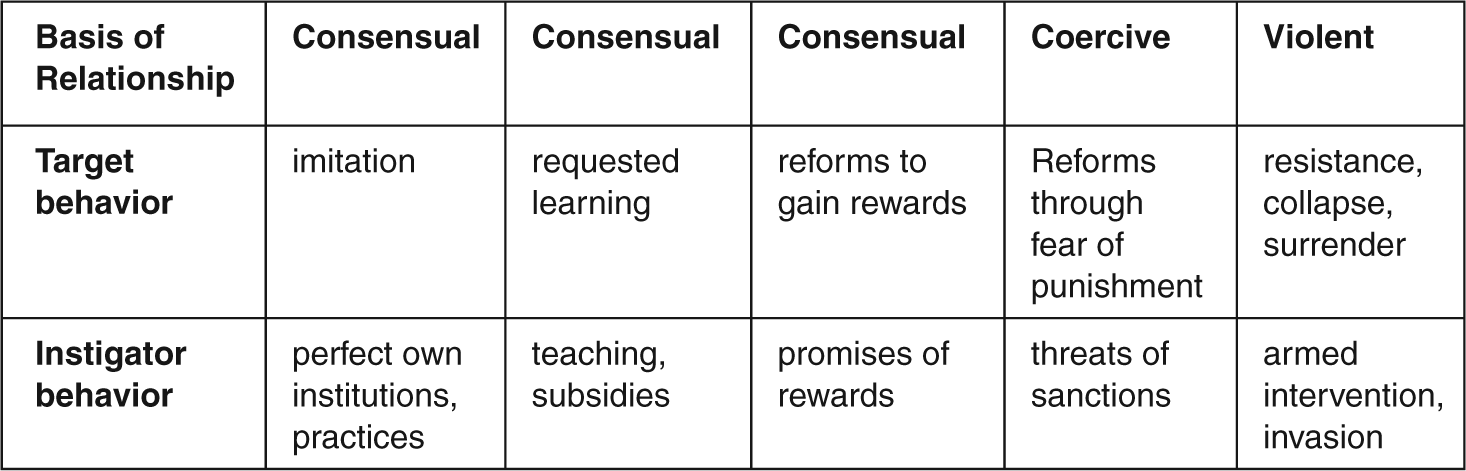
Modes of democracy promotion
The exceptionalists’ modus operandi: Freedom from external control
Most governments most of the time seeks to maximize their freedom of action. In that sense, there is nothing exceptional about exceptionalism. However, most governments most of the time also recognize that in order to maximize their own values and interests, it is necessary to enter into treaty and other arrangements to obtain the outcomes they desire. International treaties, norms, conventions, and the multilateral institutions that are often the venues for their design and negotiation serve individual and collective interests. They are designed to solve international problems for which go-alone policies would be futile and possibly dangerous to key national interests. They often impose serious constraints on freedom of action but they also enhance international trust, predictability, and cooperation in a variety of issue areas. International society is a norm-infused domain and those who systematically violate those norms not only weaken that society but may also undermine their own foreign policy goals.
There is a venerable tradition of American foreign policy discourse that discourages foreign ties, institutional memberships, and long-range commitments. George Washington’s famous farewell address advised against entangling alliances that would not only compromise American interests, but also lead to domestic corruption. The isolationists who rejected Woodrow Wilson’s great project did so primarily on the grounds that membership in the League of Nations would compromise America’s freedom of action, its sovereignty, and its ability to choose among courses of action in response to various threats and opportunities in the international system. The coterie of intellectuals and policy-makers dubbed the ‘neo-cons’, some of whom held top positions in the George W. Bush administration, averred that the United States in its moment of hegemony had to free itself of the shackles imposed by out-of-date treaties, lugubrious institutions such as the United Nations, and any other undertakings that might restrain freedom of choice. These ideas were in tune with Bush’s priorities that were to deal effectively with the major threats to American security, as he saw them, regardless of prior commitments. The steps to free the United States of international obligations and the cumbersome processes of multilateral diplomacy are many and constitute a book in themselves. The list would include the following:
Unilateral abrogation of the ABM treaty.
Withdrawal from the Kyoto Protocol.
Removing President Clinton’s signature from the treaty establishing the International Criminal Court.
Refusal to ratify the Comprehensive Test Ban Treaty.
Virtual abandonment of the Non-Proliferation Treaty by making side-deals with India.
Invading Iraq without approval of the United Nations Security Council.
Refusal to approve a new protocol to the Biological Weapons Convention.
Opposition to a draft treaty to control trafficking in small arms.
Vigorously maintaining that American sovereignty is inviolable, but insisting that the sovereignty and territorial integrity of others can be breached when American security requires it.
Asserting that if the United Nations is to be relevant, its members must abide by the body’s resolutions. However, the United States (and Israel) is not bound by UN resolutions.
These and other acts were justified by the view that the best way to ensure American security in a dangerous world is to shed constraints, whether bilateral or multilateral, and to maximize freedom of action to address the range of threats directed against the United States from named and unidentified parties (cf. Daalder and Lindsay, 2003/2005: 13).
The philosophical foundations of the French Revolution, in particular the notion of popular sovereignty, led the French to suspect all treaties and norms that were not validated by popular choice. They condemned the Peace of Westphalia on the grounds that it was an agreement among princes. They questioned existing foundations of international order because these guaranteed only the ‘tranquility’ of despots, not of peoples who remained under the yoke of tyrants and privileged classes. France, they argued, should be constrained only by the principles of natural law (which they then interpreted to mean that France should expand to its ‘natural’ borders). As Dumouriez, who became the French foreign minister for a period in 1792 and who ultimately defected from the revolution, wrote: ‘a great, free and just people is the natural ally of all people and must not have particular alliances which tie it to the destiny and interests of such and such a people’ (Armstrong, 1993: 87–88). In the early stages of the revolution, the Legislative Assembly demanded that all foreign policy engagements of the royal government be reviewed; several were subsequently annulled (Whiteman, 2003: 122–123).
In the case of the Soviet Union, as in many other post-revolutionary societies, it rejected most of the legal foundations of the society of states on the grounds that they reflected solely the interests of the bourgeois and imperialist countries. At first the Bolshevik regime violated a la carte those tenets of international law that constrained it. It abrogated the debts of the Tsarist governments and unilaterally annulled a series of pre-1917 treaties, it violated the norms of diplomatic immunity, it made a separate peace with Germany, and it frequently interfered in the domestic affairs of other states. Subsequently, the Soviet regime set about establishing a socialist international law, one that reflected class interests and was of a ‘higher order’ than bourgeois international law. Class interests and workers’ solidarity trump sovereign equality and non-intervention. International legitimacy does not reside in Westphalian principles, self-determination, or international democracy; it derives solely from the interests of the international proletariat and the cause of the world revolution (Armstrong, 1993: 126).
In subsequent years, the Soviet regime altered many of these views; indeed, it became a champion of a traditional reading of sovereignty (at least for itself) and regularly denounced violations of the norm of non-intervention when others practiced it. When it became the instigator of armed intervention, as in Czechoslovakia in 1968, it went through tortuous mental gymnastics and reinterpretation of ‘socialist international law’ to justify its actions. 2 The Brezhnev doctrine, like the Roosevelt Corollary (1905), was a major deviation from standard interpretations of international law, but it was necessary as an attempt to legitimize Soviet freedom of action.
Maximization of autonomy and freedom of action are strong imperatives in a formal anarchy populated by sovereign states (Waltz, 1979). Despite violations of norms and treaty obligations, the offending parties usually go out of their way to proclaim that these actions are consistent with other norms or moral claims. But the exceptionalist foreign policy type is characterized by claims of permanent immunity from norms of the international society. Both the French revolutionaries and the Bolsheviks made such claims. The George W. Bush administration never categorically or formally rejected international law or the norms of the United Nations Charter, but when it deemed it necessary to protect national security or to promote ‘freedom’, it was willing to act unilaterally and to justify itself on a higher morality such as national security or the responsibilities of leadership, international justice, and world peace. The systematic repudiation of so many international treaties, particularly during the first Bush administration, stands in contrast to most other states and thus warrants use of the term exceptional.
Universalization of threats
Some governments have a tendency to transform discrete threats coming from particular states or other agents at particular times into a universal, hostile Hobbesian worldview. Threats are all-pervasive, limitless, and enduring. It is the responsibility of the exceptionalist state to counter those threats by superior power, by adopting policies of preventive and pre-emptive uses of military force, and by refusing to negotiate with enemies who are perceived to be morally tainted and to have unlimited will and capacity to inflict damage on the government and its society. In the case of the United States, the examples are legion.
A prime example of the universalization of threat is the famous NSC 68 (1950). Until the late 1940s, American officials typically viewed the Soviet Union as a troublesome and ungrateful former ally against Nazi Germany, and one that posed limited threats to post-war Europe (recall that the United States was a reluctant founder of NATO). The Soviet atomic bomb tests of 1949 and the communist victory in China changed this fairly selective view of the world in which the United States was engaged. NSC 68 proclaimed, ‘the assault on free institutions is world-wide now and in the context of the present polarization of power a defeat of free institutions anywhere is a defeat everywhere’ (emphasis added). The Korean War produced a broad consensus that the Soviet Union was a universal threat, its aims were limitless, its choice of means was ruthless, and the only response was a drastic build-up of American military might. President Truman endorsed the Hobbesian worldview of NSC 68, and it remained as the leitmotif of American foreign policy discourse well into the 1980s. The threat was universal. Communist machinations lay behind every revolution or liberation movement in the Third World. Democratically elected governments that had friendly relations with the Soviet Union and/or China were suspect and, as in the cases of Guatemala (1954), Congo (1960), Chile (1973), and Nicaragua in the 1980s, had to be overthrown.
The belief structure of the Bush administration’s view of the world was analogous if not an exact replica of a universalized threat structure. ‘Terror’ is universal and hidden, but it is strategically linked to rogue state actors constituting the ‘axis of evil’. The connections between them are of course never verified, but the nightmare that the administration attempted to popularize — with considerable success at least in the United States — was of a world populated heavily by evildoers who want to harm innocent Americans. The responding ‘war on terror’ was equally indiscriminate. The United States will ‘hunt down and bring to justice’ those evildoers, wherever they are found. Pre-emption and preventive war are necessary responses to those who operate in secret. According to Condoleezza Rice’s interpretation of the 2002 ‘National Security Strategy of the United States of America’, even the suspicion that certain actors are seeking to gain control of weapons of mass destruction (never formally identified) warrants military action (National Security Adviser [sic], 2002).
The universalization and amplification of threats are revealed not only in political speeches mobilizing public opinion. These characteristics provide a perceptual foundation for intelligence estimates. During the Cold War and the George Bush administration’s handling of the Iraq problem, National Intelligence Estimates (NIE) chronically over estimated both the capabilities and intentions of America’s main adversaries (Lebovic, 2009).
This exaggeration derives in part from a broader American public perception of the world as a hostile place, an environment in which America must constantly strive to control and eliminate evildoers before their malevolent acts hit the American homeland. The popular and semi-academic literature portrays a Hobbesian world, none of which is of American making, but which must be controlled. For Samuel Huntington (1993), it is the ‘clash of civilizations’, in which the United States must mobilize, lead, and protect the great Western civilization from its enemies. For Thomas Barnett (2005) America stands as an oasis of civility and freedom in a world populated by unspecified malevolent threats. Robert Kagan (2003) argues that Americans do indeed view the world as a hostile environment in which an innocent United States must bear the burden of military leadership, not relying upon the Europeans who see the world in more Kantian terms.
Historical analogues were prominent during the French Revolution and more recently in the Soviet Union. In the case of the French, there was the highly publicized fear of counter-revolution aided, abetted, and possibly instigated by Europe’s major despots. Surrounded by hostile crowns, the links between them and elements of the French aristocracy, Louis XVI’s flight to Varennes, and the 1791 Pillnitz Declaration, a decree that unmistakably registered conservative hostility to the revolution, it is not surprising that many of the French reactions to these trends and events attained almost hysterical heights and were used to justify numerous excesses. The French came to characterize the enemy not as the courts in Vienna, London, or Berlin, but an undifferentiated transnational ‘counter-revolution’ that demanded extreme counter measures to save the achievements of 1789. Revolutionary leaders perceived a vast network of interconnected conspiracies, all magnified through rumor and hearsay (Sutherland, 2003: 132). The great ‘Terror’ reflected extreme fears of counter-revolution as well as the losses French armies were experiencing in the great foreign liberation project. War and terror became mutually supportive. The answer to the problem of French weakness and vulnerability was a combination of foreign military conquests and executions of those suspected of counter-revolutionary sympathies.
Bolshevik and later Soviet leaders consistently portrayed their revolution and the Soviet state as permanently threatened by undifferentiated ‘imperialists’. This began with the Allied intervention on behalf of the Whites during the Russian civil war, and continued under various slogans such as ‘capitalist encirclement’, ‘imperialist aggression’, and ‘German revanche’. We must not forget that the so-called Iron Curtain was not just a device to keep denizens of the workers’ paradise safely at home, but also to keep out foreign ‘saboteurs’, ‘enemy agents’, and foreign ‘provocateurs’. The degree of suspicion about all foreigners was extreme, and government propaganda constantly played on the motif of malevolent foreigners and the threat they posed to the workers of the Soviet state and to their leading party. Stalin, in particular, viewed the Soviet Union ‘as an isolated and besieged island precariously existing in an unrelentingly hostile capitalist sea’ (Marantz, 1988: 25). These perceptions of threat were not, of course, entirely fictional, but they were amplified to such a degree that ordinary Soviet citizens could perhaps better tolerate the many sacrifices they had to make to ensure the security of the Soviet motherland. Stalin’s personal paranoia was reflected in state policies. Like the French revolutionaries’ perceptions of threat almost two centuries earlier, he held that there could be no peace until Russia’s enemies in particular and imperialism in general had been destroyed. In Soviet diplomacy until the 1960s, all Western proposals were tricks, the institutions of the international community were hotbeds of espionage against the USSR, and any talk of arms control or disarmament was a ploy to weaken the deterrence capabilities of the Soviet Union. The Soviet perception of unrelenting threat did not wane until Khrushchev introduced a significantly more optimistic view of the external environment (Marantz, 1988: 31–47).
The main difference between the universalization of threats during the Bolshevik and Soviet era on the one hand, and during the George W. Bush administration on the other, is that in the former the threat perception was manufactured by the regime for a population that had few if any alternative sources of information. In the United States, the administration used all of its levers of persuasion to instill a sense of heightened fear in the American population, but alternative voices were never stilled, even though they were few and certainly not given much notice in the mainstream media. A gullible American public and media swallowed without serious interrogation the administration’s assertions that Saddam would have the bomb within a matter of months (Cheney, August 2002), that Saddam had strong ties with al-Qaeda and ‘terror’, that Saddam was a threat more dangerous than Hitler (Rice, January 2003), that members of the ‘axis of evil’ were soon to develop the wherewithal to launch weapons of mass destruction at the United States, and that the foes of freedom were mobilizing around the world to strike at the heart of America. The American media played a leading and uncritical role in purveying the administration’s threat scenarios (see Bennett et al., 2007).
The need to have an enemy
For a variety of institutional, ideological, and cultural reasons, states that have endured long periods of persistent (real or perceived) threat and fear tend to develop a ‘need’ for external enemies. The transition from a fear-based perception of the external environment to a more benign international scene may be difficult for both individuals and institutions whose raison d’etre has been intimately tied up with threat perception, identity, fixed roles, and crisis management. A permanent aura of exaggerated insecurity may also help create and sustain the role and efforts to liberate others. The democratic and socialist peace theories, prominent in all three examples discussed here, provide a recipe for security: remove your adversaries through ‘liberation’ and you will achieve permanent peace.
One gets a sense of the unease in the United States by regarding typical reactions at the end of the Cold War. Even prior to the events that led Gorbachev to reject traditional Soviet policies, many Americans had begun casting around for new threats. Prominent among those was Japan in the late 1980s. The Japanese economic miracle was moving ahead and there was much loose talk about a Japanese challenge to American supremacy in the Far East. Novels, think-tank studies, and sections of the popular media began hyping the new threat, old stereotypes of Japanese secretiveness emerged in some of the literature, and the academic studies of the growth and decline of the major powers earned a wide readership, including among members of Congress. The rupture of the Japanese bubble undermined the ‘Japan as the new threat’ scenario but a sense of unease pervaded much foreign policy discourse once George Bush senior announced the arrival of the new world order in 1991. In the early 1990s there was the looming problem of Yugoslavia’s break-up but that did not present any direct threats to the United States. The senior Bush administration instead rummaged around for threats closer to home and discovered the drug problem. Now the drug producers and expediters in Colombia, Peru, Mexico, Ecuador, and Bolivia took center stage as the emerging threat to America. The administration characterized the situation as predominantly a military problem; armed aid was directed toward incumbent governments; there was talk of using military forces for interdiction of drug traffic from South America to the United States, and an aircraft carrier was dispatched to patrol the shores of the continent. Nothing much came of this, but one has the sense that the Pentagon and many people in the upper echelons of the administration were uncomfortable without a clear-cut enemy of grand proportions.
The Clinton administration found it somewhat easier to conduct foreign relations in the absence of national fear. Foreign policy problems such as ex-Yugoslavia were dealt with cautiously, China was named a ‘strategic partner’, and the ill-fated expedition to Somalia made everyone timid about armed interventions, even if only of the humanitarian type. Rwanda was the product of this mindset. During this period, outlays for military expenditures declined dramatically, followed by almost all other governments in the world. Iraq remained on the agenda, but Clinton and his advisors did not portray Saddam Hussein as an immediate security threat.
Despite the appearance of a relatively benign international situation in the 1990s, numerous writers and think tanks in the United States continued to put forth the view of a perilous world in which numerous agents and actors were seeking to harm American interests and possibly challenge its hegemonic position. Within Washington defense circles there was a vigorous debate between the ‘blues’ and the ‘reds’ as to whether China or post-communist Russia would pose the greatest challenge to the United States. I have already mentioned several prominent analysts who were convinced that the United States remained under serious threat in a combination of new and old types of challenges. Among the group of officials and editorialists termed the ‘neo-cons’, a permanent enemy or enemies was a central tenet of their worldview. The United States must remain militarily superior to fend off the threats of all those with malevolent intent — and there are many of them. Resistance to American interventions simply confirms the initial assumption of a hostile world. The world of the omnithreat made up an important component of George W. Bush’s perception of the problems the United States faced:
We’re certain that even though the ‘evil empire’ may have passed, evil still remains. We’re certain there are people that can’t stand what America stands for.… We’re certain there are madmen in this world, and there’s terror. (Quoted in Chernus, 2006: 57; emphasis in original)
A disciplined study of the French Revolution and Soviet diplomacy and war-making would probably uncover patterns similar to those found in the United States after the Cold War. In the case of the French, the liberation policy did not last long enough to establish a long-term trend, but certainly a sense of fear was manufactured as a means of promoting national military mobilization and the excesses of the Terror. For the Soviet Union, manufactured fear was a constant from the early days of the Bolshevik revolution to the more confident diplomatic postures developed much later during the Khrushchev interlude.
The need to have enemies is a phenomenon that requires research. Any analysis at this point is tentative and hypothetical. In much of the post-Cold War American political analysis, hostility and victimhood are prominent themes. The influential works of Kagan, Huntington, Kristol, and many others bear out this generalization. When there is no real threat around, Americans tend to become uneasy and are prone to invent new ‘monsters to slay’. This is a cultural habit or artifact, one with deep historical roots, but also deriving from institutional needs such as the military–industrial complex, xenophobic thought structures in elements of the population, social needs to appear virtuous and charitable, and a host of other predispositions relating to trust, attitudes toward foreigners, and displacement of social fears onto outsiders.
Innocence
Underlying much of the need to have an external foe or enemies is the portrayal of the exceptionalist as a victim of others’ hatreds and malign intentions. American innocence is a prominent theme throughout the historical discourse on American foreign policy. It is others who threaten American interests and values, and the United States itself is seldom the perpetrator of actions that give rise to foreign resistance. Americans typically dealt with the problem of ‘Indians’ as one of punishment for barbaric acts of cruelty visited upon settlers by the savages. Rare was the acknowledgment that the natives were fighting to survive as distinct cultures in their traditional lands. But virtually all of the lands annexed by the United States between the administrations of Jefferson and Jackson started out as native-held territory, from which over the years they were expelled, exterminated, or ethnically cleansed.
Expansion fed further expansion and those who resisted posed a variety of threats to American society and security. In a rare fit of accurate self-analysis, a report by the American navy’s Policy Board in 1890 frankly stated that American expansion abroad was creating fear among others and that ‘war could come as a result of American, not foreign, actions’ (Kagan, 2007: 348). No one in more recent times has conceded this as a possibility. The administration’s response to the 9/11 attacks is a case in point. At an impromptu press conference on the White House lawn, George W. Bush stated in the perplexed tone of the virtuous innocent, ‘Why would anyone want to hurt us?’ When asked by a reporter whether American policy in the Middle East would change as a result of the 9/11 attacks, Deputy Secretary of State Richard Armitage replied that he saw no reason why the United States should change its policies. It seemed beyond the comprehension of the upper echelons of power in Washington, DC that anything the United States did could be anything less than noble, virtuous, and helpful. Apparently the reams of evidence about the consequences of American actions in the Palestine issue — unremitting support for Israel — or the hundreds of thousands of deaths produced by the boycott and embargo of Iraq in the 1990s, or the construction of American military bases in Saudi Arabia made no impression in Washington. Bush’s only public explanation for the al-Qaeda attack was that these evil people hate everything America stands for, particularly its freedom. Framed this way, one is the innocent victim, and one thus does not have to indulge in any self-examination or enter into any dialogue with the enemy. The enemy has no issues to discuss, but is only driven by hatred. All that remains to be done is to root out the evildoers and bring them to justice.
Sources
The French mission to liberate Europe derived primarily from the idea that the French Revolution was historically progressive, that its values were universal (the Declaration of the Rights of Man, not of French men), and that the royal format of rule was everywhere corrupt, degenerate, a source of constant warfare paid for by innocent civilians, and tyrannical. The French Revolution stood for everything opposed to the royal mystique: public virtue, civil liberties, the destruction of the institutional hold of the Catholic Church, the main values of the Enlightenment, and rule legitimized by popular support (popular sovereignty). The obligation to bring the blessings of liberty arose not from being French, but from being free. Although elements of nationalism were prominent in the foreign policy discourses of the Committee in the early 1790s, the essential character of exceptionalism — to destroy the old balance of power and war system of the monarchs and liberate their subjects — was commonly seen as historically progressive and the wave of the future. The French Revolution was the political culmination of the Enlightenment, and the Enlightenment represented a progressive universal movement toward a higher civilization and toward the perfectibility of man.
French perceptions of philosophical and cultural superiority were no less important. Republicanism had prevailed in Venice and some other small states in 18th-century Europe, but this did not give rise to proselytizing abroad. Europe in that era was notable for its political heterogeneity and the claims of righteousness and superiority in play during the religious wars of the previous century had given way to more tolerance. But the leaders of the Enlightenment had few reservations about their path-breaking historical role. Coupled with France’s cultural eminence, few had reservations about promoting French political philosophy and republican institutions abroad.
The third source was fear. The liberation of Europe was necessary to save the French Revolution from the plots and counter-revolutionary activities of Europe’s remaining monarchs. Regime change in favor of republican governments would remove these threats and thus allow the French to take their revolution to its final steps. Exceptionalism was thus not just an ideological pose, but also a patriotic duty. Already in 1792, some French politicians were expounding theories of democratic peace: France could never be secure until all its neighbors adopted the principles and practices of the French Revolution (Whiteman, 2003: ch. 4).
For the Bolsheviks, the great debates surrounding the appropriate strategies for promoting revolution abroad constituted a main arena of ideological dispute. For Trotsky and his followers, ‘permanent revolution’ was the duty of all Marxist parties to promote. This meant unlimited support of revolutions abroad and the rejection of the norms, rules, and games of the imperialist-led international society. For others, saving the Bolshevik revolution was the highest priority and if this required deals with the imperialists, they could be tactically justified. One cannot have successful revolutions abroad without a successful center to provide ideological and material leadership.
Like the French Revolution, the other major source of exceptionalism was fear of counter-revolution and foreign intervention. These constituted significant leitmotifs in the Bolshevik mobilization of public support for destroying the institutions of Tsarist and the young Russian capitalism. The Russian revolution was unique in many ways and foreign intervention in the 1918–21 civil war proved that the ‘imperialists’ would not accept its survival. Under such threat, Bolshevik foreign policy could not possibly accommodate its strategies and tactics to the reigning norms and rules of European international relations. If the Bolshevik revolution was historically exceptional, how could Bolshevik foreign policy be conventional, they asked?
The roots of American exceptionalism go back to the colonial period, when the Puritans and their followers regarded themselves as a unique social and religious experiment. A main component of early Americans’ self-perception was that they were uniquely free and that in their constitution they had created historically progressive political institutions and practices. America was free, virtuous, and peaceful. Europe was in contrast fallen, corrupt, and warlike. The American Creed, to use Samuel Huntington’s term (1981: 13–30), is constituted of a bundle of values such as liberty, equality, individualism, the rule of law, and constitutional government. They serve as the intellectual platform for the idea that American values and principles benefit all mankind and the assumption that others wish to become like Americans. The major theme running throughout American history is the perfection of the American political and economic experiment and its contrast with others’ institutions and social habits. The underlying assumption is not just one of difference, but also of superiority. It has historically provided the foundation of the belief that the United States has not only an obligation, but also a right, to lead other nations (McCartney, 2006: 26). Religion is another source. Providentialism started with the early years of colonization in the 17th century. While the term has had numerous meanings in different historical contexts and was promoted by different groups, the underlying assumption is that God has a special plan for America and that God has favored America over other societies (Guyatt, 2007). Superiority is not just a result of man-made institutions, but has been earned through the Almighty’s capacity to differentiate between peoples, to reward some and to chastise others. In territorial expansion throughout American history, rather grubby motives of greed could be endowed with more glorious foundations such as ‘manifest destiny’. More recently such sentiments provided justifications for foreign policy actions. To Woodrow Wilson, for example, the United States is a unique society developed as part of God’s plan for humankind. His League of Nations project was part of that plan. In similar fashion, Ronald Reagan intoned that American predominance in the world serves the interests of civilization and is part of God’s plan for the world (Chernus, 2006: 47). George W. Bush frequently implied that America’s struggle to make the world democratic is part of a divine purpose.
The American Creed, then, rests on a mixture of religion, assumed superiority of political, economic, and social institutions, and a combination of charitable and paternal impulses to convert others to American values, principles, and public mores. These are deeply embedded in American culture and bolstered by the historic experience of two world wars. They do not have a commanding role in all administrations, at all times, but they appeared significantly in the late 19th century, during Wilson’s administrations, in the early years of the Cold War, and in the junior Bush’s first administration. The famous 2002 ‘National Security Strategy of the United States of America’ (NSS) claims that America’s principles of liberty and justice ‘are right and true for all people everywhere’ (National Security Strategy of the United States of America, 2002, p. 1). It reappears in the 2006 version of the NSS. The avowed goal of American statecraft, that document avers, is ‘to help create a world of democratic, well-governed states’ (National Security Strategy of the United States of America, 2006, p. 1). This is not significantly different from Woodrow Wilson’s aspirations, or, for that matter, from Theodore Roosevelt’s goals in the Caribbean and Central America.
The moral and ideological foundations of exceptionalism
States that adopt the liberation dimension of exceptionalism must base their teaching, commands, or aggression on certain moral and ethical assumptions that are embedded in their views of superiority. Why is there such certainty in the messianic-liberation message? One cannot be a model, teacher, or instigator of foreign regime change with a low view of national self-worth.
The French revolutionary program of ‘liberating’ Europe from the yoke of despotism was, as suggested, the view that the revolution was the culmination of the Enlightenment whose home had been France. For at least a century prior to the revolution, France had been a source of inspiration, awe, and sometimes fear throughout the continent. Much of it came from ‘soft power’. Louis XIV had set himself up as the model European monarch, reigning over a society typified by the royal mystique, superior literary and artistic culture, advanced manufacturing and agriculture, and also superior in the arts of war. Versailles became the template for all significant courts in Europe, while French was the recognized diplomatic language of the era. As the saying went during Louis XIV’s heyday, ‘not a dog barked in Europe’ without the permission of the king of France (quoted in Blanning, 1996: 17). The French set the cultural tone of 18th-century Europe. In virtually all manifestations of intellectual activity — music perhaps excepted — it was the leader for others to follow. It was not by accident that Voltaire became a major advisor to Frederick the Great. The idea of teaching and liberating others thus had a monumental base of prestige upon which to make claims. Just as Athens had been the educator of Hellas, France in the 18th century was the cultural, political, and ideological beacon for Europe.
In the case of the Soviet Union, the moral basis of exceptionalist/liberation ideas and actions lay in scientific Marxism. The appeal of the Bolsheviks abroad was not based on Russia’s culture or Lenin’s personal mystique. It was, rather, the belief in Marxism’s scientific foundations. A progressive view of history was already part of late 19th-century European thought, buttressed by both Hegel and the social Darwinists. Marx added the scientific element. The desire to end exploitation is not just a charitable paternal motive, but also a necessary part in the historical development toward a higher stage of freedom. The parallels to French thought at the time of the 1789 revolution are pronounced: the Enlightenment replaced custom and religion with reason, and reason applied to the political realm resulted in liberation from dynastic tyranny. For the Bolsheviks, science was akin to the French notion of reason, but even more authoritative. Right is not a question of faith or belief, but of a truth validated by the scientific method. To advance the cause of freedom by ending exploitation is a high historical calling, scientifically correct and morally compelling.
In the later years of communist rule in Russia, the moral bases of liberation thought and action came to be based increasingly on a materialist interpretation of industrial achievement. Soviet propaganda ignored the finer points of scientific Marxism and dialectical materialism while emphasizing dramatic increases in production figures and the quality of Soviet science and technology, space achievements in particular. Unlike the United States, however, the themes of consumer satisfaction and material conditions of life played only a minor role.
In the case of the United States, the moral foundation of the liberation creed is based on the twin pillars of political and economic ‘freedom’. Democracy is intertwined in the American mystique with the notion of free markets. Only Americans have been wedded to both (Europeans are suspect because of their ‘socialist’ policies 3 ) and they have helped produce a society of political liberty and unprecedented economic opportunity. Americans can show the world how to achieve it. While others may be technically free (there are many countries in the ‘free world’) and similar to the United States in their political arrangements, none surpasses America in the opportunity for and the amassment of wealth and a capacity for commercial innovation. As politicians like to repeat, the United States is the ‘greatest nation’ in the world, and this refers not just to military might but primarily to average wealth and the opportunities to advance through the application of hard work and ingenuity. American ‘soft power’ is also in play: pop culture — films, television, music, and technological gadgets — are universally popular and massively emulated by others. The entire American ‘way of life’, then, is seen as a model and the ‘last great hope’ for others. All of this is part of the American myth that in turn is the moral basis for the liberation ideology and actions.
Finally, American actions have provided the evidence of charitableness and superiority. Not only is there a rhetorical or religious American mission, but in World Wars I and II, the Americans literally saved the Europeans from German hegemony and Nazi slavery. History has proven America’s firm commitment to the emancipatory mission.
The sources of exceptionalism, and particularly of its missionary dimension, are significantly similar in the three cases under discussion. The political philosophy of the Enlightenment and 18th- and 19th-century progressive views of history and human perfectibility, combine with the 20th-century scientific foundations (the democratic peace and socialist peace theories) to produce moral imperatives for liberation and paternalism. These philosophical sources of exceptionalism trump the 17th-century principle of cuius regio, eius religio underlying the Westphalian system of tolerance and respect for difference in the social make-up of states. But there is something unique about the American experience. Of the three cases of exceptionalism, it is the only one that has survived. It appears from time to time, only to be followed by more conventional foreign policy behavior.
Grotius versus Vattel, Jackson versus Wolfowitz
The rhetoric and actions taken under exceptionalist foreign policies create critical problems for world order. There are two fundamentally incompatible views of the type of international system in which states should operate. The debates are as old as International Relations theory, with Grotius representing the view that state entities should have recourse to armed intervention only in highly prescribed sets of circumstances (e.g. to seek compensation for an injury/attack), and Vattel, who argued that armed intervention to end tyranny is permissible as long as the victims of that tyranny request foreign assistance.
The prevailing Grotian and Westphalian norm is that no organization or government has the right to employ armed force against another state, or to interfere in its internal affairs. This view reflects the values of tolerance of political diversity in the world and the right of people to choose their own governments. This view has been most forcefully argued recently by Robert Jackson (2000).
The opposing view, represented by some proponents of a perverted version of the democratic peace theory such as Paul Wolfowitz and George W. Bush’s 2004 State of the Union message and his actions in Iraq and elsewhere, is that those who are committed to freedom, democracy, and peace have an obligation (a mission in Bush’s words) to alter the governing arrangements of societies that do not enjoy the blessings of freedom. The virtues of freedom (nowhere expressed in detail by Bush and his followers) are self-evident, but, in addition, freedom, as the democratic peace literature suggests, is the road to universal peace. Political tolerance cannot extend to those who because of their internal political arrangements represent tyranny and a threat to others. These regimes are evil, and must be exorcised in order to bring peace to the world and freedom to the victims of tyranny.
To date, the international community has not granted official sanction to the latter view. The United Nations Charter and the parallel documents of contemporary regional organizations represent the Grotian-Westphalian view, but have moved slightly toward the ‘peace through democracy’ camp by acknowledging a responsibility to protect victims of massive human rights abuses by governments, and by instituting features of democratic governance in post-civil war reconstruction. Armed intervention for humanitarian purposes, however, is limited to outrageous assaults by governments against their citizens, or to cases where different communities within a state wage war against each other with concomitant atrocities, and in all cases requires community approval through the votes of international organizations (cf. Arbour, 2008). No government today has publicly stated that there is a universal right to intervene militarily against governments just because they are authoritarian or malevolent.
The victorious World War II allies were successful in democratizing Germany and Japan, but throughout the developing areas of the world the installation of actual or pseudo-democratic regimes through armed intervention has had a checkered history. One recent study concludes that the ‘historical experiences of imposed democracies … cast a bleak outlook for the durability of the current imposed democracies in Iraq and Afghanistan. Not only do nearly 63% of our sample of 43 imposed democratic regimes fail during our period of observation (1800–1994), but the mean durability of imposed democratic regimes is 13.1 years’ (Enterline and Grieg, 2008: 342). Another recent study (Gleditsch et al., 2007) concluded that forced democratization brought some measure of liberalization, but nothing approaching the qualities of mature democracies. The targets tend to end up as semi-democracies with political instability and internal conflict at much higher levels than under autocracy. Bruce Russett (2005: 405) has summarized the record of messianism: ‘Military interventions have sometimes installed democracy by force, but they have more often failed, and the successes have been immensely expensive in lives and treasure.’ 4
A more fundamental critique of the exceptionalist foreign policy type is that in both the French and Soviet examples, the quest for liberating the victims of tyranny or capitalist oppression ultimately led to imperialism. The French believed that the populations of the rest of Europe craved to be liberated. It came as a surprise when those same populations, whatever their beliefs about freedom, resisted obtaining it through French bayonets. Soviet domination of East Europe could never have come about without the chaos surrounding the end of World War II. The populations in question no doubt were happy to be liberated from Nazi rule, but that did not mean that they embraced Soviet rule. In the case of the United States, despite some who use the terminology of imperialism, a better term is benign hegemony. The United States has learned to tolerate diversity, but only up to a point. Mossadegh, Arbenz, Lumumba, Castro, Allende, Ortega, Noriega, Hussein, and others have all paid the price for their apostasies against America’s concept of a liberal world order. ‘Regime change’ was no invention of the George W. Bush administration.
Conclusion
Foreign policy exceptionalism is not exceptional but it is rare. There are sufficient examples to suggest that it is a type of foreign policy. The United States is not the first, and may not be the last, to adopt messianic strains in its foreign policies, to claim exemption from the most basic norms of international society, and to portray itself as an innocent victim of generalized and universal threats. Indeed, these are hallmarks of many revolutionary regimes (Halliday, 1999). However, England during the heyday of colonialism in the last 20 years of the 19th century, the United States, and the Soviet Union in its last 20 years approximately, could hardly be termed ‘revolutionary’ states. They were and are mature polities, with well-established domestic regimes and lengthy foreign policy traditions, so it is not just revolutionary states that employ exceptionalist rhetoric and actions. What is exceptional about American exceptionalism is its longevity. As a set of ideas, it goes back to the revolution. As a basis of policy making it appears in actions, periodically, since the mid-19th century.
In all three cases considered here, exceptionalism was born of cultures that encompassed perceptions of national superiority, linked to paternalistic and idealistic compulsions to bring one’s own gifts to all mankind and to remake the world in one’s own image. All the cases rested on assumptions that societies elsewhere yearned to be ‘free’. As the French, the Soviets, and the Americans learned, however, the gifts and good intentions of one’s own society may well end up looking like imperialism, hubris, and intolerance of resistance for others.
From the academic perspective, if there are sufficient similarities between the three cases to suggest a type of foreign policy, then we may ask if there are not also other types that could help us construct a typology of foreign policy. The ‘hermit’ type, encompassing for example Communist Albania, Burma since 1961, and Bhutan until recently, could be explored. And there would be many others. But that is a subject for another project. Here it is sufficient to suggest that exceptionalism is not exceptional.
Footnotes
Acknowledgements
Ole R. Holsti and Paul Marantz made helpful comments and suggestions on an earlier version of the manuscript. I appreciate their help.
1.
Tony Smith (2007) presents a detailed intellectual history of ‘neoliberalism’ (his expression for exceptionalism) and its co-optation of the democratic peace literature. He makes a compelling case that the Bush version of exceptionalism is significantly different from the Wilsonian brand. It is a doctrine justifying American supremacy, not community.  argues that Smith’s polemic, as well as the Bush administration, failed to understand the democratic peace hypothesis correctly.
2.
Sergei Kovalev, quoting Lenin, offers one example: ‘A man living in a society cannot be free from that society, so this or that socialist state, existing in the system of other states making up the socialist community, cannot be free from the common interests of that community. The sovereignty of each socialist country cannot be set up in opposition to the interests of the socialist world and the interests of the world revolutionary movement’ (Kovalev, 1968: 5–6).
3.
American political figures as disparate as Dwight Eisenhower and Sarah Palin have made derogatory comments about Sweden as a ‘socialist’ country.
4.
There is a growing literature, much of it based on comparative case studies or quantitative analysis, regarding the outcomes of attempted democratization through armed force. Smith (1994), , and a host of more limited studies are available. Most of the findings justify Russett’s conclusion.