







Abstract
Despite the widespread nature of evasion (bad-faith compliance), this interesting phenomenon is under-studied in International Relations. Even the most sophisticated typologies of compliance and rule following overlook evasion. This is problematic because evasion is essentially a false positive that looks like genuine compliance but can have the effect of violation. Drawing on purposivist legal theory, this article offers an in-depth discussion of evasion. It articulates what evasion is, why it occurs, how it relates to designed flexibility, and how it impacts accountability. Evasion entails intentional compliance with the letter of the law but violation of the purpose of the law in order to minimize inconvenient obligations in an arguably legal fashion. Three original case studies illustrate the empirical purchase and generalizability of evasion in International Relations. Evasion contributes a more nuanced understanding of compliance, cautions that legality sometimes hinders accountability, and offers policy recommendations to counter undesirable evasion. The article concludes with promising directions for a research program on evasion.
Introduction
As the number of asylum seekers from the Czech Republic increased in the late 1990s, Britain found its obligations under the 1951 Refugee Convention increasingly inconvenient. Given hostile public opinion, British officials deemed asylum seekers politically costly and the processing of their claims a burden. At the same time, they considered the blatant violation of the Convention unpalatable. To minimize inconvenient British obligations without violating international refugee law, British authorities devised a clever solution. In 2001, they concluded an agreement with the Czech Republic to station British immigration officers in the Prague airport. These officers “pre-cleared” passengers and refused entry to potential asylum seekers, most of them Czech citizens of Roma ethnicity. Britain argued that since Article 1 of the Refugee Convention defines refugees as individuals “outside the country of nationality,” those refused entry were not covered as they never left the Czech Republic. The British judiciary repeatedly upheld this literal interpretation and ruled that Britain complied with the Refugee Convention. 1
This is an instance of what I call bad-faith compliance or evasion, which entails following the letter of the law but violating its purpose (spirit) in order to minimize inconvenient obligations in a way that is arguably legal. This type of behavior is abundant in international politics. Australia minimized its obligations under the Refugee Convention by passing domestic legislation that excluded thousands of islands from its territory for immigration purposes. Asylum seekers that subsequently landed there did not technically enter Australian territory, and therefore were arguably not covered by the Refugee Convention (Inder, 2010). Multinational corporations exploit loopholes in tax codes to technically legally minimize their liabilities through tax havens and creative accounting techniques (Gravelle, 2009). Actors game the carbon market and dodge the Kyoto Protocol legally to sell already-used certified emission reduction credits (Chan, 2010: scam 9). States circumvent anti-mercenary international law by integrating private fighters into their national forces (Percy, 2007: 376).
What exactly is evasion and how does it differ from cognate behaviors? When and why does it occur? What are its consequences? We are all superficially familiar with evasion, but most of us would struggle to articulate satisfactory responses to these questions. The scholarly literature in International Relations (IR) is of little help because it overlooks evasion. Nuanced compliance typologies include good-faith non-compliance, but they omit its mirror image, bad-faith compliance or evasion (Mitchell, 2007: 895). Although evasion overlaps with flexibility, the IR literature focuses mainly on designed flexibility (Koremenos et al., 2001) and misses much of evasion, which often qualifies as non-designed flexibility. Studies on the instrumental use of international rules examine how states reduce their obligations through “regime-shifting” (Helfer, 2009), resist compliance pressures through “rhetorical adaptation” (Dixon, forthcoming), and exploit international rules as a resource in the politics of legitimacy from sanctions to lawfare (Hurd, 2005; Smith, 2002). These intriguing studies touch on evasion, but a detailed analysis of evasion is outside their scope.
This article provides a systematic discussion of evasion, articulating what it is, why it occurs, and what its main consequences for accountability are. It is inspired by purposivist legal theories, according to which legislation is a purposive act, laws have purposes, and legal interpretation should center on these purposes, rather than on legislative intent or the plain text (Barak, 2005; Dworkin, 1986; Eskridge and Frickey, 1990: 332–339; Fuller, 1969: 146; Hart and Sacks, 1994 [1958]: 136, 148). This study argues that when alternatives are costly, ineffective, or unavailable, agents opt for evasion in order to minimize their inconvenient obligations. Successful evasion allows agents to decrease their obligations without technically violating the law and having to pay the costs. Evaders can have their cake and eat it too. A key consequence of evasion is that it hinders accountability. Under the shield of legality, evaders can minimize their obligations with little or no accountability. In terms of scope conditions, evasion is most likely when there is a considerable gap between the letter and the purpose of the law (loophole), and when agents possess sufficient legal resources to exploit this gap.
The study offers a number of contributions. The main contribution is the conceptual-theoretical development of evasion. The compliance literature omits evasion or lumps it into an over-inclusive category of compliance. This is problematic because evasion is essentially a false positive that looks like compliance but can have the effects of violation. Coding it as compliance can distort inferences about the causal relationship between compliance and other variables of interest. By articulating what evasion is and how it differs from other forms of rule following, the article also opens the way for more nuanced analyses of compliance. Another contribution is to show that, in contrast with conventional wisdom, legality sometimes hinders accountability (see also Pillinger et al., 2016). The argument cautions against exaggerated optimism regarding the extent to which international law can bolster accountability in international politics.
A third contribution is to policy. Stronger monitoring and enforcement, recommended by the literature to deter violations, might do little to counter evasion, an arguably legal form of compliance. Yet, because evasion often leads to similar harms as law violation, leaving it unanswered can be problematic. We are faced with a dilemma:
Just about every field of law … is replete with puzzling cases in which people routinely try to bypass, circumvent, plan around, duck, or slide past some legal provision or other, and we can’t figure out whether to let them get away with it or not. (Katz, 1996: 4)
Better knowledge of evasion will help us decide when and how evasion should be countered. I propose a two-step purposivist policy to counter undesirable evasion.
The article proceeds as follows. The first section reviews extant typologies of compliance, shows that they overlook evasion, and proposes a new typology that captures evasion. The second section draws on purposivist legal theory to articulate what evasion is, how it relates to flexibility, why it occurs, and how it undermines legal accountability. Next, three brief case studies based on over 100 semi-structured interviews, primary documents, and the secondary literature illustrate the empirical purchase and generalizability of evasion. The cases are France’s evasion of the European Union’s (EU’s) Freedom of Movement Directive (FMD - Directive 2004/38/EC), Japan’s evasion of the International Convention for the Regulation of Whaling (ICRW), and banks’ evasion of the first Basel Accord. The article concludes with contributions and promising directions for future research.
Typologies of compliance: Missing evasion
Depending on one’s theory of law, there are a number of ways to define compliance (Kingsbury, 1998). I adopt the conventional definition in IR, according to which compliance is law–behavior conformity. Compliance occurs “when the actual behavior of a given subject conforms to prescribed behavior, and non-compliance or violation occurs when actual behavior departs significantly from prescribed behavior” (Young, 1979: 104; see also Raustiala and Slaughter, 2002: 539; Simmons, 1998: 77). Of course, compliance is not an intrinsic feature of behavior. Particular behaviors are constructed as compliance or violation through a process of legal definition, interaction, justification, and interpretation, a process that, in turn, shapes the meaning of compliance. 2 Although what counts as compliance is socially and legally constructed and negotiated, it is often stable enough to allow assessments of whether a particular behavior conforms to the law. Scholars carefully distinguish compliance from implementation, which refers to measures that facilitate compliance, and effectiveness, which can be defined as law-induced behavioral change that furthers the purpose of the law (Raustiala and Slaughter, 2002: 539). Compliance, implementation, and effectiveness are closely related, but they can vary independently.
Much of the compliance literature operates with a dichotomous conception, according to which agents either violate or comply with international law. Although not without virtue, this approach conceals important differences among various types of compliance. In the words of Oran Young (1979: 105; see also Simmons, 1998: 78), “It is undoubtedly easy and convenient to think of compliance as a binary choice, but I believe that it is unsatisfactory.”
The literature has made important headway toward identifying more nuanced types of compliance and violation. Some scholars focus on what agents comply with, and distinguish between compliance with international rules (primary compliance) and international rulings (secondary compliance) (Fisher, 1981). Others distinguish degrees of compliance and propose continua ranging from full compliance, through various forms of partial compliance, to non-compliance (Morrow, 2007). Perhaps the most prominent typology in IR includes coincidental compliance, treaty-induced compliance, good-faith non-compliance, and intentional non-compliance (Mitchell, 2007: 895). Given the influential nature of this last typology, the rest of the section focuses on it to illustrate the omission of evasion, and amends it to propose a new typology that captures evasion.
This typology originates in two great debates of the compliance literature. The first debate centers on the causality of compliance. One side contends that compliance is coincidental rather than caused by the law (Goldsmith and Posner, 2005; Morgenthau, 1978 [1948]: 282–299). The other side argues that the law can cause compliance through various instrumentalist and normative mechanisms (treaty-induced compliance) (Guzman, 2008; Koh, 1997). The second debate is about the intentionality of non-compliance. For the enforcement school, non-compliance is an intentional choice, the result of incentive structures that provide more benefits for violation than compliance (Downs et al., 1996). For the managerial school, non-compliance is generally unintentional. Agents try in good faith to comply with the law, but capacity problems, legal ambiguity, and indeterminacy, as well as unanticipated changes over time, hinder their ability to comply perfectly (good-faith non-compliance) (Chayes and Chayes, 1993).
This and similar typologies are valuable, but they neglect evasion, providing an incomplete picture of how agents respond to the law. Although scholars are aware of good-faith non-compliance, they overlook its mirror image, evasion, which is essentially a form of bad-faith compliance. If good-faith non-compliance follows the purpose of the law but violates its letter, bad-faith compliance or evasion violates the purpose of the law but follows its letter. 3 The relevant literature ignores evasion altogether or folds it into other types of compliance. When evasion is widespread, this can distort our understanding of the causal relationship between (types of) compliance and other variables.
The main reason for missing evasion is that these typologies do not explicitly incorporate the purpose of the law in their conceptions of compliance. The next section discusses legal purpose in depth. Here, I briefly define it as the broad aim that the law is meant to serve, such as decreasing pollution or protecting human rights. The purpose of the law is often found in treaty preambles, and it is distinguished from the letter of the law, which refers to the treaty’s substantive articles. The neglect of the purpose or spirit of the law stems largely from the fact that it is seen as too elusive and contested to be useful for social-scientific treatments of compliance (Mitchell, 1996: 5).
While this concern is well founded, there are at least three reasons why it does not necessarily warrant the exclusion of legal purpose from our typologies of compliance. First, the chief concern about relying on legal purpose is that it increases uncertainty about whether a given behavior qualifies as compliance. This is a fair concern, but excluding legal purpose might do more to hide the problem than to solve it. It leads to false certainty, whereby uncertainty about compliance is prematurely eliminated through a definitional move. Given some degree of indeterminacy inherent in the law, some uncertainty about compliance is inevitable. Our definitions of compliance should capture it rather than conceal it. Second, the degree of uncertainty that legal purpose injects into our definition of compliance should not be overstated. Concerns about the elusiveness of legal purpose are at their strongest when legal purpose is not explicit. However, legal purpose is often explicit in treaty preambles. It is still generally broad and somewhat ambiguous, but arguably not more so than broad treaty articles. Just as we would not eliminate ambiguous portions of the letter of the law from our analyses, we should not jettison the purpose of the law either.
Third, despite some efforts to exclude the purpose of the law from the compliance literature, it is still implicitly present. Whenever we use good-faith non-compliance, we implicitly invoke legal purpose because good faith essentially captures conformity with legal purpose. Some scholars also find it useful to briefly acknowledge the purpose of the law in their work (Jacobson and Brown Weiss, 1998: 4; Young, 1979: 107). Instead of using legal purpose implicitly, we should do so explicitly by drawing on sophisticated approaches in the legal scholarship. This would contribute to a more rigorous usage of legal purpose and would facilitate the identification of evasion.
As a first step in this direction, I propose a typology based on whether one complies with the letter or the purpose of the law (Table 1). Deep violation transgresses both the letter and the purpose of the law, while deep compliance follows both. The Soviet Union engaged in the deep violation of the ICRW. 4 By harvesting whales with little regard to global quotas, size limits, protected species, and closed seasons stipulated by the ICRW and its Schedule, the USSR violated both the letter of the law and the purpose of the law, which aimed at the conservation and orderly exploitation of whales (Ivashchenko and Clapham, 2014). In contrast, states like Australia that respected quotas or stopped whaling altogether engaged in deep compliance, following both the letter and the purpose of the ICRW.
A typology of compliance.
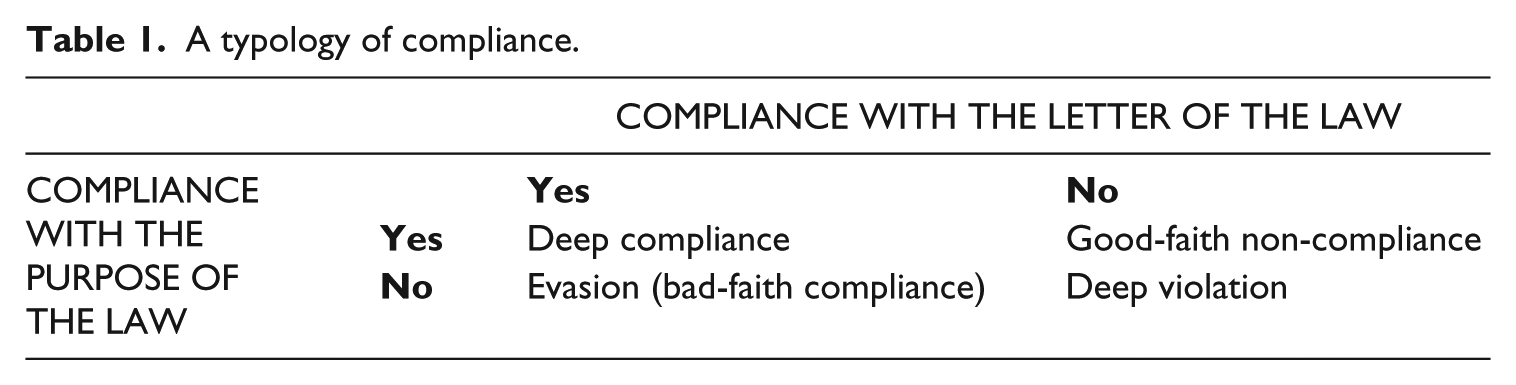
The letter and the purpose of the law are closely, but not perfectly, aligned. This makes it possible to comply with one but not the other. Between the two extremes of deep violation and deep compliance we find good-faith non-compliance, which follows the purpose of the law but not its letter. An example would be a state that intends to comply with the ICRW but is unable to do so. If a major storm discontinues radio contact with its whaling ships, the state cannot inform these ships that the whaling season has ended and so they continue whaling after the end of the season. 5 Lastly, evasion or bad-faith compliance technically follows the letter of the law but not its purpose. 6 An example of evasion, as we will see later, is Japan’s use of a loophole in Article VIII of the ICRW to continue whaling for commercial purposes under the guise of “scientific whaling.” The next section discusses evasion in detail.
Evading international law
A rich array of legal, sociological, and public policy studies demonstrate that under certain conditions, the law does less to deter deep violation and induce deep compliance than to motivate evasion (Katz, 1996; Leitzel, 2003). Inspired by this interdisciplinary literature (particularly purposivist legal theory), this section articulates what evasion is, how it relates to flexibility, why agents evade, and what the consequences for accountability are. Any kind of rule can be evaded as long as there is a gap between its letter and its purpose. Following much of the compliance literature in IR, I focus on international treaty law.
What is evasion?
I define evasion as the intentional compliance with the letter of the law but not its purpose in order to minimize inconvenient legal obligations in an arguably legal fashion. The first and most important element of evasion is that it complies with the letter of the law but not its purpose. This definition is based on a purposive theory of law. As readers may be unfamiliar with it, I briefly discuss it here. According to this view, the law has a purpose that it seeks to realize. As Justice Frankfurter put it: “Legislation has an aim; it seeks to obviate some mischief, to supply an inadequacy, to effect a change of policy, to formulate a plan of government” (cited in Barak, 2005: 110). Although legal scholars and practitioners may disagree about the substantive purpose of the law, they tend to agree that the law has a purpose (Dworkin, 1986; Fuller, 1969: 146; Hart, 1994 [1961]: 249; Hart and Sacks, 1994 [1958]: 136, 148).
Legal purpose can reside at different levels of abstraction, ranging from the entire legal system to individual treaties (Barak, 2005: 113–115). Here, I focus on individual treaties’ legal purpose. The primary sources of legal purpose are treaty preambles, as well as the “fundamental principles” and “general obligations” sections, where legal purpose is often explicitly mentioned. 7 The preamble of the International Convention on the Elimination of All Forms of Racial Discrimination reveals its aim to eliminate racial discrimination. The Chemical Weapons Convention’s aim to eliminate the use of chemical weapons can be found in the “general obligations” section, while the goal of the Convention on Long-Range Transboundary Air Pollution to reduce air pollution is in the “fundamental principles” section. International treaties may have more than one purpose. If these purposes are convergent, it is easier to establish conformity between them and behavior. If they are divergent, we must assess conformity between behavior and the legal purpose that is primary, more specific, more relevant for the case at hand, and based on more reliable sources (Barak, 2005: 118).
A few more points are important. One is that if legal purpose is about obviating some “mischief,” as Justice Frankfurter put it earlier, it is tempting to conclude that legal purpose is normatively desirable. Yet, unless one is prepared to deny legal status to “bad” laws, legal purpose can also be “bad.” Evasion is agnostic about the normative desirability of legal purpose. Second, legal purpose can change considerably over time, often in response to purposive legal interpretations (discussed later) that are less constrained by the literal reading of the text and original legislative intent (Pauwelyn and Elsig, 2013: 454). Third, purposivism does not capture the entire universe of goals that the law serves. It focuses more on the substantive goals that the law explicitly seeks and less on goals implicit in the legal process, such as predictability (Fuller, 1969; Kratochwil, 1989). A last point is that laws made for self-interested reasons captured by public choice approaches can be purposivist as long as they contain some legal purpose. Legal purpose is determined by the “objective” collective intention that lawmakers included in the law, regardless of their “subjective” individual intentions omitted from the law (Barak, 2005: 134; Hart and Sacks, 1994 [1958]: 1375).
Having discussed the purpose of the law, we can turn to its relation with the letter of the law. Although the letter and the purpose of the law are closely aligned, there is a gap between the two. Laws are “generally overinclusive and underinclusive if assessed by reference to their purposes” (Sunstein, 1995: 990, 995). I cannot discuss here why these gaps emerge (see more on the emergence of gaps in Búzás, 2016), but it is important to note their role in evasion. The letter–purpose gap allows evaders to technically comply with the letter of the law but not its purpose, which makes evasion arguably legal (Chayes and Chayes, 1993: 191).
Although the letter–purpose gap may be inevitable, its size varies, which has important implications for the legality of evasion. The larger the letter–purpose gap, the easier successful evasion is and the more difficult it is to challenge the legality of evasion. It is beyond the scope of this article to measure the precise size of this gap, but I point to two factors that shape its size. One is the quality of drafting, which determines to what extent legal purpose is reflected in the legal text. Although the treaty preamble typically contains the purpose of the law, substantive articles contain loopholes that permit behaviors at odds with this purpose. 8 Evasion is agnostic as to whether particular loopholes are intentionally designed or are the non-designed consequences of drafters’ limited knowledge and (legal) language’s “open texture” (Hart, 1994 [1961]: 128–136).
Another factor that shapes the size of the letter–purpose gap is legal interpretation. As the law has no meaning without interpretation, the gap is really one between the range of reasonable interpretations of the law’s purpose and letter. The differences between alternative interpretive strategies should not be overstated, but they are consequential. By interpreting the legal text in light of the purpose of the law, purposivist interpretations can narrow the purpose–letter gap. 9 This makes it more likely that evasion is ruled illegal if challenged in court. In contrast, non-purposivist interpretations give more weight to other interpretive elements. For instance, textualism emphasizes the legal text at the expense of legal purpose to constrain what it considers pernicious judicial discretion (Eskridge and Frickey, 1990: 340). The result is a narrower, more legalistic interpretation that can widen the purpose–letter gap. This makes it less likely that evasion is ruled illegal in court. The interpretation of international law is relatively eclectic, containing both purposivist and non-purposivist elements. 10 Yet, non-purposivist elements remain influential and provide abundant opportunities for evasion. 11
The second defining element of evasion is intentionality. Evasion is intentional in the general sense of awareness that one’s behavior complies with the letter but not the purpose of the law. However, it is also intentional in the specific sense of intending to bring about this particular relationship between one’s behavior and the law. Just as criminal law identifies certain crimes like fraud or obstruction of justice partly based on specific incriminating mental states or “guilty mind,” we can identify evasion partly based on “intent to evade.” “Intent to evade” is a specific form of bad faith intent to minimize one’s legal obligations. 12
There are two main ways to establish intent to evade empirically. One is to impute it based on observable behavior, just as courts attribute “guilty mind” when adjudicating white-collar crimes. Behaviors that make little sense apart from their circumventing specific laws can serve as “badges of evasion” (Buell and Griffin, 2012: 155). For example, 364-day credit guarantees renewed repeatedly right as they are about to expire make little sense apart from Basel I regulations that imposed costs on credit guarantees that exceeded one year. From the proliferation of repeated 364-day guarantees, we can infer intent to evade these regulations. 13 The other way is to infer intent to evade from discourse, which is an important source for establishing that agents are aware of rules and that these rules shape their behavior. Evaders’ public or (more often) private conversations might provide evidence about intentionally designing and selecting behaviors to evade laws.
Why do agents evade?
The third defining element of evasion is that agents engage in evasion to minimize inconvenient legal obligations in an arguably legal fashion. Evasion brackets broader jurisprudential questions regarding the nature of international legal obligations. Its premise is that inconvenient legal obligations exist, leaving open the sources of inconvenience. Underlying evasion is a strategic view of how agents respond to the law, based on two components: (1) rules give agents choices; and (2) there are multiple ways to respond to the law, and some minimize inconvenient obligations better than others. Agents tend to choose the legal response they expect to best minimize inconvenient obligations.
In some cases, agents can cope with inconvenient obligations by responding to the law in ways other than evasion. They can engage in deep violation or deep compliance, transgressing or obeying both the letter and the purpose of the law, respectively. They can also opt for the valid use of designed flexibility mechanisms, discussed later. However, these options are not always readily available, can incur prohibitive social and material costs, or might not effectively lower inconvenient obligations. When this is the case, evasion becomes an attractive option. Evasion can complement or substitute alternatives. The extent to which it will be part of agents’ obligation-minimizing set of strategies will depend on its availability, costliness, and effectiveness relative to alternatives.
Agents are most likely to evade under two broad scope conditions: (1) when there is a considerable gap between the letter and the purpose of the law; and (2) when agents have sufficient legal resources to identify and exploit these gaps. Assuming the presence of scope conditions, we can posit this general proposition regarding the likelihood of evasion:
Proposition 1: Agents are likely to evade when alternatives are costly, not readily available, or ineffective at minimizing inconvenient obligations.
What are the consequences of evasion for accountability?
One important consequence of evasion is that it can shield evaders from legal accountability. Indeed, what is typically being evaded is accountability. Accountability
implies that some actors have the right to hold other actors to a set of standards, to judge whether they have fulfilled their responsibilities in light of these standards, and to impose sanctions if they determine that these responsibilities have not been met. (Grant and Keohane, 2005: 29)
I distinguish between international legal and non-legal (normative) accountability mechanisms. 14 International legal accountability is my primary focus. In the ideal version of international legal accountability, the law determines all the elements of accountability as defined earlier (Brunnée, 2005; Grant and Keohane, 2005: 36–37). International and domestic courts hold accountable violators of legal standards based on legally admissible evidence and impose sanctions prescribed by the law. The state responsibility regime in international law comes closest to this ideal, but international legal accountability is also present to varying degrees in the case of specific international treaties and international soft law transposed into binding domestic legislation.
Evasion can shield agents from international legal accountability. Insofar as this accountability mechanism is triggered by violations of international law and evasion is deemed legal, evaders will not be held accountable. Since evasion is arguably legal, there is variation in the plausibility of its claim to legality. Although there is always a risk that evasion will be ruled illegal when challenged in court, the more textualist the court is in its interpretation, the larger the letter–purpose gap will be. This increases the plausibility of evasion’s claim to legality and decreases the risk of it being ruled illegal. When the delegation of interpreting and implementing international law is low, this risk becomes negligible as authoritative third parties can do little to rule evasion illegal. 15 Nonetheless, when interpretation and implementation are delegated to purposivist courts, evaders could be held legally accountable.
International law is not simply a yardstick for measuring compliance, but also a resource through which agents “interpret, justify, and understand their behavior and the behavior of others” (Hurd, 2011: 295; see also Kratochwil, 1989). Although justificatory legal discourse helps hold violators accountable (Chayes and Chayes, 1993: 204–205; Koh, 1997: 2602, 2636–2638, 2646), if evasion qualifies as compliance with the law, the accountability function of such “jawboning” will be impaired. However, critical discourse that lost its legal teeth can retain some “normative bite.”
This takes us to normative accountability, where agents hold accountable violators of normative (ethical) standards, and subject them to social sanctions through naming and shaming. We can think of legal and normative accountability as the endpoints of an accountability continuum, with highly legalized accountability at one end, non-legalized normative accountability at the other, and much overlap in between. When legalism is dominant such that normative discourse, judgment, and behavior are a function of following the law, there is little distinction between the two types of accountability and evasion can potentially protect from both (Pillinger et al., 2016; Shklar, 1986 [1964]). When the two remain distinct but overlap such that the purpose of the law violated by evaders reflects popular normative standards, evaders will be more vulnerable to normative accountability. We can summarize this discussion as follows:
Proposition 2: Evasion weakens legal accountability, especially when delegation and purposivist interpretation are low. All else equal, evasion weakens non-legal, normative accountability to a lesser extent.
How does evasion relate to the use of designed flexibility?
The precise relationship between evasion and designed flexibility is empirically contingent, but a tentative conceptual discussion may be instructive. According to the rational design literature, parties intentionally build flexibility into international agreements to reap the benefits of international cooperation without being overly constrained. Flexibility mechanisms are “insurance policies” against uncertainty (Helfer, 2013: 175), which permit the adjustment of particular members’ inconvenient treaty obligations (adaptive flexibility) or the modification of entire treaties (transformative flexibility) to accommodate changes that make compliance too onerous (Koremenos et al., 2001: 773). Parties can opt out of obligations through reservations, temporarily suspend them through escape clauses, terminate them through withdrawal, adjust them by exploiting imprecision, or adjust entire agreements through finite duration provisions.
The relationship between and distinguishability of evasion and designed flexibility depends largely on whether flexibility is set at the optimal level (see Table 2). When designers set flexibility optimally, agents can use flexibility mechanisms to adjust their obligations but they are unlikely to abuse them without punishment. Relatively precise and verifiable criteria facilitate the distinction between valid and invalid uses of designed flexibility (Koremenos, 2016: 100, 125; Pelc, 2009). When flexibility mechanisms are used invalidly, they are likely to be identified, ruled illegal, and punished. Under optimal flexibility, both valid and invalid uses of flexibility differ from evasion because they lack one or more of its defining features. Invalid uses of designed flexibility usually violate the legal letter and are more likely to qualify as deep violation than evasion. Valid uses comply with the legal letter but lack intent to evade and/or do not violate legal purpose. They are more likely to qualify as deep compliance than evasion.
Evasion and flexibility.
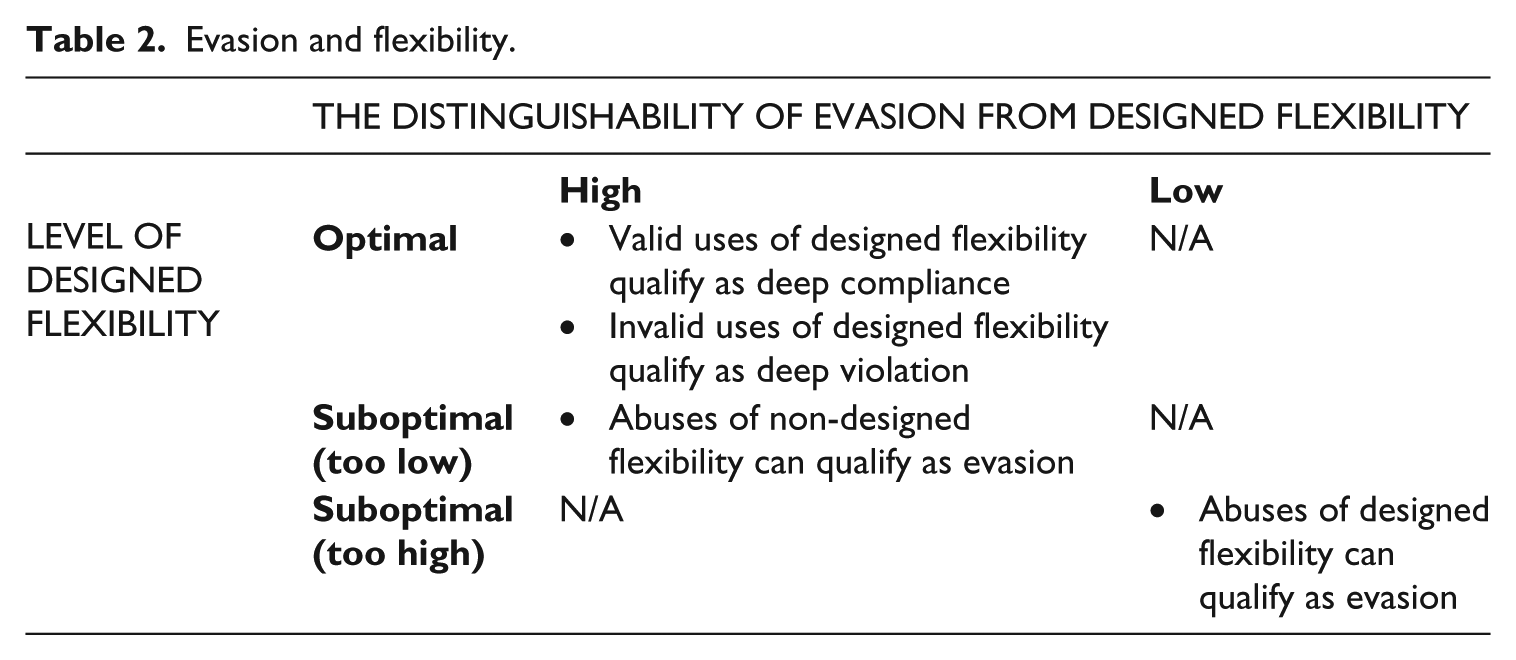
When designed flexibility is not set optimally, there are two possibilities. If flexibility is too high, abuses of designed flexibility can qualify as evasion. Valid uses of designed flexibility are difficult to distinguish from abuses. Some of these abuses will be undertaken by opportunistic agents with the intent to evade. High flexibility due to imprecision, for instance, increases the chances that abuses that are at odds with legal purpose will nonetheless comply with the overly malleable legal letter. Exaggerated flexibility based on the low delegation of interpreting, monitoring, and enforcing treaties further compounds the difficulties of challenging the legality of such abuses. Thus, abuses of designed flexibility when flexibility is too high can display the defining features of evasion and qualify as evasion. As discussed later, Japanese “scientific whaling” is an example.
If flexibility is too low, flexibility mechanisms are costly and will rarely be employed. Evaders are more likely to opt for non-designed flexibility (Búzás and Graham, 2016), distinguishable from designed flexibility. Uses of non-designed flexibility go beyond the purview of the rational design literature. Flexibility can be non-designed in at least two ways. Creative actors can employ designed flexibility mechanisms in ways unintended or even contrary to drafters’ intentions (Graham, forthcoming). They can also discover non-designed flexibility (loopholes), exploiting the “open texture” of language and the limited knowledge and foresight of drafters (Hart, 1994 [1961]: 128–136). Behavior that exploits non-designed loopholes can exhibit the defining features of evasion and can qualify as evasion. An example examined later is banks’ financial innovation to evade Basel I capital requirements through novel securitization strategies. This discussion can be summarized as follows:
Proposition 3: When drafters set flexibility optimally, evasion differs from valid and invalid uses of designed flexibility. When drafters set flexibility too high, evasion can take the form of abuses of designed flexibility. When drafters set flexibility too low, evasion can take the form of abuses of non-designed flexibility.
Empirical illustration
This section demonstrates the empirical utility of evasion in three original case studies: France’s evasion of the EU’s FMD; Japan’s evasion of the ICRW; and banks’ evasion of the first Basel Accord. The first case is based on over 100 semi-structured interviews conducted between 2013 and 2015 with French government officials, human rights activists, legal experts, and European bureaucrats. The cases also draw on primary documents and the secondary literature. I selected cases that show variation in the relevant variables, satisfy the scope conditions of evasion, and are diverse, covering different issue areas and agents, as well as soft and hard law, in order to demonstrate the generalizability of evasion (Gerring, 2007: ch. 5).
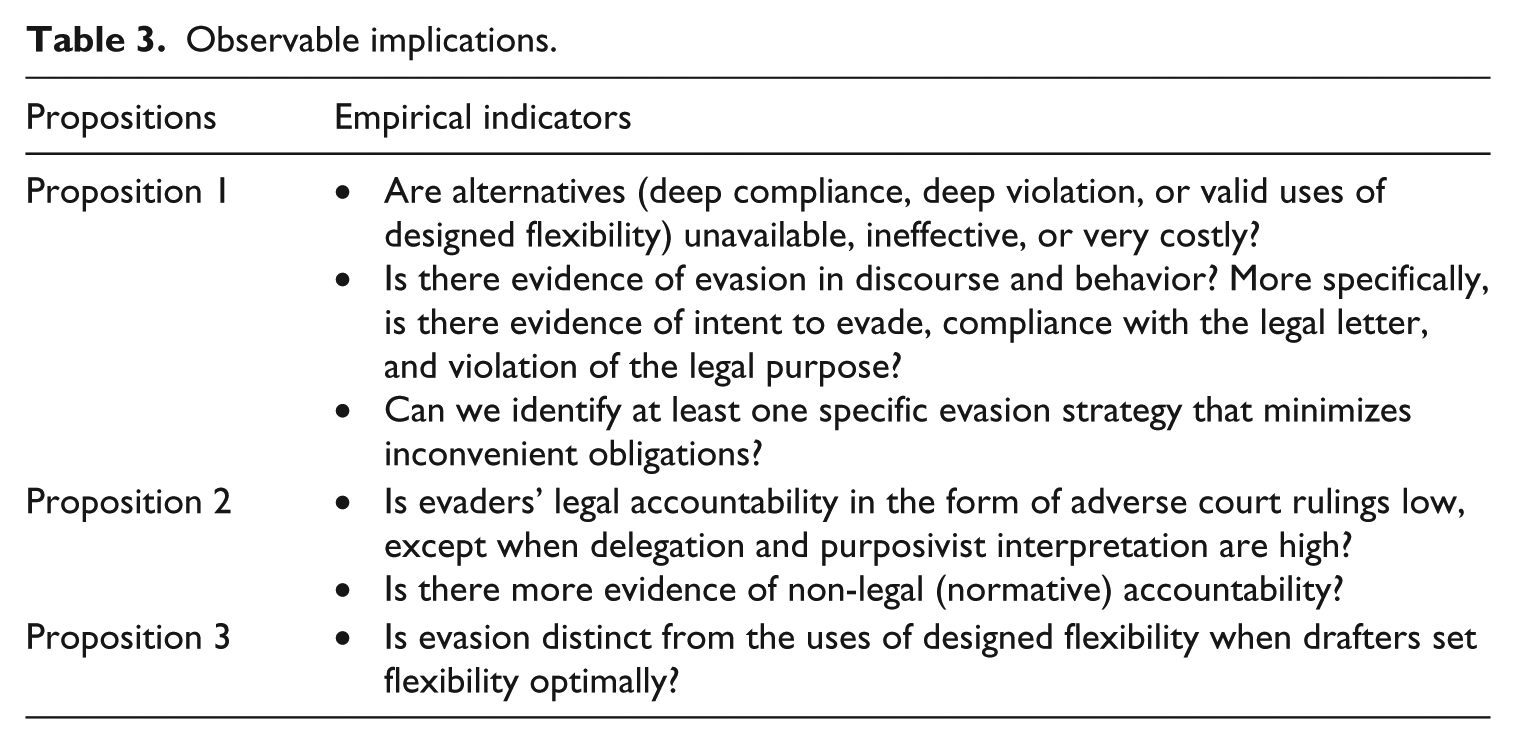
Each case provides evidence for the three propositions derived earlier. The evidence is organized according to the observable implications listed in Table 3. Given space constraints, the aim is to provide persuasive plausibility probes rather than definitive proof. Future work can build on this model to provide exhaustive empirical tests.
Observable implications.
France and the expulsion of Roma immigrants
The legal purpose of the EU’s FMD is to give EU citizens the right, regardless of ethnicity, to travel to and reside in other member states subject to a few conditions. 16 However, the influx of a relatively small number (about 15,000–20,000) 17 but visible and generally poor Roma from Romania and Bulgaria elicited strong public opposition, making this legal obligation inconvenient for the French government. About 60% of the French hold unfavorable views of Roma, compared to 24% of Muslims and 7% of Jews. 18 A BVA poll from 28 September 2013 found that 77% of the French agreed with then Minister of Interior Manuel Valls that the Roma do not integrate in French society and should stay in their home countries. 19 Subjects I interviewed confirmed the public’s strong anti-Roma sentiment. 20
France employs evasion to expel Roma immigrants
The French government came under pressure from domestic constituents to return Roma immigrants to their countries of origin. Supporting Proposition 1, alternatives were unavailable, ineffective, or very costly. Deep compliance in the form of Roma-friendly policies was widely perceived as “political suicide.” 21 Blatantly violating the FMD would also have been very costly, resulting in adverse rulings by domestic courts and the European Court of Justice. For a brief period in 2010, France opted for covert violation, singling out the Roma for evictions and expulsions. 22 After the press uncovered this operation, French expulsions attracted intense scrutiny, which foreclosed the possibility of covert violation.
Another option was the use of flexibility mechanisms, particularly the exception in Article 27 of the FMD that allows member states to expel immigrants if they “represent a genuine, present and sufficiently serious threat affecting one of the fundamental interests of society.” Yet, few Roma could be expelled through the valid use of this flexibility mechanism because they rarely posed this kind of threat. 23
French officials resorted to evasion, hoping to satisfy domestic constituents without paying the costs of law violation. 24 Since France does not keep race- and ethnicity-based statistics, exact numbers of expelled Roma are difficult to find. Newspaper reports, French public statements, and the unofficial statistics of human rights organizations reveal that the vast majority of expelled Romanian and Bulgarian citizens are of Roma ethnicity. 25
One specific evasion strategy is the “humanitarian aid for return.” 26 The government offered the Roma 300 euros per adult and 100 euros per child to leave the country “voluntarily.” 27 According to the French Office for Immigration and Integration, in 2011 alone, 10,600 immigrants were repatriated, of whom 8,692 or 82% were Romanians and Bulgarians. 28 Since the policy is applied in the shadow of the threat of expulsion, police intimidation, and extreme Roma poverty, it is questionable how voluntary these departures are. 29 In 2009, the French Equality Body (HALDE) noted that the overwhelming majority of targeted individuals under the “humanitarian aid for return” are Roma, and condemned the policy as undermining racial equality. 30
Yet, the policy provides France with sufficient legal cover to eject unwanted Roma immigrants with impunity. Validating Proposition 3, this evasion strategy could be seen as the use of non-designed flexibility, distinct from rationally designed flexibility. Inconvenienced by what they saw as low levels of designed flexibility, evaders creatively borrowed the policy of “humanitarian aid for return,” typically applied to refugees and non-EU citizens, and applied it to the FMD in ways not envisioned or intended by its drafters. 31 Doing so practically increased the flexibility of the FMD, allowing France to remove EU citizens of Roma ethnicity arguably legally.
This and similar French strategies exhibit the defining elements of evasion, bolstering Proposition 1. We can infer intent to evade from French behavior and discourse. Some interviewees hinted at intent to evade. One senior French official acknowledged: “The way we worked … was to strictly abide by European law, but still use all the margins that were available within the framework of the European [Freedom of Movement] Directive.” 32 There is also indirect evidence of intent to evade. A Ministry of Interior secret memo dated 5 August 2010 singled out the Roma for eviction and expulsion: “prefects must carry out, within their geographical areas of responsibility, at least one operation per week, be it an evacuation, dismantling or expulsion, with priority being given to Roma.” 33 When this memo was leaked, France dropped all references to the Roma and expressed its commitment to legal expulsions.
While the “humanitarian aid for return” arguably complies with the letter of the FMD, it also undermines the legal purpose of ensuring the right to free movement to all EU citizens, regardless of ethnicity. To be sure, this right can be limited under certain circumstances, and some Roma individuals are rightfully subject to these restrictions. Unfortunately, many others are subject to restrictions based on their ethnicity and are expelled in ways that are arguably legal but undermine their right to free movement. In the words of one scholar, “French policy has generally — and most successfully — sought to operate within the boundaries of EU law and its own laws on discrimination, while in effect targeting the majority of the Roma population for deportation and a minority for integration” (Parker, 2012: 483, emphasis in original). Human rights activists also remain “unconvinced that France has embraced the spirit [purpose] of EU rules” on this issue. 34
Evasion shields France from legal accountability
France came closest to being held legally accountable when, in 2010, the European Commission threatened to take France to the European Court of Justice in response to the aforementioned Ministry of Interior memo. Once France shifted from covert violation to evasion, the Commission suspended legal action. 35 In the words of one official, the advantage of evasion is that “It’s not illegal, but that’s why it’s very difficult to make the government be punished by law [sic].” 36 In theory, one could contest the voluntariness of the “humanitarian aid for return” by invoking the United Nations High Commissioner for Refugees (UNHCR) guidelines, which stipulate that voluntariness implies free and informed choice. In practice, however, it is difficult to find admissible evidence and prove in court that such returns are not genuinely voluntary, particularly since France has considerable discretion in interpreting and implementing the law. 37 Most Roma removals remain unchallenged or are ruled legal by domestic courts. 38 To date, there have been no adverse rulings in European or international courts against France’s expulsion of the Roma. Evasion weakens legal accountability, supporting Proposition 2.
There is more evidence of non-legal accountability, notably, normative accountability: non-governmental organizations (NGOs) like Human Rights Watch engaged in naming and shaming; the United Nations’ (UN’s) Committee on the Elimination of Racial Discrimination warned about anti-Roma racism in France; and Pope Benedict XVI appealed for French compassion toward the Roma. 39 The European Parliament also raised concerns that Roma removals “amount to discrimination on the basis of race and ethnicity,” and Viviane Reding, Vice-President of the European Commission, called the French treatment of Roma immigrants a “disgrace.” 40 Important as these pressures might be, France has resisted them successfully. As one French activist put it, “We talk, we talk, we talk, but nothing is changing in the field.” 41 In conclusion, evasion helps France expel Roma immigrants with little accountability.
Japan and “scientific whaling”
In 1951, Japan joined the ICRW and its Schedule, administered by the International Whaling Commission (IWC). The initial purpose of the treaty was “to provide for the proper conservation of whale stocks and thus make possible the orderly development of the whaling industry.” 42 Over time, this dual legal purpose of conservation and exploitation evolved and conservation became the primary purpose, despite opposition from whaling states (Hirata, 2005: 131). This evolution was mainly the result of an increase in the IWC membership of non-whaling states. Given our earlier discussion that in the case of divergent legal purposes, all else equal, one should focus on the primary purpose to assess evasion, I will focus on conservation.
Japan employs evasion to continue whaling
In 1982, non-whaling states achieved the three-quarters majority required to change the Schedule and passed a moratorium on commercial whaling. 43 This whaling ban created an inconvenient legal obligation for Japan, which has a long tradition of whaling. Supporting Proposition 1, alternatives to minimize these obligations were unavailable, costly, or ineffective. Deep compliance was unpalatable given that Japanese whaling has deep cultural roots and is reinforced by the political clout of the fishing industry (Hirata, 2005: 141–144; Peterson, 1992: 153, 171). Deep violation was unattractive both because it would have increased tensions with the US, the main champion of the moratorium, and because exploiting the ICRW’s flexibility promised a cheaper way to continue whaling. Japan initially opted for the valid use of designed flexibility. It objected to the moratorium under Article V(3), which gives member states the possibility to opt out of amendments if they object to them within 90 days following IWC notification. However, in response to US pressure, Japan dropped its objection (Hirata, 2005: 132; Peterson, 1992: 172–173). 44
Japan turned to evasion, exploiting the “scientific whaling” loophole in Article VIII of the ICRW. Paragraph 1 allows member states to issue whaling permits to their nationals “for purposes of scientific research” as they see fit, “exempted from the operation of this Convention.”
Japan’s use of the “scientific research” loophole exhibits the defining features of evasion, validating Proposition 1. We can infer intent to evade from a number of factors. The first is the timing of Japanese scientific whaling. Japan launched the Japanese Whale Research Program under the Special Permit in the Antarctic (JARPA I) in 1987, right after the moratorium entered into force. Japan also deliberately launched JARPA II before the IWC’s Scientific Committee could assess the scientific merit of JARPA I, even though IWC resolution 2003-3 asked Japan not to do so. Second, statements by Japanese officials suggest intent to evade. One Japanese official revealed that Japan’s aim was “to ensure that our whaling can continue in some form or another,” while the Director-General of Japan’s Fisheries Agency stated that “the scientific whaling program in the Southern Ocean was necessary to achieve a stable supply of minke whale meat.” 45
Third, certain aspects of Japan’s scientific whaling suggest intent to evade, even if the program is not devoid of scientific value (Morishita, 2006). Under JARPA I and II, Japan killed over 10,000 whales. 46 This number is disproportionate to the limited scientific contribution. For instance, JARPA II resulted in only two peer-reviewed papers. 47 Many scientists argue that the research is “in reality just a front for the continued exploitation of whale stocks while the Moratorium on commercial whaling remains in place” (Clapham et al., 2007: 314).
In addition to exhibiting intent to evade, Japanese whaling also complies with the letter but not the purpose of the law. The textualist reading of Article VIII gives considerable discretion to member states and broadens the letter–purpose gap by exempting scientific whaling from the moratorium. This has allowed Japan to contend that its whaling is legal. Yet, as a large group of scientists put it, Japan’s whaling is “antithetical to the objective” of the ICRW (Clapham et al., 2007: 315). Mitchell (1998: 285) infers from the increase in scientific permits that whaling states like Japan are “following the legal ‘letter’ rather than the moral spirit [purpose] of the moratorium.” There is scientific evidence that some whaling would be sustainable (Mitchell, 1998: 286–287), and this would be compatible with the ICRW’s secondary purpose of exploitation. Nonetheless, Japanese whaling undercuts the primary purpose of conservation and qualifies as evasion.
Evasion (imperfectly) shields Japan from legal accountability
Evasion has allowed Japan to engage in whaling arguably legally for 25 years despite the moratorium. Japan’s evasion strategy could be seen as the abuse of designed flexibility under suboptimally set flexibility, confirming Proposition 3. Japan arguably has too much flexibility due to its discretion to interpret and implement the ICRW.
Under these circumstances, convergent with Proposition 2, holding Japan legally accountable was difficult. 48 Opponents of whaling resorted to non-legal, particularly normative, accountability mechanisms combined with political pressure and sabotage. Over the years, more than 30 IWC resolutions criticized Japanese scientific whaling, environmental NGOs condemned whaling expeditions, scientists initiated petitions, and anti-whaling states exerted political pressure. 49 Although critics could not stop Japanese whaling, without their efforts, Japan would have probably killed more whales. Anti-whaling pressures likely helped lower Japanese whaling targets and reduce catches below these targets. 50
Legal accountability under the ICRW became possible when Japan accepted the compulsory jurisdiction of the International Court of Justice (ICJ) in 2007. The whaling case shifted from low delegation, where Japan could self-interpret the law, to high delegation, where the ICJ interprets the law. In May 2010, Australia took Japan to the ICJ. The ICJ adopted a purposivist interpretive stance, narrowing the letter–purpose gap. It noted that despite the reference to exemption in Article VIII, this article “has to be interpreted in light of the object and purpose of the Convention.” 51 On 31 March 2014, the ICJ ruled that Japan violated the commercial ban on whaling, and ordered it to cease JARPA II and revoke scientific whaling permits. 52 This corroborates Proposition 2 that high delegation combined with purposive legal interpretation hinder evasion.
Whether Japan shifts to deep compliance or simply updates its evasion strategy remains to be seen. In November 2014, Japan proposed a new whaling program, the New Scientific Whale Research Program in the Antarctic Ocean (NEWREP-A), and in October 2015, it submitted a new reservation to exclude whaling disputes from ICJ jurisdiction. There are reasons to worry that “The plan is a variation on the same evasion of treaty obligations.” 53
Banks and capital requirement minimization
In 1974, the major industrial countries established the Basel Committee on Banking Supervision (BCBS). The BCBS issues the Basel Accords, which set international standards to harmonize national regulatory differences and “to strengthen the soundness and stability of the international banking system.” 54 These purposes are convergent, facilitating an assessment of evasion. It is the legal purpose of strengthening the stability of the financial system that is particularly relevant for our discussion. Over 100 states transposed the soft law standards of the Basel Accords into binding domestic regulation. This section focuses on the 1988 Basel Accord, known as Basel I.
Banks employ evasion to minimize capital requirements
Under Basel I, banks were required to hold capital amounting to at least 8% of their risk-weighted assets as a buffer against unexpected losses. 55 To satisfy minimum capital requirements, banks could increase their capital or decrease the riskiness of their assets. Although this capital requirement contributes to the stability of the financial system, individual banks find it inconvenient because, in their view, it increases costs and decreases profits.
Validating Proposition 1, alternatives to evasion were costly, ineffective, or unavailable. Deep compliance was unattractive because it narrowed banks’ profit margins and threatened their competitiveness. 56 Deep violation was unpalatable because — since Basel I was encoded into hard domestic law — it threatened expensive legal action. Designed flexibility in the sense of formal flexibility mechanisms was low because the softness of Basel I made it unnecessary. Thus, banks engaged in evasion to escape capital requirements. Studies find that Basel I “prompted a flurry of creativity to circumvent its constraints” (McBarnet, 2012: 78). According to Federal Reserve estimates, amounts involved in evading Basel I exceeded US$200 billion (Jackson, 1999: 26).
One complex evasion strategy was to concentrate credit risk and then sell the least risky securities. 57 Banks pooled together diverse loans and sold them to their special purpose vehicles (SPVs), separate legal entities that perform various financial activities. These SPVs issued asset-backed securities to investors to pay for the sponsoring banks’ loans. They organized asset-backed securities into different classes (tranches) to concentrate credit risk, the risk that borrowers would default on their loan payments. At the top were the least risky (senior) securities, which were the least affected by defaults. Subordinated to these at the bottom were the most risky (junior) securities, which were the first to absorb credit losses. This vertical organization concentrated the bulk of the original pool’s credit risk into a fraction of the securities. The sponsoring bank provided some form of credit enhancement for the riskiest class of securities, guaranteeing the payment of the cash flows of the security in case of default. This made these securities more attractive to investors. In the US, this credit enhancement was recourse, which entailed a dollar-for-dollar capital requirement for the amount of the financial guarantee. The least risky securities, which received high credit ratings, were then sold to investors.
Under Basel I, the original loan pool would have incurred an 8% capital requirement for banks. As long as the riskiest category of the vertically organized securities remained under 8% of the original loan pool, concentrating credit risk and selling the least risky securities decreased capital charges. For a pool of loans worth US$100,000, Basel I would have required banks to hold US$8,000 in capital. If banks’ SPVs concentrated credit risk in less than 8% of the securities pool, they could decrease capital requirements because banks’ dollar-for-dollar financial guarantee would amount to less than US$8,000. By concentrating credit risk in a few securities deemed high-risk and selling most securities deemed low-risk, banks could decrease their minimum capital requirements without necessarily transferring risk.
This strategy displayed the defining elements of evasion, supporting Proposition 1. It technically complied with the letter of Basel I but undermined its purpose. Banks decreased their actual capital ratios below the minimum capital requirements, arguably weakening themselves and the stability of the financial system. This was possible because regulatory measures of capital and risk do not perfectly capture actual capital and economic risk. Since all loans in a pool were assigned the same risk under Basel I, selling a portion of these loans decreased regulatory risk and increased capital ratios even if the loans sold transferred little actual risk (Jones, 2000: 36). Later, under Basel II, similar evasive practices weakened the stability of the financial system and arguably contributed to the financial crisis (FCIC, 2011: xix).
We can infer intent to evade primarily indirectly from the complexity of these evasive practices, which makes little sense in the absence of dodging Basel I’s capital requirements. Some studies also provide more direct evidence through admissions by lawyers involved in evasive financial engineering (McBarnet, 2012). In conformity with Proposition 3, banks’ evasion practices could be seen as the abuse of non-designed flexibility. By engaging in financial innovation, banks escaped legal control (Tarullo, 2008: 81). Novel practices like securitization allowed banks to identify gaps in the law that were probably neither intended nor anticipated by drafters.
Evasion shields banks from legal accountability
Supporting Proposition 2, evasion protected banks from legal accountability. Under Basel I, national bank supervisors were in charge of enforcement. I am not aware of any cases in the US, for example, where a bank was held legally accountable in court for evading Basel I capital requirements. Other enforcement actions were also rare as bank supervisors employing capital indicators based on Basel I considered the vast majority of banks well capitalized. The Federal Reserve, the Office of the Comptroller of the Currency, and the Federal Deposit Insurance Corporation together supervised 8,700 banks but initiated “prompt corrective action” only 27 times between 1993 and 2001 in response to all cases (rather than just evasion) where banks’ capital ratios approached floors set by Basel I. Even among problem and failed banks, only 4% were subject to corrective action (Wellons, 2005: 290–300). The legality of evasion gave national supervisors an excuse not to hold evaders accountable. While they wanted to protect the economy from bank failures, they did not want to disadvantage their banks relative to foreign competitors that could get away with lower levels of capital (Tarullo, 2008: 26).
Banks seem to have been subject to more normative accountability, although capital adequacy was overshadowed by money-laundering concerns. If the English-language sources of LexisNexis are any indication, the media was moderately concerned about questionable capital adequacy practices. 58 The Basel Committee, the International Monetary Fund, the World Bank, and the Financial Stability Forum also provided compliance assessments that may have had shaming effects. 59 While normative accountability may have reduced the scale of evasion, it could not stop the practice.
The Basel Committee eventually closed some of Basel I’s loopholes in the subsequent Basel II and III. Yet, as the Financial Stability Board (2011: 4) recently put it, “Although Basel III closes a number of identified shortcomings, both the incentives for, and the risks associated with, regulatory arbitrage [evasion] will likely increase as Basel III raises the rigour of bank regulation.” 60
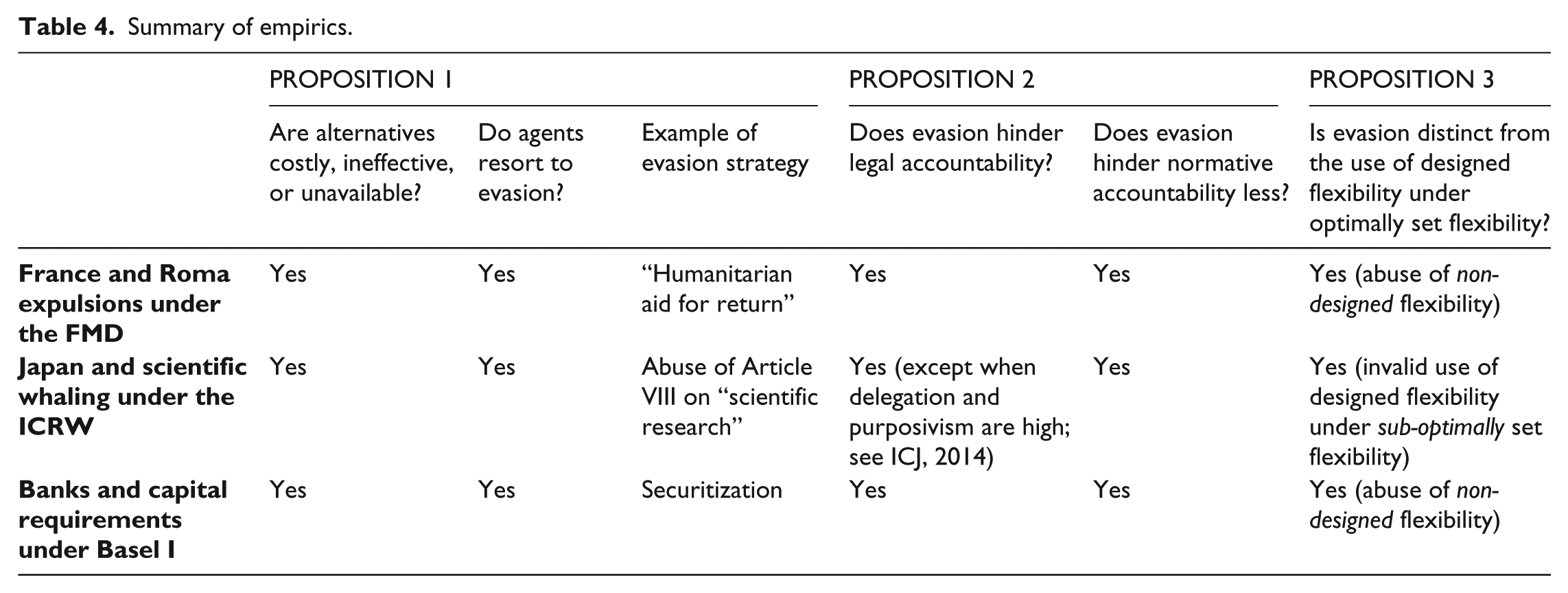
In sum, the three case studies establish the plausibility of the propositions derived from our theoretical discussion (see Table 4). They corroborate that agents opt for evasion when alternatives are costly, ineffective, or unavailable. Evasion hinders legal accountability (but not necessarily normative accountability), especially when delegation and purposive interpretation are low. Finally, evasion can be seen either as the abuse of non-designed flexibility (when drafters set levels of flexibility suboptimally low) or the abuse of designed flexibility (when drafters set levels of flexibility suboptimally high).
Summary of empirics.
Conclusion: Contributions and future research
The article discussed what evasion is, why it occurs, how it relates to flexibility, and what its consequences for accountability are. This conceptual-theoretical development of evasion is the main contribution of the study. In addition, the article offers a more nuanced view of compliance. Distinguishing evasion from other compliance behaviors not only broadens our typologies of compliance, but also makes possible more nuanced explanations, more accurate findings, and better policy recommendations. Evasion is essentially a false positive that looks like genuine compliance but can have the effects of violation. Especially when evasion is widespread, coding it as compliance risks faulty inferences about the causal relationship between compliance and other variables of interest. Disaggregating compliance, especially distinguishing evasion from other types of compliance, may be a good alternative to discarding compliance altogether, as some critics advise (Martin, 2013).
Another contribution is that legality can hinder accountability. When evasion is successful, its technical legality insulates evaders from legal accountability. If the evaded law is widely considered “good,” there is a risk that evaders can cause harm with near impunity. This leads to policy implications for countering undesirable evasion. Since evasion is more likely to undercut legal than non-legal (normative) accountability, the argument cautions against exaggerated reliance on legal accountability and discourages too much legalization of non-legal accountability mechanisms. Although it may be impossible to abolish evasion altogether, it may be possible to curb it through a two-step purposivist institutional-legal measure that narrows the letter–purpose gap. The first component is drafting legal texts to better reflect legal purpose and to include broad anti-evasion clauses. To inhibit treaty-makers’ creation of loopholes and reliance on opportunistic self-interpretations, purposivist lawmaking must be coupled with a second step — delegating legal interpretation to purposivist third parties and courts. The ICJ’s 2014 ruling against Japanese “scientific whaling” illustrates the effectiveness of this second step in combating evasion. Admittedly, this purposivist design also has potential costs, such as arbitrary discretion by third parties and uncertainty about what the law requires (Sunstein, 1995: 973–975). Further research should examine when the benefits of anti-evasion measures outweigh the costs.
Future research could also examine “Who evades?” to assess whether agent attributes influence evasion. The case studies suggest evaders are agents with abundant legal resources, democratic regime type, and respect (however superficial) for the rule of law. It would be interesting to evaluate systematically whether variation in these factors explains variation in evasion. Ex ante, agents that score high on these dimensions have the capabilities to build loopholes into international law. Ex post, they possess the legal resources to discover and exploit both designed and non-designed loopholes, and they may be more inclined than others to evade rather than violate the law.
While this article discusses primary evasion or the evasion of rules, it could be edifying to extend our attention to secondary evasion or the evasion of rulings. Will Japan evade the ICJ’s adverse ruling? When international courts rule against governments, these latter might simply “change the language of a national law to technically comply with the decision, without significantly changing domestic policy” (Alter, 2000: 507). Future work could examine the extent to which agents will respond to the judicialization of international politics with secondary evasion. Lastly, this study painted a relatively static picture of law and evasion. In reality, both change in interesting ways, often in response to one another. The regulatory “cat-and-mouse” between evaders and treaty-makers can be a significant driver of legal change, heretofore ignored in IR. Future research should capture this dynamic process to help explain the evolution of international law.
Footnotes
Acknowledgements
For helpful comments and suggestions, I thank Erin Graham, Elspeth Guild, Marcus Holmes, Ian Hurd, Ronald Mitchell, Kevin Young, and Alex Wendt. I am also very grateful to the editors and the anonymous reviewers of the European Journal of International Relations.
Funding
This research received no specific grant from any funding agency in the public, commercial, or not-for-profit sectors.