






Abstract
Multiculturalism is an increasingly salient election issue. The growing size of many countries’ ethnic minority populations pushes parties to support multiculturalism, whereas the emergence of far-right parties in many countries pressures them to oppose it. This article examines parties’ positions on multiculturalism in a comparative context. It looks at 19 countries including most of Western Europe, North America, Australia, New Zealand, and Japan. It argues that the influence of ethnic minorities over parties depends on electoral systems, and the strategies mainstream parties adopt in response to the far-right. The article finds that increases in ethnic minorities’ electoral strength lead parties to increase their support of multiculturalism to a greater degree in single-member district electoral systems than in proportional ones. Further, parties co-opt the anti-multicultural positions of far-right parties, and right parties do so more than left parties.
Introduction
Increased global migration has forced western developed countries to grapple with different approaches to immigrant integration. The growth in the size of immigrant and ethnic minority populations and the emergence of far-right parties across the developed world have increased the salience of multiculturalism. Despite this, much of the literature on multiculturalism ignores parties. Work on party systems, particularly on immigration issues and how parties respond to the far right, is relevant to analyses of policy development and public debate over multiculturalism. This article examines the influence that ethnic minorities and far-right parties have on party positioning on multiculturalism. In doing so, it links electoral incentives to parties’ multicultural positions.
This article presents three important and novel findings. First, it shows that increases in the strength of ethnic minorities do more to increase support of multiculturalism in single-member district (SMD) systems than in proportional ones. This fits with findings in the existing literature that show that ethnic minorities are more likely to be elected in SMD systems (Dancygier, 2014; Marschall et al., 2010; Trounstine and Valdini, 2008). Not only do these systems increase the likelihood of minorities being elected, but they also increase minorities’ policy influence. Second, the article shows that mainstream parties, particularly parties on the right, co-opt the anti-multicultural positions of far-right parties. In line with work by Meguid (2008), this demonstrates that the emergence of far-right parties reduces mainstream party support for multiculturalism. Although this article agrees with Meguid that there are differences between the ways that mainstream right and mainstream left parties respond to the far-right, it also shows that those responses are more similar to each other than Meguid suggests. Finally, the article finds that the tension parties face when taking positions on multiculturalism is most acute for mainstream right parties. This is not only because mainstream right parties are more responsive to the far-right, but also because changes in ethnic minority electoral strength have a stronger influence on mainstream right parties than on left parties.
Theory and hypotheses
Situating the article within the literature
The existing literature on multiculturalism routinely ignores political parties and electoral systems. Work on Australia (Jupp, 1991; Lopez, 2000), Britain (Adolino, 1998; Grillo, 1998), Canada (Fleras and Elliot, 2002; Pal, 1993), and the Netherlands (Ireland, 2004) shows that ethnic minorities influence the development of multiculturalism. Koopmans et al.’s (2012) multi-country analysis confirms this. But an analysis of how political parties and electoral systems mediate the influence of ethnic minorities is missing from this work. This is the case despite a growing literature that shows that parties play an important role in the development of immigration and citizenship policy (Bruenig and Luedtke, 2008; Howard, 2009; Perlmutter, 1996), and a substantial literature showing that electoral systems affect the electoral success of ethnic minorities (Dancygier, 2014; Marschall et al., 2010; Trounstine and Valdini, 2008). This article highlights electoral systems’ influence on parties’ responsiveness to ethnic minorities when choosing to support or oppose multiculturalism. The article thus presents unique findings about the way the electoral systems affect minorities’ policy influence.
The article also presents one of the first analyses that distinguishes between left and right parties when examining the way that electoral systems mediate minorities’ influence. Left and right parties’ different ideologies may affect the way that they respond to ethnic minorities. A left party may support multiculturalism out of a commitment to social justice, whereas a right party may see multiculturalism as a way to win over ethnic minority voters that have traditionally supported other parties. In the latter situation, the way that electoral systems shape minority influence is more important than in the former situation. Distinguishing between left and right parties is thus essential to an analysis of the way electoral systems affect parties’ responsiveness to minorities. This distinction is particularly important given that mainstream right parties play an important role in the development of multiculturalism policies (Fleras and Elliot, 2002; Lopez, 2000; Pal, 1993).
Ethnic minority influence is counterbalanced by far-right parties. Much work has been done on the emergence and influence of far-right parties in France (Schain, 2006), the Netherlands (Akkerman, 2005; Irwin and van Holsteyn, 2003; van Heerden et al., 2014; van Kersbergen and Krowel, 2008), Sweden (Dahlström and Esaiasson, 2011; Odmalm, 2012), and Switzerland (Husbands, 2000; Skenderovic, 2007). This literature is complemented by case study and multi-country work that looks broadly at far-right parties (Carter, 2005; Green-Pedersen and Krogstrup, 2008; Green-Pedersen and Odmalm, 2008; Jensen and Thomsen, 2011; van der Brug and van Spanje, 2009), as well as work that looks at how mainstream parties have responded to the far-right (Arzheimer, 2009; Givens, 2005; Ivarsflaten, 2008; Oesch, 2008; van Spanje, 2010). This work, however, often excludes countries without far-right parties such as Canada (until recently), Germany, and the United Kingdom. This is problematic because it makes it difficult to distinguish the influence that far-right parties have had on mainstream parties from changes that would have happened in mainstream parties regardless of the emergence of the far-right. Including countries without far-right parties in the analysis allows this article to distinguish between the impact far-right parties have and the changes that have occurred in both countries with and without such parties.
This article contrasts the impact of far-right parties with the influence of ethnic minorities. Far-right parties do not exist in a vacuum, and they compete to influence policy (and parties) with advocates who support multiculturalism such as ethnic minorities. Because many developed countries are seeing both increases in ethnic minority electoral strength and the emergence of far-right parties, it is important to understand these forces’ influence relative to each other. Ignoring the extent to which growing ethnic minority electoral strength can mitigate the influence of far-right parties misses the extent to which far-right parties have to compete with other actors to influence party’s positions.
Finally, this article looks specifically at far-right parties’ influence on multicultural positions, which can be distinguished from broader immigration policy (Koopmans et al., 2005). This allows the article’s findings to be more closely tied to specific policy adoption than analyses that look at immigration positions in broader terms.
Ethnic minorities, the electoral system, and party positions
Ethnic minorities have strong incentives to advocate for multiculturalism. Recognition of a country as multicultural, funding for ethnic minority organizations, and bilingual education can help ethnic minorities integrate into society while maintaining their cultural practices (Banting et al., 2006). The greater the electoral strength of ethnic minorities, the more important winning their support is, and the more likely parties should be to support multiculturalism.
Parties may also increase their support of multiculturalism to gain the support of ethnic minority organizations. Because ethnic minority organizations play an important role mobilizing voters (Berger et al., 2004; Bloemraad, 2005), engaging organizations can be valuable to parties trying to win ethnic minority votes. Favoring multiculturalism can win a party the support of ethnic minority organizations, and through those organizations’ endorsements, votes. Organizational support may also provide a party with volunteers and financial donations and help recruiting candidates. The stronger ethnic minorities are electorally, the greater the benefit ethnic minority organizations can provide to parties, and the more incentive parties have to seek their support.
Electoral systems are critical mediators of ethnic minority electoral strength. The greater the influence a block of voters has over the number of seats a party wins, the greater the incentive parties have to appeal to them. In SMD systems, parties’ incentives to respond to groups of voters depend on their size and geographic distribution. Large voting blocks will have a greater impact on election results if they are spread across a large number of districts. A large group of geographically concentrated voters will determine the outcomes in some districts but have no influence over others, and thus have less influence over election outcomes (Calvo and Rodden, 2015; Jusko, 2015; Rodden, 2010). The opposite is true for small groups of voters. Small groups of geographically dispersed voters have limited influence over results because they are a small minority of the voting population in every district. When small groups are concentrated, however, they make up a large share of the vote and influence outcomes in particular districts (Johnston and Ballantyne, 1977). Because geography does not influence the way the votes are translated into seats in proportional systems, they are not subject to the same dynamics.
Ethnic minorities tend to be small voting blocks that are geographically concentrated. This should lead changes in ethnic minority electoral strength to have a larger impact on party positions in SMD systems. When ethnic minorities make up a small portion of the population, they are a small portion of the population in every district and therefore should have little influence over election results. As the ethnic minority population grows, the number of districts in which ethnic minorities play a crucial role in determining election outcomes should increase, and parties’ incentives to respond to their issues should increase as well. Because ethnic minorities are geographically concentrated, an increase in the ethnic minority population does not occur in all districts equally. Ethnic minorities become pivotal voters in districts with disproportionately high percentages of ethnic minorities faster than they would become pivotal in proportional systems. As a result, increases in the ethnic minority population make the number of seats a party wins contingent on a party’s ability to win ethnic minority votes more quickly in SMD systems than in proportional systems. This is the mechanism that Huber (2012) points to when he demonstrates that political parties are more likely to appeal to voters along ethnic lines in SMD systems than in proportional ones. It is also an explanation used by Triadafilopoulos (2012) for why Canadian political parties are more supportive of multiculturalism than German ones. The geographic concentration of ethnic minorities should mean that as ethnic minority electoral strength increases, ethnic minorities influence over party policies should increase faster in SMD than in proportional electoral systems.
Far-right parties and mainstream party support for multiculturalism
Parties face strategic dilemmas when confronted by far-right challengers. Meguid (2008) outlines three different strategies that mainstream parties can pursue in response to fringe parties. They can pursue dismissive strategies, hoping that refusing to engage with the fringe party will make it irrelevant. A mainstream party can adopt adversarial strategies, emphasizing its opposition to the ideas raised by the fringe party. With this strategy, the mainstream party hopes that the fringe party can steal support from its rivals, whereas the mainstream party that takes the adversarial strategy gains the support of voters opposed to the fringe party. Finally, a party might pursue an accommodating strategy by co-opting fringe party positions to prevent voters from defecting to it. Each strategy has implications for how far-right parties influence multiculturalism. Parties that respond to the far-right with adversarial strategies should strengthen their support of multiculturalism, whereas parties that pursue accommodating strategies should weaken their support of multiculturalism.
The choice between an adversarial and accommodating strategy is influenced by parties’ ideologies. For mainstream right parties, the proximity of far-right parties on the left-right spectrum should make mainstream right voters more likely to defect to the far-right. Kitschelt and McGann (1995) find that far-right parties often combine anti-multicultural and populist positions with free market ones to create center-right, anti-immigrant platforms. Mainstream right voters do not have to compromise on left–right issues to vote for a far-right party and therefore should be more likely than left voters to do so. Adversarial strategies carry a high level of risk for mainstream right parties. Because the major issues that separate the mainstream right from the far-right are often multiculturalism and immigration, failure on the part of the mainstream right to co-opt far-right positions leaves anti-multicultural voters with the easy decision to defect. Right parties thus face strong pressure to adopt accommodative strategies in order to keep their anti-multicultural support. This is consistent with scholarship on the Front National (FN) in France that links decisions by the center-right Chirac government to adopt more restrictive immigration policies with concerns over loss of support to the FN (Marthaler, 2008).
Left parties face competing pressures when deciding how to respond to the far-right. Unlike right parties, there is often some distance between the left–right positions of left and far-right parties. This means that left voters defecting to a far-right party have to compromise on left–right issues. Left parties have some incentive to adjust their positions in order to hold on to anti-multicultural voters. Opposition to multiculturalism cuts across the left–right political spectrum (Bruenig and Luedtke, 2008; Kriesi et al., 2008) and far-right parties have demonstrated an ability to take support from left parties (Oesch, 2008). Hinnfors et al. (2012) show that even in the absence of a far-right challenge, concern over competition from foreign labor can lead left parties to adopt restrictive immigrant admission policies. Left parties that maintain their support of multiculturalism in the face of a far-right challenge risk losing anti-multicultural voters.
But left parties, unlike right parties, face pressure to adopt adversarial strategies. Left parties can benefit from such a strategy in two ways. Left parties tend to have strong support within ethnic minority communities (Bird et al., 2011; Dancygier, 2010), and accommodating strategies can end up costing left parties this support. This is especially true when there are other pro-multicultural parties that ethnic minorities can move to. Additionally, adversarial strategies may hurt their mainstream right competitors by forcing the latter into a difficult decision. If the right party co-opts the far-right position, the left party can win over pro-multicultural mainstream right voters. If the right party pursues an adversarial strategy, the left party still benefits from its mainstream right competitor losing votes to the far-right. The ambiguity in the strategies that left parties might pursue comes through in the existing literature. Meguid (2008) and van Heerden et al. (2014) suggest that left parties have adopted adversarial strategies in France and the Netherlands, whereas cross-national work by Bale et al. (2010) suggests that left parties co-opt far-right positions. There are, thus, competing findings regarding mainstream left party responses to the far-right.
Data and methods
Party positions
Measures of party support for multiculturalism must account for different understandings of multiculturalism. Multiculturalism can refer to demographic diversity, an approach to integrating ethnic minorities, the recognition of national minorities such as the Quebecois or Catalans, or the development of separate institutions for minorities. This article, drawing on work by Kymlicka (1995) distinguishing immigrants from other minority groups, considers multiculturalism policies to be policies that speak to the interests of immigrants and similar ethnic minorities. Academic literature on multiculturalism sees multiculturalism as policies that allow immigrants to integrate while maintaining their culture (Kymlicka, 1995; Parekh, 2006; Taylor, 1994). In line with this literature, parties need not mention the term multiculturalism in order to be considered as supporting multiculturalism. Support for cultural diversity can be functionally the same as supporting multiculturalism if a party understands cultural diversity in a similar way to multiculturalism.
Data from the Comparative Manifesto Project (CMP) is used to measure party positions. The CMP scores parties’ policy positions by counting the percentage of positive and negative mentions of the policy that appear in a party’s election manifesto. Negative mentions are subtracted from positive mentions in order to create an overall multiculturalism score for parties. To fill in gaps between elections, a linear trajectory is calculated between one year and the next. 1 This accounts for the degree to which changes in party positions do not happen all at once during elections, but rather gradually over time. Finally, to generate scores for a party system as a whole, an average weighted by seat share of party positions is calculated for each country in each year. Three scores are created using this method: a score for all parties within a party system, a score for left parties, and a score for right parties. Parties that are coded in the CMP as either communist or social democratic are considered left parties, whereas parties that are coded as conservative or Christian democratic are considered right parties. Separate scores are not calculated for other types of parties because variation in their number and presence makes cross-country comparison difficult, but they are included in the cross-party measure.
The CMP approach to coding fits with this article’s approach to multiculturalism. The CMP does not use mentions of the term “multiculturalism” to determine a party’s position but rather looks at what a party says about cultural diversity in general. Statements that refer positively to the preservation of minority cultural heritage are coded as pro-multicultural, whereas statements that refer to the importance of encouraging integration and cultural assimilation are coded as anti-multicultural (Volkens et al., 2013b). For example, a 2003 Swiss Social Democratic Party mention of the value of including minorities in the police force and a 2002 Swedish Social Democrat manifesto reference to diversity are coded as positive mentions of multiculturalism even though the term “multiculturalism” does not appear in either statement (Volkens et al., 2013a). In this respect, the CMP’s approach to coding multiculturalism fits well with this article’s definitions.
Unfortunately, the CMP conflates multiculturalism targeted at ethnic minorities with multinationalism targeted at national minorities. Statements that are favorable to the accommodation of national minorities are coded as multicultural. This leads the CMP to exaggerate the multiculturalism scores of separatist and regionalist parties, and to a lesser extent, nationalist parties. Parties such as the Bloc Quebecois or the Vlaams Belang (later Vlaams Blok) end up with high multiculturalism scores because of their support for greater recognition of the national minorities. Regionalist and separatist parties often see multicultural recognition for ethnic minorities as a threat to their own aims for recognition. Nationalist or far-right parties also are unlikely to support multiculturalism aimed at ethnic minorities but may support some degree of recognition for national minorities. A Swiss nationalist party’s positive mentions of multiculturalism, for example, are more likely to be a result of support for recognition of French, German, or Italian national minorities than for immigrants and ethnic minorities. In order to account for these distortions, separatist/regionalist and nationalist parties have been removed from the calculation of cross-party positions. 2,3
Figure 1 presents the distribution of scores for cross-party multicultural positions. It shows that in most countries, multiculturalism makes up a small portion of parties’ platforms, but that parties usually make some reference to it. In only 17.25% of cases do party systems score a zero, whereas 9.97% of cases score below zero and 72.78% of cases score above zero. At the same time, most parties score between −0.5 and 1, meaning that less than 1% of most parties’ platforms is devoted to multiculturalism. The narrow range of party positions means that effects that would otherwise appear to be small are important. A change of even 0.5 points can move a party system from average to strong support of multiculturalism.
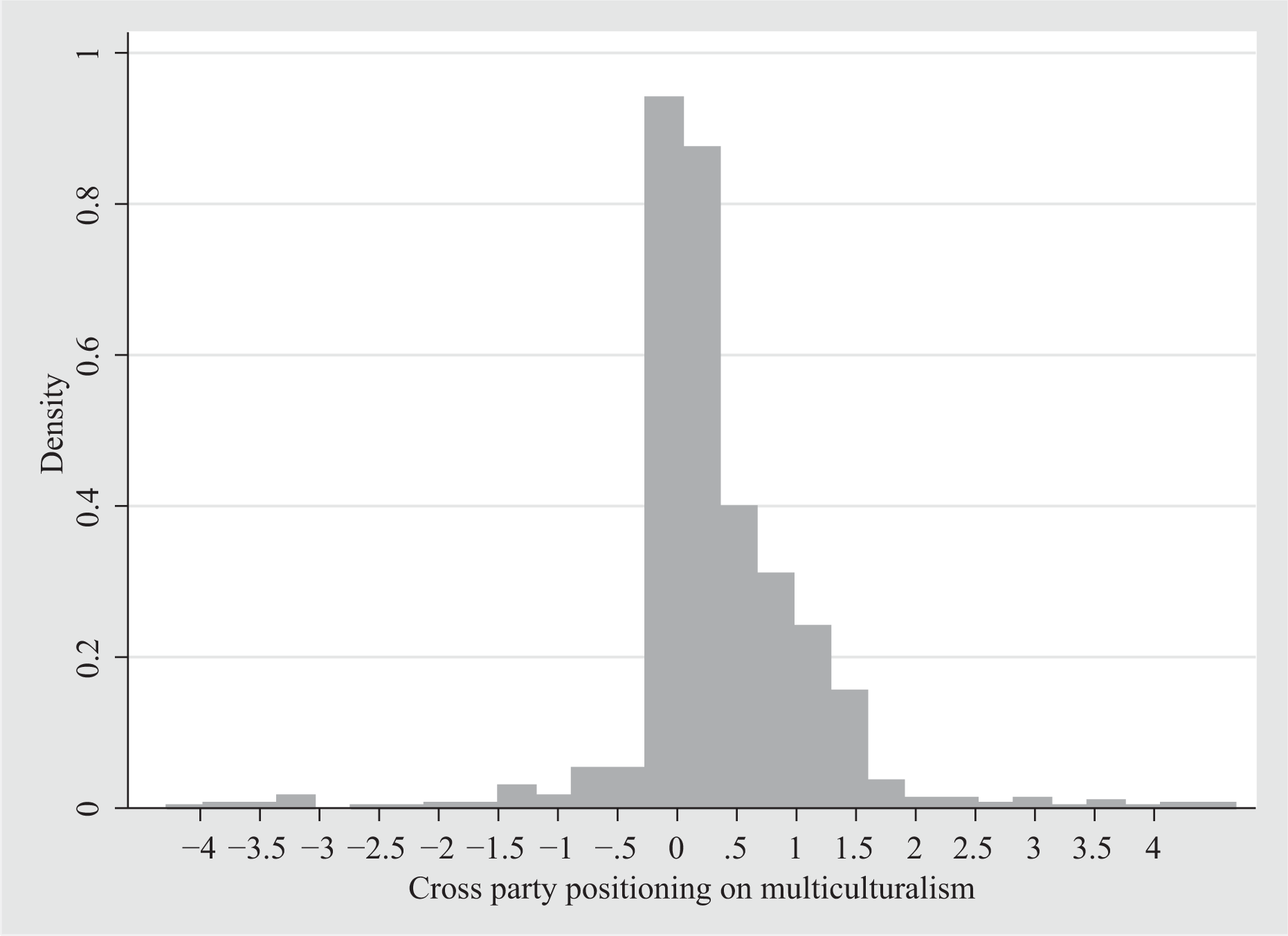
Bars show the percentage of all observations for cross party support for each score for cross-party support.
Ethnic minority political strength and far-right parties
Ethnic minority electoral strength is a product of two factors. The first is the size of the minority population measured using United Nations Department of Economic and Social Affairs data (United Nations, 2008). This is not a perfect measure of a country’s ethnic minority population. It does not take into account the number of second and third generation immigrants who may identify as ethnic minorities but are not foreign born. It also does not account for foreign-born immigrants who do not identify as ethnic minorities, such as ethnic Germans born in Eastern Europe who have immigrated to Germany. The availability of demographic data on the number of individuals who identify as ethnic minorities is inconsistent across different countries, however. Countries measure ethnic minority populations differently, and some do not measure the size of their ethnic minority populations at all. Although the size of the foreign-born population is not a perfect measure, it is the best available for a cross-country comparison.
The ability of ethnic minorities to influence politics depends on their ability to obtain citizenship and to vote. To account for this, access to citizenship is the second component of a country’s ethnic minority electoral strength score. This is measured using a reversed version of Janoski’s Barriers to Naturalization Index. 4 The Barriers to Naturalization Index scores countries from 0 to 1 taking into account 12 different aspects of the naturalization process, including “good conduct, willingness to integrate, language skills, dual nationality, application complexity, application fees, state discretion in granting citizenship, residency requirements, jus sanguinis laws preventing jus soli naturalization of children, women allowed to maintain citizenship after marrying a foreigner, and mothers when married to a foreigner being able to transfer citizenship to their children” (Janoski, 2010, 37). Countries scoring a 1 in the Barriers to Naturalization Index have highly restrictive citizenship rules, whereas countries scoring close to 0 have liberal rules. The formula used to calculate ethnic minority electoral strength is as follows:
The provision of voting rights for noncitizens has been excluded from this article’s measure of ethnic minority electoral strength. This has been excluded because the article is examining national party manifestos and voting rights for noncitizens are almost always limited to local elections. It is possible that voting rights at the local level may increase ethnic minorities’ engagement with national-level political parties. Because the impact local voting rights has on national party responsiveness is unclear, it is not apparent how such rights should be weighted when calculating ethnic minority electoral strength, and they have been excluded from the measure.
In theory, countries could score anywhere from 0 to 100 for ethnic minority electoral strength. A country scores a 0 if it either scores a 1 on the Barriers to Naturalization Index or has a foreign-born population of 0. Conversely, a country scoring 100 has no barriers to naturalization and a population that is 100% foreign born. In practice, scores for ethnic minority electoral strength vary between 0 and 20. Figure 2 shows the average ethnic minority electoral strength across the different countries in the article’s analysis. Immigration countries such as Australia, Canada, and New Zealand (the United States is the exception among these countries) score very highly, some of the colonizing countries and Nordics such as France, Germany, Sweden, and the United Kingdom have moderate scores, and countries such as Austria, Japan, and Switzerland have low scores.

Bars show the average ethnic minority electoral strength for each country.
The article divides electoral systems into two categories, SMD and proportional. 5 This broad categorization maximizes the number of cases in each category.
The strength of a far-right party may not affect its influence over other parties because it is dependent on the strategies that rival parties pursue. If mainstream parties pursue dismissive strategies, or only slightly co-opt the far-right parties’ positions, the far-right party will grow while having little impact on other parties. Conversely, if a mainstream party adopts an accommodating strategy, the far-right party will become weaker while having a large impact on the positions of mainstream parties (Meguid, 2008). Any analysis of far-right parties’ influence over mainstream parties that focuses on far-right parties’ strength suffers from this endogeneity problem.
As a result, the indicator used for far-right parties is their presence. In the vast majority of cases, the CMP coding for nationalist parties is used to determine whether parties are far-right parties. Four additional parties, not coded in the CMP as nationalist parties, are included as far-right parties because they are often considered to be strong anti-immigrant parties. These are the Vlaams Belang (and Vlaams Blok) in Belgium, the Progress Party in Denmark, the Progress Party in Norway, and the New Democracy Party in Sweden. 6 A far-right party is considered present in a party system if it has won either 5% of the popular vote or a seat in the lower house of the legislature in the preceding election.
Controls and methods
The analysis includes two control variables. A lagged dependent variable is used to control for the influence a parties’ past position has on its current one. This isolates the effect of ethnic minorities and far-right parties on the position that parties take in a particular year. The lagged dependent variable is able to control for factors unique to the party that influence its position, but do not vary over time. This lag only works as a control against factors that do not covary with ethnic minority electoral strength or far-right party presence. An independent control variable for time is not included in the analysis because much of the influence time has on party positions will be captured by the lagged dependent variable. 7
The lagged dependent variable suppresses some of the effect of the other independent variables in the model. This is because the variable captures some of the impact that each independent variable has on future values of the dependent variable. If a party’s current position is influenced by its past position, and that past position is influenced by ethnic minority electoral strength, the ethnic minority electoral strength variable only captures the influence of current electoral strength, whereas the lagged dependent variable, in part, captures the influence of past electoral strength. To account for the total impact of an increase in ethnic minority electoral strength or far-right party presence has on party position over time, a Koyck lag model 8 is used and included in the table. This accounts for the effect that any increase in ethnic minority electoral strength and far-right presence in one year would have over a long period of time (Beck, 1991).
Weak economic conditions may reduce support for multiculturalism. During economic downturns, the majority population may start to see immigrants as competitors for scarce jobs and resources (Alesina and Glaeser, 2004; Betz, 1994; Freeman, 2002; Joppke, 1999). If this is the case, poor economic conditions should be connected to decreases in party support for multiculturalism. In particular, unemployment should lead to increased opposition to multiculturalism, as labor market vulnerability is often connected with anti-immigrant sentiment (Makowsky and Stratmann, 2014; Mayda, 2006). This is controlled for by the inclusion of a variable for the unemployment rate in countries taken from OECD data (OECD, 2013).
There is no control for public opinion in this analysis. The literature on immigration policy suggests that public opinion has a limited influence over multiculturalism because parties are nervous about alienating either advocates or opponents of the policy (Freeman, 2002; Green-Pedersen and Krogstrup, 2008; Lahav, 2004). When public opinion does influence debate, it is often because opinion has been mobilized by far-right parties, which are a key variable in the paper’s analysis (Koopmans et al., 2012; Perlmutter, 1996). Finally, public opinion data that are comparable across all of the countries and time included in the article is limited. Eurobarometer and World Values Survey data on immigration and multiculturalism is very limited prior to the 1990s. Any public opinion data control would severely limit the number of observations that could be included in the analysis.
The data used in this article comes from an original time-series cross-sectional data set. Included in it are 19 countries; most of Western Europe and Scandinavia, Canada, the United States, Australia, New Zealand, and Japan. The data set runs from 1970 to 2011. Each test in this article uses time-series cross-sectional least squares regression models with fixed effects and clustered standard errors, both by country. The fixed effects that control for country account for the degree to which the politics of multiculturalism unique to a particular country affect party positions. This is important to isolating the effects of the independent variables from the broader politics of particular countries.
Results
Ethnic minorities, electoral systems, and party positions
Ethnic minority electoral strength increases support for multiculturalism but this effect is only substantial in SMD systems. Table 1 shows that ethnic minority electoral strength in proportional systems has a negligible impact on party positions. In such systems, support for multiculturalism increases by 0.005 points for every one point increase in ethnic minority electoral strength. In proportional systems, increases in minority electoral strength do little to change party positions.
Determinants of cross-party positions on multiculturalism.

Note: SMD = single-member district; PR= proportional representation.
*p < 0.1; **p < 0.05; ***p < 0.01. The results presented in this table come from time-series cross-sectional regression models that use fixed effects and clustering, both by country.
aTotal effects are calculated using a Kocyk lag model.
bThis result comes from a separate regression that uses SMD electoral systems as a base category for comparison (instead of proportional systems) and interacts proportional systems with ethnic minority electoral strength instead of SMD systems.
The effect of ethnic minority electoral strength in SMD systems is much greater. Figure 3 presents the divergence in ethnic minority electoral impact on party positions between systems. The steeper line for SMD systems shows that as ethnic minority electoral strength increases, party support for multiculturalism rises faster than in proportional systems. Table 1 shows that a one point increase in ethnic minority electoral strength in an SMD system immediately increases support for multiculturalism by 0.017 points. Over time, this increase grows to 0.122 points. To put this into context, the tests suggest that all else being equal, support for multiculturalism in the United Kingdom would increase instantaneously by 0.158 points if it had an ethnic minority population with the electoral strength of Canada’s. 9 Over a long enough period of time, that increase would grow to 1.135 points.
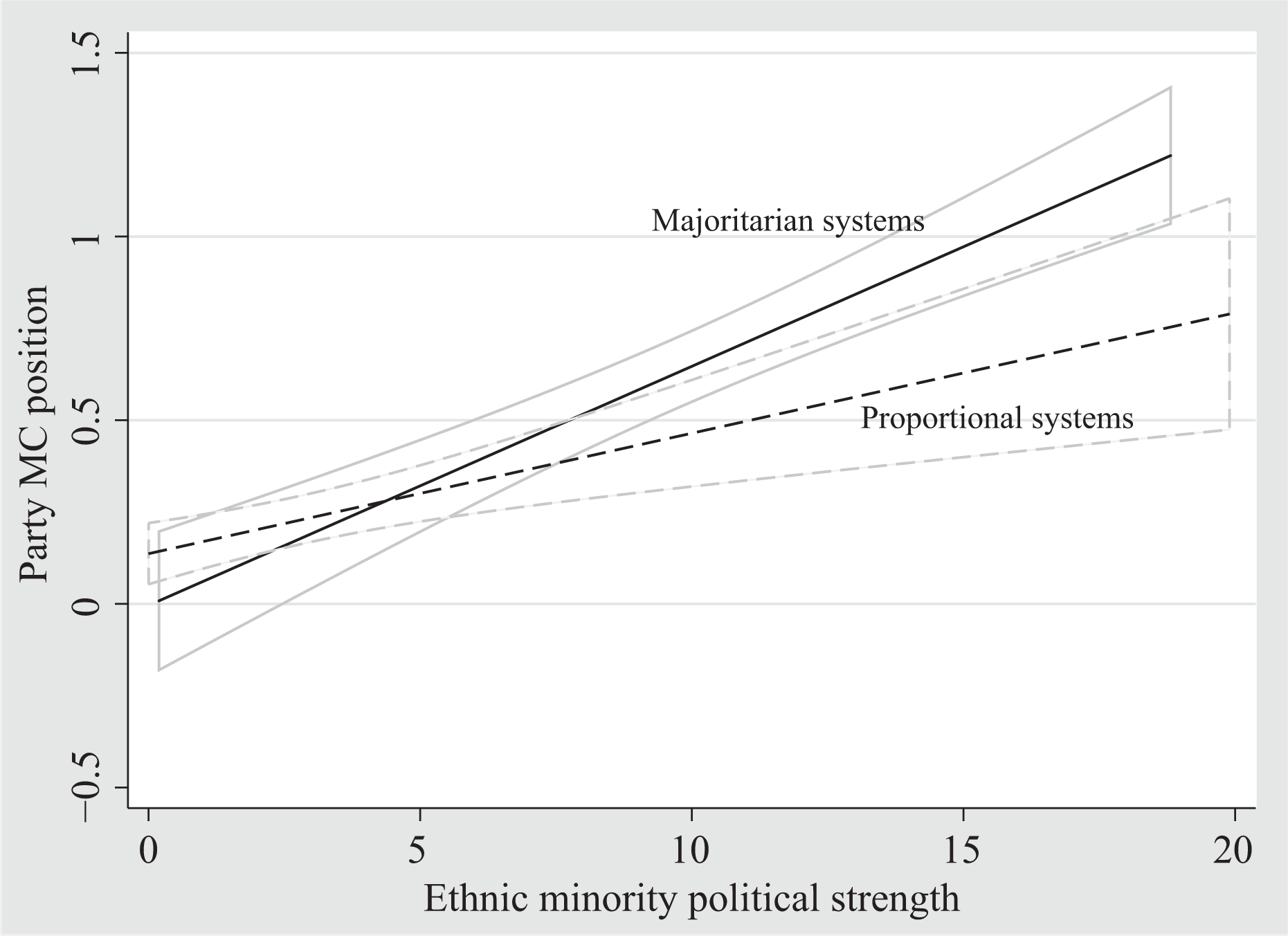
Margins plots are not possible for models including lagged independent variables. This figure presents the predicted values for model 4 in different electoral systems.
Increases in ethnic minority electoral strength are particularly important to mainstream right positions in SMD systems. Table 2 shows that each single point increase in ethnic minority electoral strength leads to an instantaneous 0.024 point increase in mainstream right support for multiculturalism, which grows over time to 0.171 points. This equates to an instantaneous 0.223 increase in support for multiculturalism among mainstream right parties when one moves from a country with the United Kingdom’s ethnic minority electoral strength to a country with Canada’s. This effect increases to 1.581 points over time. The influence of increases in ethnic minority electoral strength over mainstream right parties in SMD systems is highlighted by the steep trend line in Figure 4.
Determinants of mainstream right party positions on multiculturalism.
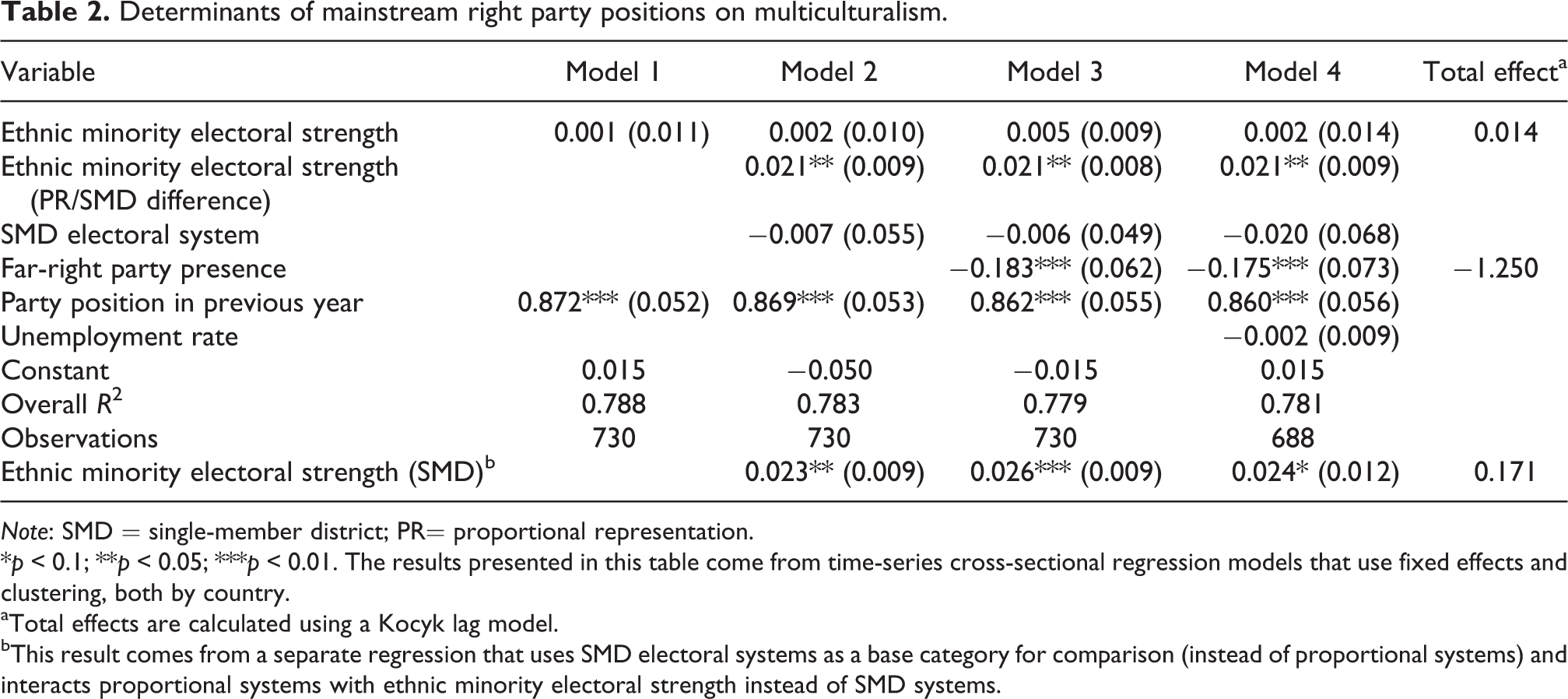
Note: SMD = single-member district; PR= proportional representation.
*p < 0.1; **p < 0.05; ***p < 0.01. The results presented in this table come from time-series cross-sectional regression models that use fixed effects and clustering, both by country.
aTotal effects are calculated using a Kocyk lag model.
bThis result comes from a separate regression that uses SMD electoral systems as a base category for comparison (instead of proportional systems) and interacts proportional systems with ethnic minority electoral strength instead of SMD systems.
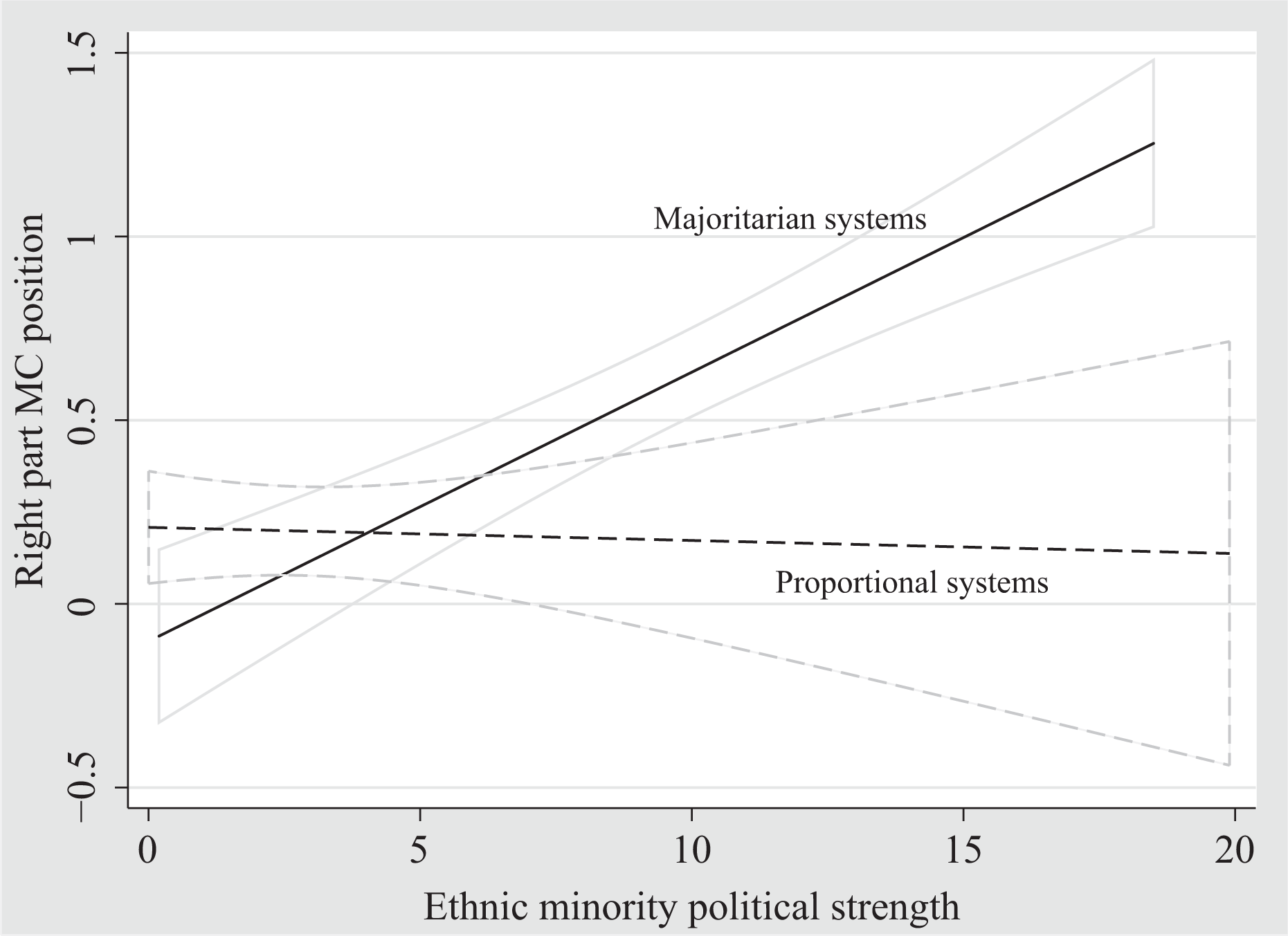
Margins plots are not possible for models including lagged independent variables. This figure presents the predicted values for model 4 in different electoral systems.
Tests on ethnic minority electoral strength provide limited support for the article’s first hypothesis and strong support for its second. Ethnic minority electoral strength has a negligible effect on support for multiculturalism in proportional systems but strong effects on party positions in SMD systems. This difference is particularly large for mainstream right parties. In SMD systems, parties respond to increases in ethnic minority electoral strength by increasing their support for multiculturalism. This provides strong support for hypothesis 2.
Far-right parties and mainstream party positions
Table 2 shows that mainstream right parties pursue accommodating strategies. The presence of a far-right party in one year reduces mainstream right support for multiculturalism by 0.175 points. Over time, the drop in support grows to 1.250 points. This fits with evidence from Figure 3 that shows a drop in right party support for multiculturalism starting in the early 1990s, slightly before the emergence of many far-right parties. Figure 5 shows a substantial difference in the positions of mainstream right parties between when far-right parties are present and far-right parties are absent. This difference is large, mainstream right parties have an average multiculturalism position of 0.4 when far-right parties are absent and a position slightly below zero when far-right parties are present. Figure 5 confirms the negative relationship that comes through in the regression analysis in Table 2. There is strong evidence that mainstream right parties are pursuing accommodating strategies.
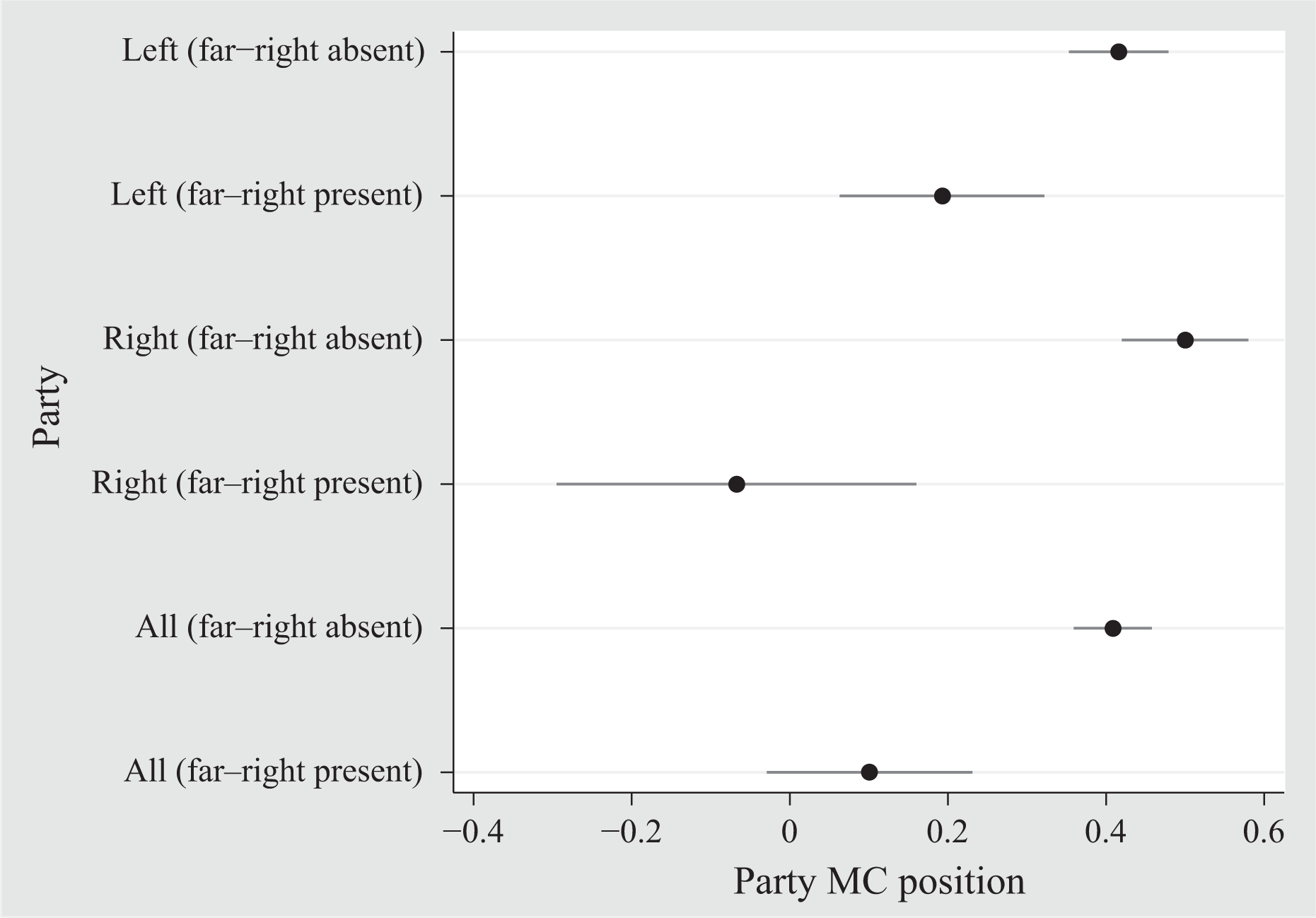
Dots show the average party position. Lines show the range for the 95% confidence level.
Table 3 shows evidence of an accommodating strategy on the part of left parties, though they do not move as much as mainstream right parties do. Support for multiculturalism in one year drops by 0.091 points when far-right parties are present and drops by as much as 0.565 points given enough time. Like mainstream right parties, Figure 6 shows a drop in left support for multiculturalism that exceeds the 95% confidence level. Left parties go from average support for multiculturalism that scores a 0.4 when far-right parties are absent to a score of 0.2 when far-right parties are present. When far-right parties are absent, left parties are slightly less supportive of multiculturalism than mainstream right parties are, but when far-right parties emerge, the left becomes slightly more supportive of multiculturalism than the mainstream right. This suggests that left parties are much more conflicted when pursuing accommodating strategies. Although right parties make an unambiguous move to oppose multiculturalism when facing a far-right party, left parties make only a slight adjustment to their position.
Determinants of left party positions on multiculturalism.

Note: SMD = single-member district; PR= proportional representation.
*p < 0.1; **p < 0.05; ***p < 0.01. The results presented in this table come from time-series cross-sectional regression models that use fixed effects and clustering, both by country.
aTotal effects are calculated using a Kocyk lag model.
bThis result comes from a separate regression that uses SMD electoral systems as a base category for comparison (instead of proportional systems) and interacts proportional systems with ethnic minority electoral strength instead of SMD systems.
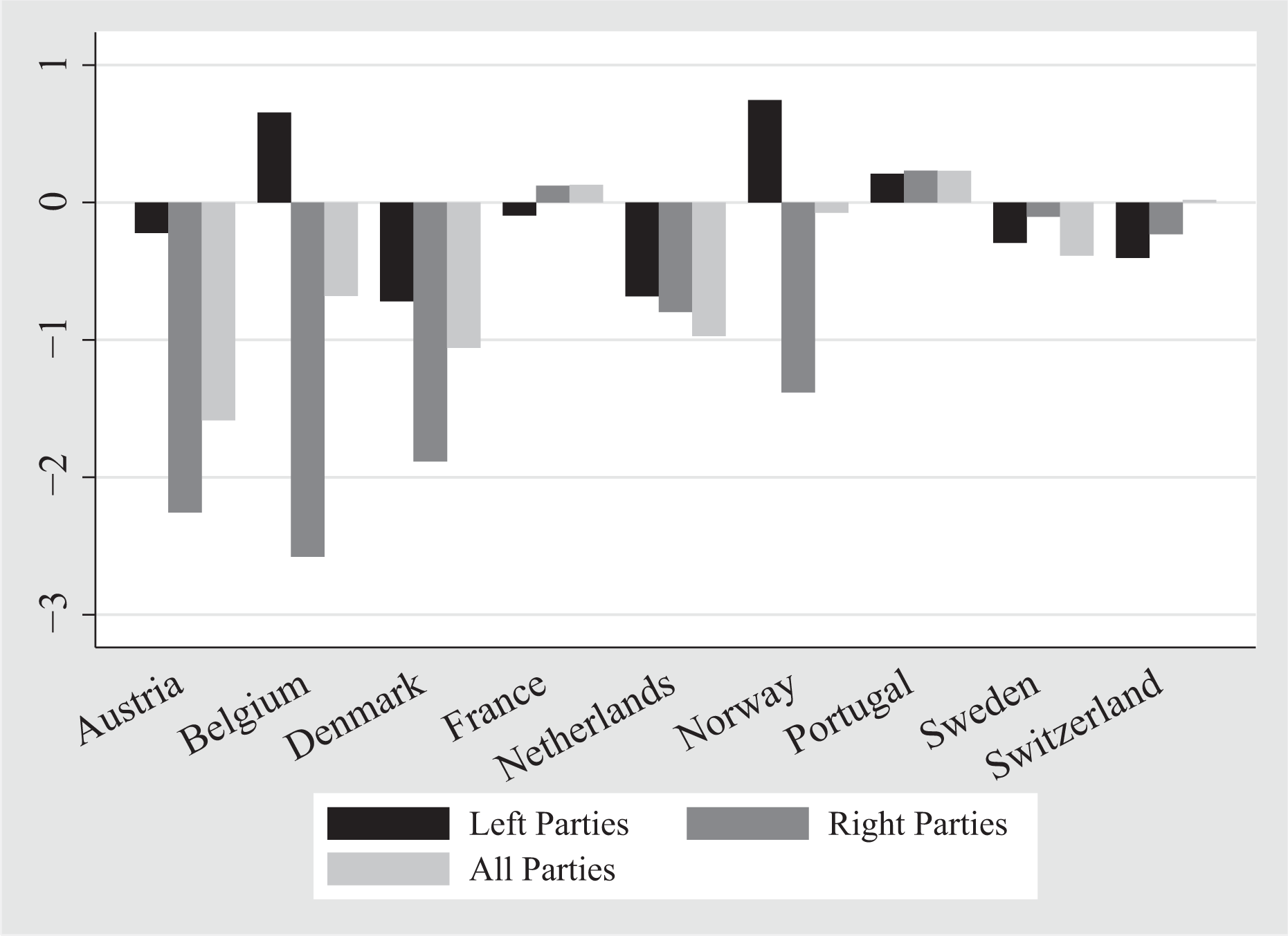
Bars show the difference in party positions between when a far-right party is present and when one is absent.
Figure 6 compares the change in mainstream parties’ responses to far-right parties in eight countries that have observations with far-right parties both absent and present. These differences support the distinctions between right and left party responses to the far-right discussed earlier. In only three countries, France, Sweden, and Switzerland, does the drop in support for multiculturalism for left parties exceed the drop in support among right parties. In only two countries, France and Portugal, 10 do right parties increase their support of multiculturalism when far-right parties are present. In every other country, the presence of a far-right party causes the mainstream right to reduce its support. In comparison to right parties, only six countries see left parties reduce their support of multiculturalism in response to the emergence of the far-right, and only in France, Sweden, and Switzerland does that drop exceed the drop in support among right parties. In three countries (Belgium, Norway, and Portugal), the emergence of far-right parties leads left parties to increase their support of multiculturalism. This suggests that left parties in these cases are responding to the emergence of far-right parties with adversarial strategies. In most cases, left parties pursue accommodating strategies, but weaker accommodating strategies than mainstream right parties, and left parties are more likely to pursue adversarial strategies than right parties. The variance in left party responses to the far-right can help to explain the competing expectations and findings in the existing literature. In one case, the Netherlands, cross-party support for multiculturalism falls to a greater extent than either left or right support. This is a result of the centrist Volkspartij voor Vrijheid en Democratie’s (VVD’S) [People’s Party for Freedom] co-option of far-right anti-multicultural positions.
The tests presented in this section of the article show strong support for hypotheses 3 and 4. Hypothesis 3 is supported by the significant drops in far-right support for multiculturalism in the regression analysis, the average positioning across all countries presented in Figure 5, and the country-by-country analysis presented in Figure 6. The movement of left parties is less clear, though the data does suggest that left parties are more likely to pursue weak accommodating strategies than they are to pursue adversarial strategies. This supports hypothesis 4.
Conclusion
Ethnic minorities and far-right parties place competing pressures on mainstream parties. Increases in ethnic minority electoral strength have a positive impact on cross-party and mainstream right support for multiculturalism in SMD systems but have limited impact in proportional ones. This shows that the influence of ethnic minorities over the positions of parties is often contingent on a countries’ electoral system. Electoral systems ought to be carefully considered in analyses of multicultural policy development. That electoral systems are particularly influential over mainstream right parties is also important. Winning over mainstream right parties can be crucial for advocates of multiculturalism. Right parties that are supportive of multiculturalism have had important and positive impacts on policy adoption in countries such as Australia and Canada.
Far-right parties have a more complicated impact on parties. They pull mainstream right parties toward opposition to multiculturalism. Far-right parties also tend to reduce mainstream left party support for multiculturalism, but this affect is less consistent across the countries examined in this article. This suggests, in line with some of competing findings in the existing literature, that left parties face complicated decisions when deciding whether or not to co-opt the positions of far-right parties. There is some truth to the arguments made by Meguid (2008) and van Heerden et al. (2014) that suggest that left parties adopt adversarial strategies, but there is also truth to the claims made by Bale et al. (2010) that mainstream left parties also co-opt some of the anti-multicultural and anti-immigrant positions of far-right parties. The result is that left parties respond to the emergence of far-right parties with somewhat weaker and less consistent accommodating strategies than far-right parties do.
The positions that parties take reflect a balance between the competing pressures of ethnic minorities and far-right parties. That balance is mediated by countries’ electoral systems. In SMD systems that have substantial ethnic minority populations, the positive effect that ethnic minorities have on multiculturalism can cancel out the negative influence that far-right parties have. In proportional systems, ethnic minorities have far less power to do so. This is particularly the case for mainstream right parties who are not only more responsive to far-right parties, but also to changes in ethnic minority electoral strength in SMD electoral systems. All of this suggests that the electoral strength of a country’s ethnic minority population, its electoral system, and the presence of far-right parties are crucial factors to consider when examining the politics of multiculturalism.
Supplemental Material
Supplemental Material, PPQ678881_Appendix_1 - Multiculturalism, political parties, and the conflicting pressures of ethnic minorities and far-right parties
Supplemental Material, PPQ678881_Appendix_1 for Multiculturalism, political parties, and the conflicting pressures of ethnic minorities and far-right parties by Daniel Westlake in Party Politics
Footnotes
Acknowledgements
This article benefited greatly from comments and assistance provided by Richard Johnston (UBC), Antje Ellermann (UBC), Andrew Owen (UBC), and Edward Koning (Guelph) as well as from the Doctoral Fellows Meeting Group at the Institute for European Studies at the University of British Columbia.
Declaration of Conflicting Interests
The author(s) declared no potential conflicts of interest with respect to the research, authorship, and/or publication of this article.
Funding
The author(s) received no financial support for the research, authorship, and/or publication of this article.
Supplemental Material
Supplementary material for this article is available online.
Notes
References
Supplementary Material
Please find the following supplemental material available below.
For Open Access articles published under a Creative Commons License, all supplemental material carries the same license as the article it is associated with.
For non-Open Access articles published, all supplemental material carries a non-exclusive license, and permission requests for re-use of supplemental material or any part of supplemental material shall be sent directly to the copyright owner as specified in the copyright notice associated with the article.
